Showing posts with label art and architecture. Show all posts

Wednesday, October 19, 2011

Apple #553: Kaleidoscopes

I noticed that a lot of my entries lately have been about things that are white. Cotton balls. White caterpillars. Pantyhose. Well, that's not white, but it's blah-colored. I thought it was time for an entry with some color! Let's brighten things up around here! So I give you kaleidoscopes.


Pretty cool, huh?
(Photo and kaleidoscope by Peggy & Steve Kittelson who pretty much seem to be masters of the art)


  • Kaleidoscopes were invented in 1816 by a Scottish inventor named David Brewster. He was 35 years old.

David Brewster, several years after he invented the kaleidoscope.
(Photo from the David Brewster Society)


  • He was studying light and mirrors and optics. He was a pretty smart dude, by the way. He also invented the forerunner of the lighthouse, among other things. His method of calculating the angle at which light must strike a given surface to achieve maximum polarization of light, a calculation known as Brewster's Angle, is still used today in building microscopes and lasers and fiber optics, in adjusting radio signals, in meteorology, and all sorts of other applications.
  • So while he was doing all that investigating of light and mirrors and polarization, he noticed that the light bouncing off of two mirrors created patterns and colors that were visible on other surfaces. Long story short, he put the two mirrors inside a tube with an opening to look into it at one end and bingo, he had a kaleidoscope.
  • The word, by the way, is a compound word made of several Greek words. It breaks down like this: kalos (beautiful) + eodos (shape) + scopeo (to look at).
  • Dr. Peter Roget -- yes, the Roget of thesaurus fame -- said of the kaleidoscope, "In the memory of man, no invention, and no work, whether addressed to the imagination or to the understanding, ever produced such an effect."
  • Kaleidoscopes were an instant hit. People all over Britain and the United States were buying one or more for their homes. They were quite the Victorian fad.


With visions like this, it's easy to see why the gadgets became so popular.

(Grapevine kaleidoscope available from Victorian Connection)

  • One of the things that will determine what shape you see at the end of the tube is how many mirrors are inside the tube. Regardless of how many they are, the mirrors run the full length of the inside of the tube.
  • Most kaleidoscopes have two mirrors. They produce the image you see the most often. Some people call these shapes mandalas.

The image looks like a circle but when you look closely, you'll see it's actually a decahedron (10-sided object). The center is a five-pointed star.
(Photo from possumjim and elizabeth)


A tube with three mirrors creates a triangular-shaped image, like this one.
(Photo from Kaleidoscopes of America)


Very few kaleidoscopes use four mirrors, but this one does. Four mirrors produce a series of rectangular images that are on opposite sides of a center line.
(Photo and kaleidoscope from Peggy & Steve Kittelson)


  • The angle of the mirrors also affects the image you'll see. The smaller the angle, the greater the number of reflections. In a two-mirror kaleidoscope, if the mirrors are placed at a 10 degree angle, the number of reflections is 360 degrees in a circle / 10 degrees minus 1, or 35 reflections. If the mirrors are placed at a 40 degree angle, there will be 360 / 40 -1 or 8 reflections.
  • As you can imagine, making sure those mirrors have straight, aligned edges can make a lot of difference. Kaleidoscope makers do their best to make sure everything is lined up just right, but sometimes the mirrors wind up out of alignment.

In this one, something about the position of the mirrors wasn't aligned quite right.
(Photo from
possumjim and elizabeth)


  • Some kaleidoscopes have an eyepiece at the front. That front lens is a diopter lens and it isn't involved in any of the reflecting activity in the body of the kaleidoscope. Its purpose is to magnify the image that you see at the end of the tube, making everything appear sharper and clearer to your eye. The longer the kaleidoscope, the more likely it'll have that front diopter, and the stronger it will have to be.
  • Many kaleidoscopes also contain liquid. This is to make sure the pieces slide around slowly and easily, rather than chunking and slipping and rattling abruptly into place. Often the liquid is mineral oil (a.k.a. baby oil) or glycerin. More recently, kaleidoscope makers use silicone, which is less prone to leaking.

This kaleidoscope has two mirrors, but it's oil-filled, which is what gives everything that rich, liquid feel.
(Photo and kaleidoscope by Peggy & Steve Kittelson)

  • A lot of kaleidoscopes being made today include found objects. Not just glass pieces, but other little tidbits like springs or buttons or doll eyes. My great uncle made a kaleidoscope. It had mostly pieces of glass in it but there were also a couple squares of window screen in there.


This kaleidoscope uses all sorts of seashells. I'm pretty sure that Judith Paul and Tom Durden made this one. They make a lot of seashell kaleidoscopes.
(Photo from balluun)


  • Some kaleidoscopes enclose the bits of glass and other goodies not in a chamber at the end of the tube but outside of it on a wheel which the user turns. Sometimes the shapes are fixed in place in the wheel, and sometimes the shapes are free-moving inside the glass wheel.

This is a three-mirror double-wheel kaleidoscope. This photo shows how the wheel is connected to the body. You can see that there are two layers of glass in the wheel, which will make for additional reflections and colors.
(Photo and kaleidoscope by Koji Yamami)


This is what you see when you look through one of his 3-mirror wheel kaleidoscopes. This one, I think, must be only a single-wheel.
(Photo and kaleidoscope by Koji Yamami)


  • Another variation is to use a tube instead of a wheel at the end of the kaleidoscope. The tube can be rotated or slid back and forth to change the scenery.

This is an oil-filled stained glass tube kaleidoscope.
(Photo and kaleidoscope by Koji Yamami)


The glass inside the tube are drawn and twisted to make very delicate shapes.
(Photo and kaleidoscope by Koji Yamami)


  • Once you realize that the basic components themselves can have so many variations, all sorts of possibilities start to open up. All you need is a tube -- which doesn't even have to be circular -- some mirrors to put inside it, and some shapes that will let at least some light through. From there, the sky is the limit.

This kaleidoscope is made from a wine cask.
(Photo and kaleidoscope by Mitsuru and Yuriko Yoda)


This is what you see when you look in the wine cask kaleidoscope.
(Photo and kaleidoscope by Mitsuru and Yuriko Yoda)


  • Kaleidoscopes that include images of the thing you point them at are called teleidoscopes. Instead of the end of the scope being a piece of glass with black backing on it, it's another lens. So the mirrors inside the tube are reflecting the image of what's outside the tube.

This is the view through a teleidoscope looking up at the treetops.
(Photo by jcarwash31 on Flickr, sourced from Rikki's Teleidoscope)


The variations and the permutations are endless. That's one of the reasons kaleidoscopes continue to fascinate us.

Additional resources:
Tips on how to take photos of kaleidoscope interiors
Instructions for how to make a simple three-mirror wheel kaleidoscope


Sources
Brewster Kaleidoscope Society, Sir David Brewster
Kaleidoscopes of America
Japanese Kaleidoscopes

Monday, March 23, 2009

Apple #376: Sharpies

Some time back, Stefan Bucher who draws the Daily Monsters, put a link to the Daily Apple on his page. Since then, lots of people have come from his site over here to browse around. I've been meaning for some time now to do an entry on the Sharpie marker as a way of saying hello and thanks for stopping by.

In case you're not familiar with the Daily Monsters, Stefan does this really cool thing where he blows an ink blot onto a page, and then uses Sharpie markers to make a monster out of the ink blot. He films himself doing this and posts it in sped-up time onto his blog. So you get to watch the monster come to life in Sharpie-fast-action. As a friend pointed out, watching him do the fills with the Sharpie is very satisfying.


One of Stefan's monsters in the making
(Photo still from Designers Who Blog)


I'm assuming that people who stop by here by way of his blog would be interested in Sharpies, markers, drawing, and what-not. So, Daily Monster visitors, here you go.


The black Sharpie. Stefan's and many artists' weapon of choice.
(Image from Jerry's Artarama discount art supplies)


  • The Sharpie was invented by the Sanford Ink company in 1964. It was the first pen-style permanent marker. Johnny Carson and Jack Parr endorsed Sharpies on their shows.
  • Currently, more than 400 million Sharpies are made each year. That's enough for 4 Sharpies per household in the US. Do you have 4 Sharpies? I think I have 5. So if you've only got 3, maybe I have yours.
  • "Permanent" marker means the ink contains either dyes or pigments, it will write on most surfaces, and it is water-resistant. It might smudge if you get water on it, but it won't go away entirely.
  • The black ink in Sharpies is permanent ink, which is made with ethylene glycol monobutyl ether (EGBE) in an alcohol solvent.
  1. Ethylene glycol - A member of the alcohol family. Used in antifreeze and deicers as well as in ink. Don't worry, it's not carcinogenic. If you inhale a lot of it, though, you could be in for some serious respiratory damage.
  2. Combine ethylene glycol with monobutyl ether and you get a very effective cleaning solvent. Which is sort of funny because the Sharpie ink, which contains EGBE, is very hard to remove.
  • The colored inks are made of Permchrome, which is a proprietary formula (meaning they won't say exactly what it is). These inks are also based in alcohol but they don't contain glycol ethers.
  • To get Sharpie out of fabrics, some people recommend spraying the area with hairspray or rubbing alcohol and then blotting with paper towel. If that doesn't work, there are some specialty ink removers.

These 24 Sharpies in a zip case cost $29.99.


SOME THINGS TO DO WITH SHARPIES

On your walls
  • One man in Kentucky drew a mural on all the walls of his basement using $10 worth of black-ink Sharpies. Sounds like it might be kind of ho-hum, but because he likes mystery novels, the drawings include lots of bookshelves as well as his renderings of people like Hercule Poirot and Sherlock Holmes, lounging in his basement. Check out the 360 video of his basement.
  • If you want to color your own wallpaper, but you're not that good at drawing, you could buy this wallpaper designed by Jon Burgerman in the UK, which he made to be colored in.

Jon Burgerman's colour-in wallpaper
(Photo from Jon's blog)


  • Justine Ashbee makes her own enormous art using Sharpies (paint pens, she says, but other people call them Sharpies). I'd post an image here so you could see but she doesn't want people to do that. So check out her photos of her art. It's pretty cool.

On your vehicles
  • You can re-paint your car. Jason Thorgalsen "tattooed" his Lamborghini using Sharpies. Apparently it took him 2 weeks.

(Photo by VOD Cars)


On your clothes

On your skin
  • Some people don't even bother with the T-shirts. They go straight to drawing on the skin, sort of like tattooing by Sharpie.

(Sharpie tattoo by Vince Diga, photo from Eating Sandwiches)


(Drawing and photo by Insanity)

  • Or, of course, you can Sharpie-tattoo your friends when they are asleep. Which is what seems to have happened to this poor sap.
  • If you're about to have surgery done, you'll probably be written on with a Sharpie. Before they cut people open, they mark the spot where the surgery is to take place, just to make sure they don't cut the wrong person in the wrong place or take off the wrong limb or whatever. And Sharpies are the pen of choice to make that X.

In your hair
  • One artist has used Sharpies to tint her hair. She uses Sharpies to draw, and she got the idea to give herself auburn low-lights with a red Sharpie. "It works and it stays in," she said. Jamie at a beauty blog recommends using Sharpies to touch up the gray in between appointments at the hair salon.
  • eHow says if you have a synthetic hair piece, like say for a weave, a cheap and fun way to dye it is to color it with Sharpies.

On paper or anyplace else

  • You could use them to make poems. Sure, you could write with them the old-fashioned way. But Austin Kleon uses them to black out some words from newspaper articles, and the words he leaves alone form poems.

I think this is called Gimmick. By Austin Kleon.

  • Four Seasons Fly Fishing uses Sharpies as part of the process of tying flies.
  • You could make a kaleidoscope using mirrors, PVC pipe, and Petri dishes. The Petri dishes are the part you draw on. Dr. Greivenkamp has complete instructions.


(Image from Pen2Paper, office supplies in the UK)


If you want more ideas for things to do with your Sharpies, stop by the official Sharpie blog.


P.S. The first race of the Formula One season is this weekend! I know you're all as excited as I am.


Sources
Sharpie History and FAQs
Agency for Toxic Substances & Disease Registry, ethylene glycol
Dow, Product Safety Sheet for Ethylene Glycol Butyl Ether
Cleanit Supply, Understanding "Butyl" (Ethylene Glycol Monobutyl Ether)
Thrifty Fun, Sharpie on Carpet
Don Retson, "Sharpies excise big expenses in operating-room budgets," Edmonton Journal, October 11, 2008

Tuesday, April 29, 2008

Apple #313: Monsters and Braunschweiger

The topic of Braunschweiger has come up way too many times in the last few days for me to ignore. It came up in an e-mail conversation with a good friend not long ago. Then I overheard some people at work talking about it. Finally, this weekend, a friend and I went to a restaurant that was, shall we say, non-vegan friendly, and a Braunschweiger sandwich was on the menu. So it is clearly time for me to tell you all about Braunschweiger.


BUT FIRST, A NOTE FROM OUR MONSTER

Before I do, I first want to tell you about a little something I keep forgetting to mention. Some time back, I gave you all the link to one of my favorite blog sites, Stefan Bucher's Daily Monster page. There's also a permanent link to it over there in the right sidebar. He's now doing a slightly different version, but for a while there, he was drawing monsters and posting sped-up videos of the monsters being drawn, or coming to life as it were. Visitors to his website, without any prompting, started posting their own little stories about the monsters, giving them names, histories, methods of birth, etc. Bucher started making his monsters more colorful, more people posted stories, everybody started having more and more fun.

And after 100 monsters, Stefan made a book out of the whole thing. A tangible, you-can-hold-it-and-turn-the-pages book. The book was released some time in February. I'm bringing this up now because I, your intrepid Apple Lady, was one of the people who submitted stories to the Daily Monster page, and some of my stories were selected for inclusion in Stefan's book. In return for those stories, Mr. Bucher kindly sent me a copy, which arrived at my door just the other day.


The book, as you can see, is called 100 Days Of Monsters, and you can buy it through Amazon for around $12. If you click on the link to the Amazon page, you can see shots of what the pages look like, and if you scroll down the Amazon page, you can get an idea of how Stefan Bucher's drawings and people's subsequent postings worked. Or you can just go to his Daily Monster page and see what he's up to now, which gives you pretty much the same idea.

The good thing about the book is that the stories are sampled down to some of the very best. And you can read the stories side-by-side with their respective monsters. The DVD that comes with the book allows you to see the animation of these particular monsters coming to life, which is really fun because he starts with a blob, and sometimes you think you can see the monster within the blob, but then he takes it in a different and usually delightfully surprising direction.

In the book, Mr. Bucher used everyone's real names, even though most people posted their stories online using screen names. So if you buy a copy and read the stories, perhaps you might be able to figure out the true identity of your Apple Lady (that is, if you don't know me personally already).

But even better than that, the monsters are really creative and slightly goofy, and some people's stories are wonderfully funny. I read several of the stories when the book arrived, and some of them made me laugh so hard and so long, I had to wipe tears from my eyes. And I'm not even talking about my own stories! (har har) I haven't read them all yet because I want to save some of them for the next time I need a really good belly-laugh.

So check out 100 Days Of Monsters (with DVD). I guarantee, you'll be glad you did.


NOW, BACK TO OUR BRAUNSCHWEIGER

Perhaps you may have noticed the occasional package of Braunschweiger in your grocery store's meat department. You can usually find it somewhere near the hot dogs or the bacon or the packaged lunch meats. I know I've noticed it, in the distinctive yellow and orange Oscar Mayer package, and I wondered what the heck it was.


What Braunschweiger looks like in the package and out of it, sliced. Kraft, which owns the Oscar Mayer brand, makes its own Braunschweiger, but they didn't have any pictures of it, nor did they even have any information about it on their website. The Braunschweiger in this photo is available from Bavaria Sausage, Inc.

  • Turns out, it's liver sausage. Or, to be more German about it, liverwurst. Livers of various animals -- which animals seems to depend on who's making the sausage -- are seasoned and cooked and then smoked.
  • Some people say the word "braun" in Braunschweiger means "smoked." But actually the name comes from the German town, Braunschweig, which gets Anglicized to Brunswick.
  • In making your Braunschweiger, you could use pig livers, chicken livers, goose livers, or some combination thereof, whatever you prefer. Most people seem to use pork liver.
  • You have to make sure you have enough fat so it'll stick together, so people generally recommend using pork liver that's about 50% fat, or else adding bacon fat or lard or whatever fat source you prefer. Cook it all up, then chill it. That will make the grinding easier.
  • Once it's well-chilled, grind the mixture in your processor with salt and pepper and various spices -- many people recommend nutmeg -- until you've got a puree.
  • Then pack that puree into some loaf pans, or get out your sausage casings and stuff. Refrigerate your pans or links for a couple of days, and Bob's your uncle, you've got Braunschweiger!

If you want to know more details about what spices to use when you make your Braunschweiger, or how to get your own pork livers right from the pig, check out some of these sources. I'll warn you ahead of time, some of these pages are not for the faint-of-stomach.

One slice has about 5 grams of fat. One slice of Oscar Mayer beef bologna, by comparison, has 8 grams of fat. One slice of Oscar Mayer Genoa salami has 3 grams of fat. So it seems to be not that much different nutritionally from other sausagey types of meat.

If you want to know what you can make with your Braunschweiger, lots of people seem to like it in dips or spreads:

But you can always slice it and put it on a sandwich:


Here's what it looks like in sandwich form, this one called the Curse of '49, with Muenster Cheese, tomato, onion, and mustard. You can buy this sandwich for $6.25 from the Brown Bag in Columbus, Ohio.


And now you know.


Additional Sources
Fit Watch, Free Online Calorie Counter, Braunschweiger
Merriam-Webster dictionary, braunschweiger

Saturday, October 28, 2006

Apple #203: Wonders of the World

Last night, a friend said, "What are the seven wonders of the world, anyway?"

I said there were seven ancient wonders and seven modern wonders, and I started to list what I could remember -- the Hanging Gardens of Babylon, the Colossus of Rhodes -- and he suggested the Golden Gate Bridge as one of the modern wonders.

Surely, he said, Niagara Falls ought to be in there somewhere. But was there a separate list for the natural wonders versus the man-made wonders?

Clearly, it was time for the Apple Lady to step in.

As we suspected, there are actually many lists of wonders of the world. Herodotus was the first known person to come up with such an idea, as a way to celebrate the best of human structures that express a reverence for religion, art, mythology, science, or political dominance.

Ever since Herodotus, people have been coming up with lists of wonders all over the place. I'll start with the Ancient Wonders and give a couple other lists after that.


SEVEN WONDERS OF THE ANCIENT WORLD

Listed chronologically, in order of their construction:

Great Pyramid of Giza
  • in Memphis, Egypt
  • built as a tomb for the Egyptian Pharaoh Khufu around 2560 BC
  • the oldest and only surviving structure of the Ancient Wonders
  • was originally 481 feet high and for 43 centuries, was the tallest structure on Earth
  • each side is 751 feet long
  • consists of about 2 million blocks of stone
  • interior sarcophagus is aligned with the directions of the compass

Hanging Gardens of Babylon
  • legendary palace and gardens along the Euphrates River, about 50 km south of Baghdad
  • built by King Nebuchadnezzar II, supposedly to please his wife who was from greener lands
  • built around 600 BC, and the foundation of the palace was only recently discovered
  • little is now known about the gardens
  • the plants grew above ground, even above eye-level and were irrigated with sloping channels, while grass grew green underfoot
  • all of this was accomplished in the desert-like conditions of Mesopotamia

One rendition of what the Hanging Gardens might have looked like. You can see more renditions at Joseph Berrigan's page.


Statue of Zeus at Olympia
  • enormous statue of the ruler of the Greek gods, seated on his throne
  • carved in honor of the Athenian Olympic games by renowned sculptor Pheidias
  • Pheidias started working on the statue in 440 BC
  • it was built starting with a metal frame over which were laid sheets of metal and ivory and gold
  • the statue is 40 feet high, or about four stories, and the base is 20 feet wide
  • the legs of the throne were decorated with sphinxes, Zeus' garments were inlaid with animals and lilies, and an eagle perched atop his sceptre
  • copies and reconstructions have since been attempted, but none managed to parallel the original work

Temple of Artemis at Ephesus
  • in Ephesus, which is about 50 km south of Izmir, in Turkey
  • built in honor of the Greek goddess of hunting and nature
  • foundation was constructed in the 7th century BC, but the rest of the structure was built around 550 BC
  • it was made of marble, with 127 Ionic columns aligned around the outside
  • the terrace alone was 260 feet by 430 feet
  • it housed many statues, including four bronze statues of Amazon women
  • though the temple had been burned, it was still standing and the locus of a very strong religious group still devoted to Artemis when Paul visited Ephesus in the 1st century AD

Mausoleum at Helicarnassus
  • Helicarnassus is now Bodrum, on the coast of the Aegean Sea in southwest Turkey
  • built in honor of King Maussollos, who was a local governor of Caria, one of Persia's outposts
  • the structure of Maussollos' tomb (hence, mausoleum) and was originally planned by his wife, who was also his sister, Artemisia
  • it was completed around 350 BC, three years after Maussollos had died, and one year after Artemisia had died
  • it was 120 feet by 100 feet at the base, and rose to a total height of 140 feet
  • on the surrounding podium and on top of the roof were all sorts of life-sized statues of people, lions, horses pulling chariots, and free-standing sculptures


One depiction of what the Mausoleum might have looked like
(from a page on the subject from the Netherlands)


Colossus of Rhodes
  • built at the harbor around the Island of Rhodes, in the Mediterranean
  • enormous statue of Helios the sun-god
  • took 12 years to build, and was finished in 282 BC
  • it has long been described as standing astride the harbor, with one foot on either side, but given the width of the harbor, this is highly unlikely to have been the case
  • the base was made of marble, an iron and stone framework rose up from there, and was overlaid in bronze
  • the dimensions were such that "few people can make their arms meet around the thumb"
  • an earthquake in 226 BC weakened the statue at the knee, and it fell over

Lighthouse of Alexandria
  • built by the Ptolemy rulers of Egypt shortly after the death of Alexander the Great
  • located off the coast of Alexandria, on the island of Pharos
  • the word Pharos is the root word of lighthouse
  • the lighthouse stood about 40 stories high and contained and internal shaft where fuel was lifted to keep the nighttime fire burning
  • during the day, an enormous mirror was used to reflect sunlight and direct ships
  • a statue of Poseidon, Greek god of the sea, stood atop the whole thing
  • the last of the non-existent Ancient Wonders to crumble
  • a series of earthquakes proved its undoing in 956, 1303, and 1323 AD

This model of the Lighthouse gives you an idea of the structure's massive scale (from a U of Texas course Intro to Greece)


NATURAL WONDERS OF THE WORLD

There are lots of different lists of natural wonders. Some list only 7, some list far more. Some, though they restrict their list to 7, have different items on their list. I've decided to go with this list, which was compiled primarily by CNN:

  • Grand Canyon in Arizona
  • Great Barrier Reef off the coast of Australia
  • Mount Everest in Nepal
  • Northern lights
  • Paricutin Volcano in Mexico
  • Rio de Janeiro harbor
  • Victoria Falls on the border of Zambia and Zimbabwe


I know it's a postcard, but it's the best image I found that helps me to understand why a harbor is on this list. And yes, all that water is one harbor. That statue, called Cristo Redentor (Christ the Redeemer), is on other lists of man-made wonders.


MODERN WONDERS OF THE WORLD

This list, too, appears in many and various forms. The one repeated most often was compiled by the American Society of Civil Engineers. I detect a bit of a bias towards the United States -- where's the Eiffel Tower, for example -- and towards engineering -- somehow, I doubt that the North Sea Protection Works is especially pleasing to the eye.

  • Channel tunnel between France & England
  • CN Tower in Toronto, Canada
  • Empire State Building in New York
  • Golden Gate Bridge in San Francisco, CA
  • Itaipu Hydroelectric Dam on the border of Brazil & Paraguay
  • North Sea Protection Works (good pictures of this at Wikipedia)
  • Panama Canal

The Itaipu dam provides more hydroelectric power than can be generated by 10 nuclear power plants. 28% of Brazil's electricity and 78% of Paraguay's electricity is generated by this dam alone. To build it, engineers had to move 50 million tons of dirt and rock and then shift the course of the seventh largest river in the world.
(Photo by Rab & Jo)


There are also lists of forgotten wonders, wonders of the medieval mind, forgotten wonders of the medieval mind (but if they're forgotten wonders of the mind, how did we wind up with a list of them?), and so on. Niagara Falls, by the way, are included on the Forgotten Wonders of the Natural World list.

All these lists lead me to think that you or I could make a list of wonders, and if we told enough people about our list, we might get everybody to think we were being Very Official about our Seven Wonders of the World's Bathrooms or whatever topic we chose.

In fact, a preservation foundation are trying to put together a new list of the New Seven Wonders of the World, and they're taking votes! The New Wonders will be announced in Lisbon, Portugal, on July 7, 2007 (07-07-07).

Sources
Alaa Ashmawy's Seven Wonders of the Ancient World
Wonder Club, Complete Listing of World Wonders
123World, Seven Wonders of the World and More
Wikipedia, Seven Wonders of the World

Wednesday, March 8, 2006

Apple #153: Eero Saarinen

I realized the other day that I know hardly anything at all about architects. I can name a lot of famous painters and a few famous photographers, and of course I know of tons of musicians, but I don't know of very many architects at all. Frank Lloyd Wright and Mies Van der rohe are about it.

So I decided to teach myself something about a famous architect who is new to me. And I just picked a name, Eero Saarinen, because it's a crazy-looking name and I thought, maybe I'd learn something exotic besides.

Turns out, he was influenced by Mies van der Rohe, and is known as a modernist architect. His work is characterized by a similar clarity of design, yet his buildings often include dramatically curved, sometimes swooping roofs. He also uses lots of ovals or elliptical shapes, and he's a big fan of windows and allowing in natural light. I find the shapes of his buildings very pleasing and a welcome relief from all the rectangles and squares typical of industrial buildings.

After seeing photos and reading descriptions of his work, I am very impressed by what he's done. I'm also glad I learned about him.

  • Eero Saarinen was born near Helsinki, Finland in 1910.
  • His father was a noted architect, Eliel Saarinen, who was also the first president at the Cranbrook Academy of Art in Bloomfield Hills, Michigan. His mother, Loja, was a sculptor who also made architectural models and was a photographer and a weaver as well.
  • In 1923, Eero emigrated with his family to the United States and became a citizen.
  • He studied sculpture in Paris and architecture in the US at Yale. Following a year of travel in Europe, he returned to the US and taught at his father's school, Cranbrook.
  • In 1937, he collaborated with another architect, Charles Eames, in designing furniture (later, he would name his child by his second marriage Eames, after his friend). They won all sorts of awards in The Museum of Modern Art's 1940 competition called Organic Design in Home Furnishings.
  • He finally settled into working at his father's architectural firm near Cranbrook until 1950.
  • He is best known for his creation of the TWA terminal at John F. Kennedy Airport in New York City.
      • The building has all sorts of sweeping, dramatic curves, wing-shaped overhangs, and oval shapes, all of which help to suggest flight and the sky.


Photos from Galinsky, a free service for people interested in modern buildings

  • He also constructed the Gateway Arch in St. Louis, Missouri, which I think is far more impressive or at least notable, but for some reason, people always seem to mention the TWA Terminal before they mention the Arch. He was awarded the commission to build the Arch after winning a design contest in 1947.
      • The Arch is a 630-foot high single tapered curve made of steel. It stands on the bank of the Mississippi River in St. Louis and is meant to symbolize a doorway into the American West. It is the tallest memorial in the United States.
  • Other buildings he is known for include:
      • Dulles Airport in Chantilly, Virginia (near Washington, DC), which has one great big swooping roof over lots of windows.

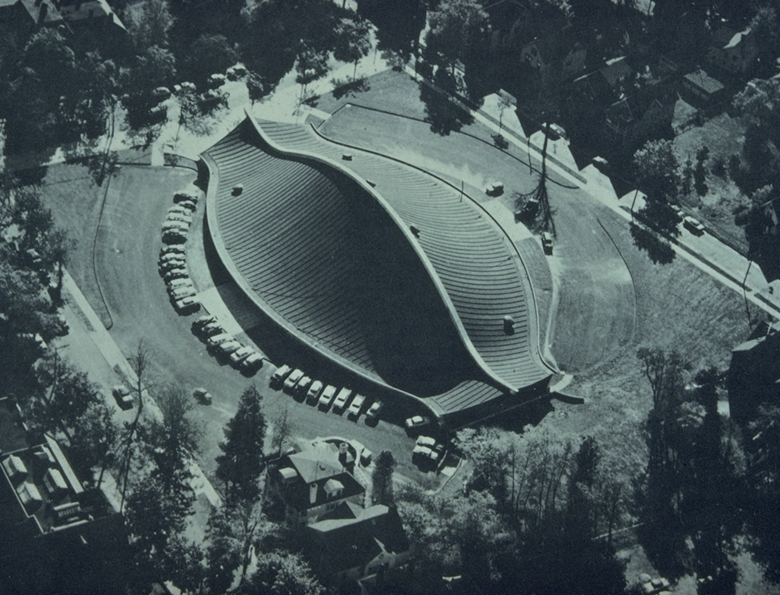
Kresge Auditorium
(Photo by M. A. Sullivan, from Bryn Mawr's collection)

      • Kresge Auditorium at MIT, has a geodesic dome which is like a cap that is pulled down into points at opposite ends. The outer walls of the structure under the cap are all windows.
      • Kresge Chapel, also at MIT, is a non-denominational chapel that does not use any symbols that could be associated with any particular religion. The building is compact, circular, and high-walled, fairly unassuming looking from the outside.

Photo from Galinsky

      • However, on the inside, the brick walls curve in an undulating pattern, and natural light that descends from above the altar illuminates a decorative screen of golden metal rectangles that shimmer impressively.


Photos from Galinsky


Other buildings he created include:
      • John Deere Headquarters in Moline, Illinois, which was the first building to use weathered steel, which is left unpainted and allowed to form its own cinnamon-colored protective coating.
      • North Christian Church in Columbus, Indiana, has a single, needle-like spire that rises up from the center of a wide hexagonal structure.
      • Concordia Theological Seminary in Fort Wayne, Indiana, has a high-pitched, tent-like triangular chapel that lets in extraordinary amounts of light, with a spire behind the chapel and a large curved lake with fountain in front of it.
      • Yale Hockey Rink, which has a very dramatically curved roof, sort of reminiscent of a skate blade except curvier, and a long bank of windows and doors beneath. Seen from above, it looks sort of like the shell of some prehistoric animal.
  • In addition to buildings, he also created many furniture designs (apparently lots of architects have designed furniture), primarily for Knoll International. Many of his furniture designs continue to be sold today:
      • In 1956, he made the Tulip Chair, the white fiberglass and aluminum chair with the pedestal instead of legs (he said that other chairs suffered from a "slum of legs"). I always associated the Tulip Chair with the 70's, but apparently it comes from the 50's.
      • He also made the Womb Chair in 1948, of molded fiberglass and designed so that you could curl up in it.

      • In 1946, he made the Grasshopper Chair, named because it sort of looks like a grasshopper's big bent legs. It is made of bent plywood with an upholstered seat.


  • He is perhaps best known for his TWA Terminal, which was completed in 1962. However, Saarinen died of a brain tumor in Ann Arbor, Michigan a year previously, in 1961. He was 51 years old.
Sources
Scandinavian Design, Eero Saarinen
Great Buildings Online, Eero Saarinen
Galinsky, architects, Eero Saarinen
National Park Service, Arch History & Architectural Information, Eero Saarinen - Architect With a Vision
R 20th Century, Eero Saarinen

Finnish Cultural Institute in New York, Eero Saarinen: Realizing American Utopia

Monday, March 7, 2005

Apple #45: Venus de Milo

VENUS de MILO

I saw the Venus de Milo once, when I was in Paris several years ago. I went to the Louvre, which is massive, got a map, and went looking. Following the map, I turned left at Winged Victory like I was supposed to, but every time I thought I was about to find her, I wound up in the stupid decorative porcelains room. Finally, I ran out of time and had to leave the museum. So I went back the next day and looked some more. When I finally found her, it was like the angelic music played and a light shone on her. I sat on the carpeted bench that surrounded the dias where she stood and just sat there, for a good ten minutes. I'm sitting here with the Venus de Milo, I told myself. That's the Venus de Milo right behind me.

And she really was that beautiful. There's such grace and movement in her pose, and a kind of cockiness too. She's not a woman who just stands there and looks pretty. She's got a force in her, no denying it.


(Photo from UTexas' syllabus on Aphrodite)

  • Venus de Milo is the Romanized version of her name; she is more accurately called Aphrodite of Melos, after the Greek island where she was found.
  • Aphrodite is the Greek goddess of love and beauty. It's pretty bold to say, Yes, I can carve a statue that is the epitome of beauty.
  • People say the way the cloth is draped about her hips represents that kind of bravado, in that it is intricately carved, yet manages to convey a sensuousness at the same time. The drapery also cleverly hides the seam where the statue, carved in two sections, joins together.
  • It is not certain who sculpted the statue, but people are now pretty sure it was probably Alexandros of Antioch, son of Menides, who was also a singer and composer.
  • (Alexandros was also the name of Paris, the guy who essentially started the Trojan War, when he picked Aphrodite in a goddess beauty contest because she promised him the most beautiful woman in the world.)
  • The statue was sculpted around 150 BC, in an era known as the Hellenistic period.
  • She was found by a Greek peasant on an island in the Aegean sea, called Melos (hence, the name), in 1820.
  • At the time, the Turks were in charge of Greece, so they took the statue from the peasant.
  • The French then purchased her from the Turks for 1,000 francs, or roughly the cost of a sizable herd of goats. This purchase was part of France's campaign to acquire excellent pieces of classical art and thus compete with England and Italy.
  • As it turned out, the statue was not of the classical but Hellenistic period, which meant to the French at that time that it was not as good. So they went to lots of trouble to try to obscure some of the facts about its history, and in so doing, created lots of publicity for the statue. This was the beginning of the Venus de Milo's rise to its current level of fame.
  • The statue was presented to King Louis XVIII, who was so fat he was carted around in a wheelchair. French sculptors tried to provide arms for the statue, depicting her holding all kinds of things, from apples to lamps, and pointing in various directions. The king declared that she should be left armless, that her beauty should not be marred by the additions of any other sculptor. This was unheard of at the time, that a broken statue should be left as it had been found.
  • She is now the second-most famous work of art in the world, behind the Mona Lisa.
  • The number of websites selling reproductions of this statue is staggering. It's hard to find even a picture of the real thing.

Sources
Loggia's art history section,
Aphrodite of Melos
Wikipedia's page on the
Venus de Milo
The Louvre's page on the
Venus de Milo, translated from the French
"
Base Deception," Smithsonian Magazine, October 2003
Photo from
the Louvre