Showing posts with label health - remedies and treatments. Show all posts

Monday, June 10, 2013

Apple #639: Geothermal Mud Pots

I'm starting with a preamble.  If you want to, you can skip it and go straight to the geothermal mud pots (a.k.a. the good stuff).


Geothermal mud pot at Yellowstone.
(Photo by Christian Begeman)


Coughing in the Middle of the Night & Being Speedy


For the past several nights, I've been waking up in the middle of the night coughing.  It's been driving me nuts.  I Googled the problem, and it turns out this is pretty common.

(Side note: I didn't want to do a Daily Apple on this because I've learned the hard way that medical problems can have so many possible causes, the entry very quickly becomes less than useful, and then people post questions about their own medical situation, and not being a doctor, I have no business giving advice even if I knew what to say.)

But based on what I read (the best source I found on the subject is Harvard Medical School's page), and based on my personal situation, my coughing is probably due to the most unpleasantly phrased post-nasal drip.  The liquid from the nose slides down to the throat while you're asleep and triggers a cough.

I've so far tried various home remedies: sleeping on a propped up pillow, a tablespoon of honey before bed, gargling with saltwater, using a Neti pot.  In spite of all these things, I still wake up coughing.  So now I'm trying another suggestion, which is a nasal decongestant.  I hate these things because whether they say non-drowsy or may make you drowsy or whatever, they make me so speedy I can't sit still.  I've only tried one or two of these types of things in my life and I can't remember which ones I've tried, so I picked one off the shelf pretty much at random, and now here I am all twitchy and itchy and speedy from the stupid stuff.  What's more, I still keep having to blow my nose.

So it's probably going to be a long night.

And I'm probably going to be extra-wordy in this entry.  You've been warned.

Geothermal Mud Pots


Mud pots in action near Calipatria, CA.
(Photo from flickriver)


I was trying to decide on a topic for this week's Daily Apple.  Naturally, I thought some type of natural disaster might make a good post.  I've covered hurricanes, earthquakes & tsunamis, thunderstorms, and derechos, and while I haven't done an entry on volcanoes in general, I did do one on Mount Etna.  I have not done an entry on tornadoes, but I did sort of mention them in last week's entry on why Oklahoma has no basements despite being practically a magnet for tornadoes. So I thought something other than tornadoes would make a nice change.

So I cast my mind back to junior high science classes and the movies the teachers used to show us about natural disasters and earth science.  Earthquakes, volcanoes, etc.  The volcanoes were my favorite part, but another really good part was about the geothermal mud pots.  Everyone in the class got a huge laugh out of seeing those things spew mud and make all sorts of rude noises.  Then we'd beg the teacher to please please please run the film backwards (you kids with your DVDs and your VCRs will never know such delights), and if he was in a good enough mood, the teacher would do it.  Oh, the hilarity.

OK, so let me show you some videos of these geothermal mud pots, and then I'll find out some facts about them and pass those facts along to you.

This one is from Kamchatka, Russia.  The sounds still make me giggle.  Completely juvenile humor, I know.


Here are some closer to home in Salton Sea, California:


This one shows the mud pots across a whole area:


Now for the facts, ma'am.
  • Mudpots are one kind of geothermal activity. Hot springs and geysers are similar, but they each have slightly different characteristics.
  • Here's how geothermal stuff happens:
    • Beneath the crust is a layer of magma, or hot molten rock.  The movement of the plates that form the earth's crust or volcanoes can force the magma closer to the crust.  
    • If the magma shoots up through the crust, you get volcanoes.  When groundwater comes in contact with the magma and the resulting steam shoots up, then you get geothermal activity.
  • Hot springs happen when the steamy water coming up from below forms a pool. Usually the water contains various minerals that come from the magma.  Hot springs are usually not that hot but only warm, so sometimes people like to bathe in them.
  • If the water doesn't stay in a nice calm pool but shoots up like a fountain, then it's a geyser.  A whole lot of pressure is required to make the steam shoot up like that, so usually there's a huge underground network of twisting and turning tunnels that hold the groundwater and keep the pressure building until finally the thing spouts off.

(Encyclopedia Britannica has a really great diagram that illustrates this whole process for hot springs and geysers. I can't embed the link here for copyright reasons, but it's worth the click to see it.)

  • Mud pots are similar to hot springs in some ways.  Usually the steam coming up isn't jet-propelled like a geyser but only bubbling to the surface.  It's often not super-hot but only warm.  Mud pots may also form pools, as hot springs do.  But there are two major differences.  
  • In mud pots, the steam coming up from below also contains sulfuric acids that erode the surrounding rock.  The rock turns to sand and clay and that mixes with the water, making mud.  
  • The sulfuric acid also means that most mud pots have a definite odor about them, like the smell of rotten eggs.
  • The material surrounding the mud pots often also includes volcanic ash, or rocks that have been formed from volcanic ash (i.e. pumice).  When water interacts with the ash, or when the acidic water hits the pumice, it makes bubbles.  When the bubbles rise to the surface, they burst and fling the mud in all directions.

 I know you want to see more.


  • Mud pots can change  in character as the amount of water varies.  If there's a lot of groundwater, the water can overwhelm the mud and it becomes more like a hot spring.  If there's too little water, the mud pot will dry out and it becomes only dry, cracked earth with steam venting from it.
  • Mud pots can also turn into what people call mud volcanoes, or mud domes, or mud gryphons (< 3 meters tall).  The mud can pile up around the opening of the mud pot, getting taller and taller while the muddy steam still keeps spewing out.
  • The steam coming up from the volcanoes is often hotter than what's in the mud pots

 
Mud volcano, or mud gryphon, at Salton Sea
(Photo from Toadhaven Home School)


Video of a mud volcano in action, followed by some dry mud pots issuing steam. Please also enjoy the videographer's Midwestern accent.


  • A geothermal power plant has been built near these mud pots at Salton Sea, and some people say the mud pots are no longer as active or fun to watch.
  • Some mud pots also have other minerals such as iron oxide, potassium, or magnesium which give the mud color.  Those mud pots are typically called paint pots.  Paint pots have no sulfur.  If they did, the sulfur would turn the mud gray.

In part of this video, the mud is pink. That's a paint pot.


An especially vibrant paint pot at Yellowstone.
(Photo from Globus Journeys)


  • All these mud pots will vary from one season to another, and from one year to the next.  Over time, they may change a lot, even dry up completely.  Some people say the mud pots at Yellowstone don't look anything like they used to.  A geothermal power plant was built near the Salton Sea mud pots to harvest some of the geothermal steam coming up in that area.  As a result, the mud pots there are reportedly nowhere near as active now as they are in the videos shown here.
  • But there are mud pots in lots of places in the world.  There are some in New Zealand, some in Iceland, and some in Costa Rica.  Who knows, some others may pop out in new places, too.

Mud pot in Iceland, and some steam vents. (This video is pretty loud.)


Sources
Home Science Tools, Geysers
Janice Kleinschmidt, Sea of Wonders, Palm Springs Life, March 2006
Geothermal Features, Mud Pots
National Park Service, Yellowstone, Mudpots and How They Work

Monday, October 31, 2011

Apple #556: Bored at Work

For many years now, I've used Sitemeter to keep details of the traffic that comes to me site. to their data, I am well aware that a lot of people are looking at the Daily Apple during the work day. That suits me fine; in fact, it warms the cockles of my heart. This is because my original goal in creating this blog was to give people who are stressed out or overburdened or otherwise taxed by their jobs a place to go to read about everyday, relatively unstressful things. Learn something new for a bit, then go on back to work. So it seemed that I must be fulfilling that goal.


Is this how you feel before you go surfing around and wind up at the Daily Apple?
(Photo from Your Balance)


But recently it occurred to me, maybe people are stopping by here not because they're stressed out, but because they're bored. Looking for something, anything to break up the monotony. So why not make an entry for the bored, as well as for the stressed out? (As it turns out, boredom can be a version of stress. But more on that shortly.)

Of course, since I'm all about finding answers to questions, I thought I'd take up several questions on behalf of those who are bored at work: are other people bored in their jobs too, what's causing your boredom and what can you do about it, and why should your boss care if you're bored?


(Photo from Label Girl Hype)


Boredom Defined
  • Believe it or not, researchers have had trouble defining workplace boredom. One good definition is "a transient affective state in which the individual feels a pervasive lack of interest in the current activity."
  • It's transient because if you do something else, you don't feel bored anymore. But as long as you're doing the current activity, you feel a pervasive lack of interest.

Traditionally when studying boredom, researchers focused on people working blue collar jobs. But now they recognize that office and white collar jobs can be just as unstimulating.
(Photo by Renault, from Treehugger)


Signs You're Bored at Work
  • You're tired all the time. You yawn about every 20 minutes, it seems.
  • You check the clock frequently. It seems to have hardly moved.
  • You try to focus on the task at hand, but you're uninterested and easily and willingly distracted. Tasks may take you twice as long as you know they should because you allow other things to pull you away.
  • The metaphorical needle that registers your intellectual or emotional involvement lifts only a fraction above zero all day long.
  • You find yourself doing pointless, non-job-related things at work, like looking at videos of kittens on skateboards, or playing Angry Birds, or shooting paperclips at the ceiling tile. For hours.

Is this sort of activity how you spend your time at work? Do you fantasize about the whole place crumbling down like this?
(Screen shot from Capsule Computers)


  • You imagine what you would be doing if you were at home or out with a friend or someplace else, anyplace else. The daydreams get longer and more involved as time goes on.
  • You show up later and later and you leave earlier and earlier.
  • You feel yourself "coming down with something" about once a week.
  • You find yourself looking at job ads while you're at work.
  • You check the clock again.

Another way to fill those dead zone hours.
(Photo from the Guardian)


Lots of People are Bored at Work

  • 1/3 of Britons said they were bored at work for most of the day.
  • 55% of US employees said they were "not engaged" by their work.
  • 61% of college graduates who have since taken jobs say they are regularly bored at work.
  • Boredom has been found to be the second most commonly suppressed emotion at work (I wonder what the first is).
  • Professions who report the highest rates of boredom include:
  1. Administrative/Secretarial: boredom gets a 10/10
  2. Manufacturing: 8.1/10
  3. Sales: 7.8/10
  4. Marketing: 7.7/10
  5. IT/telecommunications: 7.5/10
  6. Scientific research: 7.3/10
  7. Media: 7.1/10

People who do very technical but repetitive work, such as research lab assistants, also report high levels of boredom.
(Photo from Reuters)


  • Based on those results, it looks to me like just about every job has the potential to be boring.
  • Except maybe for teaching. Teachers gave their jobs a 4.0/10 on the boredom scale.
  • 28% of graduate TAs, however, said they were bored in their jobs. Apparently, they require something other than, or in addition to, teaching to keep them engaged.


In spite of all the brightly colored decorations and stars which are probably meant to be motivational, these people look thoroughly unenthused in their cubicle land.
(Photo from Focus)


  • Even a job you might think of as challenging could become boring. One of George W. Bush's senior advisers admitted to ducking out to the movies out of boredom. One day while out and about he ran into an official from another department. I'm not sure if the other guy was headed to the movies too, but it was an encounter they both found awkward.

Why You're Bored


"Workplaces today are increasingly automated, with faceless technology being the interface through which many tasks are completed. Many jobs in the past that involved skill use, decision-making and contact with people can now be achieved with the press of a few (boring) buttons." -- Sandi Mann


  • Job is not challenging enough. This is probably the number one cause of boredom regardless of profession. You may have a lot of stuff to do, but if none of those tasks use your intellect to the extent that you possess it, you can get mighty bored pretty quick.
  • Having work that is unchallenging can be just as stressful as having too much work or having too many expectations placed on you. With monotonous work or work that's too easy, you can wind up just as burned out, disengaged, unmotivated, exhausted, and depressed as if you had too much to do.
  • Job does not fully utilize your skills or knowledge. This is a more specialized version of the same thing. If you've been trained at some point in a certain skill -- and that skill could be anything, mouth to mouth resuscitation, gas metal arc welding, speaking and reading Portuguese -- if that skill is important to you, and your job allows it to lie fallow, you can begin to feel bored. Even if the job requires you to use several other skills that you have, the fact that that one particular skill is going unused can be bothersome. It's like having two arms but only using one. Sure, you're using one arm, but that other arm is perfectly good. Soon enough, you'll feel those muscles beginning to atrophy, and dissatisfaction and unease will set in soon enough.
  • Job is full of repetitive and uninteresting routines. Lots of manufacturing jobs fit this description, but white-collar jobs can be mindlessly repetitive too. Filling out the same forms over and over, answering the phone the exact same way every two minutes and telling people the same thing again and again, creating the same spreadsheets with slightly different numbers--all of that can get pretty old pretty fast. Jobs that require watching for infrequent events (life guarding, patrolling, workplace inspection) also fall into this category.

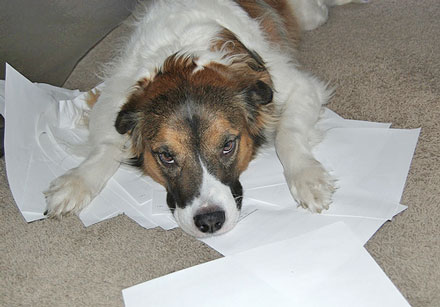
Even the dog hates paperwork.
(Photo by Chris Scott, from the Cheerful Monk)


  • Not enough to do. Not having enough to do can actually be more dissatisfying than having too much to do. This runs a close second on the boredom/stress scale behind not being challenged enough. 800,000 employees surveyed rated jobs that offered "too little work" lower than jobs with "too much work."
  • People notice the lack of work especially after they've had bursts of time where they had a lot to do or even too much to do. They get used to operating at a higher level of productivity, and having to drop back to extremely low levels of engagement can be all the more frustrating afterward.
  • Too many constraints. The job has so many rules, requirements, and restrictions, it's hard to get anything accomplished. Or it's too physically restrictive; you can't leave your station to walk around, or you're not allowed to talk to the people nearby. Your employer feels so much like a third world dictatorship, you're not only bored out of your mind, you're contemplating storming the walls with catapults and battering rams.
  • The confinement may be intellectual rather than physical. A lack of opportunities to learn new things, and no provisions for training or for opportunities to interact with and learn from other professionals in the industry keep you from being challenged afresh. You have probably gotten very efficient at performing your job, but you're operating at that same level and you have done so perhaps for years on end. Stagnation, boredom, a feeling of mental atrophy have taken hold.

A screenshot from The Office was inevitable.
(Photo from Rookie Pastor)


  • Too many meetings. This is a specific form of constraint which keeps people from actually accomplishing anything. 82% of white collar workers report spending nearly 1/3 of their work week in meetings of one kind or another. Keep people in a room talking about how they're going to do something and talking about how they're talking and eventually someone's either going to fall asleep or run out of there screaming.
  • Job lacks meaning. The big-picture nature of one's job or industry may not match up with your values. Say you are passionate about the rights of children, but for your job, you design cereal boxes. Making sure cereal is packaged safely and so that the cereal lasts a long time and tastes good may be beneficial to children who eat cereal. But in a bigger picture way, over time, you may begin to feel the gap between what you really care about and how you're spending your workday. Though you may be very good at designing cereal boxes and though it may pose consistently new challenges to you, the fact that you don't really care all that much about cereal boxes may lead you to disengage from the work and become bored.
  • Job is too difficult. This one is less common, but it does happen, perhaps most often among students (by the way, all of these factors can apply in the classroom as well as on the job). When students took classes that were above their comprehension levels, they had difficulty grasping the material, so very soon they had difficulty paying attention and quickly became bored.

(Demotivational poster from MotiFake)


What to Do About It

"Boredom . . . is an alerting phenomenon that all is not well and something must be done."


This is a bit of a stressful, depressing topic, isn't it? Well, hopefully these possible solutions will bring some hope to the picture.

Short term solutions
  • Intersperse activities. Instead of doing one mindless task that takes hours until you're done, try breaking it up into smaller pieces and inserting another task in between. The inserted tasks may be just as mindless, but simply bringing some variety to the picture can help. Or you may find that the interspersing activity needs to be something more lively, like talking with a colleague, or walking to the vending machine for a coffee.
  • Take breaks. Get up from your desk and walk around. Go to the water cooler and get yourself a big cup of cool water. Go outside, breathe in some fresh air. Walk around the block. My friend Angelica, who is admittedly a bit nutty, does five quick push-ups in her cubicle to wake herself up.
  • Clean up your work area. Putting away the accumulated paperwork, cleaning off your desk, organizing files, sweeping the floor where you stand every day -- these are small things that first of all burn up some of your extra time. But a clean, newly organized work environment also contributes to a sense of being refreshed. Cleaner, more organized surroundings may wake you up a bit. Maybe you'll see things in a new light, and you'll see more possibilities within your work.

(Photo from Oprah.com)

  • Give yourself challenges. If you're supposed to enter the data for 199 reply cards an hour and you've mastered that, challenge yourself to complete 225 reply cards an hour. Perform the list of your daily tasks in alphabetical order. See if you can complete two versions of that insurance form, one in English to be filed and one in French for yourself.
  • A caution about this tip: it's possible you'll get so focused on your own self-imposed challenges that you'll lose sight of the more immediate and important goal of completing the work accurately. You want to be careful not to make your self-imposed challenges too difficult or diversionary. And since your self-imposed challenges are probably pretty meaningless, you may get bored with those soon, too. But they'll spark your brain for a little while at least.
  • Design your own rewards. Decide that if you finish filing that mountain of paperwork, you'll take yourself out to lunch. Every fifth call you field, you get to put a gold star on your desk calendar. The trick here is to choose rewards that don't wind up bankrupting you, and you'll want to alter them periodically so that even the rewards don't get old.

Here's one alternative to giving yourself gold stars.
(Photo from Xinjo)


  • Other people. Go talk to the person in the next cubicle. Form a friendship with the guy down the hall or the woman on the next floor. Socializing with someone for a little while can re-energize you and wake you up so you can go back and focus on that repetitive task again.
  • That said, in some workplaces, you may find the people around you to be boring. The things they're interested in may be things you find absolutely stultifying. If that's the case, then your boring co-workers can actually contribute to your boredom and stress.
  • Other work. If it won't get you in trouble, bring something from home to do. Read a book, write a letter to a friend, read the actual newspaper, write down the details of that invention you've been meaning to patent. Just be careful not to use company equipment to do your personal work. The advisability of this may also depend on the temperament of your boss. She may blow her stack at the sight of you knitting at your desk. Or he may be perfectly fine with you doing crossword after crossword while you wait for the phone to ring.

Find your Hobbes. Or draw him.
(Drawing by Xris at Buzznet)


Long term solutions
  • Ask for more work. As we've seen, simply increasing the workload may not be enough, especially if you're not feeling challenged by what you're already doing. But if you're underutilized and you have too much time on your hands, having more to do will help somewhat.
  • Ask your co-workers if they need help. Something they do might be slightly different than what you do, and having something different to do could perk up your interest. You'll want to be careful about how you approach people and whom you approach. Some workplaces get extremely territorial and offers to help could be regarded as efforts to steal someone else's turf. But if you phrase it so that it doesn't seem like you're taking their stuff away but rather helping them to look better in the long run, you might have better results.
  • Ask your boss for more responsibilities. Lots of people suggest phrasing this delicately. They say it's not a good idea to go to your boss and say, "I'm bored," because people have been known to get fired after saying that. It's better to come across as being proactive, solving a problem, and being willing to take on more work. Instead of going to your boss with a complaint, phrase it as an offer. Try something along the lines of, "I've found a way to be more efficient about filling in the boxes on those forms so I'm available to take on more work." Offer to take on something specific -- and new to you. For example, "I noticed that the mail room is a mess. It looks like it hasn't been cleaned in about a decade. Do you mind if I cleaned it up and possibly re-organized it too?" Or you could go Erin Brockovich and take on that weird, annoying thing that everyone has been ignoring and pushing being the filing cabinet, and it may just turn out to be something really interesting and challenging.
  • Ask your boss for more training. Learning something new, being challenged in a new way, and finding new approaches to performing old tasks can help wake up the work day. As a plus to your employer, you may learn how to be more productive, or more creative, or how to expand your products or services, and ultimately earn the company more money.
  • Seek opportunities outside of work. This isn't looking for a job elsewhere -- yet. These opportunities could be taking classes unrelated to your job, perhaps learning a new hobby or a craft or a skill. Or it could be volunteering, or joining a club, or planning an event like a block party or a reunion.

These people are volunteering to help keep their riverbanks clean and healthy. The work they're doing is probably labor-intensive and menial, but they're smiling because the work means something important to them.
(Photo from River Guardians)


Why Employers Should Care

If you're a boss and an employee comes to you asking for more work, or for work that challenges or stimulates them in new ways, believe them. It took some nerve for them to approach you with this, and they've probably already tried to live with things they way they are for quite some time. They're telling you they need more from the job, and they mean it. Just because you feel busy doesn't mean they do.

So give them what they're asking for. There are about a thousand reasons why you should.

Boredom can quickly lead to any or all of these negative consequences:
  • Poor performance
  • Increased errors
  • Accidents
  • Absenteeism
  • Stress-related illnesses
  • Increased thrill-seeking (which can lead to injuries)
  • Property damage


Here, Level of Pressure can be read as Workload. Note that the section where there is little to do and which is characterized by boredom has the lowest level of performance on the entire graph. The sweet spot of productivity is a workload that keeps you about 10% to 20% below fully occupied.
(Graph from Right Corecare)

  • Boredom "casts a pall on the whole organization and creates a demoralized de-energized atmosphere. Furthermore, it blocks creativity, which will undercut a company's ability to stay abreast of the marketplace competition," says one expert.
  • Says another, "Boredom can build like a critical mass that hurts the company's performance and market position."
  • All of these negative consequences translate directly to the bottom line. Whether it's in terms of lost revenue, decreased productivity, the cost to fix mistakes, increased insurance costs, even worker's compensation payments or liability lawsuits, as an employer, you're going to be shelling out money in one way or another if your employees are bored.
  • Eventually, you'll lose your employees altogether. 45% of hiring experts agreed that firms lost top workers because they were bored (1998).
  • 24% of office employees surveyed said the reason they looked for jobs elsewhere was because of boredom.
  • Half of employees who say they're bored consider changing not just their jobs but their professions.

Which Leads Me Back to You, the Bored Employee
  • If you've tried all the ways to wring more out of your job and that's still not doing the trick, it's probably time to find a new job.
  • That's easier said than done these days, but if nothing else, the job search will give you something challenging to do.
  • You might want to look for a job whose work is meaningful to you. The people who report being the happiest in their jobs are those who in some way serve others.

Physical therapists, clergy, firefighters, teachers, psychologists, and authors are among those who say they are happiest in their jobs.
(Photo from Building Best Body)


"The cure for boredom is curiosity." --Dorothy Parker


(Photo from Christa in New York)


Get curious and try new things! Who knows what possibilities will open up for you?


Sources
Douglas LaBier, Feeling Bored at Work? Three Reasons Why, and What Can Free You,
Psychology Today, May 3, 2010
Cynthia D. Fisher, Boredom at work: a neglected concept, Bond University ePublications, December 1, 1991
Dr. Sandi Mann, Boredom in the Workplace, Presentation for the Association of Business Psychologists, May 7, 2009 (PowerPoint slides)
Kate Hilpern, Chairmen of the Bored,
The Guardian, June 28, 2008
Sirota Survey Intelligence, Bored Employees Are More Disgruntled Than Overworked Ones, Research Finds
Career Rookie, Combating Entry-Level Boredom
Zen Habits, 30 Things to Do to Keep From Getting Bored Out of Your Skull at Work
Deborah S. Hildebrand, Career Advice, How to Overcome Boredom at Work
HelpGuide.org, Preventing Burnout

Monday, January 10, 2011

Apple #501: Milky Taste in My Mouth

For the last several weeks, I've had a persistent milky taste in my mouth.  As if I'd just drunk a big glass of milk and really needed to brush my teeth.  But brushing my teeth or chewing mint gum had no effect.  The inside of my mouth also felt tacky or sticky.  I was also pretty thirsty, but again, no amount of water that I drank had any effect on the milky taste or that stickiness.  Very mysterious.


My mouth has tasted as though I've been drinking a glass of milk like this every five minutes. But I haven't had a glass of milk in years.
(Photo from Teacher Art)


So naturally I did what any good Apple Lady would do, I looked online for answers.

I found out that a lot of people have experienced a similar situation. "This weird milky creamy taste has been driving me crazy," said one person. "Everything tastes creamy and nothing I do changes it. It's weird as I don't drink milk as I am lactose intolerant."  A woman named Katy said, "It won't go away, there is no discharge, or discoloration to my saliva...it just tastes milky--everything! even water!"

A number of people suggested brushing your tongue to get rid of the taste.  Since I do that every morning, I doubted that doing it again would make any difference, but I tried it.  No difference.

People also suggested rinsing with mouthwash.  Tried it.  No difference.  Then I read elsewhere that you should avoid mouthwash under these circumstances.  Oops.  Brush with baking soda.  Tried it.  No difference.  Rinse with salt water.  Tried it.  Slight improvement, but the milky taste came back within a few hours. 

But of course these suggestions weren't a diagnosis, and to find the effective treatment, you really need a correct diagnosis.  Again, lots of people had lots of different ideas about what might be causing the persistent milky taste.

You must be pregnant, several people said.  Not possible in my case, and it was also not possible for a member of the male sex to whom this was suggested.  Here are some other suggestions people had, which also did not apply to me:
  • Diabetes
  • Sinus infection
  • Neurological issue
  • Side effect of birth control
  • Burning mouth syndrome -- feels like your mouth has been scalded when it hasn't
  • Dysgeusia -- sense of taste gets confused by any number of conditions, including:
      • too little Zinc
      • too much Vitamin A 
      • too little thiamine
      • Chemotherapy medications
      • Blood pressure medications
      • Formaldehyde inhalation
      • Alzheimer's, strokes, Parkinson's disease
      • Multiple sclerosis
      • Diabetes
These possible illnesses were getting way too exotic to be correct.  The only other condition that kept popping up all the time and seemed like a possibility was oral thrush, or candidiasis.

(Normally I would insert a picture here, but I find the photos of this condition to be really unpleasant.  I don't want to inflict them on anyone who doesn't want to see them, so instead, I'll provide links to a few photos.)

  • Here's a photo of thrush on the tongue (it's #25 of 40), with a tell-tale smooth red patch in the middle.

Thrush is really a yeast infection. This yeast is different than the kind of yeast used to make bread or beer.  Unpleasant though this sounds, it's actually a fungus. Its scientific name is Candida albicans. It's a permanent resident in our mouths and in women's vaginas, but it's usually kept in balance by the equally always-present bacteria.  Sometimes, though, the balance between the bacteria and the yeast gets thrown off and the fungus gets out of control.  Hence, yeast infections, or oral thrush.

All this sounded like it might apply. But as I read on, it sounded less and less accurate.  The people who get it most often tend to be
  • very old or very young
  • immunocompromised which means people with HIV or on chemotherapy
  • people taking anti-bacterial medications
  • people taking cortisone-type drugs or birth control pills
  • people who have diabetes
  • people who smoke
  • people who wear dentures, especially if the dentures don't fit right.
None of those things applies to me.  [Update: Another thing that should be on that list is people who are very stressed out or tired or haven't been eating properly lately.  Anything that can put your immune system under strain can make you susceptible to this sort of thing.  So if you've got the thrush in your mouth, that doesn't necessarily mean you have some terrible immune disorder. First thing to do, get more sleep! Eat healthier foods! I say this as much to me as anybody else.]

Most of the medical sites about this condition also say that it's characterized by
  • white cottage cheese-like lesions or bumps on the tongue or inside the mouth
  • when scraped off, they are painful and may bleed
  • cracking at the corners of the mouth
  • painful swallowing
  • stomach ache
I did have the stomach ache, but only for a little while after eating.  I did not, however, have the white bumps or cracked lips, which seemed to be the primary indicator, so I thought it couldn't be thrush after all.

To be on the safe side, though, I tried some other things that people suggested for warding off thrush.  I read that sugars, bread, beer, or wine will only feed the thrush, so it's best to avoid those. Since so many foods seem to have either sugar or carbs in them, this was difficult to do but I did my best.  I didn't see much difference in the milkiness in my mouth, though.


Drinking beer or wine while you've got thrush will only feed the yeast in your mouth. You also may experience huge amounts of flatulence as the yeast in your mouth is essentially partying way more than you are.
(Photo from The Caterer's Blog)


I also read that the active cultures in yogurt may help fight the thrush, so I did try eating some.  I ate what I had in the fridge at the time, which was a typical variety with fruit, but my stomach hurt as usual and it otherwise didn't seem to have any effect.  As the days passed with no change in the milkiness, I continued to search online, hoping I would find a different answer that seemed to fit better.

Then I remembered.  Some time back, my dentist told me it looked like I've been grinding my teeth, so I got one of those over-the-counter bite guard things that you mold out of plastic.  I tried them, but after a day or two they felt like they didn't fit right.  I cleaned them by brushing them with toothpaste as directed, but when they became too irritating to wear, I set them aside.  Weeks passed.  Then I thought, eh, I'll give it another try.  But they still didn't feel right and the next day I put them away again.  They aren't dentures, but maybe these bite guard things could cause thrush like dentures do.  And if I remember correctly, I think it was shortly after this that the milky taste showed up in my mouth.


I can't remember now if this was the brand of bite guard I bought or not. But it was something like this, anyway.
(Photo from Amazon, where you can buy a set of bite guards like these for around $19)


So.  It is my theory that I did have the oral thrush, but it wasn't advanced enough for the white bumps to show up.  [Update: my theory was correct; I did have thrush.]  The sites I read online said that oral thrush is pretty easily treated with antifungal medications which a doctor can prescribe.  I was all set to make an appointment, but then I thought, let me see if I can make it go away on my own.

I decided to eat yogurt.  This time, instead of eating one with fruit in it I decided to look for a kind that had the least amount of sugar possible.  I compared the labels of the various brands at the grocery store, fully expecting that I would wind up with Plain and Boring and Terrible.  But, I told myself, if it makes this milky taste go away, it will be worth it.

The brands with the least amount of sugar were those that had sugar substitutes like Nutrasweet.  I didn't want any of those.  The variety with the next-lowest amount of sugar was actually semi-flavored. It was Stonyfield Organic French Vanilla, with 24 grams of sugar.


At 24 grams of sugar, this was the winner of the Yogurt In My Grocery Store With Low Sugar competition. I've more recently discovered that some of the Greek yogurts have less sugar per container, between 16 & 18 grams.
(Photo from Green Mountain Vermont


The label also boasts that it has "six live active cultures: S. thermophilus, Bifidus, L. bulgaricus, L. casei, L. acidophilus, L. rhammosus." All the yogurts I've ever encountered have at least the L. acidophilus.  I had no idea whether it would matter or not that those other 5 are in this yogurt, and I still don't know whether it makes any difference.

I bought a few 6-ounce containers of it and gave it a try.  It was actually pretty tasty, not bland at all.  I ate one container with my dinner that night.  The next morning, the milky taste was still there, but quite a bit less than it had been before.  So I had some with my breakfast.  By the time I had the third one with my dinner that night, saints be praised, the milky taste was gone!


Keeping in mind the fact that the medications doctors prescribe to knock out things like this are supposed to be taken for at least a week to have a lasting effect, I went back to the store and bought all the rest of the containers they had.  I have been eating this yogurt with breakfast and dinner for the past four days or so, and the milky taste is still gone.  I have been feeling very smart and self-reliant.  I did eat a few cookies tonight -- lots of sugar -- and I can feel the milky taste threatening to come back.  Which means more yogurt is in my future!

[Update: While the yogurt got rid of the milky taste, that was only fleeting.  The milky taste came back after I ate some cookies -- sugary stuff -- and though the taste went away again after more yogurt, I then noticed some very small white patches on the back of my tongue.  They looked as if the tops of my taste buds had turned white.  Very distressing.] 

The "live active cultures" in yogurt are actually good bacteria.  The word that's really in right now and which means essentially the same thing is "probiotics."  These bacteria in yogurt -- L. acidophilus and the others -- will increase the amount of bacteria present in your mouth and they may be sufficient to get that out-of-control fungus back in balance.  By the way, if you're lactose intolerant, it's possible that these bacteria, the Bifidus in particular, may help make your digestive system more lactose-tolerant.

I do need to point out that my oral thrush -- if in fact that's what it is and I'm 95% sure that's what it is -- is very mild.  No white spots or anything like that. My guess is that if you've got the white spots like mad, yogurt might not be enough to handle the problem. If the thrush has started creeping down your throat and you're experiencing pain when you swallow, for sure skip the yogurt plan and go straight to your doctor to get the anti-fungals ASAP.

Medical websites disagree about yogurt's effectiveness.  Some say that yogurt might help, and others say that yogurt is no better than placebo and you're better off getting yourself to a doctor to get the special anti-fungal medication that will get things under control.

I want to be very clear that I am not saying or guaranteeing or anything-ing that if you eat this (or any) yogurt, you will be magically cured.  All I'm saying is that this is what happened to me, this is what I tried, and these are the results I've seen.  I am also not ruling out the possibility that I may have to go see the doctor and get a prescription after all.

[Update: I did go to my doctor to get a prescription. The yogurt was keeping it at bay, but it wasn't knocking it out and I suspect if I let things go on much longer, the yogurt would have lost the battle entirely.]

But if you've got the milky taste in your mouth and you want to give the yogurt a try, give it a shot and see what happens.  Be sure to choose a very low-sugar kind, though, or you'll only be feeding the thrush.  Alternatively, you could take acidophilus tablets, though I've never seen any in a typical grocery store.


L. Acidophilus tablets. See how they've added the hip new word "probiotics" on the label? This stuff has been in yogurt for decades.
(Photo from Amazon, where you can buy these tablets for $7.94)


Apparently, there are also anti-fungal mouth washes like Lotrimin or Diflucan or Mycostatin which can help if the yogurt of tablets do not.  I think those mouthwashes are available over the counter, but I'm not sure.

[Update: those mouthwashes are available by prescription only.  My doctor prescribed Nystatin, and though the label boasts "fruit flavored," and though it's thick and bright yellow which seems to promise that it might be banana-flavored, it actually tastes like very strong cough syrup. Very terrible.  You have to swish it around and keep it in your mouth as long as possible, and then swallow it.  You have to do this five times a day.  It tastes horrible, but it's working.]

Last Update, I promise: I posted this in the comments but I'm going to put it in the body of the entry too because sometimes people skip the comments.  Neither the yogurt, the mouthwash, or even prescriptions were effective enough to get rid of the problem. It turned out, the only thing that was truly effective was not giving the little buggers any sugar at all whatsoever.  That meant changing my diet pretty extensively to avoid all sugar and carbs.


If you've got the same kind of milk mouth I had, it won't work to only reduce sugar.  You have to cut it out of your diet completely.
(Image from the Weight Loss Blog)


It was hard to do, but it was the only thing that worked.  It's known as the candida diet. It is extremely restrictive and not easy to follow, but doing so is the only thing that made the milky mouth go away. If I ate anything on the Avoid list, even a little bit of it, the milky taste came back.

http://www.thecandidadiet.com/foodstoavoid.htm

A side benefit was that, after a few months of avoiding sugar, I lost nearly 30 pounds.

After a few solid months of being on the diet, when the milky taste had been gone for a good long while, I slowly and very gingerly started trying a few foods that contain sugar, to see if the milky flavor would come back.  The first thing I tried was ketchup.  No milky taste.  Good.  After another few days, I tried eating a hot dog with half a bun.  No milky taste.  Good.  So you see, bit by bit, and very slowly in case it showed any signs of coming back, I stepped back into the waters of a more regular diet until I was sure the dang condition was gone.

Eventually, I went back to my previous eating habits.  All the weight I'd lost came back, and then some. :(  But the milky taste did not return.


One final note to all interested readers: there's no point describing your symptoms to me in a comment and asking me to give you a diagnosis.  I am not a doctor, and I can't help you with that.  If you're at all in doubt about what's going on with your body, whatever it is, the best idea is always to go see your doctor and let him or her diagnose the situation and prescribe treatment.


Sources
Blurtit, I Have Had a Milky Creamy Taste In My Mouth For The Past Week
suite101, Bad Taste In the Mouth, February 2, 2009
NetWellness, Dental and Oral Health (Adults), Milky saliva, May 19, 2008
Questionland, Bizarre rotten milk taste in my mouth
Yahoo!Answers, I have had a milky taste in my mouth for almost a week? HELP!?
Mayo Clinic, Oral Thrush
American Academy of Oral & Maxillofacial Pathology, Burning Mouth/Burning Tongue Syndrome
and Oral Candidiasis
University of Iowa Hospitals & Clinics, Health Topics, Thrush
The Straight Dope, What's with the "live active cultures" in yogurt?
National Yogurt Association, Live and Active Culture (LAC) Yogurt FAQ's

Thursday, December 16, 2010

Apple #498: Chapped Lips

I'm going to interrupt my series on Christmas in different countries because I must learn about chapped lips.  Now that winter is here for real, my lips are getting chapped again, and this is bugging me.


Chapped lips are really unpleasant.
(Photo from nature Medical lip balm)


CAUSES
  • The primary cause of chapped lips in the winter time is dehydration.  Not that they get cold, but that they lose moisture.
  • In the winter, the cold air is much drier than in the summer, and that dries out your lips faster.
  • Your saliva also contributes to chapped lips is frequent contact with your saliva.  I had thought saliva made your lips chapped because when the saliva evaporates, that also takes moisture away from your lips.  Turns out that's only part of the reason.
  • Saliva also contributes to chapped lips because there are enzymes present in saliva that are there to help begin digesting food.  When saliva is on your lips, those enzymes don't know they're sitting on lips, they think it's food.  So they go to work on your lips.  This robs your lips of moisture as well as a thin layer of protective outer cells on already thin skin; thus, chapping.
  • It's also possible your lips could be sunburned.  For most people, this isn't much of a factor in the wintertime because it's generally less sunny.  But for people who ski or snowboard or are otherwise active outside in the winter, the sun glinting off the snow combined with the very cold and dry winter wind can really do a number on your lips.
  • Another thing people do sometimes is chew at the loose skin or bite their lips or otherwise obsessively gnaw at them.  Sometimes this happens during sleep so you may not be aware that you're doing it.  But if you notice in the morning that there are torn or ragged places on your lips, sometimes torn to the point of bleeding, that may be what's going on.

If your lips are bloody like this in the morning, it could be because you've chewed on them in your sleep.
(Photo from Health Rookie)

  • It could also be that you've breathed through your mouth all night long.  The air rushing in and out past your lips on a regular basis for hours will dry out your lips in your sleep.  If you snore a lot, you may wake up to discover your lips are very chapped.
  • Smoking depletes your body of moisture and vitamins both, and can contribute to chapped lips.  But if you smoke, chapped lips are probably the least of your worries.
  • Related to the sunburn issue, eating or drinking citrus can also contribute to chapped lips.  Orange juice, oranges, grapefruit, etc., can leave behind a residue on your lips that is what's known as phototoxic.  This means when the substance is exposed to ultraviolet light, the skin beneath it suffers greater damage than it would by itself.  So citrus is kind of like the anti-sunscreen.  It's the "Here, Sun, Come Screw Up My Skin" screen.
  • Any of the aforementioned things may be contributing to chapped lips.  But if your lips seem like they are always (chronically) chapped and they have been for a long time, and if that's combined with swelling or itchiness, or even dizziness, you may have developed an allergy. 
  • All sorts of products have been discovered to be related to allergies that give people chapped lips.  They range from various fragrances in whatever lip product you may wear, to too much Vitamin A, to medications (especially those that treat acne), to toothpaste.  If you think you might have an allergy or chronically chapped lips, check out this list in bullet points of possible causes of chronically chapped lips.

WHAT TO DO: PREVENTION
  • Drinking lots of water will help hydrate your lips from the inside out.
  • Using a dehumidifier may also help.  If the air is moist, it will be less likely to dry out your lips.
  • If your lips are painfully chapped, steer clear of very salty or very spicy foods for a while. Both will steal moisture from your lips, and they'll also make your already sensitive lips hurt even more.
  • Instead of breathing through your mouth which keeps air moving over your lips and increasing the rate at which moisture evaporates, breathe through your nose as much as possible. I know this isn't always possible if you're out in the cold walking or doing something even vaguely strenuous, but you know what I mean.
  • Wear a scarf so that it covers your mouth.  This will protect your lips from the cold, the wind, and the sun.

WHAT TO DO: TREATMENT
  • My go-to lip balms, Chapstick and Burt's Beeswax get an "OK" rating from dermatologists.  They are  wax-based, and while the waxes do provide some barrier against the cold, the barrier isn't all that great.  And these balms don't contain much that will address the problem of a lack of moisture.
  • Those camphor-based lip balms -- the ones that people tend to get addicted to -- can actually make things worse instead of better.  Too much camphor can steal moisture from your lips, which will make you reach for the camphor balm again, which will dry out your lips even more, etc., ad nauseam.
  • You'll also want to avoid any cosmetics that contain alcohol.  Alcohol steals moisture. Think of how fast it dries when you dab in on your skin.  Putting alcohol on your lips will steal what little moisture  they have that much faster.
  • For example, a lot of people say they really like Aquafina Hydrating Lip Balm (yes, the bottled water company).  People say they can't live without it, they put it on all the time.  That makes me think, hmm, there's probably a reason people feel like they need to use it all the time; in other words, maybe it actually makes things worse instead of better.  So I checked the ingredients

Aquafina Hydrating Lip Balm comes in metallic-looking tubes like these or else in white plastic tubes.
(Photo and product available from Walmart)

  • True, this lip balm has antioxidants and beeswax and various feel-good ingredients like jojoba and sweet almond oil.  But it also has menthol and two types of alcohol.  So it taketh even as it giveth, hence people feeling the need to use it continually.
  • Other products that hydrate will probably work better.  People disagree about petroleum-based products. Vaseline works really well at holding in moisture (it's also great on chapped skin on other parts of your body like your feet or your elbows).  But some people are wary of using petroleum-based products on their lips.
  • Murad's Soothing Skin and Lip Care does contain petrolatum, but it also has lanolin and vitamin E to help promote moisture.  A touch of salicylic acid is supposed to help exfoliate the skin to keep those ragged little bits from hanging around.  As for the price, you know it's going to be high: it's $15 a tube pretty much everywhere ($14.50 on Amazon).

Murad Soothing Skin and Lip Care, according to Newsweek, was voted the number one lip balm in the country.  I don't know who does these polls, but that's what they said, anyway.
(Photo from  Murad)


  • B. Kamins Lip Balm with SPF 20 has petrolatum, as well as a bunch of different kinds of wax (beeswax, paraffin, carnauba wax), plus vitamin E, plus it has three types of sunscreen, and it has maple flavoring. (You can also get a version without the maple flavor.) This one sells for the oh-so-low price of $19 a tube.  Sorry, this time Amazon doesn't save you anything.

B. Kamins Lip Balm with sunscreen.  And, if you wish, with maple flavor.
(Photo from DERMAdoctor)

  • The old-school Palmer's Cocoa Butter Lip Balm has a few different types of wax, plus cocoa butter which is supposedly a natural moisturizer, and Vitamin E and beta carotene, and a little bit of sunscreen.  No alcohol or menthol, but it does have fragrance.  Some people may be allergic to the fragrance or may develop an allergy.  But still, I'm surprised the ingredients in an old-school product like this match up as well as they do with current dermatologists' recommendations.

Palmer's has the additional benefit of being cheaperoo.  You can get a pack of 12 of these for what you'd pay for one tube of the fancy kind.
(Photo from Ishizawa Labs)

  •  Eucerin Acute Lip Balm (I think Aquaphor is the US verion) is good for extremely dry, chapped lips.  It's got a bunch of lubricants like glycerin and castor oil and magnesium stearate, plus various antioxidants such as Vitamin E and Vitamin B5, plus an extract of licorice root which is supposed to be helpful for those who suffer from eczema.  No fragrance, no preservatives.

German version of Eucerin's lip balm. 5.87 Euros or 7.76 US dollars.
(Photo from Bennewitz)

  • I should probably let you in on how I deciphered the ingredients lists.  I had to use a dictionary.  Here are some "translations" for the terms you may see in lists of ingredients:
    • BHT = antioxidant
    • Pantothenic acid = Vitamin B5
    • Tocopheryl Acetate = Vitamin E
    • Oxybenzone = sunscreen
  • One last thing: if you've got cracks at the corners of your mouth, this generally isn't a dehydration issue, but rather due to a deficiency in riboflavin.  Time to hit the B2 supplements.

Sources
DERMAdoctor, Chapped Lips
Lawrence E. Gibson, M.D., Mayo Clinic, Chapped Lips: What's the best remedy?
Articlesbase, Chapped Lips - Causes, Symptoms and Treatment, April 1, 2008
Valerie Latona, 7 Tips for beautiful lips, bnet Health Publications, March 2002
Adam Waters, eZine Articles, Kiss Chapped Lips Goodbye
4 Reasons You're Getting Chapped Lips, Cosmopolitan
Ingredient lists for individual products
OneLook dictionary

Monday, November 9, 2009

Apple #419: Clogged Ears

The Weeki Wachee mermaids and I have this in common at least: ears getting clogged from swimming.


What's happening, more or less, when you get water in your ears -- it fills the outer ear canal.
(Diagram from sinuswars.com)


When I was a kid I swam in our community pool and in the lake all the time. A few other kids had all sorts of problems with their ears, and they had to wear ear plugs or even get tubes put in their ears. Proud little me who didn't know any better thought they were just wussies. I never had any trouble with my ears, same as I didn't have trouble with water going up my nose unlike other kids did, and I thought the two were equally as preventable.

Now that I'm older, I get water clogging my ears all the time. I do about five strokes of freestyle and whoosh, my ear fills with water. The right one especially. I have a theory that the shape of my ear canal has changed as my body has gotten bigger and now they let in water more easily. Since they make ear plugs that are sized differently for children and adults, I suspect my theory may be correct.

Regardless of whether my theory is true or not, the fact remains that I have to shake the water out of my ears a lot more often than I used to. So here are some tips about how to deal with water in your ears:

  • The first thing to try when you get water in your ears is to jerk your head sharply sideways toward the ear that is clogged. About five or six tries usually works the water loose.
  • If that doesn't shake it loose, some people say to do that while hopping on the opposite foot. If the water is in your right ear, jerk your head to the right and hop on your left foot. I have never been able to get that to work for me, though, because I'm so busy trying to keep my balance that I can't get a strong enough jerk to work the water loose out of my ear.
  • Other people say to lie down with your clogged ear against the pillow and wait. Take a nap for an hour or two. The water will drain out on its own.
  • If you don't have that much patience, there are some other items you can employ.
  • DO NOT USE Q-TIPS! All they do is shove ear wax deeper into your ear and wind up creating knobs of wax that can obscure your hearing and may have to be removed by a doctor.

Another reason Q-tips are bad: you can push them in too far and pierce your eardrum, like this. Ouch!
(Image from the Morning Mash-Up)


  • One of the best things to use in your ears is a solution of half vinegar, half rubbing alcohol. This is actually a solution recommended for ear infections, but it helps to dislodge water clogs, too.
  • The vinegar/rubbing alcohol solution works because it's acidic. Ear wax is naturally acidic and it helps keep bacteria and fungus at bay. Lots of swimming and showering can reduce the acidity in your ear and allow that stuff to start to grow (swimmer's ear, by the way, is an itchy bacterial infection). The vinegar/rubbing alcohol help to replace some of the acidity that's been lost and can fight those nasties that want to take root in your ear.
Equal parts of this


and this


  • Here's how to use it:
  • You'll only need a few drops so mix equal parts vinegar and rubbing alcohol -- say, a half teaspoon of each.
  • Make sure it's at body temperature. Some people's ears are very sensitive to cold solutions, so cold vinegar & rubbing alcohol could be painful. It can also help to use this solution just after a nice warm steamy shower.
  • Put just a few drops -- it's easiest if you have an eardropper -- into the affected ear and let it slosh around in there a bit.
  • Then tilt your head upright and wait. Fairly soon, the clogged feeling in your ear should go away.
  • The reason this solution works is mainly because of the alcohol. Alcohol evaporates more quickly than water, and it also takes some of the water with it as it evaporates. So even though it seems counter intuitive, adding this particular liquid to your ear will actually help get rid of the other liquid that's already in your ear that you can't get out.
  • You can also buy a product called Swim-Ear. It already comes in a bottle with a dropper nozzle so you don't have to worry about finding an eardropper for it. But it's 95% rubbing alcohol (a.k.a. isopropyl alcohol) and 5% glycerin, which is a soapy fat that will help the alcohol feel less harsh in your ear. Since Swim-Ear costs $3 to $7, and an entire bottle of rubbing alcohol and an entire bottle of vinegar together cost around $3, I don't think the Swim-Ear is worth the price.
  • If you have ear tubes or if you have a ruptured eardrum, or if you have any scratch in the skin of your ear, these solutions will hurt! If that's the case, you can use a vinegar-only solution. It may take longer to dry the moisture, but it will sting less and its acidity will still help fight the bacteria.
  • Some people also recommend a few drops of hydrogen peroxide in the ear, for the same purpose. It'll probably fizz like mad and that may also be uncomfortable.
  • If you don't want to risk any stinging solutions at all, you could also use an ear dryer. These are little dryers, specially made to aim into the ear canal and, depending on the type of ear dryer, blow cool or warm air into your ear to help the moisture evaporate faster.


Dryears blows little puffs of cool air from a squeezy-bulb and sells for about $15.


Mack's EarDryer is battery-powered and has 5 disposable plastic tips, which means it can be used 5 times, and it's approved for all ages, even children as young as a year old. You can order it through Amazon for the low low price of $63.

  • Or you could use a hair dryer. The hair dryer won't target the air directly into the ear canal the way those ear dryers will, but it can help. But be sure to put it at the lowest setting or else you could over-dry the sensitive, thin skin on your ears and maybe even burn it.
  • It's possible that either the ear dryer or the hair dryer could overdry the wax in your ear, in which case you'd become susceptible to bacteria and fungus, in which case you'll have to use the vinegar/alcohol solution. So probably it's best to start with that.
  • I'm going to say it again: DO NOT USE Q-TIPS! Or anything pointy like them!
  • To prevent the clog in the first place, you can use ear plugs designed for swimming. Some are made for children, some are made for teen-agers, others are for adults. Some are even moldable to fit the shape of your ear, and those are less likely to swim away from you. Some are made to go over the outside of the ear canal and come with a strap that goes around the head. This variety keeps those plugs in place but really makes your kid look like a total nerd.
  • Ear plugs, by the way, can still pack the wax into your ear just as Q-tips do, but because they're larger and more blunt, they can't push all the way into the ear canal. Still, it's a good idea if you use ear plugs on a regular basis to flush out your ears now and then with a mineral oil solution, to keep that wax from balling up in there.
  • Regardless of what kind of ear plugs you use, do not use them at depths any lower than 10 feet. The increased water pressure at that depth will cause the ear canal to close around the ear plugs and that could get very painful.
  • If you have an infection -- itching, swelling, pus, etc. -- go see your doctor. Lots of different things can cause ear infections, and a doctor needs to look at it to see what it is and give you the appropriate treatment.

[EDIT:] I found out that the size of the internal workings of your ear doesn't increase in size much after your teen years.  But the way your Eustachian tube functions -- how well it opens and closes -- can change as you age.

Related entries: ear wax and wax removal, broken eardrum

Sources
Dealing with Swimmer's Ear - Even If You Fon't Swim, WebMDblog, August 19, 2008
dealmac forum, How do I unclog ear after swimming? August 2005
Article Insider, Water Clogged Ears
Advanced Otolaryngology, What Is Earwax?
MayoClinic, Swimmer's Ear
Physics Forums, Does alcohol really help to evaporate water?

Timothy C. Hain, Dizziness-and-balance.com, Eustachian Tube Dysfunction (ETD)

Sunday, April 19, 2009

Apple #381: Blisters

This weekend, it was really nice and sunny here, so I decided to do some yard work. Nobody ever raked up the leaves from last fall, and when the guys come to cut the grass every few weeks, they leave all the clippings so those pile up too. So even though my backyard is quite small, I had a lot of raking to do. And I got a blister on the inside of my thumb. Two of them, actually, one on each hand in almost the exact same spot. But the one on the left hand showed up first and was far worse.

After the blister tore and opened up, smart me started pulling up dandelions, getting my hands good and dirty. Of course I wasn't wearing gloves. And of course I got dirt in that open blister. I thought, ah, that'll wash off.

But two and a half hours later when I was done and washing my hands, though I could get the dirt and mud off of everything else, I couldn't get it to come off of that spot of exposed skin. I tried water, soap and water, hydrogen peroxide, Neosporin. It wouldn't budge.

I slathered on the Neosporin, bandaged it up again, and went about my day. Hours later, it was throbbing. I took off the bandage and looked at it and it was all gooey and bright pink. I touched a Kleenex to the places where the dirt was, and the goo came off and so did the dirt. So I got as much of the dirt off that way as I could, washed it all again, more hydrogen peroxide, more Neosporin, another bandage.

I didn't bandage it up overnight because I remembered my mom saying things about blisters needing to "breathe." (I think now that she must have said this about burns, not blisters.) That turned out to be a bad idea because any time I turned over in my sleep, I managed to brush that open blister against a fold of pillow or sheet and the wincing pain woke me up every single time. Did smart me get up and put a bandage on it? No. Smart me kept trying to sleep like that.

Now today, I kept bandaged it up all day. Felt much better, except when something bonked the place where I have that blister. The skin all around it is quite tender. When I took the bandage off, I saw that the open spot is now a deep, angry red.

Wait a moment! I now have a brand-new digital camera! And I can actually show you what this looks like, instead of trying to find somebody else's photo that is only an approximation!


There it is! That's my thumb! And its blister. On display for the whole world to see. It feels a little strange, actually, showing everybody my thumb. Not that people can't normally see it in real life. But you know what I mean. This is different.

But I shall press on! In the name of science and knowledge and education and all those good things, I show you my thumb!

The blistered place looks even more red and angry in person.

So I want to know, is there anything special about taking care of a blister that I don't already know? Apart from getting a lot of dirt ground into that tender, underneath skin, was there something I did in my blister ministrations that I shouldn't have?

  • For pressure blisters, it's best if you can avoid breaking the blister. The liquid under the skin is called serum. It's what's in your blood minus clotting agents and red blood cells. It acts as a cushion and it contains all sorts of helpful stuff that aids in healing and helps keep away bacteria.
  • Wash your hands with soap and water before touching a blister. Blisters can get infected pretty easily, even if they are unbroken.
  • Most blisters will eventually break on their own, and they are supposed to do that.

Unbroken blisters that developed after walking about 3 miles. Probably in uncomfortable shoes.
(Photo by leeives on Flickr)


  • If a blister is really giving you trouble and it hasn't broken yet and it's painful because it's swollen with fluid, you can break it yourself. If you do that, make sure to use a needle that you've sloshed with alcohol or passed through a flame to sterilize it first.
  • Do not break a blister that has blood in it.
  • Once the blister is broken, wash your hands first (check), apply an antibiotic ointment (like Neosporin, I did that), and cover with a bandage or gauze (I did that, too).
  • Change the bandage any time it gets wet or dirty. (I've gone through lots of bandages because it's hard to get them to stay on my thumb.)
  • A few first aid sites say to remove the flap of dead skin, which is called the "roof," by the way. But most say to leave it alone because it will help to prevent further infection.
  • You should allow the blister about 7 to 10 days to heal.
  • If the blister develops pus, swelling, red streaks leading away from the wound, increasing pain, or gets warm, that is a sign of infection.
  • If it gets crusty and "drains honey-colored fluid," or if you get a fever and chills and vomiting, that's the sign of an especially bad infection, and you'll want to call your doctor ASAP.
  • To prevent getting a blister in the first place, you can apply moleskin (I could never get moleskin to stay stuck for any length of time at all) or you can get these things called blister plasters. Blister plasters are supposed to help protect the skin from friction, or if you already have a blister, they'll also work like a bandage and keep it from getting dinged up any more and promote healing.

Blister plasters are more widely available in the UK. This particular kind is made by a company called Afmeting and sells for €9.95 for a pack of 20 from Happy Steps.

  • Blister plasters are supposed to be especially good at sticking, so you can put them in curvy or complicated spots like the side of a toe or your Achilles heel or the inside of your thumb. If you warm the plaster between your hands for about a minute before applying, it sticks better. The plaster isn't supposed to peel off, even if it gets wet, but some people say it does anyway.
  • Or as my friend Elaine pointed out, I could have worn gloves. That probably would have helped.

Sources
Mayo Clinic, Blisters: First aid
WebMD, Blisters - Home Treatment
Sports Injury Clinic.net, Blisters
Treatblisters.com, Intro and Blister treatment
Firstaidkits.org, Blister First Aid and Treatment
Sportsactive: Actively tested: Blister plasters,
The Independent, September 31, 2001