Showing posts with label movies. Show all posts

Wednesday, March 1, 2017

Apple #741: This Is Not News

Last night was DT's first address to Congress.  I didn't watch. I had to take a nap.  I had bills to pay.

After I woke up and paid my bills, I got on facebook.  I came across this interview -- I shouldn't even call it that. Verbal mangling -- between Tucker Carlson and Bill Nye.


If you want a left-wing spin on this interview, here's Raw Story's presentation of it. If you prefer a right-wing spin, here's the National Review's presentation. Whichever one tickles your fancy. 

I have seen "interviews" like this for years, decades. We all have.  Every commentator on Fox has a show like this in which they "interview" people in just this way.  This doesn't deviate from any norm that Fox established long ago.  The difference is, I watched this with that brain-freshness you have when you just wake up.  I took every bit of it in like every moment was essential to my survival.  And what did I see?

Nothing we don't already know, nothing we haven't already learned.  I saw that Carlson is not really interested in anything Nye has to say.  He pretends to; that is the pretense of his show and having the interview in the first place. But his pretense isn't even very well held.  His only purpose is to have Nye on his show and somehow discredit him, humiliate him, show him up so Carlson's listeners can get past whatever Nye has to say and go back to thinking exactly what they were thinking before Nye began to speak.

A true interview should engage, listen, learn from what people have to say.  Then build on that person's expertise to help us advance, however slightly, in our knowledge of the world around us.  Carlson's tactics are to interrupt, obfuscate, poke fun of, ignore, shut down.  When Nye's statements threaten to break through Carlson's veneer, instead of responding, he returns to his initial question as if Nye has not answered it.

This interview asks nothing of its viewers except to put up with the near-constant interruption (which is so rude and awful, a lot of people in fact can't put up with that and do not watch these shows). The pay-off is, you don't have to change anything about what you thought before. You can relax back into your comfortable wish that what Nye has to say, that human beings have accelerated climate change to catastrophic levels and unless we change our course of action double-quick, thousands of people are going to suffer.  Nah, you don't have to hear that. All you have to pay attention to is how clever Carlson was to shut him down. Yeah, Nye can't answer a simple question.  He was asked a simple question and he couldn't answer it. Yeah. Carlson says it 15 times so it must be true. Nye has nothing to say. He's ridiculous.

Even when Nye does Carlson a favor and explains to him what is going on with the leaks in the White House and in the Republican party, Carlson is so baffled by this straight-up unfiltered information he dismisses it out of hand as ranting. He finishes with outright laughing at his guest.

The lesson of this "interview" is don't listen.  Don't engage.  Stick to what you thought before you asked the question and persist in your unbelief.

As I've said, this is nothing new. Fox News commentators have been doing this sort of thing since Rupert Murdoch started the network. And countless people have decried these tactics since they first appeared on the media scene. Rush Limbaugh has been doing this unimpeded for decades on the radio, and his imitators have been slavishly doing the same too. (By the way, Rush and his ilk could never have had a show had it not been for the removal of the "fairness doctrine" which required broadcasters to give equal time to differing opinions -- a doctrine removed during Ronald Reagan's push for deregulation. This article by former staffer Bruce Bartlett discusses this change in journalism and other developments in a pretty fascinating overview.)

But in spite of calls to boycott Rush, in spite of experts pointing out why Fox News' tactics are so egregious, no one has effectively challenged this approach.  If they had, these shows would not still be on the air.  They would not have the viewership that they do.  We would not have Donald Trump as our President.

Because this mindset, of holding fast to your mindset, is comfortable.  It allows us to be comfortable and to stay that way.  It is so enticing, it has permeated everything about our culture.  It's in our colleges.  College, a place you go to have your brain challenged more than it's ever been challenged before and maybe ever will be again.  A place where you are asked to do nothing but learn all day, every day.  A place where you are to be molded by knowledge into a new being: an adult, ready to engage with the world and advance us a little further as human beings.

Instead, students come to college not as students but as consumers. They sit in their chairs, and they expect to be entertained for six weeks and get an A at the end. They don't really want to learn. They've got their devices. They're plugged into their headphones. They're wearing their pajamas to class. They want to be comfortable. They're not doing anything our culture hasn't taught them all their lives.

It's in our movies. La La Land, a movie so beloved it was nominated for I don't know how many Oscars (14) and came within a hair's breadth of winning best picture, asks nothing of its viewers. It presents one cliche after another, it presents only one relationship (what friends? they were only different-colored women in different-colored dresses. Ooh, diversity!), and a white man explains jazz. Jazz, a medium that requires and thrives on listening, is based on the very act of listening to what someone else has to say (musically), to take it in and respond, build on what you've heard, and create something new. I don't think the movie ever even plays actual jazz. Instead, it returns to a theme we heard at the beginning and replays it. The guy who's supposed to be a musician is played by a guy who can't sing very well, nor is he a very good dancer. Doesn't matter. We're not listening that closely anyway.


There are so many things wrong with this promo image, I don't even know where to begin. Obviously superimposed on a fake background, with a fake enormously outsized streetlight, and what are those wooden pier things doing there? There are so many versions of this image, some without a streetlight, some without their feet visible, some with the pair of them reversed, it's impossible to know which one is the "real" one. 
None of the images like this are even real, anyway. Below, is (I think) a screenshot from the actual movie. Messy hair and all.
(Daily Mail above, Independent below)
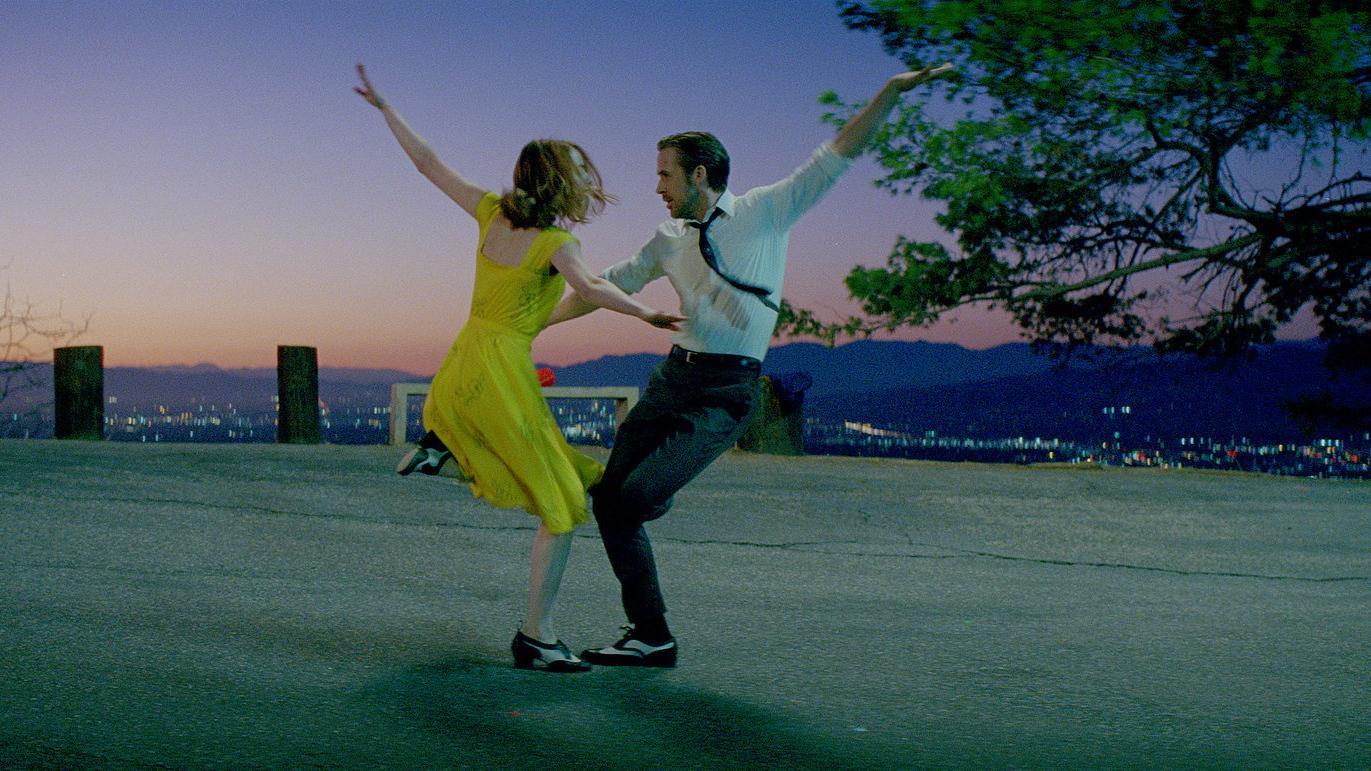


And when the movie is about to approach a sad ending -- which ISN'T EVEN VERY SAD. She marries a man whom she apparently loves and who apparently loves her, she has a daughter who is sweet, she is fabulously successful so she can go off and leave her child with someone else without fear or worry or any trouble about the expense or the social politics of it. The only thing that is sad is that she marries a different guy -- and just as it's about to face that slight bit of discomfort, it backs away, revisits the entire movie in faced-paced miniature, showing us exactly what we've just seen, and gives us the happy ending. So we get to escape from our escapism and have things just the way we want them. We get to have the happy ending, and we also get an easy-to-swallow dose of the bittersweet along with it. Nothing hard to accept or difficult or thought-provoking about any of it.

People loved it.

It's pap.

It's in our radio stations, our TV stations. Hear something you don't like? Change the station. You don't have to listen to any music that's not to your taste, don't have to watch any movies not to your liking (yes, La La Land turned out not to be my taste, but I sure did learn a lot from watching it, if only how much our culture is drained of real engagement with any subject), don't have to watch any TV shows you don't like. You don't even have to scroll through channels. You can custom-stream whatever show you want direct to your tiny little device and watch that show over and over and over and over and over and over. Talk about tunnel vision.

Hear some bit of science you don't like? Shut it off.  Disable the organizations that put out the scientific data in the first place. We don't want to hear about climate change and the damage fracking is doing, so we'll shut it all off. People have no clue how much science went into that egg on their breakfast table, that steak on their dinner plate. But why should they care? That egg is going to show up whether they know how it was made or not. Someone else will put it there. Someone else will take care of it. Someone else will think about it. I'm just going to eat it.

And what about people you don't like? You can shut them off too. Don't like their religion? Don't let 'em in. Don't like the color of their skin? Kick 'em out. Put 'em in jail. Put them on the other side of the wall and us on this side. We want only people like us here. People who look like us, talk like us, refuse to think like us. Because that's what makes us comfortable.

Daily Show-lovers are just as guilty of this. When Jon Stewart shows up, don't you feel that undeniable sense of "Ahh," of sinking into that mental Naugahyde lounger while you wait to be told just how wrong they are and just how right we are?  Isn't it lovely?  Isn't it rich?

It's the height of privilege, this ability to choose what to hear.  We can afford to buy the devices that enable that choice. We can afford to move out of neighborhoods we don't like, to drive away from a situation that frightens us, to fly to a country where we can drink fruity drinks by the pool and eat spicy foods and fly away again.

No wonder our President is so privileged he has no idea how privileged he is. No wonder he rejects anything he disagrees with. No wonder he tells lies outrageous and small all the time, and gets away with it. The difference between truth and lies has not mattered for a very long time. No wonder he has kicked out news media he doesn't like; we do that all the time. No wonder he is kicking out ideas, people, religions, anything he doesn't like. We have done this for decades.

Take a good long look at the man we have spent decades building. In front of our noses, behind our backs, in spite of us, because of us. We all had a hand in this creation.


If we want to dismantle him, we need to rebuild ourselves.

We can't bring back the fairness doctrine and require media to give equal coverage to opposing viewpoints. Our media is too diffuse to enforce that regulation, if anybody would even support it. But we can do more to encourage critical thinking, demand critical thinking. Seek out opinions that differ from your own. Challenge yourself and see what you discover. Ask questions. Write to your TV station, your newspaper. Subscribe to a newspaper. Subscribe two: a local paper and one that does in-depth investigative reporting. Tell people about what you've learned. Talk to people who have different opinions than you do, and don't just talk.  Ask why, and listen.

Don't disengage. Engage.

Monday, March 30, 2015

Apple #707: Movie Trailers

I went to an actual movie this weekend. In the theater and everything.  It's been many moons since I did that.

I saw It Follows, if you're interested.  In spite of the many questions I had -- what exactly happened with the guys on the boat?  What was the swimming pool plan supposed to be? Are there specific rules about how the transfer of following happens, I mean, do certain things need to be achieved? If you see it, you'll know what I mean.

In spite of all those questions, I liked it.  That conclusion does not seem like it would follow my list of questions, but it does follow that since the movie was set near Detroit in a landscape I recognized, and it did cool things with setting and the sense of time, I would find it eerily familiar.  It also follows that, since I can make many puns with the title, I would like it.


Screenshot from It Follows
(Image from Entertainment Weekly)


Anyway.  The point of all this is that a Daily Apple question emerged prior to said watching of said movie.  The friend with whom I went to said movie --we'll call him JohnCarpenter -- said, at the conclusion of the trailers, "Wait a minute. They're called trailers, but they show them before the movie.  Shouldn't they be called previews instead?"

Good question, JohnCarpenter, says I.

  • As you might guess, trailers once upon a time were shown after the movie.
  • Let's start at the beginning.
  • Long, long ago, back in the silent-era-stone age, before you were even a flicker in your parents' eye, movies used to be shown in a continuous fashion.  You'd pay your nickel, walk in and sit down at some point in the cycle.  There was a feature film, followed by several short films, including maybe a public service message from the Army or some government entity, a bit of newsreel footage, a cartoon or two, and then the feature film would start up again.
  • People would come in and sit through the whole loop.  Instead of getting up and leaving when they got to the end of the loop, they would stay and watch it all go around again.  All for one nickel.
  • In 1913, various theaters around the country began showing a 13-episode serial movie called The Adventures of Kathlyn.  Taking advantage of the fact that a lot of people liked reading serial publications in newspapers and magazines, the release of this film corresponded with the printing of the same installment in the Chicago Tribune.  


Screen shot from The Adventures of Kathlyn. Oh, the drama.
(Photo from Columbia University's  Women Film Pioneers Project)

  • The idea was that you'd read the episode in the paper and then go see it acted out, or vice versa.  Or if you read it one week, you could go see the next episode in the theater the next.  Or maybe somebody who read the Tribune would tell you about what they'd just read, and then you'd go see it in the theater.  You get the idea.
  • Here's a brief description of the serial, from the New York Times
"the serial detailed the experiences of Kathlyn Hare, the pretty daughter of an explorer (Lafe McKee). Kathlyn resided in a mythical India, fighting off unwanted advances from a handsome native, Umballah (Charles Clary), when not battling an endless array of ferocious jungle fauna." She also befriends native servants and frees the enslaved peoples. Naturally.
    • Interesting sidenote: the animals used in the filming of this serialized film eventually became the first animals to reside in the then-new Los Angeles Zoo. 


Newspaper ad from the Chicago Tribune for The Adventures of Kathryn. It's hard to see at this size, but the ad includes a list of Chicago theaters showing the movie. Eventually, some 200 papers ran the serialized story, and the serialized movie was shown in theaters around the country.
(Image from Carole & Co.)
  • Another innovation about all of this was that at the end of the movie episode for the week, there would a be a scene depicting one of the characters in a cliffhanger of some sort, and then a title card would be laid over the image, inviting patrons to return the following week to see what became of their favorite character.  The next week, the movie would pick up with that cliffhanger and proceed from there.
  • That little teaser at the end of the episode is generally considered to be the first trailer.
  • At about the same time, the advertising manager for Marcus Loew theaters (yup, still a big name in the movie theater business today) in New York City got an idea.  A play called Pleasure Seekers was being performed on Broadway, and he had a short little film made to promote it, including footage of the rehearsals.  This was probably the first short film advertising a production, and even though it was for a play, it's still fairly close to what we think of today as a trailer.
  • This short promo for the play was inserted among that continuous loop of short films & cartoons & newsreels. It fit in very well with all those other supplemental materials, so the theaters throughout the Loews chain started doing that, and soon other theaters did too.
  • By 1915, movie theaters were making their own short films to promote their feature-length movies.  They were pretty basic, with bits from the film spliced together, and maybe a title card at the beginning and end, maybe some text laid over the film.
  • Below is the trailer for Birth of a Nation (1915), and below that, a montage of several early movie trailers. You'll note that they are all silent movies. That Birth of a Nation trailer sure makes me want to watch it. Lincoln gets shot in it and everything. Except, oh dear, the KKK are the good guys. Boy, it's hard to see them as anything but bad guys now.


  • As movie-making evolved, incorporating sound and utilizing more complex filming and editing techniques, so too did the trailers.  One particular company, the National Screen Service or NSS, made trailers for all the film companies. Even as they used these new techniques, they tended to follow a similar format, since the trailers were all made essentially by the same guy.
  • Below is the trailer for King Kong (1933). Note the use of the text laid over the scenes from the film, which is a technique from the silent era, but also the use of voice-over specific to the trailer at the end.  That is a newer innovation.  


  • By Gone with the Wind (1939), they're still using the text overlay, but now they're interspersing the voice-over telling you how wonderful the picture is, with segments from the movie itself.


  • As trailers were becoming more advanced, movie theaters were showing more of them more often. Theaters were also moving away from running that continuous loop of one feature film and many short films throughout the day.  Now they had a few set times for the film, or maybe they were showing more than one film in the same theater, and they needed to get the audience out in between.  The trailers at the end of the film gave people the message: show's over, time to move on.
  • There is one additional suggestion for the early meaning of the word "trailer," which is a more technical one.  Lou Harris, former executive at Paramount, was quoted as saying that the piece of film that contained the trailer was spliced onto the end of the feature film.  So it really did "trail" at the end of the movie.


Back in the day, this is essentially how two pieces of film were spliced together -- with tape or glue.
(Photo from ULine)

  • Finding the date when theaters started showing trailers before the feature film rather than after is a little more difficult.  Many people say they began making the switch some time in the 1930s.
  • Film studios tried calling them something other than trailers -- "previews" "prevue of coming attractions" and so on.  But it was too late.  "Trailers" had stuck. 
  • A few final notes. You might call these trailers: 
  • Trailers are often made while the movie itself is still being made. Sometimes the trailer editors use the rushes -- the first prints made of a day's filming, which may or may not be kept in the final edit.  So it sometimes happens that a trailer contains footage or dialogue that isn't in the final version of the film.
    • In Casablanca's trailer, Rick says, "All right, Major, you asked for it."  But he never says that line in the film. 
    • The trailer for Terminator 2: Judgment Day contains several bits & pieces that are not in the movie -- on purpose. Director James Cameron wanted the trailers to explain how the Terminators were made, to address people's skepticism about how he could be in the sequel after he'd been destroyed in the first.
  • A lot of people say that Jaws (1975) was the first movie whose trailers were shown on TV,  but actually the practice started as early as the 1950s. Movie historian Keith Johnston says the first movie to put its trailers on TV was Born Yesterday (1950), starring William Holden and Judy Holliday.
  • But here's the trailer for Jaws anyway.  Because I want you to see how the voice-over has evolved, from telling you how great the movie is to telling you about the movie (though it still seems pretty shlocky).  It's also surprising how much of the movie it shows.


  • Moviegoers from the 1980s and 1990s will remember that nearly every single trailer started with a phrase like, "In a world . . ." or "In a time . . . " It was one guy who did the voice-overs for all those trailers.  No, it wasn't Morgan Freeman, it was a guy named Don LaFontaine.  Watch this mashup of trailers and be taken back to a time when there were still voice-overs in trailers, along with all the special effects.


Finally, I just want to point out that this entry about trailers was inspired by a movie called It Follows.  Do you follow?


Sources 
The Straight Dope, Why are they called "trailers" if they're shown before the movie? November 7, 2007
Filmmaker IQ, The History of the Movie Trailer
The Dissolve, Becoming attractions: A brief history of film trailers
Priconomics, Why Are Movie Trailers Called "Trailers"? March 18, 2015
The New York Times, The Adventures of Kathlyn [Serial] 1913 Review Summary
Nicolae Sfetcu, The Art of Movies [ebook, unpaginated]
IMDb, Terminator 2: Judgment Day trivia

Monday, February 3, 2014

Apple #660: Green screens

Daily Apple reader Jim Bob wants to know why green screens aren't blue anymore, but green.  If you know what a green screen is, this question makes sense to you.  If you don't, this may sound like gibberish.  Or, if you are the film/video naif like I once was, the very existence of green screens may come as a total shock.  So let's begin answering Jim Bob's question by first talking about what a green screen is.

  • So, you know how the TV meteorologist stands in front of a weather map and makes all sorts of gestures while the high and low pressure bars shift around and words like COLD! or HOT! suddenly appear?  The meteorologist isn't really standing in front of a screen that is dynamically doing all that behind him or her.  What's really back there is a plain screen -- which, these days, is green.


Weather lady gesturing in front of a plain green background on the left.  With the aid of technology, she winds up looking like the weather lady pointing out key features of a dynamically changing map.
(Photo from virtualstudio.tv)

  • The screen behind the meteorologist might be called all sorts of things -- background screen, green screen, blue screen -- but they are all essentially the same thing.  This background is the blank into which your fancy background will eventually be placed.
  • They do this same sort of thing with movies all the time, and more and more often as they're using so much digital filmmaking and special effects.  Your action super-hero isn't really dangling from a rope from a helicopter hundreds of feet above a chasm filled with fire and saber-toothed dragons.  No.  Your action super-hero is on some studio lot someplace, holding onto a rope in front of a green screen.  All the rest is added in later, and probably computer-generated besides. The saber-toothed dragons, of course, are real.
  • Much of the Star Wars action scenes were filmed using green screens.  Or actually, blue screens.
  • Ah, lost innocence.


For the newer Star Wars movies, they went with the blue screen.  It doesn't hurt my heart so much to look at this because the newer Star Wars movies couldn't hold a candle to the Luke Skywalker ones.
(Image posted by Voodoo Child and ComputerForums


  • OK, so how do they swap out the green for all that dramatic scenery or the shifting weather map?  In answering this, I will answer Jim Bob's question about why the switch from blue to green.
  • Back in the day, they used to use blue screens. This was because the filmmakers (TV or movie) could run the film through a red filter, which would make the blue black.  That would turn the shot of the meteorologist in front of the weather map into a black & white matte shot.
  • Then they would overlay the shot of the weather map on top of the black & white shot, and voila, wherever there was black, that would get filled in with the weather map.  
  • Same goes with filmmaking.  Actor is filmed in front of the background screen (keyhole image), the shot gets filtered so it becomes black & white (the mask), and the fancy background gets filled in wherever there's black (combined image).


Example showing the 3 steps of using a green screen: the keyhole shot of the person, the black & white filtered mask, and finally the combined image.
(Tiny image from Technologies for Worship)


Or maybe the process is best represented in 4 steps, as shown here.
(Image from Crystal Vision)

  • For TV purposes, this was all done on the fly, live.  So sometimes you might see some fuzziness around the edges of the meteorologist, where the filter picked up some of the darker shades of the meteorologist's hair, or maybe the seams of his suit, or maybe the spots in his tie.  And since they were filming live, there wasn't much they could do about it.
  • The problem wasn't so much that it was live TV, it was the color blue.  It was initially preferred because blue contrasts very well with white people's skin tones (and since white people are the ones on TV and in movies the most often, we're the most concerned with them. Ahem.)  But people tend to wear blue clothes.  Or they have blue eyes.  Even if it's not exactly the same shade of blue as the screen behind them, their blue clothes or their blue eyes could still get masked out.
  • So you'd wind up with what happens in this mini-scene from Groundhog Day, in the clip below, from 4 seconds in to about 8 seconds. (Today is Groundhog Day, by the way. Don't forget your booties 'cause it's cold out there.)


  • Producers used to sweat over this quite a bit, getting the actors ("the talent" ["Did he actually call himself 'the talent'?"]) or the TV guests or whoever to change out of whatever blue clothes they happened to be wearing into something not-blue.
  • But then they hit on a novel solution: change the color of the screen.  Instead of making everybody change their clothes, make the background a different color.
  • Now, they could have made the screen any color of the rainbow.  Especially with today's film & digital technology, the background screen could be any color at all--yellow, orange, magenta, periwinkle.  Whatever.  But they settled on neon green because people aren't very likely to be wearing that color, and it still provides a good contrast with most skin tones.
  • On St. Patrick's Day, they might run into some difficulties.  But otherwise, the green screen has worked pretty well.


Life of Pi in front of the blue screen, and above a blue pit which is supposed to be the ocean. (That book was such a crock. He stole almost the entire plot from a 1981 novel, and then changed the ending so that it was all a dream.) I suppose maybe the movies stick with blue because they of course control what the people are wearing; they don't have to worry about anybody showing up unexpectedly wearing something that will match the background screen.
(Photo from SocialNewsDaily)

  • If you were making your own movie, you wouldn't necessarily have to use a background that is neon green.  You could use a background that is of a different color.  But you'd better make sure your superhero's costume isn't the same color as your homemade background.
  • You would also want to make sure there is no texture in your homemade background.  Say you're making a film in your high school hallway, where the walls are painted cinderblock.  That would not be a good idea because cinderblock has all sorts of pits and little holes in it, which will create shadows, and when you try to get your cinderblock background to turn black so you can swap it out, the shadows won't get picked up, so you'll wind up with your superhero standing in front of a background of the Grand Canyon with all sorts of pits and dots in it.
  • Actually, an old-school green chalkboard (that's a pun but it's also accurate) works very well as a green screen.  But of course the chalkboard wouldn't go any lower than about the waist or mid-thigh, so that could present a problem.
  • You also want to make sure your background and the person standing in front of it are lit separately.  Make sure you light the background evenly -- no hard spotlights that create hot white bright spots and shadows at the edges -- and try to keep your actor-person's shadow from falling on the background, which means make sure they stay far enough away from the green screen.  Shadows make that part of the background a different color, so when you try to mask it out, it will be harder to pick up.


I am certainly no expert, but based on the advice I read elsewhere, this looks to me like an example of what NOT to do. There is hard light hitting the top of the green screen, there is outdoor light mixing with the artificial light, the screen has rumples and creases in it which means it also has shadows.  The guy who worked on this set and posted the image says this set-up was "far from perfect," but acceptable given the budget and situation.
(Photo from Brian Brown, posted at DFInfo.net)


Here's a layout showing what kinds of lights should be placed where, and the formula for figuring out how far things should be placed from each other.
(Diagram and lots of helpful instructions from SteveoStudios)


This looks like a much more professional set-up. Notice, for example, how her shadow is falling forward, away from the green screen, yet her face is still brightly lit.
(Photo and more lighting tips from eyefish.tv)

  • Also, if you're going to do any zooming in or out, you'd better make sure that the zooming you do of your person in front of the background matches the zooming you'll do in your fancy landscape.  Otherwise you might wind up with your person looking like they're becoming a giant against a fancy landscape that is growing, but not as fast as the person.  Generally, zooming is not recommended unless you're highly skilled because it's too dang hard to get things to match up right.
  • You also want to make sure your camera while you're filming the foreground shots doesn't move.  Say you're using a handheld camera to film your friend Joe in front of the green chalkboard in the Economics classroom.  The entire shot is going to bounce and wiggle a bit, which may be OK on its own.  But once you mask out the green chalkboard and put your fancy background of computer-generated Antarctica with giant spiders behind your friend Joe, he's going to bounce and wiggle around while Antarctica stays still, and it will look obviously wrong and silly.
  • That's all the mechanical stuff.  The big thing I wanted to know when I got to reading about this was, how do they get rid of the green?  Is there a magic anti-green button that they push?
  • The answer is, kind of yes, but it's harder and more complicated than we'd all want it to be.  If you've ever used Photoshop and tried to swap out one background color for another, you know 1) basically how this process works; 2) it can be a real painstaking task when it seems like it should be such a simple thing to do.
  • This process, by the way, is known as chrominance keying, or chroma keying for short.  Many people include using a green screen and managing the mechanics that I just described as part of the chroma keying process.  But for my money, it seems like the real chroma keying happens in post-production, when you're manipulating the images to get them to combine.
  • For amateurs who want to chroma key, you could use a video editing software program like Final Cut Pro X to edit your movies and make combined shots.  Essentially, you would tell the software what color to look for -- the color of your background screen, and then you push the Matte button.  It turns that background color black and thus makes the black & white mask.
  • But of course it's never so easy as that.  You might have to adjust the edges to make sure it's not ghosting -- leaving behind an outline -- or erasing parts of your actor's hair, or you might have to account for any shadows that you just couldn't get rid of when you filmed the background image, or maybe there are gradient differences in your background image and you have to deal with those one by one.


The Chroma Key Effect in Adobe Premiere.  Looks pretty simple, but that apparently simple toolbox holds a wealth of capabilities.  And it only gets more complex from here.
(Image from Media College)


In Final Cut Pro X, aligning the background shot with the foreground shot to make sure what your actor is doing makes sense in front of the fancy background you're going to give her.
(Screen shot from Apple Support)


Cleaning up an incompletely masked background in a combined image using Final Cut Pro X.
(Screen shot from Apple Support)

  • So, making the black & white mask and ultimately your combined image can take a lot of work, and it's a bit of an artistic process in itself.
  • That's even more true for TV & movie filming.  In those situations, their cameras are pulling in so much information, and thus generating so much data, they can't do the image combining on a PC. As powerful as our computers are today, they still can't keep up with all that data and do all the on-the-fly processing involved in chroma keying.
  • So TV stations and filmmakers use hardware whose sole purpose is video mixing.  They might use a video mixer (or a vision mixer) which can do all sorts of things, like making transitions such as wipes from one shot to another, or putting together shots from different cameras to make a seamless single take, or adding effects like turning everything sepia-toned to make it look like an old movie.  Among the things a video mixer can do is combine shots & do chroma keying.


Lots of people recommend the Videonix MX-1 or MXPro video mixer for chroma keying.
(Image from Southern Advantage, whose current price is $2,500.  Amazon has some used ones for sale for $700.)


This Snell & Wilcox Kahuna HD/SD would be used by a large studio.  That word Kahuna is there for a reason.
(Image from Media College)

  • For even greater and more sophisticated control of the chroma keying process, like if you're Peter Jackson and you want to make sure your Avatars look totally real in front of their fake alien background, then you would get a piece of hardware whose sole purpose is chroma keying.  You would use one of these if you have lots of other kinds of manipulations you want to do to the film, so you could do your other video mixing while you're doing the the chroma keying separately.  You would also get some really sophisticated color correction, lighting compensation, and edge correction capabilities that a video mixer or some PC software program simply wouldn't have.


The Safire 3 3G/HD/SD chroma key board. Does real-time chroma keying. It's supposedly a favorite among sports broadcasters because it uses algorithms to determine what color to mask out -- making it very good at dealing with complex background colors like grass.
(Image and product from Crystal Vision


Well, Jim Bob.  I think that about covers green & blue screens.  Next time you see a movie where the action hero is dangling from a rope from a helicopter, you will be more impressed, not so much with the actor, but with all the work that went into making it look like he really was doing such a damn fool thing.


Sources
Videomaker, How Does Green Screen Work?, and The ChromaKey Genie
Howstuffworks, How Blue Screens Work
Media College, Using Green Screen Footage and Vision Mixer
VirtualStudio.TV, What is Chroma Keying and how do green screens work? 
Technologies for Worship, The Basics of Video Keying
Sign Video, How Chroma Keying Works
Apple Support, Final Cut Pro X: Use chroma keys
Crystal Vision white paper, The Importance of the Chroma Keyer in a Virtual Studio System

Monday, September 30, 2013

Apple #654: Notorious

TMC is showing Hitchcock's Notorious tonight.  I would very much like to go on and on about why I think Ingrid Bergman is so fantastic in this movie.  But I'll try to keep it to a brief intro, for those of you who may not have seen this movie.  (Yes, some Notorious virgins do exist).


One of many movie posters for Notorious
(Image from The Arts Desk)


Most of us know Ingrid Bergman best from Casablanca, where she plays the uber-good, most-sought-after, fighting-on-the-good-side, love-of-two-men's-lives.  Coming from that perception of her, to see her in Notorious, it's kind of a shock.  Because her character, Alicia Huberman, is a bad girl.

When the movie begins, her father has been convicted of being a spy for the Nazis.  She reacts to this information not with the usual, oh-woe-is-poor-dramatic-me Hollywood response, but by getting loopily sloshed.  When was the last time you saw a woman in a Golden Era movie getting bombed on screen?

Not only does she get trashed, she does so with such sarcastic aplomb, the only person who could be her equal would be Cary Grant.  Oh, wait, guess who shows up!

Her performance is so rich and complex--ah, what the heck, I'll just show you what I mean.


Not only is she free with the bottle, she's also had a few, um, boyfriends.  If I understand the above scene correctly, the old guy at the right is proposing to be her sugar daddy, and she's considering it. No pure-as-the-Ilsa-driven-snow here.

The meat of the story is that Cary Grant's character, Devlin, is a government agent and he wants Alicia (Bergman) to spy on her father's Nazi friends in Rio.  Of course when you're a woman, you're not just a spy, you have to be a seductress.  Her main job is to seduce the man leading her father's friends, played by Claude Rains. (You know him from Casablanca, too.  "I'm shocked, shocked to find that gambling is going on in this establishment.")

So the government men--and Devlin--are assuming that since she's had a few sexual partners in the past, she wouldn't mind faking it with one more guy.  Except Devlin has already kind of fallen for her.  Nothing like a little high-speed drunk swerving to make you fall in love with a woman.


Bergman also does a stellar hangover.
(Still from The Girl with the White Parasol)


But Devlin also knows about her "seductive" past as well as the seducing she's supposed to do, so he's all bitter and snarky about it. Every time he makes unkind remarks, she smarts but tries not to let him see. This is because she is in love with him and is actually trying to turn over a new leaf after having learned of her father's death.  But since Devlin has told her what her assignment is and says he did not protest to his superiors on her behalf, she's embarked on a self-destructive, why-the-hell-not path.  They both punish each other for the fact that she actually goes through with the plan of seduction.

The result is such wonderfully sarcastic lines from her as: "Every time you look at me, I can see [your mind] running over its slogans: 'Once a crook, always a crook,' 'Once a tramp, always a tramp.' Go on. You can hold my hand. I won't blackmail you for it afterwards."

Also, "When do I go to work for Uncle Sam?" takes on whole new meanings.

OK, that's enough praises.  Now for the facts.


This is the Blu-Ray version from Amazon, but it's also available on plain old DVD & VHS too.
Notorious [Blu-ray]

  • The movie is based on a short story called "The Song of the Dragon" by John Taintor Foote that was published in the Saturday Evening Post. The story was published in 1921--before World War II, before anybody knew about Nazis or uranium ore.  
  • Much of the plot of the movie was the invention of Hitchcock and screenwriter Ben Hecht.  In fact, the atom bomb was dropped on Japan only a few months before Notorious was filmed, so changing the diamonds in the wine bottle to uranium ore was a very timely alteration.
  • Foote turned his short story into a novel in 1923, and 4 years later, a silent movie was based on the novel: Convoy.  In that movie, 2 men are in the Navy in World War I.  One man finds out that the other is a secret agent for the Germans, and he tells the German spy's fiancee.  But he tells her to stay with him so she can spy on him.  Among other events in the movie, the woman is arrested as a streetwalker.
  • I bet very few people remember the silent movie or the novel or the short story.  But they do remember Notorious.
  • The censors' rules at the time said no kiss could last longer than three seconds.  So Hitchcock told Bergman and Grant to kiss for 2 seconds, break apart, and kiss again, and keep doing that.  The results are 3 minutes of standing-up-kissing that looks like something a lot more horizontal.


  • That scene also looks seamless, but it actually took many long takes because of the complicated blocking required. The dialogue, though, was largely improvised between Grant & Bergman.
  • By the way, that chicken shows up later.  She's trying to cut it up and it's hard as a rock.  She says, half-laughing, "It caught fire once."
  • Bergman was 5'9" -- 7 inches taller than Claude Rains.  In scenes with him, she wears flats.  Also, when he could get away with it, Hitchcock had him stand on a box.
  • Many people refer to a particular shot as being classic Hitchcock.  The camera pans a large room from an upstairs balcony and then slowly zooms closer and closer until it eventually focuses on a key in Ingrid's hand--the thing which is of greatest importance to her in that entire party.  Thus, people argue, this is an example of how Hitchcock is the master of point of view.  He shows you with this shot exactly what she is thinking, and how nervous she is about it. 


How the key-in-the-hand moment was filmed.  Takes some of the romance out of it, doesn't it?
(Photo by Robert Capa, from Vicki Lester's Beguiling Hollywood)

  • There's yet another moment when Hitchcock demonstrates his moviemaking prowess.  A cup of coffee features prominently (no spoilers for the benefit of the uninitiated).  The camera stays focused on the cup as it is carried across the room and put on a table next to Ingrid.  A later filmmaker asked Hitchcock how he kept both the cup and Bergman in focus.  He said he used a 3-foot cup of coffee and filmed it from 25 feet away.  The other filmmaker protested that that couldn't be because a person carried the cup to her.  Hitchcock replied that it wasn't a person's hand but a piece of statuary holding the cup.
  • 4 years after the movie was released, Bergman was denounced in the Senate for leaving her husband in favor of director Roberto Rossellini.  She was pregnant with Rossellini's child.  The Senator called Bergman "Hollywood's apostle of degradation" and "a powerful influence for evil" and asked that she be barred forever from the country on the grounds of "moral turpitude."
  • Some years before that scandal broke, she was quoted as saying, ''I cannot understand why people think I'm pure and full of nobleness. Every human being has shades of bad and good.''  Knowing that is probably a large part of why she was such a skilled actress.
  • She did leave the United States and gave birth to three children with Roberto--including Isabella.  It wasn't until 1955 when Darryl Zanuck asked her to be in Anastasia and after being on the Ed Sullivan show that she began to be welcomed by the U.S. public again.  Eventually, she did return to the United States, and she was awarded an Oscar for her performance in Anastasia.
  • She reclaimed her position in the hearts of the public to such an extent that in 1972 a different Senator read into the Congressional Record an official apology for the previous attack on her in the Senate.
  • She died of breast cancer on her 67th birthday in London, 1982. 
  • "'I have had a wonderful life," she said during a press conference in 1956. "I have never regretted what I did. I regret things I didn't do. All my life I've done things at a moment's notice. Those are the things I remember. I was given courage, a sense of adventure and a little bit of humor." 


Ingrid. Notorious. Fantastic. Worth Watching.
(Photo from Dr. Macro's High Quality Movie Stars)


Sources
IMDb, Notorious
AMC filmsite, Notorious (1946)
Frank Cottrell Boyce, My favourite Hitchcock film: Notorious, The Guardian, June 16, 2012
Jasper Rees, The Hitchcock Players: Ingrid Bergman, Notorious, The Arts Desk, August 7, 2012
Turner Classic Movies, Trivia: Notorious
Film and Literature: Page to Screen, Hitchcock's Use of Editing Techniques: Notorious
Silent Hollywood.com, Convoy, 1927
Emanuel Levy Cinema 24/7, Oscar Scandals: Ingrid Bergman
The New York Times, On This Day, Ingrid Bergman, Winner of 3 Oscars, Is Dead, August 31, 1982

Saturday, August 31, 2013

Apple #650: Huckleberries

Yesterday, I tried some huckleberry frozen yogurt.  It was really tasty.


Jeni's huckleberry frozen yogurt.  I don't know if the recipe for this particular flavor is in her book, Jeni's Splendid Ice Creams at Home, but I've heard a number of people say her ice cream recipes turn out really well.
(Photo from Jeni's)


As I was eating this lusciousness, the line from some movie played in my head: "I'll be your huckleberry."  In some terrible Southern accent.  The more it replayed itself, the more I thought, what is that awful line from?  And what the heck are huckleberries anyway?

  • The line is from Tombstone, said by Val Kilmer in his miserable attempt to sound like he's from Georgia.  The line is actually, "I'm your huckleberry."
  • Before I get into all the particulars about that expression, which is a metaphor, I need to start with the thing itself, which is a fruit.

Huckleberry, the Fruit

  • As the woman at the ice cream counter told me, huckleberries are a lot like blueberries


Huckleberries.  These particular berries happen to grow wild on a farm in Washington state. Note the red stems.
(Photo from EUTOPOS farm)


      • They're smaller and usually their skin is darker, more purple or reddish-purple, or red.
      • They have a lot more seeds, so they have more of a crunchy texture
      • They have a thicker skin
      • They tend to be more tart, but with an intense flavor.


The much smaller, darker huckleberries are on the left.  Blueberries are on the right.
(Photo by Philip Potempa from The NWI Times)


Blueberries on the bush. As the name says, these berries are blue, often with an apparently powdery coating.
(Photo, as well as the plants themselves, from Florida Hill Nursery)


Huckleberries on the bush. These berries tend to be a darker purple or reddish-purple, and the stems are often red.
(Photo from Fat of the Land)


  • Huckleberries are not grown commercially as blueberries can be.  They only grow wild.  Or I should say, "Most attempts to grow huckleberries commercially in fields during the past century have failed."
  •  (Which makes it even more remarkable that Jeni's gets enough huckleberries to make a lot of frozen yogurt.)
  • Huckleberry bushes grow in the Southeastern US, and different varieties grow out West and in Alaska.
  • They grow especially well in areas where forest fires have occurred. 
  • One site says, "About a third of a grizzly bear's diet consists of huckleberries."  I'm not sure I can verify that, but I mention it because it gives you an idea of where huckleberries grow -- where grizzly bears live.  And there must be a lot of them growing there.

Huckleberry, the Term

  • Now that we know something about the fruit, what does it mean to call someone, or yourself, a huckleberry?
  • Most people say that the phrase "I'll be your huckleberry" or "I'm your huckleberry" means "I'm your man." As in, you want somebody to do something for you?  Or, you think nobody's tough enough to take you on?  Well, I'm your man. Or woman.  As in, accepting a challenge or a dare.
  • But how did "I'm your man" (or woman) become "I'm your huckleberry"?
  • Some people say that the phrase comes from the South, where there are lots of huckleberries, or maybe from the West.  
  • That's the extent of their explanation.  I guess they mean that the saying just grew out of there, the same way that huckleberry bushes grew?  Pretty flimsy explanation, in my opinion.


Where the black huckleberry grows. There are several other varieties of huckleberries that grow in many other states.  But they don't have a distribution map for the growth of the phrase "I'm your huckleberry."
(Distribution map from USDA Plants Database)

  • Curiously, the earliest instance of the use of huckleberry as slang means somebody who's nice and sweet, and also kind of a wimp, or innocent and therefore easily tricked. 
  • Another slang meaning of huckleberry is someone who is small and insignificant.
  • Mark Twain told an interviewer in 1895 that he chose the name Huckleberry to establish that Huck Finn was a boy "of lower extraction or degree" than Tom Sawyer.  So he was definitely thinking of the small & insignificant meaning of huckleberry.


Huckleberry Finn's name was supposed to indicate that he was of a lower class than Tom Sawyer.  But though his name meant "insignificant," he sure turned out to be anything but that.
(Cover image from The Adventures of Tom Sawyer and Adventures of Huckleberry Finn [Signet Classics])

 
  • That "small & insignificant" meaning might be the origin of another meaning of huckleberry, which is that of a sidekick.  The theory here is that, compared with the big cheese, the sidekick tends to be overlooked.
  • The sidekick meaning might be what's meant in the lyrics of "Moon River:"
Two drifters off to see the world
There's such a lot of world to see
We're after the same rainbow's end
Waiting 'round the bend
My huckleberry friend, moon river and me 
  • But "My huckleberry friend" seems to mean more that we're partners, the sidekick river and I, rather than that the river is the lesser of us two.
 
"Moon River" was written especially for Audrey Hepburn in her role as Holly Golightly in Breakfast at Tiffany's


  • But these definitions -- small & insignificant, sidekick, a sweet & easily duped rube --  are the opposite of the meaning of the "I'm your man" phrase.  By these definitions, saying "I'm your huckleberry" would be calling yourself a pushover, or someone of no account.  
  • I wonder if the phrase is one of those reverse psychology things.  As in, you might think you can overlook me like you'd ignore a huckleberry, but I am in fact the huckleberry who is going to kick your ass. Sort of like a David & Goliath thing.  That's just a guess of mine.
  • Someone else thinks that the phrase was originally "I'm your hackle-bearer."  Hackles in the Old West were handles on caskets.  So you'd be saying, "I'm the one who's going to put you in your coffin and carry you to your grave."  That's a pretty ballsy thing to say.  
  • According to this theory, then, hackle-bearer became hackle-berry which because huckleberry.
  • That seems like quite a stretch.  But the word huckleberry has itself gone through many changes.
      • When Europeans came to North America, they encountered small, dark berries that reminded them of bilberries.  One regional dialect's name for bilberry is hurtleberry.  So they called these new berries hurtleberries.
      • It didn't take long at all before that word morphed into huckleberry. In fact, the earliest known use of it is from 1670, so it's as if the colonists got off the boat, heard the word hurtleberry, and said no, I'm in a new country now, I'm calling it something else.
      • (Hurtleberry comes from the Old English word whortleberry, so some etymology dictionaries will start huckleberry's origins with whortleberry).
  • So I suppose it's possible that the phrase could have undergone a similar transformation.  But I'm skeptical.
  • So the etymological origins of the phrase "I'm your huckleberry" remain unclear.  But the movie where the line was said is a known thing.  It came from TombstoneI'll finish with some clips.


Val Kilmer as Doc Holliday.
(Photo from ...And the Adventure Continues)


Doc Holliday.  His mustache is way better than Val's.
(Photo from Fantastic Mustache)


The first time Val says it, all young & healthy. Have I mentioned how much I hate his fake accent?


The second time he says it, not feeling quite as chipper.  He says it right away, so unless you want to see somebody get shot in the head, you don't need to watch the whole thing.


All this from a spoonful of frozen yogurt.


Sources
What's Cooking America, Huckleberries - The History of Huckleberries
Northwest Berry & Grape Information Network, Information on Huckleberry Plants
Dictionary.com, huckleberry
Online Etymology Dictionary, huckleberry
The Tombstone Epitaph, Huckleberry origin sparks various views, November 5, 2009
World Wide Words, Huckleberry

Sunday, February 27, 2011

Apple #509: The Oscar

The Oscar awards ceremony is tonight.  So I thought it would be fitting to find out everything about Oscar.  The award itself.


The Oscar statuette
(Image from the Academy of Motion Picture Arts & Sciences)

  • They're referred to as statuettes.
  • The official name of the award is the Academy Award of Merit, but everybody calls them Oscar.
  • Nobody knows for sure where that name came from, but the most popular legend has it that the Academy librarian at the time, Margaret Herrick, said when she first saw it that it looked like her Uncle Oscar. 
  • Whether that's the true origin of the name or not, by 1934, the name was commonly used in articles about the awards, and by 1939, the Academy adopted it as the official nickname of the award.
  • Each Oscar is 13.5 inches tall and weighs 8.5 pounds.
  • The statue is of a crusading knight holding his sword so that the point goes down to his feet, and he's standing on a reel of film.
  • The film reel has five spokes, one for each of the original five branches of the Academy of Motion Picture Arts and Sciences: actors, directors, producers, technical crew, and writers.
  • What a crusading knight has to do with the movies is anyone's guess. The art director for MGM at the time, Cedric Gibbons, is the one who came up with the design as something "suitably majestic."
  • They've been awarded each year since 1929, two years after the Academy was founded.
  • Over the years, they've been made of different materials:
      • 1929: gold plating on the outside, solid bronze on the inside
      • During World War II: painted plaster (after the War, recipients were allowed to trade in the plaster ones for gold-plated ones)
      • After WWII: reverted to gold plated exterior
      • Currently: 24-karat gold plating on the outside, and on the inside is Britannium, which is an alloy of mostly tin, with a little bit of antimony and copper mixed in.  It's the Britannium which gives the Oscar its sleek texture.
  • R.S. Owens & Company is the company who's made the Oscars since 1982.  They're based in on the northwest side of Chicago (Jefferson Park, 5535 North Lynch, to be exact.).  
  • They also make the Emmys, the MTV Music Video Awards, the Rock & Roll Hall of Fame Awards, the Clio which is for excellence in advertising, and all sorts of other relatively famous awards.
  • You could have them make an award specially for you.  Like this one, perhaps:

If you want to order this statuette, ask for the Classic Achievement Economy Award. If you only want one, it'll cost you between $70 and $100, depending on how tall you want it to be.
(Image from R.S. Owens)


Maybe someday the Daily Apple could win this award, eh? One of these costs a mere $188.10.
(Image from R.S. Owens)


Every once in a while, you hear about a strange place where some actor or other keeps his or her Oscar.  So I thought I'd find out about a few of those for you too.
  • Timothy Hutton (Best Supporting Actor, Ordinary People, 1980): His sister thought it would be funny if he put it in the fridge, so he did.  Last anyone asked, the Oscar was still in his refrigerator. "It's sitting there, right next to some beers," he said in 2008.
  • Jodie Foster (Best Actress, The Accused, 1988; The Silence of the Lambs, 1991): She put hers in the bathroom "because they looked good with the faucets." She had to move them out of there, though, when they started to get corroded on the bottom. Now they're in a trophy case in her den.
  • Kate Winslet (Best Actress, The Reader, 2009) also keeps hers in the bathroom.  This is so her guests can look at it and pick it up and hold it without the embarrassment of asking.

Kate Winslet: Yay! I won! I'm putting this thing in my bathroom!
(Photo from Fusion Magazine)

  • Emma Thompson (Best Actress, Howard's End, 1992) is yet another recipient who keeps hers in the bathroom. "They look far too outré anywhere else." She says they're in there tarnishing "along with everything else, including my body."
  • Morgan Freeman (Best Supporting Actor, Million Dollar Baby, 2004) told this story: "When my house was being built in 1988, one of the guys who was doing finishing work said he wanted to construct a trophy cabinet for me. And he put an acrylic sign on the top shelf saying 'No Parking: Oscar Only.' So when I won, I took down the sign and put the Oscar in its place."
  • Cuba Gooding, Jr. (Best Supporting Actor, Jerry Maguire, 1996) used to keep his Oscar in his wine cabinet. Because the cabinet was temperature-controlled, the statue "stayed beaming new." Now that he keeps it in his screening room, it's begun to get tarnished.
  • Jennifer Hudson (Best Supporting Actress, Dreamgirls, 2007) kept hers for a while in a house she had bought but hadn't had time to furnish. Finally she bought a special pedestal for it and a light that she keeps lit. She lets her guests take pictures of themselves with it, but they are not allowed to touch it. 

Jennifer Hudson: Hands off the Oscar, people!
(Photo from Entertainment Weekly)

    • Cate Blanchett (Best Supporting Actress, The Aviator, 2005) doesn't keep her Oscar in any one place.  It roves around the house "like my family and I do."
    • Guillermo Navarro (Best Cinematography, Pan's Labyrinth, 2006) also has moved his Oscar to various places in this house.  For a while it was in his kitchen because he was "trying to incorporate it into the family," and then it moved to his room where he keeps it with a group of other awards he won for that movie. After he'd had it for a year, his family had a birthday celebration for his Oscar's first birthday.
    • Reese Witherspoon (Best Actress, Walk the Line, 2005) told one source she keeps it in her living room, and told another source that she keeps it in the place where her family puts all of her children's artwork. She said her kids like to play with it and dress it up.

    Reese Witherspoon: Thank you so much. My kids are totally going to love playing with this.
    (Photo from the People's Daily Online)

    • Juliette Binoche (Best Supporting Actress, The English Patient, 1997) said that while winning the Oscar was a dream come true, once she had it, she didn't know where to put it. "I put it in a box with the plates," she said. "I guess I shouldn't do that."
    • Danny Boyle (Best Director, Slumdog Millionaire, 2008) keeps his in a shoe bag under his bed. "I used to have it out and get up every day and you just can't look at it. It's like an elephant in the living room, you cannot avoid it." 
    • Kevin Costner (Best Director and Best Picture, Dances with Wolves, 1990) said, "I used to have my Oscars in my underwear drawer for three or four years." Then he had a screening room built in his house and now he keeps them in that room "on a golden shelf." 

    Kevin Costner: Heeyyyy! I'm putting these in the drawer with my skivvies!
    (Photo from The Spill)

    • Barbra Streisand (Best Actress, Funny Girl, 1968; Best Song, A Star is Born, 1977) keeps her Oscars in her barn. That may sound quaint and rustic, but the barn holds only the awards and stuff she's accumulated in the course of her singing career. And it's on her estate in Malibu.
    • Anna Paquin (Best Supporting Actress, The Piano, 1993) said that the night she won it, she slept with it next to her bed. But now she keeps it in her closet "next to my boots."
    • Susan Sarandon (Best Actress, Dead Man Walking, 1995) kept hers in the guest bathroom, along with all of her other awards. Most recently, though, it was on tour with the Museum of Natural History's exhibit about gold.  She said, "I haven't seen it in a few years."


    Now I'm going to wonder when I seem them accept those Oscars, is that another one destined for some bathroom in LA?

    Sources
    The Academy of Motion Picture Arts & Sciences, The Oscar Statuette
    Fox News, "What's an Oscar Statuette Really Made Of?" February 20, 2009
    Jennifer Roche, About.com, RS Owens & Company - Manufacturers of the Oscar
    Boy Abunda, "Where do Oscar winners store their trophies?" The Philippine Star (reprinted from The Hollywood Reporter)
    Oliver O'Neal, Mid-Day, Where does your Oscar live? March 1, 2009
    Victor Balta, comcast.net, As Seen on TV, Hutton Stays Chill About His Oscar, December 5, 2008
    Reese Witherspoon sent her assistant to tour Paris sewer with her son, Celebitchy, November 26, 2008
    Jennifer Hudson on where she keeps her Oscar, Urban-Hoopla, February 23, 2008
    Danny Boyle hides his Oscar under his bed! The Times of India, January 26, 2011
    So where does Guillermo Navarro keep his Oscar? Movie Set, October 3, 2008

    Thursday, September 10, 2009

    Apple #408: Harold and Maude


    Last night I watched Harold and Maude again for the, I don't know, 15th time? I was first introduced to it in college by a woman who lived on my floor, DeeDee. DeeDee was royally cool in a Gashlycrumb Tinies-loving way, and she also loved this movie. She must have put it on the TV & VCR in our common room 5 or 6 times a year.

    Now, watching it again many years later, even after having suffered the death of a family member, I still laughed out loud at parts of it. Some elements of the movie's attitude about death -- it's a parade, it's part of the great circle of life, etc. -- seem at best simplistic to me now. But I am won over again anyway because of the movie's deadpan delivery and its overall enthusiasm.


    Another nice thing about the movie are the occasional landscape shots like this.
    (Screen shot from Flickr, uploaded by abemaddk)


    For those who haven't seen it -- and I know some of you are still out there (ahem, Jason) -- it might seem strange at first to call this movie enthusiastic. Harold Chasen is a 20 year-old living in an enormous California house with his widowed mother, and he is obsessed with suicide and death. Sounds lovely, you might say. I don't want to spoil it for you, but trust me when I tell you there is a comic, albeit dark, edge to his obsession.

    The car he buys is an old 1959 hearse. For diversion, he goes to funerals. There he meets Maude, a 79 year-old woman who is a delightful nut. She, too, likes to go to funerals. She also likes to take other people's cars ("merely acting as a gentle reminder: here today, gone tomorrow, so don't get attached to things"), pose for ice sculptures, experiment with enormous erotic wood carvings, sing and dance, and drink oat straw tea.


    The scene where Maude first speaks to Harold, at a funeral.
    (Image from Bill's Movie Emporium)


    Telling you much more would spoil some of the surprises the movie has in store. I will add that Vivian Pickles, who plays Harold's mother, has stayed fixed in my mind all these years. Often when I do something that absolutely cracks me up but which I also know is kind of ridiculous, I will say to myself in her voice, "I suppose you think that's very funny, Harold." Absolutely dripping with disdain. And it makes me laugh even more.


    Harold's mother (Vivian Pickles), calling him on the carpet.
    (Screen shot from Cinema Splendor)


    Lots of deadpan, dark humor, and some more obvious slapstick stuff too, especially in the scenes with Uncle Victor. One film critic argues that this movie, released in 1971, was the first black comedy.

    There are lots of great sites out there that already pay tribute to this movie in far greater detail than my lone entry will do. But I'll try to assemble some trivia from an assortment of those sites so at least this won't be the same combination of trivia that already exists everywhere else.

    • All the music in the movie is songs by Cat Stevens (now Yusuf Islam). Two of the songs he composed specifically for this movie -- "Don't be Shy" and "If You Want to Sing Out, Sing Out." Neither song was available for purchase until 1984, so if you wanted to hear those songs, you had to go see the movie.
    • The other songs that appear in the movie are:
    1. On the Road to Find Out
    2. I Wish, I Wish
    3. Miles from Nowhere
    4. Tea for the Tillerman
    5. I Think I See the Light
    6. Where Do the Children Play?
    7. Trouble
    • The songs were released on a few different albums, but no soundtrack per se existed until 2007 when a limited edition LP was released. As far as I can tell, everybody is now sold out of it so it's probably a collector's item now.
    • Ruth Gordon never learned to drive a car. So in the scene where Maude is driving Harold's hearse like mad down the hill from the cemetery, the hearse ("Good on curves") is being pulled by a tow truck.
    • Later, Harold fuses his Cadillac hearse with a Jaguar that his mother buys him ("I quite like it, indeed"). The props people actually did this, but they only made one and they could only do that scene at the end in one take.

    Harold and his Jaguar-hearse
    (Photo from Everybody Lies)


    • Lots of cameos in the film. The director, Hal Ashby, is the crazy-looking bearded fellow with the glasses, watching the trains at the amusement park with Harold and Maude.
    • After Maude ttss's to get Harold's attention at the funeral and people turn to look at her, she hides by another funeral attendee -- who is Cat Stevens.
    • The hapless cop on the motorcycle is credited as M. Borman, but he was actually Tom Skerritt.
    • The movie was filmed in Hillsborough, California, which is south of San Francisco. The house where the Chasens live is the Rose Court Mansion. Mrs. Chasen's butler is played by the man who was the actual butler of that mansion at the time.

    The butler and Mrs. Chasen in the Rose Court Mansion. "Harold, what have you done? That was your last date!"
    (Photo from Harold & Maude the Unofficial Homepage)


    • The screenplay was written by Colin Higgins in 1971. An earlier form of it was his MFA thesis at UCLA.
    • Harold and Maude was later novelized and still later turned into a play. But it was a movie first.
    • The movie was not a hit when it was released. The New York Times' Vincent Canby said in 1971 that Harold and Maude are obviously made for each other, but only because Bud Cort and Ruth Gordon are "so aggressive, so creepy and off-putting." He said that the scene that begins with Maude singing at the piano and ends with her gimme an L cheer is "an embarrassed low."

    Left to right, director Hal Ashby, Bud Cort, and Ruth Gordon
    (Photo sourced from Cinebeats)


    • I thought I detected a New York accent in Bud Cort (Harold) and yes, Cort was born in New Rochelle and later moved to New York City.
    • His birth name was Walter Edward Cox, but he later changed it because he didn't want to be confused with Wally Cox. When he was a child, he slept in a teepee in the living room.
    • In 1975 he was offered the part of Billy Bibbit in One Flew Over the Cuckoo's Nest, but he turned it down because he was afraid he was in danger of being typecast and he wanted the role of McMurphy, which went to Jack Nicholson.
    • 8 years after Harold and Maude, Cort was in a car accident that almost killed him. His skull was fractured, his arm and leg were broken, and several teeth were knocked out.
    • Ruth Gordon played one of the evil people in Rosemary's Baby, and she won an Emmy for her role as Dee Wilcox on Taxi.
    • She also has the dubious distinction of being the oldest person, at age 79, to host Saturday Night Live.

    To me, they will always be glorious birds.
    (Screen shot from Hughshow's top 5's)


    Sources
    Harold & Maude, the unofficial Homepage is probably the most complete site for those who want to dig deeper into this movie
    Film in America, Harold and Maude (locations)
    IMDB, Harold and Maude, Bud Cort
    Whitney Matheson, "For the love of 'Harold and Maude,'" USA TODAY, July 24, 2000
    Nina Metz, "'Harold and Maude' aging gracefully,"
    Chicago Tribune, September 4, 2009
    Vincent Canby,
    The New York Times, Harold and Maude (1971), December 21, 1971