Showing posts with label food - fruit. Show all posts

Sunday, January 31, 2016

Apple #726: Honeydew Melon

Let's talk about Honeydew.

I know, it's the blah placeholder in hotel and restaurant fruit salads.  I know it's filler.  I know that its blah-ness has annoyed people to the point of outrage.  Kirsten King on BuzzFeed said, "It's about time we acknowledge the havoc honeydew melon is wreaking on all of our lives."

(No hyperbole there.)


Honeydew melon. Not actually wreaking havoc on anyone's life, and actually capable of being delicious.
(Photo from ProduceGreek)


King goes further, saying, "honeydew has this magic* ability to stay unripe [This, by the way, is categorically untrue] and taste like you're biting into a ball of spa-flavored Styrofoam." Her asterisk takes you to another asterisk which says "*shitty".

Then she puts gigantic capital red letters over various stock photos of people, shouting things like, PUT HONEYDEW IN MY SALAD AND I WILL CUT U. Over a picture of a couple happily eating fruit salad on a beach balcony she wrote, FINDS HONEYDEW IN SALAD, GETS DIVORCE.

OK, that last one is funny.

The point is, people are annoyed by honeydew.  I get it.  I've lost patience with it too -- in those crappy pre-made fruit salads.  Even The New York Times is fed up with honeydew (or maybe just Josh Barro at the NYT): "Every time I see a fruit platter at a hotel or a conference, I ask myself the same question: Where does all this honeydew melon come from, and does anyone actually want to eat it?"

Dawn Eisner, who used to be head of the buffet at the Radisson Plaza in Kalamazoo, Michigan (rather an odd source for Barro's article, but OK), said, “Nobody eats the green melon.” So why even serve it? “It looks nice next to watermelon, cantaloupe and pineapple.”

In other words, who cares what it tastes like?  It looks good.  That's its sole purpose on the plate.  Can you imagine the aneurysm Tom Colicchio would have if he heard such a statement?


"You put something on the plate just for looks? And you don't care how it tastes? That's criminal."
(Photo of Chef Tom Colicchio from Bravo, sourced from the Dallas Observer)


One sentence tucked into the midriff of Barro's article says, "Partisans emphasized to me the importance of finding the right honeydew melon; under their theory, those of us who think we dislike honeydew are just scarred from all the hotel breakfasts and conference buffets where it is served underripe and out of season."

This theory is correct.

Ladies and gentlemen, don't blame the melon.  In fact, never blame the fruit.  Just as rock-hard underripe peaches sold in chain grocery stores across the country are giving peaches everywhere a bad name, so too are these hunks of underripe honeydew dumped into piles of fruit that lazy-ass hoteliers and cheap-ass restaurant owners want to call a fruit salad.  That is not fruit salad.  That is a bowl of laziness and food maltreatment that they want you to think is fruit salad.  That's somebody trying to work a Jedi mind trick on you and failing miserably.


The hotel & restaurant miserable fruit cup. Giving a bad name to good fruit everywhere.
(Yes, this is a stock photo that I did not pay for. That's what these lousy fruit cups are worth. And what the heck is that meat on the plate? From alamy.)


Think about it.  Fruit is nature's sugar-enticement.  Fruit is intentionally designed to make you want to eat it.  That plant's continued survival depends on you eating its fruit and fertilizing its seeds.  It is a matter of life and death for that plant that it must taste good.  If a fruit doesn't taste good, nobody eats it, the plant dies.

By serving these lousy, underripe, half-frozen, tasteless hunks of what never had the chance to become full-fledged honeydew, wedding caterers and buffet managers everywhere are contributing to the death of a species -- Cucumis melo, to be exact.

So, let's get to some truths about honeydew melon and maybe we can rescue it -- and ourselves -- from perdition.

  • Honeydew was first grown in the tropics of West Africa, and then the French discovered it. They cultivated it in southern France and most particularly in Antibes.  The name of the cultivar that we now grow in California and Arizona is called the White Antibes.
 

Antibes in southern France is on the coast of the Mediterranean between Cannes and Nice. Napoleon lived here for a while, at first by choice and then in prison.  For centuries, this has been a favorite spot for celebrities, everyone from F. Scott Fitzgerald to Madonna. You think these people are going to eat lousy melons, or do you think they're going to eat some of the most delicious melon in the world?
(Photo from SunHat France)

  • Honeydew is also popular in China. It was an American who introduced honeydew to the Chinese -- finally, something we brought to them instead of the other way around.  It was a former US Secretary of Agriculture, Henry A. Wallace, who had founded his own seed company, Pioneer Hi-Bred, who gave seeds of the honeydew to some Chinese planters when he was there on a visit.
  • Let's put that in perspective too.  A guy who had been in charge of the entire US Department of Agriculture, who knows all the good stuff that can be grown in this country, and starts his own seed company, gives what to the Chinese? Honeydew. "I think this is good and I think you'll like it too" -- and he's saying that about honeydew.
  • In China, honeydew are sometimes called Wallace melons, after the guy who gave them the seeds.
  • (Wallace went on to become Vice President of the United States under FDR.)


Honeydew grow on the ground among vines, like their relatives the cantaloupe and pumpkin and cucumber. It is possible to grow them off the ground on trellises, but the melons get so heavy, it's best to support them with specially-made slings.
(Photo from Cherry Gal)

  • A lot of people say if they're going to eat melon, they'd prefer to eat cantaloupe rather than honeydew.  I think they think the cantaloupe is sweeter.  But in nutritional terms, honeydew & cantaloupe are the same.  Same amount of sugar per slice, same amount of calories.
  • Cantaloupe is also often victim to being served underripe or cut too close to the rind. But since it's easier to tell when you're doing that to cantaloupe, because the flesh of the melon will be an obvious green versus orange, that doesn't happen as often as it does with honeydew.  Even so, a lot of places do serve green-edged cantaloupe.


If you look closely, you can see that the edges of the cut chunks of this melon are green. This is a major violation in melon-eating. If you get a fruit cup and it's got cantaloupe with green corners on it like this, send it back. Don't stand for this unripe melon business anymore!
(Photo from CitiClean)

  • In fact, those green corners on cantaloupe are, to me, the bellweather indicator for how good or lousy a fruit salad is going to be. If I see those green corners in a container of fruit, I won't buy it. Somebody doesn't care enough to get the cantaloupe right, they're probably not going to get anything else in the salad right either.
  • Even if they did get the cantaloupe right, they probably didn't get the honeydew right.  One of the ways they may have gotten honeydew wrong is they may have frozen it.  This is just outright idiocy, but some people do it.
  • Don't freeze the honeydew.  You might as well suck all the flavor right out of it and call it a sponge. There's no resurrecting it after it's been frozen.
  • More often, people serve honeydew when it's just plain not ripe.  To be fair, it is not always easy to tell if a honeydew is ripe.  Here are some of the indicators to look for:
    • The outside skin should be a creamy, near-yellow color.
    • If it's white, it's not ripe
    • The skin should feel almost waxy, not fuzzy.
    • The melon should feel really heavy when you pick it up. (The cashier said after she'd bagged my honeydew, "Feels like you got a head in there." And no, I do not mean the dirty pun -- either of them.)
    • Press the round spot on either end of the melon. (I think of this as the fontanelle.) It should give a little to pressure.
    • Run your hand over the surface of the melon. If you can distinguish fine wrinkling, it's ready.
    • Smell it. If you don't smell anything, it's not ripe. If you smell the soft scent of melon, it's ready.
    • If the outside is creamy-colored but it's dinged up and looking a little bruised, it's probably overripe. But if you're going to eat the whole thing today and every other melon is not even close to being ripe, that might be the best choice in the bin.
  • The Produce Guy says the honeydew is probably the easiest melon to tell when it's ripe, but interestingly enough, he kind of gets his selection wrong in this video. His method (45 seconds in) is to wet his thumb & wipe it off on his clothes to remove the oils present in his skin, and then rub his thumb on the outer surface of the melon. He says if it squeaks, the melon is ripe. In my opinion, there are a lot of reasons why this method could produce faulty results, and it looks like that's what happened in this instance.


  • Something else to consider is the time of year. Honeydew does have a season, in spite of the fact that it seems to be always present in produce sections and fruit cups all year long. Honeydew are best at the end of summer, beginning of September.  
  • The good news is, once you get a honeydew home from the store, it will continue to ripen at room temperature. 
  • I just want to highlight this statement because it directly contradicts Kirsten King's hyperbolic and crude and factually incorrect remark that honeydew have some magic ability to stay unripe. In fact, honeydew are the only type of melon that will ripen after it's been picked, even if it has been picked way too early.
  • Since most melons (and most fruit in general) that are sold in grocery stores are sold in a very underripe state, it may take a couple days before your honeydew is fully ready.
  • If you want it to ripen faster, put the honeydew in a paper bag. This will trap the chemicals the fruit emits during the ripening process, and you'll hasten ripening maybe by about a day's worth or so.
  • If you want to delay ripening, or keep your ripe melon from becoming too ripe, that's when you put it in the refrigerator.  But in most cases, once you've got your melon home, refrigeration won't be necessary.
  • After you cut it open, then you'll want to refrigerate it.


This honeydew is overripe. See how the flesh has turned dark in places, almost to a liquid? You could still use this, I suppose, but the flavor will be a little off, not quite as light and delightful as it should be.
(Photo from Everyday Healthy! Everyday Delicious!)


Here's the overripeness in cube form.  The points on some of these chunks are kind of a yellowish-green. They've gone too soft, almost pithy.
(Photo from Everyday Healthy! Everyday Delicious!)


Also not what you want to see in cubed honeydew.  Pale, almost white, no juicy glisten, unripe tough green at the corners. Unappetizing.
(Photo from Aunt Mid's)


This is what cubed honeydew should look like. Mostly green, glistening with juice, firm but with a little bit of softness at the part where the seeds grew. Much more appealing.
(Photo from Fresh Start Foods)

  • When you cut open your honeydew, scoop out the seeds only from the part you're going to eat.  Leave the seeds in the other portion, wrap it snugly in plastic wrap, and put that in the fridge. The seeds will help the melon stay a little fresher longer.
  • Once you've scooped out the seeds from the part you're going to eat, when you cut away the rind, aim for about 1/4 inch away from the rind.  You don't want to cut too close to the peel because the flesh tends to be tougher there and have less flavor.  That tougher flesh also looks whiter than the rest of the melon, so cut off whatever looks white and keep what looks green.
  • (That's another thing the Produce Guy got wrong; he cut way too close to the rind.)


See how the flesh of the cut melon gets lighter right next to the rind?  That's what you want to cut away.
(Photo from fit brains)

  • As with any fruit, you can assist the flavor of the cut honeydew by sprinkling it with sugar and lemon juice. Let it sit in the sugar & lemon for a bit, and it will start to break into the fruit and release more flavor. Chefs call this "macerating" the fruit, which sounds either violent or sexual. But it's only lemon juice & sugar. 
  • If the fruit is fully ripe, that shouldn't be necessary. The fruit should be juicy & sweet enough on its own.
  • All that should pay off with this: the taste of a ripe, delicious, juicy honeydew. When you cut into the melon, juice will run out and you'll be able to smell its light, sweet fragrance. When you bite into a piece, it will be soft and giving, and the taste will be somewhat delicate but still sweet, with a kind of light green lusciousness. It has almost a pear-like texture but without the graininess. It will be smooth, cool, juicy, delightful, sweet, lovely, and lush.
  • Now that's a honeydew.


I got a honeydew from the store today, knowing I was going to do this entry. I'm going to go downstairs right now and see if it's ripe.
(Photo from Food for Thought)


P.S. I almost forgot to tell you my favorite honeydew joke!
What did the two melons say to each other?
"Sorry, dear, I cantaloupe."
"Oh, honeydew."
Ba-dum-ching!


Sources
Josh Barro, That Honeydew Melon Looks Good, but Does Anyone Eat It? The New York Times, August 2, 2014
WebMD, Honeydew: 7 Fun Facts
University of Arizona, Collecge of Agrciulture and Life Sciences, Honeydew Melons (use to this source with caution; there are a lot of contradictory and even incorrect statements here)
Tucson Community Supported Agriculture, About Honeydew Melons

Monday, February 2, 2015

Apple #700: Avocados & Guacamole

A whole lotta people watched the Superbowl tonight.  And a whole lotta those people ate guacamole.  So I thought now would be a good time to talk about guacamole.


Guacamole served in one of those trendy, so-called authentic volcanic mortar bowls.
(Photo and recipe from the California Avocado Commission)

Avocados

  • Guacamole, as I'm sure you know, is made from avocados.  So let's start there.
  • Avocados are native to Mexico.  The Aztecs who lived in Mexico before it was colonized by Spain were cultivating avocado trees as long ago as 500 B.C. We have evidence that the Incas in Peru were cultivating avocados as far back as 750 B.C.
  • The avocado trees were growing in Mexico, just on their avocado-own, as long ago as 5,000 to 7,000 B.C.


Avocados grow on trees, like this.  A single tree can produce anywhere from 150 to 500 avocados in one year.
(Photo by joeysplanting, sourced from The Garden Lady, who can tell you how to grow an avocado tree)


This is how an avocado seedling sprouts from that giant pit inside.
(Photo from Reclaim Grow Sustain)


This is how avocados hang from the tree. Like a pair of testicles.
(Photo from AnandTech forums)

  • The word "avocado" comes from the Nahuatl (the language spoken by the Aztecs) word "ahuacatl." Which means "testicles."
  • So perhaps this is why the avocado is sometimes considered an aphrodisiac.  (Something to consider this Valentine's Day.)
  • Spanish priests arriving in Mexico did not find the joke funny at all. In fact, they took it so seriously, they prohibited their flock from eating the avocado.
  • Maybe this is why it took 300 years for someone to bring avocados north from Mexico into California.  The Spaniards arrived in Mexico in the 1500s; the first avocado trees weren't planted north of Mexico, in California, until 1871.
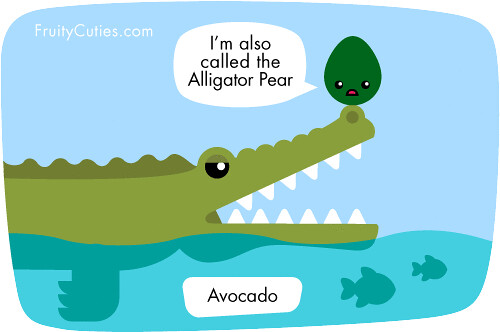
  • Even then, it took a really long time for avocados to catch on with the American public in general.  In the early 1900s, Americans were calling avocados "alligator pears" because of their shape and the way the skin is green and bumpy.  Doesn't sound very appetizing, does it?


Or, maybe now, people think the name "alligator pear" is cute.  And perhaps more appealing to children than "avocado."
(Image from FruityCuties on Flickr)

  • It was the California Avocado Growers' Exchange who started calling them "avocados," deriving the word from the original Nahuatl in 1920.
  • With lots of help from the California Avocado Growers' Exchange -- marketing and PR pieces and so on -- more people over the years began to get more familiar with the avocado.  But the fruits were expensive to buy outside California, so they were considered something that rich people ate, or something that was served at fancy parties.  Kind of like the way people talk about arugula now.
  • Then, when prices were beginning to come down a bit and people were getting a little comfier with the avocado, the whole fat-is-bad thing hit in the 1980s and doctors started telling everybody "Don't Eat Fat."  Since avocados have a lot of fat, especially for a fruit (yes, avocado is a fruit.  And yes, 85% of its calories come from fat), people took this to mean that avocados are bad for you and will give you a heart attack or something terrible like that.
  • It is true, avocados are relatively high in fat, but they've got the monounsaturated kind, the kind that may help chip away at your cholesterol. In addition, their particular kind of fats can also help to reduce inflammation, a benefit that people with arthritis have experienced.  They also have 4 grams of protein per fruit.  How many pieces of fruit can you think of that contain protein?  So avocados and their fats are actually quite healthy-friendly.
  • We've also learned since the 1980s that one cup of fresh avocado can increase your body's absorption of beneficial carotenoids & other antioxidants by anywhere from 200% to 400%.  Let me put it this way: Spinach has all kinds of good stuff for your body.  Put a little fresh avocado on that, and your body will extract even more goodness from that spinach.


Nutrition Facts for 1 cup of raw avocados. More info available from NutritionData.com


This might be a better way of demonstrating how the fat in avocado really isn't so bad, compared to other fatty foods.
(Diagram from Smart Living)


The most nutritious part of the avocado is just beneath the skin, in the darker green flesh. So avocado growers recommend using the "nick and peel" method to take off the skin, which will help preserve the nutrient-est part of the fruit. That method is demonstrated here: 


  • But we didn't know any of that in the 1980s.  We just thought avocados were expensive and decadent and kind of bad for you.  
  • So in the 1990s, the California Avocado Growers started making commercials. There was one showing Angie Dickinson eating an avocado with a spoon, another one featuring an avocado named Mr. Ripe, whose purpose was to show people that ripe avocados are not bright green but rather a dark greenish-black.  In other words, they were trying to promote the heck out of avocados.
  • Then they found out that a lot of people were eating guacamole -- among other things -- on Super Bowl Sunday.  Here, I have to pause for a minute and show you this quote from Olga Khazan, writing for The Atlantic:
Americans did with the big game what we’ve done with seemingly every national event: Turn it from a day centered on a specific purpose to a day of consuming thousands more calories than our stomachs will comfortably fit. Super Bowl Sunday became less about football fanaticism and more about chips and seven-layer dip. In recent years, Americans have consumed 1.23 billion chicken wings on Super Bowl Sunday and eaten 15 million pizzas.
  • Pretty sharp, eh?
  • Well, the Avocado Growers (now the California Avocado Commission) took advantage of this, big-time.  In the days leading up to 1992's Super Bowl, they showed football players on TV eating guacamole.  They got football players and their families to submit recipes for guacamole and had a tasting competition.  At the game itself, they had PR people handing out samples of guacamole to fans at the stadium and to reporters.  They did this sort of thing for a couple years running and pretty soon, guacamole and avocados became a companion story, along with the new of the game itself.
  • And boy, did their efforts pay off.  In 2012, we Americans ate 12 million pounds of avocados on Super Bowl Sunday.  Yes, all those avocados on just one day.
  • The only other days of the year when we eat as many or more avocados are on Cinco de Mayo -- a holiday we didn't pay much attention to as a country until recently -- and Independence Day.  The avocado, a Mexican fruit once banned for its testicularity, has now become an American staple.
  • Today, an estimated 43% of US households purchase avocados.
  • That's a huge uptick from back in the 1960s, but it looks like there's more room to grow, doesn't it?  Avocado growers in Mexico apparently agree because they're getting in on the marketing game, now too.  I noticed -- and maybe you did too -- their commercial for avocados during this year's Super Bowl.


  • 90% of the avocados we buy here in the U.S. come from California -- specifically from an area covering 52,000 acres from San Luis Obispo to San Diego.  I guess the avocado growers in Mexico want to put a dent in that 90%. 

Guacamole

  • But we don't really care about marketing and commercials, do we?  What we really care about is guacamole.  Because it's gooooood.  


Guacamole. Once you start eating it, you can't stop.
(Recipe & photo by Quentin Bacon at Real Simple)

  • The Aztecs, who grew those avocados way back in the B.C. days, made guacamole too.
  • If you'll remember, their word for avocados was ahuacatl (testicles, yes). Their word for guacamole was ahuaca-mulli, or avocado sauce or avocado mixture.
  • I suppose, translated literally, that would be testicle sauce.
  • Traditionally, guacamole is made from 5 ingredients:
    • Avocado
    • chiles or hot peppers
    • onion
    • tomato
    • salt
  • I know, you cilantro-lovers are saying, what about the lime and the cilantro?  Most of us add those 2 ingredients today, but guacamole purists say that's not the truly traditional way to make guacamole.  They say the lime & cilantro spoil the flavor.  I know a few cilantro-lovers who might disagree with that.
  • One other thing to note about these ingredients.  I've always used jalapeño peppers because that's what's most readily available.  But most of the recipes I've checked for this entry say to use serrano chile.  
  • Serranos look like jalapeños, but they are smaller and more slender. Like any pepper, they start out green when they are least ripe, and they slowly darken and get spicier through yellow to orange to red.  The greener the pepper, the milder the heat.
  • Serranos are hotter than jalapeños, but not as hot as cayenne or habanero peppers.  One site describes the difference in heat levels this way: In a strong man contest, habaneros can lift an 18-wheeler, serranos a VW van, and jalapeños a Vespa scooter.  So if you think  spicy, you'd probably better not upgrade to serranos.


Left to right: Habanero, serrano, jalapeño. Hottest, hotter, hot
(Photo from cookthink.com)

  •  As with any truly good recipe, there are a million slightly different ways you can make it, according to your preferences.  Same is true for guacamole.


Anjali at The Pickyeater makes her guacamole according to the recipe in a cookbook called Must Have Been Something I Ate (which I think is a terrible name for a cookbook).  This recipe calls for extra spices, including cumin & coriander, the juice of both limes and lemons, and instead of fresh peppers, uses chili powder and cayenne.
(Photo and recipe at The Pickyeater)


  • (By the way, adding your favorite salsa to a bowl of chopped or mashed avocado is the shortest short-cut to guacamole.)
  • If you want to make the traditional guac but also with cilantro & lime, Simply Recipes has your recipe.
  • (I would show you photos of their guac, but these people have their copyright watermarks all over their pictures. So, no free photo PR from me.)
  • If you really want to get wacky with it, Avocado Central has guacamole recipes like
    • Bacon guacamole
    • Buttermilk Ranch guacamole
    • Mango guacamole
    • Mariachi guacamole (does it really have ground-up mariachis in it?)
    • Pistachio guacamole
    • Tomatillo guacamole
  •  For a selection of more "authentic" or traditional recipes, check out the recipe options available at -- where else? -- the California Avocado Commission.


The recipe for this guacamole won the California Avocado Commission's recipe for Best Guacamole Ever -- in 2010.
(Photo and recipe from the California Avocado Commission)


Hey, I almost forgot.  This is my 700th Apple.  It's late and I don't know what to say about that at the moment other than, 700 is a fairly big number.


Sources
Mother Nature Network, Who invented guacamole? June 19, 2013
Olga Khazan, The Selling of the Avocado, January 13, 2015
Online Etymology Dictionary, guacamole
Guyot, Top 10 Romantic Foods: Avocado
California Avocado Commission, Fun Avocado Facts
The World's Healthiest Foods, Avocados
Live Science, Avocados: Health Benefits, October 23, 2014
Gourmet Sleuth, Guacamole - Recipe Ingredients and History
Eat More Chiles, Serrano
Cookthink.com, Habanero vs. Serrano vs. Jalapeño

Saturday, August 31, 2013

Apple #650: Huckleberries

Yesterday, I tried some huckleberry frozen yogurt.  It was really tasty.


Jeni's huckleberry frozen yogurt.  I don't know if the recipe for this particular flavor is in her book, Jeni's Splendid Ice Creams at Home, but I've heard a number of people say her ice cream recipes turn out really well.
(Photo from Jeni's)


As I was eating this lusciousness, the line from some movie played in my head: "I'll be your huckleberry."  In some terrible Southern accent.  The more it replayed itself, the more I thought, what is that awful line from?  And what the heck are huckleberries anyway?

  • The line is from Tombstone, said by Val Kilmer in his miserable attempt to sound like he's from Georgia.  The line is actually, "I'm your huckleberry."
  • Before I get into all the particulars about that expression, which is a metaphor, I need to start with the thing itself, which is a fruit.

Huckleberry, the Fruit

  • As the woman at the ice cream counter told me, huckleberries are a lot like blueberries


Huckleberries.  These particular berries happen to grow wild on a farm in Washington state. Note the red stems.
(Photo from EUTOPOS farm)


      • They're smaller and usually their skin is darker, more purple or reddish-purple, or red.
      • They have a lot more seeds, so they have more of a crunchy texture
      • They have a thicker skin
      • They tend to be more tart, but with an intense flavor.


The much smaller, darker huckleberries are on the left.  Blueberries are on the right.
(Photo by Philip Potempa from The NWI Times)


Blueberries on the bush. As the name says, these berries are blue, often with an apparently powdery coating.
(Photo, as well as the plants themselves, from Florida Hill Nursery)


Huckleberries on the bush. These berries tend to be a darker purple or reddish-purple, and the stems are often red.
(Photo from Fat of the Land)


  • Huckleberries are not grown commercially as blueberries can be.  They only grow wild.  Or I should say, "Most attempts to grow huckleberries commercially in fields during the past century have failed."
  •  (Which makes it even more remarkable that Jeni's gets enough huckleberries to make a lot of frozen yogurt.)
  • Huckleberry bushes grow in the Southeastern US, and different varieties grow out West and in Alaska.
  • They grow especially well in areas where forest fires have occurred. 
  • One site says, "About a third of a grizzly bear's diet consists of huckleberries."  I'm not sure I can verify that, but I mention it because it gives you an idea of where huckleberries grow -- where grizzly bears live.  And there must be a lot of them growing there.

Huckleberry, the Term

  • Now that we know something about the fruit, what does it mean to call someone, or yourself, a huckleberry?
  • Most people say that the phrase "I'll be your huckleberry" or "I'm your huckleberry" means "I'm your man." As in, you want somebody to do something for you?  Or, you think nobody's tough enough to take you on?  Well, I'm your man. Or woman.  As in, accepting a challenge or a dare.
  • But how did "I'm your man" (or woman) become "I'm your huckleberry"?
  • Some people say that the phrase comes from the South, where there are lots of huckleberries, or maybe from the West.  
  • That's the extent of their explanation.  I guess they mean that the saying just grew out of there, the same way that huckleberry bushes grew?  Pretty flimsy explanation, in my opinion.


Where the black huckleberry grows. There are several other varieties of huckleberries that grow in many other states.  But they don't have a distribution map for the growth of the phrase "I'm your huckleberry."
(Distribution map from USDA Plants Database)

  • Curiously, the earliest instance of the use of huckleberry as slang means somebody who's nice and sweet, and also kind of a wimp, or innocent and therefore easily tricked. 
  • Another slang meaning of huckleberry is someone who is small and insignificant.
  • Mark Twain told an interviewer in 1895 that he chose the name Huckleberry to establish that Huck Finn was a boy "of lower extraction or degree" than Tom Sawyer.  So he was definitely thinking of the small & insignificant meaning of huckleberry.


Huckleberry Finn's name was supposed to indicate that he was of a lower class than Tom Sawyer.  But though his name meant "insignificant," he sure turned out to be anything but that.
(Cover image from The Adventures of Tom Sawyer and Adventures of Huckleberry Finn [Signet Classics])

 
  • That "small & insignificant" meaning might be the origin of another meaning of huckleberry, which is that of a sidekick.  The theory here is that, compared with the big cheese, the sidekick tends to be overlooked.
  • The sidekick meaning might be what's meant in the lyrics of "Moon River:"
Two drifters off to see the world
There's such a lot of world to see
We're after the same rainbow's end
Waiting 'round the bend
My huckleberry friend, moon river and me 
  • But "My huckleberry friend" seems to mean more that we're partners, the sidekick river and I, rather than that the river is the lesser of us two.
 
"Moon River" was written especially for Audrey Hepburn in her role as Holly Golightly in Breakfast at Tiffany's


  • But these definitions -- small & insignificant, sidekick, a sweet & easily duped rube --  are the opposite of the meaning of the "I'm your man" phrase.  By these definitions, saying "I'm your huckleberry" would be calling yourself a pushover, or someone of no account.  
  • I wonder if the phrase is one of those reverse psychology things.  As in, you might think you can overlook me like you'd ignore a huckleberry, but I am in fact the huckleberry who is going to kick your ass. Sort of like a David & Goliath thing.  That's just a guess of mine.
  • Someone else thinks that the phrase was originally "I'm your hackle-bearer."  Hackles in the Old West were handles on caskets.  So you'd be saying, "I'm the one who's going to put you in your coffin and carry you to your grave."  That's a pretty ballsy thing to say.  
  • According to this theory, then, hackle-bearer became hackle-berry which because huckleberry.
  • That seems like quite a stretch.  But the word huckleberry has itself gone through many changes.
      • When Europeans came to North America, they encountered small, dark berries that reminded them of bilberries.  One regional dialect's name for bilberry is hurtleberry.  So they called these new berries hurtleberries.
      • It didn't take long at all before that word morphed into huckleberry. In fact, the earliest known use of it is from 1670, so it's as if the colonists got off the boat, heard the word hurtleberry, and said no, I'm in a new country now, I'm calling it something else.
      • (Hurtleberry comes from the Old English word whortleberry, so some etymology dictionaries will start huckleberry's origins with whortleberry).
  • So I suppose it's possible that the phrase could have undergone a similar transformation.  But I'm skeptical.
  • So the etymological origins of the phrase "I'm your huckleberry" remain unclear.  But the movie where the line was said is a known thing.  It came from TombstoneI'll finish with some clips.


Val Kilmer as Doc Holliday.
(Photo from ...And the Adventure Continues)


Doc Holliday.  His mustache is way better than Val's.
(Photo from Fantastic Mustache)


The first time Val says it, all young & healthy. Have I mentioned how much I hate his fake accent?


The second time he says it, not feeling quite as chipper.  He says it right away, so unless you want to see somebody get shot in the head, you don't need to watch the whole thing.


All this from a spoonful of frozen yogurt.


Sources
What's Cooking America, Huckleberries - The History of Huckleberries
Northwest Berry & Grape Information Network, Information on Huckleberry Plants
Dictionary.com, huckleberry
Online Etymology Dictionary, huckleberry
The Tombstone Epitaph, Huckleberry origin sparks various views, November 5, 2009
World Wide Words, Huckleberry

Thursday, August 15, 2013

Apple #647: Fried Green Tomatoes

I'm probably late to the party on this topic, but I had a fried green tomato for the first time ever this past weekend.  It was served on a grilled hamburger with crispy bacon and boy, let me tell you, that might have been the best hamburger I have ever eaten.  The crispy breading on the tomato merged with the crispiness of the bacon, and the flavor of the tomato melted with the flavor of the burger, and mmm, was that good.


Fried green tomatoes, with a fresh green one too.
(Photo from For the Love of Sunday)


But of course, as your intrepid Apple Lady, I had many questions about fried green tomatoes.  Yes, I saw the movie when it came out in 1991 and yes, I heard all about the fried green tomato craze at the time.  But the details of the dish never sunk in with me.  So now I have many questions.  First and foremost being, do you need special tomatoes or do you use regular old tomatoes that just aren't ripe?

The Tomatoes

  • Yes, "green tomatoes" means simply unripe regular tomatoes. 
  • You don't want to use the red, ripe, juicy ones because if you try to fry those, they'll just turn to mush on you.  They need to be green & unripe so they'll be firm enough to stand up to the battering & frying. 


Green tomatoes for frying.  Just like the red ones, except not ripe. Or red.
(Photo from The Forgotten Teaspoon)

  • But most grocery stores don't sell unripe/green tomatoes, so where do you find them?
  • Many people recommend farmer's markets.
  • You could grow tomatoes yourself and pick them before they ripen.
  • Some people say you can sometimes find them at Asian or Mexican grocery stores.
  • If you really can't find green tomatoes anywhere, go to your local grocery store and from among the red tomatoes, choose the palest, hardest, most-green-tinged tomatoes you can find.  Then when you prepare them for frying, salt the slices first and let them stand. The salt will draw out some of the moisture.  Pat them with a paper towel and then give the frying a shot.  They won't turn out quite as well as the fully green/unripe ones, but they might turn out OK.
  • If you are choosing from among red tomatoes, avoid the heirloom varieties ("green zebras") which stay green even when they are ripe.  These will be too mushy and seedy for frying.

The Recipes

  • As is the case with any much-beloved dish, there are a million variations on how to make fried green tomatoes.  Every recipe I've seen has a slight difference.  So here's a summation of some of the recipes I've come across.
Green tomatoes
  • 4 large, or 
  • 3 medium, or
  • 2 large

Slice tomatoes
  • in 1/2-inch thick slices, or
  • thinly for crisper frying.
  • And peel them, or
  • don't peel them

If the slices are especially moist, salt them. Let them stand about 5 minutes, then pat dry with a paper towel.
 

Green tomatoes, nice and big, sliced for frying
(Photo from La Bella Vita Cucina)


Dip the tomatoes in your favorite coating. Options include but are not limited to:
  • all-purpose flour, or
  • flour mixed with corn meal, or
  • flour plus Cajun seasoning

Next, dip them in your favorite goo.  Options include but are not limited to:
  • eggs, or
  • eggs & milk, or
  • buttermilk, or
  • eggs & buttermilk

Finally, dip them in your favorite crunchy coating. Options include but are not limited to:
  • corn meal (considered de rigeur for the Southern version), or
  • Panko bread crumbs, or
  • bread crumbs churned to a powder in your home mixer, or
  • corn meal and bread crumbs and salt and pepper, or
  • corn meal and bread crumbs and salt and paprika
  • corn meal and flour and cayenne pepper

Prepare the oil for frying.  You could use
  • olive oil, or
  • olive oil plus bacon fat, or
  • olive oil plus butter, or
  • vegetable oil, or
  • peanut oil, or
  • lard

Use enough oil to
  • make 1/4" to 1/2" worth in the skillet, or
  • come up the sides of the slices but not over them, or
  • coat the tomatoes completely


Green tomatoes, frying in a skillet. It looks like most people agree that the oil shouldn't cover the tomatoes.
(Photo from Kikipotamus the Hobo)


Put the oil in a skillet and heat to a medium-high heat in the neighborhood of 360° to 375°.  Drop in the coated tomatoes and let them fry for 3-5 minutes on each side. (Everybody seems to agree on these particulars.)  Let them drain on a paper towel/cookie rack, but don't let them cool too long.  They're best when they're still hot and juicy.


Green tomatoes, fried and cooling on a rack.
(Photo from Southern Living)


Recipes I consulted:
Slate's version, with Panko crumbs, olive oil & butter or bacon fat
Southern Living's version, with egg & buttermilk & cornmeal, vegetable oil
Allrecipe's version, with 4 tomatoes, eggs & milk & flour & cornmeal
Erika Kendall's version like her great-grandmother used to make, with buttermilk, Panko, & paprika
Simply Recipe's version, with flour, Cajun seasoning, and peanut oil
Kikopotamus' version, with corn meal and cayenne pepper
La Bella Vita Cucina's version, with buttermilk and Italian herbs, plus marinara sauce


Are Fried Green Tomatoes Really Southern?

  • While you're eating your fried green tomatoes, here's one last thing I found out about them.
  • Robert Moss, a food writer and culinary historian who lives in South Carolina looked into the history of fried green tomatoes. He first consulted Fannie Flagg's novel, Fried Green Tomatoes at the Whistle Stop Cafe, and her Original Whistle Stop Cafe Cookbook.  They both said that, based on her family's history, Flagg thought that fried green tomatoes became popular during the Depression, when people were frying up whatever they had and eating it. 
  • But, Moss says, saying a food practice originated during the Depression is a bit suspect when you're talking about the South because "The Depression did not have nearly the crushing effect on the lifestyles of people in the South as it did in the rest of the nation for the simple reason that the Southern economy was already crippled from the agricultural disasters of the 1920s and had been, in fact, a wreck since the Civil War." 
  • In other words, people in the South were hit hard economically long before the Depression.  So if they were cooking food in a certain way in response to hard times, they would have done so long before the 1930s.


I don't know. Do these look especially Southern?  Or depressed?
(Photo from All Day I Dream About Food)

  • So Moss consulted more resources.  He looked at newspaper archives for recipes, and he consulted cookbooks that were published as far back as the 1800s.  He discovered that it wasn't until the 20th century that recipes for fried green tomatoes started showing up in Southern publications.
  • In fact, he says, it looks to him like the recipes first appeared in the Midwest and Northeast. Here's a timeline of some of the cookbooks he found that contained recipes for fried green tomatoes:
      • 1873 - fried tomatoes in The Presbyterian Cookbook, Dayton, OH
      • 1877 - fried tomatoes in The Buckeye Cookbook (I'm guessing that one's Ohio too)
      • the late 19th century - fried tomatoes in several other cookbooks from the Midwest
      • 1889 - fried green tomatoes in Aunt Babette's Cookbook, a kosher Jewish cookbook
      • 1919 - fried green tomatoes in The International Jewish Cookbook
  • So, he says, it looks like fried green tomatoes weren't originally Southern after all, even though now they're so pervasive in the South, "you can't swing a dead cat without hitting a platter of fried green tomatoes" in Charleston, and presumably in other Southern locales.
  • Many people took note of his findings and had various and differing reactions.  Some people proclaimed, "Fried Green Tomatoes are Actually Jewish!"  
  • Other people said, just because some Jewish cookbooks had recipes for fried green tomatoes doesn't mean that people in the South weren't also eating them in the 19th century. (A fair point, I think.)
  • Still other people said, tomatoes first came to the US via the South, so probably people were frying them green for centuries, and anyway, they're a staple of Southern cooking now, so there.
      • (That part about tomatoes coming to the US via the South is only kind of true.  The earliest known grower of the tomato in the US was Thomas Jefferson, who grew them on his farm in Virginia in 1781. A few years later, tomatoes were introduced to Philadelphia in 1789 by a French refugee from Santo Domingo, and then to Salem, Massachusetts in 1802 by an Italian painter.  So it isn't as if only Southern people ate tomatoes first and then the North slowly followed suit. It would be more accurate to say that tomatoes became popular in various locations throughout the colonies in the late 1700s to early 1800s.)
  • It would probably also be accurate to say that, while fried green tomatoes are considered today to be primarily a Southern dish, they have been popular in the past throughout the Northeast and Midwest.


Fried green tomatoes with Creole remoulade
(Photo from Baton Rouge Living)


P.S. Yes, tomatoes are a fruit.

Sources for the history stuff
Robert F. Moss, The Fried Green Tomato Swindle
Smithsonian, The Surprising Origins of Fried Green Tomatoes
Thehistoricfoodie's Blog, Fried Green Tomatoes
Baton Rouge Living, Southern Fried Green Tomatoes
Texas A&M Aggie Horticulture, The Tomato Had To Go Abroad To Make Good
Landscape Imagery, I Say Tomayto, You Say Tomahto

Sunday, August 26, 2012

Apple #600: Peaches

I recently got some distressing news. Peaches ripen this time of year, and I often go home to where the peaches grow in abundance in the orchards.  A lady down the road grows and sells the largest, sweetest, most delicious peaches I have ever had. But my mom tells me that this year there is nothing out front of her place except a sign saying, "No peaches. Frozen out. See you next year."


None of these this year.  None.
(Photo from Tie Dye Travels)


My mom further tells me that all the local places that make homemade pies and which usually have peach pies to spare--this year they have hardly any.  One place will only sell it by the slice. They don't have enough peaches to sell whole peach pies. At another place, you can buy a whole peach pie but it will set you back $35.

My dad tells me that the dearth of peaches is not due to the drought but rather to the very early warm temperatures we had this spring which got the blossoms to pop out, but then there was a freeze that zapped them, so hardly any blossoms became peaches.

Knowing that there are hardly any of these magnificent peaches to be had has got me pining for them even more than usual.  So here is my ode to the ripe and wonderful peach.


The Unripe Peach

But first I must sing my lament to all the peaches ruined by agribusiness.


This is a very unripe peach. I got this from my local grocery store, and it's typical of most peaches available at grocery stores. There's hardly any juice coming out of this thing, the flesh is so hard you can scrape it with your fingernail, there's no softness, no juicy translucence. It's so tough it's almost woody in texture. Bah. This could have been a beautiful peach.
(Photo by the Apple Lady)

  • The majority of peaches for sale in the grocery store are travesties. They give peaches a bad name. They are an insult to peaches.
  • These poor peaches are picked way too early, long before the fruit is ripe. This is because, when the fruit is green, it is still hard and therefore less likely to get bruised in transit. Since these peaches are destined to be shipped to the far-flung corners of the country, shipping concerns outweigh all other concerns. Like taste. And flavor. And, by the way, nutrition.
  • So the hard, green peaches are boxed up and put into refrigerated cars to keep them cool so they will not ripen on the long journey to your grocery store.  They're unpacked and stacked in nice neat piles in your produce section and there, finally, they begin to ripen.  Kind of.

 
Peaches get stacked on top of each other in the grocery store and wish, wish, wish they could ripen.
(Photo from freshlife)

  • But what really happens is that, for nearly every single one of those stunted, chilled peaches in the perfectly stacked pile, the true ripening process has already been interrupted and altered. Now the peaches will soften, kind of, but they won't develop the sugars in the same slow way. The fruit will not slowly become saturated with juices but instead will get soggy and pithy. Hardly any flavor will develop.  
  • If you buy a couple, hoping they will get better, and bring them home to let them ripen further, soon the bumps that the fruit sustained in transit will now appear as bruises. But the rest of the fruit will still feel too hard. So you'll give the peach another day or two. Now the bruises will become full-on bad spots and the rest of the fruit will be a pithy, disappointing mess. Toss it out.
  • To prove to you that I'm not making this up, here's what one produce distributor has to say about most peaches sold in this country:
"It's unfortunate that many of our peaches are bred to have superior shelf life and exterior color," says Karen Caplan, chief executive of Frieda's Inc., a Los Alamitos, Calif., high-end distributor of imported and domestic produce. "The growers don't focus on flavor. They refrigerate them in transit, put them on the shelf, and they go mealy."  [WSJ]
  • And here's what one farmer says:
"The whole fruit industry in this country is about decorating stores," says John Driver, a Modesto, Calif., apricot grower who sends his fruit to farmers markets around San Francisco. "They're looking for size, color and hardness, but people don't want to eat the things."  [WSJ]

Sigh.  Enough of the sadness.  Now I will sing the glories of the truly well-ripened peach.
  • A tree-ripened, fresh peach will be somewhat soft to the touch but when you cut into it, you will discover that the flesh is wonderfully soft and yielding. 
  • Juice will run down your hands and wrist. When you bite into it, juice will run down your chin.
  • The sweetness of the peach will fill your mouth and you'll feel that delicate piquancy that is unique to the peach at the back of your mouth. You will not be able to keep yourself from making hummy yummy noises of delight.
  • I am not the only one who feels this way, either. One agricultural extension person, in the midst of a very dry account of how to grow and raise peaches could not resist saying, "Nothing compares to the taste of tree-ripe peaches."
  • I don't mean to be a snob about this. I only mean to say that a well-ripened peach is like the nectar of the gods. Everyone deserves to taste something that delicious at least once. More than once. Every summer.


Here is what the inside of a nicely-ripened peach looks like. See how the outer edges are glistening with juice?  See how the edges look softer and gushier than the rest of the fruit? Actually, this one probably could have stood to ripen a touch more, but in general, that lovely glistening softness is the signal that this wondrous fruit is ready to eat.
(Photo from Hanna Lulu's Blog)


How to Choose a Good One
  • If you are lucky enough to be able to pick peaches yourself, you will know the peach is ripe when you twist the fruit gently on its stem and it comes away in your hand. If you have to tug or pull, that jessie is not ready yet. Leave it for another day and go on to the next one.
  • Don't press down with the tips of your fingers because that will leave bruises. Use your whole hand and cradle that peach with your palm. Peaches like to be held.


This is how to hold a peach and pick it. If the peach doesn't come away from the branch easily, leave it.
(Photo from Michigan Peach Sponsors)

  • If, like most of us, you have to select from peaches that someone else has picked, look first at the color of the fruit. There shouldn't be any green on the skin.
  • But sometimes even peaches that don't show any green are still not ripe. How to distinguish those?
  • Sometimes a lot of yellow will indicate that the peach isn't quite ready yet, but yellow can be misleading.  Some varieties of peaches do have more yellow to the skin than pink or blush or red (in fact the better, original peaches are more yellow than red or pink). So yellow isn't always the best indicator because sometimes it means good, and sometimes it means not-yet-ripe.


Look, ma, no green! If you were going on color alone, you might think this peach is ripe. But it is very not ripe.
(Photo by the Apple Lady)

  • Peaches also get fatter and rounder as they ripen.  Some varieties come to a little elfin point at the bottom, and as they ripen, the point gets less sharp until it softens out to a little bump. But not every type of peach has that point on the bottom, so shape is not always the best indicator either.
  • Mainly, go by touch.  If they feel hard and unyielding--not ready.  They should feel soft and heavy.
  • That said, a good peach should have some firmness to it.  You don't want it to be too ripe.  You should feel some give when you apply gentle pressure, then firmness beneath.  
  • Don't stand there squeezing the life out of those freddies. Apply gentle pressure and when you feel some give, you'll know you've got a good one.
  • And of course, go by smell. If you can smell a lovely peachy aroma coming off the fruit, it's ready.


Here is more juicy peach ripeness. The edges where the pit has been taken away are translucent and gleaming with juice.  Oh, I am quivering with yearning for a bite of fresh, ripe peach.
(Photo from Confessions of a Makeup Fiend)

  • When you get the peaches home, spread out a paper towel on your table or counter top and place the peaches stem-end down on the paper towel. Don't stack them but place them individually.  This way, the weight of one peach on another won't cause any bruising, and they will ripen & soften nicely at room temperature.
  • But you'll want to eat them as soon as possible. If you did put them in the refrigerator, they'd probably only last about a week before they got mushy.
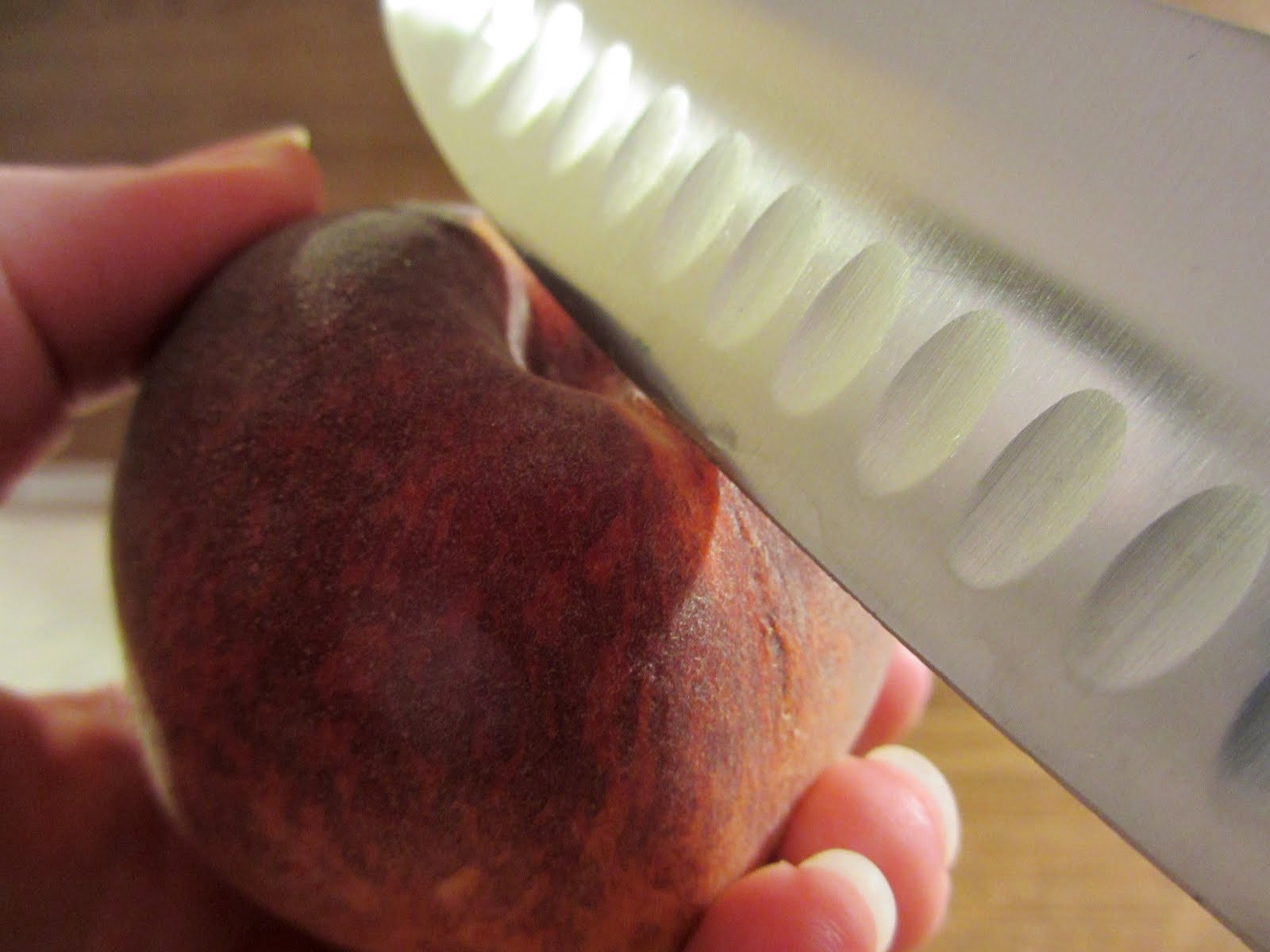
  • The best way to cut a peach is to run your knife along the handy groove in the peach, in a circle all the way around the fruit. Be sure the cut deep enough so that the knife approaches the pit most of the way around. Then put down the knife, grasp each half of the peach in each hand (by the palm, not the fingertips), and twist.  The peach will separate very nicely from the pit and you'll have two smooth halves to bite into.


The best way to cut into a peach, demonstrated on a very unripe peach. If this were ripe, there would be juice dripping everywhere. Wonderful, delicious juicy juiceness. But no. Dry as a bone.
(Photos by the Apple Lady)

  • The term "freestone" does not designate a variety of peaches but rather a feature, which is that the fruit separates relatively easily from the pit. Saying you're about to eat a freestone peach is like saying you're going to take a ride in a convertible. Saying you're going to eat a freestone Red Haven would be like saying you're going to go for a ride in a convertible Trans Am.
  • Nearly every variety of peach sold in stores and most peaches grown locally are freestone peaches. Most people just don't like the hassle of tearing the pit away from the flesh.
  • The opposite of freestone, by the way, is cling, which means the peach clings to the stone. Most canned peaches are identified as cling peaches. 
  • (Full disclosure: I used to think that canned peaches were called "cling" because of the odd way that the corn syrup & juice makes the peach slices seem to cling to each other.)

 
This is what eating a peach should be like. Messy and juicy and fantastic.
(Photo from Backseat Gourmet)

  • White flesh vs yellow flesh is another distinction people are making these days.  Again, the color of the flesh is a feature that is characteristic of some varieties.
  • White-flesh peaches have a higher sugar content and they're even more fragile than the yellow-flesh varieties. Which says to me that the grocery store is absolutely not the place to buy white-flesh peaches.
  • Here are just a few of the 300+ varieties of peaches grown in the US:
    • Redhaven (most widely planted)
    • Loring
    • Gold Dust
    • Golden Jubilee
    • Summer Gold
    • Summer Lady
    • Ryan Sun
    • Big Red
    • Cal Red
    • Autumn Prince
  • Some of these grow best in the Midwest; others are better-suited to the southern Atlantic; still others grow best in California.


These peaches are from Georgia.
(Photo from Wikipedia

  • About the fuzz. I know a lot of people really dislike the fuzz. Truthfully, it can be a bit aggravating. If you wash the peach well in warm water, you can rub off most of the fuzz. Then if you cut the peach in half and bite into the half, rather than sinking your face into the whole peach, the fuzz will be less bothersome.
  • But why's it there in the first place? Nobody can say for sure.  The best or at least most prevalent guess seems to be that it helps protect the peach against invading bugs like aphids.
  • If you really hate the fuzz and you want to avoid it at all costs, eat a nectarine instead.
  • People say that the only difference between peaches and nectarines is that nectarines have smooth skin. But the skin seems a little thicker and the flesh seems to be more substantial and less delicate.
  • Genetically speaking, the smooth skin of the nectarine is a recessive trait.

 
Smooth-skinned nectarines on the left, fuzzy-skinned peaches on the right.
(Photo from Two Fat Bellies)
  • People call peaches the queen of fruits. They don't say that about nectarines.
  • Here's a really magnificent way to eat peaches. Besides just eating them raw, that is.
  • Cut up a couple of peaches and put them in a small saucepan. Heat them over medium heat and stir. 
  • As they get warm, the fruit will start to break down. Keep stirring until they've become a sauce.
  • Pour warm over vanilla ice cream. You will not believe that anything on this earth could taste so heavenly.

Sources
My own peach-eating and -picking experience
Michigan Peach Sponsors, How can I tell if a peach is ripe?, What are the differences between a peach and a nectarine?
Pickyourown.org, Peach facts and picking tips
Stan Sesser, "The Best Peach on Earth," The Wall Street Journal, August 21, 2009
Rodney Bosch "Peaches, Abundant and Cheap, Can Often Fall Short on Flavor," Los Angeles Times, July 28, 1994
Gary Gao, Growing Peaches and Nectarines in the Home Landscape, Ohio State University Extension Fact sheet
Bill Shane, Growing Peaches in the Home Garden, Michigan State University Extension
Mac's Pride FAQs, McLeod Farms
Susan Westmoreland, "Freestone vs. Cling Peaches," Good Housekeeping