Friday, May 27, 2011

Apple #526: Sheriff vs. Police

I have received another request!  Regular Daily Apple reader Geronimo and I happened to walk past a sheriff's car yesterday, and Geronimo said, "Here's a Daily Apple for you.  What's the difference between the sheriff and the regular police?  And state police, too?"

He went on to say that in Westerns, the sheriff used to be one guy in charge of all the deputies in town.  But since there are lots of cars marked Sheriff and lots more cars marked for the police department driving all over our city, it seems like the Sheriff is no longer just one guy but lots of people.  But are the sheriffs in charge of the police officers, or what are their roles?  And what about the state police, too?

Geronimo, I have your answer.
  • Essentially, the differences boil down to jurisdictions.
      • Police: local city or town or municipality
      • Sheriff: county
      • State police: state
  • There are, of course, more details about the differences in their duties and how they operate.

Local Police


The Texas City, Texas, Police Department.  Their sub-units include patrol, SWAT, Crime Scene Investigation, Criminal Investigation, and K-9 units.  A police department this large probably wouldn't need much help from a sheriff's office.  But a smaller town with a smaller police force might.
(Photo from the Texas City Police Department)

  • Local police patrol within a city or a town.  Within the city or town limits, they are supposed to maintain public safety, cite or arrest people if necessary, and provide safety education to people who live there. 
  • They may also have specialized sub-departments such as bomb squads or riot police.  But these sub-departments, again, will only operate within the city limits.
  • Most police departments, however, are quite small.  The majority of police departments employ10 or fewer officers.
    • Local police officers' salaries are paid out of the town or city budget.
    • Local police report to the Police Chief, who is appointed.  Usually it's the mayor who does the appointing, but sometimes it's a city commissioner or board of city leaders. 
    • Local police officers usually wear blue.

      Sheriffs 


      All these people -- and the dog -- work for the Sheriff's Office in Montcour County, PA.  The guy in the middle wearing the suit, the one who looks like a crime boss, is the Sheriff, Ray C. Gerringer.  Everybody else is some type of deputy.
      (Photo from Montcour County)

      • Sheriffs operate at the county level.  So they generally patrol outside city limits, in the more rural parts of a county.  They can, however, go into the jurisdiction of the local police (into town) to perform their jobs.
      • Some towns may ask sheriffs to act as their local police and patrol their town.  Instead of forming their own police department, they'll pay the county sheriff's office for police patrol.
      • Strangely, even though sheriffs operate at the county level, they are created, so to speak, by a state's constitution.  The state constitution is where a sheriff's duties and responsibilities are outlined.

      The person driving this car may not be the actual sheriff.  At the very least, he or she works for the sheriff's office.
      (Photo from GaramChai)

      • There is only one Sheriff.  Everybody else who works in the sheriff's office is a deputy of some kind.
      • The Sheriff is an elected official.
      • Sheriff's offices may also act as a coroner's office.  
          • Coroners, by the way, also act at a county level. They are sort of the Keeper of Death-Paperwork.  They investigate suspicious deaths, determine or declare causes of death, issue death certificates, must be present at cremations, and they may perform or hire services such as autopsies or toxicology testing. 
      • Another side note: the word "sheriff" comes from the Old English "shire reeve."  The reeve was the law-keeper who worked for the King or whoever was in charge of the shire.  I was hoping to find an explanation for why the word has only one r and two f's, but the etymology didn't help much. In fact, the etymology would suggest even more strongly that the word should have two r's instead of one.  But who ever said that English spellings made sense?

        State Police


        These are state police troopers from West Virginia.  If you see some sort of police official wearing a hat in that funny shape (it's called Campaign style), you'll know they're a state trooper.
        (Photo by the West Virginia State Police)

        • State police work for the state.  So everything they do lives at the state level.
        • State police chiefs are appointed by the governor.
        • State troopers are generally associated with highway patrol, and they do a lot of that.
        • There might be a special sub-unit within the state police that's assigned to highway patrol.  Those highway patrol units will be assigned, not to highways across the whole state, but to specific sections of highway within the state.  The State of California Highway Patrol (CHiPs), for example, has units assigned to patrol highways in and around LA County.

        Ponch and Jon were actually state troopers working for the California Highway Patrol.  I used to have a major crush on Jon.
        (Photo posted by BigMac at Metal Banned)

        • State troopers may also investigate drug trafficking, organized crime, human trafficking, illegal immigration, or other wide-ranging activities that encompass lots of territory within a state or involve transporting lots of things or people over highways. 
        • State troopers are also the ones who monitor highway weigh stations.
        • They may step in to help local police or even county sheriff's office in time of need.  They may help with particularly difficult criminal investigations, or they may help in times of disaster relief, or during search and rescue efforts.
        • Because state police are funded at the state level, and because they are often involved in more extensive detective investigations, they tend to have the best equipment or the most specially trained units of any police force in the state.
        • State troopers may also help protect high-ranking state officials, or state property, or people or places in rural areas that don't have much of a police presence.
        • Generally speaking, state trooper departments are very large.  They average around 2,000 people per state.
        • State troopers usually wear brown.  And the funny hats.


          A whole bunch of police.
          (Photo from the Sun Sentinel)


          No, not these guys:

          They're a different operation altogether.
          (Photo from Graphics Hunt)


          Not the Dream Police, either.  (Song starts at 1:00)


          Sources
          Broward County Sheriff's Office, What's the difference between a sheriff's office and the police department?
          Wise Geek, What is the Difference Between a Sheriff and a Police Officer?
          Differencebetween.net, Difference Between Police dept and Sheriff's dept
          Los Angeles County Sheriff's Department, What is the difference between a Police Officer, Highway Patrol Officer, and a Sheriff's Deputy?
          FAQ, Trivia and Information on Life in America: Ask A Desi, Sheriff and Police
          HowStuffWorks, How State Troopers Work
          The Chippewa Herald, What does a coroner do?
          Q and As Career: What Does a Coroner Do?

          Monday, May 23, 2011

          Apple #525: Herons vs. Egrets vs. Cranes

          Several years ago when I was visiting my friend Maximilian, I saw in his backyard a white bird with a long skinny neck and skinny legs.  I asked him what it was, a heron, a crane, or what?  He shrugged and said, "Goony bird."  He said that's what his grandfather calls any of those wading birds because it's so hard to tell one kind apart from another.  I have used "goony bird" with great satisfaction and success ever since.


          A bunch of wading birds, or goony birds. (Actually, they're egrets.)
          (Photo by KS Chak at Picasa)


          But recently, as I have become more aware of birds in general, I decided I wanted to know the difference.  I asked a couple of friends what the difference was.  "One kind has a crook in its neck?" one friend ventured.  "Herons are blue," said another, "aren't they?"

          The fact that my other friends didn't know the difference either was a sign: time for a Daily Apple.

          • According to the various sources I found, even the birding people have trouble telling the three apart sometimes.  So if I mis-state something here, please correct me (without shouting or belittling, thanks) in the comments and I'll fix the error as soon as possible.

          HERONS
          • Most commonly, herons have dark, almost dusty-looking feathers. They might even look a little ragged around the edges.
          • Often their feathers are a dusty or steely blue. These are probably Great Blue Herons.
          • Very rarely herons can be white. These are Great White Herons (more on them in a bit)
          • While flying, the heron holds its neck in an S shape. This is because the head and neck weigh more than the body.
          • Most varieties of heron have a yellow beak.
          • Like to roost in trees.
          • Herons tend to be solitary (a few varieties like to hang around in groups, but not many)
          • They stand and wait for prey in the water to happen by, then spear it with their beaks.

          Great Blue Heron. Younger blue herons' feathers are duller, less blue, but definitely not white.
          (Photo from Carnivora forum, posted by Maersk)


          Great Blue Heron in flight.  Neck held in telltale S curve.
          (Photo from Zimbio)

          • There are other types of herons than the Blue and the White, but the Blue is the most common, and the fact that there's a white one is often what mixes people up.

          This is a Yellow-Crowned Night Heron. One of the few varieties of heron other than the Great Blue that lives in the United States. This one is from the Everglades. Doesn't look much like a heron at the moment, but wait til it flies and you'll see that characteristic S bend.
          (Photo by Amy at Magnificent Frigate Bird)
           
          • The Great White Heron is actually a variant of the Great Blue Heron, but it is much rarer. It lives only in South Florida especially in the Everglades and in some parts of the Caribbean.
          • Found mainly near salt water.
          • Is huge -- 50 to 54 inches long
          • Has yellow or pink or otherwise light-colored legs.

          This bird was identified as a Great Egret, but its legs are yellow, which means it's a Great White Heron.
          (Photo (c) Tristan Reid, sourced from Surfbirds.com)


          EGRETS
          • Herons and egrets tend to get grouped together.  Both generally have long necks and long bills.
          • Like herons, they also fly with their necks held in an S shape.  
          • Generally speaking, egrets are smaller than herons.
          • If it's all white, it's probably an egret.  Some herons have white feathers, but they also have black tips or gray overlays, or some other color involved.
          • The Snowy Egret has a black beak and black legs and yellow feet.
          • The Great Egret has a yellow beak and black legs.
          • The black legs is the easiest way to tell that it's a Great Egret and not a Great White Heron.
           
          Snowy Egret. Smaller than herons, smaller than the Great Egret. Tends to do this hunchback thing while sitting. Note the black legs and yellow feet.
          (Photo by J.R. Compton)


          Snowy Egrets look more majestic while flying. They hold their necks in the S shape.
          (Photo by actual at Weather Underground)


          Great Egrets have bigger everything than Snowy Egrets: longer beak, longer legs, bigger wingspan. Note the black legs.
          (Photo from InformZoo)


          CRANES
          • Cranes are in a different order than herons and egrets. They're part of the Gruiformes. I mention this only as a way of saying that the differences between herons and cranes are greater than the differences between herons and egrets.
          • Cranes fly with their necks held straight 

          Neck outstretched while flying means it's a crane. This happens to be a Common Crane.
          (Photo by Dr. Glenn Olson, sourced from Journey North)

          • Call sounds like a trumpet with a rolled "r" and can be heard for miles
          • Do not like trees
          • Cranes are much more gregarious, preferring to hang around in groups.
          • Cranes are the ones who do those elaborate paired courtship dances. 
          • They will eat plants as well as fish and frogs and bugs.
           
          Sandhill cranes have brown body feathers and a red forehead.
          (Photo from Wild Facts)


          Whooping Crane in flight. These tallest birds in America nearly went extinct but are now making a comeback. Note the black wingtips and the red forehead and cheek. Beak is short, almost duck-like. No S bend in its neck while flying means it's not a heron or an egret.
          (Photo from the Whooping Crane Eastern Partnership, sourced from US Fish & Wildlife Service)


          You might be tempted to call this a heron, since its feathers are dark gray and it's walking with a bend in its neck. But it's actually a Common Crane.  Note the red patch at the forehead, the short beak, gray legs, and relatively smooth feathers except for that bustle-like tuft at the end. And remember, the S rule only applies during flight.
          (Photo by David Hutton, from the BBC)

          • There are lots of other varieties of cranes, but the Sandhill, Common, and Whooping are the three that live in North America.

          OK, so let me see if I can simplify this some more so I'll actually remember the differences:
          • Herons: usually gray or dusty blue, fly with S in their neck
          • Egrets: all white with black legs, also fly with S
          • Cranes: may be lots of varying colors, fly with straight neck, like to hang out in groups

          Does that help?


          Sources
          Bird Watcher's General Store, Cranes vs. Herons
          Carnivora Forum, Sandhill Crane vs Great Blue Heron 
          The Tiny Aviary, Of Cranes and Herons, July 2, 2008
          Surfbirds.com, Herons, Egrets, and Ibis of North America
          Earthlife.net, Ardeidae: Herons, Egrets and Bitterns
          USGS, South Florida Information Access, Great White Heron (Ardea herodias)
          JR Compton, Amateur Birder's Journal, Herons vs. Egrets
          Thinkquest, Explore the Life of a Pond, Cranes, Herons, and Egrets
          Cornell Lab of Ornithology, Great Blue Heron, Whooping Crane

          Sunday, May 15, 2011

          Apple #524: Mount Etna

          I check weather.com frequently.  It's a wellspring of information.  Today, I learned from that uber-useful site that Mount Etna erupted recently.  So I thought I'd find out more about the volcano.


          • As of this writing, Etna's most recent eruption happened on Thursday, May 12, 2011.
          • Etna is one of the most active volcanoes in the world.

          Etna is a volcano on the island of Sicily, which is south of Italy.  It's about ten miles from a town called Catania, whose citizens have been dodging Etna's lava for centuries.
          (Map from geology.com)

          • Eruptions have been documented as far back as 1500 B.C. and it has erupted more than 200 times since then.  
          • Scientists think it originated underwater.  It has erupted so many times, it's now above sea level.
          • Notable eruptions include one in 1669 that marked people's first efforts to try to control the flow of lava, but the lava made it all the way to the town of Catania and the sea as well.  It killed somewhere between 60,000 and 100,000 people.  After that disaster, artificial attempts to stop the flow of lava were outlawed until the 1980s.

          From a fresco in the cathedral at Catania depicting the eruption of Mount Etna in 1669. There are two vents shown here, the smaller of the two with a 9 kilometer-long fissure extending from it.
          (Image from U.C. Davis)

          • Another notable eruption happened in 1852 when the volcano spewed forth more than 2 billion cubic feet of lava that covered more than three square miles of land nearby.
          • In 1979, Etna began an eruption that would continue for 13 years.
          • In 1992, people tried to control the lava flow again, this time by using explosives to make a hole beneath the lava tunnel and then dropping huge concrete blocks into the hole to try to stop it up.  Like the effort in 1669, this was unsuccessful.
          • Etna's most recent series of eruptions started in 2007 and is considered to be "ongoing."

          Etna's eruptions are so common that this recent outburst was described in the media mainly in terms of whether it might affect this year's Giro d'Italia.  Cycling fans were assured that the race would go on as usual, with the eruption acting as a picturesque backdrop.  Officials did have to close the airport in Catania for a while, though.
          (Photo from the AP via the Daily Telegraph)

          • Scientists aren't exactly sure why Etna erupts as often as it does and where it does.  They have proposed lots of theories but none quite fit the data.  But Etna's behavior is probably related to the fact that it's located right where the African tectonic plate meets with the Eurasian tectonic plate.
          • Its unusual behavior may also be related to the fact that Etna is actually two volcanoes, one on top of the other.  The bottom volcano is a shield volcano.  The one on top is a more recent stratovolcano.
          • Shield volcanoes are usually huge in diameter, not that tall, and with broad long sloping sides that are built of many layers of lava flows.  Mauna Loa in Hawaii is the world's largest shield volcano.  Typically, the lava flows that come from these are relatively slow-moving.  The lava may also escape from fissures along the flank of the volcano, rather than exclusively from the central vent.

          Lava that flowed down from Mount Etna to the town of Nicolisi in July 2001.
          (Photo from Getty Images via National Geographic News)

          • Stratovolcanoes, on the other hand, are more cone-shaped, rise higher into the air, and are made up of layers of lava flows, mud flows, and pyroclastic material (I'll define that word in a minute). Mt. Fuji is the most notable type of stratovolcano.  
          • Stratovolcanoes are often the most deadly variety of volcano.  They are usually located at the convergence of two tectonic plates.  In most cases, stratovolcanoes are dormant for long periods of time, as the energy from the movement of the plates beneath builds up.  When stratovolcanoes do erupt, their eruptions are usually very explosive, powerful, and deadly.
          • One of the things that makes stratovolcanoes so dangerous is their creation of pyroclastic materials.  These are huge chunks of magma and rock that get blown to bits when a lava explodes.  The pyroclastic materials may range in size from rocks the size of a fist, to pebbles smaller than a dime, to ash. 
          • "Some of them are bigger than cars, and some might be as big as trucks," said one volcano watcher of the boulders coming out of Etna this week.
          • In spite of Etna's dual-volcano personality and its potential to cause a lot of damage, the fact that it erupts so frequently probably keeps it from being that much of a threat.  More dangerous stratovolcanoes hold in their energy for decades until it explodes and it's all released at once.  Etna's regular release of energy and gases are probably why it's not considered a pressing danger to people living in nearby Catania.
          • 2010 was a relatively quiet year for the volcano. When it erupted in January 2011, vulcanologists expected that it would continue erupting this year pretty much continually, maybe for weeks or months at a time. This eruption is confirming that expectation.

          Lava flows from Mount Etna's eruption in January 2011
          (Photo from National Geographic News)


          An eruption on the flank of Mount Etna in 2007.
          (Photo from Earthweek)


          An especially pyrotechnic eruption from Mount Etna.  I don't know what year this was taken.
          (Photo by Luke and Alyssa Meyr, sourced from MIS Blue Team Science)

          •  "Etna" is Greek for "I burn."  Seems aptly named, doesn't it?
          Sources
          The Sofia Echo, Mt Etna in Sicily erupts, international airport closed, May 12, 2011
          The Daily Telegraph, Volcanic threat erupts as Francisco Ventoso wins sixth stage of the Giro d'Italia, May 13, 2011
          Brett Israel, Mount Etna blasts lava, ash into the sky, OurAmazingPlanet via MSNBC News
          ABCNews, Volcano Chasers at Mt. Etna
          Mt. Etna erupts "like cannon" 6 tourists killed, 23 injured, The Montreal Gazette, September 13, 1979
          Jessica Ball, Geology.com, Mount Etna - Italy 
          San Diego State University, Department of Geological Sciences, Shield Volcanoes, Stratovolcanoes
          USGS, Shield Volcanoes
          Solcomhouse, Mount Etna

          Monday, May 9, 2011

          Apple #523: The Moon

          It's very late at night.  So I thought I'd find a few facts about the moon.


          Gallileo spacecraft took this photo of the Moon, not me.
          (Photo from NASA)

          • The Moon is made of the Earth. Scientists are pretty sure that the Moon was formed about 4.5 billion years ago, when a giant something-or-other about the size of Mars crashed into the Earth. The collision sent a giant spray of rock and earth and basically hunks of the Earth's crust flying into the air.  All the debris, smaller than the Earth, fell into orbit around our planet.  Gradually, after about 100 million years, the debris coalesced into what we now know as the Moon.  So you could say the Moon is very upper-crust.
          • We're about the same age. Even though the Moon was formed out of the Earth's crust, scientists have estimated that the Moon and the Earth about both about 4.56 billion years old.
          • But the Moon is a lot skinnier. The moon has about 1/80th the mass that Earth does. But don't worry. The Moon might be skinnier, but we're a lot more popular.

          The Earth, as seen from the Moon's surface. This was taken shortly before Neil Armstrong and Buzz Aldrin got out of Apollo 11 to go walk on the Moon. These kinds of photos always give me the strangest kind of vertigo.

          (Photo by Getty, sourced from CNN)

          • The Moon wants more space.  It's slowly moving farther away from the Earth, at a rate of about 4 centimeters per year. But don't worry, it's not going to break up with us completely.  In about 50 billion years from now, it will stop drifting away and settle into a new orbit.  By that point it will be far enough away that instead of taking roughly 27.3 days to make it around the Earth, it will take 47 days.  I wonder if we'll adjust our calendars by then.
          • The Moon's official name is "the Moon."  Nobody knew for a long time that other planets had their own satellites.  So when they called ours the Moon, they thought it was the only one.  When they found out there were other moons orbiting other planets, it was too late to call the Moon Murgatroyd or Mephistopheles or Millicent or anything else but Moon.  So they refer to the other moons as "a moon" with a lower case m, or else they give those other moons specific names like Io.

          The Moon on March 19, 2011, when it was at its closest point to Earth.  Scientists refer to this as the Super Perigee Moon.  It's seen here looking over the shoulder of the Lincoln Memorial in Washington, D.C.
          (Photo by Bill Ingalls at NASA)

          • The Moon shows us only its face.  Back in the good old days when the Moon was first formed, it used to rotate around the Earth and show off all its sides.  But over time its rotation slowed down untiil it became "tidally locked" with Earth. Another way to describe this is to say that it rotates on its axis at the same rate of speed as it takes to go around the Earth.  In other words, it's stuck on showing us one side. This is how we got things like Pink Floyd's Dark Side of the Moon. Because it only shows us one side, no one had any idea what was over there on the other side until 1959 when a Soviet spacecraft went over there and took pictures.  Thanks to lots more spacecraft and space cameras, NASA will soon be releasing new topographic map of the moon -- all the way around.

          Here's a recent composite of lots of photos taken by NASA's Lunar Reconnaissance Orbiter Camera, of the far side of the moon.
          (Photo from NASA)

          • The hot side stays hot and the cold side stays cold. Well, that's true for about two weeks at a time.  Because the takes 27.3 days to complete one rotation, its days are a lot longer.  One full day, from sunrise to sunrise, takes about 27.3 days.  This means that for two weeks, the same side of the moon is facing the sun.  Because there's barely any atmosphere around the Moon -- or at least, not like what we have -- the sun's light and heat go straight to the Moon's surface.  The bright side can get up to 243 degrees F in that two-week period.  Meanwhile, the dark side can get as cold as -272 degrees F in that same time period.
          • The Man in the Moon is really geography. What we think looks like a face is the highlands, which look brighter, and the large seas of once-upon-a-time-volcanic-lava, which are darker.  This lunar geography was formed by all sorts of asteroids and other space-things slamming into the Moon and leaving scars all over the place. 

          I always wondered what exactly people thought was the man in the moon.  This is one person's outline.  Is this where you see the man in the moon, too?
          (Image by David Haworth)

          I like to think of the Moon as friends with all of us.  Here, it's friends with the giraffes. 
          (Photo from desktopart wallpaper)


          Other Daily Apple entries about the Moon:
          Blue Moons
          Full Moons, Orange and Otherwise
          Origins of the Earth and Moon
          Lunacy and the Full Moon


          Sources
          Fraser Cain, Interesting Facts about the Moon, Universe Today, October 24, 2008
          NASA, The Far Side of the Moon -- And All the Way Around, March 11, 2011
          The Earth's History, How old is the Earth?
          National Geographic News, Moon Facts, July 16, 2004
          NASA, Solar System Exploration, Earth's Moon

          Saturday, May 7, 2011

          Apple #522: The Two-Dollar Bet

          My friend--call him Jeroboam--is going to the Kentucky Derby tomorrow.  I asked him to place a bet for me, and I gave him the standard minimum amount, $2.

          Afterward I wondered, why is the standard minimum bet $2?  That seems to be true only in horse racing, so is there something about horse races or how betting on horses that just works well with $2 bets?  Did that practice come from some particular track or country?  Where does this whole $2 tradition come from?


          How did this ↑ get so closely connected with that ↓?
          (Photo from Horse Racing Tips)

           
          (Image from Wikimedia Commons)

          • I looked and looked for the answer to this.  From what I could find online, nobody knows, it's just tradition. Most people really don't care why it's so.  It just is.

          People placing their bets on horse races.  Are we locked into doing it this way because we've always done it this way?  But "always" had to have started at some point or other.
          (Photo from the LA Times blog)

            • Apple Lady that I am, I did not want to accept this as an answer.  So I adjusted my question (sometimes when you can't find the answer you seek, it's because you're asking the wrong question).  I have it in my head that all things about modern horse racing come from Ireland.  So I wondered if they have a $2-minimum bet there, or a £2-pound minimum, or a 2-punt (Irish pound) minimum.

            What the Irish punt looks like.  Ah, apparently they don't use the punt there anymore.  Too bad.
            (Photo from sabsi at Virtual Tourist)

              • Nope.  Minimum bets in Ireland vary from track to track more than they do here in the U.S. Many tracks and turf accountants (Ireland's word for horse racing bookies) take £2 minimum bets, but some will take a £1 minimum, and others will accept a €1 minimum.  
              • Just because their standard minimum bet isn't some unit of 2 doesn't necessarily mean the Irish weren't the ones who started that, but since we're talking about betting and all, I'm going to bet that the practice didn't come from Ireland.  My theory is that if it did, they'd still be doing it that way pretty much across the country instead of scattered here and there.
              • So I went at my question yet another way.  I looked up the history of horse racing and betting in general, hoping I'd stumble across some little factoid or person's name that might lead me to the first $2 bet.
              • I didn't encounter anything like that, but I discover the origin of parimutuel betting.  What's that, you say?
              • Well (this is a side note, obviously), renditions of the story vary, but there was this French guy, Monsieur Joseph Oller. He was from Spain but he lived in France.  Lots of sources say his name was Pierre and he owned a perfume shop.  But actually his name was Joseph and he was into cockfighting.  He wanted to invent a way that the bookie could always make money on a bet, no matter what the odds or the payout.  Cleverly, he came up with a mathematical formula and a machine to go with it.

              Joseph Oller. He invented the parimutuel betting process, which is used at nearly all horse racing tracks today.
              (Photo from the Rutherford Journal)

                • Details of the machine are vague, but it sounds an awful lot like a specialized calculator.  Apparently his machine kept track of how much money people put down on a particular horse or a particular race. Once the race was over, the machine/his system tallied up the total money in the pool, took out a fixed percentage in taxes and fees to the bookie or the track (the percentage today may range from 14 to 25 percent), and then divided up the rest of the money equally among all the winning bettors.

                A descendant of Oller's machine, this is an early "totaliser" used in Auckland in 1906.
                (Photo by J. Chadwick, sourced from the Rutherford Journal)


                Today we call them tote boards and they look like this.
                (Photo from Saratoga.com)

                  • People say the reason Oller's method is called "pari-mutuel" is because it became popular in Paris before coming to America.  These people have not looked at their French etymology.  The word literally means "to equalize a bet." The reason bettors liked this system is, for one thing, the machine made it harder for the bookies to cheat (something Oller got caught doing once). It also meant that people at the track got paid the same as people who couldn't go, and people who bet a little got the same percentage as the people who bet a lot.
                  • Tracks and bookies like the system because it means they will always get paid no matter what.
                  • Oller's system was developed in 1865.  People describing it don't mention anything about a 2-franc bet. If anything, they put all talk of money into US dollars and jump straight to the present day and get into trifectas and exotic bets and all sorts of other, more modern stuff.  So it's difficult to tell if the $2-bet or its French counterpart existed when Monsieur Oller cockfighter/inventor came up with his system.
                  • One thing that was clear from what I read about the history of horse racing is that the Jockey Club formalized a lot of the rules of horse racing and breeding.  So I checked them out.
                  • No mention of whether they had anything to do with establishing the $2 bet as the standard, or even whether they had much to do with rules about betting at all. But I thought there might be some other clues about their history that could help us out.
                  • The first time the Jockey Club got together to hatch their horsey plans was in 1750.  Mainly they wrote down a bunch of rules. By 1814, they had established five races, now considered classics, for three year-old horses in England.  They are the three races that make up the English Triple Crown plus the 1,000 Guineas and the Epsom Oaks races, all of which are still run today.  Since these races were so seminal to the sport, it's possible that betting conventions started somewhere in this time period.

                  A cartoon poking fun at the Jockey Club, circa 1790.
                  (Engraving by Thomas Rowlandson, sourced from the Georgian Index)

                    • But that's all taking place in England. People were racing horses in America, too, while all this was going on.  But horse racing wasn't really formalized here until after the Civil War.  
                    • In 1868, the Jockey Club published its first copy of The American Stud Book. This is an alphabetical list of all the Thoroughbred horses in the United States, and it is still published each year. If you're a horse and you're not in this book, you're not anybody.  What gets you into this book is if you are an American descendant of horses that were listed in the General Stud Book which was first published by one of the Jockey Club's founders in 1791.
                    • So these Jockey Club people are the ones who decide who's a Thoroughbred and who isn't.  They hold the reins to the whole enterprise.

                    Volume II of the first American Stud Book.
                    (Photo from the FullWiki)

                      • To me, this American Stud Book looks like the watershed moment in the history of American horse racing.  This looks like the event that established horse racing as the breeding-conscious, uber-competitive animal that it is today.
                      • So I thought, "I wonder what people got paid in 1868." Then I looked it up.
                      • Daily wages varied quite a bit depending on whether you were male or female, whether you worked on a farm or in some type of factory.  But in 1868, a male factory worker took home, on average, roughly $2 a day.
                      • Oooh, don't you love it when facts line up like serendipitously that?
                      • OK, so maybe this is too serendipitous.  I've made a lot of guesses and assumptions along my researching journey to this point.  But even if the fact that a daily wage in 1868 was $2 is not the reason we maintain $2 as the standard minimum bet, it sure is interesting that, once upon a time, people loved horse racing so much that they were willing to bet an entire day's pay on one horse in one race.
                      • As one horse racing enthusiast pointed out, in 1930, you could walk into any race track in America and place a $2 bet to win.  You can do exactly the same thing, for exactly the same amount, more than 60 years later, in 2011.  Where else, in what other casino or lottery or betting pool, has the minimum bet stayed the same for over 100 years? 
                      • That's a rhetorical question. I don't intend to research that one.

                      Let's hope tomorrow's is a good race.
                      (Photo from the horse racing blog)


                      P.S. The horse I picked didn't win.  Not even close.  But Animal Kingdom sure did put on a show, didn't he?

                      For this specific race, a $2 bet on Animal Kingdom paid $43.80, $19.60 and $13 if you bet to win, place, or show, respectively. Nehro paid $8.80 and $6.40 to place or show. Mucho Macho Man paid $7 to show.

                      If you want to understand how to calculate what a $2 bet might pay, this page is a good place to start for some basic information.


                      Sources
                      University of Massachusetts Lowell, Center for Lowell History, Weekly Wages, 1824-1868
                      Matt Gardner, Handle, Inflation and the $2 Win Bet, and down the stretch they come, August 23, 2010
                      Gambling in American History, Pari-mutuel Wagering Systems, March 19, 2010
                      Bill Burton, About.com, The History of Parimutuel Betting
                      Northlands Park, How to bet the horses?
                      Webster's New World Dictionary, parimutuel definition

                      Monday, May 2, 2011

                      Apple #521: Where Does the Debris Go?


                      [Note from the Apple Lady: I was in the middle of working on this entry when I got the news about Osama Bin Laden.  I realize you're probably not all that interested in the topic of this entry at the moment, but rather than switch horses to a subject having to do with war, I decided to stick with this.  At the very least, I wanted to finish what I started.]

                      I have had a request!  Daily Apple reader Leopold pointed out that, in the wake of all these storms and hurricanes and tornadoes, there is rubble all over the place.  That all has to get cleaned up, of course.  But, he wanted to know, where does the rubble go?

                      The destruction surrounding those severe storms is certainly not a happy topic so that might seem to make it not suitable for the Daily Apple, but rubble-removal is the beginning of rebuilding.  Plus, I suspect that the people who do the rubble-hauling largely go unseen.  So this will shine a light on these essential services that most of us rarely think about.

                      • The short answer to where does the rubble go (the term the officials use is "debris") is to the landfill.

                      A landfill, it turns out, isn't just a great big hole in the ground, but it's a pretty sophisticated combination of engineering and chemistry.
                      (Diagram from Runco Environmental)

                      • But of course the more complete answer to Leopold's question is more complicated than that.

                      WHAT THE "STUFF" IS
                      • Exactly where the debris goes depends on what kind it is, whether it's vegetable, construction, or hazardous material.
                      • The first thing a city or county or municipality does is to take care of any hazardous situations.  While this may include downed power lines, the city may have to remove downed trees or branches in order to get to the power lines.  So the way they describe this step is to say that they clear roadways to allow vehicles to access any potentially hazardous areas.

                      This is exactly the kind of hazardous situation that gets taken care of first: a downed tree blocking a street and leaning on a power line to boot. This is after a winter storm in Santa Barbara, Florida, in January 2010.
                      (Photo by Victor Maccharoli from the Daily Sound)

                      • Most of the time what they're clearing away in this first step is vegetative.  Because trees and branches and stumps are bulky and weirdly-shaped, taking them straight to the landfill is strongly discouraged.  So the vegetation might get turned into wood chips first, or it may be taken somewhere for recycling, if it's possible to recycle any of that wood.
                      • Since the vegetative stuff has to get "reduced" before it's taken to the landfill, it's carefully collected separately from any construction material.
                      • In most cases, it is vegetative debris that people are dealing with after a storm.  But if a storm is especially severe, there may be construction debris to remove. As with the vegetative stuff, the construction debris gets sorted and processed, with the goal of recycling any of the materials if at all possible, and of reducing the bulk of the stuff.
                      • Broken concrete has to be divided into two types: that with metal bars in it and that without.  Concrete without metal bars is considered "clean" and can be re-used.  It can be covered up with uncontaminated soil and used as fill material in land that's going to be built up (think of those hills that get created out of nowhere when they build new roads or that go around new buildings).  Broken chunks of "clean" concrete can also be re-used as erosion control barriers.

                      This broken concrete has metal rods in it, which means it isn't considered "clean" or re-usable, so that's probably why it's been piled up together. This is in the aftermath of Hurricane Ivan in Pensacola, Florida, in 2005.
                      (Photo by Leif Skoogfors from FEMA)

                      • Bricks, rocks, stones, asphalt, and soil can usually be re-used for all sorts of building and engineering purposes, provided it hasn't been contaminated by, say, sewage or chemical spills.
                      • The construction material that can be re-used gets separated out.  Everything else goes to the landfill.
                      • Then there's the hazardous stuff.  This includes construction material (usually roofing) with asbestos in it, lead pipes, batteries, animal carcasses, infectious waste (think of what might happen if a hospital got hit by a tornado), toxic chemicals that might have been spilled, and soil that's been contaminated.  This stuff needs to get handled by waste disposal professionals who are specially certified to handle these types of materials.  The materials have to be contained and disposed of according to very specific guidelines that are tailored to each type of material.
                      • Included in the hazardous category are some household products.  Appliances, including refrigerators, air conditioners, ovens, washing machines, heat pumps, etc., all referred to as "white goods," may contain hazardous chemicals -- substances like refrigerants, freon, oil, or possibly even mercury.  Those chemicals have to be removed from the appliances before they are added to the landfill.
                      • Electronics like computers and cell phones and TVs also fall into the hazardous household goods category.
                      • Vehicles may also have to be disposed of.  In the case of cars or trucks, those are typically taken to a junkyard. Boats may be taken to a similar kind of junkyard, but for navigational vessels.  Vehicles usually don't wind up in the landfill because of the oil, gasoline, rubber tires, and the fact that they're pretty big and bulky.

                      Somebody's going to have to get that mini-van off the top of that other car and the huge tree branch.  That's got to be a specialty job.
                      (Photo of tornado damage near Beaver Creek, North Carolina from our amazing planet)


                      HOW IT GETS HANDLED
                      • After the city clears the roadways, there may be additional stuff to deal with.  If the storm damage is especially widespread in a city, the city might institute a kind of disposal grace period, so to speak. For a small window of time, they'll notify homeowners that collection trucks will circulate among the especially hard-hit streets and pick up any vegetative stuff that's been brought to the curb, at no charge to the residents.  The stuff is not to spill out into the roadway and block traffic, and it has to be carefully separated from any construction or building material.

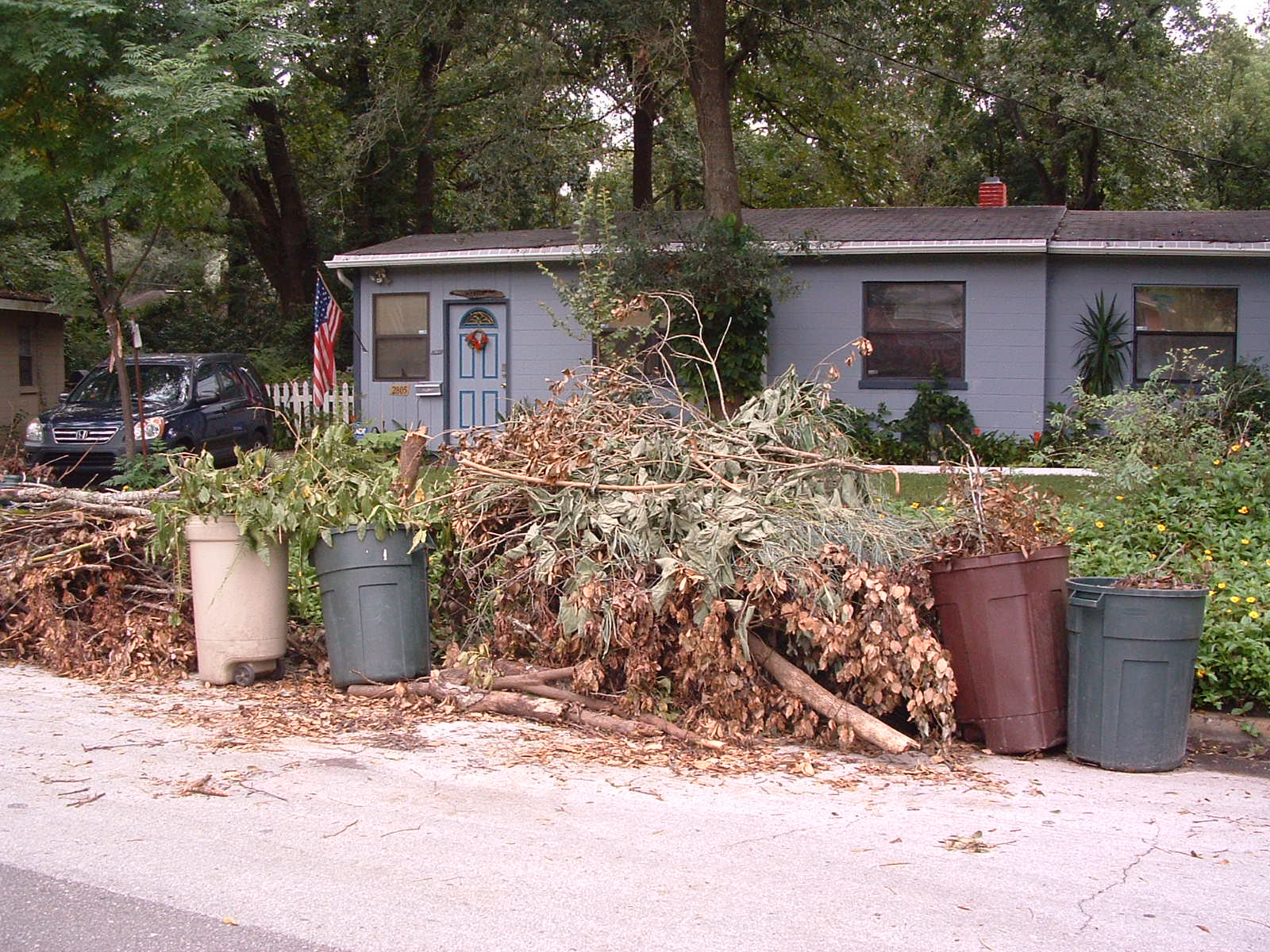
                      Vegetation piled along a roadside, waiting for city pick-up. This stuff is what fell down in one guy's yard during Tropical Storm Fay in Jacksonville, Florida, in 2008.
                      (Photo from Rabid Fun)

                      • Alternatively, a city may post notices that residents can bring their debris to the landfills free of charge.  In some cases, they may direct people to bring their debris to a separate way-station instead.  Once at the way-station, they'll still direct people to separate their vegetative stuff from the construction stuff.  People working at the way-stations will do some additional sorting and processing at the site before sending it off to be re-used or to the landfill.
                      • Where the stuff gets taken may also depend on who's paying for the clean-up.  Initially, the city or municipality would be in charge of the clean-up, but it may become apparent that the area should be declared a federal disaster area.  
                      • When that happens, FEMA gets involved.  They don't necessarily take over the clean-up process, but they may advise local officials about how to handle the sheer volume of stuff.  They may decide that the city needs to set up a way-station and they may advise the city on where to set one up.  
                      • FEMA officials will also monitor the debris-removal activities to assess what kinds of materials are being removed, and by whom, and using what procedures.  The disposal costs for which they reimburse are determined by these sorts of details, so FEMA keeps an eye on it.

                      WHO COLLECTS IT
                      • The first people to get involved are the city's waste collection services.  Good old trash trucks.

                      It was hard to find a picture of the guys who pick up the trash.  Lots of photos of the trucks, not so many of the people themselves.  These guys work for New Orleans' downtown trash collection service, SDT.
                      (Photo by Eliot Kamenitz at The Times Picayune)

                      • After larger storms, however, it may be obvious that the city doesn't have enough trucks, or the right kind of equipment like enormo-stump-grinders, or the right kind of expertise such as hazardous material handling.  That's when they call in the contractors.

                      There's no way a regular city trash truck or some guy with a chainsaw and a truck could handle this enormous tree, felled during the Raleigh, North Carolina tornado.  Time to call the special tree- and stump-grinder guys.
                      (Photo from active rain)

                      • Sometimes the contractors are simply guys with more trucks.  But often the contractors are businesses who have the equipment and expertise to handle specific materials.  There are contractors who specialize in stump-grinding, contractors who specialize in branch and tree removal, contractors who deal with refrigerant removal, who break up concrete, who collect and clean contaminated soil or mud, who handle asbestos, who clean up toxic chemical spills, etc., etc.

                      These guys work for VanBooven Tree Care. They're certified arborists and experts in tree pruning and removal. Notice the extra-long chainsaw blade, the special hard hats, and the protective gloves.  They were one company hired to help Kansas City clean up after a storm in 2010. By the way, the majority of injuries related to storm damage happen after the storm, when Average Joes get out there with their chainsaws and try to saw up trees by themselves.
                      (Photo from VanBooven Tree)


                      The Bobcat with the claw on it, being used here to pick up storm debris, and the huge Dumpster-like truck are owned by a contractor that specializes in storm debris removal. The stuff they're collecting is debris from Hurricane Katrina in New Orleans.
                      (Photo from VCM Ventures, Ltd.)


                      These guys are experts in asbestos removal. They're all suited up as federal regulations require. The thing they're throwing out is a piece of ceiling tile.
                      (Photo from Asbestos Jobs Info)


                      WHO PAYS FOR IT
                      • All this debris- removal costs big bucks.  Providence, Rhode Island estimated that dealing with the tree damage alone after a storm that struck six nearby cities would cost an estimated $54 million.
                      • Days after the tornado hit Raleigh, North Carolina, the city put 40 trucks to work collecting vegetative waste left along the roadsides as part of that first-stage debris removal. The city thinks that tree & branch removal alone will cost $1 million, but that amount could easily go higher.  The city expects it to take another six weeks for a private contractor to haul away some 150,000 cubic yards of debris. They didn't offer an estimate for what that might cost.
                      • St. Louis spent $10,000 on Dumpsters and $30,000 on a huge tree grinder. One city administrator estimated that cleaning up the debris on one particular street alone would cost an estimated $3 million.  That $3 million is significant because it represents one threshold of damage that a county must reach in order to qualify for FEMA reimbursement.
                      • If FEMA gets involved, they will reimburse local governments for expenses related to the removal of some types of materials, but not all types. Generally speaking, they reimburse for the removal of material that's on public property but not private, they don't reimburse for general construction material removal because most insurance policies cover that, and they'll reimburse for the removal of only some types of hazardous material, provided it's dealt with according to regulations.
                      • Typically, the federal government is estimated to cover about 75% of storm clean-up expenses.
                      It always amazes me how destruction can happen so fast, in a matter of minutes or even seconds, but recovery and rebuilding takes so much longer -- years longer, sometimes -- and with so much effort.  Here's to all the people who are helping others dig out and rebuild.


                      Sources
                      Laura Camper, Removal of post-storm debris poses challenges, The Anniston Star, April 30, 2011
                      State Helps with Grove Tornado Debris Cleanup, Williamsburg Yorktown Daily, May 1, 2011
                      Record tornado outbreak left massive cleanup job, The Miami News-Herald, April 23, 2011
                      Reece Rutland, Reports: 285 homes completely destroyed, Cleveland Daily Banner, April 30, 2011
                      Survey Shows Clean Up Could Cost Cities Millions, Providence Business News, April 28, 2011
                      Raleigh makes plans for storm cleanup, Raleigh News-Observer, April 18, 2011
                      NCDOT to help with debris removal, Jacksonville Daily News, April 21, 2011
                      Cities cleaning up from the storm are worried about the bottom line, St. Louis Today, April 28, 2011
                      Illinois Environmental Protection Agency, Construction and Demolition Debris
                      FEMA, Debris Management and Debris Management Guide
                      Brookhaven National Laboratory, Pollution Prevention