Sunday, September 9, 2012

Apple #602: Toasting Etiquette

I've had a request!  Daily Apple reader Jarred wants to know:
Apple Lady, what's the deal with toasting etiquette? I have always heard that you only clink glasses when it's wine, but nothing else.  Do you think this would be a good topic for a Daily Apple?

Of course it's a good topic for the Daily Apple!

My first response was that what's in the glass should be alcoholic, not necessarily wine.  But I looked into it to see if that's correct.


They're toasting with wine here, but you don't necessarily have to have wine in your glass to drink a toast.
(Photo from Taylor Eason.com)


What's in the Glass
  • Traditionally it was considered de rigeur that everyone's glass contain alcohol, but most people now agree that that's not necessary.  The only beverage which you are not supposed to drink during a toast is water.
  • Why not water?  According to superstition, it's bad luck.  I couldn't find much about why, except that among sailors, drinking a toast with water is considered hoping that the toast-ee will die by drowning.
  • What is important is making sure that everyone's glass is filled before offering a toast. 

 
This is Virna Lisi and she's toasting you.  I think that's champagne.
(Photo from Starlet Showcase)

Other Toasting Etiquette
  • The host should be the first to toast.
    • Exception: If you're into the dessert and the host still hasn't offered a toast and doesn't seem likely to do so, it is acceptable for a guest to offer the first toast.
    • Exception: At less formal occasions such as at a small dinner party, if a guest wants to toast the host in thanks, that's acceptable.
    • Exception: At weddings, it is traditional for the best man to offer the first toast.
  • If it's a large group and you want to get everyone's attention, stand up.  Don't click silverware against the glass because 1) that's annoying and 2) you might break the glass and no one wants shattered glass all over the table.  Simply standing will get people's attention.  Invite them to stand with you and soon everyone will be standing and ready to listen.
  • The only person who should not stand is the person who is being toasted.  If you are the one being toasted, for example, you should remain seated, accept the toast graciously but do not drink from your glass, and after everyone has drunk, thank the person who made the toast.  To participate in the toast when you are being toasted would be like applauding yourself. 

Proper toasting etiquette is being observed here for the most part. The toast-er is standing, holding his glass to the toast-ee, who is apparently the bride, who is sitting. The other guests are also sitting, but since it's a small group, that's OK. The only etiquette violation here is that the bride is apparently planning to drink to herself, and that would not be OK.
(Photo from eHow)
 
  • It's not necessary that everyone clink glasses, especially if it's a large group.  Raising your glass and calling out something like, "Cheers!" or "To Jarred!" or some other group response following the toast, and then drinking, is perfectly appropriate.
  • If you are the one making the toast:
    • Keep it short.  Everyone is holding their glasses aloft, patiently waiting to be allowed to drink. They don't want to stand there holding their glasses while you go on and on about what happened in the second grade. If it's a formal occasion and you want to give a moving, personal, delightful performance, preparing something ahead of time may be appropriate. But still, brevity is the soul of wit and much appreciated by thirsty party-goers.  Write down what you want to say and cross out about half of that.
    • Keep it sweet. Even if you want to begin a toast by remembering someone who is no longer alive but dearly missed, that's fine, but end on a positive note. Any group gathering is a celebration among those present, so let everyone enjoy the current, happy occasion.
    • Make eye contact with the person being toasted.  You're offering that person a gift with your toast, not grandstanding so that everyone can admire you. Looking at the toast-ee will invite the rest of the group to do the same, thus putting the focus on the correct person.
  • If you are in another country, other or additional rules about toasting may apply. In France, for example, you should never allow your arm to cross another person's while clinking your glass. In Japan, the glass is continually refilled so that it never goes empty. In Korea, the glass is not refilled until it is empty. It's even good form to shake out the last few drops so that the host knows to refill your glass. The best policy is to keep your eyes and ears open and do as the [insert name of country here]s do.

Of course, even the most formal occasions can veer toward the informal as the evening goes on. Regulations about proper toasts get a little looser too. Though I think the no-water rule would still apply.
(Photo from Wikimedia)


Some Short & Sweet Toasts
  • Cheers!
  • Salud!  (Spanish)
  • Prost! (German)
  • Skål! (Swedish)
  • L'chaim! pronounced leh-CHAY-eem (Hebrew)
  • Sláinte pronounced SHLAWN-cha or SHLAWN-ta (Irish)
  • My heart is as full as my glass when I drink to you, my friend!
  • May your home always be too small to hold all your friends.
  • Here's to your health! You make age curious, time furious, and all of us envious.
  • To your very good health. May you live to be as old as your jokes.
  • May your joys be as deep as the ocean, and your misfortunes as light as its foam.
  • A full belly, a heavy purse, and a light heart.
  • May the road rise to meet you.
    May the wind be always at your back.
    May the sun shine warm upon your face;
    the rains fall soft upon your fields and until we meet again,
    may God hold you in the palm of His hand.
  • May those who love us, love us
    And those who don't, may God turn their hearts.
    And if He doesn't turn their hearts,
    May He turn their ankles
    So we'll know them by their limping.
 For more toasts for all occasions, check out the Etiquette Scholar.


Some of those toasts are for decidedly less formal occasions.
(Photo from 100 Beers)


History, or at least Legends

These little tidbits have been repeated several places as historical fact. I can't verify that they are historically accurate, but if only through sheer repetition, they have come to be regarded as fact.
  • Supposedly, the practice of raising and clinking glasses prior to drinking originated in Greece. Apparently, sneaking poison into other people's drinks was a rather common practice.  Everyone taking their first drink together was considered a gesture of good faith--or else it was a way to find out fast if anyone at the table had been poisoned.
  • Clinking glasses is also thought to have originated with that fear-of-poisoning thing. The idea was that clinking glasses would make the topmost contents of your glass, including any poison lingering at the top, slosh out and into your neighbor-and-possibly-poisoner's-glass. How's that for convivial sharing?


Clinking glasses: sharing the poison as well as the pleasure
(Photo from Skeptic Money)

  • The term "toasting" originated from the Roman practice of putting a piece of toasted bread into a goblet of wine before drinking, which helped to mellow the flavor of the wine.
  • The practice of adding toast to a goblet of wine continued into medieval English times, except their practice was to drink the wine until you got to the piece of bread at the bottom.
  • This one I can verify: even though we all know that Spock liked to say "Live long and prosper," it was Washington Irving who first penned that one. 


Spock and Washington Irving -- both said, "Live long and prosper."
(Photo from the Star Trek Database and from Biography.com)


Sources
Etiquette International, Toasting - A Memorable Art
German Toasting Glasses, Proper Toasting Etiquette 
Etiquette Scholar, Toasting
Kevin Toyama, Honolulu Star Bulletin, Well-delivered toast makes memorable event
Lynne Rossetto Kasper, The Splendid Table, Toasting Etiquette
InSide the TravelLab, Wine, Health, and Seven Years of Bad Sex: Toasting Traditions in France

Monday, September 3, 2012

Fame & Fortune


Good news!  Your Daily Apple is being featured in a new online magazine, Magic Octopus!


The magazine is intended for "intergalactic warrior mystics who step outside of the expected." Its inaugural issue is all about glitter, and the esteemed editors have chosen to feature the Daily Apple's entry on Disco Balls. The issue includes more glitter-related articles on topics such as glam rock and a glittery burlesque show, plus an astrology column, poetry, and more!  For all you writers out there, they're accepting submissions of poetry, short fiction, and novel excerpts. Check it out!

Monday, August 27, 2012

Apple #601: Blue Moons

So there's going to be a blue moon in a few days.  Which means it will be the second full moon this month.

Why is it called a blue moon, anyway?


A full moon that, with photography's help, appears to be blue. But the blue moon we'll experience won't actually look blue.
(Photo from Geekologie)

  • Originally, a blue moon did not mean the 2nd full moon in a month. It meant something else.
  • So, it takes about 29.5 days for a moon to go from full to new and back to full again.  This is close to a month, but not quite.  But still, if you average it out, 12 months in a year means there should be 12 full moons in a year. Assuming a season is 4 months long, there should be 3 full moons per season.


This example month shows how the moon's phases mostly but don't exactly correspond with a calendar month.
(Image from menstruation.com.au)

  • But of course since our calendar doesn't match up exactly with what the moon does, every once in a while the anomalies show up.  Sometimes there are 4 full moons per season.  The Farmers' Almanac used to refer to that 4th full moon of the season as a blue moon.
  • Then in 1946, a guy named James Hugh Pruett wrote an article for a magazine called Sky and Telescope.  He consulted his Farmers' Almanac about blue moons (and a 1943 issue of the magazine which, in a Q&A column, was a bit vague about the definition), but in doing so, Pruett misunderstood the definition and he presented his misunderstanding in his article as fact.  He wrote:
"Seven times in 19 years there were — and still are — 13 full moons in a year. This gives 11 months with one full moon each and one with two. This second in a month, so I interpret it, was called Blue Moon."
  • Thus the definition that a blue moon is the 2nd full moon in a month was born. 


Another psuedo-blue moon
(Photo from Albert Combrink)

  • Subsequent articles of the magazine used the, shall we say, revised definition.  So other people were this using 2nd full moon in a month as their definition, too.  Books like the Kids’ World Almanac of Records and Facts were describing a blue moon as a 2nd full moon in a month.  Trivial Pursuit used that as the definition of a blue moon, too.  In short, that definition entered the popular culture and it is now considered the primary definition.
  • One thing I find especially interesting about all of this is that official astronomy sites like NASA, etc., will refer to the newer definition as having come from "modern folklore."  But it didn't.  It came from a magazine dedicated to astronomy -- from astronomers themselves.  Yes, it originated with a mistake, but it was an astronomy person who made it.  So it's not exactly folklore.


And this "blue moon" isn't exactly real.
(Photo from Within My Eyes)

  • According to the new definition -- 2nd full moon in a month -- here are the dates of recent-past & upcoming blue moons:
    • December 31, 2009
    • August 31, 2012
    • July 31, 2015
    • March 31, 2018
    • October 31, 2020 (ooh, Halloween)
    • August 31, 3023
    • May 31, 2026
    • December 31, 2028 (ooh, New Year's Eve)
  • According to the original definition -- the 4th full moon in a season --  here are recent-past & upcoming blue moons:
    • November 21, 2010 
    • August 21, 2013
    • May 21, 2016
  • Even though the dates are different, using either definition, blue moons occur about once every 3 years.  
  • So "once in a blue moon," which we normally mean as something that happens very rarely if at all, apparently really means about once every 3 years.


This moon looks blue in the photo, but the moon probably didn't appear to be so when the photographer took the picture. Just as the phrase "blue moon" indicates a moon that doesn't actually look blue.
(Photo from Doing the 116 Blog)

But why is it Blue?
  • Now that we've got our terms and our dates straightened out, we still haven't found the answer to the question, why's it blue?
  • Moons that actually appear to be blue in the sky are, in fact, very rare.  The first known instance when the moon appeared to be blue happened in 1883, after the eruption of Krakatoa, a volcano in Indonesia.


Krakatoa (or Krakatau as the Indonesians call it) erupting more recently.
(Photo from Fajaryusufrock)

  • The eruption was so enormous, scientists today think it must have been like the blast of a nuclear bomb that would be about 13 times the strength of the bomb that was dropped on Hiroshima in 1945.  Tons of ash went everywhere, including up to the top of Earth's atmosphere.
  • The ash had enough particles of just the right dimension (1 micron wide) that scattered red light but allowed other colors like blues and greens to pass.  White moonbeams passing through the cloud of ash appeared to people on Earth as blue.
  • The ash lingered for years, so the moon appeared as blue for a very long time (the sun also appeared as lavender but for some reason "lavender sun" didn't stick).
  • Even though people saw the moon as blue for a long time, it hadn't happened before, or at all often as far as anybody knew.  So the phrase "once in a blue moon" really did refer to something truly rare.

In true correspondence with the term, I am preparing this Daily Apple as a true Daily Apple -- the second one in two days.  I also just discovered that I wrote an entry on Blue Moons once before.  I completely forgot about that.  Repeating a topic, my dear readers, is very rare.  That's like the moon after the eruption of an Indonesian volcano rare.


One more not really blue moon for you
(Photo from Fact-o-tron)


Sources
Sky & Telescope, What's a Blue Moon?
EarthSky, The next Blue Moon is August 31, 2012
StarDate, Moon Phases
Moon Giant, What is a Blue Moon? 
NASA Science News, Blue Moon
NASA, Blue Moon
Daily Apple, Full Moons, Orange and Otherwise
Farmers' Almanac, Full Moon Names and Their Meanings

Sunday, August 26, 2012

Apple #600: Peaches

I recently got some distressing news. Peaches ripen this time of year, and I often go home to where the peaches grow in abundance in the orchards.  A lady down the road grows and sells the largest, sweetest, most delicious peaches I have ever had. But my mom tells me that this year there is nothing out front of her place except a sign saying, "No peaches. Frozen out. See you next year."


None of these this year.  None.
(Photo from Tie Dye Travels)


My mom further tells me that all the local places that make homemade pies and which usually have peach pies to spare--this year they have hardly any.  One place will only sell it by the slice. They don't have enough peaches to sell whole peach pies. At another place, you can buy a whole peach pie but it will set you back $35.

My dad tells me that the dearth of peaches is not due to the drought but rather to the very early warm temperatures we had this spring which got the blossoms to pop out, but then there was a freeze that zapped them, so hardly any blossoms became peaches.

Knowing that there are hardly any of these magnificent peaches to be had has got me pining for them even more than usual.  So here is my ode to the ripe and wonderful peach.


The Unripe Peach

But first I must sing my lament to all the peaches ruined by agribusiness.


This is a very unripe peach. I got this from my local grocery store, and it's typical of most peaches available at grocery stores. There's hardly any juice coming out of this thing, the flesh is so hard you can scrape it with your fingernail, there's no softness, no juicy translucence. It's so tough it's almost woody in texture. Bah. This could have been a beautiful peach.
(Photo by the Apple Lady)

  • The majority of peaches for sale in the grocery store are travesties. They give peaches a bad name. They are an insult to peaches.
  • These poor peaches are picked way too early, long before the fruit is ripe. This is because, when the fruit is green, it is still hard and therefore less likely to get bruised in transit. Since these peaches are destined to be shipped to the far-flung corners of the country, shipping concerns outweigh all other concerns. Like taste. And flavor. And, by the way, nutrition.
  • So the hard, green peaches are boxed up and put into refrigerated cars to keep them cool so they will not ripen on the long journey to your grocery store.  They're unpacked and stacked in nice neat piles in your produce section and there, finally, they begin to ripen.  Kind of.

 
Peaches get stacked on top of each other in the grocery store and wish, wish, wish they could ripen.
(Photo from freshlife)

  • But what really happens is that, for nearly every single one of those stunted, chilled peaches in the perfectly stacked pile, the true ripening process has already been interrupted and altered. Now the peaches will soften, kind of, but they won't develop the sugars in the same slow way. The fruit will not slowly become saturated with juices but instead will get soggy and pithy. Hardly any flavor will develop.  
  • If you buy a couple, hoping they will get better, and bring them home to let them ripen further, soon the bumps that the fruit sustained in transit will now appear as bruises. But the rest of the fruit will still feel too hard. So you'll give the peach another day or two. Now the bruises will become full-on bad spots and the rest of the fruit will be a pithy, disappointing mess. Toss it out.
  • To prove to you that I'm not making this up, here's what one produce distributor has to say about most peaches sold in this country:
"It's unfortunate that many of our peaches are bred to have superior shelf life and exterior color," says Karen Caplan, chief executive of Frieda's Inc., a Los Alamitos, Calif., high-end distributor of imported and domestic produce. "The growers don't focus on flavor. They refrigerate them in transit, put them on the shelf, and they go mealy."  [WSJ]
  • And here's what one farmer says:
"The whole fruit industry in this country is about decorating stores," says John Driver, a Modesto, Calif., apricot grower who sends his fruit to farmers markets around San Francisco. "They're looking for size, color and hardness, but people don't want to eat the things."  [WSJ]

Sigh.  Enough of the sadness.  Now I will sing the glories of the truly well-ripened peach.
  • A tree-ripened, fresh peach will be somewhat soft to the touch but when you cut into it, you will discover that the flesh is wonderfully soft and yielding. 
  • Juice will run down your hands and wrist. When you bite into it, juice will run down your chin.
  • The sweetness of the peach will fill your mouth and you'll feel that delicate piquancy that is unique to the peach at the back of your mouth. You will not be able to keep yourself from making hummy yummy noises of delight.
  • I am not the only one who feels this way, either. One agricultural extension person, in the midst of a very dry account of how to grow and raise peaches could not resist saying, "Nothing compares to the taste of tree-ripe peaches."
  • I don't mean to be a snob about this. I only mean to say that a well-ripened peach is like the nectar of the gods. Everyone deserves to taste something that delicious at least once. More than once. Every summer.


Here is what the inside of a nicely-ripened peach looks like. See how the outer edges are glistening with juice?  See how the edges look softer and gushier than the rest of the fruit? Actually, this one probably could have stood to ripen a touch more, but in general, that lovely glistening softness is the signal that this wondrous fruit is ready to eat.
(Photo from Hanna Lulu's Blog)


How to Choose a Good One
  • If you are lucky enough to be able to pick peaches yourself, you will know the peach is ripe when you twist the fruit gently on its stem and it comes away in your hand. If you have to tug or pull, that jessie is not ready yet. Leave it for another day and go on to the next one.
  • Don't press down with the tips of your fingers because that will leave bruises. Use your whole hand and cradle that peach with your palm. Peaches like to be held.


This is how to hold a peach and pick it. If the peach doesn't come away from the branch easily, leave it.
(Photo from Michigan Peach Sponsors)

  • If, like most of us, you have to select from peaches that someone else has picked, look first at the color of the fruit. There shouldn't be any green on the skin.
  • But sometimes even peaches that don't show any green are still not ripe. How to distinguish those?
  • Sometimes a lot of yellow will indicate that the peach isn't quite ready yet, but yellow can be misleading.  Some varieties of peaches do have more yellow to the skin than pink or blush or red (in fact the better, original peaches are more yellow than red or pink). So yellow isn't always the best indicator because sometimes it means good, and sometimes it means not-yet-ripe.


Look, ma, no green! If you were going on color alone, you might think this peach is ripe. But it is very not ripe.
(Photo by the Apple Lady)

  • Peaches also get fatter and rounder as they ripen.  Some varieties come to a little elfin point at the bottom, and as they ripen, the point gets less sharp until it softens out to a little bump. But not every type of peach has that point on the bottom, so shape is not always the best indicator either.
  • Mainly, go by touch.  If they feel hard and unyielding--not ready.  They should feel soft and heavy.
  • That said, a good peach should have some firmness to it.  You don't want it to be too ripe.  You should feel some give when you apply gentle pressure, then firmness beneath.  
  • Don't stand there squeezing the life out of those freddies. Apply gentle pressure and when you feel some give, you'll know you've got a good one.
  • And of course, go by smell. If you can smell a lovely peachy aroma coming off the fruit, it's ready.


Here is more juicy peach ripeness. The edges where the pit has been taken away are translucent and gleaming with juice.  Oh, I am quivering with yearning for a bite of fresh, ripe peach.
(Photo from Confessions of a Makeup Fiend)

  • When you get the peaches home, spread out a paper towel on your table or counter top and place the peaches stem-end down on the paper towel. Don't stack them but place them individually.  This way, the weight of one peach on another won't cause any bruising, and they will ripen & soften nicely at room temperature.
  • But you'll want to eat them as soon as possible. If you did put them in the refrigerator, they'd probably only last about a week before they got mushy.
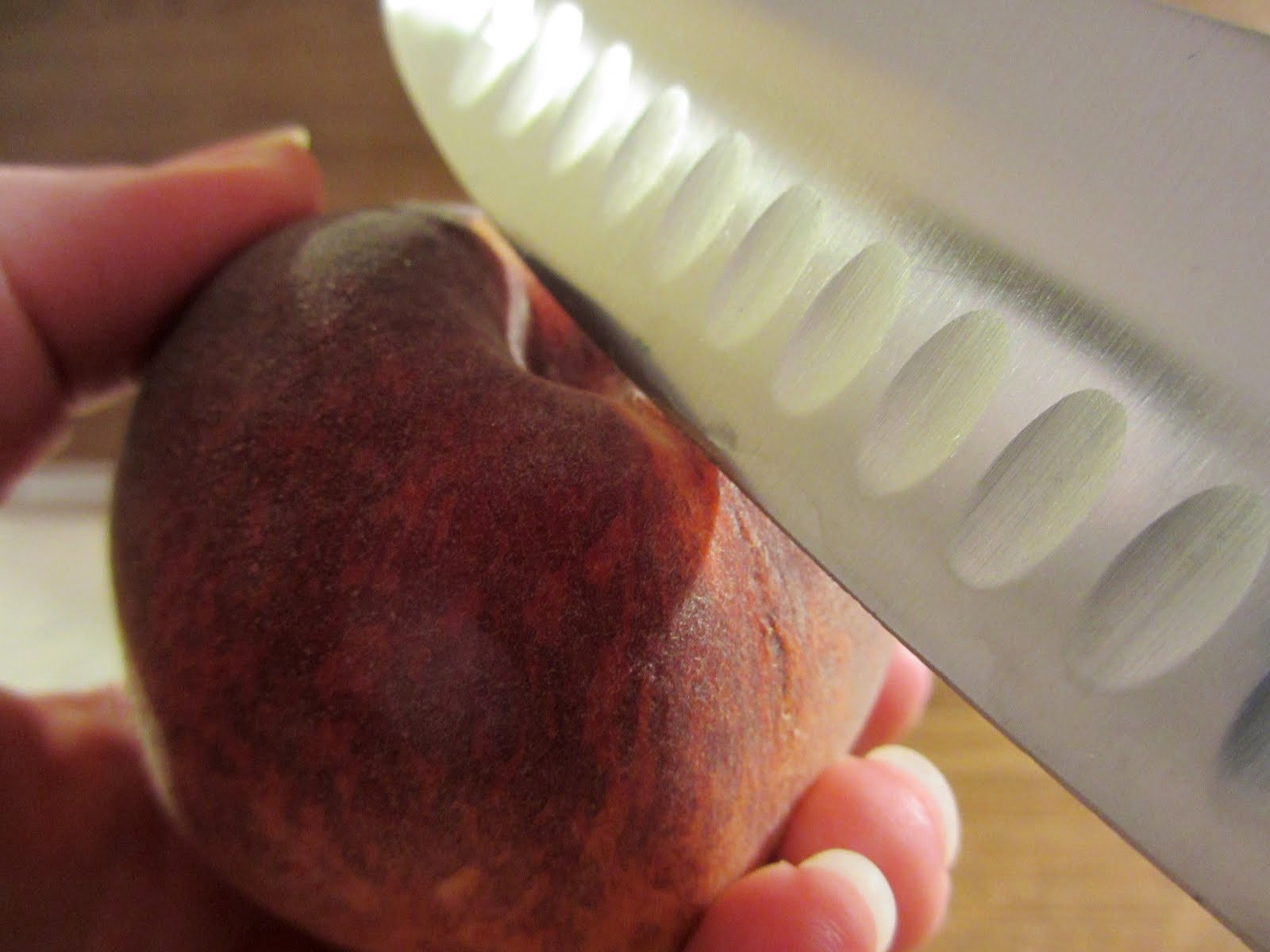
  • The best way to cut a peach is to run your knife along the handy groove in the peach, in a circle all the way around the fruit. Be sure the cut deep enough so that the knife approaches the pit most of the way around. Then put down the knife, grasp each half of the peach in each hand (by the palm, not the fingertips), and twist.  The peach will separate very nicely from the pit and you'll have two smooth halves to bite into.


The best way to cut into a peach, demonstrated on a very unripe peach. If this were ripe, there would be juice dripping everywhere. Wonderful, delicious juicy juiceness. But no. Dry as a bone.
(Photos by the Apple Lady)

  • The term "freestone" does not designate a variety of peaches but rather a feature, which is that the fruit separates relatively easily from the pit. Saying you're about to eat a freestone peach is like saying you're going to take a ride in a convertible. Saying you're going to eat a freestone Red Haven would be like saying you're going to go for a ride in a convertible Trans Am.
  • Nearly every variety of peach sold in stores and most peaches grown locally are freestone peaches. Most people just don't like the hassle of tearing the pit away from the flesh.
  • The opposite of freestone, by the way, is cling, which means the peach clings to the stone. Most canned peaches are identified as cling peaches. 
  • (Full disclosure: I used to think that canned peaches were called "cling" because of the odd way that the corn syrup & juice makes the peach slices seem to cling to each other.)

 
This is what eating a peach should be like. Messy and juicy and fantastic.
(Photo from Backseat Gourmet)

  • White flesh vs yellow flesh is another distinction people are making these days.  Again, the color of the flesh is a feature that is characteristic of some varieties.
  • White-flesh peaches have a higher sugar content and they're even more fragile than the yellow-flesh varieties. Which says to me that the grocery store is absolutely not the place to buy white-flesh peaches.
  • Here are just a few of the 300+ varieties of peaches grown in the US:
    • Redhaven (most widely planted)
    • Loring
    • Gold Dust
    • Golden Jubilee
    • Summer Gold
    • Summer Lady
    • Ryan Sun
    • Big Red
    • Cal Red
    • Autumn Prince
  • Some of these grow best in the Midwest; others are better-suited to the southern Atlantic; still others grow best in California.


These peaches are from Georgia.
(Photo from Wikipedia

  • About the fuzz. I know a lot of people really dislike the fuzz. Truthfully, it can be a bit aggravating. If you wash the peach well in warm water, you can rub off most of the fuzz. Then if you cut the peach in half and bite into the half, rather than sinking your face into the whole peach, the fuzz will be less bothersome.
  • But why's it there in the first place? Nobody can say for sure.  The best or at least most prevalent guess seems to be that it helps protect the peach against invading bugs like aphids.
  • If you really hate the fuzz and you want to avoid it at all costs, eat a nectarine instead.
  • People say that the only difference between peaches and nectarines is that nectarines have smooth skin. But the skin seems a little thicker and the flesh seems to be more substantial and less delicate.
  • Genetically speaking, the smooth skin of the nectarine is a recessive trait.

 
Smooth-skinned nectarines on the left, fuzzy-skinned peaches on the right.
(Photo from Two Fat Bellies)
  • People call peaches the queen of fruits. They don't say that about nectarines.
  • Here's a really magnificent way to eat peaches. Besides just eating them raw, that is.
  • Cut up a couple of peaches and put them in a small saucepan. Heat them over medium heat and stir. 
  • As they get warm, the fruit will start to break down. Keep stirring until they've become a sauce.
  • Pour warm over vanilla ice cream. You will not believe that anything on this earth could taste so heavenly.

Sources
My own peach-eating and -picking experience
Michigan Peach Sponsors, How can I tell if a peach is ripe?, What are the differences between a peach and a nectarine?
Pickyourown.org, Peach facts and picking tips
Stan Sesser, "The Best Peach on Earth," The Wall Street Journal, August 21, 2009
Rodney Bosch "Peaches, Abundant and Cheap, Can Often Fall Short on Flavor," Los Angeles Times, July 28, 1994
Gary Gao, Growing Peaches and Nectarines in the Home Landscape, Ohio State University Extension Fact sheet
Bill Shane, Growing Peaches in the Home Garden, Michigan State University Extension
Mac's Pride FAQs, McLeod Farms
Susan Westmoreland, "Freestone vs. Cling Peaches," Good Housekeeping

Monday, August 20, 2012

Apple #599: C:\ Drive and 404 Not Found

Now that the Olympics has ended (sigh), it's time for me to get caught up on a few requests.  I've got one that comes from a reader and one that comes from me.  Since they're both computer-related and brief, I'm combining them into one entry.

C:\ Drive


C:\ command prompt
(Image from DeviantArt)


Regular Daily Apple reader Jeremiah wants to know, why are computer hard drives labeled c:\?  Why not a:\ or q:\ or any other letter?

Well, I know why it's not called a:\. Those were floppy drives.  But why the hard drive isn't called any other letter of the alphabet, I don't know.

  • The reason it's called c:\ turns out to have about as much thought behind it as, because floppies were called a:\.
  • IBM came up with this naming convention.  Way back in the days of the first computers, there really wasn't a thing like a hard drive -- at least, not the way we know hard drives today.  Most of the information was supplied by some external source, like a floppy disk.

 
The 8-inch floppy disk. First introduced in 1971, with storage capacity of about 100K.
(Photo from Old Computers.net)

The 3 1/2 inch floppy disk, first introduced by Sony in 1980.
(Photo from Old Computers.net)

This is a Macintosh (circa mid-1980s) with a floppy drive visible in the front.
(Photo from Only HD Wallpapers)

  • Since floppy disks were usually what you needed even to boot the computer, their drives were called a:\.
  • As computers got more advanced, they began to require users to load one floppy disk, switch to another and load that, and sometimes switch back to the first.  So it became convenient to add a second floppy drive, called -- you guessed it -- b:\.
  • Some people, when they tell this story, say that the b:\ drive was for a different type of external media, namely, tape drives.  Tape drives obviously had different dimensions and specifications than a floppies, so they needed a different drive altogether to handle those, and thus, those got called b:\. 


Various versions of magnetic storage tape (not cassette but computer), with a floppy at far right, all sitting on top of a tape drive.
(Photo from Wikipedia)

  • I'm not sure which of the two versions is more reputable -- b:\ drive is second floppy or b:\ drive is tape drive -- so I'll leave it to you to decide which tale you prefer.
  • Hard drives, which came along a little later, got the next available letter, c:\.
  • People have wondered, now that there aren't floppy drives anymore, and very few people use tape drives -- or even mention b:\ drives -- why not bump the hard drive up to a:\?
  • Answer: because every computer-related thing is standardized to look for the hard drive at c:\. Software, hardware, peripherals, you name it, when it wants to find the hard drive, it says, "C:\? Where are you?" If the hard drive were re-named anything else, c:\ would go unfound. It would wander, lost and lonely, through the world of computers, friendless and disconnected....

404 Not Found
This is the closest I could find to what I remember about how the 404 Not Found message used to look.  Ah, Netscape. Remember Netscape?  Good times.
(Image from AlphaSoftware)

  • Speaking of things not found, I wanted to know why that web error message you used to get -- not so much anymore, but every once in a while it does pop up -- had that number 404 at the beginning.
  • Once upon a time, long long ago in 1992, the World Wide Web Consortium (but mainly some guy named Tim Berners-Lee) came up with a list of codes, each of which stood for a different type of web browsing event. If some web page wasn't able to display anything helpful, it would at least display a handy 3-digit number that would tell you what was going on. The codes are specific enough so that, if there's some problem in communication, the code displayed would tell you where the communication broke down.
  • The codes were based, by the way, on FTP status codes. Those go all the way back at least to 1985, if not longer.
  • There are 5 categories of status codes. The first digit indicates the category.  The categories are as follows:
    • 1xx = Informational. Request received, continuing process
    • 2xx = Success. Action was received, understood, and accepted.
    • 3xx = Redirection. Needs further action to process the request.
    • 4xx = Client error. The request contains bad syntax or cannot be fulfilled.
    • 5xx = Server error. The request is apparently valid, but the server failed to fulfill it.
  • Since the 2xx's indicate success, you would hardly ever see a 2xx code.  The 4xx's mean that something about the request you made didn't work.
  • The second & third digits work together as in, "01" "02" "03" or "10." Some of the categories only go up to "07" or "05" or even only as far as "01." The 4xx's -- the "it's your fault" codes -- go all the way up to "17." Of course. Always blame the user.
  • What seems to be counter to "it's your fault" is that the 4xx's are also considered transient errors. Meaning, this is the information we're getting from the server at the moment. But if you try again a bit later, your request might work after all.
  • Here are the codes for the 4xx's:
    • 400 = bad request
    • 401 = unauthorized
    • 402 = payment required
    • 403 = forbidden
    • 404 = not found
    • 405 = method not allowed
    • 406 = not acceptable
    • 407 = proxy authentication required
    • 408 = request timed out
    • 409 = conflict
    • 410 = gone
    • 411 = length required
    • 412 = precondition failed
    • 413 = request entity too large
    • 414 = request URI too large
    • 415 = unsupported media type
    • 416 = requested range not satisfiable
    • 417 = expectation failed.
  • Some of those seem redundant, but other seem like they would be just as useful as 404, if not moreso. Some, like 401 payment required or 401 unauthorized, seem like they would still come in handy today. I might have seen 400 maybe once.  But I don't think I've seen any of the other ones ever.


Well, I'll be dipped. Somebody did get a 410 gone. This is from Germany, though, so maybe that explains it. German precision engineering and all that.
(Image from Schnurpsel, which word I did not make up, I promise.)

  • But the point is, why, if there are all of those "it's your fault" codes, did we only ever really see 404?


Getting a little more current, another 404 Not Found display.
(Image from ZackTheTech)

  • It's rumored that 404 was named after a room at CERN, where the original web servers were located. But that rumor is incorrect. There isn't even a room numbered 404 at CERN.
  • The truth seems to be that 404 turned out to be a very handy catchall. It means that you've done something wrong, but it's not being very specific about what that problem is. Maybe you mistyped something, but it's not sure. It also can't say for sure whether the page or sever you tried to access is permanently gone or disabled. All it knows is it couldn't make the connection. 
  • In fact, it's not really sure about anything, just that there's a problem. If you try again, though, it might work. Or it might not,
  • That's a pretty handy error message:  "It's not working and we're not sure why! But try again and see what happens!"


This is what the 404 Not Found screen looks like these days.  You can see the 404 status code at the bottom of the window.
(Image from Evagoras Charalambous


  • Actually, these status codes are still in use today. In fact, there are now extended codes, which add a decimal point and another digit after the 404 to give you more detail about why you got the 404. Not every site will use the extended codes, but some do.
  • From the web developer side of things, if you can access the log files for a website, you'll see that one of the fields indicates the HTTP status code. This page parses the data you'll see in log files and points out where the status code appears.
  • I think I need to employ 417 Expectation Failed on a more frequent basis.

Sunday, August 12, 2012

Apple #598: Olympics Medley

As the Olympics wind down to a close, I thought I'd show you the answers I found to a host of little questions that I had about various bits & pieces from different athletic events.  It's a medley of Olympic facts!

Diving: What's up with those little towels that the divers carry around all the time?


Christina Loukas drops her shammy down from the diving board during the women's 3M springboard prelims.
(Photo by David Eulitt of the Kansas City Star)


  • They're called shammies or sammies.  
  • Like the chamois (pronounced shammy) towels for drying off your car, they used to be made of actual chamois, which was the skin of a particular goat that lives in Europe and Asia. Towels made of this material were super-absorbent, so they didn't need to be big.
  • Now, however, these towels are made of synthetic poly-vinyl materials which are just as absorbent. So instead of calling them by the original French word, they're now called by the way the French word is pronounced: shammy (or shammies, plural).
  • Some divers call them Sammies because of this: in 1977, Dr. Sammy Lee was coaching the US diving team at the Swedish cup. A Norwegian diver was using a shammy, and he gave it to Dr. Lee, who passed it on to a member of his team. The team started calling the coach Shammy instead of Sammy. The team member to whom he'd given the towel was none other than Greg Louganis. When Louganis started winning all sorts of medals for his diving, the kind of towel he was using became popular too. When a company in the states started making the towels, Dr. Lee stamped his name Sammy on them, so people called the towels Sammies.


The Sammy towel sells for between $12 and $20 each.
(Photo from Swimx.com)

  • The reason this towel is so popular is because divers need their hands to be dry before they execute a dive. This is so, when they clamp their hands around their legs to do a tuck or a spin, their hands won't slip. This would not be a good time for your hands to slip.
  • So the divers will bring their shammies / Sammies up onto the board with them, dry off, toss the towel down to the deck, and retrieve it after the dive.
  • Since the shammy is pretty much the only thing a diver carries around during a competition, most divers have developed all sorts of rituals around their shammy. They towel off in a certain way, or tie it in a knot, or twirl it, even carry it around with them like a security blanket.


Great Britain's Tom Daley has a tie-dyed shammy.  Here, he's using it to cover his eyes between dives.
(Photo from UK Eurosport)

This leads to my next question, which is:


Diving: How come the divers go into those little pools after they dive?

Especially if they need their hands to be dry, why do they go in the water and get wet again before their next dive?
  • Divers are athletes. Like all athletes, they need their muscles to stay warm and loose. If they got out of the diving pool and toweled off and just stood around waiting for their next dive, they'd get cold and tighten up.
  • So they go into those little pools -- which are like hot tubs -- in between dives. The water in the little pools is kept at a higher temperature than the regular swimming pool so the divers will stay warm.


Divers waiting in the hot tub in between dives. Notice they all have their shammies with them.
(Photo from Business Insider)

Swimming: How do the swimmers shave down?  Do they shave or do they wax?

I was on my school's swim team as early as the third grade.  I was never fast, and I have enough 5th and 6th place ribbons to prove it, so I wasn't on the high school team.  But we young ones swam the same practices with the older girls, so that's how I learned about shaving down.


Hooray!  We're body-hair free!
(Ricky Berens, Ryan Lochte, Michael Phelps at Beijing 2008)
(Photo from Heavy)


Here's the deal with shaving for swimming.  Body hair increases drag and slows you down in the water.  Less body hair makes you faster. Research has been done that proves this, so shaving down has become a pretty standard practice in the sport since about the 1950s. What a lot of swimmers do -- this is true for both men and women -- is not shave for the majority of the season, until a key meet.  Then they'll shave pretty much everything that's not covered.

This is partly for the physical benefit of reducing drag by that 1%, but it also gives you the sensation of feeling slicker and quicker in the water.  Imagine shedding all that hair one day and then getting in the water -- whoo!  You feel slick as a seal.

The question I had as I watched the Olympic swimmers compete was, do they shave, which means having to shave several times over the course of the competition, or do they wax?


We're so well-shaven, it's kind of unbelievable!
(After Dana Vollmer, Rebecca Soni, Missy Franklin, and Allison Schmitt set a new world record in the 400M relay at London 2012)
(Photo from The Strata-Sphere)

  • I couldn't find anything definitive that says such & such percentage of Olympic swimmers shave while 100 minus such & such wax.  But it looks like most swimmers do still shave, while a few here and there will wax.
  • I did find a video of a couple Danish women swimmers waxing each other's armpits before the competition.  So those swimmers, at least, prefer to wax.
  • Kerri Walsh-Jennings, who is not a swimmer but a beach volleyball gold medalist, says in preparation for her tournaments where she wears bikinis, she neither shaves nor waxes.  She says, "I hate getting waxed.  Waxing makes me want to punch someone in the face." So she gets her unwanted hair removed with lasers.


That fan is practically shrieking, "Those lasers did a great job!"
(Kerri Walsh-Jennings after her 2nd gold medal win at the Beijing Olympics in 2008)
(Photo from Pregnant Hollywood)

  • Laser hair removal is the option that yields the longest-lasting results, but it's also the most expensive by far, and it can also give you scars or hyperpigmentation.  So you would want to make sure the person lasering the hair off of you is certified and has a lot of experience.
  • But for most of us regular people, and even for most competitive swimmers, shaving is still the way to go. Here are some tips for shaving down:
  • For regions that may be longer or more lush, start with an electric trimmer or razor first. Shorter hair is easier on ye olde razor blade, which you want to be sharp.
  • Most swimmers shave their legs and arms. Men also shave the chest and back. Even if you don't have a visibly hairy chest or back, shaving down those little hairs can help.
  • For areas that you can't reach, have someone shave there for you. This is why lots of swim teams have shaving parties the night before a meet.


At this team shave-down, a swimmer named Matt is getting waxed.

  • What not to shave: some say that shaving the underside of the forearm isn't necessary.  This part of your arm pulls you through the water, and you could use the extra help pushing the water out of your way here.
  • You also don't need to shave your head. Swim caps are sufficient to reduce drag. If you want to shave your head for some team spirit reason, go ahead. But you don't need to.
  • Shaving your specials isn't necessary either.  Anything that's covered by the suit already has help in reducing friction in the water. Most women swimmers will keep their bikini line clean for visual purposes, but anything beyond that is your personal choice.

Track & Field: How come so many US runners are wearing those bright yellow shoes?


Looks like every runner but one in this group is wearing the neon yellow shoes.
(Photo from Natural Running Center)

  • Ah, Nike is glad we've asked. In fact, that is exactly what they hoped we would do.
  • Nike is not a sponsor of the 2012 Olympics, but they have given these particular shoes, with the color named Volt, to US track & field athletes to wear in competition. (They also gave the shoes to boxing and fencing athletes; 400 athletes total.)
  • Nike intentionally made the shoes neon yellow because that color really catches the eye of anyone watching. They knew it would stand out especially well against the red track.
  • They wanted these shoes to be so eye-catching that we would all ask what they are and then, because the athletes wearing them did so well, we would all be so overcome with the desire to own a pair for ourselves, we would run out an buy them in droves. At $100 to $200 a pair.


Nike Volt shoes, up close.
(Photo from Vehicle Media)

  • Nike has done all this without actually sponsoring the Games.
  • Other companies -- like Adidas -- pay hundreds of millions of dollars to be an official sponsor. But Nike has not forked over such cash, and they are not an official sponsor.  But because their shoes are so prevalent and visible, and because they've made a few commercials that mention London (along with a lot of other cities and without saying "London Olympics" or "London 2012") and they aired them during Olympics broadcasts, people think that Nike is a sponsor.
  • There is a department called the Olympic Delivery Authority that tries very hard to make sure that non-sponsor companies don't benefit financially from an association with the Olympics that they didn't pay for.  
  • When this group got wind of the Nike shoes situation, they considered going after Nike with a lawsuit. But they changed their minds, probably when this publicly-funded group realized what big pockets they would be going up against.
  • There is also a rule which restricts athletes from appearing in ads during and shortly before the Olympic Games. But this rule doesn't say anything about what the athletes can or can't wear in terms of branded apparel. So although the athletes can't tweet about their shoes or post photos on facebook or Instagram, they can wear them. On TV. In front of millions of viewers.


The US women's gymnastics team compete barefoot. But at their medal ceremony, they were all wearing the Volt shoes. That's how pervasive these shoes are.
(Photo from Natural Running Center)

  • After reading all this, I kept wondering, why would the athletes wear the shoes? These people are super-attuned to their sport, and shoes have got to be a crucial part of their equipment. Bad shoes or the wrong shoes introduced at the last minute could have devastating results. So why would they wear a pair of shoes simply because some Nike marketing person handed them over?
  • Because, first of all, Nike sponsors a ton of athletes. The thing all these business magazines and newspapers are all geeked about is that Nike didn't pay to sponsor the Games.  They're all thrilled because they think Nike seems to be getting away with something. But Nike does sponsor a boatload of athletes
  • It's therefore in the athletes' interest to wear the shoes because Nike has probably helped them out in a huge way, financially and equipment-wise, for a long time leading up to this moment.
  • Still, my question persists. So wearing the shoes might be a way of thanking their sponsor. That's nice. But there must be something performance-wise that they like about the shoes.  So why did the athletes choose to wear these shoes over something else they might have trained with?
  • The best I could discover is what Nike says about their own shoes. They say that, for the shoes that have spikes, the spike plate is especially lightweight which gives runners who wear them a slight edge over their competitors. Nike says their other types of shoes in this series which do not have spikes are also lightweight, and they are engineered for a precision fit to feel like a second skin.  Apparently, lots of athletes agree.

 
Nike Volt shoes for sprinters. This group is called Zoom.
(Photo from Nike, Inc.)


These Nike Volts are "flats" for the distance racers. And maybe preferred by the general public.
(Photo from Runblogger)

  • By the way, Nike will be an official sponsor of the Games in Rio in 2016.


Oh, and one last thing. No, the gymnasts don't wear anything under their leotards. That goes for men and women.


Sources
Diving
Swimx, The Sammy Towel
NBC Olympics, 10 things you should know about diving
iSport, Why Divers Use a Shammy
Swimming
iSport, How to Shave Down for a Swim Meet
howstuffworks, Why do swimmers shave their bodies? Shaving Tips for Swimmers
Solo Swims, Shaving Down: The effects on swimming of removing body hair
Swimmer's Daily, Danish Darlings introduce Mie to their Wax On Wax Off ritual
Livestrong, What Do Swimmers Do to Remove Body Hair?
Daily Mail, "'Waxing makes me want to punch someone': Team USA beach volleyball stars on getting their bodies in shape for THAT skimpy kit", July 30, 2012
Well Being Tips, Split Seconds Count - Olympic Swimmers and Hair Removal
Track & Field
AdAge Global, Consumers Don't Really Know Who Sponsors the Olympics
Forbes, Ambush Marketing: An Olympic Competition. And Nike Goes for Gold, August 7, 2012
NBC News, The Bottom Line, Nike takes marketing gold with neon-yellow shoes, August 10, 2012
Metro News, Yellow volt shoes a hit at London Olympics, August 12, 2012
Nike, Inc. Nike Unveils Volt Collection for Track and Field