Saturday, June 30, 2007
Birthday
Yesterday was my birthday. That's right, the Apple Lady does have a birthday. And it is also true that the Apple Lady knows how to celebrate. Made for a pretty rocky day today. But I promise, there will be a full-on apple post tomorrow.

Wednesday, June 27, 2007
Oh, Fickle Internet
I should know better than to boast about the Daily Apple getting lots of hits. Sure as I do, a week or two later, they evaporate.

But I suppose, just as they go, so shall they return. It is the Daily Apple, after all.

But I suppose, just as they go, so shall they return. It is the Daily Apple, after all.
Sunday, June 24, 2007
Apple #250: Ear Wax
Ear wax is weird stuff.

Cerumen is produced by glands that line the ear canal.
The cerumen mixes with skin and sweat and body oils and becomes ear wax.
Then it travels the canal away from the ear drum (tympanic membrane) out of the ear.
(Diagram owned by Northwestern, used by Dr. Timothy Hain)

One commonly available method to remove ear wax at home.
(You can buy this product for $8.19 from drugstore.com)
Sources
James K. Bredenkamp MD, "Ear Wax," MedicineNet
Timothy C. Hain, MD, Ear Wax, August 2002
American Academy of Otolaryngology - Head and Neck Surgery, Earwax and Perforated Eardrum
About.com: Deafness, Audiology - Ear Wax, Brian Taylor, Clinical Audiologist
Mayo Clinic, Diseases and Conditions, Ruptured Eardrum, February 2, 2007
National Institutes of Health, National Library of Medicine, Medline Plus Medical Encyclopedia, Ruptured Eardrum, February 19, 2007
Columbia University, Fathom, An Introduction to Anglo-Saxon Manuscripts, Session 4: Materials and Techniques.
- Ear wax is actually a combination of substances.
- Glands near the external ear canal produce cerumen (comes from a Latin word that means "wax").
- That substance then combines with flakes of skin, sweat, and oil.
- Mixed together, that's ear wax. Delightful, isn't it?
- Ear wax can range in texture from almost liquid to firm or nearly solid.
- The moisture content of ear wax is an inherited trait.
- This means that people originating from different parts of the globe have wax of different consistency.
- European-origin folks have moister wax, while Asian-origin folks have drier wax.
- Wax can also range in color, from a very pale yellow, to a deeper yellow, to reddish brown. The darker the wax, the longer it has been in your ear.
Cerumen is produced by glands that line the ear canal.
The cerumen mixes with skin and sweat and body oils and becomes ear wax.
Then it travels the canal away from the ear drum (tympanic membrane) out of the ear.
(Diagram owned by Northwestern, used by Dr. Timothy Hain)
- Aided by the tiny hairs that line the ear canal, ear wax will travel out of the canal to the outer portion of your ear.
- Once the wax reaches that outer portion, it will dry, turn flaky, and fall out.
- You should not use Q-tips to clean the wax out of your ears, tempting though it may be. This is because, while the swab will collect some of the wax at the outer portion of the ear, it will push even more of it back toward the ear drum.
- If you get enough wax pressing up against your ear drum, you will start to have trouble hearing, and you may even wind up with a perforated ear drum.
- In addition, the wax helps to keep dirt and bacteria and other nasty things from traveling the ear canal to the sensitive and crucial parts of your ear. If you have removed the moist wax from your ear, there will be little available to combat those nasties, and you are more likely to get an infection.
- Ear wax build-up is the number one cause of hearing loss. But most of the time, that wax build-up is caused when the ear's owner has used some pointy object like a Q-tip to try to remove the wax and has succeeded only in jamming the wax farther into the ear.
- So unless you want to give yourself an infection or hearing loss, don't stick anything pointy in your ear! I know it's tempting. Believe me, I do.
- If you really must get that wax out of there on your own, you can try these methods:
- Put a few small drops of mineral oil (baby oil) or olive oil into your ear. Let the drops sit for a few moments, then tilt your head the other way to encourage the oil to slide out. Rest your head on a towel -- no need to jerk yourself around -- and allow the oil and excess wax to slide out on its own.
- If your ear seems to be really plugged, you can try those ear wax removal kits from the pharmacy. Follow the directions on the box closely.
One commonly available method to remove ear wax at home.
(You can buy this product for $8.19 from drugstore.com)
- You should never try either of these removal techniques if your ear drum is perforated.
- It can be hard to tell if your ear drum is perforated, or ruptured. But here are some signs:
- Sharp, sudden pain in one ear
- Sudden drainage from the ear that is pus-filled or bloody
- Hearing loss, often accompanied with pain
- Ringing (tinnitus) in the ears, often accompanied with pain.
- If your ear wax is dark brown, don't confuse that with blood. Ear wax turns brown when it gets old, and that's perfectly normal. If that was blood coming out your ear, you'd know it.
- If you think your ear drum has been ruptured, go to the doctor. Don't stick anything in there, not even ear drops. Let the doctor take a look and decide what treatment is necessary. Most ruptures will heal on their own within two months. But in some cases, the doctor might tell you to wear a patch over your ear to keep out infection or to take antibiotics, or the doctor might recommend surgery.
- Here's one last ear wax fact for you: in medieval times, monks used to use ear wax to smooth out the pigmentation for illuminated manuscripts. Resourceful, eh?
Sources
James K. Bredenkamp MD, "Ear Wax," MedicineNet
Timothy C. Hain, MD, Ear Wax, August 2002
American Academy of Otolaryngology - Head and Neck Surgery, Earwax and Perforated Eardrum
About.com: Deafness, Audiology - Ear Wax, Brian Taylor, Clinical Audiologist
Mayo Clinic, Diseases and Conditions, Ruptured Eardrum, February 2, 2007
National Institutes of Health, National Library of Medicine, Medline Plus Medical Encyclopedia, Ruptured Eardrum, February 19, 2007
Columbia University, Fathom, An Introduction to Anglo-Saxon Manuscripts, Session 4: Materials and Techniques.
Wednesday, June 20, 2007
Apple #249: Hand Signals for Bicycling
I brought my bike up from the basement last week and I've been riding it in the evenings when it hasn't been too hot. I can't remember the last time I rode a bike, and let me tell you, it feels wonderful.
I love the speed of it, the way the wind rushes past my face. At the same time, I'm going slowly enough that I can look at houses and people and all sorts of interesting things as I ride by. In that way, biking has all the benefits of walking, in that I feel like I'm physically part of the neighborhoods I'm moving through, not like when I'm in a car and securely wrapped in my metal bubble. But I'm moving faster than walking, so I can cover more territory. But mostly it just feels good.

You can ride a bike just about anywhere.
This woman is riding her bike -- in Laos.
(Photo by Stuart, posted at World 66)
I've been really wishing I could remember hand signals. Sometimes there are cars behind me, and I don't want anyone to have to guess about anything. I remember that if you want to turn in one direction, you stick your hand straight out. Another direction, you hold your shoulder straight out but raise your forearm perpendicularly in the air. But is that for a right turn or a left turn? Because I couldn't remember, I was just pointing vigorously in the direction I meant to go.
Turns out, that weird signal is out of fashion. You could still use it if you wanted to, but apparently most people are like me in that they can't remember which way that's supposed to indicate.

LEFT TURN -- hold out your arm straight to the left.
(Diagram from Dr. James Watrous)

RIGHT TURN -- hold out your arm straight to the right.
This one is much more obvious than the other, so I'm only going to post this one.
(Diagram from Dr. James Watrous)

STOP -- hold out your left arm and drop forearm toward the ground.
I can't imagine using this signal very often. Mainly because I need both hands to work the hand brakes.
(Diagram from Dr. James Watrous)
Some other bicycling safety tips:

(Diagram from Bike Miami Valley)

This is the Prime Minister of Japan, riding a bicycle.
He doesn't look too confident about it, does he?
Though the kids seem to be loving it.
(Photo from What's up around the Prime Minister)
Sources
Kidshealth, Bike Safety
James Allen Watrous, Ph.D., Bicycling Hand Signals
Bike Miami Valley, Bicycle Safety: Hand Signals
Jesse White, Illinois Secretary of State, Illinois Bicycle Rules of the Road
I love the speed of it, the way the wind rushes past my face. At the same time, I'm going slowly enough that I can look at houses and people and all sorts of interesting things as I ride by. In that way, biking has all the benefits of walking, in that I feel like I'm physically part of the neighborhoods I'm moving through, not like when I'm in a car and securely wrapped in my metal bubble. But I'm moving faster than walking, so I can cover more territory. But mostly it just feels good.
You can ride a bike just about anywhere.
This woman is riding her bike -- in Laos.
(Photo by Stuart, posted at World 66)
I've been really wishing I could remember hand signals. Sometimes there are cars behind me, and I don't want anyone to have to guess about anything. I remember that if you want to turn in one direction, you stick your hand straight out. Another direction, you hold your shoulder straight out but raise your forearm perpendicularly in the air. But is that for a right turn or a left turn? Because I couldn't remember, I was just pointing vigorously in the direction I meant to go.
Turns out, that weird signal is out of fashion. You could still use it if you wanted to, but apparently most people are like me in that they can't remember which way that's supposed to indicate.
LEFT TURN -- hold out your arm straight to the left.
(Diagram from Dr. James Watrous)
RIGHT TURN -- hold out your arm straight to the right.
This one is much more obvious than the other, so I'm only going to post this one.
(Diagram from Dr. James Watrous)
STOP -- hold out your left arm and drop forearm toward the ground.
I can't imagine using this signal very often. Mainly because I need both hands to work the hand brakes.
(Diagram from Dr. James Watrous)
Some other bicycling safety tips:
- Ride as far to the right in your lane as possible. Sometimes potholes or parked cars make it too dangerous or difficult to hug the curb, but try to keep to the right as far as you can.
- If you're going to make a left turn, do a head check first. This acts as a kind of signal to traffic that you mean to move out into the road. When the traffic is clear, move into the left turn lane (if there is one), and once you're in that lane, keep to right of that lane as you make your turn.
(Diagram from Bike Miami Valley)
- If there is no left turn lane, wait at the right side of the right lane for traffic to clear, and then cross the right lane and make your left turn.
- If somebody told you to ride your bike against traffic, they gave you bad advice. Always ride with the flow of traffic.
This is the Prime Minister of Japan, riding a bicycle.
He doesn't look too confident about it, does he?
Though the kids seem to be loving it.
(Photo from What's up around the Prime Minister)
Sources
Kidshealth, Bike Safety
James Allen Watrous, Ph.D., Bicycling Hand Signals
Bike Miami Valley, Bicycle Safety: Hand Signals
Jesse White, Illinois Secretary of State, Illinois Bicycle Rules of the Road
Sunday, June 17, 2007
Apple #248: John Bellairs
Have you ever read this book?


It's The House With a Clock In Its Walls, and it's one of my favorite books, ever. Yes, it's for young adults, but a good book is a good book no matter what age it's for. If you haven't read it -- and if you like the Harry Potter books -- you should definitely check it out.
The book is about a shy, overweight kid named Lewis Barnavelt, whose parents are dead and so he moves to a small town in Michigan with his large, bearded, mysterious Uncle Jonathan. Uncle Jonathan's house is old and full of strange objects like umbrella stands and mirrors that display strange images -- all of which make sense when Lewis discovers that his uncle is a wizard. Not only that, but the house used to belong to a different wizard before Uncle Jonathan, a malevolent wizard. The previous wizard hid a clock somewhere in the house, a clock whose ticking becomes louder and more threatening as Halloween approaches, and Lewis must find it.

Lewis Barnavelt, as drawn by Edward Gorey
That's the plot. But there's more. The book's author, John Bellairs, has an easy touch in creating the likable overweight Lewis, the gruff but loyal Uncle Jonathan, and the eccentric neighbor Mrs. Zimmerman who likes purple. Along with the suspense that makes me say out loud things like, "Uh-oh, that's bad," and "Ooh, I knew he shouldn't have done that," Bellairs manages to convey a coziness, with people eating chocolate cake and playing cribbage in the evenings.
I first read this book long ago, back in yon Apple Lady's youth, and then a few nights back, I was at a friend's house, perusing her bookshelves, and I saw that she had several books by John Bellairs. Excited, I asked her about them. She said, "Dude, John Bellairs rocks."
She, too, had read The House With a Clock In Its Walls in her younger days, but she had also read many of his other books, and these were what she had on her shelves. She flipped through a few of them, showing me that Edward Gorey had illustrated some, and that Mercer Mayer had illustrated some others.
"I opened this one up," she said, pulling The Figure In the Shadows off her shelf and turning to a picture of a boy stealing another boy's Sherlock Holmes cap, "and this picture took me right back to fifth grade."
She was kind enough to lend me two of her Bellairs books:


The Figure In the Shadows is a sequel to The House With a Clock. In this book, Lewis is being bullied and though his friend Rose Rita tries to stand up for him, he is ashamed that a girl is protecting him. He finds a magic coin in an old trunk of his uncle's and discovers that the coin gives him a strange sense of new-found power. But soon, the coin begins to exert other powers as well. . . .


The Curse of the Blue Figurine is about a different young boy, Johnny Dixon, who lives in a small town in Massachusetts with his grandparents. He goes to Catholic school and discovers in the basement of the accompanying Catholic church a mysterious blue statue with a note warning that anyone who removes it from the church will bring vengeance upon his head. Nervous Johnny is startled by a noise in the basement, so he runs out of the church still holding the figurine, and now he's in for it.
I read both of these books this weekend. I liked them both (though I liked Lewis and his uncle a touch better than the bookish Johnny), but I also noticed enough similarities that I started to wonder about John Bellairs. Both books were set in the 1950s, both of their main characters went to Catholic school, both boys got picked on by tougher kids, both boys were orphans in some sense.
So let's see if I can identify some similarities.

John Bellairs, altar server.
He looks almost exactly the way I pictured Lewis Barnavelt.
(Photo from Bellairsia)
So, yeah, a lot of things in common between the author as a youth and his young leading men. And he's even acknowledged those similarities in various letters and interviews.

(Photo from Calculo's page on John Bellairs)
Bellairs died in 1991 of heart disease. However, author Brad Strickland was asked by John's son Frank to complete four of his father's books that he left unfinished. Strickland also wrote three new books based on Bellairs characters. Reminds me of what's still going on with V.C. Andrews -- writing from beyond the grave.
Thanks for the books, John B!
Sources
Bellairsia, John Bellairs Biography
Carol Schaal, "John Bellairs: The Spooky Writer Who Cast a Magic Spell," Notre Dame Magazine, Summer 2003
Thinkquest site about all the Bellairs books, authored by six twelve year-olds, The Authors page
Kelly Sedinger, Bellairs Lewis Barnavelt Books, Green Man Review
It's The House With a Clock In Its Walls, and it's one of my favorite books, ever. Yes, it's for young adults, but a good book is a good book no matter what age it's for. If you haven't read it -- and if you like the Harry Potter books -- you should definitely check it out.
The book is about a shy, overweight kid named Lewis Barnavelt, whose parents are dead and so he moves to a small town in Michigan with his large, bearded, mysterious Uncle Jonathan. Uncle Jonathan's house is old and full of strange objects like umbrella stands and mirrors that display strange images -- all of which make sense when Lewis discovers that his uncle is a wizard. Not only that, but the house used to belong to a different wizard before Uncle Jonathan, a malevolent wizard. The previous wizard hid a clock somewhere in the house, a clock whose ticking becomes louder and more threatening as Halloween approaches, and Lewis must find it.
Lewis Barnavelt, as drawn by Edward Gorey
That's the plot. But there's more. The book's author, John Bellairs, has an easy touch in creating the likable overweight Lewis, the gruff but loyal Uncle Jonathan, and the eccentric neighbor Mrs. Zimmerman who likes purple. Along with the suspense that makes me say out loud things like, "Uh-oh, that's bad," and "Ooh, I knew he shouldn't have done that," Bellairs manages to convey a coziness, with people eating chocolate cake and playing cribbage in the evenings.
I first read this book long ago, back in yon Apple Lady's youth, and then a few nights back, I was at a friend's house, perusing her bookshelves, and I saw that she had several books by John Bellairs. Excited, I asked her about them. She said, "Dude, John Bellairs rocks."
She, too, had read The House With a Clock In Its Walls in her younger days, but she had also read many of his other books, and these were what she had on her shelves. She flipped through a few of them, showing me that Edward Gorey had illustrated some, and that Mercer Mayer had illustrated some others.
"I opened this one up," she said, pulling The Figure In the Shadows off her shelf and turning to a picture of a boy stealing another boy's Sherlock Holmes cap, "and this picture took me right back to fifth grade."
She was kind enough to lend me two of her Bellairs books:
The Figure In the Shadows is a sequel to The House With a Clock. In this book, Lewis is being bullied and though his friend Rose Rita tries to stand up for him, he is ashamed that a girl is protecting him. He finds a magic coin in an old trunk of his uncle's and discovers that the coin gives him a strange sense of new-found power. But soon, the coin begins to exert other powers as well. . . .
The Curse of the Blue Figurine is about a different young boy, Johnny Dixon, who lives in a small town in Massachusetts with his grandparents. He goes to Catholic school and discovers in the basement of the accompanying Catholic church a mysterious blue statue with a note warning that anyone who removes it from the church will bring vengeance upon his head. Nervous Johnny is startled by a noise in the basement, so he runs out of the church still holding the figurine, and now he's in for it.
I read both of these books this weekend. I liked them both (though I liked Lewis and his uncle a touch better than the bookish Johnny), but I also noticed enough similarities that I started to wonder about John Bellairs. Both books were set in the 1950s, both of their main characters went to Catholic school, both boys got picked on by tougher kids, both boys were orphans in some sense.
So let's see if I can identify some similarities.
John Bellairs, altar server.
He looks almost exactly the way I pictured Lewis Barnavelt.
(Photo from Bellairsia)
| | Bellairs Himself | Bellairs Characters |
| Hometown | | Lewis Barnavelts’: New |
| Elementary school | St. Mary’s Roman Catholic | Johnny Dixon’s: St. Michael’s Roman Catholic |
| Physique | Overweight | Lewis: Fat and moon-faced |
| Social Habits | Often alone, “scaredy-cat” | Johnny D. and Lewis B: both bullied by bigger, tougher boys |
| Reading Habits | Voracious reader | Johnny D: complimented on his reading abilities |
| Interests | Joined Latin and Chess clubs | Lewis: knows Latin quite well Johnny: plays chess with the professor across the street |
| Deaths | Grandmother died 1951 (John was 13) | Lewis: both parents dead Johnny: mother died of cancer, father fighting in the Korean War |
| Other Places | Taught at | Johnny Dixon lives in |
So, yeah, a lot of things in common between the author as a youth and his young leading men. And he's even acknowledged those similarities in various letters and interviews.
"The heroes of my books are loners and outsiders because that's the way I felt when I was a kid," Bellairs wrote in a letter. "If you're fat, brainy, can't play sports and are physically cowardly, you don't fit in." -- Bellairs
"Writing seems to be (for me) a way of memorializing and transforming my own past. I write about things I wish had happened to me when I was a kid." -- Bellairs
(Photo from Calculo's page on John Bellairs)
Bellairs died in 1991 of heart disease. However, author Brad Strickland was asked by John's son Frank to complete four of his father's books that he left unfinished. Strickland also wrote three new books based on Bellairs characters. Reminds me of what's still going on with V.C. Andrews -- writing from beyond the grave.
Thanks for the books, John B!
Sources
Bellairsia, John Bellairs Biography
Carol Schaal, "John Bellairs: The Spooky Writer Who Cast a Magic Spell," Notre Dame Magazine, Summer 2003
Thinkquest site about all the Bellairs books, authored by six twelve year-olds, The Authors page
Kelly Sedinger, Bellairs Lewis Barnavelt Books, Green Man Review
Storage in Your Stairs
I don't usually do this, but I came across something at a site I check occasionally, Inhabitat, which covers innovations in environmentally-friendly design. They find some really creative stuff from all around the world. This particular idea I thought was worth passing along.

An Australian company called Unicraft Joinery has come up with a way to make storage space out of stairs. Apparently the idea is not new, but I still think it's ingenious. The comments about this particular concept are additionally enlightening and entertaining.
An Australian company called Unicraft Joinery has come up with a way to make storage space out of stairs. Apparently the idea is not new, but I still think it's ingenious. The comments about this particular concept are additionally enlightening and entertaining.
Thursday, June 14, 2007
Apple #247: Turtle Noises
My latest burning question is: do turtles make noise?
They seem like such quiet creatures, but so many of the seemingly-silent ones turn out to make some sound, so I wondered if that's true of turtles, too.
The short answer is yes, they do, but the noises depend on whether you're talking about a turtle or a tortoise.
So, first, the differences between turtles and tortoises:
Some people say tortoises are a type of turtle. Other people say there really is no distinction between the two in a strict classification sense. But then they all list the following differences anyway.
Now, for the sounds of turtles & tortoises:
TURTLES

These turtles are not in the water at the moment; they're taking a break from it. You can see their webbed, flipper-like feet, which indicate their preference for swimming rather than walking.
(Photo from Snail's Tales blog about bugs, animals, and other oddities)
TORTOISES

Tortoises tooling around on land at the Santa Fe Teaching Zoo
Larger tortoises have been heard making various noises, including vocalizations.

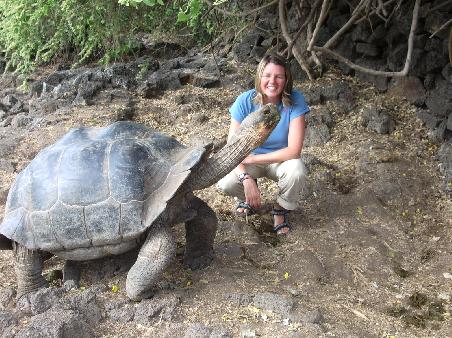
This Galapagos tortoise lives at the Charles Darwin Research Station on the Galapagos Islands and is saying hello to this woman named Allison.
(Photo from Allison Webb's Travelogue on Break Fresh Ground)
Sources
Tricon Kindergarten Class, Turtles vs Tortoises
Fresno Chaffee Zoo, Turtles, Tortoises and Terrapins
Science Museum of Minnesota, Painted Turtle FAQ
All Experts, Turtles, Russian Tortoise Noise, Noise from side neck turtle
Reptile Rooms, whistling turtle noise
Charles Darwin Research Station Fact Sheet, Galapagos giant tortoises
Galapagos Travel Blog, Tortoise Mating
Sean McKeown, Duane E. Meier, and James O. Juvik, The Management and Breeding of the Asian Forest Tortoise in Captivity, 1991
Smithsonian, Reptiles & Amphibians Fact Sheets, Radiated Tortoise
They seem like such quiet creatures, but so many of the seemingly-silent ones turn out to make some sound, so I wondered if that's true of turtles, too.
The short answer is yes, they do, but the noises depend on whether you're talking about a turtle or a tortoise.
So, first, the differences between turtles and tortoises:
Some people say tortoises are a type of turtle. Other people say there really is no distinction between the two in a strict classification sense. But then they all list the following differences anyway.
| Turtles | Tortoises |
| prefer swimming | prefer walking |
| live in salt water | live on land or in fresh water |
| awkward walking on land | not good swimmers and could drown |
| have blade-shaped flippers | have legs rather than flippers |
| flatter shells | high-domed shells |
Now, for the sounds of turtles & tortoises:
TURTLES
These turtles are not in the water at the moment; they're taking a break from it. You can see their webbed, flipper-like feet, which indicate their preference for swimming rather than walking.
(Photo from Snail's Tales blog about bugs, animals, and other oddities)
- Turtles have no vocal chords, but they do sometimes make other sounds.
- Hissing: when turtles pull their heads into the shell, sometimes they emit a soft hissing sound. This is not actually a vocalization but the sound of the air in the turtle's lungs as well as the air in the shell being expelled as the turtle's body moves into the empty space.
- Gurgling, bubbling, whistling: If a turtle makes a gurgling, gargling, bubbling, whistling, or wheezing noise, the turtle may have a respiratory infection, and the sound you hear is the sound of fluid in the turtle's lungs. If you own a turtle and it is making sounds like these, check the humidity and temperature of your turtle's environment to see that it's appropriate for your turtle's needs.
TORTOISES
Tortoises tooling around on land at the Santa Fe Teaching Zoo
Larger tortoises have been heard making various noises, including vocalizations.
- Tortoises also make a hissing noise when they retreat into their shells.
- The Radiated Tortoise, which only lives on the island of Madagascar, will make a high-pitched noise if it is caught, sometimes for hours afterwards. Most predators would be so startled by this disturbing sound, they would release the tortoise.
- Forest Tortoises have been heard thumping their heads on the carapaces of other tortoises, as a prelude to mating.
- Galapagos, Forest, and other tortoises have been heard grunting during mating. Others have described the Galapagos' mating cries as roaring or bellowing, loud enough to be heard for hundreds of yards. Only the male makes sounds, and only during mating.
This Galapagos tortoise lives at the Charles Darwin Research Station on the Galapagos Islands and is saying hello to this woman named Allison.
(Photo from Allison Webb's Travelogue on Break Fresh Ground)
Sources
Tricon Kindergarten Class, Turtles vs Tortoises
Fresno Chaffee Zoo, Turtles, Tortoises and Terrapins
Science Museum of Minnesota, Painted Turtle FAQ
All Experts, Turtles, Russian Tortoise Noise, Noise from side neck turtle
Reptile Rooms, whistling turtle noise
Charles Darwin Research Station Fact Sheet, Galapagos giant tortoises
Galapagos Travel Blog, Tortoise Mating
Sean McKeown, Duane E. Meier, and James O. Juvik, The Management and Breeding of the Asian Forest Tortoise in Captivity, 1991
Smithsonian, Reptiles & Amphibians Fact Sheets, Radiated Tortoise
Sunday, June 10, 2007
Apple #246: Sunburn and Sunscreen
I went to hear former President Clinton give a commencement speech today, which meant that I was sitting in the sun for about three hours. Silly me, although I wore sunglasses and a hat and brought my own bottled water, I did not put on sunscreen before going to the ceremony. Bah, I thought, I'll be fine.
I now have one of the worst sunburns I've ever had. It is not the worst because I left as soon as Clinton stopped speaking. I knew I was getting burned -- my skin looked bright red through my sunglasses though it looked the same without my sunglasses -- and when I scratched near my collarbone where the skin is thinner and very sensitive to sun, it stung. As soon as I could, I practically ran to get out of the sun. But this burn is pretty bad. Some six hours later, my skin is deep red, flaming hot, and tingling and prickling. I'm also feeling slightly nauseous. Bleah.

A woman named Erin with a bad sunburn
(Photo from her directory at MIT)
SUNSCREEN

Relatively new sunscreen products, all with high SPFs
(Photo from Blog This Next's pages on sunscreens)
SUNBURN

The best stuff I ever used after a sunburn was a blue aloe vera gel. I can't remember now the exact name of the product, but it was something like this. Except this has Lidocaine in it, to which some people are allergic.
(Photo and opportunity to order from Drugstore.com)

This person's shoulder was sunburned so badly, blisters arose. This blistering means he sustained a second-degree burn. If you burned your hand on the oven, say, enough to get a second degree burn, you'd take that pretty seriously, wouldn't you?
(Photo posted at Gadling.com)
SUN POISONING

This bicyclist is applying sunscreen, and look how happy he is!
(Photo from the Hopkins 4K for Cancer)
Your skin is your friend. Be nice to it.
(This includes you, too, Apple Lady!)
Sources
Melissa Stoppler MD, Summer Survival Kit, eMedicine Health
Melissa Stoppler MD, MedicineNet.com, Sunburn and Sun-Sensitizing Drugs
American Academy of Dermatology, Facts About Sunscreens
National Library of Medicine and NIH's Medical Encyclopedia, Sunburn
Kidshealth.org, Sunburn
I now have one of the worst sunburns I've ever had. It is not the worst because I left as soon as Clinton stopped speaking. I knew I was getting burned -- my skin looked bright red through my sunglasses though it looked the same without my sunglasses -- and when I scratched near my collarbone where the skin is thinner and very sensitive to sun, it stung. As soon as I could, I practically ran to get out of the sun. But this burn is pretty bad. Some six hours later, my skin is deep red, flaming hot, and tingling and prickling. I'm also feeling slightly nauseous. Bleah.
A woman named Erin with a bad sunburn
(Photo from her directory at MIT)
SUNSCREEN
- Apply sunscreen about half an hour before you go out into the sun.
- Make sure you pretty much glop it on. Most people don't put on enough sunscreen, or they apply it too thinly.
- SPF = the ratio of the amount of time it would take for protected skin to get a burn vs. the time unprotected skin would burn. SPF 15, for example, is supposed to mean that if you wear sunblock with SPF 15, it would take 15 times longer before your skin burns than without sunblock. But that ratio is usually not accurate because many people don't apply sunblock correctly, or it washes off, etc.

Relatively new sunscreen products, all with high SPFs
(Photo from Blog This Next's pages on sunscreens)
- Most doctors recommend sunscreens with SPFs of at least 30.
- No sunscreen is waterproof. If it claims to be, it is lying. It can be water resistant, but it will not be waterproof.
- There are so many problems with sunscreen that packagers are no longer allowed to call it sunblock, only sunscreen.
- Choose a sunscreen that protects against UVB and UVA rays, a.k.a. "broad spectrum" protection.
- Sunscreens are good for a minimum of three years. But if you use the product properly and as often as you should (any time you're in the sun for more than 20 minutes), you should use up a bottle of sunscreen long before three years have passed.
- And by the way, there is no safe way to tan. Whether you're in the sun or in a tanning bed, you are damaging your skin and increasing the likelihood of giving yourself skin cancer.
SUNBURN
- There really are no good ways to treat a sunburn once it's happened. This is why sunscreen is so important. The best you can do after the fact is try to make the pain and heat a little less severe.
The best stuff I ever used after a sunburn was a blue aloe vera gel. I can't remember now the exact name of the product, but it was something like this. Except this has Lidocaine in it, to which some people are allergic.
(Photo and opportunity to order from Drugstore.com)
- Things you can put on your skin to ease the burn:
- Equal parts milk and water on a cool compress.
- Aloe-based lotions.
- Or, if you have an aloe plant, you can split open a leaf and scoop out the goop and put it right on your skin, though it takes a lot of aloe goo to do very much. The aloe lotions are much easier to use and provide more coverage.
- Even regular moisturizers can help.
- Cool -- not cold -- baths or showers. If you do take a shower, you'll want to avoid a strong spray.
- You can also take aspirin or an NSAID like Tylenol, which can help reduce the pain and some blistering.
This person's shoulder was sunburned so badly, blisters arose. This blistering means he sustained a second-degree burn. If you burned your hand on the oven, say, enough to get a second degree burn, you'd take that pretty seriously, wouldn't you?
(Photo posted at Gadling.com)
- Things that will make your sunburn feel worse:
- Lotions with oils or Vasoline, which will trap the heat to your skin
- Old fashioned "treatments" like butter or toothpaste -- these will make the pain worse!
- Products with perfumes which will be irritants
- Bath salts or bath oils
- Soap
- Scratchy towels or scrubby things like loofahs or sponges
- More sun exposure
- Also, products with anesthetics such as benzocaine or lidocaine (Solarcaine, e.g.) can trigger an allergic reaction
SUN POISONING
- You should go to the emergency room if your sunburn is so extreme you experience the following:
- Severe pain and blistering
- Headache
- Confusion
- Severe chills
- Rapid pulse
- Nausea, even vomiting
- Fainting (a.k.a. sun poisoning)
- If these things are happening, you have sun poisoning.
- If you don't go to the hospital, you'll risk contracting an infection at the blister sites. What is more likely is that you could get severely dehydrated and lose way too may electrolytes, which can throw the body into toxic shock. You do not want that to happen.
This bicyclist is applying sunscreen, and look how happy he is!
(Photo from the Hopkins 4K for Cancer)
Your skin is your friend. Be nice to it.
(This includes you, too, Apple Lady!)
Sources
Melissa Stoppler MD, Summer Survival Kit, eMedicine Health
Melissa Stoppler MD, MedicineNet.com, Sunburn and Sun-Sensitizing Drugs
American Academy of Dermatology, Facts About Sunscreens
National Library of Medicine and NIH's Medical Encyclopedia, Sunburn
Kidshealth.org, Sunburn
Thursday, June 7, 2007
Bob Barker Hangs up his Microphone
I just read that today (or I guess yesterday) was Bob Barker's last day of taping The Price is Right. He's done, he says, retired. After 35 years, he's giving up the the daily standing ovations.
Here's the article I just read about his retirement.
And here's an Apple I did a while back about Bob Barker.
Here's the article I just read about his retirement.
And here's an Apple I did a while back about Bob Barker.
Sunday, June 3, 2007
Apple #245: Pistachios
Regular readers of the Daily Apple have probably noticed that I usually have a new entry posted on Sunday evening. This is because I know what it is like to have a job that you loathe, that sucks your soul each day a little more, and therefore what a balm it can be -- however temporary -- to have something entertaining, humane, diverting to look at on a Monday when you've just said good-bye to your weekend and the long week is starting up again. That is no longer true for me, but it once was. So I sympathize.
Last night, I did not complete my usual mission. I started this entry on Sunday (hence the Sunday time stamp) but could not finish it. We had an enormous thunderstorm, and after it passed and turned into lightly trickling rain, my cable went out. For two and a half hours. Then it was bedtime. So this entry is a day late. To those of you who rely to any degree on reading this on your Mondays, I apologize. But at least you have something new to read today, yes?
Now, on to the entry itself.
So, the last time I went to the grocery store, I bought some pistachios.

You can buy these roasted pistachios for about $6.75 a pound from Nuts Online.
(Photo from Nuts Online)
I've been eating them in my lunches at work and as a snack in the evenings. I have to eat them with two hands, to pinch open the shells and sometimes pick off that brown coating over the green nutmeat. Because it takes two hands, I therefore concentrate on what I'm doing, which led to me think about the nuts I was eating.
It struck me that these nuts are unique in many ways:
THE SPLIT

Those closed-up ones really aren't as good as the already open ones.
(Photo found at the Foodgoat blog)
THE GREEN

Pistachios sans shells, which appear to have been dyed red.
They look good to me full-out naked like this, too.
(Photo sourced from Feed Me I'm Hungry's entry on 3 dishes to make using pistachios)
THE RED

Red pistachios, bagged & ready for you, for $3.50 from Walgreen's.
(Photo from Walgreen's)
THE SALT

These pistachios were grown and are being processed in Iran, the nut's homeland, so to speak.
(Photo from Dorchin Co)
THE BENEFIT
STORAGE
THE TREE

A young pistachio tree in Georgia
(Photo from the University of Georgia)

Pistachios on the tree
(Photo from the California Pistachio Commission)
Sources
California Pistachio Commission FAQs
California Rare Fruit Growers, Inc., Pistachio, 1997
"Why Are Some Pistachios Red?" Popular Science, July 2002
"Pistachios Lower Cholesterol, Provide Antioxidants," Social Science Research Institute News, Penn State, May 14, 2007
Eagle Ranch Pistachios, Pistachio Tree Information
Last night, I did not complete my usual mission. I started this entry on Sunday (hence the Sunday time stamp) but could not finish it. We had an enormous thunderstorm, and after it passed and turned into lightly trickling rain, my cable went out. For two and a half hours. Then it was bedtime. So this entry is a day late. To those of you who rely to any degree on reading this on your Mondays, I apologize. But at least you have something new to read today, yes?
Now, on to the entry itself.
So, the last time I went to the grocery store, I bought some pistachios.
You can buy these roasted pistachios for about $6.75 a pound from Nuts Online.
(Photo from Nuts Online)
I've been eating them in my lunches at work and as a snack in the evenings. I have to eat them with two hands, to pinch open the shells and sometimes pick off that brown coating over the green nutmeat. Because it takes two hands, I therefore concentrate on what I'm doing, which led to me think about the nuts I was eating.
It struck me that these nuts are unique in many ways:
- The shells are split open already. We don't eat any other nuts (that I know of) that are already open. I think if I came across a walnut or an almond that was split open as much as most pistachios are, I'd be inclined to distrust it. But if the shell of a pistachio is mostly open, then I think, mm yum.
- The nuts are green. Again, I would normally associate the green color with unripeness. Not so with pistachios.
- They're salted in a different way than, say, peanuts are salted. The salt on peanuts seems to be more granular, but the salt on pistachios is more of an all-over coating, or maybe a dusting. I'd like to know how they get that salt on there.
- Used to be, pistachios were almost always dyed red. Where did that idea come from? Why red?
You see? Many observations, many questions.
THE SPLIT
- If you get a pistachio with the shell unsplit, it means the nut is not ripe. Shocking, yes, but true. Somehow, somebody must have gotten this fact across to me because I do regard split pistachios as looking very good -- besides the fact that the unsplit ones can be a pain to open.
- The nut -- technically "the kernel" -- expands as it ripens until it splits the shell. The California Pistachio Commission recommends discarding unsplit pistachios because that means they are unripe. But then, the CPC would have an interest in you throwing away your pistachios, wouldn't they?
Those closed-up ones really aren't as good as the already open ones.
(Photo found at the Foodgoat blog)
THE GREEN
- The green in the pistachio kernel comes from chlorophyll, the same thing that makes plant leaves green. Why the kernels are green as opposed to brown, which is true of most nuts, I don't know. I guess we'll have to ask the pistachio trees, and they're not talking.
- Growers prefer kernels that are very green as opposed to yellow-green. Probably the yellow ones don't look as ripe.
Pistachios sans shells, which appear to have been dyed red.
They look good to me full-out naked like this, too.
(Photo sourced from Feed Me I'm Hungry's entry on 3 dishes to make using pistachios)
THE RED
- Before 1976, pistachios were not grown in the US but were imported from the Middle East (mainly Iran, Turkey, and Syria). Companies that harvested the nuts there used "antiquated harvesting methods."
- It is true that if the nuts are picked but then are not processed for 12 to 24 hours, the shells get stained and spotted. So it's possible that those pre-1976 nuts were stained because the producers took a little too long to get to the roasting.
- In any case, the US importers decided to dye the pistachios to hide the evidence of "antiquated harvesting." They decided that red was the right color, since it would make pistachios more eye-catching compared to other nuts. So that's how they got turned red.
- Some pistachio-eaters are still partial to the red color, so some pistachios grown in the US are still dyed red using vegetable dyes.
Red pistachios, bagged & ready for you, for $3.50 from Walgreen's.
(Photo from Walgreen's)
THE SALT
- I found a recipe for roasting and salting pistachios yourself, and I suspect it's the same method, on a smaller scale, by which pistachio processors get that really fine coating of salt on their nuts. Here's the recipe:
- Add 2 to 3 ounces of salt to 1/2 cup of water (4 ounces).
- Pour saltwater into a deep saucepan over high heat and stir to dissolve the salt.
- Add 8 to 10 cups of pistachios and stir until all the water is evaporated and the salt remains on the nuts.
- Transfer the salted nuts to a cookie sheet and roast in a preheated 250 degree F oven.
- Roast 1 1/2 to 1 3/4 hours, stirring about every 30 minutes.
These pistachios were grown and are being processed in Iran, the nut's homeland, so to speak.
(Photo from Dorchin Co)
THE BENEFIT
- Some research was released lately that says eating pistachios helps reduce stress. As with all these medical studies involving food, however, that does not mean you can go out and shovel truckloads of pistachios down your throat and expect to be stress-free.
- The research showed that people who ate a small to moderate amount of pistachios (1.5 ounces per day, or about a handful) showed signs of the lowest amount of stress, where people who ate more pistachios (3 ounces per day, or about two handfuls) were only slightly less stressed out than the people who ate none.
- So as always, beware those articles with the headlines that proclaim that this or that food will make you happy / skinny / avoid heart disease / sexy / stress-free / taller / fill in the blank.
STORAGE
- Keep pistachios stored in an airtight container, or they will get soft (as I myself discovered).
- You can freeze the nuts, too, and keep them that way for months.
THE TREE
- Pistachios are related to both the cashew and the mango.
- Pistachios are not actually nuts but are drupes, which are fruits with a single seed. In other words, stone fruit, like peaches, apricots, plums, cherries -- and mangos.
- A pistachio tree does not produce nuts until it is at least five years old. It reaches its full nut-making capabilities somewhere between age seven and age ten.
A young pistachio tree in Georgia
(Photo from the University of Georgia)
- Many pistachio trees in the Middle East are hundreds of years old. One pistachio tree in Iran is still producing at a ripe 700 years old. Another in the Ukraine's Nikitsky Botanical Garden is 1,000 years old, but I don't know whether it still makes nuts. Here's a photo of a gnarly 1,500 year old pistachio tree in Greece.
- Only the female trees produce pistachios. The male trees produce the necessary pollen.
- A new pistachio tree, about 3 to 4 feet tall, will set you back about $28.50.
- It took US growers 47 years to figure out how to raise pistachios as a crop. Seeds were first brought from Iran in 1929, and people planted and experimented for years before they got the trees to produce like their Iranian ancestors.
- For tips on buying, growing, and harvesting a pistachio tree yourself, check out Eagle Ranch Pistachios' Tree Information pages.
Pistachios on the tree
(Photo from the California Pistachio Commission)
- You can shake, knock, or pick ripe nuts from the tree. The California Rare Fruit Growers association says, "A single shaking will bring down the bulk of the matured nuts." I like the idea of standing under a pistachio tree and shaking it so that all sorts of nuts come raining down.
Sources
California Pistachio Commission FAQs
California Rare Fruit Growers, Inc., Pistachio, 1997
"Why Are Some Pistachios Red?" Popular Science, July 2002
"Pistachios Lower Cholesterol, Provide Antioxidants," Social Science Research Institute News, Penn State, May 14, 2007
Eagle Ranch Pistachios, Pistachio Tree Information
Tuesday, May 29, 2007
Other Daily Apples
As I have done occasionally over the past couple of years, I took a look around to see where the Daily Apple stands in Google's lexicon, and if there are other Daily Apples on the horizon. This time, I discovered two.
I don't know how long they've been around, but I don't think they can have been in existence as long as THIS Daily Apple. But they're getting more Google-love than this here blog. And at least in the case of the first blog on the list, that extra love is well-deserved.
What this means, at the very least, is that when you have a good idea, other people are bound to join in sooner or later.
I don't know how long they've been around, but I don't think they can have been in existence as long as THIS Daily Apple. But they're getting more Google-love than this here blog. And at least in the case of the first blog on the list, that extra love is well-deserved.
- Mark's Daily Apple is about health. Provides basic tips, light-hearted encouragement, etc. It's got a simple but slick design, he's got a forum you can join, it's pretty solid. Won a Bloggy award this year. Though the name of the blog would have you believe it's just one guy's blog, he's actually got three additional people writing for him.
- Your Daily Apple is a much lower-budget blog, more in my neck of the woods. It's only been around since December 2006 and is apparently about rock & roll news and miscellany that has caught the eye of the page's keeper, someone who refers to him or herself as The Daily Apple Sez.
- There's also a television program called Daily Apple TV. It's a talk show, mainly about health or other topics that seem to be targeted toward folks of retirement age. It's been on the air -- somewhere -- since September 2006.
What this means, at the very least, is that when you have a good idea, other people are bound to join in sooner or later.
Thursday, May 24, 2007
Apple #244: Horse + ? = ?
Here's a conversation between two friends that resulted in a request for help from this here Apple Lady (the names have been changed):
So here are how the animal pairings work out:
I have a pretty good idea of what a horse looks like, so to me, these other types of equines are defined by how they differ in size and appearance from a horse. Mule and donkey lovers may bray their displeasure at this, but that's how equines are organized in the Apple Lady's brain.
So for comparison's sake, here's a picture of a horse:

(Photo from Eye of Dubai)
DONKEYS

Baby and adult donkey, who live at the Robinson Ranch in Madisonville, Texas
(Photo from donkeys.com)
MULES

This mule is named Handy Man, and he lives at the Mule Action Ranch in Weiser, Idaho
(Photo by Diana K. Tibbets)
ZEBRA HYBRIDS

This is Joe the Zedonk (zebra + donkey)
(Photo by Lisa McDonald, posted at Zebra Hybrids)
BURRO
PONY

This pony's name is Bunowen Castle Ri, and is being ridden & shown by Mathew Lawrence at the UK's National Pony Society Olympia Final in May 2006. To me, that looks exactly like a horse except the legs are too short.
(Photo posted at the National Pony Society)
So, have you got all that, Lily Anne & Jehoshephat?

From top to bottom, a zedonk named Patchwork, a miniature donkey, and a goat
(Photo by Ivan Karakashian, Columbia News Service)
Sources
American Donkey & Mule Society
The Robinson Ranch
Geocities, Zebra Hybrids
UC Davis entomology course
Katherine Blocksdorf, About.com, Feeding Ponies
Horse fun
JEHOSHAPHAT: there's some donkeys and mules around here. i really like them.
JEHOSHAPHAT: their ears are spectacular.
LILY ANNE: Can you tell me the dif?
JEHOSHAPHAT: a donkey is a donkey, but a mule is a cross between a horse and a donkey.
JEHOSHAPHAT: all mules are born sterile.
JEHOSHAPHAT: donkeys are smaller.
LILY ANNE: how many other species have that mixability, I wonder?
JEHOSHAPHAT: you can mix horses and zebras, i know that.
LILY ANNE: I'm going to have to talk to the Apple Lady about this. There's research to be done, here, and she's just the dame to do it.
JEHOSHAPHAT: ah, the apple lady.
So here are how the animal pairings work out:
- Female horse + male donkey (jack) = mule
- Male horse + female donkey (jennet) = hinny, which is generally referred to as a mule
- Zebra + any type of equine = zebra hybrid
- Zebra + horse stallion = Zorse
- Zebra + pony = Zeony
- Zebra + donkey = Zebroid, Zebrass, Zedonk (I'm not kidding)
I have a pretty good idea of what a horse looks like, so to me, these other types of equines are defined by how they differ in size and appearance from a horse. Mule and donkey lovers may bray their displeasure at this, but that's how equines are organized in the Apple Lady's brain.
So for comparison's sake, here's a picture of a horse:
(Photo from Eye of Dubai)
DONKEYS
Baby and adult donkey, who live at the Robinson Ranch in Madisonville, Texas
(Photo from donkeys.com)
- really long ears
- donkeys' haunches don't have the big muscular curve that horses do
- straighter back
- mane is stiff and usually upright
- hooves are smaller and rounder
- many have a cross and stripe over their shoulders, but not all
- characteristic AW-ee AW-ee bray
- donkeys, in addition to being used as pack animals, can also be used to guard a cattle herd and will ward off pesky dogs -- though they can be trained to tolerate the family dog.
- if you do want to use a donkey as a guard animal, make sure it is at least 3 years old.
MULES
This mule is named Handy Man, and he lives at the Mule Action Ranch in Weiser, Idaho
(Photo by Diana K. Tibbets)
- are not a species, but are a hybrid of the donkey and the horse
- ears are long and narrow, longer than a horse's, smaller than a donkey's
- thin forelock and coarse hair in the mane
- usually have some features reminiscent of a horse
- not quite as chunky in the body as a donkey
- tend to whinny and try for a bray but can't pull it off with as much gusto
- female mules have a 1 in 1 million chance of being fertile and have actually given birth. Those that have been fertile are scientific mysteries.
- male mules have never, ever sired anything.
- people generally castrate the male mules because they do still have the hormones, so sometimes they kind of run amok.
ZEBRA HYBRIDS
This is Joe the Zedonk (zebra + donkey)
(Photo by Lisa McDonald, posted at Zebra Hybrids)
- brown or light tan coats but with characteristic zebra stripes
- body shape resembles either a donkey or a horse, depending on its non-zebra parent
- manes are stiff and upright, usually no forelock
- make a barking sound or a "qua-ha" like a zebra
- because zebras can bite and will not let go, owners of zebra hybrids need to be very cautious and well-trained in handling the animals.
BURRO
- Spanish wild donkey
- Refers only to wild donkeys and only to those that are mid-sized
- All the pictures I found showed "burros" carrying stuff for people or being ridden by people. And if they have to be wild to be burros, I figured those animals technically were not burros.
PONY
This pony's name is Bunowen Castle Ri, and is being ridden & shown by Mathew Lawrence at the UK's National Pony Society Olympia Final in May 2006. To me, that looks exactly like a horse except the legs are too short.
(Photo posted at the National Pony Society)
- 14.2 hands high or shorter, while a horse is larger than 14.2 hands high
- also tend to be stockier than horses
- eat less, can cope better on more rugged ground
So, have you got all that, Lily Anne & Jehoshephat?
From top to bottom, a zedonk named Patchwork, a miniature donkey, and a goat
(Photo by Ivan Karakashian, Columbia News Service)
Sources
American Donkey & Mule Society
The Robinson Ranch
Geocities, Zebra Hybrids
UC Davis entomology course
Katherine Blocksdorf, About.com, Feeding Ponies
Horse fun
Monday, May 21, 2007
This week
Here's what happened this week to the Daily Apple:

This image loaded so small, I don't know whether you can see it or not, but basically the amount of traffic this blog was getting jumped from about 35 hits per day to today's total of almost 400 hits per day. That may not be all that much for lots of blogs, but for the Daily Apple, that's huge. And usually, Sundays nights are when this blog gets the least amount of traffic. Not this week.
I don't know whether this is a fluke like other upticks have been in the past. We'll all have to stay tuned and find out what happens to the Daily Apple.
Oh, and the Loch Ness Monster entry is still the most frequently visited -- 64 hits today alone.

This image loaded so small, I don't know whether you can see it or not, but basically the amount of traffic this blog was getting jumped from about 35 hits per day to today's total of almost 400 hits per day. That may not be all that much for lots of blogs, but for the Daily Apple, that's huge. And usually, Sundays nights are when this blog gets the least amount of traffic. Not this week.
I don't know whether this is a fluke like other upticks have been in the past. We'll all have to stay tuned and find out what happens to the Daily Apple.
Oh, and the Loch Ness Monster entry is still the most frequently visited -- 64 hits today alone.
Sunday, May 20, 2007
Apple #243: Fettuccine Alfredo
So the other day, my friend and I were talking about Fettuccine Alfredo. Made with butter, cream, and cheese, it sounded to us like maybe the dish had been influenced by French cuisine, which tends to use sauces with lots of butter and cream. "Maybe Fettuccine Alfredo is Northern Italian, then," my friend said. "I'd be curious to know what part of Italy it comes from." So another Daily Apple entry is born.
FETTUCCINE ALFREDO'S BEGINNINGS

Alfredo di Lelio
(Photo posted by Bill Carson at photo.net)

D.W. Griffith, Charlie Chaplin, Mary Pickford, and Douglas Fairbanks, Sr. These four together founded United Artists in 1919.
(Photo from UA but posted at Kipnotes)

Douglas Fairbanks and Mary Pickford, married in 1920, divorced in 1936.
(Photo from Carpe Vino)
Fettuccine Alfredo has become one of those dishes that everybody makes, and everybody makes a bit differently. To my way of thinking, this indicates the dish is a good one, since everybody adapts it to their own taste (like potato salad). So I can't advocate one recipe for Fettuccine Alfredo as The Authentic Recipe. But I can say that the following recipe seems to embody the original concept:


NORTHERN OR SOUTHERN ITALIAN?

To my untutored eye, Rome appears to be smack in the middle of the country. But according to what I've read elsewhere, Rome considered part of Southern Italy.
(Interactive map from Yahoo Travel)
Sources
e.rcps, Fettuccine Alfredo with Cheese, Cream and Butter
Food Reference.com, Fettuccine Alfredo
Food Timeline, history notes, muffins to yogurt
Lidias Italy.com, Fettuccine Alfredo
John F. Mariani, "Everybody Likes Italian Food," American Heritage Magazine, December 1989
Yahoo! Answers.com, Does Alfredo sauce exist in Italy?
Life in Italy: Southern Italy by Train
Answers.com, Food and Culture, Southern Italy
IMDB, Douglas Fairbanks biography
PBS.org, American Experience, Douglas Fairbanks
FETTUCCINE ALFREDO'S BEGINNINGS
- The story goes that Fettuccine Alfredo was first made in Rome.
- Specifically, the recipe was conceived by Alfredo di Lelio, whose Roman restaurant was called Alfredo all'Augusteo.
Alfredo di Lelio
(Photo posted by Bill Carson at photo.net)
- Some say the dish was first made in the 1920s, others say 1914. In either case, I had assumed the dish would be much older than this.
- Legend further has it that Hollywood megastars of the time, Douglas Fairbanks and Mary Pickford, went to Alfredo's restaurant while on their honeymoon and ordered the signature fettuccine.
D.W. Griffith, Charlie Chaplin, Mary Pickford, and Douglas Fairbanks, Sr. These four together founded United Artists in 1919.
(Photo from UA but posted at Kipnotes)
- Before leaving Rome, the famous newlyweds presented chef di Lelio with a golden pasta fork and spoon in thanks for the delicious food. Journalists reported the heck out of this, and it wasn't long before restaurants in America were trying to duplicate the dish enjoyed by their beloved Hollywood stars.
Douglas Fairbanks and Mary Pickford, married in 1920, divorced in 1936.
(Photo from Carpe Vino)
- The dish faded from popularity through the War years because not many people had heavy cream, butter, and fresh cheese at hand. In the 1950s, other Hollywood stars of the day (Ava Gardner, Tyrone Power, Richard Burton, Liz Taylor, etc.) were vacationing around the world, and when they got to Rome, they ate at Alfredo's restaurant. The charismatic restaurateur convinced them to try his signature dish, and the stars of the 1950s loved it, too. When they got back to the States, they started asking for it at their favorite restaurants. Chefs in the US who had not heard of Fettuccine Alfredo scrambled to learn about it and offer it to their star patrons.
- One source says that Alfredo's original dish never included the heavy cream but that the 1950s stars demanded it in the States. But most other sources say that heavy cream was part of the original dish, and that it was US chefs who altered it by substituting egg yolks for the cream. Most recipes today will tell you to use heavy cream -- especially if you have fresh Fettuccine.
Fettuccine Alfredo has become one of those dishes that everybody makes, and everybody makes a bit differently. To my way of thinking, this indicates the dish is a good one, since everybody adapts it to their own taste (like potato salad). So I can't advocate one recipe for Fettuccine Alfredo as The Authentic Recipe. But I can say that the following recipe seems to embody the original concept:
- 10 oz fresh fettuccine
- 8 tablespoons unsalted butter, at room temperature
- 1/2 cup freshly grated Parmigiano Reggiano (Parmesan), at room temperature, plus extra cheese to pass at the table
- 1 cup heavy cream, very lightly whipped
- Salt and freshly ground pepper
- Heat salted water for pasta to bring to a boil.
- Begin making sauce relative to cooking time of the pasta.
- In a pan large enough to hold the sauce and all the pasta together, melt butter over low heat.
- Slowly add lightly-whipped heavy cream to the pan, whisking continually.
- Stir continuously until the sauce is hot and slightly reduced.
- Still stirring, slowly add grated cheese.
- The sauce should thicken without becoming gloppy.
- Add salt and pepper to taste.
- (At this point, pasta should be cooked)
- Drain pasta and add it to the sauce. Mix well.
- Serve with grated Parmesan to pass at the table.
NORTHERN OR SOUTHERN ITALIAN?
- Tourists who have been to Italy and asked for Fettuccine Alfredo there report receiving puzzled looks from their waiters. Apparently, when the dish is described to them, the waiters proclaim that it sounds entirely too fatty and unappetizing, and surely it must be an American bastardization of something else.
- But, no. It comes from Rome.
- Which brings us to the other part of the question, which is whether Fettuccine Alfredo is a northern or southern Italian dish.
- The answer is not as easily arrived at as you might think. Some people say that Rome is part of "middle Italy" -- neither north nor south. A lot of guidebooks include Rome in their list of places to visit when touring southern Italy. Very few sites I visited describe Rome as a northern city. So it would seem that Rome is more southern than northern.
To my untutored eye, Rome appears to be smack in the middle of the country. But according to what I've read elsewhere, Rome considered part of Southern Italy.
(Interactive map from Yahoo Travel)
- In terms of cuisine, it's even less clear-cut. Northern Italian cuisine is characterized by meats, butters, creams -- expensive ingredients that poorer Italians who lived in the south did not have. Southern Italian cuisine uses tomatoes, fish, pasta -- the cheaper stuff that nonetheless became tasty dishes.
- For a long, long time, Rome was the place where cattle were slaughtered, so a lot of meat dishes were served in Rome. This sounds like Roman food would be considered more northern, doesn't it?
- But, more than one site says, since people came to Rome from all across Italy, Roman food reflects a combination of both Northern and Southern influences.
- So if you wanted to be diplomatic about it, you could say that Fettuccine Alfredo is a truly Roman dish in that its sauce comes from a Northern Italian tradition, while the pasta and the dish's simplicity speak to a Southern Italian sensibility.
Sources
e.rcps, Fettuccine Alfredo with Cheese, Cream and Butter
Food Reference.com, Fettuccine Alfredo
Food Timeline, history notes, muffins to yogurt
Lidias Italy.com, Fettuccine Alfredo
John F. Mariani, "Everybody Likes Italian Food," American Heritage Magazine, December 1989
Yahoo! Answers.com, Does Alfredo sauce exist in Italy?
Life in Italy: Southern Italy by Train
Answers.com, Food and Culture, Southern Italy
IMDB, Douglas Fairbanks biography
PBS.org, American Experience, Douglas Fairbanks
Thursday, May 17, 2007
Holy Hits, Batman
I'm not sure what brought this on, but my quiet Daily Apple, which is accustomed to getting around 30 to 35 hits per day, is all of a sudden getting traffic like gangbusters. Today, so far, the entry on the Loch Ness Monster alone has gotten 61 hits. Lots of people like looking at pictures of the Loch Ness Monster, it's true (perhaps because it doesn't exist). But other entries are getting hits, too. Remember good old Swiss Cheese? Remember thunderstorms? Remember Mr. T, Stevie Wonder, and the Stork, Bringer of Babies? Well, Google (finally) has. And it's leading people thither. Whew!
Monday, May 14, 2007
Apple #242: Sinkholes
I was reading an article about the Dead Sea and how it's shrinking, and how they're trying to divert water from the Red Sea into the Dead Sea to keep it from evaporating. The article also said that one of the reasons they don't want the Dead Sea to keep shrinking is because sinkholes keep opening up around it. The article described how sinkholes formed, but it was either confusing or I wasn't paying attention, or anyway I didn't really get it. So I've decided to find out how sinkholes form.

One of the sinkholes near the Dead Sea.
(Photo from the Geological Survey of Israel)

The early stages of sinkhole formation, when water is eroding the limestone beneath the soil and forming water pockets.
(Diagram by USGS, sourced from U of Florida)

A sinkhole, post collapse
(Diagram by USGS, sourced from U of Florida)

A house in Florida completely sunk in a sinkhole
(Photo from the Southwest Florida Water Management District)

Montezuma's Well, a sinkhole that's been around a long, long time.
(Photo sourced from Ron's Log about life in the desert)
EDIT: At the end of May 2010, tropical storm Agatha caused all kinds of flooding and mudslides and various other rearrangements to the landscape in Central America. One of those rearrangements was a giant sinkhole that yawned in the middle of Guatemala City. There was another a sinkhole that opened up in Guatemala City in 2007. That one was estimated to be 300 feet (100 meters) deep.
This 2010 sinkhole is a brand new one. It's only about 3 miles away from the old one. A three-story house that was used as a clothing factory fell into it, and according to CNN, a security worker fell into it and died, though his death has not yet been confirmed. The reason there were no casualties from when the clothing factory fell in is because everyone had left work about an hour before the sinkhole appeared.

Sinkhole in Zone 2 of Guatemala City, 2010
(Photo from Trending Daily)
As of June 1, scientists are estimating that the new sinkhole is about 66 feet across and 100 feet (30 meters) deep, or only about 1/3 as deep as the 2007 sinkhole. It's probably only the angle from which the photographs were taken, but the new one looks even scarier than the old one.
It's not that obvious in the photo I have here, but that building with the greenish-blue front is teetering over the hole.
Here's what the 2007 sinkhole looked like:

2007 sinkhole in Guatemala. The two look very similar, don't they?
(Photo from News Junkie Post)
The 2007 sinkhole opened up because of a ruptured sewer line in the city's sewer drainage system. They're not saying yet what caused this one, though speculation has included the possibility that it could be the sewer system again, or that the sinkhole touched down into a massive underground cave. City officials also don't know yet how they'll attempt to fill the hole.
Sinkholes in Popular Culture

Sinkhole that opened up beneath a garbage truck in Toronto in 2006
(Photo posted at Stormchasers)
Sources
Southwest Florida Water Management District, Sinkholes brochure
US Geological Service, Water Science for Schools, Sinkholes
University of Florida, Plant Management in Florida Waters, Sinkholes
Jake Page, Dragonfly Dramas, Smithsonian Magazine, January 2002
Desert USA, Montezuma's Well: A Living Oasis
2010 sinkhole news
Crews probe Guatemala sinkhole as neighbors flee, Associated Press, June 1, 2010
Ezra Feiser, Guatemala City sinkhole so big, so round it "doesn't seem real," Christian Science Monitor, June 1, 2010
Ker Than, Sinkhole in Guatemala: Giant Could Get Even Bigger, National Geographic Daily News, June 1, 2010
Tropical Storm Agatha blows a hole in Guatemala City, The Guardian, June 1, 2010
Guatemala Sinkhole: The Guatemala Crater that's making news, Trending Daily, May 31, 2010
Ole Ole Olson, Massive Sinkhole In Guatemala Created By Tropical Storm Agatha, News Junkie Post, May 31, 2010
Ole Ole Olson, 2007GuatSink, News Junkie Post, May 31, 2010
Guatemala Sinkhole: Giant Crater Opens in Guatemala City, Long Island Press, May 31, 2010
One of the sinkholes near the Dead Sea.
(Photo from the Geological Survey of Israel)
- Where it rains, or any place there's a body of water, some of that water will soak into the ground.
- The farther the water soaks into the ground, the more acidic it becomes as it travels through the soil.
- Eventually that acidic water is going to hit rock beneath the soil.
- Depending on where this is happening, that rock might be a salt bed or it could be limestone or some other type of soft rock. If that's the case, that acid-laced water will erode and crack the soft stone beneath the layers of soil.
The early stages of sinkhole formation, when water is eroding the limestone beneath the soil and forming water pockets.
(Diagram by USGS, sourced from U of Florida)
- Over time, the water carves out such a big space in the underground rock that pools or even small lakes of water form in the rock.
- Eventually, that space in the rock becomes too big for the soil and other rock above to keep acting as a ceiling, and the pressure of the rock and soil above will make that surface material collapse into the hole.
A sinkhole, post collapse
(Diagram by USGS, sourced from U of Florida)
- Thus a sinkhole is born. Or more accurately, thus it is revealed to those of us living on the surface.
- In the United States, Florida and the area surrounding the Texas panhandle are the places where sinkholes are most likely to form.
- One day in September 1999, a sinkhole opened up beneath Lake Jackson in Tallahassee, Florida. Within a few short days, the entire lake and everything in it -- fish, alligators, plants, frogs, everything -- drained down the sinkhole.
"It was spectacular," said Jess Van Dyke, a regional biologist for the State of Florida who was on the scene when it happened. He saw "animals trying to scramble out, a whirlpool of gators, birds and bass went down the hole."
- It is now possible to walk across the entire dry lakebed from shore to shore.
A house in Florida completely sunk in a sinkhole
(Photo from the Southwest Florida Water Management District)
- Some sinkholes persist for a long time once they've opened up. One famous sinkhole that harbors a complete ecosystem is Montezuma's Well near the Grand Canyon in Arizona.
- Another enormous sinkhole -- the world's deepest -- is in Mexico, and it happens that NASA is sending a robotic explorer into it this week. The sinkhole is called Zacaton, and it is 282 meters deep. While divers have made the attempt to reach bottom, they have not succeeded and at least one person died trying. This will be the first time anyone will see what is down there at its deepest point.
Montezuma's Well, a sinkhole that's been around a long, long time.
(Photo sourced from Ron's Log about life in the desert)
EDIT: At the end of May 2010, tropical storm Agatha caused all kinds of flooding and mudslides and various other rearrangements to the landscape in Central America. One of those rearrangements was a giant sinkhole that yawned in the middle of Guatemala City. There was another a sinkhole that opened up in Guatemala City in 2007. That one was estimated to be 300 feet (100 meters) deep.
This 2010 sinkhole is a brand new one. It's only about 3 miles away from the old one. A three-story house that was used as a clothing factory fell into it, and according to CNN, a security worker fell into it and died, though his death has not yet been confirmed. The reason there were no casualties from when the clothing factory fell in is because everyone had left work about an hour before the sinkhole appeared.
Sinkhole in Zone 2 of Guatemala City, 2010
(Photo from Trending Daily)
As of June 1, scientists are estimating that the new sinkhole is about 66 feet across and 100 feet (30 meters) deep, or only about 1/3 as deep as the 2007 sinkhole. It's probably only the angle from which the photographs were taken, but the new one looks even scarier than the old one.
It's not that obvious in the photo I have here, but that building with the greenish-blue front is teetering over the hole.
Here's what the 2007 sinkhole looked like:
2007 sinkhole in Guatemala. The two look very similar, don't they?
(Photo from News Junkie Post)
The 2007 sinkhole opened up because of a ruptured sewer line in the city's sewer drainage system. They're not saying yet what caused this one, though speculation has included the possibility that it could be the sewer system again, or that the sinkhole touched down into a massive underground cave. City officials also don't know yet how they'll attempt to fill the hole.
Sinkholes in Popular Culture
- Because a sinkhole opens up when the pressure from above gets to be too great, that means that a person walking over a secret sinkhole could trigger its collapse and fall when the thing caves in. This strikes me as ripe material for a horror movie and leads me to my next question: have there been any books or movies that use sinkholes?
- Star Wars - Episode III, Revenge of the Sith - Obi-Wan Kenobi leads a battle against the general of the droids on the edge of a sinkhole on the planet Utapau.
- A movie called Sinkhole was released in 2003, but it seems to refer to sinkholes as more of a concept than actual items or plot events.
- On Hostile Ground, which was a TV movie from 2000, is about a city worker and her geologist friend (John Corbett) who try to keep New Orleans from having its annual Mardi Gras parade because a giant sinkhole is growing ever larger and collapsing all the city's sewage tunnels.
- A sinkhole does appear briefly in Gothika, but that movie makes insanity rather than sinkholes its star. A sinkhole also opens up in the War of the Worlds, but I suspect that movie uses anything and everything they could render in CGI.
- Seems like some untapped potential is lurking in sinkholes, all you horror writers out there!
Sinkhole that opened up beneath a garbage truck in Toronto in 2006
(Photo posted at Stormchasers)
- I did find sinkholes appearing in other media:
- Quad Desert Fury - Gameboy game. Race your ATV over the desert and avoid sinkholes to beat the competition.
- There's a song called Sinkhole by a punk band named Fifi. The lyrics in this sample are: "The city's gonna fall / the city's gonna fall / the city's gonna fall into the sinkhole."
- And there's a band called Sinkhole. They have three CDs (two plus a compilation), which include songs such as
- Fudge Bar
- Burning, Itching, Irritation
- Smell Isn't Everything
- Go Ahead, Eat My Pretzels
Sources
Southwest Florida Water Management District, Sinkholes brochure
US Geological Service, Water Science for Schools, Sinkholes
University of Florida, Plant Management in Florida Waters, Sinkholes
Jake Page, Dragonfly Dramas, Smithsonian Magazine, January 2002
Desert USA, Montezuma's Well: A Living Oasis
2010 sinkhole news
Crews probe Guatemala sinkhole as neighbors flee, Associated Press, June 1, 2010
Ezra Feiser, Guatemala City sinkhole so big, so round it "doesn't seem real," Christian Science Monitor, June 1, 2010
Ker Than, Sinkhole in Guatemala: Giant Could Get Even Bigger, National Geographic Daily News, June 1, 2010
Tropical Storm Agatha blows a hole in Guatemala City, The Guardian, June 1, 2010
Guatemala Sinkhole: The Guatemala Crater that's making news, Trending Daily, May 31, 2010
Ole Ole Olson, Massive Sinkhole In Guatemala Created By Tropical Storm Agatha, News Junkie Post, May 31, 2010
Ole Ole Olson, 2007GuatSink, News Junkie Post, May 31, 2010
Guatemala Sinkhole: Giant Crater Opens in Guatemala City, Long Island Press, May 31, 2010
Subscribe to:
Posts (Atom)