Monday, September 27, 2010

Apple #483: Toads at Night

I like to go walking in the woods around here.  Sometimes I get so into it, I keep walking even though the sun has set and it's beginning to get dark.  Right around that time, I've been noticing toads out and about.  It's pretty tough to see by that point and I think I'm walking past dead leaves on the path and most of the time that's what they are, but then sometimes one of them moves.  Hops & skitters away.  When I lean closer, peering through the almost-darkness, I discover it's a toad.  Sometimes I can get out my camera and take a picture in time, but often the toad hops off into the grass before I can snap the shot.

What's been puzzling me is: what are the toads doing out at night?  They're cold-blooded, right?  Doesn't that mean they need sunlight to survive?  If that's true, how they heck can they be bopping around when it's dark?


These were all taken in the dark, with me aiming my camera at some dark spot on the ground, trying to zoom in and get the dark spot that's actually the toad, and then pressing the button so the flash goes off, and then I find out whether I got the frog in the photo or not. As you can see, sometimes the toads are still a bit far away to see much of them.  They're also not that big, as you can see by the comparison with the grass and little path-side plants.
(Photo by the Apple Lady)


  • First of all, I have to admit that I thought these dudes were all frogs.  Nope.  They're toads.
  • Generally speaking, toads have bumpy skin. 

Sunday, September 19, 2010

Apple #482: Sharks

I've been sick this week.  No energy for much else besides sleeping and lying on the couch.

So now, for no particular reason, I give you sharks.


The Great White Shark, or more simply, the white shark. Here's what Jacques-Yves Cousteau reported when he encountered one: "Shark saw us, its reaction was unexpected. Frightened, it released a cloud of excreta and disappeared with incredible speed." Basically, the shark crapped its pants at the sight of a human and ran.
(Photo from Daily Scuba Diving)


SHARK ATTACKS
or You've Got More Fish to Fry Closer to Home

Movies like Jaws -- which I will stop and watch any time it's on TV, by the way. "Smile, you son of a" -- and cable TV shows like When Sharks Attack! have inflated people's fears of sharks.  In real life, most of us have very little reason to fear sharks compared to all the other life-threatening things out there.  Here are some facts to put sharks in perspective:

(If you want the details, click the Read More link)

Monday, September 13, 2010

Apple #481: Nauseous vs. Nauseated

Do you know when it's appropriate to use the word "nauseous" and when to use "nauseated"?  I hear people say sentences like, "Whoo, I'm nauseous" so often, my knee-jerk response is to say that that's correct.

But every once in a while I run across somebody who says rather peevishly that you're not supposed to say you're "nauseous," dummy, you're supposed to say you're "nauseated."  But I usually forget this and "nauseous" is what most often slips out -- no pun intended.

Maybe it's because I don't know why you're supposed to say "nauseated" instead.  So I decided to look it up.

Well. Surprise, surprise.  Get ready for a little etymology whiplash.  I'll try to keep the nausea to a minimum.


Nausea = seasickness
(Photo from British Columbia Coast of Canada Weather)


  • First of all, all those "nausea" words originally come from a very similar Latin root word which means "sea sick."   That seemed pretty obvious once I read it, but I doubt that would have occurred to me.
  • Now, as far as the difference between "nauseated" and "nauseous" goes, let's start with the fact that they're two different parts of speech.  
  • "Nauseated" is actually a form of a verb. So let's look at what "nauseate" means.
  • The very first definition, according to my OED, is "to reject (food, etc.) with loathing or a feeling of nausea." 


This little girl is rejecting broccoli with a feeling of loathing. Which means she is nauseating.
(Image from being anonymous)

    • That's right.  When you say, "Ugh, Lady Gaga is nauseating," technically what you're saying is that Lady Gaga is sticking out her tongue in disgust and pushing away a plate of food.
    • If what you really mean is that you are sickened by Lady Gaga, technically what you should say is "Lady Gaga is nauseous." Because "nauseous" is an adjective, meaning "causing nausea or sickening."
    • How to remember the difference?  Things that make you sick are nauseous.  Roller coasters are nauseous.  Ships on rolling waves are nauseous.  This very entry may be nauseous.  Or else just remember that what is correct is the opposite of the way you would normally say it.


    That's one nauseous roller coaster.
    (Photo from Livestrong.com)

    • So how come nearly all of us commonly say it the other way around than you're supposed to?
    • I think because another definition of the verb "nauseate" shows up farther down the list.  This definitions uses another form of the verb, "nauseated" (intransitive) to mean something that can be done to you: "to become affected with nausea, to feel sick." 
      • I think, too, that we've heard the words used incorrectly enough times that what was originally incorrect now sounds correct.  In fact, Merriam-Webster has taken to saying that because of the current, more pervasive usage, it may actually be correct to say "I feel nauseous" when you're sickened by something, instead of  "I feel nauseated."
      • Still, some grammar purists persist, proclaiming that just because everybody says it, doesn't make it right.  I'll give you one example of one person's protest against this tendency to alter definitions apparently willy nilly:
      When a word is used incorrectly often enough, rather than teach proper usage, we simply succumb to the uneducated masses and go along with it--just like our pitiful public school system. The same can be said for Merriam-Webster, et al[.] that rush to legitimize any popular or cannibalized words or phrases. Those who should know better but can't admit they are wrong are, in fact, the biggest problem. THE MEDIA! People who don't even know how to properly consult a dictionary for pronunciation are changing our language!  --Anonymous
      • Well, I don't like to admit this, Anonymous, but what you've described is kind of how grammar works.  We collectively decide what the rules are, and if enough of us change our minds over time, that's what the rule becomes.
      • Here's a case in point, Anonymous:  once upon a time it used to be correct to say "I feel nauseous."
      • That's right, ladies and gentlemen, the first definition my OED offers for "nauseous" is "inclined to nausea; fastidious."  Meaning, a person can, in fact, be nauseous. 
      • This definition is marked obsolete.  Which means this is how people used to use the word.  It means that, once upon a time the majority of people agreed that it was correct to say "I feel nauseous," and then over time, the next majority decided, nah, "I feel nauseated" is correct.  So now apparently, we're swinging back to prefer the original.
      • Proof, ladies and gentlemen: grammar evolves.  Even your own Apple Lady doesn't like to admit this, but it's true.
      • So if you really want to stick it to some grammar purist when he or she tries to correct you for your usage of "nauseous," you can answer back that you're simply using the original definition, and that if he or she has a problem with it, go look it up. 

      P.S. In case you can't tell, I love the Oxford English Dictionary.


      Sources
      Oxford English Dictionary, nausea, nauseate, nauseating, nauseous
      Online Etymology Dictionary, nauseate and nauseous
      American Heritage Dictionary of the English Language, nauseous
      Words Between the Spaces, Nauseous vs. Nauseated, August 8, 2010
      Phrogz, Nauseous vs. Nauseated
      eHow, How to Use Nauseated and Nauseous Correctly
      Grammar Girl, A Few Short Questions, October 26, 2007

      Saturday, September 4, 2010

      Apple #480: Ice Cubes

      All right, I'm ready to tell you what I learned about ice cubes.  I discovered a little bit of history about their invention, but mainly what makes them interesting has to do with the unusual properties of water and how it freezes and melts. So I'm going to break it all down into those categories.


      (Photo of ice cubes from Habimama)


      INVENTION

      A lot of people say that one guy, Dr. John Gorrie, invented the ice cube. But actually, he invented refrigeration and an early version of air conditioner.

      Gorrie believed that diseases like yellow fever wouldn't survive in cooler air (actually air temperature had nothing to do with it), so he designed a machine that would cool the air.  The machine used compressed air to generate ice bricks, and the air flowing over the ice bricks was released into the room to cool it.


      A model of the ice-making refrigeration machine that Dr. Gorrie invented. The ice bricks collected in the wooden box at the top, and the air flowed over the box.
      (Photo from Gorrie's Fridge)

      By my reckoning, the first guy to invent ice cubes as we know them today -- little hunks of ice used for the purpose of cooling beverages or food -- was an inventor named Lloyd Groff Copeman. 
      (Click the Read More link for the full entry)

      Tuesday, August 31, 2010

      Coming soon: Ice cubes

      I'm working on an entry for you about ice cubes.  Surprisingly, there is a lot to learn about the subject.  So I'm not finished with it yet.

      In the meantime, here are some ice cube trays.  What do you think of ice cubes shaped like Pi?


      (available for $8.99 from ThinkGeek)


      Or how about the Titanic sinking in your drink?

      (Gin and Titonic ice cube tray from Gadgets.co.uk for £5.95)


      (for more ice cube shapes & trays, click the Read More link)


      Thursday, August 26, 2010

      Apple #479: Skunks in the Fall

      I have smelled skunk in the air twice in the past two days. Is it my imagination, or do I smell skunks more often this time of year in general?


      Is that eau de skunk I detect on the air this fall evening?
      (Photo from Warner Bros., sourced from Misster-Kitty)

      • No, it is not my imagination.  Skunks are out and about much more often in the fall. They do what's called the "fall shuffle."
      • They mate and give birth in the spring, so that's not what it's about.

      (for more, click the Read More link)


      Monday, August 23, 2010

      Apple #478: Flukes

      The word "fluke" came up in conversation the other day.  As in, "I don't know what the deal with that was.  I guess it was just a fluke."  It struck me as a funny word, first of all for the way it sounds.  Not too many words in English are very similar.

      Then the more I thought about it, I realized its definitions made it an unusual word too.  Because it can mean some oddball thing that happens out of the blue, but it also means a fish or something too I think, and it's also a type of worm.  That's a lot of different kinds of things for one word.  How come there are so many definitions?  And are any of them related?

      • My standard word origin sources, the OED and the Online Etymology Dictionary, disagree about the order in which these definitions occurred.  Other dictionaries offer still other orders and relationships among the meanings.  But they agree on a lot of major elements, and since the OED is so freakin' exhaustive about everything, I'm going to regard that one as the most reliable.  But just know that other people disagree with this exact order and relationship among definitions.
      I. The OED says the fish came first.
      • In this meaning, "fluke" comes from a bunch of Old English words like flook and flowk.  All these are related to the Germanic word flaut, meaning flat.
      • So, the OED says, the first definition of fluke is a flat fish, a.k.a. the common flounder.

      This woman is holding a fluke that she caught.  Note the shape of the fish as well as the fact that it's pretty flat compared to most other fish.
      (Photo from Geared Up Publications)

      • The fluke fish, or flounder, is not at all uncommon. But there is an unusual thing about them:  because they lie flat on the ocean floor, one eye of the flounder will migrate as the fish matures to the side of the fish that faces up.
      • Another definition that the OED puts under that same set of flook/flaut/flat words is the fluke worm. 
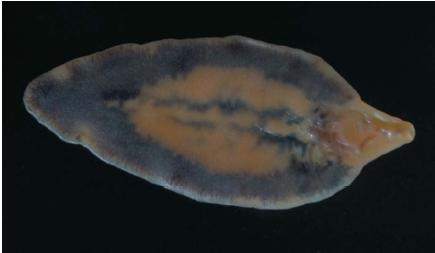
      • There are actually a lot of different kinds of fluke worms, but they're all parasites and they're all equally disgusting so I'm not going to dwell on them.

      This is one type of fluke worm.  Others are more worm-like in shape, but this one's shape is especially similar to our friend the fluke fish.
      (Photo from Shacharit Serefina)

      • The OED also puts a certain kind of potato in with the fish and the worm.  They are fluke potatoes, which are small and kidney-shaped.  

      Fluke potatoes: small, kidney-shaped, with papery skins.
      (Photo from Bon Appetit, sourced from The Guardian)

      • They are much better-known in the UK because that's where they hail from.  You might know them as Jersey potatoes or Jersey Royal potatoes because they are grown on the island of Jersey.
      • The OED thinks they're called fluke potatoes because of their shape, but I'm wondering if it may be related to our oddball definition. In 1880, a Jersey island farmer bought a potato that had a shape he hadn't seen before.  He cut it up, planted the pieces in his garden, and lo and behold, he got a bunch of potatoes that tasted better than the other kind he'd been growing.  So did he call them "fluke potatoes" because of their shape, or because he thought it was a fluke that they turned out so well?

      II. The next set of words, says the OED, are all named flukes because they look like the fluke fish.
      • The first of these meanings is the large triangular plates on each end of the business part of an anchor.
       
      Here's an old-school type of anchor. The flukes are the flared-out ends where the anchor would bite into the sea floor.
      (Photo from the Anchor Bag)


      This is a newer type of anchor, called the Danforth Standard Fluke. Here, the flukes are the very large triangular plates that stick up from the horizontal crossbar.
      (Photo and anchor available from iboats.com)

      • The next fluke-shaped thing on the OED's list is the barb on the end of a lance, spear, or arrow.
      • I would assume that means the point where the lance, spear, etc. pierces somebody.  But on a couple of websites that deal in antique armory, they refer to "flukes" as the decorative flanges that flare out sideways away from the point of the lance, spear, etc.

      Ambrose Antiques refers to the downward-curving flare off the front and the crescent-shaped flare off the back as the flukes.  This is a copy of a 16th century Halberd from Germany, by the way.
      (Photo from Ambrose Antiques)

      • Also in this group is the whale's fluke, or the two flaring parts of the tail.

      This particular fluke belongs to a baby blue whale swimming off the coast of Costa Rica.
      (Photo from Nature's Crusaders)

      • According to the OED, "fluke" can refer to both parts of the tail taken together as a whole, or it is also acceptable to refer to them as "flukes."  So if you're going to say "fluke," you'd probably better make it clear whether you mean one half of the tail or the pair of flukes taken together.
      • There are also several other fluke-type words that have to do with catching whales by the tail.  There is the fluke-chain or the fluke-rope, both of which are looped around the flukes.  One may also go fluking, which means to go whaling and to catch whales by use of fluke-chains or fluke-ropes.  Or that's what they did in Moby Dick's time anyway.

      III. Now we get to the "oddball" definition.
      • This definition probably comes from English billiards, some time in the 1870s or so.  If somebody made a lucky shot, it was called a fluke.  Not only is it lucky, it's probably not repeatable and so therefore, it's unusual.  (Pool players in the US today would call this slop.)
      • This word could also mean a lucky guess, a chance breeze that blows somebody a good turn.
      • What's kind of cool about this is that everybody is guessing that the lucky pool shot is the origin of this meaning.  None of the dictionaries I consulted knows for sure that this is where it came from, and they're all making the same pool-shooting guess.  Nobody offers any suggestions for root words.  Nobody knows whether this meaning has anything to do with the shape of the fluke fish, or the pointy thing on the end of an anchor, or the flukes of a whale, or any of that. In fact, it may not have anything to do with the other definitions of "fluke" at all.
      • So this meaning is, in effect, a fluke itself.  It's a guess and it's not like any of the others in the group.


      This video is labeled a fluke shot, but really, this kid is showing a tremendous amount of skill in managing the spin and placement of the ball.  The shot is challenging enough, though, that maybe he'd have trouble making it happen very often. Also, the cue ball is not involved, so he couldn't really use this shot in an actual game.  But still, nice touch, dude.


      Sources
      The OED
      Online Etymology Dictionary, fluke
      Dictionary.com, fluke
      sensagent dictionary, fluke
      New Jersey Fishing, Fluke
      Great British Bites: Jersey Royal Potatoes, The Times Online, April 15, 2008

      Sunday, August 15, 2010

      Apple #477: Woodpeckers

      My niece said she saw a "very ugly bird" a few weeks ago.  She thought it might be a woodpecker, so she asked me to do a Daily Apple about woodpeckers.

      I've seen quite a few woodpeckers recently, and I don't think they're ugly birds at all.  I'm not sure I would say any bird was ugly except maybe a vulture.  But let's put the question of beauty or ugliness aside for now and just talk about woodpeckers.

      • Woodpeckers have very strong, pointed beaks that they can use like a hammer to knock against trees and also like a chisel to dig bugs out of the bark.
      • They also have very long tongues, which further help in ferreting out bugs.

      Woodpeckers don't just have long, stiff beaks, they also have very long tongues, as this photo of a red-bellied woodpecker demonstrates.
      (Photo from the Hilton Pond Center)

      • Woodpeckers knock their beaks against trees for a variety of reasons:
          • to drum up insects tucked among the crevices of bark
          • to make holes in the trees that become their nests
          • to communicate courtship signals to other woodpeckers in the area
      • Woodpeckers knock wood somewhere between 8,000 to 12,000 times a day.
      • Whenever I hear one, I'm always impressed at how fast the beats fall -- how do they move their heads back and forth fast enough to knock that fast -- and how loud it is.  The sound is so loud, it echoes for tens of yards.
      • There are lots of different species of woodpeckers -- somewhere between 180 and 220 of them.

      Here are 9 types of woodpeckers. Reading in order L to R top down: 8) flicker 1) red-cockaded 2) hairy 3) downy 7) sapsucker 6) red-headed 9) ivory-billed 4) pileated 5) red-bellied
      (Brochure from the US Fish & Wildlife Service)

        • Woodpeckers have been seen in every part of the world that has forests, except in Australia.
        • One of the largest species is the ivory-billed woodpecker.  It's about 20 inches long, has a 3-foot wingspan, and can weigh over 1 pound.  Only the imperial woodpecker in Mexico is larger.
        • It was thought to be extinct, but someone spotted the bird in Arkansas in 2005, though it has been hard to find again since then.
        This is huge.  It's kind of like finding Elvis.

        --Frank Gill, a past president of the Audubon Society, when he heard the news that someone had seen the ivory-billed woodpecker.
            • The pileated woodpecker is the third largest woodpecker in North America after the ivory-billed, and they are much more common.  These are nearly as large as crows, and the holes they make in trees are often rectangular-shaped.
            • 'Pileated" is pronounced "PY-lee-ate-ed."  The word means having a cap over the whole top of the head.  It comes from the Latin word "pileus," meaning a felt cap with no brim.  That old felt cap, too, covered the entire top of the head.
            • Pileated woodpeckers have the distinctive red peaked head and black and white stripes across the face.

            Pileated woodpecker with the famous red crested head. I don't know if you can tell, but the photo is a little blurry where the bird is tapping super-fast against the trunk.
            (Photo from Avian Web)

            • Their call is a high-pitched, somewhat nasal, and fast-repeating chirp-chirp-chirp-chirp-chrip. The call, too, is very loud and carries, echoing, through the trees.


            The Pileated is probably the woodpecker on whom Woody was based.  I freakin' hated Woody Woodpecker, by the way. He annoyed the daylights out of me.  The real bird is far less irritating.
            (Photo from iOffer.com)

            • The Nuttall's woodpecker is much smaller, and it has black and white stripes across its back and its wings.  It is also missing the signature peak that we've all come to identify with woodpeckers, though it does have a red cap.

            The Nuttall's Woodpecker is distinguished from its very similar fellow the Ladder-backed woodpecker by the thick black stripe at the base of its neck.  The Nuttall's lives in California almost exclusively.
            (Photo by Harry Fuller at Towhee.net)

            • The Hairy woodpecker is smaller yet.  The male has just a little spot of red at the back of his head, while the female has no red spot at all.

            The hairy woodpecker is distinguishable from is near-lookalike fellow the downy woodpecker primarily by the length of its beak: the hairy woodpecker's beak is longer than half its head. Now, if you could just measure the woodpecker's beak and head before it hops or flies away. . . . 
            (Photo by Gordon Ellmers from About.com)

            • The Acorn woodpecker drills a bunch of holes in oak trees and fills the holes with acorns they've collected. They may pack the acorns so tightly into the holes, even squirrels can't prise out the nuts.

            Acorn woodpeckers can cause a lot of damage, not just to trees but also to fence posts, wood-sided buildings, and as in this case, telephone poles.
            (Photo by Sue Bryan at Norfolk Birders)

            • Sapsuckers and flickers -- which have calls very similar to pileated woodpeckers though not as loud -- are part of the same family as woodpeckers.  They are all classified as Picidae.

            The famous yellow-bellied sapsucker. As you can see, it really does have a yellow belly. It also looks a lot like a woodpecker -- which is why it's part of the same family.
            (Photo from Urbee Car)

            • If woodpeckers are drumming holes into your property and you want them to knock it off, here are some of the best methods to keep them away:
                • Put metal mesh over areas they have tended to drill into.
                • Put up statues of owls or snakes. Be sure to relocate the statues now and then so the birds don't get used to them
                • Go outside and clap your hands loudly every time you hear the bird hammering. Do it enough times and the bird may get the message.
                • Some sticky repellants such as 4-the-Birds and Roost-No-More have been successful.


            Sources
            Defenders of Wildlife, Woodpeckers
            Thomas H. Maugh, II, "Long thought extinct, a species of woodpecker sails back into view," boston.com, April 29, 2005
            Cornell Lab of Ornithology, All About Birds, Pileated Woodpecker
            Onelook.com, pileated
            Shaw Creek Bird Supply, North American Woodpecker Species
            Professional Pest Control Supplies, Woodpeckers

            Monday, August 9, 2010

            Apple #476: Pronouncing Arkansas

            I know I just did a Daily Apple entry last night, but I'm trying to make up for the dearth of entries recently.  And besides, this makes it a true Daily Apple, Alex!

            I was looking through an catalog from Arkansas today, and that reminded me to ask, Why the heck do they pronounce it "ARK-an-saw" and not "ar-KAN-sas"?  Given that Kansas is pronounced "KAN-sas," that seems to be the pronunciation that would make sense.  Why is it different?

            • Like so many place names in the United States, "Arkansas" is derived from a Native American word. How we wound up with this word and this pronunciation is like a long game of Telephone Operator played through four different languages.
            • Once upon a time, when French Jesuits were still making their way westward, they were told about a tribe of Native Americans who lived farther south down the Mississippi from where they were.
            • This tribe called themselves the Quapaws, or sometimes the Oogaqpa, which means "downstream people."
            The Arkansas River runs diagonally across the center of the state, while the Mississippi flows south along the eastern border.  The Quapaws lived somewhere in the area east of what is now Little Rock.
            (Map from GreenwichMeanTime.com)
             
            • But the people who told the French Jesuit explorers about the Quapaws were Algonquian-speaking Native Americans who lived in the Ohio Valley.  The Algonquians didn't use the Quapaws' word for their tribe but rather their own Algonquin word, which meant "south wind," and was pronounced Ookanasa.
            • Each French explorer heard that word differently, apparently, because when they wrote down their maps of the region, they used various spellings of the name the Algonquians had told them.
                • Marquette wrote "Arkansoa"
                • Joliet wrote "Arkansea"
                • LaSalle wrote "Arkensa" and also "Acansa"
                • DeTonti wrote "Arkancas"
                • LaHarpe wrote "Arkansa" or "Arkansas"
            • LeHarpe's version of the name was actually based on his name for the river which ran near where these people lived.  The river, he felt sure, was called the Arkansas and the people who lived there were the Arkansa tribe.  People who were members of the tribe were called Arkansa plural, or Arkansas.
            • Except in French, you don't pronounce the final s the way we do in English.  The s influences the final vowel sound slightly, but it stays a vowel, yielding something quite close to "ARK-an-saw."
            • Then Zebulon Pike came through the territory in 1811, and he spelled it on his map the way he heard it: Arkansaw.

            Zebulon Pike wasn't French but American.  He was born in Trenton, New Jersey, and served under General George Washington before he went exploring in the southwest.  I think they're still doing their hair in New Jersey like his.
            (Photo from Pike's Peak Cog Railway)

            • When Arkansas became a state in 1836, they used LeHarpe's spelling, Arkansas.  But there were still a lot of variations in the way people pronounced the name.
            • Because in the meantime, things were going differently in nearby Kansas, which had recently become a state.  Instead of retaining the French pronunciation of the word (which would have kept it something like KAN-sah), the folks in Kansas Anglicized the name of their state and pronounced it KAN-sus.

            The red line shows the Arkansas River flowing through Arkansas down there on the lower right as well as through Kansas, which is the pale yellow state in the upper middle. The fact that the same river runs through both states is why their names are similar.
            (Map from Encyclopedia VBXML)

            • So some people in Arkansas were pronouncing their state as the French and Zebulon Pike did while others were pronouncing it like the Kansans.
            • In fact, in the Arkansas state legislature, one senator preferred to be introduced as being from ARK-an-saw, while the other preferred to be introduced as being from ar-KAN-sas.
            • In 1881 the senators finally went head to head about this, after which the state adopted a general resolution declaring that the state name would be pronounced ARK-an-saw.
            • There is an extremely colorful -- which is to say it's full of hyperbole and coarse language -- rendition of the argument one senator made in favor of the ARK-an-saw pronunciation.  It's not certain whether this was the debate that was actually made on the floor of the state legislature, or an embellished version written after the fact.  Some think that maybe Mark Twain penned this speech, given the fact that a similar though far tamer version appears in his Life on the Mississippi.  If you'd care to have a look-see, you can read the text at this site. Scroll down to "Here is Randolph's field-collected text."
            • I had always thought that the way Kansas was pronounced made more sense and Arkansas was the rogue.  But in fact, Kansas is the one that altered its pronunciation and Arkansas is actually closer to the original.

            Sources
            SHG Resources, Arkansas Symbols, State Name
            The State of Arkansas, Introduction
            Pete Thomas, Cimarron Kansas Network, Arkansas, the state
            The Straight Dope, Why is Arkansas pronounced Ar-kan-SAW?
            alphaDictionary, Origins of US State Names
            Netstate, Kansas State History Information

            Apple #475: Grilled Cheese Sandwiches

            I have slacked off in my Daily Appling lately, for no real reason.  I'll try to make it up to you this week with some good entries.  Hopefully, you'll enjoy this one.

            Having already done an entry about bisques, in which I discussed tomato soups and bisques, it seemed only right to follow it up with an entry about grilled cheese sandwiches.  I thought, Since I just did a food entry I'll wait a while on that one, but when three different people mentioned grilled cheese sandwiches to me over the course of two days, it seemed destiny was demanding an entry.  Could destiny be hungry for grilled cheese?


            Grilled cheese with pickle and fries.  Boy, that looks good, doesn't it?
            (Photo from Yum Sugar)

            • People have been eating bread and cheese together for centuries.  Well, duh, that's because the combination is a fantastic one.  But putting them together in a sandwich -- not open-faced -- and grilling it, that's a more modern invention.
            • A lot of people say, by the way, that the Romans invented grilled cheese sandwiches, but this is not true.  Wealthy Romans might sometimes have had cheese with their bread and fruit for breakfast, but they probably wouldn't have made a sandwich of the bread and cheese, and they certainly didn't grill it.
            • Still others say that the grilled cheese is a descendant of the French sandwich called the Croque Monsieur, which was invented some time in the 1900s.  This is basically a ham and cheese sandwich with bechamel sauce on top.  

            The Croque Monsieur, a French ham and cheese sandwich whose name literally means "Mister Crunchy." The bechamel sauce on top, by the way, is made of butter, flour, salt, pepper, Parmesan and Gruyere cheese.  Extra good.
            (Photo and recipe for the sandwich from Simply Recipes)

            • I am going to argue, though, that if you're going to say that the Croque Monsieur is the father of grilled cheese, then you had better be prepared to allow any sandwich that has cheese and gets grilled to be an ancestor of grilled cheese.  Because by my definition, as soon as you throw meat on that sandwich, it ceases to be a grilled cheese and becomes a Whatever Meat You've Got On There and Cheese Sandwich.
            • In fact, the grilled cheese sandwich as we know it came about with the invention of processed cheese, or what we now call Kraft Singles.
            • A guy named James L. Kraft started a cheddar wholesaling business in Chicago in 1903.  He wanted to keep his cheddar from spoiling as fast and to make sure that the cheddar was consistently good from one batch to the next.  
            • He tried some different ideas, but then in 1916 he hit on what would be the winner:  he shredded "refuse cheddar," re-pasteurized it to sterilize it again, and added sodium phosphate as a preservative.  (Sodium phosphate by itself is a pretty potent laxative, by the way.)
            • He advertised the heck out of his cheese, promised that it would last longer and would be consistent from one package to the next, and charged more for it (even though it was made from inferior cheese and a laxative), and it was hugely successful.

            Kraft Singles, the sine qua non of grilled cheese sandwiches.  Perhaps it's too small to see, but the packaging says "Pasteurized prepared cheese product."
            (Photo from Gravity7)

              • Processed cheese might not have been as successful, though, without the influence of two World Wars.  It was much easier to ship overseas than regular cheddar, the Navy loved it because it would last longer on ships, and it was generally easier to carry around in ration packs.
              • So it was at least some time after the 1920s or 1930s that the grilled cheese sandwich was born.  It may have been born on a Navy ship, since World War II Navy cookbooks contain recipes for "American cheese filling sandwiches" which were broiled on board.
              • But, ah, sharp reader that you are, you noticed I said broiled, not grilled.  Some enterprising Navy cook might have grilled his cheese sandwiches, but we have no record of that. So the grilled cheese may not actually have taken its first breath until some time later.
              • After WWII, American school cafeterias served cheese sandwiches using the American cheese.  These may or may not have been grilled; my source is not clear on this point.  But they weren't quite the grilled cheese as we know it, since they were served open-faced.  
              • It was during this time, however -- the 1950s, that is -- that the cheese sandwich was first paired with tomato soup.  Tomato soup was thought to be a good source of Vitamin C, and therefore a nutritional addition to a sandwich that didn't offer much in the way of vitamins.
              • What is certain is that by the 1960s, people had added the top slice of bread and they were grilling the sandwiches.  How we got from broiling to grilling, and how that second slice of bread got added, history does not tell us.  It may remain forever a culinary mystery.

              The original grilled cheese: processed a.k.a. American cheese between two slices of bread, grilled.
              (Photo from Food Vixen in NYC's Blog)

              • Once born, the love for grilled cheese sandwiches has only grown. 
              • April is officially National Grilled Cheese Sandwich Month.  All during April, various TV shows and restaurants host grilled cheese-making contests, Kraft has a tell-us-why-you-love-grilled-cheese contest, and restaurants all over the country offer more or better or fancier grilled cheeses throughout the month.
              • One restaurant in Cincinnati called Lavomatic reportedly makes a different grilled cheese sandwich every day, whether it's April or not.  When I checked their menu, the grilled cheese of the day was boursin, mild cheddar, and sharp white cheddar.  (Notice: no meat.)  They were also serving a tomato bisque.
              • Another restaurant called Campanile in Los Angeles serves only grilled cheese sandwiches as their main courses.  But their grilled cheeses are fancy -- with marinated onion and whole grain mustard -- and they often include other ingredients like beer-battered soft shell crab, or braised lamb and artichokes, or -- I must confess this one sounds really good -- bacon, avocado, and tomato.
              • Yet another restaurant, this one a diner called The Pop Shop in Collingswood, NJ, regularly serves over 30 varieties of grilled cheese sandwiches.  They have won awards for their grilled cheese sandwiches, and one day Bobby Flay showed up for a grilled cheese throwdown.  Bobby Flay won with his brie, goat cheese, and bacon sandwich.  But once again, in my book, as soon as you put meat on it, it's not a grilled cheese anymore, so I don't know how authentic I'd call that victory.

              Even this psycho girl loves grilled cheese sandwiches.
              (Image from Adland.TV)

                • There is also the Grilled Cheese Invitational, held each April in Los Angeles.  250 amateurs and 50 professionals can compete.  Contestants can enter one sandwich per category.  The categories are Missionary, Kama Sutra, and Honey Pot. Missionary is the standard grilled cheese with no extra ingredients (oh dear, what does this say about me), Kama Sutra can have extra ingredients but the interior must be 60% cheese, and the Honey Pot is like the Kama Sutra except suitable for dessert.
                • Winning sandwiches include the "I'd Tell You What's In It (but I'd have to kill you)," "A Dessert so delicious is was not meant for Man Ding Dong," "Foe Cheesy!" and "The DaVinCheese."

                They're serious -- mostly -- about grilled cheese sandwiches at the Grilled Cheese Invitational.
                (Photo from the Grilled Cheese Invitational)

                • There's also a guy in New York's East Village who started a facebook page offering to make a grilled cheese sandwich for anyone who asks for $5 to $7. He grills the sandwiches in a pan, wraps them in foil, then puts them in a 500 degree oven to maximize crispness.  He'll then ride his bike to meet customers on a specified nearby street corner and hand off the sandwich in exchange for the cash.  It's all conducted as an underground service because he's not an official restaurant with health code inspections or anything.  His page is called bread.butter.cheese.
                I don't know how much longer I want to do it because I'm living in fear.  It would be such a stupid thing to get in trouble for. . . . I kind of want to quit, it's getting too big, but I want to feed these people.
                • Perhaps the best indication of the popularity of the grilled cheese sandwich is the visions people have had while eating them.
                • The most famous, of course, is the woman who saw the Virgin Mary in her grilled cheese sandwich.  She sold the sandwich on eBay to an internet casino called Golden Palace for $28,000.  Then she got the sandwich with the likeness of the Virgin Mary tattooed on her breast.

                Diana Duyser with her famous grilled cheese sandwich, packaged in the plastic case with cotton balls where she kept it for 10 years before selling it on eBay.
                (Photo from Atheist Point)

                • Other grilled cheese-lovers have found Hello Kitty and Howard Stern on their sandwiches.  Those were also sold on eBay.
                • What makes the grilled cheese so popular, in my opinion, is not all the public hoopla but the fact that it remains a great at-home, comfort food.
                • My favorite way to make grilled cheese is thusly:
                    • Whole wheat bread
                    • Cheddar cheese (not the processed stuff)
                    • Yellow mustard
                • Squirt the mustard on the bread, slice enough pieces of cheese to cover one slice, close the sandwich, butter the outside, place it in a hot pan.  Turn down the heat slightly as the sandwich cooks.  Check it once in a while and when the bread is getting browned, flip.  It'll take less time to cook the other side.  When you hear the melted cheese hit the pan with a sizzle, it's done.  Crunchy on the outside, gooey on the inside: excellent.
                • In spite of the excellence of my grilled cheese sandwiches, I have been engaged in a heated debate for several years with a friend of mine, Mercutio, about the best way to make one.  The details of this debate are far too extensive to get into here.
                • I will say this much, though.  In defense of my methodology, here are the instructions from the official National Grilled Cheese Sandwich Month page:
                It is most common for the assembled sandwich to be buttered on the outside and placed on a griddle, pan, cast iron skillet, or rarely, in a dedicated sandwich maker to be heated. Once the bread on the bottom half of the sandwich has reached a toast-like texture, the sandwich is flipped and continues cooking until the other side has toasted and the cheese has melted. 
                Another method is to butter one slice of bread on both sides, grill the bottom side until the butter melts, then flip. Wait for the inside to be grilled, flip and add the cheese. Then butter the other slice of bread and grill, then place the slices of bread together.
                • Do you see anything in those instructions about putting a lid over the sandwich?  Noooo.  Mercutio, I rest my case.


                  If you really want to get fancy with your grilled cheese, here's one with Monterey Jack cheese, sliced jalapeños, and butter.
                  (Photo from Asylum.com, which has a list of 5 fancy grilled cheeses)


                  Sources
                  The Food Timeline, FAQs: sandwiches, grilled cheese
                  Irulan Serena, AllExperts.com,  Ancient/Classical History, grilled cheese sandwich, April 2, 2008
                  Sherri Granato, The Grilled Cheese Sandwich, America's Favorite Comfort Food, Associated Content, September 5, 2007
                  David Clark, "A Brief History of 'American Cheese,' from Colonial Cheddar to Kraft Singles," Mental Floss, January 7, 2009
                  Medline Plus, sodium phosphate
                  Erin Zimmer, Serious Eats, April is National Grilled Cheese Month, April 7, 2009
                  Yelp, Pop Shop
                  Amber Sutherland and Jeremy Olshan, He's making a gouda livin', New York Post, August 2, 2010
                  Gone-ta-Pott.com, National Grilled Cheese Sandwich Month
                  Brendan I. Koerner, The $28K Sandwich That Grew No Mold, Slate.com, November 23, 2004
                  Surfer Sam, Famous EBay Auctions 

                  Thursday, July 29, 2010

                  Apple #474: How to Avoid Getting Trampled

                  Ever since I read about the people who got trampled at the Love Parade in Germany, I've been wondering, now what are you supposed to do, again, if you're in a crowd like that?  Work your way to the outside, right?  But those people were in a tunnel.  There was no "outside" for them to get to.  What should they have done?


                  When people are this tightly packed together, it's too dangerous.  An estimated 1.4 million people turned up for the Love Parade when the venue was capable of holding only 300,000.
                  (Photo from Billboard.com)


                  This isn't a very happy Daily Apple topic, I know.  I'm choosing to believe that because I'll be giving safety tips, talking about prevention and avoidance, that will in the end make it a positive entry.

                  Strategies to avoid getting caught up in a crowd vary depending on how thick the crowd is, how pressed-together the crowd has become.  So I'm going to start with early warning signs, things you can do before it gets tight, and what you can do at each stage from there.
                    • Get a map of the venue and find the exits.  If it's an outdoor, multiple-street event, look for side roads that lead to larger thoroughfares that aren't part of the event and that will be less congested.
                    • Look for indications that organizers have put some thought into this event and are prepared to handle the crowd.  You want to see methods of crowd control -- things that will help keep a crowd from getting out of hand in the first place, or ways that someone in charge can redirect a crowd or avert any problems.
                    • Good crowd control things to look for are:
                        • Barriers.  These could be metal barricades, sawhorses, caution tape, ropes, etc.  Yes, these are actually good things, not obstacles, because they help channel the group to a manageable size, and they'll keep sudden bottlenecks from forming. 
                     
                    Metal barricades like these at music or sporting events are actually good things.  They'll help keep crowds from getting out of control.
                    (Photo from Blockader)

                        • Directional signs.  Seems simple, but these do help because they tell people which routes are best, not which ones seem the most convenient at first but then turn out to be bottlenecks.  If a lot of signs have been knocked down or walked over, that's an indication that the crowd could be getting too big.
                        • Police officers or security personnel, especially uniformed people who can see above the crowd.  They could be standing on a building or even astride a horse.  Higher vantage points will help them to see situations as they form and try to keep anything from getting out of hand.  The fact that they're officials will also mean that they'll have more success than an average Joe at trying to redirect or split up a large crowd.

                    I know a lot of people out there don't like to see mounted police officers at concerts or popular events, but they can do a lot to keep crowds from getting dangerous.  The fact that the officers at the Love Parade apparently didn't do much, well, that's another story.  (Did you notice the velvet rope in this picture too?  Another crowd control device at work.)
                    (Photo from Wikimedia Commons)

                        • Loudspeakers.  These could be speakers set up on large stands, or they could be bullhorns that security personnel are carrying.  Sometimes somebody's got to tell a crowd what to do or where to go.  If there are a lot of people in the area, these things will be crucial at redirecting the foot traffic.
                    • If you're about to enter a crowded area and you don't see any of these types of crowd control, it could become a dangerous situation.  Hang back until any clustering subsides, find a different route, or even turn around entirely.
                    • When you do join a large crowd, try to keep close to the edge if you can.  This will give you the greatest freedom of movement and flexibility in case things start getting too bunched up.
                    • If you're already in the thick of a crowd, make sure you have enough personal space around you so that you can plant your feet and keep yourself stable, if necessary.  They say there shouldn't be more than four people per square meter, but I don't know how big a square meter is.  A good indication is that if you're being touched on all four sides, the crowd is too closely packed and you should seek an area that's less congested.
                    • If you get jostled and don't have enough room on the ground to plant a foot, it's really gotten too close.  Time to make getting out of the crowd your main priority.

                    A crowd in the streets of New York after the Giants' Superbowl parade. Although this crowd is closely packed, the mounted and motorcycle police are close at hand, keeping an avenue open in the crowd. While there was some disorderly behavior, this crowd never really got out of control.
                    (Photo from The New York Times)

                    • In order to get yourself out of the crowd, experts say that it won't work if you turn around and try to press face first against the crowd.  But you can sometimes move sideways as the crowd surges forward. Pull your arms in close to your body and don't try to push against the flow of the crowd but keep edging and zig-zagging among the people as they move forward until you reach the outer edge of the group.
                    • If you're in a tunnel, which was where the people at the Love Parade got stuck, working toward the edge wouldn't do any good. In that situation, experts say that if you can, move gradually backward.  This seems a little dangerous to me because you wouldn't be able to see where you're going or to know if someone is going to run into you from behind.  But the reason they say this is because the crowd will have bunched up due to a bottleneck ahead of you.  It's only going to get more crunched together as more people press in from the back of the crowd.  The only exit then is to the back. 
                    • If you drop something, forget about it.  Don't stop to pick it up or try to make the crowd stop or flow around you.  Even if it's your purse full of irreplaceable photos of your dearest sweetest honey pie, you're better off with out it.  In fact, at this stage, you're actually better off if you're not carrying anything.
                    • If you do fall down, curl up in that good old fetal position.  Protect your head and your stomach from being kicked accidentally.  If it's possible, try to roll toward the outside edge.  But make sure to protect your more vulnerable parts.

                    Hopefully you'll never get to that point.  Remember, just because a ton of people are heading over there, that doesn't mean that's the cool place to be or the place you need to be right this minute.  Enjoy the show, but allow yourself the room you need to move and breathe, and stay safe.


                    The people in this crowd aren't pressing against each other.  Everybody has enough space all the way around, everybody can easily keep both feet on the ground, nobody's panicked and nobody's pushing forward with a lot of demanding urgency.  But clearly, they're all very interested in what's about to happen -- they've gathered at an annual feast day and they're all about to eat.  Looks like a good crowd to me!
                    (Photo from Living in Sri Radhakund)


                    Sources
                    Amanda Ripley, How Not To Get Trampled at the Inauguration, Slate.com, January 19, 2009
                    wikiHow, How to Evade a Stampede of Shoppers
                    M. M. Rooni, Stampede Safety Precautions, Associated Content from Yahoo! March 9, 2010
                    Ask Metafilter, What's the best way to protect yourself if you're caught in a stampede? October 1, 2008

                    Sunday, July 25, 2010

                    Apple #473: Bisques

                    I was trading e-mails with a friend of mine -- Mercutio, actually, from the fainting entry.  He was talking about tomato soup, and I said I liked Campbell's Tomato Bisque.  He said, "I love a good Tomato Bisque.  Even though I have no idea what makes it 'bisque'." 

                    Thus a Daily Apple is born.


                    This is a crab bisque with hunks of extra crab in the middle.
                    (The recipe looks really easy. Combine two cans of soup plus your favorite shellfish plus sherry and Worcestershire sauce. Photo and recipe from Thutmose Solomon.)

                    • A bisque is a soup that's usually made with shellfish, been thickened with cream and then puréed. 
                    • It may also have wine or cognac.  It may also have vegetables.  But usually the three necessary components for a soup to reach bisque status are shellfish, cream, and having been puréed.
                    • To get the most flavor into a bisque, many chefs leave the shells on the shellfish during the cooking process. 
                    • A chowder is close to a bisque, but it hasn't been puréed. 
                    • Making a bisque used to be far more complicated, time-consuming, and difficult.  Here is the traditional French method described by Ochef:
                    The preparation of a bisque is no small achievement. It involves marinating the shellfish of your choice in a sherry-infused court-bouillon [a type of broth] overnight, cooking the fish in the court-bouillon with tomatoes, removing the fish and pounding it to a purée in a mortar and pestle, passing the purée through a sieve back into the bouillon and simmering it for a couple of hours. Finally, the hot soup is whisked into a tureen where three (not two, not four) beaten egg yolks are waiting, after which some cream and brandy or sherry is added. 
                    • This demanding recipe is probably why it used to be the case, if you saw a bisque on the menu, you knew you were at the finest of French restaurants.  And you'd probably have to pay scads of money for that bowl of soup.
                    • Perhaps the most commonly known bisque is the lobster bisque.  Often its presence on a menu today, whether it is prepared according to those traditional instructions or not, still signifies an upper class meal. 
                     
                    A lot of lobster bisques have the creamy puréed broth, but then people also put chunks of lobster and maybe other shellfish into it. This one seems to be more like a "true" lobster bisque with a hunk of lobster tail added as a garnish.
                    (Photo and soup from Heller's Sea Food Market, which sells a bowl of this bisque for $6.99)

                    • In the case of lobster bisque, many chefs remove the shells before cooking so that nobody bites into a stray chip of tough lobster shell.  But some chefs still leave the lobster shells on, and they purée the shells along with everything else.  They say that without the shells, the flavor just isn't as good.
                    • After reading all these definitions of bisques, I started to wonder about my good friend, Campbell's Tomato Bisque.  I went downstairs and got a can out of my cupboard and checked the label.

                    Sells for $19.55 for a pack of 12 cans on Amazon.

                    • They've got the cream in there, and they've got the purée, but there's no shellfish.  
                    • I suppose they wouldn't be able to sell as much of the soup if they put any kind of shellfish flavor in it.  Too many concerns about allergies, and maybe not enough people like shellfish either.
                    • Considering that Campbell's sells their tomato bisques for about $1.75, I'm going to bet that, in addition to not using shellfish, they don't marinate anything overnight or pound anything with a mortar and pestle, or whisk anything into a tureen.  
                    • Well, maybe they use some gigantic industrial-sized vat with a mixing paddle as big as your head.

                    This is a 60-gallon processor used by Campbell's in one of their manufacturing plants.  You can see the mixing paddle on the floor next to it.  This particular one was purchased in 1975 and it's been decommissioned.  If you want to buy it, they're offering it for sale on their asset recovery site.

                      • If you made your own bisque, you wouldn't need a machine that big.  Even if you didn't marinate anything or use any shellfish, as long as there was cream involved and you puréed it, I think you could call it a bisque and the soup police wouldn't come arrest you.

                      The recipe for this tomato bisque doesn't include shellfish, though it does call for chicken broth.  It also has butter and cream and sugar. Yum. Still, I think the key to making a good tomato soup would be to allow it to cook slowly, for a long time. That would reduce the acidity in the tomatoes and coax out the sweetness.
                      (Recipe for and photo of tomato bisque from myrecipes.com)

                      • Well, I don't actually know if the food police have a department dedicated solely to soup.  But here are the food police at work in London:

                      Actually it's just the regular East London police closing down a take-out restaurant because a law was passed recently forbidding the sale of fast food within so many meters of schools.  But you never know when the food police might darken your doorstep and say, "Ma'am, we've received information that you're making a chowder and calling it bisque."  
                      (Photo from the Daily Mail)


                      I think if there really were a soup police, it would be Alton Brown.


                      Sources
                      MiMi.hu, definitions of Bisque
                      Wise Geek, What is Bisque?
                      O Chef, Difference Between a Bisque and a Chowder

                      Monday, July 19, 2010

                      Apple #472: Bears by Size

                      I went to the zoo last weekend with a friend.  We saw polar bears, black bears, brown bears.  This raised the question, which type of bear is the largest?  Is it really the polar bear, as the exhibit claimed?  What about the Kodiak bear?  Time for the Apple Lady to get to work.

                      In looking for facts about each species, I found some facts that seemed to be common among most of them.  Bears are mainly huge and strong, but they're also smarter and more capable than I think most of us today typically give them credit for.  Here are some of those common traits:
                      • Bears are not nearsighted, as is commonly believed.  Their vision is actually quite good.
                      • They have extraordinarily keen sense of smell, often able to smell food from miles away, even canned food.
                      • They have excellent long-term memories and their navigation abilities exceed those of humans.
                      • Most bears are good swimmers. Some can swim half a mile or farther in fresh water.
                      • Many can run as fast as 30 mph.  Imagine a 500-pound animal running at you at 30 miles an hour!
                      Here's the list of bears in order of size, from biggest to smallest:
                      1. Polar bear
                      2. Kodiak bear
                      3. Grizzly bear (type of brown bear)
                      4. Black bear
                      5. Giant panda
                      6. Sun bear
                      7. Sloth bear
                      Now here are the details about each, including dimensions, species name, and a few facts about what they eat and their habits.

                      Polar bear
                      Ursus maritimus

                      This polar bear has collapsed from heat exhaustion. Not a happy sight, but I chose this photo to give you a sense of the bear's size.
                      (Photo from Eco-Enquirer)


                      nose-to-tail length: 7 to 8.4 ft.
                      shoulder height: 5.3 ft. (that's as tall as me)
                      avg weight: 900 to 1,600 lbs
                      Polar bears are the largest land predators alive in the world today.


                      Range, in yellow, of the polar bear
                      (Map by National Geographic)

                      • There are about 25,000 to 40,000 polar bears in the world.
                      • Their paws have several features which help them in their environment:
                          • slightly webbed, which helps them swim better,
                          • furry even on the underside for greater protection against the cold ice
                          • wide and flat, which makes them act like snowshoes
                          • that shape also helps them literally shovel snow to build their dens
                          • are covered with small papillae -- miniature cleats -- and indentations -- mini suction cups -- both of which help increase friction and stability on the ice
                      • Forepaws are 5-3/4 in long and 9 in wide (fatter than they are long). Hind paws are 13 in long and 9 in wide.
                      • Their fur is white, which provides camouflage. 
                      • Their skin beneath is black, to help absorb heat from the sun.
                      • Mature males' fur turns yellow as they age.
                      • When polar bears dive into the water, their ear canals close in protection against the frigid water.
                      • Seals are their main food source. Polar bears sit by cracks or holes in the ice. When seals surface to breathe, the polar bears lunge its head forward and grab the seal in its mouth.
                      • A polar bear will eat a seal once every 5-6 days.  Their stomachs can store 150 lbs of food. 
                      • Polar bears can smell seals up to 40 miles away. 
                      • They also eat grasses, seaweed, berries, lemmings, and voles.
                      • They may also hunt beluga whales and walruses.
                      • Females dig their dens into deep snow drifts.
                      • 2/3 of all polar bear births are twins.
                      • Polar bears have no natural enemies except humans.

                      A couple naturalists observed a polar bear and a husky dog becoming friends and playing with each other.
                      (More photos at Session Magazine)

                      Polar bear swimming. She's using her front paws almost exclusively. 


                      Kodiak Bear
                      Ursus arctos middendorffi

                      The massive shoulder hump on the Kodiak is obvious here.
                      (Photo from the North American Bear Center)

                      nose-to-tail length: up to 10.5 ft
                      shoulder height: 5 ft
                      avg weight: up to 1,500 lbs
                      The largest Kodiak in captivity was Clyde, who lived in the Dakota Zoo in N.D.  When he died at age 22, he weighed 2,400 lbs.


                      The green spot is the Kodiak Archipelago, the only place on earth where Kodiak bears live.
                      (Map from Alaska Department of Fish & Game)

                      • Kodiaks are a subspecies of the Brown bear
                      • They live only on the Kodiak Archipelago in Alaska
                      • Only about 3,000 Kodiaks are alive today
                      • They have a large shoulder hump, which is a mass of muscle, that helps them dig for food
                      • They eat 90 lbs of food a day, most of it plants and berries.
                      • Also eat salmon, deer, elk, or cattle.
                      • They are usually solitary, but they often feed in large groups. To make sure everyone gets enough to eat without fighting, they have developed their own unique language and social structure.


                      Bart the Bear, a Kodiak bear actor, who lived 22 years. This photo gives you a good idea of this bear's size.
                      (Photo from Bart the Bear's unofficial home page)


                      Brown Bear / Grizzly Bear
                      Ursos arctos / Ursus arctos horribilis

                      The grizzly bear's white-tipped fur, shoulder hump, and long snout are its easily distinguishable traits.
                      (Photo from the USGS)

                      nose-to-tail length: 6 to 7 ft
                      shoulder height: 3 to 3 1/2 ft
                      weight: coastal, up to 1500 lbs
                      weight: inland, up to 850 lbs
                      avg weight: 550 lbs


                      Range, in orange, of the Grizzly or brown bear
                      (Map from Defenders of Wildlife)

                      • In coastal Alaska and Canada, they are called Brown bears.
                      • In the inland 48 states, they are called Grizzly bears
                      • Around 1,000 - 1,200 grizzlies in the lower 48, around 30,000 in Alaska.
                      • Has a hump on its shoulders and long, straight claws
                      • Outer, long hairs called "guard hairs" on back often have white tips, giving them a "grizzled" appearance
                      • Brown bears' fur may range in color from dark brown to light blond.
                      • Grizzly bears like vegetation and will eat grasses, roots, berries, mushrooms.
                      • Coastal brown bears eat salmon but a lot more vegetation than grizzlies.

                      I saw this brown bear at the zoo.  He's tearing into a stump to get at the bugs in it. He had just gotten out of the water, where he'd been scooping up seaweed from the bottom of the pool with his claws and eating it by the pawful.
                      (Photo by the Apple Lady)

                      • Inland grizzlies eat moose, caribou, or elk, or small mammals, as well as vegetation. 
                      • 70% of human deaths from grizzlies were by a female defending her cubs.
                      • In the lower 48, grizzlies are Endangered, except for those who live in Yellowstone.
                      • In Alaska, they are a game animal and may be hunted but according to very strict regulations.

                      Grizzly bear's paw. Man, that's big.
                      (Photo from Frances Hunter's American Heroes Blog)


                      Black bear
                      Ursus americanus

                      A black bear from Tennessee
                      (Photo from First People)

                      nose-to-tail length: 4 to 7 ft
                      shoulder height: 2 to 3 ft.
                      avg weight: 200 lbs to 600 lbs


                      Range, in yellow, of the black bear
                      (Map from National Geographic)
                       
                      • May be black, blue-gray, blue-black, whitish-blue, brown, cinnamon, blonde, or even white
                      • Eat plants, fruits, nuts, berries, bugs, honey. Also salmon, small mammals, and carrion.
                      • About 600,000 black bears in North America, about half in the US.
                      • Their eyes are blue when they're born but turn brown as they mature.
                      • Black bears have never been known to attack a human. In fact, all adult black bear deaths are human-related.
                      • There are 16 subspecies of black bears, mostly distinguished according to where they live.
                      • The Cinnamon Bear, Kermode Bear, and Glacier Bear are all subspecies of black bear.
                      • Louisiana black bear and Florida black bear are threatened subspecies.

                      The Kermode Bear, in the foreground, is a white subspecies of the black bear. You can tell it's not a polar bear by the shape of the head, which is much more round than a polar bear's wedge-shaped skull.
                      (Photo from UniqueDaily)


                      [edit:] Eagle-eyed regular reader Jason alerted me to this news article about a bear -- a black bear, I think -- that broke into one family's Toyota, accidentally shut itself inside, knocked the car into neutral, and rolled downhill. Really funny and worth a look.


                      Giant Panda
                      Ailuropoda melanoluca

                      Giant panda, doing its favorite thing: eating bamboo
                      (Photo from Scientific American)

                      nose-to-tail length: 5 1/2 to 6 ft
                      shoulder height: 2 to 3 ft
                      weight: 200 to 330 lbs.


                      Giant pandas live in only six small bits of forests in mountain provinces of China -- those little red dots.
                      (Map from the San Diego Zoo)

                      • Naturalists weren't sure for a long time whether pandas were more like raccoons or bears. Finally they decided that pandas were a type of bear. But they remain classified separately from all other types of bears.
                      • Only about 1,000 to 2,000 giant pandas exist in the world.
                      • Eat bamboo almost exclusively, 10 to 12 hours each day.
                      • Have large crushing molars, large jaws, and an exceptionally wide esophagus, all the better to eat and swallow the bamboo.
                      • Because they can't build up enough fat on their bamboo diet, they don't hibernate in winter but instead migrate to warmer climates.
                      • Panda bears were the second animal after dogs to have their genome decoded by scientists.  They discovered, among other things, that pandas can't taste umami, that mysterious and complex sixth taste. So researchers think that meat simply doesn't taste good to pandas, and that this may explain why they prefer bamboo.
                      • Unlike many other bears, they're not quick movers, but if necessary, they will catch small animals for food.
                      • Have an enlarged wrist bone which is functionally a sixth digit that pandas use similarly to a thumb.
                      • They don't roar like other bears but make a bleating sound like a goat.


                      Sun Bear
                      Helarctos malayanus

                      The Malayan Sun Bear showing off its claws and its telltale yellow-orange chest patch.
                      (Photo from the Wellington Zoo)

                      nose-to-tail length: 4 to 5 ft
                      avg weight: 60 to 150 lbs.


                      Range, in yellow, of the Sun Bear
                      (Map from National Geographic)

                      • Named for the lighter-colored bib-shaped patch on their chests, which were said to resemble the rising sun.
                      • Sometimes also called the honey bear.
                      • Unlike most other bears which are active during the day, sun bears are nocturnal.
                      • They are very shy and live in remote areas, so not much is known about them.
                      • They are omnivores, but the fruits they like are coconuts, palm trees, and bananas. 
                      • They also eat small birds, lizards, and rodents.
                      • Sun bear mothers have been observed cradling and carrying their young in their arms while walking on their hind legs.


                      Spectacled Bear
                      Temarctos ornatus

                      Some spectacled bears have markings that go all the way around their eyes, like this one. But not all of them do.
                      (Photo from Zoos Worldwide)

                      nose-to-tail length: 5 to 6 ft.
                      avg weight: 220 to 340 lbs.


                      Range, in yellow, of the Spectacled bear
                      (Map from National Geographic)

                      • Markings on the spectacled bear are unique to each bear, like a fingerprint.
                      • Sometimes called the Short-Faced bear or the Andean bear.
                      • The only bears that live in South America, they live in the jungles in the Andes Mountains.
                      • Mostly nocturnal, solitary except during mating season, and very shy.
                      • Eat vegetation including tree bark and orchid bulbs, fruit, berries, cacti, honey. 
                      • May also eat meat such as rodents, small birds, insects, and small cows.
                      • They have been known to climb trees, break off branches to make a platform, and sit there waiting for several days for fruit to ripen.

                      Another spectacled bear, with fairly different markings
                      (Photo from the Phoenix Zoo)


                      Sloth Bear
                      Melursus ursinus

                      The sloth bear has shaggy fur which reminds me of a dog's.
                      (Photo from Bears of the World)

                      nose-to-tail length: up to 6 ft
                      avg weight: 120 to 310 lbs.


                      Range, in yellow, of the Sloth Bear
                      (Map from National Geographic)

                      • Have a shaggy black coat, and a cream-colored snout and bib on their chest.
                      • Eat mainly termites and ants. They will use their claws to dig open rock-hard insect mounds, blow away the excess dirt, and suck up the insects through a gap in their front teeth.
                      • Also eat mangoes, figs, flowers, and sometimes honey.
                      • These bears are also sometimes called honey bears.
                      • There are 2 subspecies, the Indian and the Sri Lankan.
                      • The only bears to carry their young on their backs.

                      Sloth bears going after a termite mound in the London zoo.
                      (Photo from the London Zoo)


                      Other "bears" that are not bears
                      • The koala is not a bear but a marsupial.
                      • The red panda is not a bear but its own species, more closely related to the raccoon.


                      Sources
                      Alaska Department of Fish & Game, Brown Bear, Kodiak Bear Fact Sheet
                      Kodiakbear.net, Kodiak Bear Facts 
                      Defenders of Wildlife, Grizzly Bear, Black Bear
                      Great Bear Foundation, Brown Bear, Panda Bear (giant panda)
                      National Geographic, Grizzly Bear, Black Bear, Sun Bear, Polar Bear, Sloth Bear
                      North American Bear Center, Quick Black Bear Facts, Polar Bear Facts
                      Pandabearmd, Panda Bear Facts
                      San Diego Zoo, Mammals: Giant Panda, Mammals: Andean (Spectacled) Bear
                      Katherine Harmon, Giant panda genome sequenced, explains taste for bamboo, Scientific American, December 13, 2009