Sunday, November 14, 2010

Apple #493: Cowlicks

I got my hair cut this weekend.  Yes, all of the hairs on my head, har har.

My hairdresser, Roger, and I enjoy talking to each other during the whole hair-cutting and -styling process, and this time, one of the things we talked about is cowlicks.  I asked him how many of his clients are men (he said about 50%, which surprised me), and does it take less time to cut their hair.  He said sometimes it takes longer because their hair is shorter so you have to pay more attention to details and be careful to avoid making visible cut lines.  He said it can also take longer if they have a cowlick.

That word is so odd, I of course had to ask him more about it.


Art Clokey, the maker of Gumby, might be the king of the cowlick.
(Photo from Art Baxter's blog)

  • I asked Roger, "What is a cowlick, exactly? Is it just a place where the hair grows in a different direction?"
  • "Yup," he said, "that's all it is. For whatever reason, the follicles in that area face one direction and the follicles everyplace else are headed somewhere else."
  • Dictionaries all over the place confirm Roger's answer.
  • One hair cutting site tells hair stylists, "You will see at least one cowlick on every head of hair you cut."  The hair on the crown is where the growth pattern starts, and they count this as a cowlick.
  • The crown of your head is where Harry Potter's cowlick is. 
Harry had a thin face, knobbly knees, black hair, and bright green eyes. He wore round glasses held together with a lot of Scotch tape because of all the times Dudley had punched him on the nose. . . . Harry must have had more hair cuts than the rest of his class put together. But it made no difference. His hair simply grew that way. All over the place. (Sorcerer's Stone)


This drawing comes the closest to how I envisioned Harry Potter before any of the movies came out. Here, it seems he's got about six cowlicks. In later books, he's usually smoothing down the hair at the back of his head, which suggests maybe only one cowlick.
(Drawing from Panda vs. Robot)


This boy's cowlick, visible in his first grade photo, stuck up in every school photo until his hair was allowed to get very long. You can see the progression of hair length at his blog, unappealingly titled Poop and Boogies.


This boy has two cowlicks at the crown of his head. One site reckons that about 10% of the population has double cowlicks.
(Photo from The Outsiders)

  • Cowlicks also often appear along the hairline, either above the forehead or at the nape of the neck. 

This boy has a very obvious cowlick above his forehead. It's kind of like a whorl of hair.
(Photo from Crunchyroll)


This girl has two cowlicks in her bangs. You can tell by the way some of the hair is sort of veering sideways while another strand is sort of puffing out away from her head.
(Photo of Swistle from her eponymous blog, Swistle)


This woman has a cowlick at her nape.
(Photo from Hair Boutique.com)

  • To deal with cowlicks, Roger told me that you can cut the hair around it so as to disguise it--"blend it" was actually how he put it.
  • In most cases, allowing the cowlicked hair so that it has more weight can sometimes be enough to make it sit down.  
  • Allowing the hair around it to grow a bit longer, especially if the surrounding hair falls over the cowlick, can help weigh it down too.
  • The length/weight factor can be tricky, though, because with some cowlicks, when the surrounding hair gets too long, the cowlick will "separate" from the rest of the hair. This can make it look like your hair is thinning in one place when that's not actually the case. The trick is to keep an eye on it and keep the hair at the ideal length.
  • Alternatively, cutting the cowlick very short can keep the cowlick from expressing itself at all. But this usually means you have to like buzz cuts.
  • If you've got wavy hair as well as a cowlick, your stylist may be able to trim layers nearby so that the cowlick appears to be part of one of the layers and doesn't seem to be an anomaly at all.
  • If you've got double cowlicks, it can help to allow the hair between the cowlicks to grow longer so that the cowlicks don't shove up the middle hair but are in fact weighted down a bit by the in-between hair.
  • When styling hair with cowlicks, don't try to comb a cowlick to go in a direction it doesn't want to go.  You'll only make it stand up all the more.  
  • When blow drying, though, you may be able to coax it into relaxing if you point the blow dryer downward over the cowlick. Combining such careful blow drying with gels or mousses can sometimes tame a cowlick.
  • Be careful, though, not to rely too much on product to cement down a cowlick.  If the cowlick stands up anyway, it'll only look all glisteny and more obvious because of the extra product.

Too much product on a cowlick and you could wind up looking like Alfalfa.
(Photo from flyte)

  • If hair cutting or styling doesn't do the trick, you could try waxing to remove the cowlicked hair.  It will grow back and it will still point in another direction, but people say that waxing it enough times will eventually soften the hair and make it relax and lie down more easily.
  • You can also remove the hair permanently either with electrolysis or plastic surgery.  I don't understand how this doesn't create another problem: a bald patch where no hair grows, but people do it.  This is the kind of thing you do if you're a Hollywood star and you have scads of money and are hyper-critical of your looks.
  • If you're a kid in junior high or high school and you don't like your cowlick, let your hair grow and forget about it.  You'll be much better off.
  • Lastly, the word itself. "Where does that word cowlick come from?" I asked Roger. "Do people mean they think it looks like you've been licked by a cow?"
  • Roger laughed but said he didn't know.  From what I can gather from sources online, the origin of the word is less icky.  
  • Apparently, people thought that the whorled places on their heads looked like the whorled spots on a cow's hide.  Those swirled spots on cows, they thought, were places where the mother cows had licked their young, creating that swirled patch.  So they called similar-looking swirled patches on people cowlicks.
  • (Actually, the calves are born with those swirly patches already in place, before the mother cow even starts licking. That's true for us, too: we're born with our cowlicks.)
  • I know I've seen those swirly spots on a cow's flank or on its legs, but I can't find a photo of that sort of thing anywhere. The best I've been able to find is cowlicks on the faces of cows.

This cow has a giant cowlick smack in the middle of its forehead. And doesn't look especially thrilled about it, either.
(Photo from Matter Network)


By the way, if you're interested, this blog has a great series of photos documenting the difficult but in the end incredible process of a calf being born (and getting licked by its mother).


Sources
Encarta, cowlick
Karen Marie Shelton, Hair Boutique.com, Problem Hair: Cowlicks
Hair Cutting Site, Cowlicks, Why Does Cowlick Hair Stand Up?
Jason P. Ruel, BellaOnline, The Dreaded Cowlick!
Doris Moller Hairstyling, How to Treat and Style Problem Hair

Monday, November 8, 2010

Apple #492: Earlobes

My previous two entries were pretty intense, so I thought it would be good to shift back to something more relaxed.

You don't normally think too much about your earlobes, but for no earthly reason I can determine, last night, I dreamt about mine.  They grew to an enormous size, taking up the whole of my mental screen if you will, and they also took on an odd rounded hexagonal shape.  If you happen to be a dream specialist and you know that this dream means something incredibly embarrassing about me, I guess I'd rather not know.

But it did get me thinking about earlobes.  Weird things, when you think about them.  What the heck are they for, for one thing?


Nice earlobes!
(Photo from Simply Ageless)

  • Scientists say that, as far as they can tell, earlobes serve no biological purpose.  They do have a hefty blood supply for their size, but that doesn't seem to provide any particular benefits to the head or anyplace else as far as scientists can tell.  Earlobes are probably some evolutionary leftover that, in some previous form on some previous animal, did serve a purpose.  But the way they are now, on our bodies, they're pretty much decorative.
  • Which makes them a nice place to put things like earrings and tattoos and so on.
  • A lot of people say, by the way, that earrings used to be a mark of slavery and therefore you shouldn't pierce your ears.  They quote various passages in the Bible to support this.  But there are lots of other passages in the Bible that describe people wearing rings in their ears, and in those passages the earrings are described as decorative, and sometimes even celebratory. So if you want to show off those shapely lobes of yours, go for it.
  • Speaking of shapes of earlobes, you probably know that some of us have earlobes that are "attached" and some of us have earlobes that are detached or free-hanging.

The A earlobe is detached and the B earlobe is attached.
(Photos from Windows to the Universe)

  • You probably also remember from your science classes that the attached vs. detached earlobe is a genetic trait. The detached earlobe (in the photo above, A) is the dominant trait, while attached (B) is recessive.
  • This means that if you have attached earlobes, you inherited the gene from both of your parents.  Even if neither one of your parents have attached earlobes, if your ears are detached, they both must carry the recessive gene for attached earlobes. On them, since they have detached earlobes, that dominant trait outweighed the recessive, so that the attached earlobe remained not expressed, or not visible.
  • Here's another fact about the shape of earlobes that I just learned: creased earlobes may indicate that their owner has heart disease.
 
This guy has a creased earlobe.  Here, the crease runs almost vertically down the lobe.
(Photo from Craig's Scrapbook)

  • Scientists did a bunch of studies where they looked at people who had heart disease in some form and -- I don't know why -- they also looked at their earlobes.  They didn't do just one study, but a lot of them, and generally speaking in most of the studies, about 70% to 80% of the people who had heart disease also had the creased earlobes.
  • If you have creased earlobes, this doesn't mean you are necessarily going to get heart disease.  It also doesn't mean that if you just figure out how to uncrease your earlobes, any heart disease you may have will go away.
  • In fact, it is possible that people simply develop earlobe creases as they get older, regardless of any health issues.  It is also possible that people may develop an earlobe crease from sleeping more often on one side of the head than the other.
  • But even though there may be no direct relationship between the presence of the crease and heart disease, the critical mass of the data suggests that if you do have the crease, it might be a good idea to keep an eye on your cardiovascular health. Get your blood pressure and cholesterol levels checked out, give your body a little extra help in the cardiovascular aspect, and maybe you'll be among the 20% to 30% with creased earlobes without heart disease.
  • It is definitely known that your earlobes keep growing as you age.  They grow, on average, about 0.22 millimeters a year -- a very tiny amount, but it's there.  This is true for both men and women.  You may have noticed that earrings that used to look good on your ears when you were younger fit you differently now.  
  • It could only be gravity stretching out the collagen in your earlobes. However, some scientists have found evidence that suggests that our earlobes grow in seven-year cycles, where the rate of growth increases a bit each year until year 7, and then the growth rate drops off again and rebuilds through another 7 years.
  • If that's the case, then maybe there's more going on to make your earlobes get bigger than plain old gravity.  Your hair also grows in 7-year cycles, so it's not as if your body made up that rule for earlobes alone.  
  • Still, most scientists lay the blame for earlobe growth at the door of gravity. 
  • A lot of people online say that your earlobes line up with your nipples.  Of course I had to try to verify this.
  • I looked at a lot of pictures of shirtless people looking ahead to the camera, and based on what I've seen, I'm going to have to say that claim is not exactly true.  It looks to me that you can say the outside edge of the ear is aligned with the nipple, but not necessarily the lobe.  This is purely based on limited observation, so perhaps more study is needed.
 
It's tough to find a not-indecent photo of someone with his shirt off, and with his head facing the camera so you can see whether his earlobes line up or not. In this photo of Mark Wahlberg, all of these things are true. Now, see what I mean about the earlobes not quite lining up with the nipple?  The outside of the ear seems to be a better indicator. (Marky Mark's famous third nipple is also visible here.)
(Photo from Electric 94.9)


Sources
MadSci Network, Why do we have earlobes, what are they for? August 31, 1999
My Jewish Learning, Body Piercing in Jewish Law
Windows to the Universe, Are your earlobes free hanging or attached to your head?
The Straight Dope, Are earlobe creases a sign of heart disease? September 2, 2009
Dr. W. Gifford Jones, Another Look At The Earlobe Crease, Canada Free Press, December 12, 1992
University of Alabama Birmingham Dear Doctor Column, Ear Lobe Creases Don't Mean You Have Heart Disease, October 2, 2003
Reader's Digest, Why do our earlobes seem to grow longer as we grow older?
The Register, Do our ears grow longer with age? May 26, 2006
C. Niemitz et al., Human ears grow throughout the entire lifetime... (Abstract) Institute for Human Biology and Physical Anthropology, December 2007

Tuesday, November 2, 2010

Apple #491: Fallacious Arguments in Action

In my previous post, I talked about logical fallacies that a lot of people use practically all the time. I took three very common ones that are also sort of tricky in some way--straw man, ad hominem, and slippery slope--and talked about what they are, how to recognize them, how to respond to them.

It's one thing to look at all those techniques in the lab, so to speak, but how do you identify them when they're flying past you in a commercial?  So I thought I'd take two commercials, one from each party, and break them down.

You'll notice that they use some additional types of arguments that I didn't discuss in my previous post.  But I think you'll be able to understand them in context.  If not, you can always consult the links to my sources at the bottom of this entry, which includes pages that define logical fallacies.

So I'm going to post two commercials, one from each party.  I'll provide you with a transcript of what the voice-over says, and then break down the voice-over along with any particular images afterward.

First, here's a commercial from the Republicans, weighing in on a race for House of Representatives in Pennsylvania:


Americans said no to government-run health care,
but Congress and Liberals like Mark Critz didn't listen.
Democrats and Liberals rammed through a bad health care bill [which]
Pennsylvianians didn't want and can't afford
(on screen: 58% of Pennsylvanians Oppose Health Care Bill).
Our economy is struggling,
but now costs will rise and workers could lose jobs
(on screen: "State's jobless rate rises to 8.9%" "US Steel to record $27M charge for health care law").
And with $500 billion in Medicare cuts,
Pennsylvania seniors' care will suffer.
Mark Critz.  He'll put the Liberal agenda before Pennsylvania.
The National Republican Congressional Committee is responsible for the content of this advertising.

OK, here's my breakdown of the ad:

Americans said no to government-run health care,
  • Suppressed Evidence or Half-Truths: Which Americans? How many of them? When? The photo seems to be from the Tea Party movement's rally in Washington, but the text implies that this group was speaking for Americans in general.  Further, how is "government-run health care" being defined?  Does this include Medicare?

but Congress and Liberals like Mark Critz didn't listen.
  • Suppressed evidence:  When did the failure to listen occur? To what specifically was candidate Critz supposed to respond, and how did he fail to do so?
  • Spurious similarity and Ad Hominem: Mark Critz is being conflated with all "Liberals" and all of Congress. Putting all three of these proper nouns together suggests that they are all the same or equally responsible.  But of course they are all different: Congress is a group of elected officials from two or more parties who vote various ways on various bills, Liberals may be anyone of that political persuasion whether elected or otherwise, and this particular candidate is one Representative.  This is also suggesting that "liberal" is something inherently and always bad.

Democrats and Liberals rammed through a bad health care bill [which]
Pennsylvanians didn't want
(on screen: 58% of Pennsylvanians Oppose Health Care Bill, with reference to Rasmussen 3/15/10).
  • Emotive language: "rammed through" "bad bill."
  • Spurious similarity and Ad Hominem: Democrats (elected) and Liberals (not necessarily). Again, suggesting that being "liberal" is always bad.
  • There is actually some factual accuracy here.  The 58% refers to a Rasmussen Reports poll of 1,000 Pennsylvanians likely to vote, conducted a week prior to the passage of the health care reform bill.  Of the 1,000 surveyed, 58% said they opposed the plan proposed as of that date.

. . . and can't afford.  Our economy is struggling,
but now costs will rise and workers could lose jobs
(on screen: "State's jobless rate rises to 8.9%" "US Steel to record $27M charge for health care law").
  • Suppressed Evidence:  the claim is made that Pennsylvania can't afford the health care reform bill, but no facts are provided to substantiate how much the bill would specifically cost the state and what percent of the cost the state would be unable to pay. 
  • Incidentally, the $27 million is a tax on a subsidy which the government has been providing to keep some of the company's retirees off of Medicare. The tax on the subsidy effectively reduces the amount of the subsidy the company is to receive.  After other subsidies the company will receive related to Medicare later in the year, the company expects its tax increase for the year to total less than $10 million.
  • Slippery slope: the passage of the health care bill inevitably will result in costs going up, and people could lose their jobs. To their credit, they don't say that workers "will" but only "could" lose their jobs. Still, they've traveled along a chain of progressively more dire events without stating exactly how one will lead to the other.
  • Correlation implies causation: putting the headline about the jobless rate next to the headline about the $27 million charge next to each other is meant to imply that the first has occurred because of the other, when that is at the very least unproven or an exaggeration.

And with $500 billion in Medicare cuts,
Pennsylvania seniors' care will suffer.
(on screen: older man looking worried next to a doctor with his head in his hands)
  •  Begging the question: didn't the outset of this commercial oppose funding government-run health care? Wouldn't this commercial also be in favor of reducing the amount of money that funds Medicare, which is a government-run health care program?
  • Slippery slope: the $500 billion in cuts will be made at the national level, not at the state level, but the statement implies by proximity that Pennsylvania's health care will be cut by a similarly large amount, and that health care provided at the state level will therefore be insufficient to meet the need.
  • Appeal to pity: if we feel sorry for the people on screen, we should not vote for someone or something that has caused their plight.

Mark Critz.  He'll put the Liberal agenda before Pennsylvania.
  • Straw man: The entire commercial is effectively a straw man argument.  Rather than discussing specific actions taken or arguments made by the candidate, the commercial has instead taken issue with the health care reform law and the policies of "liberals" in general.  After the statement "Mark Critz didn't listen," the commercial has not referred to the candidate at all. Those who made the commercial have assumed that their audience is already opposed to the health care reform law and has turned that into its punching bag (or straw man), and then linked by association the name of Mark Critz.
  • Argument by fast talking: the whole commercial lasts for 32 seconds.  It's very difficult to analyze and engage with these points one at a time in 32 seconds.  It took me an hour and a half to break down its argument and type up its parts.
The National Republican Congressional Committee is responsible for the content of this advertising.
  •  A statement of fact.
In sum, this commercial has about a nibble of factual information, but nearly all of it is some form of innuendo and suggestion.


And now for a commercial from the Democratic Party.  This one is also regarding a race in Pennsylvania, but from March of 2010. One of the reasons I chose this one is because it blames nearly all the same problems on the other guy. (I had to shrink it to make it fit here)


[music]
[visual distortion of image]
Female reporter voice-over: In Pennsylvania, the unemployment rate is 8.8%.
That means about one in eleven Pennsylvanians who want to work are not working right now.
(on screen: "Pennsylvania unemployment: 1 in 11 jobless; 4,900 lost jobs; 27,000 found jobs")
Male reporter: More than one out of of thirty people living in Pennsylvania last year lost their jobs.
[visual distortion of image]
On screen text: "Toomey opposed creating jobs"
[visual distortion of image]
On screen text: "Toomey opposed middle-class tax cuts"
[visual distortion of image]
On screen text: "Pat Toomey: he doesn't support us."
The Democratic National Committee is responsible for the content of this advertising.

My breakdown of the ad follows:

[music]
[visual distortion of image]
  • Emotive (wordless) language: the dire-sounding music and the frequent distortion of the visuals suggest darkness and disruption, something disturbing and unpleasant.  The combination of the music and the visual distortion encourage you to make an associative link between that emotional landscape and the candidate whose picture remains on the screen throughout.
Female reporter voice-over: In Pennsylvania, the unemployment rate is 8.8%.
That means about one in eleven Pennsylvanians who want to work are not working right now.
(on screen: "Pennsylvania unemployment: 1 in 11 jobless; 4,900 lost jobs; 27,000 found jobs" next to photo of the candidate)
  • Correlation implies causation, or, Guilt by association: there is no statement that Toomey is in any way responsible for the statistics the reporter is narrating or showing on screen. The ad is simply placing two images next to each other and again encouraging the viewer to make an associative link between the jobless rate and this candidate and to assume that he is responsible for the employment situation in the state.
  • Incidentally, the commercial does not provide a date for this news broadcast and accompanying data, but it is probably from October or November of 2009, about four months prior to when this ad aired.

Male reporter: More than one out of of thirty people living in Pennsylvania last year lost their jobs.
  • Correlation implies causation, or, Guilt by association: The commercial is employing the same tactic, leaving the candidate's image on screen next to that of the reporter who is commenting about the unemployment rate.  The commercial never says directly that Toomey is responsible for this data, only implies it by association.
  • Suppressed Evidence: The date stamp on the broadcast indicates December 21, presumably of 2009. The reported data about the jobless rate in Pennsylvania did change slightly from October of 2009 to December 2009. For reasons which remain unclear to me, articles in the fall indicated that 1 in 11 Pennsylvanians were looking for work, and articles in December and January said it was 1 in 30. However, the unemployment rate of 8.8% remained unchanged during that period.  The ad chose to use the data which made it appear as though the jobless situation was worsening, when other data released at the same time would have suggested otherwise.  Furthermore, while the 8.8% rate is high, it was lower than the national average, which was between 9% and 11%.

On screen text: "Toomey opposed creating jobs"
  • Argument by Selective Observation: In the statement from March 11, 2010 to which the ad refers, Toomey says he would have voted against the bill on the floor because it "contains a net tax increase, does not eliminate earmarks, and employs badly designed tax incentives that will do little to create new jobs." He would have voted for a different proposal that he thought we be a more effective method of creating jobs. He never said that he opposed creating jobs, only that he was against one particular bill that was intended to create jobs.  The ad has overlooked so much of the substance of the candidate's statement as to misrepresent it completely.

On screen text: "Toomey opposed middle-class tax cuts"
  • Argument by Selective Observation:  The commercial references only toomeyforsenate.com, not a particular page or a date, so it is not possible to determine exactly what the commercial is highlighting from the candidate's stated position on taxes. What the candidate does say there now reads as follows:
We should throw out [the current tax code] and replace it with a fairer, simpler, flatter, honest, and transparent system that would lower taxes for everyone who pays taxes. . . . We should allow taxpayers, both individuals and businesses, to choose between the current system, and a simple, flat tax system that taxes income once at one low rate, and allows a generous exemption for all taxpayers.  Those who prefer the current system could use it. . . . Congress should cut the tax on capital gains to encourage businesses to grow. . . . we need to lower our tax on businesses . . . the last thing we should be doing as our economy struggles to recover is raise taxes.
  • I saw nothing about the middle-class and taxes on this particular page.  Either there was a statement on the site earlier that is not there now, or those who made the commercial engaged in some behind-the-scenes slippery slope thinking and assumed that since the candidate wants to lower taxes on businesses and provide an alternative flat tax rate, this therefore means he would oppose reducing taxes on the middle class. Because of a lack of evidence, I can't say for sure whether that's what happened or not.

On screen text: "Pat Toomey: he doesn't support us."
  • Appeal to Peer Pressure: Clearly, this statement is saying, "If you're one of us you won't vote for this candidate." Leaving aside the identity of "us" -- Pennsylvanians? Democrats? 'good guys'? -- this tactic sets up an in-group/out-group dichotomy, putting this guy whose image has been disturbing us through this entire commercial on the outside, and allying the viewer with some undefined but apparently more preferable "us."

The Democratic National Committee is responsible for the content of this advertising.
  • A statement of fact.

This commercial, too, tosses out a bit of data, but so manipulates it that by the end, it bears almost no resemblance to its sources.  It, too, relies heavily on innuendo, association, and suggestion.


SUMMATION

Well.  Some of the tactics used in both of these commercials are so blatant they're almost laughable.  I mean, come on, showing us people with their head in their hands?  Telling us if we're "one of us" we won't vote for so-and-so?  How playground does it get?

I know the negative ads are easier to pick apart than the ones that seem to be all happy-smiley in favor of a candidate.  But I wanted to put myself through the paces of identifying these tactics to give myself the intellectual practice, and it was easier to do that with the negative ads.

Still, I was surprised to see how nearly every statement in both of these ads was some kind of logical fallacy, some kind of emotive appeal, or some manipulation of the facts to shade things in a particular light.  I knew these ads engaged in this stuff, but I wouldn't have thought it was nearly every single statement.  Sheesh.


WHAT TO DO?

When you break down these kinds of ads, really query each statement, it becomes obvious what a pack of lies and manipulation they are.  But if these ads didn't work to some extent, neither party would spend the money on them.

The best way I can think of to counter ads such as these is to demand facts.  Ask for specifics.  From the candidates themselves, from their campaigns, from the people who call you asking for your vote, from media coverage of the campaigns.  That includes all the opinionators, both blue and red, talking up the airwaves. Don't let them get away with appeals to fear, with vague statements about the doom and gloom of our society as we know it, with name-calling and verbal sleight of hand.  Demand the facts!  Dates, numbers, specifics! If these people won't give you the information, go find it yourself!

Realistically, I know, most of us do not have the time to do this.  With multiple candidates running for multiple offices, each of them holding a variety of positions on a huge array of issues, most of us don't have the time to wade through all the information available about each candidate running for each office.  So we wind up using these ads as a kind of shorthand, even when we know better.  "I don't know how that guy voted on the issues that affect me the most--in fact, I'm not even sure which issues affect me the most--but that one commercial did make him seem untrustworthy, so I'm going to vote for somebody else."

It takes time and it takes mental effort.  It took me about 3 hours to dissect these two commercials alone.  You're probably not going to set down and analyze each commercial, but you get my point.  It's time-consuming.  It isn't always very fun.  It might get your blood pressure rising.  But it is important.  Essential, in fact, to the continuation of a democracy.

Thomas Jefferson said it best: "An educated citizenry is a vital requisite for our survival as a free people."

Demand specifics!  Then go vote!

--citizen Apple Lady


Sources
Don Lindsay, A List of Fallacious Arguments
University of North Carolina at Chapel Hill, Fallacies
Karen Tumulty, "Making History: House Passes Health Care Reform," Time, March 23, 2010
Rasmussen Reports, Toplines - 2010 Pennsylvania Senate - March 15, 2010
Keystone Research Center, PA Economy Track
Associated Press via BusinessWeek, "US Steel to record $27M charge for health care law," April 7, 2010
Associated Press via Redorbit, U.S. Steel Announces Charge Related to New U.S. Health Care Legislation, April 7, 2010
Associated Press via BusinessWeek, "AK Steel Sees $31 Million Charge From New Health Law," March 23, 2010
Associated Content, Pennsylvania Unemployment Rate at 8.8% Bests the Nation's Unemployment Rate, November 29, 2009
Associated Press via BusinessWeek, More Pa. jobs lost in 2009 than initially thought, March 4, 2010
Allentown Morning Call, Toomey would not have voted for jobs bill, March 11, 2010
Toomey for Senate, Tax Reform Is Needed, as of November 2, 2010

Monday, November 1, 2010

Apple #490: Fallacious Arguments

Normally I avoid discussing politics on this blog.  That's antithetical to my whole Daily Apple purpose.  But I am very much in favor of self-education, and that's the point of this entry.  (Technically, this topic is really about logic, but it gets so abused in the political realm, I'm going to have to talk about politics.)

To the point:  the other day, I watched a political video on YouTube.  Then I read the comments people had posted below it.  Several people accused other commenters of employing straw man and ad hominem arguments and said that their statements were therefore unsound (in fact, they yelled these things at each other).  I saw those phrases "straw man" and "ad hominem" enough times that I finally had to go look them up.

Once I did, I realized I kind of already knew that arguments like that were suspect, I just didn't know the name for them or why they didn't work.  And then I thought, OK, so now I know what these are, how do I recognize them in those political ads?  And once I know that, then what do I do?

Well.  Let me break down these questions for you one at a time. First, the definitions of some of those terms.


FALLACIOUS ARGUMENTS

People make fallacious arguments in all sorts of contexts.  They show up in lots of places, not just politics, but politics is where they seem to rear their head the most often or the most visibly.  One of the reasons people use fallacious arguments a lot is because it's easy to do, and even though the arguments are logically unsound, they are often very effective anyway.

Here are a couple common ones that also require a little extra explication.


(Image from hardluck_01 on Photobucket)


Straw man:  Instead of engaging with a particular topic that you have proposed, your opponent swaps it for something else and takes issue with that.
    • The topic that has been swapped is one that is much easier to take issue with, a "straw man" rather than a "real man."
    • The sign that someone has pulled a straw man: you find yourself arguing about a completely different subject than the one you started out with. If the second subject seems to burn with controversy, that's another good sign.
    • Famous examples: "If you support [fill in the blank], you're just like Hitler."
    • Sample conversations in which a straw man appears:
        • Person 1: What do you think of the proposal to cut the budget for the swimming pool?
        • Person 2:  It's further evidence of how much this school hates athletes.
        • analysis: Person 2 has turned the subject from focusing on the budget to a perceived animosity toward a group of people. Person 1 will likely feel the need to try to prove that the school does not hate athletes before the topic of the budget can be addressed.
    • It's very tempting to make a straw man argument.  Assigning meaning to things is one of the most important tools we use to help ourselves make decisions. It's hard to engage with a topic as apparently boring or unfathomable as a budget.  But if we can say what it means that the budget is getting bigger or smaller or whatever it's doing, then we know how we're supposed to respond.  Similarly, most of us have no idea why we should vote for this guy or the next guy, but if I can say that guy #2 is like Hitler, then we'll sure as heck know what to do!
    • What to do when faced with a straw man: ask your interlocutor to get back to the topic at hand. Try posing the question in a different, perhaps less open-ended way: "Do you think the swimming pool budget cut is too big?" You'll get a yes/no reply in answer to that one. 
    • Alternatively, present your interlocutor with additional facts: "Are you aware that the budget for the swimming pool is currently five times that of the budget for the music program?"
    • Or ask your interlocutor to provide you with facts: "Do you know how the swimming pool budget compares to any other item in the budget?"

    Ad Hominem: literally, "concerning the man." Instead of attacking a person's argument, you attack the person's character.
      • It's not the same as outright name-calling, but when you're saying bad things about somebody (or good things) and using that to justify a decision, you're pulling an ad hominem.
      • The sign that an ad hominem has occurred: name-calling.
      • Typical examples:  
          • "Vote for Candidate X for Congress because he and his family are really good-looking." (as if the appearance of one's family would make one a good politician.)
          • "Don't vote for Candidate X for Congresss because she's too brainy." (as if intelligence would make one a poor politician.)
          • "Don't vote for Candidate X for Congress because he's rich and doesn't understand us regular people." (as if wealth would make one a poor politician.)

      Here's an interesting example. The speaker is clearly engaging in ad hominem: don't support the other guy because he's a wolf.  But the cartoon itself is engaging in ad hominem, depicting the speaker as a wolf, albeit in sheep's clothing. The difference is, the cartoon is basing its depiction on a specific thing the speaker is doing. Even so, more evidence is probably warranted.
      (Cartoon from Caracas Chronicles)

      • The ad hominem gets iffy when the name-calling seems to be relevant.  For example, if you say, "Don't vote for Candidate X because she cheated on her tax return," the suggestion is that because she cheated on her tax return and was not trustworthy in that one instance, she would therefore not be trustworthy in all instances, and would therefore make a poor politician.
      • You can't make all of those conclusions based on that one instance in the past.  But we do make those kinds of judgments all the time.  Perhaps the most famous example of an ad hominem is what happened to President Clinton.  It was more complex than this, but essentially, President Clinton got impeached because he did receive oral sex from Monica Lewinsky and he lied about it.  People assumed that, since he cheated on his wife and lied about it, who knew what else he was lying about; he must therefore be an untrustworthy President, and he got impeached (by the House only, but still).
      • Sometimes a person's character is admissible in making decisions.  Think about the drug addict who takes the stand as an eyewitness. His or her testimony is going to be colored by the possibility that he or she may have been under the influence at the time.  So sometimes an ad hominem is a valid argument.
      • What to do when faced with an ad hominem: ask your interlocutor to spell out how it's relevant. "How does Candidate X's physical appearance/personal wealth/intelligence help/hurt when it comes to being a politician?"  At the very least, you might uncover some interesting relationships your interlocutor has made between one facet of a person's life and another.

      Slippery Slope: begins at one position and says that this will inevitably lead to the next worst thing, then the next worst thing, until it finally ends at something just shy of apocalypse, and so therefore the position where we started must not be allowed.
      • Doesn't allow for the possibility that the chain of events could be stopped at any point before reaching the apocalypse.
      • Signs of a slippery slope: a list of possible events, each one more terrible than the last. There's usually also some exaggeration in one or more of the events.
      • Famous slippery slopes: 
          • Marijuana is a gateway drug: anyone who does marijuana will try the next harder drug and so on until they wind up hooked on heroin.
          • The rationale for the Vietnam War, a.k.a. the Domino Effect: if we allow Vietnam to "go communist," communism will inevitably spread to each country in Southeast Asia until all of Asia is communist.
      • Even though this technique is logically false, it can be effective anyway because it plays on people's fears.  Usually the last thing we hear is what rings in our ears and we tend to react to that.  "What's that you say?  Eating Blow-Pops will lead to epidemic diabetes, which will mean the death of thousands of children?! No, of course I don't want thousands of children to die! Down with Blow-Pops!"

      These are not agents of widespread death and destruction.  They're just Blow-Pops. Now that I think of it, though, since they start out as hard candy and then become gum, maybe Blow-Pops are themselves a slippery slope... candy for suckers.
      (Photo from Mast General Store)

      • The tricky thing about slippery slope arguments is that tucked among the reactionary fear, there may actually be a plausible mechanism by which accepting one event may lead people to accept the second and then the third. However, to make a slippery slope argument even somewhat valid, you have to bolster it with specifics about exactly how people could make that transition. 
      • Trudy Govier, writing about the "Famous, or Infamous, Slippery Slope," explains it better than I can.  Taking the example of legalizing assisted suicide in turn leading people to accepting the murder of disabled people and the devaluing of all life in general, she says:
      The burden of proof is on people who appeal to slippery slope arguments to argue against assisted suicide. They need to buttress their arguments by explaining just how and why people would be led from supporting assisted suicide to supporting the killing of the handicapped and to de-valuing life itself. They then need to recognize that in exploring the likelihood of unintended consequences, they have entered the territory of probabilities and the balancing of pros and cons. At that point, they will enter into a debate with supporters of assisted suicide where they will be engaged in considering reasons, risks and safeguards. . . . Carefully amended and qualified in this way, a slippery slope argument would not be a fallacy. But the amendments allow that it is far from a compelling argument. It only gives one consideration supporting the claim that illegitimate actions might come to be condoned.
      •  In other words, if you find yourself faced with a slippery slope argument, ask your interlocutor to break down the chain of events and, step by step, provide specifics about how each step will necessarily occur as a consequence of the first one.  If they can't provide that breakdown, they don't get to have all the events in their chain reaction.
      • Alternatively, here is one of my favorite rebuttals to slippery slope arguments: "Getting out of bed in the morning is a slippery slope."--Michael J. Fox

      Next up: I'm going to take two political ads and parse out the logical fallacies in each.

      Sources
      Don Lindsay, A List of Fallacious Arguments
      University of North Carolina at Chapel Hill, Fallacies
      WiseGeek, What is a Straw Man Argument?, What is a Red Herring?
      Fallacy Files, Straw Man 
      Quartz Hill School of Theology, Logical Fallacies
      Trudy Govier, Humanist Perspectives, The Famous, or Infamous, Slippery Slope

      Monday, October 25, 2010

      #489: Pumpkin Seeds

      So I carved a Jack o' lantern the other day.  First time I've done that in years.  It was fun.  Here's how it turned out:


      You can't see it here, but he's got a long curvy stem coming out of the top.
      (Jack o' lantern and photo by the Apple Lady)


      But the thing I want to talk to you about is pumpkin seeds.  You can roast 'em and eat 'em.


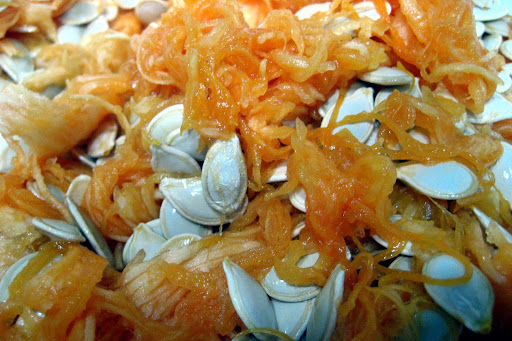
      Pumpkin seeds, husk on, prior to roasting
      (Photo from borisromanov.com)

      • While you're carving your pumpkin, separate the seeds from the pumpkin goo as much as possible.
      • Rinse the seeds really well in a colander and pick out the stringy innards and other pumpkin what-not from among the seeds.
      • Dry the seeds the best you can.  Blotting them with a paper towel will get some of the water off. Putting them in a pan on top of the stove while you heat the oven will help dry them out some too.
      • Spread out the seeds in a pan with maybe a tablespoon or so of your favorite margarine/butter/cooking oil, and salt generously.
      • Bake in a 300 degree oven for 25-30 minutes, depending on how wet the seeds are to begin with.  The drier you can get them ahead of time, the less time it'll take to roast them.
      • Stir them around the 10 to 15 minute mark to make sure they're not sticking to the pan.
      • When they're crunchy, they're done.

      Pumpkin seeds, husk on, post roasting. I'm eating some of my roasted seeds right now.
      (Photo from Life's Ambrosia)


      Pumpkin seeds make for a nice alternative to salty crunchy snacks like peanuts or potato chips or tortilla chips.

      Even more than that, pumpkin seeds are good for you in a lot of ways:
      • They have most of the B vitamins (stuff like thiamine, riboflavin, niacin, folic acid).
          • This means they'll help your body metabolize your food, process and regulate cholesterol, aid in the production of certain amino acids, strengthen nerve sheaths, assist in formation of red blood cells -- all essential things that basically help your body keep going
          • Deficiencies of the B's can lead to chronic fatigue, depression, dementia, insomnia, and weird diseases like beri beri and pernicious amnesia.
      • Pumpkin seeds are also fairly high in potassium and calcium.
          • Calcium, as we know, is important to maintaining bone strength. It also may help in reducing the symptoms of PMS.
          • Potassium helps in the regulation of blood pressure, is important to the function of your heart, kidneys, and liver, it helps regulate the body's fluid levels, supports muscle tone, and is important to maintaining mental function.  
          • If you're lacking in potassium, you might feel weak, get crampy or lots of muscle twitches, irregular heartbeat, you might develop kidney or liver problems, or you might get depressed, mentally confused, have trouble sleeping.
      • Alcoholics, you'll want to eat up your pumpkin seeds because alcohol depletes the body's reserves of the B's and potassium.
      • Pumpkin seeds also contain L-tryptophan, that stuff everybody talks about at Thanksgiving, and which is helpful in combating depression.
      • Some people think that pumpkin seeds help resolve bladder and prostate issues.
      • Many people also think that pumpkin seeds help reduce cholesterol.

      Pumpkin seeds without the husk, also called pepitas. They're used a lot in trail mixes.
      (Photo from Nuts Online, which sells raw pumpkin seeds for about $5.25/lb)


      There's gold in them thar pumpkin guts -- the seeds!
      (Photo from Brad's Gallery on Picasa)


      You might also be interested in my entry on pumpkins.

      Sources
      Jason Earls, The Benefits of Pumpkin Seeds, Health.Learninginfo
      Dr. Jerry Gordon, How B Vitamins Work, TLC
      WebMD, Live Well Vitamins & Lifestyle Guide, Calcium, Potassium
      Charlene Nuble, Potassium and Its Benefits to the Human Body, ezine articles

      Monday, October 18, 2010

      Apple #488: How Many Leaves Fall

      I've been walking around in the woods lately, enjoying the rustle and crackle of walking through fallen leaves on the paths and the leaves turning color on the trees.  This year's colors aren't quite as pyrotechnic as other years because it's been so dry, but some of the colors are still pretty eye-popping.


      (Photos by the Apple Lady)


      All these leaves turning and dropping to the ground led me to wonder, how many leaves fall each autumn?

      Well, of course no one is going to go all across the country and count every single leaf on the ground.  Ho, ho, no, that would be silly (though I am wondering right now if it could be done, if you had enough people....).  So of course such a number has to be an estimate.

      It turns out, even counting the number of trees is a near-impossibility.  But there are people at the US Forest Inventory & Analysis program who do count trees.  Or actually, they count a sample of trees within an area of forest and generate an estimate for the total number of trees in the entire forest.

      And someone did come up with an estimate for the average number of leaves that grow on a mature tree:  about 200,000.

      So, putting together all those estimates, I have a total estimate for you.  Drum-roll, please.


      Or instead of a drum roll, how about a stroll across a leafy bridge?  If you want to count the leaves, or even the trees as you go, it would be much appreciated.
      (Photo by the Apple Lady)


      This number is for
      • In the United States only
      • not including Hawaii, New Mexico, West Texas, or Wyoming
      • forest land only (not counting the trees in your yard or the local city park or along your streets, etc.)
      • does not include timberland either (land owned by industrial companies)
      • hardwood trees only (the best way to get deciduous trees only, and no conifers)
      • doesn't include every single variety of hardwood in existence, but includes the major and most common species
      • only those hardwoods that measure 1" in diameter at breast height (dbh)

      Estimated number of trees that drop their leaves in the forests of the US: 203,257,948,035.  (Over 203 billion, in other words)

      Multiply that number of trees by 200,000 leaves, and you get, depending on your preferred method of notation:
      • 40,651,600,000,000,000
      • or 4.06516 E+16
      • or more than 40 quadrillion leaves.
      Given all the bits & pieces of data (trees) that are not included, I'd say that's probably a third of the actual total.


      These leaves strewn all across this path are only a very small sample of the 40 -- or perhaps 120 -- quadrillion leaves that will fall this autumn.
      (Photo by the Apple Lady)


      Sources
      USDA Forest Service, Forest Inventory & Analysis, Forest Inventory Data Online, Standard Reports
      Wisconsin County Forests, Questions and Answers about Wisconsin Forests

      Monday, October 11, 2010

      Apple #487: Saturday Night Live

      Saturday Night Live first aired in 1975 on this day, October 11.  There is so much I could say about this show.  To keep it manageable, I tried to find some facts about the show that you might not already know, plus a few memory lane tidbits here and there.


      Here's the cast of SNL, season one. L to R: Laraine Newman, John Belushi, Jane Curtin, Gilda Radner, Garrett Morris, Dan Aykroyd, Chevy Chase
      (Photo from Colm Hogan)

      • George Carlin was the show's first host.
      • Andy Kaufman appeared on the first episode.  He lip-synced along to a recording of the Mighty Mouse theme song.  His bit ran long and though people suggested that it be cut, Michaels decided to cut Billy Crystal's stand-up routine instead.
      • Here's a transcript of a bit that John Belushi did as Martin Gresner, pretending to have had his arm bitten off by a shark.  Phyllis Crawford was played by Jane Curtin.
      Victims of Shark Bite  

      [ open on title graphic ]

      [ Music Over: "Mack the Knife", Bobby Darin ]

      [ dissolve to talk show set ]

      Phyllis Crawford: Hi, I'm Phyllis Crawford, and welcome to "Victims of Shark Bite." My first guest: Mr. Martin Gresner from Long Island, New York.

      [ reveal Mr. Gresner, sitting in a chair with one leg under the other and one sleeve dangling without an accompanying arm ]

      Phyllis Crawford: Mr. Gresner.. would you tell our audience just how you became a victim of shark bite?

      Martin Gresner: I'd be happy to, Phyllis. Uh.. I was swimming about fifty yards offshore from my summer home in Mattatuck, Long Island. It was high tide, and, all of a sudden, I felt this sharp, piercing pain in my left shoulder. I didn't know what it was at first, uh.. my left arm felt.. numb. Well, my arm was gone. Since then, I've had to learn to do everything with my right hand.

      Phyllis Crawford: Just when did this incident take place?

      Martin Gresner: [ tilts his head back to think ] Oh, I'd say maybe.. [ his left hand pokes out from under his dangling sleeve as he counts on his fingers ] ..three, four months ago. [ returns his left hand under his sleeve ] I've had, uh.. I've learned how to shave with my right hand, and eat with one hand --

      Phyllis Crawford: Excuse me, Mr. Gresner, but it appears to me as though you do have a left arm there.

      Martin Gresner: Nope! It's gone, see? [ uses his right hand to toss his dangling sleeve over his shoulder ] Shark bit it off! Nothing there!

      Phyllis Crawford: No, Mr. Gresner, that's your sleeve. [ raises his empty sleeve, then flips the side of his jacket to reveal his hidden left arm ] You do have a left arm, and it looks perfectly normal to me.

      Martin Gresner: [ lifts his left arm and examines it ] It does?

      Phyllis Crawford: Yes.

      Martin Gresner: [ taps his left fingers nervously as he looks down at his right leg tucked under his left leg ] Oh, it was my leg! It was my leg! He bit my leg off, see? I have to hop around on one foot, I'm an invalid, I have a wheelchair --

      Phyllis Crawford: Uh, Mr. Gresner, you do have a leg there, it's tucked under your other leg. [ grabs his right foot and thrusts his leg out ] You see? You're fine! There's nothing wrong with you.

      Martin Gresner: Well, I saw that movie where that guy had his leg bit off --

      Phyllis Crawford: [ slightly annoyed tone ] We'll be back with another victim of shark bite after this commercial message.

      Martin Gresner: [ points to his chin ] I've got a scar here, where my sister pushed me off a porch, and --

      [ fade out ]  


      John Belushi and Jane Curtin.
      (Photo from Broadway Video)

      • Saturday Night Live is the longest-running late night show.  It has won 21 Emmy Awards.
      • It was originally called NBC's Saturday Night.
      • Lorne Michaels, one of the show's creators, is Canadian.  He got started writing comedy on Laugh-In.  He also produced The Kids in the Hall.
      • Michaels left the show in 1980, its sixth season, and everything went so badly, the entire cast was fired except for Eddie Murphy and Joe Piscopo. When Michaels returned in 1985, the show was on the verge of cancellation.  He fired the entire cast and started over, and he has not left since.
      • Steve Martin was never a member of the cast.  He guest hosted 13 times and also made surprise appearances.

      Steve Martin's King Tut, first performed in 1978, I think.
      (Photo from The Raider.net)

        • Gilda Radner was the first person to join the cast.
        • As of 2003, the show had a total of 77 cast members.
        • For each week's show, somewhere between 30 to 45 scripts are written.  Most are rejected during the week's preparation and only a few make the cut to be aired on the show.
        • Tina Fey is the first female head writer in the history of the show.
        • Conan O'Brien wrote many sketches for SNL from 1988 to 1991, though he was often not credited.
        • Cast members who have died:
            • John Belushi, 1982, cocaine + heroin (speedball)
            • Gilda Radner, 1989, ovarian cancer
            • Danitra Vance, 1994, breast cancer
            • Michael O'Donoghue, 1994, cerebral hemorrhage
            • Chris Farley, 1997, cocaine + heroin (speedball)
            • Phil Hartmann, 1998, murder
            • Chris Rocket, 2005, suicide

        Gilda Radner on The Muppet Show with Dr. Bunsen Honeydew. The Muppets were also on the first episode of SNL, and many other episodes afterward. The writers weren't a fan of having them on the show, though. Writer Michael O'Donoghue said once, "I won't write for felt."
        (Photo from The Muppet Show Season 3 DVD)

          • When Lorne Michaels offered, on the air, to bribe the Beatles to come on the show, Lennon and McCartney were watching the show in their apartment in New York. They seriously discussed getting in a cab and going to the studio to perform, but they decided they were too tired and didn't go.
          • Only three shows were not truly live but allowed for a 7-second tape delay.
              • Richard Pryor, 1975
              • Sam Kinison, 1986
              • Andrew Dice Clay, 1990
          • As you might guess, each of these occasions was to allow time to censor any swear words.
          • The F-bomb has slipped out many times -- and not during those three tape-delayed shows.  Here are some of those instances:
              • Paul Shaffer, 1980
              • Prince, 1981
              • Morris Day and the Time, 1990
              • Steven Tyler (Aerosmith), 1990
              • Michael Stipe (R.E.M.), 1994
              • Adam Horovitz (Beastie Boys), 1994
              • Norm McDonald, 1997
              • James Hetfield (Metallica), 1997
              • Jenny Slate, 2009
          • Here's the transcript of the first Weekend Update, the only segment that has appeared on every show:

          Announcer: From Saturday Night news headquarters, this is Weekend Update, with Chevy Chase.

          Chevy Chase: [ talking into the telephone ] What are you wearing right now? [ smiles ] No bathrobe? [ notices the audience, hangs up telephone ] Good evening, I'm Chevy Chase!

          Our top story tonight: dedication ceremonies for the new Teamsters Union Headquarters building took place today in Detroit, where Union President Fitzsimmons was reported to have said that former President Jimmy Hoffa will always be a cornerstone in the organization.

          Now, world leaders in the news: Japan Emperor Hirohito met Mickey Mouse at Disneyland this week. The Emperor presented Mickey with a Hirohito wristwatch.

          Dateline: Washington. At a press conference Thursday night, President Ford blew his nose. Alert Secret Service agents seized his handkerchief and wrestled it to the ground.

          And, yesterday, in Washington, President Ford bumped his head three times getting into his helicopter. The CIA immediately denied reports that it had deliberately lowered the top of the doorway.

          And, Ford was on the campaign trail, announcing in Detroit that he has written his own campaign slogan. The slogan? "If He's So Dumb, How Come He's President?"

          The Post Office announced today -- [ looks around, lost ] Just a second, I lost my place. [ shuffles his papers ] Oh! The Post Office announced today that it is going to issue a stamp commemorating prostitution in the United States. It's a ten-cent stamp, but if you want to lick it, it's a quarter.

          Chevy Chase: Murder at the Blaine Hotel again. For a live report, let's go to Laraine Newman in midtown Manhatten, at the Blaine hotel. Laraine?

          Laraine Newman: [ over the sounds of sirens in the background ] Chevy, I'm standing outside a room on the 15th floor of the Blaine Hotel, where number 38 in a series of grizzly and bizarre murders has occurred just over an hour ago. [ pan down to reveal three legs, each with a yellow sock on the foot, covered by a sheet and poking out of the doorway ] The motive, again - murder, as it has been in the previous 37 slashings. In a fit of pique, the Mayor has called the Blaine Hotel a pockmark on the neck of midtown Manhatten. Once again, grizzly death and murder in the Blaine Hotel. Laraine Newman, reporting.

          Chevy Chase: Still to come: Earthquake Claims San Diego, Four Million Die in Turkey, and Arlene Visits an Art Museum.

          [ dissolve to ad parody for Triopenin ]

          [ dissolve to Blaine Hotel ad card ]

          Announcer: Guests of NBC Saturday Night stay at the fabulous Blaine Hotel in midtown Manhatten. The Blaine, a tradition for more than half a century.

          Chevy Chase: Our final story tonight concerns the birth of a baby sandpiper at the Washington Zoo. It's the first such birth in captivity on record. The pip made its debut at 9:18 this morning, weighing in at just under fourteen grams, and, according to zoo officials, resembled its mother quite closely. The name given our fuzzy little friend? Simply "Pip". One humourous note: the bird was stepped on and crushed to death this afternoon by Goggles, the baby hippo born in captivity last Wednesday.

          Well, that's news this evening. This is Chevy Chase saying, good night, and have a pleasant tomorrow.

          [ Chevy quickly redials his phone, as we fade ]


          Chevy Chase vs. Billy Murray: one of the biggest rivalries in show business of all time.
          John Landis, on what happened the night when Chase returned to guest host after Murray had taken the spot in the cast that he'd left:  "I've only been to SNL three times, and one time I was there, Chevy and Billy were having this huge screaming fight in the hallway, and Michael O'Donahue and Tom Davis were holding them back, and John and Danny jumped in because Chevy and Billy were really going to come to blows. I mean, it was a huge argument. And the thing I remember about Billy Murray -- I didn't know Bill Murray, but he's screaming, you know, foaming at the mouth, 'Fucking Chevy,' and in anger he says, 'Medium talent!' And I thought, 'Oh boy, that's funny. In anger he says 'medium talent.' That really impressed me. I went, 'So, Bill Murray -- wow, who is that guy?'" Murray went on to suggest to Chase that he, um, pay more attention to his wife, and the argument turned into a fistfight. 
          (Go to Corsair.com if you want the uncensored version of what he said.)
          (Photo from Cracked.com)


          Related entry:  Food King and Animal House

          Sources
          Saturday Night Live Information & Biography Center
          Lonympics, Saturday Night Live - just the facts
          ShareTV, Saturday Night Live Fun Facts
          Saturday Night Live Transcripts
          The Corsair, Bill Murray Versus Chevy Chase

          Friday, October 8, 2010

          Apple #486: Jellyfish

          I went to a nearby aquarium with some friends this summer.  I meant to do a Daily Apple entry about some of the fish & animals & creatures I saw there, but I've only just now remembered.  So I give you: jellyfish.


          I don't know what kind of jellyfish this is because the aquarium decided to get all entertainment-y, and they took all the "boring" stuff off their signs, such as the names for the animals.  But I do know this is some kind of jellyfish.  It was in a tank with curved glass on the outside and it was lit up with that bright pink light so the jellyfish would be visible.
          (Photo by the Apple Lady)


          Some Nice, Easy Facts
          • Jellyfish have existed for more than 650 million years.  That makes them older than dinosaurs, older than sharks.
          • Individually, each jellyfish lives for about three to six months.
          • Jellyfish never stop growing. However, since they don't live very long, "never" for most jellyfish is a short time.


          This jellyfish was in a different tank than the pink one. I don't know what species it is, but it's a different one than in the first picture.
          (Photo by the Apple Lady)

          • A group of jellyfish swimming together is called a smack.


          This is a whole bunch of jellyfish.  A smack of them, I should say.  The colors didn't come out too well in the photo, but the frondy things -- which I guess must be tentacles -- are green on some of them, pale purple on others, and pale pink on still others.
          (Photo by the Apple Lady)

          • Female jellyfish store their fertilized eggs in their "oral armpit," which is actually more mouth than armpit.
          • One fertilized egg turns into a polyp, which is sort of like a  seed pod.  The polyp generates more polyps off of itself.  The polyps  break open and inside of each one are several tiny jellyfish.

           
          Jellyfish #3
          (Photo by the Apple Lady)

            • Jellyfish are pretty simple, anatomically speaking. They do not have:
                • brain
                • central nervous system
                • circulatory system
                • respiratory system
                • bones
                • scales
                • shells
            •  Jellyfish do have:
                • epidermis (skin)
                • gastrodermis (skin around the digestive system)
                • mesoglea (fancy word for the jelly-like goo)
                • rudimentary digestive system
                • nematocysts (stinging cells)
            • Not all types of jellyfish have tentacles. The stinging cells might be on other surfaces of their bodies.


            Ah, don't these jellyfish look nice and peaceful, almost as if they're dancing?
            (Photo by the Apple Lady)


            The Rest of the Story

            You might be tempted to think that jellyfish are pretty and colorful and nice and simple.  But jellyfish are actually much more complex and capable than you might think.  In fact, it's possible that they could be taking over the world.  Or at least, the oceans.

            • Because of overfishing, jellyfish are able to reproduce pretty  much at will and with far fewer predators.  As a result many of our  oceans are approaching what scientists call a "jellyfish stable state,"  which will be when jellyfish effectively rule the ocean.
            • Echizen jellyfish, for example, are growing like mad off the coast of  Japan probably because of overfishing. This species can get to be over 7 feet in diameter and weigh more than  660 pounds. 


            This is the Echizen or Nomura's jellyfish, which live off the coast of Japan. Pretty dang huge.
            (Photo from Beer Steak)

            • Another species of jellyfish can avoid death.  Not by dodging predators or anything so basic as that.  They can make their cells literally get younger.
            • The fancy name for this process is transdifferentiation, and only the Turritopsis Nutricula jellyfish can do it.  In transdifferentiation, as a cell develops, it gets younger instead of older.  So basically this jellyfish, when it's had enough of aging, can make itself revert to a polyp state and essentially rebirth itself.
            • As far as scientists know, these jellyfish can do this over and over again, indefinitely.
            • Another type of jellyfish, the sea wasp or box jellyfish, kills more  people per year than any other creature in the ocean.  Including sharks.
            • That box jellyfish, by the way, has 24 eyes and 64 anuses. And 64 mouths as well; jellyfish use the same orifice for eating food and expelling  wastes.


            Here are a couple of pictures to show you what a box jellyfish looks like. Its cap -- for lack of a better word for it -- has a dome-like top and it comes down quite a ways over the tentacles. If you see one of these, get the heck away from it fast!
            (Photos from Destination-Scuba and Scubadoc, respectively)

            • What makes any jellyfish's sting so virulent is, to quote a scientist from a National Geographic video, "all the blood cells that are exposed to a jellyfish's venom will immediately swell up and explode." 

            If You Get Stung
            • If you've been stung by a box jellyfish, you've got 3 minutes to get the venom off you before you die.
            • Other types of jellyfish, it's not so dire, though it can be extremely painful.


            Jellyfish sting
            (Photo from Bryanking.net)


            Box jellyfish sting
            (Photo from Scuba-doc)

            • If you're having trouble breathing or swallowing, or if you're having chest pain, get thee to a doctor immediately.
            • Best thing to do is--no, not urinate on it--is first, get any stuck-on tentacles off of you.  Don't use your bare hands but use tweezers, a gloved hand, a stick--anything to peel off those  tentacles.
            • Then as soon as possible, rinse the area with any one of the following liquids.  In order of preference, most to least effective:
                • Vinegar
                • Rubbing alcohol
                • Either of the first two diluted with salt water
                • Salt water
            • Fresh water, ice, or hot water can make the nematocysts (stinging cells) release more toxins, so you definitely want to avoid using those.
            • If you've gotten stung around the eye, then use a ton of fresh water -- a gallon of it -- so as to overwhelm the nematocysts with a liquid that won't sting the crap out of your eye still further.
            • Even after you've plucked off the stingers you can see and after you've rinsed, you still probably haven't gotten all the stinging cells off of you, so apply shaving cream or baking soda or cornstarch or mud or sand to neutralize the stinging still further.  Then shave.  If you don't have a razor handy, use something like a credit card or a hotel key to scrape the area as best you can. 
            • Then rinse again with vinegar or alcohol.
            • Finally, wrap the area in an Ace bandage the same way you'd wrap a sprain, and take some aspirin.
            • After you've rinsed and bandaged yourself, you might want to go see a doctor anyway.  The doctor can give you Benadryl to calm any itching, steroids to reduce any inflammation, and pain medication if necessary.  It's also easy for jellyfish stings to get infected days later, so you may need antibiotics too.
            • A final word about the urine thing: some people say it helps reduce the sting. But it's a gamble. The thing in urine that works to neutralize the nematocysts is ammonia. But most people's urine has a far greater amount of fresh water than ammonia.  So urinating on a jellyfish sting can actually increase the pain, the same as pouring fresh water on it would.


            Some places in Australia where box jellyfish are particularly prevalent have gigantic hydrants like this one filled with vinegar.  This is because vinegar is the best thing to use to rinse off jellyfish stings.
            (Photo from Life in the Fastlane)


            Sources
            Aquatic Community, Jellyfish Facts
            Roy D'Silva, Buzzle.com, Facts About Jellyfish
            Beer Steak, Jellyfish Facts

            Scienceray, Weird But True: Jellyfish Facts
            Simon Crisp, Asylum for All Mankind, Giant Echizen Jellyfish Invade Japanese Waters
            Rod Brouhard, About.com, How to Treat a Jellyfish Sting
            emedicinehealth.com, Jellyfish Stings Treatment
            WebMD, Jellyfish Sting Treatment

            Monday, October 4, 2010

            Apple #485: Football Penalties

            Watching football on TV the other day with a friend and regular Apple reader, when a team got called for being offsides he wondered, what's the difference between offsides and false start?  I realized I didn't know the answer.  There are other penalties, too, he went on, which seem awfully similar, like encroachment and illegal motion. What's the difference between all of those, or are they only different words for the same thing?

            All questions for the Apple Lady to investigate, to be sure.

            Turns out, it's not just a matter of a ref preferring one word for the same penalty over another, they are distinct penalties.


            This is Doug Rosenbaum, a current NFL ref who started his officiating career at high school games
            (Photo from Illinois Wesleyan University Magazine)


            I should say, I looked this up for NFL rules only. NCAA (college) rules might be different, as might high school rules.

            All these penalties are related to what you can and can't do before the ball is snapped. The rules vary depending on whether you're on offense -- the players with the ball -- or defense.

            Applet #484: Taxicab

            Hey everybody, I'm working on a new entry, but I haven't finished it yet and I must go to bed.  In the meantime, here's a little tidbit I learned recently:

            Taxi cab is short for taximeter cabriolet.

            Literally, this means a vehicle that measures (meter) the tax (taxi-) to be charged for riding in a horse-drawn two-wheeled carriage (cabriolet). 

            Cabriolets, actually, were named after the Isle of Capri.  The French called their carriages "cabriolets" as a way to say, "riding in our carriages is as smooth as the lightness of goats leaping about the rocky Isle of Capri."

            I guess even the French had rotten cab rides.  The only difference is, they knew how to make their snarkiness sound fancy and divine.


            This taxi in Yambol, Bulgaria, has seen better days. But it might still travel as lightly as goats frolicking on some rocky island.
            (Photo from Yambol Daily Picture)


            Source
            Scorpio Tales, Curious Word Origins