Sunday, March 27, 2011

Apple #514: That Factory Song

So the other day a friend of mine was singing that factory song that gets used in Warner Brothers cartoons.  He said, "I don't even know what that song is called." I didn't either, but we both knew it well enough to sing several bars of it.  Thus another Daily Apple was born.

In case you don't know what I'm talking about, here's a cartoon where I definitely remember the song being used. The cartoon is called I Gopher You:


The song appears in bits and pieces, beginning around 1:48. The gophers' names, by the way, are Mac and Tosh.

  • The song is called "Powerhouse."  It was written in 1936 by a jazz composer named Raymond Scott.
  • The song has two parts that are very distinct from each other.  Part A is the frantic running-around part. Part B is the more methodical part with a jazzy saxophone over it.
  • Scott never intended this song to be used in cartoons.  He was the pianist in his jazz band the Raymond Scott Quintette (sic). "Powerhouse" was one of the songs he wrote for his quintet.

Raymond Scott in the CBS studios in 1937, a year after he wrote "Powerhouse."
(Photo from raymondscott.com)

  • In 1943, Warner Brothers bought the rights to his music.  That included "Powerhouse" as well as lots of other songs of his.  Carl Stalling, the music director for Warner Brothers, was a particular fan of Scott's music, and he used it in many of his cartoons.  
  • Warner Brothers cartoons where this song was used however briefly, in chronological order. (I've looked up some of them and provided links to the cartoons for you.  If there's no link, that doesn't necessarily mean there isn't a video of the cartoon online somewhere; it only means I didn't look it up.)
Swooner Crooner uses both parts of "Powerhouse" all over the place, but especially in the beginning before the crooner begins to sing.


  • The song has been used in other cartoons as well, including:
      • The Simpsons (And Maggie Makes Three)
      • Animaniacs (Toy Shop Terror)
      • Ren & Stimpy (Big Baby Scam; Doubleheader; Mad Dog Höek)
      • Duckman (Aged Heat 2: Women in Heat). 
  • Toy Shop Terror was actually written for the song.  The Cartoon Network has also used "Powerhouse" as its theme song for a number of years.
  • Neither Scott nor his wife ever watched cartoons.
  • "Powerhouse" was also used in Honey, I Shrunk the Kids.  Actually, the film's composer inserted bits of it into his score without permission and without crediting Scott.  After being threatened with a copyright infringement lawsuit, Disney agreed to pay an undisclosed amount to Scott's estate in a settlement.
  • The Canadian rock band Rush also used the music in their 1978 song "La Villa Strangiato."  They, too, had to pay royalties after the fact.
  • Apparently, as of 2003, the song entered the public domain. But you might want to double-check that before you go using it willy-nilly.
  • After Scott left his 1930s quintet, he went on to collaborate with all sorts of musicians and other folks, including Dorothy Collins, Berry Gordy, and Jim Henson, with whom he wrote a number of experimental films, and a commercial for Bufferin aspirin.
  • A graduate of Juilliard who believed strongly in improvisation and also a graduate of a technical high school who loved electronics, Scott was also an inventor of all sorts of musical equipment and instruments to create new sounds.

This was Scott's "wall of sound," 6-foot by 30-foot electro-mechanical sequencer that used various timing solenoids, switches that operated relays, tone circuits, and 16 oscillators. It produced its own music, but if you stood close to it, you couldn't hear the music it made over the clicking and clacking of the machine itself.
(Photo from raymondscott.com)

  • The guy who invented the Moog Synthesizer, Bob Moog, met Raymond Scott in the 1950s.  
  • Moog was very impressed by Ray's recording studio and his extensive shop which was "the size of a football field."  Not just a hundred yards long, it was two floors connected by an elevator. The first floor was a machine shop with all sorts of drill presses and machine tools. The second floor was his wood-working shop which had five lathes, among other things. He also an electronics assembly room, about the size of a barn, with all sorts of spare electronics parts.
  • Some time after Moog visited, Scott sent him an instrument that combined a keyboard with an electronic circuit, which Scott called the Clavivox.  It was very similar to an analog synthesizer that Moog invented, but not until several years later, in the 1960s.
Raymond Scott was definitely in the forefront of developing electronic music technology, and in the forefront of using it commercially as a musician. He foresaw the use of sequencers and electronic oscillators to make sound — these were the watershed uses of electronic circuitry. He didn't always work in the standard ways, but that didn't matter because he had so much imagination, and so much intuition, that he could get something to work. And do exactly what he wanted it to do. (Bob Moog)


Scott leaning on his Clavivox, in front of his wall of sound.
(Photo from the Raymond Scott Archives, sourced from Animation World)

It seems quite fitting that one of Scott's lasting contributions was a piece of music that sounds as mechanical as all the gizmos that he liked to play around with. 

You can buy the mp3 of "Powerhouse" from Amazon for $0.99


Or you can purchase it as one of several songs on this CD.  In this version, "Powerhouse" sounds much more 1930s-ish, not the sleek, polished up arrangements used in the cartoons.


The song and the album are also available on iTunes.

Sources
Anonymous response to old cartoon music, The Soundtrack Collector, January 28, 2004
RaymondScott.com, Other cartoons using his music, Memories of Raymond Scott by Bob Moog
Irwin Chusid, Raymond Scott: Accidental Music for Animated Mayhem, Animation World Magazine, July 1999

Monday, March 21, 2011

Apple #513: Wolverines

Recently a friend and I watched a really good documentary about wolverines. Not the team, and not the X-Man. The actual animals. Turns out they are way cooler than I ever knew.


Nature: Wolverine: Chasing the Phantom
(Available for $11.93 through Amazon)


The documentary said that little is known about wolverines because so few people have seen them. Even some of the researchers who have spent decades studying wolverines have never actually seen them in person. They may have caught wolverines on camera, but they've never actually encountered a wolverine.

What the documentary did get across was that wolverines are super fast and strong for their size, they are indefatigable, and they have personality to spare. So I want to know more about these animals. What are some of the basic facts that we do know about them?


Wolverines have pointy faces but a snubbed nose, very thick fur that is a mixture of brown and black with golden hairs under the chin, a stout bushy tail, and huge feet with claws. This one is doing one of the wolverine's favorite things: running over the snow.
(Photo posted by Anonymous at care2)

  • Wolverines may look like a cross between a bear and a raccoon, but they're actually members of the weasel family.
  • They're not big -- only about 3 to 4 feet long and they weigh about 30 to 40 pounds. But they pack a punch in those little bodies.
Picture a Weasel—and most of us can do that, for we have met that little demon of destruction, that small atom of insensate courage, that symbol of slaughter, sleeplessness, and tireless, incredible activity—picture that scrap of demoniac fury, multiply that mite some fifty times, and you have the likeness of a Wolverine.
--Ernest Thompson Seton, 1953

  • Here's a 2-minute bit from a Wild Kingdom episode that gives a brief overview of the wolverine, and gives you a good idea of how they move. I wanted to embed it here but the dang link they provided didn't work.
  • Wolverines cover territories that are enormous relative to their size -- anywhere from 200 to 1,000 square miles.
  • In deep snow, when other animals typically slog away and sometimes founder, wolverines can cover as much as 15 miles in a day. And, by the way, they run the entire time. 
  • They're able to run like this over snow mainly because of their feet. Put simply, their feet are huge.


It's tough to tell how large the wolverine's paw is from this photo, but you can get a sense of how sharp their claws are. I'm more stunned by the fact that the wolverine is allowing himself to be held, though it looks like he won't put up with it for long.
(Photo from The Wolverine Blog)


This drawing of a wolverine's paw print isn't that great. For one thing, it's about half the size that it should be. But I posted this image because it gives a good idea of how the toes of the wolverine fan out. Because of the size of their paws and the way they spread out like this, it's as if the wolverines are running on snowshoes.
(Image from Through the Eyes of a Wolverine)

  • The Latin name for wolverine is Gulo gulo, which means glutton glutton.
  • They are so named not because they kill more food than they can eat or because they overeat, but because the animals they kill for food can be enormous compared to their size. They've been known to take down elk, moose, or caribou.
  • Most of the time, though, they kill smaller animals like rabbits or grouse or squirrels, or they eat carrion -- animals that are already dead. They're especially good at finding dead animals buried deep under the snow.
  • If they do kill or come across more food than they can eat at one time, they'll mark the food (spray it with their scent), bury it under the snow to preserve it, and come back for it later.
  • Eventually, they'll eat everything -- bones, teeth, skull, everything.
  • One person in the documentary said that one of the reasons he's so impressed with wolverines is because other animals that you normally think of as being really good in the mountains, like mountain goats, can still get taken out by avalanches. But wolverines not only survive the avalanches, they eat the animals that don't.
  • They are pretty much unstoppable.  When they're moving, which is most of the time, they're running. When they sleep, it's only for about three or four hours at a time. Then they get up and run some more.
  • Wolves, bears, and mountain lions are the wolverine's only predators. Those animals are also a wolverine's primary competitors for food.  But a wolverine is not so helpless against them.  A single wolverine is capable of driving a pack of wolves away from a kill.
  • They're not especially graceful and they don't see too well, so when they hunt, they use the element of surprise. They'll climb up a tree or onto a tall rock and when some likely animal wanders by, they'll jump on the animal's back. Sometimes this breaks the animal's back, or sometimes fighting ensues.


One common way that researchers have studied wolverines is to hang some sort of meat from a tree in front of a camera. Wolverines come around, climb the tree to get the food, and their motion triggers the camera shutter. That's how this picture was taken.
(Photo by Audrey Magoun, sourced from Chattermarks)

  • Wolverines are also excellent swimmers.
  • They live in dens under rocks or roots in the warm months. During winter, they dig dens deep into snow drifts. Often their dens include a complicated system of tunnels and chambers.
  • Wolverines generally keep to themselves except during mating. Both males and females may mate with more than one wolverine. When the female gives birth, she may have anywhere from 1 to 6 kits, any or all of which may have different fathers.
  • The babies are born in a den dug into the snow. They're born blind with white fur that camouflages them against the snow.  As they mature, their fur darkens.
  • Wolverines were hunted to near extinction because of their fur.  It's very thick and dense, so actually an entire coat made of wolverine fur would be extremely heavy. Now, if people use wolverine fur at all (some native people still do), they use it only to line the hoods of parkas because of its other remarkable quality -- it doesn't hold moisture and therefore it won't freeze.
  • The fact that wolverines used to be hunted a lot for their fur is one reason why few people have seen them -- there are very few of them left.  Their snowy and wild habitats are also going away, so they have retreated farther and farther north.

Wolverines live in the areas in black -- or at least, this is where they are believed to live as of 1999. The numbers refer to subspecies. (1) is Gulo gulo gulo (I'm not kidding) and (2) is Gulo gulo luscus.
(Map from San Francisco State University Department of Geography)

  • They once lived as far south as Arizona and New Mexico.  As you can see, they've moved quite a distance north. 
  • They also really don't like being around people. That's probably another reason why few people have seen them in the wild.
  • Wolverines aren't on US endangered or protected species lists because applications for them to be included were rejected for insufficient data. Nobody can find enough wolverines to conduct a census that anybody thinks is anywhere near accurate. [EDIT: soon this will be no longer true. As of February 2013, US wildlife officials are asking that wolverines be added to the endangered species list because their habitats are threatened by climate change. Only an estimated 250 to 300 remain.]
  • There is some good news, though.  In 2004, a wolverine was spotted in Michigan -- a state where no one has seen a wild wolverine in 200 years. They saw the animal near a town called Ubly, which is about 90 miles north of Detroit.


This is the wolverine that was seen in Michigan in 2004, photographed as it was running out of the woods and across a field. 
(Photo by wildlife biologist Arnie Karr via AP)

  • In 2010, a wolverine was spotted in Grand Teton National Park in Wyoming. Later, that same wolverine was seen in Colorado -- 500 miles south. The last time anybody saw a wolverine in Colorado was in 1919.
  • Researchers were able to catch him and put a radio collar on him.  They named him M56 (I think the M stands for male), and people are hoping to be able to monitor his movements.

See? Enormo-paws.
(Photo from Esquire)

  • If you think you've seen a wolverine, document as much of the experience as you can -- take pictures of the animal or its tracks, note your location by GPS or as specifically as possible -- and let the folks at The Wolverine Blog know about it.

If you're interested, here's the documentary I watched. It was on PBS, so your library probably has a copy of it.


Nature: Wolverine: Chasing the Phantom
(Available for $11.93 through Amazon)

Sources
National Geographic, Wolverine (Gulo gulo)
Arctic Animals, Wolverine (Gulo gulo)
Muirmaid, Wolverine
The Animal Files.com, Wolverine
Fur Commission USA, Fur types in brief
New Hampshire Public Television, NatureWorks, Wolverine - Gulo gulo
C. Breen, The Biogeography of Gulo gulo (wolverine), Biogeography, San Francisco State University
Colorado Division of Wildlife, Wolverine
Kurt Repanshek, Wolverine Sightings Growing in Rocky Mountain National Park, National Parks Traveler, August 6, 2010
David Runk, First Michigan wolverine spotted in 200 years, Associated Press, February 25, 2004

Monday, March 14, 2011

Apple #512: How Earthquakes and Tsunamis Happen

So with all the recent articles and conversations about the enormous earthquake that Japan suffered at the end of last week, there's been lots of talk about plate tectonics.  Plates of the earth's crust shifting and bumping into each other.  People are using words like subduction and convergent plates and all sorts of stuff like that.  Even though I studied earthquakes in school like everybody else, I'm having a hard time visualizing the complete process by which an earthquake occurs.  So, like a good Apple Lady, I looked it up.

Because it's a process, static diagrams weren't very helpful to me.  I wanted animations.  Drawings in action, with arrows and helpful identifiers to show me what's happening, to show me how the stuff under the crust can build up, or how an earthquake can send shock waves through the ground.  So I went looking for lots of videos.

I found some helpful stuff.  I'm going to give them to you from basic and general to more specific, zeroing in on what happened in Japan, first to create an earthquake, and then to create the tsunami.


Plate Tectonics Basics

Basically, the earth's crust is a series of floating flat islands of rock, or plates. The plates are sliding around on top of molten rock. As the plates bang into each other or drift apart, the shape of the landscape changes. Mountains might form, or volcanoes could form and erupt, or earthquakes could happen.

In this animation, the process ends with the creation of a volcano:


Types of Plate Movements and Boundaries

As the hunks of the earth's crust are floating around, they bump into each other or interact with each other in different ways. Sometimes they float away from each other (diverge), sometimes they bump into each other (converge), and sometimes they rub against each other (transform).

This presentation shows how the plates can interact with each other to create different results. Specifically, it describes the various types of boundaries and what happens to the crust in each case:


This soundless animation focuses specifically on what happens as the crust on one plate is forced beneath another.  This process is called subduction.  As shown here, the crust that gets pushed down into the hot magma gets melted and eventually bubbles back to the surface in the form of volcanoes:


The voice-over for this one is in French, but the images are still helpful, I think. This animation shows plate movement at the bottom of the ocean. First it shows what happens when plates diverge, and then it shows convergent plates where one is subducted beneath another and volcanoes and mountains form as a result -- all at the bottom of the ocean:


Earthquakes in the Ocean Creating Tsunamis

The process by which volcanoes are formed is very similar to the process by which earthquakes are created. The difference is, instead of one plate happily subducting another below it to be melted and turned into a volcano, the plate getting butted against pushes back or rebounds, and that causes an earthquake.

This animation shows an oceanic plate pressing against a continental plate until an earthquake results. There's no sound, but explanations are included in text along with the animation:


This is an animation of the earthquake and subsequent tsunami that happened in Sumatra in 2004. It shows one oceanic plate pressing against a continental plate. The passage of time is indicated in the right hand corner. The pressure builds up until finally the continental plate pushes back, so to speak, creating an earthquake.  By the way, the speed with which the "island pops up" is deceptively fast.  In real life, that would take many years.

But this is the closest depiction I could find of what happened in the earthquake in Japan:


Tsunamis

Compared to the creation of an earthquake, the process by which tsunamis occur is relatively simple. Also, since they are in effect reactions to earthquakes in the ocean, they happen much more quickly.  But because so much water is involved, they can be far more destructive than the earthquakes that created them.

Quick & dirty overview of how a tsunami is formed:


I can't embed this next video, but I can give you a link.  This meteorologist's animation isn't great, but his explanation is helpful and it's a more complete explanation than the animation immediately above.


This guy with a British accent explains pretty much the same thing as the American meteorologist.  His images are rather static and though they're kind of hard to read, they're actually more descriptive than the meteorologist's. This guy also goes on to talk about where tsunamis tend to be more common:


This animation generated by NOAA shows the path(s) of the tsunami following the earthquake in Japan.  Suddenly the Pacific Ocean seems much smaller:


Here's another graphic from NOAA, this one static.  It shows the intensity of the tsunami that started at its originating earthquake off the shore of Japan.


The black triangles, I think, are tide gauges. The black lines are "computed tsunami arrival times."
(Graphic by NOAA, sourced from dose.ca)


Pretty intense.  All of it courtesy of the seething hot mass that is the mantle beneath our feet.

If you want to know more about how tsunamis work, read this brief article by Jeremy Bernstein, a physicist and regular contributor to the New York Review of Books.  It's descriptive without being too technical, informed without being stuffy.  Good stuff.
(Thanks, regular reader Jason, for the link.)

Apple #511: Forsythia

It's that time of year when the forsythia bushes are beginning to bloom.  I saw the first one of the season blooming in my neighborhood the other day.


Forsythia blooming its nice, bright yellow flowers when few plants aren't doing much of anything yet.
(Photo by Arielle from Flickr, sourced from Country Gardener)

  • Forsythia plants are members of the olive family.
  • They're originally from China.
  • Forsythia plants are named after William Forsyth, a guy who was one of the founders of the Royal Horticultural Society in England in the late 1700s.
  • You might think that because they're named after Forsyth, he had something to do with the discovery of the plants.  Not so.  They were discovered by a different guy named Robert Fortune.  He was a plant enthusiast and he discovered the shrubs in China.
  • Some people call the plants Golden Bells, after the shape of the flowers.

Botanists would say these blooms have 4 lobes, mostly in clusters of 2 or 6. The layperson might say they look like golden bells.
(Photo from Garden Calendar)

  • The flowers bloom in March or April and stay in bloom only about two to three weeks.
  • The forsythia's flowers bloom so early, the plant's own leaves haven't even popped out when the flowers are open.
  • The rest of the year, the plants don't look like much. But they sure are a welcome sight in early spring.
  • If you really want to see the forsythia bloom in the winter, you can force them. Cut off a few of the branches all the way to the stem, bring them inside, and put them in a vase with water.  After only a few weeks, the branches will bloom into those characteristic bright yellow flowers.
  • Some people use them as "border" plants, a whole bunch of them in a row. When not in bloom, they provide a natural screen.  When in bloom, the effect of so many forsythia blooming all in a row can be pretty spectacular.

Forsythia grown in a border
(Photo from The Gardener's Network)

  • You can grow forsythia bushes from branch cuttings. Cut a 3- to 6-inch branch and put the end in moist soil.  Over the next 3 weeks or so, keep the soil moist until the branch develops roots.
  • Once the branch has grown roots, you can plant it any time.  However, the time of year when they'll like it the best is in the winter, when they are dormant.
  • They also like the soil to be moist, but well-drained.

Because they're easy to care for and because of their bright, cheerful flowers, forsythias are a favorite with home landscapers.
(Photo from Home Interiors Junction)

  • You don't have to prune them, but because they grow so fast, you'll probably want to.  Forsythia plants have it in them to grow as large as 7 or even 10 feet tall.

Dwarf forsythias are a popular variety because they can be grown in tight spaces. The dwarf will only reach about 2-4 feet high.
(Photo from Brighter Blooms)

    • It's best to cut back the branches right after they've finished blooming, in still early spring.  Cut off the oldest branches, not all but about 1/4 to 1/3 of them.  Choose the ones that are rubbing against each other and ones that are curving back in toward the center.  Also remove ones that are hanging down so that they are touching or close to the ground. 
    • Cut the branches down as close to the ground as you can get, or at least within 4 inches of the ground.  This will encourage new growth which will sprout in a more compact arrangement.
    • Even if you cut the entire shrub to the base, new canes will sprout the next spring, and by the following year, you'll have a whole, blooming forsythia again.
    • Keep in mind, those newer branches won't bloom the first year.  When it's pruning time, you'll know not to cut the branches that didn't bloom.

    Bluebirds are a welcome sight, too. A bluebird on a forsythia branch must surely be the best kind of good luck.
    (You can buy a print of this photo from Marie Read Wildlife Photography for $45)


    Sources
    About Forsythia
    David Beaulieu, Forsythia Bushes - Plants That Herald Spring, About.com
    U Conn Plant Database, Forsythia x intermedia (Border Forsythia)
    Flower Gardening Made Easy, How to Prune Forsythia
    The Gardener's Network, How to Grow and Care for Forsythia Bushes
    The Garden Helper, How to Grow and Care for a Golden Bells Forsythia Plant

    Sunday, March 6, 2011

    Apple #510: Ligers

    A relatively new reader of the Daily Apple has asked me if I would do an entry on ligers.  When I pointed out that I discussed them briefly in an entry on cross-bred animals, he said that wasn't enough.  He wanted more.

    Pah.  Ligers deserve more than a picture.  And a better one than that.  I would humbly suggest a whole apple on them (along with their offshoots).  The coolest thing about them is that they are HUGE compared to lions, tigers, or other combinations.  So huge that they can't really survive on their own - they'd get too pooped trying to catch prey.  And zoos won't display them since they're "fake", so they only exist where individuals have the resources to make them and keep them on their own.  Also, I remember seeing a whole Liger / Tigon chart.  It starts with lions and tigers at the top, then get different names with each successive cross-bred combination.  Like Litigers and Tiligons and stuff like that.  And Ligers are very specific - mom has to be one, dad has to be another.  That's the difference between a Liger and a Tigon.

    OK, Mr. Humbly Suggest.  Here are your ligers.


    This gives you an idea of how big a liger can get.  With this particular liger, the fur is the color of a lion's but has the stripes of a tiger. Some ligers may be more orange in color, or have a more obvious mane around the face.
    (Photo from truthorfiction)

    • The first thing to know, as Mr. Humbly Suggest has already said, is that ligers are the result of a male lion mating with a female tiger.
    • (Female lion plus male tiger = tigon.)
    • Ligers like to swim, which is true of tigers but not lions. Some handlers report that ligers are confused the first few times they're presented with water, as if their lion part wants nothing to do with water while their tiger part does.
    • Ligers grow to be larger than either a lion or a tiger.  Some get to be as big as 800 or 1,000 pounds.

    This is either Sinbad or Hercules. Both are among the biggest ligers at T.I.G.E.R.S., a place which regularly breeds ligers and other exotic, cross-bred animals.
    (Photo from T.I.G.E.R.S.)

    • By comparison, a captive tiger would be unlikely to reach 650 pounds.
    • Ligers get to be so big because they're lacking some growth-inhibiting gene.  Or maybe there are 3 or 4 of those genes that are missing.  Sources conflict on this point, probably because researchers aren't really sure what's going on at the genetic level.
    • Their size means that adult ligers eat a ton of meat -- well, maybe not a ton. They eat about 50 pounds of raw meat in a single meal.
    • But since these animals don't exist in the wild, they've never caught their own food but always lived in confined areas.  As a result, they're not very good at catching prey.  Either they get worn out, or their muscles simply aren't up to the task of moving such enormous bulk at speeds necessary to catch and kill enough food to feed themselves.

    This is a liger named Freckles.  Looks Photoshopped, doesn't it?  But no, that's a real liger.
    (Photo from Big Cat Rescue)

    • Usually ligers are sterile, but every once in a great while, a female liger might turn out to be fertile.  
    • You could mate her with a male lion or a male tiger, but never a male liger.  This is because there has never been any such thing as a fertile male liger.
    • Here are some of the combinations that are possible from breeding lions and tigers and their cross-bred offspring:
        • M lion + F tiger = liger
        • M tiger + F lion = tigon
        • M lion + F liger = li-liger
        • M lion + F tigon = li-tigon
        • M tiger + F liger = ti-liger
        • M tiger + F tigon = ti-tigon
        • M liger = 0
        • M tigon = 0
    • Lions and tigers in the wild live in very different places -- basically, one lives in Africa and the other in India -- so on their own, they wouldn't mate and reproduce offspring.  If you see such a thing as a liger or a tigon, it's the result of a person getting involved in the mating and breeding of the big cats.
    • Here's what one site has to say about breeding ligers and tigons:
    Respectable zoos frown on the breeding of hybrids such as ligers and tigons, as they have no value from a conservation point of view and are taking up space and resources that could be used to breed endangered species. They are basically freaks bred by unscrupulous zoos in order to make money out of people willing to pay to see them. 
    • Often the young ligers have serious birth defects and don't live long after birth. Some develop neurological disorders such as head shakes, and these young ligers don't live long either.
    • In addition, since the ligers are larger than their parents, they may grow too large even in the womb. So the tigresses who carry them have to undergo C-section deliveries or may even die in the process of giving birth to a liger.

    These liger cubs were born in a zoo in Taiwan in 2010. The tiger mother rejected them, so they had to be hand-raised by zoo staff.  The Taiwan zoo maintains that the breeding of these cubs was "accidental," as a result of the tigers and lions living in the same enclosure.  Conservation groups said they didn't care whether it was accidental or not, that these cubs represented a violation of the Wildlife Conservation Law, and that the zoo should be fined.  I couldn't find an update about the story to learn whether the zoo had actually paid the fine or not.

    • Big Cat Rescue asks, if you agree that the breeding of ligers (and tigons) is irresponsible and not actually animal-friendly, and if you see a liger at a zoo or on TV, that you contact Big Cat Rescue or notify your local media.

    Sorry, Mr. Requester, but it sounds like this is another instance when bigger is not necessarily better.

    Sources
    Liger.org, What Is a Liger?
    Big Cat Rescue, Ligers
    Tiger Territory, Ligers
    Los Angeles Times, Your morning adorable: controversial baby ligers in Taiwan, August 16, 2010
    BBC, Taiwan zoo faces fine over 'liger' cubs, August 16, 2010

    Sunday, February 27, 2011

    Apple #509: The Oscar

    The Oscar awards ceremony is tonight.  So I thought it would be fitting to find out everything about Oscar.  The award itself.


    The Oscar statuette
    (Image from the Academy of Motion Picture Arts & Sciences)

    • They're referred to as statuettes.
    • The official name of the award is the Academy Award of Merit, but everybody calls them Oscar.
    • Nobody knows for sure where that name came from, but the most popular legend has it that the Academy librarian at the time, Margaret Herrick, said when she first saw it that it looked like her Uncle Oscar. 
    • Whether that's the true origin of the name or not, by 1934, the name was commonly used in articles about the awards, and by 1939, the Academy adopted it as the official nickname of the award.
    • Each Oscar is 13.5 inches tall and weighs 8.5 pounds.
    • The statue is of a crusading knight holding his sword so that the point goes down to his feet, and he's standing on a reel of film.
    • The film reel has five spokes, one for each of the original five branches of the Academy of Motion Picture Arts and Sciences: actors, directors, producers, technical crew, and writers.
    • What a crusading knight has to do with the movies is anyone's guess. The art director for MGM at the time, Cedric Gibbons, is the one who came up with the design as something "suitably majestic."
    • They've been awarded each year since 1929, two years after the Academy was founded.
    • Over the years, they've been made of different materials:
        • 1929: gold plating on the outside, solid bronze on the inside
        • During World War II: painted plaster (after the War, recipients were allowed to trade in the plaster ones for gold-plated ones)
        • After WWII: reverted to gold plated exterior
        • Currently: 24-karat gold plating on the outside, and on the inside is Britannium, which is an alloy of mostly tin, with a little bit of antimony and copper mixed in.  It's the Britannium which gives the Oscar its sleek texture.
    • R.S. Owens & Company is the company who's made the Oscars since 1982.  They're based in on the northwest side of Chicago (Jefferson Park, 5535 North Lynch, to be exact.).  
    • They also make the Emmys, the MTV Music Video Awards, the Rock & Roll Hall of Fame Awards, the Clio which is for excellence in advertising, and all sorts of other relatively famous awards.
    • You could have them make an award specially for you.  Like this one, perhaps:

    If you want to order this statuette, ask for the Classic Achievement Economy Award. If you only want one, it'll cost you between $70 and $100, depending on how tall you want it to be.
    (Image from R.S. Owens)


    Maybe someday the Daily Apple could win this award, eh? One of these costs a mere $188.10.
    (Image from R.S. Owens)


    Every once in a while, you hear about a strange place where some actor or other keeps his or her Oscar.  So I thought I'd find out about a few of those for you too.
    • Timothy Hutton (Best Supporting Actor, Ordinary People, 1980): His sister thought it would be funny if he put it in the fridge, so he did.  Last anyone asked, the Oscar was still in his refrigerator. "It's sitting there, right next to some beers," he said in 2008.
    • Jodie Foster (Best Actress, The Accused, 1988; The Silence of the Lambs, 1991): She put hers in the bathroom "because they looked good with the faucets." She had to move them out of there, though, when they started to get corroded on the bottom. Now they're in a trophy case in her den.
    • Kate Winslet (Best Actress, The Reader, 2009) also keeps hers in the bathroom.  This is so her guests can look at it and pick it up and hold it without the embarrassment of asking.

    Kate Winslet: Yay! I won! I'm putting this thing in my bathroom!
    (Photo from Fusion Magazine)

    • Emma Thompson (Best Actress, Howard's End, 1992) is yet another recipient who keeps hers in the bathroom. "They look far too outré anywhere else." She says they're in there tarnishing "along with everything else, including my body."
    • Morgan Freeman (Best Supporting Actor, Million Dollar Baby, 2004) told this story: "When my house was being built in 1988, one of the guys who was doing finishing work said he wanted to construct a trophy cabinet for me. And he put an acrylic sign on the top shelf saying 'No Parking: Oscar Only.' So when I won, I took down the sign and put the Oscar in its place."
    • Cuba Gooding, Jr. (Best Supporting Actor, Jerry Maguire, 1996) used to keep his Oscar in his wine cabinet. Because the cabinet was temperature-controlled, the statue "stayed beaming new." Now that he keeps it in his screening room, it's begun to get tarnished.
    • Jennifer Hudson (Best Supporting Actress, Dreamgirls, 2007) kept hers for a while in a house she had bought but hadn't had time to furnish. Finally she bought a special pedestal for it and a light that she keeps lit. She lets her guests take pictures of themselves with it, but they are not allowed to touch it. 

    Jennifer Hudson: Hands off the Oscar, people!
    (Photo from Entertainment Weekly)

      • Cate Blanchett (Best Supporting Actress, The Aviator, 2005) doesn't keep her Oscar in any one place.  It roves around the house "like my family and I do."
      • Guillermo Navarro (Best Cinematography, Pan's Labyrinth, 2006) also has moved his Oscar to various places in this house.  For a while it was in his kitchen because he was "trying to incorporate it into the family," and then it moved to his room where he keeps it with a group of other awards he won for that movie. After he'd had it for a year, his family had a birthday celebration for his Oscar's first birthday.
      • Reese Witherspoon (Best Actress, Walk the Line, 2005) told one source she keeps it in her living room, and told another source that she keeps it in the place where her family puts all of her children's artwork. She said her kids like to play with it and dress it up.

      Reese Witherspoon: Thank you so much. My kids are totally going to love playing with this.
      (Photo from the People's Daily Online)

      • Juliette Binoche (Best Supporting Actress, The English Patient, 1997) said that while winning the Oscar was a dream come true, once she had it, she didn't know where to put it. "I put it in a box with the plates," she said. "I guess I shouldn't do that."
      • Danny Boyle (Best Director, Slumdog Millionaire, 2008) keeps his in a shoe bag under his bed. "I used to have it out and get up every day and you just can't look at it. It's like an elephant in the living room, you cannot avoid it." 
      • Kevin Costner (Best Director and Best Picture, Dances with Wolves, 1990) said, "I used to have my Oscars in my underwear drawer for three or four years." Then he had a screening room built in his house and now he keeps them in that room "on a golden shelf." 

      Kevin Costner: Heeyyyy! I'm putting these in the drawer with my skivvies!
      (Photo from The Spill)

      • Barbra Streisand (Best Actress, Funny Girl, 1968; Best Song, A Star is Born, 1977) keeps her Oscars in her barn. That may sound quaint and rustic, but the barn holds only the awards and stuff she's accumulated in the course of her singing career. And it's on her estate in Malibu.
      • Anna Paquin (Best Supporting Actress, The Piano, 1993) said that the night she won it, she slept with it next to her bed. But now she keeps it in her closet "next to my boots."
      • Susan Sarandon (Best Actress, Dead Man Walking, 1995) kept hers in the guest bathroom, along with all of her other awards. Most recently, though, it was on tour with the Museum of Natural History's exhibit about gold.  She said, "I haven't seen it in a few years."


      Now I'm going to wonder when I seem them accept those Oscars, is that another one destined for some bathroom in LA?

      Sources
      The Academy of Motion Picture Arts & Sciences, The Oscar Statuette
      Fox News, "What's an Oscar Statuette Really Made Of?" February 20, 2009
      Jennifer Roche, About.com, RS Owens & Company - Manufacturers of the Oscar
      Boy Abunda, "Where do Oscar winners store their trophies?" The Philippine Star (reprinted from The Hollywood Reporter)
      Oliver O'Neal, Mid-Day, Where does your Oscar live? March 1, 2009
      Victor Balta, comcast.net, As Seen on TV, Hutton Stays Chill About His Oscar, December 5, 2008
      Reese Witherspoon sent her assistant to tour Paris sewer with her son, Celebitchy, November 26, 2008
      Jennifer Hudson on where she keeps her Oscar, Urban-Hoopla, February 23, 2008
      Danny Boyle hides his Oscar under his bed! The Times of India, January 26, 2011
      So where does Guillermo Navarro keep his Oscar? Movie Set, October 3, 2008

      Sunday, February 20, 2011

      Apple #508: Sundays

      I try to do a Daily Apple each Sunday. (Yes, I know this is turning into a weekly blog rather than a daily one, but we'll discuss that another time).  Anyway, so it's a regular Sunday thing here at the Daily Apple.  Which means it's high time I talked about Sundays.

      Here's a song for you to listen to as you read.


      • My mom says there's an old saying that if it rains on Easter, it will rain for a month of Sundays afterward.
      • A month of Sundays would be thirty Sundays.  Which is 7 and a half months.  That's a lot of rainy Sundays.
      • That's quite ironic because "Sunday" literally means "day of the Sun."
      • The day of the week Sunday is not to be confused with the ice cream treat, the sundae.  

      I like hot fudge sundaes best.
      (Photo from Girls Online)

      • The exact birthplace of the sundae is hotly contested between Two Rivers, Wisconsin, and Ithaca, New York. Both places have rather extensive tales about the first sundae that was served. One place says it was vanilla ice cream with chocolate syrup that was intended for making chocolate sodas, the other places says it was vanilla ice cream with cherry syrup and a candied cherry on top.  
      • In both cases, though, the ice cream treat was first conceived of and served on a Sunday.
      • After a while, as the Sunday treat became more and more popular, some people got up in arms about this frivolous luxury item being called the same thing as the day of religious observance. (This was in the 1880s or thereabouts.)  So various soda fountains took to calling them sundaes instead, and that's the word that stuck.
      • About Sunday being the day of religious observance and the day of rest: It was actually on the seventh day that God rested from doing all that creating.  Which, according to our calendars, would be Saturday.  Most of the references to the Sabbath or the day of rest in the New Testament also seem to have occurred on the seventh day. 
      • Also, apparently the very early Christian church moved the day of worship from the Jewish Sabbath day (Saturday) to Sunday in order to accommodate the Romans' pagan traditions.  Many Christian church leaders today will agree that the fact that Sunday is celebrated as the day of worship is more due to tradition than Biblical authority.
      • So, Sunday as the day of worship is another thing that has stuck.

      A Sunday at the Salisbury Presbyterian Church in Midlothian, Virginia
      (Photo from the Salisbury Presbyterian Church)

      • I for one take the day of rest thing very seriously.  I usually sleep in and often I take at least one nap on Sunday.  Sometimes two.
      • I couldn't find any hard data about this, but apparently a lot of people take naps on Sundays. A quick Google search turned up the following remarks from all sorts of blogs:
          • "The Four Hour Sunday Nap . . . I adore the 'Sunday nap.'"
          • "I only get to nap on Sundays and it is for at least an hour."
          • "Sunday Funday . . . couch napping"
          • "I just took the most wonderful Sunday nap"
          • "Sunday = Nap Day"
          • There's also a Facebook group called "If I don't get my Sunday nap, I'm cranky all week"


      Dogs will always be willing to take a Sunday nap with you.
      (Photo by Carl Rosenvold)


      This is Emjae's version of the Sunday nap.
      (Photo from James and Cindy)

      • One mother says "I REALLY love my Sunday afternoon naps. They rejuvenate me and help me prepare for another long week." But her kids get a little bored while she sleeps.  She posted some pictures of how they entertained themselves one Sunday during nap time:


      (Photos from The Nolden Family Blog)

      • Speaking of data about Sundays, according to one Bureau of Labor Statistics survey, 80% of us Americans watch a bunch of TV on Sundays, an average of 4 hours.
      • Much of the TV we watch is sports.  So it's no mistake that the Superbowl is on a Sunday.  
      • We also like to attend some sort of religious service (about 25% of us do, that is), or laze around with friends or family, go for ye olde Sunday drive, or read the Sunday paper.
      • Not everybody likes Sundays. There's even a condition called the Sunday neurosis.  This is when a person can't handle the fact that Sunday is unscheduled, without a routine, completely open. People don't know what to do with themselves and kind of wig out.
      • There's another kind of Sunday, the sort that Kris Kristofferson sang about. (Johnny Cash actually wrote the song.)


      • Someone having a Kris Kristofferson kind of Sunday could probably use a few naps, too.
      • Whew, that was kind of a downer, eh?  How about another Sunday song.  The lip syncing in this is terrible, but the fashion is inspired.


      • This one's for you, Carrie.  Some of you may not remember this, but Little House on the Prairie used to be on Sunday nights. 7 pm, if I remember right.  So this counts as a Sunday song.


      I hope that wherever you are, you're enjoying your Sunday.

      Sources
      Online Etymology Dictionary, Sunday
      What's Cooking America, Ice Cream Sundae - History and Legends of the Ice Cream Sundae
      BibleStudy.org, WHICH day is the Bible Sabbath?
      CBS News, What Makes Sundays So Special? February 1, 2009

      Monday, February 14, 2011

      Apple #507: Worcestershire Sauce

      I love the Worcestershire sauce.  I add it to ground beef when I'm making chili or -- most especially deliciously -- your basic hamburgers.  It's tangy and salty and zippy and nothing else tastes quite like it.  I like it so much, in fact, that I think I don't add it to enough things.  What else is good with Worcestershire sauce?

      My other main question is, I'm pretty sure it comes from India, so why the British name?  I mean, other than the fact that the Brits co-opted lots of things in their colonial days, and this is probably just one more of those things.  Maybe a better way to ask the question is, what would it be called if we called it by its Indian name?


      Lea & Perrin's. "The original."
      (Photo from Bon Appetit)

      • First of all, yes, the recipe originally comes from India.  Legend has it that a guy named Lord Marcus Sandys was Governor of Bengal for a while, and then in 1835, he came back to England.  Specifically he returned to the city of Worcester, where he was from.
      • He had a recipe that he brought with him from India, and he went to the local chemists and asked them to make it for him.  Back then, chemists did all kinds of stuff, from preparing medicines and powders to making ketchups and things like that.  These particular chemists were named John Lea and William Perrins.
      • So Lea & Perrins mixed up the recipe for Lord Sandys, except that when they tasted it, it was terrible.  One source says that it was so "fiery" it almost blew their heads of.  So they left it in its barrel in the basement.  They forgot about it down there until they found it again several months later, during spring cleaning.  They tasted it again and discovered it had matured to a delicious flavor.
      • They bought the recipe from Lord Sandys and began making it themselves.  By 1838 they were selling it to their customers, and thus was Lea & Perrins Worcestershire Sauce born.
      • So goes the story that gets repeated quite often.  However, there are flaws with this tale. First of all, a Lord Marcus Sandys didn't exactly exist. There was an Arthur Marcus Cecil Sandys, but he wasn't in India and he wasn't old enough to be in India in the 1830s.
      • A perhaps more accurate version of the tale is that a novelist named Mrs. Grey was visiting the Sandys' home when Lady Sandys (which is inexplicably prounced "Sands," by the way) said she wished she could get some good curry powder.  Mrs. Grey said she had an excellent recipe at home, which she'd gotten from her Uncle Charles, who was a Chief Justice in India.  
      • Lady Sandys took the recipe to Lea & Perrins, they frowned at it and said they'd have to work to find all the ingredients to make the powder, but they'd do their best. But after they made the powder, they thought it was inedible. (Some accounts conflict about whether they actually delivered any of it to Lady Sandys or not.)  They tried it in a solution, to make a sauce, but still no good.  So they stowed it in the basement, forgot about it, then rediscovered it months later.  Upon this later tasting, voila, delicious. 

      For those of you who've never tried it, this is what it looks like poured out. Think of it as a condiment, or a flavoring that you'd add to a dish to make it more tasty.
      (Photo from the BBC)


      So What's in It?
      • Anchovies. This ingredient is farthest down the list on the label, but it's probably the most important. The anchovies are actually fermented -- the reason why the sauce tasted good only after a few months -- and it's the fermentation that provides that magical taste of umami. The anchovies also put Worcestershire sauce in a very long line of fish sauces that come from all over Asia and which were also made as long ago as in ancient Rome. Which, furthermore, makes Worcestershire sauce a very close relative of ketchup.
      •  Tamarind. This is the next most important ingredient. Tamarind is a fruit which has the highest amount of sugar content of all fruits, but it's also got a lot of acid. So all by itself it has that eternally seductive sweet/sour thing going on.  If you've had phad thai, you've tasted tamarind.  And some phad thai recipes, anchovies, too.  Again, it's that fish sauce thing.

      Tamarind are the squishy-looking dark fruits that grow inside long, bumpy seed pods.  The fruit gets smashed up, the seeds within it extracted, and the pulp gets used in the sauce. It has kind of a jelly-like consistency.
      (Photo from knoxnews)

      • Vinegar and salt.  I put these two things together because this combination is what ferments the anchovies.  The salt cures the fish and keeps it immune to things that would try to make it rot, while the vinegar provides the kind of bath in with the fish eventually liquefies and gets juicy and flavorful.  In other words, it's brine.
      • Garlic and onions.  I put these together because it seems like any recipe that's worth its salt (har har) includes both.Gotta have 'em for flavor.
      • Molasses. Derived from sugar cane, it's dark and thick and sweet and gooey.  In England, they call it treacle. (By the way, if you want to read a jaw-dropper of a true story about molasses, check out the Boston Molasses Flood.)
      • Soy sauce. Some say they include this, others don't. But it does add still more salt.
      • Corn syrup. This one is particular to W. sauce made for the States. W. sauces made in other countries will use actual sugar or malt vinegar instead of white vinegar and leave out the corn syrup.
      • Chili pepper extract. It was probably this that made the original Lea & Perrins think the sauce they'd made was fiery.  I don't know how much of it the modern-day sauces use compared to the 1800s versions, but today's W. sauce doesn't taste all that spicy to me.
      • Cloves. These add a darker, aromatic flavor which, I would guess, helps to bridge all the sugary sweetness and the salty vinegarness.
      • Natural flavorings. None of the manufacturers will reveal exactly what the rest of their flavorings and spices are, so they tack on this catch-all.
      • The New York Times says you can make Worcestershire sauce yourself in about 10 minutes.  But for one thing, they don't provide the actual recipe, and two, I suspect this is like ketchup.  Whenever anybody else tries to make it, it's all "fancy" and chunky with tomatoes and it's got weird spices in it -- no thanks.  I just want the basic, regular old ketchup.  And probably by the time I assembled all the ingredients to make Worcestershire sauce myself, I'd have spent two weeks, not 10 minutes.  
      • But for you intrepid souls out there who wish to dip your culinary fingers into the make-your-own-Worcestershire, here are a couple of recipes. This one comes pretty close in terms of ingredients.  It takes 15 minutes to prep, but 3 hours to cook it.  This one from Saveur seems the most authentic.  It may take 10 minutes to cook, but you have to refrigerate it anywhere from 3 weeks to 8 months.


      French's Worcestershire sauce is the kind I've been using.
      (Photo from GardenGrocer.com)


      About the Name
      • I couldn't find any site that identified what this would be called in India (though lots of sites list names of various other fish sauces from other countries).  One site that tells still another version of the origin of Worcestershire Sauce says that it was originally a chutney.
      • People from Worcester don't pronounce their town the way it's spelled (wor-ches-ter, for example).  They pronounce it in two syllables: wus-ter.  I've tried to unearth a reason for this but all I can discover is that it's maybe part of their accent? Or they just do.  Towns with similar types of names, like Gloucester or Leicester, all lose that middle syllable and become glo-ster and les-ter.
      • Once it becomes Worcestershire, that last "shire" doesn't get the kind of shiny emphasis that Americans give it. It's more like "shəh."  So, all together, the British pronounce it Wus-tə-shəh.
      • My finder seems to be broken today.  I know there was a Bugs Bunny cartoon when he has to fight some knight in a shiny suit of armor, and they guy says in a very toff voice that he is the Earl of Wusterhesterchestershire sauce. With each syllable, his enormous mustache puffs out from beneath the visor of his armored helmet. Does anyone else remember this cartoon?

      Here's a label of a brand called Stretton's which was produced in the early 1900s.  This has a nice list of suggestions of uses for the sauce.
      (Image from Worcester City Museums)


      A blog called Nancy's Kitchen has a long list of recipes that call for Worcestershire sauce. The dishes are a bit basic and old-school, but it looks like a solid list nonetheless.


      Sources
      Food.com, Worcestershire Sauce
      Diner's Digest, Worcestershire Sauce
      WordIQ, Worcestershire sauce
      IndiaCurry, Did Worcestershire sauce originate in India?
      Patrick Di Justo, What's Inside Worcestershire Sauce? Wired, May 24, 2010
      Amanda Hesser, Worcestershire Sauce, 1876, The New York Times, October 15, 2009
      Peggy Trowbridge Filippone, Worcestershire Sauce Ingredients, About.com
      WiseGeek, What is Molasses?
      English Language & Usage, How should I pronounce "Worcestershire" as a rhotic English speaker?
      WordReference.com, Worcester as Wooster (pronunciation)
      College of Holy Cross, How do you say 'Worcester?'

      Monday, February 7, 2011

      Apple #506: Keep Your Fingers Crossed

      I just finished watching the Super Bowl.  I happen to like the Packers, have done for quite a while, so I'm happy with the result, though the third quarter was rough.  Congratulations to the team, and get well soon, Charles Woodson!

      OK, now it's on to Daily Apple business.  I thought about choosing a Super Bowl-related topic, but I'm sure people will be tired of that topic soon enough.  So I decided to go with one I've had in mind for a while, but that's maybe somewhat related: crossing your fingers.


      See? Fans cross their fingers for their favorite players or teams all the time. This woman is at Wimbledon in 2004.
      (Photo from Chicago Now


      I recently told someone I was keeping my fingers crossed for them, and it struck me as a sort of strange thing to say.  Yes, I know, it's a way of wishing someone good luck, but where did that phrase come from?  What are we really doing when we cross our fingers?

      • There are many theories on the origin of this phrase.  Usually, when there are many theories, that means no one knows for sure.  But I'll present each one and give you my reasons for why I prefer one over the others.
      • The Random House Dictionary of Popular Proverbs and Sayings is only partially helpful.  It provides a definition, though not a story of origin.  It defines "keep your fingers crossed" as follows: "Hope for success. The saying derives from the superstition that bad luck may be averted by making the sign of the cross. Originated in the 1920s."
      • First of all, making the sign of the cross and crossing your fingers are two different actions.  Second, stating that this particular action comes from a superstition is like defining a word by using the definition of the word.  Finally, dating this as recently as the 1920s seems way too recent to me.  The dictionary offers no reason why I should accept this date as accurate, either.  So I'm going to pass on this one.

      • Another theory says the practice emerged during the Hundred Years' War (1137-1457) between France and England.  According to this theory, archers about to shoot an arrow would cross their fingers and pray or wish for luck, then draw back the bow string and fire.
      • This time period seems closer to what I would expect.  The little story I read about this doesn't say so, but I'd expect the reason archers may have done this, or may be thought to have done this, is that presumably one hand was busy holding the bow, so they'd only have one hand free.  But would they have had time to make a gesture like this before firing off arrows in the heat of battle?  Maybe, maybe not.  Even so, I'm liking this tale as a possible origin.  But it still seems incomplete.  Where did they get the idea for that particular gesture?

      • A lot of people like to say that it originated from when the early Christians were hiding from persecutors, and they would cross their fingers as a secret signal to each other. 
      • I've only seen this tale mentioned, but never with any sources or dates or documents or anything like that.  Which leads me to believe this tale is apocryphal.

      • Here's the theory that seems the most credible to me: the gesture dates back to pre-Christian times in Europe.  Way back then, people thought that crosses were good signs, and the intersection point was where good spirits met.  Originally, making the gesture took two people: Person A placed his or her index finger across the index finger of Person B.  At the same time, one or both people made a wish. It was believed that the wish was "trapped" in the intersection of the crossed fingers and would therefore come true. Over time, the gesture got diluted so that two people weren't necessary, and one person could cross his or her fingers and make the wish.
      • This tale rings true to me because that gesture does seem to be really old and pervasive, it does seem to be more pagan than Christian, and I think it's true of human nature that things we start out doing very formally or ritually often change over time to some more simplified and informal version.
      • Finally, this is the story as unearthed by Charles Panati, who is a physicist and former science editor for six years for Newsweek, and he's written six books on the origins of things, including Extraordinary Origins of Ordinary Things, where this information appears.  So I'm going to cast my vote in favor of his theory.

      • One final wrinkle: what about the time-honored tradition of crossing your fingers behind your back to negate a lie that you've just told?  
      • I don't really have the sources to back it up, but some people say that it actually comes from the same place, it's just used in a different setting.  Since crossing your fingers is supposed to bring in the good spirits, the idea is that they'd be there to ward off any bad spirits brought on by the lie you just told.
      • Didn't work too well for Veruca Salt, though. 
      • (Remember? In the inventing room, when Wonka is handing out Everlasting Gobstoppers and he says you mustn't give them to anyone else, and they all say, "Agreed," except Veruca Salt crosses her fingers behind her back.  And then this happened to her.)


      Veruca Salt, crossing her fingers to ward off her lie. She never did get a chance to show her Everlasting Gobstopper to anybody, though. By the way, did you know her first name means Wart in Latin?
      (Photo was from mischiefmydear.com, but it's now 404 Not Found)


      Sources
      Random House Dictionary of Popular Proverbs and Sayings, cited in Yahoo Answers by cheeky chic
      Hiss.In, Idioms, Sayings, and More, Keep your fingers crossed
      Seiyaku.com, Fingers Crossed
      The Straight Dope, What's the origin of keeping your fingers crossed? July 10, 2000
      Panati's Extraordinary Origins of Ordinary Things, pages 8-9
      Straight Dope message boards, Straight dope on Crossing fingers

      Wednesday, February 2, 2011

      Apple #505: Record Snowfalls

      With the incredible amounts of snow that have blanketed all sorts of places across the country in the past couple of days, I got curious about snowfall records.  What are some of the records for snowfall, and how do those compare to the current situation?

      So what location would you expect to be the snowiest place in the country?  Maybe Alaska, or maybe in the mountains?  You'd be correct.

      According to NOAA's National Climatic Data Center, the location that had the greatest amount of snowfall in one day was Georgetown, Colorado, on December 4, 1913.  They got 63 inches in one day.  That's 5.25 feet of snow.


      Where Georgetown, CO is.  It's an old mining town outside of Denver, elevation 8,520 ft.  So, yeah, you'd expect this place to get some snow.
      (Map from ePodunk)

      The place that got the greatest daily snow depth -- that would be snow that's accumulated over some unspecified number of days, but it's continued to pile up -- was recorded by the Rainier Paradise Ranger Station in Washington. This is in the Mount Rainier National Park. They managed to get an accumulated 293 inches of snow.  Or nearly 25 feet.
       

      The star marks the location of Mount Rainier National Park.  It's about a 3-hour drive from Mount St. Helens.
      (Map from National Parked)


      Mount Rainier, which is actually a volcano, is in the pretty much in the center of the park.  The Paradise Ranger Station is on the south side of the mountain.
      (Map from Gorp)

      Mount Rainier's elevation, as you can see, is over 14,000 feet.  The ranger station, quite a ways down from the top of the volcano, is at 5,550 feet.  The ranger station's average snowfall for December and January is between 105 and 175 inches (those are monthly totals). So yeah, another pretty snowy place.

      The place that got the most amount of snow to fall over the course of a month is Tamarack, California, which got 313 inches of snow in the month of March in 1907.  That's more than 26 feet of snow.


      Tamarack is a tiny place, so tiny I couldn't find a map that indicates it.  It's south of South Lake Tahoe and east of Sacramento.  It's in the Sierra mountains.
      (Map from Always on Vacation)

      The Central Sierra Snow Lab has an even bigger monthly record: 390 inches in Tamarack in January 1911.  I don't know why NOAA doesn't have that 1911 amount.  But Tamarack, high in the mountains, is another regularly snowy place.


      The place that's racked up a ton of records is Thompson Pass, Alaska.


      Here's Alaska.  The place we're interested in is on the peninsula that sticks out into the Prince William Sound, near Valdez.
      (Map from Sarah Palin Truth Squad)


      Thompson Pass is at the top of that peninsula, just northeast of Valdez.
      (Map from Moon Travel Guides)

      Their big records came in 1953 and 1955. They win for the following:
      • Greatest 2-day snowfall: 120.6 inches, December 30, 1955
      • Greatest 3-day snowfall: 147 inches, also December 30, 1955
      • Greatest 4-day snowfall: 163 inches, also December 30, 1955
      • Greatest 5-day snowfall: 175.4 inches, the next day, December 31, 1955
      • Greatest 6-day snowfall: 172.6 inches, February 24, 1953 (1953 beat 1955)
      • Greatest 7-day snowfall: 186.9 inches, February 25, 1953
      • Greatest snowfall August through July: 974.1 inches, 1953

      So Thompson Pass, Alaska is another always-snowy place.

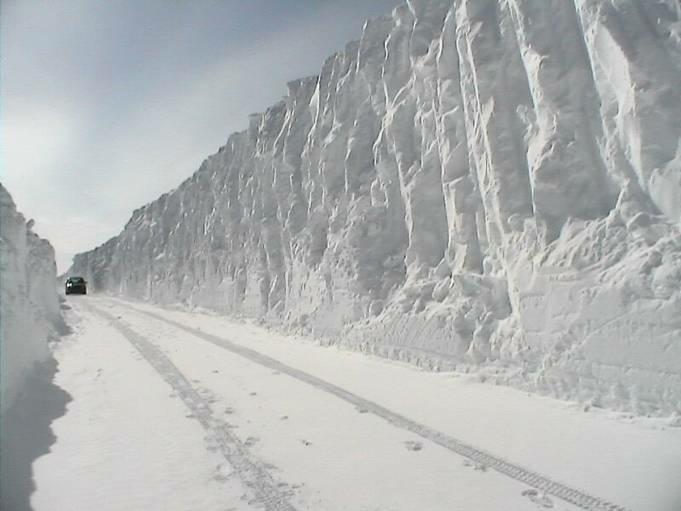
      Let's put these numbers into perspective.  170 inches of snow is about 14 feet.  Some of those other records were for 25 and 26 feet.  But what does that much snow look like?


      This is Jim. He's standing in front of a snow drift about 15 to 20 feet high.  This is at Crater Lake, Oregon.
      (Photo from Fred and Hank Mark America)


      This is the gift shop at Crater Lake, surrounded by snow, probably also somewhere between 15 and 20 feet.  As Jim from the above picture says, "Does this gift shop/cafe remind you of the Overlook Hotel or what?"
      (Photo from Fred and Hank Mark America)


      This photo along with a couple others showing construction equipment shoveling out snow have been getting passed around the internet for several years now. This is probably from Newfoundland or Labrador, in Canada. How much snow would you say is here, 12 feet? 15 feet?
      (Photo from Snopes)


      No idea where this is or how much snow is here. 20 feet or more?
      (Photo from Gallary Photo)


      Here's Chicago in 1967.  4 inches of snow were predicted, but they got 23 inches total instead.  It started snowing on a Thursday in January, kept it up all day, and continued until early Friday morning.  Two days before, the temperature had hit a record 65 degrees.

      (I think these are Chicago Tribune photos, but I found them at PlanetBarberella)


      (Photo from PlanetBarberella. She has tons more good ones at her site)


      Now here's Chicago on February 2, 2011.  I can't seem to find any definitive snowfall amounts, but apparently various locations around the city are reporting anywhere from 20 to 24 inches.  The winds got up to 60 or 70 miles per hour at night, which made for lots of snow drifts.


      This is roughly near Logan Square
      (Photo from Avoision)


      Liz is standing in thigh-deep in the snow.  There's an undefined amount of snow between the bottom of her feet and the ground, but probably if she'd been able to tunnel down that far, the snow would be to her waist.
      (Photo from Avoision)


      This is Milwaukee Avenue, normally super-busy.  Normally, there's no way people would be able to walk any distance in the middle of that street.  But today, because of all the snow, it's a completely different story.
      (Photo from Avoision)


      Now here's what two feet of snow looks like:


      Har har.
      (Snow sculpture by G. Lynas, photo sourced from Lorna Sass At Large)


      Okay, so my whole point was, all those places that got record-holding amounts of snow were in places where you'd expect a ton of snow.  High in the mountains, or in Alaska.  Those places get 20+ feet of snow, while Chicago got 20+ inches. But I still find the amount that Chicago got to be impressive because Chicago is nowhere near any mountains.

      That's what being close to the Great Lakes will do for you.


      Sources
      NOAA National Climatic Data Center, National Snowfall and Snow Depth Extremes Table
      ePodunk Georgetown Community Profile
      USA Today, Climate of Mount Rainier National Park, Wash.
      National Park Service, Mount Rainier FAQs
      The Storm King, Sierra Snowfall
      Chicago Tribune, The Chicago Blizzard of 1967
      National Examiner, Punxsutawney Phil and the Blizzard of 2011: Record snowfall in Chicago, Midwest, February 2, 2011