Monday, August 6, 2012

Apple #597: Pommel Horse


The voting on which entry I should do next was a dizzying deluge, but the winner is clear: pommel horse. One Daily Apple reader in particular said that the reason she wants to know more about it is to learn why our American gymnasts don't seem to be very good at it.

I'll start off with some basics, and then hopefully along the way I'll be able to uncover what makes it so challenging.  Whether or not I can say why our gymnasts have trouble with it, we'll see.


KrisztiƔn Berki of Hungary won gold in the pommel horse at London 2012. Look at that insane extension of his legs.
(Photo from Kagura-girl)


What's a Pommel?
  • First things first, let's define this word pommel.
  • I had thought the pommel was the knob that sticks up from a horse's saddle. But it's not the knob (which is actually called the horn); it's the arch on which the horn rests.
 
This diagram of a Western saddle is pretty complex, but it shows where the pommel is. It's the arch that stands up from the saddle, and the horn stick sup from that.
(Diagram from Fine Saddles)

  • The real purpose of the pommel is that it holds the saddle together.  But conveniently for the rider, you can also grab onto it if your horse is bucking.  The horn, which sits atop the pommel, makes the emergency grab even easier. 
  • The other purpose of the pommel is to help you mount the horse in the first place.  After you put your foot in the stirrup, you reach across the back of the horse to grab the pommel on the far side of the saddle and use that as leverage to pull yourself up.
  • The thing to note here is that when you're mounting the horse, after you've pulled yourself up on the stirrup, you have to swing the other leg over the back of the horse.  
  • When you're dismounting, from a seated position, you lean forward on the pommel to push yourself up so you're standing in the stirrups, then swing your right leg back over the horse and, with one foot still in the stirrup, bring your legs together, then turn to remove your foot from the stirrup, and slide down to the ground.


This instructor takes every step of mounting and dismounting very slowly and deliberately, but if you're patient, you'll see the similarities with pommel horse gymnastics routines.

  • Sound familiar?  That's because the gymnastic pommel horse event comes from the art of horse mounting. 

Pommel Horse Origins
  • Long, long ago, going at least as far back to Alexander the Great's time, soldiers used to practice mounting a horse by using a wooden horse as a model. 
  • In the 17th century, a drill instructor began teaching his students various horseback acrobatics as a way to improve their ability to mount horses under all sorts of challenging battle conditions.  Soon the cavalrymen were showing off about who was the best at these various equestrian acrobatics.


Pommel horse from 1795.  As far back as that, the legs allowed for adjustable height.
(Image from GymMedia


Pommel horse today.
(Photo from Smartly)

  • The soldiers' routines mainly involved climbing onto or jumping over the horse.  While the false horse did have two pommels, they didn't really figure into the acrobatics much.
  • But eventually, when the practice moved from the battlefield into the gymnasium, the gymnasts began to use the pommels as something to swing from, first with one leg, then the other.  By the 1880s or so, German gymnasts had innovated the two-legged swing, and that is where the real similarity with today's sport begins.
  • To back up and clarify a bit, there was this whole movement in the 1800s in Germany, emphasizing the importance of exercise as part of any man's education (back then, it was only men who were going to school).  Gymnasiums sprang up at universities all across Germany, as men were trained to exercise their bodies as well as their minds. 
  • During this time, a gymnastics instructor developed all sorts of equipment and exercises as part of the effort to exercise his pupils in new and more challenging ways.  This instructor,  Friedrich Ludwig Jahn, developed the equipment or the exercises that went with them for the parallel bars, the horizontal bar, the vault, and the pommel horse -- all of which are standard elements of men's gymnastics today. 


Friedrich Ludwig Jahn, the guy who invented the gymnastics pommel horse as we know it today, and probably the focus of lots of curse words from lots of gymnasts.
(Image from Pfannhauser)

What Makes the Pommel Horse so Difficult?
  • The pommel horse requires tremendous upper body strength.  You're swinging your legs around, doing handstands, spinning about, and your legs aren't supporting you at all. The only thing holding you up are your hands and your arms, and you have to hang on tight while your legs are whipping around.


This is Louis Smith, who won silver for Great Britain at London 2012. Please notice the enormous muscles in his chest and arms.
(Photo from not sure)

  • Other events in men's gymnastics really put a strain on upper body strength, most notoriously, the rings.  Those things are just punishing.  So how is the pommel horse different?
  • The pommel horse also relies very heavily on momentum.  You have to get a lot of speed going to execute those spins properly, and in fact, you rely on the momentum to carry your legs more than you could do on your own. If you make a mistake, you lose momentum, and you therefore also lose the ability to perform the next skill, and the whole thing falls apart like a house of cards.
  • How you do each element depends on your individual height and weight.  You have to keep your weight distributed evenly throughout each skill or you'll get thrown off.  What's more, the differences in each person's body make it difficult to teach someone else exactly how to do a skill. A taller, thinner gymnast will have to hold himself differently than a shorter, heavier gymnast, for example. These variations make trial and error crucial to learning the skills. 
  • Combining the importance of upper body strength and momentum, how you position your hands is crucial. Placing them in even the slightly wrong spot can throw off your weight distribution and thus your momentum, and then everything can go wrong very fast.


This is Danell Leyva of the United States at London 2012, just prior to falling off the pommel horse. I suspect that his critical mistake happened before this shot was taken and here he's already on his way off. But I think I can guess how this photo shows that he's destined to hit the floor.  His weight is thrown well forward of his supporting left arm, his right arm is only brushing the side of the horse which can't give him much support, he is bent at the waist, and his legs aren't held tight together. All of these things would throw anybody's balance off-kilter.
(Photo from The Spokesman-Review)

  • The individual skills -- to say nothing of stitching them together into a seamless routine -- are just plain freakin' hard to master. 
  • One of the central skills is to spin in circles. You might think this would be like flinging your legs out or up to get them to go over a horse, but that's not how you do it.  You have to keep your legs clamped together and rotate your hips to make your legs swing around. (This seems pretty intuitive to me, like how I spin myself around in an inner tube in the water. But it's probably a lot harder when you're holding yourself up in the air rather than floating in water and supported by an inner tube.)
  • They say the best way to learn how to do the circles is not even to involve the pommel horse at all for the first few weeks or months because you'll be too freaked out by the possibility of whacking your legs or your special parts against the pommels. So you learn on what's called a mushroom, a little round table-like thing with a padded top, and you spin around that. Then you progress to mushrooms that are higher up and progressively more like a pommel horse.
  • A common mistake people make when learning to do the circles is they bend at the waist in mid-circle. This slows you down and eventually makes you stop. You have to keep your body straight the entire way around the circle. 
  • There are all sorts of techniques to keep you from "piking the circle," including putting your feet in a bucket which is attached to a rope that holds the bucket hip-high and helps keep your body straight as you work your way around the mushroom.


This looks like a mild form of torture to me.


The subtitles in this video are kind of annoying ("let's c some circles b4 we start"), but it shows the difference between someone who can do circles adequately and someone who can do them really well.


Why Aren't American Gymnasts Very Good at the Pommel Horse?
  • Here we enter the realm of gray area and speculation.  So let me give you some data first.
  • US athletes have not medaled in the pommel horse since 1984 -- which was also the year of the Soviet boycott, so they might not have even won then if the Soviets had been playing.
  • Countries with the most medals in pommel horse, going all the way back to 1896:
    • USSR or Russia -- 13
    • Switzerland -- 9 (only 1 after 1936)
    • Finland -- 6
    • USA -- 6 (3 from 1904)
    • Germany -- 5
    • China -- 3
    • Romania -- 3
    • Great Britain -- 3
  • Though the Russians haven't won recently, they have traditionally owned to the pommel horse.
  • Why this is, I can't say for sure.  Perhaps it's just one of those things about sports, that the people who are best at it tend to stick around and coach the kids in their homeland. Since the younger athletes learn from the best, they in turn become the best. 
  • As for why the US isn't all that great in it, I'd guess there's a similar factor working the other way: that their coaching hasn't been as good as the Russians'. All of this is just my guess, though.


Here's Xiao Qin, who won gold in the pommel horse at Beijing in 2008. He breaks his line a bit at one point, but he keeps going. His body is very straight throughout, and he keeps his speed.  (This video is from Televisa, so there's English & Spanish commentary.)


This is Alexei Nemov of Russia from 1996 in Atlanta. He took the bronze. But for my money, his performance is better. Obviously huge upper body strength, but he goes faster and more smoothly, the straightness and flexibility of his legs on the flares is impressive, and he didn't have a break in his line the way Qin did.  Yeah, I've watched a few videos so now I'm an expert.


  • I will leave the final thought to Katia Bachko who, writing for The New Yorker, said this:
Everyone who is Russian has a thing for gymnastics. It’s an innate affinity. . . . We are born loving vodka, cold winters, and pommel horses. 


Sources
OneLook.com, pommel
Certified Horsemanship Association, How to Mount a Horse Video
GymMedia, History of the Pommel Horse
Livestrong.com, What is the origin of gymnastics equipment?, June 14, 2011
About.com, Men's Pommel Horse Olympic Gymnastics Medalists
The Atlantic Wire, The Weird End to the Men's Gymnastics Team Final: A GIF Guide, July 31, 2012
Drills and Skills, Pommel Horse Drills and Skills
Made Man Manual, Pommel Horse Skills
American Gymnast, Pommel Horse Training Progressions, July 10, 2010
BBC Sport Photo Galleries, Gymnastics Photo Guide
Katia Bachko, Why I Wish the Russian Gymnasts Had Won, The New Yorker, August 1, 2012

Friday, August 3, 2012

Apple #596: Kinesio Tape

I know I asked you, dear readers, to choose between two topics for my next entry: the pommel horse or synchronized diving, or to propose a third option.

One faithful Daily Apple reader posed a third option with this question:
Why do the divers have these big red streaks on their backs and legs? One Chinese diver had two parallel streaks on her lower back, one had one thicker one, and another diver had one on her front thigh. What does this mean? What is it made out of? Why doesn't it wash off in the water?


Wu Minxia, synchronized diver from China, wearing the muscle tape on her lower back and on her ankle.
(Photo from NBC Olympics Mobile)


I happen to know the answer to this.  It's muscle tape.  Athletes have been using it in lots of sports for several years.  But I'm glad you asked because it is sort of a mysterious material, and I would like to know more about it, too.

  • The first time I remember noticing it for sure was during the Beijing games when beach volleyball medalist Kerri Walsh wore it on her shoulder.
 
Kerri Walsh during the 2008 Beijing Olympics, wearing black muscle tape on her shoulder.
(Photo by Georgios Kefalas, from Monsters and Critics)

  • She had had surgery on her shoulder the year before the games. The surgery attended to problems with her rotator cuff, took out a bone spur, and got rid of some debris and scar tissue from a previous surgery. 
  • Though her shoulder had healed by the time she got to Beijing, she was wearing the muscle tape to bolster it.
  • I was struck by how it seemed flexible enough to conform to her muscles and the shape of her shoulder, allowing more specificity of placement and giving her more range of motion than a wrapped bandage would, and it never came off even though she was doing all sorts of diving into the sand and various other exertions, not to mention a lot of sweating.
  • The brand name for it is Kinesio Tape. It was developed by a Japanese chiropractor named Dr. Kenzo Kase. 

Dr. Kenzo Kase, inventor of Kinesio tape.
(Photo from Kinesio UK)

  • (Actually, there is another brand of this tape out there, called KT Tape.  But most people are talking about the Kinesio brand.)
  • The tape, according to Kinesio UK, is flexible enough to stretch 30% to 40% longer than its resting length, it allows the skin to breathe, but it will stay on for 3-5 days at a stretch. (a little pun there for you)
  • It's made of cotton, which is porous enough to allow moisture to escape through it, which means it will stay on even when it gets wet.  
  • What makes it stick is a special heat-activated adhesive. When you first put it on, you have to rub it briskly to get the adhesive working, and then it will stick. 
  • According to the company that makes Kinesio, the tape supposedly allows more blood flow to reach sore muscles by pulling the skin slightly away from the muscle. Its effects are to reduce swelling, pain, and muscle fatigue.
  • Kinesio says there's a special way it must be applied, and they train and certify people in how to do that.  They say that there are now some 4,000+ certified Kinesio Taping (they put a little R in a circle after this) practitioners in the UK alone.


Kerri Walsh's tape was black, and for a long time, that was the only color of it that I saw. But now you can also get it in beige, blue, and red, as shown here. One roll sells for £7.95 (~$12.35), and a box of 6 rolls goes for £41.50 (~$64.40).
(Photo from Kinesio UK)


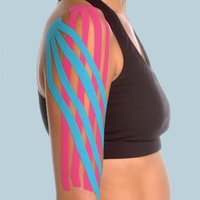
They also sell it in a different variety, called "fan cut." I'm guessing this is so you can spread out the ends to cover a lot of surface area more easily. A pack of 50 goes for £46.50 (~$72).
(Photo from Kinesio UK)


Ah, yes. Here is the fan cut option in use.
(Photo from North Coast Medical)

  • As far as whether or not it actually works, opinions are mixed. There hasn't been a lot of medical research done on the tape, but what has been conducted has found that there is a short-term benefit in some circumstances, like increased r ange of motion, or a reduction in pain. But long-term, the studies haven't seen results any better than a placebo.
  • It should be said that, even though this tape has existed for 30 years, there hasn't been a ton of research that's been able to cover the long-term.  
  • It should also be said that the placebo effect can be a powerful thing.  In other words, if you believe that something will help you, it just might do so.
  • Here are just a few other athletes who have used the Kinesio tape:
    • Supposedly, some Japanese athletes wore it in the 1988 Seoul Olympics, but you couldn't see it under their clothes.
    • Lance Armstrong and his team wore it.  Here's what Armstrong says about it in his (and his ghost writer's) book Every Second Counts:
The guy who put us all back together was our chiropractor, Jeff Spencer … Jeff is part doctor, part guru, part medicine man. He had all kinds of strange gizmos and rituals and cures, a remedy for every condition. . . . But Jeff had something that was better than any laser, wrap, or electric massager. He had The Tape. It was a special hot-pink athletic tape that came from Japan and seemed to have special powers. George got a problem with his lower back. Jeff turned him around and started putting hot-pink tape on it. George thought, “How can that help?” But the next day the pain had disappeared – it was gone. We swore by Jeff’s pink tape. He would tape the hell out of anything. You had a tweaky knee? He taped it. A guy would start to get tendinitis and he’d say, “Don’t worry. No problem. We’ll tape it.”


Leryn Franco, javelin thrower from Paraguay, wearing the blue Kinesio tape at the Athens Olympics in 2004.
(Photo from City Centre Chiropractic)


    • David Beckham (soccer/football)
    • Lots of other famous soccer players including Mario Balotelli
    • Tiger Woods (golf)
    • Rafael Nadal (tennis)
    • Novak Djokovic (tennis
    • Justine Henin (tennis)
    • Jared Sullinger (college basketball)
    • Edgerrin James (professional football)
    • Paulo Villar (track) 
    • Nikola Janovic (water polo)
    • Alex Mumbru (basketball)
    • Sara Goller (beach volleyball)
    • Loads more athletes at the London 2012 Olympics


David Beckham sporting the pink Kinesio tape
(Photo from Merchant Circle


Serena Williams wearing it on her plaguey knees.
(Photo from Skirts N Sports)


Brigitte Foster-Hylton (2155) from Jamaica, in 100M hurdles at the 2008 Beijing Olympics, wearing the Kinesio tape.
(Photo from Skirts N Sports)


One veterinarian in the UK has even used it on horses.
(Photo from Manual Lymphatic Drainage)


The voting for my next entry has been a bit slim.  So far, the pommel horse is in the lead.  If you'd like to vote on what you'd like to read for my next entry, do so here.

Sources
Kerri Walsh says she'll be ready for Beijing, ESPN Olympic Sports, May 31, 2008
Kate Kelland, Reuters, Scientists skeptical as athletes get all taped up, Calgary Herald, August 2, 2012
Carly Weeks, The latest craze at the Olympics: body tape. But does it do anything? The Globe and Mail, August 2, 2012 
Chris Woolston, "The Healthy Skeptic: The sticky issue of kinesiology tapes," The Los Angeles Times, April 4, 2011
Fort Collins Gonstead Chiropractic
Dallas Medical & Chiropractic Clinic, Kinesio taping in Dallas
Kinesio UK
theratape.com, Kinesio Tape
IAAF Athletes Biographies, Brigitte Foster-Hylton
Men's Basketball: OSU Insider, The Columbus Dispatch, March 9, 2011

Wednesday, August 1, 2012

Your votes, please

I'm contemplating another Olympics-related Daily Apple entry in the near future.  Since my entry on water polo turned out to be so popular, I thought I'd get your input.

Which would you rather read about, 1 or 2:

1. Pommel horse in gymnastics -- what a weird thing, first of all, so where did it come from and why is a gymnastics thing and not an equestrian event? Second of all, it's plain amazing how fast the gymnasts get going on that thing, so how do they do that?

2. Synchronized diving -- how in the world do you learn this? How do you get your dive to be the same height as your partner's, your spins in the air going at the same rate, your untucking from the spin happening at the same time, your angle into the water the same, etc., etc.

Or is there a third item which has piqued your interest?  Here's a tip: the more specific your query, the better.  For example, asking me about swimming will probably get you a mish-mash of general information.  But if you say you want to know how to swim the butterfly stroke, then you might get something you're more satisfied with.

Let me know in the Comments.  I'm looking forward to hearing from you!

Sunday, July 29, 2012

Apple #595: Water Polo

So I'm watching water polo on the Olympics, and I keep thinking, man, that looks hard.  I can't imagine treading water, fighting off the other player, and flinging the ball to the net, then having to swim as fast as possible to the other end of the pool.

On top of all that, I've heard that water polo is actually a rough sport, that there's a lot of scrapping and injuries.  It looks pretty benign, with all that water and the bathing suits and the funny caps, so it's kind of hard to believe it's all that rough-and-tumble.  The announcers aren't saying much about the behind-the-scenes--or under-the-water--truth about the sport.  So it's time for the Apple Lady to find out.


Water polo.  With all that splashing and waving of arms and swimming around, is it really that violent a sport?
(Photo from Wikipedia


HOW PEOPLE DESCRIBE IT
  • One of the ways of knowing the nature of a thing is by how people describe it.  Here are some of the ways people describe water polo: 
    • "A unique combination of swimming, throwing, and martial arts." 
    • "The only contact sport played in the water"
    • "An aquatic form of rugby." My brother played rugby for a while.  His face after a rugby match was usually pretty colorful with bruises and scratches and scrapes. If water polo really is like rugby, then it must be pretty high-contact.

NATURE OF PLAY
  • But they wear those funny-looking caps. The caps are funny-looking, but there are reasons for that.  They tie under the chin so they won't come off when a player goes underwater, or is dunked, or is pushed or shoved.
  • The reason you don't want the cap to come off is because it includes ear protectors. The ear protectors aren't to keep water from trickling into and clogging your delicate ears, but rather to shield your ears from getting bashed by an opponent's elbow, or from getting slapped by an opponent and your ear drum bursting as a result. 
   
There's also this.
(Photo from Water Polo blog)

  • But all they're doing most of the time is treading water and waving their arms around.
  • OK, first, the treading water part. To stay afloat while you're playing, you have to do what looks like treading water.  But the motion is different and harder than that. The especially effective method of treading water is called the "eggbeater kick."  You lift one leg at a bent position, as if you're sitting in a chair, while you kick out the other leg sideways and rotate it in a circle.  Then you switch legs and do the same thing.


The eggbeater kick, which water polo players use to stay afloat while they're playing.
(Photo from coachesinfo.com)

  • Since kicking out your leg is a motion essential to the sport, it's easy to kick or be kicked accidentally.  And since it's hard for the refs to see from above water what's going on below the surface, getting kicked happens not so accidentally, and often, and without penalty. Usually, if an opponent kicks you, it's to try to keep you at a distance so the opponent can catch the ball or score or keep from being blocked. 
 
Here's a shot of some of what goes on underwater during a water polo match.  You can see people in the midst of their eggbeater kicks, but it also looks like the guy in the foreground may have just gotten shoved underwater by his opponent.
(Photo from SM Texas)
  • As for the waving of the arms, that's part of defending, or reaching out to catch the ball.  As it turns out, lots of penalties happen during the defending process.  More on that in a second, but first:
  • If you still think this is wimpy, you try raising yourself up out of the water high enough to throw a ball over someone's head, and faster than they can reach out to stop it -- all while not being able to stand on anything.
Look how high out of the water this guy is.  He's not standing on anything, he's just doing his special eggbeater kick to propel himself up higher out of the water.
(Photo from NorCal Water Polo)


There are tons of great photos out there of water polo players in action, showing how strong they are.  I can't show you any of them because they're all owned by Getty or Corbis.  So you'll either have to click the link to see for yourself, or just trust me when I say, these are some impressive athletes. 


PENALTIES
  • A good way to assess how violent or physical-contacty a sport is is by what behavior has been banned.  This suggests that, even though such & such is not allowed, it does happen, and they've had to make a special rule outlawing that behavior.
  • So I'll talk about the types of fouls that happen in water polo, from least serious to most serious. This is leaving out penalties like violating the amount of distance you're supposed to keep from the goal, or what you're not allowed to do when you're out of the pool, etc.  I'm only going to mention the physical types of fouls.
  • In addition to kicking, opponents can get away with lots of infractions which are technically not allowed, but which the refs tend not to see because they happen underwater.  
    • Wrist-holding: an opponent may grab your wrist and hold it in order to keep you from going after the ball or from raising your arm to defend against you. As long as your wrist is underwater, they can usually get away with it until you break their grip
    • Grab-and-go: say you're on defense, in front of an offensive player. The offensive player reaches across to grab your arm and, using you like a stationary object, pulls herself forward ahead of you.
    • Suit-grabbing: players don't grab opponents' bathing suits to disrobe and embarrass them, though that may happen. The men grab each other's suits at the waist to keep a defender low in the water and unable to block, or to keep an offensive player from getting up in the water to make a shot.  Female players may do the same thing, or they may also grab another player's shoulder straps, but since it's easier to get your shoulders out of the water, it's easier to attract the ref's attention and get a penalty called. (Mutual suit-grabbing here)
  • Since suit-grabbing is pretty common, water polo players wear bathing suits that are as small and snug as possible.  Women water polo players are required to wear one-piece suits.


US Men's Water Polo team, 1996. I bet if it were safer to do so, and allowed, they would play without their bathing suits.  OK, yes, this is some eye candy for some of you Daily Apple readers out there.  But I posted this for another reason, which is to say, judging from how ripped these guys are, you probably have to be in this kind of super-great shape to play this sport. So I take this to be further evidence that this is a very physically demanding sport.
(Photo from The Hostages)

  • There are, of course, many physical-contact things you're not allowed to do, and which will get a penalty called against you if you did them.  Since these things are outlawed in the rule book, I'm assuming that they do happen.
    • Swimming across an opponent's legs.Your opponent is leaning forward for the ball, almost lying flat in the water, and you swim across her legs so that she can't swim as fast. Presumably you could get kicked, but she'll slow down, and you get to cut a corner essentially, and cut her off.
    • Swimming on the opponent's shoulders. Yes, that's right, I said "on." As far as I can tell, this means essentially, swimming over an opponent, or pressing down on his shoulders to make him sink as you're swimming.
    • Any other form of impeding, meaning you're somehow physically restraining the other person or holding them back or down in the water.  If the impeding looks violent or intentional, you can get kicked out of the game (more on that in a bit). 
    • Striking the ball with a clenched fist. This puts too much force into a strike, but it also makes it likely that you would punch somebody by mistake. So you have to smack the ball with an open palm, which means you might slap somebody by mistake, but that's OK.
 
This is Lyuba Tschougounova, who played in junior college in 2009.  Looks like she's fending off two opponents at once, one who is actively trying to block her, and the other at the ready.
(Photo from Concordia Eagles)

  • There are a whole series of infractions which are all classified as "acts of brutality." I am not exaggerating.  If a player is found to be committing an act of brutality, the payer is s kicked out (excluded) for the rest of the game, and a player from the opposing team gets a free shot at the goal (penalty throw).
  • An act of brutality is defined as playing "in a violent manner, including kicking, striking or attempting to kick or strike with malicious intent against an opponent or an official."  Yes, against an official.
  • Here are acts of brutality in water polo:
    • Intentionally splashing an opponent in the face
    • Holding (grabbing onto), sinking (pushing down into the water), or pulling back (grabbing onto and pulling away) an opponent who is not holding the ball.  Any of these things are allowed, apparently, if an opponent does have the ball.

 
The hold, sink, or pull back rule. This rule seems to be quite a big gray area, judging from the rule book's efforts to define what is happening in each diagram.  I'm guessing that it's like holding in football, that you're not supposed to do it, but that it happens all the time.
(Image from FINA Water Polo Rules)

This looks like this might qualify as a hold.  Once again, I can't show it to you here.  Thanks, Getty!

    • Kicking or striking an opponent intentionally
    • Using the elbow to strike backwards to hit an opponent behind you
    • Head butting backwards to do the same


Striking with the elbow backwards is classified as a "brutality" and can get you kicked out of the game.
(Image from FINA Water Polo Rules)

  • The key here, I suspect, is that the refs first have to see that you've committed the infraction, and then they have to interpret your actions as violent and intentional.  A player may think another player's actions are violent and intentional, but until the ref agrees, you may be stuck trying to fight the guy off.
 I wouldn't call this intentional, but it does look like this altercation could have turned into something fairly serious.


INJURIES
  • Another way to find out how rough the spot is would be by finding out what kinds of injuries are common to water polo players. 
  • As in any sport, there are lots of overuse or repetitive motion injuries. In water polo, those happen especially to the shoulder or elbow from throwing, or to the lower back from rotating while throwing, and to the groin and knee, from doing the "eggbeater kick."  And because it's a water sport, water polo players can also get inflammation in the ear canal, a.k.a. swimmer's ear.
  • Most of the injuries in water polo fall in this overuse category, and most of the injuries are to the shoulder.
 
This is Lauren Wenger. She was named the June Athlete of the Month in 2009 by the US Olympic Committee.  Look at her enormous muscles in her shoulder.  That speaks to how strong water polo players' shoulders get from having to whip the ball as hard and fast as they can.
(Photo from Women Sport Report)

  • But what about injuries sustained as a result of contact with other players?  What are those like?
    • Contusions, or bruises, are very common, especially to the face.
    • Lacerations, or cuts, are common too. You can get cut when the ball hits you in the face, or by a player's fingernails or toenails. 
    • There are lots of eye injuries, including cuts to the face around the eye or cheekbone, black eyes, bleeding into the eye, scratched corneas, etc.
    • Some players even sustain "blow-outs" or complete fractures of the bone around the eye.
    • Sprains & fractures. Most often, these happen to fingers, which get hyperextended or bent or bashed when a speeding ball hits the hand at a strange or unexpected angle.  But sometimes the sprain or fracture happens because of contact with an opponent.
    • Concussions or head injuries. These aren't that common, but they do happen, usually happen as a result of getting elbowed in the head or head-butted.
    • Spine injuries. These can be a repetitive motion injury, from turning your head to breathe during freestyle swimming.  But some players have sustained cervical spine injuries due to blows to the shoulder area from another player.
    • Fatal intracranial bleeding. In other words, a head injury that has resulted in internal bleeding on the brain, from which someone died.  I don't know any details about how this happened, only that it did happen to a water polo player.
 
Ervin Zador got punched in the eye during the "Blood in the Water" match between Hungary and USSR in the 1956 Olympics.
(Photo from Wikipedia)

  • Recently, a sixteen year-old boy in Southern California who had just made the water polo team died during practice.  He said he was thirsty, got out of pool to get a drink of water, got back in the pool, and later, he was found unconscious at the bottom of the pool.  As of this writing, no cause of death had been officially determined.
All right.  I'm convinced.  Water polo is a demanding, physical, high-contact sport.

And to put some of the fun back into it, here you go:


Sauce for the goose....
(Photo from magaz!nes.com)

[Edit: Here we go. This video shows the underwater truth pretty succinctly.]


Sources
FINA Water Polo Rules
Miljenko Franić, Alan Ivković, and Ratko Rudić, Injuries in Water Polo, Journal of Croatian Medicine, June 2007
iSport, Underwater Tactics for Water Polo
Stop Sports Injuries, Water Polo
Jeno Kiss, Department of Orthopedics and Trauma, St. John's Hospital, Budapest, Sport related injuries in water polo
Palm Desert water polo player's death stuns family, friends, Los Angeles Times, June 18, 2012

Sunday, July 22, 2012

Apple #594: Wildfire containment

This is another question that came up while I was away on vacation.  When those wildfires were burning in Colorado and elsewhere, news reports kept saying things like, "The fire is 30% contained," or "The fire is estimated to be 45% contained."  In one news story I heard on the radio, the reporter asked the fire chief how he calculated containment.  He said something about the amount of acreage involved, but he said it so quickly, I didn't catch it.

So I wanted to find out, how do they calculate what percentage of a wildfire is contained?


Wildfire taking out trees as it moves across the ground.
(Photo from Chez-Audelle)


On July 4, 2012, several wildfires were burning across the state of Montana. The percent containment figures make for a nice, neat graphic, don't they?
(Map from the Billings Gazette)


Percent Containment
  • It turns out, there isn't any fancy calculation involved in arriving at percent containment.  It's an estimate.  Here's how it works.
  • A wildfire encompasses a certain amount of area.  Imagine the area as a filled-in ellipse.  Most wildfires aren't like that; they'll often have portions bulging out in one direction or other, but for the ease of description, picture an ellipse.  The outer edge of the ellipse is the fireline.
  • When firefighters try to put out the wildfire, their first goal is to stop it from spreading.  They may put up some kind of temporary barrier around the fireline, or they may dig trenches, or they may spread some type of retardant, or they may remove trees or easily burnable stuff from the projected path of the fire, etc.  All these techniques are methods of containment.
  • When the fire chief gets interviewed and is asked some question like, "How close are you to getting this fire under control?" the fire chief tells the reporter what percent of the ellipse has some kind of containment barrier around the fireline.
  • That's all there is to it.  There's nothing absolute about it.  It's an estimate based on the chief's understanding of the size of the fire at the time, and how much of a barrier they've put down so far.
Today, most wildfire containment methods use retardant dropped onto areas just beyond the fireline, as shown in this photo of the Waldo Canyon Fire, June 23, 2012
(Photo from The Colorado Springs Gazette)

Actual Containment: My Take
  • Based on what I've read, it sounds to me like this % containment number is a number they tell the media to make them happy.  It's a number to give to the reporters (and to us the public) so we can feel like we have a solid and easy-to-grasp concept to cling to.  But as far as I can tell, firefighters do not themselves think in such terms.
  • To them, containment = 100% contained.  The question for them is, how do we get from this fire burning out of control to 100% contained, and put out?

I find this to be a pretty fascinating map.  This is a map of the High Park Fire in Colorado as of June 21, 2012. The red area represents where the fire was burning on that date. The red outline is the "uncontrolled fire edge." The black outline is the "completed line," meaning where they have put some sort of fire control measure in please.  The map is very detailed, even including gray-shaded areas where an older fire once burned.  But nowhere does it say anything about containment--presumably because, according to firefighter parlance, containment had not yet been reached. To see a larger version of the map, go to Summit County Citizens Voice.
(Map from Summit County Citizens Voice)

  • To answer this question, firefighters run all sorts of calculations--very complicated ones involving calculus and all sorts of higher math because there are so many variables involved in a wildfire.
  • Here are some of the features about a wildfire that firefighters have to take into account:
    • Fire intensity -- the rate of heat released by a fire. That's both radiant and convectional heat.
    • Rate of spread -- the distance the fire moves horizontally over time. Usually this is calculated at the head of the fire.
    • Fire type -- is it burning at surface or ground level, or is it burning in the crowns of trees
    • Type of fuel -- usually when it's a wildfire, it's mostly wood and leaves that's involved, but maybe there are other materials in the area, especially if there are houses or industrial buildings.  Even if the fuel is nearly all wood, there are other factors to consider such as how wet is the wood, is it densely or loosely arranged, how big or small is it (fine fuels like sawdust ignite much more rapidly), how dense is the material (a rotten log will ignite more quickly than a sound log), and so on.
    • Fuel load -- weight of fuel/unit area, often expressed as tons/acre
    • Fuel chemical composition -- if there are chemicals identified in your type of fuel, what kinds of chemicals are they?  Of course if accelerants are involved, everything burns faster & hotter. But even if the fuel is primarily wood, high concentrations of resins or oils in the wood can increase flammability and heat output. On the other hand, if the wood has a high mineral content, particularly phosphorus, that will reduce or even retard flammability.
    • Weather -- we hear the most about this one.  All sorts of factors with the weather come into play, including how fast is the wind blowing and is it blowing the fire toward unburned fuel areas. Of course whether or not it's going to rain is a huge factor, but air temperature and humidity will also affect the fire.


Obviously the intensity of the wildfire above is far greater than the one below.
(Photo, top from Treehugger. Photo, bottom from US Fish & Wildlife Service, sourced from Wildlife Risk Explorer)

  •  As I said, those are only some of the variables the firefighters will take into account.  Some of those variables are easier to estimate than others.
  • Then they take all that data and plug them into those very complicated equations to try to find the answers to questions like these:
    • What kind of material would be the most effective at stopping the fire? 
    • How much of that material will we need to create barriers around the entire fire?
    • How fast will we need to build those barriers?
    • How long will it take to reach 100% containment, given such & such barriers?
  • Put in a very theoretical sense, firefighters are trying to solve the fire (equation) for containment (x).
  • (If you're interested in what some of those complicated equations are, check out this paper from 1980. It gives instructions for how to run some of these equations on a pocket calculator. To run them yourself, you would need to know the data for at least 8 variables. I'm sure there are more sophisticated methods of running these calculations today, but this gives you an early, behind-the-scenes glance anyway.) 

Firefighters working on a wildfire in Australia
(Photo from Chez-Audelle)

  • Of course, regardless of all this data, a wildfire is still wild.  Even though firefighters do their very best to find out everything they can about a particular fire and how it's behaving, and try to predict where it might go next and how fast it might get there, a wildfire can still be unpredictable.
  • That's not something we like to hear, especially if homes are at risk of being burned and people's lives may be at risk.  So we get a very estimatey-but-it-sounds-official percent containment number in our news stories.

Related entries: Fire, Fire Departments

Sources
Forest Encyclopedia Network. All sorts of great information here. Especially good pages include Fire Intensity, Fireline Intensity, Rate of Spread
National Wildfire Coordinating Group, Contained; Containment; Control Line; Controlled
Frank A. Albini and Carolyn H. Chase, Fire Containment Equations for Pocket Calculators, USDA Forest Service INT-26B, January 1980
LAist, What Do Fire Officials Mean When They Say 'Containment'? 2008
Rebane's Ruminations, Wildfire Containment Percentage - Say What??!! August 18, 2009

Monday, July 16, 2012

Apple #593: Derechos

So I've been away on vacation, and I read about those derechos that hit several states.  They didn't hit where I was, and I had zero access to the internet or TV.  Those of you at home may have heard all sorts of explanations and definitions of a derecho already, but I had only a smallish daily newspaper, so I did not.  Now that I'm back among the swirl of telecommunications, I want to find out about these derechos.


The June 2012 derecho on the southeast side of Chicago.
(Photo from Twitter, sourced from The Original Weather Blog)


Mainly I want to know, what the heck are they, and is this some new term the meteorologists have cooked up?  Is this a sign that global warming is getting crazy?

Definition

  • NOAA's Storm Prediction Center says that a derecho is a
    • widespread
    • long-lived
    • wind storm,
    • accompanied by rapidly moving rain or thunderstorms
  • I'll take each of those attributes in turn.
  • Widespread: extends in a swath of more than 240 miles or greater along most of its length.  In other words, the storm encompasses a huge amount of territory all at once.
 
Radar image of the derecho on June 29, 2012 (my birthday, by the way, and this is the second one to happen on my birthday).  This derecho was especially widespread, sweeping across 700 miles.
(Image from the National Weather Service, sourced from Wikipedia)

  • Long-lived: this one seems to be inaccurate, since your experience of a derecho might seem relatively brief, only about ten or fifteen minutes.  But the key is that the derecho spans the entire 240+ miles, and the entire storm continues along that span for several tens of minutes. What's more, the system may take as long as 24 hours to develop and its entire lifespan can last 2 days.
  • Wind storm: wind gusts have to reach at least 58 mph for the storm to get called a derecho. Why 58, I don't know.  Seems pretty random, but that's what NOAA says.  Sometimes winds can exceed 100 mph.
  • The wind storm attribute has another important aspect, which is that while tornadoes spin and hop about, dropping down to inflict damage in a few places and hopping up to move someplace else, the derecho moves in a straight line across an area.  So a derecho is sometimes described as inflicting "straight-line wind damage."
  • In fact the word derecho is Spanish for "straight ahead" or "direct." (More on the word origin in a bit.)

This field of corn in Indiana has been all smashed down by the high winds of the 2012 derecho. Gives a pretty good sense of a derecho's straight-line, strong winds.
(Photo from the DuBois County Free Press)

  • Accompanied by fast-moving thunderstorms: usually there are several thunderstorms happening within the band, or bow, of the derecho.  There can be all sorts of downbursts, sometimes occurring a fair distance apart, or clustered together, or ganged in one big swath.  The downbursts themselves can individually last a brief time, but as the entire bow of the derecho moves across the landscape, more downbursts can get whipped up and release their rain.

Derecho Strikes the Eastern United States
You've probably seen this image of the 2012 derecho all over the place.  This was taken in La Porte, Indiana.  The front line is clearly visible here.  That's typical of thunderstorms, but this is like a line drawn in the sky with a ruler. And you can just tell by those roiling clouds that they are not messing around, this is going to be a big-ass storm.
(Photo by NASA Goddard Photo and Video)

  • The damage caused by a swath of downbursts can be similar to the damage caused by a tornado.  What's more, a tornado or tornadoes can occur within a derecho.  During a May 2009 derecho, 45 tornadoes were reported.
  • The damage a derecho can cause typically includes uprooted and fallen trees or utility poles; overturned boats, SUVs, or even cars; collapsed barns and small buildings; and flying debris including tree limbs, roofing material, broken glass, etc. Power lines are also very vulnerable, and power outages that last for extended periods of time across large areas are very likely.
  • In the June 29, 2012 derecho, 3 million homes were without power, 12 people were killed, and 20 people were injured.
washington dc derecho: big tree down
This is in the DC area, after the 2012 derecho. The root mesh is sticking up 10 feet in the air, which gives you an idea of how large this tree is. Note the power lines pulled down by the tree.  This sort of thing happened all over the place, which is one of the reasons it took so long for the power to get turned back on for so many people.
(Photo by woodleywonderworks on Flickr)

How, When, & Where Derechos Form

  • Meteorologists have a tough time predicting derechos for several reasons:
    • because derechos encompass so much territory, and it's hard to amass all the data in time to put together that big a picture. 
    • because sometimes a derecho can form very rapidly when several thunderstorms suddenly gang together to form one great big storm
    • because meteorologists still don't understand enough about how and why they form
  • But some things about how derechos form meteorologists do feel fairly sure of:
    • They happen most often in May, June, and July. These months are when thunderstorms are more likely to occur.
 
Months when derechos are most likely to happen in the United States
(Graph from NOAA)

    • They often happen in the midst of a heat wave. When a large upper-level high pressure system just sits over the Midwest, something called an elevated mixed layer (EML) of air forms.   This means that above the place where the hot air is just sitting, as you move higher into the atmosphere, the temperature drops rapidly with each incremental climb. There's no breeze mixing up or even moving the hot air down below, so it gets all concentrated there, and the cool air up above doesn't move around either.  Big differences in air temperature is the main thing that results in big storms.
    • They may also happen in early spring or early fall.  This is less common, but it can happen. Derechos that spring up during these times are a little different, since they're associated with very strong low pressure systems, as opposed to those long-lasting high pressure systems.
    • They tend to occur east of the Rockies.  The Rocky Mountains are tall enough that that big fat layer of hot air can't sit in one place low to the ground, so the EML doesn't develop above it.  This is why derechos usually happen in the Plains states or in the Midwest, or occasionally along the Atlantic.
 
Map showing how likely derechos are to occur in various parts of the United States. From this map, it looks like derechos never occur west of the Rockies.  That isn't exactly true; they have happened in the West, but extremely rarely.
(Map from NOAA)


I wonder if the stratifications visible in this cloud -- which is the 2012 derecho -- are the stratifications that occur in the elevated mixed layer.
(Photo from WordlessTech)


Derechos and Global Warming?

  • By now you've probably gathered that derechos have been known to meteorologists for a while. The term was first coined by a physics professor, Dr. Gustavus Hinrichs, at the University of Iowa, in 1888.  One of the storms he used as a basis for his term occurred in 1877.
 
Hinrich's figure depicting a storm he was the first to call a derecho sweeping across Iowa in 1877.
(Image from NOAA)

  • So they're nothing new.  It's apparently only that the term hasn't entered common (that is, non-meteorological) parlance until recently.
  • Since derechos are often linked with heat waves, it is tempting to think that if global temperatures rise, we may see more derechos in the future. But meteorologists hesitate to make such a leap.  For one thing, they say they don't have enough data to 
    • make a definite link between greenhouse gas emissions and heat waves, or indeed any weather pattern associated with derechos
    • come up with any consistently reliable weather pattern for derechos in general.  They simply don't have enough records or enough data about derechos to make these kinds of sweeping generalizations about them.
  • In fact, while they have a list of derechos that have occurred in the past, they say right up front that they know the list isn't complete.  All the sites I checked on this refer to NOAA's list of "noteworthy" derechos, which is to say, it's nowhere near all of them.

I don't have anything insightful to say about this photo other than holy crap, look at that thing. This is Minnesota, June 29, 2012.
(Photo by Brittney Misialek for the Minnesota Star Tribune)

  • So there's no way to be certain of all sorts of things; for example, how many derechos happened in the late 1800s when the term was first coined, or even before that.  Which means scientists can't compare the frequency now with the frequency then and therefore can't draw any real conclusions.
  • The list of noteworthy derechos, in chronological order, goes like this:
    • July 4, 1969: Ohio Fireworks Derecho
    • July 4, 1977: Independence Day Derecho
    • July 4-5, 1980: More Trees Down Derecho
    • June 7, 1982: Kansas City Derecho of 1982
    • July 19, 1983: I-94 Derecho
    • May 17, 1986: Texas Boaters' Derecho
    • July 28-29, 1986: Supercell Transition Derecho
    • May 4-5, 1989: Texas Derecho of 1989
    • April 9, 1991: West Virginia Derecho of 1991
    • July 7-8 1991: Southern Great Lakes Derecho of 1991
    • March 12-13, 1993: Storm of the Century Derecho
    • July 12-13, 1995: Right Turn Derecho
    • July 14-15, 1995: Ontario-Adirondacks Derecho
    • May 30-31, 1998: Southern Great Lakes Derecho of 1998
    • June 29, 1998: Corn Belt Derecho of 1998
    • Sept 7, 1998: Syracuse Derecho of Labor Day; NYC Derecho of Labor Day
    • July 4-5, 1999: Boundary Waters-Canadian Derecho
    • May 27-28, 2001: People Chaser Derecho
    • July 22, 2003: Mid-South Derecho of 2003
    • May 8, 2009: Super-Derecho of May 2009
    • June 28, 2012: (not yet named as far as I know)
  • Now here's what they look like put on a timeline:
 (Data from NOAA; chart by the Apple Lady)

  • According to this very incomplete data, it's tempting to conclude that there was a spike in activity in the mid-to late 1990s and that it's declined again.  But you can't make that conclusion because this isn't all the derechos that have occurred, only the noteworthy ones.  So it's impossible to say whether they're increasing in frequency or not.
  • Many meteorologists say that you can expect about one derecho every year or two somewhere in the US.  Usually they're not as huge as the one we had this year, though.

Derecho from May 27-28, 2001 near Fort Supply, Oklahoma.
(Photo from NOAA, by Douglas Berry)
  • Some evidence suggests that derechos seem to be more damaging because shade trees planted in the postwar years in urban and suburban areas are now matured, so many more trees have fallen in recent years.
  • So the final answer on the relationship between derechos and global warming is maybe. 

Man, the wind pulled up that tree and the grass like it was sitting in carpet. This is in Vineland, NJ, and that's Grace.
(Photo from MyFoxPhilly, taken by Margaret Hartman)
Sources
NOAA Storm Prediction Center, About Derechos
Kristina Pydynowski, Intense Storms Called a "Derecho" Slam 700 Miles of US, AccuWeather.com, July 2, 2012
ABCNews Good Morning America, "Derecho" Storm Ravaged Washington Area, July 2, 2012
Jason Samenow, Did global warming intensify the derecho in Washington, D.C.? Washington Post Local, July 5, 2012