Showing posts with label animals - reptiles and amphibians. Show all posts

Sunday, March 26, 2017

Apple #742: Spring Peepers

As faithful Daily Apple readers may have noticed, your Apple Lady has fallen off the ball. This is largely because I have been stumped by the Trump Effect.  All week long, we are beset by news of whatever idiotic thing he's tweeted, whatever racist executive order he's made, whatever selfish and oblivious thing he's done, whatever outlandish lie he has told.  Each weekend, I try to decide what I want to talk about in a Daily Apple, and all I do is flail.

Do I choose some basic fact of science that one of his brainless minions has gotten completely wrong, and explain how and why it's wrong?  Well, it doesn't really matter to this administration whether they are right or wrong, only that they get their way.

Do I choose the latest bit of information about the ever-growing list of connections between Trump and Russian financiers, legitimate and not?  While an illegal financial arrangement is there, I am sure of it, the money dots have not yet been connected, and in the meantime, it's such a swirling pool of individuals, I'm not sure which person or bank is the one to profile at this point, or if I'd only be contributing to the swirl.

And there's the exhaustion of trying to keep up with all the ugliness of this administration.  Do I really want to spend another day of my week talking about that ugliness?  Would it be better to give people a break and talk about some normal thing from everyday life?  But then am I only sticking my head in the sand and ignoring the thing that is in the process of changing all our lives so dramatically.

Without a decision, I post nothing.  And another week passes.

But I think I found an answer it a tiny little thing.

This weekend, I was walking in a park in my city -- a large, many-acre park with lots of trees and some streams and rivers and even a couple ponds.  I took a little-used path deep into the trees, and it comes out to the edge of a pond at the far end of the park, and the air was ringing with the noise of the spring peepers.


I hope the little video I took to record the sound will upload here.  At first, you hear mostly the wind, but then the noise of the spring peepers emerges.  It doesn't seem as loud on my video as it did in real life.  There must have been thousands of them chirping away, super-piercing loudly.  It was almost tactile in my ears, the noisy peeping from all directions.

  • Spring peepers are tree frogs.  They live in trees and shrubs and bushes.  They have little sticky pads on their toes that help them climb.
  • They come down to ponds or swamps or other watery areas to mate and lay their eggs.
  • They could be any number of colors typical to frogs & toads -- brown, gray, green, yellow.
  • Their Latin name is Pseudoacris (false locust, for its call that sounds like the insect but isn't) crucifer (cross, for the X-shaped mark on its back).


Spring peepers are small, usually about 3/4" long.  The biggest they get is an inch and a half long.
(Photo from Yoopers Teez)


It occurred to me, these little peepers have no idea who the president is.  They could care less.  Well, they are certainly aware that the climate has changed and they're dealing with that, but they are getting about their business regardless. It is spring, time to mate, and that is for damn sure what they're doing.

  • It's only the males who peep.  They make the peeping sound to attract and entice the females. 
  • Most sites say they start their peeping at dusk, but every year I hear these peepers going at it in broad daylight.
  • A male frog won't peep until he's about three years old.  Since spring peepers only live to be 3 or 4 at most, they've got to get their peeping right.
  • They force a bunch of air into the vocal sac under their chin, and as that air passes over their vocal chords, it makes a squeak or a peep.
  • A male does this over and over, about 90 times per minute, for four hours in one day.  The next day, they do it all again.  This can go on for 4 to 8 weeks until everybody's got a mate.
  • Scientists theorize that they band together for their peeping because, even though it increases their direct competition with each other, they benefit from the combined volume of their calls.
  • The result is a gigantic chorus of peeping made by hundreds or perhaps thousands of tiny frogs.


Year after year these frogs get together and do their thing.  They put up this marvelous chorus which is unbelievably loud for their individual tiny size.  They've done this for centuries, and they'll keep on doing so for centuries more.

Yes, their habitats are threatened by over-fertilization and climate change and water shortages and everything else we hear about.  But these frogs, like so many other animals and plants around the globe, are keeping on, regardless of who is president, regardless of what idiotic things get said or done in Washington.  I have been coming to this park for I don't know how many years now, and every year, there are these peepers, peeping away like mad.  Come spring, no matter what, as long as they've got life and breath in them, these frogs are going to show up and get to peeping.
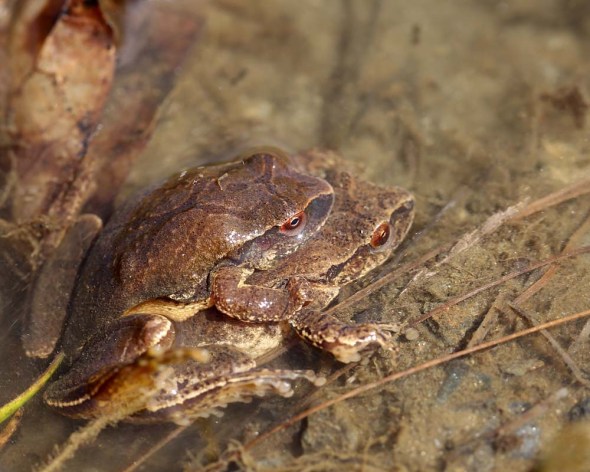
  • When one female is especially interested in one mate, she walks up to him ("enters his calling area," as the scientific site puts it) and nudges him.   Sort of like that old Monty Python sketch--nudge nudge, wink wink, know what I mean--except better.
  • The male climbs on the back of the female nudger and hangs on.  She swims back into the pond and starts laying her eggs, with the male hanging onto her back the whole time.
  • She can lay anywhere from 700 to as many as 1,200 eggs at one go, with Mr. Frog on her back the entire time.  
  • The male fertilizes the eggs after they emerge from the female are laid.
  • Within 6 to 12 days, the eggs hatch and you get tadpoles.
  • That's what it's all about. 


Male spring peeper atop a female. After she lays her eggs, she goes back into the woods. He stays in the water and keeps on singing.
(Photo from Naturally Curious with Mary Holland)


Life goes on, see?  These tiny little frogs, they make sure of it.  So I decided that's what I have to do.  Not, you know, breed like a spring peeper, but keep on.  I can't let some nincompoop with an overlong tie and the stupidest haircut and the most wrongest ideas ever--I can't let a jackass like that stop me.  I have to be like the peepers.  I have to get on with my business.  Help out where I can, do for others when I can, but I have to keep on with my own life too.  Show up and do my Apple thing.  So here I am, Appling.

I hope you're able to find a way to keep on keepin' on too.

Peep.

Sources
Penn State University New Kensington, Virtual Nature Trail, Spring Peeper
National Wildlife Federation, Spring Peeper
Farmers' Almanac, Fun Facts about Spring Peepers
National Geographic, Spring Peeper

Monday, September 27, 2010

Apple #483: Toads at Night

I like to go walking in the woods around here.  Sometimes I get so into it, I keep walking even though the sun has set and it's beginning to get dark.  Right around that time, I've been noticing toads out and about.  It's pretty tough to see by that point and I think I'm walking past dead leaves on the path and most of the time that's what they are, but then sometimes one of them moves.  Hops & skitters away.  When I lean closer, peering through the almost-darkness, I discover it's a toad.  Sometimes I can get out my camera and take a picture in time, but often the toad hops off into the grass before I can snap the shot.

What's been puzzling me is: what are the toads doing out at night?  They're cold-blooded, right?  Doesn't that mean they need sunlight to survive?  If that's true, how they heck can they be bopping around when it's dark?


These were all taken in the dark, with me aiming my camera at some dark spot on the ground, trying to zoom in and get the dark spot that's actually the toad, and then pressing the button so the flash goes off, and then I find out whether I got the frog in the photo or not. As you can see, sometimes the toads are still a bit far away to see much of them.  They're also not that big, as you can see by the comparison with the grass and little path-side plants.
(Photo by the Apple Lady)


  • First of all, I have to admit that I thought these dudes were all frogs.  Nope.  They're toads.
  • Generally speaking, toads have bumpy skin. 

Thursday, June 14, 2007

Apple #247: Turtle Noises

My latest burning question is: do turtles make noise?

They seem like such quiet creatures, but so many of the seemingly-silent ones turn out to make some sound, so I wondered if that's true of turtles, too.

The short answer is yes, they do, but the noises depend on whether you're talking about a turtle or a tortoise.

So, first, the differences between turtles and tortoises:

Some people say tortoises are a type of turtle. Other people say there really is no distinction between the two in a strict classification sense. But then they all list the following differences anyway.

Turtles

Tortoises

prefer swimming

prefer walking

live in salt water

live on land or in fresh water

awkward walking on land

not good swimmers and could drown

have blade-shaped flippers

have legs rather than flippers

flatter shells

high-domed shells


Now, for the sounds of turtles & tortoises:

TURTLES


These turtles are not in the water at the moment; they're taking a break from it. You can see their webbed, flipper-like feet, which indicate their preference for swimming rather than walking.
(Photo from Snail's Tales blog about bugs, animals, and other oddities)

  • Turtles have no vocal chords, but they do sometimes make other sounds.
  • Hissing: when turtles pull their heads into the shell, sometimes they emit a soft hissing sound. This is not actually a vocalization but the sound of the air in the turtle's lungs as well as the air in the shell being expelled as the turtle's body moves into the empty space.
  • Gurgling, bubbling, whistling: If a turtle makes a gurgling, gargling, bubbling, whistling, or wheezing noise, the turtle may have a respiratory infection, and the sound you hear is the sound of fluid in the turtle's lungs. If you own a turtle and it is making sounds like these, check the humidity and temperature of your turtle's environment to see that it's appropriate for your turtle's needs.

TORTOISES


Tortoises tooling around on land at the Santa Fe Teaching Zoo

Larger tortoises have been heard making various noises, including vocalizations.
  • Tortoises also make a hissing noise when they retreat into their shells.
  • The Radiated Tortoise, which only lives on the island of Madagascar, will make a high-pitched noise if it is caught, sometimes for hours afterwards. Most predators would be so startled by this disturbing sound, they would release the tortoise.
  • Forest Tortoises have been heard thumping their heads on the carapaces of other tortoises, as a prelude to mating.
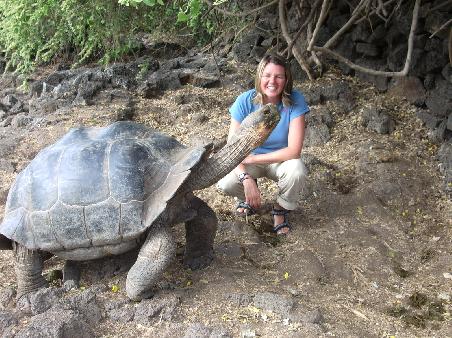
  • Galapagos, Forest, and other tortoises have been heard grunting during mating. Others have described the Galapagos' mating cries as roaring or bellowing, loud enough to be heard for hundreds of yards. Only the male makes sounds, and only during mating.


This Galapagos tortoise lives at the Charles Darwin Research Station on the Galapagos Islands and is saying hello to this woman named Allison.
(Photo from Allison Webb's Travelogue on Break Fresh Ground)


Sources
Tricon Kindergarten Class, Turtles vs Tortoises
Fresno Chaffee Zoo, Turtles, Tortoises and Terrapins
Science Museum of Minnesota, Painted Turtle FAQ
All Experts, Turtles, Russian Tortoise Noise, Noise from side neck turtle
Reptile Rooms, whistling turtle noise
Charles Darwin Research Station Fact Sheet, Galapagos giant tortoises
Galapagos Travel Blog, Tortoise Mating
Sean McKeown, Duane E. Meier, and James O. Juvik, The Management and Breeding of the Asian Forest Tortoise in Captivity, 1991
Smithsonian, Reptiles & Amphibians Fact Sheets, Radiated Tortoise

Sunday, August 13, 2006

Apple #189: Salamanders

When I was in Florida, my friends and I found ourselves discussing a burning question: can salamanders really survive amid fire? We had heard people describe salamanders as walking around in fire. I once upon a time got hooked on a computer game called Dungeon Keeper, and some of the creatures in it included salamanders, and they were the only creatures who could walk through fiery lava. So do actual salamanders live on the sides of volcanoes or something? Where does this salamanders-enjoy-fire idea come from, and is it accurate?

  • In real life, salamanders like to live in watery or moist environments.

This is a Tiger Salamander from Illinois
(Photo from MichaelCravens.com)


  • Salamanders are also known as newts.
  • They don't have scales or hair or feathers, just a smooth skin that is often moist or even slimy to the touch, like frogs.
  • They are very closely related to frogs, in fact (they are also related to the Mexican axolotl).
  • Salamanders begin life in the water, much like frog tadpoles. Once they transform from larvae into their adult bodies, most will leave the water and live on the land.
  • Wherever they live, all salamanders need to be near water or somehow be able to keep their skin moist. If their skin dries out, they will dehydrate and die.
  • Another caution: it's really not good for salamanders if you touch them. They have their whole super-slick skin thing working for them, and the oils and dirt and stuff on your skin will mess that up. So don't pick them up or touch them.
  • Salamanders are nocturnal. They hunt for their food at night, eating insects, earthworms, millipedes, aphids, and moths.
  • Most salamanders live in the Northern Hemisphere, and primarily in North America. Some live in Central or South America. They're also spread across Europe (they seem to be really popular in the Netherlands), all the way across the expanse of Russia over to Japan.
They don't live in especially hot climates. They need to stay moist and be near water to survive. So where does this salamanders-live-in-fire business come from?


This picture of a salamander in fire was drawn in 1617.
(Image from Strange Science)


  • The word "salamander" comes from a Greek word that means "fire-lizard."
  • According to Greek mythology, salamanders were believed to be able to quench fire. Such notables as Aristotle and Pliny said they had observed this very characteristic.
  • Here are some possible explanations for why Aristotle and others through the centuries believed this about salamanders:
    • The necessary moistness of the salamander's skin may make the animal more resistant to fire to begin with. They also secrete an extra, milky slime when they encounter fire, so this does give them a bit more imperviousness.
    • Some species of salamanders like to live in rotting logs. When people picked up the rotting logs and threw them on the fire, the salamanders scurried out to safety. Thus people thought the salamander could survive being thrown into a fire.
    • Another thought is that since most salamanders like to live in the water, they are more likely to survive a wildfire than other types of animals. Here comes a fire, jump in the water, wait for the fire to go out, come back out of the water, and lo, it looks like the salamander lived through a fire.
    • In fact, many salamanders thrive in post-wildfire environments, where loose debris that is also moistened by a hard rain covers the forest floor, and insects get to stirring over the remnants.
  • Of course the myth-makers weren't content to let the salamander stop at being able to combat fire. Over time, the salamander became larger, and it lived in fires, and it liked fires so much that it became an animalistic symbol of fire. Salamanders became something like dragons, except without the malevolence.

This salamander from a game of the same name looks more like a snake or a dragon, but it's a salamander and apparently there was lots of fire involved.
(Image from Insomnia)


Other notable appearances of salamanders:
  • In Marco Polo's records of his visit to China, he reported that his Chinese hosts gave him something called salamander cloth. It could not be burnt even if it was thrown into a fire. He was told it was made from the hair of salamanders, but in truth, it was asbestos.
  • In Ray Bradbury's Fahrenheit 451, the firemen's truck is called the salamander.

Guy Montag at work on the salamander, in the movie version of Fahrenheit 451.
(Photo from Squidoo)

    Sources
    James L. Byford, "Salamanders Handbook," School of Agriculture and Home Economics, University of Tennessee
    Melissa Kaplan's Herp Care Collection, Salamanders and Newts, August 17, 2002
    Living World.org, Amphibia: Caudata
    Environmental Literacy Council, Salamanders
    Global Oneness Commitment, Salamander - Mythology
    Answers.com, Amphibians and humans
    Sylvia Volk's Asia Page, University of Calgary, Ancient Uses of Asbestos
    Bookwolf, Fahrenheit 451, Questions for study with answers

    Thursday, July 27, 2006

    Apple #186: Anoles

    I'm back from my vacation. I had a very nice time, thank you very much. I went to Florida to visit a friend and while I was there, I encountered many topics that piqued my curiosity. So the next few entries will be related to stuff I saw or did while in Florida.

    I have to start with the lizards. In case you don't know this, little lizards run around everywhere in Florida. They sit on rocks, on window screens. They cling and hang upside down on signposts or tree trunks. They'll dart out of the way as you walk past. Sometimes, if you approach them slowly, they'll do this neck-flare thing. They have a secret flap of skin under their chins and they'll inflate this thing. It doesn't blow up like a bubble but it unfolds more like a wing or a sail of a ship. On some lizards, this flap is red in the center, and on others, it's orange or a yellow-orange.

    So I want to know, what is the name of these lizards, what do they eat, what's that flap thing called and what's it for, and what do they do when we're not looking?


    This lizard is hanging onto the tree, hoping we don't see him, hoping we'll go away
    (Photo from Todd Campbell's page)


    • These types of lizards are called Anoles (pronounced uh-no-lees). The most common are the Brown Anoles. Green anoles live higher up in the trees and have become less common.
    • Anoles can change their color, but unlike chameleons, they don't change color based on what they're standing on. Their color varies depending on the temperature or their mood, and it takes a bit longer for their color to change.

    A green anole, showing its magic flap
    (Photo from Cerci's Journal)

    • Anoles are usually about 5 to 8 inches long. They have long, thin tails that they can abandon pretty easily, and the tails will continue to wriggle on the ground to confuse or entertain would-be predators while the anoles escape.
    • They have little toe-pads at the end of their long, slender toes, which help them to climb and cling to surfaces that appear to be quite smooth.
    • Anoles eat little bugs. Sometimes they eat wood roaches or other bugs that can be almost as large as they are. They are sometimes recruited into a yard to help gardeners get rid of pesky insects, though they probably don't consume enough mosquitoes or roaches for people to notice a real difference.

    Green anole eating a dronefly
    (Photo from Wikimedia)

    • Males tend to hang out in visible places, like on the sides of tree trunks or the sides of rocks. Females tend to stay hidden under vegetation or near large rocks.
    • Males can afford to be more visible because they have bigger dewlaps. That's right, I said dewlaps. That's what the neck flap thing is called (it's also sometimes called a throat fan). There's a flexible rod of cartilage in the outer ridge of it, and when the anole flexes the cartilage, the dewlap swings into view.

    Brown anole with dewlap displayed
    (Photo from a blog called Resurgemus)

    • The anole will often bob or bounce its head a few times and maybe throw in a couple push-ups just prior to swinging out its dew lap.
    • Males display the dewlap to defend their territory, trying to scare off other creatures by flashing the warning red color. They also display the dewlap during courtship.
    • The color of the dewlap can change, depending on temperature, time of day, or if the anole is feeling especially ticked off or amorous.
    • Anoles came from Cuba and other parts of the Caribbean and were introduced in Florida in the late 1800's. They have since spread from Florida into Georgia and are working their way into other neighboring states. They have been seen hitching rides on the undercarriages of cars, on boats, and even on windshield wipers.
    • Their prevalence notwithstanding, they do have many predators, especially cats, snakes, birds, and small children who try to catch them. I guess it doesn't have to be children who try to catch them, because I tried a couple times (and failed; they were too quick for me).
    • If an anole gets in your house, the safest way to catch it is to corner and trap it in your hands as gently as possible. The anole will try to look fierce to scare you away, but it's only 5 inches long, is not venomous, and has only little bitty things for teeth. Just drop it back outside and it'll scurry off, glad to get away from you.
    • It's best not to keep anoles as pets. They're wild animals and are happier trapping bugs out in the yard where they can find them on their own.

    Brown anole, relaxing in grassy comfort
    (Photo from Answers.com)


    Sources
    Florida Gardener, Florida Garden Critters, Green Anole and Cuban Brown Anole
    Institute for Biological Invasions, The Brown Anole, by Todd Campbell
    Howard Youth, "Florida's Creeping Crawlers," Zoogoer, Smithsonian National Zoological Park, May-June 2005

    Sunday, April 16, 2006

    Apple #163: Axolotls

    Sorry about the infrequent posts lately. In my free time the past few weeks, I was working on my taxes. This year, they were nightmare-ish. I had to fill out extra forms and schedules and worksheets and who knows what else. But now all that's done, filed, official, done. So, on to other things.

    Some time ago, I was at the aquarium in Niagara Falls and I saw the strangest animal there. There were actually about six of them in the tank of water. They were very pale, looked like they'd never seen daylight in a kajillion eons, and they had these frondy things like extra arms sticking out of their necks.


    Photo from Jean Hardiwck, Ph.D.'s page, which describes how she uses axolotls and other creatures to study cardiac function.


    The sign beneath the tank said the frondy things were their gills exposed. They looked like something out of a Simpsons episode. The person I was with was disgusted, then fascinated, but then disgusted again by them. The more I looked at them, the more I thought they looked like they'd be good to eat. Fleshy, not too many bones, no fur or hair or scales to worry about. The person I was with said, "Ugh, you want to EAT them?"

    Yes. I did.

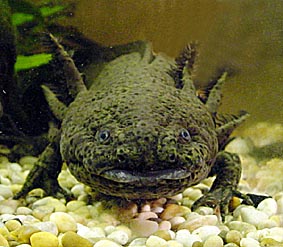
    It turns out, these things are called Axolotls. The word is pronounced like it looks: Ax-uh-lo-tul. Here's another picture:


    Photo linked from Steven Carr's page on the Origin of Evolutionary Novelty, Department of Biology, Memorial University of Newfoundland

    • Axolotls are from Mexico. They are an aquatic amphibian, specifically a type of salamander.
    • The name for these animals comes from an Aztec word, Nahuatl. The most commonly accepted translation for axolotl is "water dog."
    • They originally lived in high-altitude, freshwater and volcanic lakes in a couple of regions of Mexico. But after one of their favorite lakes was filled in to make more room for Mexico City, they are now on the endangered species list, and most are raised in captivity.
    • In the wild, Axolotls tend to be darker colored, most often sort of chocolate-colored. In captivity, they are often paler, ranging from gray to pale yellow to white albino.

    Photo from Animalweb's page on amphibians

    • Axolotls are often studied with great interest because if they lose a limb or other tissue, they can grow new limbs.
    • Perhaps the reason they can regenerate tissue has to do with the second reason they fascinate scientists, which is that while most amphibians progress through three stages of growth, from egg to larva to adult, Axolotls stay in the larval stage their entire lives.
    • They do reach sexual maturity, even while they are in their larval state, and though they do grow lungs, they continue to breathe primarily through their gills.
    • If they are taken out of the water, they can breathe for a while through their skin, but only if the skin stays moist.
    • If you want them to metamorphose into full adults, you can make it happen if you give them lots of iodine or a shot of a hormone called thyroxine. If you make them turn into adults, they'll only live about 5 years. If they stay in larval form, they'll live to be 10 or 15.
    • It's speculated that the reason they don't become fully-grown adults on their own is that the freshwater lakes where they used to live didn't have enough iodine in them. But that's just a guess.

    Photo from a German site on Axolotls

    • Axolotls are carnivores. They will eat either live or dead food. They like lots of different kinds of worms, including earthworms, bloodworms (midge larvae), blackworms, or whiteworms. They can also eat Daphnia or brine shrimp. Breeders have also been known to feed their Axolotls chopped beef heart, but that's not the best choice becaues Axolotls can't digest mammal proteins very well.
    • Axolotls have sort of stubby teeth, and they snap at their food, trapping it, then swallow it whole.
    • They like it cold, preferring water temperatures around 60 degrees Fahrenheit.

    Photo from the University of Kent

    • They used to be a staple of the diet of Aztecs, and until very recently, they were sold in Mexican markets. People liked to eat them best roasted. So I am by far not the only person who thought they'd be good to eat.
    This just in as of August 2009: only about 1,200 axolotls still live in the wild.


    Sources
    Caudata.org, Axolotls
    Wikipedia, Axolotl
    About.com, Axolotls as Pets
    Wellington Zoo, Axolotl