Showing posts with label betta fish. Show all posts

Wednesday, December 3, 2008

Apple #355: No More FishFish

FishFish is dead. Long live FishFish.


FishFish, though colored similarly to this betta, hasn't looked like this in a long time.
(Photo from the Virginia Tech Union)


When I got home from work today, I went to feed my betta fish, but then I discovered he was lying on his side at the bottom of the bowl. Never a good sign.

He's been sick for a long time. Back before I'd even had him for a year, he got Pop Eye and Fin Rot. Though I tried several different types of antibiotics on a number of occasions, I was never able to get rid of either illness. So both diseases have been progressing (his fins getting smaller and his eyes getting more bulgy) ever since.

Gradually, he made fewer and fewer bubbles. Then when it got cold this winter, I kept the room temperature a little lower than I did in the summer time. FishFish, being tropical and loving hot, humid weather, was not enthused. In fact, he's been very sluggish ever since it got cold. Sometimes I had to shake his bowl to rouse him and get him to eat.

Then, the day before yesterday when I fed him, even though he was alert in there, he had no interest in his food or me. Usually, he tried to attack me whenever I came near his bowl. I always appreciated his vigor and willingness to go after me. I believe that if there had been no bowl between us, I probably would have sustained definite though tiny injuries, inflicted by my intrepid FishFish. And I would have been so proud of him.

But there just wasn't any fight left in him. Yesterday when I went to feed him, the food from the day before was still floating at the top. When FishFish doesn't even try to eat his food -- especially the bloodworms, which he loved to sneak up on and chomp from below -- let alone attack it, that is not good. So I wasn't too surprised today when he was lying at the bottom of his bowl. No more FishFish.

I got him on March 22, 2006. Almost three years ago. According to what I've read on the subject, that's a pretty long life for a betta fish. He survived traveling with me; he survived staying at home and toughing it out while I traveled without him. He courageously survived an inadvertent attempt on his life when he was nearly boiled to death. I enjoyed him living with me. I hope that, in spite of my owner-operator errors, he enjoyed living with me too.

I gave him a decent send-off, said good-bye and thank you for living with me. No fanfare. No bunting. That's the way FishFish would have wanted it.


AJ's betta fish, George Michael, who apparently looked like the fish pictured here, recently met with a similar fate.
(Photo from Wikipedia and sourced from AJ's blog, Sorry I Can't Hear You I Was Humming)


Good-bye, FishFish. Thanks for all the bubbles.

Sunday, March 23, 2008

Apple #305: Easter Lilies and FishFish

First things first. Happy Easter, everybody!


Easter Lily
(Photo from Wikimedia)


Texas A&M has a page full of interesting stuff about Easter Lilies, such as:
  • Easter Lilies are native to Japan. They were first brought to the US after World War I, when a soldier planted several hybrid bulbs on the south coast of Oregon in 1919.
  • Their popularity in the US exploded during World War II when, after the bombing of Pearl Harbor, it became extremely difficult to get Easter Lilies.
  • Now, 95% of Easter Lilies sold in the US are grown in a very small region along the California-Oregon border, near where that soldier planted his first hybrid bulbs.
  • The bulbs take three to four years before they are ready to be potted and forced to bloom in time for Easter.
  • Lots of traditions and legends surround the connection between Easter and Easter Lilies, but here is one particularly compelling item:
      • White lilies were found growing in the Garden of Gethsemane, where before Jesus was arrested, he prayed so fervently "his sweat became like drops of blood falling to the ground." Tradition has it that where the drops of his blood fell, lilies grew.

FISHFISH

The next item on my list is to note that yesterday was FishFish's second birthday -- believe it or not. For those who may not know who or what FishFish is, he's my betta fish. And technically, he's more than two years old because two years ago yesterday is actually the anniversary of when I brought him home from the pet store. But he's still coming along swimmingly (har har), thanks in no small part to kind friends who look after him while I'm gadding about in other parts of the country.

For more about FishFish, in the right-hand frame under the section Browse the Daily Apple, click on the betta fish link.

Thursday, March 22, 2007

Happy Birthday, FishFish!

I am interrupting my current string of posts on What's Your Favorite Place to bring you this breaking news: my fish is an astonishing one year old today!

Given that fish are sensitive creatures and not well-suited for living in human environments, and that the average lifespan of a Betta fish is two years, the fact that I have had him for one entire year is truly a milestone.

Those die-hard readers of the Daily Apple may recall the day when I first brought home my Betta fish, a day of much wonder and excitement. He has since survived my first encounter with his natural tendency to make a bubble nest, his growing dislike of the vegetable food pellets he came with and my decision to start feeding him bloodworms -- which he absolutely loves and attacks with great relish.

Since then, he developed some unfortunate bacterial infections, which I did not report to you, fair reader, because I was unsuccessful in combating them. He developed pop-eye, an infection which made his eyes bulge rather cartoonishly, and then he developed fin-rot, which meant that his long lovely swishy fins were slowly getting smaller, appearing as though they had been nibbled by something.


Fins looking frayed or slightly chewed is a sign of fin rot
(Photo from Bettatalk's page on Betta diseases)


I read many Betta fish health websites and learned that I ought to buy one or more various kinds of antibacterial pills, dissolve them in water, and add a couple teaspoons' worth to his water each day. When the first round of antibacterials didn't work, I asked at the pet store how my fish could have gotten these infections, and the man in charge of fish shrugged and said pretty much anything can introduce bacteria into a fish bowl however vigilant you may be.

I tried a different course of antibacterials but alas, they did not make FishFish's pop-eye go away. I think the antibacterials did halt the spread of the fin-rot, but his fins are still looking quite ragged. I decided to accept the fact that I could not treat his pop-eye and his eyes are now permanently bulgy, and he has most likely gone blind.


Pop eye is clearly present in the eye on the left. It was hard for me to tell for a while whether my fish had pop eye because his scales are a dark color and also because both of his eyes looked about the same. But finally I concluded this meant that both eyes were affected.
(Photo by Sierraraptor, posted at the Fish Junkies site on Pop Eye)


Some days when he is lethargic, I hold a hand mirror up to his bowl. In the early days (oh, those happy days) when FishFish was still spry, when I held up a hand mirror, he'd see his reflection and think it was another male Betta in his territory, and he would flare all his fins in a most spectacular fashion. But now he doesn't usually respond. When I approach his bowl to feed him, however, he does still try to attack me, in true Siamese Fighting Fish fashion. So all hope is not lost.


Lydia is making her Betta fish flare by holding a mirror in front of him.
(Photo from Daniel Chia's Betta Barracks)


I also think that the frequent water changes were stressing him out. I moved him to a more secluded location in my kitchen, and instead of giving him partial water changes every day, I now only remove the visible nasty bits in his bowl as soon as I see them and give him a full water change about every ten days. That runs contrary to what most experts will tell you, but I do suspect that all the things going in and out of his bowl every day were way stressing him out and may have contributed to his illnesses. He is now a bit more sedate, less frantic, in his new secluded location and without me messing with him every fourteen hours.

He has also survived an inadvertent attempt on his life. One day a few months ago when I was cleaning his bowl, I screwed up and accidentally put him into hot water. Poor FishFish! When I do a complete water change, I fill an empty Cool Whip container with Betta-friendly water and put FishFish into that while I empty his bowl, rinse it out with very hot water and wipe out the insides, then refill it with more Betta-friendly water. I was so focused on getting that hot water ready to wipe out his empty bowl that I wasn't thinking and poured hot Betta-friendly water into his temporary holding bowl.


Another Betta fish-owner uses a plastic cup as her water-change container. This seems a bit small to me. She has a lightweight square of plastic on top to discourage her fish from jumping out.
(Photo from Betta Basics by Liv and Maria)


When I put FishFish into his dish of friendly but near-boiling hot water, he immediately started racing around the dish at absolute top speed, with much splashing as if he were trying to jump out. In horror I realized what I had done and wrung my hands in despair. How could I fix this terrible error? I couldn't just pour cold water from the tap into his holding dish with him because the chlorine in the tap water would kill him. I had no Betta-friendly water ready that was cold. While I dithered and shouted apologies, he had flipped over onto his back and was swimming upside down, his gills completely exposed to the air and gasping for breath.

I finally put his holding dish into the sink and ran cold water into the sink so that it ran around the outside of the dish. I clutched my hands to my chest and watched as my poor FishFish still struggled and gasped while the water cooled -- oh, so slowly! -- while I begged the water to cool off faster. Finally, he righted himself and seemed to be resting. He was still panting, but it appeared that the crisis had passed.

So despite my near-assassination and germ warfare tactics, FishFish has survived. Here's to FishFish! who lives in spite of my ministrations!


Picture this fish with pop eyes and looking generally battle-scarred and you'll have a good idea of what FishFish looks like.
(Photo from BettaFishPictures.com)


I have hung blue and red crepe paper streamers in my kitchen where he lives, to celebrate the occasion. I plan to include FishFish in the celebrations by giving him a full water change -- without the near-boiling water -- and a few extra bloodworms.

Thursday, May 11, 2006

Apple #168: Allergies

Before I get into allergies, I have a small Betta fish update.

I was feeding my Betta the pellets that came with the bowl kit that I bought. But he was spitting out the pellet once or twice before he'd swallow it. I looked this up online and though many sites say different things, the upshot I think is that he was spitting out his food because he didn't really like it. Lots of websites say that pellets may be the cheapest and easiest thing to feed your Betta, but it's probably one of the foods they like the least.

Lots of Betta sites recommend feeding your fish live bloodworms or freeze-dried bloodworms. Despite the name, they are not actually worms, but the larvae of midge flies. I read that feeding live bloodworms can make it more likely that your fish gets parasites and diseases and crap like that, so I decided to give the freeze-dried variety a try.


Freeze-dried bloodworms


The kind I got come in a little plastic box with a flip top, sort of like a Tic Tac box. I opened the box, gave it a little tap and about five or six of the dead, winged bugs dropped out into the water. And lo and behold, FishFish snuck up underneath one of them, then snapped it up like it was prey! He did this with each of the bugs and found them all in no time.

So I've kept feeding him the bloodworms, and it's pretty obvious he likes them better. He gets much more excited when they're in the water, and the rest of the day, he is way more active. When I was feeding him just pellets, he'd spend a lot of time at the bottom of his bowl, hanging out in his favorite hiding place. Now, every time I walk past his bowl, he's swimming around with his little fins going, and though he's always made bubbles every day, he makes even more bubbles each day. I plan to give him a few pellets now and then, just to keep some variety, but I'm sold on the bloodworms.

ALLERGIES

Now, on to the real posting. The reason I started out with the Betta fish thing is that lately, my skin has been itching like crazy. I read that some people are allergic to bloodworms, so I thought maybe that's what's been going on with me. But most people say their allergic reaction is respiratory in nature, rather than itchiness. Plus, I make sure to wash my hands right after handling the food, and I just don't think that's the cause.

So I was looking up allergy information in general and here are some of the things I learned:

  • Allergic reactions are what happens when your body encounters a type of protein that it doesn't like. I had thought that you could be allergic, potentially, to just about any substance. But it's really types of proteins that trigger the reaction.
  • When your body encounters the Enemy Protein, it makes an antibody to help fight off the Enemy Protein. The antibody is called Immunoglobulin E, or IgE, for short. Your body makes millions of these, and fast. The IgE runs around in your blood stream and attaches itself to certain types of blood cells and also certain types of tissue cells. When the IgE shows up on these cells, the cells are essentially told to start producing histamine. And histamine is what makes your eyes water and your nose get runny and your skin turn itchy, and it can give you rashes and hives and make you start to sneeze and all hell breaks loose to try to get the Enemy Protein far, far away.

This French guy is beseiged by an allergic reaction
(Image from L'Ambroisie)

  • In very serious reactions, your lips or tongue may swell, the lining of your throat can swell to make it difficult to swallow, or even breathe. You may get dizzy and pass out. If you're not revived, usually with a shot of epinephrine, that could be all she wrote. This type of reaction is called anaphylaxis. You've heard about this probably most often in reference to bee stings or peanut allergies. If you've seen My Girl, you've seen an example of anaphylaxis.

My Girl still from HBO Sinapore

  • When it comes to reactions to certain types of foods, there is an important distinction to make between an allergic reaction and intolerance. In most cases, intolerances do not involve your immune system, the reactions are short-lived and while unpleasant, will not be life-threatening. Lactose intolerance, for example, might make you bloated and give you gas, but it's not going to close up your throat and kill you.
  • Some people can't tolerate sulfites in their foods. Sulfites are a kind of preservative that occur naturally in wine and it's also used in lots of canned or bottled foods. In this case, the reaction can be severe because sulfites produce sulfur dioxide gas, which can cause all sorts of problems in a person's lungs, including triggering an asthma attack or anaphylaxis.
  • The most common food allergies are
    • Peanuts
    • Tree nuts, including almonds, pecans, and walnuts
    • Dairy
    • Soy
    • Wheat
    • Eggs
    • Fish and shellfish

For some people, this sight instills great fear and the desire to flee
(Photo from Virginia Market News Service)


  • You may have noticed that lots of food labels these days have printed the above-listed ingredients in bold type, or they are listed again at the end of the ingredients in bold print. For example, I've seen this on bread labels and on peanut M&Ms. This is because these food allergies are so common, and people can really have severe reactions to these ingredients.
  • Here are some other common sources of allergic reactions (notice that all will include some type of protein):
    • Insect bites
    • Airborne particles including mold spores, animal dander, or pollen
      • Dust fits under this category, but it's actually not dust that people are allergic to. It's actually the fecal matter produced by dust mites. Yup.
    • Antibiotics or other types of medications
    • Manufactured chemicals, including cosmetics, dyes, laundry detergents, pesticides, or household cleaners
You'll be happy to hear that the advice that doctors give most often about allergies is that the best thing to do is avoid the thing that triggers the reaction. Well, duh.

Sources
Betta talk.com, Food
Aquariumpros.com, Frequent Aquarium Questions
Brine Shrimp Direct, Specialty Diet for Aquarium Fish
Greater Cincinnati Killfish Association, Bloodworms . . . a cautionary note
International Food Information Council, Food Insight, Food Allergy Myths and Realities, November/December 1997
About.com, Allergies, Sulfite Sensitivity
Nemours Foundation, Teens Health, Allergies
Net Wellness Consumer Health Information, House Dust Allergy

Tuesday, April 11, 2006

Apple #162: Some Updates

I'm brewing up another topic for you, but in the meantime, I have a few updates to share.

FISHFISH

My Betta fish, Fishfish, has revealed himself to be a bubble-maker. By that I mean he makes bubbles every day. After I change all the water in his tank, he makes a slightly larger amount. I learned in a book I read that Bettas tend to make the most bubbles after a 100% water change. According to this book, Bettas aren't really ready to mate until the bubbles are bigger than the size the fish normally makes. But you know, I'm starting to think that these fish-book-writing people don't have that much better of an idea about what the fish want than I do after only staring at my fish for a chunk of time each day. All I know is, my fish is a bubble-making Fishfish.

I also suspect he can see his reflection in the side of his bowl. He swims up to the side of the bowl, looks at it very intently, and flares his fins. He also likes a certain tight spot behind the fake plant in the bottom of his bowl. If he hasn't been back there in a while, he swims over to it very cautiously, and then flares his fins like mad, just to make sure no one's snuck back there when he wasn't looking.

For more about betta fish, see basic betta fish care and bubble nests and water care and betta fish food.

FORMULA ONE

In case anybody is interested, here are the major events in this year's Formula One season so far. In the second race of the year, young major threat Kimi Raikkonen had an accident in the very first lap, making his car look like it had been stomped on, and though he was unhurt he was out of the race. In the third race, seasoned 7-time champion Michael Schumacher bounced his Ferrari off one wall and then another in the 32nd lap, totaling his car. Your Apple Lady's favorite and last year's champion, Fernando Alonso, won the first and third races, and he came in second in the second race.

So Alonso has an early lead in the drivers points race with 28 points. At 14 points, Alonso's teammate Giancarlo Fisichella is tied for second with Raikonnen, the formidable Finn. Schumacher is not far behind, tied for fourth, with 11 points.

The next race is coming up on April 23, in Europe's third smallest state, San Marino, in central Italy. The racetrack and town are called Imola, and both are near the birthplace of the Ferrari, the Lamborghini, and the Maserati. Tickets for the race -- if you can still get them -- are going for a mere $128 for one seat in general admission to about $875 for a seat in a prime location. If you'd rather wait, you could go to the fifth race in Cologne, and pay only $113 for a 3-day pass to general admission. A bargain!

Sources
Formula One official website
CIA World Factbook, San Marino
Wikipedia, San Marino Grand Prix
Ticket Finders, San Marino Grand Prix 2006

Wednesday, March 29, 2006

Apple #159: Betta Fish, part II

PROGRAM NOTES

First, a program note or two. On Monday, Google Finance picked up my entry on the Voice of Voice Mail, in which the company name National Semiconductor was mentioned. So the page put a link to that Apple on their page of NSM stock info. Consequently, this blog got a lot of hits from people in tech companies for a day or two.

Then I mentioned this event to a fellow blogger, Felix, and he kindly posted this news on his site. He gets way more traffic than I do, so a lot of his readers came over here to check out the Daily Apple. Thanks, Felix!

As a result of all this new traffic, the Daily Apple is closing in on getting more hits in a month than it ever has. Right now, it's just about at 350. The best month was in April of last year, when I wrote an entry on the Pixies.

Finally, about a week ago, I was using StumbleUpon to find new websites I might like, and I came across a site called Damn Interesting. It's similar to this blog in that it picks a different topic to investigate, but it faithfully adheres to the "each day" mantra, and it's written by about six different writers, and is far more professionally produced. I e-mailed the guy behind this site, Alan Bellows, telling him I was doing something similar and asking him to take a look at the Daily Apple and tell me what he thinks. Here's his reply:

I am a frequent Stumbler myself, it's a great way to find interesting stuff. I took a look at your site today, and it looks quite nice. You certainly put a lot more effort into the quality of your content than most, and it shows. Keep it up!

Thanks, Mr. Bellows!

BETTA FISH UPDATES

Now, on to the fish news.

So I got a Betta fish about a week ago. Named him FishFish. I kept him in the little dish he came in from the pet store until the chlorine disappeared from my tapwater, which took about a day, and then I put him into his new bowl. He swam around and investigated everything very carefully for a while. The third day I had him, I came downstairs and discovered he had made a bubble nest! I was very excited because I had thought that maybe if I was lucky, he might make a bubble nest after I'd had him for several months or something. But never as soon as this!


The bubble nest looks like a bunch of soap bubbles. Usually the bubbles are all clustered together like this, and sometimes they are in clusters.
(Photo from Ikan Laga's blog which has tons of photos and information about caring for bettas.)


I started thinking that it was sad that FishFish's nest was just going to sit there without any little fish for him to put into it. Could I go to the store and get a female betta to help him fill his nest? Was his bowl big enough to hold another fish? How much time did I have to get a female to him before his nest went away? Would he never make another nest again?

I had too many questions, so I called the pet store where I'd bought FishFish. The woman who answered told me that she's had two bettas, and one of them never made a bubble nest, and one of them made bubble nests all the time. There isn't a "bubble nest season" or anything like that, as far as she knows. She said the nests last until you change the water, which in my case, is about a week. She also said that if I wanted to get a female, I'd have to keep her in a separate tank because once she spawned, he would try to chase her off, and since she'd have no place else to go, he'd fight her to try to get her to leave, and keep fighting her, until he killed her.

I decided I didn't have room for another tank in my already crowded kitchen, so my betta was left alone with his bubble nest. The bubbles slowly shrunk and slowly disappeared each day. I was changing about 25% of the water daily (based on advice I read online), and though I didn't suck up any of the bubbles into the turkey baster I use to remove some of the water, the bubbles seemed to be going away on their own.

Then last night, I did a complete water change (for some helpful instructions on how to do this, check out the California Betta Society and Rachel's Healthy Betta info). Before I went to bed, I watched him and it looked like he might be making more bubbles. But these bubbles looked smaller than the other ones, and they popped almost right after he made them. So I decided not to get my hopes up and went to bed. When I got up today, lo and behold, he'd made another nest! Very exciting, I think.

Here's what he does when he's making bubbles. He swims up to the surface and gulps in some oxygen. Then he drops down below the surface and his gills and the side of his body behind his head bulge way out. It looks like he's about to burp. But nothing comes out of his mouth at this point. He swims around for a while, and sometimes he opens his mouth very wide and sticks his lips out -- sort of the way you and I would parody a fish mouth -- but even then, nothing comes out. Then he swims up toward the surface and sort of spits out a few bubbles. They drift on their own to the sides of the bowl, so his bubble nest is really more like a bubble necklace around the surface of the water.

Obviously, I've watched him for extended periods of time. Because he can't tell me if he doesn't like the water in his tank, or his food, or anything else, I have to watch how he swims and try to interpret what he's doing to figure out if he's healthy and happy.

I've also read some things online about betta health, and there are a few pages in particular that I found especially helpful. If you have a betta who's doing weird things like swimming funny or spitting out his food, or has developed spots or anything, here are some sites I've found helpful:

Betta talk, Topic: betta spitting out his food
Betta diseases, and how to prevent them
Colors of bettas, with lots of pictures
Betta diseases, and how to treat them

Stuff I've been putting into my betta's water:


Water Conditioner
This takes the chlorine out of tapwater. With this, you don't have to let your tapwater sit out for a day; you put a few drops of this into the water, swish it around a bit, and it's ready to go. This particular water conditioner also has other stuff in it that's supposed to help protect your fish's scales and keep its color bright.


Aquarium salt
I added this after I read one of those sites on betta diseases and learned that even freshwater fish can benefit from a little salt in their tank, because the salt helps prevent diseases. I asked a vet-knowledgeable friend of mine if regular table salt would work, and she said no, because table salt for people has iodine added to it, and that wouldn't be good for the fish. Aquarium salt has other minerals instead of iodine that are more helpful. So I got a little carton of this. Because my tank isn't that big, and because the salt doesn't evaporate, I use only about ten grains of this, and only when I do a complete water change.

For more entries about betta fish, see betta fish care basics and betta fish and bubbles and feeding betta fish

Wednesday, March 22, 2006

Apple #156: Betta Fish

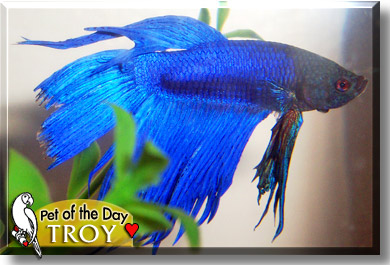
I got a fish today. I chose a Betta fish because it seemed like they're relatively easy to take care of. The one I picked out has a bluish-green body with some red mixed in here and there, and his fins are a bright turquoise blue. He seemed more active than some of the others, and I thought his coloring was especially pretty. I haven't named him yet, but I have taken to addressing him as Fishy Fish. As in, "Hey, Fishy Fish, how are you doing in there?" He can't answer me, of course, but he seems to be doing all right.


This is close to what my fish looks like, except the body of mine is a little darker.
This Betta's name is Troy. (Photo from Pet of the Day)

  • Bettas live in shallow ponds or rice paddies or even slow-moving streams in Thailand, Indonesia, Malaysia, Vietnam, and parts of China.
  • These parts of the world are pretty hot and humid, so that's how these fish like their water. If the temperature of the water in their bowl or aquarium drops below 75 degrees F, the Betta fish will get sluggish and listless and unhappy. They're happiest when the water temperature is around 80 degrees.
  • Even though they like it warm, they don't like to be in direct sunlight.
  • The males are extremely territorial, and if one male is in proximity to another, they will flare their fins most dramatically and try to fight each other for mating rights. If you do get more than one male, keep them in separate tanks. Also, it's best not to put the tanks next to each other where they can see each other, but put a little distance between them or perhaps a picture of a nice underwater scene or something.
  • Females, on the other hand, generally will not fight each other.

Female Betta. Notice how much shorter her fins are than the male's.
(Photo from Animal Port)

  • Since Thailand used to be called Siam, and since the males of this species often fight with each other, Bettas are also known as Siamese fighting fish.
  • Bettas have a special respiratory organ that allows them to breathe oxygen directly from the water's surface. In fact, they can only breathe at all if they have access to the surface of the water. What this means for you, the owner, is make sure not to put anything in the tank that will crowd the surface, and don't cover the tank, either. While many Betta owners say that aerators can help, it is not necessary to put an aerator in a Betta's tank for it to live happily.
  • It's important not to overfeed Bettas. They don't eat much food in a day, and if you're feeding them dried food meant for Bettas, maybe three or four pellets a day will be enough. You'll have to watch your fish to see how much he wants, but something in that neighborhood should be about right. If you put too much food in the bowl, the fish won't eat it, and the food will rot, which means it will produce toxins and mess up your fish's water.
  • It is also important to make sure your fish's water is fresh and clean. I've seen recommendations that say to change the water once a week, to change at least half the water in the tank once a week, or to change about 20% of the water each day. So there doesn't seem to be a hard and fast rule on this, but probably the cleaner the water, the happier your fish will be. But you don't want to go scooping up your fish into a little net and moving him to another tank every day, either. Based on what I've read, I'd say that changing half the water once a week is probably the least amount you could do and keep your fish alive.
  • You can't just put tapwater into the bowl, however. Tapwater has chlorine in it, and that will kill your fish. Some fish tank kits come with tablets that take out the chlorine (the kit I bought had these), and you can either use those tablets, or use springwater that's available in most grocery stores, or you can "age" the water from your tap. If you let tapwater sit out for 24 to 48 hours, the chlorine will dissipate on its own. Then it's safe to put your fish in the water.

These are the water treatment tablets that came with my kit.
(Photo from Aquarium Parts West)

  • The guy at the pet store also told me that the bacteria on the gravel at the bottom of the tank is actually good to have, to some extent. It helps eat up the refuse that your fish will produce. But that bacteria can get out of hand, so about once a month, it's a good idea to rinse out the gravel.
  • Don't use soap on the tank or the gravel or anything else you might put in the tank. To fish, soap is a toxin.
  • It's become popular to sell flower vases with lilies growing in them as tanks for Bettas. While this looks pretty, Bettas in fact don't really like to live in flower vases. Many people say that the fish will eat the lily roots, but they only do this when they are starving. Normally, Bettas prefer bugs or dried mosquito larvae (which is what most Betta fish food is made of). Also, the plant's roots release substances in the water that are toxic to the fish, or the plant may grow in such a way that the fish can't get to the surface where it needs to breathe.

This is a no-no. Although the fish can access the immediate surface of the water, the plant is crowding out the top of the vase, which restricts the oxygen that can get to the water's surface. Also, if any roots come loose they can rot in the water.
(Photo from Betta Talk)

  • Bettas do like to have a place to hide, or a little nook to call their own, so it's a good idea to give them some structured thing in the tank, like a plant or a shell or a hunk of rock that has a niche in it where the fish can hang out.
  • If you have a male Betta (and because of their coloring, most people buy males), you might notice that strange-looking bubbles are appearing near the surface of the water. These bubbles are your fish's way of building a sort of nest for any baby fishlings (or fry) he might have. When Bettas mate, the male first produces the bubbles, the female comes along and they do their thing, and then when she spawns eggs, he picks them up in his mouth and puts them in the bubbles he's made to keep them safe. So if bubbles appear in your fish's tank, it means he's healthy and he's looking to find a mate.

This Betta is in a large tank and has made huge bubble nest.
(Photo from Jim Sonnier's page)

  • If you're interested in breeding Betta fish, you'll do better if you give the fish a much larger tank, make sure you keep the water temperature up, and aerate the tank as well. Live plants will also help to improve the water quality.
  • Generally, Betta fish live for about two years. If its tank is especially well-cared for, the fish may live three years or longer.
For more on my betta fish see later entries on betta fish food and bubble nests and water treatment and more bubble nests.

Sources
About.com, Shirlie Sharpe's article on Siamese Fighting Fish
Ask the Vet, Betta or beta fish care
Aquarium Fish.net, Betta Fish Vase
Wikipedia, Siamese Fighting Fish