Showing posts with label music. Show all posts

Monday, April 25, 2016

Apple #731: Prince and His Entourage

Like so many people, I've been rather stunned by the news of Prince's untimely death. I was never a huge fan, but the man had some serious songwriting skills, and he seemed about to embark on a new realm of creativity, and his music and style and persona were a huge part of the cultural landscape in my formative years.  People who are so famous, whose work and image and music and everything else are everywhere, you forget that they can do something so human as to die. It's kind of a shock.


(Photo from this Finnish news page)


Like so many people, I am remembering personal experiences when this man's music was the soundtrack. Dancing to "Purple Rain" with a crush-object who was on the track team. Recording "When Doves Cry" off the radio onto my tape recorder in my bedroom and trying to match his falsetto "Ooh-hoo"s and failing completely. A girl on my softball team listening to "Darling Nikki" on her headphones as we rode the van to an away game and cracking up and passing the headphones around because of how dirty the lyrics were. But my most vivid and complete Prince-related memory does not even involve him, but someone who impersonated him.


The real Prince and his band in 1982, from 1999
(Photo sourced from The Left Call)


My freshman year, our high school had a cover-band dance. You could get your friends together, dress up like some famous band, and then at the dance, pretend to be them and lip sync to a recording. One bunch of guys wore taped-up trash bags and they were Devo. A few stoner dudes were a rather disorganized Van Halen. A gaggle of popular girls was The Go-Gos. It was funny to see this person or that person you knew from your math class or wherever, all dressed up and acting the part, but kind of missing the mark and still obviously them.

But then the lights went out in the gym entirely, except for spotlights playing around the door, as if frantically searching for who might enter next.  A buzz of excitement swept through the crowd as everyone speculated about who it might be.  A hum of music picked up over the loudspeaker, and you could feel it thrumming through your body, and the anticipation built. The doors opened, and the spotlights picked out a crew of people, it was hard to make out who they were, there was lace and the flash of necklaces, there was a guy wearing scrubs -- was that David H from my Latin class? -- and he was holding out his hands to keep the crowd from pressing too close.  Excited murmurs went through the crowd. "It's Prince, that's Prince. I can't believe it, it's Prince."

Among the entourage was this skinny dark-haired guy wearing an improbable get-up of a long black shiny coat, white gloves, his hair in some kind of curly pompadour, and a black satin mask over his eyes. It wasn't really Prince, was it?  It sure as hell looked like him.  His crew were leading him to the stage, and it made no sense at all that he was masked and couldn't see a thing, but everyone was going NUTS.  People were screaming and losing their minds and this guy hadn't even reached the stage yet.  But when he did, wearing tight black pants and a white shirt with a huge collar unbuttoned to his navel, people went INSANE. His posse in that motley collection of lace, necklaces, underwear, and scrubs took up their posts at the keyboards and guitars, and they started to play. "Let's Go Crazy," I think it was, and that was exactly what everybody did.


Part of the real Prince's entourage/performance group always included several women who were either musicians, back-up singers, or dancers, or a combination thereof. Often they wore lacy or super-revealing or skin-tight outfits. Here they are performing in Syracuse in 1985.
(Photo from The Dawn Experience)


The guy at the center of all this was not, in fact, Prince.  It was Fran Fazzina, another guy from my Latin class who was of indeterminate race.  In my blindingly white high school, being anything other than white meant you were on the outside looking in.  He wasn't a stand-out in my Latin class in any way.  He didn't say much, didn't do especially well or poorly on our weekly tests, just showed up, did what he had to do, and left.

But after he was Prince, his world changed.  People high-fived him in the hall, they wanted to talk to him, they wanted to be around him.  I talked to him in Latin class and discovered he had a whiplash sense of humor lurking under there, and I couldn't keep up with his ironic wit.  I developed a crush on him.  I still remember the scent of his cologne.  He got invited to parties. There were rumors about parties at his house. People said his house, which was a two-story colonial, had an elevator going up the middle.

Google Fran's name now and what comes up is a poker player living in Los Angeles.  I have no idea if he's the same guy or not.  Interestingly, there are no photos of him.  Just as real-life Prince was very protective of his privacy, real-life Fran seems to be that way too.

But this guy only PRETENDING to be Prince got that kind of reaction.  Imagine what it must have been like for the actual, real and true Prince.

One of the best tributes I've read is from Paul Westerberg, of Replacements fame, whose career grew up alongside Prince's in Minneapolis. When a guy whose talent you admire says of a fellow musician the first time he saw him perform,

I was next to another musician, a couple other guys that were up-and-comers and that thought they were hot shit, and we were watching Prince. The guy turned to me and said, "I'm fucking embarrassed to be alive." And that's how I felt. He was so good. It was like, "What are we doing? This guy is, like, on a different planet than we are." It was showmanship, it was rock & roll, it was fun, it was great. (from Rolling Stone)
and
I've spent more time with Bob Dylan, and I've got to say that I was more in awe of Prince. (from Rolling Stone)

you know he was the real thing.

People were in awe of his talent, of his presence, of him.  They wanted to be around him, to get close to him and whatever magic he had.

I know that all celebrities have "people" but that seemed to be especially the case with Prince. Pretty much every news article about him mentions his "entourage."  "His people told TMZ he was battling the flu." "Prince's entourage will be questioned in investigation of his death." "In his final years his entourage was smaller than it had been at the height of his stardom. He had a couple of assistants, a manager and, of course, bodyguards. There wasn't a huge entourage of friends hanging around."

I think what made Fran-as-Prince's performance so successful was the presence of that entourage. When he was surrounded by a group of people (by the way, that's what entourage means, etymologically speaking, "surrounded by"), everyone wondered, who is that guy, that he either needs that many people to protect him, or that so many people just want to be around him?

I was going to do a whole thing about entourages, about other famous people and their entourages (Oprah Winfrey, Frank Sinatra, President Obama, Jesus), but I don't want to wander that far from the main subject, which is Prince himself.  One of the things I've been thinking about is what's it like to be a member of an entourage? Do you still feel like you have a personality of your own, or how much of yourself do you give over to this person whom you've dedicated yourself to surrounding?

It was like being around the biggest boss and icon all at the same time. Everyone who worked for him knew him and respected him; they all believed in him and worshipped him. He was just so capable, he was always right, and he really was. (anonymous assistant of Prince's, quoted in ENews)
[H]e had this smile, it's the smile that your dad or your teacher would give you. It was all you needed to say that you've done a good job. That would be enough. (Michael Kronick, Prince's memorabilia manager, quoted in ENews) 

But of course the corollary to that is, what's it like to be the focal-point of that entourage?  Are you able to retain your own personality, or how much of your true self becomes subsumed in this version of yourself that you've created and that other people are maintaining for you?  How exhausting is it to try to meet those expectations all day every day, even when you're supposed to be relaxing and out of the limelight?  How are you then able to pull it together and summon the enormous magic that works like mad in front of thousands of people?

The more famous he became, the further and further it would take him away from the person he was before he became famous. I am not sure if anyone really knew the real Prince, we all loved him, but I don't know how much we really knew him. (anonymous friend, quoted in ENews)


I was just watching this video, talking about the rainstorm the night of Superbowl 2007 when Prince performed, and how incredible it was that he was able not just to pull it off but to make it look like the whole thing was planned, part of his show, to be the consummate professional and entertain the hell out of everybody. If you missed the performance in 2007, or even if you did see it at the time, check this out. It's really quite impressive.


They're saying now that Prince was taking painkillers for years, as a way to help him deal with stage fright and crowds. Some people are saying this destroys their vision of him, or how could have been on drugs, he was a Jehovah's Witness.  I say, no one is immune to addiction.  And I say, however talented he may have been, the man was still human.  I say, God bless him for wanting to keep bringing it full-bore to people, even though it cost him more than most of us ever will ever know.


(Signed album owned by Corrie Stone-Fielder, sourced from Las Cruces Sun-News)


P.S. to David Bowie fans, "Heroes" was on his encore set-list at performances he gave this month.


Sources
If you want to read about other entourages & such
ENews, Inside Prince's Private World: The Man Behind the Legend from Those Who Knew Him
The Bert Show, What It's Like Working With Prince: A Former Member Of Prince's Entourage Calls In
Nozo, What is it like to be part of a famous person's entourage? [blue on black, really hard to read]
The Richest, Ridiculous Jobs of Celebrity Entourage Members
Mental Floss, 7 Entourages That Changed the World 
Online Etymology Dictionary, entourage
Celebuzz, Top 10 Worst Celebrity Entourages of the Decade
Wonderwall, Celebrity Cliques: The Stars' Real-Life Entourages
Daily Mirror, This massive entourage is what it takes to bring Barack Obama to Britain

Monday, May 19, 2014

Apple #672: Sam the Sham & the Pharaohs

As you may be aware, I've gone on many travels in the past month or so.  Naturally, I encountered many things that made my Apple Lady brain ask many questions. I want to share some of those things with you. But first, I must tell you a story.  And then I will give you some Daily Apple facts.


Betty Boop as Little Red Riding Hood. This is relevant, I promise.
(Screen shot sourced from Pinterest)


On one of my travels, I happened to be in a small town in Michigan, the fair state of my birth.  I am not from that small town (I am not naming names so as to protect the, well, maybe not-so-innocent).  After I finished my a long day of work there, I went exploring.

I found a wonderful restaurant downtown, a pub that served British and Indian food.  Delicious, well-prepared, yet not that expensive.  The wine was tasty, the service was decent, the dessert delicious.  This was on a Wednesday night.  The next night, I tried someplace else and was disappointed.  Friday night, I thought, heck, I liked that first place so much, I'll go back.  Friday, the same place was a completely different scene.

What had been a quiet pub with few occupants toward the end of its night, on Friday, it was a bit of a local hot spot.  A roving guitarist was playing hit songs, and there was a gang of rather soused locals sitting at the top end of the bar.  One of them, a man who looked something like Brian Cox from a couple decades ago, was going back to his seat as I was walking in.


Brian Cox. The man in question looked something like him, hair a bit more lush, face a bit younger and also redder with drink.
(Photo from MovieActors.com)


I'll call our man Mr. Not Cox.

He was obviously having a good time, snapping his fingers along to the roving guitar man's song, which I think was "Yellow Submarine."  I ducked and paused in the doorway, waiting for Mr. Not Cox to pass.  He saw me, smiled, and stopped right in my path.  There wasn't much room to get past him so I was waiting for him to take a step to the side, but he held out his hand for me to go by, laughed, and said, "You're so shy."  It was not about shyness, but I did not want to discuss it.

I went to my table, ordered my food, and watched the Tigers game on TV.  Roving Guitar Man came by, dropped a piece of paper inside a plastic protective sleeve, and told me sotto voce (though his face mike picked it up so that anyone paying attention could hear) to see if there was anything I wanted to hear.  He roved on, playing someone else's earlier request.


This is Usher, but I'm showing you this for the face mic.  Mr. Roving Guitar was wearing one like this, and he also had his guitar wirelessly amped, so wherever he went in the restaurant, everyone could hear him.
(Photo from CelWalls.com)


Names of songs were printed, in alphabetical order, in two columns down the 8-1/2 x 11 sheet of paper.  The list of songs continued on the back.  They included fairly standard 60s & 70s rock songs -- Beatles tunes, some Neil Diamond numbers, Gordon Lightfoot, some Johnny Cash, "A Horse With No Name," you get the picture.  Kind of impressive, that he was essentially saying, "I can play any one of these 150 songs. You name it, I play it."

But he was playing them all in the same boom-chick, happy-go-lucky, hey-everybody-let's-all-have-fun kind of style.  When he roved back to my table a few songs later, I asked him to play Elvis Costello's "Alison," just to see if he could put any kind of real feeling into one of his renditions.


Nope.  He played this song with the same boom-chick, happy-go-lucky style.

I thought that request might be my only shot, but it took a while for my food to arrive, and other people at tables were finishing up and leaving, so Mr. Roving Guitar had fewer people to ask what they wanted to hear.  He came back around to me and asked for another request.

I'd noticed "Little Red Riding Hood" from Sam the Sham & The Pharaohs and thought about asking for that one.  But I decided I'd rather choose something that maybe the whole room could get into.  The soused locals at the bar were getting a little more vocal, singing along to "Cheeseburger in Paradise," so I thought a more sing-along item would go down better.  So I asked Mr. Roving Guitar for "Ring of Fire."


When Mr. Roving Guitar kicked off the song with its unmistakable, "Love, is a burning thing," while still standing near my table, Mr. Not Cox at the bar turned around with excitement and shouted across to me at my table, "Yes! I almost picked this song!  I LOVE this song!  I almost picked it! What a coincidence!"

I nodded with what I hoped was a neutrally pleasant expression and went back to my dinner.

Mr. Roving Guitar clearly knew the soused locals at the bar because he asked a few of them by name what songs they would like to hear.  They asked for all sorts of items from the list--I can't remember now what they all were--and I was half-listening to the music, half-watching the Tigers game.  After a while, I looked over toward the bar to see what the soused locals might pick next when, uh-oh, here comes Mr. Not Cox sliding off his barstool and coming over to my table.

Standing in front of me, he said in a somewhat deprecating fashion, "Our eyes met at some point tonight, I'm not sure when" (I thought, was it when you shouted at me across the bar, or was it that awkward moment when I first walked in and you thought you were being a gentleman but you were really not? But I kept that neutrally pleasant smile on my face and said nothing), "and I thought I'd just come over and say hello, and maybe I could join you for a drink."

I said something completely non-committal in return, like, "Hello," since that was the minimum that was asked of me.  I really did not want Mr. Soused Not Cox to sit down at my table because, in my experience, guys in his condition are not really interested in anything meaningful, they just want to blather on about themselves and say stupid things, and they're hoping to get some physical thing or other out of the deal.  So I tried to let him know, No dice, without having to come out and say it.

Then he says, "I can see you're reluctant.  I didn't mean anything by it.  I just thought, hey, our eyes met at some point, maybe we could have a friendly conversation.  But if you don't want to, hey, that's life."  He shrugs as if to say, no big deal, you want to be a jerk, that's up to you, it's got nothing to do with me.

So I thought I could either tell him to beat it and feel like a jerk, or I could say, No, it's fine, sit down.  So I said, "No, it's fine, sit down."

Instead of taking the chair right next to where he was standing, he went around the table and sat in the one against the wall.  I don't know why he did that, but I thought it was kind of odd.  Maybe so he could still see his fellow soused locals at the bar?  Maybe it was so he could see the bartender and simply wave and call to her, "Could I have another Pinot Grigio?  I don't need two, I'll just take one."


Pinot Grigio.  He didn't need two, just one.
(Photo from Chatham Imports)


So he started talking.  He had retired in November, he loves music, really loves it, loves what this guy plays, loves my purse, how it's blue and all, and he has a place up on Lake Superior where he likes to spend as much time as possible in the summer, but now that he's retired, he can go up there so much more often, and it's beautiful, really beautiful. 

I'm sure it is beautiful.  I like the Great Lakes, myself.  But this was all said with a soused, show-off manner, and I was nodding, half-smiling, all the time thinking, as soon as I've finished my half-glass of wine, I'm out of here.

Then, here comes Mr. Roving Guitar again, playing his latest request, "Little Red Riding Hood."


He's roved over to my table where Mr. Not Cox is still talking, trying to talk over the music, but Mr. Roving Guitar gets louder.  Now, if you don't know the song, you really need to click the button and listen to it.

Because, lo and behold, when Mr. Roving Guitar gets to this verse, the song changes key and gets serious:

What big eyes you have,
The kind of eyes that drive wolves mad.
So just to see that you don't get chased
I think I ought to walk with you for a ways.

and Mr. Roving Guitar, who until now was all boom-chick, play everything exactly the same way, GETS DOWN ON ONE KNEE IN FRONT OF ME AS HE IS PLAYING and is singing to me and in essence telling me, with great, exaggerated but no less sincere seriousness, that the guy sitting at my table is the Big Bad Wolf.

I start laughing because though I do not need him to tell me this, he is absolutely right, and I am impressed at his chutzpah in doing this right in front of the soused locals who surely know him the same as they know Mr. Not Cox.

The thing is, I'm not sure Mr. Not Cox understood what was happening.  He was chuckling away merrily, as if his mark was not being explicitly warned against him.

And then, as the song is going on and Mr. Roving Guitar continues to sing so clearly in my direction he might as well be speaking entire paragraphs to me, my face turns red.  Flaming, super-hot, and I am sure, beet red.

"You're blushing!" Mr. Not Cox announces, pointing.

How very astute.  There's nothing like being pointed at to make a blushing person stop blushing.  Right. 

I said, "Yes, I know," and tried to make myself stop by taking a sip of wine.  Mr. Roving Guitar got up off his knee and went roving around the rest of the bar, finishing his song.

Well, I sat and listened to Mr. Not Cox talk for a little while longer, until I had finished my wine and paid up, and then I took my leave.  I looked around for Mr. Roving Guitar so I could wave in his direction and let him see I was leaving by myself, no wolf with me.  But Mr. Roving Guitar had finished his set and was talking to a woman he knew at the bar.  So I tipped my mental cap to him and left.

And now I will tell you a few things about Sam the Sham and the Pharaohs.


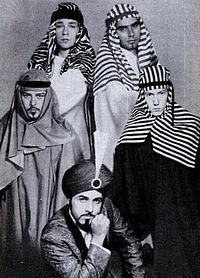
Sam the Sham & the Pharaohs, in a publicity still for a 1965 terrible re-make called When the Boys Meet the Girls
(Photo from Robert Kruse's page on Sam the Sham etc.)

  • You may know them by their more famous song, Wooly Bully.
  • Sam the Sham's real name is Domingo Samudio.  Some sources spell it Zamudio, except people shortened his last name and called him Sam.
  • Sam was born in Dallas, Texas, and that's where his group hails from.
    • He was in the Navy in Panama, and then he was a carny for a couple of years, after dropping out of U Texas-Arlington, and before forming the band that would become the Pharaohs.
    • They dressed up and called themselves Pharaohs after Yul Brynner's costumes in The Ten Commandments (1956).
      •  "Old Ramses, the King of Egypt, looked pretty cool," Sam said once in an interview, "so we decided to become The Pharaohs." 
     
     
    Sam and the Pharaohs, 1965
    (Photo from Wikipedia)

    • He called himself "the Sham" because, as he said, "what I was doing, fronting the band and cutting up was called 'shamming.'"
    • The band went through a lot of iterations.  The first group recorded an album which didn't sell at all, so they broke up.  Then another group of people formed the band, they wrote "Wooly Bully" (which is about a monster with two big horns and a wooly jaw), which became all kinds of popular.
    • The band changed some more, they recorded lots of songs about nursery rhymes, including "Little Red Riding Hood," and they took the show on the road.
    • For a while, they were backed by a group of three female backup singers who called themselves The Shamettes.
      • "When I was a kid, about 10 years old or so," Mr. Not Cox told me, "Sam the Sham and the Shamettes came to the fair and my dad took me to see them.  Now, we're from a small town and we're not dumb, there's just a lot you don't see.  And I had never seen anything like the Shamettes."
      • "Why, what were they wearing?" I asked, thinking maybe they had on spangly suits like Las Vegas dancing girls.
      • "I can't remember, I was only ten, but I do remember I had never seen anything like that." And he gestured with both hands in front of him, signifying, breasts.

    Sam and the Shamettes.  They look pretty tame to me.  But maybe this was a relaxed moment, not on stage in all their Shamette glamor.  Or maybe what looks tame to adult-me seemed like a really big deal to a small-town 10 year-old boy.
    (Posted on Reddit)

    • Sam the Sham & the Pharaohs' fame started to fade as musical tastes changed in the late 60s and early 70s.  Sam tried to remake himself and recorded a blues album in 1971.  It won a Grammy --  for Best Album Liner Notes. 

    How's that for a travel Apple?

    Monday, December 2, 2013

    Apple #653: Vince Guaraldi

    Greetings, faithful Daily Apple readers!  Now that our calendars have turned the page to December, I can start giving you Christmas-related posts.

    Who is this Vince Guaraldi guy and how is this a Christmas-related post you ask?  Hit play and within one second, you'll know.


    Guaraldi the Jazz Musician

    • Vince Guaraldi was very much a San Francisco dude.
      • Born in San Francisco in 1928
      • Graduated from Lincoln High School in SF
      • Went to SF State College
    • He started playing jazz piano in public while he was in college.
    • His first real performances were at the Jackson's Nook, the hungry i, and the legendary Black Hawk (closed in 1963), all  in San Francisco.

    Vince Guaraldi early in his career, or at least, before he adopted the facial hair.
    (Photo from Derrick Bang's Five Cents Please)

    • Any time people talk about jazz, they get all name-droppy, which always bugs me.  For those of you not well-versed in multitudinous jazz musicians, suffice to say that Guaraldi played with some pretty heavy-hitters early in his career.  For those of you who want the names, here are some of the guys he played with:
      • Sonny Criss
      • Bill Harris
      • Chubby Jackson
      • Art Tatum
      • Woody Herman's Thundering Herd
    "It was more than scary," Guaraldi said of working for Art Tatum as an intermission pianist. "I came close to giving up the instrument, and I wouldn't have been the first after working with Art Tatum."
    • Guaraldi's early recordings include sessions with vibraphonist Carl Tjader (1953), and some other recording sessions with trios he played with at various live venues throughout San Francisco.
    • Among his live performances was playing piano in  Carl Tjader's Quintet at the first Monterey Jazz Festival in 1958.  The Quintet got a standing ovation.
    • One heavy-hitter in the jazz world, Jon Hendricks, said of Guaraldi:
    "Vince is what you call a piano player. That's different from a pianist. A pianist can play anything you can put in front of him. A piano player can play anything BEFORE you put it in front of him."


    I'm not sure when this was taken, but now we're getting into the facial hair.  Perhaps it was around this time that fellow jazz musicians started to call him Dr. Funk.
    (Photo from Derrick Bang's Five Cents Please)

    • There's one name-droppy person you need to know.  Fellow San Francisco native Ralph Gleason stopped in at the clubs where Guaraldi was playing.  Gleason was the music critic for the San Francisco Chronicle and one of the founders of Rolling Stone.
    • Gleason liked what he heard, and he was also intrigued by Guaraldi's style.  He said that Guaraldi had "stubby, thick, tough little mitts" for hands.  The size of his fingers meant that Guaraldi played the piano physically differently than most people:
    "Vince is always pulling splinters from his fingers, driven in when he claws at the wooden baseboard, behind the keys. His fingernails are perpetually split and ragged from hitting that wood. He fingers all wrong when he makes runs and plays chords. All wrong, that is, from the standpoint of efficiency and ‘piano technique.’ He doesn’t make the runs the way it says you should in the Czerny exercise books. He makes the runs the way it fits his stubby little hands. And if he finds shortcuts, and ways to play something with this thumb that ought to be played with his middle finger, he plays it with his thumb. But I’ve noticed over the years in jazz that almost all the good ones do it all wrong, because it’s the sound that matters—and the sound, with Vince, is beautiful and moving." 

    Guaraldi's Road to Peanuts

    • In 1959, a French/Portuguese movie called "Black Orpheus" was released.  It was a re-telling of the story of Orpheus and Eurydice, set during Carnival in Rio. (It won the 1960 Oscar for Best Foreign Film, by the way.)  The film prominently featured a couple of songs in the bossa nova style, one of which was called "Samba of Orpheus."  
    • Here's the song from the movie:


    • Guaraldi wrote his own arrangements of the songs from this film, in particular the "Samba of Orpheus."  Here's his version.  Once the piano kicks in, you will recognize his style instantly.


    • Guaraldi and his trio recorded the songs he adapted from the film soundtrack along with a few others, and they were released on a 1962 LP.  To promote the LP, Guaraldi's producers also released a single which featured "Samba of Orpheus" on the A side.  They couldn't decide what to put on the B side for the longest time, and finally they settled on a piece that Guaraldi wrote, nothing to do with that film.  The B-side song they chose was a little tidbit called "Cast Your Fate to the Wind."
    • Don't recognize it, do you?  But I bet as soon as you push play below, you will know the tune immediately.


    • The single was released to radio stations and it got quite a lot of play in the N California area.  Some inquisitive DJs in Sacramento turned the single over and played the B side, and "Cast Your Fate to the Wind" took off.
    • The song won a Grammy in 1963 and audiences clamored for it. Guaraldi became something of a fixture in the San Francisco music & television scene, producing various jazz-related programs that aired on local TV stations.

    It was after "Cast Your Fate" became a hit that Guaraldi began to make all sorts of recordings.
    (Photo from Dadrock)

    • OK, so now we here we are in 1963.  "Cast Your Fate to the Wind" is a hit in the San Francisco area.  TV producer Lee Mendelson is in San Francisco to work on a documentary about the also-popular comic strip Peanuts, penned by Charles Schulz, who also lived in Northern California.
    • Mendelson was in a taxi, and "Cast Your Fate to the Wind" was playing on the taxi driver's radio. Mendelson liked the song so much, he contacted the music critic for the San Francisco Chronicle, who happened to be Ralph Gleason, who happened to have heard Guaraldi play many times and admired his dexterity with his stubby fingers.  
    • Mendelson asked Gleason if he knew the guy who wrote that song he'd heard on the radio, and of course Gleason said he did.  He set up a meeting between Mendelson and Guaraldi and the two met for lunch.  Mendelson told him about the documentary and asked if Guaraldi would be willing to write music to be the background for the show.

    Television producer Lee Mendelson. You wouldn't take this guy to be a jazz lover, would you?
    (Photo from The Bluegrass Special)

    • Guaraldi said he loved reading Peanuts and would be thrilled.  A few days later, he called Mendelson and said he had something. He was so excited, he played the tune to him over the phone.
    "I was blown away!" Mendelson said. "It simply SOUNDED like the characters in Peanuts. He finished playing and got on the phone. 'What do you think?' he asked.'"It's sensational, perfect! Do you have a name for it yet?' 'I thought we should call it "Linus and Lucy,"' he replied. Little did Vince and I know what that would mean to our futures." (from Snoopy and the Gang)
    • The documentary was called "A Boy Named Charlie Brown" -- not to be confused with the animated feature.  The documentary was never released, never shown to the public.  Mendelson couldn't get anyone to buy it.
    • Mendelson also made a pilot TV show about the world's worst baseball player, Charlie Brown.  The pilot was rejected by all three networks, and that never went anywhere either.
    • Coca-Cola somehow got wind of either the pilot or the documentary, or something, but anyway they had the idea that a Charlie Brown Christmas special might go over well.  They contacted Mendelson and asked if he would be interested in making that, and said that Coca-Cola would be its sponsor.
    • Mendelson asked Schulz to put together an idea (a.k.a. a "creative treatment"), and the next day, the two of them gave Coke a single-page, triple-spaced description of what this Peanuts Christmas special might be like.  In reply, Coke sent Schulz and Mendelson this telegram: 
    CONFIRM SALE OF CHARLIE BROWN FOR CHRISTMAS TO COCA-COLA FOR DECEMBER BROADCAST AT YOUR TERMS WITH OPTION ON SECOND SHOW FOR NEXT SPRING. GOOD GRIEF!
    • When Mendelson began working on this Christmas special, he contacted Guaraldi again and asked if they could use is music for the special.  Rumor has it that Schulz did not much like jazz, but he went along with what the producers wanted -- which was Guaraldi's music.
    • The rest, as they say, is history.

    This iconic moment from A Charlie Brown Christmas would soon be in everyone's future.
    (Photo from Houston Press)

    Guaraldi "captured something about the lilting quality of the kids," remembers Jean Schulz, Charles' widow. "The way they walk and bounce a little bit — he captured that in his music." 

    • Even after all the success of the multiple Peanuts specials that were made over the years, Guaraldi still performed live in Northern California, sometimes for no cover charge.

    1970s Guaraldi
    (Photo from Derrick Bang's Five Cents Please)

    • In fact, the night he died, February 6, 1976, he played a gig at Butterfield's in Menlo Park, CA. One reader of a blog about Guaraldi describes his final night this way:
    "After concluding the first set at Butterfield's Nightclub in Menlo Park, California, Guaraldi and drummer Jim Zimmerman returned to the room they were staying in that weekend at the attached Red Cottage Inn, to relax before the next set. In Zimmerman's words, 'He was walking across the room and just collapsed. That was it.' His cause of death has been variously described as a heart attack and/or an aortic aneurysm. Guaraldi had just finished recording the soundtrack for It's Arbor Day, Charlie Brown earlier that afternoon."
    • Guaraldi had even had a check-up only a few weeks before. The doctor gave him an EKG and the results were good enough that the doctor didn't think he had any heart problems.  The doctor said that the stomach problems and tiredness he was experiencing were probably ulcers.


    (Album cover and album itself from All Music)

    "I don't think I'm a great piano player," Guaraldi once said, "but I would like to have people like me, to play pretty tunes and reach the audience. And I hope some of those tunes will become standards. I want to write standards, not just hits."
    • I think he got his wish, don't you? 


    Sources
    Derrick Bang, The Official Site of Vince Guaraldi, "A Few Words about Dr. Funk"
    All Music, Vince Guaraldi Artist Biography
    IMDb, Black Orpheus
    Snoopy and the Gang! Vince Guaraldi
    Coca-Cola, The Secret History of Charlie Brown's Christmas
    Saber Point, Searching for Answers: the Death of Vince Guaraldi (Continually Updated)

    Monday, October 28, 2013

    Apple #658: Lou Reed. What Else?

    So Lou Reed died today.  71.  Liver disease.  Because I kind of thought maybe he'd never go, it might be the most shocking thing he ever did.

    Before I tell you some facts you may or may not have known about Lou Reed, I want to tell you a little story.  You might like to listen to this song while you read.


    Once upon a time in college, I used to get weak in the knees over a certain tall, blonde, and self-assured hockey player with a most musical name: Jim Ballantine.  He was a friend and housemate of someone I'd gone to high school with.  Sometimes I'd go over to my friend's house with the hope that a certain hockey-playing heartthrob would be home.

    One day, my friend was not there, but this pulse-racing fellow was.  He said I could hang out and wait for my friend, or whatever I wanted to do was cool with him.  I don't think I spoke.  I think I just nodded.  I stood there in the living room, which sported a beat-up red leather couch, and he went into another room and put on some music.  "Do you like Lou Reed?" he called.  "Yeah," I said faintly, "I do."

    I wasn't just saying that, either.  I'd recently gotten a cassette of Lou Reed's greatest hits and of his recent New York (it was the early 90s, I was a college student, broke, tapes were what you listened to), and I listened to both over and over in my dorm room.  To my utter delight, as I stood there in the living room of the heartthrob hockey player with the red leather couch, here came the first piano chords of "Satellite of Love."  He turned it up, satisfyingly loud.  As the background singers kicked in, Jim went through the living room to the kitchen for toast & peanut butter, then out to the hallway to collect his leather jacket (be still my heart), then back into the living room again for his books, Lou Reed grooving away the entire time. 

    I want to tell you, it was among the most delicious experiences of my decade.

    There's more, but first, here are my Lou Reed facts.

    • He was born Lewis Allan Reed, in Brooklyn, 1942.  His father was a tax accountant.
    • In his teens, he was given "weeks of electroshock therapy" at Creedmore Psychiatric Hospital in Queens.  Some sources say this was because he was "moody and resisted authority."  Others say it was an attempt to "cure" his bisexuality.


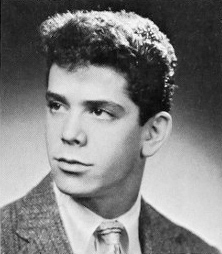
    Lou Reed's high school senior yearbook photo
    (Photo from Wikipedia)

    • He went to college and Syracuse, and Delmore Schwartz was one of his English professors.
    "I was an English major in college (Syracuse University), for chrissakes," Reed said in a 1992 interview. "I ought to be able to put together a good lyric at the very least. It would be embarrassing if I couldn't. And I really like rock. It's party stuff, dance stuff and R&B stuff that we all grew up on and loved. But I wanted something that would engage you mentally, that you could listen to on another level. I just thought that would be the perfect thing in rock 'n' roll. That 10 years from now you could still listen to one of my albums because it wasn't just a party record, but something that would engage you emotionally, intellectually, if not spiritually, on the level that a novel can."
    • He met John Cale after college, and after they formed bands of various combinations, eventually they became the Velvet Underground, named after a book about "practices of nonstandard sexuality."
    • The songs he wrote were about drugs, heroin, sex of all flavors, S&M -- the sorts of things suburban lipsticked ladies would call "alternative lifestyles."
    • Andy Warhol saw the Velvet Underground performing in Greenwich Village, scooped them up into his traveling performance art, had Nico singing with them, designed the album cover with the banana on it, and it was off to Warhol-fame-land.
    "The first Velvet Underground record sold 30,000 copies in the first five years," said Brian Eno, himself a legendary musician and producer. "I think everyone who bought one of those 30,000 copies started a band!"


    Lou Reed & Nico, from the Velvet years
    (Photo from Flickr)

    • But soon Reed left the Velvet Underground, and for two years, he worked as a typist in his father's accounting firm.
    • David Bowie really liked the VU, and he offered to help produce Reed's solo album "Transformer," which includes "Satellite of Love." (David Bowie sang back-up vocals).
    • That album is also the original home of "Walk on the Wild Side," which is probably the Reed's best-known song -- his only Top 40 hit.  Though a version of the song edited out the reference to oral sex, radio stations were soon playing the original version.  I can't recall ever hearing the song without that line in it.
    Candy came from out on the Island
    In the back room she was everybody's darling
    But she never lost her head
    Even when she was giving head
    She says, "Hey, babe
    Take a walk on the wild side"
    • He actually got frustrated by how popular "Walk on the Wild Side" became because everybody always wanted him to play that, and he wanted to try other things, play other songs. 
    • Though in an interview years later, he said that even his hit song wasn't that big of a hit.


    Reed went blonde for a while, in the mid-70s.  
    (Photo from Dangerous Minds)

    • He dipped his musical fingers into glam, punk, prog-rock (he recorded an album with Yes), alternative, noise, straight-up rock & roll, R&B, heavy metal -- music of all sorts, constantly confounding people's expectations. One could even argue that his 1978 Take No Prisoners was a comedy record.  But through it all, he was always undisputedly cool.
    • He was married to a cocktail waitress, then was "romantically involved" with a transvestite named Rachel [last name uncertain], and for a long time he was married to Sylvia Morales who is often described as a British designer, but who has also been described in more underground circles as a stripper and "part-time dominatrix."  


    Lou, from the 70s Transformer era.
    (Photo from Cinema Fanatic)

    • In several of his songs, he addresses Sylvia directly.  In "My House," Lou and Sylvia use a Ouija board to contact his dead professor Delmore Schwartz.
    • Most recently, he was married to musician and performance artist Laurie Anderson.


    Lou & Laurie, as seen by Annie Liebovitz
    (Photo via the Edwynn Houk Gallery)

    • In later years, he became friends with people like Vaclav Havel -- yes, the Czech literary dude who became the first president of the Czech Republic.  Havel said he smuggled a Velvet Underground record into Prague, and that the Velvet Underground was central to the "Velvet Revolution" in Czechoslovakia in the 1980s.
    • Jazz saxophonist Ornette Coleman loaned his talents on Reed's album/play "The Raven," based on Edgar Allan Poe's poem. (You'll note that Lou and Edgar spell their middle names the same way.)
    • In his later years, he got so into Tai Chi, he even had his Tai Chi instructor on stage during concerts in 2008. 


    From the 2000s, around the time of his Metal Machine Music release -- which is "kind of, you know, a guitar solo" except chaotically epic.
    (Photo from PopMatters)


    • Though he maintained steadfastly in interview after interview in the 1970s that he never took drugs, and though he was sober since some time in the 1980s, Reed developed liver disease.  In April (some sources say it happened in May), he had a liver transplant.  But it was pretty much the final effort. Last week, his doctor told him there wasn't anything else he could do for him, so Reed left the hospital for home, in Southampton, NY.
    • In a recent review he wrote of a Kanye West album, Reed wrote: “You do [make music] because you like it, you think what you’re making is beautiful. And if you think it’s beautiful, maybe they think it’s beautiful.”
     
    And now for my coda.  Jim Ballantine died several years ago.  The last time I saw him, he'd turned up at my friend's house in the middle of the night, by motorcycle, wearing his leather jacket.  No explanation, even though he'd been graduated a couple years, turned pro, and moved well away from college.  He'd just dropped in to say hey.  I was sitting on the couch with my friend, the movie we'd been watching on pause because of Jim's arrival.  He put his hand on my shoulder and squeezed hello.  Then he went off to see the rest of his friends who lived in the house.

    It turned out, he'd been diagnosed with Lou Gehrig's disease.  He didn't tell any of his friends.  Nobody knew until a month or two before he died.  The diagnosis might have been why he turned up at the house that night, or he might have just felt like stopping in for a shot and a laugh or two. 

    So I want to tell you that every time I hear "Satellite of Love," I remember Jim Ballantine.  And now that Lou Reed has gone to meet his man, maybe the two of them are up there together.  Maybe Lou Reed is playing "Satellite of Love" and Jim Ballantine gets to stand right next to him. 

    Satellite's gone
    up to the skies
    Thing like that drive
    me out of my mind


    (Photo from the Poetry Foundation)


    Sources
    Outsider Whose Dark, Lyrical Vision Helped Shape Rock & Roll, The New York Times, October 27, 2013
    Lou Reed dead at 71, NY Daily News, October 27, 2013
    Lou Reed, Velvet Underground Leader and Rock Pioneer, Dead at 71, Rolling Stone, October 27, 2013
    Lou Reed, legendary rock pioneer, dead at 71, Chicago Tribune, October 27, 2013
    Lou Reed Dead: Legendary Rock Musician Dies at 71, HuffPost Celebrity, October 27, 2013
    Looking Back at Lou Reed's Blue Period, New York Observer, 3/15/99
    Rock legend Lou Reed dies at 71, CNN, October 28, 2013


    Thursday, June 28, 2012

    Apple #592: A Whole Lotta Blues

    I thought I'd finish up my series of blue entries with a whole bunch of blue things, with a few facts about each. Sort of like the finale at a fireworks show.

    Blue Suede Shoes


    (Photo from some site on Etsy that isn't loading)

    • We all know Elvis Presley performed the song, but Carl Perkins is the guy who wrote it. He got the idea from Johnny Cash.
    • Cash told Perkins about an Air Force sergeant he used to know was rather particular about his appearance. He used to say, jokingly, "Just don't step on my blue suede shoes!" The reason this was a joke was because he'd be wearing his Air Force uniform at the time, with his regulation-issued shoes.
    • Cash thought this was a good line for a song, but Perkins didn't have any idea what to do with it. Not long afterward, he was performing at a dance when he heard a boy tell the girl he was dancing with, "Uh-uh! Don't step on my blue suedes!" He thought it was pretty incredible that the boy would care more about his shoes than the girl, and that's what made the song start to click in his head.

    Baby Blues

     "I was shakin' in my shoes whenever she flashed those baby blues"


    Blue eyes of a newborn
    (Photo from info.com) 

    • The phrase comes from the fact that a lot of Caucasian babies are born with blue eyes. It's supposed to suggest wide-eyed innocence, as innocent as a newborn babe.
    • When people say that all babies are born with blue eyes, they are exaggerating. Some percentage of Caucasian babies are, but not every baby is born with blue eyes.
    • Some babies' blue eyes will change to a different color as the babies get a little older. This is because the melanin doesn't kick in until it's exposed to ultraviolet light.
    • Usually, after about 6 to 9 months, you'll notice a baby's eye color will have started to change.
    • Some babies' eyes will continue to change for as long as three years.  In about 10% of babies born with blue eyes, it may take even as long as adulthood until their eyes have settled on their final color.

    Bluegrass


    Kentucky bluegrass, a.k.a. Poa pratensis. Its tendency toward lushness is what makes this a favorite "barefoot grass."
    (Photo from Power Seeds Inc.)

    • Bluegrass the music,is named for bluegrass the plant, which has a blue-ish tinge and grows in Kentucky.
    • Naturally, you'd think that Kentucky Bluegrass the plant would be native to Kentucky. Actually, it's originally from all over the place: almost all of Europe, northern Asia, and the mountains of Algeria and Morocco.
    • If you're just starting a lawn of bluegrass, don't mow it until it gets higher than 2 inches. And going forward, it's best not to mow it any shorter that 2 inches.

    Blue Humor


    The Aristocrats may be the quintessential bluest joke. Here's Gilbert Gottfried, after telling it at a friar's roast not  long after 9/11.
    (Photo from Youdopia NSFW)

    • Jokes that involve bad language or sexual or vulgar or crude situations are typically referred to as "blue humor."
    • A lot of people say that this phrase comes from another phrase, "blue laws," which were laws going as far back as the 17th century that punished bad language, lying, swearing, public drunkenness, etc. In other words, laws that governed moral behavior. That much of the origin of "blue humor" seems to be true.
    • However, people go on to say that the phrase "blue laws" comes from the fact that the laws were printed on blue paper.  This part is not true.
    • The experts can't say for 100% certain, but they're reasonably sure that "blue laws" is related to the word "bluenose."
    • A bluenose is a very rigidly moral person, presumably one who would write laws about what you can and cannot say in public.

    Blueprints


    Blueprints are architectural or other detailed drawings that have a blue background and the text and lines are in white.
    (Photo from Twins Daily)

    • Blueprints, as you'd expect, are so named because they are blue.  
    • The paper doesn't start out to be blue, but it turns out that way as a result of the process by which the designs are printed on the paper.
    • Technically, a blueprint is called a cyanotype. Making a cyanotype is a lot like developing a photograph. The process uses iron compounds, which start out to be green, but once they're exposed to UV light, they turn blue.
    • (Sort of the opposite of baby's eye color thing then.)
    • If you want to know more about how to make a cyanotype, a site called Alternative Photography has the instructions.

    Blue Whales


    The blue whale. Everything about it is superlative.
    (Photo from Wonderful Whales)

    • Blue whales are the largest mammals on Earth.
    • They can get to be 100 feet long and weigh some 200 tons.
    • Here's a weird tidbit: their tongues, alone, can weigh as much as an elephant. (I don't know who's going around weighing blue whale tongues, but I believe this assertion)
    • They eat anywhere from 4 to 8 tons -- tons -- of krill per day.
    • Baleen, the stuff over their mouths that they use to filter in food, is made of stuff very like our fingernails.
    • They're also among the loudest animals on the planet. Their sounds are at very low frequencies, but they're so loud, other blue whales can hear them up to 1,000 miles away.
    So many things to know about blue whales, I may just have to do a separate entry about them.

    And now, with this last hurrah, I must tell you that I'm going on vacation.  Please of course browse around in the meantime.  With 591 other entries to choose from, I'm sure you'll find something to interest you.  See you in a couple of weeks!


    Want more blue things? How about bluebirds , blueberries, Steely Dan's "Deacon Blues," plus of course the entries from this series: blue-footed booby, blue jeans, bleu cheese, and the ever-popular blue-plate special. 

    Sources
    Squidoo, Elvis Songs: Blue Suede Shoes
    Songfacts, Blue Suede Shoes by Carl Perkins
    Rockabilly Hall of Fame, Blue Suede Shoes: Chronology of a Hit
    Anne Marie Helmenstine PhD, About.com, Why Are Babies Born with Blue Eyes?
    What to Expect, Baby's Eye Color
    Texas A&M System, Aggie Horticulture, Kentucky Bluegrass
    Snopes.com, Blue Laws
    Patrick Bromley, About.com, Blue Humor
    Dictionary.com, blueprint
    Alternative Photography, Cyanotype - the classic process
    National Geographic.com, Blue Whale
    Enchanted Learning, Blue Whale, the Loudest Animal on Earth 

    Sunday, August 14, 2011

    Apple #542: Bachman-Turner Overdrive

    Anyone else hear "Michelle Bachmann" and think "Bachman-Turner Overdrive?"

    Honestly, I couldn't tell you what songs they did. I'm sure I know the songs, but if I heard them I wouldn't be able to identify Bachman-Turner Overdrive as the artist. So let's find out about the band.

    • The front man in Bachman-Turner Overdrive is Randy Bachman, originally from The Guess Who.
    • Bachman is Canadian (Winnipeg) and so were the rest of The Guess Who.
    • They had a bunch of hits. American Woman. No Time. These Eyes.


    • Somewhere in there, Bachman converted to Mormonism. After that, he and the rest of the Guess Who didn't get along so well. So he left.
    • After some solo work and teaming up with a couple other people briefly, he formed another band called Brave Belt. That included Chad Allan from The Guess Who and Bachman's brother Robbie on drums.
    • Allan left to get married and go to school, and a couple other guys joined: another brother Tim Bachman, and Fred Turner, who was recommended by Neil Young and was also Canadian.
    • They named this band Bachman-Turner and added the word "Overdrive" after Tim's trucker magazine which was called Overdrive. Thus Bachman-Turner Overdrive was born.
    • They didn't have much success until their second album which was released in 1973, and then Takin' Care of Business hit the big time.
    • In 1974, their next album included You Ain't Seen Nothin' Yet, which was distinguished by the stuttering ("b-b-b-baby, you just ain't seen n-n-n-nothin' yet"), and which was a huge hit.

    This is weird. The song You Ain't Seen Nothin' Yet originally appeared on the album called Not Fragile. Maybe this is the cover of a single, not the full LP. But besides that, they spelled the name wrong. It's supposed to be Bachman with one n, not two.
    (Photo from nostalgia and retrospection)


    • Randy had written the song years earlier in imitation of his brother Gary, who apparently stuttered. Gary said he always liked the song but he had no idea it had anything to do with him until he read about it in his brother's autobiography.
    • Randy originally submitted a non-stuttering version to the label, but they rejected it.
    • The Stuttering Foundation recently named it the greatest rock song featuring stuttering lyrics. They chose it over Bennie and the Jets by Elton John, Changes by David Bowie, and My Generation by The Who because only You Ain't Seen Nothin' Yet hit number one and was about a real person.
    • After 1974, the band started going through what would become typical: one guy would leave, another join. One guy leaves, another joins, and the name changes only slightly. Rinse and repeat.
    • Randy wanted the band to go more country-rock. Fred Turner wanted it to sound heavier. The two disagreed and eventually, in 1977, Randy left.
    • After Randy's departure, the band changed their name to BTO.
    • The minus-Randy BTO version of the band released two albums, Rock n Roll Nights and Street Action. Neither one did very well.

    Album cover of Rock n Roll Nights. Screams success, doesn't it?

    • I'd tell you some of the song names from those two albums (Amelia Earhart, Rock n Roll Hell, You're Gonna Miss Me, Takes a Lot of People), but I doubt you'd recognize them.
    • In 1983, they reunited as Bachman-Turner Overdrive, mostly touring as the opening act for Van Halen. They recorded a studio album and a couple of live albums.

    The late 80s version, or the "new BTO." Robbie's not in the band and Randy's not pictured here. Of the Bachmans, only Tim.
    (Photo from allpar.com)


    • Since then, there have been a lot of lawsuits and even more confusion over the name. The lawsuits have to do whether the band could call themselves BTO and they've had to pay lots of money to keep using it.
    • Many fans shorten Bachman-Turner Overdrive to BTO, even though they're supposed to be different bands. Or the bands have been slightly different versions with a few different people, who often play songs that the original Bachman-Turner Overdrive released in the 1970s.
    • So, yeah, it's probably better just to talk about their glory days. Hey, remember that song, You Ain't Seen Nothin' Yet? That's a good song to sing along to when it comes on the radio, isn't it?
    I met a devil woman, she took my heart away
    She said I had it comin' to me, but I wanted it that way
    I think that any love is good lovin'
    And so I took what I could get, mmm
    Oooh, oooh, she looked at me with big brown eyes
    And said

    You ain't seen nothin' yet
    B-B-B-Baby, you just ain't seen nothin' yet
    Here's something that you never gonna forget
    B-B-B-Baby, you just ain't seen nothin' yet

    Turns out, this entry has nothing to do with Michelle Bachmann after all. Her eyes are blue!

    Sources
    allpar.com, Driving Music: Bachman-Turner Overdrive
    allmusic.com, Bachman-Tuner Overdrive biography
    Aldo Santin, "Stuttering Foundation salutes BTO hit You Ain't Seen Nothing Yet," Winnipeg Free Press, August 8, 2011

    Monday, July 11, 2011

    Apple #535: Thugs

    The Anonymous Californian asked me to do an entry about thugs. Does the word have something to do with the goddess Kali, he wanted to know.


    Idol depicting the Hindu goddess Kali
    (Photo from Hindu Goddess)


    I thought that sounded too weird. What could thugs and Kali possibly have to do with each other? I guessed that it's an onomatopoeic word that describes the sound of getting hit on the head with a blunt instrument before getting robbed.

    Turns out I was way wrong, and the Anonymous Californian was right.

    It also turns out that the historiography about thugs has changed a lot over the past decade or so. I'll tell you how the story has gone for a long time, then how it's recently been changed. Then I'll tell you about the current pop culture usage of the word.


    The Original Story
    • The story goes that there was a band of robbers who lived in India. By religious persuasion, they were Hindi. In particular, they were fans of Kali, who is known mainly as the dark goddess, or the goddess of destruction.
    • The Hindi word for their group is thag (the t has a dot under it), which in English got turned into thug. The people who were members of the group were called Thugs, and the group as a whole was called Thuggee.
    • The word thag means "cheat, swindler, deceiver."
    • Most dictionaries say that the more accurate word for this band of bad guys is Phansigar, which means "strangler." This is because, the stories have it, the Thugs would loop a cloth or they'd drop a metal ring concealed within a cloth around the necks of their victims and strangle them.
    • Some stories say that the Thugs would tighten the loop, then release it to allow their victims to breathe for a bit, then tighten it again, thus drawing out the death. They didn't mean to inflict torture; they thought of death as a rite of passage, both for the victim and for the murderer.

    Ceramic figurine depicting Thugs at work
    (Photo from anomalies-unlimited)


    • They perpetrated such murders in honor of Kali, to show their allegiance to her and to their cult. Honoring her meant killing in a way that was similar to how she had done it in the stories, which is to say by strangling and by leaving no mark or blemish on the victim.
    • Most of the time, the Thugs were placid, law-abiding people. But, so the stories went, three times a year, these people would commit these terrible crimes. In this apparently dual existence, they demonstrated their deception and thus deserved the name thug, "deceiver."
    • The Thugs had a whole list of people they would not target -- women, beggars, the physically disabled, and those who practiced certain crafts. Nearly exclusively, they targeted travelers.
    • The Thugs would disguise themselves as a group of travelers, sometimes as many as 60 of them at once, and thus lure unsuspecting real travelers to join their group, thinking they had found safety in numbers. Once the Thugs had their unsuspecting victims well away from any help, they would attack the real travelers, robbing them, killing them, and burying them in graves of very specific proportions.

    Thugs and poisoners, c. 1857. The guy in the white mustache holding what looks like a looped string in his right hand and the guy crouching to his left are Thugs.
    (The New World Encyclopedia has labeled this image "Thugs and Prisoners." But somebody misread the original caption)


    • All sorts of estimates have been made of the number of victims killed by the Thugs. Some say one million, some say two million. The high-estimators say these numbers are borne out by the fact that Thuggee was in existence for several centuries. Others say no, Thuggee wasn't really around for that long and there weren't that many murders, the Thugs mainly committed robbery, so the number of people killed was more like 50,000.
    • In the 1830s when the British shifted from trading with India to trying to control it, the British military set about suppressing Thuggee. The British told people about the traveling disguise ruse which made travelers less likely to fall for the trick, they passed a bunch of laws outlawing piracy and allowing for severe punishments of such pirates, and they hunted down all sorts of suspected Thugs, even those who had fled to neighboring countries.
    • Hundreds of suspected Thugs were captured, they confessed to thousands of murders, and they were hanged or exiled or sent to prison camps. Eventually, Thuggee was stamped out.

    William Henry Sleeman, British civil servant who was put in charge of the "Thuggee Department" in India, which was responsible for the capture and execution of hundreds of suspected Thugs.
    (Photo from Wikipedia)


    The Revised Story
    • In the past ten years or so, a few historians have revisited the stories about Thuggee. Hey, they noticed, most of the stories we've heard about Thugs were told by the British.
    • The British had that whole racist thing going on, where they thought that since they were white people they were a whole lot better morally than any dark-skinned people, and it was their job to bring civilization and order to a country full of wild, ignorant, unruly dark people.
    • So, naturally, the historians said, the stories the British would tell about a group like this would be wildly exaggerated. They'd be like stories about the boogeymen. The stories kept the white women afraid and therefore dependent on their men to save them, gave the British license to use whatever means necessary to subjugate this "other" group, and in general fueled their whole white power agenda.
    • The historians took another look at some of the evidence and said, yup, exaggerations all over the place. Those confessions that the soldiers got out of suspected Thugs surely were coerced, those confessions can't be trusted, they'd likely have been as wildly exaggerated as the British imagination.
    • Yes, these recent historians said, there was a group who worshiped Kali, but every Hindi worships Kali to some degree or another. Yes, there was a band of robbers, and yes they did target travelers who were mainly white, but that's because it was easier to steal from them.
    • There might have been a few murders that happened in the course of those robberies, but the numbers of people killed weren't anywhere near what those myths say. The reality is far less dramatic and lurid than the stories say.

    Revising the Revised Story
    • Well, sure enough, there was a backlash among other historians against this new theory.
    • Wait a minute, they said. You're saying Thuggee wasn't really around for that long? We beg to differ. Remember that one British guy who pretty much hunted Thugs? Remember how those Thug informants showed him all those graves? What about that?

    A Thug from the early 1800s named Behram. He's generally considered to have killed more people than anyone else in history. Accounts vary, however, as to how many people he personally killed, and since he informed on fellow Thugs, he was never tried.
    (Photo from blindloop.com, which no longer works)


    • All, right, this second batch of historians said, we'll grant you that the truth maybe wasn't as gothic as it's been told in the past. They might not have killed 2 million people, but they did kill quite a few people.
    • We think, they went on, the motivation for the robberies wasn't all that religious stuff. They were really doing it because they were poor and they needed the money. People thought they were weirdly religious, but they were just superstitious.

    My Take on This
    • That's where the historiography of Thugs stands today. Because of all these different versions of the story about Thugs, I'm not sure which one is accurate. I have no way to know, so I gave you all of them.
    • I do find it interesting that a story about "deceivers" is so mixed-up and told in so many different ways, it's pretty much impossible to know what the truth is.
    • I also find it interesting that this story is associated with Kali. She isn't just the goddess of darkness, she's the goddess of all kinds of things. Literally.

    A fairly typical depiction of Kali, with her necklace of heads, her multiple arms, her tongue out, and standing on Shiva.
    (Image from Carrie & Danielle)


    • Kali is beyond the masks of the worldly. Under her influence, the illusions of this world are sloughed off and the truth emerges. She wears a necklace of fifty heads, each one marked with a letter of the Sanskrit alphabet, thus symbolizing infinite knowledge. That's knowledge of all things, dark and light. The heads are symbolic of the ego, the body. She is the liberator of the ego, allowing us to move into a formless place of all knowledge. Her name literally means "time." She rules the past, present, and future. Without her, the cycle of death and rebirth could not happen.
    • So while she may be known as the goddess of destruction, what she's destroying are earthly things that keep us chained. She's scary-powerful, but she's not "bad" in the same way that life is not "bad."
    • Just as Kali is far more complicated and complete than the epithet "goddess of destruction" would suggest, so the story about Thugs is far more complicated and many-headed than a one-line dictionary definition might suggest.
    • But wait, there's more.

    Present-Day
    • In 1992, rapper Tupac (or should I write 2Pac? I'm not sure) Shakur got two infamously rival gangs, the Bloods and the Crips to agree to what he called the Code of Thug Life.
    • The Code lists 26 rules for things you should and should not do.
    • Membership in the gangs means, first and foremost, that while you will get rich, you will also go to jail, and you will die.
    • More specifically, membership means there will be crime, of course (mainly drug dealing), but violence is not to be committed in places where innocent people could get hurt.
    • Several groups of people are not to be harmed: pregnant women, children, old people, and "civilians," meaning people not in gangs or the police. Shooting at parties and schools is strictly forbidden.
    • [Edit: I since learned that this rule may come from Tupac's personal experience. At a party in Marin City in the summer of 1992, during a fight between Tupac and some of his long-time enemies, a six year-old girl was shot and killed. I'm not sure if he devised his Code before or after that incident.]
    • Following this code will help you succeed financially, will protect you and your brothers as much as possible, and will help you stay righteous.

    Drawing of a famous photo of 2Pac's Thug Life tattoo.
    (Image from Nigelicious at Kaneva)

    • I don't know if 2Pac knew about the original Thugs or not. Maybe he did. He read a lot. But there sure are a lot of similarities with those Thugs in India.
    • The inevitability of death is taken as a given, to be accepted up front.
    • Thievery is acceptable. Murder against certain people in certain circumstances is acceptable.
    • But said crime is acceptable only in certain locations, or against certain people.
    • In fact, certain types of people are explicitly not to be harmed.
    • There isn't a religion involved, but there is a code of behavior that's meant to keep people connected.
    • What's more, the idea of 2Pac's Thug Life morphed over time, just as the stories about the Thugs have.
    • After 2Pac released his enormously popular album called Thug Life, which he made with a group of his friends that he called Thug Life, the sense of being a Thug changed. It expanded from being someone who was a member of either one of those gangs to include anyone who had a rough start in life.
    • "Thug" now more or less means that you started from nothing, you lived and worked through having nothing, and you rose above it but without forgetting where you came from.
    • Outside the realm of rap culture, the word thug means "ruffian, hoodlum." No stories of goddesses or British soldiers or murdered rap stars, just your basic criminal.

    So, is a thug a robber and a murderer? Or just a robber? Is "thug" an epithet people fling out of fear, or is it an epithet to be adopted with pride? Is a thug a run-of-the-mill criminal, or someone crafty and clever, taking care of people to the benefit of some and the detriment of others? Does the answer depend on who's asking? Is a thug, like Kali, something more complicated than "all-bad?"


    Sources
    The Oxford English Dictionary, Thug, Thuggee
    Online Etymology Dictionary, thug
    The Free Dictionary, thug
    Sue Mahan, Pamala L. Griset, Terrorism in Perspective, 2002. Thugs, pp 49-52.
    Anomalies-Unlimited, Charming Art from India
    John Walsh, Kali's Killers: The Truth about the Thugs, SE Asian History, December 20, 2007
    Subhamoy Das, About.com, Kali: The Dark Mother
    Devi Press, Kali Goddess
    BBC History, The British Presence in India in the 18th Century
    ThugLifeArmy, Code of THUG LIFE
    Urban Dictionary, Thug Life, Thug