Showing posts with label science - psychology. Show all posts

Sunday, June 27, 2010

Apple #466: Making Decisions When You're Tired

For some time now, I've been aware of the fact that when I'm tired, I have a harder time making decisions.

In the grocery store, for example, whether to buy things that are cheap/bad for me or expensive/good for me is always an issue, but when I'm tired, this can become an almost impassable choice.  I stand there staring at the options until I wind up deciding on the basis of something stupid or irrelevant -- it's the loaf of bread I happen to have in my hand when I give up trying to make a decision.  I like poppy seeds and this muffin looks like it has more poppy seeds in it.  I first ate that cereal at a friend's house when I was a kid and that was a good day then, so I'll buy it now.  Or I walk away from the whole thing altogether.

I've noticed this sort of thing happening often enough that I, in true Apple Lady fashion, have gotten curious about it.  I wondered, is there a set of steps your brain goes through on the way toward making a decision?  And does being tired somehow keep your brain from getting to one or more of those steps?  Is there something in particular that's getting derailed, and is there some way I can get my brain back on the rails even when I am tired?

I've been doing quite a bit of reading on this for a while now, and I found all of it really fascinating.  Of course, since it's the brain that's involved and the brain is a complicated piece of machinery, the answers are not simple 1, 2, 3.  But I'll try to break down what I've learned into simple enough bits that you'll be able to take them in.


The Brain Is Complicated
  • The first thing to know is, your brain is not like a department store: one room for shoes, one room for memories, one room for anger, a room for decision-making, a room for shoes, and so on.  But it is very tempting to imagine it this way.


In the 19th century, phrenology heads like this one were very popular among scientists.  They drew sections on heads and labeled them with all sorts of attributes or emotions because they believed that those emotions were handled or produced by that particular part of the brain.
(Photo from Hill Gallery folk art)

  • There's still a kind of phrenology at work today.  Neurologists will hook subjects' brains up to various imaging machinery and they have the subjects perform certain tasks.  They watch a small portion of the brain to see whether it "lights up," or is especially active during this task.  This research gets published in the popular media as, "Left side of brain controls speech!" or "Right side of brain determines whether you're religious!"
  • In truth, the brain is an extraordinarily complex web of chemical and neurological interactions. In nearly every brain activity, there are several regions or systems involved to some degree or other.  Pinning a particular mental function down to one place or one chemical exchange isn't realistic.

It's the Prefrontal Cortex, Stupid -- But Wait, There's More
    • So it is misleading to say what nearly everybody says about decision-making, which is that it's handled by the prefrontal cortex.  That's generally true, but it's also more complicated than that.


    The prefrontal cortex  is the hunk at the front of the brain that starts above your forehead and goes back to about the middle of your head. This is where a lot of the activity surrounding decision-making takes place, but it's not the only part of your brain involved.
    (Diagram from Brian Explorer)

    • The prefrontal cortex is not the only place involved in decision-making, but to make things easier for a second, let's say that it is.  I'll come back to the other areas later.

    Seven Is My Limit!
    • While most of your brain handles an incredible amount of information and performs a tons of tasks at lightning speeds, the prefrontal cortex is a bit weak by comparison.  Researchers have found that the prefrontal cortex can handle only about  seven pieces of input toward a decision at one time.  Any more than that and it gets overloaded and it spins and spins, or it shuts down, or it otherwise can't reach a decision.
    •  Let me put this in real-life terms.
    • Let's say Wanda is in a store, holding a shirt sleeve with the price tag  dangling off it, trying to decide whether or not to buy the shirt. 
      • She's taking in the visual cues of the shirt and the price tag, and  probably other sensory input as well. She's feeling the texture of the fabric, the store is playing music,  someone just walked by wearing perfume, and there's a guy in the back of the  store shouting into his cell phone, so she's hearing and feeling and smelling all of these things. 
      • She's also considering how this shirt looked when she tried it  on, she's trying to remember how much  money is in her bank account, and how well did shirts like it hold up after she washed them several  times, she's wondering does she even like the color of this shirt, does her husband like  this color, does she have other things at home that she can wear it  with, and so on.


    The blue shirt. A black hole of indecision for Wanda.
    (It's by Oasis, and it sells for £14.40 on burningahole.com.uk)

      • Not counting the guy shouting into his cell phone, the perfume, and the   music, Wanda is trying to negotiate six factors in that shirt-buying  decision.  That's not an especially high number, but for the prefrontal cortex,  it's a lot.  If I were to add one more factor to that decision, Wanda's  prefrontal cortex would get overloaded, and that's when she would  probably walk away from the whole thing. 
      • Or she might make a decision whether to buy or not on the basis of whatever thought or emotional response out of all of those that stands up and demands the most attention.
        • Maybe the color of the shirt reminds her of the color her room used to be when she was a little girl, and that's a happy memory for her, so she buys the shirt.
        • Maybe the music that the store is playing is something she likes and is in some way soothing to her.  She decides she doesn't need to worry about money all that much, so what the heck, she'll buy the shirt.
        • Maybe the guy shouting into his cell phone gets even louder and trips her annoyance limit, so she lets go of the shirt sleeve and walks out of the store without buying the shirt.

      Logic + Emotions or Instincts = Decision
      • Even though our powers of logic and reason and analysis may be engaged, our emotions and  memories get called into the act, too.  Those emotions and memories and what some researchers call "instinctual" responses come from other parts of the brain than the prefrontal cortex.

      The colored sections are collectively called the limbic system. Each of these elements has something to do with our emotions or instinctual responses. The hypothalamus deals with basics like breathing, hunger, thirst, heart rate, body temperature, as well as sexual response, anger, and aggression. The pituitary gland is where hormones are produced that regulate the  stuff that the hypothalamus wants controlled.  The amygdala is also involved in sexual response, anger, aggression. The hippocampus is where short-term memories get converted to long-term memories.
      (Diagram from Dr. C. George Boeree)

      • Those "emotional centers" in the limbic system are all connected to the prefrontal cortex. (I'll talk about those connections later.)  But these areas of the brain also get involved, along with the prefrontal cortex, in decision-making.
      • We have a sort of prejudice against emotions when it comes to decision-making.  We like to think that the best decision-making is done completely logically and rationally.  But our brains don't -- and in fact, can't -- work that way.
      • People who lack emotions because of brain injuries have been studied for some time, and the research continues to find that they   often have a very difficult time making decisions.  Even decisions as simple as whether to use a black pen or a red pen, they just can't process it. 
      • This is because, when faced with a decision, in addition to calling upon facts, the brain  also calls upon memories and emotions of similar experiences from the  past, and it brings all that into account. People who can't access their emotions can't bring those to bear on decisions, and they simply can't make a choice.
      • In truth, our emotions are very much involved in nearly every decision we make.  

       
      We tend to assume that we don't want emotions involved in decision-making.  But in real life, we need and want them involved.  Mr. Spock might be an  entertaining concept on television, but in real  life, he would probably  be annoying, if not dangerous.
      (Photo from ugeene's  Nerd Zone)


      Emotions: Hey, They're Not So Bad
      • Let me talk about terminology for a second.  Some researchers have studied emotions versus logic, others have studied what  they call "instinctual" responses or gut reactions versus analytical  thinking, or they have compared the influence of long-term memory versus short-term memorization, those sorts  of pairs.  Even though each of those pairs involves slightly different activities, I'm going to simplify them for the sake of this  discussion and call all the emotional/memory/gut reaction stuff the instinctual response.  All the analytical cognitive reasoning stuff I'm going to call logic.
      • To demonstrate how often our instinctual response gets involved in decision-making, here is a math problem one researcher uses to reveal how readily this happen:
        • A bat and ball together cost $1.10.  The bat costs $1 more than the ball.  How much does the ball cost?
        • Most people answer right away: 10 cents.
        • That seems like it should be the correct answer, but it is not.  If the ball costs 10 cents, the bat would cost $1 more than that, or $1.10, which would bring the total to $1.20.
        • The correct answer is found with a bit of algebra.
            • ball + ball + $1 = $1.10
            • 2x ball = $0.10
            • ball = $0.05
      • Most of us don't stop to work out the problem step by step.  We rely on the number of times we've had to make change at the store, or other scenarios where we've wound up with simple answers like $1, and that's how we arrive at our answer -- and we get there very quickly, too.  
      • Those of us who deal with more complicated math problems on a more frequent basis probably saw the trick in that problem much sooner, knew there was more to it than met the eye, and arrived at the correct answer -- and got there quickly, as well. 
      • In fact, chances are that those who are more "mathy" than the rest of us didn't actually take the time to do the algebra problem step by step, but rather had done enough problems like it to know how this one would turn out, too. Even for those who have what we would generally call a more logical mind, simply because their brains do math problems more often, they still probably would have engaged that instinctual response to arrive at an answer.
      • We tend to demonize emotions and say that when the emotions get involved, we make poor decisions.  But this is a great example of why we're erroneous in saying that.  The "mathy" people would have relied on their instinctual response to arrive at the answer to the bat & ball problem, while the less mathy among us did the same thing.  The difference is not that the mathy people didn't engage their instinctual center but rather that the mathy people have a lot more experience with this type of problem, and that's why they got the right answer.
      • In fact, sometimes we make better  decisions because our emotions are involved. One of the occasions when you want your instinctual response/memory center to be the most  involved is, seemingly paradoxically, when you've  done a task hundreds or thousands of times.  
        • People who have played thousands of games of chess, for example, remember the consequences of the moves they made in  past games and they've linked those memories to success (positive  emotion) or failure (negative emotion).  The chess experts who are  making moves at lightning speed are rapidly rejecting other possible and  less favorable moves based on the hundreds of occasions those moves  have turned out badly.  Because of their memories and emotional  experiences, they can rule out a multitude of options and thus make  decisions very quickly.  They don't have to "think;" they can act on  their "gut instinct."
      • So let's go back to Wanda in the store holding the shirt sleeve.  Her prefrontal cortex is trying to manage all sorts of logical aspects to the question.  But in the end, her instinctual response center steps in and makes the decision for her.  The color reminds me of something nice; let's get the shirt.  That guy is annoying the crap out of me; let's get out of here.  If that instinctual response center didn't step in, she'd probably still be standing there holding the dang shirt sleeve.

      Context Is Everything
      • Even if you don't believe me that your emotions are involved in decision-making, even if you did that math problem step by step and you are still convinced that you are always logical and rational about all your decisions, I've got news for you.  Your brain takes short-cuts.  Whether you're aware of it or not.  All the time.
      • Perhaps the biggest short-cut your brain takes in decision-making is to rely on context.  
      • Here's one really good example of that:
        • People were put in one of two rooms. One room had a chocolate bar over in the corner, and the other room had a can of Spam over in the corner.  The chocolate and the Spam were both some distance away, they were wrapped up, not emitting any scents or anything.  Each person, once seated in his or her given room, was given a bag of chips to eat.  Everybody got exactly the same kind of chips.
        • The people who ate the chips in the room with the chocolate bar said they liked the chips a whole lot more than the people who ate the chips in the room with the can of Spam.
        • There was no difference in the chips.  The subjects weren't influenced by the chocolate or the Spam through any other route than visually, and yet they were significantly influenced by the visual proximity of those items.

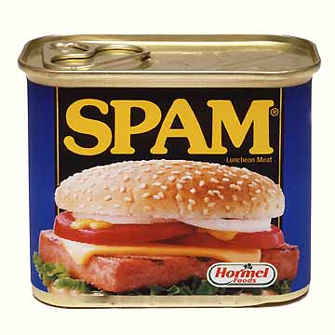

      Chocolate or Spam?  Don't need to think much about that choice.
      (Hershey bar photo from Quia. Spam photo from The Geek Whisperer)

        •  Here's another example of how context influences our decisions.  This time, the emotions get involved in ways we'd rather not admit.
          • People were given dice and a small amount of money to gamble with. 
          • First they were told they would keep 40% of the money if they didn't gamble, and then they were given the opportunity to roll the dice.  Next they were told they would lose 60% of the money if they didn't gamble, and they were given the opportunity to roll the dice. The outcomes are exactly the same, but they are worded differently.
          • When people were told they would lose more if they didn't gamble, they rolled the dice far more often.
          • Some of the subjects even said they knew the odds were the same, yet they just couldn't help themselves.  This is because how the situation was framed (the context) triggered people's fears of losing resources.


          This guy, a behavioral economist named Dan Ariely, has more examples about how context influences our decisions.  The first 2:25 or so is a bit of a preamble, but then he gets into specific examples.  It's about a 15 minute talk, but he's engaging in the way he presents his material, he's got a really good point about why we should care about all this, and I highly recommend it.

          •  What his talk comes down to is that we rely on things like context and optical illusions because making decisions is hard.

           What Did the Doctor Say?
          • Another short-cut our brains take is to rely on experts to help us out.  If we're faced with a complex set of choices, we sit there and churn over the choices to try to arrive at a decision on our own.  But if we're told that such-and-such an expert has advised that this choice is the best one, our brains churn over the problem for a significantly shorter amount of time, and we tend to make the same choice as what the expert has recommended.
            • This is why you see commercials that feature someone in a white coat who is or looks like a doctor. Movie and TV stars in commercials, same thing. If we think that someone we respect or look up to for any reason has thought out the problem for us already, we tend to stop thinking and do what the "expert" recommends. Scary, but true.


            If someone wearing a white coat like this guy is says we should do something, most of us stop thinking and do what he says.
            (This guy actually is a doctor.  He's Dr. Lawrence Raisz, and he's an expert in bone health at the New England Musculoskeletal Institute. Photo from U of CT Health Center)

              • Another version of this is we get out our cell phones and call our friends, our spouses, our parents, and ask, "Do I get the tattoo or not?"
              • When the decisions are about things we care about, things that are complex issues, things that have lots of facets and contingencies and maybes, the decisions get even harder.  Our prefrontal cortex gets overwhelmed and we turn to things like context and experts to help us make the choice.

              Add a Dose of Pleasure
              • Okay, so you're getting the point that decision-making is hard, lots of things are involved, our brains turn to other inputs to make decisions more easily.  It's already complicated to begin with.  But there is (at least) one more element to the decision-making process, and that's pleasure.
              • Dopamine is a neurotransmitter, a chemical that carries with it an electrical impulse from one neuron in the brain to another. It travels from the hypothalamus and pituitary gland (part of the limbic/emotional center, remember), and it follows pathways that lead to our old friend the prefrontal cortex.

              The path that dopamine takes from its home in the ventral tegmental area (VTA), which is near the limbic system, up to the prefrontal cortex.
              (Diagram from the NIH's National Institute on Drug Abuse)

                • Dopamine has a lot of different jobs.  One of them is to help make our motor muscle movements smooth.  People with Parkinson's Disease have a deficiency of dopamine.
                • Another, more famous job of dopamine is to stimulate our "pleasure centers" which are more or less in the brain stem.  When we do something our brain interprets as good, dopamine is released, it stimulates that reward center in the brain stem, we feel a sense of enjoyment, and so we want to do that good thing again.
                • Similarly, when we make a decision that our brain interprets as good, dopamine is released, and we feel a sense of pleasure with the decision we've made.  So we'll be more likely to make decisions like it again in the future. 
                • Our brains in effect train us to make decisions, perform tasks, and repeat the behavior based on whether or not we've gotten rewarded.
                  • Three researchers, Montague, Dayan, and Schultz, spent 15 years studying how monkeys make choices.
                  • They connected the monkeys to electrodes that tracked dopamine levels in their brains, and the monkeys were trained to push a bunch of buttons in a particular sequence.  If they got the sequence right, they would get a squirt of juice -- a reward.
                  • They discovered a ton of things in their 15 years with the monkeys, but one of the main things they found was that before the monkeys got their reward, the dopamine neurons started to fire.  The monkeys had learned to expect that when they got the light code right, they'd get the reward, which triggered the pleasure.  The monkeys saw a pattern and connected getting the light code correct with pleasure.
                • What this means for us is that, like the monkeys with their juice, we are constantly looking for patterns of behavior that will get us a reward.  Last time I bought a shirt like this, that turned out to be a really good experience, so I'm going to buy another shirt like it.  Or, last time I went into that store, there was a guy in there talking on his cell phone really loudly and that was annoying, so I'm not going to go in there again.  We do this kind of thing all the time.
                • Addicts are an extreme example of how we all respond to patterns and rewards.  A lot of addicts talk about "triggers."  When an alcoholic hears the pffft of someone opening a can of beer, they'll start to salivate and want a drink.  Heroin addicts will start to want a fix if they see a needle or a belt or other equipment associated with shooting up.  Their brains have been trained to expect a reward in response to certain patterns of behavior.  Once part of that pattern is set in motion, their brains are already getting the dopamine ready.

                I bet you're already anticipating the motion of levering open the bottle cap, the resultant pffft spray, perhaps the sound and the smell of it. Maybe you've also noticed the beads of moisture on the bottle. Thirsty yet?  That's your hypothalamus and the dopamine getting you ready for something to drink.
                (Photo from Channel 4 in Belfast)

                  • Another aspect of this is true, too.  I'll let this guy named Jonah Lehrer, who's written a whole book about how the brain makes decisions, talk about the relationship between dopamine and patterns and addiction.

                  I talked to a woman named Ann Klinestiver, who was diagnosed with  Parkinson's in 1998, and, like many Parkinsonian  patients, she was put on a drug called a Dopamine agonist. And the purpose of  these drugs is to increase the amount of Dopamine in the brain.

                  One of the common side effects of these drugs is gambling  compulsions. Some studies estimate that as many as 10 to 15 percent of  patients on these drugs develop some sort of gambling problem. And in  the case of Ann, it's a very sad story. It really ruined her life. She  lost her entire life savings, more than $250,000. Her husband left her.

                  She  had a compulsion for slot machines. She would spend 18 hours at a time  putting quarters into one-armed bandits. And I think one of the reasons  slot machines and games of chance in general are so addictive is because  they hijack the Dopamine system. 

                  The Dopamine system's great at finding patterns. It can find the pattern that predicts a squirt of juice, but it's terrible at dealing with random systems. It's terrible at dealing with that random-number generator inside the slot machine because it generates a consistently surprising reward.

                  Even though there's no pattern to find, we can't help but search for a pattern.

                  When Ann got a reward from a slot machine, when she got some coins in return, the end result was this surge of emotion, this surge of Dopamine that signaled something really good had happened. And so she became transfixed by this random system.

                  Her brain was literally trying to figure it out, in essence. It was trying to find the pattern that predicted the clanging coins, that predicted when she would win in the casino. But the reality, of course, is that there's no pattern to be found. You know that no matter how hard her Dopamine neurons tried, they would never find the sequence of events that predicted the payout. But because they were so saturated with neurotransmitter because she was on this Dopamine agonist drug, she simply couldn't walk away.


                  Jonah Lehrer talks about this topic and more of the elements of decision-making in his book How We Decide, which you can order from Amazon for about $10.


                  Besides All That, You're Tired

                  Now, add to all of this the fact that we're tired.  We haven't had enough sleep the night before.  Or it's the end of a long day and we've already had to make a ton of decisions.
                  • Research has shown that the act of making decisions themselves tires us out.
                    • This has been demonstrated, time and again, on voting ballots.  Say there's a complicated proposition up for a vote.  On some ballots, it's positioned at the top where voters are "fresh" when they first read it.  On others, it's positioned farther down.  On still others, it's at the end.  
                    •  The farther down the ballot, the more people voted no, and the more people abstained from voting on it altogether. By the time they got to the issue, they were tired of having to make so many choices, and they simply didn't have enough left in the mental tank to grapple with the complicated concepts.
                    • This is why nearly every single ballot puts those propositions right up front.
                  • Not only does decision-making tire us out, some decisions wear us out more than others.
                    • Easiest: someone else has made the choice and all you have to do is implement it.  If the person in the white coat has told you to swallow the pill and you believe the person in the white coat, all you have to do is swallow the pill.
                    • A little harder: to think about the options you've been given and indicate some that you like better.  This is like answering the question, "What are some of the movies you've seen lately that you've liked?" as opposed to answering the question, "What's your all-time favorite movie?"
                    • Hardest: to choose one thing from among a lot of options.  This, my friends, is a trip to the grocery store.
                  • No wonder I have trouble making decisions when I'm tired at the grocery store.
                  • It's no mistake, by the way, that all those guilty pleasures are right next to the check-out stand.  Those are called "impulse buys" in the retail business.  What they're counting on is that you'll already be so fatigued by the other decisions you've had to make in the rest of the store that you'll be too tired to resist the candy bars and the National Enquirer and the mini-crossword puzzle book, and you'll also want to reward yourself for what you've just been through.

                  What It Comes Down To

                  So now that we know all of this, what do we do?  We can't exactly reconfigure our brains to operate differently.  Mainly, the people who talk about this all say that we can be aware of our limitations, understand how our brain works, and not get frustrated when it's not working at the speed or agility we'd like.  Recognize that it's already done a ton of stuff for us today, and be patient.

                  Well, that's all very nice, but for me, it doesn't really help when I'm standing there with the loaf of bread in my hand, or when Wanda is standing there holding onto that danged shirt sleeve.  So here's what I've done or tried in the past few days since I read about all this stuff. And it seems to help.
                  • Get more sleep.  I hate this suggestion, but I have to say it because it's true.  Sleep is like food to your brain.  It needs it.
                  • Simplify.  If you find yourself adding more criteria to a decision you're already having trouble making, stop.  That's only going to make it harder for you to decide. 
                  • Eliminate some of the factors involved in the decision, if you can.  Get rid of the elements you care less about, or focus only on the one that's most important to you.  If you're Wanda standing there holding the shirt, maybe you care most about how much money you'll have to spend.  Maybe you care most about how it looked on you when you tried it on.  Maybe you care most about whether your spouse will think you look hot in it.  You might still make an emotional decision, but at least it'll be most in line with what you want after you've left the store.
                  • Give your brain a break.  Put down the loaf of bread, walk over to the  floral aisle or someplace where you can just look at pretty stuff but not be required to make any decisions.  Then go back to the bread aisle,  and probably the choice will seem obvious.
                  • Time Those Decisions. If you know you're tired, don't put yourself in a situation where you'll have to make lots of choices.  Go to the grocery store earlier in the day.  Don't get into a huge conversation with your spouse about whether to buy that house when you're about to go to bed. Intersperse thorny-decision-making times with activities that are fun and less mentally taxing.  Your prefrontal cortex -- and your dopamine receptors! -- will thank you. 
                  • Actually a couple researchers did have one big-picture statement to make.  They said that since nearly everything about the brain links up to that reward system, which is governed by the central limbic system, we're all ultimately pawns of those most basic impulses: food and sex.  Even the most high-falutin' and apparently selfless of our values, they say, can ultimately be traced back to those basics.  So if you're having trouble choosing something, ask yourself, will it get me more food?  Will it get me more sex?  Supposedly, since that's what your brain is really grappling with anyway, getting straight to that point might help you make a decision more quickly and to your greater satisfaction.


                    According to some researchers, this is all we really want in the end: food and sex.  In fact, just thinking about either of these two things -- particularly if the food is chocolate -- can reduce anxiety, improve mood, and even help people cope with physical pain.  Man, that's powerful stuff.
                    (Photo from Neuromarketing)


                    Sources
                    Dan Vergano, Study: Emotion rules the brain's decisions, USA Today, August 6, 2006
                    Dermot McGrath, Where the Brain Makes Decisions, Wired, April 22, 2002
                    Elizabeth Landau, Why your brain can't always make good decisions, CNN.com, 1/12/2009
                    Dr. C. George Boeree, General Psychology, The Emotional Nervous System
                    Jonah Lehrer: Passions Of The Brain, interview with Terry Gross, NPR, March 2, 2009
                    Jonah Lehrer, A New State of Mind, Seed Magazine, August 8, 2008 
                    Lisa Bendele, Professor explains how we make decisions, The Daily Princetonian, September 21, 2007
                    On Amir, Tough Choices: How Making Decisions Tires Your Brain, Scientific American, July 22, 2008 
                    Kathleen D. Vohs, et al., "Making choices imapirs self-control" (Abstract), Journal of Personality and Social Psychology, January 25, 2010
                    Kara Rogers, Neuroeconomics: Studying How We Make Decisions, Encyclopedia Britannica Blog, July 21, 2009
                    Augenblick and Nicholson, Choice Fatigue: The Effect of Making Previous Choices on Decision Making, Stanford University Department of Economics, April 2009
                    Lee Dye, How the Brain Makes Quick Decisions, ABCNews.com, February 19, 2009
                    The Schizophrenia Homepage, New Research Provides Brain Clue to Making Best Choices for Self, March 13, 1997
                    Theallineed.com, Researchers find where brain learns to make decisions, 2005
                    3Dchem.com, Dopamine, January 2007

                    Monday, August 3, 2009

                    Apple #401: Somebody's Watching You

                    The other day I was watching a TV show, and in it a woman was sitting in her apartment eating Chinese food in front of her window with the shades open (the hussy). A man in the next apartment building stood at his window, apparently watching her. Because she was sitting sideways to the window, she did not know this while we, the viewers, did. But then she raised her head suddenly and turned, looked out the window and saw the guy looking at her. And I said to no one in particular, "Yeah, what is that, when you feel like you're being watched?"

                    I know I've had that feeling more than once, though I can't remember any specific instances. It's almost a physical sensation, a sort of prickling at the base of the neck. How odd, I thought, that we can somehow sense that we are being stared at, even when our backs may be to the person staring at us. So I wanted to know if scientists had any kind of explanation for this.

                    I'm sure you'll have this song in your head the whole time you're reading this, so I might as well post the video so you can have a listen, if you want. (Yes, that's Michael Jackson on the chorus. This is kind of eerie now.)


                    Well. Apparently I am either schizophrenic, or I am a crackpot who believes my house is haunted or that I have seen UFOs. Because according to what I found, researchers have been only able to identify -- definitively and with the kind of results that researchers require -- this sensation of being watched in schizophrenics. And also in one woman with epilepsy. In her case, they physically stimulated with an electrical impulse the tempoparietal region of her brain, and she said she definitely sensed someone else in the room with her. She said this person was standing just behind her and mimicking her movements exactly. But of course no one was there. They said she was interpreting her own movements as those of some shadow person. In general, researchers talk about this sensation of someone watching you as "illusory," signs of delusion or paranoia, and otherwise an indication that you're in some way mentally ill.

                    On the other side of the spectrum, the greatest number of anecdotes people tell about feeling they're being watched seem to come from folks who claim to have experienced the paranormal. They get the feeling that eyes are upon them, they turn around, and they see something in the woods that they insist is Bigfoot. Or a few seconds later, they see some shiny metallic object hover and then streak across the sky. Or in the next second, a mysterious mist appears in the upstairs bathroom and they are convinced it is the ghost of Uncle John who died very tragically in that location.


                    If we feel we're being watched and we can't see by whom, then it must be aliens!
                    (Photo from forteanpix)


                    Now, I know that I am not schizophrenic, nor am I an epileptic with someone electrically stimulating my brain, and I have not seen Bigfoot, UFOs, or the ghost of Uncle John in my bathroom. But I have experienced this sensation. And I am willing to bet a whole lot of money that you, dear non-schizophrenic-non-epileptic-with-stimulated-tempoparietal-lobe-non-Bigfoot-seeing reader, have too.

                    Even Bugs Bunny has felt it. Twice in the same episode. Make that three times.


                    So I continued my search. Along the way, I found all sorts of evidence that we -- people and animals, actually -- are definitely influenced in various ways if someone is watching us.

                    • When a human being is looking at a jackdaw's food dish, the jackdaw will take much longer and be much more cautious about retrieving food from the dish than when a human is not looking at their food.
                    • Starlings will avoid their food dish completely if a human being is looking at their food.
                    • Researchers set out a donation collection box in a cafeteria. Sometimes they put a picture of a pair of eyes above the box, and sometimes they put a picture of some flowers above. People donated significantly more money when the picture of the eyes was above the box.
                    • A certain fish called a wrasse grooms its fellow fish very gently when other fellow fish are watching. But when no other fish are watching, the wrasse doing the cleaning gets much more aggressive and even bites off the skin of the fish it's cleaning.
                    • Lots of animals including squirrels and various species of birds will hide their food, even dig holes and bury it, if they think a predator such as an owl or a human being is watching. One of the keys here is that the squirrels will still try to dodge and hide food from the owl, even if there is no owl present but they think an owl is there.
                    • One long-accepted theory in psychology is called "evaluation apprehension." This means that if you are good at a task and you know that someone is watching you with the purpose of evaluating your performance, you will do even better at the task. On the flip side, if you're not very confident about your ability and you know someone is observing you, you'll perform the task more poorly.
                    • If you're being watched but not necessarily evaluated, that is, if you have any kind of audience, your level of performance will be affected. This is called social facilitation or the audience effect. It's difficult to predict exactly how your performance will be affected. You may get stage fright, for example, and freeze up. Or you may start stammering, or like Ron Weasely, you might miss all the goals that come your way except for one spectacular goof that happens to save the goal in spite of yourself. Conversely, you might love the audience and become more expansive and even better at whatever it is you're doing. Regardless, having an audience, knowing we are being watched, affects our behavior.
                    It seemed strange to me that, if researchers can quantify and are willing to accept all of that, why aren't they willing to accept that we can sense without directly seeing the observer when someone is watching us? So I kept searching.


                    Art at the Walker Arts Center in Minneapolis. If this were my wallpaper, I wouldn't be able to stand being in the same room with it for more than a few minutes.
                    (Photo by gimmesanity)


                    Then I found an article, published in a scientific journal, that said all sorts of things that I nodded along with. This sensation has been described in fiction for decades, from Tolstoy to Aldous Huxley, to Sir Arthur Conan Doyle. Women describe the feeling they are being stared at particularly in public places, including bars. Wildlife photographers and hunters report having felt the sensation and shortly thereafter discovered that some wild animal was, in fact, staring at them. Detectives are trained not to stare at their subjects for too long lest their subject turn and discover they are being watched. In other words, people in all sorts of circumstances describe this sensation.

                    This article said that scientists have primarily left investigation of sensation to the realm of the paranormal. But, he said, some research has been done into this sensation, and then he recounted the research history. (More on that in a moment.)

                    So that was article 1. In article 2, he offered explanations for what could possibly cause this sensation. He began talking about things like alternate theories of the process of vision, and then he said that there are morphic perceptual fields that our brains emit, in the same way that magnets emit a magnetic field, and he said that when we sense someone looking at us, perhaps it is that the perceptual fields are colliding or something like that. By the time I got to this part, I had long since parted company with him.

                    This guy's name is Rupert Sheldrake, and it turns out he "researches" and argues in favor of all sorts paranormal abilities including telepathy. He has conducted his own experiments into this business of sensing someone watching you, and he got results that were slightly better than chance. That is, when a subject said they felt someone watching them, only slightly more than 50% of the time, they were right.

                    Just over 50% is not considered statistically significant enough to prove that something works because it's about the same as chance. In fact, most other studies on this topic that researchers have conducted got roughly the same results. A little bit more than half the time, something like 52% of the time or so, the people who said they felt someone watching them were correct. And maybe 48% of the time, they were wrong. Even though they said they felt eyes upon them, no one was looking at them at all.


                    Sheldrake has published a book about all of this, The Sense of Being Stared At: And Other Unexplained Powers of the Human Mind, which also covers other topics such as cats who run to the phone when their owners are calling, or someone who thinks hard about receiving an e-mail from someone and then a message actually arrives from that person.



                    But Sheldrake found ways to reinterpret his data so that it would suggest that the results were better than chance. Or when he got results better than chance, when other researchers tried to run the same study, they did not get results similar to his. Or there were flaws in the way he set up the study to begin with. So most serious researchers have dismissed Rupert Sheldrake's theories about all of this.


                    The pigeons don't seem to be at all aware that they're being watched.
                    (Photo from Morning Berryz)


                    So where does this leave us? According to the "serious" scientists, those of us who say we've experienced this sensation remain in the realm of crackpots and schizophrenics (apologies to people with schizophrenia). But I maintain that these scientists are being far too dismissive. Just because we're not always right about whether we're being watched doesn't mean we don't get that sensation. Just because our radar is faulty doesn't mean we don't have it. I'm going to stick with my assertion that most of us have experienced the feeling of being watched at one time or another, and that it is a genuine sensation that does come from some source.

                    But, we want to know, what causes that feeling? Here are some theories that I've seen loosely tossed into the mix without ever really having been pursued. But they are possibilities.
                    • This sense is something leftover from when we were predators & prey. This theory doesn't really explain how it works that we feel we're being watched, or why we get that feeling in a specific instance. But it's a thought. And it does allow for the fact that people and animals both behave differently when they're being watched.
                    • We actually do see the observer in our peripheral vision. In my original example of the woman eating Chinese food in her apartment, she was sitting sideways in front of the window, so she could have seen the guy courtesy of her peripheral vision. But sometimes we get this feeling when someone is directly behind us, well out of the range of our peripheral vision.
                    • We are responding to other sensory cues. Perhaps we hear someone approaching, the faint rustle of fabric, the footfall of a shoe on the floor. Or perhaps we smell the other person's scent. But how does this explain how a woman who is in a bar that is extremely noisy and crowded with all sorts of people and smells gets the feeling that some guy is looking at her, and she turns, and some guy is, in fact looking at her?

                    These kangaroos turned around and looked at the people who were looking at them. But they probably heard the clicking of the shutter when the people took a few other pictures prior to this one.
                    (Photo by Feeling Alive on the Kachoong travel blog)


                    I'm not satisfied that these are complete explanations. But since I read about all of this, I have paid attention to what happens when I look up from my task to discover a person nearby. In every case (and this has only been about 10 instances since I really started paying attention), I was responding to some sort of noise. The person was walking toward me and the floor creaked, or they had dropped a pencil, or they were sliding a cup across a table. Sometimes the person was looking at me, sometimes not. But always I was responding to some sort of sound, whether I was immediately conscious of that or not.

                    That's the best I can offer you on this topic. If you've experienced the feeling of being watched and you'd care to share your experience, please let us all know with a comment to this entry.

                    Oh, and that woman eating Chinese food in front of her window when she saw the guy looking at her? Turns out, she was wrong. He was looking at someone else, a floor above.


                    Sources
                    People more honest when they think they're being watched, scientists find, Wales Online, June 28, 2006
                    Eyes reveal our paleo-brain in action [summary],
                    Science, July 7, 2006, p. 25
                    People, Animals Behave Better When Watched, Iran Daily, July 29, 2007, p. 4
                    Jackdaws know when they are being watched, The Naked Scientist, April 10, 2009
                    Scientific Explanations for Paranormal Phenomena, Socyberty, March 29, 2009
                    Is it really me? A question of bodily integration and integrity, Ockahm's Razor, January 20, 2008
                    Rebecca Morelle, Meet the brains of the animal world, BBC News, May 7, 2009
                    Flying Squirrels.com, Predators
                    Roger Highfield, Starlings know if you are watching them, April 30, 2008
                    Adrian Furnham, The psychology of behavior at work (Google Books)
                    Simple Experimental Designs: Being Watched, chapter 6 of Understanding Research Methods and Statistics in Psychology, November 21, 2007
                    Rupert Sheldrake, The Sense of Being Stared At, Part I: Is it Real or Illusory? Journal of Consciousness Studies, vol 12 no 6, 2005, pp 10-31
                    Rupert Sheldrake, The Sense of Being Stared At, Part 2: Its Implications for Theories of VisionJournal of Consciousness Studies, vol 12 no 6, 2005, pp 32-49
                    Wikipedia, Rupert Sheldrake and Psychic staring effect
                    The Feeling of Being Stared At, The New York Times, October 19, 1913

                    Friday, July 17, 2009

                    Apple #397: The Purpose of Laughter

                    The other day I was walking home after a very nice walk in the woods, and I was approaching a busy intersection. A woman was standing at the corner with some friends, waiting for the light to change, and she laughed. Loudly enough that it echoed across the entire intersection.

                    It was such a carrying laugh it really struck me, and I suppose because I'd just come out of the woods and had been surrounded by all sorts of nature, I wondered, what is that laughter supposed to communicate? Like, if scientists were studying us as if we were just another animal out in the woods or someplace, what would they write in their scientific papers about what we humans are communicating to each other when we laugh?

                    • Laughter, the scientists say, forms social bonds. It's a way of saying to the people around you, I'm a friend, not a foe.
                    • During play, even aggressive play, if someone laughs, that signals to the other person, I'm only kidding around, don't take it seriously.
                    • The person who hears the laughter experiences a reduction in tension. Specifically, the fight-or-flight response that we get in response to danger is significantly calmed down when we hear someone laugh.
                    • One way that scientists know this is by observing other animals who also laugh. That's right, there are other animals who laugh: rats in response to tickling, dogs, chimps, and apes, to name a few.
                    • The laughter sounds made by other animals are not as vocalized as ours are. Dogs make a sort of breathless panting when they laugh. Chimp laughter sounds like a handsaw cutting wood. Rats make high-pitched chirping whistles out of range of the human ear.


                    I wonder if the breathy sounds that other animals make sound anything like this type of breathy laugh.

                    • Researchers have observed that if a dog doesn't laugh during play, the other dogs will interpret it as aggressive and they will attack.
                    Here's proof that dogs know all about tickling. This Great Dane is tickling this baby, to the obvious enjoyment of both dog and baby.


                    • Besides signaling I'm only having fun, laughter further develops social bonds through its contagiousness. When we hear someone laughing, we tend to start laughing at the very sound, whether we even know what it's about.
                    • If Jane is laughing, and we all start laughing along with Jane, we're all sharing something together and, bing, we've formed a social bond.
                    • By the way, the contagiousness of laughter is what's behind all the laugh tracks in TV shows. We are far more likely to laugh when we are in a group than when we are alone (even laughing gas has been shown to be less effective when taken with no one else present), and we are even more likely to laugh if we hear others doing it, too. So when we're watching some TV show all by ourselves and the jokes are pretty lame, we might not laugh at all. But if the show has a laugh track with sounds of lots of people laughing, we are more likely to laugh.
                    Something about this sound file of a guy laughing makes me laugh.

                    • The down side of laughter is that sometimes we use it to laugh at other people. To mock them. This has the effect of excluding people, of telling them by our laughter that they are not as good as us in some way.
                    • But I'm willing to wager that most of the time when we laugh at someone else, we're probably doing it in front of a group of others. I am guessing that we are really trying to form a bond with those other people by laughing at that one person we've identified as somehow not good enough. We're trying to say to the other people, "You and I are not like that low-life. We are better than him or her and so we get to laugh together at that person." It's not a happy way of forming a social bond, but it's a social bond regardless.
                    • While we might want to do all we can induce other people to laugh, especially if we are TV producers, it is very hard to make someone laugh on command, or even simulate laughter.
                    Sounds like this is a young girl, and her laughter sounds utterly fake.

                    • In fact, laughter is defined as an uncontrollable response. At the same time, it is one whose goal is to form a bond with other people. Which is a pretty strange thing when you think about it. As one astute researcher pointed out, when was the last time you felt overcome by the urge to repeat, "Hello hello hello"?
                    This explosive laugh sounds like the person was completely overtaken by the need to laugh.

                    • We don't make just any sounds when we laugh; we make a series of very specific sounds. Almost always, they are vowel sounds repeated, as in "ha-ha-ha," or "he-he-he." Sometimes we might alter the first or the last vowel sound ("Ho-ha-ha-ha" or "Ha-ha-ha-he"), but rarely do we change up those vowel sounds within the sequence. "Ha-ho-ha-he-ho," for example, seems all wrong and even a little disorienting.
                    This laugh starts out with a bunch of ha's but then changes to lots of inhalations in a row. But still, it's a repeating pattern rather than an alternating one.

                    • We also tend to repeat the vowel sounds at nearly the same time apart from each other. Ha-ha-ha-ha. In fact, one researcher has measured the time in between each "ha" to be an average of 210 milliseconds apart. Any faster (hahahahaha) or especially slower (ha . . . . ha . . . ha . . . ha) and we tend to distrust it.
                    To me, this woman's laugh sounds genuine at first, but then it seems to be too precise, or too well-spaced, and by the end, I distrust it.

                    • We also usually begin laughing loudly and get quieter to the end of the vowel sounds, presumably as we run out of air. If you try to begin softly and get louder, it will feel and sound completely wrong.
                    • (I'm noticing that, as I try these variant forms of laughing, the weirdness of it is making me laugh.)
                    • (And, while I'm noticing that talking about laughing can induce laughs, the word itself is weird. I've noticed this while typing it so many times for this entry. So I looked it up. Etymologically speaking, it comes from words that look more or less insane:
                    1. hlæhhan [Old English]
                    2. hlihhan [Germanic]
                    3. hlæja [Old Norse]
                    4. cachinare [Latin]
                    5. kakhati [Sanskrit]
                    • These words are all weird looking because they are trying to be onamotapoetic. That is, they are attempts to make words that sound like their meaning, in this case, laughter.)
                    • Getting back to my point about how we use laughter, unlike how I've interrupted my own train of thought, we don't usually laugh in the middle of a sentence. If you listen to someone telling a joke to a group of people, you'll notice that 1) the person doing the telling is laughing a lot more than the listeners--signaling that it's a joke and trying to encourage them to laugh; 2) the person doing the telling/laughing will nearly always inject the laughter at the end of a sentence. "So I went to the butcher shop, right? (ha-ha) And standing at the counter, there was this dog. (ha-ha)" Et cetera.
                    This woman says a sentence and laughs at the end of it -- punctuates it with her laugh.

                    • The well-ordered nature of laughter -- you never would have thought that before -- suggests that laughter is a very deeply rooted neurological response. That is, as well as being all about communication and language and culture, it is so fundamentally so that it is physically encoded into our brains in a very specific way.
                    • That's part of the uncontrollable response nature of laughter. But another sign that laughter is hard-wired into us is that every single culture of people on earth laughs. We all laugh in response to tickling. (That's called reflex laughter) And, I'm willing to bet, that since we all laugh when we are tickled, we would all recognize when someone is laughing in response to being tickled.
                    • I'm going to suggest here to any negotiators who are trying to broker world peace in the midst of hugely tense cross-national talks, that everyone should take a break for a little tickle party. It's something everyone can agree on, it'll get everybody laughing, it'll take all the tension out of the room, and then maybe something could get accomplished.
                    • My suggestion isn't so wacky. Various weighty international negotiations, such as those between Reagan & Gorbachev at Geneva or the Middle East peace talks that took place during the Clinton administration, often changed dramatically in tone once someone told a joke. In some cases, it was only after they got each other laughing that they were able to relax enough to reach some kind of agreement.
                    Another possible tool to break the ice in rocky negotiations could be showing cranky world leaders this video.


                    They might all start getting on each other's trampolines and yelling at each other like that, though.

                    This person sounds like she thought something was funny, laughed, thought about it some more and thought it was funny enough to laugh at it again. Which is exactly what I'm doing in response to that video.

                    • However, you do have to be careful about telling jokes to people from other countries. Because reflex laughter is the only kind of laughter that is universal. Laughter in response to jokes is very culturally-dependent. If you try to tell a joke to somebody from another culture and you guess wrong at their sense of humor, you might not make them laugh, or worse, you could risk really offending them. So I think my tickling session idea has a far greater chance of success.
                    • Or everybody could play a good game of Ha. We used to play this at slumber parties. (For the sake of clarity, I'm going to alternate genders here, but in real life, the slumber parties I went to were not co-ed.)
                    • Person 1 lies down on the floor on her back. Person 2 lies down on his back, perpendicular to her, with his head on her stomach. Person 3 lies down on her back, perpendicular again and with her head on his stomach, and so on until everyone is lying down with his or her head on the stomach of someone else and also with someone's head on his or her stomach.
                    • Person 1 begins by saying "Ha" a few times. Saying this word will push air out of Person 1's stomach so that Person 2's head starts moving up and down, sort of bouncing. It feels funny, so Person 2 will begin to laugh. That makes Person 3's head bounce up and down so Person 3 begins to laugh, and so on down the chain until everyone is laughing and everyone's head is bouncing.

                    I'm still thinking about the fact that everyone laughs at being tickled. Everyone. That's pretty powerful.

                    I wonder how different the world might be today if anyone had ever thought to tickle Hitler.


                    P.S. for some completely made-up fun based on a true fact (that rats laugh when tickled), stop by the Tickle-easy.


                    Sources
                    All the laughter .wav files are from Wallace Chafe at UC Santa Barbara's laughter sounds.
                    Robert R. Provine, "Laughter," American Scientist, Jan-Feb 1996, 38-47.
                    Kristen Coveleskie, Laughter: the Glue of Humanity? Biology 202, Bryn Mawr College, 2004
                    Global Oneness, Tanganyika Laughter Epidemic - the Incident
                    Patricia Milford, "Laughter as Communication: Some Intercultural Implications," Annual Meeting of the International Communication Association, May 1980.
                    "Tickled apes yield laughter clue," BBC News, June 4, 2009
                    "Rats 'like a laugh,'" BBC News, May 1, 1998
                    Encyclopedia Britannica, Laughter
                    Online Etymology Dictionary, laugh

                    Monday, July 23, 2007

                    Apple #256: Lunacy and the Full Moon

                    At the last full moon, an inquiring Daily Apple reader wanted to know if there is a correlation between the occurrence of a full moon and people acting strangely. We've come back around to a this month's full moon, so I thought now would be a good time to answer this question.

                    For centuries, people have held onto this theory that the full moon makes people nutty. The word lunacy or lunatic is actually derived from the Latin luna, which means "moon." But is there any actual truth to the theory that people go even slightly crazy during the full moon?


                    Does this sight make you feel a little wacky?
                    (Photo by David Heath, who provides details about how he took this picture)


                    The short answer is no.

                    Scientists have studied the correlation between the presence of a full moon and upticks in emergency room visits, spikes in aberrant psychiatric behavior, possible increases in drug abuse, etc. The majority of the studies conducted can find no correlation between the full moon and people's behavior. Some studies do show an increase in some activity or other, but sometimes that increase occurs during a different phase, like the new moon or the waxing moon, rather than the full moon And some of those studies suffer from serious flaws in how they were designed or carried out.

                    Despite the preponderance of evidence weighing against the theory, many people do still believe that there is a correlation. They often present their own "evidence," which is often anecdotal, or the story of what happened to one guy on one night that happened to be a full moon.

                    Some police departments do staff more officers on the full moon -- not because the moon makes people crazy, but rather because the extra light keeps people out and about longer, so they seem to be more likely to get into car accidents or otherwise have things happen to them. It is worth noting, however, that many research studies did not show an increase in the number of car accidents during any particular phase of the moon.


                    If people do get wonky during the full moon, how come the wonkiness doesn't seem to start when the full moon is visible during the daytime, but waits until nightfall?
                    (Photo by cinnamon gurl, posted at her blog Write About Here)


                    Even so, people have an ongoing fascination with the moon, and some hold on to the theory that the full moon makes people nutty. Well, all right, if you really want to go on believing that, I guess that's fine. But to those of you who persist in this belief, allow me to pose these questions: why should the moon's fullness (which is really a play of light based on the positions of the Earth and the moon relative to the sun) have an effect on the behavior of some individuals? And if it does affect the behavior of some people, why doesn't it affect everybody, and in the same way?


                    Selection of Studies that Found the Full Moon Does Not Influence Human Behavior
                    • One 1983 study found that while calls to a poison center about unintentional poisonings increased during the full moon, calls about intentional poisonings showed no correlation.
                    • Furthermore, that study found that drug abuse and suicide attempts increased -- not during the full moon but during the new moon.
                    • A study in 1994 found no correlation between the presence of a full moon and admissions to a psychiatric hospital.

                    Is it the full moon, or is it Beatlemania?
                    (Photo by Birinci Bölum)


                    • A 1983 study of calls for police assistance over a three-year period found no relationship between the number of calls and the phases of the moon.
                    • Multiple studies investigating the relationship between the phases of the moon and the occurrence of suicide have been conducted. Many have found no relationship, including an extensive study of 4,190 suicides over a 58 year-period.
                    • A study of nearly 151,000 emergency-room admissions over a four-year period found no increase in patient visits to the hospital, the number of calls for ambulances, or admissions to hospitals on the day of a full moon.

                    You may want to be less aggressive toward animals during the full moon, although this particular dog looks too happy to bite anybody.
                    (Photo from Dog Chat)

                    • One study did show that the number of people reporting being bitten by animals increased during the full moon. However, two other similar studies showed no such relationship.

                    For a longer and more comprehensive list of these and other studies, see Dr. Chudler's list of studies on whether the full moon influences behavior.

                    And finally, I'll ask you: did you feel a little extra psycho today? Did you notice any inexplicable oddities in your behavior at all? Did you even know that tonight was a full moon?


                    We'll probably understand the connections between the full moon and human behavior only when we get our hands on a few of those werewolves out there. Like this one!
                    (You can print out this picture and color it yourself for free)


                    Sources
                    Hannah Holmes, The Skinny On Lunacy and the Full Moon, Discovery Online
                    Eric Chudler, Ph.D., University of Washington, Moonstruck! Does the Full Moon Influence Behavior?
                    Robert Todd Carroll, The Skeptic's Dictionary, full moon and lunar effects
                    Astronomical Society of the Pacific, Astronomical Psuedo-Science: A Skeptic's Resource List, 5. The Full Moon and Lunacy
                    Benjamin Radford, "Strange Things Do Happen at Full Moon," Live Science, June 13, 2007