Showing posts with label airplanes. Show all posts

Monday, September 22, 2014

Apple #685: Remembering 9/11 -- the Pentagon

Continuing my previous entry about the 9/11 attacks, I'm going to tell you a few things I learned about the plane that crashed into the Pentagon.

I don't know about you, but I tend to think of this one a little differently than the others because the building that was hit was a military building.  As if, all those people working there were military employees of one degree or another, and when you sign up for that job, you know that violence and death might come with it.

That said, it probably doesn't get more "desk job" than the Pentagon.  I doubt that any of the people who worked there ever expected an attack to land right on their doorstep -- or their very desk.

But then I only recently learned that over half of the people in the Pentagon who were killed were not members of the military, but were civilians.


The Pentagon, headquarters of the US Department of Defense. This photo was taken in 2008, after the 9/11 attacks but before the entire reconstruction was complete -- though I don't see any signs of work in progress.
(Photo from Wikipedia)


Here are some numbers:
  • 58 passengers (including the 6 hijackers) and 6 airline crewmembers were on American Airlines flight 77 when it hit the Pentagon. 
  • Ages of the passengers ranged from 71 to 3.
  • At least 2 passengers made phone calls to people on the ground and told them the plane had been hijacked. One of those passengers was Barbara Olson.


Barbara Olson née Bracher, one of the passengers on Flight 77.
(Photo from Find a Grave)

  • Olson was an attorney and legal commentator for CNN, Fox News, and other conservative news programs. She was flying home a day early so she could be with her husband, Ted, on his birthday.  She called Ted, who happened to be the US Solicitor General (this person's job is to represent the US government in cases that come before the US Supreme Court).  She told him her flight had been hijacked and then the call got cut off.  He tried to call Attorney General John Ashcroft, but was unable to reach him.
  • She called her husband again, he asked where the flight was, but the best she could tell him was that it was "flying over houses" and that it was heading "northeast."  By this time, the plane had long since turned around from its destination flight path to Los Angeles and was instead heading toward Washington, DC.  
  • Her husband told her of the other two planes that had hit the World Trade Center.  She did not seem panicked, nor did she seem to think her own plane would soon crash.  But about 10 minutes later, at 9:37, the flight she was on hit the Pentagon.
  • As the plane zoomed closer to the Pentagon, the wings hit streetlight poles and one engine hit a power generator, causing an explosion shortly before the plane hit the building. 
  • Before impact, the hijacker "advanced the throttles to maximum power."  The plane hit the Pentagon at about 530 miles per hour.
  • All 64 people on the plane were killed.  125 people on the ground were killed.  70 of the people in the Pentagon killed were civilians.
  • The part of the building that was hit was in the process of being renovated, so fewer people were there than otherwise might have been -- only 800 of the possible 4,500 who might otherwise have been there.
  • The plane ripped a 90-foot wide hole in the west side of the building.  It penetrated the limestone exterior and 3 of the Pentagon's famous 5 rings -- a total of 210 feet.  
  • Within 40 minutes, more of the building collapsed, making rescue efforts even more difficult.  However, the incident commander was told beforehand that a collapse was likely, so he gave the order to evacuate the building, and the evacuation was swift and efficient. No first responders were injured.
  • The 4,300 gallons of airplane fuel (some say there were 7,000 gallons of fuel) resulted in fires that burned in the building for several days.  
  • The area that was hit was equipped with a newly installed sprinkler system, but other parts of the building did not have sprinklers, and it was there that the fire spread and caused the greatest damage. Also at that time, the building was "packed with thousands of tons of asbestos, brushed with lead-based paint and constructed with mercury and PCBs."


This gives you an idea of the vertical size of the impact into the side of the Pentagon.
(Photo from the FBI)


In this overhead shot, you can see the hole in the outer wall.  It's hard to see any damage to the 2nd ring, but then you can see the blackened area on the inside of the 3rd ring
(Photo from the FBI)

 
Devastation, two rescue workers, and their dog at work.
(Photo from the FBI)


  • I found out many years later, someone from my high school was in the Pentagon when it was hit.  He was one of the people helping others to get out.  
  • I wanted to upload the video of CBS News recalling 10 years later what happened at the Pentagon, but they won't let me embed the video.  So here's a link to the CBS page where you can watch the clip, if you're interested. He's the tall skinny guy in the naval uniform.  He describes how he and some others ran into the hole made by the aircraft to pull people out, and how he freed a man trapped under his desk.
  • The Pentagon Memorial is a large park filled with benches and with lined with trees.  The benches are aligned on the path the plane took toward the building.  Each bench is for one victim.  The benches are arranged in chronological order by the birth dates of the victims.  


Benches at the Pentagon Memorial. There is a little pool of water beneath each bench.
(Photo by VeloBusDriver at Flickr)


  • The first bench at one side of the memorial is for John D. Yamnicky, Sr., a defense contractor who was born in 1930, fought in two wars as a Navy pilot, and who had a patch over one eye.  He was a passenger on Flight 77.
  • The last bench at the opposite side of the memorial is for Dana Falkenberg, 3 years old, born in University Park, Maryland. She was a passenger on Flight 77.  She was traveling with her father and her sister, Zoe.
  • Here is a random sample of some of the other people who have benches in the memorial:
    • Allen P. Boyle, born 1970, lived in Fredericksburg, VA.  He was a Defense Department contractor.
    • Janice M. Scott was born in 1954 and was from Springfield, VA.  She was a civilian employee of the US Army.  She often visited the National Archives and she researched her family history, going back several generations to ancestors who had been slaves in Mississippi and left after the Civil War.

Janice M. Scott, one of the scores of people killed by the attacks on 9/11.
(Photo from The Washington Post)

    • Peggie M. Hurt was an accountant for the US Army.  She was 36 years old and lived in Crewe, VA. She sang in her church choir and made the 3- to 4-hour drive every third Sunday to go back to her hometown church to sing. The night before the attacks, she'd taken her godmother out to dinner to celebrate her 86th birthday.
    • Dong Chul Lee was a passenger on Flight 77.  He was born in 1953, and was from Leesburg, VA.  He worked as an engineer for Boeing, which meant he often flew to Seattle for his job.  He had a wife, Jungmi, and three children. 
    • Johnnie Doctor, Jr. was an information systems technician first class for the US Navy. He was 32 years old, from Jacksonville, FL. He used to wear a pendant on a chain around his neck. They found the pendant on his body, but no chain. The pendant was the thing that convinced his wife he was really gone. 

Johnnie Doctor, Jr., another of those killed in the crash into the Pentagon.
(Photo from The Washington Post)


What the Pentagon Memorial looks like at night.
(Photo from mla.march.penn)


See also Remembering 9/11 -- Shanksville, PA and Remembering 9/11 -- the World Trade Center

Sources
National Commission on Terrorist Attacks Upon the United States, "We Have Some Planes" and Heroism and Horror
FBI, Ten Years After: The FBI Since 9/11, Response and Recovery: The Pentagon in Flames and The Flights
The New York Times, Barbara Olson, 45, Advocate and Conservative Commentator, September 13, 2001
Daily Mail, Wife's secret call from hijacked plane [date not provided]
CBS Evening News, Heroic tales from the Pentagon on 9/11/01, September 8, 2011
Los Angeles Times, Pentagon, a Vulnerable Building, Was Hit in Least Vulnerable Spot, September 16, 2001
The Washington Post, A Long-Awaited Opening, Bringing Closure to Many, September 12, 2008

Tuesday, September 16, 2014

Apple #684: Remembering 9/11 -- Shanksville, PA

Last week I had an appointment way on the other side of town before work. I got there early.  Exhausted due to a cold I've been battling, I parked in the lot, locked my car doors, put my seat all the way back, and intended to take a nap.  This particular location turned out to be much closer to the airport than I'd realized, I discovered by the number of airplanes flying over.  They were taking off, each one very loud at first but then slowly fading off into the distance.  After maybe a minute of quiet, here came another one roaring up into the sky.  This incessant noise of airplanes taking off one after another reminded me: it was Thursday, September 11.


(Photo by addicted eyes at Flickr, sourced from TripCart)


So I started thinking about the events of that day as I remembered them.  I was nowhere near New York City or the Pentagon or Shanksville, PA on that day.  Everything I know came to me over the radio or by TV news or in the newspaper.  But because so much of it was broadcast, non-stop, live, and for so long, and mostly because it was so shocking and unbelievable, it is of course stamped on my mind as I'm sure it is for anyone who was alive and sentient on that day.

As I was recalling some of the events of that day, I realized there was a lot I didn't know about the plane that went down in Pennsylvania.  When I got home, I looked it up.  Because the whole "Let's roll" phrase got co-opted by politicians, I didn't pay much attention to the facts of what actually happened at the time.  So the other day I wound up learning quite a lot about what took place on that plane.

I went on to read about all sorts of things -- the hijackers, the contents of the toxic cloud of debris, specific engine houses of the FDNY and how they were affected, and on and on.  Once I'd started, I couldn't get it out of my mind.  I'd turn something over in my mind, imagining it, wondering at it, and discover I had another question.  Back to the internet to find out the answer.

Then I watched a program on the History channel, 102 Minutes That Changed America.  (The interactive thing they have on their website is worth checking out.  It gives you a piecemeal idea of what the documentary as a whole is like.)


Initially released September 11, 2008
(Image of DVD cover from Wikipedia)


It's all videos that were taken by various people on that day at various places around New York City.  The videos have been edited together to be are presented in roughly chronological order.  There is no voiceover, no commentary, only the ambient sound in the videos.  If someone speaks to the cameraperson, you hear that.  If someone shrieks in the background, you hear that.  When the program comes back from commercial, you see a black screen with a running time stamp, and you hear audio from one of the recordings.  Then the visual fades in.

I found myself trying to remember, at what time exactly did the first tower collapse?  Wasn't it 10:02?  So I kept watching.  Even as I remembered that strange, detached, disbelieving feeling -- am I really seeing what I think I'm seeing?  Is that actually happening? --  I wanted to tell the people on the screen who were standing about, staring up at the towers and the black smoke billowing out of them to get moving, go, get out of there.  Because this time around, I knew what was going to happen.  I knew how real it was.  I wanted to take the shoulders of the firefighters as they walked past in a line, in full gear that would be all too insufficient, heading toward the towers to try to get more people out of them.


(Photo from Undicisettembre)


The program goes until some time after both towers have collapsed.  There is hardly anyone in the streets, everything is coated in that terrible thick beige dust that one firefighter said was filled with tiny shards of glass, and everything seems coated in silence.  One cameraperson is walking down some street that is otherworldly and apocalyptic in this way, and out of the haze of debris emerges a large lump the same beige color as the debris.  It's moving, it's a man, covered in the terrible dust.  His hair, his face, his eyeglasses, his shirt, his arms, his legs -- everything about his person is covered in the thick stuff.  He says to the cameraperson, "I heard something give and I ran.  I'm 69 years old, but I can still run."  He continues walking past the camera, his shoulders stooped, probably from a lifetime of work at some desk that is now vaporized, his footsteps making hardly any noise in the dust-thickened street.

After I watched that documentary, it seemed as if it had all just happened.  The sights, the sounds, the emotions were so immediate, all over again.  The next day, I checked the news, expecting to see some sort of follow-up, someone talking about it.  But of course there wasn't much.  This did after all happen 13 years ago, not the day before.  But watching those videos of the planes plowing into the towers, the black smoke billowing out of them, the towers collapsing in on themselves with a horrible feeling of doom that you can feel collapsing in your stomach, and the apocalyptic streets afterward--it all seems to me now to have just happened.

So I've kept thinking about it, remembering things I saw, looking up more facts, learning new details.

I thought about discussing some other topic entirely in this blog post, especially since the spirit of this blog is supposed to be geared toward positive things.  But this has been so on my mind, it seemed flippant to talk about something mundane and silly.  So if I was going to do a post on 9/11, maybe I should give you a list of things that are somehow positive that have come out of the attacks.  But that is so one-sided, it seems almost like telling a lie.  Because what did happen first was awful.  To ignore that, to pretend like the carnage inflicted is somehow not worth mentioning, or is too unpleasant to mention, or should be passed over only slightly, is somehow to betray all those people who lost their lives, all those firefighters who did rescue people from those buildings, all those people who did manage to get out, all those people who still suffer the effects of that horrible toxic cloud of debris and the aftershocks of what happened on that day.


(Uncredited photo posted at Keenly Kristin)


So, what can I tell you?  I think I'll pass along some of the things I've learned in all that I've read and watched over the past few days.  Some of the things you may already know; in fact, many of the things may not be new to you at all.  But these details filled in little gaps in my knowledge, or reminded me of aspects I'd forgotten.  Some of them might be demonstrations of the goodness of people during horrific events.  Some of them might be unpleasant or uncomfortable.  And, fair warning, some of them will be gruesome.  Because those are facts, too, things I've wondered about.  All of it falls under the question: What, exactly, happened?

I'll leave it to you to decide whether you want to continue reading or move along to something elsewhere that is more cheerful, more 2014.

United Airlines Flight 93, crashed in Shanksville, Pennsylvania


Composite of the crew and passengers on board Flight 93.

  • Once the passengers were sent to the back of the plane, they called spouses or loved ones or even 911 on their cell phones or on the in-flight telephones. Because the plane was flying so low, it was possible to establish cell connections.
  • The two planes had already crashed into the World Trade Center, and people on the ground told the passengers about this.  So they realized that the plane they were on had been hijacked for a similar purpose. They took a vote of some kind and decided to try to resist the hijacking.
  • One of several passengers who made calls was a man named Tom Burnett.  He called his wife four times during the flight. She told him about the other hijackings.  He passed the information on to fellow passengers and they decided to resist.  
  • Burnett's wife had once worked as a flight attendant, and she told him to "sit down, be still, be quiet, and don't draw attention to yourself." This is what flight attendants are trained to tell passengers in the event of a hijacking.  But he told her he was "putting a plan together," and that he and other people on the plane were "going to do something." 


Deena Burnett holding a photo of her husband, Tom, one of the passengers involved in resisting the hijackers. For more than a year before the hijacking, Tom had been attending daily Mass, and he believed that God had something important in mind for him to do. This may have been why he was able to keep calm and form a plan during the hijacking.
(Photo from Diablo Magazine)

  • The hijackers had already knifed a passenger and someone else in the cockpit, most likely the pilot. It is likely that they also killed one of the flight attendants when she struggled against them.  The hijackers closed the door to the cockpit as they redirected the plane toward Washington, DC. Meanwhile, after gathering information and coming up with a plan, the passengers apparently attempted to storm the cockpit, rolling the food cart into the door to bash it open.
  • Lisa Beamer was on the phone with her husband, Todd Beamer, who was on the plane and among those who were resisting the passengers.  She said that his final words, which he said while he was on the phone with her, were "Let's roll!"  
  • The hijacker flying the plane, Ziad Jarrah, pitched the nose up and down to shake the passengers and stop their attack. The cockpit voice recorder captured "loud thumps, crashes, shouts, and breaking glasses and plates," and Jarrah apparently assumed he'd thwarted their attack.  But some seconds later, someone shouted, "Roll it!" and the sounds of fighting continued.  
    • By the way, the official report does not include the phrase, "Let's roll," but rather "Roll it." For whatever that's worth.
  • In response to continuing struggles from the passengers, Jarrah said, "Is that it? Shall we finish it off?" and another hijacker answered, "Yes, pull it down, pull it down!" Jarrah pulled the yoke hard to the right, rolling the plane onto its back and it plunged toward the ground, even as sounds of the passengers resisting continued.


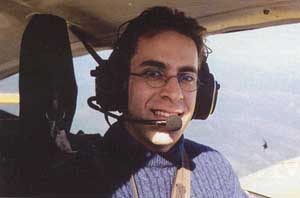
Ziad Jarrah, the hijacker who flew United Flight 93 into the ground. This photo really gets to me.  It was taken during his flight training in Florida in 2000. He looks like a pretty normal person, doesn't he?  I've stared at this photo, wondering how does a person go from smiling in a fairly normal way to hijacking a plane and killing scores of people.  Jarrah was born in Beirut, Lebanon, to an upper middle class family.  He, like the other hijackers, seemed normal, courteous, and friendly to Americans who met him in the years before the hijacking. One researcher who has studied the hijackers hypothesizes that it was becoming obsessed with religion, specifically with a doctrine that emphasized revenge and attacking others, that changed them.
(Photo from Wikipedia)

  • The plane plowed into the ground at 580 miles per hour, in an empty field in Shanksville, Pennsylvania, about 20 minutes' flying time from Washington, DC.
  • The impact was so great, followed by four explosions, the fire chief in the Shanksville Fire Department felt the ground shake.  In the fourth grade classroom of a nearby school, the ceiling tiles bounced and settled again.
  • Nearly all of the plane and everyone on it were blown to fragments. The coroner said, when he examined the crash site, the only recognizable body part he saw was "a piece of spinal cord with five vertebrae attached."  However, he never saw a single drop of blood. "The only thing I can deduce," he said, about why there was no blood visible anywhere, "is that the crash was over in half a second. There was a fireball 15-20 meters high, so all of that material just got vaporized." 


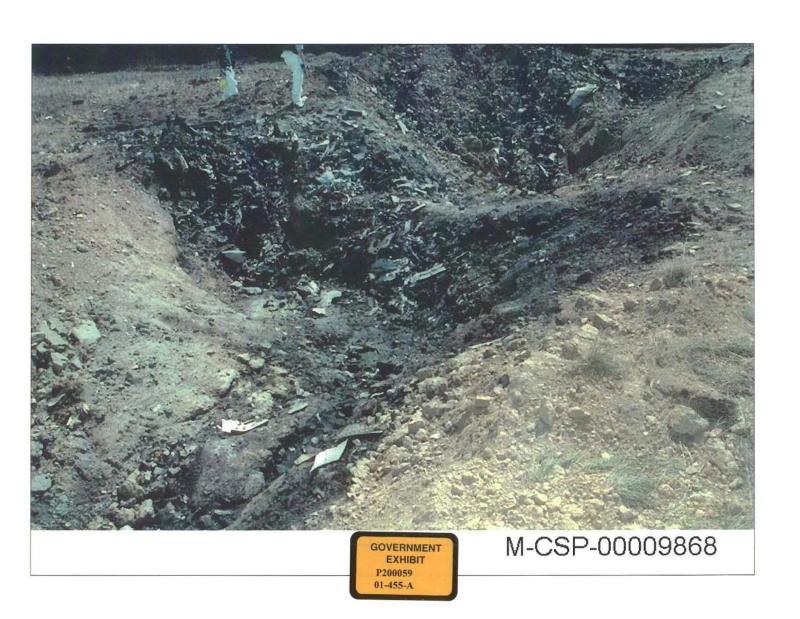
Flight 93's impact site. It looks like a bunch of burned dirt because when the plane hit the ground, large sections broke off, and the explosions burst those to fragments. The rear of the plane was driven into the ground, and the loose soil collapsed in around it, effectively burying it. (See On Hallowed Ground)
(FBI - investigation photo sourced from NPS site)

  • The passengers on Flight 93 never would have known about the other planes, and probably would not have resisted, had their flight taken off according to schedule. Flight 93's take-off was delayed 42 minutes because of too much air traffic at the airport in Newark.  Had the flight not been delayed, the passengers never would have known anything about the other flights and Flight 93 might have gone on to the hijackers' destination.
  • It was thought that this flight was intended to hit the White House, and that plan was actually discussed.  Interviews and testimony after the crashes revealed that it was probably intended to hit the US Capitol instead, which is more easily visible from the air.
  • 8 days after the crash, all the passengers and crew of Flight 93 were nominated for the Congressional Gold Medal.  It took until this year, 2014, before the medals were actually awarded. 
  • The Congressional Gold Medal is Congress' "highest expression of national appreciation for distinguished achievements and contributions." 


The Congressional Gold Medal awarded to the crew and passengers of Flight 93 that crashed in Shanksville, Pennsylvania, rather than into the US Capitol, thanks to their resistance.
(Photo from Coin Update)


Congressional Gold Medal awarded to the crew and passengers on the flight that crashed into the Pentagon, and to the people on the ground who were killed.
(Photo from Coin Update)


The Congressional Gold Medal awarded in honor of those killed at the World Trade Center towers. The numbers 11, 175, 77, and 93 on the front of the coin are the flight numbers of the planes that were deliberately crashed, and they are positioned as if on the face of a clock, at about the times when the planes crashed.
(Photo from Coin Update)


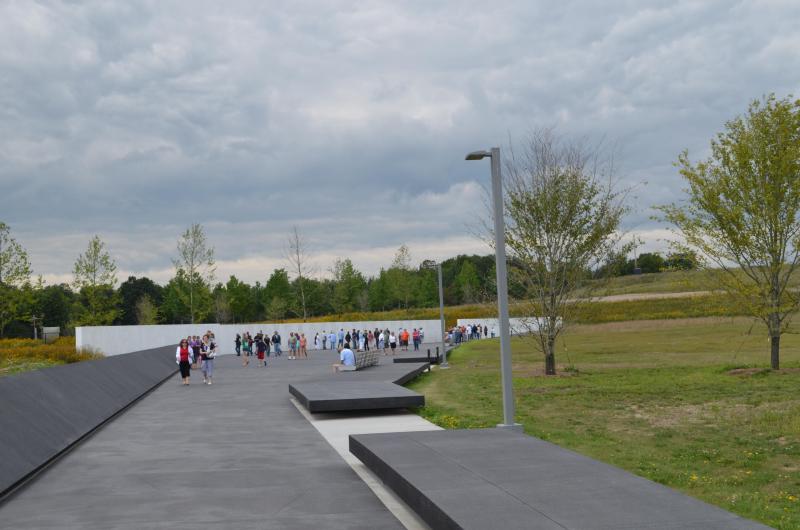
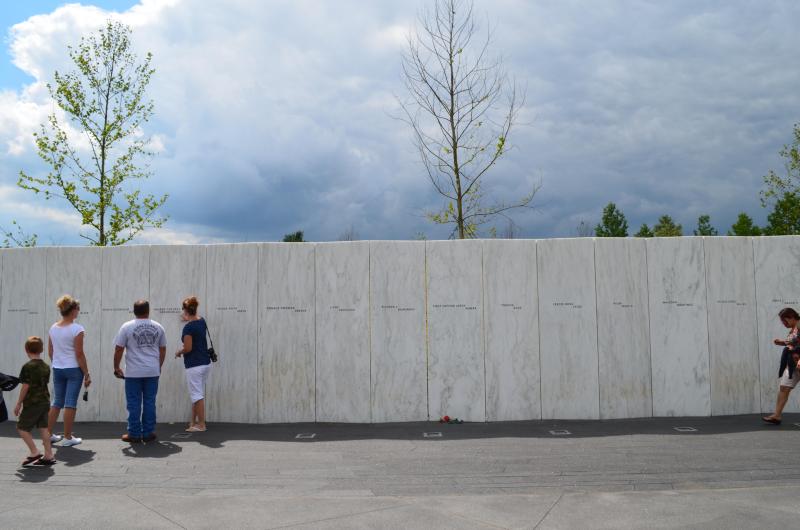
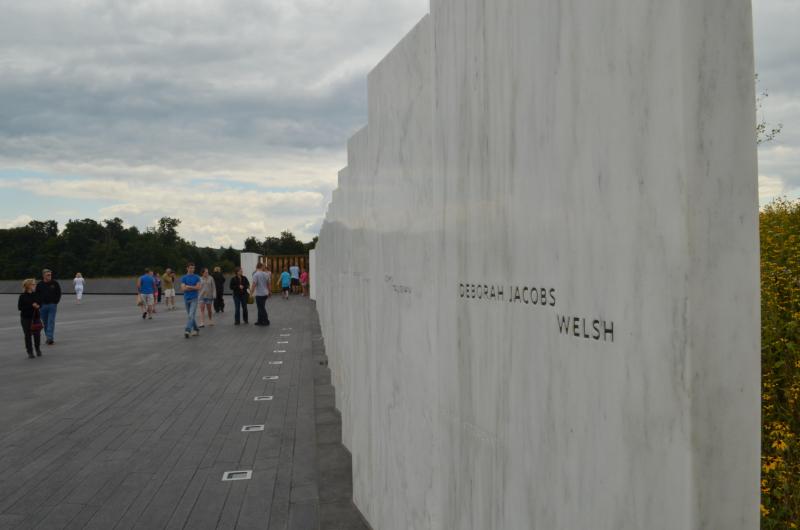
The site of the crash of Flight 93 is now a memorial site.  There is a large plaza with a walkway that leads to a wall bearing the name of each crew member and passenger. The entire memorial is surrounded by a field of wildflowers.


(Photos from the National Park Service Flight 93 National Memorial)


Their names are also engraved in bronze at the 9/11 memorial site in New York City.
(Photo by Amy Dreher, from the 9/11 Memorial)


That's all I can do for today.  I guess I'll have to break this into multiple posts.  Which means the flight that hit the Pentagon will be next.


Sources
National Commission on Terrorist Attacks upon the United States, "We Have Some Planes"
Tom Burnett Family Foundation, Transcript of Tom's Last Calls to Deena
The Age, "Let's roll": A catchphrase that became a battlecry, September 9, 2002
The Age, On Hallowed Ground,  September 9, 2002
Diablo Magazine, "This is Not my Life. My Life is Quiet, Suburban, and Ordinary." August 26, 2011
The Washington Post, The 9/11 Hijackers: Perfect Soldiers, May 1, 2005
Philly.com, Flight 93 families honored, and thanked, at U.S. Capitol (article),  Flight 93 families honored, and thanked, at U.S. Capitol (photos), September 11, 2014
US House of Representatives, Congressional Gold Medal Recipients

Monday, August 18, 2014

Apple #681: Airport Runway Signs

I have had a request!  Daily Apple reader Jamarcus wants to know, what do all those signs next to airport runways mean?  You know, the ones that look something like this:


This sign lights up so it will be visible to pilots at night. But what do the letters and numbers mean?
(Photo and sign from Astronics Corporation)


A very good question.  Something I have often wondered myself.

Before you can interpret the signs, it helps to know how things get named at airports.

Taxiways

  • There are taxiways, and there are runways.  Runways are the paved strips where planes take off and land.  Taxiways are the paved passageways the planes take to get from the terminal to the runway to take off, or from the runway where they've landed back to the terminal.
  • You definitely want to keep the two separate because you don't want one plane ambling down a runway as another plane is about to land there.
  • A lot more real estate is covered by taxiways.  Some of our airports are enormous, and a plane may have to travel quite a long way to get from the terminal gate out to the runway.  It will have to drive down a lot of taxiways before it gets to the runway.
  • Taxiways are indicated with letters, beginning A, B, C, etc.  All airports begin their naming of taxiways with A, and one taxiway can go for a really long way. So the signs you see from your airport window will most often have an A on them.  
  • Some airports are so big or have so many taxiways, they get up to G.  Theoretically, taxiways could be lettered all the way up to Z, and then get the letters doubled: AA, BB, CC, etc.  But in real life, it's rare that taxiways are named much deeper into the alphabet than G.
  • Taxiways can never be named H.  The letter H is reserved for helipads -- landing places for helicopters.
  • They can also never be named I or O, because those letters could be mistaken for numbers.
  • They can also never be named X because an X on a sign means the runway or taxiway is closed.
  • You will often see signs that combine a letter and a number, such as A1, or B3 (as above), or C2.  These indicate either:
    • a stub taxiway -- a connector that goes from a runway to a taxiway that runs parallel to the runway (a little cross-bar connector from a runway to a taxiway) 
    • or the exit or entrance connector that goes from a taxiway to & from the terminal. The connectors get named sequentially A1, A2, A3, etc. along the length of the taxiway.
  • Keeping all those rules in mind (and a few I've left out for brevity's sake), an airport also needs to make sure no taxiway has a name that could be confused with a runway, and no two taxiways have the same name. 


Well, this is hard to see. But the runways have the dashed lines, and the taxiways are thinner.  The taxiways are named, from top to bottom, A, B, and C, and the little connectors that go between the runways and the taxiways are named, from left to right, A1, A2, A3, A4, A5, A6, and A7, and then in similar fashion for the connectors that go off taxiways B and C.  The little taxiway that goes vertically, bisecting the runways and the parallel taxiways, is named J.  That one gets its own letter, as opposed to something like C5, because that's a high-traffic taxiway.
(Diagram from the FAA's Engineering Brief on Taxiway Nomenclature)


This isn't a real-life runway but a screen shot from a simulator, but it does the job for our purposes.  The runway is on the right, as indicated by the white markings. The taxiway, outlined in yellow, is on the left.  A taxiway stub connects the two.  The colored paint and types of markings is a whole other set of visual indicators for pilots.  
(Photo from SimFlight)

  • By the way, the names of taxiways are not pronounced as the letters (A, B, C), but by the names that correspond to each letter, according to the NATO phonetic alphabet (Alpha, Bravo, Charlie).   So taxiway A2 would be called "Alpha two."
  • Yes, this is the same alphabet popularized by Wilco's Yankee Hotel Foxtrot.

Runways

  • Runways get named using numbers.  The thing that determines which numbers get assigned to a runway is where the runway is relative to points on a compass.  Then it gets turned into a kind of code.
  • North, South, East, and West all correspond to degrees on a compass.  North = 360°, for example.  According to this runway code, you lop off the 3rd digit of the compass point.  So if a runway were pointing true north, it would get numbered 36.  For the 4 points of the compass, the code works like this:
    • North = 360° = runway number 36
    • South = 180° = runway number 18
    • East = 90° = runway number 9
    • West = 270° = runway number 27
  • But of course it's rare for a runway to be heading in exactly the position of one of the points of the compass.  So in most cases, the runway number is arrived at by rounding off ±5°.  Let's say a runway is heading 176°.  That's within 5° of 180°, so its runway number would be 18.
  • It is also of course likely that a runway won't fall within 5° of one of the ordinal points on a compass, so it is very likely that runways will be named other numbers besides these four.
  • Because there are only 360° on a compass, you can't have a runway with a number higher than 36.  Also, since North is indicated by 360°, there is no 0°, so there will be no runway named 0.
  • Finally, because you may be allowed to land on a runway from either direction, its name will often be expressed from either approach direction, as in ##-##.  The first number indicates the compass direction from one end of the runway, let's say, 22.  That means the runway's compass heading is 220° (or within ±5° of that).  So the second number will be 180° from 220°, which is 40°, which becomes number 40.  This runway's official name is therefore 22-40.
  • By the way, the runway numbers are not pronounced the way we normally pronounce two-digit numbers. They are said individually.  Not "runway twenty-two" but rather "runway two-two." Nine is pronounced "niner."  Yes, just like in Airplane!

Signs

  • Now that you know what the letters and numbers mean, let's look at some signs.


(Photo and sign from Astronics Corporation)

  • This is our sign from earlier.  Now we know that B means "Taxiway Bravo" and B3 indicates a taxiway stub or connector or exit.  Anything in a black box with a yellow outline means "this is where you are."  So this sign means "You are on Taxiway Bravo. Taxiway stub Bravo three is to the right."

(Photo and sign from Astronics Corporation)
 
  • Here's another one. This means "You are on Taxiway Alpha.  Taxiway Foxtrot is to the left or angled to the right."


(Image from Avery Dennison)

  • Let's try a little more complicated one.  This one means, You are on Taxiway Hotel 3, Taxiway Charlie is to the left, Taxiway stub Charlie two is angled to the upper right, and more of Taxiway Charlie is to the right.
  • The red circle with the white line through it means "CLOSED."  This sign seems to be saying a little too softly that Taxiway stub Charlie two is closed, but that's what it means.  
  • (I think in this case, Avery Dennison, a label-making company, is saying you could put one of our  temporary "CLOSED" sticker on your runway signs.  Really, the airport should put up a giant CLOSED sign and they're also supposed to paint big red Xs on the ground before a closed section.)


This is what a CLOSED, or NO-ENTRY sign should look like. Either this or a gigantic X. Big and obvious. No subtlety. 
(Image from the Aircraft Owners and Pilots Association) 

  • Those yellow signs are the kinds you see most often. Taxiway Alpha's exit is this way, etc.  Now that you've got those down, you'll be able to interpret most of the signs along the taxiways that you'll see from your airplane window.
  • But there may be other signs in other colors and letters.  What about those?


(Image from Holland Aviation)

  • By now you know the part in the black box means "You are currently on Taxiway stub Sierra six."  The stuff on the right you might guess indicates a runway named either "two four or zero six." You are correct about that, but since it's in red, it also means a whole other thing.
  • Red signs mean "stop" or "holding position."  This means the plane has to stop right here and wait until it gets the go-ahead from air traffic control to proceed onto the runway.  There will also be some yellow & black markings like crazy on the pavement next to the sign.  The plane is absolutely not to cross those yellow and black lines at all until the pilot gets the OK.


(Photo from Airchive)

  • What about this one?  It's a red sign, so you know it means stop, but there are no numbers on it, only the letters ILS.  That can't mean a taxiway, right?
  • Right.  ILS stands for Instrument Landing System.  This is the signalling system used by air traffic control to give pilots precise information about taking off from a runway, or landing on it.  The red ILS sign means this is a critical ILS zone, and "stop here and wait or you will interfere with ILS signals being given to planes taking off or landing on this runway."


(Image from the Aircraft Owners and Pilots Association)  

  • You might also see a red sign with two runway numbers followed by the letters APCH.  That stands for "Approach."  Like the ILS sign, this means you've entered the approach for a particular runway (runway 15, in this case), and you must wait here so you don't interfere with the ILS signals for incoming planes.


(Photo from Air News Times)

  • This image is kind of dark, but anyway, what does FBO mean?  That's not a taxiway either, right?
  • Right.  FBO means "Fixed-base operator."  It's basically the gas station for airplanes.  FBOs are typically businesses that operate independently of the airport -- Chevron, or Philips 66, or some other gas company -- but that serve airplanes at the airport.  They provide fuel for the planes, and they also may provide maintenance services, hangars, parking, equipment rental, and so on.  They are used most often by people who fly their own planes.


(Image from the Aircraft Owners and Pilots Association) 

  • This one you don't see very often, but MIL means a military installation is that way.
  • I think that about covers it.  Thank you for flying with the Daily Apple today.  Enjoy your destination.

Sources
FAA, Airport Marking Aids and Signs
FAA Engineering Brief No. 89, Taxiway Nomenclature Convention
Jim Sweeney, The Short Course: Airport Signs
Aircraft Owners and Pilots Association, Airport Signs and Markings
Nevada DOT, AOPA's Airports Signage & Markings (this uses the terms runways and taxiways interchangeably, which is very confusing)
AOPA's runway flash cards
Bangalore Aviation, Airport runways: All you wanted to know but were afraid to ask
Sploid on Gizmodo, This is what all the signs and symbols at the airport runway mean
Alpha Bravo Charlie.info
 

Monday, August 26, 2013

Apple #649: Service Dogs & Air Travel

Last time, I did an entry about dogs on airplanes.  I found out about how people can travel with their pet dogs (or other pets).  Basically, the rules are you can keep your pet dog with you in the cabin if your dog is really tiny.  Otherwise, the dog flies cargo.

But I did wonder about service dogs.  Most service dogs are much larger than the tiny size limits the airlines impose for pets in the cabin.  So are the rules for service dogs different?  Can people take their service dogs on board?  Or do size rules apply for service dogs, too?

And what does the TSA do when someone comes through the line with a dog, whether it's a service dog or a pet?


I wish I could say they'd let your service dog fly in the cockpit.  This is Nathan, and he's a service dog for the Coast Guard. So he gets to ride on Coast Guard airplanes.
(Photo by Cyndi Perry, from Coast Guard Compass)

Service Dogs -- Basic Rules

  • In a nutshell, yes, service dogs can travel in the cabin with the passenger.
  • Size rules do still apply, though.  The rules are a little less stringent than the rules for pet dogs, but the animal has to be able to fit under the seat or at the animal owner's feet without obstructing an aisle or another passenger's space.  If the service dog can't fit in the space available in the cabin, it has to travel in a carrier in cargo.
  • There are some exceptions to this rule. For longer flights such as to Hawaii or the UK, service dogs may travel in the cabin.
  • Airlines are not allowed by law to charge extra to travel with a service dog.  Whether the dog is with you in the cabin or in cargo, you won't be charged.
  • Some airlines will also allow you to ship your service dog's carrier as a checked bag, free of charge.
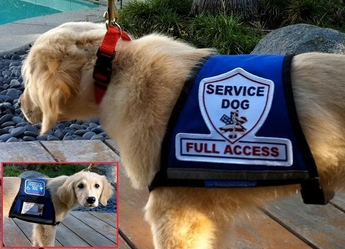
  • If the service dog is with you in the cabin, it has to be on a leash or harness, and it should also be wearing a vest or other garment that clearly indicates the animal is not a pet but is working.


This service dog vest is clearly marked and it includes an identification pouch. This one costs $60. They seem to fall in the $50-$75 price range.
(Photo from ServiceDogPatches.com)

  • You will not be required to show any kind of documentation that you need the service dog with you.  
  • Some working animals are designated as Emotional Support Animals (ESA).  These animals are there to help people who experience some kind of psychological or mental health distress.  If you are traveling with an ESA, you will probably be asked to show proof (like a signed letter) that a licensed medical professional has said you need to have this dog with you.
  • Whether your animal is a service animal, an ESA, or a pet, it's best to let the airline know as soon as possible, well in advance of the flight, that you'll be traveling with a dog. 


This service dog is probably too big to be allowed in the airplane cabin.  But look what a good dog she is!
(Photo from The Blackburn Review)

 Service Monkeys

  • Pretty much the same rules apply to service monkeys.  
  • Yes, there are service monkeys. Or helper  monkeys, as they're more often called.


A Capuchin helper monkey in action.
(Photo from Blogapova)

 TSA Screening of Service Animals

  • Basically, the TSA (Transporation Security Administration; the security people at the airport) are going to screen both you and your service animal.
  • Again, you'll need to have your animal on a leash or a harness, and the animal needs to be wearing some kind of identification saying this is a service animal. You should also tell the security officer that your dog is a service animal.
  • You and your dog on a leash will walk through the metal detector.  The dog can go before or after you, or you can go at the same time, they'll leave that up to you. 
  • If you don't want to go through the metal detector you & your dog don't have to.  But you would in that event have to submit to a full pat-down.  And the dog would still have to be "inspected." I think this means visually, and also a check of the garment the dog is wearing.
  • The security officer does have to ask before touching your service animal.  The security officer will know better than to pet, play with, distract, or feed your service dog. 


A woman and her service dog, Hosta, going through the metal detector in Kansas City. Hosta is still on his leash as he goes through the detector.  She's actually training her dog to be a service dog, so she and several other handlers are taking their dogs to the airport for trial runs.
(Photo from KSDS Puppy)


Since Hosta set off the alarm -- probably because of his leash -- he had to get patted down.  He didn't mind.
(Photo from KSDS Puppy)


Hosta the service dog waiting while his owner is patted down.
(Photo from KSDS Puppy)


Hosta the service dog waiting patiently for his bag.  OK, that doesn't really have to do with TSA screening, but I included it because I thought the picture was funny.
(Photo from KSDS Puppy)

  • If you set off an alarm but your dog doesn't, they'll give you further screening and they'll let you keep your dog with you.
  • If your dog sets off an alarm and you don't, they'll separate you and the dog while they give the dog further screening.  They won't take off the dog's harness/vest/backpack, but they'll search it to see what the dog might be carrying in there.
  • Wouldn't that suck if your service dog were a mad bomber and you didn't even know it?
  • Seriously, though, I'm not sure what they do if they find, say, explosive material on the dog but not on you.  Remove the explosive stuff, first of all.  I guess they'd probably detain you and the dog until they found out who put the explosive stuff in your dog's pocket.
  • One final note on this topic: If you've gone through security and you go outside to let your dog, you know, do its doggy thing, when you come back inside, you and your dog will have to go through the TSA screening again. 

 TSA Using Dogs, Too

  • While searching for information on this topic, I found a whole bunch of news articles about how the TSA is using dogs to screen passengers for bombs, guns, and any explosives.  They're hoping the dogs will help to reduce the long lines of people waiting to go through metal detectors.
  • Dogs have been used to screen cargo for several years now.  But dogs screening passengers is relatively new -- even though the TSA were given the approval to do that many years ago.
  • The passenger-screening dogs can detect a "vapor trail" of explosives, meaning they can detect a suicide bomb vest, a backpack containing explosives, or a firearm.  When the trained dog detects an odor of explosives, the dog will sit next to where it found the scent.
  • The breeds they're using include Labrador retrievers, Vizslas, German shepherds, and Belgian malinois -- all breeds with an especially keen sense of smell, or they're good with people, or both.


One of the TSA working dogs.  Note the TSA patch on his vest.
(Photo from NBC-2 in Florida)

  • In early July, they announced they're trying out the dogs in Honolulu, Tampa, Indianapolis, Chicago, Denver, and Washington Dulles. If all goes well there, they'll use more dogs in more airports.  I think they must have since decided it's going all right, because that dog in the picture above was being used at the Southwest Florida International Airport in Fort Myers.
    • The GAO (General Accounting Office) is skeptical about all this because according to their tests, the dogs weren't all that effective.  They said the TSA wasn't meeting the requirement that the canine teams get 4 hours of training every 4 weeks, the TSA doesn't keep track of which dogs are best at finding which  type of explosive material, and sometimes the dogs miss explosives or they say they've found something when there aren't any explosives present.
    • Apparently, also according to he GAO, the reason the dogs are being used on passengers at on some airports and not others is because officials at some airports have concerns about the "composition and capabilities" of the passenger-screening dogs, and they've said you can use the dogs on cargo at our airport, but not on people. 
    • The TSA responded to that report by saying, we're going to do better about complying with training requirements, and we'll keep doing assessments of the passenger-screening dogs that are being used so we can see where we need to improve.
    • Further evidence that the TSA doesn't have this down quite yet: in May, one TSA bomb-sniffing dog in Atlanta bit a passenger in the stomach.  The woman took a picture of the bite, and it looks pretty bad, actually.  The wound has now healed, the woman got a bunch of rabies shots, but she needn't have because the dog had been up to date on its rabies vaccine.
    • The woman wasn't even flying.  She was waiting in the baggage area to meet her sister, and the dog came up to her and bit her.
    • Now, here's another question: what happens when a TSA bomb-sniffing dog meets a service dog?  And what if the service dog is carrying explosives?  One hopes that it would all go well from a dog-civility standpoint.   But is this a scenario the TSA are trained to handle?


    The TSA names their bomb-detection dogs after victims who were killed in the 9/11 attacks.  These bomb-sniffing Labrador puppies in training are named Hoey and Hatton.
    (Photo by Reuters, from Travelers Today)


    Sources
    National Service Animal Registry, Flying with Service Dogs and Emotional Support Animals
    Alaska Air, Service and Emotional Support Animals
    American Airlines, Service Animals
    Delta Airlines, Service Animals
    United Airlines, Service Animals
    Transportation Security Administration, Service Animals and Passengers with Service Dogs and TSA Dogs & Aviation Security
    NBC News, TSA dog bites passenger at Atlanta's Hartsfield-Jackson airport, May 13, 2013
    Atlanta Journal-Constitution, Explosives-sniffing dog bites woman at airport, May 10, 2013
    CBS This Morning, TSA trying out screening with dogs, July 3, 2013
    Houston Chronicle, TSA tests bomb-sniffing dogs in a select few airports, July 4, 2013
    USA Today, GAO questions using TSA dogs to screen passengers, January 31, 2013
    The Hill, TSA ineffectively using bomb-sniffing dogs, GAO report finds, February 1, 2013

    Monday, August 19, 2013

    Apple #648: Dogs on Planes

    When I recently traveled by airplane, one of the passengers on the first leg of my trip had a very small dog with her.  While we were waiting for boarding to start, she had the dog on a leash, and he was pretty docile, sniffing various things, watching me very closely as I ate my tuna sandwich.  When it was time to board, she put the very small dog into a dog-carrier that had a shoulder strap.  It was about the size of carry-on luggage.  She also had a purse and another carry-on.


    This is very similar to the dog I saw, and the carrier is similar too.  Except the one I saw was pink.
    (Photo from Animal Planet)


    I might have thought nothing of this, but on my return trip, a different woman had her very small dog with her.  It looked like a miniature Boston terrier.  Again, I noticed the dog while waiting to board.  She & the dog were both napping, the dog lying across her stomach like a small belt.  I lost track of the two once we boarded, but after the flight when I was walking through the airport, I saw the two of them, the tiny Boston terrier now on a leash, at one of the food stores.  The dog was sniffing about but otherwise waiting patiently while the woman picked out an apple.

    So I had to find out.  Dogs are allowed on planes?  And they're allowed in airports?  What are the rules about dogs and airplanes?

    • First of all, regardless of whether your dog travels in the cabin or in cargo, you will have to show that your pet is healthy.  You'll have to get a health certificate from your vet that says your pet is healthy and will be OK to fly.
    • After that, the rules about taking dogs on airplanes differ, depending on where the dog will be traveling.  You've got 2 options: in the cabin, or in the cargo space. 

    In the Cabin

    • This is the friendlier option of the two because this means you get to keep your dog with you.  But in order to be allowed to bring your dog on board with you, many many conditions must be met.
        •  Only very small dogs are allowed in the cabin. 
        • The dog has to be able to fit comfortably in a carrier that measures (depending on the airline) 8-9 inches high x 12-13 inches wide x 15-23 inches long.  Some airlines also require that the dog in the carrier must fit under the seat.
     
    This soft-sided dog carrier is 9" x 10" x 15".  And it's camouflage.  And it's got Martha Stewart's name associated with it.  All of which may be a bonus, or it may make you gag.
    (Photo & carrier from PetSmart. It's currently on sale for $48) 


    If you've got your pet in a carrier on board, most airlines will say the carrier has to fit under the seat in front of you.
    (Photo from PetRelocation)

        • The dog must be older than 8 weeks.
        • You might want to be even safer and wait until the dog has had its vaccinations, which happens at 10-12 weeks.
        • Some airlines say the dog + kennel can't weigh more than 20 pounds.
        • Some airlines say certain breeds, even if they are small enough & old enough, are not allowed to fly.  Snub-nosed dogs such as pugs, shih tzus, Pekingese, and bulldogs, which already have breathing difficulties and may not handle the changes in air pressure, are often not allowed to fly. This goes for snub-nosed cats too.  The Humane Society says it doesn't matter which airline, don't bring these types of animals on a plane; it's too dangerous.
        • If you want to bring more than one small dog with you, the airline may refuse.  That is, they might let you take one, but not more than one.
        • Some airlines have a limit on the total number of dogs & cats on board.  So your dog may meet all the criteria, but the airline could say, sorry, we've already got 5 dogs in the cabin on this flight, and we can't allow another one. 
        • If your dog meets all these criteria, bringing your dog on board will cost you an extra $100 to $125, depending on the airline, each way.  You don't have to buy an extra seat, especially since the kennel will probably have to be stowed under the seat in front of you.  But you will have to pay an extra fee.
        • Each airline has slightly different rules, so if you do want to bring your dog in the cabin with you, check with your airline to see what they require.


    Here's another type of small-dog carrier.  This one is a backpack but it also has a telescoping handle and the wheels so you could tow it around like a carry-on.  It measures 18.5" H x 11.5"W x 13"L.  This is the Casual Canine Deluxe Backpack Pet Carrier On Wheels from Amazon. Egad, it's $73.

    In Cargo

    • From what I've read, if you can't take your dog in the cabin, I think you're better off not bringing the dog at all.  Because dogs flying cargo can encounter all sorts of problems.  But first, the rules.
        • The pet carrier must have solid sides and it must be large enough for your dog to be able to stand up without hitting his or her head and wide enough so your dog can turn around easily.


    Here's a solid-sided pet carrier that you could use for in-cargo travel. It opens at the top and at the front, and it has a handle.  Water cup, dachshund, cat, and parrot not included. This Petmate Two Door Top Load 24-Inch Pet Kennel, Metallic Pearl Tan and Coffee Ground Bottom sells on Amazon for $39.

        • The carrier must be properly labeled with your identification and the final destination.
        • The carrier must have 2 plastic dishes, one with food and one with water, that attach to the inside of the carrier door.  Some people put ice cubes in the water dish because they won't spill, but they will gradually melt so the animal will have water. 
        • Some airlines also require that a small bag of food be taped to the top of the carrier -- though I don't know what that would do except drive your pet nuts with the smell of food it couldn't reach.
        • Some airlines also require some kind of padding in the carrier, like a blanket or a newspaper or a doggy pad.
        • Some people take the extra precaution of attaching a battery-powered fan to the inside of the carrier.  This isn't required, but many airlines think it's a good idea. 


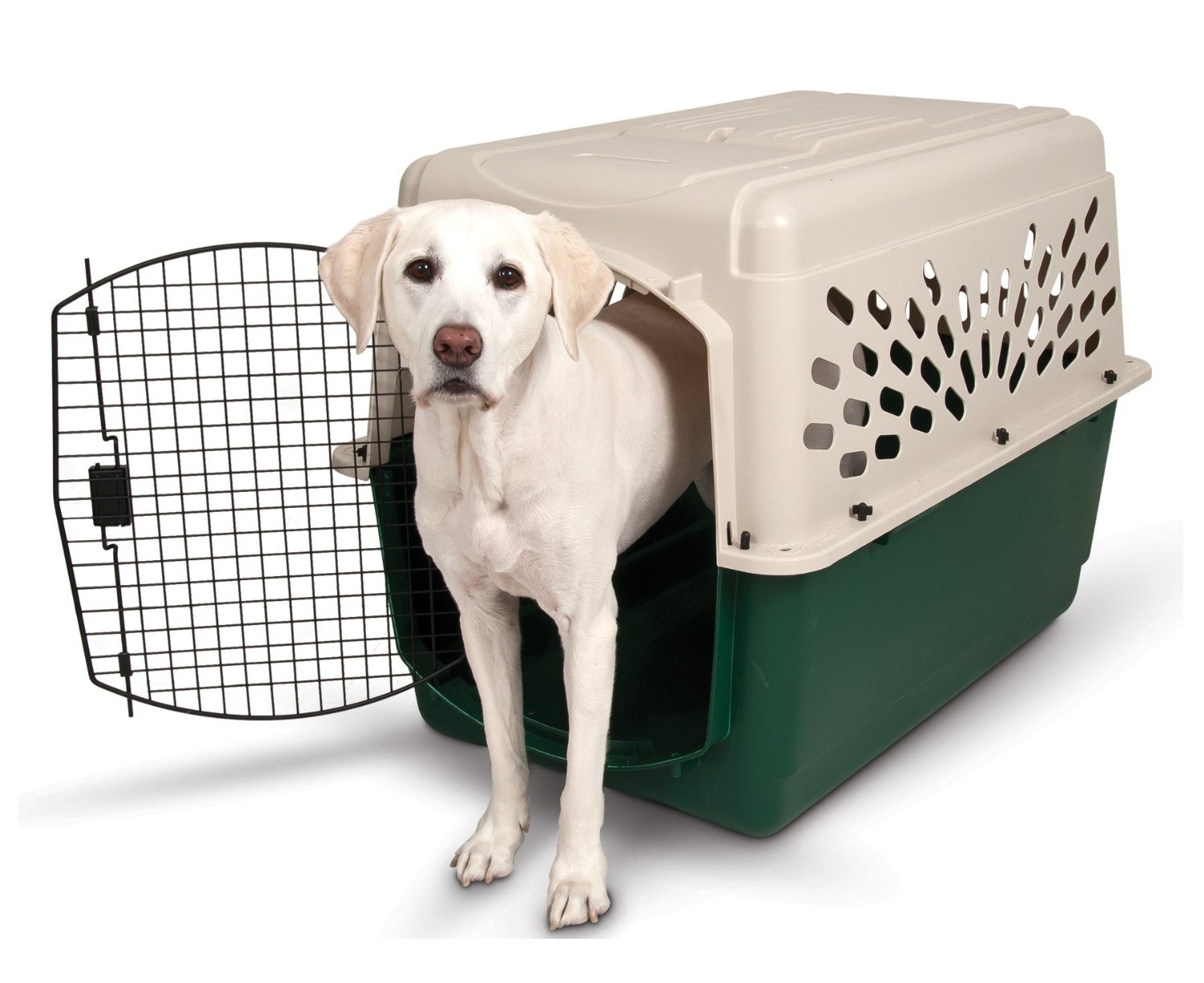
    This is a large-pet carrier, but I'm not really fond of it.  There isn't a lot of ventilation.  The door is a grid and there are some openings on the upper sides & back, but there's no ventilation on top, and the the lower sides are solid.  This is typical of the larger-dog carriers that I saw.  I don't know why they give the big dogs less ventilation.  Seems like they ought to have more.  This is the Remington Pet Kennel, 40-Inch for Pets 70 to 90-Pound, Beige/Remington Green. Amazon says they don't have any in stock right now, but it looks like you might be able to get it from Walmart.

    • "Cargo" used to mean that the pets were put in the same place with the baggage.  Many newer jets now have a special area separated from the baggage compartment where animals are kept.  
    • But the pet cargo space is still under the belly of the plane where there are no people to look after the animals during the flight, which means many problems can happen.  
        • Someone's pit bull was in the cargo hold for a really long flight, and in that time, it chewed on its kennel trying to get out to the extent that the dog seriously injured its mouth. Who knows what would have happened if the dog had managed to get out of its kennel.  
        • Someone else's Golden Retriever gnawed at the zip ties holding its kennel door shut, the zip ties got lodged in the dog's throat, and the dog had to be euthanized.


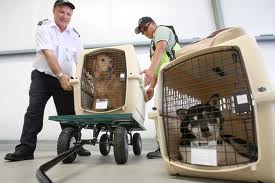
    These 31 kennels each contain a working dog that worked for the military spotting IEDs in Iraq.  They're being brought back home to the States. This situation is a little unusual, in that 31 dogs were transported on a single plane, and several dog caretakers were on hand at each stage of the 3-stop flight to make sure everything went smoothly.  But imagine this on a smaller scale, and that might give you an idea of what the pet cargo area might look like on a commercial flight.
    (Photo from Move One)

    • The pet cargo area does have ventilation and heating or cooling necessary to allow the pets to travel safely--most of the time. But conditions can get a bit dicey.
    • If the air temperature outside gets above 85F or below 45F, the cargo hold's ability to compensate is not as good and your pet could be at risk for becoming overheated or freezing.  In fact, many airlines won't let you put your pet in the cargo hold if the weather forecast predicts temperatures above or below those limits.
    • But sometimes--heck, often--those forecasts are wrong, and the temperature can go higher or lower than expected, and your pet could be at risk.  Some pets have died in the cargo hold for this very reason.
    • It's also possible that the flight could be delayed and the cargo hold could get too hot, or your pet could get dehydrated.
    • A member of the ground crew is supposed to put the pets into the cargo hold, but it sometimes happens that a dog busts out and gets loose on the runway.  One cat escaped and was lost in the airport for more than 2 months.  


    Ground crew loading dogs for flight in cargo.  The dogs don't look too sure about this.
    (Photo from Animal Radio)

    • Other things can go wrong with the cargo loading.  One cat's kennel was stacked on top of another, and the one on top fell, landed on the door which broke, and the water spilled, and the cat was so severely dehydrated and malnourished by the end of the flight, it had to be euthanized.
    • So while there are fewer restrictions on bringing your dog along in cargo, there are also a lot more risks.  In fact, most airlines require you to sign a liability waiver, meaning you won't try to sue them if your dog dies in the cargo hold.  To me, that says, don't do it if you can avoid it.


    OK, now I'm just enjoying these pictures of dogs in carry-on luggage, and by posting more of them, I'm totally undermining my stern warnings.  This is the Snoozer Roll Around 4-in-1 Pet Carrier, Red & Black, Medium, also available through Amazon. It currently sells for $71.


    The Data

    • The airlines are required to report animal deaths, injuries, or losses, but their reports are pretty out of date.  Some guy named Jol Silversmith who is interested in all sorts of arcane facts that must be divulged by law has been keeping track of animal incident reports on a much more current basis.
    • According to that data, from January to June 2013, there were 11 animal deaths, 4 animal injuries, and 2 animal losses.  That's for in-cabin and in-cargo travel both.  That doesn't seem like a lot, less than 1 death per month, but it doesn't say how many animals flew, so it's hard to know the percent risk of pet-death or -injury due to airplane flying.
    • If your pet does die during the flight, the airline will pay for a necroscopy (like an autopsy) to find out why your pet died.  They report the results of the necroscopies, and that's where this data comes from.
    • Besides overheating or overcooling, something that seems to happen a lot is the flight worsens existing health conditions, like heart disease or kidney problems or cancer, that not even the vet knew about.  These animals are smaller than we are, and their hearts and kidneys and blood vessels may not be as good at withstanding the pressure changes.
    • So you can take your dog (or cat or other pet) on a flight with you.  It just might not be the best thing for the dog, especially if it would have to fly cargo.
    • The Humane Society agrees with me. "The HSUS recommends that you do not transport your pet by air unless absolutely necessary."  That's their boldface, not mine.


    Pugs and other snub-nosed dogs especially should not fly.
    (Photo and fridge magnet from Zazzle)

    More Tips

    • If you absolutely do have to bring your dog on the plane, here are some good ideas, whether the dog is flying cargo or in-cabin:
        • Make sure your pet's collar can't get stuck on the carrier door.
        • Put your identification & contact info on the pet's collar as well as on the carrier door. 
        • Clip your pet's nails before the flight.
        • Don't feed your pet 4-6 hours before the trip.
        • Don't give your pet tranquilizers, unless the vet says to do so, and gives you tranquilizers specifically for air travel.
    • Carry a photograph of your pet so if your dog does bust loose, you can show people what he or she looks like.
        • Start getting your pet used to the carrier at least one month before air travel.  Do everything you can to make sure Mitzi is as calm & comfortable in there as possible.  You do not want her freaking out in her carrier in the cargo hold and possibly injuring herself when there's no one around to help her.


    I'm going to say it one more time.  While it might be nice to have your dog with you when you get to wherever it is you're flying, it's probably better for the dog not to get on that airplane in the first place.

    Related entry: Service Dogs on Planes


    Sources
    DogFriendly, The Real Scoop on Pet Air Travel in 2013
    For Dummies, Traveling with Your Dog by Jet Plane
    The Humane Society of the United States, Travel Safely with Your Pet by Car, Airplane, Ship, or Train
    Huffington Post, Pet Deaths in Airplanes Continue, Pressuring Airlines to Change Policy, October 4, 2012
    Animal Planet, 5 Tips for Taking Your Small Dog on a Plane
    Mother Nature Network, Family mourns pug's death on transatlantic flight, November 16, 2011
    Third Amendment, Animal Incident Reports Month by Month