Showing posts with label mythological creatures. Show all posts

Sunday, September 7, 2014

Apple #683: Days of the Week

I was thinking about doing a Daily Apple on Tuesday.  Wednesday is hump day, Thursday is now apparently throw-back Thursday, Friday is the end of the work week, but what about Tuesday?  No one pays any attention to Tuesday.  Except sometimes there are two-for-Tuesday things.

I wondered what Tuesday is named for.  I don't know if I was taught this way, or if this is something my brain came up with on its own, but I thought that the days of the week were named for Roman gods.  Saturday is named for Saturn, obviously.  The other ones I was less sure about. Thursday must be named for Thor -- not Roman, but still a mythological god.  Friday was maybe named for Friya.  But again, what about Tuesday?  Could there be some relationship to the word "two?"



Days of the week -- in bottlecaps
(Photo from BeansThings on Flickr)


Wrong. Some of my assumptions were actually correct, but for wrongity wrong reasons.  Saturday is in fact named for Saturn, but, oh, let me show you what I found out.

  • The days of the week are named for the planets in our solar system, including the sun & the moon. (The planets are named for gods, so there's some overlap here.)
  • This is more obvious in the Romance languages than it is in English. 
  • Let me show you with a table.  Blogger is terrible at handling tables, so I hope this turns out OK.

 
Day Celestial Body French Spanish Italian
Sunday Sun Dimanche Domingo Domenica
Monday Moon (Luna) Lundi Lunes Lunedì
Tuesday Mars Mardi Martes Martedì
Wednesday Mercury Mercredi Miércoles Mercoledì
Thursday Jupiter (Jove) Jeudi Jueves Giovedì
Friday Venus Vendredi Viernes Venerdì
Saturday Saturn Samedi Sábado Sabato

  • It's really easy to see where French, Spanish, and Italian used the names of the planets for their days of the week.  The only one that doesn't quite fit is Sunday.  In these languages, their word for Sunday means "Day of the Lord."
  • I suppose if the Earth's rotation had allowed for more days of the week, we'd also have days named after Uranus and Neptune and maybe even Pluto.
  • But hang on a minute.  The order of the planets in this list does not correspond with the order in which we usually think of them, in terms of their distance from the sun.

 
Nine planets (minus Pluto) and their position relative to the sun. This is not how our days of the week are ordered.
(Image from Nine Planets)

  • Here is what some people have proposed as the reason for this order.  Put the celestial bodies in our list in a circle, assuming Earth is at the center.  Order them according to their time of revolution around the earth, and you get this:

(Diagram from The Calendar FAQ)

  • OK, now start with the moon (Monday), and count one position clockwise around the circle for each hour of the day: Saturn 1, Jupiter 2, Mars 3, Sun 4, Venus 5, etc.  Stop when you hit 24 and your finger will be on Mars.  The next day of the week.  Do the same thing again, beginning with Mars, and the 24th position will be Mercury. And so on until you have the planets listed in the order we've seen above.
  • Pretty clever, eh?
  • So why don't our words for days of the week look like those French & Spanish words?   Why isn't our Tuesday more like Mars Day?
  • Answer: because of that whole Old English thing.

Celestial Body Old English Current English
Sun Sunne Sunday
Moon (luna) Mona Monday
Mars Tiu Tuesday
Mercury Wōden Wednesday
Jupiter (Jove) Þunor Thursday
Venus Frigg Friday
Saturn Saturnus Saturday

  • You can definitely see the similarities between Old English and our present-day English.
  • But it sure seems like a big leap from "Mars" to "Tiu," and from "Mercury" to "Wōden." And what's that weird letter Þ?
  • Tiu -- sometimes spelled Tiw, this was the name of the Old English/Germanic god of war.  Mars was the Roman god of war.  Tiu's name is a descendant of the old Norse name for their god of war, Tyr.  Just as people say the Roman god of war, Mars, and the Greek god Ares were the same thing (though they kind of weren't), so you could also say that Tiu and Mars were pretty much the same gods. Tiu is also known as the god of hand-to-hand combat, heroism, and justice.


This is Tiu, or Tiw.  He was kind of a bad-ass.  There was a seriously bad wolf, Fenrir (hello, Harry Potter fans) whom the gods were trying to tie up and subdue. The wolf said he would never give up unless one of the gods put their hand in his mouth. Tiu was the only god who had the guts to do so.  The dwarves made a magical ribbon and the gods used it to bind up the wolf, but not before he'd bitten off Tiu's hand. So Tiu is often depicted as being one-handed.
(Image from Saxons and Vikings in Britain)


  • Wōden -- this is another descendant of a Norse god, in this case, Odin.  Wōden was an Anglo-Saxon god who was the big cheese, in charge of all sorts of things. He created the earth and sky out of the body of a dead giant, he made the first man and woman, and he made the laws that govern the universe.  You'd think that would make him like Jupiter/Jove, but he was also the god of learning, poetry, and magic. So he got correlated with Mercury, who was the god of poetry, communication, speed, trickery, and the escort to Hades.  Tiu (or Tiw) was one of his children.


This is Odin, the Norse god whose Anglo-Saxon counterpart was Wōden. Odin was seriously cool. He's flanked by his two ravens, Thought and Memory, who flew off and came back to him with news of each day's events. It's hard to see it in this drawing, by he's often shown missing one eye because he agreed to lose one for the privilege of drinking from the fountain of wisdom.
(Image from U Colorado Mythology Course)


  • Þunor -- First of all, that weird letter Þ is called a "thorn." It's from the Old English alphabet and it's pronounced th. So you'd say this name Thunor.  Looks like thunder, doesn't it?  This is the Anglo-Saxon god whose counterpart in Norse mythology is Thor, who was the god of thunder, lightning, storms, oak trees, strength, and war. (I'm beginning to wonder, who wasn't a god of war?)  Þunor was another son of Wōden's. 


Þunor, or Thor, using his hammer to fight off the giants. In addition to all those other strong-man things, he was also the god of protection of humankind.
(Painting by Winge, 1872, from Wikipedia)
 
  • Frigg --  Frigg was the wife of Wōden. Sometimes her name is spelled Frigga. Some say she is not the same goddess as Freya; others say she is very similar and so might be the same.  She is the goddess of love, marriage, and motherhood.  She weaves the web of destiny, so she knows everyone's fate, but she does not reveal it. This may explain why Friday is such an exciting day of the week.


Frigg, goddess of love and marriage and motherhood, and also weaver but not revealer of destinies. She looks like she knows more than she's telling, doesn't she?
(Image from Norse Gods and Goddesses)

  • The rest of the days -- Sunday / sun; Monday / moon; Saturday / Saturn -- seem pretty obvious, so I won't go into them in detail. You get the picture.
  • You might be thinking, well, this is only Western cultures that have named their days of the week this way.  
  • It is true that in many other languages, the days of the week are simply numbered -- 1st day, 2nd day, 1st day off, 2nd day off.  
  • But take a look at the days of the week in Japanese:


Orthography Romanization Translation
Sunday  日曜日  nichiyōbi  Sun day
Monday 月曜日  getsuyōbi Moon day
Tuesday  火曜日  kayōbi Fire day
Wednesday 水曜日  suiyōbi Water day
Thursday  木曜日  mokuyōbi Wood day
Friday  金曜日  kin'yōbi  Gold day
Saturday 土曜日  doyōbi  Earth day


  • You might think at first that this is a completely different method for naming the days of the week -- at least, except Sunday & Monday.
  • But if we look at these names through the lens of the Chinese theory of the five elements (yes, I know Chinese and Japanese culture are two different things, but they did borrow things from each other quite often), you start to see something pretty familiar.  Remember, the Japanese terms are elements.
    • Fire -- the color red, south, summer, midday, and the planet Mars
    • Water -- the color black, north, winter, midnight, and the planet Mercury
    • Wood -- the color green, east, spring, dawn, and the planet Jupiter
    • Gold -- the color white, west, autumn, dusk, and the planet Venus
    • Earth -- the color yellow, the center, the end of each season, and the planet Saturn
  • Adding those definitions to our chart, we get this:


Orthography Romanization Translation Celestial Body
Sunday  日曜日  nichiyōbi  Sun day Sun
Monday 月曜日  getsuyōbi Moon day Moon
Tuesday  火曜日  kayōbi Fire day Mars
Wednesday 水曜日  suiyōbi Water day Mercury
Thursday  木曜日  mokuyōbi Wood day Jupiter
Friday  金曜日  kin'yōbi  Gold day Venus
Saturday 土曜日   doyōbi  Earth day Saturn

(with thanks to Bathrobe's Days of the Week)

  • Again, pretty cool, eh?
  • By the way,  the days of the week in Chinese (Mandarin), are essentially numbered, as in ritual-day one, ritual-day two, ritual-day three, etc.  
  • However, there is one old set of names in Mandarin for the days of the week that nobody uses anymore, and that set is based on the planets.  
  • The theory, very speculative, is that the planet-based names originated in ancient Mesopotamia and Egypt. That tradition was picked up on by the Greeks and Romans and spread through the Western world. It also traveled westward to cultures in Persia, the Middle East, and Central Asia, and eventually reaching China and Japan.


Sources
Oxford Dictionaries, Just Plutonic? Roman gods and their relationship to the days of the week
Bathrobe's Days of the Week, In the West, Japanese, Chinese
The Calendar FAQ, The Week
Lawrence A. Crowl, The Seven-Day Week and the Meanings of the Names of the Days
Calendars through the Ages, Our Seven-day Week
Infoplease, Woden
Behind the Name, Þunor and Thor
Encyclopedia Mythica, Frigg
Norse Mythology for Smart People, Frigg

Monday, May 14, 2012

Apple #582: The Truth about Ninjas

I have a new pair of shoes that are black, slip-on, with fabric uppers and soft soles. They're very comfortable and quiet when I walk around in them, so I've taken to thinking of them as my ninja shoes.  I've said such phrases to myself as, "Where are my ninja shoes?" and "I'll wear my ninja shoes today," often enough that I started to think about ninjas.

There are of course all the very fun but exaggerated depictions of ninjas as stealthy, black-clothed, face-masked, sword-carrying fighters who drop in, slice an enemy to ribbons, and vanish immediately. It's all very mythical and tall-tale.  But those depictions must have come from somewhere.  Were there real ninjas once upon a time?  Were they anything like the way we think of them today?


Ninjas as we think of them today: black-suited, faceless, armed with throwing stars, and so full of secret mysterious powers, they're not really real. Except to be really awesome!
(Image from Alt World)

  • Yes, ninjas really did exist.  But the information we have about them is sketchy because (a) it was a long time ago and (b) they were secretive by design, so they didn't exactly keep a whole lot of records about themselves.
  • As a result, there is quite a bit of disagreement and uncertainty about what was actually true about ninjas back in the day. So what follows represents people's best guesses today about ninja history.

History
  • Ninjas were hired spies or assassins in Japan between the 11th and 16th centuries.  So while Europe was having its monks and Middle Ages, Japan was having its ninjas and samurai.
  • They were kind of always outsiders from the get-go.  The story goes that as dynasties were falling in China and rulers and monks were fleeing from China into Japan, they brought their fighting tactics with them.
  • In the meantime, Japan was controlled by a ruling class of warriors who followed strict codes of fighting. In a battle, a samurai would select a single opponent to challenge, recite his family lineage, and then attack.  Samurai wore armor and bright colors and were very much full of family pride and loyalty. 

Samurai warriors in their armor. I bet they made a lot of clanking and banging when they walked around. What does the Wizard of Oz call the Tin Man?  You clinking, clanking, clattering collection of caligenous junk! That's probably what ninjas thought of samurais.
(Photo from Music Lovers)


  • Some of the people whom the samurai had defeated were pretty ticked off at them.  They wanted to fight and defeat the samurai, but they needed help. So they turned to the ninjas. 
  • Ninjas (shinobi or shonobi) had become a group living in the mountainous Iga province and in a smaller area called Koga, in the southern part of the Omi province.  
  •  

The box in red shows the Iga province and part of the Omi province where the Ninjas lived.
(Map from Iga & Koga)

  • Nobody is really sure who the first ninja was or how there came to be enough of them that they formed a community -- two communities actually -- except that it didn't take long before ninja parents were teaching their children how to be ninjas too. The techniques they used to fight have been traced back to China (and before that, India), so it seems that the Chinese monks trained various villagers and farmers in the ninjas' art of ninjutsu.
  • Ninjutsu is, like karate or tae kwan do, the name of a fighting technique which encompasses methods and skills for fighting, as well as all sorts of philosophies about enemies and allies and ways of living and so on.  Ninjutsu is still taught and practiced around the world today.  I'll get into the details of ninjutsu in a bit, but the short version is that it's about being stealthy, blending into the background, and doing the unexpected.
  • So some samurais hired some ninjas to be spies and assassins on their behalf.  With the ninjas' help, the samurais could employ all sorts of shady techniques without ever doing such dirty work themselves.  The ninjas were very effective, so the samurai boss would win the fight thanks to the work of the ninjas.
  • After witnessing the prowess of the ninjas, other samurais hired ninjas to fight their battles, and back and forth and so on.  This went on for years. Decades. Centuries, even, through all sorts of wars and political upheavals and changes in emperors.
 
Ishikawa Goemon is a cult hero, thanks to Kabuki plays and more current anime tales. Some people say he was a ninja. Others say he was simply an ex-samurai turned thief with a band of robbers who stole from the  rich and wound up getting boiled to death.
(Image from Iga & Koga)

  • Through all of that, even though the ninjas were hired by the rich guys, the ninjas retained their status as lower class common people, and as outsiders.  While a few ninjas came to be known for their abilities, for the most part, they remained largely not-famous.  Since they would fight for any side, and so potently, in time, the samurai and the warlords came to fear the ninjas as much as they were helped by them.

Hattori Hanzo is another figure who is said to have been a ninja. Actually, he was born a samurai, and he enlisted the help of ninjas from the Iga province. His legacy today is that he became a master ninja, but that's probably myth-making after the fact.
(Image from Wikipedia)

  • Finally, after a prolonged civil war in Japan, in the late 1500s a warlord who sought to unify the country saw the ninjas as a threat to that unity and stability.  He attacked them openly at their stronghold at Iga. Fighting out in the open in one huge group was not the ninjas' strong suit, and they were routed. Some survivors stayed in the service of the warlords, but others fled to the mountains where they continued to practice and teach ninjutsu, though in far smaller numbers.
  • Ninjas pretty much faded out of the historical picture, but they never left the memories and imaginations of many Japanese. So their mystique has persisted into our culture today.

How They Fought
  • The details get especially fuzzy here because, in addition to all the other reasons why ninja history is unclear, ninjutsu is still practiced. There is a lot of disagreement over whether certain techniques or implements were really used back then, or if x and y are things that have been added since.
  • For sure, ninjas were trained to move and walk quietly and without being observed. They used secret codes and aliases. They did not want to reveal themselves when they were on a mission, or at any other time if they could help it.
  • So they wore, not black suits with masks which would have made them very conspicuous (that's actually a costume from Kabuki theater), but rather the clothes like the peasants they moved among. If they were to be operating at night, they wore dark blue, not black.  Sometimes they posed as Buddhist priests, or flute players whose flutes held poisoned darts, or -- I kid you not, one site says this -- candy salesmen.
  • A few ninjas were women. Sources disagree about how common it was for women to be ninjas, but there were female ninjas. 
  • Sidenote: Ninjutsu classes for women are now huge in Iran.It's estimated there are some 3,500 women trained in ninjutsu. Some people interpret this to mean that Iran's government now has all these potential female spies they can put to use. To me, it looks like this is a rare opportunity for women in Iran to feel like they have some power and control in their life.

Women in Iran studying Ninjutsu say they like it for the way it balances body and mind, strength and agility.
(Photo from the Daily Mail)

  • OK, back to the history.
  • The ninja's primary emphasis was on infiltrating enemy territory. Most often they did this to gain information, to understand who and what they would be facing, and then from their position inside the castle or stronghold, to let in more warriors who would attack. Occasionally their purpose would be to assassinate a particular leader.
  • So the principles of ninjutsu emphasized how to be really good at sneaking around enemy places without being noticed.  There are various walking techniques which train you to move silently through leaves or shadowed areas or over wooden planks. 
  • They were instructed not to eat garlic or beans so they could not be detected by smell.
  • They knew how to pick locks, climb trees and walls, and subsist on little food even though they traveled long distances.
  • Ninjutsu also identified five weaknesses (laziness, anger, fear, sympathy, and vanity) and five needs (security, sex, wealth, pride, and pleasure).  Practitioners were taught to spot these in others so that they could exploit such weaknesses or needs for their own purposes.
  • Finally, of course, ninjutsu covered various methods of combat, armed and unarmed, including several "striking techniques."
  • Ninjutsu includes training in the art of using pressure points to weaken and gain control over an enemy very quickly. A fierce nipple pinch -- seriously! -- can put a person at your mercy.
  • There's a lot of dispute over what weapons they used. The most famous weapon, the throwing star, some people say they only tossed as a distraction, like in the movies where a cowboy throws a rock in one direction to get his enemy to shoot at it and reveal his position.
 
An array of ninja weapons. Some say this many weapons is a more recent attribution. Others say ninjas did use some weapons like these, but mainly for distraction or catching the enemy off-guard. Since most of these are small and easily concealed, and since concealment is practically a ninja's middle name, I'm guessing they did use weapons like these.
(Image from Only HD Wallpapers)

  • Ninjas also used poisons and smoke.  There's some dispute about whether the smoke was used in combination with poison -- like tear gas, for example -- or if the smoke was used for disguise, to cloak the ninja's departure so that enemies could not follow. But for sure ninjas did use smoke.
 
Smoke was one of the ninja's tools. But whether it was used as a disguise as shown here is up for debate.
(Photo from The Art of Ninjutsu)

  • Where they could, they even built structures to snare the enemy.  There are diagrams from their original manuscripts showing trap doors, passageways that led to dead ends where an enemy could be quietly offed, and even a covered pit whose floor is riddled with spikes.
  • One of the rules of ninjutsu was, essentially, don't be a slave to the rules. They taught, if it's practical, do it. If your senses are telling you one thing and the rules say another, don't be an idiot, follow your senses.
OK, now that I've given you the historical facts, I can't resist. I have to share with you some of the ninja lore that's out there.

Ninjas can kill anyone they want! Ninjas cut off heads ALL the time and don't even think twice about it. These guys are so crazy and awesome that they flip out ALL the time. I heard that there was this ninja who was eating at a diner. And when some dude dropped a spoon the ninja killed the whole town.
--RealUltimatePower: The Official Ninja Webpage

  • Ninja don't sweat. Ever.
  • Bullets can't kill a ninja. Even 1 million bullets can not kill a ninja.
  • The Fart of a Ninja is a million times deadlier than the venom of a rattlesnake. With the right wind conditions, a single fart could wipe out a small village.
  • Ninja invented skateboarding. Not even to do tricks, just to kill time in between killing.
  • --Enter the Ninja


    A room full of ninjas. hint: one is hiding behind the wallpaper. Four are hiding behind the desks. One hypnotized you to not see him. Three are hiding behind the camera. One is dressed as a teacher who is also a ninja so you can't find her. At least six are hanging outside the window.
    --Ucyclopedia definition of Ninja (cut-throatius ninjutsu-useis head-rippus-offis assassinus Japanensis)


    There is also a long-standing debate raging online about who would win, ninjas or pirates.  Since ninjas invented the internet, this is pretty much a no-brainer.  Obviously the whole thing was created by ninjas only to show their dominance over the weak one-eyed pirates. Duh.


    Sources
    Kallie Szczepanski, History of the Ninja, About.com
    WestLORD, The Art of Ninjutsu
    Facts and Details, Ninjas in Japan: History, Training, Technology and Tactics
    The Smoking Jacket, Stuff You Should Know: Ninjas
    Listverse, Top 10 Myths About Ninjas, April 23, 2009
    Ninpo/Ninjutsu History
    Shinbukan, A Brief History of Ninjutsu

    Friday, October 28, 2011

    Apple #555: Ghosts, Goblins, and Ghouls

    Halloween is coming soon, so I thought you'd all want to brush up on the specifics of a few entities you might encounter as you're doing your Halloween thing this weekend. Just a quick introduction for each.

    GHOSTS


    Photo taken in 1936 supposedly of the ghost known as the Brown Lady of Raynham Hall
    (Photo from Wikipedia)

    • Ghosts are the disembodied soul of a dead person, usually appearing as a pale or transparent form.
    • Originally the word simply meant soul or spirit. It wasn't necessarily good or evil.
    • Then the word came to be associated with various Germanic and Norse words that mean "to frighten" or "to be amazed." The phrase "to be aghast" means that you are shocked or frightened -- similar to being frightened by a ghost.
    • Generally, ghosts may simply be the spirit of a dead person and not necessarily malevolent. Or a ghost may be a spirit that has turned evil, or someone's evil spirit double.
    • Ghosts may not necessarily be the spirit of a person but could be spirits of dead animals, or more rarely, spirits of trees or other objects.
    • Candles and torches near graves or during funeral rites were initially intended to help guide the departing soul away and on into its next life. Candles etc. were also supposed to keep the evil spirits away from the dead body and from reanimating it.
    • A poltergeist, by the way, is a noisy ghost: poltern (make noise or rattle) + geist (ghost).
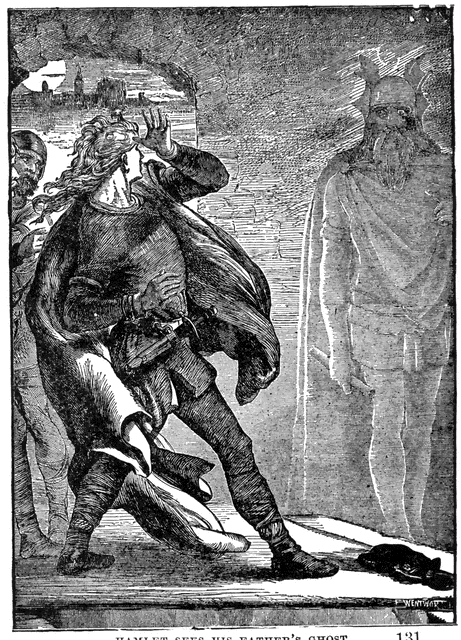
    • Some famous ghosts include the ghost of Hamlet's father, Casper the Friendly Ghost, and the ghost of Jacob Marley.


    Hamlet sees his father's ghost.
    (Image from USF clipart)


    When Jacob Marley freaks out and starts yelling and shaking his boxes and chains at Scrooge, whoof, he's scary.
    (Photo from Stuff from 311)


    I loved this book when I was a kid. This is about a family of ghosts who move into a suburb to haunt it. The little children ghosts are thrilled to discover trick-or-treating, but they eat so much candy, they become tangible and turn into marshmallow.
    (The Marshmallow Ghosts is out of print, but some people are selling used copies on Amazon)


    GOBLINS


    Goblins in the woods
    (Image from Seligor's Castle)


    • Some people say goblins came from France in the 12th century, others say England. Still others say goblins hail from Germany, from kobold, the demon of mines, or from the Greek kobalos, the mischievous spirit.
    • Regardless of where they first came from, they have no home now, so they haunt other people's homes and old trees and the clefts of mossy rocks.
    • They're ugly little malevolent things.
    • Sort of like poltergeists, they like to mess up stuff. Their laughter sours milk or turns the fruit rotten and makes it fall off the trees. They'll turn direction signs around or blow out candles or hide little objects, all to confuse people.
    • They generally run around outside and wreak minor havoc.
    • Very different from how they appear in Harry Potter, by the way, where the goblins are in charge of Gringotts Bank, and even moreso from the movie versions where they're depicted according to stereotypes so anti-Semitic they made me wince.

    Hobgoblin Detour
    • One of my favorite sayings is "A foolish consistency is the hobgoblin of little minds." (Ralph Waldo Emerson, Self-Reliance)
    • But hobgoblins are different than goblins. They're more elf-like where goblins are more gnome-like.
    • Hob means "elf." It's a variant on the name Rob, which is short for Robin Goodfellow, who was a miscreant elf in German folklore.
    • They can be annoying and harassing, or downright terrifying.
    • Puck from A Midsummer Night's Dream is perhaps the most well-known hobgoblin. He's more mischievous than mean, though.

    Puck, hobgoblin and trickster sprite.
    (Image from Seismic Twitch)


    GHOULS
    • The word comes from the Arabic ghul and it means an evil spirit that robs graves and feeds on corpses. The word comes from an Arabic verb meaning "to seize."
    • They're very similar to zombies, though not quite the same. Zombies are dead people reanimated to eat live people. Ghouls are spirits who eat dead people. Technically, ghouls would eat zombies. But I suspect the two would get along at a dance party.
    • Ghouls live in graveyards or deserts. They may take the form of a hyena.
    • Ghouls can also be people who are grave robbers, or it can be a more metaphorical insult for those who delight in the macabre so much, they are ghoulish.


    Yikes. Ghouls are pretty scary.
    (Image from Hypnogoria)


    This is kind of funny and also historically accurate. This is Ghoul with a Pearl Earring. But see, in many of the cultures where the Arabic ghul originated, often the evil spirit was female. See?
    (Image from Why not?)


    • My favorite line about ghouls comes from Hitchcock's Rear Window when they're looking out Jimmy Stewart's window and Grace Kelly says, "We're two of the most frightening ghouls I've ever known." But she says it in that Grace Kelly way which is so delicate, if she'd been talking to you, you'd almost delight in being so insulted.


    Jimmy Stewart and Grace Kelly: two of the most frightening ghouls you've ever known?
    (Screen shot from Rear Window from GoneMovie.com)


    I sneaked in some Shakespeare there, did you notice? This turned out to be secretly a Shakespeare entry! A Shakespeare entry in a costume! Hahaha!

    Ah, Halloween. Too much fun.


    Sources
    Onelook, ghosts, ghoul
    Encyclopedia of Death and Dying, Ghosts
    Online Etymology Dictionary, ghost, goblin, ghoul
    Dictionary of Phrase and Fable, goblin
    Oxford World Dictionary, goblin
    Long long time ago, Puck
    bordeaux undiscovered wine shop, Of Goblins and Fairies for Halloween, October 29, 2009
    Wisegeek, What is a hobgoblin?
    tribe.net, ghoul

    Friday, September 5, 2008

    Apple #338: Werewolves

    Sorry for the delay in getting the next Daily Apple to you. For some reason, things have been sort of hectic since I got back from my mini-trip for the holiday, and I haven't been able to get to this.

    And I've also had trouble deciding what the next entry should be about. I had a few ideas, looked into them a bit and had to discard them as too boring. So be glad I didn't take us down those paths.

    Then today, on the way home from work, I heard this time-honored classic. Well, I don't know if it's either time-honored or a classic, but this song always makes me think of my brother, who thinks this is a very funny song, particularly the line, "I saw a werewolf drinking a pina colada at Trader Vicks. His hair was perfect."


    So I thought, I've covered vampires, zombies, and the Loch Ness Monster, so I think now it's time to take a look at werewolves. And while you read this entry, maybe you'd like to have the above song playing in the background for your entertainment and edification.

    For those of you with little children, you might not want to read this entry aloud to your young ones.


    Modern-day depiction of the werewolf
    (Image from Flight of the Dragon)


    • The word werewolf is a combination of Anglo-Saxon words wer which means "man" and wolf, whose meaning I think you already know.
    • Another term which some people in the psychiatric professions actually use is Lycanthropy. This one comes from the Greek words lukos + anthropos or "wolf man." So it means the same thing as werewolf, but it sounds more erudite, apparently.
    • The first recorded mention of a werewolf was in Germany, in village called Bedburg near Cologne, in 1591.
    • Wolves were plaguing the countryside and they were either attacking people (which is actually an extremely rare thing for wolves to do) or else people were afraid that the wolves would progress from attacking their livestock to attacking people.
    • Then one day the townspeople had cornered a wolf and were going at it with sharp sticks and other implements. But this particular wolf, instead of lashing out with its teeth or running away, stood up and revealed itself to be a middle-aged man named Peter Stubbe who lived in the same village.
    • Peter Stubbe apparently had become a very bad man. He was put on the torture wheel and said that he had killed 16 people, 13 of them children. He said he had learned sorcery when he was a teenager and had made a pact with the devil, who gave him a magic belt that allowed him to take on the guise of a wolf to attack people. As a wolf, he would bite his victim's throat and suck the blood from their veins (vampire-like, no?). If his victim were a woman, he would rape her before he killed her.
    • The village decided to put Peter Stubbe to death in the most horrific way they could imagine: they pulled off his flesh with red-hot pincers, broke his arms and legs, cut off his head, and burned his corpse.
     
    The Book of Were-Wolves from 1865 tells the story of Peter Stubbe who was executed in this gruesome manner, apparently to correspond with the gruesomeness of his crimes.
    (Image from World's Strangest)


    • People equated his savagery with that of wolves, and they decided that he and anybody else who committed such horrific acts were sort of channeling the savage spirit of the wolf. So I'm thinking that the story about the wolf revealing itself to be Peter Stubbe was told after the fact, and was the town's way to try to explain how somebody could do such terrible things.

    "Werewolf" by Lucas Cranach Sr., from around 1510, depicting the werewolf's carnage.
    (Image from Duke University librarian Ed Babinski's blog)


    • After that, and throughout much of Europe, there were lots of stories about werewolves -- people who were transformed into part-wolves and attacking other people. One of the key features of the werewolf stories is the transformation process.
    • Some people said that you could fall asleep and the devil would take the form of a wolf and go out and do all the things that were your worst, most evil sleeping desires and kill men and beasts.
    • Other people said you could become a werewolf if a witch or a sorcerer had cursed you. Becoming a werewolf in this fashion was also an involuntary thing, and you were under the spell of someone more evil than you.
    • Of course there is the now more commonly known method of becoming a werewolf, which is by being bitten. If the saliva of a werewolf got into your bloodstream, then you also became a werewolf whether you wanted to be one or not.
     
    The transformation from American Werewolf in London
    (Screen shot from Saint Vespaluus)


    • But there were other stories about people who chose to become werewolves. One version of the voluntary werewolf was that evil people put on a wolf skin and went about doing terrible things while wearing the hide of a wolf. Sometimes the only bit of a wolf that the evil person would wear was a belt.
    • Or a person could become a werewolf by worshiping the devil. Usually there was a ritual that involved drawing a circle on the ground and rubbing an ointment into the skin (this ointment may have contained belladonna or nightshade, which are hallucinogens in small doses). Following the ritual to the devil, you would then be given the power to become wolf-like and go do your evil things.
    • There are also lots of other medical-based theories to explain the notions of werewolf-like behavior.
    • One possibility is that the were-person maybe had rabies. This one is easiest to connect with the werewolf-by-biting method because rabies is often transmitted by animal bites. However, while rabies does make people writhe around and do lots of strange things, but mainly it constricts the throat and keeps you from being able to swallow and you die from it within a few days.
    • It's also possible that people actually ingested something that altered their behavior. The Ergot fungus (today's generally-accepted explanation for all the insanity surrounding the Salem witch trials) which affects rye grasses is one of those possible somethings. Back in the day, people ate rye bread without realizing the rye grass had the fungus in it, and the fungus gave them convulsions and delusions and hallucinations and all sorts of unpleasant things. The Ergot fungus, by the way, is sometimes called Wolfzahn or wolf's tooth. But the Ergot fungus is more often poisonous before its hallucinogenic effects can occur. And there were far more people tried for being werewolves than there were actual outbreaks of the Ergot fungus.
    • Another something that people could have eaten or come in contact with is belladonna or nightshade. These are plants which, in high enough doses, can be fatal, but in small doses can be hallucinogenic. Those ointments that people rubbed on themselves during werewolf rituals seem to may have included either one of these hallucinogens, so it's possible that the influence of a small amount of this plant is what made people go berserk.
     
    Belladonna. This is poisonous, but at low doses, drops from the plant will make your pupils dilate. But please don't eat this. It is one of the most toxic plants in the Western Hemisphere, and though it does cause hallucinations, you get those shortly before it kills you.
    (Photo from Botany Photo of the Day)


    • There is also a disease which is popularly called "Wolfitis," or Hypertrichosis. Basically all that happens is you get a lot of body hair, sometimes all over the place, or sometimes localized in one or two places. But it doesn't really affect your behavior in any way.
    • Or perhaps the were-people really had Porphyria. This is actually a group of diseases caused by a rare genetic disorder that makes people extremely sensitive to light, and it also affects the red blood cells so that you become very pale, and you also happen to grow a lot of body hair. While all this physical stuff is happening, you also become afflicted with various mental disturbances ranging from depression to hysteria and delirium. Late stages of this illness include a deterioration of the skin and the teeth. That all sounds really awful. This theory has also been proposed as an explanation for vampires.
    • There is also a mental disorder called Lycanthropy. This is a severe form of psychosis in which the person believes him or herself to be a wild animal, usually a wolf. Nebuchadnezzar in the Bible, for example, is described to have such severe depression over a seven-year period that for a time he believed himself to be a wolf. The very few cases of lycanthrophy that have emerged in the last century or so have been linked to schizophrenia.
    • Those real-world substances and illnesses are all very real concerns. But it's hard to say whether all the werewolf stories actually can be traced back to real-world effects, or how many of them are the stuff of imagination. Certainly Hollywood picked up on the werewolf stories. And as we get farther and farther away from very real fears about the damages that wolves can do, the stories we tell about werewolves become less horrific and more ironic and comical.


    Cover of I Was A Teenage Werewolf starring Michael Landon!
    (Image from Monsterland Toys)


    • Werewolf of London (1935) -- a dapper London scientist goes to Tibet in search of a rare flower and instead gets attacked in the forest, which transforms into a werewolf. Back in London, he terrorizes the city during the full moon. Only the juice of the rare flower can save him.
    • The Wolf Man (1941) -- stars Claude Rains as the main man and Lon Chaney, Jr. as his werewolf self. Bela Lugosi is in it, too, and is the one responsible for the initial attack. Establishes the werewolf's vulnerability to silver.
    • An American Werewolf in London (1981) -- directed by the same guy who made Animal House, two backpacking college guys are in London and one of them is attacked by a werewolf and returns to tell his friend in a dream that the same thing will happen to him.
    • There are also such gems as The Rats Are Coming! The Werewolves Are Here! (1972), which features both man-eating rats and blood-sucking werewolves, and Werewolves on Wheels (1971) which includes biker gangs, devil monasteries, and biker chicks. Ah, the 70s.
    • The Howling (1981) -- A TV reporter has been following the story of a serial killer named Eddie who has been preying on the homeless. The story gets to her, so her boss tells her to take a vacation in the woods. Hmm, what's the dumbest place to go if you're in a werewolf movie? (This one has lots of sequels, notably The Howling II: Your Sister is a Werewolf.)
    • Teen Wolf (1985) -- It's puberty that turns Michael J. Fox into a werewolf. He's in high school, plays basketball, wants to impress a girl, and discovers he's a werewolf. Great.
    • There's also a remake of the 1941 movie due out in 2009, called The Wolf Man, starring Benicio del Toro and Anthony Hopkins (of course).
    • So, if you find yourself in a werewolf movie, how do you disable a werewolf? It seems that the most effective remedy is to splash water on him. Whether it's holy water or tap water, rolling him in the dew, or whatever form of water, it seems that the werewolf really hates water. Maybe because he's been running around out in the forest getting good and dirty and really does not want a bath?
    • Legend also has it that you could disable him with some good old wolf's bane, a.k.a. monk's hood. This actually is a very poisonous flower and its root extract has been used to poison the tips of arrows.

    Monk's hood or wolf's bane. This variety is pink. Others may be purple or yellow. But they're all very toxic, and you should wash your hands if you so much as touch this.
    (Photo from Paghat)


    • If you want to kill the werewolf outright , of course there's shooting a silver bullet through his heart, but that's a relatively recent method. The method in existence for much longer than this is to decapitate him.

    I think the lesson here is to stay away from those poisonous plants.


    Sources
    Sk. Nur-Ul-Alam, Werewolves: The Myths and the Truths
    Monstrous.com, Vampires and Werewolves
    ExecutedToday.com, 1589: Peter Stubbe, Sybil Stubbe and Katharina Trump
    Tracy V. Wilson, Howstuffworks, How Werewolves Work
    Werewolf Info

    Saturday, January 5, 2008

    Apple #291: Daily Apples in the News

    Yesterday, I heard on NPR that the FBI had recently re-opened the cold case of D. B. Cooper, who hijacked an airplane in 1971 and got away without getting caught.

    Immediately, my ears perked up, because I had done a Daily Apple about D. B. Cooper a while back.

    For those of you who may not remember every single Daily Apple in as much detail as I do, you can check out the old entry, of course. But in sum, he was a guy in his 40s or so who, the night before Thanksgiving in 1971, took control of a Northwest Airlines plane on its way to Seattle, and demanded $200,000 or else he'd blow up the plane. The plane landed in Seattle, they gave him the money and some parachutes he'd also asked for, he let the passengers go, and then made the crew fly him to Mexico City. En route, he jumped out of the plane into a rainstorm. Nobody ever found him.


    FBI and police sketches of D. B. Cooper. Except now, he'd look much older.
    (Image from the FBI)


    Many speculated that he died during the jump, but some people think he survived. He's kind of turned into a legendary figure. Now, though, the FBI has re-opened the case. They say he's no legend, just a mediocre guy in his 40s who couldn't think of any other way to take care of his family. But apparently, they also think he survived and that he has eluded them to this date.

    [Edit: More recent news stories say the FBI are following up on a "credible" and "pretty interesting lead," but they won't give more details than that. 8/1/2011]

    Original Daily Apple story about D.B. Cooper (scroll down)
    NPR story with more details
    FBI's official web page asking for help in solving the case


    Having heard this news story, I wondered how many other Daily Apple topics have been in the news recently. So I thought I'd check in on a couple.


    DAVID LEE ROTH

    The first one that comes to mind is the fact that David Lee Roth is now, despite all Eddie Van Halen's assertions for years and years and years, touring again with Van Halen.

    Faithful Daily Apple readers may recall that the original Daily Apple on David Lee Roth was prompted by the desire to answer one of my brother's favorite eternal questions: What do you think David Lee Roth is doing right now?

    Well, now we know what David Lee Roth is doing with most of his time these days.


    L to R: Alex, DLR who can't believe his luck, Eddie, & Wolfie (who looks a lot like his mom, Valerie)
    (promo photo sourced from My San Antonio Blogs)


    The band now includes Wolfgang Van Halen, Eddie's son, who is playing bass instead of Michael Anthony. Eddie's on guitar, and Alex is on drums, and DLR is on vocals, of course. The tour started in December, and is scheduled to last until early April.

    I picked one of the places they're playing at random -- New Orleans on February 8 -- and asked Ticketmaster to give me a best available ticket.

    They offered me a seat in row 20 of a a lower-level section next to the stage, but at the very left corner of it. Apparently all the floor tickets are sold out at this venue. Price: $147.50 plus $15.50 in fees, or $163. For one person.

    Cheapest available was $47.50 plus all fees for a total of $60.85. This is for an upper level seat in row 8, which isn't completely nosebleed, but it's close.

    True-blue David Lee Roth fans (headquartered in Hell, Michigan) are loving the tour. Van Halen fans, however, have given the shows mixed reviews. Many people said that Diamond Dave missed lyrics, sang the same verse over and over, or otherwise screwed up. But others said the show rocked and they loved it.

    First official announcement that the reunion tour would actually happen
    Van Halen's official website
    Original Daily Apple about David Lee Roth
    David Lee Roth sighted on The Sopranos (scroll down)


    TUNA TARTARE

    Kate Walsh, a star on the TV series "Grey's Anatomy," recently got engaged to her boyfriend Alex Young. He proposed to her in a restaurant in San Francisco. Knowing how much she likes butterflies, he asked the chefs to form a tuna tartare in the shape of a butterfly. After it was served, he asked her to marry him.


    Tuna tartare: an aphrodisiac for Kate Walsh?
    (Photo from The Incredible Shrinking Whimsical)


    While Walsh was quoted as saying she likes butterflies, the article didn't mention whether she likes to eat tuna tartare, regardless of its shape.

    News of Kate Walsh's engagement
    Original Daily Apple on tuna tartare


    BRETT FAVRE

    Brett Favre, seemingly eternal quarterback of the Green Bay Packers, has been in the news a lot this fall. Most recently, sportswriters for the Associated Press newswires voted on the NFL's Most Valuable Player. Tom Brady, quarterback for this year's undefeated and seemingly iron-clad New England Patriots, got every single vote for MVP except one. And that vote went to Brett Favre.

    In December, he passed Dan Marino's record for most total passing yards in a career. Referees stopped the play once he'd completed the pass so they could give him the game ball. Right after the whistle blew, Favre asked what happened, had been a penalty?


    (Photo from Greta Van Sustern's page)


    His current NFL records:
    • Total passing yards (61,655)
    • Career TD passes (442)
    • Pass attempts (8,758)
    • Pass completions (5,377)
    • Wins as a starting quarterback (160 as of 12/16/07)
    • Consecutive starts as a quarterback (251 as of 12/16/07)

    News about the MVP voting results

    Favre breaks Marino's record
    Favre's current and career stats
    Original Daily Apple about Brett Favre
    (I just realized that was my 4th ever post and Favre's jersey number is 4. I don't think I did that on purpose. But I might have.)


    LOCH NESS MONSTER

    The Loch Ness Monster, who also seems to be eternally popular as well as immortal, is in the news again. This time it's because of a movie mainly for children called "The Water Horse: Legend of the Deep." The movie draws on the legend of the Loch Ness Monster, except, instead of discovering the monster alive and well in the lake, the boy protagonist finds an egg which hatches and grows into a water creature very like the Loch Ness Monster, whom he calls Crusoe.


    Alex Etel, the 13 year-old child lead in The Water Horse, apparently hugs a Loch Ness Monster-lookalike. Except that's a computer generated image, and he's actually touching nothing.
    (Photo from the Washington Post)


    Review of The Water Horse
    Original Daily Apple entry on the Loch Ness Monster


    NINTENDO

    Finally, due to the enormous success of its video game system the Wii (pronounced whee), Nintendo has risen from the ashes like a phoenix. Just a few years ago, they were a near-dinosaur in the video game world compared to Sony and Microsoft. Now, Nintendo has the third largest market capitalization of all Japanese companies. In other words, they have sold boatloads of stock and people have bought it like crazy because they love the Wii. So the company is having enormous success right now.


    Somebody boxing on a Wii projected on a big screen -- on a Norwegian Cruise Line ship.
    (Photo from Siliconera)


    Overview of Nintendo's current success
    Original Daily Apple entry about Nintendo


    There's no real rhyme or reason to how I picked these entries, or why I put them in the order that I did. I just picked a few topics, checked the news, and reported on what I found.

    But the point is, even though your Apple Lady isn't always hip to the most current events all the time, your Daily Apple can still keep you in the know about the very latest.

    When somebody brings up Tom Brady's MVP award, for example, you could maybe come back with some of Brett Favre's stats. Or when somebody says they saw "The Water Horse," you could say you saw the surgeon's photo and it's all bunk.

    Or when you see some old guy carrying a briefcase with tattered twenty-dollar bills sticking out of it, you can say, "Hey, that's D. B. Cooper, and I recognize him because I read the Daily Apple!"

    Or something like that.

    Monday, December 31, 2007

    Apple #290: The Phoenix

    Well, Apple readers, I'm back from my trip home. It was filled with much, much sleeping -- all of it very necessary -- as well as other good things like sandwiches, dog walks in the snow, board and card games with my parents, and finally, football on TV. I encountered some topics during my vacation that I plan to investigate here in these (web) pages. But I'm going to hold off on those because I thought it would be more appropriate to do an Apple on something New Year's Eve-related instead.

    I considered the various aspects of New Year's Eve, such as how have various cultures around the world celebrated the beginning of a new year, or the Times Square ball drop, or party hats and blow-horns, etc. None of these topics really piqued my interest, though. So I tried to think of something kind of New Year's-esque, and I thought of the phoenix. You know, the bird that gets re-born.

    • The phoenix is a mythological bird that lives a very long time and then is reborn or resurrects itself. It is symbolic of new life, regeneration, all those good things.

    Generally what we imagine when we think of a phoenix.
    (Image from Bocage Books)

    • Lots of different cultures have stories about a phoenix. Depending on the country of origin, the bird may have a different name, a different method of dying or resurrecting itself.
    Culture
    Arabia

    Name
    Phoenix

    Characteristics
    Only one exists at a time. Lives near a well, sings an enchanting song.

    Appearance
    Large as an eagle with scarlet and gold feathers

    Death & Resurrection
    Builds its own pyre of aromatic branches and spices (like myrrh) and sets itself on fire. Rises from the ashes 3 days later.


    Grecian phoenix, nesting in a palm tree
    (Image from Anyone for Tee?)


    Culture
    Greece

    Name
    Phoenix

    Characteristics
    Comes from Arabia to Heliopolis in Egypt to bury his father, encased in an egg of myrrh.

    Appearance
    Eagle, with scarlet and gold feathers

    Death & Resurrection
    Builds a nest on top of a palm tree with aromatic plants (cassia and myrrh) and dies. Young phoenix arises from the dead phoenix.


    Egypt's Bennu
    (Image from Phoenix Moon)


    Culture
    Egypt

    Name
    Bennu

    Characteristics
    Soul of the sun god, Re, or also a symbol of the periodic flooding of the Nile.

    Appearance
    Heron with two long feathers extending from his head, sometimes also crowned with the sun

    Death & Resurrection
    Stands alone on the rocks following the flood.


    The closest representation I've found to how I picture Fawkes.
    (From Laura Freeman's Harry Potter tarot deck)


    Culture
    Harry Potter (I couldn’t resist)

    Name
    Phoenix, specifically, Fawkes

    Characteristics
    Animal representative of Albus Dumbledore. Tears have healing properties, as does its song.

    Appearance
    Size of a swan, crimson feathers, long (very strong) tail. Claws, beak, and tail are golden.

    Death & Resurrection
    Can appear and disappear at will, but also dies in a burst of flame to be re-born almost immediately in its ashes.


    China's Feng Huang
    (Image from the Aerie of Paragon)


    Culture
    China

    Name
    Feng Huang

    Characteristics
    Very gentle, lands without crushing anything, eats only dewdrops. But it does attack snakes.

    Appearance
    Rooster’s beak, swallow’s face, snake’s neck, goose’s breast, tortoise’s back, stag’s hind legs, fish’s tail

    Death & Resurrection
    Immortal. Appearance signals the start of good times; disappearance marks onset of bad times. Nests in the woo-tung tree.


    Culture
    Japan

    Name
    Ho-Oo

    Characteristics
    Combination of the male Ho and female Oo bird.

    Appearance
    Very similar to the Chinese Feng Huang

    Death & Resurrection
    Descends from heaven at the birth of a virtuous ruler and nests in a paulownia tree. Goes back to heaven at the close of peaceful and prosperous times.


    Hindu Garuda (here, he's eating a snake)
    (Photo by D. Finnin)


    Culture
    Indian / Hindu

    Name
    Garuda

    Characteristics
    King of birds. Hates evil, attacks snakes

    Appearance
    Head, wings, talons, beak of an eagle; body and limbs of a man. White face, red wings, brilliantly shining body.

    Death & Resurrection
    Fought the gods to get the draft of immortality and rescued his mother from the underworld where she was guarded by snakes. Carries immortality still.


    • In nearly all of these stories, as you can see, the phoenix is a force of good. Sometimes its appearance only signals the beginning of good times; in other stories, the phoenix actively fights on behalf of good and against evil.
    • Basically, if the phoenix is on your side, you're in good shape.
    • In addition to these mythological birds, other birds have been suggested as variants of the phoenix.
        • Although the name Firebird is very suggestive of the story of the Phoenix, I don't think the Russian legend of the firebird is actually that similar to the phoenix. You can read the story of the firebird yourself and see what you think.
        • The Thunderbird, who is present in many Native American stories just as there is not one Native American tribe, so there is no single Thunderbird, is also said to be similar to the phoenix. But just as there is not one single Native American tribe but several tribes with all sorts of different stories, so there is also not one Thunderbird. In just one of the stories I read, the Thunderbird seems more powerful and god-like than the phoenix, and it has more to do with influencing the weather. But again, you can read the Thunderbird stories yourself.

    May your new year be like the phoenix rising from the ashes. Or, may your new year be as filled with goodness as the phoenix's song. Or, may you be empowered like the feng huang to fight the snakes of evil and nest in the woo-tung tree of happiness. Or otherwise, happy new year!

    Sources
    Mythical Realm, Rise of the Phoenix
    Encyclopedia Mythica, Garuda and Phoenix
    Carlos Parada, Greek Mythology Link, The Phoenix
    Godchecker, Chinese Mythology, Feng-Huang
    Dr. Jean Couteau, archipelaGoMagazine, Garuda: From Myth to National Symbol
    Harry Potter Lexicon, The Bestiary, Phoenixes: Fawkes
    N.S. Gill, "Phoenix - Bird - The Phoenix," About.com: Ancient / Classical History