Showing posts with label animals - water mammals. Show all posts

Thursday, June 28, 2012

Apple #592: A Whole Lotta Blues

I thought I'd finish up my series of blue entries with a whole bunch of blue things, with a few facts about each. Sort of like the finale at a fireworks show.

Blue Suede Shoes


(Photo from some site on Etsy that isn't loading)

  • We all know Elvis Presley performed the song, but Carl Perkins is the guy who wrote it. He got the idea from Johnny Cash.
  • Cash told Perkins about an Air Force sergeant he used to know was rather particular about his appearance. He used to say, jokingly, "Just don't step on my blue suede shoes!" The reason this was a joke was because he'd be wearing his Air Force uniform at the time, with his regulation-issued shoes.
  • Cash thought this was a good line for a song, but Perkins didn't have any idea what to do with it. Not long afterward, he was performing at a dance when he heard a boy tell the girl he was dancing with, "Uh-uh! Don't step on my blue suedes!" He thought it was pretty incredible that the boy would care more about his shoes than the girl, and that's what made the song start to click in his head.

Baby Blues

 "I was shakin' in my shoes whenever she flashed those baby blues"


Blue eyes of a newborn
(Photo from info.com) 

  • The phrase comes from the fact that a lot of Caucasian babies are born with blue eyes. It's supposed to suggest wide-eyed innocence, as innocent as a newborn babe.
  • When people say that all babies are born with blue eyes, they are exaggerating. Some percentage of Caucasian babies are, but not every baby is born with blue eyes.
  • Some babies' blue eyes will change to a different color as the babies get a little older. This is because the melanin doesn't kick in until it's exposed to ultraviolet light.
  • Usually, after about 6 to 9 months, you'll notice a baby's eye color will have started to change.
  • Some babies' eyes will continue to change for as long as three years.  In about 10% of babies born with blue eyes, it may take even as long as adulthood until their eyes have settled on their final color.

Bluegrass


Kentucky bluegrass, a.k.a. Poa pratensis. Its tendency toward lushness is what makes this a favorite "barefoot grass."
(Photo from Power Seeds Inc.)

  • Bluegrass the music,is named for bluegrass the plant, which has a blue-ish tinge and grows in Kentucky.
  • Naturally, you'd think that Kentucky Bluegrass the plant would be native to Kentucky. Actually, it's originally from all over the place: almost all of Europe, northern Asia, and the mountains of Algeria and Morocco.
  • If you're just starting a lawn of bluegrass, don't mow it until it gets higher than 2 inches. And going forward, it's best not to mow it any shorter that 2 inches.

Blue Humor


The Aristocrats may be the quintessential bluest joke. Here's Gilbert Gottfried, after telling it at a friar's roast not  long after 9/11.
(Photo from Youdopia NSFW)

  • Jokes that involve bad language or sexual or vulgar or crude situations are typically referred to as "blue humor."
  • A lot of people say that this phrase comes from another phrase, "blue laws," which were laws going as far back as the 17th century that punished bad language, lying, swearing, public drunkenness, etc. In other words, laws that governed moral behavior. That much of the origin of "blue humor" seems to be true.
  • However, people go on to say that the phrase "blue laws" comes from the fact that the laws were printed on blue paper.  This part is not true.
  • The experts can't say for 100% certain, but they're reasonably sure that "blue laws" is related to the word "bluenose."
  • A bluenose is a very rigidly moral person, presumably one who would write laws about what you can and cannot say in public.

Blueprints


Blueprints are architectural or other detailed drawings that have a blue background and the text and lines are in white.
(Photo from Twins Daily)

  • Blueprints, as you'd expect, are so named because they are blue.  
  • The paper doesn't start out to be blue, but it turns out that way as a result of the process by which the designs are printed on the paper.
  • Technically, a blueprint is called a cyanotype. Making a cyanotype is a lot like developing a photograph. The process uses iron compounds, which start out to be green, but once they're exposed to UV light, they turn blue.
  • (Sort of the opposite of baby's eye color thing then.)
  • If you want to know more about how to make a cyanotype, a site called Alternative Photography has the instructions.

Blue Whales


The blue whale. Everything about it is superlative.
(Photo from Wonderful Whales)

  • Blue whales are the largest mammals on Earth.
  • They can get to be 100 feet long and weigh some 200 tons.
  • Here's a weird tidbit: their tongues, alone, can weigh as much as an elephant. (I don't know who's going around weighing blue whale tongues, but I believe this assertion)
  • They eat anywhere from 4 to 8 tons -- tons -- of krill per day.
  • Baleen, the stuff over their mouths that they use to filter in food, is made of stuff very like our fingernails.
  • They're also among the loudest animals on the planet. Their sounds are at very low frequencies, but they're so loud, other blue whales can hear them up to 1,000 miles away.
So many things to know about blue whales, I may just have to do a separate entry about them.

And now, with this last hurrah, I must tell you that I'm going on vacation.  Please of course browse around in the meantime.  With 591 other entries to choose from, I'm sure you'll find something to interest you.  See you in a couple of weeks!


Want more blue things? How about bluebirds , blueberries, Steely Dan's "Deacon Blues," plus of course the entries from this series: blue-footed booby, blue jeans, bleu cheese, and the ever-popular blue-plate special. 

Sources
Squidoo, Elvis Songs: Blue Suede Shoes
Songfacts, Blue Suede Shoes by Carl Perkins
Rockabilly Hall of Fame, Blue Suede Shoes: Chronology of a Hit
Anne Marie Helmenstine PhD, About.com, Why Are Babies Born with Blue Eyes?
What to Expect, Baby's Eye Color
Texas A&M System, Aggie Horticulture, Kentucky Bluegrass
Snopes.com, Blue Laws
Patrick Bromley, About.com, Blue Humor
Dictionary.com, blueprint
Alternative Photography, Cyanotype - the classic process
National Geographic.com, Blue Whale
Enchanted Learning, Blue Whale, the Loudest Animal on Earth 

Thursday, August 7, 2008

Apple #333: The Platypus

I cannot remember now how this came up, but it did. I was e-mailing a friend and I mentioned a platypus. There was a reason; I think I was making a joke, but I can't recall anything further than that. (No, it was not a dirty joke! Sheesh.)

But I wound up looking up information about the platypus. And there are so many strange facts about this animal, I just had to share them with you.


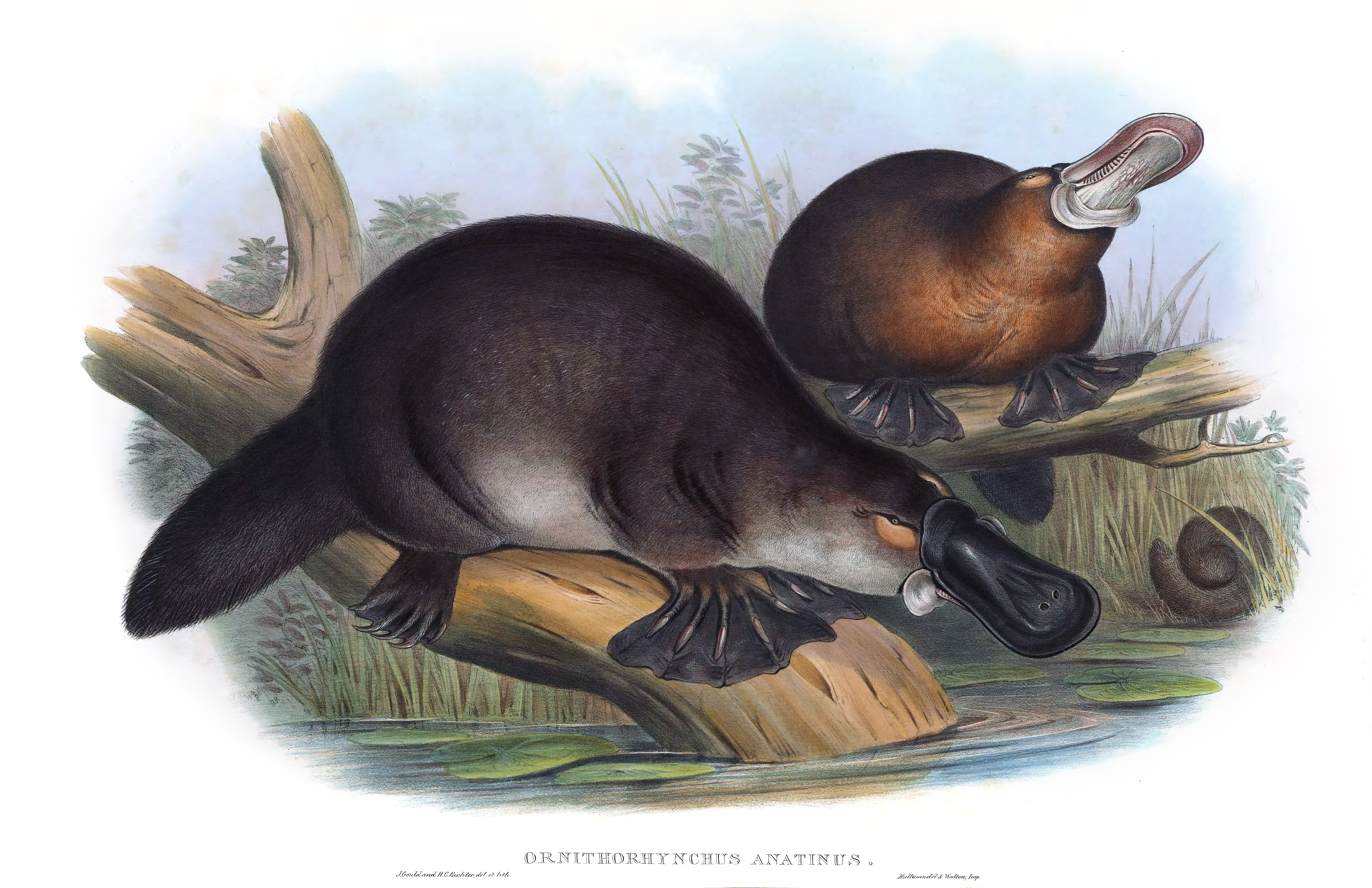
Print of the platypus, by John Gould, from 1863. Goofy-looking, aren't they?
(Image from Wikimedia Commons)


Nobody agrees what the plural should be.

  • Most of the time, words that end in -us, as platypus does, are Latin words. Usually, to make the plural of these kinds of words is to change the -us to an -i. So lots of people think that the plural of platypus is platypi.
  • Not so.
  • Platypus is actually derived from Greek, not Latin. Specifically, it comes from πλατύς ("platys", flat, broad) and πους ("pous", foot), meaning "flat foot" (see the section below on webbed feet).
  • So the plural of platypus technically should be platypodes. But who in the world ever says platypodes?
  • Some people avoid this difficulty and go for platypuses. But that sounds really awkward, doesn't it?

It's an egg-laying mammal.

  • For an animal to be a mammal, it must give birth to live young, that is, not in an egg the way a chicken or a fish does. But the platypus, a mammal, lays eggs.
  • The platypus also has fur, is warm-blooded, feeds its young with milk produced in mammary glands, has a single bone in its lower jaw, and has three middle ear bones -- all the other characteristics required of mammals.
  • (By the way, five species of mammals lay eggs. The platypus is one, and four species of echidnas make up the rest.)

It has a bill like a duck.

  • But this duck bill is covered in a skin that some describe as leathery, others call rubbery.
  • The nostrils are at the end of the bill, which allows the platypus to breathe even while swimming.
  • But the platypus dives underwater a lot to look for food and dig its burrows, and the fact that its nostrils can be closed off comes in very handy.

Platypus, showing off its amazing bill
(Photo from The Complete Platypus)

  • And this bill -- which really is not that much like a duck's -- is a sensory organ in and of itself. That's right,

It can sense electrical fields caused by muscular movements of its prey.

  • In the skin of the bill are all sorts of receptor cells -- nerve endings, if you like. They can sense touch, like our skin does, hot and cold, etc.
  • But there is also a row of a different kind of receptors -- about 850,000 of them -- that sense electrical impulses.
  • Here's how it works. Say some little animal is trying to hide out in the sandy riverbottom and thinks it's being all sneaky, but then maybe it flinches or even moves slightly. When it does that, its muscles generate an electrical pulse which the platypus can sense with its super-sensitive bill, and then snap! the platypus catches the animal.
  • (It doesn't eat what it's caught right away, but stores the food in cheek pouches. When the pouches get full, the platypus surfaces and crunches -- well, does not crunch since a platypus has no teeth, only grinding pads -- grinds up its food.)
  • Scientists think that, when it is swaying its bill back and forth and rooting around in the sand, the platypus is using those electroreceptors to pick up electrical activity.
  • In fact, this is probably how the animal "sees" underwater at all. Because while the platypus swims, its eyes and ears are shut.

Platypus swimming for the bottom, its eyes and ears shut
(Photo from The Complete Platypus)


  • Only the platypus and a few species of fish have this electroreceptor ability.

It has webbed feet.
  • The platypus lives in rivers, streams, and coastal lakes in Australia.

The green patch indicates where the platypuses live in Australia.
(Map from Unique Australian Animals)


  • It has to eat 20%-25% of its body weight each day, and since it eats worms and crayfish and frogs and things like that that live in the water, the platypus spends a lot of time swimming around.
  • So, webbed feet are definitely an asset.
  • Even though its feet are webbed, the platypus doesn't rely on the webbing to make it go faster, but for steering. I'm not sure how the researchers know that, but that's what they say. I guess the platypus mainly kicks, sort of, to get around in the water.

It has a tail like a beaver's.

  • The platypus uses its flat, paddle-like tail, not for propulsion, but as a rudder while swimming.


Here you can see how wide the platypus' tail is.
(Photo from a MySpace page called the Metaphysical Platypus)


  • Like the beaver, the platypus also uses its tail to push soil around when digging burrows in the sides of riverbanks.
  • The tail is also a great place to store fat. That extra fat comes in handy if the platypus has trouble finding food for a time, or if the platypus is a female and needs to incubate her eggs (more about the eggs below).

Its legs attach in a weird place.

  • In other types of mammals, the legs attach underneath the body. That's true of your body, for example. That's also true of other mammals, like a dog or a horse or a cat: the legs extend down from below the body.
  • In a platypus, though, the hips and shoulders attach on the side of the body. This is another characteristic, like egg-laying, that is more reptilian than mammalian.

See how the shoulder joint kind of sticks out sideways?
(Painting by Rod Scott, sourced from jameswatkins.com)


That's very similar to what this Italian wall lizard's shoulder joints are doing.
(Photo from Zooillogix)


It's venomous.
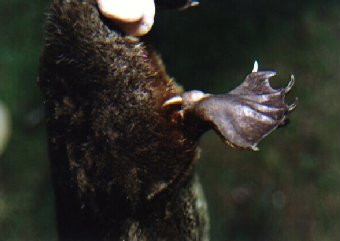
  • The platypus has a long talon, called a spur, on the ankle of its hind legs. Actually, the spurs fall off the females after they're a year old, so in adult platypodes, only the males have ankle spurs.

Ankle spur on a male platypus
(Photo from Wikimedia Commons)


  • These spur contains venom. It can kill small animals up to the size of a dog. Though the venom isn't strong enough to kill a human, it can cause you enough pain that you couldn't do much more than writhe around. And the venom can work itself into your immune system so that you feel pain at the slightest stimulus for a long, long time afterwards. The only other substance known to have this effect? Really strong opiates that people abuse for years.
  • The males only produce this venom during the breeding season, and platypuses are shy and will probably run away from you, but even so. Watch out for them platypi!

It growls.

  • Male or female, if a platypus doesn't like what you're doing and wants you to go away, it will growl. Apparently, the growl sounds like that of a puppy's.

The whole reproductive process is odd in many ways.

  • Researchers have recently discovered that the platypus has 10 different sex chromosomes. Some of them are typical of mammals, some typical of birds.
  • The female platypus has two ovaries, as most female mammals do, but only the left ovary actually works. This business of having a single working ovary is common in birds.

A platypus egg.
(Photo from Geneva Schools)


  • After fertilization, the female incubates usually 2 eggs internally -- is pregnant with them, so to speak -- for about 28 days. Then she lays the eggs and keeps them warm externally for about 10 days.
  • A chicken, by comparison, incubates internally for 1 day and externally for 21 days.
  • While a chicken sits on her eggs, the platypus swims around with hers, the eggs curled up under the fattest, warmest part of her tail.

The word for "baby platypus?" Puggle, of course.


The female produces milk, but not through teats
  • When a cat, or a pig, or a cow has babies, they line up to suck at their mother's teats to get the milk, right?
  • When a platypus has babies -- or when the platypus eggs hatch -- they climb onto her abdomen.
  • There, the mother's mammary glands produce milk, but the milk leaks out through the pores of her skin and collects in grooves. The young puggles lap up the milk from the grooves.
  • When the mother is lactating, she has to consume 90% to 100% of her bodyweight in food each day.


(Photo from Curious Animals)

No wonder, when the first people from England saw drawings of the platypus, and even when they saw the actual animal itself, they thought it was a hoax.


Probably the reason the platypus seems so strange is that, as scientists now know, its genetic map is part bird, part reptile, and part mammal.


Diagram showing the various characteristics of the platypus and which general animal group's genes they come from.
(Diagram by Zina Deretsky of the National Science Foundation)


One scientist, Michael White, has a lot to say about this characterization of the platypus as 1/3 this and 1/3 that. He says, it's all platypus, and it's all mammal. He feels quite strongly about this too.

Who knew the platypus could arouse such passion?


Sources
The Complete Platypus
Unique Australian Animals, Platypus
Geneva, Ohio Area City Schools, The Duck-Billed Platypus
ABC Australia, Scribbly Gum, Platypus Spurred to Action, July 2004
Online Etymology Dictionary, platypus
Onelook, platypus
Wikipedia, Platypus
Discovery Channel News, "Study: Platypus Retains Bird Sex Link," and Platypus: Lots of Sex Chromosomes, October 25, 2004
Jeanna Bryner, "Scientists decode mixed-up platypus genome," MSNBC Live Science, May 12, 2008

Saturday, February 24, 2007

Apple #227: Orcas

The other night, I was out with some friends. The TVs in the bar were playing, for some reason, the National Geographic Channel, which was showing an episode about sharks and other sea animals.

Then one friend -- I'll call him Harvey -- pointed to the TV and said, "Orcas! I hate orcas! They scare me. They're like sharks but smarter, and they're huge -- one orca is as big as this bar." We regarded the TV and him with some skepticism.

Harvey went on, "I just know, someday, I'm going to be on my honeymoon, and we're going to be walking on the beach, hand in hand all nice. Then an orca will swim up onto the beach, slide right up there, and chomp me and carry me out to sea, and I'm going to be like, 'Dammit! I liked her.'"

Well. Clearly, some of what he said was in jest. But is it true that orcas are "like sharks but smarter?" Are they really that big, and will they swim up onto a beach to attack a human?


Orcas seen from the coast of Orcas Island in Washington
(Photo from Orcas Island Bayside Cottages, where you can rent a cottage for about $200 per night)


  • Orcas are also called killer whales. That name "killer whales" is a misnomer, though, first of all, because they are not whales.
  • Orcas are actually part of the dolphin family, and are the largest type of dolphin.
  • They surface and breathe through a blowhole the way dolphins do, and they also communicate with series of complex clicking and chattering sounds. They recognize each other by their sounds.
  • People have also identified distinct populations of orcas, mainly by the "dialects" they use. Orcas from different populations will not inter-breed.
  • Orcas stay with their mothers their entire lives.
  • Orcas live in every ocean in the world, though the highest numbers of orcas live in colder waters. They will sometimes swim into estuaries to catch sea lions and penguins, but they usually don't stray far from the sea. So an orca is not likely to swim up onto a beach to catch something.

The darker blue patches are the places where orcas live.
(Image from PetandWildlife.com)


  • Orcas grow to be about 27 to 33 feet long, and they weigh somewhere around 8,000 to 12,000 pounds. For the sake of comparison, large male Asian Elephants weigh around 12,000 pounds, but they're only 11 feet tall.
  • The black on their backs means that animals above the water have trouble distinguishing them from the water's surface. The orcas' white bellies blend in with the light above the surface of the water, so animals in the water have trouble seeing them as well.
  • Orcas eat fish, turtles, squid, octopi, birds, penguins, seals -- and sharks. They have also been known to attack small blue whales. In fact, orcas are at the top of the ocean food chain.
  • A typical orca will eat about 550 pounds of food per day.
  • They are pretty serious hunters. They can achieve bursts of speed up to 30 mph to catch prey. They can dive as deep as 100 feet to go after something.
  • Orcas' teeth are large and interlocked for added stability in the jaw. The teeth curve inwards and backwards in pairs on both the top and bottom of their jaw. Basically, this means they can gnash the flesh of their prey extremely quickly. They don't have to chew their food after the initial strikes, but can swallow animals as large as sea lions whole.

Keiko, getting his teeth checked by a trainer. Each tooth looks about as big around as one of the man's fingers. Supposedly an orca's tongue feels like sandpaper.
(Photo from jikido-san's Flickr photostream)


  • Often orcas will work in groups -- called pods -- to catch their prey. Their tendency to hunt in packs has earned them the epithet "wolves of the sea."
  • Some of their hunting techniques include:
    • Ramming into an ice floe to knock an unsuspecting seal into the water,
    • Slapping their tails on the surface of the water to create a wave that sloshes penguins or sea lions into the water,
    • Herding schools of fish until they are surrounded by orcas and are easily swallowed by the mouthful,
    • Working together in groups to chase larger prey like sharks and biting and chasing the prey until it's too tired and becomes food.
  • The orcas share what they've caught.
  • As far as whether orcas will attack humans, only a very few instances of orcas attacking humans have been recorded. One recent attack happened in captivity, at a Sea World, when an orca carried and repeatedly plunged its trainer underwater. Some people believe that instead of trying to drown the man, the orca was actually trying to breed with him. The orca is such an efficient hunter that if the orca had wanted to eat the trainer, it would have done so without hesitation.
  • update: in February 2010, just after his noontime show at Sea World, an orca named Tilikum surfaced, grabbed one of his trainers by her pony tail and began thrashing her about in the water, eventually killing her.  One dolphin trainer who had warned Sea World that they were working their show mammals too hard said of the incident, "Happy animals don't kill their trainers."  Many trainers and people who work with water mammals say that too many years spent in a tank that's far smaller than their usual habitat makes them "demented."

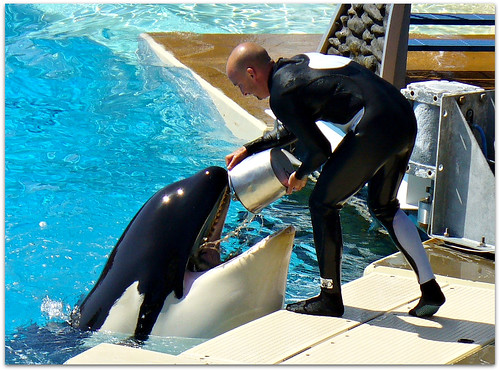
Here is Shamu being fed -- rewarded -- in captivity. Very different from the way orcas usually eat in the wild. Perhaps this is why some captive orcas, over time, get confused.
(Photo from Scandblue's Flickr photostream)


  • The few attacks on humans that are on record all occurred in captivity, and they are very similar to the Sea World incident.
  • There are no recorded incidents of orcas in the wild attacking humans. This may be because humans tend not to be in the places where orcas hunt.
  • Because there have been so few attacks on humans, people say that orcas should not be called "killer" anything. And once again, orcas are not whales, but dolphins.

So, yes, orcas really are that big. Imagine an animal the size of an elephant, but longer, swimming and eating in the ocean.

And yes, orcas are really that smart. They communicate using a distinct form of language, and they have developed sophisticated hunting techniques. So yes, they are "like sharks but smarter." In fact, they eat sharks.

However, since orcas prefer to stay in the ocean, they will not steam up onto a beach. Unless a human being is a trainer putting him or herself near the mouth of an orca on a regular basis, it is very unlikely an orca will attack a person. So unless Harvey is planning on honeymooning on the beaches of Antarctica and masquerading as a sea lion at the edge of an ice floe, he is probably safe from the orcas.


Sources
Enchanted Learning, Orca
National Geographic for Kids, Orcas Fun Facts
Orca Network
PetsandWildlife, Largest Dolphin: Orca (Killer Whale) Fact Sheet
Tigerhomes, Killer Whale Attacks on Humans - Orca Attacks
Humane Society of the United States, Sea World Attack Reaffirms Whale of a Truth
Singapore Science Centre, Do killer whales attack humans?

Saturday, December 16, 2006

Apple #211: Walruses

I saw something on Animal Planet the other day about how some people found a young, injured walrus and nursed him back to health. There were a lot of close-up shots of this young walrus. He had the pouchy front cheeks, the whiskers, and his skin looked smooth and he had an expression like a nice but slightly confused dog: What's are you doing? Will there be food?

I realized I didn't know all that much about walruses. Time to do a little appling.

  • Walruses live on both the Atlantic and Pacific shores. Pacific walruses are generally larger. They weigh, on average, around 2,000 pounds.
  • Walruses live in enormous groups, or herds, by the hundreds. Scientists say this makes them the most gregarious of all animals.

This is only part of a herd of walruses
(Photo from the NOAA Photo library, used at Gregory's page on walruses)


  • They group together as a way to keep warm, which is essential since they tend to live in pretty cold places, like off the coasts of Canada and Greenland, and in the Bering sea.
  • They also have a layer of blubber to keep them warm. Their blubber can be as much as 4 inches thick.
  • Even though walruses hang out together by the hundreds, they separate themselves into groups of males and groups of females.
  • They also develop hierarchies within the groups based on size, aggressiveness, and tusk length. Bigger walruses with longer, unbroken tusks are at the top of the social ladder, while smaller walruses with shorter or broken tusks are at the bottom. Walrus tusks can grow to be 30 to 39 inches long.
  • Walruses use their tusks for fighting and for getting in and out of the water from icy or rocky shores. This process of entering or exiting the water is referred to as "hauling."

This walrus has hauled himself out of the water to take a break in his search for food. Just relaxing on a big old pile of ice.
(Photo by Budd Christman of NOAA, and posted by the Landfast Ice Gallery)

  • Their foreflippers have all the same skeletal components as the arms of a land animal, but everything is shortened and slightly modified. In the water, walruses use their foreflippers for steering (for propulsion, they alternate strokes of their hind flippers), and on land, they use the foreflippers as front legs in walking.
  • Scientists have discovered that most walruses have slightly larger bones in their right flipper. This means that most walruses use their right flipper more often than the left.
  • In the water, walruses can reach speeds up to about 20 mph. They can stay underwater as long as 10 minutes without coming up for air.
  • Walruses may communicate with each other above water or below. Above water, they clack their teeth and whistle. Below water, they make clicking or knocking noises, tapping, and "bell-like sounds." You can listen to some walrus sounds here -- and in this one, I thought the gonging sound was a person playing a drum, but it's actually a walrus!
  • Walruses have a special throat muscle that keeps water from going down its throat when the mouth is opened.
  • They eat a lot of shellfish, like clams and sea cucumbers and crabs. They dive underwater to look for clams, but because the water is usually cloudy and dark, they sniff along the bottom and use their whiskers to find food. The technical name for their whiskers is vibrissae.
  • They might use their tusks to dislodge the clams, or some walruses also blow powerful jets of water at the sea floor to uproot the mollusks. Then they suck the soft-bodied animals out of their shells and swallow them whole. Adult walruses can eat anywhere from 3,000 to 6,000 clams at one sitting.

This walrus is snuffling out clams on the sea bed
(Photo from the BBC)


  • Walruses may also eat fish occasionally, but they like the shellfish best. If food is really scarce, they may scavenge from corpses of dead seals, but that's when times are hard in walrus-land.
  • There are, however, some rogue walruses who eat seals a lot. They are referred to as "habitual seal-eaters." I'm not kidding. They are usually male walruses, they're usually larger than other males, and they're recognizable as seal-eaters because their skin gets grease-stained from seal blubber. Sounds like these are the bad seeds in the walrus herd.


Then, of course, there's the musical walrus.
(If you want to know what the song means, read what John Lennon said about it.)


Sources
Sea World Education Department Resource, Walruses
Helen Briggs, "Most walruses are right-flippered," BBC News, October 22, 2003