Showing posts with label animals - mammals. Show all posts

Monday, February 22, 2016

Apple #728: Elephants

Today I saw a little video on facebook of an elephant picking up a couple pieces of trash and putting them into a trash can.  I can't find the video now, no idea where it was filmed or any context for the elephant doing this. But it got me thinking about elephants.

You may remember an entry I did a while back on Elephant Feet. I just re-read that entry, and there's a lot of interesting stuff in there that I had forgotten.  Tracts! Varying numbers of toenails!

Anyway, I really like elephants. Fascinating, and rather marvelous that they've put up with us as long as they have. They're probably the most recognizable animal of all, and we think we know all the basic things there are to know about them.  So I want to put together some facts about elephants that maybe you don't already know.


A herd of elephants in the forest. Look how closely together they're all standing. Nobody but nobody is getting past them. African forest elephants are now considered to be a completely separate species than African savanna elephants.
(Photo from Endangered Earth)

  • Just as we are right- or left-handed, elephants are right- or left-tusked. The tusk that the elephant uses more often will be smaller than the other due to wear.


Looks like that largest elephant is probably left-tusked.
(Photo from WildAid) 

  • Adult elephants eat 300 to 400 pounds of vegetation per day. They eat grass and leaves, as I'm sure you know, but they also eat the roots, and the bark, as well as bamboo and cultivated crops like bananas and sugarcane, especially if their grasslands have been taken over by farmers.
  • An adult elephant drinks 30 to 50 gallons of water per day.
  • This is why elephants spend so much of their time on the move, looking for water and vegetation to eat.  


Holy bananas, that's an enormous animal. This is Satao, a bull elephant who has coated himself in red dust. Sadly, Satao was killed for his ivory in 2014. Unfortunately, you can't really talk about elephants without talking about the killing-for-ivory.
(Photo from Colorado State University, sourced from the University of Oxford)

  • Elephants cool themselves off in several ways:
    • their huge ears radiate heat
    • they spray themselves with water using their trunks
    • they coat themselves with dust or mud to protect themselves against sunburn (the dust also helps protect against parasites and insects)


Look at that happy bathing elephant.
(Photo from Pinterest, looks like it was posted by Pat Galipeau in Nepal)
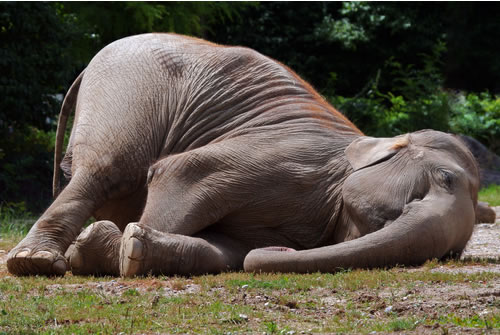
  • Elephants don't sleep very much. They can lie down to sleep, but not for very long since their internal organs will get crushed by their own body weight, or the weight of their bodies pressing against the ground can get really uncomfortable on, say, the hipbone or the side of the face. So they only sleep lying down for maybe 30 minutes to 1 hour at a time. They lie down on one side, sleep for 30 minutes, get up, then lie down on the other side for another 30. They'll do this for about 4 hours and then they're on the move again, looking for more food.
  • They can sleep standing up -- most fully grown elephants only sleep standing up -- but again, not for very long stretches. Sometimes they're being vigilant, or perhaps it's only that they're used to sleeping for short periods of time.


Doesn't look very comfortable, does it?
(Photo from Charlie's Crib)

  • Elephants are extremely important to their landscape. Not only do they alter it enormously by tearing down tree branches and uprooting trees, but they also disperse the trees' seeds. It is estimated that at least 1/3 of the species of trees in central Africa's forests depend on the elephant to disperse their seeds for them. 
  • Elephants do not like bugs. If an acacia tree is infested with ants, elephants won't eat its branches. This is because they do not want to get ants crawling up their trunk. (Augh! Can you imagine? That would be awful.)
  • They also don't like bees and will avoid beehives. So farmers are now protecting their crops against elephants by establishing beehives along the borders of their farmland. This doubly helps their crops because they get pollinators as well as protection.
  • The mother elephant carries her elephant baby for 22 months. That's the longest gestation time of any mammal. A calf weighs 200 to 250 pounds at birth and stands 3 feet tall. That means the mother elephant is carrying around a 100-pound baby for over a year.
  • A baby elephant's trunk has no muscle tone.  That means the baby can't use the trunk at all for several months, until it develops those muscles. From birth, it suckles from its mother by mouth.


Elephants use their trunks like straws when they drink: they suck water partway up their trunks and hold it, then bring their trunks to their mouths and squirt the water in. 
(Photo from Wonderopolis)

  • But the elephant's trunk is pretty much indispensable. Its eyesight is quite poor, but its trunk with its 150,000 muscle parts is profoundly capable.  The trunk can grab and pull things with great strength, or it can caress another elephant's face with great gentleness, the trunk can smell food a great distance away, and of course the trunk is the tube through which the elephant trumpets, calls, tweets, and makes those sonic rumbles that are too low for humans to hear, but which the elephants can detect from up to 5 miles away.
  • The way that elephants detect those rumbles, by the way, is with their feet. The sound travels into their feet, up their legs, and ultimately to the middle ear. They use echolocation, determining how long it takes for the signals to arrive at each of their front feet as an indicator of the distance of the origin of the sound.
  • An elephant's sense of smell is extremely sensitive -- they are the best smellers in the animal kingdom. They can smell water from up to 12 miles away.
  • But it turns out that if an elephant is using its trunk like a hand to hold onto something, that truncates some of its smelling capabilities, and it also keeps the elephant from being able to feel around for the food with the end of its trunk. This is why experiments designed by humans to test elephants' ability to pick up sticks to get to food often were not successful.


I guess this means that the whole time elephants are painting (to please us, mind), they can't smell too well.
(Photo from Listverse)

  • Other tests that gave elephants the opportunity to roll objects into position and stand on them like stepstools to reach the food have been much more successful. Recent research of this sort has proven that elephants at least match chimps in terms of use of tools and problem-solving abilities.
Video below shows Kandula, an 8-year-old Asian elephant at the Smithsonian zoo, rolling a cube into place to reach food dangling from above. No one showed him how to do this; he smelled the food, found the cube, and put 2 & 2 together.

  • We have also come to understand that elephants experience and express a wide range of emotions and associated actions -- grief, consolation, stress, depression, joy. 
  • Elephants have been seen inspecting the bones of a dead elephant, snuffling them with their trunks, kicking sand or even laying palm branches over them. They do not do the same thing for the bones of other animals.
  • However, after one man who studied and lived with a herd of African elephants died, the herd arrived at his house and demonstrated signs of mourning him.
  • Females live in highly social herds that cooperate with each other to solve problems, including one instance when a young elephant bounded into the wrong herd and was effectively kidnapped by the new herd.  Her original herd banded together to confront the kidnapping herd, and they released her.

Video below shows a baby elephant collapsing in a road and several elephants from its herd coming to help. It looks like the baby elephant is having trouble standing, or something's not right with its balance, and eventually the elephants figure out he needs help on one side, and they support him on that side until he's able to stand and walk off the road. This is one of the things I love about elephants: they're so enormous and powerful, but they can be so gentle with each other.


A baby elephant among its herd looks like a pretty good place to be.
(Award-winning photo by Blaine Harrington)

  • About 1 in 3 elephants recognize themselves in a mirror. This may not sound like much, but only about 1 in 5 chimps recognize themselves in a mirror. This suggests that elephants' self-awareness is better than most other mammals'.
  • Adult males tend to live most of the time on their own, but they are not as completely solitary as people have thought. They often encounter other males on their search for food and water, and they may band together in groups of 12 or 15.

Video below shows Shirley and Jenny, two circus elephants being reunited after 20+ years at an elephant sanctuary in Tennessee. Whoever thought there should be bars between them did not know much about elephants. The way they embrace each other with their trunks at the end, you can't tell me that's not love.

  • And for the big finish: elephants don't actually like peanuts.
Sources
Ferris Jabr, The Science Is In: Elephants Are Even Smarter Than We Realized, Scientific American, February 26, 2014
Smithsonian, 14 Fun Facts About Elephants
World Wildlife Foundation, Elephant
Defenders of Wildlife, Basic Facts about Elephants
National Geographic Society, African Elephant
African Wildlife Foundation, Elephant
San Diego Zoo Animals, Elephant (they have a live elephant cam. As I type this at 11:15 at night, they elephants are walking by.)
Fact Slides, 28 Facts About Elephants
Modern Ghana, Do You Know Elephants Stand To Sleep?

Sunday, January 15, 2012

Apple #565: Elephant Feet

Way back before Christmas, I was watching a documentary about elephants.  The elephants were walking along in their slow, rhythmic way, and I was noticing their feet.  When they stepped on the ground, their feet seemed to squash outward, like there was a cushion built in there.  Of course an elephant's feet have to support a lot of weight, so I thought maybe they're built in some special way that gives them extra support. The more I thought about it, the more I wanted to know, how is an elephant's foot put together.

Here is a brief video of an elephant walking to show you a little bit of what I was looking at. Watch the back feet of this young elephant to see most clearly how the feet sort of squash outward with each step.


  • It turns out, elephant feet do come equipped with an interior cushion.
  • The way elephant feet are built, the animals are essentially walking on their tip-toes the entire time.
  
This is what the bones of an Asian elephant's back foot look like. If you put your hand tent-like on a table so that only the tips of your fingers touched the table, you'd have a good representation in front of you.
(Photo from Elephants Encyclopedia)

    • A cushion of "fibrous connective tissue" and "adipose tissue" (which means fat), along with collagen and various other protein-like substances acts as a cushion that sits between the bones of the foot and the outer skin.
     
    This diagram shows the position of the bones within an elephant's foot. The gray shaded area represents where the cushion of fatty tissue and cartilage supports the bones.  To see a full-color artistic depiction of the same idea, check out Margaret Meintjes' print (she won't allow any reproduction of her image whatsoever or I'd show it to you here)
    (Diagram from The structure of the cushions in the feet of African elephants, Weissengruber et al., Journal of Anatomy, December 2006)

    • The fibers within the fatty tissue give the cushion a little more substance and structure than it would have otherwise. This is one of the things about an elephant's foot that helps it to grip the ground better.
    • The cushion is also why elephants walk so softly -- which is pretty remarkable given what enormous animals they are.
    Here is a whole family of elephants walking past the jeep of the person taking the video. The noise of the wind blowing is louder than the footsteps of the elephants. (By the way, that's Serengeti.)


    • Another thing that gives an elephant's foot traction is the channels or "tracts" on the bottom of their feet.


    The bottom of a healthy elephant's foot. Tracts like these that are clean and distinct help an elephant to maintain traction on slippery ground. And yes, this is the photo from my latest teaser.
    (Photo from The Elephant Sanctuary in Tennessee)

    • Since elephants also use their feet to push aside vegetation and dirt to make their "sleeping spots," the tracts turn out to be helpful in excavation, too.
    • Elephants have toenails, too, except they're technically not toenails because they're not connected in any direct way to the toes.  The bones of the toe are buried deep within the foot, and the "nails" live independently on the outside of the foot.  The nails are more like protective shields for the front of the foot. "Cornified nails" is the way one site described them.


    Elephant "toenails" technically aren't toenails.
    (Photo from Elephant Information Repository)

    • Like humans' toenails, elephants need to have their toenails trimmed periodically.  In the wild, all the walking around and digging they do along with the mud baths they give themselves--all that activity helps to keep their toenails worn to so that they're even with the bottom of their feet, their tracts stay clean, and the cushion stays tihck and healthy.
    • In captivity, however, elephants don't move around or "excavate" as much.  Because their feet don't get the kind of use they need in order to stay healthy, they tend to have a lot of foot problems.  In fact, 50% of elephant health problems in captivity are related to their feet.  So elephant foot care becomes extremely important.  Lots of sites online have all sorts of instructions about how to give elephants baths and, in particular, how to wash and care for their feet.
    • Apparently, it's much easier to trim an elephant's toenails if the foot is warm and still damp from a bath.
     
    This is how an elephant gets a pedicure -- with an iron rasp.
    (Photo from the Elephant Encyclopedia)


    These keepers at the Dublin Zoo are doing it the way you're supposed to:  give the elephant a bath first, then trim the toenails and, yes, trim the bottom of the foot too.  Trimming keeps the tracts clean and healthy.


    • Two more interesting tidbits about elephant feet:
    • There are all kinds of variations among elephants in terms of toes and nails. In general, African elephants have 4 toenails on their front feet and 3 on the back, while Asian elephants have 5 on the front feet and 4 on the back. But these numbers aren't true for all elephants. In fact, some elephants have 0 nails on one or more feet. Why this is so, no one is quite sure, except that it might be part of the variations within the species.
    • Bulls make different footprints than females. Bull elephants place their back feet just to the side of where the front feet fall, so their footprints usually show two rounded or ovoid prints side by side.  Females, however, place their back feet in exactly the same spot as the front.

    OK, one last video. This shows Raja (pronounced Rai-ya) getting her nails filed. I don't think the keeper has washed her feet first so this is probably not the best way to do it. But what I like about this video is how Raja keeps sneaking her trunk out through the bars, trying to get more of those carrots.


    Sources
    Weissengruber et al., The structure of the cushions in the feet of African elephants, Journal of Anatomy, December 2006, 781-792.
    Elephant Information Repository, The Feet
    Elephants Encyclopedia, Elephant Feet, Trimming Elephant Feet
    Elephant Encyclopedia, Feet Hoof Care
    The Elephant Sanctuary in Tennessee, African Ele-Diary 2004 
    Carol Buckley, Captive Elephant Footcare: Natural-Habitat Husbandry Techniques
    Remote Animal Monitoring Solutions, Thermography of the Elephant Foot

    Monday, June 27, 2011

    Apple #533: Giraffes

    I am currently overwhelmed with work so I don't have time to do a lengthy entry tonight. I'm also a bit stressed. So I thought I'd choose a gentle topic.

    What could be more gentle than giraffes? They seem very calming. Just thinking about them seems soothing.

    I wonder how many of them are strolling around out there.


    The Wildlife Conservation Society describes giraffes as "peaceful amblers."
    (Photo from Tree of Life)


    • There are nearly 100,00 giraffes in the world.
    • Conservation people put this number in negative terms. "There are less than 100,000 left," they say. But that's more than I thought. 100,000 giraffes seems like a lot to me. More comforting than, say, 250.

    See? Look at all these giraffes.
    (Photo from WallpaperPimper)


    • They live in particular areas across Africa, and people now think there may be 6 different species of them, which are distinct depending on their home region.
    • In some regions, the populations are declining. In others, they're on the rise.

    In general, this is where giraffes live. They like the savannahs.
    (Map from Animal Fact Guide)
    Link
    • People think that giraffe don't vocalize, but they actually do make sounds.
    • Adult giraffes don't vocalize much at all, though the females might call to the calves, and the males sometimes make a coughing sound when courting.
    • Calves are more vocal. They might mew or bleat. This video shows a young giraffe bleating. It takes a while to get to the giraffe noise. But the giraffe in the background while the guy is getting interviewed kept cracking me up.

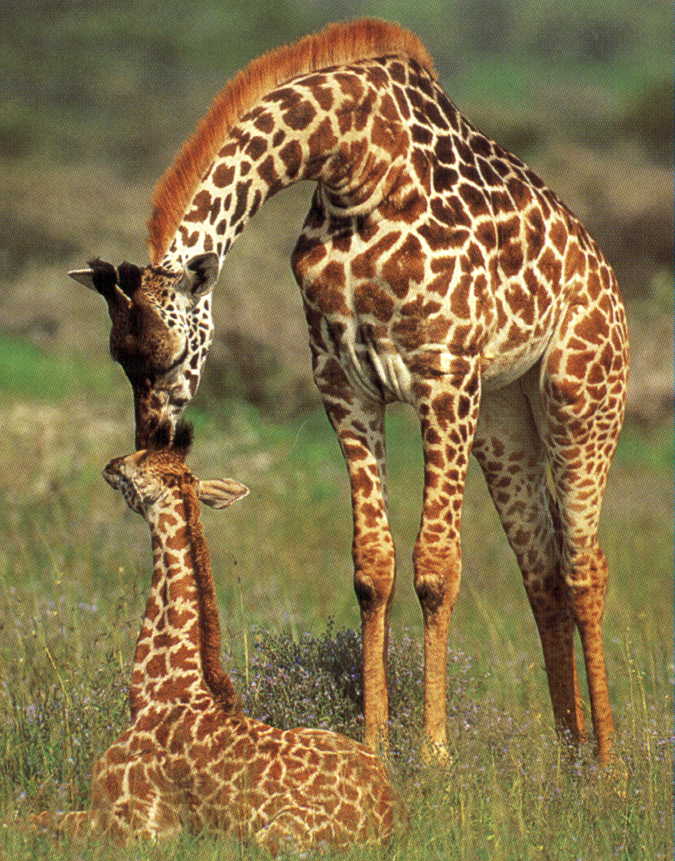
    Giraffe nuzzling calf
    (Photo from Giraffes.org)


    • Here's a fact that will surprise you: at 8 feet, the giraffe's tail is the longest of any mammal.
    • Yup, you really can't go wrong with giraffes.

    Good night, giraffes.
    (Photo from Boost Inspiration)


    Sources
    Giraffe Sanctuary, How many species of giraffes exist?
    Wildlife Conservation Society, Giraffe
    Animal Fact Guide, Giraffe

    Monday, March 21, 2011

    Apple #513: Wolverines

    Recently a friend and I watched a really good documentary about wolverines. Not the team, and not the X-Man. The actual animals. Turns out they are way cooler than I ever knew.


    Nature: Wolverine: Chasing the Phantom
    (Available for $11.93 through Amazon)


    The documentary said that little is known about wolverines because so few people have seen them. Even some of the researchers who have spent decades studying wolverines have never actually seen them in person. They may have caught wolverines on camera, but they've never actually encountered a wolverine.

    What the documentary did get across was that wolverines are super fast and strong for their size, they are indefatigable, and they have personality to spare. So I want to know more about these animals. What are some of the basic facts that we do know about them?


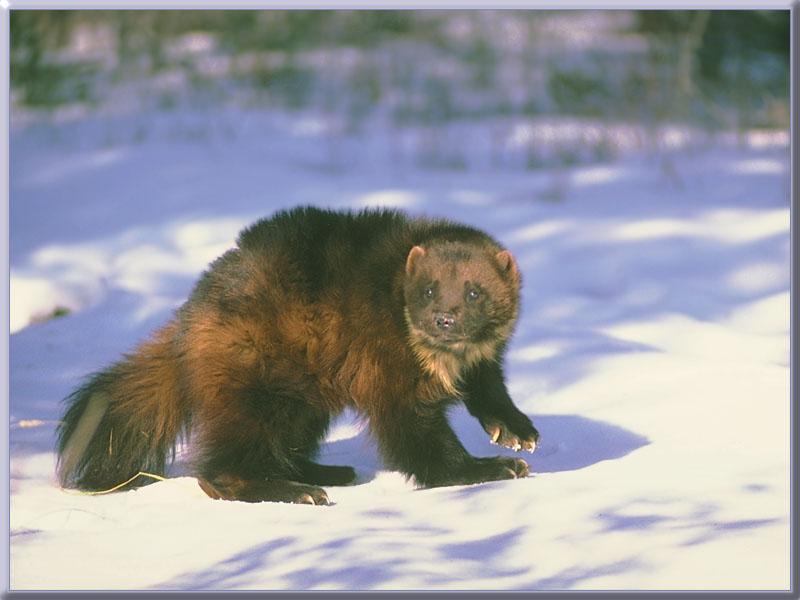
    Wolverines have pointy faces but a snubbed nose, very thick fur that is a mixture of brown and black with golden hairs under the chin, a stout bushy tail, and huge feet with claws. This one is doing one of the wolverine's favorite things: running over the snow.
    (Photo posted by Anonymous at care2)

    • Wolverines may look like a cross between a bear and a raccoon, but they're actually members of the weasel family.
    • They're not big -- only about 3 to 4 feet long and they weigh about 30 to 40 pounds. But they pack a punch in those little bodies.
    Picture a Weasel—and most of us can do that, for we have met that little demon of destruction, that small atom of insensate courage, that symbol of slaughter, sleeplessness, and tireless, incredible activity—picture that scrap of demoniac fury, multiply that mite some fifty times, and you have the likeness of a Wolverine.
    --Ernest Thompson Seton, 1953

    • Here's a 2-minute bit from a Wild Kingdom episode that gives a brief overview of the wolverine, and gives you a good idea of how they move. I wanted to embed it here but the dang link they provided didn't work.
    • Wolverines cover territories that are enormous relative to their size -- anywhere from 200 to 1,000 square miles.
    • In deep snow, when other animals typically slog away and sometimes founder, wolverines can cover as much as 15 miles in a day. And, by the way, they run the entire time. 
    • They're able to run like this over snow mainly because of their feet. Put simply, their feet are huge.


    It's tough to tell how large the wolverine's paw is from this photo, but you can get a sense of how sharp their claws are. I'm more stunned by the fact that the wolverine is allowing himself to be held, though it looks like he won't put up with it for long.
    (Photo from The Wolverine Blog)


    This drawing of a wolverine's paw print isn't that great. For one thing, it's about half the size that it should be. But I posted this image because it gives a good idea of how the toes of the wolverine fan out. Because of the size of their paws and the way they spread out like this, it's as if the wolverines are running on snowshoes.
    (Image from Through the Eyes of a Wolverine)

    • The Latin name for wolverine is Gulo gulo, which means glutton glutton.
    • They are so named not because they kill more food than they can eat or because they overeat, but because the animals they kill for food can be enormous compared to their size. They've been known to take down elk, moose, or caribou.
    • Most of the time, though, they kill smaller animals like rabbits or grouse or squirrels, or they eat carrion -- animals that are already dead. They're especially good at finding dead animals buried deep under the snow.
    • If they do kill or come across more food than they can eat at one time, they'll mark the food (spray it with their scent), bury it under the snow to preserve it, and come back for it later.
    • Eventually, they'll eat everything -- bones, teeth, skull, everything.
    • One person in the documentary said that one of the reasons he's so impressed with wolverines is because other animals that you normally think of as being really good in the mountains, like mountain goats, can still get taken out by avalanches. But wolverines not only survive the avalanches, they eat the animals that don't.
    • They are pretty much unstoppable.  When they're moving, which is most of the time, they're running. When they sleep, it's only for about three or four hours at a time. Then they get up and run some more.
    • Wolves, bears, and mountain lions are the wolverine's only predators. Those animals are also a wolverine's primary competitors for food.  But a wolverine is not so helpless against them.  A single wolverine is capable of driving a pack of wolves away from a kill.
    • They're not especially graceful and they don't see too well, so when they hunt, they use the element of surprise. They'll climb up a tree or onto a tall rock and when some likely animal wanders by, they'll jump on the animal's back. Sometimes this breaks the animal's back, or sometimes fighting ensues.


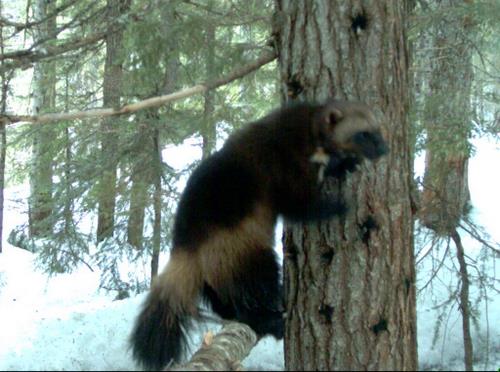
    One common way that researchers have studied wolverines is to hang some sort of meat from a tree in front of a camera. Wolverines come around, climb the tree to get the food, and their motion triggers the camera shutter. That's how this picture was taken.
    (Photo by Audrey Magoun, sourced from Chattermarks)

    • Wolverines are also excellent swimmers.
    • They live in dens under rocks or roots in the warm months. During winter, they dig dens deep into snow drifts. Often their dens include a complicated system of tunnels and chambers.
    • Wolverines generally keep to themselves except during mating. Both males and females may mate with more than one wolverine. When the female gives birth, she may have anywhere from 1 to 6 kits, any or all of which may have different fathers.
    • The babies are born in a den dug into the snow. They're born blind with white fur that camouflages them against the snow.  As they mature, their fur darkens.
    • Wolverines were hunted to near extinction because of their fur.  It's very thick and dense, so actually an entire coat made of wolverine fur would be extremely heavy. Now, if people use wolverine fur at all (some native people still do), they use it only to line the hoods of parkas because of its other remarkable quality -- it doesn't hold moisture and therefore it won't freeze.
    • The fact that wolverines used to be hunted a lot for their fur is one reason why few people have seen them -- there are very few of them left.  Their snowy and wild habitats are also going away, so they have retreated farther and farther north.

    Wolverines live in the areas in black -- or at least, this is where they are believed to live as of 1999. The numbers refer to subspecies. (1) is Gulo gulo gulo (I'm not kidding) and (2) is Gulo gulo luscus.
    (Map from San Francisco State University Department of Geography)

    • They once lived as far south as Arizona and New Mexico.  As you can see, they've moved quite a distance north. 
    • They also really don't like being around people. That's probably another reason why few people have seen them in the wild.
    • Wolverines aren't on US endangered or protected species lists because applications for them to be included were rejected for insufficient data. Nobody can find enough wolverines to conduct a census that anybody thinks is anywhere near accurate. [EDIT: soon this will be no longer true. As of February 2013, US wildlife officials are asking that wolverines be added to the endangered species list because their habitats are threatened by climate change. Only an estimated 250 to 300 remain.]
    • There is some good news, though.  In 2004, a wolverine was spotted in Michigan -- a state where no one has seen a wild wolverine in 200 years. They saw the animal near a town called Ubly, which is about 90 miles north of Detroit.


    This is the wolverine that was seen in Michigan in 2004, photographed as it was running out of the woods and across a field. 
    (Photo by wildlife biologist Arnie Karr via AP)

    • In 2010, a wolverine was spotted in Grand Teton National Park in Wyoming. Later, that same wolverine was seen in Colorado -- 500 miles south. The last time anybody saw a wolverine in Colorado was in 1919.
    • Researchers were able to catch him and put a radio collar on him.  They named him M56 (I think the M stands for male), and people are hoping to be able to monitor his movements.

    See? Enormo-paws.
    (Photo from Esquire)

    • If you think you've seen a wolverine, document as much of the experience as you can -- take pictures of the animal or its tracks, note your location by GPS or as specifically as possible -- and let the folks at The Wolverine Blog know about it.

    If you're interested, here's the documentary I watched. It was on PBS, so your library probably has a copy of it.


    Nature: Wolverine: Chasing the Phantom
    (Available for $11.93 through Amazon)

    Sources
    National Geographic, Wolverine (Gulo gulo)
    Arctic Animals, Wolverine (Gulo gulo)
    Muirmaid, Wolverine
    The Animal Files.com, Wolverine
    Fur Commission USA, Fur types in brief
    New Hampshire Public Television, NatureWorks, Wolverine - Gulo gulo
    C. Breen, The Biogeography of Gulo gulo (wolverine), Biogeography, San Francisco State University
    Colorado Division of Wildlife, Wolverine
    Kurt Repanshek, Wolverine Sightings Growing in Rocky Mountain National Park, National Parks Traveler, August 6, 2010
    David Runk, First Michigan wolverine spotted in 200 years, Associated Press, February 25, 2004

    Thursday, August 26, 2010

    Apple #479: Skunks in the Fall

    I have smelled skunk in the air twice in the past two days. Is it my imagination, or do I smell skunks more often this time of year in general?


    Is that eau de skunk I detect on the air this fall evening?
    (Photo from Warner Bros., sourced from Misster-Kitty)

    • No, it is not my imagination.  Skunks are out and about much more often in the fall. They do what's called the "fall shuffle."
    • They mate and give birth in the spring, so that's not what it's about.

    (for more, click the Read More link)


    Monday, May 17, 2010

    Apple #457: Bats

    I was out in the woods the other evening, I saw a fair number of bats flying around.  This reminded me, I like bats.


    Bats flying at dusk. These are actually Mexican Free-Tailed bats, one group of which lives in an enormous colony of several million near San Antonio, Texas.
    (Photo from Nature's Crusaders)


    A bat got in my house once.  I was in bed with the lights off, and I heard it whooshing around above my head.  Since I couldn't see what it was, at first, I was kind of terrified.  But once I got the light on and saw what it was, and when I saw that it was following a sort of pattern around the room near the ceiling, I got over being afraid of it and tackled the problem of how to get it outside.

    I went downstairs to get a container large enough for it, and when I came back upstairs, it had flown into the other bedroom.  I shut myself in there with the bat so he couldn't fly into another room.  He flew around and around and then paused on the molding at the top of one of the windows.  He had bright eyes, a small, quick face, and his wings looked leathery but soft.

    I talked to him.  I said, "You're not going to be happy in here because there's no food for you to eat."  I noticed that any time I said a word with an "s" sound in it, his ears moved.  So I said a lot of other things to the bat, trying to use a lot of "s" words.  During our conversation, he left the top of the window and flew around the room quite a few times, but he flew around less often and stayed on the window longer.  Finally as he was pausing, listening to my "s" words, I was able to get close enough to him, said I was sorry, and clapped him in the huge container that had once held many gallons of frozen yogurt.

    I quick opened the window, held the container outside the window, lifted off the lid, and he flew out right away.  He seemed to be unhurt.  As soon as he was gone, I missed him.  It was nice having a guest.


    A bat in the house may read your good books?
    (Photo from Get Rid of Bats)


    I just looked up what you're supposed to do if you have a bat flying around in your house.  Basically, I did what they recommend.  But because there is a faint possibility that a bat could carry rabies, I should have gotten a rabies vaccination.

    If you have one bat in your house, open a window and chances are the bat will fly out on its own.  If that doesn't happen, put on thick gloves, find something like a net or a large container, and capture it long enough to release it outside.  Then you should stop by the hospital or the doctor's office and get a precautionary rabies vaccination.

    If you have lots of bats living in your house, it seems counter-intuitive, but build a bat-friendly house for them in your yard.  Then when it's dark, wait for them to fly out to find food and close up any holes where they could get in.  When they come back, if they can't get into your house, they'll move into the bat house.  More details about that process are available here.


    Bat houses work best when they're made of cedar and mounted under eaves but with exposure to the sun to keep them warm. This bat house by Looker Inc., is one of many types that are made to the Organization for Bat Conservation specifications. This means it will have a better chance of attracting bats already in your house, and of keeping them there so they will eat the bugs you don't want in your yard or on your plants.

    • There are over 1,100 species of bats.
    • Bats represent 20% of all species of mammals.
    • They are the only mammals capable of true flight.
    • Bats are very long-lived for their size.  Most live to be around 15 or 20 years old.

    What I find interesting about bat anatomy is that it is literally the arms and the fingers that support the wings.
    (Photo from Bat Conservation International)

    • The fact that bats use their arms and hands to fly is essentially the reason they sleep upside down.  They're resting their arms.  Their feet aren't made for walking, but like birds' feet, their at-rest position is a grasping position.  So when their feet are relaxed, they're curled around the branch and the bat can fall asleep, nicely relaxed.
    • They don't have the problem with blood rushing to their head like humans do.  Because of their small size, blood distribution isn't an issue, so it doesn't matter to their circulatory system whether they're right-side-up or not.
    • Bats are not blind.  Really.  In fact, most species of bats have excellent vision.
    • Like dolphins, they "sound" out their territory by echolocation.  They make high-pitched tweets and are able to analyze the echoes that bounce back.  Not only do their know where their friends and relatives are, they also know where obstacles are so they can avoid them.  
    • Their echolocation systems are so good, they can detect obstacles as fine as a human hair.
    • Which therefore means they will not get caught in your hair.
    • One handy way to categorize the species of bats is by the food they eat.

    Species of bats divided up according to the foods they eat.
    (Pie chart from Bat Conservation International)


    Bug-Eaters
    • Nearly 2/3 of bat species eat bugs.  And they eat a lot of bugs.  One small brown bat can eat about 1,000 bugs the size of mosquitoes in only one hour.
    • A female bug-eating bat who is either pregnant or lactating will eat her entire body weight in bugs each night.
    • Nearly all the species of bats who live in North America are bug-eaters. 

    This is the Eastern Red Bat. It's the most common tree-dwelling bat in North America.  It lives anywhere from the northernmost tip of Maine down to central Florida, and west until about the Rocky Mountains.  They come out to eat early in the evening, often at the edge of forests or even around streetlights where moths are plentiful. While sleeping, they curl their tails around them and are often mistaken for dangling pine cones or dead leaves.
    (Photo from Bat Conservation International)

    • Many bug-eating bats will migrate to nearby caves or mines to hibernate for the winter, but some travel from as far north as Canada to as far south as Mexico.
    • As with many migrating animals, researchers aren't sure how bats find their way back to the same hibernation and summer homes each year.
    • Most mammals mate in the spring, but not these bats.  Most of these species mate in the fall.  Then they all go hibernate for the winter.  When the female wakes up in the spring, she ovulates, and the egg is fertilized by the sperm that has lain dormant inside her all winter.
    • Once she's pregnant, she'll move from her winter roost to another roost that's warmer.  Lots of other female bats will find the same roosting spot, and they'll form a nursing colony.  The babies are born about 2 and a half months later.

    You'd think this bat would be called Big-Eared Bat, but actually this is the Spotted Bat.  Its ears are pink and so are its wings. I'm not sure where the spots are, actually.  It's very rare and it eats only moths. Its territory ranges from southern British Columbia in sort of a stripe all the way down to the middle of Mexico.
    (Photo from Bat Conservation International)


    Fruit-Eaters
    • The other 1/3 of bats eat plant nectar or fruit.  Most fruit-eating bats live in tropical climates.

    This is the Straw-Colored Fruit Bat, which lives in Africa.  As shown in the photo, they can use their "fingers" for help in climbing along tree branches.  These bats are fairly large, they don't mind flying around in the daytime, they like to eat the fruit of palm trees, and they're very gregarious.  Sometimes they form colonies as large as 1,000,000 bats.
    (Photo from the Organization for Bat Conservation)

    • Fruit-eating bats also act as pollinators of the plants whose fruit they eat.  The fruit-eaters are also very good at, um, fertilizing and distributing the seeds of their favorite plants.
    • Some of the plants that bats pollinate include bananas, avocados, peaches, mangoes, figs, cashews, and agave.
    • Flying foxes are the largest species of bat.  They live in Indonesia and Australia.  Their wingspans reach nearly six feet.

    This is the Egyptian Fruit Bat. They live, obviously, in Egypt, but also in Pakistan, Turkey, and around the Arabian Peninsula.  Males will roost in the nesting colony with the females.
    (Photo from the Organization for Bat Conservation)

    • A tiny fraction of other bat species eat small animals like fish, mice, or frogs.

    The Fringe-Lipped Bat is one of the few species that eat frogs, or anything other than bugs or fruit.  This bat lives in Panama.
    (Photo by Alexander T. Baugh from the University of Texas at Austin)


    Blood-Eaters
    • Only 3 species of bats are vampire bats, and all 3 species live in Latin America.  

    A vampire bat. Boy am I shaking in my boots at the sight of that tiny little thing.
    (Photo from Life123)

    • They do feed on blood, but only the blood of birds, cattle, horses, and pigs.  They typically go up to livestock while they're sleeping, cut open the skin with their teeth, and lap up the blood.
    • They don't suck blood but rather they lap it with their tongues.  They have never attacked a human.
    • The saliva of vampire bats contains two handy enzymes. 
    • The first numbs the skin around the bite and keeps the animal from waking up.
    • The second enzyme dissolves blood clots. This keeps the blood which is their food flowing.  But researchers have managed to collect the enzyme and use it to treat people who have had strokes.
    • Some vampire bats will adopt young orphan bats, which is very rare for any wild animal. 


    A nectar-eating bat. I don't know any more about it than that. But it's a cool photo.
    (Photo from aaaaaahhhhshark)


    Okay, so maybe most bats won't win a beauty pageant.  But is that any reason to make up all sorts of lies about them?  I think not.  And would you rather have millions more mosquitoes?


    Oh, and how could I forget:  "You wouldn't hit a bat with glasses on, would you?"  Still makes me laugh.


    Sources
    Bat Conservation International, All About Bats
    Defenders of Wildlife, Bats
    Contra Costa County Office of Education, Bats! Why should you care?
    The Wild Ones Animal Index, Vampire Bat
    Life123, What Do Vampire Bats Eat 
    CoolQuiz! Why Do Bats Hang Upside Down?
    DOE Newton Ask A Scientist, Bats Upside Down

    Sunday, January 31, 2010

    Apple #436: Groundhog Day

    I can’t believe I haven’t done an entry yet on groundhogs or Groundhog Day.

    Typical groundhog.
    (Photo from Construction Lit Mag)


    Real Groundhogs
    • Groundhogs and woodchucks are the same thing.  They’re two different names for the same animal.
    • Groundhogs are a type of marmot.  They’re in the same family with squirrels, prairie dogs, and chipmunks.
    • Usually their fur is brown, but they may also be completely black.  More rarely, they may be all white (albino).
    • They're stocky animals with flattened heads and brushy tails. Their legs are thick and strong and because they spend much of their time digging, they tend to waddle when they walk.
    • They're slow runners, so they escape from predators (foxes, coyotes, dogs) by ducking into their dens.
    • If cornered, they can be fierce fighters. There are lots of stories about particularly feisty groundhogs fighting off dogs as big as Lassie.

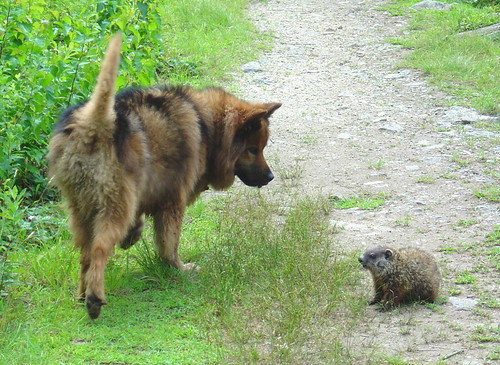
    Groundhog and dog, squaring off. The groundhog won this round, perhaps only because the dog's owner corralled him and pulled him away.
    (Photo from Hoarded Ordinaries)

      • They make several noises. They grunt when they're happy; when they fight, they make a series of huffing, then squealing noises; and when a predator is approaching, they let out a high-pitched, warbling, chattering sound called a shrill. (Wav files are from HogHaven.)
      • They also grind their teeth, and they make a sound like a low bark, but people don't know the purpose of this sound.
      • In the spring and summer they spend the majority of their time eating.  They have to store up enough fat in order to survive the winter, when they hibernate.
      • During these months, groundhogs hang out where they can find the most food, which happens to be in areas where woodlands meet open spaces, like fields, roads, or streams.
      • They eat grasses and dandelions and clover and alfalfa as well as fruits and occasionally tree bark. They also find a gardener's vegetables very tasty. Because they have to eat like mad in the summer and fall in preparation for winter, they have destroyed many a farmer's crops.
      • Another reason they have to keep eating is because their teeth don’t stop growing throughout their lives.  They have to keep chewing to keep their teeth worn down, or else their teeth will get way too big and possibly even kill them.
      • Groundhogs' feet have little paw pads, and on their back feet, they have a thumb-like digit which makes their paws look very similar to human hands, except with those extra pads and the long, sharp claws.

      I found some great photos of groundhog feet, but they have copyright notices all over them. So I can't show them to you here. But if you really want to see, and I recommend you look, check out this photo of a groundhog's front paw and this other photo of a groundhog's rear paw.

      The tracks a groundhog makes.

      • With those sharp claws, groundhogs can and sometimes do climb trees. They can also swim.  But usually they stay on the ground.
      • They have one den for summer and one for winter. The summer dens are relatively shallow, only 2 to 4 feet deep. They're built close to where they can find food, and often beneath structures like sheds or barns or garages.
      • Winter dens are dug in dry areas and are several feet deep. This is where the groundhogs go after the first frost to hibernate, so the dens have to be deep enough to keep the animals below the frost line.
      • While hibernating, the animal's heart rate plunges, and its body temperature is not much warmer than the temperature inside its burrow, about 39 to 40 degrees.
      • Winter or summer, the dens usually have two entrances, one where they come and go most often, and a second, smaller one where they can look out and see if the coast is clear or sneak out and escape a predator who's interested in the den.
      • Inside, the dens are lined with leaves and they are kept quite clean. There are rooms where the animals sleep and nurse their young, and a separate room which is essentially the bathroom. The groundhogs will wipe their feet before entering the den.


      Cross-section of a groundhog's den.
      (Drawing by Judith Moffatt, from Highlights Kids)

      • In the spring, as soon as he emerges from hibernation, the male starts looking for a female. He walks from den to den until he finds a female who's interested. He mates with her and stays with her until she's ready to give birth. Then she kicks him out of the den to have her babies.
      • She usually has about six cubs, which are born blind and helpless.
      • She keeps him away from the cubs and won't let her near them. So he goes back to wandering from den to den, looking for another female. But most of them have already had their cubs and they run him off, too.


      Groundhog Day
      • The legend, which seems to have come to the U.S. with settlers from Germany (and the Germans may have gotten the tradition from Roman conquerors), is that if a groundhog wakes from hibernation, sees its shadow, and returns to its den, there will be six more weeks of winter.
      • I’m not sure why Punxsutawney, PA became the center for Groundhog Day predictions, other than that a lot of Germans settled in Pennsylvania.  And the media might have had something to do with it.
      • Punxsutawney Phil has been predicting the weather since 1887.  It wasn’t until 1966 when the ceremony of Phil emerging from his burrow at Gobbler’s Knob was made public.  Since then, it has become an increasingly popular media event.
      • Now thousands of people descend on Gobbler's Knob, often as early as 3:00 in the morning or even the night before.  They wait outside in the cold until sunrise, around 7:00, when Phil makes his prediction.  I'm told there's a lot of drinking and shenanigans that go on in that 3 a.m. to 7 a.m. window. 
      • In Punxsutawney on February 2, the groundhog is brought out of his “home” in a tree stump.  He’s held up next to the president of the Groundhog Club and supposedly he speaks his prediction in “groundhogese.”  The Groundhog Club President then announces Phil’s prediction to everyone else.

      Punxsutawney Phil being held up by one of the members of the Inner Circle. That's what those guys in the top hats call themselves.
      (Photo from mypunchbowlblog)

        • Punxsutawney Phil almost always sees his shadow. Only 12 times out of the 109 years for which there are records did not see not see his shadow. In 1943, he didn't even come out of his hole. I don't blame him. There was a major war on that year.
        • He's been seeing no shadow more often lately. 6 of those 12 times he didn't see his shadow were in the last 10 years. Maybe Punxsutawney Phil knows about global warming too?
        • February 2 is what's known as a "cross-quarter" day, which means it's halfway between the winter solstice (the onset of winter) and the vernal equinox in March (the beginning of spring).  So by the calendar, February 2 is the dead middle of winter.
        • As it happens, groundhogs don't really end their hibernation until after Feb. 2. Depending on how far south or north they live, they may wake up a week later, or not until March.
        • What wakes them up is the change in the amount of daylight.

        I plan to continue my celebration of Groundhog Day by watching, again, the movie of the same name, starring Bill Murray and Andie MacDowell.  I don’t think her character is all that charming or desirable, and that sort of dampens the movie for me.  But the rest of it, particularly the fact that the day repeats over and over and over until he apparently gets it right, is genius.  And I love Bill Murray.  He lets the groundhog drive.  Maybe if I watch the movie enough times, I’ll get to run off with him.


        Okay, campers, rise and shine! Don't forget your booties cause it's cold out there today.

        It's cold out there every day.  What is this, Miami Beach?

        Not hardly. And you know, you can expect hazardous travel later today with that, you know, that, uh, that blizzard thing.

        That blizzard-thing? That blizzard-thing. Oh, well, here's the report! The National Weather Service is calling for a "big blizzard thing!"

        Yes, they are. But you know, there's another reason why today is especially exciting.

        Especially cold!

        Especially cold, okay, but the big question on everybody's lips...

        -- On their chapped lips.

        -- On their chapped lips, right. Do you think Phil is gonna come out and see his shadow?

        Punxsutawney Phil!

        That's right, woodchuck chuckers, it's

        [in unison] GROUNDHOG DAY!

        If you want to know how long Phil Connors actually lives Groundhog Day over again, The Movie Guy has come up with an estimate. The short answer: nearly 34 years.


        P.S. How much wood could a wood chuck chuck?
        • Though they can gnaw on bark, woodchucks don't actually eat that much wood, nor do they carry it around as beavers do. However, if they could carry it around, and if they used wood to fill one of their dens, they would have chucked about 700 pounds' worth of wood.

        Sources
        National Geographic, Animals, Groundhog (Marmota monax)
        Dr. Julia Spencer, Groundhogs.com
        Hinterland Who's Who, Mammal Fact Sheets: Woodchuck
        IMDb, Groundhog Day (1993)
        Groundhog Day, The Official Website of the Punxsutawney Groundhog Club
        Jason Patton's Groundhog Day page

        Sunday, December 6, 2009

        Apple #424: Reindeer

        I'm thinking I might do some Christmas-related entries. I don't know yet if every entry I do this month will be about a Christmas topic. That might get a bit tiresome. Or we all might enjoy it. We'll see. But for right now, I'd like to talk about reindeer.


        A reindeer, doing one of the things reindeer love best -- eating.
        (Photo from the Polar Trec)


        • Reindeer are semi-domesticated caribou. They are the only type of deer that has been domesticated.
        • Reindeer were domesticated some 7,000 years ago, longer ago than the horse.
        • They're very similar to their cousins the wild caribou, but they are a bit smaller, they have shorter legs, and their fur is lighter colored.
        • They live on the tundra in Alaska, Canada, Greenland, Scandinavia, northern Russia and norther Asia. In the lower 50 states, breeders keep herds fed on commercial feed and raise them in places as far south as the Midwest, Tennessee, Mississippi, and Texas.


        This male reindeer, the Rock, lives in Lake Crystal, Minnesota.
        (Photo from Reindeer Owners and Breeders Association)


        • Reindeer's hooves are broad and flatten out, which makes it easier for them to walk on top of snow or soft ground.
        • Their hooves are also good at digging down through the snow to the grass beneath.
        • They can run fast. Their thick fur, which traps and insulates air, also makes them good swimmers.
        • They like to eat lichen, and they eat a lot of leaves (birch and willow are their favorites) and grass, and mushrooms. They eat 12 pounds of plants each day.


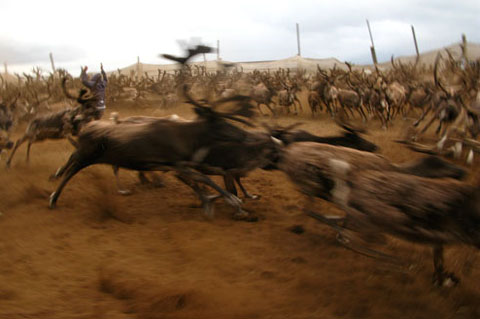
        Reindeer, headin' down the highway. Probably looking for more food.
        (Photo from the Wonderopolis)


        • I'm amazed that this is all they eat because they can weigh between 200 and 600 pounds.
        • Reindeer live in herds, which may vary in size from 20 deer to thousands. The herd is always traveling, searching for more green food for everyone to eat.


        This reindeer herd lives in Sweden.
        (Photo by Mats Andersson)


        • They really hate flies and they will seek out breezy places, shorelines, or high peaks to get away from them in the summer. In the winter, though they tend to seek shelter, they also look for open spaces where the wind might have blown the snow off the grass.
        • The males have a white furry mantle around their necks called a mane. They also get a little chin beard.
        • Both the male and female get antlers each year. 
        • The males lose their antlers in winter, but the females keep theirs all through winter until they give birth in the spring.


        This is George. He lives near Palmer, Alaska. You can see the velvet on his antlers. Velvet is a furry skin with blood vessels that covers the antlers until they are fully grown and hardened. When the antlers are hard enough, around August, the reindeer will rub off the velvet and the males will fight each other.
        (Photo from Reindeer Farm's Photostream)


        • Of course the males fight each other with their antlers. In the fall, their necks swell up and they get protective of the females and aggressive with each other. They'll fight and work out who belongs with whom for a few months.


        Very blurry photo of males fighting. It's hard to make out the details, but it gives you the sense of the herd as well as the fight.
        (Photo from Microkhan)


        • The males will mate with a harem -- this is the word the sites use -- of about 5 to 15 female reindeer.
        • In the spring, when the female is ready to give birth, she leaves the herd and finds a secluded spot somewhere not too far from the summer grazing area. Each year she's pregnant, she'll come back to that same spot to give birth.
        • The reindeer is born in late May or early June, weighs 11 to 20 pounds, and stands within minutes of birth.
        • At one day old, a reindeer can outrun a grown man.


        A reindeer fawn named Thunder, only a few days old, from Knoxville, Tennessee
        (Photo from Reindeer Owners and Breeders Association)


        • The fawn's coat is not speckled with camouflage but looks the same as its parents.
        • The fawn will grow really fast, so that by the time it is only four months old, it will weigh about 90 pounds.
        • Young deer will start growing antlers at one year old.


        Female reindeer and fawn, both with antlers. Since the fawn's are just sprouting, it's probably about a year old.
        (Photo from Wonder Club)


        By the way, the reindeer names in the song are
        • Dasher
        • Dancer
        • Prancer
        • Vixen
        • Comet
        • Cupid
        • Donner
        • Blitzen
        • Rudolph
        But I think real-life reindeer are cooler than the ones in the song.


        Sources
        Bear Country USA, Reindeer
        Reindeer Owners and Breeders Association, Reindeer Info
        Wonder Club, Reindeer
        Enchanted Learning, Reindeer
        Reindeer Learning Zone