Showing posts with label word or phrase origins. Show all posts

Monday, January 2, 2017

Apple #738: Knocking on Wood

I have had a request! My friends & I were talking about 2017, and how we hoped it would be better than 2016 in many ways. One of our number, Kalonice, knocked on the table for good luck. Then she said, "Where does that come from, knocking on wood?" Naturally, I had to find the answer.


(Image from Woman's Day)


Before I do any research, I'm going to put forth a guess. I'm going to say it has something to do with touching the wood of the crucifix.

  • I am wrong! The custom goes back way before Christianity.  
  • As with many of our traditions that have been around for a very long time, no one can say with certainty what is the exact timing or origin of the practice. But it goes all the way back to pagan times when Europeans -- perhaps the Druids or the Greeks -- believed that spirits lived in trees. 

 
One rendering of what a tree spirit might look like.
(Image from Tana Hoy)
  • So when you spoke of your hopes for good luck, you'd touch or bang on the trees or the wood of your house or whatever wood was near to hand from which the spirits might spring. Researchers think original idea was possibly that you were asking the spirits to make this good luck wish come true. Or maybe you were acknowledging that they are in charge, and knocking on their wood is like saying, "Hello, I know this is up to you, so I hope you'll allow this wish to come true."
  • Over time, the tradition got co-opted by the non-pagans.  Christians began saying that knocking on wood was a way of saying, This is up to Jesus, so I'm going to knock wood which reminds me of the crucifix.  So I was kind of right, but there was a more-right answer that came first.
  • At some point, the idea must have changed from propitiating the tree gods or essentially praying to Jesus to give you good stuff and became a superstition that tried to keep evil-minded spirits from bringing you bad luck.  Around the 17th century, when people said "knock wood" (or in Britain, "touch wood"), they would add the Latin phrase "absit omen," which means "may the omen be absent from me."
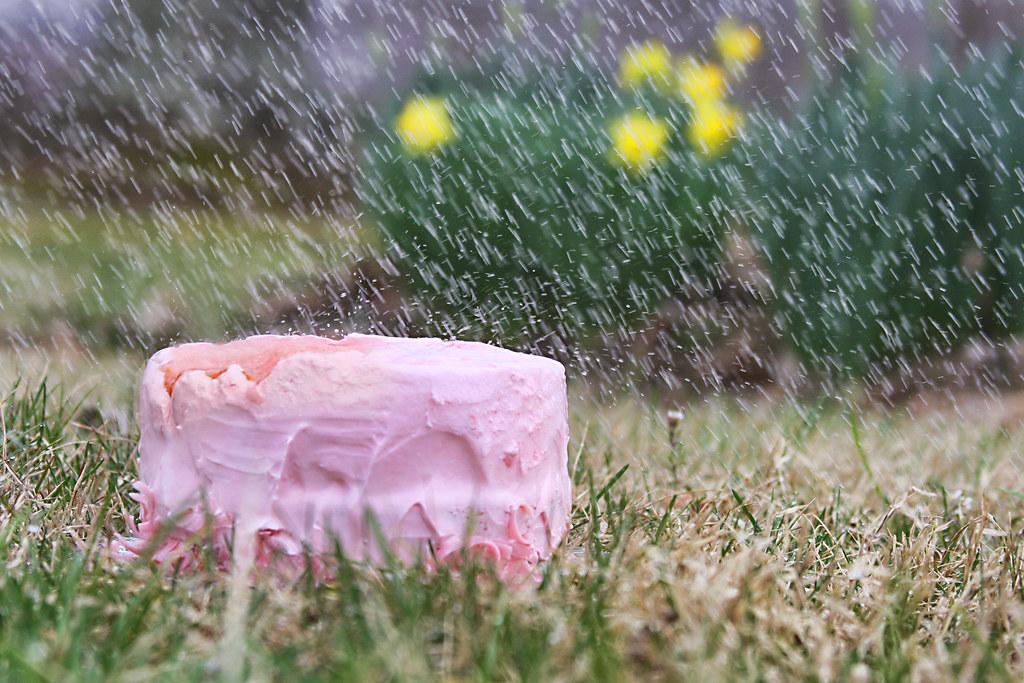
  • Keeping away the bad luck seems to be the prevailing attitude today, so much so that I'm tempted to disagree with the researchers and bet that this might have been the idea from the beginning.  Lots of societies hold the idea that if the spirits find out that you have too much good luck, they'll  foul things up for you. You know how this goes. As soon as you think everything's cake, something drops out of the sky -- or maybe from the treetops -- and wrecks your cake.


Someone left the cake out in the rain -- not just bad but also bad luck.
(Photo by Doris Rapp on Flickr) 

  • Here are similar expressions in other languages. In some countries, the expression is meant to ward off evil spirits, and in others, it is meant to seek the protection of the good spirits.
    • Arabic: امسك الخشب (imsek el-khashab), means knock wood, but gets translated as "God is the Protector"
    • Brazilian Portuguese: bater na madeira
    • Czech: klepat na dřevo
    • Finnish: koputtaa puuta
    • Greek: chtipa xilo
    • Swedish: ta i trä   
  • German lore has it that the devil can't touch oak, so if you knock oak, you're proving that you aren't the devil. 


Either Jack proves the German lore wrong, or that door is not made of oak. This seems especially creepy, though, knowing that knocking wood is supposed to keep the badness away, and here the bad guy is doing it, wanting to be let in so he can bring about more badness.
(The Shining gif from Metro News)

  • There's also a story from Jewish history. When they were being persecuted during the Spanish Inquisition in the 1490s, the Jews were hiding in synagogues and temples, which were made of wood.  They devised coded knocks to indicate they weren't the bad guys so their fellow Jews would let them in. Knocking on wood was a thing that helped them, resulting in good luck.   
  • I don't know if I buy this story because the only places where I've seen it recounted are on sites that don't have a Jewish focus. Sites maintained by people with a Jewish background say it's a Christian practice that they've adopted.
  • So while it's hard to say exactly when the practice started, and while some cultures mean it to keep the bad stuff away and others mean it to bring the good stuff, what does seem to be true is that cultures & languages throughout time and around the globe knock wood.


Really going for the good luck, or touching wood all the way around the tree, hoping that 2017 will be better than the auguries currently show.
(Photo posted by Shouvik Chatterjee at Quora)

Sources
Mental Floss, Why Do We Knock on Wood?
Today I Found Out, Why Do We Knock on Wood?
The Phrase Finder, Knock on wood
Metro News, Why do we touch wood to avoid bad luck?
Touch Wood for Luck, The History & Superstition of "Touch Wood"
Islam in Everyday Arabic Speech, page 115

Sunday, November 22, 2015

Apple #721: The Wrong Side of the Bed

For quite a while now, I've been getting up on the wrong side of the bed.  I mean that metaphorically.  As the old saying goes.

But where does that saying come from?  And just what is the wrong side of the bed, anyway?


  • Well. As with most sayings and customs that have been passed around with no attribution whatsoever, 1) nobody is really sure where it comes from and 2) there are a lot of ideas out there presented as fact which are a lot of hogwash.
      • hogwash - kitchen swill, or slops fed to pigs (not the disgusting remnants left over after washing a hog), or in general, the refuse from a kitchen or brewery. Later, an insult referring to cheap liquor.  Still later, an insult referring to "inferior writing."


Not actual hogwash. Or if you like, a metaphorical demonstration of hogwash, in the sense that it is inaccurate.
(Image from Lifevine's Blog)


Actual, for real & for true hogwash.
(Photo of a bucket of pig slop, as ferried on the back of a man's bicycle in China from Waffles & Steel)

  • Back to the wrong side of the bed.  The saying means you wake up grumpy for no apparent reason, so you might as well explain it by saying you got up on the wrong side of the bed.
      • (I haven't been waking up grumpy, I've been waking up out of sorts, unhappy, sometimes downright inconsolable. But this makes about as much sense as being grumpy due to getting up on the wrong side of the bed, so I'll just say I've been getting up on the wrong side of the bed.)


This for sure would be the wrong side of the bed.
(Sourced from SlideShare)

  • Some recent news articles refer to a mysterious "study" conducted by Sealy UK (you know, the people who make mattresses).  I've looked at Sealy's website and their blog where they publish little press releases about the results of their "research," and I don't see anything on either site about this "study."  But let's pretend that it was published, and let's pretend that it was done with at least a modicum of scientific rigor.
  • According to this mysterious "study," Sealy UK found that in the case of couples who sleep together, there really is a "right" and "wrong" side of the bed.  That is, the person who sleeps (and therefore wakes up) on the left side of the bed is 10% more likely to have a positive outlook on life, and to be 8% more likely to enjoy their job.  The person who sleeps on the right side of the bed is, as you might therefore expect, more pessimistic and more likely to dislike his or her job.
  • This ephemeral study further says that for those who are not in a relationship, if they don't have many friends, they sleep on the right side of the bed.  Those not in a relationship who do have a large circle of friends sleep on the left side of the bed.
  • My big question which goes unanswered in the articles that quote this ethereal study is which side of the bed is the left and which is the right?  The left as you face the bed, or the left as you're lying down in it?  I suppose, since we're talking about sleeping in the bed and getting up from the bed, it would be the left as you're lying down in the bed.  But we need to know these details.  Otherwise, how will we rescue ourselves from pessimistic loneliness, since apparently all it takes is sleeping on the other side of the bed?
      • In case you can't tell, I have more than a healthy dose of skepticism about this so-called study and its purported results.


This kid got up on the wrong side, and is skeptical of everything besides.
(Photo from The[Robert]D.)


Our conventional wisdom about the wrong side of the bed says it's on the left.  Is that what this photo is saying, or not?
(Photo from Reinventing the Event Horizon)

  • If this "study" of Sealy's is correct, it flies in the face of centuries of commonly-held wisdom about what is the wrong side of the bed.
    • A lot of other sources on ye olde internette claim that the wrong side of the bed is the left side.  These hogwash purveyors say that the reason we have this phrase at all is because for a long time we -- or perhaps it was ye olde Romans, since some say this phrase is as old as the Roman Empire [we are awash in gallons of hogwash here] -- were very superstitious about anything left-handed.  The thinking here is that, since people used to be terrified of the lefties, if someone was plagued by mysterious bogeymen throughout their day, then it must have been that they got up on the cursed left side of the bed.  Or at least, that's what those silly superstitious people used to think, way back in the day.


[Cue the buckets of hogwash here.]

  • Other sources don't try to stake out which side of the bed is the bad side, or why, only that those silly people long ago thought that there were ghouls or demons lurking under one side of the bed, and they infected you as you arose from your slumber. So you spent your day fighting off the grumpy-making demons, and your day was screwed.
  • Now, there might seem to be some logic to the idea that the wrong side of the bed would be the left side.  Because the word wrong does mean the opposite of right. However, wrong's oppositeness to right is in the sense where right means moral, just, fair, etc.
  • Digging further into the opposites, etymologically speaking, the word right does not have anything to do with the right-hand side, but rather it means straight or even (it comes from the Latin rectus).  Wrong does not come from any word having to do with the left-hand side, but rather it means crooked, not straight.  A wrong, for example, could mean an unjust thing done to another person, but it could more concretely mean the crooked branch of a tree, or the curved rib of a ship.
  • So, making the claim that there is some etymological reason why the wrong side of the bed would be the left-hand side would be, er, wrong.
  • Further, those who say the phrase dates back to Roman times are also (say it with me) wrong.  The OED, the reference book that has been one of my dearest loves for decades, says that the first recorded published instance of the phrase "the wrong side of the bed" is from 1801.  Let me give it to you in all its finest OED detail:
To get up or out of bed (on) the wrong side, with allusion to the supposed disturbing effect on one's temper. colloq.
1801 Marvellous Love-Story I, 167 You have got up on the wrong side this morning, George. 

The OED. This may be my desert-island book--if I'm allowed to bring both volumes.
The Compact Edition of The Oxford English Dictionary, Complete Text Reproduced Micrographically (in slipcase with reading glass) (v. 1-20)

  • Other examples from later dates follow, but there you have it. First published usage is from 1801. Don't you think, if this phrase dated back to Roman times, there might have been another published instance of it before 1801?
  • What the incomparable OED does not tell us is why this phrase exists, what gave rise to it.  And that's really what we want to know.
  • I suspect that the reason we don't have a definitive source from which this phrase springs, or a particular reason for its existence lies within the nature of the phrase itself.  I believe what the phrase initially intends to express goes, in long form, something like this: 
Geez, George, you're in a bad mood, and it looks totally random and out of the blue as far as I can tell. You're acting like you just woke up this way, that it's got nothing to do with anything happening around you, you're just plain cranky today.  That makes no sense, really, so what put you in the bad mood to begin with must be something that makes about as much as sense -- like getting up on the wrong side of the bed. 
  • Looking for an explanation of the phrase might make about as much sense as looking for an explanation for the bad mood.  You'll find it on the wrong side of the bed.  Wherever that is.
  • As far as whether or not this entire blog post is hogwash, in the "inferior writing" sense of the term, I leave that to you to decide.

Sources
Hogwashy
New Zealand Herald, Left side of bed may be the 'right' side for best sleep, November 22, 2015
Daily Mail, Woken up grumpy? It really could be because you got out of bed the wrong side (and we FINALLY know which side that is), November 21, 2015
Sealy Blog, Sleep Research
Grammar-Monster, What Is the Origin of the Saying "To Get Out the Wrong Side of the Bed"?
Bloomsbury International, Get up on the wrong side of the bed
Woman's Day, The Origins of 12 Common Idioms, August 10, 2009
Ask Men, Weird Expressions & Their Origins - Part 4

Non-Hogwash
Online Etymology Dictionary, wrong, hogwash 
World Wide Words, Wrong side of the bed
The Compact Edition of The Oxford English Dictionary, Complete Text Reproduced Micrographically (in slipcase with reading glass) (v. 1-20)

Monday, March 23, 2015

Apple #706: Shampoo

I would like you to think about the word "shampoo" for a moment or two.  Say it out loud, slowly.  Sham poo.

This is the stuff we put in our hair?  To clean it?  Oh, I don't want the real poo, only the fake poo will do for me.  Who came up with this word?  Who in their right mind thought this was a good idea?  And why did we all go along with it?

A word-origins mystery in need of a Daily Apple if ever there was one.


Confidently Clean / Sham Poo.  Seems like an oxymoron, doesn't it?
(Photo from somewhere on this page: Aussie Moist Shampoo 13.5 Fl Oz (Pack of 6))


  • I blame the Brits.
  • The Oxford English Dictionary folks think that shampoo comes from the Hindi word chāmpo (sometimes it's spelled cāmpo, but the c should have a horizontal line above it, which means the c is pronounced ch).
  • This Hindi word chāmpo means "to press" as in "to massage."
  • The OED further elucidates the definition by giving an obsolete definition "as designating a part of the process of a Turkish bath."
  • Because, you know, India, Turkey, same thing.


An Ayurvedic massage today, including knotted towels soaked in a mixture of rice and warm milk. Perhaps this is similar to the original meaning of chāmpo?
(Screenshot from a video showing the entirety of the massage, which begins with a head massage. Warning: once the guy stops talking and the massage starts, it's very hypnotic. From wn.com.)


  • Reading the instances when the OED found uses of the word in its earliest appearances, it does look as though a bunch of British guys were referring to a practice that was probably massage -- and misspelling the Hindi word in a phonetic English way.
    • The first instance where they found shampoo being used was from 1762, from a text called Voyage of the East Indies (or something like that; there's a lot of abbreviation). The sentence is "Had I not seen several Chinese merchants shampooed before me, I should have been apprehensive of danger."  
      • Meaning, I suppose, that if a bunch of Chinese guys get shampooed (or chāmpo-ed) and come through it safely, then it must be safe for the British guy, too.
    • One instance in 1813 actually got the spelling closer to the Hindi: "She [a Mahratta wife] first champoes her husband and fans him to repose; she then champoes the horse."
      • Ahem.
    • This sentence, from 1829, gets very specific, and it's clear that what's meant is massage: "In the East Indies, friction with the hand, or what is called champouing, is generally practiced."
    • Or this one, from 1869, also clearly describes massage: "Shampoeing [sic] may be compared to a gentle kneading of the whole person." 
    • This, going back in time to 1823, is specific, though racially uncomfortable: "We had long ago seen negroes employed in percussion upon their Barbadean masters, by whom it is termed 'Champooing.'"
    • This one, from Jean A. Owen in a book about Hawaii, where he or she is talking about Tahiti, where some Hindi people do live: "In Tahiti, too, a traveler, on entering a house is always given a mat to lie on, and his weary limbs are shampooed whilst food is prepared for him."
      • sounds like an especially nice welcome.


"Indian head massage," as practiced by a clinic in Stoke-on-Trent, Staffordshire, UK. A depiction of one of the earlier meanings of shampoo?
(Photo from Real Ease in the UK)

  • In other instances, from memoirs of travels to the Indies or letters about trips there and things of that nature, it's not entirely clear what's happening during the ch/shampooing, if it's massage or hair-washing, or what.  
    • Dickens, from Pickwick Papers: "The other shampoo'ed Mr. Winkle with a heavy clothes-brush."
      • seems more likely that he means the massage definition.
    • Thackeray, from Vanity Fair: "Pinching the bed-curtains, poking into the feathers, shampooing the mattresses."
      • since the other two actions involve manual pressure, probably the shampooing does too, but perhaps washing could also be meant.
    • Here's an even more interesting one, from someone named Haliburton (with one el) in 1838: "So our diplomatists shampoo the English, and put 'em to sleep."


Shampooing today
(Photo from eHow)

  • But over time, by 1860, the English word came to mean only the massaging of the head & washing the hair.
    • "The patient should have . . . the hair cut and shampooed, and the whole body well cleansed with carbolic soap." (1881)
    • "Brilliant with gas, and redolent of rich perfume, are the modern shampooing salons." (1881)
  • And now, just for funsies, here's one final use of the word "shampoo," submitted without comment:
    • "the shampooed body . . . is rubbed all over with a preparation of soap confined in a bag, till he is one mass of lather." (1821)
      • oh, wait. I do have a comment. I think that's a lot like what's depicted in that video of Ayurvedic massage.  Seriously.

The next time your shampoo your hair, remember these two things:
  1. champou, not shampoo
  2. it's as much about the massage as it is about the product.  
I bet you'll enjoy washing your hair more than usual.

Sources

Sunday, November 18, 2012

Apple #611: Grateful vs Thankful

With Thanksgiving fast approaching, we'll all soon be giving thanks for the many good things in our lives.  Some of us have already started doing that.  I've noticed that sometimes people say they're "grateful" and sometimes they say they're "thankful."  Which got me wondering, what's the difference between the two words?  There must be some difference; they're two different words.

So what is the difference between "grateful" and "thankful"?


At Thanksgiving dinner, we are grateful.
(Photo from DIY)


  • I did a lot of looking online, and various sources disagree on this.  Some say there is no difference, some say there is a difference, but they disagree with each other about which one means what thing. Some dictionaries even use one word to define the other and vice versa.  
  • I'm basing my answer on the most authoritative sources out there, and the ones that can explain why they use the definitions they do.  This, of course, means the Oxford English Dictionary (my favorite reference book of all time), as well as a few other sources.
  • I know, I know, you don't want all the background mishmash, you just want the answer.  OK, here it is.  Then I'll get into the details.
  • Grateful = the feeling is directed to a person
  • Thankful = feeling of gratitude in general, or to God or luck or good fortune or some intangible force
  • Don't believe me, or need help remembering the difference?  I'll break it down for you. 

 
This is a good depiction of grateful.  An exchange between two people.
(Photo from Whispy lifestyle)

  • Grateful, says the 1828 edition of Webster's, is "kindly disposed towards one from whom a favor has been received."
  • That same dictionary uses almost exactly the same definition for thankful, except it leaves out the "towards one from whom" part.
  • My OED's definition of grateful begins "Of persons, their actions and attributes."
  • You can say, "I'm grateful to Mr. Rogers for making my childhood more enjoyable."  But you can't say "I'm thankful to Mr. Rogers," etc.  That just sounds weird.
  •  That's because you can be grateful to a person, but you can't be thankful to a person.


Here's a question.  Can you be grateful to animals?  I'm going to say yes.
(Photo from Wikimedia)

  • The words are very close in meaning, and the reason it gets confusing is when the words change grammatical form, the meanings change.  You do say, "Thank you, Mr. Rogers" but you don't say, "Grate you, Mr. Rogers."
  • Because we often thank people it seems like we should be able to be thankful to people.  But, nope.  We are grateful to people and thankful to God (or good luck, or fortune, or unseen forces).

  
This is being thankful.  Thanking the universe.
(Photo from SEO.com)

  • If it's a general situation that has affected you positively, then you say you're thankful: "I'm thankful that the traffic on the way to Sesame Street was not bad" or "I'm thankful that my ice cream cone did not fall to the floor."
  • But if you can identify a person as being somehow responsible for the favorable situation, then you use grateful: "I'm grateful that those semi trucks turned off on another road while I was on my way to Sesame Street," or "I'm grateful to my brother for not knocking my ice cream cone to the floor." 


When we have Thanksgiving, we are giving thanks to God (or to good fortune or the universe) for our family.
(Photo from Dan Arnold's page)

  • All this said, if you mix up the two words, the grammar police will not come to arrest you. And for that, you can be grateful.*
  • (*This is assuming that the grammar police exist.)

Sources
1828 Noah Webster's Dictionary of the English Language, grateful and thankful
Online Etymology Dictionary, grateful and thank
My copy of the Oxford English Dictionary
OneLook, grateful and thankful

Thursday, June 28, 2012

Apple #592: A Whole Lotta Blues

I thought I'd finish up my series of blue entries with a whole bunch of blue things, with a few facts about each. Sort of like the finale at a fireworks show.

Blue Suede Shoes


(Photo from some site on Etsy that isn't loading)

  • We all know Elvis Presley performed the song, but Carl Perkins is the guy who wrote it. He got the idea from Johnny Cash.
  • Cash told Perkins about an Air Force sergeant he used to know was rather particular about his appearance. He used to say, jokingly, "Just don't step on my blue suede shoes!" The reason this was a joke was because he'd be wearing his Air Force uniform at the time, with his regulation-issued shoes.
  • Cash thought this was a good line for a song, but Perkins didn't have any idea what to do with it. Not long afterward, he was performing at a dance when he heard a boy tell the girl he was dancing with, "Uh-uh! Don't step on my blue suedes!" He thought it was pretty incredible that the boy would care more about his shoes than the girl, and that's what made the song start to click in his head.

Baby Blues

 "I was shakin' in my shoes whenever she flashed those baby blues"


Blue eyes of a newborn
(Photo from info.com) 

  • The phrase comes from the fact that a lot of Caucasian babies are born with blue eyes. It's supposed to suggest wide-eyed innocence, as innocent as a newborn babe.
  • When people say that all babies are born with blue eyes, they are exaggerating. Some percentage of Caucasian babies are, but not every baby is born with blue eyes.
  • Some babies' blue eyes will change to a different color as the babies get a little older. This is because the melanin doesn't kick in until it's exposed to ultraviolet light.
  • Usually, after about 6 to 9 months, you'll notice a baby's eye color will have started to change.
  • Some babies' eyes will continue to change for as long as three years.  In about 10% of babies born with blue eyes, it may take even as long as adulthood until their eyes have settled on their final color.

Bluegrass


Kentucky bluegrass, a.k.a. Poa pratensis. Its tendency toward lushness is what makes this a favorite "barefoot grass."
(Photo from Power Seeds Inc.)

  • Bluegrass the music,is named for bluegrass the plant, which has a blue-ish tinge and grows in Kentucky.
  • Naturally, you'd think that Kentucky Bluegrass the plant would be native to Kentucky. Actually, it's originally from all over the place: almost all of Europe, northern Asia, and the mountains of Algeria and Morocco.
  • If you're just starting a lawn of bluegrass, don't mow it until it gets higher than 2 inches. And going forward, it's best not to mow it any shorter that 2 inches.

Blue Humor


The Aristocrats may be the quintessential bluest joke. Here's Gilbert Gottfried, after telling it at a friar's roast not  long after 9/11.
(Photo from Youdopia NSFW)

  • Jokes that involve bad language or sexual or vulgar or crude situations are typically referred to as "blue humor."
  • A lot of people say that this phrase comes from another phrase, "blue laws," which were laws going as far back as the 17th century that punished bad language, lying, swearing, public drunkenness, etc. In other words, laws that governed moral behavior. That much of the origin of "blue humor" seems to be true.
  • However, people go on to say that the phrase "blue laws" comes from the fact that the laws were printed on blue paper.  This part is not true.
  • The experts can't say for 100% certain, but they're reasonably sure that "blue laws" is related to the word "bluenose."
  • A bluenose is a very rigidly moral person, presumably one who would write laws about what you can and cannot say in public.

Blueprints


Blueprints are architectural or other detailed drawings that have a blue background and the text and lines are in white.
(Photo from Twins Daily)

  • Blueprints, as you'd expect, are so named because they are blue.  
  • The paper doesn't start out to be blue, but it turns out that way as a result of the process by which the designs are printed on the paper.
  • Technically, a blueprint is called a cyanotype. Making a cyanotype is a lot like developing a photograph. The process uses iron compounds, which start out to be green, but once they're exposed to UV light, they turn blue.
  • (Sort of the opposite of baby's eye color thing then.)
  • If you want to know more about how to make a cyanotype, a site called Alternative Photography has the instructions.

Blue Whales


The blue whale. Everything about it is superlative.
(Photo from Wonderful Whales)

  • Blue whales are the largest mammals on Earth.
  • They can get to be 100 feet long and weigh some 200 tons.
  • Here's a weird tidbit: their tongues, alone, can weigh as much as an elephant. (I don't know who's going around weighing blue whale tongues, but I believe this assertion)
  • They eat anywhere from 4 to 8 tons -- tons -- of krill per day.
  • Baleen, the stuff over their mouths that they use to filter in food, is made of stuff very like our fingernails.
  • They're also among the loudest animals on the planet. Their sounds are at very low frequencies, but they're so loud, other blue whales can hear them up to 1,000 miles away.
So many things to know about blue whales, I may just have to do a separate entry about them.

And now, with this last hurrah, I must tell you that I'm going on vacation.  Please of course browse around in the meantime.  With 591 other entries to choose from, I'm sure you'll find something to interest you.  See you in a couple of weeks!


Want more blue things? How about bluebirds , blueberries, Steely Dan's "Deacon Blues," plus of course the entries from this series: blue-footed booby, blue jeans, bleu cheese, and the ever-popular blue-plate special. 

Sources
Squidoo, Elvis Songs: Blue Suede Shoes
Songfacts, Blue Suede Shoes by Carl Perkins
Rockabilly Hall of Fame, Blue Suede Shoes: Chronology of a Hit
Anne Marie Helmenstine PhD, About.com, Why Are Babies Born with Blue Eyes?
What to Expect, Baby's Eye Color
Texas A&M System, Aggie Horticulture, Kentucky Bluegrass
Snopes.com, Blue Laws
Patrick Bromley, About.com, Blue Humor
Dictionary.com, blueprint
Alternative Photography, Cyanotype - the classic process
National Geographic.com, Blue Whale
Enchanted Learning, Blue Whale, the Loudest Animal on Earth 

Sunday, April 8, 2012

Apple #578: What Does "Easter" Mean?

As you may recall from my last entry, I am in the midst of answering a multi-part question from Daily Apple reader Roxanne. But before I continue with that, I have to address the fact that today is Easter

Word-curious Apple Lady that I am, I naturally wondered, why is it called "Easter" anyway? The Christian celebration has to do with Jesus being raised from the dead, but the word for it seems to have nothing to do with any of those concepts. So where does the word "Easter" come from?


This is about our how culture celebrates Easter: a little bit Christian, a little bit pagan.
(Photo from Discovery News)


  • The answer, I'm afraid, is rather iffy.
  • I consulted my compact edition of the Oxford English Dictionary (my favorite reference tool ever), and it gave me an uncharacteristically confusing answer. I'll spare you the heavily abbreviated and perplexing details and rather summarize the illuminating explanations provided elsewhere.
  • The word "Easter" comes from a whole lot of old Germanic words that, in lower case form, refer to the place where the sun rises, or the dawn itself.
  • The Venerable Bede, or Baeda, who was a priest living in a monastery in Northumbria, England around 700 A.D. provided an additional definition. He wrote a number of books, some of them histories, some of them Biblical commentaries.


Venerable Bede, or Baeda, a priest from Northumbria who wrote down a lot of stuff.
(Image from NNDB)


  • In one of his books, he said that back before his time, before there were any monasteries in Northumbria, or before there was much practice of Christianity there at all, the month of April was called Eosturmonath, or the month (monath) of Eostre.
  • Eostre, he said, was the name of a pagan goddess of the dawn (or perhaps spring, depending on your translation of Bede), and that pagan worshippers used to celebrate her feast day on the first day of Spring.
  • Well, if he's correct, that means the most sacred of days on the Christian calendar is named for a pagan festival.


Artist's depiction of the supposed goddess Eostre, by Jacques Reich, 1909. The artist associated her with all sorts of spring-like things: flower petals, babies, rabbits, the stork.
(Image from Wikipedia)


  • That's not very unusual, actually; all sorts of Christian holidays are linked in some fashion with pagan celebrations. I suppose the only reason I find this startling is because I never heard anyone talk about this before. Sure, there are bunnies and egg-dyeing (as opposed to egg dying, something any expectant mother would lament) but I never heard anybody say that the very name of the thing refers to a pagan feast.
  • But, as it turns out, the Venerable Bede might have made the whole thing up. Nobody can find much evidence of this supposed Eostre goddess.
  • Jacob Grimm, (yes, one of the Brothers Grimm), confirmed Bede's story but only in a word-origin sense. He said it seemed like the word for the goddess came from a particular Old High German word ostar. But he did not say he saw any evidence of the existence of the goddess or actual celebrations carried out in her honor.
  • Scholars still debate whether any goddess named Eostre or Ostara ever existed in the way-back day. Some say they have found evidence; others say the evidence is still rather scant.
  • So the jury is still out about whether there was a goddess named Eostre.
  • But our word "Easter" today does come from those original lower-case root words: the place where the sun rises, or the dawn itself. And therefore, beginnings.


Sunrise. New Day. Fresh start. Also, Easter.
(Photo from Wikimedia Commons)


Happy Easter, everybody.


Sources
My copy of The Oxford English Dictionary
Association of Polytheist Traditions, Eostre and Easter Customs
All About History, Origin of the Word Easter
About.com Paganism/Wicca, History of Ostara - The Spring Equinox
NNDB, Venerable Bede

Sunday, March 25, 2012

Apple #576: Jealousy vs. Envy

So a friend of mine recently bought a house. I'll call her Margaretta. (No, her name isn't really Margaret. I'm thinking of that part in The Sound of Music when the children go to the convent to talk to Maria, but they only get Sister Margaretta, and she won't let them in. They say her name over and over so plaintively, "Oh, Sister Margaretta, please. Please, Sister Margaretta. Please.")

So my friend Margaretta bought a house. I wish I owned my own house. I think this means that I am jealous. Or am I envious? I know there's a difference between the two, but what is it? And which of the two am I?


I think maybe I'd like a bungalow like this one. Nothing too big or too fancy. But I would like a big tree out front, for some shade.
(Photo from StarCraft Custom Builders)


I'm looking at my Oxford English Dictionary, and there are scads of definitions for these terms. I'll summarize the best I can while still preserving some sense of organization.


Envy
  • Looking into my OED, I'm actually rather shocked at how bad envy is. I'd thought it meant something along the lines of wanting what you don't have, but no. It goes way farther than that.
  • Envy comes from the Latin invidere, which strictly speaking, means to look upon. But somewhere in there, even in Roman times, it took on a negative connotation: to look maliciously upon.
  • Our English definitions not only include the malicious part, they make it a pretty major element of what the word means.
  • Envy is first of all, "malignant or hostile feeling; ill-will, malice, enmity."
  • Whew, that's harsh. I do not bear any of these feelings against Margaretta. Not even close. But wait, there's more.
  • "Active evil, harm, mischief."
  • Egad, no.


The Wicked Witch of the West might be the best personification of the malicious meanings of envy. She wants those ruby slippers so badly, she's filled with ill will, malice, and enmity toward Dorothy. By the way, to be "green with envy" means you're so filled with envy, you're sick to the point of turning green.
(Photo sourced from The Pop Culture Divas)


  • Not until way down in definition 3 do we get to the plain wanting-what-someone-else-has part:
  • "The feeling of mortification and ill-will occasioned by the contemplation of superior advantages possessed by another."
  • Well, that's closer to what I mean, but I don't feel mortified, and I don't feel any ill will toward Margaretta. I'm happy for her that she owns a house. It must give her a great sense of achievement, and I can imagine how gratifying that must be for her. I'm glad she's experiencing that. All that said, I'd like to own my own house and experience something like that too.
  • OK, now, down in definition 4b, we get a much tamer meaning: "A longing for the advantages enjoyed by another person."
  • Yeah, this is much closer to what I mean. But I don't think I want to say "I'm envious" and then have to direct people all the way down to definition 4b to arrive at my true meaning. Let's look at jealousy and see if that comes any closer.

Jealousy
  • Jealous (jealousy's root word) starts out pretty harsh, too: "Vehement in feeling, as in wrath, desire, or devotion."
  • I think most of us use the word jealous with a much tamer sense than this, probably not approaching anything like "vehement."
  • Later definitions get more specific and tend to focus more on the desire part, especially in an amorous sense.
  • Definition 2 is "covetous of the love of another, fond, lustful." This doesn't apply at all to what I feel about Margaretta and her house.
  • Definition 3 gets into the ways in which jealousy mess with the jealous one's head: "Zealous or solicitous for the preservation or well-being of something possessed or esteemed" (That is, you own something or you think you do, and you start to get all protective of it, out of fear that you might lose it); "vigilant or careful in guarding; suspiciously careful or watchful."


This image gets jealousy about right. The kid in the foreground is angry, begrudging what's going on behind him, looking a bit sideways at the two kids hugging behind him. One of the huggers is taunting the foreground kid--or maybe that's only how the foreground kid perceives it.
(Image from MotiFake)

  • Definition 4 really digs into it: "Troubled by the belief, suspicion, or fear that the good which one desires to gain or keep for oneself has been or may be diverted to another; resentful towards another on account of known or suspected rivalry."
  • I don't feel any kind of rivalry or competition with Margaretta. I'm not trying to hang onto something in the face of her pursuit of my goods. I'm beginning to think that jealousy doesn't apply to my situation at all, but I'm pretty fascinated by how detailed the OED is getting with this. It even makes me wonder if some definition-writer for the OED was ever afflicted with jealousy at some point.
  • It parses this very detailed definition still further, saying that jealousy takes on this particular characteristic in relation to sexual love: "Apprehensive of being displaced in the love or good-will of some one; distrustful of the faithfulness of wife, husband, or lover."
  • There are still further definitions, and they all deal pretty much with suspicion. "Suspicious, apprehensive of evil," "Doubtful, mistrustful," "Suspiciously vigilant against," "Requiring suspicious or careful vigilance," etc.

Leave it to the French to depict jealousy in all its fullness. In this 1994 remake of L'Enfer (Torment or Hell), Cluzet plays a hotel manager who is increasingly suspicious that his wife is cheating on him. As the movie progresses, his jealousy becomes more and more obsessive until, well, until things go very wrong.


The original L'Enfer, filmed in 1964, intended to go even further. The director, Clouzot, filmed a lot of sequences in which he played with lighting like mad. The effect is an evocative indication of the distortion of the jealous husband's mind, the way he sees her as constantly changeable, taunting, yet always out of reach. I think the green/blue/yellow portions are especially effective.


I say the film "intended" to go further because the director suffered a heart attack during filming and the movie was never finished. A documentary from 2009 (L'Enfer d'Henri-Georges Clouzot) showed some of the extant pieces of the film together including test shots like the ones in the above sequence, along with commentary and stills of what happened during filming.

By the way, don't confuse these with the 2005 L'Enfer. That one, like the 1994 film, also stars Emmanuelle Béart, but the storyline is completely different, about three sisters with a terrible event in their pasts.

And, as long as we're on the subject of the Fench and jealousy, there's also Alain Robbe-Grillet's Jealousy. But while it's quite gripping and travels much the same path that L'Enfer does, it's a novella and it doesn't have any pictures in it, which sadly makes it less exciting for most website audiences.

  • All right, now that I've distracted you with all sorts of pretty moving pictures, I'll get back to the topic at hand. I think it's safe to say that jealousy, which seems to involve a lot of suspicion, guarding of goods (or people) one already has against possibly losing them to someone else, most often in the context of sexual relationships, does not apply to my desire for a house like Margaretta's.

Covetousness
  • So if jealousy isn't what I mean, and envy is kind of what I mean, but only way down in Definition 4, maybe there's another word that would work better. The only other word I can think of that might fit my situation is covet.
  • This word isn't used all that often anymore -- I think because it makes too many people think of the 10th Commandment, "You shall not covet your neighbor's house; you shall not covet your neighbor's wife, nor his male servant, nor his female servant, nor his ox, nor his donkey, nor anything that is your neighbor's." Nobody wants to admit, with something so obvious as a simple word choice, that they're going around violating one of the Ten Commandments. (I don't care if you say you're not religious; I bet you're still too spooked to use this verb in real life.)
  • But maybe the shoe fits. I'm not afraid to wear shoes that fit. So let's consult the dictionary and find out.
  • Covet's primary focus is on desire, but mainly as it relates to material goods.
  • Covet comes from the Latin cupere, which is also the ancestor of our word cupidity. It, too, means "passionate desire," but it very quickly becomes "inordinate greed." Covet probably isn't too far away from that.
  • Definition 1 of covet says it means "to desire eagerly" but that's said in reference to things or material objects.
  • That's true of my situation. I desire a house, and that's a material thing. But I don't know if I'd say "eagerly." Let's see what else the dictionary says, though. Maybe definitions farther down will fit better.
  • Ah, by definition 3, the eager desire takes a turn toward the negative: "To desire culpably; to long for (what belongs to another)." Here's where covet gets all commandment-y.
  • The fourth and final definition is, succinctly, "To lust" or "To have inordinate or culpable desire for."


You may remember what Dr. Hannibal Lecter taught us about coveting. He asks Clarice, about the serial killer "Buffalo Bill," "What is his nature?" She guesses that he kills women, but Dr. Lecter says, "No. That is incidental. He covets." Buffalo Bill (Jamie Gum or Jame Gumb) is perhaps the best example of how coveting can go seriously wrong.
(Photo from starpulse.com)


  • Well, I'm not lusting after Margaretta's house, or any house, for that matter. I would like to own a house. I wish I could, like Margaretta, own my own house. But I don't think that wish is inordinate or culpable.
  • It looks like definition 4 of envy is the one that fits best. I am envious (definition 4) that Margaretta owns her own house. There.

Comparison

  • To sum up, here are the basic differences between envy, jealousy, and covetousness:
  • Envy: "A longing for the advantages enjoyed by another person" sometimes to the point where you feel malignant or hostile feelings toward that person. Someone else has something and you'd like to have it.
  • Jealousy: you have something, or you're in a relationship with someone, and you're all freaked out that you might lose it. You get very suspicious and guarded lest you lose whatever it is you have to a real or perceived rival. You have something and you're afraid of losing it.
  • Covetousness: you really want something, especially some material goods of some kind, but you want it to the point of lust.

None of these things is really a good emotion to have. I wouldn't recommend that anybody go around feeling envious all day, for example. And in exploring these words, we've encountered some pretty unsavory people. So in this sense, I've violated the spirit of the Daily Apple.

But I did want to know the distinctions between these words, and I do feel better for knowing them. And I would recommend going around consulting the dictionary all day, if you felt like it. So I think the appropriate thing to celebrate here is the Oxford English Dictionary.


Go, OED!


Related entries: Eat Your Heart Out


Sources
My copy of the Oxford English Dictionary. Perhaps my favorite reference book of all time.
IMDb, Inferno (1964), Hell (1994), Hell (2005)
Stuart Jeffries, "Clouzot's towering inferno," The Guardian, October 29, 2009
Zola Levitt Ministries, Ten Commandments (includes Hebrew translations)
God Didn't Say That, The Ten Commandments Don't Forbid Coveting (actually a quibble over translations. Maintains that the verb should have been translated as take rather than covet.)

Scorpio Tales, Expressions & Sayings, G

Sunday, February 26, 2012

Apple #571: Cheesy

So the other day I was reading a book and it mentioned a song, "Hazard," by Richard Marx. I said to my friend Joachim, "I don't remember a song called 'Hazard,' do you?" He said he didn't, and after a moment he said, "Didn't he sing one that went like this?" and he began to sing "Whatever it takes / Or how my heart breaks / I will be right here waiting for you."

"Yes, yes, that's right!" I said, cringing in disgust. "Ugh, that song is awful!"

A quick Google search and he'd pulled up the video his phone. Grinning, he held it up so I could see Richard Marx's coiffed hair.


"Ugh," I said, "look at that. The cheese is practically dripping out of your phone, there's so much cheese in that song."

After he realized that his phone was not leaking actual cheese, he laughed. "Yeah, that is pretty much as cheesy as it gets."

That's when the word "cheesy" struck me. "You know," I said. "I like to eat cheesy things. I think they're pretty great, in fact. So I wonder how 'cheesy' came to be a bad thing."

"Huh," he said. "Yeah, I wonder."

Thus another Daily Apple was born.

  • The first meaning of cheesy is the good one: "Of or belonging to cheese; abounding in cheese."


French onion soup with Gruyere on top can be ridiculously cheesy.
(Photo and recipe from Closet Cooking)


Of course there's also cheesy pizza.
(Photo from f0o0od.tumblr)


And we certainly can't forget cheesy mac & cheese.
(Photo and recipe from Christy Jordan's Southern Plate)


  • See? Abounding in cheese can be pretty fantastic.
  • The second meaning of cheesy is a little less appetizing: "Resembling cheese in appearance, consistency, etc."
  • For whatever reason, the things that have a cheesy appearance seem to more often resemble the cottage cheese variety rather than the hard cheeses. For example, will making soap, the stuff you mix together at one point would take on a cheesy consistency.
  • Or, within this meaning, is the pathological sense of cheesy, meaning that something about a person's body is cheesy, or cheese-like. I don't want to gross you out to smithereens, so I won't go into detail. I'll just say, think infections, and move on.
  • The third meaning is where we start getting into the slang. My Oxford English Dictionary says that this slang usage of the word meant "fine or showy." They speculate that it derived from the second meaning, resembling cheese. So, still thinking of cheese as a good thing, if you called someone or something cheesy, you'd be saying, hey, that looks pretty fine.
  • Their example of the word in context is from 1858. (Specifically, the sentence reads, "To see him at Tattersall's sucking his cane, his cheesy hat well down on his nose." So very British.)


This is the sort of image that comes to my mind with this meaning: a British fellow nattily dressed with a sleek top hat on his head, and rather proud of his appearance too. This guy happens to be W. F. Candy, who in 1910 was the first captain of the University of Pretoria's soccer club.
(Photo from the University of Pretoria)


  • This is where the OED entries stop. But here's where the Online Etymology Dictionary comes in. He thinks that our present slang meaning of cheesy, as in "cheap or inferior," is an ironic reversal that came after the "fine or showy" sense.
  • You know how it is. For about a generation or so, people use one term to indicate that something is really great. Then the next set of teen-agers come along and they decide that they hate what the previous group thought was great, so they use the same word but to them, it means its opposite. Like how "hippie" at one time meant a person who was iconoclastic, counter-cultural, and daring. Now people use it with all sorts of scorn and derision, meaning a person who is stupidly idealistic, outdated, and also unwashed and therefore a bit dirty.
  • Similarly, what in 1858 in Britain was fine or showy, in 1896 in the United States was cheap or inferior.
  • Some dictionaries also add to this last slang definition, "blatantly inauthentic." To me, that's the one that captures best the true height of cheesiness, the uber-Richard-Marxness of cheese. Total and utter Velveeta, as it were.


Velveeta when unwrapped. Kraft says it is technically "Processed pasteurized cheese food."
(Photo from Paco Does Bacon)


  • I suppose that's the fundamental difference in the two general usages of cheesy. The first sense uses actual, for-real cheese and is therefore delicious. The second sense uses processed cheese, Velveeta, American slices which are so not cheese but are rather some congealed mass of oil and other stuff masquerading as cheese. It's icky and full of all kinds of fakery and not good for you. But a lot of people like it anyway.


To get to the slice, you have to peel away the two slices of cellophane. This has always made the pseudo-cheese inside to be just another form of cellophane, only slightly more yellowy and rubbery.
(Photo from--believe it or not--Gourmet magazine)


I couldn't leave you hanging with the bad kind of cheesy. Here's some good cheesy:


This grilled cheese is made with homemade boule bread, sharp Cheddar, Dijon mustard, and about a half teaspoon of horseradish. With butter on the outside so it grills up nicely. Mmmm.
(Photo and recipe from Mad Mad Me)


See also: grilled cheese sandwiches


Sources
My Oxford English Dictionary, without which so many of these entries would not have been possible
Online Etymology Dictionary, cheesy