Showing posts with label sports and games - olympics. Show all posts

Sunday, August 12, 2012

Apple #598: Olympics Medley

As the Olympics wind down to a close, I thought I'd show you the answers I found to a host of little questions that I had about various bits & pieces from different athletic events.  It's a medley of Olympic facts!

Diving: What's up with those little towels that the divers carry around all the time?


Christina Loukas drops her shammy down from the diving board during the women's 3M springboard prelims.
(Photo by David Eulitt of the Kansas City Star)


  • They're called shammies or sammies.  
  • Like the chamois (pronounced shammy) towels for drying off your car, they used to be made of actual chamois, which was the skin of a particular goat that lives in Europe and Asia. Towels made of this material were super-absorbent, so they didn't need to be big.
  • Now, however, these towels are made of synthetic poly-vinyl materials which are just as absorbent. So instead of calling them by the original French word, they're now called by the way the French word is pronounced: shammy (or shammies, plural).
  • Some divers call them Sammies because of this: in 1977, Dr. Sammy Lee was coaching the US diving team at the Swedish cup. A Norwegian diver was using a shammy, and he gave it to Dr. Lee, who passed it on to a member of his team. The team started calling the coach Shammy instead of Sammy. The team member to whom he'd given the towel was none other than Greg Louganis. When Louganis started winning all sorts of medals for his diving, the kind of towel he was using became popular too. When a company in the states started making the towels, Dr. Lee stamped his name Sammy on them, so people called the towels Sammies.


The Sammy towel sells for between $12 and $20 each.
(Photo from Swimx.com)

  • The reason this towel is so popular is because divers need their hands to be dry before they execute a dive. This is so, when they clamp their hands around their legs to do a tuck or a spin, their hands won't slip. This would not be a good time for your hands to slip.
  • So the divers will bring their shammies / Sammies up onto the board with them, dry off, toss the towel down to the deck, and retrieve it after the dive.
  • Since the shammy is pretty much the only thing a diver carries around during a competition, most divers have developed all sorts of rituals around their shammy. They towel off in a certain way, or tie it in a knot, or twirl it, even carry it around with them like a security blanket.


Great Britain's Tom Daley has a tie-dyed shammy.  Here, he's using it to cover his eyes between dives.
(Photo from UK Eurosport)

This leads to my next question, which is:


Diving: How come the divers go into those little pools after they dive?

Especially if they need their hands to be dry, why do they go in the water and get wet again before their next dive?
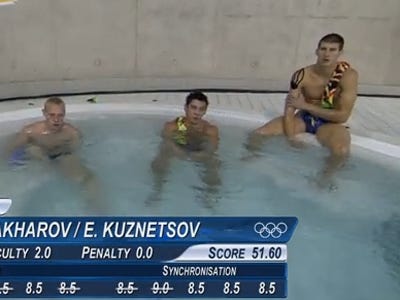
  • Divers are athletes. Like all athletes, they need their muscles to stay warm and loose. If they got out of the diving pool and toweled off and just stood around waiting for their next dive, they'd get cold and tighten up.
  • So they go into those little pools -- which are like hot tubs -- in between dives. The water in the little pools is kept at a higher temperature than the regular swimming pool so the divers will stay warm.


Divers waiting in the hot tub in between dives. Notice they all have their shammies with them.
(Photo from Business Insider)

Swimming: How do the swimmers shave down?  Do they shave or do they wax?

I was on my school's swim team as early as the third grade.  I was never fast, and I have enough 5th and 6th place ribbons to prove it, so I wasn't on the high school team.  But we young ones swam the same practices with the older girls, so that's how I learned about shaving down.


Hooray!  We're body-hair free!
(Ricky Berens, Ryan Lochte, Michael Phelps at Beijing 2008)
(Photo from Heavy)


Here's the deal with shaving for swimming.  Body hair increases drag and slows you down in the water.  Less body hair makes you faster. Research has been done that proves this, so shaving down has become a pretty standard practice in the sport since about the 1950s. What a lot of swimmers do -- this is true for both men and women -- is not shave for the majority of the season, until a key meet.  Then they'll shave pretty much everything that's not covered.

This is partly for the physical benefit of reducing drag by that 1%, but it also gives you the sensation of feeling slicker and quicker in the water.  Imagine shedding all that hair one day and then getting in the water -- whoo!  You feel slick as a seal.

The question I had as I watched the Olympic swimmers compete was, do they shave, which means having to shave several times over the course of the competition, or do they wax?


We're so well-shaven, it's kind of unbelievable!
(After Dana Vollmer, Rebecca Soni, Missy Franklin, and Allison Schmitt set a new world record in the 400M relay at London 2012)
(Photo from The Strata-Sphere)

  • I couldn't find anything definitive that says such & such percentage of Olympic swimmers shave while 100 minus such & such wax.  But it looks like most swimmers do still shave, while a few here and there will wax.
  • I did find a video of a couple Danish women swimmers waxing each other's armpits before the competition.  So those swimmers, at least, prefer to wax.
  • Kerri Walsh-Jennings, who is not a swimmer but a beach volleyball gold medalist, says in preparation for her tournaments where she wears bikinis, she neither shaves nor waxes.  She says, "I hate getting waxed.  Waxing makes me want to punch someone in the face." So she gets her unwanted hair removed with lasers.


That fan is practically shrieking, "Those lasers did a great job!"
(Kerri Walsh-Jennings after her 2nd gold medal win at the Beijing Olympics in 2008)
(Photo from Pregnant Hollywood)

  • Laser hair removal is the option that yields the longest-lasting results, but it's also the most expensive by far, and it can also give you scars or hyperpigmentation.  So you would want to make sure the person lasering the hair off of you is certified and has a lot of experience.
  • But for most of us regular people, and even for most competitive swimmers, shaving is still the way to go. Here are some tips for shaving down:
  • For regions that may be longer or more lush, start with an electric trimmer or razor first. Shorter hair is easier on ye olde razor blade, which you want to be sharp.
  • Most swimmers shave their legs and arms. Men also shave the chest and back. Even if you don't have a visibly hairy chest or back, shaving down those little hairs can help.
  • For areas that you can't reach, have someone shave there for you. This is why lots of swim teams have shaving parties the night before a meet.


At this team shave-down, a swimmer named Matt is getting waxed.

  • What not to shave: some say that shaving the underside of the forearm isn't necessary.  This part of your arm pulls you through the water, and you could use the extra help pushing the water out of your way here.
  • You also don't need to shave your head. Swim caps are sufficient to reduce drag. If you want to shave your head for some team spirit reason, go ahead. But you don't need to.
  • Shaving your specials isn't necessary either.  Anything that's covered by the suit already has help in reducing friction in the water. Most women swimmers will keep their bikini line clean for visual purposes, but anything beyond that is your personal choice.

Track & Field: How come so many US runners are wearing those bright yellow shoes?
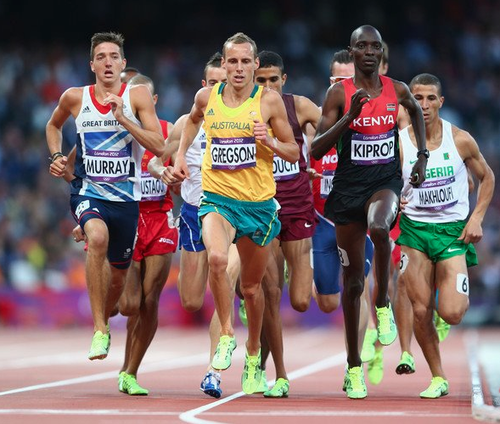

Looks like every runner but one in this group is wearing the neon yellow shoes.
(Photo from Natural Running Center)

  • Ah, Nike is glad we've asked. In fact, that is exactly what they hoped we would do.
  • Nike is not a sponsor of the 2012 Olympics, but they have given these particular shoes, with the color named Volt, to US track & field athletes to wear in competition. (They also gave the shoes to boxing and fencing athletes; 400 athletes total.)
  • Nike intentionally made the shoes neon yellow because that color really catches the eye of anyone watching. They knew it would stand out especially well against the red track.
  • They wanted these shoes to be so eye-catching that we would all ask what they are and then, because the athletes wearing them did so well, we would all be so overcome with the desire to own a pair for ourselves, we would run out an buy them in droves. At $100 to $200 a pair.


Nike Volt shoes, up close.
(Photo from Vehicle Media)
  • Nike has done all this without actually sponsoring the Games.
  • Other companies -- like Adidas -- pay hundreds of millions of dollars to be an official sponsor. But Nike has not forked over such cash, and they are not an official sponsor.  But because their shoes are so prevalent and visible, and because they've made a few commercials that mention London (along with a lot of other cities and without saying "London Olympics" or "London 2012") and they aired them during Olympics broadcasts, people think that Nike is a sponsor.
  • There is a department called the Olympic Delivery Authority that tries very hard to make sure that non-sponsor companies don't benefit financially from an association with the Olympics that they didn't pay for.  
  • When this group got wind of the Nike shoes situation, they considered going after Nike with a lawsuit. But they changed their minds, probably when this publicly-funded group realized what big pockets they would be going up against.
  • There is also a rule which restricts athletes from appearing in ads during and shortly before the Olympic Games. But this rule doesn't say anything about what the athletes can or can't wear in terms of branded apparel. So although the athletes can't tweet about their shoes or post photos on facebook or Instagram, they can wear them. On TV. In front of millions of viewers.


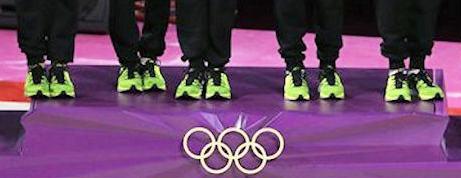
The US women's gymnastics team compete barefoot. But at their medal ceremony, they were all wearing the Volt shoes. That's how pervasive these shoes are.
(Photo from Natural Running Center)

  • After reading all this, I kept wondering, why would the athletes wear the shoes? These people are super-attuned to their sport, and shoes have got to be a crucial part of their equipment. Bad shoes or the wrong shoes introduced at the last minute could have devastating results. So why would they wear a pair of shoes simply because some Nike marketing person handed them over?
  • Because, first of all, Nike sponsors a ton of athletes. The thing all these business magazines and newspapers are all geeked about is that Nike didn't pay to sponsor the Games.  They're all thrilled because they think Nike seems to be getting away with something. But Nike does sponsor a boatload of athletes. 
  • It's therefore in the athletes' interest to wear the shoes because Nike has probably helped them out in a huge way, financially and equipment-wise, for a long time leading up to this moment.
  • Still, my question persists. So wearing the shoes might be a way of thanking their sponsor. That's nice. But there must be something performance-wise that they like about the shoes.  So why did the athletes choose to wear these shoes over something else they might have trained with?
  • The best I could discover is what Nike says about their own shoes. They say that, for the shoes that have spikes, the spike plate is especially lightweight which gives runners who wear them a slight edge over their competitors. Nike says their other types of shoes in this series which do not have spikes are also lightweight, and they are engineered for a precision fit to feel like a second skin.  Apparently, lots of athletes agree.

 
Nike Volt shoes for sprinters. This group is called Zoom.
(Photo from Nike, Inc.)


These Nike Volts are "flats" for the distance racers. And maybe preferred by the general public.
(Photo from Runblogger)

  • By the way, Nike will be an official sponsor of the Games in Rio in 2016.


Oh, and one last thing. No, the gymnasts don't wear anything under their leotards. That goes for men and women.


Sources
Diving
Swimx, The Sammy Towel
NBC Olympics, 10 things you should know about diving
iSport, Why Divers Use a Shammy
Swimming
iSport, How to Shave Down for a Swim Meet
howstuffworks, Why do swimmers shave their bodies? Shaving Tips for Swimmers
Solo Swims, Shaving Down: The effects on swimming of removing body hair
Swimmer's Daily, Danish Darlings introduce Mie to their Wax On Wax Off ritual
Livestrong, What Do Swimmers Do to Remove Body Hair?
Daily Mail, "'Waxing makes me want to punch someone': Team USA beach volleyball stars on getting their bodies in shape for THAT skimpy kit", July 30, 2012
Well Being Tips, Split Seconds Count - Olympic Swimmers and Hair Removal
Track & Field
AdAge Global, Consumers Don't Really Know Who Sponsors the Olympics
Forbes, Ambush Marketing: An Olympic Competition. And Nike Goes for Gold, August 7, 2012
NBC News, The Bottom Line, Nike takes marketing gold with neon-yellow shoes, August 10, 2012
Metro News, Yellow volt shoes a hit at London Olympics, August 12, 2012
Nike, Inc. Nike Unveils Volt Collection for Track and Field

Monday, August 6, 2012

Apple #597: Pommel Horse


The voting on which entry I should do next was a dizzying deluge, but the winner is clear: pommel horse. One Daily Apple reader in particular said that the reason she wants to know more about it is to learn why our American gymnasts don't seem to be very good at it.

I'll start off with some basics, and then hopefully along the way I'll be able to uncover what makes it so challenging.  Whether or not I can say why our gymnasts have trouble with it, we'll see.


KrisztiƔn Berki of Hungary won gold in the pommel horse at London 2012. Look at that insane extension of his legs.
(Photo from Kagura-girl)


What's a Pommel?
  • First things first, let's define this word pommel.
  • I had thought the pommel was the knob that sticks up from a horse's saddle. But it's not the knob (which is actually called the horn); it's the arch on which the horn rests.
 
This diagram of a Western saddle is pretty complex, but it shows where the pommel is. It's the arch that stands up from the saddle, and the horn stick sup from that.
(Diagram from Fine Saddles)

  • The real purpose of the pommel is that it holds the saddle together.  But conveniently for the rider, you can also grab onto it if your horse is bucking.  The horn, which sits atop the pommel, makes the emergency grab even easier. 
  • The other purpose of the pommel is to help you mount the horse in the first place.  After you put your foot in the stirrup, you reach across the back of the horse to grab the pommel on the far side of the saddle and use that as leverage to pull yourself up.
  • The thing to note here is that when you're mounting the horse, after you've pulled yourself up on the stirrup, you have to swing the other leg over the back of the horse.  
  • When you're dismounting, from a seated position, you lean forward on the pommel to push yourself up so you're standing in the stirrups, then swing your right leg back over the horse and, with one foot still in the stirrup, bring your legs together, then turn to remove your foot from the stirrup, and slide down to the ground.


This instructor takes every step of mounting and dismounting very slowly and deliberately, but if you're patient, you'll see the similarities with pommel horse gymnastics routines.

  • Sound familiar?  That's because the gymnastic pommel horse event comes from the art of horse mounting. 

Pommel Horse Origins
  • Long, long ago, going at least as far back to Alexander the Great's time, soldiers used to practice mounting a horse by using a wooden horse as a model. 
  • In the 17th century, a drill instructor began teaching his students various horseback acrobatics as a way to improve their ability to mount horses under all sorts of challenging battle conditions.  Soon the cavalrymen were showing off about who was the best at these various equestrian acrobatics.


Pommel horse from 1795.  As far back as that, the legs allowed for adjustable height.
(Image from GymMedia) 


Pommel horse today.
(Photo from Smartly)

  • The soldiers' routines mainly involved climbing onto or jumping over the horse.  While the false horse did have two pommels, they didn't really figure into the acrobatics much.
  • But eventually, when the practice moved from the battlefield into the gymnasium, the gymnasts began to use the pommels as something to swing from, first with one leg, then the other.  By the 1880s or so, German gymnasts had innovated the two-legged swing, and that is where the real similarity with today's sport begins.
  • To back up and clarify a bit, there was this whole movement in the 1800s in Germany, emphasizing the importance of exercise as part of any man's education (back then, it was only men who were going to school).  Gymnasiums sprang up at universities all across Germany, as men were trained to exercise their bodies as well as their minds. 
  • During this time, a gymnastics instructor developed all sorts of equipment and exercises as part of the effort to exercise his pupils in new and more challenging ways.  This instructor,  Friedrich Ludwig Jahn, developed the equipment or the exercises that went with them for the parallel bars, the horizontal bar, the vault, and the pommel horse -- all of which are standard elements of men's gymnastics today. 


Friedrich Ludwig Jahn, the guy who invented the gymnastics pommel horse as we know it today, and probably the focus of lots of curse words from lots of gymnasts.
(Image from Pfannhauser)

What Makes the Pommel Horse so Difficult?
  • The pommel horse requires tremendous upper body strength.  You're swinging your legs around, doing handstands, spinning about, and your legs aren't supporting you at all. The only thing holding you up are your hands and your arms, and you have to hang on tight while your legs are whipping around.


This is Louis Smith, who won silver for Great Britain at London 2012. Please notice the enormous muscles in his chest and arms.
(Photo from not sure)

  • Other events in men's gymnastics really put a strain on upper body strength, most notoriously, the rings.  Those things are just punishing.  So how is the pommel horse different?
  • The pommel horse also relies very heavily on momentum.  You have to get a lot of speed going to execute those spins properly, and in fact, you rely on the momentum to carry your legs more than you could do on your own. If you make a mistake, you lose momentum, and you therefore also lose the ability to perform the next skill, and the whole thing falls apart like a house of cards.
  • How you do each element depends on your individual height and weight.  You have to keep your weight distributed evenly throughout each skill or you'll get thrown off.  What's more, the differences in each person's body make it difficult to teach someone else exactly how to do a skill. A taller, thinner gymnast will have to hold himself differently than a shorter, heavier gymnast, for example. These variations make trial and error crucial to learning the skills. 
  • Combining the importance of upper body strength and momentum, how you position your hands is crucial. Placing them in even the slightly wrong spot can throw off your weight distribution and thus your momentum, and then everything can go wrong very fast.


This is Danell Leyva of the United States at London 2012, just prior to falling off the pommel horse. I suspect that his critical mistake happened before this shot was taken and here he's already on his way off. But I think I can guess how this photo shows that he's destined to hit the floor.  His weight is thrown well forward of his supporting left arm, his right arm is only brushing the side of the horse which can't give him much support, he is bent at the waist, and his legs aren't held tight together. All of these things would throw anybody's balance off-kilter.
(Photo from The Spokesman-Review)

  • The individual skills -- to say nothing of stitching them together into a seamless routine -- are just plain freakin' hard to master. 
  • One of the central skills is to spin in circles. You might think this would be like flinging your legs out or up to get them to go over a horse, but that's not how you do it.  You have to keep your legs clamped together and rotate your hips to make your legs swing around. (This seems pretty intuitive to me, like how I spin myself around in an inner tube in the water. But it's probably a lot harder when you're holding yourself up in the air rather than floating in water and supported by an inner tube.)
  • They say the best way to learn how to do the circles is not even to involve the pommel horse at all for the first few weeks or months because you'll be too freaked out by the possibility of whacking your legs or your special parts against the pommels. So you learn on what's called a mushroom, a little round table-like thing with a padded top, and you spin around that. Then you progress to mushrooms that are higher up and progressively more like a pommel horse.
  • A common mistake people make when learning to do the circles is they bend at the waist in mid-circle. This slows you down and eventually makes you stop. You have to keep your body straight the entire way around the circle. 
  • There are all sorts of techniques to keep you from "piking the circle," including putting your feet in a bucket which is attached to a rope that holds the bucket hip-high and helps keep your body straight as you work your way around the mushroom.


This looks like a mild form of torture to me.


The subtitles in this video are kind of annoying ("let's c some circles b4 we start"), but it shows the difference between someone who can do circles adequately and someone who can do them really well.


Why Aren't American Gymnasts Very Good at the Pommel Horse?
  • Here we enter the realm of gray area and speculation.  So let me give you some data first.
  • US athletes have not medaled in the pommel horse since 1984 -- which was also the year of the Soviet boycott, so they might not have even won then if the Soviets had been playing.
  • Countries with the most medals in pommel horse, going all the way back to 1896:
    • USSR or Russia -- 13
    • Switzerland -- 9 (only 1 after 1936)
    • Finland -- 6
    • USA -- 6 (3 from 1904)
    • Germany -- 5
    • China -- 3
    • Romania -- 3
    • Great Britain -- 3
  • Though the Russians haven't won recently, they have traditionally owned to the pommel horse.
  • Why this is, I can't say for sure.  Perhaps it's just one of those things about sports, that the people who are best at it tend to stick around and coach the kids in their homeland. Since the younger athletes learn from the best, they in turn become the best. 
  • As for why the US isn't all that great in it, I'd guess there's a similar factor working the other way: that their coaching hasn't been as good as the Russians'. All of this is just my guess, though.


Here's Xiao Qin, who won gold in the pommel horse at Beijing in 2008. He breaks his line a bit at one point, but he keeps going. His body is very straight throughout, and he keeps his speed.  (This video is from Televisa, so there's English & Spanish commentary.)


This is Alexei Nemov of Russia from 1996 in Atlanta. He took the bronze. But for my money, his performance is better. Obviously huge upper body strength, but he goes faster and more smoothly, the straightness and flexibility of his legs on the flares is impressive, and he didn't have a break in his line the way Qin did.  Yeah, I've watched a few videos so now I'm an expert.


  • I will leave the final thought to Katia Bachko who, writing for The New Yorker, said this:
Everyone who is Russian has a thing for gymnastics. It’s an innate affinity. . . . We are born loving vodka, cold winters, and pommel horses. 


Sources
OneLook.com, pommel
Certified Horsemanship Association, How to Mount a Horse Video
GymMedia, History of the Pommel Horse
Livestrong.com, What is the origin of gymnastics equipment?, June 14, 2011
About.com, Men's Pommel Horse Olympic Gymnastics Medalists
The Atlantic Wire, The Weird End to the Men's Gymnastics Team Final: A GIF Guide, July 31, 2012
Drills and Skills, Pommel Horse Drills and Skills
Made Man Manual, Pommel Horse Skills
American Gymnast, Pommel Horse Training Progressions, July 10, 2010
BBC Sport Photo Galleries, Gymnastics Photo Guide
Katia Bachko, Why I Wish the Russian Gymnasts Had Won, The New Yorker, August 1, 2012

Sunday, July 29, 2012

Apple #595: Water Polo

So I'm watching water polo on the Olympics, and I keep thinking, man, that looks hard.  I can't imagine treading water, fighting off the other player, and flinging the ball to the net, then having to swim as fast as possible to the other end of the pool.

On top of all that, I've heard that water polo is actually a rough sport, that there's a lot of scrapping and injuries.  It looks pretty benign, with all that water and the bathing suits and the funny caps, so it's kind of hard to believe it's all that rough-and-tumble.  The announcers aren't saying much about the behind-the-scenes--or under-the-water--truth about the sport.  So it's time for the Apple Lady to find out.


Water polo.  With all that splashing and waving of arms and swimming around, is it really that violent a sport?
(Photo from Wikipedia) 


HOW PEOPLE DESCRIBE IT
  • One of the ways of knowing the nature of a thing is by how people describe it.  Here are some of the ways people describe water polo: 
    • "A unique combination of swimming, throwing, and martial arts." 
    • "The only contact sport played in the water"
    • "An aquatic form of rugby." My brother played rugby for a while.  His face after a rugby match was usually pretty colorful with bruises and scratches and scrapes. If water polo really is like rugby, then it must be pretty high-contact.

NATURE OF PLAY
  • But they wear those funny-looking caps. The caps are funny-looking, but there are reasons for that.  They tie under the chin so they won't come off when a player goes underwater, or is dunked, or is pushed or shoved.
  • The reason you don't want the cap to come off is because it includes ear protectors. The ear protectors aren't to keep water from trickling into and clogging your delicate ears, but rather to shield your ears from getting bashed by an opponent's elbow, or from getting slapped by an opponent and your ear drum bursting as a result. 
   
There's also this.
(Photo from Water Polo blog)

  • But all they're doing most of the time is treading water and waving their arms around.
  • OK, first, the treading water part. To stay afloat while you're playing, you have to do what looks like treading water.  But the motion is different and harder than that. The especially effective method of treading water is called the "eggbeater kick."  You lift one leg at a bent position, as if you're sitting in a chair, while you kick out the other leg sideways and rotate it in a circle.  Then you switch legs and do the same thing.


The eggbeater kick, which water polo players use to stay afloat while they're playing.
(Photo from coachesinfo.com)

  • Since kicking out your leg is a motion essential to the sport, it's easy to kick or be kicked accidentally.  And since it's hard for the refs to see from above water what's going on below the surface, getting kicked happens not so accidentally, and often, and without penalty. Usually, if an opponent kicks you, it's to try to keep you at a distance so the opponent can catch the ball or score or keep from being blocked. 
 
Here's a shot of some of what goes on underwater during a water polo match.  You can see people in the midst of their eggbeater kicks, but it also looks like the guy in the foreground may have just gotten shoved underwater by his opponent.
(Photo from SM Texas)
  • As for the waving of the arms, that's part of defending, or reaching out to catch the ball.  As it turns out, lots of penalties happen during the defending process.  More on that in a second, but first:
  • If you still think this is wimpy, you try raising yourself up out of the water high enough to throw a ball over someone's head, and faster than they can reach out to stop it -- all while not being able to stand on anything.
Look how high out of the water this guy is.  He's not standing on anything, he's just doing his special eggbeater kick to propel himself up higher out of the water.
(Photo from NorCal Water Polo)


There are tons of great photos out there of water polo players in action, showing how strong they are.  I can't show you any of them because they're all owned by Getty or Corbis.  So you'll either have to click the link to see for yourself, or just trust me when I say, these are some impressive athletes. 


PENALTIES
  • A good way to assess how violent or physical-contacty a sport is is by what behavior has been banned.  This suggests that, even though such & such is not allowed, it does happen, and they've had to make a special rule outlawing that behavior.
  • So I'll talk about the types of fouls that happen in water polo, from least serious to most serious. This is leaving out penalties like violating the amount of distance you're supposed to keep from the goal, or what you're not allowed to do when you're out of the pool, etc.  I'm only going to mention the physical types of fouls.
  • In addition to kicking, opponents can get away with lots of infractions which are technically not allowed, but which the refs tend not to see because they happen underwater.  
    • Wrist-holding: an opponent may grab your wrist and hold it in order to keep you from going after the ball or from raising your arm to defend against you. As long as your wrist is underwater, they can usually get away with it until you break their grip
    • Grab-and-go: say you're on defense, in front of an offensive player. The offensive player reaches across to grab your arm and, using you like a stationary object, pulls herself forward ahead of you.
    • Suit-grabbing: players don't grab opponents' bathing suits to disrobe and embarrass them, though that may happen. The men grab each other's suits at the waist to keep a defender low in the water and unable to block, or to keep an offensive player from getting up in the water to make a shot.  Female players may do the same thing, or they may also grab another player's shoulder straps, but since it's easier to get your shoulders out of the water, it's easier to attract the ref's attention and get a penalty called. (Mutual suit-grabbing here)
  • Since suit-grabbing is pretty common, water polo players wear bathing suits that are as small and snug as possible.  Women water polo players are required to wear one-piece suits.


US Men's Water Polo team, 1996. I bet if it were safer to do so, and allowed, they would play without their bathing suits.  OK, yes, this is some eye candy for some of you Daily Apple readers out there.  But I posted this for another reason, which is to say, judging from how ripped these guys are, you probably have to be in this kind of super-great shape to play this sport. So I take this to be further evidence that this is a very physically demanding sport.
(Photo from The Hostages)

  • There are, of course, many physical-contact things you're not allowed to do, and which will get a penalty called against you if you did them.  Since these things are outlawed in the rule book, I'm assuming that they do happen.
    • Swimming across an opponent's legs.Your opponent is leaning forward for the ball, almost lying flat in the water, and you swim across her legs so that she can't swim as fast. Presumably you could get kicked, but she'll slow down, and you get to cut a corner essentially, and cut her off.
    • Swimming on the opponent's shoulders. Yes, that's right, I said "on." As far as I can tell, this means essentially, swimming over an opponent, or pressing down on his shoulders to make him sink as you're swimming.
    • Any other form of impeding, meaning you're somehow physically restraining the other person or holding them back or down in the water.  If the impeding looks violent or intentional, you can get kicked out of the game (more on that in a bit). 
    • Striking the ball with a clenched fist. This puts too much force into a strike, but it also makes it likely that you would punch somebody by mistake. So you have to smack the ball with an open palm, which means you might slap somebody by mistake, but that's OK.
 
This is Lyuba Tschougounova, who played in junior college in 2009.  Looks like she's fending off two opponents at once, one who is actively trying to block her, and the other at the ready.
(Photo from Concordia Eagles)

  • There are a whole series of infractions which are all classified as "acts of brutality." I am not exaggerating.  If a player is found to be committing an act of brutality, the payer is s kicked out (excluded) for the rest of the game, and a player from the opposing team gets a free shot at the goal (penalty throw).
  • An act of brutality is defined as playing "in a violent manner, including kicking, striking or attempting to kick or strike with malicious intent against an opponent or an official."  Yes, against an official.
  • Here are acts of brutality in water polo:
    • Intentionally splashing an opponent in the face
    • Holding (grabbing onto), sinking (pushing down into the water), or pulling back (grabbing onto and pulling away) an opponent who is not holding the ball.  Any of these things are allowed, apparently, if an opponent does have the ball.

 
The hold, sink, or pull back rule. This rule seems to be quite a big gray area, judging from the rule book's efforts to define what is happening in each diagram.  I'm guessing that it's like holding in football, that you're not supposed to do it, but that it happens all the time.
(Image from FINA Water Polo Rules)

This looks like this might qualify as a hold.  Once again, I can't show it to you here.  Thanks, Getty!

    • Kicking or striking an opponent intentionally
    • Using the elbow to strike backwards to hit an opponent behind you
    • Head butting backwards to do the same


Striking with the elbow backwards is classified as a "brutality" and can get you kicked out of the game.
(Image from FINA Water Polo Rules)

  • The key here, I suspect, is that the refs first have to see that you've committed the infraction, and then they have to interpret your actions as violent and intentional.  A player may think another player's actions are violent and intentional, but until the ref agrees, you may be stuck trying to fight the guy off.
 I wouldn't call this intentional, but it does look like this altercation could have turned into something fairly serious.


INJURIES
  • Another way to find out how rough the spot is would be by finding out what kinds of injuries are common to water polo players. 
  • As in any sport, there are lots of overuse or repetitive motion injuries. In water polo, those happen especially to the shoulder or elbow from throwing, or to the lower back from rotating while throwing, and to the groin and knee, from doing the "eggbeater kick."  And because it's a water sport, water polo players can also get inflammation in the ear canal, a.k.a. swimmer's ear.
  • Most of the injuries in water polo fall in this overuse category, and most of the injuries are to the shoulder.
 
This is Lauren Wenger. She was named the June Athlete of the Month in 2009 by the US Olympic Committee.  Look at her enormous muscles in her shoulder.  That speaks to how strong water polo players' shoulders get from having to whip the ball as hard and fast as they can.
(Photo from Women Sport Report)

  • But what about injuries sustained as a result of contact with other players?  What are those like?
    • Contusions, or bruises, are very common, especially to the face.
    • Lacerations, or cuts, are common too. You can get cut when the ball hits you in the face, or by a player's fingernails or toenails. 
    • There are lots of eye injuries, including cuts to the face around the eye or cheekbone, black eyes, bleeding into the eye, scratched corneas, etc.
    • Some players even sustain "blow-outs" or complete fractures of the bone around the eye.
    • Sprains & fractures. Most often, these happen to fingers, which get hyperextended or bent or bashed when a speeding ball hits the hand at a strange or unexpected angle.  But sometimes the sprain or fracture happens because of contact with an opponent.
    • Concussions or head injuries. These aren't that common, but they do happen, usually happen as a result of getting elbowed in the head or head-butted.
    • Spine injuries. These can be a repetitive motion injury, from turning your head to breathe during freestyle swimming.  But some players have sustained cervical spine injuries due to blows to the shoulder area from another player.
    • Fatal intracranial bleeding. In other words, a head injury that has resulted in internal bleeding on the brain, from which someone died.  I don't know any details about how this happened, only that it did happen to a water polo player.
 
Ervin Zador got punched in the eye during the "Blood in the Water" match between Hungary and USSR in the 1956 Olympics.
(Photo from Wikipedia)

  • Recently, a sixteen year-old boy in Southern California who had just made the water polo team died during practice.  He said he was thirsty, got out of pool to get a drink of water, got back in the pool, and later, he was found unconscious at the bottom of the pool.  As of this writing, no cause of death had been officially determined.
All right.  I'm convinced.  Water polo is a demanding, physical, high-contact sport.

And to put some of the fun back into it, here you go:


Sauce for the goose....
(Photo from magaz!nes.com)

[Edit: Here we go. This video shows the underwater truth pretty succinctly.]


Sources
FINA Water Polo Rules
Miljenko Franić, Alan Ivković, and Ratko Rudić, Injuries in Water Polo, Journal of Croatian Medicine, June 2007
iSport, Underwater Tactics for Water Polo
Stop Sports Injuries, Water Polo
Jeno Kiss, Department of Orthopedics and Trauma, St. John's Hospital, Budapest, Sport related injuries in water polo
Palm Desert water polo player's death stuns family, friends, Los Angeles Times, June 18, 2012

Friday, February 19, 2010

A Little Olympics Interlude

Did you see Shaun White's finals in the halfpipe last night?  I hope so because it was insane.  Ridiculous.


AP Photo of White flying in Vancouver 2010.
(Photo from Brisbane Times)


In the snowboarding halfpipe, they get two shots at it.  He got the highest score in the first round and in the second round, he went last.  By the time it was his turn to go again, he knew how everyone else had scored and that no one had been able to beat his score from the first round.  So he knew before he did his second run that he had already won the gold medal.

He was standing up at the top of the run with his coaches, celebrating, and you could hear him whooping and talking because they had a microphone up there.  He said, "I can't do this right now," meaning he was too excited to do his second run.  He asked what should he do, should he just go straight down the middle or what, and one of his coaches told him to "knock the shit out of it."  Once he'd gotten himself ready to go, that's exactly what he did. At the end of the second run, he did a new, but now-signature move of his called the Double McTwist, which is two head-over-heels flips plus 3.5 twists.

I wanted to find a video on YouTube of both runs for you, but I could only find the first one.  It's been set to music, no commentary, but I think you'll see, even if you know nothing about the sport -- which I don't -- how pretty phenomenal it is.  Then the video plays the same run over again in slow motion and it's there that you'll really get a sense of how high he flies above the edge of the wall.  I'm guessing that's thirty feet?  Ah, the Brisbane Times says 8 meters, which is just over 26 feet.

Nuts, I can't get it to load here.  Here's the link to the video on YouTube.  It may not be around for long.

You can also watch videos of both of his runs at the NBC Olympics page.  It'll prompt you to download a mini-program called Silverlight and then you'll have to watch an ad, but you'll be able to see both runs and hear the commentary.  At the end is an interview in which, among other things, he says hi to his dog Rambo.

I love how the announcers are just laughing at the end of his second run.  I mean, it's nuts what he's able to do.

Congratulations, Shaun!  Well-deserved!

Monday, February 15, 2010

Apple #440: Complete TV Schedule for 2010 Winter Olympics

Today I was trying to find out which Olympic events were being televised at which times.  You would not think this should be a difficult question to answer, but I discovered that it is.

In past years, NBC has done an excellent job of listing which events were going to be televised when and on what channel.  For some reason, this year, they decided to make their website TV schedule so that you have to mouse over each time slot on each individual day, or you can look at the full schedule but only for a single day at a time.  You can also search by individual sport, but it'll only tell you the same really general stuff like, "Apolo Ohno returns to the ice for the 500 m live" (that happens on the 24th, by the way).  Their schedules don't always tell you exactly which of the Alpine Skiing events is happening, for example, or whether both men's and women's competitions are happening on that day.


I am not trying to say that this blog entry is in any way sanctioned by NBC. I'm only saying this is where I looked first, where I wish I had found the information I was after, and where I got some of the information I used below. You can also click on the logo and go directly to NBC's TV listings if you like.


I thought, surely someone else would have put this together.  I looked around and I found some schedules that local newspapers had put together of a few days' worth of events.  I also found Mahalo's TV Schedule, which makes everything easy to read and it's very simplified.  So if you don't want a whole lot of detail, but you want to know which events are on NBC throughout the Olympics, check their page.

I, of course, want more detail.  I found the official list of events posted by the official Vancouver Olympics folks. If you have a friend or relative who's competing in the Olympics, this is a great place to go and see when, in Vancouver time, they're actually competing.  But this page does not tell you when these specific events will be televised.


I am not trying to say that this blog entry is in any way sanctioned by the people running the Vancouver 2010 Olympics. I'm only saying this is another place I looked for the information I sought, another place where I wish I had found the information I was after, and where I got some of the information I used below. You can also click on the logo and go directly to the official schedule of events in Vancouver if you like.


So, yours truly decided to marry the official Vancouver events with NBC's TV schedule to give you a detailed list of everything that will be televised on all basic channels from now through the end of the Olympics.

  +
Again, NBC and Vancouver 2010 have not seen or approved this entry at all.  This is merely a visual way of demonstrating how I made the schedule listed below.


CAVEATS:
  • These times are Eastern Standard Times.  Your broadcast times may vary.
  • (medal) means that the event will reach its medal conclusion in this time slot. There may also be qualifying heats or rounds before that, but a medal winner will be determined at some point in that time period.
  • Weather has a way of screwing things up.  Games and events might have to be delayed and broadcast at another time.  I have no way of anticipating those alterations.
  • It's possible that your cable schedule and channels might be different than mine.  Double-check your listings before staking your life on DVR'ing something as it's listed here.
  • I didn't list HD channels because all they said they were going to do was show highlights.  If you've got HD channels and you want to watch highlights there, check your listings.
  • Not every event that occurs in a given day is broadcast on the day that it happens.  Usually they pick it up later, like at 1:30 in the morning of the following day.  So if an event appears at the end of the day's schedule as having occurred but not having been listed, check the following day's schedule and you'll probably find it there. 

Here's the schedule.  I've made internal links that will jump to each day within this schedule.  Or if you want the entire schedule to keep by your television and DVR, click on the title of this entry and then print out the whole thing.  Enjoy the Olympics!

Monday, February 15
Tuesday, February 16
Wednesday, February 17
Thursday, February 18
Friday, February 19
Saturday, February 20
Sunday, February 21
Monday, February 22
Tuesday, February 23
Wednesday, February 24
Thursday, February 25
Friday, February 26
Saturday, February 27
Sunday, February 28


12:00 a.m. – 4:00 a.m. NBC
Replay of Previous Primetime
Pair figure skating, short program
Speed skating, Women’s 3000 m (medal)
Luge, Men’s singles (medal)
Freestyle skiing, Men’s moguls (medal)

3:00 a.m. – 5:30 a.m. MSNBC
Hockey, Women’s US vs. China replay

1:00 p.m. – 2:30 p.m. NBC
Cross Country skiing, Women’s 10 km free (medal)

2:30 p.m. – 4:00 p.m. NBC
Snowboarding, Men’s cross

4:00 p.m. – 5:00 p.m. NBC
Cross Country Skiing, Men’s 15 km free (medal)

5:30 p.m. – 8:00 p.m. MSNBC
Hockey, Women’s Canada vs. Switzerland

8:00 p.m. – 12:00 a.m. NBC
Pairs Figure Skating free skate (medal)
Snowboarding, Men’s cross finals (medal)
Speed Skating, Men’s 500 m (medal)
Alpine, Men’s Skiing downhill (medal)

Other events that occur but are not listed:
Hockey, Women’s Sweden vs. Slovakia
Luge, Women’s singles


12:30 a.m. – 2:00 a.m. NBC
Luge, Women’s singles
Medal ceremonies

2:00 a.m. – 5:00 a.m. NBC
Replay of Previous Primetime
Pairs Figure Skating free skate (medal)
Snowboarding, Men’s cross finals (medal)
Speed Skating, Men’s 500 m (medal)
Alpine, Men’s Skiing downhill (medal)

3:00 a.m. – 5:30 a.m. MSNBC
Hockey, Women’s Canada vs. Switzerland replay

12:00 p.m. – 3:00 p.m. USA
Curling, Men’s round robin session 1, includes US vs. Germany

3:00 p.m. – 5:00 p.m. NBC
Biathlon, Women’s 10 km pursuit (medal)
Biathlon, Men’s 12.5 km pursuit (medal)

3:00 p.m. – 6:00 p.m. USA
Hockey, Men’s USA vs. Switzerland

5:00 p.m. – 8:00 p.m. CNBC
Curling, Women’s round robin session 1 includes US vs. Japan

5:30 p.m. – 8:00 p.m. MSNBC
Hockey, Women’s US vs. Russia

8:00 p.m. – 10:00 p.m. CNBC
Hockey, Men’s Canada vs. Norway

8:00 p.m. – 12:00 a.m. NBC
Figure Skating, Men’s short program
Snowboarding, Women’s cross (medal)
Speed Skating, Women’s 500 m (medal)
Alpine Skiing, Men’s super combined downhill
Alpine Skiing, Men’s super combined slalom (medal)

10:00 p.m. – 12:30 a.m. CNBC
Hockey, Women’s Finland vs. China

Other events that occur but are not listed:
Luge, Women’s singles (medal)
Curling, Men’s round robin session 2 including US vs. Norway
Hockey, Men’s Russia vs. Latvia


12:30 a.m. – 2 a.m. NBC
Luge, Women’s singles (medal)

12:30 a.m. – 2:30 a.m. CNBC
Hockey, Men’s Russia vs. Latvia

2:00 a.m. – 5:00 a.m. NBC
Replay of Previous Primetime
Figure Skating, Men’s short program
Snowboarding, Women’s cross (medal)
Speed Skating, Women’s 500 m (medal)
Alpine Skiing, Men’s super combined downhill
Alpine Skiing, Men’s super combined slalom (medal)

2:30 a.m. – 5:00 a.m. CNBC
Hockey, Men’s Canada vs. Norway
Hockey, Women’s Finland vs. China
Curling, Men’s round robin session 2 including US vs. Norway

3:00 a.m. – 5:30 a.m. MSNBC
Curling, Men’s round robin session 2 including US vs. Norway

12:00 p.m. – 3:00 p.m. USA
Curling, Women’s round robin session 2 including US vs. Germany

3:00 p.m. – 5:00 p.m. NBC
Cross Country skiing, Women’s sprint classic (medal)
Cross Country skiing, Men’s sprint classic (medal)

3:00 p.m. – 5:30 p.m. MSNBC
Hockey, Men’s Finland vs. Belarus

5:00 – 8:00 p.m. CNBC
Curling, Men’s round robin session 3 including US vs. Switzerland

5:30 – 8:00 p.m. MSNBC
Hockey, Women’s Canada vs. Sweden

8:00 p.m. – 10 p.m. CNBC
Hockey, Men’s Sweden vs. Germany

8:00 p.m. – 8:30 pm NBC
Speed Skating, Men’s1000 m (medal)

8:30 p.m. – 11:30 pm NBC
Alpine Skiing, Women’s downhill (medal)
Snowboarding, Men’s halfpipe (medal)
Short Track, Women’s (medal)

10:00 p.m – 12:30 a.m. CNBC
Hockey, Women’s Slovakia vs. Switzerland

Other events that occur but are not listed:
Luge, Doubles (medal)
Curling, Women’s round robin session 3
Hockey, Men’s Czech Republic vs. Slovakia


12:00 a.m. – 1:30 a.m. NBC
Short Track, Men’s 1000 m
Short Track, Women’s (medal)
Luge, Doubles (medal)
Medal ceremonies

12:30 a.m. – 2:30 a.m. CNBC
Hockey, Men’s Czech Republic vs. Slovakia

1:30 a.m. – 5:00 a.m. NBC
Replay of Previous Primetime
Alpine Skiing, Women’s downhill (medal)
Snowboarding, Men’s halfpipe (medal)
Short Track, Women’s (medal)

2:30 a.m. – 5:00 a.m. CNBC
Curling, Women’s round robin session 3
Hockey highlights

12:00 p.m. – 3:00 p.m. USA
Curling, Men’s round robin session 4 including US vs. Denmark

3:00 a.m. – 6:00 a.m. MSNBC
Curling, Women’s round robin session 4 ?

3:00 p.m. – 3:30 p.m. NBC
Biathlon, Women’s 15 km (medal)

3:00 p.m. – 5:30 p.m. USA
Hockey, Men’s Canada vs. Norway

3:30 p.m. – 5:00 p.m. NBC
Snowboarding, Women’s halfpipe

5:00 p.m. – 8:00 p.m. CNBC
Curling, Women’s round robin session 4 including US vs. Denmark

5:30 p.m. – 8:30 p.m. MSNBC
Hockey, Women’s US vs. Finland

8:00 p.m. – 10:00 p.m. CNBC
Hockey, Men’s Canada vs. Norway

8:00 p.m. – 12:00 a.m. NBC
Figure Skating, Men’s free skate (medal)
Snowboarding, Women’s (medal)
Alpine Skiing, Women’s super combined downhill
Alpine Skiing, Women’s super combined slalom (medal)
Speed Skating, Women’s 1000 m (medal)

10:00 p.m. – 12:30 a.m. CNBC
Hockey, Women’s Russia vs. China

Other events that occur but are not listed:
Biathlon, Men’s 20 km (medal)
Skeleton, Women’s
Skeleton, Men’s
Curling, Men’s round robin session 5 including France vs. Canada
Hockey, Men’s Slovakia vs. Russia


12:30 a.m. – 2:00 a.m. NBC
Skeleton, Men’s (medal)
Skeleton, Women’s
Biathlon, Men’s 20 km (medal)
Medal ceremonies

12:30 a.m. – 2:30 a.m. CNBC
Hockey, Men’s Slovakia vs. Russia

2:00 a.m. – 5:00 a.m. NBC
Replay of Previous Primetime
Figure Skating, Men’s free skate (medal)
Snowboarding, Women’s (medal)
Alpine Skiing, Women’s super combined downhill
Alpine Skiing, Women’s super combined slalom (medal)
Speed Skating, Women’s 1000 m (medal)

2:30 a.m. – 5:00 a.m. CNBC
Curling, Men’s round robin session 5 including France vs. Canada
Biathlon, Men’s 20 km (medal)

3:00 a.m. – 5:00 a.m. MSNBC
Curling, stated as Men’s but Women’s round robin session 4 teams are listed

12:00 p.m. – 3:00 p.m. USA
Curling, Women’s round robin session 5 including Russia vs. US

3:00 p.m. – 5:00 p.m. NBC
Cross Country skiing, Women’s 15 km Pursuit (medal)
Recap of Men’s Figure Skating from Thursday

3:00 p.m. – 5:30 p.m. MSNBC
Hockey, Men’s Belarus vs. Sweden

5:00 p.m. – 8:00 p.m. CNBC
Curling, Men’s round robin session 6 including France vs. US

8:00 p.m. – 10:00 p.m. CNBC
Hockey, Men’s Czech Republic vs. Latvia

8:00 p.m. – 11:30 p.m. NBC
Ice Dancing, compulsory
Skeleton, Women’s (medal)
Ski Jumping individual
Alpine Skiing, Men’s Super-G (medal)

10:00 p.m. – 1:00 a.m. CNBC
Curling, Women’s round robin session 6 including Denmark vs. Canada

Other events that occur but are not listed:
Hockey, Men’s Finland vs. Germany


12:00 a.m. – 1:00 a.m. CNBC
Curling, Women’s round robin session 6 including Denmark vs. Canada (continued)

12:00 a.m. – 1:30 a.m. NBC
Medal ceremonies and recap

12:00 a.m. – 3:00 a.m. MSNBC
Hockey, Men’s Finland vs. Germany

1:30 a.m. – 5:00 a.m. NBC
Replay of Previous Primetime
Ice Dancing, compulsory
Skeleton, Women’s (medal)
Ski Jumping individual
Alpine Skiing, Men’s Super-G (medal)

3:00 a.m. – 6:00 a.m. MSNBC
Curling, Men’s round robin session 6 including France vs. US

12:00 p.m. – 3:00 p.m. MSNBC
Curling, Men’s round robin session 7 including Sweden vs. US

1:00 p.m. – 2:30 p.m. NBC
Freestyle Skiing, Women’s aerials

2:30 p.m. – 4:00 p.m. NBC
Ski Jumping individual (medal)

3:00 p.m. – 5:30 p.m. MSNBC
Hockey, Men’s Norway vs. Switzerland

4:00 p.m. – 6:00 p.m. NBC
Cross Country skiing, Men’s 30 km Pursuit (medal)

5:00 p.m. – 8:00 p.m. CNBC
Curling, Women’s round robin session 7 including US vs. Great Britain

7:30 p.m. – 10:00 p.m. MSNBC
Hockey, Men’s Slovakia vs. Latvia

8:00 p.m. – 11:30 p.m. NBC
Alpine Skiing, Women’s Super G (medal)
Short Track, Men’s 1000 m (medal)
Speed Skating, Men’s 1500 m (medal)
Bobsled 2-man

10:00 p.m. – 1:00 a.m. CNBC
Curling, Men’s round robin session 8

Other events that occur but are not listed:
Short Track, Women’s 1500 m (medal)
Hockey, Women’s TBA
Hockey, Men’s Germany vs. Belarus


12:00 a.m. – 1:00 a.m. NBC
Short Track, Women’s 1500 m (medal)
Medal ceremonies

12:00 a.m. – 1:00 a.m. CNBC
Curling, Men’s round robin session 8 (continued)

12:00 a.m. – 3:00 a.m. MSNBC
Hockey, Men’s Germany vs. Belarus

1:00 a.m. – 5:30 a.m. NBC
Replay of Previous Primetime
Alpine Skiing, Women’s Super G (medal)
Short Track, Men’s 1000 m (medal)
Speed Skating, Men’s 1500 m (medal)
Bobsled 2-man

3:00 a.m. – 6:00 a.m. MSNBC
Curling, Men’s round robin session 7 including Sweden vs. US

12:00 p.m. – 1:30 p.m. NBC
Freestyle Skiing, Men’s cross (medal) – new to Olympics

12:00 p.m. – 3:00 p.m. MSNBC
Curling, Women’s round robin session 8 including Canada vs. US

1:30 p.m. – 3:00 p.m. NBC
Biathlon, Men’s 15 km mass start (medal)

3:00 p.m. – 6:00 p.m. NBC
Hockey, Men’s Russia vs. Czech Republic

5:00 p.m. – 8:00 p.m. CNBC
Curling, Men’s round robin session 9 including US vs. Great Britain

7:00 p.m. – 10:00 p.m. MSNBC
Hockey, Men’s Canada vs. US

7:00 p.m. – 11:00 p.m. NBC
Ice Dancing, original dance
Alpine Skiing, Men’s giant slalom (medal)
Bobsled 2-man
Speed Skating, Women’s 1500 m (medal)

10:00 p.m. – 1:00 a.m. CNBC
Curling, Women’s round robin session 9 including US vs. Sweden

11:30 p.m. – 12:30 a.m. NBC
Biathlon, Women’s 12.5 km mass start
Medal ceremonies

Other events that occur but are not listed:
Hockey, Men’s Sweden vs. Finland


12:00 a.m. – 12:30 a.m. NBC (continued)
Biathlon, Women’s 12.5 km mass start
Medal ceremonies

12:00 a.m. – 1:00 a.m. CNBC (continued
Curling, Women’s round robin session 9 including US vs. Sweden

12:00 a.m. – 3:00 a.m. MSNBC
Hockey, Men’s Sweden vs. Finland

12:30 a.m. – 4:30 a.m. NBC
Replay of Previous Primetime
Ice Dancing, original dance
Alpine Skiing, Men’s giant slalom (medal)
Bobsled 2-man
Speed Skating, Women’s 1500 m (medal)

3:00 a.m. – 5:30 a.m. MSNBC
Curling, Women’s round robin session 9 including US vs. Sweden

12:00 p.m. – 3:00 p.m. USA
Curling, Men’s round robin session 10 including Canada vs. US

3:00 p.m. – 5:00 p.m. NBC
Cross Country skiing, Men’s sprint free (medal)
Cross Country skiing, Women’s sprint free (medal)

3:00 p.m. – 6:00 p.m. USA
Hockey, Women’s TBA

5:00 p.m. – 8:00 p.m. CNBC
Curling, Women’s round robin session 10

8:00 p.m. – 10:30 p.m. CNBC
Hockey, Women’s TBA

8:00 p.m. – 12:00 a.m. NBC
Ice dancing, free dance (medal)
Freestyle Skiing, Men’s aerials
Ski Jumping team (medal)

10:30 p.m. – 1:00 a.m. CNBC
Curling, Men’s round robin session 11 including US vs. China

Other events that occur but are not listed:
Hockey, Women’s TBA


12:00 a.m. – 1:00 a.m. CNBC
Curling, Men’s round robin session 11 including US vs. China (continued)

12:30 a.m. – 2:00 a.m. NBC
Hockey, Men’s elimination round TBA
Medal ceremonies

2:00 a.m. – 5:00 a.m. NBC
Replay of Previous Primetime
Ice dancing, free dance (medal)
Freestyle Skiing, Men’s aerials
Ski Jumping team (medal)

3:00 a.m. – 5:30 a.m. MSNBC
Curling, Men’s round robin session 11 including China vs. US

12:00 p.m. – 3:00 p.m. USA
Curling, Women’s round robin session 11 including US vs. China

3:00 p.m. – 5:00 p.m. NBC
Speed Skating, Men’s 10,000 m (medal)
Biathlon, Women’s 4x6 km relay (medal)
Freestyle Skiing, Women’s cross

3:00 p.m. – 6:00 p.m. USA
Hockey, Men’s elimination round TBA

5:00 p.m. – 8:00 p.m. CNBC
Curling, Men’s round robin session 12 including Canada vs. China

8:00 p.m. – 10:00 p.m. CNBC
Hockey, Men’s elimination round TBA

8:00 p.m. – 12:00 a.m. NBC
Figure Skating, Women’s short program
Freestyle Skiing, Women’s cross (medal)
Bobsled, Women’s
Nordic Combined (medal)

10:00 p.m. – 12:30 a.m. CNBC
Hockey, Men’s playoffs

10:00 p.m. – 1:00 a.m. MSNBC
Curling, Women’s round robin session 12 including Switzerland vs. US

Other events that occur but are not listed:
Hockey, Men’s playoffs TBA


12:00 a.m. – 1:00 a.m. MSNBC
Curling, Women’s round robin session 12 including Switzerland vs. US (continued)

12:30 – 2:00 a.m. NBC
Recap of Figure Skating, Women’s
Medal ceremonies

12:30 – 2:30 a.m. CNBC
Hockey, Men’s playoffs TBA

2:00 a.m. – 5:00 a.m. NBC
Replay of Previous Primetime
Figure Skating, Women’s short program
Freestyle Skiing, Women’s cross (medal)
Bobsled, Women’s
Nordic Combined (medal)

3:00 a.m. – 5:30 a.m. MSNBC
Curling, Women’s round robin session 12 including Switzerland vs. US

3:00 p.m. – 5:00 p.m. NBC
Hockey, Men’s quarterfinals

5:00 p.m. – 8:00 p.m. MSNBC
Curling, tiebreaker rounds

7:00 p.m. – 10:00 p.m. CNBC
Hockey, Men’s quarterfinals

8:00 p.m. – 11:30 p.m. NBC
Short Track, Men’s 500 m
Short Track, Women’s 3,000 m relay (medal)
Bobsled, Women’s (medal)
Alpine Skiing, Women’s Giant slalom (medal)
Cross Country skiing, Men’s 4x10 km relay (medal)
Freestyle Skiing, Women’s aerials (medal)

10:00 p.m. – 12:30 a.m. CNBC
Hockey, Men’s quarterfinals

Other events that occur but are not listed:
Speed Skating, Women’s 5000 m (medal)
Short Track, Women’s 1000 m


12:00 a.m. – 12:30 a.m. CNBC
Hockey, Men’s quarterfinals (continued)

12:00 a.m. – 1:30 a.m. NBC
Short Track, Women’s 1000 m
Speed Skating, Women’s 5000 m (medal)
Medal ceremonies

12:30 a.m. – 2:30 a.m. CNBC
Hockey, Men’s quarterfinals

1:30 a.m. – 5:00 a.m. NBC
Replay of Previous Primetime
Short Track, Men’s 500 m
Short Track, Women’s 3,000 m relay (medal)
Bobsled, Women’s (medal)
Alpine Skiing, Women’s Giant slalom (medal)
Cross Country skiing, Men’s 4x10 km relay (medal)
Freestyle Skiing, Women’s aerials (medal)

3:00 a.m. – 5:30 a.m. MSNBC
Curling, Men’s tiebreaker round

12:00 p.m. – 3:00 p.m. USA
Curling, Women’s semifinals

2:00 p.m. – 4:30 p.m. MSNBC
Hockey, Women’s bronze medal game (medal)

3:00 p.m. – 5:00 p.m. NBC
Preview of Figure Skating, Women’s free skate
Cross Country skiing, Women’s 4x5 km relay (medal)

5:00 p.m. – 8:00 p.m. CNBC
Curling, Men’s semifinals

6:00 p.m. – 9:00 p.m. MSNBC
Hockey, Women’s gold medal game (medal)

8:00 p.m. – 12:00 a.m. NBC
Figure Skating, Women’s free skate (medal)
Freestyle Skiing, Men’s aerials (medal)
Nordic Combined, individual 10 km (medal)


12:30 a.m. – 2:00 a.m. NBC
Recap of figure skating
Medal ceremonies

2:00 a.m. – 5:00 a.m. NBC
Replay of Previous Primetime
Figure Skating, Women’s free skate (medal)
Freestyle Skiing, Men’s aerials (medal)
Nordic Combined, individual 10 km (medal)

3:00 a.m. – 6:00 a.m. MSNBC
Curling, Women’s semifinals

12:00 p.m. – 3:00 p.m. USA
Curling, Women’s bronze medal game (medal)

3:00 p.m. – 5:00 p.m. NBC
Hockey, Men’s semifinals

3:30 p.m. – 5:30 p.m. MSNBC
Speed Skating, Men’s team pursuit
Speed Skating, Women’s team pursuit

6:00 p.m. – 9:00 p.m. CNBC
Curling, Women’s gold medal game (medal)

8:00 p.m. – 11:30 p.m. NBC
Alpine Skiing, Women’s slalom (medal)
Short Track, Men’s 500 m (medal)
Short Track, Men’s 5000 m relay (medal)
Short Track, Women’s 1000 m (medal)
Bobsled 4-man

9:00 p.m. – 12:00 a.m. CNBC
Hockey, Men’s semifinals

Other events that occur but are not listed:
Biathlon, Men’s 4x7.5 km relay (medal)
Snowboarding, Women’s PGS (medal)


12:00 a.m. – 1:30 a.m. NBC
Snowboarding, Women’s PGS (medal)
Biathlon, Men’s 4x7.5 km relay (medal)

1:30 a.m. – 5:00 a.m. NBC
Replay of Previous Primetime
Alpine Skiing, Women’s slalom (medal)
Short Track, Men’s 500 m (medal)
Short Track, Men’s 5000 m relay (medal)
Short Track, Women’s 1000 m (medal)
Bobsled 4-man

3:00 a.m. – 5:30 a.m. MSNBC
Curling, Men’s semifinals

12:00 p.m. – 3:00 p.m. USA
Curling, Men’s bronze game (medal)

1:00 p.m. – 6:00 p.m. NBC
Speed Skating, Men’s pursuit (medal)
Speed Skating, Women’s pursuit (medal)
Snowboarding, Men’s PGS
Cross Country skiing, Women’s 30 km mass start (medal)

6:00 p.m. – 9:00 p.m. CNBC
Curling, Men’s gold medal game (medal)

8:00 p.m. – 11:00 p.m. NBC
Figure Skating exhibition gala
Alpine Skiing, Men’s slalom (medal)
Bobsled 4-man (medal)
Snowboarding, Men’s PGS (medal)

10:00 p.m. – 12:30 a.m. MSNBC
Hockey, Men’s bronze medal game (medal)


12:00 a.m. – 12:30 a.m. MSNBC
Hockey, Men’s bronze medal game (medal) (continued)

1:02 a.m. – 4:02 a.m. NBC
Replay of Previous Primetime
Figure Skating exhibition gala
Alpine Skiing, Men’s slalom (medal)
Bobsled 4-man (medal)
Snowboarding, Men’s PGS (medal)

3:00 a.m. – 6:00 a.m. MSNBC
Curling, Men’s gold medal game (medal)

6:00 a.m. – 12:00 p.m. MSNBC
Figure Skating exhibition gala

12:00 p.m. – 3:00 p.m. NBC
Cross Country skiing, Men’s 50 km mass start (medal)
Medal ceremonies

3:00 p.m. – 6:00 p.m. NBC
Hockey, Men’s gold medal game (medal)

7:00 p.m. – 10:30 p.m. NBC