Showing posts with label science. Show all posts

Monday, August 3, 2015

Apple #715: Fan on High vs. Fan on Low

Let me tell you a little story about fans.  Well, two stories, actually.  Maybe three, if you count the cows.

Recently, a friend of mine was visiting.  We'll call him Montgomery.  We went to an all-day event and when we came back to my house, we discovered the A/C was not working.  Broken. Busted.  No go, Charlie.  It had been in the 90s most of the day and very humid.  So it was really hot & stuffy in my house.

I got out one of my trusty box fans and Montgomery turned it on while I tried to see if the reason the A/C wasn't working was anything I could fix.  Turned out, no, the motor was dead.  Nothing I could do about that except put in a call for a repair man.  After doing that, I sat down on the couch in front of which Montgomery had placed the fan and turned it on.


This is very like the box fans I own.  Mine are also Lasko Weather Shield models.  They do the job, and they don't rattle. You can buy this fan from Amazon for about $39.  I got mine from Target for about $10 less, if memory serves.


Normally I turn my trusty box fans immediately to the highest possible speed (3 out of 3).  Montgomery had set it to 2.  I thought, of course at the higher speed the fan will cool things off faster, or more, or better.  So I turned the fan up to 3.  Much to my great surprise, the higher speed did not feel better.  In fact, it kind of felt worse.  Like it was blowing warmer air on us, or the higher speed air was battering us but not really cooling things off.  So I put it back down to 2, and instantly it felt better.  We felt more of a cooling effect, and the speed was gentler and more lulling.  We sat in front of the fan on medium speed and talked for a long time, and felt pretty comfortable, in spite of the hot stuffiness elsewhere in the house.

I vowed to remember this lesson and try it on my own another time.  So I did and now we come to my second story.  In both senses of that phrase.

My bedroom is upstairs, and the A/C even when it is working properly does a poorer job of cooling things off up there.  So usually at night I turn on one of my trusty box fans -- exact same kind as the one Montgomery & I had used -- aimed at where I sleep in the bed.  I keep the fan positioned a fair ways away from the bed, over by the closet, because that's where the A/C vent is.  My theory is the fan will blow the cool air that comes out of the A/C vent in my direction where I'm sleeping in bed.  It is this fan that I always turn up to 3.


I also put my box fan on a chair so it's roughly the same height as my bed.  Not as high as on the stool shown in this photo.  But a similar idea.
(Photo from Lennbob on Flickr)


But after Montgomery's visit, I tried out the fan at level 2 instead.  I thought that, as with my experience with Montgomery, the fan on the lower setting would feel cooler and more gentle and pleasant, and I would save energy besides.  So I lay in my bed, waiting to feel the gentle cooling of the medium setting.  Instead, I did not feel cooled off enough.  I tried this on three different occasions, and each time, I had to get up and turn the fan up to 3.  Then I could feel the cool breeze and drop off to sleep.

So what gives?  Why did the fan work better on level 2 in one instance, and level 3 in another?  You've probably already guessed the answer.  But first, let me tell you a few things I learned about fans.

  • The little truism people like to say is: Fans cool people, not rooms.  They churn the air, and the motion of the air over your skin causes the sweat your body produces to evaporate that much more quickly, and thus your body cools off more quickly as a result.  Fans, in essence, create wind chill.
  • So a fan will help you cool off more quickly.  But it doesn't do much to change the temperature of the room.
  • There's kind of an asterisk to that statement which is the case of ceiling fans.  Ceiling fans move the air just as a box fan does, but since it's situated on the ceiling and since cooler air wants to sink while hot air wants to rise, a ceiling fan will create an entire column of air that is about the height of the room.  You will feel the breeze of the moving column of air, but that column also puts in motion the hot air at the top of the room, causing it to cool slightly and descend.  So a ceiling fan does cool the air in a room a little bit.


How a ceiling fan distributes the air and therefore regulates the air temperature.
(Diagram from the Fan Doctor)


In the summer, turn on your ceiling fan so it rotates counter clockwise and pushes the air downward beneath the fan. In winter, reverse the fan so it rotates clockwise and moves air upward beneath the fan. 
(Diagram from the Fan Doctor)

  • Former stock car racer and inventor Walter Boyd got the idea to maximize this principle when he invented the High-Volume Low-Speed fan, specifically to keep dairy cattle cool.
  • He had invented all sorts of things, from modifications to improve the safety and performance of race cars to a machine that improves the way roofing materials are applied, to a machine that raises the Jumbotron.  So I guess somebody asked him, hey, guy who is good at inventing improvements to things, can you figure out a better way to keep my cows cool?
  • The reason this is important is because if dairy cows get too hot, they don't produce milk.  They are rather sensitive creatures, it turns out, and their threshold for temperature comfort is lower than people might have guessed.  If you're putting all your dairy cows in the milking barn and it's a warm day, the dairy cows are going to get too hot to give as much milk, or maybe some won't give any milk at all, and nobody's going to be very happy about that.
  • Farmers were using fans in their cattle barns but the fans weren't doing enough to keep the cows chill (no, regular reader Jason, that is not a typo. No need to correct me).  They needed a better solution that would not cost a lot.


A dairy cattle milk barn. Note the box fans suspended above the cows.
(Photo from Modern Farmer) 

  • So Boyd thought about fans.  He noticed that if a fan is on too high, sometimes that's not comfortable.  Sometimes the speed of the fan does not make you cooler.  So it probably wouldn't solve the problem to speed up the fans the dairy farmers were already using.
  • He also knew that these dairy barns are huge, and it's of little use to have a relatively small fan in front of only one or two cows.  What you really need is to get all the air in that huge cattle barn moving.  You don't have to get it moving fast, but you have to get it moving.  So he came up with a giant fan that would move a lot of air in a large room: the high-volume low-speed fan.


Example of a high-volume low-speed fan (HVLS).
(Photo from Nelson Equipment)

  • These HVLS fans are attached to the ceiling, so they're taking advantage of that principle of moving an entire column of air.  The blades of the fan are enormously long so they'll move a lot of air.  They're also modeled after airplane propellers, not only in the materials with which they're constructed but also in the sense that the angle at which the blades are tilted will maximize the amount of airflow their motion can generate.
  • These fans were regarded as a great innovation because they did help cool those dairy barns at relatively little cost.  So dairy farmers all over the place started buying and installing these things left & right.  If you've ever been in a great big barn-like room, you've probably seen one of these.  They are installed in most of the buildings in my state's fairgrounds, for example.  
  • The HVLS fans did improve things, but not quite enough, it turns out.  The dairy farmers conducted more research over the years and discovered if they attached water spray nozzles to the HVLS fans so the cows get sprayed with a fine mist of water while the fans move the air and therefore also distribute that mist, then the cows would stay cool enough even in very hot weather to keep producing milk.  
  • Hey, nobody wants an unhappy cow.


(Photo from Apple Guardians) 


  • But the point of this HVLS story is that this Boyd guy knew that low-speed fans can sometimes be more effective than a high-speed ones.
  • There are also various laws of aerodynamics that suggest that a low-speed fan may be more effective. For example:
    • In order to 2x the speed of a fan, you have to 8x the power of the motor.  A higher-powered motor will generate more heat by its action so now you have a high-speed fan pushing the hot air it's creating as well as the hot air in the room.
    • (I also read a lot of things about mass air flow vs. volumetric air flow, but I don't feel that I understand the difference well enough to explain it to you.  Suffice to say, it led me to the conclusion that moving a lot of air slowly could be more effective than moving a little air quickly.)
  • So why the heck, if all those things are true about slow-moving fans, wasn't my box fan just as effective or even more effective at the slower speed?
  • The answer, I think, is distance.  When Montgomery was here, we were sitting very close to the fan on level 2.  Like, maybe 2 feet away from it at most.  The fan I keep up in my room I have maybe 6 or 7 feet away from the bed.  If I'd moved it closer, the level 2 speed might have felt more comfortable than the level 3 speed.  
  • But since I want the fan to move the cool air from the A/C vent in my direction, and since the moving air has to travel a lot farther to accomplish that, I need the fan to have a higher speed so it can create more force to move the air farther.  
  • (I really hope my high school physics teacher, Mr. Wisz, would agree.  No joke, that was his name.  He was the best.)


Another demonstration of the fact that distance matters.  The ceiling fan people are saying that when a room's ceiling gets higher, and thus farther away from you, you don't want to get a ceiling fan that goes really fast to make the moving air travel farther. Instead, you make sure the fan is positioned closer to you so you can better feel its effects.
(Diagram from CeilingFan.com)

  • But the point for all you fan-running folks out there is this: Don't necessarily assume that putting your fan on the highest possible speed will give you the best results in all situations.  There are lots of variables -- distance from you to the fan being one of them, but also the size of your fan, the level of humidity (air density), how much heat your fan creates in doing its job, and who knows what else.  The number of ice cream sundaes in the room.  
  • Try your fan out at a lower speed first.  Give it a few minutes, see if that's sufficient.  If it's not, then turn the thing up.  You might be surprised to find that the lower speed was better.  Or maybe not.


(Photo from FarmTek)

  • Bonus question: why are fans made to go OFF HI MED LOW as opposed to OFF LOW MED HI?
  • Answer: to overcome impedance (like resistance but in an electrical current), the voltage of the fan has to be high enough to get the thing going.  Then it can be turned to a lower setting.

P. S. Here's another trick I used to use in an apartment that did not have air conditioning: put a bowl of ice cubes in front of the fan. Here, they're using those freezer pack things.  Probably a better idea as they stay frozen longer.


(Photo from The Good Human)


Sources and Stuff I Read
Howstuffworks, How do fans make you feel cooler?
Mental Floss, How Does a Fan Work to Cool You Off?
Electronics Cooling, All You Need to Know about Fans, May 1, 1996
Lasko, Create a wind chill in your home with help from electric fans
SF Gate, The Direction & Speed of Ceiling Fan Rotation in the Winter & Summer
Spoke, Walter Boyd 
Architectural Record manufacturer-sponsored article, HVAC for Large Spaces: The Sustainable Benefits of HVLS Fans, December 2009
Plant Services, Walter Boyd talks about HVLS fan technology, March 25, 2011
Private University Products and News, Big Fans Improve Comfort and Efficiency across Campus
J. W. Worley and J. K. Bernard, Cooling Effectiveness of High-Volume Low-Speed Fans Versus Conventional Fans in a Free-Stall Dairy Barn in Hot, Humid Conditions, The Professional Animal Scientist, 24 (2008): 23-28 (pdf)
Wikipedia, High-volume low-speed fan
Hudson Products Corporation, The Basics of Axial Flow Fans (pdf)
Teledyne Hastings Instruments, Mass Flow versus Volumetric Flow
The Vacuum Lab, The Difference Between Volume Flow and Mass Flow (pdf)
Tangent Labs, Volumetric Flow vs. Mass Flow (pdf)
UC Boulder, Density, Mass Flow Rate, & Volumetric Flow Rate  (video)
Emerson Network Power, Achieving Energy-Efficient Data Center Cooling: Does Reducing Fan Speed Always Result in Energy Savings? (pdf)

Monday, June 22, 2015

Apple #713: Nutrition Data Labels

I have developed a fondness for a rather terrible junk food.  I've always liked Fritos, especially when inserted into a grilled cheese sandwich.  But now they've got these newfangled souped-up Fritos -- the Honey BBQ Flavor Twists.  The name itself should tell you this is processed pseudo pfood from the pit of badness, but apparently, I don't care.

The twistiness makes the Fritos extra-crunchy and therefore very satisfying, and the honey barbecue flavor, which is probably an affront to all genuine barbecues everywhere, is such a diabolical combination of sweet and spicy that I keep going back for more.

I've been trying to cut back on the sugar these days, and I assumed these junky temptresses would have tons of sugar in them.  I mean, they've got "Honey" in their name.  But when I checked the nutrition label, it says only 1 gram of sugar per serving, where one serving equals 23 chips.


Nutrition Facts for Fritos Honey BBQ Favor Twists.  Recipe for for my downfall, apparently.
(Image from Frito-Lay)


23 chips is a fairly good amount.  I can usually hold myself to about that many per junk-out session with the Fritos.  1 gram of sugar is not that much.  In fact, it's surprisingly little.  Especially when the ingredients include
  • Corn -- among the sweetest of the vegetables. It is, after all, the source of corn syrup.
  • Sugar
  • Brown sugar
  • Honey solids
  • Molasses solids

Either all these sweetening agents are present in very small amounts, or somebody's not doing their math right.

So then of course I had to wonder, who puts together this nutrition data, anyway?  Is it the food manufacturers themselves who say how much of x, y, & z is in their stuff, or is somebody else looking at the food they make and tallying up the goods & the bads?  If it's the food manufacturers themselves, what's to prevent them from lying through their high fructose corn syrup-coated teeth?

Never fear, the Apple Lady has got the skinny for you.

  • It's the FDA that is in charge of the Nutrition Data label.  But when I say "in charge of," I mean they are the ones who say what the label looks like, and what information must be included on it -- you have to say how much trans fats are in your food, how much sodium, how much protein, etc., etc.
  • By the way, they've proposed changing the way the Nutrition Data label looks.  An example of the current label is shown below on the left, and an example of the proposed new label is on the right. 


(sample Nutrition Facts labels, current and forthcoming, from the FDA)

  • They want to make the information that's most important to people bigger and easier to read -- calories in big print, as is the serving size, and the % daily values are closer to the thing they're measuring.  I think it's an improvement. 
  • Speaking of serving size, the FDA are also going to change the way servings sizes are calculated, to reflect what's more realistic.  Instead of making serving sizes say how much of a thing you should eat or drink, they're going to say how much of a thing you actually will eat or drink.  So for a 20-ounce Coke, for example, instead of saying that's a serving and a half or whatever amount they now use, soon they'll say it is one serving, since most people drink the entire 20 ounces as a serving.  Which will mean the amount of sugar per serving displayed on the label of a 20-ounce Coke will most definitely go up.


The exterior of one of the FDA's buildings at its campus headquarters in Silver Spring, MD
(Photo from the FDA's Flickr page)


One of the labs at the FDA. This particular lab is used for drug evaluation, but this gives you an idea of the level of technology the FDA is using on a regular basis to carry out its multitudinous operations.
(Photo from the FDA's Flickr page)

  • The FDA also dictates the way percentages of daily values are calculated (you would expect this to be obvious and simple, but it's not), and they stipulate how the samples of a particular food are to be determined, how many must be sampled, what math to use to get rid of outliers in the sample, and so on.
  • I want to pause on this concept of sampling for a moment.  Let's say your product is dried plums.  You grow your plums in several different orchards in different locations around the country.  The plums grown in California during a drought will be slightly different -- maybe smaller with a darker & thicker skin -- than the plums grown in Michigan during an especially rainy season -- maybe larger and with more moisture -- and those will again differ slightly from the plums grown in Idaho during an especially sunny time -- maybe these will have a lighter-colored skin but darker flesh.  
  • Because of these variations, the nutritional content of the plums in each of these regions will also vary slightly.  Maybe the droughty California plums will have a higher fiber content, while the rainy Michigan plums have more sugar, while the sunny Idaho plums have more Vitamin C.
  • The FDA therefore has rules about how to account for such variations in crops.  Either you use a database that's already been complied for your product (in this case, plums) that has been let's say "normalized" to take into account all the variations -- growing season, have the crops been transported and how far and for how long, in what soil were they grown, how were they processed, and so on.  Or if the FDA doesn't have a database already, you can develop your own, but the FDA has very strict rules about how you do that.
  • So, ultimately, the FDA is in charge of what the label looks like, how the samples are compiled, and what math is used to arrive at the numbers that go on the label.
  • But the real meat & potatoes of the business -- how the food itself is tested and analyzed -- the FDA is not in charge of that.
  • The testing & analysis of the food is the responsibility of the food manufacturer.  In the case of our Honey BBQ Twisty Fritos, that would be Frito-Lay.
  • However, most food manufacturers do not test & analyze their own foods.  They don't have the expertise or capabilities to do that.  Most food manufacturers hire a laboratory to do the testing & analysis for them.
  • Who are the food testing laboratories?  They are legion, across the country and around the world.
  • Think of all the things that foods can be tested for.  Here is a short list:
    • Nutritional data -- fats, vitamins, minerals, calories, etc.
    • Presence of toxins -- bacteria, salmonella, fungal toxins, etc.
    • Organically grown or not, and the effect on nutrition
    • Influence of pesticides or herbicides
    • Presence of GMOs or influence of GMOs on nutrition
  • That gives you one clue as to how many food testing labs there are out there.  


An FDA inspector and a store employee conducting a pretty simple on-site test to determine the pH of rice.  With a pH of < 4.6, the rice can be left at room temperature while the sushi, right, is prepared.
(Photo from the FDA's Food Safety Flickr page)

  • Maybe a better indicator of the number of food testing labs is the range of methods that can be used to analyze food. Those, too, are now legion.
    • One of my favorite methods is by incineration.  That's right, they burn the food.  Then they analyze the ash. The ash can tell them lots of things, such as levels of carbon or potassium, or the alkalinity of the food.  Two notable observations: if they're analyzing a sugar or a gelatin and there's an unusually high amount of ash after burning, it means the sugar is of low quality.  Or when analyzing other types of food, a high amount of ash can indicate "the presence of an adulterant," like dirt or sand.
    • Most methods these days are extremely advanced, and the names for those methods use very big words.  I've listed some of these techniques along with a super-simplified description of how the technique is used to identify a food's chemical components.
      • mass spectrometry -- identifies chemicals by their mass
      • nuclear magnetic resonance spectroscopy -- by the magnetic fields surrounding the nuclei
      • polymerase chain reaction -- by their DNA replicated on a large scale
      • gas chromatography -- by the gases present when the material is vaporized
      • high-performance liquid chromatography -- by the way each component interacts with another liquid
      • capillary electrophoresis -- by the way the ions react after voltage is applied
      • supercritical fluid extraction -- by the way the compounds behave in the presence of a non-organic solvent super-heated and super-pressurized so it is between a liquid and a gas

This is what a mass spectrometry machine looks like, circa 2005.
(Photo by Nayu Kim on Flickr)

  • You can see how a food manufacturer would not possess the expertise or the equipment to run such tests.
  • The methods the labs use to run their tests are stipulated, for the most part, by the industry associations to which they belong.  There are several such associations -- the American Association of Cereal Chemists, the American Oil Chemists Society, the Institute of Food Technologists, to name a few.

http://www.aoac.org/iMIS15_Prod/AOAC

  • The AOAC is a global association of academics, government agency members, laboratories, instrument manufacturers, and other providers of chemical technology services and equipment.  Since 1884, these members have contributed their knowledge and experience toward the development of standards of chemical analysis -- not just for testing food for nutritional content, but they also test supplements & vitamins, infant formula, livestock feed, fertilizer, soil & water, and human & animal pharmaceuticals.
  • They publish what seems to be the industry bible that describes the best way to run all sorts of tests, whichever method you're using, or for whatever component(s) you want to identify.  Their guide, Official Methods of Analysis, is the must-have reference tool for the industry (though the current edition, the 19th, is sold out at the moment).
  • It's all voluntary, people's participation in this association and their contribution to the development of better & better standards.  But if they screwed up their own standards, they'd only be making things harder for themselves.  Having standards is also a way they can tell which companies are doing a good job and which companies are doing shoddy work and so might be giving their fellow chemists a bad name.
  • So it's in an industry association's best interests to come up with the best practices that they can and to keep everybody as informed about those best methods.  This is why the FDA seems to feel pretty confident in relying on the chemical & food research community to develop and maintain their own methods for analyzing foods.
  • So, to recap, a food manufacturer hires one of these food analysis labs that are most likely a member of the AOAC or similar organization.  The lab runs whatever super-duper tests they have on the food -- in our case, the FritoLay Honey BBQ Flavor Twists--and then they report the results of their multiple & complex tests to the food manufacturer.
  • It is up to the food manufacturer to make sure that the information on the Nutrition Data label is accurate and is presented in line with the FDA's regulations (the math is done correctly, etc.).
  • The manufacturer sends the information about the label to their packager, the packager prints the labels on the packaging & ships out the product, the grocery store puts it on the shelf, we pick it up, read the label, say, "Only one gram of sugar? Heck, that's hardly anything," and buy the stupid bag of Fritos.


The Frito-Lay Honey BBQ Flavor Twist packaging being produced.  The material used is a pre-printed plastic film which extends product shelf life. Frito-Lay's Fayetteville, TN plant is working to find more ways to recycle this material.  Their scraps from making potato chips are sold to a dog food manufacturer.
(Photo from Maintenance Technology)

  • But the FDA isn't entirely and totally trusting of this process.  They will randomly spot-check a manufacturer's products.  They'll run their own tests and compare the results against the Nutrition Data label. (The FDA follows the AOAC's Methods in conducting their tests, by the way.)
  • The FDA is in charge of most of the foods we eat.  The USDA polices all things meat & poultry -- slaughtered, processed, packaged meats, chicken, and eggs -- and the FDA covers everything else.  It's the USDA's policy that if the stuff that's actually in the package is within 20% of what the label says, the food is in compliance.  I can't find anything that says so exactly, but I'm assuming that the FDA has a similar tolerance allowance in the neighborhood of 20%.
  • If what's in the package is more than 20% different than what the label says, then you're out of compliance and . . . I don't know what happens next.  All the out-of-compliance stuff I found was for really serious things, like foodborne illnesses (salmonella, listeria, etc.) which can be really dangerous and which were found to be present because some element of the company's operation was out of compliance with the FDA's requirements for how you're supposed to set up your shop.  
  • I couldn't find any discussion of occasions when what was in a package of Fritos differed in some way greater than 20% of what the label said, and what the FDA did about it.
  • I suppose there's probably a hierarchy of penalties -- fines, requirements to change your labels and maybe your procedures, and then if the problem persists, maybe you lose your approval to sell your foodstuffs.  But I'm just guessing at this part of it.


FDA food safety inspectors examining cans of infant formula to see if they're within their expiration date.
(Photo from the FDA's Food Safety Flickr page)

  • So, what does this all mean about my Fritos nutrition data label?  I think it means that, unless I'm willing to go out and get my own mass spectrometer and run my own spectrometry tests, I should probably accept that the industry professionals know what they're doing -- within a 20% range of accuracy, and for a normalized sample of Fritos.  
  • It is possible I could have gotten a rogue bag of Fritos that has more than 20%  of what the label says of sugar in it, which would amount to > 1.2 grams of sugar per serving as opposed to 1 gram per serving.  But the odds of that happening are not high.  
  • And I'd probably eat the crunchy twisty Fritos anyway.


Mmm, look how crunchy.
(Screenshot from this video of someone eating a bag of the Honey BBQ Flavor Twists)


Sources
USDA, Frequently Asked Questions, What are the regulations for creating food product and nutrition labels?
US FDA, Guidance for Industry: Nutritional Labeling Manual - A Guide for Developing and Using Data Bases
US FDA, Proposed Changes to the Nutrition Facts Label
US FDA, Compliance Manuals
Leo M. L. Nollet, Handbook of Food Analysis: Physical characterization and nutrient analysis
AOAC International 
Alejandro Cifuentes, Food Analysis: Present, Future, and Foodomics, ISRN Analytical Chemistry, Volume 2012, Doc ID 801607
The National Restaurant Association, The rise of nutrition analysis
Chem Guide UK, The Mass Spectrometer

Monday, August 25, 2014

Apple #682: Dog Days of Summer

It has finally turned humid this summer.  For weeks and weeks, the weather has been beautiful -- sunny, breezy, warm, and none of that oppressive humidity.  But a few days ago, we had a big fat thunderstorm, and it left a lot of that humidity behind.  Looks like it won't budge for the whole week, either.

Which makes me think, we have finally entered the Dog Days of Summer.

What does that mean, anyway?  I have always imaged it means this:


(Photo from Doggie Cakes)


(Photo by Snowlight at Flickr, sourced from Low Country Dog)


(Photo from The Pet Wiki)


The Dog Days of Summer: when the weather gets so hot, all the dogs are panting.

But no, that is not the correct definition.
  • The Dog Days refers to the position of Sirius, the dog star (No, not Sirius Black), relative to the sun.


Sirius is the brightest star in the constellation Canis Major (Bigger Dog). It's just below Orion -- the 3 stars of Orion's belt point to it.  The story goes that Canis Major is Orion's hunting dog.
(Image from Space.com)

  • Ancient Romans noticed that during the hottest time of the summer, the brightest star in the night sky -- Sirius -- was rising and setting roughly the same time as the sun. 
  • Some people say the Romans thought that Sirius's conjunction with the sun was adding heat to the days, and that's why those particular days were hotter.  
  • In reality, while Sirius is the brightest star in the sky, it is much too far away for its heat to have any impact on us.  


Sirius is larger and brighter and hotter than our sun -- though it's too far away for us to feel its heat.
(Image from Astro Bob)

  • The Romans were pretty smart cookies, though, so they may have known this and simply been aware that the two were in the sky at the same time. 
  • Ah, yes, here we are.  An astronomer named Geminus wrote, around 70 B.C., "It is generally believed that Sirius produces the heat of the 'dog days,' but this is an error, for the star merely marks a season of the year when the sun's heat is the greatest." 
  • (So, Weather Channel and everybody else, quit making the Romans out to be a bunch of dummies.)
  • Knowing that the two stars were in the sky at the same time, the Romans named that stretch of days the Dog Days of Summer. (Actually, the time period goes from about 15 days before the two rise together through 15 days after)
  • Exactly what part of summer that happened is also now in question.  Because of the very slow change in the Earth's orientation on its axis, when Sirius rises with the sun now is slightly different than when it rose back then. 
  • Some say it used to happen from July 23 though August 23, or thereabouts.
  • Now, however, the Farmer's Almanac says the Dog Days officially happen each year from July 3 through August 11, and everybody more or less goes along with that.
  • You kids with your smart phones, you've probably got an app that allows you to point your phone at the sky and it will tell you where the constellations are.  If you don't, this app called Star Walk ($2.99) supposedly does just that. Get an app like this, and you can see for yourself where Sirius is, and whether we're actually in the Dog Days or not.
  • (I know, he fell through the portal and he isn't coming back.)

Sunday, July 22, 2012

Apple #594: Wildfire containment

This is another question that came up while I was away on vacation.  When those wildfires were burning in Colorado and elsewhere, news reports kept saying things like, "The fire is 30% contained," or "The fire is estimated to be 45% contained."  In one news story I heard on the radio, the reporter asked the fire chief how he calculated containment.  He said something about the amount of acreage involved, but he said it so quickly, I didn't catch it.

So I wanted to find out, how do they calculate what percentage of a wildfire is contained?


Wildfire taking out trees as it moves across the ground.
(Photo from Chez-Audelle)


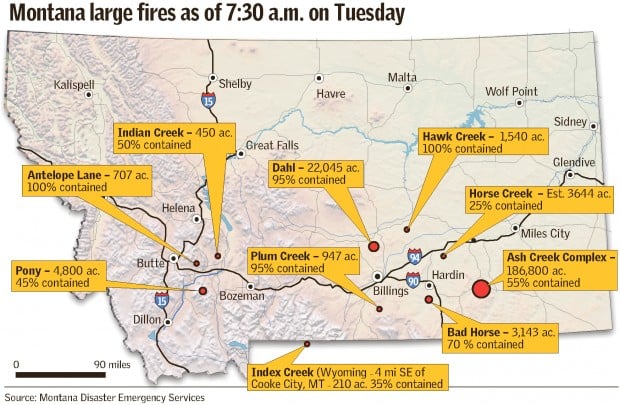
On July 4, 2012, several wildfires were burning across the state of Montana. The percent containment figures make for a nice, neat graphic, don't they?
(Map from the Billings Gazette)


Percent Containment
  • It turns out, there isn't any fancy calculation involved in arriving at percent containment.  It's an estimate.  Here's how it works.
  • A wildfire encompasses a certain amount of area.  Imagine the area as a filled-in ellipse.  Most wildfires aren't like that; they'll often have portions bulging out in one direction or other, but for the ease of description, picture an ellipse.  The outer edge of the ellipse is the fireline.
  • When firefighters try to put out the wildfire, their first goal is to stop it from spreading.  They may put up some kind of temporary barrier around the fireline, or they may dig trenches, or they may spread some type of retardant, or they may remove trees or easily burnable stuff from the projected path of the fire, etc.  All these techniques are methods of containment.
  • When the fire chief gets interviewed and is asked some question like, "How close are you to getting this fire under control?" the fire chief tells the reporter what percent of the ellipse has some kind of containment barrier around the fireline.
  • That's all there is to it.  There's nothing absolute about it.  It's an estimate based on the chief's understanding of the size of the fire at the time, and how much of a barrier they've put down so far.
Today, most wildfire containment methods use retardant dropped onto areas just beyond the fireline, as shown in this photo of the Waldo Canyon Fire, June 23, 2012
(Photo from The Colorado Springs Gazette)

Actual Containment: My Take
  • Based on what I've read, it sounds to me like this % containment number is a number they tell the media to make them happy.  It's a number to give to the reporters (and to us the public) so we can feel like we have a solid and easy-to-grasp concept to cling to.  But as far as I can tell, firefighters do not themselves think in such terms.
  • To them, containment = 100% contained.  The question for them is, how do we get from this fire burning out of control to 100% contained, and put out?

I find this to be a pretty fascinating map.  This is a map of the High Park Fire in Colorado as of June 21, 2012. The red area represents where the fire was burning on that date. The red outline is the "uncontrolled fire edge." The black outline is the "completed line," meaning where they have put some sort of fire control measure in please.  The map is very detailed, even including gray-shaded areas where an older fire once burned.  But nowhere does it say anything about containment--presumably because, according to firefighter parlance, containment had not yet been reached. To see a larger version of the map, go to Summit County Citizens Voice.
(Map from Summit County Citizens Voice)

  • To answer this question, firefighters run all sorts of calculations--very complicated ones involving calculus and all sorts of higher math because there are so many variables involved in a wildfire.
  • Here are some of the features about a wildfire that firefighters have to take into account:
    • Fire intensity -- the rate of heat released by a fire. That's both radiant and convectional heat.
    • Rate of spread -- the distance the fire moves horizontally over time. Usually this is calculated at the head of the fire.
    • Fire type -- is it burning at surface or ground level, or is it burning in the crowns of trees
    • Type of fuel -- usually when it's a wildfire, it's mostly wood and leaves that's involved, but maybe there are other materials in the area, especially if there are houses or industrial buildings.  Even if the fuel is nearly all wood, there are other factors to consider such as how wet is the wood, is it densely or loosely arranged, how big or small is it (fine fuels like sawdust ignite much more rapidly), how dense is the material (a rotten log will ignite more quickly than a sound log), and so on.
    • Fuel load -- weight of fuel/unit area, often expressed as tons/acre
    • Fuel chemical composition -- if there are chemicals identified in your type of fuel, what kinds of chemicals are they?  Of course if accelerants are involved, everything burns faster & hotter. But even if the fuel is primarily wood, high concentrations of resins or oils in the wood can increase flammability and heat output. On the other hand, if the wood has a high mineral content, particularly phosphorus, that will reduce or even retard flammability.
    • Weather -- we hear the most about this one.  All sorts of factors with the weather come into play, including how fast is the wind blowing and is it blowing the fire toward unburned fuel areas. Of course whether or not it's going to rain is a huge factor, but air temperature and humidity will also affect the fire.


Obviously the intensity of the wildfire above is far greater than the one below.
(Photo, top from Treehugger. Photo, bottom from US Fish & Wildlife Service, sourced from Wildlife Risk Explorer)

  •  As I said, those are only some of the variables the firefighters will take into account.  Some of those variables are easier to estimate than others.
  • Then they take all that data and plug them into those very complicated equations to try to find the answers to questions like these:
    • What kind of material would be the most effective at stopping the fire? 
    • How much of that material will we need to create barriers around the entire fire?
    • How fast will we need to build those barriers?
    • How long will it take to reach 100% containment, given such & such barriers?
  • Put in a very theoretical sense, firefighters are trying to solve the fire (equation) for containment (x).
  • (If you're interested in what some of those complicated equations are, check out this paper from 1980. It gives instructions for how to run some of these equations on a pocket calculator. To run them yourself, you would need to know the data for at least 8 variables. I'm sure there are more sophisticated methods of running these calculations today, but this gives you an early, behind-the-scenes glance anyway.) 

Firefighters working on a wildfire in Australia
(Photo from Chez-Audelle)

  • Of course, regardless of all this data, a wildfire is still wild.  Even though firefighters do their very best to find out everything they can about a particular fire and how it's behaving, and try to predict where it might go next and how fast it might get there, a wildfire can still be unpredictable.
  • That's not something we like to hear, especially if homes are at risk of being burned and people's lives may be at risk.  So we get a very estimatey-but-it-sounds-official percent containment number in our news stories.

Related entries: Fire, Fire Departments

Sources
Forest Encyclopedia Network. All sorts of great information here. Especially good pages include Fire Intensity, Fireline Intensity, Rate of Spread, 
National Wildfire Coordinating Group, Contained; Containment; Control Line; Controlled
Frank A. Albini and Carolyn H. Chase, Fire Containment Equations for Pocket Calculators, USDA Forest Service INT-26B, January 1980
LAist, What Do Fire Officials Mean When They Say 'Containment'? 2008
Rebane's Ruminations, Wildfire Containment Percentage - Say What??!! August 18, 2009

Monday, January 23, 2012

Apple #567: Ambergris

In keeping with my previous entry whose subject was inspired by a book I was reading, I thought I'd investigate another topic similarly inspired. I've been reading Moby-Dick. Slowly, about three pages a day, since October. If I had to read many more pages at a time, I'd have given it up long ago. But I'm determined to make my way through it for once.


Actually, I know I'd never have made it this far without the aid of Matt Kish's book of illustrations (pictured above right). I read about three or four pages of the novel at a time and then reward myself by looking at the illustrations that correspond with the pages I've read. My copy of Moby-Dick (above left) is not the edition he used when he drew his illustrations so the pagination is slightly off. But the difference is negligible. I happen to know Matt from my bookstore days, but even if I didn't I would still recommend his book of illustrations as an invaluable aid in reading the original.
(Photo by the Apple Lady)


I recently read the chapter about ambergris. It's such a mysterious substance, and I have to admit, I didn't quite believe Ishmael's explanation or description of it. So I thought I'd find out for myself.

I don't think Ishmael would take this amiss. In fact, I think that looking up the information outside of the narrative would be perfectly in keeping with the book.

Anyway, here are a few facts about ambergris:

  • Ambergris is a waxy substance that originates in a sperm whale's stomach. 


This is a sperm whale mother and her calf. Sperm whales are named for the material in their huge skulls called spermaceti, which is a gooey substance when wet and waxy when dry. Scientists still aren't sure what it's for, but they suspect it helps the whales retain their buoyancy.
(Photo from Amazon AWS)


Males can grow to be 50 meters long and weigh 50 tons. This diagram gives you a good idea of the size of a sperm whale.
(Illustration from National Geographic)

    • Sperm whales eat giant squids. Giant or colossal squids, by the way, happen to live in the very deepest waters and the whales have to dive down to get them. The spermaceti might have something to do with enabling the whales to dive that deep.
    • Squids have beaks. The whales can't digest the beaks, so they stay in the whale's stomach. The beaks are pointy and sharp, and they look remarkably like parrot beaks.


    The beak of a giant squid, up close. The beak functions as the squid's jaws and mouth, the thing it uses to clamp down on its prey. The beak of a colossal squid is about the size of a man's hand.
    (Photo from Te Papa's Blog)


    This fellow is showing the location of a squid's beak. This is not a giant squid but a Humboldt squid, but it keeps its beak in the same place.
    (Photo from KATU News)

    • As the squid beaks get sloshed around in the whale's stomach, they scrape the insides of the stomach. (Cuttlefish beaks have the same effect, by the way.) The stomach's reaction to this irritation is to produce ambergris.
    • I can't find a very good explanation of ambergris' function in the whale's stomach. Is it a protective coating? Something to encourage the whale to expel the squid beaks? I'm not sure. One site says that ambergris is "a cholesterol derivative."
    • That's probably the best answer available. Scientists don't know much about sperm whales in general. Because the whales spend most of their time swimming at such distant depths, it's very hard to study them. So a lot of what we "know" about sperm whales is guesswork at best. Our theories about ambergris are mostly that: theories.
    • Somehow the whales expel the ambergris, either by vomiting or by excretion. It floats around in the ocean until it gets washed up on shore as a black, thick, foul-smelling liquid. Like, run-away-it-stinks-so-bad. Like, pew-that's-cow-manure-plus-something-fishy bad.
    • But once it's dried ("allowed to age" is how it's delicately put) its fragrance changes completely. It's still a bit musky but it also takes on a lighter, mossy fragrance. Altogether, people find the scent of ambergris so velvety and enchanting, they only want to smell it more.
    • Once it's dried, ambergris can be white, ash-gray, yellow, or black.
    • The word "ambergris" comes from the French for "gray amber."


    What black ambergris looks like. This ambergris washed up on shore around or near New Zealand. Looks a lot like regular stones, doesn't it?
    (Photo from ambergris.co.nz)

    • The lighter-colored the ambergris, the better the aroma, and the higher its value.
    • Ambergris has been used, most obviously, in perfumes. It is reportedly the slowest of perfume materials to evaporate, which means it holds its scent for an incredibly long time. Queen Elizabeth I used to perfume her gloves with ambergris.
    • Ambergris has also been used as a type of glue. It even used to be used in cooking. Dissolved in wine, ambergris is said to produce a heady aphrodisiac. Louis XV enjoyed foods flavored with ambergris.
    • Trade in ambergris is now banned in several countries to discourage whaling. But people do still find it on shore, and the sale of found ambergris does continue. 


    A few years ago now, this woman found a huge lump of ambergris on South Australia. Ambergris is pretty light-weight for its size, but this hunk is so large, it weighed 15 kg. Its value was estimated somewhere around $300,000.
    (Photo from Laputan Logic, original source unknown)


    • If anyone is selling large quantities of ambergris perfume, chances are they got it commercially, which means they got it from a sperm whale that was killed and harvested.
    • Part of the reason ambergris is so valuable is because it is so rare. Not only is whaling banned in most of the world, which thus reduces the amount of ambergris on the market, but its occurrence to begin with is not all that common. One source says that "approximately 1% of the population" of sperm whales produces ambergris. So even if you did hunt down all the sperm whales, chances are, you wouldn't find ambergris inside most of them.

    [imagine a photo of a small bottle of ambergris here]
    Small bottle of a tincture of ambergris. "Tincture" means it's been dissolved in alcohol. The liquid is a pale gold color. The person who made this says she uses only beach-found ambergris. She sells her ambergris tincture for $85 per 10 ml bottle.
    (I would link to the photo but she says her entire site is copyrighted and she doesn't want anyone to use anything whatsoever from her site. So you'll have to go to her site if you want to see what an ambergris tincture looks like.)

    • Synthetic ambergris scents are used in perfumery today, perhaps most famously as one of the scent components in Drakkar Noir (and in another men's cologne, too: Cool Water). I wouldn't say that synthetic ambergris smells like Drakkar Noir, but it may be one of the notes in that cologne's overall scent.


    Drakkar Noir: a whale of a cologne? Har har har!
    (Photo and cologne available from Amazon)

    • One of the reasons I wanted to do this entry is because I have been wondering, the whole time I've been reading Moby-Dick, how much I could trust Ishmael (or Herman Melville). Has what we know about sperm whales changed a lot since that novel/scientific treatise was written? Am I taking in a lot of outdated, now factually incorrect information?
    • I am happy to report, at least as far as the information about ambergris goes, Ishmael was absolutely on the money. In fact, in some ways, he provided more facts about ambergris than I did. Here are some excerpts about ambergris:
    "Dropping his spade, [Stubb] thrust both hands in[to the dead sperm whale's stomach], and drew out handfuls of something that looked like ripe Windsor soap, or rich mottled old cheese; very unctuous and savory withal. You might easily dent it with your thumb; it is of a hue between yellow and ash color. And this, good friends, is ambergris, woth a gold guinea an ounce to any druggist.
    . . .
    "Though the word ambergris is but the French compoud for grey amber, yet the two substances are quite distinct. For amber, though at times found on the sea-coast, is also dug up in some far inland soils, whereas ambergris is never found except upon the sea. . . . ambergris is soft, waxy, and so highly fragrant and spicy, that it is largely used in perfumery, in pastiles, precious candles, hair-powders, and pomatum. The Turks use it in cooking. . . . Some wine merchants drop a few grains into claret, to flavor it.
    . . .
    "By some, ambergris is supposed to be the cause, and by others the effect, of the dyspepsia in the whale. . . . I have forgotten to say that there were found in this ambergris, certain hard, round, bony plates, which at first Stubb thought might be sailors' trousers buttons; but it afterwards turned out that they were nothing more than pieces of small squid bones embalmed in that matter."
    --Moby-Dick
    • Could Ishmael be the world's first Apple Lady?

    Sources 
    Merriam Webster, ambergris
    Lexicus, definition of ambergris
    Online Etymology Dictionary, ambergris 
    Ambergris.co.nz, identification 
    Tony Burfield, Ambergris Update, Feb-Mar 2005 
    National Geographic, Sperm Whale 
    Oceanic Research Group, Sperm Whales: The Deep Divers of the Ocean 
    Enchanted Learning, Sperm Whales

    Saturday, September 4, 2010

    Apple #480: Ice Cubes

    All right, I'm ready to tell you what I learned about ice cubes.  I discovered a little bit of history about their invention, but mainly what makes them interesting has to do with the unusual properties of water and how it freezes and melts. So I'm going to break it all down into those categories.


    (Photo of ice cubes from Habimama)


    INVENTION

    A lot of people say that one guy, Dr. John Gorrie, invented the ice cube. But actually, he invented refrigeration and an early version of air conditioner.

    Gorrie believed that diseases like yellow fever wouldn't survive in cooler air (actually air temperature had nothing to do with it), so he designed a machine that would cool the air.  The machine used compressed air to generate ice bricks, and the air flowing over the ice bricks was released into the room to cool it.


    A model of the ice-making refrigeration machine that Dr. Gorrie invented. The ice bricks collected in the wooden box at the top, and the air flowed over the box.
    (Photo from Gorrie's Fridge)

    By my reckoning, the first guy to invent ice cubes as we know them today -- little hunks of ice used for the purpose of cooling beverages or food -- was an inventor named Lloyd Groff Copeman. 
    (Click the Read More link for the full entry)

    Monday, June 7, 2010

    Apple #461: Shower Curtain Blow-In

    Regular reader Jason went traveling recently and stayed in a few hotels.  In one of them, he experienced that annoying habit of a shower curtain liner to billow inward while the shower is running.  It blew in so much it clung to him.

    I have had this happen to me, too. I've noticed it is more likely to happen if the shower curtain liner is especially light-weight and cheap.  It can be most annoyingly clingy and unpleasant, especially if you begin to wonder how many other people showering in this hotel bathroom have been stuck to this same shower curtain.


    This curtain looks especially prone to billowing in.
    (Photo from apartment therapy)


    Regular reader Jason wanted to know why this happens, first of all because it seems to contradict what you would expect.  You would think that the water streaming out of the shower head and beating against the curtain would push the curtain away from you.  But what happens is the opposite.  "I would be interested to know," he said, "the physics behind that."

    He also wanted to know why this happens so that the next time he's in a hotel room with an incorrigible shower curtain liner, he could maybe do something about it.

    • As it turns out, regular reader Jason is not the only person to have been interested in the physics behind this question.
    • For a long time, people have floated different theories about why this happens.  I'll list them briefly so that those of you with bar bets on this topic can settle them quickly.
    • The most obvious and most-often suggested theory is basically the buoyancy theory.  Air heated by the hot water rises, allowing cooler air to rush in below, thus pushing the shower curtain liner inward.  However, when you turn on the same shower with the same curtain using cold water instead of hot, the curtain still blows inward, which means this theory also blows.
    • A fancier theory proposed was that the principle is the same as that which enables airplanes to fly:  Bernoulli's principle.  In the case of airplanes, as air rushing over the top of the airplane wing speeds up, the air pressure above the wing drops in a direction perpendicular to the rushing flow of air.  The drop in air pressure is what "lifts" the wing of the airplane up.

    Diagram of how the Bernoulli principle works.
    (Diagram from Ted Ewert on Energetic Forum)

    • Inside the shower, people said, instead of air rushing over the top of the airplane wing, it's the water spray traveling quickly toward the shower curtain.  When you turn the shower on, the velocity of the water traveling through the air makes the air pressure around it drop, thus sucking in the curtain liner.  The problem with applying that principle to this system, though, is that it doesn't account for the presence of water droplets, which act in ways very different than straight-up fluid.  And when one physicist did the math associated with this principle, it didn't result in the shower curtain's movement.  So that theory was discarded.
    • A third theory said that the shower curtain moves inward because of what's called the Coanda effect. This effect says that when moving air or water hits a convex surface, the two will hug each other remarkably tightly and for a much longer time than you'd expect.  

    A good demonstration of the Coanda effect in action.
    (Image from The Worlds of David Darling)

    • According to this theory, it's not air currents rushing in that blow the shower curtain in but the tendency of the curtain to stay attached to the water as it falls. Exactly how the curtain liner is consistently convex was not thoroughly explained, and the actual motion didn't seem to fit what this principle said would happen, but people bought it for a while because the principle had a fancy name and it was a rather imposing physicist who first suggested it.  But it turns out this theory is all wet, too.
    • Finally a professor named David Schmidt at University of Massachusetts-Amherst did some pretty extensive research into this question.  He designed a computer simulation of a running shower with a shower curtain in a bathtub in a bathroom.  He divided up the model bathroom into 50,000 observable cells.  He let the simulated shower run at a fairly typical eight gallons a minute for 30 seconds.  
    • As far as I understand it, he ran some other software made by Fluent Inc. that uses computational fluid dynamics to analyze what happened during that simulation.  The software looked at the droplets breaking up on surfaces, how the droplets were distorted upon impact, and the aerodynamic drag involved with each droplet.  It took 1.5 trillion calculations over the course of two weeks, but then he got the answer.

    This is Dr. David P. Schmidt, who spent his Christmas break working to dispel the shower curtain mystery for us all.
    (Photo from Dr. Schmidt's page at U Mass Amherst)

    • It turns out that Bernoulli's principle is, in fact at work, but the reason Schmidt's calculations with it didn't turn out right initially is because it's happening in conjunction with another principle. That second principle is known as a shear-driven cavity. 
    • The shear-driven cavity is a situation when a fluid is moving inside a container with three fixed walls and one moving wall.  In this case, the moving wall is the shower curtain.  I haven't found a very good explanation of how the driven cavity thing works, so let me know if I haven't explained this right. As I understand it, while the water is continually running, the droplets are also slowing down as they travel because of aerodynamic drag.  Supposedly, these two forces happening in equal and opposite directions (water flowing in one direction, being slowed in another) is what gets the air in the cavity that is your shower moving and which, in turn, moves the shower curtain.
    • When we combine these two principles together, effectively, the spray of the water in the cavity with the moving wall creates a vortex.  Like the center of a hurricane or a tornado, the center of the vortex is a low pressure column.  It is this column of low pressure in the center of the vortex that pulls the shower curtain inward.  Once the water is turned off, the thing creating the low pressure column stops, and the shower curtain will hang normally again.
    • (I think it's pretty cool, by the way, that there's a mini-hurricane in my shower.)

    Actually, Schmidt said the water vortex is the shower is most like a dust devil, which are whirlwinds smaller than tornadoes and which can be tilted.
    (Diagram of dust devils from WeatherQuestions.com)

    • The low pressure in the center of the shower water vortex is a very weak force, though, which explains why curtain blow doesn't happen in every shower all the time.  Lighter weight shower curtain liners are more easily moved by the low pressure column. 
    • So the solution is simple: find a way to make the shower curtain weigh more than the force of the low pressure column.  You can do this in a number of ways.
    • Get a thicker or heavier shower curtain liner.
    • Get a shower curtain liner with weights affixed to the bottom.

    Most curtain liners are sold now with weights or, as in this photo, magnets at the bottom.
    (Photo from Craft Awl)

    • Reduce the water pressure coming out of the the shower head.
    • Curved shower curtain rods which hold the curtain farther away from the vortex -- and from you -- are another solution.  Even if blow-in does happen, they usually keep the shower curtain liner far enough away that it won't touch you. Many of the fancier hotel chains like Hilton and Westin have installed these curved shower rods for exactly this reason.

    Curved shower rod, some hotels' answer to curtain blow.  You can buy one just like the ones installed in Westin hotel bathrooms for $40.
    (Photo from bookofjoe)

    • If you're in a hotel room and don't want to buy a new curtain liner, to say nothing of a new shower rod, you can try these other tactics:
    • Set your shampoo bottles and suchlike on or against the hem of the curtain liner to weigh it down.  
    • Wet the backside of the bottom of the curtain liner so it will stick to the side of the tub.
    • Turn down the force of the water spray.
    By the way, if you want to see the vortex at work, hang a thin shower curtain liner and turn on your shower.  Doesn't matter if you use hot or cold water.  Now blow in some smoke (where you get the smoke is up to you).  You'll see the smoke take on that vortex shape.

      Sources
      The Straight Dope, Why does the shower curtain blow in despite the water pushing it out (revisited)? August 10, 2011
      David Schmidt, "Why does the shower curtain move toward the water?" Scientific American, July 11, 2001
      Kate Melville, Mystery Of The Shower Curtain Solved, Science-a-Go-Go, July 13, 2001
      Ron Lieber, Innovations Eliminate Sticky Shower Curtains, The Wall Street Journal Online, October 11, 2004
      bookofjoe, Shower curtain 'blow-in,' October 10, 2004
      WiseGeek, What is the Coanda Effect?
      CFD Online, Lid-driven cavity problem