Showing posts with label sports and games. Show all posts

Monday, October 14, 2013

Apple #656: David Ortiz's Head

I was going to make this entry about Miguel Cabrera, my mom's favorite baseball player.  But after the Grand Slam that David Ortiz hit tonight, it seems more relevant to talk about him instead.

I'll get to Miguel Cabrera.  But for now, Big Papi.

I'm not going to tell you all the batting statistics because you can look those up in a kajillion places.  Instead, I want to find the lesser-known details.  Like, for example, the size of his head.  Every time he comes up to bat, I am stunned by the size of his head.  That thing is enormous!  It barely fits into his helmet!


David Ortiz, right, and 2 of his teammates.  Look how much bigger his head is compared to the other guys'.
(Photo from Getty Images via Zimbio)

  • It turns out, hat size or helmet size is a closely guarded secret.  Because apparently, if your hat size expands noticeably after you've gone through puberty, it's generally considered to be a sign of HGH use.  
  • HGH thickens the bones in your forehead and jaw, necessitating larger hats, at the very least. 
  • So I couldn't find David Ortiz's hat size anywhere.  But maybe I can arrive at a ballpark figure (har har).
  • Barry Bonds' hat size increased from 7-1/4 to 7-3/8 (even though he took to shaving his head). That's in the neighborhood of 23-1/2" circumference.  The MLB shop says that's an XL.


You'll notice that Bonds' head, in the more recent photo on the right, seems pretty well packed into his helmet compared to the photo on the left.  More pertinent to us, though, is that in the photo on the right, his hat size is 7-3/8.
(Composite photo from Szyzygeist)


Now, I want you to notice how David Ortiz's helmet barely seems to fit on his head. And it looks bigger than Barry Bonds' head, doesn't it?
(Photo from The Joy of Sox)


Yeah, I'd say David Ortiz's head is bigger than Barry Bonds' (left).
(Photo by Deanne Fitzmaurice, SF Chronicle)

  • I don't know how much bigger David Ortiz's head is than Barry Bonds', but I would say it is definitely larger.  Bigger than a 7 3/8, for sure.  How much more, I couldn't say, but almost certainly in the XXL category.
  • Just to be clear, I'm not accusing the guy of anything.  I'm not interested in using these statistics as a sign of whether he took something illegal or not.  I just think he has an enormous freakin' head, that's all, and I wanted to see if I could find the number that showed that.
  • I'm also not trying to be metaphorical and imply that he has a big ego.  All I'm saying is the guy has a large cranium.


David Ortiz: Yeah, I'm not going to tell you my hat size, but you can bet it's pretty big.
(Photo from ESPN)

  • I did find other statistics related to his large physique.
  • He's 6'4" and between 255 and 260 pounds.
  • In 2007, he said his pant size was 40 x 34 (40" waist and 34" leg). 
  • He wears a slightly larger uniform to give himself more room to make a comfortable swing.
  • His shoe size: 16.  That's 12.5" long.
  • Jersey size: 54.  That's 54 inches around.  That's 4.2 feet, folks.  

Finally, when you have a big dome, you can do things like this, no problem:


Sources
Can Steroids Enlarge Your Head? Slate, November 19, 2007
The HGH Handbook, Men's Fitness, September 2012
Bonds Jury Hears the Science of Steroids, The New York Times, March 24, 2011
Barry Bonds and the Smoking Ballcap, Sun Sentinel, March 29, 2011
The Papi Monologues, Boston Magazine, April 2007
Game Used Authentic, Game Worn Uniforms (this is the sort of link that will disappear in the future, so in case it does, here's what it says: "2007 David Ortiz Game Worn Jersey. Authenticated by PSA/DNA and JSA. Classic Old English 'Red Sox' appears in gentile arch across the chest, fashioned from straight-stitch affixed to front left exterior tail, with a '34 54 07' embroidered swatch denoting uniform number, size and year.")
EBay, RARE Reebok Baseball Softball Cleats Shoes #34 David Ortiz Boston Red Sox Sz 16

Monday, July 15, 2013

Apple #644: Tour de France

You may have noticed that the Tour de France is on every freakin' NBC channel practically all day long.  When Lance "Uniball" Armstrong was competing, I never had much interest in it because, duh, who's going to win?  Now that he's out of it, I find myself kind of curious.

But as I'm watching the horde of men riding their bicycles, none of them apparently that much faster than the others, I realize I understand nothing about this event.  They all travel in a pack, so how is this a race?  How come the guy leading the pack today isn't the guy they're talking about as the race leader?  When the guys at the front of the pack switch off taking the lead as if it's all choreographed even though none of them are on the same team, I ask again, how is this a race?

With all these questions going unanswered even while I watched NBC's coverage, I thought it was time to find out for myself how the Tour de France works.


The Tour de France peloton. That guy adjusting his chin strap doesn't seem to be working very hard.  Neither do many of the other riders.  So what's going on here?
(Photo by Graham Watson from Cycle Sport Online)

The Course

  • The Tour de France is a series of races that total in the neighborhood of 3,550 km (2,200 miles).  The race lasts for 3 weeks, beginning in early July and ending in Paris on the Champs Elysses at the end of the month. 
  • It's considered one of the most grueling -- er, athletically challenging sports events in the world. That's like riding your bike from New York to Las Vegas, but with more mountains.  The race is so long and challenging, it would be impossible to complete it without teammates.
  • I thought the race followed one path from point A to point B, start to finish, but no.  The race course stops and starts and moves and jumps all over the place.  The course also changes from one year to the next.

Tour de France course map from 2011
(Map from Le Tour de France) 


Here's the course in 2012
(Map from Le Tour de France)


This is the course in 2013.  This year, the race started on the island of Corsica.  You know, where Napoleon was born.  And as you can see, sometimes the distance from one stage to the next is so large that the competitors have to fly to get there.
(Map from Velo Peloton)

  • The course travels over a mixture of types of terrain.  This year, there are 7 flat stages, 5 hilly stages, and 6 mountain stages with 4 finishes on the summit.  There are always 21 stages, but the number of them that are flat or hilly or mountainous varies from year to year.  (My numbers don't add up to 21, but I'll get to the parts I'm leaving out in a bit.)
  • There are also 2 rest days.
  • Each stage is timed.  The winner of the Tour de France is the person with the lowest time of all the stages added together.  
  • This is why one person might be leading the pack on one particular day, but the guy the broadcasters are talking about--the overall leader--may be somewhere else in the pack.  If current overall race leader has a huge time lead from previous stages, it might not matter if he's a ways behind in a current stage.

Races within the Race


  • So there's the overall prize, which is to win the entire race by having the lowest cumulative time.  Race officials keep track of who has the lowest overall time from one day to the next, and that person gets to wear the yellow jersey.  If someone else has the lowest overall time the next day, that person gets the yellow jersey.  And so on until the end of the race.  
  • The person wearing the yellow jersey at the end of the race / the person with the lowest overall time wins € 450,000 (~$588,000).  Traditionally the winner splits the prize money with his teammates.
  • The yellow jersey for lowest total time isn't the only thing you can win in the Tour de France.  Because the race is so long and contains so many challenges, there are lots of mini-races.
  • You can win a stage of the race.  You get  € 22,500 (~$29,400) and bragging rights for winning a day's stage.  It is possible to win a stage, or even several stages, and not be the overall race winner.
  • In addition to the flat, hilly, and mountainous stages, there are also time trials.  In French, these are called contre le montre, or CLM, stages.  Most time trials are about 35-50 km, and the riders compete against the clock, riding special aerodynamically-designed bikes.  Usually the time trials are individual events, so you could win a time trial.  There are also team time trials, in which case your personal time would only matter in the sense that it's added to your teammates' times, and your team's overall time is used to determine the winner.  
  • This year, there are 2 individual time trials and 1 team trial.  Time trials could be held on flat or hilly or mountainous ground.


  • Within certain stages, there are areas designated as sprint sections.  Points are awarded on the basis of who finishes the sprint sections in what order, meaning the first sprinter to finish the mini sprint section wins the most points and so on.  The sprinting sections could occur in the middle of a very long 100km+ section, so all of a sudden the racers will bust out the speed and start cycling like mad, jockeying for position and trying to pass each other to finish the sprint first.  The points leader of the sprint sections wins a green jersey. At the end of the race, the rider wearing the green jersey is awarded € 25,000 (~$32,600).


  • Similarly, in the mountain sections, points are awarded to the people who are the first to reach the summit of a mountain section.  The "king of the mountains" wears the polka-dot jersey.  The final polka-dot jersey winner is also awarded € 25,000 (~$32,600).


  • The white jersey is awarded to the best rider under 26 years old.  Like the other jerseys, the wearer of the white jersey may change from one day to the next.  Since relatively few riders can compete for this, it's not as highly coveted as some of the other jerseys.  The white jersey winner is awarded € 20,000 (~$26,135).


  • There's also an award for combativity. This distinction is a little harder to define.  It's been described as "most effort," "puts on the best show," or "most aggressive."  The winner of the combativity award is determined by a jury of 8 cycling experts at the end of each stage.  The combativity winner may or may not be the stage winner.  This person is awarded a race number with a red background and a white number, and at the end of the race is awarded € 20,000 (~$26,135).


  • Your team can also win awards.  Most teams start out with 9 people, but some or many often drop out as the race progresses.  So the team award recognizes the best 3 riders of a team in each stage (team time trials excepted; those get a different award).  Team winners get a race number with a yellow background and a black number.  The winning 3-person team at the end of the race gets € 50,000 (~$65,345).
  • There's also a joke award called the Lanterne Rouge (red light).  The very last man in the stage gets called this, after the red light on the caboose of a train.  The name is a joke, but if the last rider falls too far back from the pack, he can be eliminated from the Tour. Some also say that there's no dishonor in being the red light, since many riders never finish the Tour at all.  So even being last, but finishing, is still a remarkable achievement.
  • Leave it to the French to come up with a sport where the prizes are clothes, eh?

 Strategy Basics

  • By now you're getting the picture that the Tour de France is more complicated than just a bunch of guys racing their bikes from one point to another.  Some people are sprinters and are hoping only to win the green jersey.  Some people love the mountains best and only want to win those stages.  Some people have a goal of winning a certain number of stages -- like, maybe one.  There's a whole lot of stuff going on in that pack of bicyclists.
  • But knowing that different people are shooting for different goals doesn't really help interpret what's going on when you see a pack of riders all bunched up and maybe four or five guys strung out at the front.  So what is going on in that pack of riders?


The peloton.  Egad, I hope none of those riders tips over and knocks someone over that ledge.
(Photo from The Epoch Times)

  • First of all, the pack is called the peloton (the word means "herd").  "Peloton" can refer to the main bunch of riders, or it could be used to refer to the entire field of competitors.
  • In general, especially in the flat sections, the peloton tries to stay bunched together.  This helps the riders reduce drag and thus conserve energy.  Riding in the middle of a peloton can help a rider conserve as much as 40% of the energy required to keep pace.
  • The peloton will shift shape to adapt to shifting headwinds or crosswinds.  It's kind of like how a flock of birds will change direction on the fly. 


This gives you some idea of how the line of riders can move and shift as they're drafting, or compensating for wind resistance.
(Photo from Zimbio)

  • A disadvantage to sticking with the pack is that sometimes a rider will crash, and in that packed peloton which can be shoulder-to-shoulder, it's likely that a falling rider will take others down with him.  
  • An advantage to sticking with the peloton is that when the whole pack crosses the finish line, it's too difficult for the race officials to figure out who crossed exactly at what millisecond, so every rider in the pack is awarded the same time.  If you're at the very back of the bunch, you get the same time as those in the middle of the bunch.
  • The only exception to this rule is that the first three in the pack will get a time bonus, or deduction, from their individual cumulative times. This encourages people to break away from the pack, especially toward the finish of a stage.
  • But often it's not just one person who breaks away, but his entire team, or maybe a few people from different teams.  When this happens, the drafting technique changes, but still operates with the goal of conserving energy.  Members of the same team will allow one person to ride in front for a while, then drop back and let another person move forward, and so on.
  • If the breakaway pack is comprised of people from different teams, one team may still cycle through the different leaders, but they will do so in a way that tries to trap the members of the rival team so they must slow down or can't assume the lead.  
  • Sometimes a breakaway pack will allow one rider to zoom ahead while the rest of his teammates stay with the breakaway pack and trap a rival team, thus allowing their team leader to gain a significant time advantage.
  • (If you want to see a visual representation of these drafting & trapping strategies, check out this super-informative animated video about the Tour de France. The explanation of drafting methods starts around 5:19.)


So far, a lot of the photos I've posted make it look like these rides are like strolls in the park. But riders can reach speeds in excess of 100 km/hr -- 60 to 65 mph -- on mountain stage descents.
(Photo from the Winnipeg Free Press)

  • The one rider who zooms ahead of the pack gets a lot of glamor and glory, but he wouldn't be able to do that and stay there without help from his teammates (domestiques).  The teammates often ride at the front for the majority of a stage, essentially doing the grunt work and allowing the team leader to conserve energy until the end of the stage.  Teammates can also drop back to the cars that are following, collect water & food, and bring it up to the team leader.  If the leader crashes and ruins his bike, the domestique will give the leader his bike.


One of the many things the domestiques--helper teammates--will do: drop back to collect water or food from the team car, then zip up to where the team leader is riding and give him the water.
(Photo from Bike Radar)

  • All the work that the supporting teammates do is yet another reason why the winner of the Tour de France, if he's any kind of decent person at all, splits his winnings with his team.
  • Then there are the mountains.  Simply and crassly put, the mountains kick people's ass.  Riders who specialize in sprinting tend to drop out of the race in the mountains.  Riders who have trained long and hard for the Tour may still overextend themselves in the mountains, "hit the wall" as runners say, and find themselves simply too burned out to continue.
  • Many Tour winners in the past dominated the mountain sections, building up enough of a lead in those stages to compensate for slower times in the time trial stages.  Lance Armstrong was known for blowing away his competitors in the mountain stages, and he was also fast in the time trials.  Now we know how he managed to do that, but this tells you how dominant he was in the sport, that he excelled at both.

Graphical depiction of the changes in elevation of one of the mountain stages, from the race in 2006. Yeah, it's only 182 km (113 miles) long.  Piece of cake.
(Graph from Climb by Bike)


OK, so now these guys are working hard.  This is the first of several mountain stages.
(Photo from NJ.com)

One Last Question

  • Why is the winner's jersey yellow?  
  • Answer: The Tour was originally conceived as a way to promote the French newspaper L'Auto.  At the time, that newspaper was printed on yellow paper.  The yellow jersey reinforced the idea of the yellow paper.  Branding, ladies and gentlemen, in 1903.

Where are the Riders Now?

  • As I type this, the Tour has completed its 15th stage.  Only 6 more to go.  British cyclist Christopher Froome is currently wearing the yellow jersey.  He's been the race leader since the 8th stage, though he's only won 2 stages.  He's been either 1st or 2nd in the competition for the polka-dot jersey, which you now know means he was killing it in the mountain stages.  Which you also now know means this guy may turn out to be the Tour's winner.


Christopher Froome in a polka-dot jersey in 2012.  There are lots of photos of him wearing the yellow jersey, and that may be how he appears after the finish this year.  So I thought I'd give you this one for some variety.  Froome is 28 years old, and he was born in Nairobi, but he rides for Great Britain (his father is British).
(Photo from the Telegraph)


Oh, there are also the many nutjobs who line up along the course, ready to cheer on their favorite athletes.  These are some of the more sane ones.  You don't wanna see the Swiss guys in the green sling Borat-bikinis. Or maybe you do.
(Photo from Total Pro Sports)


Now that I know all this, I want to watch it.  What about you? 


Sources
Le Tour de France, 2013 Route, Sporting stakes / rules
Cathy Gellis, UC Berkeley, The Tour de France Explained
Infobytes.TV, Tour de France animated video
BBC Sport Cycling, Tour de France
BBC Sport Academy, How does Lance stay ahead of the pack?
Bike Radar, Tour de France glossary 

Monday, October 29, 2012

Apple #608: How Baseballs are Made

There is a ton of stuff going on this week.  Any number of things that your Apple Lady could talk about.
  • The Presidential election is coming up, so I could talk to you about how wonderful a thing it is that we in this country get to vote and that our votes actually do count, and how important it is to vote.
  • Next week, Daylight Saving Time will end and we'll have to move our clocks back one hour. Most of you are probably cranking up your furnace with the onset of colder temperatures.
In case you haven't guessed, I have covered all these topics already.  So what's an Apple Lady to do?

Naturally, talk about baseball.

In addition to everything else I've listed, the World Series is also going on.  I want the Tigers to win, and since it's tied in the 9th and the Giants are up 3-0 in the series, it is not looking good for the Tigers.

I don't want to jinx the Tigers, so I'm going to talk about baseballs in general.  You  know, the balls themselves.  How they're made.


The inside of a baseball, deconstructed.
(Photo from Wired)

  • From the inside out, baseballs are made of a pill, which is a ball of cork with rubber padding around it, then wool fibers wrapped around that, and two pieces of cow hide that get stitched together.

 
Here's the cross-section of showing all the ingredients inside a baseball.
(Image from Baseball Fever)

  • Every component inside the baseball is made to very precise specifications.
  • The cork at the very center weighs 1/2 ounce and measures 13/16'" in diameter.  Cork is used at the center because it is "livelier" than a rubber core.

[Scutaro just got a base hit for the Giants and the man on base scored. Giants are up 4-3 in the 10th.]

  • Around the cork are two layers of rubber, one black and one red.  They added the rubber to cushion the cork and help it last longer.
  • The black rubber layer is actually two hemispheres that are joined together by red rubber washers. That why, in that cross-section up above, there are red notches extending into the black rubber layer.
  • The black and the red layers of rubber weigh 7/8 ounces each.
  • The cork plus the layers of rubber measure 4 1/8" in circumference.
  • Latex adhesive is added to the cork + rubber, which is called the pill.
  • Wound around the rubber are four layers of wool yarn.  The first layer uses 121 yards of the thickest type of yarn, which is four-ply, and gray.  When the 4-ply yarn is wrapped around the interior, the circumference of the ball expands to 7 3/4".
  • The second winding uses 45 yards of 3-ply wool yarn that is white. (The colors are different just to distinguish the different thicknesses of yarn and the windings.)

[Jackson strikes out. Out #1 in the 10th for the Tigers.]

  • The third winding uses 53 yards of 3-ply gray wool. At this point, the ball measures 8 3/4" in circumference.
  • The fourth and final winding doesn't use wool but rather white poly-cotton yarn because the fibers are finer and smoother. 150 yards of it.

[Don Kelly, in his first appearance in the World Series, strikes out.  Now Miguel Cabrera is up.  He's the biggest batter for the Tigers.  Won the Triple Crown this year.]


Here's another cross-section showing the inside of a baseball.
(Image from Science Proficiencies)

  • The windings are done using computerized, high-tension machines which maintain a constant level of very high tension so that some spots don't get wound tighter or more loosely than others.
  • After the 4 windings, the whole thing is dipped into rubber cement to seal the deal.  At this point, the ball weighs 4 5/8 ounces.

[Miguel Cabrera just struck out.  Giants won the World Series.  In 4 straight games.  Sigh. But never fear. Your intrepid Apple Lady will press on.]

  • Next comes the outer layer.  It is made of -- get how official this is -- Number One Grade, alum-tanned, full-grained cowhide, primarily from Midwest Holstein cattle.  This particular type of cattle is preferred because their hides are considered to be smoother, cleaner, and with a better grain than cattle from other parts of the US.
  • The hide must be white.  It is punch-cut into two figure-8 patterns.  The cowhide gets moistened slightly to make them easier to work with, and more rubber cement is applied to the interior to make them stick to the woolly ball.
  • Once the two pieces of cowhide are stuck to the ball, they get stapled and then hand-sewn together using 88 inches of waxed red cotton thread.  Some say there are 108 stitches with the first and last stitches completely hidden, presumably so the stitches don't come undone.
  • It takes about 13 to 14 minutes to do this hand-sewing of one baseball.
  • When the stitches are done, the staples are taken out.  The ball is rolled to make it smooth, and then it gets inspected, weighed, and measured.  It must weigh between 5 and 5 1/4 ounces and measure 9 to 9 1/4" in circumference.
  • If it passes inspection, it gets stamped with the trademark and all official insignia and it's packaged up for sale.

Here you can see the whole process in action.  I love these how-it's-made kinds of videos.


  • A baseball must keep its round shape even after being hit 200 times by a 65-pound force.  One way they test this is to compress the ball between two anvils (the coyote would be proud!).
  • Despite its durability, the average Major League baseball gets used for only 5 to 7 pitches in a Major League game.
So now, in addition to knowing how baseballs are made, you also know to check the Daily Apple for background information on all the current news stories of the day, and also for occasional play-by-play descriptions of her preferred team losing badly.

Sources
How Products are Made, Baseball
Baseball Fever, Inside a Modern Baseball

Friday, August 3, 2012

Apple #596: Kinesio Tape

I know I asked you, dear readers, to choose between two topics for my next entry: the pommel horse or synchronized diving, or to propose a third option.

One faithful Daily Apple reader posed a third option with this question:
Why do the divers have these big red streaks on their backs and legs? One Chinese diver had two parallel streaks on her lower back, one had one thicker one, and another diver had one on her front thigh. What does this mean? What is it made out of? Why doesn't it wash off in the water?


Wu Minxia, synchronized diver from China, wearing the muscle tape on her lower back and on her ankle.
(Photo from NBC Olympics Mobile)


I happen to know the answer to this.  It's muscle tape.  Athletes have been using it in lots of sports for several years.  But I'm glad you asked because it is sort of a mysterious material, and I would like to know more about it, too.

  • The first time I remember noticing it for sure was during the Beijing games when beach volleyball medalist Kerri Walsh wore it on her shoulder.
 
Kerri Walsh during the 2008 Beijing Olympics, wearing black muscle tape on her shoulder.
(Photo by Georgios Kefalas, from Monsters and Critics)

  • She had had surgery on her shoulder the year before the games. The surgery attended to problems with her rotator cuff, took out a bone spur, and got rid of some debris and scar tissue from a previous surgery. 
  • Though her shoulder had healed by the time she got to Beijing, she was wearing the muscle tape to bolster it.
  • I was struck by how it seemed flexible enough to conform to her muscles and the shape of her shoulder, allowing more specificity of placement and giving her more range of motion than a wrapped bandage would, and it never came off even though she was doing all sorts of diving into the sand and various other exertions, not to mention a lot of sweating.
  • The brand name for it is Kinesio Tape. It was developed by a Japanese chiropractor named Dr. Kenzo Kase. 

Dr. Kenzo Kase, inventor of Kinesio tape.
(Photo from Kinesio UK)

  • (Actually, there is another brand of this tape out there, called KT Tape.  But most people are talking about the Kinesio brand.)
  • The tape, according to Kinesio UK, is flexible enough to stretch 30% to 40% longer than its resting length, it allows the skin to breathe, but it will stay on for 3-5 days at a stretch. (a little pun there for you)
  • It's made of cotton, which is porous enough to allow moisture to escape through it, which means it will stay on even when it gets wet.  
  • What makes it stick is a special heat-activated adhesive. When you first put it on, you have to rub it briskly to get the adhesive working, and then it will stick. 
  • According to the company that makes Kinesio, the tape supposedly allows more blood flow to reach sore muscles by pulling the skin slightly away from the muscle. Its effects are to reduce swelling, pain, and muscle fatigue.
  • Kinesio says there's a special way it must be applied, and they train and certify people in how to do that.  They say that there are now some 4,000+ certified Kinesio Taping (they put a little R in a circle after this) practitioners in the UK alone.


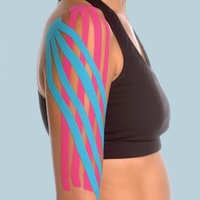
Kerri Walsh's tape was black, and for a long time, that was the only color of it that I saw. But now you can also get it in beige, blue, and red, as shown here. One roll sells for £7.95 (~$12.35), and a box of 6 rolls goes for £41.50 (~$64.40).
(Photo from Kinesio UK)


They also sell it in a different variety, called "fan cut." I'm guessing this is so you can spread out the ends to cover a lot of surface area more easily. A pack of 50 goes for £46.50 (~$72).
(Photo from Kinesio UK)


Ah, yes. Here is the fan cut option in use.
(Photo from North Coast Medical)

  • As far as whether or not it actually works, opinions are mixed. There hasn't been a lot of medical research done on the tape, but what has been conducted has found that there is a short-term benefit in some circumstances, like increased r ange of motion, or a reduction in pain. But long-term, the studies haven't seen results any better than a placebo.
  • It should be said that, even though this tape has existed for 30 years, there hasn't been a ton of research that's been able to cover the long-term.  
  • It should also be said that the placebo effect can be a powerful thing.  In other words, if you believe that something will help you, it just might do so.
  • Here are just a few other athletes who have used the Kinesio tape:
    • Supposedly, some Japanese athletes wore it in the 1988 Seoul Olympics, but you couldn't see it under their clothes.
    • Lance Armstrong and his team wore it.  Here's what Armstrong says about it in his (and his ghost writer's) book Every Second Counts:
The guy who put us all back together was our chiropractor, Jeff Spencer … Jeff is part doctor, part guru, part medicine man. He had all kinds of strange gizmos and rituals and cures, a remedy for every condition. . . . But Jeff had something that was better than any laser, wrap, or electric massager. He had The Tape. It was a special hot-pink athletic tape that came from Japan and seemed to have special powers. George got a problem with his lower back. Jeff turned him around and started putting hot-pink tape on it. George thought, “How can that help?” But the next day the pain had disappeared – it was gone. We swore by Jeff’s pink tape. He would tape the hell out of anything. You had a tweaky knee? He taped it. A guy would start to get tendinitis and he’d say, “Don’t worry. No problem. We’ll tape it.”


Leryn Franco, javelin thrower from Paraguay, wearing the blue Kinesio tape at the Athens Olympics in 2004.
(Photo from City Centre Chiropractic)


    • David Beckham (soccer/football)
    • Lots of other famous soccer players including Mario Balotelli
    • Tiger Woods (golf)
    • Rafael Nadal (tennis)
    • Novak Djokovic (tennis
    • Justine Henin (tennis)
    • Jared Sullinger (college basketball)
    • Edgerrin James (professional football)
    • Paulo Villar (track) 
    • Nikola Janovic (water polo)
    • Alex Mumbru (basketball)
    • Sara Goller (beach volleyball)
    • Loads more athletes at the London 2012 Olympics


David Beckham sporting the pink Kinesio tape
(Photo from Merchant Circle) 


Serena Williams wearing it on her plaguey knees.
(Photo from Skirts N Sports)


Brigitte Foster-Hylton (2155) from Jamaica, in 100M hurdles at the 2008 Beijing Olympics, wearing the Kinesio tape.
(Photo from Skirts N Sports)


One veterinarian in the UK has even used it on horses.
(Photo from Manual Lymphatic Drainage)


The voting for my next entry has been a bit slim.  So far, the pommel horse is in the lead.  If you'd like to vote on what you'd like to read for my next entry, do so here.

Sources
Kerri Walsh says she'll be ready for Beijing, ESPN Olympic Sports, May 31, 2008
Kate Kelland, Reuters, Scientists skeptical as athletes get all taped up, Calgary Herald, August 2, 2012
Carly Weeks, The latest craze at the Olympics: body tape. But does it do anything? The Globe and Mail, August 2, 2012 
Chris Woolston, "The Healthy Skeptic: The sticky issue of kinesiology tapes," The Los Angeles Times, April 4, 2011
Fort Collins Gonstead Chiropractic
Dallas Medical & Chiropractic Clinic, Kinesio taping in Dallas
Kinesio UK
theratape.com, Kinesio Tape
IAAF Athletes Biographies, Brigitte Foster-Hylton
Men's Basketball: OSU Insider, The Columbus Dispatch, March 9, 2011

Wednesday, January 18, 2012

Apple #566: Covering Your Tracks

I'm reading the Hunger Games trilogy.  At the moment, I'm in the second book.  At one point Katniss said she covered her tracks, literally did something to obscure her footprints so that anyone trying to follow where she walked would have trouble finding her.  This reminded me that, ever since I was a teenager and read such things in books, I have wanted to know, how exactly do you cover your tracks?


If this guy really wanted to, could he hide or disguise his tracks in the woods well enough that someone wouldn't be able to follow him?
(Photo from Just This)


I walk in the woods a lot.  I've also walked on a lot of sandy beaches and snowy roads, and I've realized, it's got to be dang hard to make all evidence that you've just walked past completely disappear.  Yet in so many books and movies, the heroes seem to be especially expert at it, and they are able to foil the bad guys who are trying to catch them.  What do they know that I don't?


I absolutely loved this book when I was a kid.  Good Luck Arizona Man is about a white boy who grew up with a bunch of Apaches and gets curious about how he came to be there.  There's all sorts of tracking and following and disguising of tracks in this book. And there's a horse race. And gold.
(Photo and book available through Amazon, though it's a collector's item now and sells for $30)

  • Covering your tracks -- and I don't mean online, I mean in real life -- is referred to as "counter-tracking."
  • The people who are best at counter-tracking are those who are good at tracking. They know what signs people leave behind as they walk through any wild area, so they know how to erase those signs or change them so that they give false information.
  • According to what I've read, it is in fact dang hard to erase your tracks.  The books and movies which make it sound so easy are exaggerating.  To do it right takes a lot of time and even then, a good tracker won't easily be fooled.
  • Think about it. Every time you set your foot on the ground, you're disturbing something.  Grass bends under your feet and because of your weight, it stays that way for a while.  Sand or soil is displaced and you leave some sort of footprint.  Rocks get turned over as you push off so that the darker, moister undersides are exposed. Little branches get broken underfoot.  All sorts of things happen.  
  • To make it truly appear as if no one has walked there, you have to stop and put all those things back into place or else hide and disperse the evidence far and wide.  But even your dispersal can leave marks that may be easily read by a skilled tracker.
    
These tracks were made by a grizzly bear, but you can see how the grass gets smashed down with each step. Not so different when people walk through grassy areas.
(Photo from the Grizzly Bear Blog)

    CHANGE DIRECTION
    • One of the common recommendations for counter-tracking is to walk backward in your own footprints for a while.  I tried this once, walking home from school when I was in eighth grade or thereabouts, and the tracks I left were completely obvious to me as the tracks of someone who had walked backwards.  
    • When you walk forward, especially if you're wearing shoes, the bulk of your weight falls on the heel. This makes your footprint deeper at the heel and lighter at the toe.  If you walk backward, most of your weight falls on the toe, so you leave a deeper impression there.  What's more, you're much more awkward going backward, so you tend to kick up a lot of snow (or dirt or sand or whatever medium you're walking in) and the tracks look really messy.  That won't fool anybody.
        
    This person is walking forward and you can see how the impression at the heel is deeper than at the toe. I couldn't find good photos of backwards footprints, so you'll just have to trust me when I say that walking backwards the impression is deeper at the toe.
    (Photo from Guardian Angel)

      • Some counter-trackers recommend walking in a zig-zag.  Walk in a zig-zag for about 30 meters, then walk in your straight line, then zig-zag some more. This works best on hard-surface areas where you don't leave as many footprints.  If you're in an area of tall grass you'll have to straighten the grass as you go, which is time-consuming.  If you're walking across someplace which is all sand or all snow, the misdirection may not help much at all.  But at the very least, you may be able to confuse a tracker for a while about where you've entered a hard-surface or grassy place and where you've exited.

      ERASE YOUR TRACKS
      • Another method people talk about a lot is brushing out your tracks.  Lots of characters in books or movies take a leafy branch and brush away the footprints, or maybe they use a blanket or a shirt to wipe away the tracks.  
      • But, I thought, don't you leave tracks in the sand or dirt where you've dragged the leaves and branches?  And wouldn't a piece of cloth that gets dragged over the ground leave pretty distinctive marks?  Wouldn't that be obvious?  
      • Skilled trackers say yes.  Brushing out or camouflaging in these ways can leave signs of their own that are pretty clear to trackers. In fact, the main thing you accomplish by doing this is to give your tracker additional information about you, primarily that you're trying to camouflage yourself and you're not doing a very good job of it.
      • There is a more involved method of erasing your tracks. If the soil where you've walked has some substance to it, use a stick to dig out the footprint you've left, stir up the soil, sprinkle more soil over the stirred-up place taking care to use soil that is exactly the same color and texture of the place where you walked, and if any loose debris like fallen leaves or dead grasses are lying about in the area, sprinkle some of that over the place you just walked too.
      • But then, of course, you have to do the same obscuring sort of thing to the place where you were crouching where you were doing all this digging & stirring & sprinkling work, and that quickly becomes an exercise in ad infinitum insanity.
      • Use a stick to fluff up the grass where you've just walked.  You'll want to be careful that the stick doesn't make marks in the dirt or soil as you're fluffing.  Or if you are walking through tall grass, take the time to unbend the grass you've just walked through.  Very time-consuming, this.

      ALTER YOUR SHOES
      • In general, this one seems to be the most effective. If you happen to have an extra pair of shoes, switch them.  Of course you'll want to do this someplace where it won't be obvious that the tracks of one shoe stops and the other one starts.
      • If you're in an area where other people have walked, switch to the kind of footwear that the locals use.  In this way, your footprints will blend in with others'.
      • The types of shoes that are least likely to leave marks are -- no surprise here -- moccasins or else shoes with soles covered in fur.  I know that most of us don't have shoes like that, but if you can somehow approximate a softer sole, that will help. 
      • The best way to do that is to cover your shoes with some sort of soft material. Tying them in rags or other clothing, or even leaves if you can get them to stay on, will alter the shape of the footprint you leave behind, and the soft material will keep the shoe from making as deep a print in the soil.
      • An additional variant of this is to disguise your tracks. Cover your shoes with some soft material and then walk on your toes. Twist your foot as you walk or flick your toes backward. This will leave an impression that is something like animal tracks. You have to be good at this otherwise you will just look like a person walking funny and it will be just as telling as if you'd stomped around in big fat honkin' hiking boots.
         
      One option is to hide your tracks among lots of other footprints like these pictured here.  Hide yourself among the crowd, so to speak.
      (Photo from the Snapshot Travel Blog)


      AVOID MAKING TRACKS IN THE FIRST PLACE
      • Try not to flex your foot as you walk but place your foot flat on the ground and pick it up just as flatly. This will disturb the vegetation and the soil much less.
      • Walk on surfaces where you're less likely to leave marks.  Paved roads are best, or else choose big stones or large rocks that won't turn over when you step on them.  Railroad tracks are good too.  This, of course, assumes your shoes aren't muddy and you're not leaving traces of dirt or mud or sand that happen to be stuck to your shoe.  Those kind of footprints are called "transfer prints."
         
      You might think you wouldn't leave footprints on hard, smooth surfaces like asphalt or linoleum or wooden floors.  But there's still the potential to leave "transfer prints" like these.
      (Photo from Katie Rowland's World Race)


      DON'T WALK ON SURFACES AT ALL
      • Shimmy up fences and walk or scuttle along the tops of them.  Climb trees and go from the canopy of one tree to another.  Of course you may leave behind some broken branches, but if you don't snap off too many of them, a tracker may think those are part of the landscape.
        
      If you can manage to cross from one tree to the next and the next, you won't leave many tracks at all.  It can't be that hard. Squirrels do it all the time.
      (Photo from Public Domain Photos)


      Well, none of these suggestions is fool-proof.  I'm sort of disappointed that there isn't some special tracks-covering secret that's been lurking out there all these years.  But on the other hand, I'm glad to know I wasn't wrong in thinking that it's hard to cover one's tracks--and as it turns out, a lot more difficult than books and movies would have you believe.

      And this is just the visual stuff.  I didn't even touch on the whole problem of disguising your scent.


      Sources
      Kim A. Cabrera and Universal Tracking Services, Tracking Glossary, Beartracker's Animal Tracks Den
      Karl, An introduction to Counter-Tracking. . . . The art of the scout, Ranging, Pathfinding, Bushcraft & Survival Notes, March 25, 2011
      Selous Scouts, Tracking and Countertracking
      Joseph Longshore II, Way of the Scout: Counter-Tracking, Wildwood Tracking

      Saturday, May 7, 2011

      Apple #522: The Two-Dollar Bet

      My friend--call him Jeroboam--is going to the Kentucky Derby tomorrow.  I asked him to place a bet for me, and I gave him the standard minimum amount, $2.

      Afterward I wondered, why is the standard minimum bet $2?  That seems to be true only in horse racing, so is there something about horse races or how betting on horses that just works well with $2 bets?  Did that practice come from some particular track or country?  Where does this whole $2 tradition come from?


      How did this ↑ get so closely connected with that ↓?
      (Photo from Horse Racing Tips)

       
      (Image from Wikimedia Commons)

      • I looked and looked for the answer to this.  From what I could find online, nobody knows, it's just tradition. Most people really don't care why it's so.  It just is.

      People placing their bets on horse races.  Are we locked into doing it this way because we've always done it this way?  But "always" had to have started at some point or other.
      (Photo from the LA Times blog)

        • Apple Lady that I am, I did not want to accept this as an answer.  So I adjusted my question (sometimes when you can't find the answer you seek, it's because you're asking the wrong question).  I have it in my head that all things about modern horse racing come from Ireland.  So I wondered if they have a $2-minimum bet there, or a £2-pound minimum, or a 2-punt (Irish pound) minimum.

        What the Irish punt looks like.  Ah, apparently they don't use the punt there anymore.  Too bad.
        (Photo from sabsi at Virtual Tourist)

          • Nope.  Minimum bets in Ireland vary from track to track more than they do here in the U.S. Many tracks and turf accountants (Ireland's word for horse racing bookies) take £2 minimum bets, but some will take a £1 minimum, and others will accept a €1 minimum.  
          • Just because their standard minimum bet isn't some unit of 2 doesn't necessarily mean the Irish weren't the ones who started that, but since we're talking about betting and all, I'm going to bet that the practice didn't come from Ireland.  My theory is that if it did, they'd still be doing it that way pretty much across the country instead of scattered here and there.
          • So I went at my question yet another way.  I looked up the history of horse racing and betting in general, hoping I'd stumble across some little factoid or person's name that might lead me to the first $2 bet.
          • I didn't encounter anything like that, but I discover the origin of parimutuel betting.  What's that, you say?
          • Well (this is a side note, obviously), renditions of the story vary, but there was this French guy, Monsieur Joseph Oller. He was from Spain but he lived in France.  Lots of sources say his name was Pierre and he owned a perfume shop.  But actually his name was Joseph and he was into cockfighting.  He wanted to invent a way that the bookie could always make money on a bet, no matter what the odds or the payout.  Cleverly, he came up with a mathematical formula and a machine to go with it.

          Joseph Oller. He invented the parimutuel betting process, which is used at nearly all horse racing tracks today.
          (Photo from the Rutherford Journal)

            • Details of the machine are vague, but it sounds an awful lot like a specialized calculator.  Apparently his machine kept track of how much money people put down on a particular horse or a particular race. Once the race was over, the machine/his system tallied up the total money in the pool, took out a fixed percentage in taxes and fees to the bookie or the track (the percentage today may range from 14 to 25 percent), and then divided up the rest of the money equally among all the winning bettors.

            A descendant of Oller's machine, this is an early "totaliser" used in Auckland in 1906.
            (Photo by J. Chadwick, sourced from the Rutherford Journal)


            Today we call them tote boards and they look like this.
            (Photo from Saratoga.com)

              • People say the reason Oller's method is called "pari-mutuel" is because it became popular in Paris before coming to America.  These people have not looked at their French etymology.  The word literally means "to equalize a bet." The reason bettors liked this system is, for one thing, the machine made it harder for the bookies to cheat (something Oller got caught doing once). It also meant that people at the track got paid the same as people who couldn't go, and people who bet a little got the same percentage as the people who bet a lot.
              • Tracks and bookies like the system because it means they will always get paid no matter what.
              • Oller's system was developed in 1865.  People describing it don't mention anything about a 2-franc bet. If anything, they put all talk of money into US dollars and jump straight to the present day and get into trifectas and exotic bets and all sorts of other, more modern stuff.  So it's difficult to tell if the $2-bet or its French counterpart existed when Monsieur Oller cockfighter/inventor came up with his system.
              • One thing that was clear from what I read about the history of horse racing is that the Jockey Club formalized a lot of the rules of horse racing and breeding.  So I checked them out.
              • No mention of whether they had anything to do with establishing the $2 bet as the standard, or even whether they had much to do with rules about betting at all. But I thought there might be some other clues about their history that could help us out.
              • The first time the Jockey Club got together to hatch their horsey plans was in 1750.  Mainly they wrote down a bunch of rules. By 1814, they had established five races, now considered classics, for three year-old horses in England.  They are the three races that make up the English Triple Crown plus the 1,000 Guineas and the Epsom Oaks races, all of which are still run today.  Since these races were so seminal to the sport, it's possible that betting conventions started somewhere in this time period.

              A cartoon poking fun at the Jockey Club, circa 1790.
              (Engraving by Thomas Rowlandson, sourced from the Georgian Index)

                • But that's all taking place in England. People were racing horses in America, too, while all this was going on.  But horse racing wasn't really formalized here until after the Civil War.  
                • In 1868, the Jockey Club published its first copy of The American Stud Book. This is an alphabetical list of all the Thoroughbred horses in the United States, and it is still published each year. If you're a horse and you're not in this book, you're not anybody.  What gets you into this book is if you are an American descendant of horses that were listed in the General Stud Book which was first published by one of the Jockey Club's founders in 1791.
                • So these Jockey Club people are the ones who decide who's a Thoroughbred and who isn't.  They hold the reins to the whole enterprise.

                Volume II of the first American Stud Book.
                (Photo from the FullWiki)

                  • To me, this American Stud Book looks like the watershed moment in the history of American horse racing.  This looks like the event that established horse racing as the breeding-conscious, uber-competitive animal that it is today.
                  • So I thought, "I wonder what people got paid in 1868." Then I looked it up.
                  • Daily wages varied quite a bit depending on whether you were male or female, whether you worked on a farm or in some type of factory.  But in 1868, a male factory worker took home, on average, roughly $2 a day.
                  • Oooh, don't you love it when facts line up like serendipitously that?
                  • OK, so maybe this is too serendipitous.  I've made a lot of guesses and assumptions along my researching journey to this point.  But even if the fact that a daily wage in 1868 was $2 is not the reason we maintain $2 as the standard minimum bet, it sure is interesting that, once upon a time, people loved horse racing so much that they were willing to bet an entire day's pay on one horse in one race.
                  • As one horse racing enthusiast pointed out, in 1930, you could walk into any race track in America and place a $2 bet to win.  You can do exactly the same thing, for exactly the same amount, more than 60 years later, in 2011.  Where else, in what other casino or lottery or betting pool, has the minimum bet stayed the same for over 100 years? 
                  • That's a rhetorical question. I don't intend to research that one.

                  Let's hope tomorrow's is a good race.
                  (Photo from the horse racing blog)


                  P.S. The horse I picked didn't win.  Not even close.  But Animal Kingdom sure did put on a show, didn't he?

                  For this specific race, a $2 bet on Animal Kingdom paid $43.80, $19.60 and $13 if you bet to win, place, or show, respectively. Nehro paid $8.80 and $6.40 to place or show. Mucho Macho Man paid $7 to show.

                  If you want to understand how to calculate what a $2 bet might pay, this page is a good place to start for some basic information.


                  Sources
                  University of Massachusetts Lowell, Center for Lowell History, Weekly Wages, 1824-1868
                  Matt Gardner, Handle, Inflation and the $2 Win Bet, and down the stretch they come, August 23, 2010
                  Gambling in American History, Pari-mutuel Wagering Systems, March 19, 2010
                  Bill Burton, About.com, The History of Parimutuel Betting
                  Northlands Park, How to bet the horses?
                  Webster's New World Dictionary, parimutuel definition