Showing posts with label food - vegetables. Show all posts

Monday, April 4, 2011

Apple #516: Bagged Salads and Bacteria

A regular Daily Apple reader, Anonymous California Guy, recently asked me if he should wash his bagged salads before eating them. He said normally he doesn't, but he read a Consumer Reports article that said they found bacteria in several samples of bagged salads.  He wants to know, does he really have to wash those salads and dry them and wrap them in towels in the fridge before eating?


Ah, the pre-washed and bagged lettuce.  Are we paying more than just extra money for that lovely convenience?
(Photo from Trudi Pratt's blog)


My initial and admittedly uninformed reaction to this is that we have been eating lettuce and spinach and all sorts of leafy things for CENTURIES.  Our food safety is probably better than it has ever been, as is probably our public health.  And yet we keep getting freaked out by the possibility of bacteria in our food.  I have a very strong suspicion that there's always been bacteria in our food.  Most of the time our body deals with it just fine and we never know about it.  Sometimes it makes us sick and we deal with that.  There are also some bacteria that are even good for us.  So my personal reaction to this news is, eh.  Big deal.

But ultimately the question to the Apple Lady (yes, she's an alter ego) becomes who is right: me or Consumer Reports?


First of all, here's what Consumer Reports did:
  • They inspected 208 containers of pre-washed salads. Some packages were in bags, some were in plastic clamshells.  
  • They bought the salads at stores in Connecticut, New Jersey, and New York.  The samples were from national brands like Dole, Fresh Express, and Earthbound Farm Organic, as well as regional and store brands.
  • All the samples were within their use-by-date, though some were older than others.
  • Their findings: 39 percent (that's 81 packages) tested positive for 10,000 or more colony-forming units per gram of total coliforms. 23 percent (that's about 48 bags) tested positive for similar levels of enterococcus.

So what should I do?

I'll answer this first according to what Consumer Reports recommends.  Then I'll get back to my take on it later.

  • The Consumer Reports study says that more of the packages that tested positive for these bacteria were the ones that contained spinach.  They don't suggest that you should avoid or specially wash the ones with spinach, but something like that seems to be the implication.
  • They also noticed that the majority of the bags that tested positive for these bacteria were ones that were closer to their use-by-date.  So they suggest that people buy the packages that are marked with use-by-dates that are as far in the future as possible.
  • They also recommend that even if the bag says the greens have been been washed once or twice or however many times that you should wash them again. 

What does it really mean?
  • First of all, the Consumer Reports study's sample size is small.  They say as much themselves.  208 samples is a pittance.  By comparison, in 2008, the Department of Agriculture tested more than 4,000 samples of both loose and packaged salad.
  • Second, the Consumer Reports sample size is localized to one region of the country.  Yes, some of the bags were from national brands, but many of the others were regional or local.  You can't say for certain that the prevalence of bacteria is at the same levels elsewhere in the country.  They may even be higher than what Consumer Reports found, but you can't say that for certain.
  • What a lot of people leave out when they re-report this story is what Consumer Reports didn't find.  They didn't find any of the worst offenders.  They found no E. coli (specifically, no E. coli 0157:H7, which is the strain that is particularly virulent), no listeria, and no salmonella.
  • (By the way, that 2008 at Department of Ag study that tested 4,000 samples? They found salmonella in two.  That's .05%.  AKA not statistically significant.  Yeah, I know, tell that to your stomach when you're throwing up, but that .05% lightning is not likely to strike you.)
  • Finally, just what are total coliform and enterococcus?  Let's take up total coliform first.  
Coliform bacteria are organisms that are present in the environment and in the feces of all warm-blooded animals and humans. Coliform bacteria will not likely cause illness. However, their presence in drinking water indicates that disease-causing organisms (pathogens) could be [present.]
The total coliform group is a large collection of different kinds of bacteria. Total coliform bacteria are commonly found in the environment (e.g., soil or vegetation) and are generally harmless. If only total coliform bacteria are detected, the source is probably environmental. Fecal contamination is not likely.
Fecal coliform bacteria are a sub-group of total coliform bacteria. They appear in great quantities in the intestines and feces of people and animals. E. coli is a sub-group of fecal coliform. The presence of fecal coliform in a sample often indicates recent fecal contamination meaning that there is a greater risk that pathogens are present than if only total coliform bacteria is detected.
  • The Consumer Reports study didn't mention fecal coliform bacteria.  They said they looked for total coliform bacteria.  They also said specifically that they did not find any E. coli, specifically the strain that is the really bad one.
  • One other thing to note about total coliform bacteria.  Since it's not feasible to test every type of food for every possible bacteria, they test for total coliform as a way to get a sort of bellwether on what's going on.  It doesn't tell you anything for sure about what's going on in there, but it gives you an indicator of what may be happening.
  • So the total coliform that Consumer Reports did find may indicate the possibility that fecal contamination occurred and that other pathogens therefore may possibly be present.  
  • So it's especially worth noting again that in this case, they did test for the three especially bad pathogens and those were not present.  Even in those samples that had the total coliform bacteria, the total coliform didn't turn out to be accurate indicators of the presence of other pathogens after all.
  • Now let's talk about enterococcus.
  • Enterococci are another group of bacteria, this one even more diverse.  Some enterococci are actually beneficial.  They are used to ripen cheeses and sausages.  Some are even sold as probiotics (ah, that's a hot buzzword these days).  They're incredibly prevalent.  They can be found in the soil, in the water, and in food.
  • Some enterococci -- particularly the ones that are associated with feces -- are pathogens of "relatively low virulence" that cause illness.  Some strains of these bad enterococci have developed resistance to antibiotics.
  • The bad enterococci can do some bad stuff.  Mostly it makes people throw up or it gives them diarrhea, both of which are your body's natural and desirable method of hitting the eject button.  More rarely the bad enteroccoci can cause urinary tract infections, meningitis, tissue ulcers, all sorts of stuff you really don't want.
  • So, yeah, maybe it's a bit worrisome that they found some enterococcus in there.  But the Consumer Reports article doesn't say which enterococcus they tested for.  Since their goal was to determine food safety and sanitary levels, it's probably a good assumption that they were testing for the fecal sort.  But that's only an assumption.  They could have been testing for the lot of enterococci as far as I know.
  • In all, 48 bags out of 208 had some kind of enterococcus, which may or may not be the bad kind. That's about 1 in 4.

Odds are, 1 in 4 of these bags of pre-washed lettuce have some form of bacteria, the exact strain of which may or may not be harmful.
(Photo from babble)


If you don't like those odds, here's what you can do to try to improve them:
  • Buy the freshest package available.
  • Once you've got them home, rinse the greens again yourself.
  • Take them out of the bag in which they were sold, rinse them in cold running water, and pat them dry.
  • Use them immediately, or if you need to store them for a while, put them in a different bag, one that's clean and hasn't been used to store anything else.
  • Keep them in the refrigerator.  Bacteria don't grow as well in the cold.
  • Eat them as soon as possible.

But even all these precautions are no guarantee.  As the Consumer Reports article itself points out, "Rinsing won't remove all bacteria but may remove residual soil."

My summation: you pays your money and you takes your chances.  Same as in every other freakin' thing in life.


(Photo from iNet Giant)


Sources
Consumer Reports, Bagged salad: How clean? March 2010
CBSNews, How Clean Is Your Pre-Washed Salad? February 2, 2010
Elaine Magee, WebMD Healthy Recipe Doctor, Bagged Salad and Bacteria: What YOU Can Do, February 3, 2010
Sarah Jio, Do You Wash Your Bagged Lettuce and Salad Mixes Before Using Them? Shine on Yahoo!, February 3, 2010
Washington State Department of Health, Division of Environmental Health, Office of Drinking Water, Coliform Bacteria and Drinking Water
Cornell Agricultural Experiment Station, Food Safety and You: Coliform Bacteria as Indicators of Food Sanitary Quality, 1999
Wilhelm H. Holzapfel, Enterococci in foods--a conundrum for food safety (Abstract), International Journal of Food Microbiology, December 2003

Saturday, May 24, 2008

Apple #319: Memorial Day Potpourri

Memorial Day is this Monday, as most people probably know. And most people -- like me -- probably have the day off and will be doing something vacation-ish.

Here's the real story about Memorial Day:


Photo from the Democracy Cell Project

  • It was originally intended to honor those soldiers who had died during the Civil War.
  • Back in the 1860s it was called Decoration Day. Lots of towns sprinkled across the United States had various Decoration Days.
  • On May 5, 1868, General Logan (Union) placed flowers on the graves of Union soldiers, and that was supposed to be the beginning of a Memorial Day that everybody in the country celebrated on the same day. Specifically, here's what he proclaimed:
      • The 30th of May, 1868, is designated for the purpose of strewing with flowers, or otherwise decorating the graves of comrades who died in defense of their country during the late rebellion, and whose bodies now lie in almost every city, village, and hamlet churchyard in the land. In this observance no form of ceremony is prescribed, but posts and comrades will in their own way arrange such fitting services and testimonials of respect as circumstances may permit.
  • It took a while even for the other Northern states to catch on, but by 1890 most of the Northern states were celebrating Memorial Day each May 30.
  • The Southern states, however, did not want to have their Memorial Day on May 30, so the various states kept on celebrating their various days of remembrance on whatever day had become their custom.
  • After World War I, the holiday was expanded to include remembrance of those soldiers who had died in The Great War, as it was called then. The date was also changed to the last Monday in May. And the Southern states signed on to celebrate their Memorial Day on the last Monday in May, too.
  • However, many Southern states continue to have an additional, separate day for remembering the Confederate soldiers who died in the Civil War.
So the upshot is, you're supposed to celebrate Memorial Day, not by barbecuing and drinking beer with your friends, but by putting flags and flowers on the graves of war veterans.

But I'm thinking, there's nothing that says you can't put flowers on the graves and then go barbecue.

With that in mind, I'm going to give you some tidbits that are a little bit more upbeat. Because I'm going out of town for a few days, and I want you to be able to see something a little more lively in addition to the somber remembrance stuff. So here are some odd facts I've gathered here and there lately:

TURNIPS


Photo from Purdue

  • To choose a good turnip, select ones that are no larger than 3 inches in diameter. The smaller, the tastier they'll be.
  • Choose the ones that are firm and heavy for their size.
  • If the greens are still attached, the leaves should be crisp and green.
  • You don't want turnips that are soft, spongy, scarred, bruised, wrinkled, or with tiny growth cuts on the outside. If a turnip sits in the bin too long, it'll get pulpy and fibrous and be no fun to eat. The good ones will have a crisp, snappy flavor.
  • Turnips will be best when they're in season, which is October through March.

SADDLE SHOES


You can get these 1950s vintage saddle shoes and other saddle shoes made more recently from Muffy's in Oregon.

  • Saddle shoes were born in the early 1900s when men and boys wore them as athletic shoes.
  • In the 1930s when people weren't exactly tripping the light fantastic, girls and women wanted shoes that were serviceable and roomy, so shoe manufacturers began making saddle shoes for them.
  • The fact that they were designed with comfort in mind also made them suitable for dancing. So you might notice that in a lot of pictures of the kids from the 1940s doing those wacky swing dances, the guys and gals are wearing their saddle shoes.
  • Technically, you could call them the two-toned Oxford, but the leather across the top of the shoe, which is of a different color than the body of the shoe, looks like the shoes have a saddle across the top, so saddle shoes it was.

Have a good Memorial Day weekend! I'll see you next week when I get back.

Sources
History.com, The History of Memorial Day
David Merchant, Memorial Day History
Infoplease, America's Wars: U.S. Casualties and Veterans
US Census Bureau, Population 1790 to 1990
Kentucky Proud Fruit and Vegetable Information About Turnips and Rutabagas
Vegan Coach, How to Cook a Turnip
Unshod.org, The History of Foot Trouble
History of Clothing, Saddle Shoes: Conventions

Monday, September 18, 2006

Apple #196: Baby Carrots

I eat baby carrots just about every day for lunch. I have meant, many times, and now I've finally remembered, to find out if baby carrots are harvested when they're small. Or are they larger carrots that are honed down to size, maybe by a carrot lathe or something.

  • As in many things, the truth about baby carrots depends. It depends on the variety of carrot you have purchased.
  • Some varieties, the Nantes variety for example, are bred to grow small and ripen quickly so that they can be harvested when they are small.

Nantes carrots, bred to grow small
(seeds are available from Renee's Garden)


Another version of baby carrots, grown in France. Notice how they're a little bit stubbier, and they taper naturally at the ends.
(These are available for ordering from Coosemans Denver)

  • Other varieties are bred to ripen quickly, but they grow long and slender. These are harvested early, but they are then peeled and cut into sections.
    • Carrots are washed
    • A cutter removes the green tops
    • An inspector weeds out the misshapen or "problem" carrots
    • Automated cutters cut the carrots into two-inch pieces
    • A third cutter trims the pieces and does some pre-peeling work
    • An automated, light-based sorter picks out any carrots that have green in them
    • Two-inch pieces are sent down pipes to the peelers
    • Peelers rotate, scrape, and peel the two-inch pieces
    • Baby carrots are weighed and packaged, then stored in refrigerated units

What most baby carrots look like in the grocery store
(Photo from Harvest Cycle)

  • Baby carrots got their start in frozen foods. Food processers were already paring down the larger sized carrots to be included in frozen mixed-vegetable bags.
  • Then a California farmer, the guy who sold Bunny-Luv carrots, was tired of dumping his misshapen, consumer-unfriendly-looking carrots. He said he used to feed his extra carrots to his pigs, but pigs can only eat so many carrots before their fat turns orange.
  • He saw the frozen baby carrots and thought, why couldn't he do that and package them to be sold fresh? So he tried it, and it was enormously successful from the start.

Your friends, the baby carrots, cooked and buttered, on the plate, ready for you to eat them
(Photo from Busy Cooks)

  • One source I read said that baby carrots have less of the good stuff like Vitamin A and beta carotene than larger carrots. This is because when carrots are allowed to ripen over a longer period of time, they store up more nutrients. However, the source said that it isn't too big an issue because regular carrots have been bred and hybridized to increase their nutritional value.
  • I wanted to know the particulars about this, so I looked up the nutritional data for baby carrots vs regular-sized carrots. I should caution that the data wasn't available in comparable units, so I did some multiplication to get comparable numbers. I don't know if that's how it really works, but at least you'll get an idea of the state of things in carrotland.
    • Baby Carrots, 50 grams (nutritional values derived by multiplying nutrition for 10g of baby carrots times 5)
      • Vitamin A 140%
      • Vitamin C 5%
      • Calcium 0.1%
      • Iron 0.1%
      • Sugars 2.5g
      • Fiber 1g
    • Big Carrots, 50 grams (about 1 small-sized regular carrot)
      • Vitamin A 120%
      • Vitamin C 5%
      • Calcium 2%
      • Iron 1%
      • Sugars 2.3g
      • Fiber 1.5g
  • What it comes down to is that carrots are good for you, whether you eat them large or small. Crunch 'em right up.
P.S. Don't forget to tell me your top five favorite Apples, please.


Sources
Ask Yahoo, "Are baby carrots really baby carrots or just carrots cut for babies?" August 4, 2004
Mary Spoon, "Are baby carrots as nutritious as large ones?" Reno Gazette-Journal, June 24, 2002
Elizabeth Wiese, "Digging the baby carrot," USA Today, August 11, 2004
Calorie Count, baby carrots and regular carrots
To read more about how Grimmway Farms grows and processes their baby carrots, go to their Consumers page, then choose Baby Carrots

Wednesday, January 18, 2006

Apple #141: Onions

Tonight while making dinner, I peeled an onion. It was a particulary pesky one, and it took me a while to get all the drier outer skin off. I noticed, not for the first time, that there was a much thicker layer, with a more membrane-like layer underneath that, to be followed by the next, thicker layer. I wondered, has anyone named these different types of layers, or does anyone know why the thicker layers alternate with a filmy one in between?

Apparently, the thicker layers are just called "layers" or "scales." The scales are actually the swollen bases of leaves that grow up from the onion and through the surface of the ground. The scales function to protect the bud of the onion. Also, when the leaves stop growing and even wither, the scales continue to nourish the bulb and the bud deep within, especially with its large supply of water.

The outer layer of the onion that gives each onion its yellow, red, or white color, is called a "tunic." The base of the onion where all the hairy things are poking out is called the "plate." Those hairy things are the beginnings of the roots, and the plate is what holds the onion together.

The thin skin or membrane in between the layers is called the "skin" or "membrane." Unfortunately, I haven't been able to find any explanation of the purpose of these thinner layers. If anyone viewing this entry knows what the thin membranes do for the onion, please ring in. Just type what you know in the Comments field of this entry, and I and everyone who visits this page will be forever in your debt.

In the meantime, the best I can offer are these photos:


(Photo by Arthur H. Harris, from the Laboratory for Environmental Biology, Centennial Museum, University of Texas at El Paso)

The above is an onion cut in half lengthwise, from stem to tip. When you cut an onion cross-wise (see below), it looks very symmetrical. But lengthwise, it appears to be more complex.

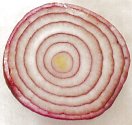
And here's a red onion cut in half cross-wise, with the red tunic of each layer plainly visible:

(Photo from Tom's Domain's recipe for tomato shrimp soup)

And finally, here are a few interesting tidbits I learned about onions while looking for the answers to my questions:

  • Onions have been around for at least 4,000 years. It is believed that the workers who built the pyramids were fed radishes and onions.
  • The Egyptians believed that the strong scent of onions was capable of reviving the dead, specifically by restoring the dead person's breath. King Ramses IV's mummy was found with small onions in his eye socket.
  • In the Middle Ages, people treasured onions so, they often paid their rent in onions or gave onions to each other as gifts.
  • Onions are still very popular throughout the world, but in no other country are they as tremendously popular as in Libya, whose citizens eat 66.8 pounds of onions per year.
  • Here's what happens when you cut an onion and why tears form in your eyes:
    • Cells containing enzymes and acids are broken open.
    • The enzymes break down the acids, and when the acids hit the air, they turn into a gas.
    • When the gas reaches the moisture in your eyes, the gas turns into sulfuric acid. This is a pretty nasty acid; it is behind the smell of rotting eggs, for example.
    • The acid stings the nerve endings in your eyes, making them produce tears in order to flush away the irritant.
    • To reduce the stinging effect of onions, you can try a lot of different things, including:
      • Cutting the onion under running tap water (though this may be too slippery to accomplish this safely)
      • Wetting the onion and your hands first so that the gas reacts with the water on the onion and your hands, not the moisture in your eyes
      • Chilling the onion for a while before cutting it, or putting the knife in the freezer for a couple of minutes first. This lowers the temperature so that when you cut open the onion, the enzymes are not as likely to react with the acids.
      • Using a very sharp knife. A sharper knife will rupture fewer cells, and thus release fewer enzymes and acids.
  • If you plug your nose and take a bite of an apple, then take a bite of an onion, I'm willing to bet the two won't taste any different to you. That's due to the magic of your nose (which should rightly be discussed in another entry).
  • After you've taken a bite of onion, to combat the onion smell on your breath or on your hands, rinse with lemon juice and water, or eat an apple, or eat a few sprigs of parsely.
Sources
New Mexico State Molecular Biology Program, Crop Plant Resources, Onion: Allium cepa L.
Food and Agriculture Organization of the United Nations, Ecoport, Allium cepa
Botany.com, Allium
Wikipedia, Onion
Everything2.com, Onion
Chapter 2: Microscopy Laboratory: Exercise 2A, from
Botany: How to prepare an onion cell slide, available through Wikibooks
National Onion Association, Trivia About Onions
You Grow Girl, All About Bulbs, includes a helpful explanation of the differences between bulbs, tubers, rhizomes, and corms, in layperson's terms
For a great article about the different varieties of onions and how to cook them well, read Mike Sodaro, "The Onion's Layers of Flavors," Food Product Design, November 2005