Showing posts with label sports and games - football. Show all posts

Monday, December 8, 2014

Apple #692: How Do Football Players Go to the Bathroom?

OK, let me say right up front: I thought this would be a pretty innocuous question.  I was watching a Packers game last week and for some reason, it occurred to me to wonder, where do they go to the bathroom?  I've never seen any evidence of it, and it's not something anybody talks about so it had never occurred to me to think about before.  I thought they might have Porta-Johns on the sidelines, which the cameras never showed because nobody wants to see that.  Or maybe those professional teams had something fancy that was small and discreet.

But it turns out, the answer is rather disgusting.

They go on the sidelines.  Literally.


The sidelines in the NFL. A.k.a. the team bathroom?
(Photo by Joe Amon, The Denver Post)


Let's put this in perspective.
  • Players arrive at the stadium several hours before kick-off.  For players who are not regular starters, they find out whether or not they're playing by whether or not their uniform is all laid out in front of their locker.  Then their start their pre-game rituals.
  • Some players read the Bible or pray, some listen to music, some get injections that help them play in spite of some compromised muscle or joint, some eat certain things (Brian Urlacher always eats two chocolate chip cookies--only two and exactly two), Jermichael Finley gets a pedicure, John Henderson of Jacksonville has someone slap him in the face hard several times, some players cover all their exposed skin in Vaseline to make themselves more slick and harder to tackle.
  • They all will spend some quality time in the bathroom.  They want to clear out the pipes as much as possible before going on the field, and they do their best to make that happen.  Some players take Pepto-Bismol to aid that effort, others drink Red Bull, and you can imagine other remedies they might use to keep the plumbing from becoming a problem during the game.
  • Then they get their pads on and get dressed.  The jerseys and pants are as skin-tight as possible so there's no loose clothing for anyone to drag and use to pull you down.  Some guys wear their jerseys so tight, they even have some embarrassing moments when they have trouble pulling them on.
  • They also get taped up.  Ankles get taped, knees get taped, muscles get taped with kinesio tape, fingers, hands, wrists get taped.  Gloves go on and oftentimes the gloves are taped on over the wrists.
  • Then a couple hours before kick-off, the players go out on the field.  They're out there warming up, stretching, getting used to the feel of the field.  Some go out and do their warm-ups before getting dressed. They'll go in, get dressed, and come back out again to do some more but lesser impact stretching. 


Pre-game warm-up. Pads & uniform on, ankles taped, gloves on. Everything but the helmet.
(Photo from USF Health)

  • Players also drink water or Gatorade to stay hydrated.  Staying hydrated is really necessary to stave off injuries and to keep muscles from cramping and forcing you to leave the game.
  • Then everybody troops back into the locker room about 30 minutes before kick-off for the coach's last instructions, the inspirational speech, and any last-minute individual or team prayers.
  • Then they go back out on the field for the player introductions, and then the two-minute warning sounds.  For many players, that's when the nerves hit.  
  • As soon as you get nervous, what do you have to do?  You have to go to the bathroom.
  • But what are you going to do?  Your gloves are on, maybe even taped onto your hands.  You've got on the skin-tight clothes that were a royal pain to pull on even with un-gloved hands.  The actual bathroom can be as far as a quarter mile away.  But the game is about to start, and you're bouncing up and down with the jitters so bad, you have got to go.

Players' Solutions

  • Different players address this problem in different ways.  Depends on the player, depends on the circumstances.
  • I should point out that players get the urge not just before kick-off, but at any one of many nervous moments throughout the game.  If he's a defensive player and the offense has been on the field for a while, and he knows he'll have to run out there again in a minute or two, the urge might come upon him then.  If he's a kicker and he knows he'll have to kick a field goal, but first the other team takes a time out, the nerves might kick in then.
  • In fact, a kicker was caught on camera doing what most of the players do to solve the problem -- urinating right there on the sideline while another person or persons holds up a towel beside him to shield his activity from view.


Nick Novak of the San Diego Chargers, caught on camera relieving himself during a game in 2011.
(Photo from Larry Brown Sports)

  • That seems to be the most common solution, to use the sideline as the restroom.  It seems they often choose to do this near the water cart.  Perhaps because the cart provides a relatively large shield that will not amble off as various players standing around the sideline might?  I don't know if that's the reason; I'm only guessing.  But it does seem a bit unsanitary.


St. Louis Rams player, urinating on the sideline during a game against the Packers in 2011.
(Photo from WKQS Sunny FM)

  • Another option that is not as popular but still fairly common is for players to go right in their pants.  Some recommend stuffing a towel into the pants first, then throwing the "sacrificial towel" away afterwards.
  • Other players do not even use a towel. Especially if it's late in the game, and they're already drenched in sweat, they will let the liquids go right in their pants.  They say that because of all the sweat no one can tell the difference, including themselves.
  • A few players will use a receptacle like an empty water bottle.  But apparently, this is not the most common technique.
  • Up to now, I have been talking about the liquid kind of elimination.  But as you no doubt suspect by this point, sometimes old #2 comes knocking on the back door, despite all a player's best efforts in the locker room beforehand.
  • What is a taped up, jerseyed up, keyed up player to do?  
  • Some players who know they have enough time will run all the way to the locker room.  But others simply cannot do that.  They can't take the risk of not being available if they're called upon to play.  Nature's call has to take a back seat to the coach's call.
  • Some players use the "sacrificial towel" in this situation too.  The towel goes in the pants, receives the donation, is used to clean up the aftereffects, and is thrown away.
  • In some cases, players don't have the luxury of time to make a choice.  Sometimes the hits in football are so forceful, the nervous system is temporarily overridden and the rear gates open without your say-so, and your pants become the receiver.
  • What do you and the other players do afterward?  Deal with it and keep playing.   
  • Some quarterbacks have found themselves in the unfortunate position of having to take the snap from a center who has had an accident in his pants.  The quarterback might opt to go to the shotgun, but for Matt Hasselbeck who found himself in just such a situation in a game in Seattle, the crowd noise was so loud, shotgun was not an option.  So he had to get right up close & friendly with that center's soiled trousers and get on with the game.
  • You probably think this is about as disgusting as I do.  I mean, I get that these guys are athletes, so they've seen pretty much every kind of impressive and also ugly thing the body can do.  So they're probably anesthetized to it.  But for some of the players, they are not only not grossed out, they even seem to be a bit proud of their outside-the-bathroom bathroom exploits.  I should re-emphasize that's the case for only some players.
  • Channing Crowder of the Dolphins said he urinated in his pants all the time.  Most often while in the huddle.  But every game.  For six years.  He seemed to be boasting about this. 


Channing Crowder.  Is he happy, or is that just urine in his pants?
(Photo from Dunk360)

  • For another player, there is no question he was boasting of his extra-bathroom pursuits.  Larry Izzo of the New England Patriots apparently "has issues" and spends a lot of his time in the bathroom.  He will drink "like, eight Red Bulls" and take "supplements" to try to deal with the #2 situation.  But during one game his methods, um, backfired, and he had to go.  So he somehow went on the sideline, during the game, and no one noticed.  Coach Bill Belichick heard about this and gave him the game ball.  According to Wes Welker, Izzo "takes ultimate pride in this whole deal. Of all the special teams tackles and Pro Bowls he's made, I guarantee you that game ball is probably a more prized item for him than his Super Bowl rings."


Larry Izzo, proud of his secretive behind-the-scenes skills.
(Photo from Wikipedia)

  • You might also think, as I do, why doesn't somebody get these guys a Porta-John?  Well, somebody did give one to the Kansas City Chiefs.  But what did they do with it?  The coach used it in a passing drill. 
  • Standing about 10 feet away, he told a receiver to get in the john and shut the door.  Then he'd give another coach a sign, and that coach would fling open the door and coach #1 would quick fling the ball at the player and he'd have to catch it.  "It's a good concentration drill, I think, for hands, eyes and getting the ball and getting your hands up quick," he said.
  • Clearly for pro football players, the game trumps everything, including their most pressing bodily functions.
  • Still.  I wish they would get Porta-Johns and use them as intended.  Or maybe at least get those guys a bunch of chamber pots.  They could even put the team logos on them.


(Photo from Wikipedia)


P.S. It's not just in the pros that this happens. Nor is it just in football.


Sources
Ryan Riddle, Bleacher Report, What NFL Pros Do in the Hours Just Before a Game, August 8, 2012
Stephen White, Bleacher Report, A Former NFL Player's Perspective on the Game Day Fans Don't See, September 8, 2012
Anthony L. Gargano, Deadspin, Jeff Garcia Pisses in Hand Towels, and the Art of Breaking Thumbs in the Loose-Ball Pile, October 19, 2010
Larry Brown Sports, Chargers Kicker Nick Novak Takes a Pee on the Sidelines, November 27, 2011
WKQSFM, How Do NFL Football Players Go to the Bathroom on the Field? November 4, 2011
ESPN Page 2, Pee is only a wee bit gross
USA Today, Former Dolphins linebacker says he wet himself during every game, November 21, 2013
Doug Farrar, Yahoo! Sports, Wes Welker: Larry Izzo once got a game ball for pooping on the sideline, May 3, 2012
Associated Press, Chiefs turn to a Porta-Potty to help curb dropped passes, August 12, 2010

Sunday, February 3, 2013

Apple #623: Do Football Players Shave Their Armpits?

As kick-off time for the Superbowl approaches, I know you're all burning with the same question I have: do football players shave their armpits?

I'm not sure when I first realized that I hadn't seen any armpit hair on a professional football field in a long time, but once the thought occurred to me, I started, well, looking for armpit hair, just to see if I could be proven wrong.  When I wasn't focused on the play and when the underside of some football player's armpit was visible, I didn't notice any.

Which led me to wonder: is this a secret, widespread trend in the sport of football?  Do football players shave their armpits without saying a word about it to anyone?

  • Short answer: yes.
  • First, the evidence:


Chris Hovan, Tampa Bay Buccaneers, naked in the pits
(Photo from BearMythology)


Another shot of Chris Hovan
(Photo from BearMythology)


It's hard to be sure, but it looks like Chris Culliver, 49ers, shaves (or waxes)
(from somewhere on ESPN's Uni-Watch page)


Warren Sapp, Tampa Bay Buccaneers (retired), apparently does not, but he appears to be naturally light under there.
(Photo from BearMythology)


You might not believe me, but this is Tom Brady, Patriots, with his wife Gisele.  No armpit hair there.
(Photo from Barstool Sports)


Clay Matthews, Packers, totally bare under there
(Photo from Bodybuilding.com)


  • Now, for all you ding dongs out there who think that armpit-shaving or -waxing somehow necessarily renders effeminate these enormous football players who make their living out of smashing into other people and throwing them to the dirt, they do this because of the sport.
  • Armpits are pretty important if you're a lineman.  Here are some instructions from various football-playing handbooks, specifically for linebackers:
On blitzing: The goal of the bull rush is not to get around the blocker but to drive the blocker back into the quarterback. By forcing the blocker into the quarterback, the linebacker interrupts the quarterback’s throwing motion, possibly forcing the quarterback to throw before he is ready. As the linebacker reaches the blocker, he drives the palms of both hands into the blocker’s armpits  (Thomas Bass, Football Skills & Drills)
Drill to teach linemen how to drive-block linebackers: On Cadence lineman will attack the playside armpit of the linebacker with his helmet and hands and keeping shoulders parallel to line of scrimmage drive the linebacker backwards. (Eric Freund, Run Blocking Drills)
On executing good zone blocking: Block the linebacker by exploding up through his play side armpit, using a good drive block technique. (Zone Blocking Principles, American Football Monthly)
On how to deliver a reach-rip block: Contact will occur on the second step. On the second step, we allow our covered lineman to use a crossover step to the call side. With the crossover step we have the lineman rip his inside arm through the call side armpit of the defender. We want our covered lineman to lean on the defender after he rips through the armpit and force his stomach up field. We do this to help the uncovered lineman. He will now try to escape for the linebacker. (Doug Schleeman, Zone Blocking)
On delivering rather than taking hits: Drive up through the tackle, putting your chest on the opponent's chest. Your hips should explode forward as you arch your back and lift the opponent off his feet. Shoot your hands through the armpits of your target, squeezing your elbows and pinkie fingers together behind the ball carrier and grabbing the back of his jersey. This arm action prevents the runner from spinning out of your tackle. (How to Take a Hit as a Linebacker in Football)
  • I could quote more, but you get the point:  armpits are an important point of contact for linemen and linebackers--or for anyone blocking or being blocked. 
  • If you've got hair under there, that gives your opponent a really easy (and painful) handle to grab onto, allowing him to become the master of you. 
  • On the other hand, if your armpit is smooth as silk, maybe your opponent's hand or arm will simply slip right off, and then you've got the advantage.
  • This is becoming more of an issue as more players are using modified jerseys.  Over time, the sleeves have gotten shorter and shorter, players have started tucking the excess fabric under their pads, and most recently, some players' jerseys have been made with much wider armpits and hardly any sleeve at all.  Example:


Osi Umeniyiora, NY Giants, wearing one of the cut-away jerseys as he's about to sack Jay Cutler, Bears. Can't tell, but I bet Osi shaves, too.
(AP Photo from ESPN)

  • The reason players are wearing the armpit-exposing jerseys is because sleeves mean more fabric for the opponent to grab onto and use it to sling you to the ground.  Less fabric means there's less for the opponent to grab onto.  It also gives you a freer range of motion.
  • So, as more players are exposing more of their armpits, they're also apparently discovering that not only is the sleeve a handle, but so is the hair. So they're getting rid of that, too.
  • In fact, a lot of running backs shave their entire arms because
    • clean-shaven arms makes it harder for the opponent to get a good grip
    • when they have to tape themselves up, the tape sticks better


Tim Tebow (gag, cough, hack, gag) clearly does not shave.  I rest my case.
(GQ photo from The Berry)


Sources
Thomas Bass, Football Skills & Drills, at Human Kinetics
Eric Freund, Run Blocking Drills
Zone Blocking Principles, American Football Monthly, May 2005
Doug Schleeman, Zone Blocking
Jake Landry, How to Take a Hit As a Linebacker in Football, Livestrong.com, April 29, 2012
Paul Lukas, Simply stated, these jerseys are the pits, ESPN Page 2, October 21, 2010

Sunday, November 13, 2011

Apple #558: Aerial Cable Cameras

This topic seems like bad timing, given the recent news about the Sandusky/Penn State nightmare. But I was asked to find out about how skycams work before that whole story broke, and in spite of my horror and disgust at that news, I discovered over the weekend that I do still like to watch football. Probably many of you out there do too. So I'm going ahead with this.

Specifically, longtime Daily Apple reader Demarcus wanted to know, how does the camera that flies over the football field work? He said at the last football game he attended, he'd noticed wires coming from each of the four corners of the stadium, and that the camera hung from the nexus of those four wires. Beyond that, he couldn't really figure out how it works.


The Skycam travels along cables over a football field to provide aerial images of the game in action.
(Photo from Wired)


This video below shows examples of the kinds of shots that are possible with these aerial cameras. In this gane, the camera used is called a SpiderCam.


  • These aerial cameras are typically referred to by the brand name Skycam, but there are lots of brands and manufacturers who make aerial cameras. Another common one is Cablecam.
  • [side note: Skycams are not to be confused with SkyCams which are stationary cameras mounted on tall buildings and other various key locations around the country and which are used to photograph weather events.]
  • Whether it's a Skycam or a Cablecam or some other aerial cam, they're set up in essentially the same way, with three major components.
  • Component 1. The wires or cables. The cables are made of very sturdy braided Kevlar. There are four of them, as Demarcus correctly noticed, and the camera hangs where the four reels intersect. The cables extend to each corner of the stadium, runs through a pulley and down to a reel and winch. Because of the cables, the camera systems are sometimes called cable cameras.
  • Component 2. The camera itself and the on-board motor and controls. The most recent version of hte Skycam uses a Panasonic AK-HC900 2/3" IT CCD camera, which is an HD camera that, in 2004, cost around $35,000.
  • Above the camera is a box that includes motors that allow the camera to pan and tilt, various electronics, and Steadicam stabilization sensors. A fiber optic cable carries the signal from the camera up to the central control (component 3). The camera and the black box together are sometimes known as the mobile spar.
  • The mobile spar is three feet tall and weighs somewhere between 25 and 45 pounds. It can whiz along the cables at speeds up to 40 mph.


A Skycam, as of 2006. Inventor Garrett Brown was awarded an Oscar for making this.
(Photo from GizmoWatch)


On the Cablecam, the box with the motor in it is flatter and more rectangular than the Skycam. This Cablecam also has a microphone attached to the bottom of the camera.
(Photo from Sports Video Group)


  • Component 3. The rest of the system is up in the booth, or somewhere remote from the camera. This is the computer which tells the camera what to do, and may be referred to as central control. Most of this system runs on Linux, or a version of it (specifics about the operating system have continued to change as the technology improves, but this is still generally true).
  • Two people control the system. One person operates a computer which directs the camera itself, adjusting the lens, its tilt and focus. Another person, the pilot, directs the reels to tighten or loosen the cables as necessary, thus moving the camera system over the field. The pilot watches a rendering of what the camera is doing on a computer screen and directs the reels using a mouse.
  • Initially, the system was controlled using a joystick.
  • [side note two: I find the use of the joystick pretty interesting, since the idea to use the above-the-field-camera in football came from video games. One guy who pilots the camera for his job says, "it's tricky. . . . It's like a video game."]
  • [side note three: the superimposed on-screen yellow first down stripe is another idea that came from video games. I agree with my dad, that this is one of the best improvements to television coverage of football games maybe ever.]


I really wanted to find a diagram of the black box where the camera motor is housed so I could see how those innards work. The best I could find was this schematic from Cablecam, which describes lots of pieces of the system, but in a fairly general way. It's hard to see much of the detail at this size, but you can see it better at this larger size, which especially helps in reading about how the winches and reels work.
(Diagram from Cablecam, hosted at Free Image Hosting)


A reel and winch controlling the cables in a Skycam system.
(Photo from Digital Producer Magazine)


  • The systems have multiple built-in back-up plans so that if a reel does snap, another one is there to catch the camera or a program is in place to move the camera out of the way.
  • But on at least one occasion that I know of, the Skycam actually did malfunction and drop to the field. This happened during a Saints-Seahawks game in 2007. Play was stopped and the network looped a whole bunch of commercials until someone got the camera fixed.


Skycam way too close to the field in this football game in 2007.
(Photo from Awful Announcing)


  • The whole system is constructed so that neither the spar nor the reels should interfere with play. But the aerial camera does sometimes make its appearance in shots of the field taken by other cameras, which some viewers find annoying.
  • It also happens sometimes that players will look up at the aerial camera and smile and wave or otherwise play up to it.
  • The guy who invented Cablecam and who was often on the field before the game helping with set-up, said that during warm-up, kickers often try to kick the ball so that it will hit the camera.
  • That was in 2005, and I don't know if anyone's succeeded in hitting the camera yet. I hope someone does, as that would be an achievement with major bragging rights.
  • As of 2005, it cost about $40,000 to $50,000 to use an aerial camera per game. Costs may have come down a bit since then, but man. That's a lot of money for one camera in one game.
  • The aerial cable camera was invented in the 1980s, but its uses were limited due to limitations in the computer software. In the 1990s, it was used more often and in more applications. In the SuperBowl in January 2001, it entered the world of football as EyeVision. The aerial cable camera's fortunes have only gone up from there.
  • Its use has spread to other sports and other venues. It's now been used in tennis, hockey, boxing, soccer, Major League Baseball, the Olympics, X-games, ice skating, swimming, bowling, even the Running of the Bulls in Pamplona. Lots of film crews have also used aerial cable cameras to help them get a specific shot, in movies, TV shows, and commercials. It's even been used at the Academy Awards.
  • Today, Cablecams and Skycams are used in about 200 events each year.


Photographer Emanuel Schwermer using a cable cam to film a car for a commercial.
(Photo from Emanuel Maximilian Schwermer's site)


More resources:

Two-page spread detailing all the types of cameras used in a professional football game.

Photo showing how the cables are attached to the roof of a stadium.

How the yellow, superimposed first-down line is done.


Sources
Henry Fountain, "A Chance to Peek Over the Quarterback's Shoulder,"
The New York Times, January 6, 2005
Eric Gwinn, "Working the angles,"
Chicago Tribune, November 11, 2004
Monday Night Football: Behind the Scenes, Digital Producer Magazine, December 3, 2004
Michael Hiestand, "Suspension sends Irvin Message," USA Today, December 1, 2005
Greg Wyshynski, "Chatting with NBC Sports Executive Producer Sam Flood about Winter Classic," Yahoo! Sports, December 21, 2010
Cablecam, What We Do
Skycam, skycam in action

Monday, November 29, 2010

Apple #495: How Much Football?

I watched a ton of football over the long Thanksgiving weekend. I think I watched 6 games in 3 days. Which leads me to wonder, just how many football games are there in a season? I'm not going to count pre-season or exhibition games.


How much of this could you watch? In one sitting?


(Photo from Sports Newscaster)

  • In the NFL, 32 teams play each other in one game per week in a 17-week period, with one week off. So that's effectively 16 games in 16 weeks, or 256 games in the regular season.
  • The post-season playoffs and the Superbowl add 11 more games, so that brings the pro football tally up to 267.
  • In college, I'm only going to count the Division I games. Those are the ones most likely to be televised, though some teams in, say, the Mid-American conference rarely if ever have their games televised. But I'll count all the Division I teams.
  • There are 12 conferences in NCAA Division I football. The conferences have varying numbers of teams and they each play some out-of-conference teams as well as some in-conference teams which makes the math a little trickier. They do all play 12 games in the regular season.
  • I'll spare you some of the math details and tell you that it all adds up to 1,440 NCAA Division I football games in the regular season.
  • This year, there are also 35 bowl games. Adding those give us a total of 1,475 college games in 2010.
  • So in theory, if you could watch every college and pro football game on television this year, you would watch 1,742 games.
  • Assuming they last an average of three hours each, that's over 5,000 hours of football or just over 217 straight days of football. 
  • That's about 7 months, give or take.
 
If you had this many televisions and they all showed football games, you could watch the entire season's worth of games in maybe 2 or 3 months.
(Photo from Audio Advice)

        • the R+L Carriers New Orleans Bowl, which is between a Conference USA team and a Sun Belt team, and provides a $325,000 per-team payout
          • there is also the Beef 'O' Brady's St. Petersburg Bowl (huh?) between a Big East team and a Conference USA team. That one pays $1 million to each participating team.

      Don't forget the San Diego County Credit Union Poinsettia Bowl. I'm sure the players love to say they played in that one.
      (Logo from NCAA Football)

        • Some of the bowl games that involve better-known teams have more recognizable names and higher payouts, such as:
            • the Hyundai Sun Bowl between the ACC (Atlantic conference) and the Pac10 pays $1.9 million
            • the Outback Bowl between the Big Ten and the SEC (Southeastern conference) pays $3.1 million
            • the Chick-fil-A Bowl between the ACC and the SEC pays $5.83 million (that's a strange amount there)

        Nothing says football like a chicken sandwich.
        (Logo from SportsSystems)

          • When you get to the really big-name bowls, then you start getting into the big money:
              • the Rose Bowl, the Orange Bowl, and the Sugar bowl each pay $17 million.
              • The BCS National Championships Bowl also pays $17 million, to each team.
          • For sure it is more prestigious to say, "We played in the Rose Bowl," than it is to say, "We played in the Chick-fil-A Bowl" or "We won the Little Caesars Pizza Bowl" (yes, that one is for real; it's between the Big Ten and the MAC). But with that prestige comes money. The more prestige, the bigger the chunk of money. Which goes to the school, of course.


          I've been to this game, in person and everything. The year I went, my team won. That probably won't happen again, though, for quite a few years yet.
          (Photo from VernonCroy)


          Sources
          NFL.com, Regular Season schedules, Post Season 2009 schedule
          NCAA Football, Division I FBS Schedules, 2010-11 Bowl Schedule

          Monday, October 4, 2010

          Apple #485: Football Penalties

          Watching football on TV the other day with a friend and regular Apple reader, when a team got called for being offsides he wondered, what's the difference between offsides and false start?  I realized I didn't know the answer.  There are other penalties, too, he went on, which seem awfully similar, like encroachment and illegal motion. What's the difference between all of those, or are they only different words for the same thing?

          All questions for the Apple Lady to investigate, to be sure.

          Turns out, it's not just a matter of a ref preferring one word for the same penalty over another, they are distinct penalties.


          This is Doug Rosenbaum, a current NFL ref who started his officiating career at high school games
          (Photo from Illinois Wesleyan University Magazine)


          I should say, I looked this up for NFL rules only. NCAA (college) rules might be different, as might high school rules.

          All these penalties are related to what you can and can't do before the ball is snapped. The rules vary depending on whether you're on offense -- the players with the ball -- or defense.

          Sunday, December 7, 2008

          Apple #356: The Football's Shape

          Today I went with a friend to the Pro Football Hall of Fame.


          The entrance to the Pro Football Hall of Fame. And yes, that's a football-shaped dome on top. It looks really cool on the inside. I'd like one just like it in my living room.
          (Photo from Destination 360)


          I was expecting that much of what I'd see would be enjoyable only to football fanatics, the sort of people who could debate at length which team would win: the 1972 Miami Dolphins, the 1976 Pittsburgh Steelers, or the 1986 Chicago Bears; or perhaps who was the be defensive player, Dick Butkus or Carl Eller. Not so. In fact, the only reason I can provide you with these details is because I learned about these teams and players from having been to the Pro Football Hall of Fame.

          They did an excellent job of describing individual players and their achievements, the history of teams extinct and extant, key games in the history of football, and spectacular or even boneheaded plays. There were jerseys that had been worn by players from the past and present, there were shoes, there was even the cast of a barefoot placekicker's foot. I learned a great deal -- something your Apple Lady always enjoys -- and I had a good time. I recommend making the trip.


          This is the Hall of Fame room, sort of the centerpiece of the whole museum. The bronze busts were actually kind of cool to look at, to see who I recognized, and whether I thought they looked lifelike or not. There's also a multimedia system that goes along with this where you can look up individual players or teams or positions and see who's got a bust on the wall and learn more about them. For example, here's the list of Hall of Famers by college. See other lists by mousing over HALL OF FAMERS at the left of the top banner.
          (Photo from the Pro Football Hall of Fame)


          One thing I was hoping to learn which they did not discuss, however, was why the football is shaped the way it is. I guessed that the football got its shape from the ball used in rugby, but I wanted to find out for certain.

          • The short answer is, I was right. The ball used in American football is based on the ball that was used in rugby.
          • The earliest football games -- I should probably call them precursors to football as we know it today -- were played at Ivy League colleges in the 1860s and 1870s. The sport they played was mostly based on rugby's rules, but it was also a unique brand of American rugged play that allowed for "roundhouses and uppercuts" before and after the ball was snapped.
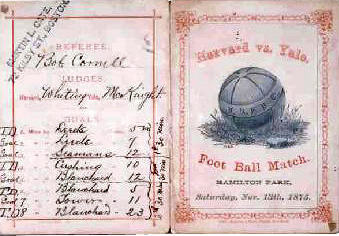
          • Harvard's three-game match against Yale in 1875 is generally considered the first American football game. Most of the rules were still rugby-like, though.
           
           
          Program from the Harvard-Yale football games in 1875. That ball sure looks round.
          (Image from Snipview)


          • It wasn't until 1880 when Walter Camp from Yale proposed that there ought to be a line of scrimmage where the ball would be placed when it was last downed, and that the ball must be advanced 5 yards in 3 plays or else the team with possession had to give it over to the other team. That's really when football as we know it was born.
          • It's important to know that our football is a descendant of rugby because that means that the first footballs were actually rugby balls.
          • So the question then becomes, why were rugby balls shaped like that? Answer: they were actually pig bladders.
          • That's right, rugby balls were made by inflating the bladders of freshly dead pigs. The shape of the ball was determined by the size and shape of the pig's bladder.


          A rugby ball from the 1880s or 1890s. When this was sold as an antique, it was described as being "melon-shaped." The description says it was quite small, and rugby balls from that time tended to be small and to vary in shape because they depended on the size of the pig's bladder inside. Which would suggest that this one does have a pig's bladder inside.
          (Photo from the Busacca Gallery)


          • Two enterprising boot and shoemakers who had shops near the Rugby school hand-stitched the rugby balls from pigs' bladders. The bladders were sometimes inflated by use of a clay pipe and sometimes directly by the mouth. Ew.
          • The pig's bladders were inserted into a leather case, which was then tightened closed around the bladder with laces.
          • By the 1860s, rugby-ball-makers were using leather instead of pig bladders for the rugby ball's innards.
          • Over the years, the rugby ball became more oval in shape because that made it easier to carry. It also went through lots of changes in the materials used so that today, a rugby ball is made mostly of synthetic materials -- plastic, polyurethane, polyester, latex, and glue.
          • The American football came on the scene after the rugby balls were made of leather, but still in basically the pig-bladder shape. They, too, had a leather bladder that was inflated inside a leather casing that was then tightened using laces.
           

          Football from the 1890s. It's not quite as rounded as the early rugby ball, but it's not as oval as footballs are today.
          (Photo from The 1890s Weekend at Mansfield (PA) University)


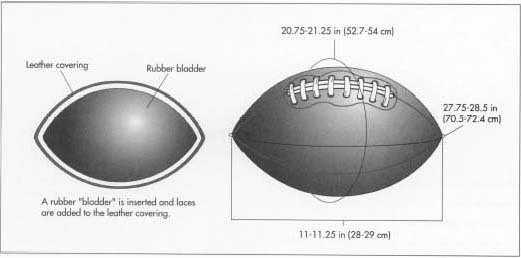
          • Today, the American football is still made in essentially the same way, with a bladder on the inside that is inflated within an outer casing.
           

          The basics of a football's construction today.
          (Diagram from How Products Are Made)


          • And, by the way, that's why people refer to a football as "the pigskin," even though it is not and never was made from pig skin. Because the rugby ball used to be.
          • The particular shape of a football is referred to as a prolate spheroid. That means the ball is round-ish, or based on the concept of round, but with a polar diameter longer than its equatorial diameter (taller than it is wide).
          • Except the football is even an exception to this, because with a true prolate spheroid, the longer ends would be rounded. But a football has pointy ends.
          • Here's one last fact about the football: with most balls that are round, one can predict relatively easily where they will bounce. With a football, however, the only time a football will bounce straight back up vertically is if it lands exactly on one of its points. But because of its odd shape, the rotation of the football can change dramatically after it has bounced -- even if it has landed exactly on one of its pointy ends -- so it is very difficult to predict where it is going to go once it has hit the ground.
          • More often than not, one physicist has stated, a football will bounce away from the person who has dropped it.
          • Which is how you get this kind of thing (41 seconds into this):


          For more about the physics of football, The Physics of Football: Discover the Science of Bone-Crunching Hits, Soaring Field Goals, and Awe-Inspiring Passes, by football fan and physicist Timothy Gay.


          Sources
          Pro Football Hall of Fame
          Bruce K. Stewart, American Football, November 1995
          How Products Are Made, Volume 3, The Football
          Anthony Mann, The Rugby Ball, Manchester Guardian, November 1998
          Sean Fagan, RL 1908, Rugby Balls
          RugbyFootballHistory.com, The Ball
          Mary Bellis, History of Football, About.com: Inventors
          Pete Grathoff, "The Football,"
          The Kansas City Star, September 1, 2008

          Saturday, January 5, 2008

          Apple #291: Daily Apples in the News

          Yesterday, I heard on NPR that the FBI had recently re-opened the cold case of D. B. Cooper, who hijacked an airplane in 1971 and got away without getting caught.

          Immediately, my ears perked up, because I had done a Daily Apple about D. B. Cooper a while back.

          For those of you who may not remember every single Daily Apple in as much detail as I do, you can check out the old entry, of course. But in sum, he was a guy in his 40s or so who, the night before Thanksgiving in 1971, took control of a Northwest Airlines plane on its way to Seattle, and demanded $200,000 or else he'd blow up the plane. The plane landed in Seattle, they gave him the money and some parachutes he'd also asked for, he let the passengers go, and then made the crew fly him to Mexico City. En route, he jumped out of the plane into a rainstorm. Nobody ever found him.


          FBI and police sketches of D. B. Cooper. Except now, he'd look much older.
          (Image from the FBI)


          Many speculated that he died during the jump, but some people think he survived. He's kind of turned into a legendary figure. Now, though, the FBI has re-opened the case. They say he's no legend, just a mediocre guy in his 40s who couldn't think of any other way to take care of his family. But apparently, they also think he survived and that he has eluded them to this date.

          [Edit: More recent news stories say the FBI are following up on a "credible" and "pretty interesting lead," but they won't give more details than that. 8/1/2011]

          Original Daily Apple story about D.B. Cooper (scroll down)
          NPR story with more details
          FBI's official web page asking for help in solving the case


          Having heard this news story, I wondered how many other Daily Apple topics have been in the news recently. So I thought I'd check in on a couple.


          DAVID LEE ROTH

          The first one that comes to mind is the fact that David Lee Roth is now, despite all Eddie Van Halen's assertions for years and years and years, touring again with Van Halen.

          Faithful Daily Apple readers may recall that the original Daily Apple on David Lee Roth was prompted by the desire to answer one of my brother's favorite eternal questions: What do you think David Lee Roth is doing right now?

          Well, now we know what David Lee Roth is doing with most of his time these days.


          L to R: Alex, DLR who can't believe his luck, Eddie, & Wolfie (who looks a lot like his mom, Valerie)
          (promo photo sourced from My San Antonio Blogs)


          The band now includes Wolfgang Van Halen, Eddie's son, who is playing bass instead of Michael Anthony. Eddie's on guitar, and Alex is on drums, and DLR is on vocals, of course. The tour started in December, and is scheduled to last until early April.

          I picked one of the places they're playing at random -- New Orleans on February 8 -- and asked Ticketmaster to give me a best available ticket.

          They offered me a seat in row 20 of a a lower-level section next to the stage, but at the very left corner of it. Apparently all the floor tickets are sold out at this venue. Price: $147.50 plus $15.50 in fees, or $163. For one person.

          Cheapest available was $47.50 plus all fees for a total of $60.85. This is for an upper level seat in row 8, which isn't completely nosebleed, but it's close.

          True-blue David Lee Roth fans (headquartered in Hell, Michigan) are loving the tour. Van Halen fans, however, have given the shows mixed reviews. Many people said that Diamond Dave missed lyrics, sang the same verse over and over, or otherwise screwed up. But others said the show rocked and they loved it.

          First official announcement that the reunion tour would actually happen
          Van Halen's official website
          Original Daily Apple about David Lee Roth
          David Lee Roth sighted on The Sopranos (scroll down)


          TUNA TARTARE

          Kate Walsh, a star on the TV series "Grey's Anatomy," recently got engaged to her boyfriend Alex Young. He proposed to her in a restaurant in San Francisco. Knowing how much she likes butterflies, he asked the chefs to form a tuna tartare in the shape of a butterfly. After it was served, he asked her to marry him.


          Tuna tartare: an aphrodisiac for Kate Walsh?
          (Photo from The Incredible Shrinking Whimsical)


          While Walsh was quoted as saying she likes butterflies, the article didn't mention whether she likes to eat tuna tartare, regardless of its shape.

          News of Kate Walsh's engagement
          Original Daily Apple on tuna tartare


          BRETT FAVRE

          Brett Favre, seemingly eternal quarterback of the Green Bay Packers, has been in the news a lot this fall. Most recently, sportswriters for the Associated Press newswires voted on the NFL's Most Valuable Player. Tom Brady, quarterback for this year's undefeated and seemingly iron-clad New England Patriots, got every single vote for MVP except one. And that vote went to Brett Favre.

          In December, he passed Dan Marino's record for most total passing yards in a career. Referees stopped the play once he'd completed the pass so they could give him the game ball. Right after the whistle blew, Favre asked what happened, had been a penalty?


          (Photo from Greta Van Sustern's page)


          His current NFL records:
          • Total passing yards (61,655)
          • Career TD passes (442)
          • Pass attempts (8,758)
          • Pass completions (5,377)
          • Wins as a starting quarterback (160 as of 12/16/07)
          • Consecutive starts as a quarterback (251 as of 12/16/07)

          News about the MVP voting results

          Favre breaks Marino's record
          Favre's current and career stats
          Original Daily Apple about Brett Favre
          (I just realized that was my 4th ever post and Favre's jersey number is 4. I don't think I did that on purpose. But I might have.)


          LOCH NESS MONSTER

          The Loch Ness Monster, who also seems to be eternally popular as well as immortal, is in the news again. This time it's because of a movie mainly for children called "The Water Horse: Legend of the Deep." The movie draws on the legend of the Loch Ness Monster, except, instead of discovering the monster alive and well in the lake, the boy protagonist finds an egg which hatches and grows into a water creature very like the Loch Ness Monster, whom he calls Crusoe.


          Alex Etel, the 13 year-old child lead in The Water Horse, apparently hugs a Loch Ness Monster-lookalike. Except that's a computer generated image, and he's actually touching nothing.
          (Photo from the Washington Post)


          Review of The Water Horse
          Original Daily Apple entry on the Loch Ness Monster


          NINTENDO

          Finally, due to the enormous success of its video game system the Wii (pronounced whee), Nintendo has risen from the ashes like a phoenix. Just a few years ago, they were a near-dinosaur in the video game world compared to Sony and Microsoft. Now, Nintendo has the third largest market capitalization of all Japanese companies. In other words, they have sold boatloads of stock and people have bought it like crazy because they love the Wii. So the company is having enormous success right now.


          Somebody boxing on a Wii projected on a big screen -- on a Norwegian Cruise Line ship.
          (Photo from Siliconera)


          Overview of Nintendo's current success
          Original Daily Apple entry about Nintendo


          There's no real rhyme or reason to how I picked these entries, or why I put them in the order that I did. I just picked a few topics, checked the news, and reported on what I found.

          But the point is, even though your Apple Lady isn't always hip to the most current events all the time, your Daily Apple can still keep you in the know about the very latest.

          When somebody brings up Tom Brady's MVP award, for example, you could maybe come back with some of Brett Favre's stats. Or when somebody says they saw "The Water Horse," you could say you saw the surgeon's photo and it's all bunk.

          Or when you see some old guy carrying a briefcase with tattered twenty-dollar bills sticking out of it, you can say, "Hey, that's D. B. Cooper, and I recognize him because I read the Daily Apple!"

          Or something like that.

          Monday, November 26, 2007

          Apple #283: Heisman Trophy

          So while I was home for Thanksgiving, I watched a lot of football with my dad. Professional, college, and high school. And they were each good games, actually.

          At one point during the football-fest, my dad and I started talking about the Heisman Trophy. That must have been during the Missouri-Kansas game because the Missouri quarterback, Chase Daniel, is considered a top contender for the trophy this year.

          Anyway, my dad said that usually offensive players win the Heisman because they get more air time. He said any football player could win, and that a few defensive players have won, but it usually goes to someone on offense.

          I filed away that little remark as a possible Daily Apple topic. Now here we are with my question: have any defensive players won the Heisman?

          Answer: yes. A few.

          Oh, yeah. First I suppose I should say what the Heisman trophy is.


          You'll notice, by the way, that the figure in the trophy is carrying the ball, stiff-arming an invisible defender. In other words, the trophy itself depicts an offensive player. Though I suppose the figure could have just recovered a fumble or caught an interception . . .
          (Photo from Heisman Trophy)


          The Heisman is a much-coveted award given to the best college football player in each given year. The trophy has been awarded since the 1930s, so it has a lot of history and because only one person wins it, it has a lot of prestige. The winner is decided by secret ballot, and the votes are cast by sports journalists and media people from all around the country, as well as by previous Heisman trophy winners. Additionally, recent voting rules have allowed one fan to cast a ballot. I don't know how they decide who that fan will be.

          Each voter chooses his or her top three candidates in order of preference, with the first choice getting the most points and the third choice getting the least. Currently, about 950 people vote on the Heisman trophy-winner.

          Now, for the defensive football players who've won the trophy.


          LARRY KELLEY, Yale, 1936
          (Image of 1936 trading card from the-game.org)
          • The second player to be awarded the Heisman Trophy.
          • It was actually the first year the award had that name. When he was told he had won, he didn't know what the award was.
          • He was a defensive end who played for Yale.
          • But he also played on offense and caught 15 TD passes, including a crucial one against Yale's arch-rival Princeton.
          • He was drafted by the Detroit Lions, but turned down the offer.
          • He went on to teach and coach football at the high school level.
          • Sadly, he sold his Heisman Trophy in 2000 to help pay his federal income taxes. Six months later, he died of a self-inflicted gunshot wound.


          LEON HART, Notre Dame, 1949
          (Photo from the College Football Hall of Fame)
          • Leon Hart also played on offense sometimes, but he's better known for his defensive performance.
          • In fact, he's considered by some to be the best defensive player ever
          • Voted All-American three of the four years he played
          • Won the AP's Athlete of the Year award in 1949
          • Known as "a savage blocker and tackler"
          • His team, Notre Dame, did not lose a single game his sophomore to senior year
          • He went on to play for the Detroit Lions
          • In 1951, he was the last player to win the All-Pro award for both offensive and defensive positions.


          CHARLES WOODSON, Michigan, 1997
          (Photo from University of Michigan's Bentley Historical Library)
          • Played as cornerback, whose primary job is to cover the quarterback and try to prevent passes
          • The season he won -- his junior year -- he had 8 interceptions.
          • He also played on offense as a pass receiver, and on special teams offense returning punts.
          • That year, he blew away Peyton Manning, Randy Moss, and Ricky Williams in the number of votes he received for the Heisman.
          • Started as a true freshman and was a two-time All-American.
          • He went on to play for the Oakland Raiders the following year, and was named the NFL Defensive Rookie of the Year.

          And that's it. Everybody else is either a running back, quarterback, full back, or wide receiver. But mostly it's running backs who've won.

          While the list of Heisman Trophy winners is like a mini-hall of fame list, here are some especially notable winners:

          • Paul Hornung, Notre Dame, 1956
              • Quarterback
              • NFL Green Bay Packers (halfback)
              • MVP in 1960 and 1961
              • Known also for his abilities to run, pass, block, and tackle. He was also a placekicker.
              • Vince Lombardi: "the most versatile man who ever played the game"
          • Roger Staubach, Navy, 1963
              • Quarterback
              • NFL Dallas Cowboys
              • 1st year in the NFL he was 27
              • MVP of Super Bowl VI
              • Voted into the Pro Hall of Fame the first year he became eligible
          • Archie Griffin, Ohio State, 1974 & 1975
              • Running back
              • 31 games with 100+ yards his senior year
              • Only player ever to win the Heisman twice
              • Woody Hayes: "the greatest football player I've ever coached"
              • NFL Cincinnati Bengals
          • Tony Dorsett, Pittsburgh, 1976
              • Running back
              • Still holds numerous NCAA records including most seasons with 1,000 yards, most yards, most yards rushing, and several others
              • NFL Dallas Cowboys
              • Named Rookie of the Year in 1977 and played in the Super Bowl as a rookie
          • Barry Sanders, Oklahoma State, 1988
              • Running back
              • Averaged 200 yards per game his junior year, the year he won the Heisman
              • NFL Detroit Lions
              • Sanders won Rookie of the Year with the Dallas Cowboys
              • Despite the Lions' abysmal performance, Sanders continued to rack up enormous statistics and to win several accolades for his abilities

          And of course, this list would not be complete without:
          • O.J. Simpson, U of Southern California, 1968
              • Tailback
              • Broke several NCAA records in both 1967 and 1968
              • Won the trophy in the biggest voting landslide in the Heisman's history
              • NFL Buffalo Bills and San Francisco 49ers
              • First running back to pass the 2,000-yard per season mark
              • Sold his Heisman Trophy in 1999 for $230,000 to pay part of the verdict against him in the wrongful death suit won by the families of Nicole Brown Simpson and Ronald Goldman.

          Enough of him. How about this instead:

          Keep your eye on #2. One interception after another, TD receptions, even a pass of his own.
          If you don't want to watch the whole thing (the sound is annoying), check out Woodson's leaping interception at about 3:50.


          Sources
          Heisman.com, Heisman Winners by Year, The Heisman Trophy
          New York Times Obituaries, "Larry Kelley, 85, a Yale End Who Won the Heisman, Dies," June 29, 2000
          College Football Hall of Fame, Leon Hart
          Pro Football Hall of Fame, Paul Hornung, Roger Staubach
          About.com, Football, O.J. Simpson

          Monday, December 6, 2004

          Apple #4: Brett Favre

          BRETT FAVRE
          (quarterback, Green Bay Packers)

          Brett Favre had a bad game today. He threw two interceptions early in the first quarter, and then managed maybe a couple first downs. Usually he puts on his impressive, super-human something and manages to pull his team out of the crapper and into a win. Tonight, though, it didn't happen. He never really got any steam going, and then he sat out the last 11 minutes of the game. I can't remember the last time he went to the bench. The Packers got killed, 47-17.

          To me, Brett Favre is the living proof that if you never give up, you can achieve your goals. I've admired him for several years now because he has continued to press on and perform unbelievably well even under the worst circumstances. Like his father dying suddenly, for example. Or his wife being diagnosed with breast cancer. He grits his teeth and plays with gusto, and he achieves what seems impossible.

          So tonight, seeing him get sacked three times (which is almost unheard of), and then going to the sidelines saddened me personally. Here's to better games, Number Four.

          Here are some of his accomplishments, and the things he's overcome to get there:

          • 30 times he has led his team from fourth-quarter deficits or ties to win the game
          • He is football's only three-time MVP, a recognition he won in consecutive years, from 1995-1997
          • In 2002, held a streak of 117 passes with zero interceptions
          • Threw a touchdown pass in 36 consecutive games (which goes back to 2002), until tonight
          • Played most of 2003 with a broken thumb on his throwing hand
          • Has a 29-0 record at home when the game temperature is 34 degrees or below. Including playoffs in these conditions, he's 36-1.
          • Including playoffs, has started in 208 consecutive games, an NFL record
          • In 2003, he reached 3,000 yards passing for his 12th season, tying John Elway for second place. He is the first NFL player to reach that 3,000 mark for 10 seasons in a row.
          • Injuries he has overcome include: recurring broken ankle, several bone chips and a bone spur removal; back injuries; abdomen and ribs; sprained thumb for most of 1999; broken thumb for most of 2003; tendonitis in his elbow; sprained knee ligament requiring surgery.
          • In college, he survived a major car accident that resulted in such serious internal injuries he had 30 inches of his intestines removed. A month after this surgery, he led his college team to a win.
          • Early in his career, he was a partier. He was hospitalized in 1996 for an addiction to Vicodin. After that hospitalization, he broke his addiction, stopped drinking, got married, and improved his game.
          • He's played with the Packers for 14 seasons and has a lifetime contract. He's 35 years old.

          Sources:

          http://www.packers.com/images/pdf/favre_brett_04bio.pdf

          http://www.packers.com/images/pdf/favre_brett_02bio.pdf

          http://sports.espn.go.com/nfl/columns/story?id=1939488

          www.startribune.com/ images/ss/980_34.html