Showing posts with label food - beans. Show all posts

Sunday, March 1, 2009

Apple #371: Beans -- vanilla

This is the final entry in a series about Beans.

VANILLA BEANS


Vanilla beans growing in Hawaii. They look a little bit like green beans.
(Photo from Huahua Farm)


Vanilla beans, dried and cured. You can get a bundle of 12 from Arizona Vanilla Company for $17.95.


Classified as:

  • Fruit.
  • Orchid.
  • That's right. Vanilla plants aren't members of the Fabaceae with the majority of the beans in this series. Nor are they in the same family as coffee plants. They are members of the Orchidaceae family.
  • There are 150 species of vanilla orchids (27 of which are native to Florida), but only 2 are grown commercially for the vanilla flavor.
  • Vanilla planifolia and Vanilla fragrans both originate from the Gulf of Mexico. If either of these plants are grown in Mexico, they are called Mexican vanilla. If they're grown elsewhere, they're called Bourbon vanilla. There's also Tahitian vanilla, which is a hybrid of planifolia and fragrans, and is grown in -- you guessed it -- Tahiti.
  • One reason that Mexican vanilla gets its own, distinct name is that the same plant's vanilla beans can taste very different depending on the soil it's grown in. Vanilla orchids growing as close as 20 miles from each other can yield different-tasting vanilla. Also, nobody cures their vanilla quite like the Mexicans do. People consider Mexican vanilla to be the best vanilla in the world.


Vanilla planifolia in bloom.
(Photo from Dragon Agro, a wholesaler of unusual plants)


General facts:
  • People now say "plain old vanilla," but it used to be considered a flavor suitable for Aztec royalty, an exotic plant, and an aphrodisiac.
  • The first people known to use vanilla were the Aztecs. Spanish explorers in the 1500s wrote home about how the members of the royal court were flavoring their royal chocolate beverages with something from a black pod -- vanilla.
  • The Spanish came back from their trip with a hot beverage of mixed chocolate and vanilla, which was not only supposed to quench your thirst and warm you up, but it was also believed to be an aphrodisiac.
  • Even though the Spanish were the first Europeans to find out about vanilla, it was the French who started growing the plants. It took them a while to figure out how to grow them, mainly because only a certain type of bee that lives around the Gulf of Mexico will pollinate the orchids.
  • But after a while the French -- it was a Belgian, really -- figured out how to pollinate the plants by hand, and they started getting lots of vanilla beans.

Vanilla orchids grown commercially on a large scale are pollinated by hand -- very gently, like this man is doing.
(Photo from Spice Lines)

  • Not until the vanilla bean is slowly cured -- dried by the sun or over a wood fire -- that the enzymes are released and the fragrance and flavor emerges. So the French brought over some of the Totonaca people, natives from Mexico who were particularly adept with vanilla, to help the French figure out how to cure the beans. The Totonaca gave them some pointers, but they didn't tell them everything. So Mexican vanilla remains the finest in the world.
  • The French started using vanilla for all kinds of stuff -- flavoring their tobacco, making perfume, and, taking another cue from the Totonaca, scenting their homes.
  • When Thomas Jefferson came back to the States after having been an ambassador in France, he was disappointed that there wasn't any vanilla. So he had somebody in France send him a bunch of vanilla. Pretty soon, doctors in the states were prescribing it as a way to "stimulate the sexual propensities."
  • Today, the majority of vanilla is grown in Madagascar and Tahiti.

Vanilla plants growing on posts. They remind me of pole beans.
(Photo from the Vanilla Company)


  • Vanilla is the most labor-intensive crop in the world. The plants take three years before they mature and blossom. The beans have to stay on the vine for 9 months to ripen. Once harvested, they still have to be cured. The curing process can take weeks or even months depending on the method used. After curing, the beans are left to "rest" for another month or two to reach their full flavor.

Workers in Veracruz, Mexico (where the Totonaca are from) laying out vanilla beans on straw mats to be cured in the sun.
(Photo, and much more about the curing process, from Spice Lines)


  • Because the beans require so much time and labor, they can be quite valuable. In Madagascar, where most of the world's vanilla is grown, vanilla rustling is a serious problem. Vanilla growers even stamp their beans with a brand like cattle ranchers do.
  • Today, vanilla is used not just as a flavoring for foods, or a fragrance in perfumes or candles. It's also used in medicines to disguise icky flavors, or to disguise pungent smells in industrial products like paint, rubber tires, and cleaning fluids.
  • However, because of the time and expense involved in producing vanilla, 97% of the vanilla used today is synthetic.
  • To use whole, cured vanilla beans, split the bean lengthwise with a very sharp paring knife. Scrape the tiny black seeds (vanilla caviar) out of the inside of the pod with the edge of your knife and put them directly into your dish.

Scraping the vanilla seeds out of the pod.
(Photo from Food Mayhem, which has a recipe for Vanilla-Chocolate Swirl Cheesecake using an Oreo crust.)


  • The pod has flavor and fragrance too. You can use the pod, as well as the seeds, in making sauces. Even after it's been cooked in a sauce, you can dry the pod and grind it up to put into ice creams or cookies. Or you can put the pod in with your sugar or coffee to provide extra vanilla flavor.
  • If you manage to find uncured vanilla beans and if you keep them for a while, they'll eventually develop a white frost on them. If the white frost gets shiny in the sunlight and makes tiny rainbows, that it's vanilla crystals. Those crystals are highly flavorful bits of vanillin and they'll be mighty tasty. "Like black gold," one grower says of them.
  • If the white stuff doesn't look shiny in the light but stays dull, it's mildew. Throw out the bean.
  • Vanilla extract is made by chopping up vanilla beans and soaking them in ethyl alcohol and water. The FDA says that vanilla extract sold in the US has to be 65% water, 35% alcohol, and 13.35 ounces of vanilla bean must be used per gallon of liquid.
  • Differences in extract come from which beans they use (they'll say Madagascar vanilla, or Mexican vanilla, for example), and whether or not they've used additives. Vanilla is naturally sweet so there's no need to add sugar or anything like that, but some companies do add corn syrup or sugar or caramel coloring.

This vanilla extract from Mexico costs $24.95 for 8 ounces. By comparison, the same size bottle of extract from Madagascar costs $19.95. But the Mexicans are kind of mad at Madagascar for driving down the prices. And everybody says that Madagascar vanilla isn't as good as Mexican vanilla anyway.
(You can buy a bottle of this extract from King Arthur Flour)

  • The good thing about vanilla extract is that it will never go bad. In fact, if you keep it for two years, it will only improve during that time. The flavor stops getting better after that two years, but it'll never deteriorate from there.
  • If you don't want alcohol in your vanilla extract, look for labels that say "natural vanilla." That means the vanilla has been soaked in glycerin or propylene glycol instead of alcohol. Doesn't mean anything about the vanilla itself.
  • Vanilla flavoring or imitation vanilla are both synthetic vanilla. Most synthetic vanilla today is made as a by-product of paper manufacturing.


The bits of bean are visible in this ice cream because it was made with vanilla paste, which is vanilla extract that's also loaded with vanilla seeds.
(Photo and a recipe from NoMU in South Africa)


That's it for the beans! I saved the best for last, didn't I?

Sources
USDA Plants Database, Vanilla Mill.
Karen Hursh Graber, Mexican Hot or Not, Vanilla: A Mexican Native Regains Its Reputation
Orchid Flower HQ, Vanilla Orchid
Boston Vanilla Bean Company, Vanilla Beans: Past and Present

Tha Vanilla Company, How to Choose and Use Vanilla Beans and Sex, Love, and the Vanilla Bean and All about Vanilla Extracts and Flavors
Spice Lines, Veracruz: In the Land of the Vanilla Orchid and Veracruz: The Secret of Vanilla's Aroma
Arizona Vanilla Company, How to Use Vanilla

Saturday, February 28, 2009

Apple #371: Beans -- coffee

This is the ninth entry in a series about Beans.

COFFEE BEANS


The coffee plant, which is an evergreen that prefers a tropical climate with lots of rain. The red things are actually berries. They are ripe when they are red. Typically they hold two seeds, or pips (what we call beans).
(Photo by Hein Biljmakers)


Coffee beans after they've been removed from the berry and dried, but not yet roasted. They look like peanuts, don't they?
(Photo by Maressa on Picasa)


Classified as:
  • Coffee beans are, first of all, legumes. Which makes coffee a fruit.
  • Unlike all the other beans we've been exploring, coffee beans are members of a completely different family -- not Fabaceae. They are dicotyledons like our previous beany friends, but beyond that, their scientific classification diverges.
  • Coffee is part of the Rubiaceae family, which include varieties of trees, shrubs, and herbs.
  • Within Rubiaceae, wild coffee belongs to a genus called Psychotria, while cultivated coffee is in the Coffea genus.
  • Most of the cultivated coffee sold is Coffea arabica, or Arabian coffee. When people throw that term around, they are actually indicating the species of coffee you're about to drink.
  • Coffea robusta is the second most-commonly sold species of coffee.

General facts:
  • While coffee was introduced to the world from the Middle East, the majority of coffee today is grown in Brazil.
  • It takes five years for a coffee plant to yield mature beans. After maturity, one tree will produce five pounds of coffee in one year.
  • Until the 1870s, people used to roast their own coffee, in a pan over a fire.
  • In the roasting methods used now, the beans are roasted to 400 F. At about that temperature, the beans darken, double in size, and crack. As the roasting continues, the beans develop an oil which gathers in pockets throughout the bean. Once the beans have cracked twice, they are cooled immediately in cold air.
  • Researchers are continuing to discover new aromatic compounds in coffee. Currently, they have identified over 800. Some of the most dominant compounds are described as follows:
  1. honey-like, fruity
  2. roasty
  3. catty
  4. earthy
  5. spicy
  6. buttery
  7. vanilla
  8. caramel-like
  9. seasoning-like.
  • Good to know that those flavor researchers make up words the same way the rest of us do. (For more on the aromatic compounds in coffee, see a previous entry about Coffee that I completely forgot about.)
  • The person who invented instant coffee was not named Juan Valdez. In fact, lots of people came up with the idea in various places around the world. One of the inventors was Belgian, living in Guatemala, and his name was George Washington.
  • The country whose citizens drink the most amount of coffee per person is -- surprise! -- Finland.

(Chart sourced from e-Importz.com, 2008)

  • However, because the United States' population is far higher than Finland's, ringing in at a consumption of 400 million cups of coffee per day, the United States is the biggest consumer of coffee in the world.
  • Based on surveys conducted in the United States, most women say that drinking coffee helps them relax. Men say that it helps them get their work done.
  • I don't drink coffee anymore, but if I did, I would say I drank it to help me stay awake and get my work done.


I'm almost done with the beans (pant, pant). Just one more to go.

Sources
Cambridge Advanced Learner's Dictionary, legumes
USDA Plants Database, Classification Down to Family Fabaceae
FAO, Definition and Classification of Commodities, 4. Pulses and Derived Products
NationMaster, Encyclopedia, Pulses
Wikipedia, Fabaceae and pulses
Edhat Santa Barbara, Veggie of the Week - Shell Beans
USDA Plants Database, Name search results for coffee
Brian Martel, A Few Facts about Coffee
Biljmakers, Coffee
Phil Lempert Supermarket Guru, Instant Coffee, April 4, 2008
Coffee Research.org, Coffee Roasting, Coffee Aroma
Cocoa Java, Fun Facts About Coffee
E-Imports, Coffee Statistics, 2008

Apple #371: Beans -- fava

This is the eighth entry in a series about Beans.

FAVA BEANS

Here they are, by request. I'm sorry, fava bean lovers, but there is no way I can talk about fava beans without including this, from Silence of the Lambs:


Fava beans in and out of their pods.
(Photo from Dinner with Julie)


Fava beans with olive oil, Parmesan, salt & pepper
(Photo and recipe from Frumpy Foodie)


Categorized as:
  • Fruit.
  • Pulse (sold commercially in large quantities in dry form)
  • Species name: Vicia faba minor. Part of the Fabaceae family, same as all the other beans we've discussed so far, but it's a type of vetch. Lots of beans are vetches, actually, which actually means that it's a climbing plant. But so are other plants that are used more as forage or ground cover. Alfalfa is a kind of vetch.

General facts:
  • May also be called broad beans, pigeon beans, horse beans, English beans, or Windsor beans. To answer one Daily Apple reader's question, they are not the same as Lima beans. Though they sure do look like Lima beans.
  • I've never had the fava beans myself, but it sounds like their taste is similar to the Lima beans: buttery, nutty, and slightly bitter.
  • Before Europeans discovered the New World and all its Phaeolus vulgaris beans, fava beans were the only beans they ate. Because those were the only ones they knew. Poor old Europeans. No black beans for them!
  • Some people think that the beans in Jack and the Beanstalk were probably fava beans. Which also had magic capabilities besides their usual fava-ness.
  • A very few people can have a severe allergic reaction to fava beans, called favism. I have no idea how you'd know whether you have this before eating fava beans, except that the people who tend to have this allergy are of Mediterranean, African, or Southeast Asian descent. Well, that rules out only about half the world.
  • The fact that some Mediterranean folks can have this allergy is kind of a kicker because during a period of famine, many Sicilians survived on the fava bean.
  • Italians -- and the Greeks -- have been eating fava beans for centuries. The name "fava" was originally "Faba," after a noble Roman family, Fabii.
  • Pythagoras, who had lots of ideas about lots of things besides just geometry, told his followers never to eat fava beans. He thought they contained the souls of the dead.
  • Europeans aren't the only ones who ate fava beans. They've been a part of Chinese meals for thousands of years.
  • In fact, fava beans have been cultivated for so long, there's no longer any wild variant of the plant left.

Fava beans, deep-fried, served in Guatemala.
(Photo from Andy's Hobo Traveler blog)

  • The pod is pretty tough and there is also some greenish white "matter" in there with the beans. Once you've got the beans out,you have to parboil them to get rid of their waxy coating. So if you buy them in the pod, you're in for some work.
  • Chefs say that fava beans are best cooked in butter, oil, or cream. Lots of people seem to like them boiled gently with olive oil and salt, and served with coarse salt and Parmesan on top.
  • They go well with lightly smoked meats, seafood, or veal. Makes sense, eh, Dr. Lecter?

Next bean for your consideration: coffee beans.


Sources
Bonny Wolf, Fava Beans: A Little Spring on Your Plate, NPR Kitchen Window, March 28, 2007
Specialty Produce, Fava Beans
FoodReference.com, Fava Beans
Moira Hodgson, Fava Beans Take Time, but Are Worth It, The New York Times, May 5, 1996
Cambridge Advanced Learner's Dictionary, legumes
USDA Plants Database, Classification Down to Family Fabaceae
FAO, Definition and Classification of Commodities, 4. Pulses and Derived Products
NationMaster, Encyclopedia, Pulses
Wikipedia, Fabaceae and pulses
Edhat Santa Barbara, Veggie of the Week - Shell Beans

Sunday, February 22, 2009

Apple #371: Beans -- green peas

This is the seventh entry in a series about Beans.

GREEN PEAS


Green peas, still in the pod.
(Photo from Ramoverseas)


Classified as:
  • Technically a fruit. But since they're sold fresh, most agricultural organizations classify them as a vegetable.
  • Not a pulse.
  • Species name: Pisum sativum.
  • The garden pea is the same species, but it is sold dry and is considered a pulse.


The pods of snap peas are a little flatter and broader than the green pea.
(Photo from Amazon.com, where you can buy seeds for these guys)


General facts:
  • Only about 5% of peas that are grown are sold fresh. The rest are frozen or canned (boo on canned).
  • If you're buying them fresh, you'll get them in the pod. Sometimes the pods are thick and tough and even though you could eat the pod, it can be pretty fibrous so it's best to shell those peas out of there.
  • With snap peas, the pods are less rounded and tend not to be as fibrous so they'll be easier to eat. These might have that "string" which we encountered on the green bean, and which you'll want to pull off.
  • With snow peas -- same species as snap peas, but different variety -- the pea (seed) is much smaller and the pod is flatter and sweet. Best to eat the whole thing, pod and pea.
  • Like green beans, green peas are also high in vitamin K.
  • I think frozen peas are easiest to work with, and they still turn out tasting moist and bright and cheery. The Barefoot Contessa agrees. She makes her pot pie with frozen peas.

Next bean, by popular demand: fava beans.


Sources
The World's Healthiest Foods, Green peas
NationMaster.com, Encyclopedia, Snap pea and Snow peas
Cambridge Advanced Learner's Dictionary, legumes
USDA Plants Database, Classification Down to Family Fabaceae
FAO, Definition and Classification of Commodities, 4. Pulses and Derived Products
NationMaster, Encyclopedia, Pulses
Wikipedia, Fabaceae and pulses
Edhat Santa Barbara, Veggie of the Week - Shell Beans

Apple #371: Beans -- green beans

This is the sixth entry in a series about Beans.

GREEN BEANS


Green beans (or pole beans) on the vine.
(Photo from Sunset seeds)


Pan-fried green beans with soy sauce and sesame seeds.
(Photo and recipe from Cafe Liz's blog of Kosher recipes)


Categorized as:
  • Technically a fruit. But because they are sold fresh, not dry, most agricultural organizations call them a vegetable.
  • We eat these in the shell. Some say the term for this is "pod bean." Others say it's "shell bean."
  • Not a pulse because they are sold fresh, not dry.
  • Species name: Phaseolus vulgaris. That's right, all those other beans like black beans, kidney beans, navy beans, etc., are Phaseolus vulgaris beans, too. Those are all also pulses. But green beans -- same species -- are not.

General facts:
  • Sometimes also called string beans. Green beans used to have a fibrous, tough thread that ran along the seam of the shell. You could remove it starting at the tip and pulling, and it came away like a string. Hence, "string beans." Now, most green beans now have been bred to have a string that's barely noticeable, if at all.
  • Sometimes also called snap beans. You have to remove the spiky tips, and the easiest way to do that is to snap them off.
  • Also called pole beans. The green bean plant is all viney and it can grow really tall, so people usually have to stake the plants to poles to keep them from falling over. Hence "pole beans."

You can call 'em Pole beans, you can call 'em Green beans, you can call 'em String beans, you can call 'em Snap beans. Just don't call 'em pulses.
(Photo from Jenkins Woodworking blog's Fiberjoy)


  • Sometimes also called runner beans for the way the vines "run" along whatever you lean them against. But there are several other species that are also called runner beans -- scarlet runner beans (Phaseolus coccineus) is a good example. Scarlet runner beans, which are named for the blossoms which are scarlet, are considered a pulse.
  • Some people put wax beans in the same group as green beans. They say the only thing different about wax beans is the color (they're yellow). Yellow beans, however, they say are a completely different bean. Make sense?
  • Green beans are very high in Vitamin K -- 25% of your daily requirement is in one cup of green beans. Vitamin K helps maintain bone density and helps your blood coagulate. For the women, if you have lots of bleeding each month, getting more vitamin K might help reduce that.
  • You can keep green beans in the refrigerator for several days and they'll still be good. But once you can see the seeds through the shell or they start to get nicked or tough, the nutrition has mostly gone out of them and there's not much point.
  • The best way to cook green beans, in my opinion, is to steam them. Get out your steamer basket, boil about a cup of water in the bottom of a saucepan, snip the tips off the beans, put 'em in your steamer basket, put the basket in the saucepan, cover, and steam. When they're done, they'll have turned a bright green, and when you poke 'em with a fork, they should be mostly tender but still with some crispness.
  • Once cooked, they're good topped with any of the usual suspects -- butter, balsamic vinegar, lemon juice, parmesan cheese, salt & pepper, etc.
  • In my opinion, canned green beans should be banned from the face of the earth. No more oversalted vegetable mush!

Next bean for your consideration: green peas.


Sources
FoodReference.com, Beans - Fresh (Edamame and Green Beans)
CliffordAWright.com, Phaseolus vulgaris or the Green Bean
Wise Geek, What are Pole Beans?
The World's Healthiest Foods, Green beans and Green beans in-depth nutrient analysis
NationMaster.com, Encyclopedia, Snap pea and Snow peas
Cambridge Advanced Learner's Dictionary, legumes
USDA Plants Database, Classification Down to Family Fabaceae
FAO, Definition and Classification of Commodities, 4. Pulses and Derived Products
NationMaster, Encyclopedia, Pulses
Wikipedia, Fabaceae and pulses
Edhat Santa Barbara, Veggie of the Week - Shell Beans

Apple #371: Beans -- lentils

This is the fifth entry in a series about Beans.

LENTILS

Leaves and pod of one type of lentil plant, the black beluga
(Photo from Bucky's Barbecue & Bread food photography blog)


One reader doesn't think the above photo is of a lentil plant -- even though it is a particular and unusual kind of lentil, the black beluga lentil, which has been hung on a wire for the purposes of photography -- so here's another photo that is more obviously of a lentil plant:


Harder to see the lentils here, isn't it?
(Photo from Energy Farms Network)


Only three of the different varieties of lentils
(Photo from eHow)


Categorized as:
  • Fruit
  • Pulse
  • Sometimes also called daal
  • Species name: Lens culinaris

General facts:

  • Lentils grow in pods that contain one or two seeds.
  • They are among the first foods to have been cultivated. They're very easy to grow and to this day, they are extremely inexpensive.
  • Lenses are so-named because they are shaped like lentils. In other words, that's how old they are: people knew about lentils long before they knew about lenses.
  • Once upon a time in Ancient Greece, Hippocrates prescribed a dish of lentils and sliced dog to treat liver ailments. I do not recommend the sliced dog.
  • They've been a staple in civilizations around the world for centuries. In Europe, Catholics who couldn't afford fish ate them during Lent, so they got branded as what you eat when there's nothing else.
  • By the way, Lent is not named after lentils, but it seems to be a descendant of the word "long" or "lengthen" because Lent lasts a long time (40 days, to be exact).
  • In the Middle East, India, and Southeast Asia, lentils remain wildly popular. In India, "any self-respecting household" eats lentils in some form at least twice a day.
  • Very popular source of protein for vegetarians.
  • One cup of lentils gives you 90% of your daily requirement of folic acid -- more than any other food. Folate is very important for women who are or will shortly become pregnant because it helps to reduce the risk of birth defects.
  • There are all sorts of varieties of lentils. They range in color from yellow to green to red to black. Green are popular with the Europeans and Americans, while red are more popular with folks in the Middle East.
  • Black lentils are very high in antioxidants.
  • As with most fruits, the smaller varieties are more flavorful, but of course the Americans like 'em big.
  • Dry lentils don't need to be pre-soaked, but they do need to be cleaned, rinsed, and cooked.
  • Get the water boiling first. With lentils, this will help reduce the gas the beans retain. Add the lentils, bring back to a boil, then simmer. Green lentils take about 30 minutes, red ones only 20.
  • They taste better if you add a peeled onion that you've cut into hunks.
  • When they're ready, pour olive oil over the lot, scoop 'em onto buttered toast, add salt, pepper, garlic salt, and maybe some of your favorite cheese, and you've got dinner.

Next bean on the menu: green beans.


Sources
National Lentil Festival, Lentil Facts & Lore
FoodReference.com, Lentils
Healthy Eating, World's Healthiest Foods: Lentils (India)
The World's Healthiest Foods, Lentils
Thoughtful Foods, Lentils
Cambridge Advanced Learner's Dictionary, legumes
USDA Plants Database, Classification Down to Family Fabaceae
FAO, Definition and Classification of Commodities, 4. Pulses and Derived Products
NationMaster, Encyclopedia, Pulses
Wikipedia, Fabaceae and pulses

Apple #371: Beans -- chickpeas

This is the fourth entry in a series about Beans.

CHICKPEAS


The chickpeas are inside those pods, usually two beans per pod.
(Photo from Pithy and Clever)


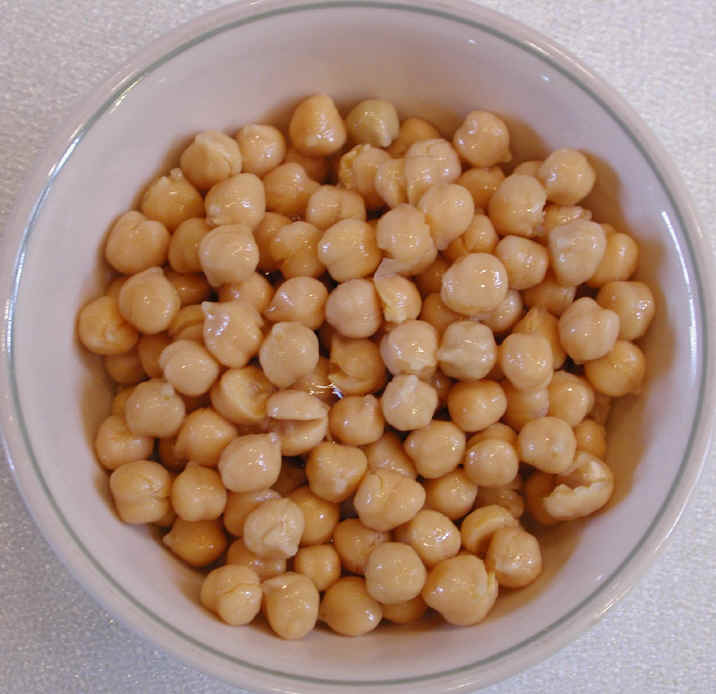
Washed, soaked, in the bowl and ready to eat.
(Photo from All Creatures Vegan - Vegetarian Recipe Book)


I take it back what I said about black beans being my favorite. My true favorite is chickpeas. Garbanzo beans, whatever you want to call them. I LOVE the chickpeas. They have a nutty flavor and they're large enough to feel substantial when biting into them. I just had some about an hour ago, in fact. Sometimes I open a can and eat them by the handful, plain. Often I make a little salad with them. I never measure anything, so the amounts are pure guesswork:
  • 1 can of chick peas
  • 1 or 2 stalks of celery, chopped
  • About a third of cucumber (if I have it), diced
  • Three slices or so of onion, minced
  • A good splash of apple cider vinegar, maybe 2 Tbsp?
  • A bigger splash of extra virgin olive oil, maybe 3 Tbsp?
  • Squirt of lemon juice concentrate, about 4 seconds' worth
  • salt
  • pepper
  • lots of grated Parmesan cheese
Takes about 5 or 10 minutes to make. I eat the whole thing in one sitting. It's crunchy, filling, and the celery and cucumber make it refreshing.

I like the chickpeas so well, this is my second time talking about them. I'll try not to duplicate the stuff I said in my previous entry on garbanzo beans.

Categorized as:
  • Pulse
  • People don't generally refer to them as either fruit or vegetable, but they are a fruit.
  • Species name: Cicer arietinum. They're still part of the Fabaceae family, but they're in a different genera than the black beans, kidney beans, pinto beans, etc.

General facts:

  • "Garbanzo" is Spanish for "chickpea," so the terms are pretty much interchangeable.
  • First cultivated around 3000 BC -- some say as early as 5400 BC -- in the Middle East. Soon became popular in India, Ethiopia, Egypt, Greek, and Rome.
  • If you're especially bothered by the gas that beans will inevitably give you, choose the garbanzo bean. Of all the beans, they tend to give people the least amount of gas.
  • Flour can be made from chickpeas, and it is gluten-free, a necessity for people with celiac disease.
  • There are actually two major varieties of garbanzo beans, Desi and Kabuli. Desi is smaller and darker while Kabuli is larger and lighter in color. Desi has higher nutritional benefits and is typically the kind milled into flour. Kabuli is more widely available in the US. Most canned chickpeas will be the Kabuli variety.
  • To prepare dry garbanzo beans, boil them in water for 2 minutes, take them off the heat, cover and let stand for 2 hours. Or soak them in water for 8 hours overnight.
  • Always skim off the foam and debris that floats to the top, drain, and rinse.
  • Then you'll need to simmer them in water for about 1 to 1 1/2 hours.
  • Canned chickpeas are much quicker and easier to use, and they retain most of their nutritional value.

Next bean: lentils.


Sources
The World's Healthiest Foods, Garbanzo beans (chickpeas)
Nicky Blackburn, Discovering the secret to civilization -- starting chickpea, Israel 21C, January 21, 2007
Wise Geek, What are Chick Peas?
Agriculture and Agri-Food Canada, Canada's Chick Pea Industry
USDA Plants Database, Classification Down to Family Fabaceae
FAO, Definition and Classification of Commodities, 4. Pulses and Derived Products
NationMaster, Encyclopedia, Pulses
Wikipedia, Fabaceae and pulses
Edhat Santa Barbara, Veggie of the Week - Shell Beans

Apple #371: Beans -- lima beans

This is the third entry in a series about Beans.

LIMA BEANS


Lima beans in the shell.
(Photo from Food Subs)


Lima beans being rinsed.
(Photo from Southern University Agricultural Research and Extension Center)


Categorized as:
  • Fruit
  • One of FAO's pulses
  • Species name is Phaseolus lunatus, or the sieva bean. It turns out, "sieva bean" is yet another name for Lima beans. It's not one I have ever heard for Lima beans, but I guess that's what the scientists call their Lima beans.

General facts:

  • I discussed lima beans briefly in a previous entry about Peru. Because Lima beans really are named after Lima (lee-mah), Peru.
  • Lima beans were probably first grown in Brazil or perhaps Guatemala, but Europeans first ate them when they were in Lima. So they called them Lima beans.
  • Sometimes they're called butter beans because of their soft, buttery texture. They are also occasionally called chad beans.
  • Most Lima beans are green or cream colored, but some less common varieties are red, purple, brown, or black.
  • Baby Lima beans are grown in Peru. Fordhook Lima beans, another popular variety, are grown in the US. I prefer the baby Limas because they're usually more tender, and don't toughen when you cook them, which can sometimes happen with the bigger Fordhooks.
  • Lima bean plants do well in humid and tropical climates, so they have become an important crop in African and Asian countries.
  • Lima beans contain a compound which is used to make cyanide. But eating cooked Lima beans won't poison you. Most varieties grown in the US have very low levels of the compound, and commercially-sold Lima beans have all been rinsed first, so they contain even less.
  • It's hard to find fresh Lima beans, but canned (not so great) and frozen (better) Lima beans are widely available.
  • Succotash is Lima beans and corn and sometimes stewed tomatoes. I used to think it had to be more complicated than that for such a fancy word, but that's all it is.
  • Lots of Lima bean recipes are listed here at lovetoknow.

Next bean on the menu: chickpeas.


Sources
The World's Healthiest Foods, Lima beans
FoodReference.com, Lima Bean Trivia
USDA Plants Database, Classification Down to Family Fabaceae
FAO, Definition and Classification of Commodities, 4. Pulses and Derived Products
NationMaster, Encyclopedia, Pulses
Wikipedia, Fabaceae and pulses
Edhat Santa Barbara, Veggie of the Week - Shell Beans

Apple #371: Beans -- pinto beans

This is the second entry in a series about Beans.


PINTO BEANS


Pinto beans, dry
(Photo by Lori Highfill, sourced from Simple Mom, who has a recipe for crock pot pintos)


Pinto beans, soaked and then cooked. For 12 hours in a crock pot with onion, bacon, and chili powder.
(Photo from Paddlin Pigs BBQ, which also gives the recipe)


Categorized as:
  • Fruit. But they are the official vegetable of New Mexico.
  • Also one of the FAO's pulses.
  • Also a member of the Phaseolus vulgaris species.

General facts:

  • When dry, pinto beans are beige with reddish streaks. "Pinto" means "painted" in Spanish.
  • When cooked, they turn pink and the streaks go away.
  • More pinto beans are grown in the US than any other type of bean.
  • The refried beans that come on your plate with your enchiladas or in your Taco Bell burrito are pinto beans.
  • Pinto beans contain more fiber than any other bean -- one cup provides 74% of your daily fiber requirement.
  • One cup also gives you 100% of your daily folate needs. Folate can help in reducing heart disease.
  • They're fairly high in copper, which helps to keep joints and tendons flexible. Copper is also essential for your body to be able to utilize the iron it needs to carry oxygen in the bloodstream.
  • To use dry pinto beans, you have to soak these for 8 hours in the refrigerator so they don't ferment.
  • Or you can boil them for two minutes, take them off the heat, and let them soak for 2 hours.
  • Either way you soak them, be sure to discard that water. It's got some of the bean-gas in it that you don't want to eat and have to expel later.
  • After the pinto beans are softened, they still need to be cooked. Bring them to a boil and then simmer and skim off the foam.
  • Wait until the pinto beans are fully cooked before adding seasonings.

Next up: Lima beans.


Sources
The World's Healthiest Foods, Pinto beans
FoodReference.com, Pinto beans
J&J Distributing, Fresh Facts, Beans - Pinto
USDA Plants Database, Classification Down to Family Fabaceae
FAO, Definition and Classification of Commodities, 4. Pulses and Derived Products
NationMaster, Encyclopedia, Pulses
Wikipedia, Fabaceae and pulses
Edhat Santa Barbara, Veggie of the Week - Shell Beans

Apple #371: Beans -- black beans

This is the first entry in a series of about Beans.

BLACK BEANS

These might be my favorite. I like their flavor, and I like that they hold their shape even after they're heated up. They stay firm and don't get all mushy, so I feel like I'm really eating something when I have black beans. I like to mix them with some salsa and a dash or two of garlic salt and put them on toast with melted cheese on top. Lunch, cheap and easy and filling.


Black beans, dried
(Photo from Delia Online)


Same thing, from a can
(Photo from All Creatures Vegan - Vegetarian Recipe Book)


Categorized as:
  • Fruit.
  • The UN's FAO also classifies it as one of several pulses, which are several varieties of beans that are sold in dry form.
  • Species name Phaseolus vulgaris (common bean).
  • Originated in Peru, along with several other common beans like navy, kidney, pinto, etc.
  • In fact, all the beans that originated in Peru are members of the same species, Phaseolusvulgaris.

General facts:
  • Sometimes also called turtle beans.
  • Flavor similar to mushrooms, but a little smokier.
  • Ounce for ounce, black beans have the same amount of protein as beef.
  • They are as high in antioxidants as super-fruits like cranberries and grapes.
  • If you're going to use dry black beans, it's best if you can soak them for 2-4 hours before boiling. If you skip the soaking and go straight to boiling, they can get soft and mushy.

Next bean in the series: Pinto beans.


Sources
The World's Healthiest Foods, Black beans
Deana Gunn and Wona Miniati, "Black Beans: A Perfect Food," isnare.com
FoodReference.com, Black Beans, Dried
USDA Plants Database, Classification Down to Family Fabaceae
FAO, Definition and Classification of Commodities, 4. Pulses and Derived Products
NationMaster, Encyclopedia, Pulses
Wikipedia, Fabaceae and pulses
Edhat Santa Barbara, Veggie of the Week - Shell Beans

Tuesday, February 17, 2009

Apple #371: Beans

I like beans. Lots of different kinds of them. Lately, I've been noticing how many different kinds of beans there are. There are varieties like green beans and wax beans, and then there are other kinds like black beans and pinto beans. Then there are things that we call "beans," but I don't know whether they are technically considered beans: coffee beans and vanilla beans.

So I thought I'd look up good ol' beans and find out what's a bean and what's not.

It turns out, beans are enormously complicated. For example, most of the time, they're a fruit. But sometimes they're a vegetable. Depending on whom you ask, peas may or may not be a type of bean. Peanuts may or may not be beans, too. And some people categorize vetch, which is a type of ground cover, right along with beans.

One thing I think I can say for certain is that all beans are legumes. Legumes are a type of fruit whose seeds grow in pods.

If all beans are legumes, and legumes are a type of fruit, you would think this would make all beans fruit. Well, that's true most of the time, except for a couple of cases when agricultural officials say they're vegetables anyway.

Here's another area of enormous confusion. Some people call some of the beans "shell beans." They say those beans that have been shelled and whose seeds we eat are called "shell beans." Lima beans are a good example here. The ones we eat still in the shell, or pod, are called "pod beans." Green beans are an example of pod beans.

But some people define "shell" and "pod" beans exactly the opposite of what I've described. Other people group the common beans in with "shell beans," while most seem to omit them.

I think I'm going to omit the terms "shell" and "pod" beans entirely because those terms turn into a bunch of beany mush pretty quickly.

Here are some nutritional facts that are true about most beans:
  • Because they're high in fiber and low in sugar, beans are also very good for people with diabetes.
  • They are high in tryptophan.
  • Tryptophan is not just to make you sleepy on Thanksgiving Day. It helps synthesize serotonin in the brain. By doing that, it improves performance under stress, reduces aggression, and promotes ovulation, and "in many ways works like Prozac," said one researcher from the University of Jerusalem.

As for what makes each bean different, I'll try to cut through the complexity and give you the information that you really want to know. I think the best way to do that is, to paraphrase Annie LaMott, bean by bean.

I originally had the beans I profiled, so to speak, as part of this one single entry, but it got way too long. So I've now broken them up into separate entries. Hopefully that makes all these beans more manageable for you.

Black beans
Pinto beans
Lima beans
Chickpeas
Lentils
Green beans
Green peas

Coming soon:
Fava beans
Coffee beans
Vanilla beans


Sources
USDA Plants Database, Classification Down to Family Fabaceae
FAO, Definition and Classification of Commodities, 4. Pulses and Derived Products
NationMaster, Encyclopedia, Pulses
Wikipedia, Fabaceae and pulses
Edhat Santa Barbara, Veggie of the Week - Shell Beans

Sunday, May 1, 2005

Apple #64: Garbanzo Beans

The other day, I went out to dinner and someone I was with got a salad that had garbanzo beans in it. I haven't had garbanzo beans in quite a while, though I do like them. I was sort of envious of the garbanzo beans, and then I started wondering about them. Why are the also called "chick peas"? How do they grow? Where do they come from?

Growing them

  • "Garbanzo beans" is what the Spanish call "chick peas." I suppose, since Spanish is not my first (or even second) language, I should call them "chick peas," but I like the word "garbanzo" better.
  • Garbanzo beans are a legume, part of the pea family. They may be one of the oldest cultivated beans, known to have been grown as far back as 5400 B.C. Most garbanzo beans are beige, but they may also be red or brown or black.
  • India is the main grower of garbanzo beans, accounting for 60% of world production in 2001. Turkey, Spain, Pakistan, and Algeria have traditionally been big garbanzo bean exporters, but recently Canada and Australia have also entered the picture.
  • According to one person in the UK, you can take any old garbanzo beans you buy from the store and put them in a dish of water until they sprout. You have to change the water each day to keep it fresh. After they've sprouted, you can plant them and they'll grow into bushy plants that look kind of like ferns.
  • They produce flowers, and then pods. Each pod has maybe 2-3 peas in them. Some people pick the pods while they're still green and then dry them; others wait until the pods dry on the vine before picking.

This is what fresh garbanzo beans look like, still in the pods.
(photo from Erin's Kitchen, a blog about eating in NY City)


This is what the beans look like dried.
(photo from Grains Canada)


Eating them
  • One serving of garbanzo beans -- which is one cup, and come to think of it, that's a lot of the little guys -- gives you half of your day's supply of fiber. It also gives you a hefty 29% of the protein you need in a given day, and 26% of iron.
  • I remember hearing, once upon a time, that garbanzo beans have a lot of fat in them. They do have 2% of your daily allotment of saturated fat, but I'm thinking, if it's a choice between garbanzo beans and cheese, for example, the garbanzo beans are probably the better option.
  • Garbanzo beans are the main ingredient in hummus, which is a dip that's really good with warm pita bread, and also of falafel. One website says you can also use garbanzo beans as a substitute for coffee.
  • Falafel are like meatballs, except made of garbanzo beans and fried. If you've never had it before, it may sound weird (I'm imagining the face my mother might make if I described this to her), but they're really tasty, especially if you serve them in a pita roll with yogurt sauce.
Falafel Recipe
  • Ingredients:
    • 8 oz dried chickpeas, or 8 oz. canned
    • 1 onion, finely chopped
    • 1 garlic clove, crushed
    • 1 slice of white bread, soaked in some water
    • 1/4 tsp cayenne
    • 1 tsp coriander, ground
    • 1 tsp cumin, ground
    • 2 tsp parsley, finely chopped
    • salt, to taste
    • oil for frying
  • If chickpeas are dried, soak overnight, then rinse and cook in fresh water for 1 to 1 1/2 hours until tender.
  • Mash, do not blend, chickpeas until pureed.
  • Squeeze water from the soaked bread and add to chickpeas along with all other ingredients, except oil. Knead until well-mixed.
  • Let the mixture rest in the refrigerator for 1 to 2 hours, then roll between the palms to make firm balls about 1 inch in size. It helps if palms are wetted.
  • Put oil in pan until about 1 inch deep, heat to 360 degrees F and fry the balls, a few at a time, until nicely brown all over. Takes about 2-3 minutes per ball.
  • Drain on paper towel.
  • Serve hot with lemon wedges or in pita with lettuce, tomato, and yogurt sauce.
Sources
Growing chickpea in the northern Great Plains, Montana State University Extension Service, 2002
How to grow chickpeas, the Gardener's Cooksite
Walton Feed's page on The Legumes. Lots of really interesting information here about beans in general.
101Cookbooks, March 19, 2005 page. Apparently, this woman is trying out recipes from her 101 cookbooks and posting the recipes she likes best. Some tasty-looking vegetarian dishes on this page.
Nutrition data for chickpeas. This nutrition data site is pretty cool. It gives a ton of information about each food item, including charts that make it easy to see what elements the food gives you a lot of, and also what other foods might be better substitutes. You can also change the serving size and see how the data changes. Really, this site rocks.
Falafel recipe from the epicentre