Having already done an entry about bisques, in which I discussed tomato soups and bisques, it seemed only right to follow it up with an entry about grilled cheese sandwiches. I thought, Since I just did a food entry I'll wait a while on that one, but when three different people mentioned grilled cheese sandwiches to me over the course of two days, it seemed destiny was demanding an entry. Could destiny be hungry for grilled cheese?

Grilled cheese with pickle and fries. Boy, that looks good, doesn't it?
(Photo from Yum Sugar)
- People have been eating bread and cheese together for centuries. Well, duh, that's because the combination is a fantastic one. But putting them together in a sandwich -- not open-faced -- and grilling it, that's a more modern invention.
- A lot of people say, by the way, that the Romans invented grilled cheese sandwiches, but this is not true. Wealthy Romans might sometimes have had cheese with their bread and fruit for breakfast, but they probably wouldn't have made a sandwich of the bread and cheese, and they certainly didn't grill it.
- Still others say that the grilled cheese is a descendant of the French sandwich called the Croque Monsieur, which was invented some time in the 1900s. This is basically a ham and cheese sandwich with bechamel sauce on top.

The Croque Monsieur, a French ham and cheese sandwich whose name literally means "Mister Crunchy." The bechamel sauce on top, by the way, is made of butter, flour, salt, pepper, Parmesan and Gruyere cheese. Extra good.
(Photo and recipe for the sandwich from Simply Recipes)
- I am going to argue, though, that if you're going to say that the Croque Monsieur is the father of grilled cheese, then you had better be prepared to allow any sandwich that has cheese and gets grilled to be an ancestor of grilled cheese. Because by my definition, as soon as you throw meat on that sandwich, it ceases to be a grilled cheese and becomes a Whatever Meat You've Got On There and Cheese Sandwich.
- In fact, the grilled cheese sandwich as we know it came about with the invention of processed cheese, or what we now call Kraft Singles.
- A guy named James L. Kraft started a cheddar wholesaling business in Chicago in 1903. He wanted to keep his cheddar from spoiling as fast and to make sure that the cheddar was consistently good from one batch to the next.
- He tried some different ideas, but then in 1916 he hit on what would be the winner: he shredded "refuse cheddar," re-pasteurized it to sterilize it again, and added sodium phosphate as a preservative. (Sodium phosphate by itself is a pretty potent laxative, by the way.)
- He advertised the heck out of his cheese, promised that it would last longer and would be consistent from one package to the next, and charged more for it (even though it was made from inferior cheese and a laxative), and it was hugely successful.
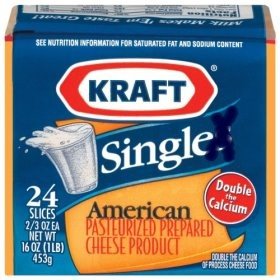
Kraft Singles, the sine qua non of grilled cheese sandwiches. Perhaps it's too small to see, but the packaging says "Pasteurized prepared cheese product."
(Photo from Gravity7)
- Processed cheese might not have been as successful, though, without the influence of two World Wars. It was much easier to ship overseas than regular cheddar, the Navy loved it because it would last longer on ships, and it was generally easier to carry around in ration packs.
- So it was at least some time after the 1920s or 1930s that the grilled cheese sandwich was born. It may have been born on a Navy ship, since World War II Navy cookbooks contain recipes for "American cheese filling sandwiches" which were broiled on board.
- But, ah, sharp reader that you are, you noticed I said broiled, not grilled. Some enterprising Navy cook might have grilled his cheese sandwiches, but we have no record of that. So the grilled cheese may not actually have taken its first breath until some time later.
- After WWII, American school cafeterias served cheese sandwiches using the American cheese. These may or may not have been grilled; my source is not clear on this point. But they weren't quite the grilled cheese as we know it, since they were served open-faced.
- It was during this time, however -- the 1950s, that is -- that the cheese sandwich was first paired with tomato soup. Tomato soup was thought to be a good source of Vitamin C, and therefore a nutritional addition to a sandwich that didn't offer much in the way of vitamins.
- What is certain is that by the 1960s, people had added the top slice of bread and they were grilling the sandwiches. How we got from broiling to grilling, and how that second slice of bread got added, history does not tell us. It may remain forever a culinary mystery.

The original grilled cheese: processed a.k.a. American cheese between two slices of bread, grilled.
(Photo from Food Vixen in NYC's Blog)
- Once born, the love for grilled cheese sandwiches has only grown.
- April is officially National Grilled Cheese Sandwich Month. All during April, various TV shows and restaurants host grilled cheese-making contests, Kraft has a tell-us-why-you-love-grilled-cheese contest, and restaurants all over the country offer more or better or fancier grilled cheeses throughout the month.
- One restaurant in Cincinnati called Lavomatic reportedly makes a different grilled cheese sandwich every day, whether it's April or not. When I checked their menu, the grilled cheese of the day was boursin, mild cheddar, and sharp white cheddar. (Notice: no meat.) They were also serving a tomato bisque.
- Another restaurant called Campanile in Los Angeles serves only grilled cheese sandwiches as their main courses. But their grilled cheeses are fancy -- with marinated onion and whole grain mustard -- and they often include other ingredients like beer-battered soft shell crab, or braised lamb and artichokes, or -- I must confess this one sounds really good -- bacon, avocado, and tomato.
- Yet another restaurant, this one a diner called The Pop Shop in Collingswood, NJ, regularly serves over 30 varieties of grilled cheese sandwiches. They have won awards for their grilled cheese sandwiches, and one day Bobby Flay showed up for a grilled cheese throwdown. Bobby Flay won with his brie, goat cheese, and bacon sandwich. But once again, in my book, as soon as you put meat on it, it's not a grilled cheese anymore, so I don't know how authentic I'd call that victory.

Even this psycho girl loves grilled cheese sandwiches.
(Image from Adland.TV)
- There is also the Grilled Cheese Invitational, held each April in Los Angeles. 250 amateurs and 50 professionals can compete. Contestants can enter one sandwich per category. The categories are Missionary, Kama Sutra, and Honey Pot. Missionary is the standard grilled cheese with no extra ingredients (oh dear, what does this say about me), Kama Sutra can have extra ingredients but the interior must be 60% cheese, and the Honey Pot is like the Kama Sutra except suitable for dessert.
- Winning sandwiches include the "I'd Tell You What's In It (but I'd have to kill you)," "A Dessert so delicious is was not meant for Man Ding Dong," "Foe Cheesy!" and "The DaVinCheese."

They're serious -- mostly -- about grilled cheese sandwiches at the Grilled Cheese Invitational.
(Photo from the Grilled Cheese Invitational)
- There's also a guy in New York's East Village who started a facebook page offering to make a grilled cheese sandwich for anyone who asks for $5 to $7. He grills the sandwiches in a pan, wraps them in foil, then puts them in a 500 degree oven to maximize crispness. He'll then ride his bike to meet customers on a specified nearby street corner and hand off the sandwich in exchange for the cash. It's all conducted as an underground service because he's not an official restaurant with health code inspections or anything. His page is called bread.butter.cheese.
I don't know how much longer I want to do it because I'm living in fear. It would be such a stupid thing to get in trouble for. . . . I kind of want to quit, it's getting too big, but I want to feed these people.
- Perhaps the best indication of the popularity of the grilled cheese sandwich is the visions people have had while eating them.
- The most famous, of course, is the woman who saw the Virgin Mary in her grilled cheese sandwich. She sold the sandwich on eBay to an internet casino called Golden Palace for $28,000. Then she got the sandwich with the likeness of the Virgin Mary tattooed on her breast.

Diana Duyser with her famous grilled cheese sandwich, packaged in the plastic case with cotton balls where she kept it for 10 years before selling it on eBay.
(Photo from Atheist Point)
- Other grilled cheese-lovers have found Hello Kitty and Howard Stern on their sandwiches. Those were also sold on eBay.
- What makes the grilled cheese so popular, in my opinion, is not all the public hoopla but the fact that it remains a great at-home, comfort food.
- My favorite way to make grilled cheese is thusly:
- Whole wheat bread
- Cheddar cheese (not the processed stuff)
- Yellow mustard
- Squirt the mustard on the bread, slice enough pieces of cheese to cover one slice, close the sandwich, butter the outside, place it in a hot pan. Turn down the heat slightly as the sandwich cooks. Check it once in a while and when the bread is getting browned, flip. It'll take less time to cook the other side. When you hear the melted cheese hit the pan with a sizzle, it's done. Crunchy on the outside, gooey on the inside: excellent.
- In spite of the excellence of my grilled cheese sandwiches, I have been engaged in a heated debate for several years with a friend of mine, Mercutio, about the best way to make one. The details of this debate are far too extensive to get into here.
- I will say this much, though. In defense of my methodology, here are the instructions from the official National Grilled Cheese Sandwich Month page:
It is most common for the assembled sandwich to be buttered on the outside and placed on a griddle, pan, cast iron skillet, or rarely, in a dedicated sandwich maker to be heated. Once the bread on the bottom half of the sandwich has reached a toast-like texture, the sandwich is flipped and continues cooking until the other side has toasted and the cheese has melted.
Another method is to butter one slice of bread on both sides, grill the bottom side until the butter melts, then flip. Wait for the inside to be grilled, flip and add the cheese. Then butter the other slice of bread and grill, then place the slices of bread together.
- Do you see anything in those instructions about putting a lid over the sandwich? Noooo. Mercutio, I rest my case.

If you really want to get fancy with your grilled cheese, here's one with Monterey Jack cheese, sliced jalapeños, and butter.
(Photo from Asylum.com, which has a list of 5 fancy grilled cheeses)
Sources
The Food Timeline, FAQs: sandwiches, grilled cheese
Irulan Serena, AllExperts.com, Ancient/Classical History, grilled cheese sandwich, April 2, 2008
Sherri Granato, The Grilled Cheese Sandwich, America's Favorite Comfort Food, Associated Content, September 5, 2007
David Clark, "A Brief History of 'American Cheese,' from Colonial Cheddar to Kraft Singles," Mental Floss, January 7, 2009
Medline Plus, sodium phosphate
Erin Zimmer, Serious Eats, April is National Grilled Cheese Month, April 7, 2009
Yelp, Pop Shop
Amber Sutherland and Jeremy Olshan, He's making a gouda livin', New York Post, August 2, 2010
Gone-ta-Pott.com, National Grilled Cheese Sandwich Month
Brendan I. Koerner, The $28K Sandwich That Grew No Mold, Slate.com, November 23, 2004
Surfer Sam, Famous EBay Auctions


 Emmentaler
 Gruyere