Showing posts with label food - flavorings. Show all posts

Monday, February 14, 2011

Apple #507: Worcestershire Sauce

I love the Worcestershire sauce.  I add it to ground beef when I'm making chili or -- most especially deliciously -- your basic hamburgers.  It's tangy and salty and zippy and nothing else tastes quite like it.  I like it so much, in fact, that I think I don't add it to enough things.  What else is good with Worcestershire sauce?

My other main question is, I'm pretty sure it comes from India, so why the British name?  I mean, other than the fact that the Brits co-opted lots of things in their colonial days, and this is probably just one more of those things.  Maybe a better way to ask the question is, what would it be called if we called it by its Indian name?


Lea & Perrin's. "The original."
(Photo from Bon Appetit)

  • First of all, yes, the recipe originally comes from India.  Legend has it that a guy named Lord Marcus Sandys was Governor of Bengal for a while, and then in 1835, he came back to England.  Specifically he returned to the city of Worcester, where he was from.
  • He had a recipe that he brought with him from India, and he went to the local chemists and asked them to make it for him.  Back then, chemists did all kinds of stuff, from preparing medicines and powders to making ketchups and things like that.  These particular chemists were named John Lea and William Perrins.
  • So Lea & Perrins mixed up the recipe for Lord Sandys, except that when they tasted it, it was terrible.  One source says that it was so "fiery" it almost blew their heads of.  So they left it in its barrel in the basement.  They forgot about it down there until they found it again several months later, during spring cleaning.  They tasted it again and discovered it had matured to a delicious flavor.
  • They bought the recipe from Lord Sandys and began making it themselves.  By 1838 they were selling it to their customers, and thus was Lea & Perrins Worcestershire Sauce born.
  • So goes the story that gets repeated quite often.  However, there are flaws with this tale. First of all, a Lord Marcus Sandys didn't exactly exist. There was an Arthur Marcus Cecil Sandys, but he wasn't in India and he wasn't old enough to be in India in the 1830s.
  • A perhaps more accurate version of the tale is that a novelist named Mrs. Grey was visiting the Sandys' home when Lady Sandys (which is inexplicably prounced "Sands," by the way) said she wished she could get some good curry powder.  Mrs. Grey said she had an excellent recipe at home, which she'd gotten from her Uncle Charles, who was a Chief Justice in India.  
  • Lady Sandys took the recipe to Lea & Perrins, they frowned at it and said they'd have to work to find all the ingredients to make the powder, but they'd do their best. But after they made the powder, they thought it was inedible. (Some accounts conflict about whether they actually delivered any of it to Lady Sandys or not.)  They tried it in a solution, to make a sauce, but still no good.  So they stowed it in the basement, forgot about it, then rediscovered it months later.  Upon this later tasting, voila, delicious. 

For those of you who've never tried it, this is what it looks like poured out. Think of it as a condiment, or a flavoring that you'd add to a dish to make it more tasty.
(Photo from the BBC)


So What's in It?
  • Anchovies. This ingredient is farthest down the list on the label, but it's probably the most important. The anchovies are actually fermented -- the reason why the sauce tasted good only after a few months -- and it's the fermentation that provides that magical taste of umami. The anchovies also put Worcestershire sauce in a very long line of fish sauces that come from all over Asia and which were also made as long ago as in ancient Rome. Which, furthermore, makes Worcestershire sauce a very close relative of ketchup.
  •  Tamarind. This is the next most important ingredient. Tamarind is a fruit which has the highest amount of sugar content of all fruits, but it's also got a lot of acid. So all by itself it has that eternally seductive sweet/sour thing going on.  If you've had phad thai, you've tasted tamarind.  And some phad thai recipes, anchovies, too.  Again, it's that fish sauce thing.

Tamarind are the squishy-looking dark fruits that grow inside long, bumpy seed pods.  The fruit gets smashed up, the seeds within it extracted, and the pulp gets used in the sauce. It has kind of a jelly-like consistency.
(Photo from knoxnews)

  • Vinegar and salt.  I put these two things together because this combination is what ferments the anchovies.  The salt cures the fish and keeps it immune to things that would try to make it rot, while the vinegar provides the kind of bath in with the fish eventually liquefies and gets juicy and flavorful.  In other words, it's brine.
  • Garlic and onions.  I put these together because it seems like any recipe that's worth its salt (har har) includes both.Gotta have 'em for flavor.
  • Molasses. Derived from sugar cane, it's dark and thick and sweet and gooey.  In England, they call it treacle. (By the way, if you want to read a jaw-dropper of a true story about molasses, check out the Boston Molasses Flood.)
  • Soy sauce. Some say they include this, others don't. But it does add still more salt.
  • Corn syrup. This one is particular to W. sauce made for the States. W. sauces made in other countries will use actual sugar or malt vinegar instead of white vinegar and leave out the corn syrup.
  • Chili pepper extract. It was probably this that made the original Lea & Perrins think the sauce they'd made was fiery.  I don't know how much of it the modern-day sauces use compared to the 1800s versions, but today's W. sauce doesn't taste all that spicy to me.
  • Cloves. These add a darker, aromatic flavor which, I would guess, helps to bridge all the sugary sweetness and the salty vinegarness.
  • Natural flavorings. None of the manufacturers will reveal exactly what the rest of their flavorings and spices are, so they tack on this catch-all.
  • The New York Times says you can make Worcestershire sauce yourself in about 10 minutes.  But for one thing, they don't provide the actual recipe, and two, I suspect this is like ketchup.  Whenever anybody else tries to make it, it's all "fancy" and chunky with tomatoes and it's got weird spices in it -- no thanks.  I just want the basic, regular old ketchup.  And probably by the time I assembled all the ingredients to make Worcestershire sauce myself, I'd have spent two weeks, not 10 minutes.  
  • But for you intrepid souls out there who wish to dip your culinary fingers into the make-your-own-Worcestershire, here are a couple of recipes. This one comes pretty close in terms of ingredients.  It takes 15 minutes to prep, but 3 hours to cook it.  This one from Saveur seems the most authentic.  It may take 10 minutes to cook, but you have to refrigerate it anywhere from 3 weeks to 8 months.


French's Worcestershire sauce is the kind I've been using.
(Photo from GardenGrocer.com)


About the Name
  • I couldn't find any site that identified what this would be called in India (though lots of sites list names of various other fish sauces from other countries).  One site that tells still another version of the origin of Worcestershire Sauce says that it was originally a chutney.
  • People from Worcester don't pronounce their town the way it's spelled (wor-ches-ter, for example).  They pronounce it in two syllables: wus-ter.  I've tried to unearth a reason for this but all I can discover is that it's maybe part of their accent? Or they just do.  Towns with similar types of names, like Gloucester or Leicester, all lose that middle syllable and become glo-ster and les-ter.
  • Once it becomes Worcestershire, that last "shire" doesn't get the kind of shiny emphasis that Americans give it. It's more like "shəh."  So, all together, the British pronounce it Wus-tə-shəh.
  • My finder seems to be broken today.  I know there was a Bugs Bunny cartoon when he has to fight some knight in a shiny suit of armor, and they guy says in a very toff voice that he is the Earl of Wusterhesterchestershire sauce. With each syllable, his enormous mustache puffs out from beneath the visor of his armored helmet. Does anyone else remember this cartoon?

Here's a label of a brand called Stretton's which was produced in the early 1900s.  This has a nice list of suggestions of uses for the sauce.
(Image from Worcester City Museums)


A blog called Nancy's Kitchen has a long list of recipes that call for Worcestershire sauce. The dishes are a bit basic and old-school, but it looks like a solid list nonetheless.


Sources
Food.com, Worcestershire Sauce
Diner's Digest, Worcestershire Sauce
WordIQ, Worcestershire sauce
IndiaCurry, Did Worcestershire sauce originate in India?
Patrick Di Justo, What's Inside Worcestershire Sauce? Wired, May 24, 2010
Amanda Hesser, Worcestershire Sauce, 1876, The New York Times, October 15, 2009
Peggy Trowbridge Filippone, Worcestershire Sauce Ingredients, About.com
WiseGeek, What is Molasses?
English Language & Usage, How should I pronounce "Worcestershire" as a rhotic English speaker?
WordReference.com, Worcester as Wooster (pronunciation)
College of Holy Cross, How do you say 'Worcester?'

Sunday, December 16, 2007

Apple #288: Cinnamon

For today's entry, I considered the Christmas tree in Rockefeller Center in New York City. But in doing a little searching around, I found an already excellent entry covering all the major facts I wanted to know about the tree: what kind is it, why does it always look so skinny, where do they get the trees, etc. For these answers and more, check out Steve Nix's guide to the Rockefeller Christmas Tree.

Also, this year, the lights aren't fluorescent bulbs but more efficient LEDs. And they're powered by 365 solar panels installed on a nearby skyscraper rooftop. When the tree is taken down after the first week of January, the wood will be used to build homes for Habitat for Humanity.

I couldn't find a photo of this year's Christmas tree, so here's a video of when it was first lit on November 28.


Anyway, since that topic has already been well-covered elsewhere, I needed to pick another subject. So I looked around and saw a mug of tea. My favorite tea right now includes several different herbs but what makes it especially tasty is the cinnamon (I prefer bags to loose tea, by the way).

So here's an Apple about cinnamon.


(Image from Leslie Beck, RN, Canada's Leading Nutritionist)

  • Cinnamon is originally from Sri Lanka, or what used to be called Ceylon.
  • The oldest known written reference to cinnamon is from -- you guessed it, regular readers -- China.
  • In the 16th and 17th centuries, cinnamon was so highly prized, European countries fought over ownership of Sri Lanka, just so they could export cinnamon.
  • By the early 1800s, though, people figured out they could grow cinnamon in other places such as the various islands in Indonesia and Malaysia. Once there was no longer a monopoly on cinnamon, the price dropped, and people stopped fighting over it -- for the most part.


Sri Lanka is shown in red on this map, but you can also see the other countries where most cinnamon is grown today, including Indonesia, Malaysia, Vietnam, and China.
(Map sourced from High Quality Organics)


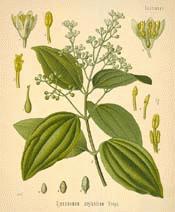
  • Cinnamon is the inner bark of a cinnamon tree (Cinnamomum zeylanicum). It's an evergreen tree that grows best in almost pure sand.
  • The bark is harvested during the rainy season when it's moist and pliable, then allowed to dry into its familiar curling shape.
  • Most of the cinnamon sold in the United States actually comes from a different tree, called Cassia (Cinnamomum cassia). This tree is native to China, and it, too, is an evergreen, but its bark is coarser and darker, and its flavor is more pungent and less sweet.


Ceylon cinnamon on the left, Cassia cinnamon on the right. Similar, but not exactly the same.
(Images from Mrs. M. Grieve's Botanical.com)


  • Though Cassia cinnamon is far more commonly available, Sri Lanka's cinnamon, or Ceylon cinnamon, is still considered the best because of its flavor, which some say is sweeter, or more "lively."
  • Ceylon cinnamon is made from only the inner bark, while Cassia cinnamon is made from the entire bark.


Ceylon cinnamon bark on the left, cassia cinnamon bark on the right.
(Images from Gernot Katzer's Spice Pages)


  • Cinnamon is one of the essential ingredients of the increasingly well-known Chinese five-powder spice.
  • Several Indian dishes that call for cinnamon actually use an entire roll of bark, or quill. The quill is put into hot oil and cooked until it uncurls, this releasing its fragrance and flavor. Then other ingredients are added to the dish. The cinnamon bark is typically removed, or else it is retained but only as a garnish.
  • If you have powdered cinnamon, though, use it quickly or else store it in the refrigerator. Once cinnamon is powdered, it loses lots of its essential oils and thus much of its flavor, and it deteriorates pretty quickly.
  • If you think you might be keeping it for a while, cinnamon sticks will actually stay preserved longer if you store them in an airtight container, and grind only what you need when you're about to use it.


In a jar is possibly the best way to store cinnamon for greatest longevity -- provided that cork makes a tight seal. And if you put the jar in the refrigerator, that would help, too.
(Image from SoftDental)


  • If you're not sure whether your cinnamon is still fresh, open the jar and take a good sniff or two. If it still smells sweet, it's good. If the sweetness is faint or not there at all, the spice won't do much for your food, either.
  • Two teaspoons of ground cinnamon* will give you more than 35% of your daily requirement of manganese.
  • You've got to have manganese to stay healthy, but you only need a little bit of it. Besides cinnamon, sources for manganese include whole grains, spinach, soy beans, nuts, olive oil, oysters, and tea.
  • There's another reason to make sure you don't go overboard with the cinnamon -- or in this case, I should say, cassia. Cassia cinnamon contains a compound called coumarin which can be toxic in high doses. Ceylon cinnamon has much lower levels of coumarin.
  • Cinnamon also contains a chemical called cinnamaldehyde.  Sounds like formaldehyde, doesn't it?  That's because they're chemically similar -- and similarly bad for you.  A little dusting of cinnamon on your French toast won't hurt you.  But a bunch of it at once will. (See below.)
  • Some people say cinnamon can aid in alleviating high blood pressure and that it can also reduce blood sugar, so it is considered to be helpful to people with diabetes. But please note that if you are going to use cinnamon as an herbal remedy, you'll be safer if you use the Ceylon cinnamon -- if you can find it.


You can make these cinnamon buns yourself with the recipe posted at Once Upon a Cakestand


*EDIT: You don't really want to eat a whole bunch of cinnamon at once because it can be toxic.  There's currently a fad called the Cinnamon Challenge which dares people to eat a tablespoon of cinnamon in 60 seconds without drinking water.  Mostly it's teen-agers who've tried it, but then, so has the governor of Illinois.

Here's why you DO NOT want to do this: people who have done this wind up calling poison control centers or else being rushed to emergency rooms because of the toxicity of so much cinnamon.  Some people have even shown up with collapsed lungs.

First, you get a terrible burning feeling in your nose and throat, you can't breathe.  Because your body knows better than you that that much of the stuff is toxic, you will gag.  You will next either spit the stuff out, or if you persist in swallowing it, you'll probably vomit (if you're lucky).  When you gag, you'll puff out a bunch of the powdered spice which you then may inhale by accident.  Once the cinnamon is in your lungs, its toxicity will go to work there, and you could wind up with an asthma attack or even scars on your lungs.  Scarring of the lungs is emphysema, folks. Same as what you get from smoking cigarettes over a long period of time.  Your lungs may even collapse.  Thus you could find yourself in the hospital with a collapsed lung, needing to be put on a ventilator.

Your body knows this is bad stuff.  Be at least as smart as your body and don't force it to do something it knows is a really bad idea.

If someone has swallowed a spoonful of cinnamon, call the Poison Control Center at 1-800-222-1222.

Sources
"LEDs will light up Rockefeller Christmas tree," AP Newswire posted at CNN.com, November 21, 2007
Peggy Trowbridge Fillippone, Cinnamon History, About.com: Home Cooking
Recipe Zaar, Kitchen Dictionary, Cinnamon
Mrs. M. Grieve, Botanical.com, Cinnamon and Cassia (Cinnamon)
Gernot Katzer's Spice Pages, Ceylon Cinnamon
Spice-Racks.com, Cinnamon: The Truth About This Spice
The World's Healthiest Foods, Cinnamon, ground
Leslie Beck, RD, Healthy Cooking, Cinnamon -- December 2006's Featured Food
Department of Health and Human Services, Agency for Toxic Substances & Disease Registry, ToxFAQs for Manganese
Lenntech, Health effects of Manganese


Consequences of the "Cinnamon Challenge," The New York Times, April 22, 2013
5 Reasons not to Take the Cinnamon Challenge, Forbes, April 23, 2013

Sunday, December 2, 2007

Apple #284: Ketchup

I have several burning questions about ketchup:
  • Why does the word have two spellings, ketchup and catsup?
  • Which of the two spellings is preferred?
  • Who first made it and how long has it been around?

The answers to all these questions are interlinked in the global history of ketchup.

Ketchup is actually the descendant of a condiment first made in China (as I have found again and again in my Daily Apple quests, just about everything in the world today came from China). But in its original form, it included no tomatoes, and was closer to Worcestershire sauce.


Worcestershire sauce
(Image from Jupiter images)


In fact, ketchup's ancestor was a pickled fish sauce, called ketsiap. This word, too, has various spellings, including kôe-chiap and ka-chiap, among others. It was thinner and more liquid than what we know as ketchup today, and its primary ingredient was pickled fish brine. People loved that fish brine, and they used it as a dipping sauce.

As sailors and other traders traveled about, they brought the sauce with them from China to Indonesia and Malaysia. From there, it made the journey to England and France, where it underwent some modifications, mainly the addition of lots of mushrooms. By the 1700s, various ketchup recipes included ingredients such as:
  • anchovies
  • fish brine
  • oysters
  • walnuts
  • mushrooms
  • kidney beans
  • lemons
  • white wine
  • vinegar
  • sweet spices like nutmeg and cloves.


Frontispiece of Elizabeth Smith's The Compleat Housewife, first published in 1742 (this image is from the 1850 version). It was published in England but sold in the US. It includes a recipe for mushroom ketchup, and is considered to be the record of the first known ketchup made in the United States.
(Image from University of Pennsylvania Library)


People started adding tomatoes to their ketchup in the 1780s. Then, in 1872, Henry J. Heinz came up with his recipe that used tomatoes plus the primary ingredient in all his multitudinous products, vinegar. He also added salt, sugar, onion, and spices, and wound up with a condiment that hit all the major taste sensations: sweet, salty, bitter, sour, and savory (umami).

Heinz' tomato ketchup hit the stores in 1876. But his was not the only tomato ketchup for sale. All sorts of other manufacturers were making their own tomato ketchup. And they each had a slightly different spelling for their product, trying to establish theirs as unique and also the best one available.


Bottles of Heinz ketchup as they appeared in 1876.
(Image from Heinz Australia)


Finally, after all the competitors edged each other out of the market, three were left standing: Heinz, Del Monte, and Hunt's. Heinz called their product Ketchup, while Del Monte and Hunt's called theirs Catsup.

So you can thank advertisers, I suppose, for the fact that two spellings for the same product are still in use today.

The spelling that seems to be the dominant choice today is ketchup. Personally, I decided I prefer that spelling because it is closest to the word for ketchup's ancestor, ke-tsiap. But another event influenced the preference in spelling.

In 1981, the US government issued a list of preferred vegetables for use in school cafeterias. They included ketchup on that list of vegetables. There was a huge outcry about this, lots of scoffing at the idea of ketchup as a vegetable, and the USDA took it off the list.

But when they put ketchup on the list, they used only one spelling, ketchup. Del Monte and Hunt's fell way behind in their sales compared to Heinz because they were selling catsup. Del Monte changed the name of their product to Ketchup, and Hunt's followed suit not long after. Both companies wanted to catch up with their competitor. Har har har!


Del Monte used to sell catsup . . .
(Image from adclassix)


. . . but now they sell ketchup -- and still classify it as a vegetable item.
(Image from Del Monte Vegetables / Ketchup)


Hunt's also sold catsup for a very long time . . .
(Image from Goantiques; ad for sale by TCAC Mall)


. . . but they, too, got on the ketchup bandwagon.
(Image from Hunt's Ketchup Products)


While all this furore was going on about whether or not ketchup could be considered a vegetable and how should companies could get more of it sold to schools, the fact remained that tomatoes, from which ketchup is made, are technically fruit.


One final tidbit about ketchup: the best way to get ketchup out of the bottle is not to invert the bottle completely and whack it on the bottom. Instead, tilt the bottle part way, as you would to pour a bottle of soda, and tap it on the neck. This will help the air slide up the neck and displace the extremely viscous viscous liquid that is ketchup, so that it will want to slide out of the bottle. If you've got a glass bottle of Heinz ketchup, try tapping on the number 57 on the neck. That should do the trick.


This billboard demonstrates the best angle for pouring ketchup.
(Image sourced from Heck Of A Guy's blog, which provides extensive detail on all the elements of decanting ketchup)


But actually, most ketchups are now sold in squeeze bottles, so that's not much of an issue anymore.

Now I'm really hungry for French fries and ketchup.

(Image from Impact Menu Systems)


Sources
Peggy Trowbridge Filippone, "Ketchup / Catsup History," Home Cooking, about.com, 2007.
Lynne Kerrigan, Culinary Sleuth, Global Gourmet, Everything You Always Wanted to Know About Ketchup.
Lynn's false facts which many people accepted as true debunked here.
Andrew F. Smith, Pure Ketchup: A History of America's National Condiment, with Recipes, page 6.
Patricia B. Mitchell, Ketchup's Colorful Past, Food History.
Joe Kissell, The Story of Ketchup, Interesting Thing of the Day, December 1, 2004.
Kimberly Skopitz, A brief history of ketchup, essortment, 2002.
The Accidental Scientist, Science of Cooking, A Brief History of Ketchup.

Wednesday, January 17, 2007

Apple #217: Salts -- Kosher and Otherwise

I like to watch cooking shows on TV. I like to watch people making things.

But many of these cooks make a point of mentioning, when they're putting salt on something, that they're using sea salt, or kosher salt, or coarse ground salt. I'm thinking, what's the difference? It's all salt, isn't it? And how can salt be kosher, anyway?
  • When it comes to varieties of salts, the short answer is, it isn't all just salt. As you may have learned in Chemistry class, salt is the vernacular for sodium chloride (NaCl). But different salts that you can put on your food may or may not have other minerals in addition to good old NaCl.

Table Salt
  • The kind you grew up with, perhaps Morton's, is harvested from salt mines, which are actually salt deposits left behind from extinct oceans. The salt is additionally processed to remove any other minerals.
  • Most salt producers then add iodine. This was something salt makers started doing in the 1920's to help combat various thyroid-related diseases that could be easily cured by increasing people's iodine intake. So they put it in the salt, and now, very few people in the Western world suffer from goiter and other such illnesses. Thanks, Morton!
  • Also, most salt makers add some type of anti-caking agent to keep the salt from clumping, which it will try to do if the humidity goes up. Hence, Morton's claim that their salt "always pours when it rains," because it's got an anti-caking agent in it.

See how carefree the umbrella girl is, with her salt pouring all over the place, even in the rain? Such are the benefits of anti-caking agents!
(Image sourced from
Ahorre products)

Sea Salt
  • These types of salts are harvested from seawater that is channeled into enormously wide trays where the sun evaporates the water and leaves behind the salt. The salt is then purified to remove any traces of aquatic life or bacteria and other badness. The salt could be further processed so that the additional minerals are refined out, but those extra goodies are left in with the salt.

Saltwater being evaporated the old-school way to leave the salt behind, in Ile de Re, France.
(Photo from Answers.com)


  • Any given sea salt could therefore include other minerals such as iron, magnesium, potassium, calcium, manganese, zinc, or iodine to boot. These minerals will be present in trace amounts only, so they won't really have any nutritional benefit. But people say that sea salts have more flavor than regular refined table salt because of the extra minerals.
  • Sea salts can come from any body of saltwater, but they are marketed as having come from one particular part of one ocean or another. Apparently, you're supposed to know that Mediterranean salt tastes better than North Sea salt, or something.
Grey Salt
  • This is a type of sea salt, and I mention it specifically only because it is an example of a "moister" salt. The amount of water that is evaporated away from the salt may vary, or it may or may not have that extra anti-clumping chemical added. In this case, a bit more moisture has been left in. This particular type of salt is harvested off the coast of Brittany (near France), and the minerals in the salt that comes from that area give it a greyish tinge. This salt is considered the salt of salts and can be very expensive.

The highly prized grey salt
(Available from Gourmet Sleuth for $6.95 for 8 oz.)


Coarse or Grinder Salt
  • These types of salt don't boast any special flavors; they are simply not ground to fine grains but available in larger crystal forms. You could grind the salt crystals yourself if you like, but many cooks use it in its crystal form, either because they feel they get a better sense of how much salt they're adding, or because it's more effective when salting meat or fish to preserve or smoke it.
  • Generally speaking, the bigger the crystal, the more you'll taste it because it will take that much longer to dissolve in the food and in your mouth.
Flour Salt
  • Conversely, salts can be ground or milled to very fine grains to be used in baking or making pastries. These types of salt also include an anti-caking agent.
Kosher Salt
  • Does not contain iodine
  • Does not contain any other additives that keep it from caking or clumping
  • Is recommended for pickling because those additives will make the brine cloudy
  • The absence of anti-caking additives also means it will adhere better to the food
  • It is usually available in larger crystals, or in flake form, which will also help it cling to the food
  • The salt itself is not kosher -- it cannot be "made" according to Jewish laws of preparing foods -- but it is used in the preparation of meats which then can be called kosher. To make meats kosher, they are soaked and then rubbed with salt so that any traces of blood are washed away.

Morton's also makes a kosher salt. You could buy this three-pound box for $2.99.
(Image from Slate.com)


For a review of various available salts, both in terms of taste and value, check out "Worth One's Salt," by Dan Crane at Slate com.


Sources
Salt Works, Gourmet Salt Reference Guide
Gourmet Sleuth, Culinary Salt - a cook's guide
Food Network, What is the difference between kosher salt, sea salt, and table salt?
Ask Yahoo, What is kosher salt? Is it better for you than regular salt?
Walton Feed, Salt (especially good explanation of kosher salt)
Mayo Clinic, Sea salt and kosher salt: Are they better for you than regular salt?
Lynn A Kunts, "The Many Benefits of Salt,"
Food Product Design, October 1994

Monday, November 14, 2005

Apple #125: Ginger

Something else my Australian friend and I talked about the other day was ginger.

Ginger root, available from Typical Dutch Stuff

I needed some for a soup I wanted to make; the recipe called for a little bit of gingerroot and all I could find at the store was a package with a whole bunch of roots in it. I said I hardly ever use ginger at all and it would have been a waste of money to buy that much ginger. She said she likes ginger a lot and that she'd like to teach more Americans to appreciate ginger.

She also said she once upon a time went to a "ginger factory" in Australia. I asked her how the plants grew, and she said she didn't see that part, just the part where they ground the ginger and also turned it into candy. Which she loves. She loves the candied ginger.
  • People call it gingerroot, although it's actually not a root. It's a rhizome, which is a plant stem with shoots above and roots below, and which is the reproductive part of the plant.
  • Ginger is one of the earliest spices introduced to Europe from the East. It's thought to have originated either in China or India.
  • Because the plant requires lots of moisture, it grows best in tropical climates. Today, it is grown commercially in China and India, and also East and West Africa, Japan, Brazil, Jamaica, Fiji and other parts of Southeast Asia, and Australia.
  • Even in places that have lots of rainfall, the growers sometimes also irrigate the crops, which then do even better with that extra water.
  • In Jamaica, which some people say produces the best ginger ever, crops are sown by two people. One person cuts the furrows and another person follows behind and drops in a hunk of root. You have to be careful not to plant them too far apart, or else weeds will sprout and choke the plants. With enough moisture, the plants will sprout in 5 to 10 days.
  • In some places like India, they plant other crops such as castor beans or gungo peas in between the ginger plants. (Now I'm going to have to find out what gungo peas are)
  • In Australia, ginger is grown by about 30 growers, and they make most of their income from processed rather than fresh ginger.

Ginger plants grown in a field, in Queensland
  • In Jamaica, the root is often first peeled, then dried in the sun. It is one of the few places that produces peeled/dried ginger, but this product is in danger of disappearing. Peeling ginger is a royal pain. It requires using a special knife with a narrow blade that allows you to mark the peel in between places where new rhizomes are sprouting. Then you have to carefully remove the thin peel in little bits where you've marked it. Most of the people who peel ginger in Jamaica today are elderly women, and fewer and fewer people know how to do it well, if at all.
  • If you want to grow ginger yourself, you can in your home. The keys are to make sure you give the plant lots of water, keep it warm, and harvest the roots from the new sprouts that shoot off from the main plant. For more specifics, see the instructions at eHow.

What your ginger plant might look like, if you grew one yourself (from Gernot Katzer's Spice Pages)
  • You also want to make sure you don't grow ornamental ginger, at least, not if you plan to eat it. There are over 1200 species of ornamental ginger, many of which actually flower. Some of them make flowers that look like little pink pineapples; some look like corn on the cob; and some look like baby pinecones that are yellow at the end and red at the base.
  • Candied, or crystallized, ginger is made by cutting the peeled roots into hunks or slices, then cooking them in sugar syrup and applying yet another, final coat of sugar. The result is a combination of a snappy, yet mellow flavor with definite sweetness from the sugar. If you want to make it yourself, try this one from Premier Systems

Crystallized ginger, as made by Holly Food Co., Ltd.

Sources
Growing Ginger in Jamaica
Ginger in Queensland, commercial production
eHow, How to Grow Ginger
Gernot Katzer's Spice Pages, Ginger (includes a discussion of the etymology of "ginger," a description of its flavor in various forms, and a catalog of how it is used in various cuisines)
Earthcare, Spices & Medicinals of the Ginger Family
The Great American Spice Company, Crystallized Ginger - Candied