Showing posts with label public services. Show all posts

Monday, June 6, 2016

Apple #732: Title IX History and Overview

I love Title IX.  Thanks to this law, there was a girls' softball team at my high school for which I could play.  We weren't very good because our school didn't put much money into softball as compared to, say, football or swimming, so our coaches were pretty much deer-in-the-headlights and so we sucked.  But at least I got to play.  Prior to Title IX, there wouldn't have been any such team.


Photo of a rally in support of Title IX held in 1979.  For a long time, the only context in which people talked about Title IX was women's sports. But it has affected way more than just athletics.
(Photo sourced from Women's Sports Foundation)


Title IX has emerged in the news over the past few years as the basis from which groups of college women are demanding that their schools get better at handling allegations of sexual assault on campus.  I say, more power to 'em, literally. When I was an undergrad, the prevailing attitude was, hey, you put a bunch of late-teens, early-twenties kids together and give them alcohol, of course women are going to get raped. What are you gonna do?  That attitude, in my opinion, is a reprehensible abdication of responsibility, and it has got to change.  Title IXers, for working to change this culture to make college campuses safer for everyone, I applaud you.

More recently still, Title IX is the policy behind which various governmental institutions are requiring that public bathrooms accommodate transgender people.  There's been a lot of outcry against this, and as far as I can tell, the primary argument is that pedophiles and perverts will use this license to wreak havoc on our innocent ones when they are perhaps most vulnerable and defenseless.   To this I say, if the problem is the pedophiles and the perverts, maybe we should be doing something about them, as opposed to discriminating against the transgender among us?

In short, there have been a lot of references to and invocations of Title IX in a variety of contexts.  Hearing it so often has made me wonder, Title 9 of what?  What's Title 8?  Where did this thing come from, and whom should I thank for making it a rule in this country that people have to abide by?

  • The person to thank, apparently, is Richard M. Nixon.
  • Title IX is one part of Public Law 92-318, which was signed into law by President Nixon on June 23, 1972.

Richard Nixon, signing something into law
(Photo sourced from Pinterest, which is not so reliable at providing provenance)

  • Another person to thank is Patsy Mink. She was Japanese-American, and a Congressional Representative from Hawaii, and she helped draft the language that would become Title IX, and she pushed for its passage.

At center: Patsy Mink, first Asian American and woman of color to serve in the US Congress, was a key force in the passage of what we now call Title IX.
(Photo sourced from the Women's Sports Foundation)

  • The law is broken up into parts-- well, Titles, then Parts, then Sections.  So if you wanted to refer to some major part of the bill, you might refer to it by the Title under which it is organized. 
  • The general purpose of the law was to amend various existing laws having to do with education, from elementary schools all the way through higher education, and including vocational education.  The goal was to expand opportunities to education to people of all backgrounds across the country.
  • More specifically, Public Law 92-318 set aside hundreds of millions of dollars -- literally -- in the form of grants or loans that could be applied for by all sorts of people.  In many cases provisions for these grants were already in place but this law expanded the range of people who could apply, or re-upped the funding, or increased the amount of funding.  

 TITLES I through VII

  • Most of the titles within the law dealt with this funding in support of new or increased educational opportunities.
  • Grants or loans were funded or expanded upon for all sorts of educational purposes, including
    • nurses who wanted to go to college
    • veterans of Vietnam (the law says "Indochina") and Korea who wanted to go to college
    • students in vocational education schools
    • people who wanted to study the causes of environmental pollution
    • training for people who want to become librarians, or resources to be purchased by libraries
    • fellowships and internships for people who want to teach at the higher education level
    • students from economically disadvantaged backgrounds who want to go to college
    • tutors of educationally disadvantaged children
    • training of teachers, teachers' aides, and teachers of migrant children
    • schools that serve Native American (the law says "American Indian") children, particularly those with special education needs, and also schools that provide education to adult Native Americans 
    • the study and teaching of the ethnic heritages of all sorts of ethnic groups in the country, along with bilingual assistance where appropriate
    • the development of educational TV programs for children (Sesame Street started in 1969, but this funding certainly would have supported its continuation)
    • people who want to go to school to pursue a career in public service 
    • work-study and community service programs
    • undergraduates who want to study a foreign language or travel to a foreign country for educational purposes
    • new or financially struggling undergraduate or community colleges that are trying to improve or expand their teaching staff
    • the construction of new undergraduate, community, and technical colleges 
    • the construction or rebuilding of schools in major disaster areas 
  • It also established the Student Loan Marketing Association, a private corporation funded with an initial $5M in government start-up money, that would serve as the marketplace for student loans insured by the government. This made loans to would-be college students much easier to come by because before this Association -- what we now call Sallie Mae, and what many people curse up and down and left and right -- it was really difficult to get a loan to pay for college because banks saw it as a bad risk. 
  • It encouraged the reform of postsecondary education so the schools would be run in a more cost-effective manner, the retention of more members of faculty, and expansion into new areas of study such as communications.
  • It directed the Secretary of Health, Education, and Welfare to conduct a full and complete investigation of youth camps around the country to determine to what extent any injuries that happen to children there are preventable, and how could local laws be modified to improve safety. (Investigations of sexual abuse were not spelled out but in retrospect, one wishes it had been.)
  • So the law covered a boatload of expansions aimed at improving educational opportunities all over the place. 

TITLE VIII - No Money for Busing (almost there)

  • Title VIII seems out of keeping with the nature of the rest of the law.  This title specifically and categorically states that no funding whatsoever could be used to pay for busing students to another district in support of desegregation.  
    • It's pretty remarkable how the language of the law in this title changes to No all over the place, where before it had been a lot of "shall".


The debate about whether children should be bused to different schools to counteract segregation was hotly contested across the country. Here is one protest against forced busing in Boston.  Looks familiar, doesn't it?
(Photo sourced from U.S. History in Context)

  • We don't normally think of Nixon as a champion of the rights of the disadvantaged, but he was royally ticked off about this part of the law.  When he signed the bill into law, he didn't talk about all the great things the law was doing; instead, he listed all the stuff he'd asked Congress to do but they hadn't.  He said, 
  • In the amendments dealing with the busing of public school children, however, this measure is most obviously deficient. Had these disappointing measures alone come to this office--detached from the higher education reforms--they would have been the subject of an immediate veto.  
  • We asked the Congress to draw up new uniform national desegregation standards for all school districts--South, North, East, and West. The Congress determined to allow the existing inequities and injustices to remain.
  • We asked the Congress to provide uniform guidance to Federal judges so that court-ordered busing to integrate public school systems would be used only as a last--never a first--resort. The Congress apparently declines to provide such guidance. 
  • He went on like this, with more "We asked the Congress"es followed by statements saying, They didn't do it.  He finished his remarks with this:
  • Confronted with one of the burning social issues of the past decade, and an unequivocal call for action from the vast majority of the American people, the 92d Congress has apparently determined that the better part of valor is to dump the matter into the lap of the 93d. Not in the course of this Administration has there been a more manifest Congressional retreat from an urgent call for responsibility.
  • End of remarks. He might as well have done a mic drop.

TITLE IX - Here we are

  • In the midst of all this stuff about what shall be funded and how much should this program get and how shall it be administered is the part you've all been waiting for, "TITLE IX -- Prohibition of Sex Discrimination," and it begins
No person in the United States shall, on the basis of sex, be excluded from participation in, be denied the benefits of, or be subjected to discrimination under any education program or activity receiving Federal financial assistance.
  • That's it.
 
  • Among page after page of language about how much money should go to this group and that group, and how it should be awarded, and how it should be insured, and what administrative bodies should be created to carry out this and that provision -- then appears this one sentence that may have changed more lives for more generations than all the rest of it put together.
  • There are some exceptions (schools with a religious affiliation, schools with longstanding single-sex admissions) and there have been some amendments that add a few more exceptions (fraternities and sororities, father-son or mother-daughter activities).
  • There's also a bit that says the same thing about the blind -- no discrimination by schools that receive federal money. Why and how this provision got put under a provision having to do with sex discrimination, I cannot explain.
  • But out of that one sentence, here are just some of the things that have come about:
  • Athletics -- girls in high school varsity athletics
      • 1971: 295,000
      • 2001: 2.8 million, or 41.5% of all varsity athletes
  • Athletics -- women in college athletics
      • 1966: 16,000
      • 2001: 150,000, or 43% of all college athletes
  • Academics -- women earning law degrees
      • 1972: 7% women
      • 1997: 44% women
  • Academics -- women earning medical degrees
      • 1972: 9% women
      • 1997: 41% women
  • Academics -- pregnant girls and women
      • 1972: usually expelled from school
      • post-Title IX: schools are not allowed to expel pregnant girls and women, and if they do provide separate classes for expecting mothers, participation must be voluntary and the programs must provide comparable education
  • Academics -- programs of study
      • 1972: girls encouraged to become wives, mothers, secretaries, nurses, or teachers, while boys were encouraged to study math and science and "harder" subjects
      • post-Title IX: significant gender disparity still exists, but the number of girls taking upper-level math and science classes is on the rise, and schools are launching concerted efforts to attract girls and women to STEM courses and programs of study.
  • Academics -- standardized testing
      • 1972: girls consistently scored lower than boys
      • post-Title IX: gender disparity still exists, but if a standardized test results in consistently lower scores for members of one sex, it can be challenged as unlawful.
  • Sexual harassment in schools
      • 1972: for those women who did go to college, if they were harassed (or perhaps I should say when they were harassed) they could expect little or no redress from the authorities at their school
      • post-Title IX: the Supreme Court ruled that schools and colleges are required to prevent and respond to harassment against girls and women, regardless of whether that objectionable behavior is done by peers, teachers, or administrators. It is also under this aegis that women are seeking to compel colleges and universities to curtail and punish campus rape.
  • Also springing from Title IX is the debate about which bathrooms transgender people should be allowed to use. 
      • (For one discussion of some of the complexities of this issue, see Jeannie Suk's opinion piece from The New Yorker; there are some elements that I for one had not considered. I do think it is worth underscoring this comment: "The common denominator in all of these scenarios is fear of attacks and harassment carried out by males—not fear of transgender people.")
      • It is too early to say how this debate will be resolved, but I think the fact that we are having this debate at all is a hopeful sign.
  • Girls and women still face gender disparity in all sorts of areas -- in the classroom, in hiring, in compensation, in what men say to women online or in person, in how politicians respond to their questions, and on and on.  
  • But we have made great progress thanks to Title IX.  Without Title IX, I probably wouldn't have an undergraduate and two graduate degrees. I might have had just as much curiosity, but not much of a venue where I could exercise it. I probably wouldn't be typing this right now.  Your Apple Lady probably would not exist.
  • And thanks to Title IX, we can continue to make more progress, to chip away at the institutional norms that bolster sexism and allow it to persist not just in education but throughout the entire lives of girls and women.
  • Thanks, Richard Nixon and Patsy Mink.

Sources
US Department of Education, Title IX and Sex Discrimination
The US Department of Justice, Title IX of the Education Amendments of 1972
Cornell Legal Information Institute, 20 US Code § 1681 - Sex
US GPO, Public Law 92-318 as enacted June 23, 1972
UC Santa Barbara, The American Presidency Project, Richard Nixon - Statement on Signing the Education Amendments of 1972, June 23, 1972
Title IX Info, History of Title IX
The Gilder Lehrman Institute of American History, The Impact of Title IX
Athletic Scholarships.net, Bridging the Gender Gap: The Positive Effects of Title IX
Title IX Info, Ten Key Areas of Title IX
Jeannie Suk, The Transgender Bathroom Debate and the Looming Title IX Crisis, The New Yorker, May 24, 2016

Sunday, December 4, 2011

Apple #561: Asphalt Planers, Pavers, and Rollers

A few months ago, they re-paved my street. No, I don't know who "they" is. The city? Some contractors? Anyway, they scraped off the old asphalt one day and then they came back on a different day and put down new asphalt. The construction equipment was pretty huge and loud and impressive, so I took some pictures.

Naturally, as your intrepid Apple Lady, I have also looked up what these machines are, so I'll provide a little bit of information about each one.


Asphalt or Cold Planer
(Photo from Baucm.com)


Asphalt Planer or Cold Planer

The first machine may have been the most impressive. This one I thought of as the asphalt scraper. But actually, to people who sell these sorts of things an asphalt scraper is a shovel. This machine is called an asphalt planer or a cold planer.

I had to split the video into two parts so I could upload it to Blogger. Part 1 is the faraway big picture version; part 2 gives you some close-up views.


The teeth of this machine is a rotating cutter drum with spikes on it. As the vehicle moves slowly forward, the drum underneath spins so that the spikes bite into the pavement, chopping the pavement into pieces. The drum gets pretty hot, so a system continually sprays water over the drum to keep everything from overheating.


Drum for tearing up asphalt


Drum with more teeth for tearing up concrete.
(Photos and drums from Trackless Vehicles Ltd.)


There are some smaller walk-behind versions of this type of machine. They're referred to as "hand" cold planers, I think because instead of sitting in a big giant honking thing to operate it, you can walk behind it and push it with your hands, even though it is power equipment.


Here you can see the underbelly of a hand cold planer. Even though I didn't see one of these in action, I thought it might be helpful to show you this version. Because according to the specs I've seen, the drums on the big honking machines are 7'2" long, which is apparently the standard.
(Photo from Taguchi Industrial Co., Ltd.)


The chopped-up pieces of asphalt or concrete are funneled up out of the machine on a conveyor belt that extends out of the machine. The conveyor belt has to be very sturdy and durable to carry lots of debris, it has to withstand high temperatures, and it's usually tracked so that the pieces don't slide back down the belt but are carried up and out of the machine. The pieces drop into a dump truck that follows behind the planer.


This is a different type of machine, a miller, but it also uses a conveyor system. The inset shows you what the conveyor belt looks like.
(Photo from Everpads)


There are lots of varieties of asphalt planers. Some are as wide as a highway lane, others are half-lane widths or narrower. You can get them with two, three, or four tracks (like wheels).

The enormous planers like the one I saw weigh somewhere between 6.5 to 8.5 tons.

In all cases, the drum seems the most crucial part. People selling used cold planers online (there are a lot of them for sale, surprisingly) talk about the relative newness or sharpness of the drum as its main selling point. The Roadtec RX60b, which is what is shown in my video and which apparently they don't make anymore, has a standard 7'2" drum and a 750 horsepower engine. A used 1998 asphalt planer, by the way, sells for $85,000. Newer ones don't have prices posted, so you know they cost a sweet bit of cash.


Asphalt Paver

That machine went by on day one. Day two (I don't actually think it was the next day, but a few days later) they came back with more machines. This time, they were laying down new asphalt.

To lay down the asphalt to their satisfaction, they used 3 types of machines. The first was the asphalt paver.


Asphalt paver with two guys helping to spread out the asphalt more evenly.
(Photo by the Apple Lady)


The asphalt paver has a dump truck driving in front of it, feeding in the new asphalt. The paver itself is made up of two major components, the tractor and the screed.

The tractor part is pretty much the drive train, the thing that makes it go. It also includes a means of getting the asphalt from the hopper in the front to the back of the machine. Some pavers use an internal conveyor system to move the asphalt within the machine, others have simply a chute that lets gravity carry the asphalt to the back of the vehicle.

In sort of the mid-section of the paver, the tractor distributes the asphalt onto the pavement. I had thought in my photos that the back end of this machine had all sorts of nozzles lined up across the back and the nozzles were spraying the asphalt onto the surface. But now, since my photos aren't clear enough and based on the descriptions I've read of these various equipment types, I'm not so sure.

At the very back of the machine is the screed. The screed vibrates and tamps down the asphalt. It's heated, either by diesel fuel or by electricity, which helps melt the asphalt and keeps it from sticking to the screed.

The screed is where a lot of asphalt-paving-equipment people focus their attention. The screed comes off and you can buy different ones with different specs, depending on the thickness of the material you're putting down, or how wide the road surface is that you want to pave at one time, or how compressed you want the asphalt to be.


Diagram of a Carlson Paver with some of the parts labeled to try to entice you to buy it. The label that I think is most interesting is the "extendable walkways," which explains how the guy in my video could stand on the back of that machine and not melt his shoes or get hurt.
(Photo from Carlson Paving Products)


Pavers weigh about 34,000 pounds. I don't know why I keep looking up how much these things weigh. I guess I'm trying to get at the hugeness of these machines.

Once again, I've got some videos for you. The first one zooms in but not quite clearly enough to see how the asphalt is put down on the pavement.

The second one follows the paver for a bit, then swings back to the roller running behind the paver.


Asphalt Rollers or Compactors

Now we come to the third part of the process, which was compressing the asphalt still further. They did this using rollers or compactors.

There are lots of different kinds of rollers which vary in size from 1 ton to 5 tons, and they vary in complexity. The point of the rollers is to pack down the asphalt and to make it smooth and even. In resurfacing my street, they used two different kinds of rollers.

The first kind was larger, and it had a roller in front and in back. These are called articulated rollers. As you can see in the photo below, there's a joint where the two halves connect. That joint allows the two rollers to move independently of each other, which requires a lot more control on the driver's part. This also enables the operator to get a lot closer to the edge of the road bed, for example, or to move one side to smooth out one particular section or another.


Articulated asphalt roller
(Photo by the Apple Lady)


Like the pavers, the rollers require water to be sprayed over the business end of the equipment. The hot water and resulting steam keeps the asphalt from sticking to the roller and allows the asphalt to be compressed evenly without getting picked up onto the roller in clumps. In the photo above, you can see the steam coming off the top of the rollers.

According to one manufacturer, the water is distributed from the on-board water tank over a mat which allows the water to spread all across the roller evenly. The mats are called cocoa mats because they're made of coconut husks.

Here's more video of the articulated roller in action.


More shots of the articulated roller. The construction people are looking to the left because that's where the paver is. They're following it, tamping down the asphalt that the paver has just put down. The roller pretty much drove backwards, away from the paver, compressing the asphalt, then went forward again to catch up the paver, then backward again and so on down the street.
(Photo by the Apple Lady)


The back end -- or maybe I should say the left side -- of the articulated roller.
(Photo by the Apple Lady)


The second kind of roller they used was a static steel-wheel roller. These don't have that joint in the middle like the articulated kind do. They're called "static" because the rollers don't vibrate (some types of rollers do).

These also spray water over the rollers to keep the asphalt from sticking.

One resource says you have to be careful with these not to drive them back and forth over the asphalt too much because they can squash the asphalt down too much, pushing it sideways, and making it too thin in places or even making cracks appear. And you just put that asphalt down too.


Static steel-wheel asphalt roller.
(Photo by the Apple Lady)


Technical Note:
Splitting an avi file in half was trickier than I expected. The first 8 programs that people recommended crashed or didn't work or produced useless files, etc. Finally I tried VirtualDub. It actually worked, produced files that would play, and came with instructions for how to use it. Kudos to AfterDawn!


Sources
Roadtec Cold Planers
Dimensions Guide, What is the size of a Cold Planer?
Machinery Trader, Roadtec RX60B for sale
Answers.com, How is an asphalt paver made? Originally from Gale's How Products are Made, 2002
King Machinery APELLC, Asphalt Pavers and Asphalt Rollers
Global Security.org, Military Field Manual 5-436, Chapter 3: Equipment Used in Bituminous Operations
Leeboy, Asphalt Pavers
Dynapac, Pavers
Machinery Trader, Roadtec Asphalt Pavers for Sale
B&W Equipment Company, Dynapac Static Rollers and Dynapac Tandem Rollers
Ritchie Wiki, Asphalt Distributors

Friday, May 27, 2011

Apple #526: Sheriff vs. Police

I have received another request!  Regular Daily Apple reader Geronimo and I happened to walk past a sheriff's car yesterday, and Geronimo said, "Here's a Daily Apple for you.  What's the difference between the sheriff and the regular police?  And state police, too?"

He went on to say that in Westerns, the sheriff used to be one guy in charge of all the deputies in town.  But since there are lots of cars marked Sheriff and lots more cars marked for the police department driving all over our city, it seems like the Sheriff is no longer just one guy but lots of people.  But are the sheriffs in charge of the police officers, or what are their roles?  And what about the state police, too?

Geronimo, I have your answer.
  • Essentially, the differences boil down to jurisdictions.
      • Police: local city or town or municipality
      • Sheriff: county
      • State police: state
  • There are, of course, more details about the differences in their duties and how they operate.

Local Police


The Texas City, Texas, Police Department.  Their sub-units include patrol, SWAT, Crime Scene Investigation, Criminal Investigation, and K-9 units.  A police department this large probably wouldn't need much help from a sheriff's office.  But a smaller town with a smaller police force might.
(Photo from the Texas City Police Department)

  • Local police patrol within a city or a town.  Within the city or town limits, they are supposed to maintain public safety, cite or arrest people if necessary, and provide safety education to people who live there. 
  • They may also have specialized sub-departments such as bomb squads or riot police.  But these sub-departments, again, will only operate within the city limits.
  • Most police departments, however, are quite small.  The majority of police departments employ10 or fewer officers.
    • Local police officers' salaries are paid out of the town or city budget.
    • Local police report to the Police Chief, who is appointed.  Usually it's the mayor who does the appointing, but sometimes it's a city commissioner or board of city leaders. 
    • Local police officers usually wear blue.

      Sheriffs 


      All these people -- and the dog -- work for the Sheriff's Office in Montcour County, PA.  The guy in the middle wearing the suit, the one who looks like a crime boss, is the Sheriff, Ray C. Gerringer.  Everybody else is some type of deputy.
      (Photo from Montcour County)

      • Sheriffs operate at the county level.  So they generally patrol outside city limits, in the more rural parts of a county.  They can, however, go into the jurisdiction of the local police (into town) to perform their jobs.
      • Some towns may ask sheriffs to act as their local police and patrol their town.  Instead of forming their own police department, they'll pay the county sheriff's office for police patrol.
      • Strangely, even though sheriffs operate at the county level, they are created, so to speak, by a state's constitution.  The state constitution is where a sheriff's duties and responsibilities are outlined.

      The person driving this car may not be the actual sheriff.  At the very least, he or she works for the sheriff's office.
      (Photo from GaramChai)

      • There is only one Sheriff.  Everybody else who works in the sheriff's office is a deputy of some kind.
      • The Sheriff is an elected official.
      • Sheriff's offices may also act as a coroner's office.  
          • Coroners, by the way, also act at a county level. They are sort of the Keeper of Death-Paperwork.  They investigate suspicious deaths, determine or declare causes of death, issue death certificates, must be present at cremations, and they may perform or hire services such as autopsies or toxicology testing. 
      • Another side note: the word "sheriff" comes from the Old English "shire reeve."  The reeve was the law-keeper who worked for the King or whoever was in charge of the shire.  I was hoping to find an explanation for why the word has only one r and two f's, but the etymology didn't help much. In fact, the etymology would suggest even more strongly that the word should have two r's instead of one.  But who ever said that English spellings made sense?

        State Police


        These are state police troopers from West Virginia.  If you see some sort of police official wearing a hat in that funny shape (it's called Campaign style), you'll know they're a state trooper.
        (Photo by the West Virginia State Police)

        • State police work for the state.  So everything they do lives at the state level.
        • State police chiefs are appointed by the governor.
        • State troopers are generally associated with highway patrol, and they do a lot of that.
        • There might be a special sub-unit within the state police that's assigned to highway patrol.  Those highway patrol units will be assigned, not to highways across the whole state, but to specific sections of highway within the state.  The State of California Highway Patrol (CHiPs), for example, has units assigned to patrol highways in and around LA County.

        Ponch and Jon were actually state troopers working for the California Highway Patrol.  I used to have a major crush on Jon.
        (Photo posted by BigMac at Metal Banned)

        • State troopers may also investigate drug trafficking, organized crime, human trafficking, illegal immigration, or other wide-ranging activities that encompass lots of territory within a state or involve transporting lots of things or people over highways. 
        • State troopers are also the ones who monitor highway weigh stations.
        • They may step in to help local police or even county sheriff's office in time of need.  They may help with particularly difficult criminal investigations, or they may help in times of disaster relief, or during search and rescue efforts.
        • Because state police are funded at the state level, and because they are often involved in more extensive detective investigations, they tend to have the best equipment or the most specially trained units of any police force in the state.
        • State troopers may also help protect high-ranking state officials, or state property, or people or places in rural areas that don't have much of a police presence.
        • Generally speaking, state trooper departments are very large.  They average around 2,000 people per state.
        • State troopers usually wear brown.  And the funny hats.


          A whole bunch of police.
          (Photo from the Sun Sentinel)


          No, not these guys:

          They're a different operation altogether.
          (Photo from Graphics Hunt)


          Not the Dream Police, either.  (Song starts at 1:00)


          Sources
          Broward County Sheriff's Office, What's the difference between a sheriff's office and the police department?
          Wise Geek, What is the Difference Between a Sheriff and a Police Officer?
          Differencebetween.net, Difference Between Police dept and Sheriff's dept
          Los Angeles County Sheriff's Department, What is the difference between a Police Officer, Highway Patrol Officer, and a Sheriff's Deputy?
          FAQ, Trivia and Information on Life in America: Ask A Desi, Sheriff and Police
          HowStuffWorks, How State Troopers Work
          The Chippewa Herald, What does a coroner do?
          Q and As Career: What Does a Coroner Do?

          Monday, May 2, 2011

          Apple #521: Where Does the Debris Go?


          [Note from the Apple Lady: I was in the middle of working on this entry when I got the news about Osama Bin Laden.  I realize you're probably not all that interested in the topic of this entry at the moment, but rather than switch horses to a subject having to do with war, I decided to stick with this.  At the very least, I wanted to finish what I started.]

          I have had a request!  Daily Apple reader Leopold pointed out that, in the wake of all these storms and hurricanes and tornadoes, there is rubble all over the place.  That all has to get cleaned up, of course.  But, he wanted to know, where does the rubble go?

          The destruction surrounding those severe storms is certainly not a happy topic so that might seem to make it not suitable for the Daily Apple, but rubble-removal is the beginning of rebuilding.  Plus, I suspect that the people who do the rubble-hauling largely go unseen.  So this will shine a light on these essential services that most of us rarely think about.

          • The short answer to where does the rubble go (the term the officials use is "debris") is to the landfill.

          A landfill, it turns out, isn't just a great big hole in the ground, but it's a pretty sophisticated combination of engineering and chemistry.
          (Diagram from Runco Environmental)

          • But of course the more complete answer to Leopold's question is more complicated than that.

          WHAT THE "STUFF" IS
          • Exactly where the debris goes depends on what kind it is, whether it's vegetable, construction, or hazardous material.
          • The first thing a city or county or municipality does is to take care of any hazardous situations.  While this may include downed power lines, the city may have to remove downed trees or branches in order to get to the power lines.  So the way they describe this step is to say that they clear roadways to allow vehicles to access any potentially hazardous areas.

          This is exactly the kind of hazardous situation that gets taken care of first: a downed tree blocking a street and leaning on a power line to boot. This is after a winter storm in Santa Barbara, Florida, in January 2010.
          (Photo by Victor Maccharoli from the Daily Sound)

          • Most of the time what they're clearing away in this first step is vegetative.  Because trees and branches and stumps are bulky and weirdly-shaped, taking them straight to the landfill is strongly discouraged.  So the vegetation might get turned into wood chips first, or it may be taken somewhere for recycling, if it's possible to recycle any of that wood.
          • Since the vegetative stuff has to get "reduced" before it's taken to the landfill, it's carefully collected separately from any construction material.
          • In most cases, it is vegetative debris that people are dealing with after a storm.  But if a storm is especially severe, there may be construction debris to remove. As with the vegetative stuff, the construction debris gets sorted and processed, with the goal of recycling any of the materials if at all possible, and of reducing the bulk of the stuff.
          • Broken concrete has to be divided into two types: that with metal bars in it and that without.  Concrete without metal bars is considered "clean" and can be re-used.  It can be covered up with uncontaminated soil and used as fill material in land that's going to be built up (think of those hills that get created out of nowhere when they build new roads or that go around new buildings).  Broken chunks of "clean" concrete can also be re-used as erosion control barriers.

          This broken concrete has metal rods in it, which means it isn't considered "clean" or re-usable, so that's probably why it's been piled up together. This is in the aftermath of Hurricane Ivan in Pensacola, Florida, in 2005.
          (Photo by Leif Skoogfors from FEMA)

          • Bricks, rocks, stones, asphalt, and soil can usually be re-used for all sorts of building and engineering purposes, provided it hasn't been contaminated by, say, sewage or chemical spills.
          • The construction material that can be re-used gets separated out.  Everything else goes to the landfill.
          • Then there's the hazardous stuff.  This includes construction material (usually roofing) with asbestos in it, lead pipes, batteries, animal carcasses, infectious waste (think of what might happen if a hospital got hit by a tornado), toxic chemicals that might have been spilled, and soil that's been contaminated.  This stuff needs to get handled by waste disposal professionals who are specially certified to handle these types of materials.  The materials have to be contained and disposed of according to very specific guidelines that are tailored to each type of material.
          • Included in the hazardous category are some household products.  Appliances, including refrigerators, air conditioners, ovens, washing machines, heat pumps, etc., all referred to as "white goods," may contain hazardous chemicals -- substances like refrigerants, freon, oil, or possibly even mercury.  Those chemicals have to be removed from the appliances before they are added to the landfill.
          • Electronics like computers and cell phones and TVs also fall into the hazardous household goods category.
          • Vehicles may also have to be disposed of.  In the case of cars or trucks, those are typically taken to a junkyard. Boats may be taken to a similar kind of junkyard, but for navigational vessels.  Vehicles usually don't wind up in the landfill because of the oil, gasoline, rubber tires, and the fact that they're pretty big and bulky.

          Somebody's going to have to get that mini-van off the top of that other car and the huge tree branch.  That's got to be a specialty job.
          (Photo of tornado damage near Beaver Creek, North Carolina from our amazing planet)


          HOW IT GETS HANDLED
          • After the city clears the roadways, there may be additional stuff to deal with.  If the storm damage is especially widespread in a city, the city might institute a kind of disposal grace period, so to speak. For a small window of time, they'll notify homeowners that collection trucks will circulate among the especially hard-hit streets and pick up any vegetative stuff that's been brought to the curb, at no charge to the residents.  The stuff is not to spill out into the roadway and block traffic, and it has to be carefully separated from any construction or building material.

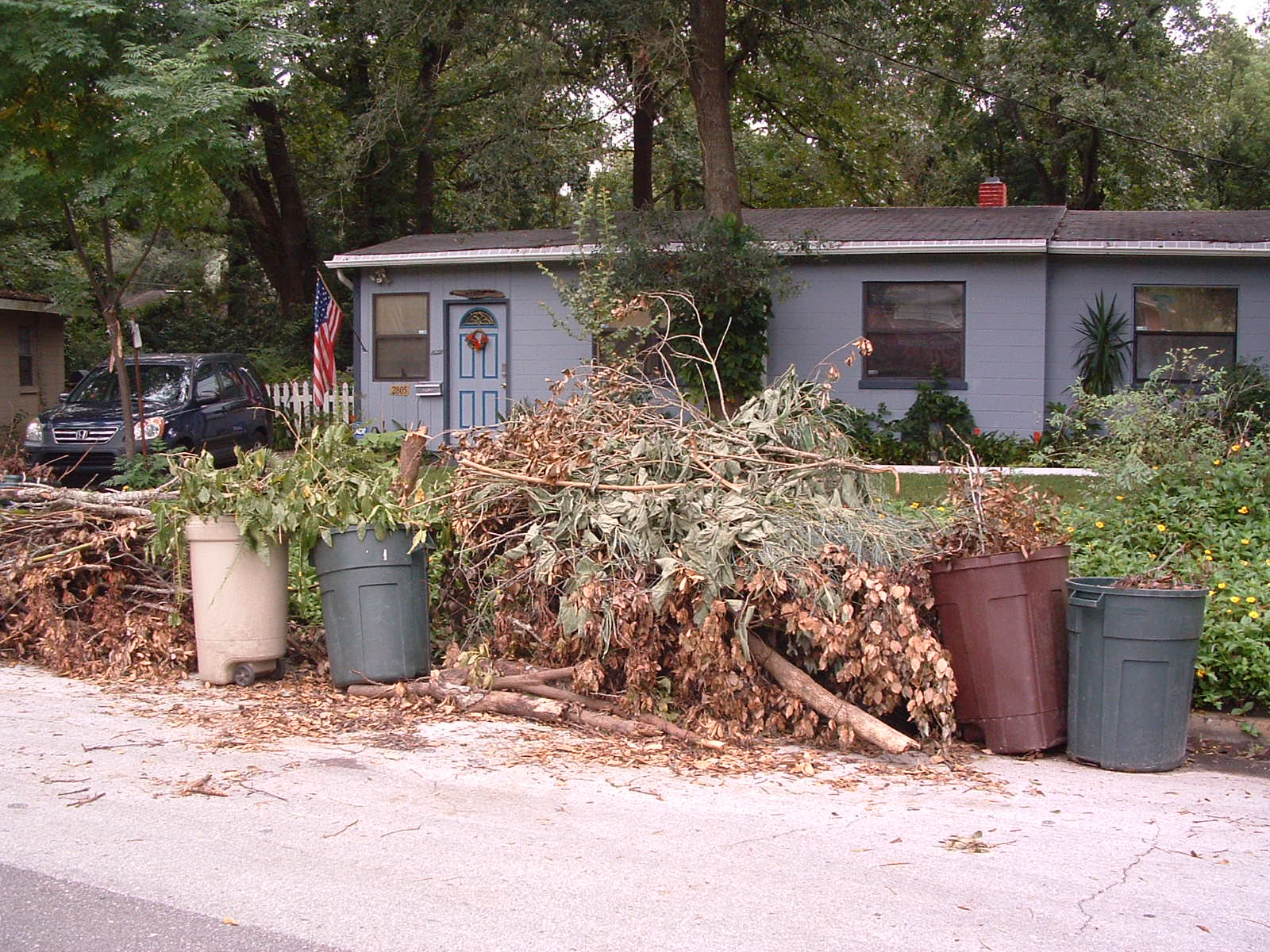
          Vegetation piled along a roadside, waiting for city pick-up. This stuff is what fell down in one guy's yard during Tropical Storm Fay in Jacksonville, Florida, in 2008.
          (Photo from Rabid Fun)

          • Alternatively, a city may post notices that residents can bring their debris to the landfills free of charge.  In some cases, they may direct people to bring their debris to a separate way-station instead.  Once at the way-station, they'll still direct people to separate their vegetative stuff from the construction stuff.  People working at the way-stations will do some additional sorting and processing at the site before sending it off to be re-used or to the landfill.
          • Where the stuff gets taken may also depend on who's paying for the clean-up.  Initially, the city or municipality would be in charge of the clean-up, but it may become apparent that the area should be declared a federal disaster area.  
          • When that happens, FEMA gets involved.  They don't necessarily take over the clean-up process, but they may advise local officials about how to handle the sheer volume of stuff.  They may decide that the city needs to set up a way-station and they may advise the city on where to set one up.  
          • FEMA officials will also monitor the debris-removal activities to assess what kinds of materials are being removed, and by whom, and using what procedures.  The disposal costs for which they reimburse are determined by these sorts of details, so FEMA keeps an eye on it.

          WHO COLLECTS IT
          • The first people to get involved are the city's waste collection services.  Good old trash trucks.

          It was hard to find a picture of the guys who pick up the trash.  Lots of photos of the trucks, not so many of the people themselves.  These guys work for New Orleans' downtown trash collection service, SDT.
          (Photo by Eliot Kamenitz at The Times Picayune)

          • After larger storms, however, it may be obvious that the city doesn't have enough trucks, or the right kind of equipment like enormo-stump-grinders, or the right kind of expertise such as hazardous material handling.  That's when they call in the contractors.

          There's no way a regular city trash truck or some guy with a chainsaw and a truck could handle this enormous tree, felled during the Raleigh, North Carolina tornado.  Time to call the special tree- and stump-grinder guys.
          (Photo from active rain)

          • Sometimes the contractors are simply guys with more trucks.  But often the contractors are businesses who have the equipment and expertise to handle specific materials.  There are contractors who specialize in stump-grinding, contractors who specialize in branch and tree removal, contractors who deal with refrigerant removal, who break up concrete, who collect and clean contaminated soil or mud, who handle asbestos, who clean up toxic chemical spills, etc., etc.

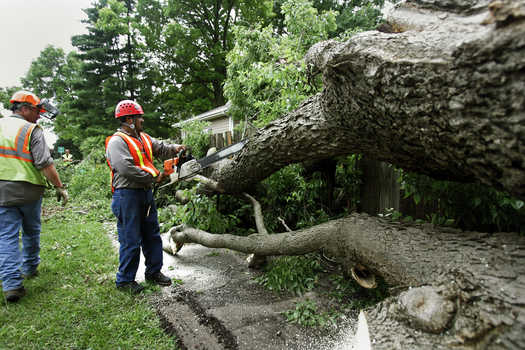
          These guys work for VanBooven Tree Care. They're certified arborists and experts in tree pruning and removal. Notice the extra-long chainsaw blade, the special hard hats, and the protective gloves.  They were one company hired to help Kansas City clean up after a storm in 2010. By the way, the majority of injuries related to storm damage happen after the storm, when Average Joes get out there with their chainsaws and try to saw up trees by themselves.
          (Photo from VanBooven Tree)


          The Bobcat with the claw on it, being used here to pick up storm debris, and the huge Dumpster-like truck are owned by a contractor that specializes in storm debris removal. The stuff they're collecting is debris from Hurricane Katrina in New Orleans.
          (Photo from VCM Ventures, Ltd.)


          These guys are experts in asbestos removal. They're all suited up as federal regulations require. The thing they're throwing out is a piece of ceiling tile.
          (Photo from Asbestos Jobs Info)


          WHO PAYS FOR IT
          • All this debris- removal costs big bucks.  Providence, Rhode Island estimated that dealing with the tree damage alone after a storm that struck six nearby cities would cost an estimated $54 million.
          • Days after the tornado hit Raleigh, North Carolina, the city put 40 trucks to work collecting vegetative waste left along the roadsides as part of that first-stage debris removal. The city thinks that tree & branch removal alone will cost $1 million, but that amount could easily go higher.  The city expects it to take another six weeks for a private contractor to haul away some 150,000 cubic yards of debris. They didn't offer an estimate for what that might cost.
          • St. Louis spent $10,000 on Dumpsters and $30,000 on a huge tree grinder. One city administrator estimated that cleaning up the debris on one particular street alone would cost an estimated $3 million.  That $3 million is significant because it represents one threshold of damage that a county must reach in order to qualify for FEMA reimbursement.
          • If FEMA gets involved, they will reimburse local governments for expenses related to the removal of some types of materials, but not all types. Generally speaking, they reimburse for the removal of material that's on public property but not private, they don't reimburse for general construction material removal because most insurance policies cover that, and they'll reimburse for the removal of only some types of hazardous material, provided it's dealt with according to regulations.
          • Typically, the federal government is estimated to cover about 75% of storm clean-up expenses.
          It always amazes me how destruction can happen so fast, in a matter of minutes or even seconds, but recovery and rebuilding takes so much longer -- years longer, sometimes -- and with so much effort.  Here's to all the people who are helping others dig out and rebuild.


          Sources
          Laura Camper, Removal of post-storm debris poses challenges, The Anniston Star, April 30, 2011
          State Helps with Grove Tornado Debris Cleanup, Williamsburg Yorktown Daily, May 1, 2011
          Record tornado outbreak left massive cleanup job, The Miami News-Herald, April 23, 2011
          Reece Rutland, Reports: 285 homes completely destroyed, Cleveland Daily Banner, April 30, 2011
          Survey Shows Clean Up Could Cost Cities Millions, Providence Business News, April 28, 2011
          Raleigh makes plans for storm cleanup, Raleigh News-Observer, April 18, 2011
          NCDOT to help with debris removal, Jacksonville Daily News, April 21, 2011
          Cities cleaning up from the storm are worried about the bottom line, St. Louis Today, April 28, 2011
          Illinois Environmental Protection Agency, Construction and Demolition Debris
          FEMA, Debris Management and Debris Management Guide
          Brookhaven National Laboratory, Pollution Prevention

          Thursday, July 29, 2010

          Apple #474: How to Avoid Getting Trampled

          Ever since I read about the people who got trampled at the Love Parade in Germany, I've been wondering, now what are you supposed to do, again, if you're in a crowd like that?  Work your way to the outside, right?  But those people were in a tunnel.  There was no "outside" for them to get to.  What should they have done?


          When people are this tightly packed together, it's too dangerous.  An estimated 1.4 million people turned up for the Love Parade when the venue was capable of holding only 300,000.
          (Photo from Billboard.com)


          This isn't a very happy Daily Apple topic, I know.  I'm choosing to believe that because I'll be giving safety tips, talking about prevention and avoidance, that will in the end make it a positive entry.

          Strategies to avoid getting caught up in a crowd vary depending on how thick the crowd is, how pressed-together the crowd has become.  So I'm going to start with early warning signs, things you can do before it gets tight, and what you can do at each stage from there.
            • Get a map of the venue and find the exits.  If it's an outdoor, multiple-street event, look for side roads that lead to larger thoroughfares that aren't part of the event and that will be less congested.
            • Look for indications that organizers have put some thought into this event and are prepared to handle the crowd.  You want to see methods of crowd control -- things that will help keep a crowd from getting out of hand in the first place, or ways that someone in charge can redirect a crowd or avert any problems.
            • Good crowd control things to look for are:
                • Barriers.  These could be metal barricades, sawhorses, caution tape, ropes, etc.  Yes, these are actually good things, not obstacles, because they help channel the group to a manageable size, and they'll keep sudden bottlenecks from forming. 
             
            Metal barricades like these at music or sporting events are actually good things.  They'll help keep crowds from getting out of control.
            (Photo from Blockader)

                • Directional signs.  Seems simple, but these do help because they tell people which routes are best, not which ones seem the most convenient at first but then turn out to be bottlenecks.  If a lot of signs have been knocked down or walked over, that's an indication that the crowd could be getting too big.
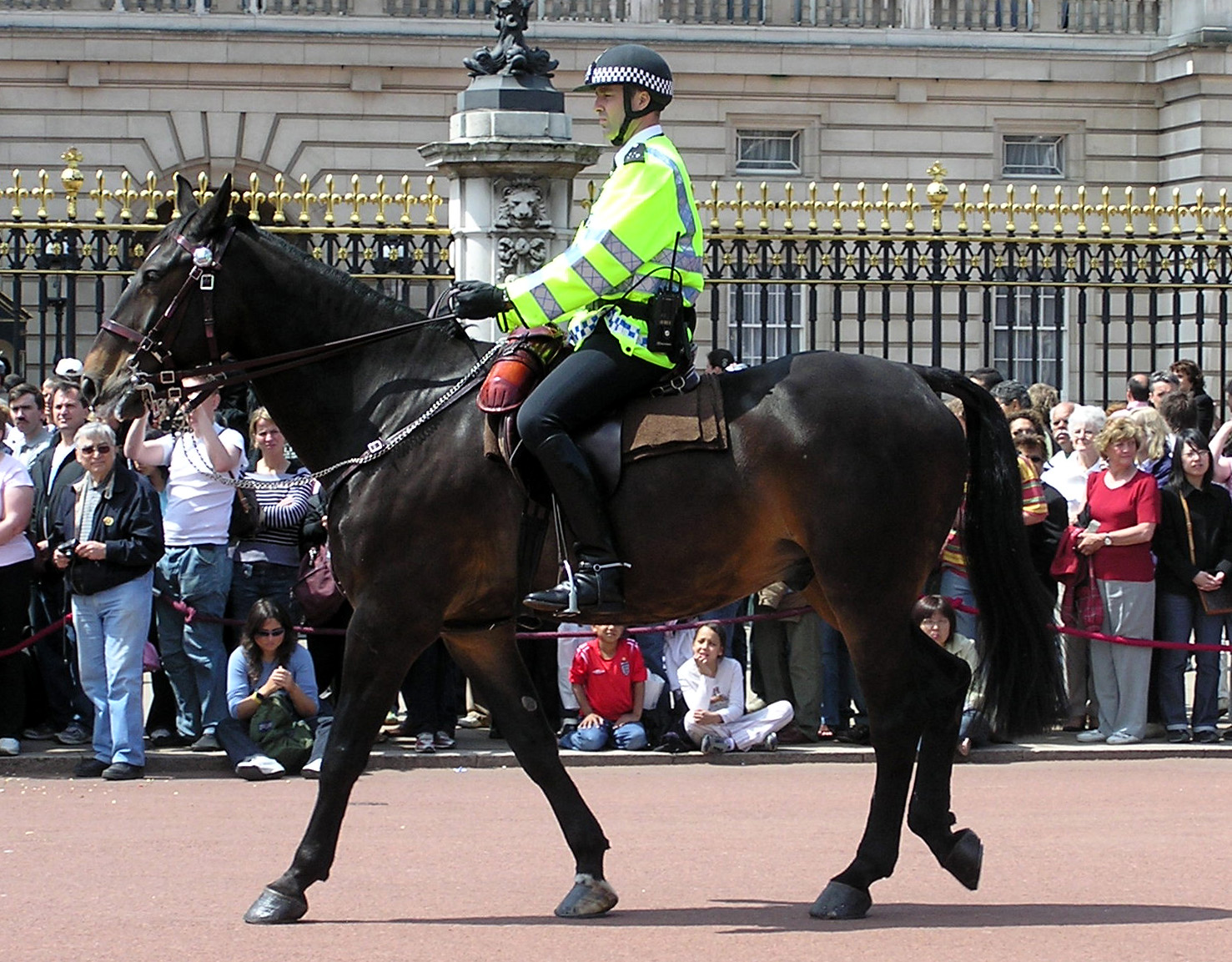
                • Police officers or security personnel, especially uniformed people who can see above the crowd.  They could be standing on a building or even astride a horse.  Higher vantage points will help them to see situations as they form and try to keep anything from getting out of hand.  The fact that they're officials will also mean that they'll have more success than an average Joe at trying to redirect or split up a large crowd.

            I know a lot of people out there don't like to see mounted police officers at concerts or popular events, but they can do a lot to keep crowds from getting dangerous.  The fact that the officers at the Love Parade apparently didn't do much, well, that's another story.  (Did you notice the velvet rope in this picture too?  Another crowd control device at work.)
            (Photo from Wikimedia Commons)

                • Loudspeakers.  These could be speakers set up on large stands, or they could be bullhorns that security personnel are carrying.  Sometimes somebody's got to tell a crowd what to do or where to go.  If there are a lot of people in the area, these things will be crucial at redirecting the foot traffic.
            • If you're about to enter a crowded area and you don't see any of these types of crowd control, it could become a dangerous situation.  Hang back until any clustering subsides, find a different route, or even turn around entirely.
            • When you do join a large crowd, try to keep close to the edge if you can.  This will give you the greatest freedom of movement and flexibility in case things start getting too bunched up.
            • If you're already in the thick of a crowd, make sure you have enough personal space around you so that you can plant your feet and keep yourself stable, if necessary.  They say there shouldn't be more than four people per square meter, but I don't know how big a square meter is.  A good indication is that if you're being touched on all four sides, the crowd is too closely packed and you should seek an area that's less congested.
            • If you get jostled and don't have enough room on the ground to plant a foot, it's really gotten too close.  Time to make getting out of the crowd your main priority.

            A crowd in the streets of New York after the Giants' Superbowl parade. Although this crowd is closely packed, the mounted and motorcycle police are close at hand, keeping an avenue open in the crowd. While there was some disorderly behavior, this crowd never really got out of control.
            (Photo from The New York Times)

            • In order to get yourself out of the crowd, experts say that it won't work if you turn around and try to press face first against the crowd.  But you can sometimes move sideways as the crowd surges forward. Pull your arms in close to your body and don't try to push against the flow of the crowd but keep edging and zig-zagging among the people as they move forward until you reach the outer edge of the group.
            • If you're in a tunnel, which was where the people at the Love Parade got stuck, working toward the edge wouldn't do any good. In that situation, experts say that if you can, move gradually backward.  This seems a little dangerous to me because you wouldn't be able to see where you're going or to know if someone is going to run into you from behind.  But the reason they say this is because the crowd will have bunched up due to a bottleneck ahead of you.  It's only going to get more crunched together as more people press in from the back of the crowd.  The only exit then is to the back. 
            • If you drop something, forget about it.  Don't stop to pick it up or try to make the crowd stop or flow around you.  Even if it's your purse full of irreplaceable photos of your dearest sweetest honey pie, you're better off with out it.  In fact, at this stage, you're actually better off if you're not carrying anything.
            • If you do fall down, curl up in that good old fetal position.  Protect your head and your stomach from being kicked accidentally.  If it's possible, try to roll toward the outside edge.  But make sure to protect your more vulnerable parts.

            Hopefully you'll never get to that point.  Remember, just because a ton of people are heading over there, that doesn't mean that's the cool place to be or the place you need to be right this minute.  Enjoy the show, but allow yourself the room you need to move and breathe, and stay safe.


            The people in this crowd aren't pressing against each other.  Everybody has enough space all the way around, everybody can easily keep both feet on the ground, nobody's panicked and nobody's pushing forward with a lot of demanding urgency.  But clearly, they're all very interested in what's about to happen -- they've gathered at an annual feast day and they're all about to eat.  Looks like a good crowd to me!
            (Photo from Living in Sri Radhakund)


            Sources
            Amanda Ripley, How Not To Get Trampled at the Inauguration, Slate.com, January 19, 2009
            wikiHow, How to Evade a Stampede of Shoppers
            M. M. Rooni, Stampede Safety Precautions, Associated Content from Yahoo! March 9, 2010
            Ask Metafilter, What's the best way to protect yourself if you're caught in a stampede? October 1, 2008

            Wednesday, July 14, 2010

            Apple #471: From Ambulance to Hospital

            Regular Daily Apple readers know that I've been having some trouble with my ears following a scuba diving class.  Don't worry, this is not why I'm doing an entry about ambulance services.  I went to the doctor about the ear thing yesterday, and he gave me some prescriptions.  They've had no effect so far other than to make me really speedy, but it's only been one day so I'm going to give it a little more time.

            No, the reason for this entry is because of a question that came up in conversation a little while ago.  A group of us were talking about a news article I'd seen around the 4th of July, which reported that a guy named Eric had blown off his arm while shooting off fireworks.  They weren't your average grocery store fireworks, but commercial-grade mortars he was lighting from a three-foot metal tube.  One of them, after he'd lit it, shot out of the tube and hit him in his left arm and blew it off.


            A rack of tubes designed to hold fireworks mortars.  Harry, the guy who works for Skylighter, the company that makes these mortar racks, says, "When using this rack, I drill holes in the feet and drive spikes through them and into the ground to keep the rack from bouncing and falling over. Care must be taken to avoid driving fasteners into the mortars. In pyro this is known as a 'bad-thing.'"
            (Photo from Skylighter)


            Fireworks mortars can be pretty huge. These are sold by Fireworks by Spectrum in Pennsylvania.


            Eric's friends wrapped his arm in ice and got him and the arm to the hospital.  Unfortunately, it sounds like he lost his arm permanently:

            While she wouldn't comment on the status of Smith's arm, spokeswoman Shelley Lotenburg said the hospital does not perform limb reattachments.

            After many exclamations like "Dude, that would suck, getting your arm to the hospital and it turns out they can't put it on!" we wondered whether he'd been brought to a different hospital, if his arm could have been reattached.  (Actually, a different news article reported that his friends said his arm from the shoulder to the elbow had been "blown to bits," so maybe not.)

            This discussion then led us to a larger question, which none of us knew the answer to, which was, when you're being driven to the hospital in an ambulance, who decides which hospital you get taken to?


            Paramedics in Folsom, California.
            (Photo from the City of Folsom)

            • First of all, the people in the ambulance are EMTs.  That stands for Emergency Medical Technician.  There are different levels of EMT, depending on how much training they've had.
            • Basic EMTs (EMT-1s) are trained for about 120-150 hours in basic life support.  They can assess what's going on, bandage bleeding wounds, and provide basic medications like oxygen, glucose, aspirin, asthma inhalants, or epinephrine.  They can't give shots or IVs.
            • Intermediate EMTs (EMT-Is) get an additional 50 or so hours of training.  They can give shots and start IVs and depending on which part of the country they're in, they may also be trained in assessing cardiac situations and providing appropriate medication, as well as some level of airway management like clearing an obstruction or intubating.
            • Paramedics are EMTs who have gotten even more extensive training.  They receive ten times the amount of training as basic EMTs and have often gotten degrees from two-year programs.  Paramedics can give shots and start IVs, they are allowed to use a lot more types of medications than the EMT-Is, they can handle lots of different airway management situations, they can read EKGs, and they might even be certified to suture wounds.

            Paramedics in training. They're learning how to intubate, provide oxygen, and use IVs.
            (Photo from the Emergency and Investigative Educational Institute in Florida)

            • So the people in the ambulance will all be at least a Basic EMT.  Probably the driver is a Basic EMT.  The people working in the back of the bus might be EMT-Is or paramedics.


            Driver compartment of an ambulance in New Jersey.
            (Photo from Roseland First Aid Squad)

            • Ambulances themselves are given different classifications.  Some provide Basic Life Support (BLS).  Some are equipped for Advanced Life Support (ALS).  
            • All ALS ambulances are staffed only with paramedics.  It used to be that most ambulances were BLS class, but it looks like more communities are getting only ALS ambulances.

            The interior of a 2004 Ford F-350 ALS ambulance in Arizona.
            (Photo from Christopher Kohl's Volunteer Fire Department)

            • Ambulances can vary in other ways, too.  Who owns and operates ambulances can vary from state to state, county to county, and city to city.  Most ambulances are part of local fire departments.  Some ambulances are part of an integrated police-fire-emergency medical response department.  Occasionally ambulances are owned and operated by hospitals or by private medical companies. These hospitals and companies work closely with local fire departments and emergency dispatchers. 

            Interior of a 2008 ALS ambulance owned by the Red Cross in Austria.
            (Photo by ggrexy on Flickr)

            • Regardless, the people inside the ambulance are trained in life support, they know how to assess the severity of a wound or a medical situation, and they are familiar with the hospital services in the area.
            • If you are alert when you're put into an ambulance, you could tell them, "Please take me to such & such hospital, I don't trust the doctors anyplace else," or "My insurance only covers me at thus & so hospital."  Or a family member could say something to that effect.  If possible, they'll do as you request.
            • But there are a lot of factors that go into the decision about which hospital they'll take you to.  Some of those factors might trump your wishes, in which case they'd take you to a different hospital.

            Interior of an ambulance in New Jersey
            (Photo from Roseland First Aid Squad)

            • Here's what's involved in deciding what hospital to go to:
              • Which is closest. Even if the nearest hospital may be across county or state lines, most ambulances are allowed to bring patients to whichever is closest.
              • Type of medical need, and which hospital treats those situations. For example, serious trauma patients need to be treated at Level 1 Trauma Centers, but not every hospital has such a center.  Not every hospital has a pediatrics unit or an OB/GYN unit either, which means not every hospital will accept a woman in labor.
              • Hospital availability.  Occasionally, a hospital may send out an alert that they can't accept more patients.  Their beds are full, some crucial equipment is not working, or they don't have enough staff on hand.  When that happens, a bulletin goes out to the dispatchers and the ambulances so they'll know not to take people to that hospital.
              • Patient request. Especially if the patient's request is based on insurance coverage, or previous history with a hospital or medical personnel at a given location, this will play a fairly big role in the decision.
                • Police custody. If a patient is in police custody, the police can dictate where the patient has to be taken.
              • Here's one dramatic example of when the nearest hospital isn't always best. A guy named Chuck who'd had a stroke when he was out mountain climbing had a helicopter ambulance come out to get him.  The pilot wanted to take him to the nearest hospital, but the paramedic and the nurse on board said no, take him to this other hospital 15 miles farther away because they have a certified stroke center.  They stood there yelling at the pilot until he agreed to take Chuck to the other hospital.  When he got there, the hospital with the stroke center gave him a specific medication that dissolved the clot in his brain, saving his life.  The nearer hospital probably wouldn't have had that medication on hand.

              The interior of a helicopter ambulance. This one is the AW139, and it's in use in the US, the UK, and Italy.
              (Photo from aerospace-technology.com)

              • In general, where an ambulance takes a patient is a judgment call and there's some flexibility in the decision-making process.  
              • Based on some chat room conversations among EMTs, it sounds like those who work for hospitals or private companies, as opposed to local governments, are told to give the patients' wishes a higher level of priority -- which can be frustrating to the EMTs.


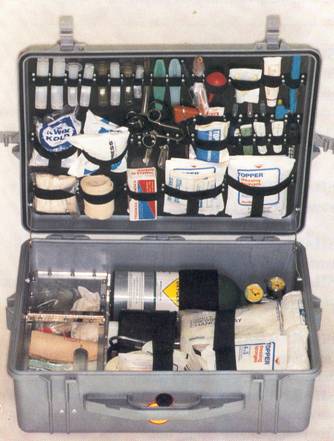
              Because I'm curious about things inside of ambulances, here's an EMT trauma kit. It contains an array of bandages, scissors, ointments, cold compresses, gloves, and other essentials. That cylinder toward the back contains oxygen. The whole thing weighs 24 pounds.
              (Photo and EMT O2 trauma case from Biotek)

              • One last fact.  It's difficult to get total data on the number of ambulance trips made for the entire country.  But I can tell you that the total number of ambulance trips in 2001 that were billed to Medicare -- which is certainly not all of them --  topped 10 million.

              Sources
              NY man blows off arm with fireworks, CNN.com, July 4, 2010
              Man who lost arm lighting fireworks in stable condition, WABC, July 5, 2010
              AlliedHealthWorld, EMT and Paramedic, EMT and Paramedic FAQs
              Rod Brouhard, About.com: First Aid, The Difference Between an EMT and a Paramedic
              Bureau of Labor Statistics, Emergency Medical Technicians and Paramedics
              Wikipedia, Paramedic
              emtcity.com, It is the patient's choice right?
              Wanakee Area EMS FAQs
              Hopper Institute, EMS Calls
              Sierra-Sacramento Valley EMS Agency, ALS Program Policy
              Salt Lake City EMS District Hospitals, Hospital Diversion Protocol 
              Poudre Valley Health System, Ambulance Services
              Crozer-Keystone Health System, Springfield Hospital EMS
              Elizabeth Cohen, Picking the right hospital can save your life, CNN, July 26, 2007
              GAO, Ambulance Services: Medicare Payments Can Be Better Targeted to Trips in Less Densely Populated Areas, September 2003

              Friday, June 25, 2010

              Apple #465: Library of Congress

              I'm working on a big ol' entry that I was hoping to have finished for you tonight, but it's not going to happen.  So I thought I'd find some quick facts about an institution that is related in a way to this here Daily Apple: a repository for an insane amount of knowledge, the Library of Congress.

              • The mission of the Library of Congress is to sustain and preserve a universal collection of knowledge and creativity for future generations.  That's an enormous goal.  So naturally, the Library of Congress will itself be enormous.
              • The Library currently holds around 145 million items -- books, photographs, maps, audio recordings, sheet music, manuscripts. These items occupy 745 million miles of shelves.
              • This includes materials also collected by overseas offices in India, Egypt, Brazil, Indonesia, Kenya, and Pakistan.
              • The original Library was burned by British troops in 1814.  Thomas Jefferson donated his personal library of 6,487 books as its replacement.  So our Library of Congress started with his collection.
              • Today, the Library receives about 22,000 new items each day.  Librarians are able to process around 10,000 per day.
              • In the US, the materials are stored in three separate buildings in on Capitol Hill and in several off-site storage facilities.  All the library stacks are closed, but as long as you're at least 16 years old, you can go there and look at materials by request, on site in the reading room.

              Reading room at the Library of Congress. 
              (Photo from UC Berkeley's Wiki on Visualization)

              • The Congressional Research Service, which is like a small army of people, responds to requests from Senators and Representatives and provides them with materials or research from the collection.  The idea is that the Library and the CRS will help our elected officials be as informed as possible about all sorts of topics. 
              • The Librarian of Congress -- the person ultimately in charge of the whole shebang -- is appointed by the President and confirmed by the Senate.  There have been only 13 Librarians of Congress since its inception in 1800.
              • The current Librarian of Congress is James H. Billington, who was sworn in on September 14, 1987.
              • The Librarian of Congress is also the person who selects our country's Poet Laureate.  
              • Our current poet laureate is Kay Ryan. Here is one of her poems:
              Sharks' Teeth

              Everything contains some
              silence. Noise gets
              its zest from the
              small shark's-tooth
              shaped fragments
              of rest angled
              in it. An hour
              of city holds maybe
              a minute of these
              remnants of a time
              when silence reigned,
              compact and dangerous
              as a shark. Sometimes
              a bit of a tail
              or fin can still
              be sensed in parks.


              Sources
              Library of Congress, About the Library