Showing posts with label beauty products. Show all posts

Sunday, November 23, 2014

Apple #690: Bobby Pins & the Bob

Thanksgiving is this week, so I'm sure you'd expect me to do a post about something to do with Thanksgiving.  I've already done a lot of Thanksgiving entries (see Ripe Apples at right).  So instead, I'm going to talk about something else that is currently of interest to me: the bobby pin.


Bobby pins fanned decoratively from a messy bun. What do you think, yea or nay?
(Photo from Free People Blog)


I got my hair cut recently, and I am not a fan.  One of the things that I let the hairdresser do was give me more bangs.  I have bangs already, but not a huge honking hunk of them.  My goal is to cover my large forehead, not to accentuate it and make a great big flashing sign that shouts in bang-speak, "HEY, BIG FOREHEAD HERE!"

But every hairdresser I have encountered who lays eyes on my rather minimal bangs sees them as some sort of Wrong That Must Be Corrected.  They immediately want to carve out a big V-shape's worth of hair and turn this into bangs and thereby plop a huge hunk of heavy hair on top of my face.


This enormous amount of bangs looks good on some people, but not on me. See how she's got a long, thin face?  (This woman's name is Carly Rae Jepsen, by the way.)  Let's just say my face is not shaped like that.  I also have thicker hair than she does.  So big honkin' bangs like this do not look good on me.
(Photo from Become Gorgeous)


This sort of thing -- minimal bangs that are not so heavy and that don't start all the way back at the crown of my head -- looks better on me.  This is Mariska Hargitay, who plays probably the only sex crimes detective whose hairstyle changes almost as often as her caseload. Note that her face is not long and slender but wider and more round.
(Photo from somewhere on this person's Pinterest page) 


The one hairdresser I was going to for several years learned that I hated this and did not try to give me the Big Bang Treatment.  But recently I went to a new person -- referral discount, close to my house, thought I'd try a change -- and when she suggested making more bangs, I forgot how much I hated that and said, "Sure, whatever you want."  Because, you know, you're supposed to trust a hairdresser to make you look better, not worse, right?  The unfortunate result: a ton of thick heavy bangs pouffing up at the top of my head, making my big head look even bigger.  Ugh.

Immediately I resolved to allow the extra baggage of bangs to grow out.  I have sectioned off the undesirable hunk, and to make them look as if they're part of the main, full-length mane, I've started keeping those bangs tucked down with the aid of that most crucial instrument, the bobby pin.

I haven't had to do this trick since high school, when another overzealous hairdresser pulled this same too-much-bangs fiasco on me, and I had to let those grow out.  Took about a year, actually, given how long my hair was at the time.  Anyway, I haven't forgotten that bobby pin trick after all this time, so I put it to use immediately.

Having now become so dependent on this long-unused beauty essential, I've started thinking about it.  Every time I insert one, I think, Bobby pin.  That's a weird phrase.  Bobby pin.  So of course I had to find out why we call these handy gizmos "bobby pins."


Bobby pins
(Photo from Sam the Bear)

The Pins

  • Bobby pins got their name when they became popular, which was during the hey-day of the bob haircut, in the 1920s.  Women used these pins to keep their bob haircut out of the face.
 

An exemplary bob from the 1920s, worn here by Louise Brooks.  You can imagine how the hair on either side of her face might slide easily and often into her eyes.  Ah, but not with the aid of the ever-discreet bobby pin!
(Photo from MrsKHistory)


Note the vintage Bob Clips at right.  They have a shape similar to the bobby pins we use today.
(Photo from Hair Archives)


The Gayla Hold-Bob Bobby Pins name says it all: these pins will hold your bob in place.
(Photo from Michelle Shepherd NZ)


And this ad explains it fully: "Bobbed Heads Want the Bobbie Pin: Keeps Hair Tidy."  I'm sure there was some very scientific research behind that 7 out of 11 heads statistic.
(Image from Michelle Shepherd NZ)
  • Unlike waving pins, which were used to keep your Marcel wave wavy, or hair clips, or bandeaux, or other decorative hair ornaments, the bobby pins were supposed to be discreet.  Blend in with your hair.  Be mostly invisible.
  • Of course, decorative bobby pins were also made.  Kind of like how dresses with very visible zippers are the rage these days: let's not hide the pins that hold up the works, let's bring those underpins to the outer light and show them off.  


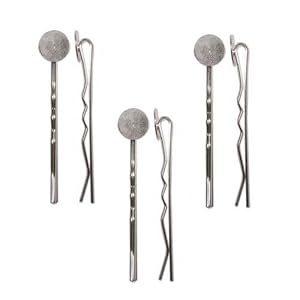
I had a pair of decorative bobby pins that looked something like this, which I think belonged to my Great Aunt Ceil.  I unfortunately lost one at a particularly fun Halloween party.
(Photo from Amazon, pins from Beadaholique. A 6-piece set of these pins can be yours from Amazon for about $5: Beadaholique 6-Piece Metal Bobby Pins with Pad for Gluing, 10mm, Silver) 

  • A lot of people say that the way you're really supposed to use bobby pins is to put the wavy side down. They say this as if it's a fact everyone, duh, should know.  They say the pins grip better that way. 
  • OK, maybe they do work better that way. But if this is something that everyone, duh, should know, then whey are all those decorative bobby pins made so that the jiggy side goes up. Riddle me that one, smarty-pants fashion magazine people.
  • I would further like to point out that bobby pins are useful for all sorts of lock-picking and safe-cracking applications, as referenced in countless noir movies and TV detective shows, most notably in Charlie's Angels.  Any good detective worth her salt would have a bobby pin on hand in the event of just such an emergency.  The Charlie's Angels detectives were so savvy, they even carried little plastic containers that held a selection of bobby pins of various widths and lengths.

Cosmo magazine, in an article fantastically titled "20 Life-Changing Ways to Use Bobby Pins" recommends using an empty Tic Tac box to hold your bobby pins.  I can't show you their photo since it has the bugbear (c) over it, but here is someone else's picture of the same thing.
(Photo from The Burlap Bag)

  • I wonder if Cosmo et al. saw those same Charlie's Angels episodes where they carry their bobby pins in a little container and got the idea to use the Tic Tac box from that.

The Haircut

  • So if bobby pins are named for the bob, why is the bob called the bob?
  • Answer: because a woman getting her hair cut that short is much like the way they bob a horse's tail.
  • No, really.  The verb to bob in the sense of cutting hair short was originally applied to bobbing horses' tails.  
    • You know, like the name of the horse in "Jingle Bells:" "Bells on Bobtail ring / Making spirits bright."

 
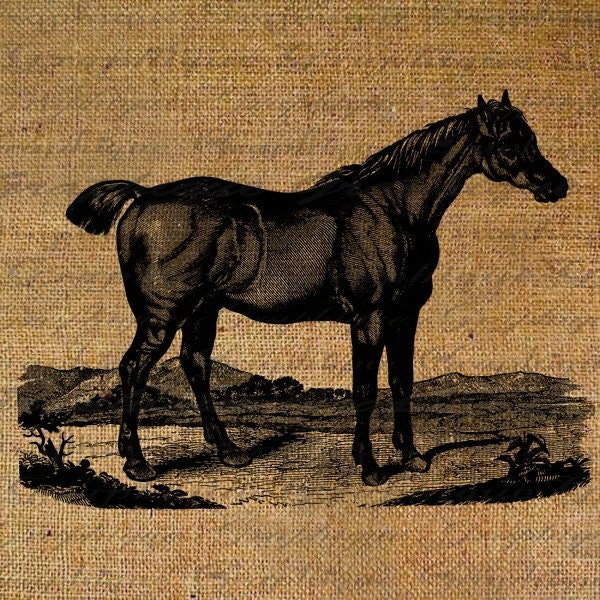
Horse with a bobbed tail
(Burlap decorated towel available on Etsy for $1)

  • Imagine, if you will, the barber taking hold of a woman's pony tail and chopping it off right above where the pony tail is secured.  That would give you essentially a bob haircut--with a little more shaping, of course.


The barber lops off the ponytail, like this, and gives you a bob.
(Image from The Hourglass Files)

  • It really was the barber, by the way, who gave most women their bobs in the early part of the 1920s. Hairdressers, used to coiffing women's long hair into complicated up-dos, were at a loss when women came asking them to chop it all off into a short style.  So women in want of a bob went to men's barbers, who were used to cutting short hair.  And they did as the women asked, shocking though so many of them found the haircuts to be.
  • When did the bob originate?  There are a lot of sites out there that give histories of the bob, but for my money, the best and most complete history is given here, at V is for Vintage.
  • This blog points out that the first woman known to wear a bob is none other than -- I don't think you'll guess this -- Joan of Arc.

 
Jeanne d'Arc. The bob looks good on her in this depiction, don't you think?
(Image from Catholic Tradition)


  • Brief biography: French peasant girl Jeanne d'Arc believed God had chosen her to lead the French army in its battles against the English (Burgundians) in the early 1400s.  A teen-ager, she cut off her hair to disguise her gender and with no military training, told the French crown prince information about troop positions that no one else could have known and which she said God had told her about. So the crown prince agreed to allow her to lead the French troops in a battle at OrlĂ©ans, which they won.  However, after some later battles that the prince undertook against Jeanne's advice, and which they lost, the English troops (Burgundians) captured her and put her on trial for heresy and witchcraft and for dressing like a man and some 67 other charges.  They decided she was a heretic and a witch, and after keeping her imprisoned for a year, burned her at the stake.  It was her insistence on dressing like a man that really put them over the top.  She was 19 years old when she was burned to death.
  • Fast forward to 1909.  Then-Pope Benedict XV beatified Jeanne d'Arc.  In 1920, she was  canonized to full-on saint, and was made the patron saint of France. All of this brought her into the forefront of the popular eye, even after centuries' worth of paintings and stories had been made and told about her.
  • Also in 1909, a French hairdresser to celebrities named Antoine began cutting his female customers' hair in a bob, a la Jeanne d'Arc.  In France, the bob is still referred to as "coupe a la Jeanne D’Arc."
  • Americans like to think the bob was invented when an American ballroom dancer named Irene Castle had her hair bobbed in 1915 for the sake of convenience.  Or else they say it was the influence of F. Scott Fitzgerald's story "Bernice Bobs Her Hair," published in the Saturday Evening Post in 1920. But really, it started with Joan of Arc and Antoine.  Who was originally from Poland.


Irene Castle, sporting her famous bob. Notice she has some of her hair pinned back -- with bobby pins, no doubt.
(Photo sourced from the Hair Archives)


French actress Polaire cut her hair short well before the bob became popular -- as early as the 1890s. But she was considered too scandalous for everyone else to adopt her style, at least, not until a few decades had passed.
(Photo sourced from Photographs, Films, Literature & Quotes from the Bygone Era)

Final Thoughts

  • So, where does this leave us?  Bobby pins, which sounds like a very British phrase, were named for the haircut called the bob, which originated in France. Popularized by a French hairdresser.  Who was originally from Poland.
  • Also, I would like to point out that many people now use bobby pins to secure hairdos which are achievable only with long hair.  See for example, 20 Life-Changing Ways to Use Bobby Pins. Read and do come back to tell me if your life has changed.

Sources
V is for Vintage, The Bob: history of a hairstyle
Smithsonian, The History of the Flapper, Part 4: Emboldened by the Bob
Hair Archives, The Bob
Online Etymology Dictionary, bob
History.com, Joan of Arc

Monday, August 4, 2014

Apple #680: Henna Tattoos

This weekend at the state fair, I got a henna tattoo.


I went for a simple $8 design of a sun. The tattoo artist offered to extend it so it goes up my finger. I said OK by me.
(Photo by the Apple Lady)


Naturally, I asked the woman who gave me the tattoo all sorts of questions about it.  And again naturally, I have still more questions.  So here follows some of the things she told me mixed in with some of the things I looked up and have learned since.

What Is Henna?

  • Henna is a dye made from the ground-up leaves of the henna plant (Lawsonia inermis).  
  • It's sometimes also referred to as mehndi or mehandi or mendhi.


The henna plant is a pretty non-descript looking shrub.
(Photo from Sailu's Kitchen)


  • The plant is a flowering shrub that grows in all sorts of places, including the US and Australia, but it's most prevalent in the dry, arid regions in northern Africa, India, and the Middle East, and it also grows in Southeast Asia.
  • The leaves themselves won't stain anything; you have to crush them or grind them up before they will work as a dye. Most people make their henna dye from powdered henna.
  • Henna has been used as a dye for both hair and skin for centuries in several different cultures & religions in the areas where it grows.
  • Though people of Muslim, Hindi, Jewish, and other faiths have all used henna, they all generally consider that henna tattoos mean some sort of good luck or blessing. 


Traditional bridal mehndi -- henna tattoo on the hands & wrists prior to a marriage, here, on a bride from India.
(Photo from Sameera Threading)

Why it's Usually Brown, and Why on the Hands & Feet

  • Traditionally in most of these cultures, women's hands or feet, or both, were tattooed before a wedding as a way to invoke good luck for the bride or the marriage.  But now lots of people get henna tattoos for lots of purposes.
  • It takes a while for the henna stain to sink into the skin.  So you don't know right away how dark the tattoo will be.  The stain can range from tan to light brown to auburn to dark brown.  
  • What color the tattoo becomes depends on the person's skin, where on the body the tattoo is applied (some areas take up the stain better than others), how much henna is present in the stain mixture, whether the henna artist has used some form of mild acid like lemon juice or vinegar as an adjuvant, etc. 
  • Because the color of the stain varies from one person to another and from one application to another, the darkness of the tattoo is consider to signify the extent of the good luck. In other words, the darker the henna tattoo, the better your luck will be.  So the theory goes. 
  • Most henna tattoos are put on the hands and feet.  This is because the skin here tends to be thicker, so it will absorb more of the henna, and the resulting tattoo looks darker than it would elsewhere.  
  • Back of the hand and top of the feet works best because it's easier to keep from disturbing the henna paste as it dries and interrupting the process by which the paste stains your skin.  But people do put henna tattoos in lots of places--palms, shoulders, calves, bellies, etc.


This henna tattoo starts on the fingers, descends down the palm, and onto the wrist. You can see how the tattoo is darker on the fingers and palm than it is on the wrist. This is because the skin on the wrist is thinner and doesn't take up the stain as well as on the hand.
(Photo from Ohio Body Art)


What It's Made of

  • Most henna artists mix the powder into a paste. Typical ingredients include:
    • henna powder
    • black tea or coffee
    • lemon juice or lime juice or orange juice or vinegar (mild citric or acetic acid)
    • sometimes the lemon juice etc. is mixed with sugar
  • That's it. People say the resulting paste feels like toothpaste.  In my very limited experience, the paste that was put on me felt smoother even than toothpaste. More like gel toothpaste.
  • The henna plant is not toxic, and neither are any of those above ingredients. (The situation is a little different for "black" henna, but I'll get to that in a bit.)
  • The paste is applied to your skin, usually through a tiny little tube, sort of like a minuscule cake decorating tip.  There are no needles, nothing is injected into your skin, it is not a painful experience at all. In fact, it's rather soothing. 


This applicator is like what my henna tattoo artist used.  Most of the applicator is a slender metal cone which tapers to a fine point with a hole in the end. At the top end of the applicator is essentially a plastic bag containing the henna paste. The artist squeezes the bag which makes the paste come out the tiny little hole at the bottom. The artist moves the applicator while squeezing out the paste. Often the artist makes very detailed designs and fine lines. I was pretty impressed with the delicacy of the skill.
(Photo from ehow)


This is another type of henna applicator. Here, instead of a little plastic bag, the receptacle that holds the paste is a plastic bottle.  The tip of the bottle is the very fine tube with a tiny hole at the end through which the henna paste emerges as it is squeezed out and applied to the skin.
(Photo from Wikimedia Commons)

  • Since nothing is injected into your skin, some people say it's technically not a tattoo. 
  • The stain sinks down into only the first few layers of your skin, all of which are dead skin cells.  As these skin cells are naturally worn away, so also will the henna tattoo. That's why it only lasts a couple of weeks. 

The Application Process

  • The paste goes on black.  You leave it on, allowing the paste to dry and so the stain has time to sink into your skin.


Henna paste being applied. Here you can see how it sits on top of the skin.
(Photo from White Ink Tattoo Center)

  • You'll want to let the paste dry for anywhere from 4-8 hours. The range of time depends on the mixture your artist is using, how hot & humid the weather is, if you've got lotion on your hands (or wherever the tattoo was applied), etc.
  • This means you won't want to wet your hand--or foot or wherever you got the tattoo--during that drying time. So this is why people tend to get their henna tattoo on their non-dominant hand. 
  • You'll also want to avoid brushing it against things, which will rub the paste off, or flexing and moving that part of your body very much. 
  • When the paste dries, it will flake off in bits.  Some of those bits got on my sheets and left faint brown stains. I washed my sheets right away and the stain came out, no problem.
  • After the dried paste flakes away, the brown stain on your skin will become visible.  Over the next day or two, the brown stain will continue to darken somewhat.
  • You'll still want to avoid washing the area that's been tattooed for about 24 hours.  After that, you can wash your hand, but you'll want to avoid any vigorous scrubbing.  The more scrubbing, the more of those dead skin cells you'll wash away, and the faster your tattoo will fade.


Process of a henna tattoo, from paste to no-paste to additional darkening.
(Image from New World Henna)


This is what the paste looks like as it's drying & flaking off -- kind of crusty.
(Photo from Cuded)


Some of the designs can be really elaborate.
(Photo from White Ink Tattoos Center)


Or even more elaborate. This person would have to keep from moving both of her hands for several hours in order for this tattoo to turn out properly.
(Photo from ehow)


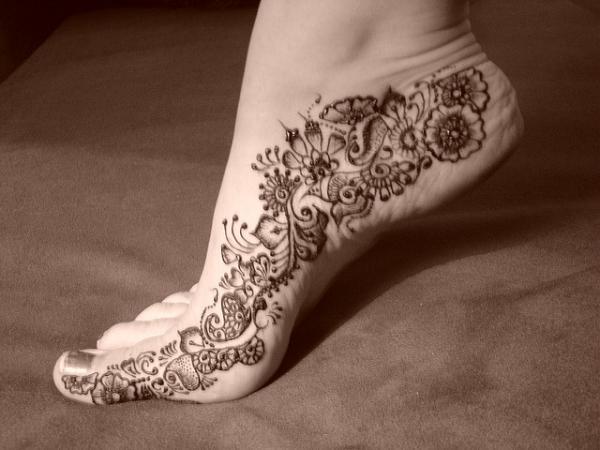
Henna on feet & toes -- also very detailed.
(Photo from Lovetoknow Tattoos)


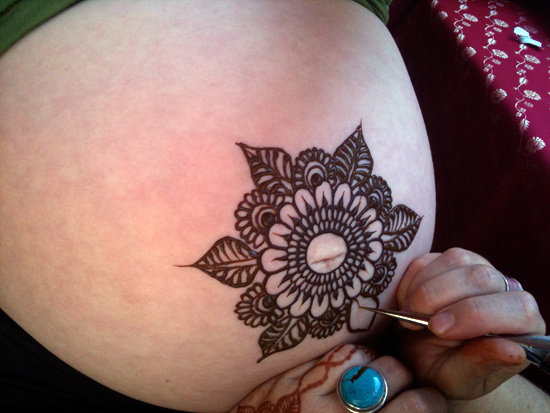
Some pregnant women get henna tattoos on their bellies--I suppose in hopes of giving good luck to their forthcoming babies.
(Photo from Pop Sugar)


This might be a cool idea for someone going through chemo.
(Photo from Best Tattoo Designs Ideas)


Black Henna

  • In most photos of henna tattoos online, the henna looks black. I'm going to assume that this is probably because the picture was taken right after the henna was applied, before the paste dried.
  • However, there is a thing people call black henna.  This type of henna leaves behind a much darker, blacker stain after the paste dries and flakes off.  
  • The ingredient that gets added to the henna that turns it black is a chemical called paraphenylenediamine, or p-phenylenediamine, or PPD.
  • PPD is a type of coal tar that's been used for many years in hair dye, especially for brunette & black dyes. 
  • Some people are allergic to PPD.  If you are allergic to PPD, you do not want this stuff to touch your skin. It is possible to develop an allergy to PPD after having been exposed to it over time. This is why the hair dye people want you to do a skin test before each self-dyeing session, to make sure you haven't developed a PPD allergy.
  • But since henna is used to dye hair as well as skin, people thought, why not add the PPD that we've been using in hair dye to the henna, to make it darker?
  • It turns out, this isn't such a hot idea because for those people who are allergic to PPD, they experience some pretty unpleasant results with the black henna tattoos.

You can see that this woman from Kuwait got a really beautiful henna tattoo. Except the henna that was used had PPD in it, and she turned out to be allergic to PPD. So her skin turned red and swelled up every place the black henna was applied.
(Photo from Evans et al., New England Journal of Medicine) 

  • Since it takes quite a few hours for the henna to soak into the skin, it can also take that long before people discover they are allergic to the PPD in black henna. So, often the artist using black henna does not know if one of his or her clients has had a bad reaction to the black henna.
  • The best thing to do, therefore, is to ask your henna artist if he or she uses black henna.  If you know you're allergic to PPD, ask if he or she would use the regular henna instead. 
  • If you get a black henna tattoo and then discover you're allergic because your hand is tingling and itching and swelling up like a beautifully decorated basketball, go to your doctor as soon as possible. Most likely, your doctor will prescribe some sort of steroid that will take down the swelling.
  • If the reaction and the swelling are severe, you could wind up with permanent pigmentation -- your temporary black henna tattoo would become permanent.
  • Even if you think you're not allergic to PPD, it's probably best to avoid the black henna.

Now I'll show you some more pictures of regular henna tattoos because there are a lot of really magnificent ones.


(Photo from Factortruth) 


(Photo from Henna Tattoo Body Art)


Foot henna
(Photo from Cuded)


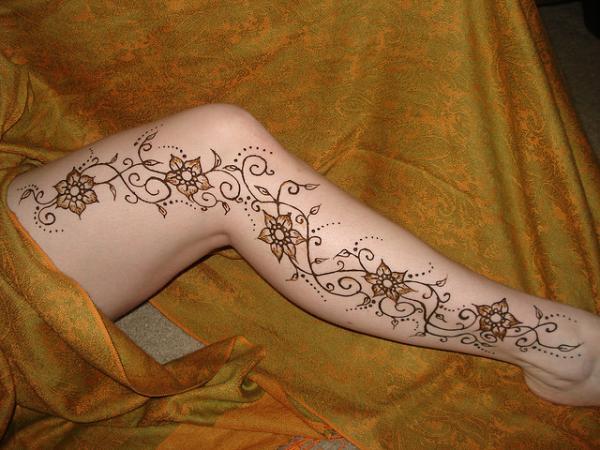
Leg henna
(Photo from Cuded)


Some henna tattoo artists are also adding additional dyes to make the henna different colors.
(Photo from Tattoos Time)


I think this one wins the prize. This is a wedding henna tattoo, complete with all sorts of colors, glitter, and body art gems.
(Photo from Crafty Nitti)


Sources
Desdemona's Designs Ohio Body Art, FAQ
Henna Arts, Frequently Asked Questions
The Henna Page, Why doesn't henna stain last forever like a tattoo?
Henna Mehndi, How to Mix Henna?
HennaTattoos.com FAQs
FDA Consumer Information, Temporary Tattoos May Put You at Risk
Colby C. Evans, and John D. Fleming, Allergic Contact Dermatitis from a Henna Tattoo, The New England Journal of Medicine, 2008; 359:627

Monday, July 14, 2014

Apple #678: Does Hair Dye Make Your Hair Fall Out?

Most of my Daily Apples start when I encounter some sort of question I don't know the answer to.  I look stuff up online, and I post what I find here.  One of my goals is to demonstrate that you can find the answer to just about any question on these here Internets, if you take a few minutes to run a few Google searches.  Now that pretty much everybody has a smart phone, you're all starting to figure that out.

But in some cases, these here Internets don't have all the answers.  I know, you Internet lovers are gasping in disbelief.  But it is true.  Sometimes the best way to learn about something is to experience it.  The answer to today's topic, can hair dye make your hair fall out, comes to you courtesy of your Apple Lady's personal experience.


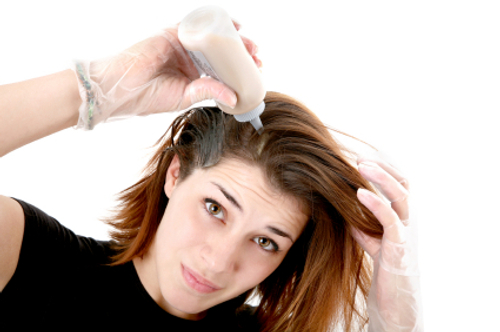
This is actually a home hair coloring DON'T.
(Photo from SheKnows)


I'll give you the answer first, and then I'll give you some more information.  If you're interested, you can read on.  Or you can just get the answer and move along.

  • Yes, hair dye can make your hair fall out.  But only if it touches (and burns) your scalp.
  • One little spelling/grammar thing.  People, you are not "dying" your hair.  You are "dyeing" it.  Dying is the process of going down that dark road to death.  Dyeing is the process of coloring.  OK?  
  • And actually, we want to find out how to dye our hair without dying it.  If you get my pun.

Knowledge by Experience

  • Here's how I learned the truth about hair dye and hair loss:
  • For a while I had my hair professionally colored, but my hairdresser left a very thin strip along the part that wasn't colored.  After several sessions when this was still the case I thought, What the heck am I paying him all this money for if he doesn't even color the roots?  I'll do this myself.
  • So I started coloring my hair myself.  So much less expensive!  Plus, I made sure to put the dye as close to the scalp as possible.  No more differently colored roots!
  • Rinsing out the color afterward, I noticed more strands than usual coming away in my hands.  Not a ton more, but enough to be noticeable.  Slightly disturbing and not ideal, but not enough to freak me out.
  • But by the third or fourth time I did it myself, I was really putting the color close to the scalp.  Get it all down in there, I thought.  We don't want any of that undesirable shade (OK, gray) to show up any sooner than necessary.  I even kind of scrubbed it in at the temples.
  • Rinsing out the color that time, egad, practically buckets of hair came away in my hands.  Not, like, in giant bunches, but six & eight & ten strands at once, again and again and again.  Combing my hair afterwards, still a ton of hair coming away.  One and two days later, still, a ton of hair coming away in my comb and my brush, and even just when running my hand through my hair.  THAT was enough to freak me out.
 

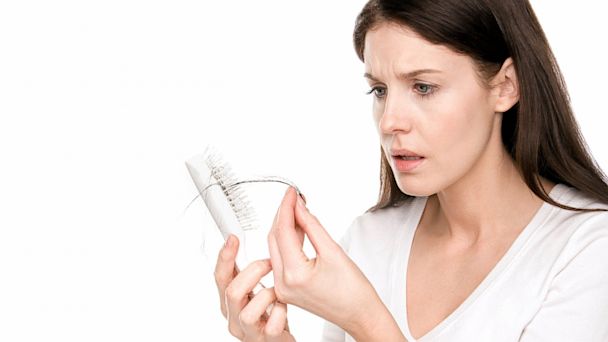
This is about the level of hair loss at that time.  Maybe not even quite as much as this.  But enough to be upsetting.
(Image from Stophairlossx.com)


  • I looked up all sorts of things online and I found out that there's a chemical in some (OK, most) hair colors that can give you "adverse reactions" including making your hair fall out, or giving you an allergic rash, etc.
  • That chemical is paraphenylenediamine, sometimes abbreviated P-Phenylenediamine, or PPD.  
    • IMPORTANT NOTE:  At the time, I thought it was the PPD that was making my hair fall out, but it turns out, that only happens if you have an allergic reaction to it.  That's why the hair color box tells you to test the color on your skin first, before applying.  This test is to see if you are allergic to the PPD.  I didn't have that skin reaction, so the PPD wasn't actually the problem.  But for a while, I assumed it was. 


This is the amount of hair loss you could experience if you are allergic to PPD.
(Photo from Ishida et al., ISRN Dermatology)


  • I checked the ingredients on the box of hair color I'd been using and sure enough, that giant para-blahblah word was in the list.  The next time I went to the store, I looked at other brands of hair color, and they pretty much all had that ingredient.  So I thought, Well, so much for coloring my hair by myself.
  • So I went back to my hairdresser.  I assumed he was using some sort of "professional" hair color that wouldn't have that bad old PPD in it.  I told him what I'd read online, and when I mentioned this chemical, he picked up a box of the stuff he uses and frowned at it.  He said, "So, you're allergic to this chemical, and I shouldn't use hair color that has that in it?"
  • OK, now, here comes what's known as a "human moment."  I so wanted my hair to be colored that, even though I suspected his hair color had the PPD in it, and even though I suspected that the PPD would make my hair fall out, I told him it was fine, don't worry about it, go ahead.  I wanted my hair to be colored, even if that meant a good deal of it would fall out.  Go figure.
  • But there is actually a logic to me telling him to go ahead.  Which is that after he colored my hair a number of times before, there hadn't been much hair loss at all.  In fact, I noticed no difference between the day after getting my hair colored by him and any other day's normal hair shedding.  You know, a strand or two here & there.  No big deal at all.
  • So this left one other possible explanation for my hair shedding episode.  I said to my hairdresser, "So, do you avoid putting the hair color all the way to the scalp on purpose?"
  • "Yes," he said.  He explained that this keeps the different colors from bleeding into each other, and it also protects your scalp and the root of the hair from being damaged.
  • If I'd just asked him the question from the get-go, that would have saved me so much time.


Ignoring the fact that they are making this poor woman's hair striped, notice how they've left a bit of hair NOT colored up near the part. This helps keep your hair from being damaged and breaking at the scalp or falling out.
(Photo from BoldSky)


Again, notice how the foil doesn't actually go all the way up to the scalp but stops a little bit below the scalp. You may not be using foils at home, but you can be sure to apply the color a bit away from the scalp.
(Photo from 7YearsYounger)


This is what you DON'T want to do.  You don't want to inject the color right down into your scalp.  These squeeze bottles don't actually give you much control over where the color goes.  It will work better if you squeeze the color into a plastic dish of some kind and use a little brush to apply the color.  Clairol's Nice 'n' Easy Root Touch-Up is really cheap--about $4.50 at the grocery store--and it comes with a brush.  The color has lots of ammonia and is pretty harsh after more than a couple uses.  But it's a cheap way to get a coloring brush that you can rinse out and use again.
(Photo from SheKnows) 


  • Since then, I've looked up this question a couple other times, trying the search a few different ways to see what other responses come up.  Because all the aesthetician/cosmetician/professional hair care people insist that no, hair dye does not make your hair fall out.  But regular people like you and me say, Well, actually, it seems like my hair is falling out.
  • After combing through (pun!) a number of comments on a few chat boards, I noticed a pattern.  People who said they'd put a ton of color on their hair, or let it soak in, or otherwise put it all the way on their scalp--these were the people saying they were experiencing episodes of "shedding": tons of hair falling out over a period of a few days to a week.
  • So I took a chance and went back to coloring my hair myself.  (I really can't afford the professional thing that often.)   I've been careful not to let the color touch my scalp, though it is hard to keep that from happening sometimes, and I have not had another shedding incident since.  Some extra hair still does come away during the post-coloring rinse, but nowhere near as much as before.
  • Thus, I call the case solved: hair dye can make your hair fall out, but only if you let it touch your scalp.  Conversely, if you keep the hair dye from touching your scalp, you can reduce the possibility of hair loss quite a bit. 

More Facts I've Learned Since

  • So, most of your hair is dead.  That's why you can color it, cut it, curl it, blow it dry, and feel nothing.  As long as you confine the stuff you do to your hair to the dead part -- the shaft -- it's probably not going to have really serious effects.
  • But when you start messing around with the live part of the hair, then you're going to have problems.


A trusty diagram of ye olde hair follicle.  How many times have you seen diagrams like this?  But here's my point: look at all the activity going on under the surface of the skin.  There are oil (sebaceous) glands, there are blood vessels, there's the outer sheath, and there is the dermal papilla, better known as the bulb or the root.  All this stuff exists to keep your hair alive and growing.  Mess with this and your hair is not going to be happy.
(Diagram from Too Loop)

  • Hair naturally goes through a cycle of growth, falling out, and regrowth.  One strand of hair is in the growing phase for 4 to 6 years.  That's right, years!  Then it goes into a resting phase where nothing's happening.  Then a new bit of hair starts growing in the follicle under the old hair, pushing the old hair out and the cycle begins again.  
  • Normally anywhere from 50 to 150 strands of hair fall out per day as part of this cycle.  


Stages in a strand of hair's life: Growth, Transition, Resting, Falling Out/Regrowth.
(Diagram from Pure Aesthetics Pure Wellness)

  • When a stressor hits, the effects are felt in the follicle.  The results -- hair falling out -- can happen right away, or more often, within 2 to 3 months of the stressing event.
  • These kinds of stressors are usually major life things, like big changes in hormone levels, giving birth, very high fevers, diseases such as diabetes or lupus, severe dieting or anorexia, chemotherapy, radiation therapy, burns. 
  • Those big-time events literally make the hair fall out of the follicle. When the stressful thing goes away, the hair usually grows back eventually.
  • One of the experts who finally admitted that dyeing can adversely affect your hair says that dyeing the hair (or bleaching it or straightening it or giving it a perm) doesn't actually make the hair fall out, but rather breaks the hair off at or near the scalp, and then the root of the hair continues growing.  
  • I think she might be splitting hairs (another pun!).  I don't remember noticing the little bulb of white at the end of any of the hairs that have come out following a coloring incident, so maybe she's right.  Maybe the hair isn't actually falling out; it's only breaking off.  But either way, it's not what you want to happen.
  • The good news is that, once the color-treating process is over, even though that's when you discover that damage has occurred, the damage has actually stopped.  From that point on, the hair continues its growth process.
  • Hair grows about half an inch per month.  So within a couple of months, you can go back to being happy, smiling you.


(Photo by Ahoova on Flickr)


Sources
Ishida et al., "Severe Hair Loss of the Scalp due to Hair Dye Containing Para phenylenediamine," ISRN Dermatology, April 2011
Dr. Judith Reichman, Getting to the root of female hair loss, TODAY Health, August 2006
Nicehair.org, Can dying [sic] your hair cause hair loss?  
Susan Donaldson James, After Hair Loss at 11, Shame Ruins Woman's Singing Career, ABC News, April 3, 2013
Florida Center for Pediatric Dermatology, Does Hair Dye Make Your Hair Fall Out? Dr. Tace Rico Explains [they're talking about PPD and allergic reactions to it]
Linda DiProperzio, Women's Hair Loss: What Your Hair Stylist Might Not Be Telling You, Care.com

Monday, September 12, 2011

Apple #547: Cotton Balls

I've lately taken to polishing my toenails. When I want to change the polish color, I rely heavily on our good friend, the cotton ball. A fairly genius little invention.


Cotton balls are so soft and fluffy and nice.
(Photo from Just for Life)


  • Cotton balls are uniquely good at absorbing liquids. They're used in medicine to treat wounds as well as in cosmetics for applying make-up and other liquids.
  • Some cotton balls are not actually made of 100% cotton but are made of synthetic fibers in part or entirely. Those cotton ball pretenders won't absorb whatever liquid you want to put on it nearly as well as 100% cotton. Other types of fibers will also tear and break apart much more quickly.
  • One bale of cotton can make 680,000 cotton balls.
  • You can use cotton balls as miniature air fresheners. Just plain cotton balls in the refrigerator has the same smell-absorbing effect as baking soda. And if you have small spots of mildew in your bathroom, soak a cotton ball or two in bleach, wedge the cotton ball against the mildew spot, and let it sit there for a few hours. When you come back, the mildew will be gone.
  • If you're having trouble starting a fire, soak a cotton ball in melted Vaseline (or any petroleum jelly). The petroleum jelly acts like an accelerant and the cotton ball acts like a super-packed wick. The fire will last a pretty long time, people say.

That looks like someone dropped their marshmallow into the fire, but no, that's a cotton ball soaked in Vaseline, used to start the fire.
(Photo from Off Grid Survival)


  • Despite all their fluffiness and niceness, there is a phobia of cotton balls. It's not very common, but some people do have it. They cannot bear to touch cotton balls. Something about the texture of them, or the sound when they're being ripped apart, gives people the shivers to such an extent, they won't go near them.
  • This phobia is known as Sidonglobophobia or Bambakophobia. It sounds like I'm making this up, especially after that one entry I did about the fear of being watched by a duck (which is a made-up phobia). But this one is for real. Apparently Michael Jackson is one of the few people who had it.
  • Here's more cotton ball weirdness: there is a diet that involves eating cotton balls. It's an insane diet because it can cause major digestive problems, to say the least. But people have done it. The idea is to eat cotton balls before your meal so that the fiber in the cotton makes you feel full and you eat less. Some people soak the cotton balls in something like orange juice to make them palatable at least. But this only makes me sigh. There are no shortcuts, people. Not even via cotton balls.
  • Yes, it's true, Marlon Brando put cotton balls in his cheeks when he played the Godfather.

Cotton balls played a crucial role in this scene.
(Photo from Celebrity Picnic)

  • Peter Sellers spoofed this to great effect in Revenge of the Pink Panther. As a master of disguises, you kneauw, he disguised himself as a rotund exaggerated version of the Godfather, complete with cotton balls in his cheeks. Except he started choking on them in front of the bad guys. When one of them clapped him on the back, the cotton balls flew out of his mouth.
  • Artist Zimoun created an art installation featuring 138 cotton balls. He put each one on in its own cardboard box, attached each to a motorized stick, and rolled them back and forth over the cardboard, and recorded the sound. It's surprisingly loud.
  • You can make tons of crafty things yourself out of cotton balls. Here is a sheep made out of cotton balls and a toilet paper tube.

Instructions for making this cotton ball sheep and all sorts of other cotton ball crafts at Artists Helping Children.


Here's another picture of cotton balls because I just couldn't resist. They're so round and soft and friendly. I definitely do not have Sidonglobophobia.
(Photo from Daily Glow)


Sources
Cotton Catchment Communities, Cotton Fun Facts
Cotton Incorporated, Personal Products: What Are They Made Of?
Fear and Phobias.uk, Phobia and Fear of Cotton Balls
Phobia Fear Release, Comments for Fear of Touching Cotton Balls
Clean Your Home, Cotton Balls Cleaning Secrets
ScoutmasterCG.com, Vaseline and Cotton Fire Ball starter
Neatorama, 10 Craziest Diets in History
Everyday Health, Outrageous Diet Fads
Flixster, Marlon Brando Best Movies and Characters