Showing posts with label seasons - spring. Show all posts

Monday, January 25, 2016

Apple #725: Brown Marmorated Stink Bugs

I've had a request!  Daily Apple reader Millicent wants to know, in short, what's the deal with stinkbugs.  She said:

What is up with so-called stink bugs? I just moved one out of the house yesterday, not handling it directly but with a Bounty paper towel, and my hands still stunk afterwards. A friend and I were talking about them this weekend, and we both think that these bugs weren't around--certainly not in these numbers--even ten years ago.

I'm a little surprised that Millicent discovered one of these bugs in her house in January, because I'm willing to bet that, like ladybugs, they hunker down and sleep for the winter and emerge in spring.  I'm also willing to bet an enormous amount of money that these are a non-native species that arrived here recently and have no predators, and that's why they're suddenly everywhere.  Ten thousand dollars, that's what I'll bet.

I asked Millicent to send me a picture of the bug she saw because often the common name one person has for a bug is different than another person's common name, so I wanted to make sure I was going to talk about the bug she meant.

She sent me a link to a general Google search page for "stink bug," so I am 95% certain that the particular stink bug she saw is the Brown Marmorated Stink bug.


The stink bug in question -- Brown Marmorated, that is.
(Photo by Thomas V. Myers, National Pest Management Association, sourced from USA Today)


And it turns out, your Apple Lady is correct on all points.  I'll take that $10,000 now, please.

  • There are some 4,700 stink bug species in the world, and about 250 of them are native to the US and Canada.  We never paid much attention to any of them because they weren't here in hordes.  Then the Brown Marmorated stink bug (Halyomorpha halys) showed up.
  • The Brown Marmorateds are native to several countries in Asia -- China, Japan, Korea (North and South, presumably), and Taiwan. They made their first recorded appearance in the United States in Allentown, Pennsylvania in 1998.  It is presumed that they traveled here on some sort of shipping container.

Billy Joel should probably write another verse about the stinkbugs showing up in Allentown.


  • This species of stinkbug does have predators that are native to the US and Canada -- other types of stink bugs, assassin bugs (yes, there is such a thing), and parasites that feed on their eggs.  But these predators also prey on several other bug species, so there aren't enough of them to tackle the ever-expanding Brown Marmorated population.
  • They have now been sighted in at least 40 states, and in very high numbers in 19 of those 40.
  • They pretty much eat everything.  They like just about every kind of fruit that grows on a tree -- citrus fruits, apples, peaches, plums, mulberries, persimmons, figs, you name it they eat it -- plus sweet corn and field corn, ornamental trees, soybeans, lima beans -- pretty much every kind of bean --  green peppers, and weeds.
  • They will poke a straw-like appendage through the skin of the fruit and suck up the sap, leaving behind clusters of brownish white badness.  Some people say the damage they leave behind is often in the shape of a cat face, but I think those people are a little creative with their visualizations.


Damage to an apple caused by the pernicious Brown Marmorated stink bug.
(Photo from Penn State University Department of Entomology)

  • When the bugs are frightened or disturbed or squashed, they emit a very unpleasant stink from their glands.  It can be difficult to get the stink off your hands or your clothes. Some people are allergic to it.
  • They're otherwise harmless to people -- they don't sting or bite -- but they can be annoying as all get-out, especially because of the stink.  And they're hard to get rid of.
  • Most pesticides don't work on them, including the kinds of sprays that are sold to the general public for in-home use.  If you smash them as you would any other bug, you'll get the stink on your skin or your clothes or your carpet or your furniture. 
  • People suggest using a vacuum to suck them up, but if you get enough of them in your vacuum, they can stink up the vacuum.
  • One entomologist from Cornell University says a better way to kill these stink bugs is to fill a household spray bottle with a solution of soapy water, which is about 1% or 2% soap.  Dish soap is probably the easiest thing to use.  Spray 'em to death.
  • The best thing to do is to make sure the stink bugs don't get in your house in the first place.  Seal up cracks along window frames or around doors with caulk, use those shields you can stick on the bottom of your door, do as much as you can to stop up any crevices a stink bug could sneak through.
  • They'll most likely want to get into your house before winter comes so they have a place to sleep through the cold weather.  Then when things warm up in spring, they'll start stirring again.  That's when most people notice them out and about.  If you happen to catch them just after they've woken up, it won't take much to bump them off because they'll still be groggy and hungry and slow. 
  • The good news is, it looks like some birds here in the US are beginning to develop a taste for the Brown Marmorateds, and people have also reported seeing some lizards eating them too.  So maybe more natural predators will emerge and help us keep these stink bugs from eating every last thing in sight and stinking up the joint besides.

Normally, I include more pictures in an entry, but these bugs are not so attractive looking, and photos of their eggs or of them swarming give me the willies.  So I'll provide links for those who don't mind looking at such things and move on.


Sources
Penn State University, Department of Entomology, Brown Marmorated Stink Bug
Bill Cary, Indianapolis Star via USA Today,  It's stink bug season: Here's how to get rid of them, April 3, 2015
Doyle Rice, USA Today, Ding, dong, stink bugs calling on warm, cozy homes, October 15, 2013
New Jersey Agricultural Experiment Station, Rutgers, Brown Marmorated Stink Bug FAQs
Orkin, Stink Bugs 
Stop BMSB

Monday, March 14, 2011

Apple #511: Forsythia

It's that time of year when the forsythia bushes are beginning to bloom.  I saw the first one of the season blooming in my neighborhood the other day.


Forsythia blooming its nice, bright yellow flowers when few plants aren't doing much of anything yet.
(Photo by Arielle from Flickr, sourced from Country Gardener)

  • Forsythia plants are members of the olive family.
  • They're originally from China.
  • Forsythia plants are named after William Forsyth, a guy who was one of the founders of the Royal Horticultural Society in England in the late 1700s.
  • You might think that because they're named after Forsyth, he had something to do with the discovery of the plants.  Not so.  They were discovered by a different guy named Robert Fortune.  He was a plant enthusiast and he discovered the shrubs in China.
  • Some people call the plants Golden Bells, after the shape of the flowers.

Botanists would say these blooms have 4 lobes, mostly in clusters of 2 or 6. The layperson might say they look like golden bells.
(Photo from Garden Calendar)

  • The flowers bloom in March or April and stay in bloom only about two to three weeks.
  • The forsythia's flowers bloom so early, the plant's own leaves haven't even popped out when the flowers are open.
  • The rest of the year, the plants don't look like much. But they sure are a welcome sight in early spring.
  • If you really want to see the forsythia bloom in the winter, you can force them. Cut off a few of the branches all the way to the stem, bring them inside, and put them in a vase with water.  After only a few weeks, the branches will bloom into those characteristic bright yellow flowers.
  • Some people use them as "border" plants, a whole bunch of them in a row. When not in bloom, they provide a natural screen.  When in bloom, the effect of so many forsythia blooming all in a row can be pretty spectacular.

Forsythia grown in a border
(Photo from The Gardener's Network)

  • You can grow forsythia bushes from branch cuttings. Cut a 3- to 6-inch branch and put the end in moist soil.  Over the next 3 weeks or so, keep the soil moist until the branch develops roots.
  • Once the branch has grown roots, you can plant it any time.  However, the time of year when they'll like it the best is in the winter, when they are dormant.
  • They also like the soil to be moist, but well-drained.

Because they're easy to care for and because of their bright, cheerful flowers, forsythias are a favorite with home landscapers.
(Photo from Home Interiors Junction)

  • You don't have to prune them, but because they grow so fast, you'll probably want to.  Forsythia plants have it in them to grow as large as 7 or even 10 feet tall.

Dwarf forsythias are a popular variety because they can be grown in tight spaces. The dwarf will only reach about 2-4 feet high.
(Photo from Brighter Blooms)

    • It's best to cut back the branches right after they've finished blooming, in still early spring.  Cut off the oldest branches, not all but about 1/4 to 1/3 of them.  Choose the ones that are rubbing against each other and ones that are curving back in toward the center.  Also remove ones that are hanging down so that they are touching or close to the ground. 
    • Cut the branches down as close to the ground as you can get, or at least within 4 inches of the ground.  This will encourage new growth which will sprout in a more compact arrangement.
    • Even if you cut the entire shrub to the base, new canes will sprout the next spring, and by the following year, you'll have a whole, blooming forsythia again.
    • Keep in mind, those newer branches won't bloom the first year.  When it's pruning time, you'll know not to cut the branches that didn't bloom.

    Bluebirds are a welcome sight, too. A bluebird on a forsythia branch must surely be the best kind of good luck.
    (You can buy a print of this photo from Marie Read Wildlife Photography for $45)


    Sources
    About Forsythia
    David Beaulieu, Forsythia Bushes - Plants That Herald Spring, About.com
    U Conn Plant Database, Forsythia x intermedia (Border Forsythia)
    Flower Gardening Made Easy, How to Prune Forsythia
    The Gardener's Network, How to Grow and Care for Forsythia Bushes
    The Garden Helper, How to Grow and Care for a Golden Bells Forsythia Plant

    Monday, March 1, 2010

    Apple #442: Daffodils

    Hey, it's March.

    Thought I'd do an entry about the flower for the month, which happens to be the daffodil.  So here you go.


    (Photo of daffodils from Let Us Talk)

    • "Daffodil" is the common name for all the flowers that are members of the Narcissus genus.
    • You may remember the myth of Narcissus: 
    • There was once a young man who was so handsome that men and women alike fell in love with him. But he cared for no one but himself. When he spurned one admirer too many, the gods caused him to gaze at his own reflection in a pool of water.  He loved the sight of himself so much, he could not tear his eyes away.  "Now I know what others have suffered from me," he said, "for I burn with love of my own self." 

    Narcissus, looking at himself, and Echo, the hapless nymph who fell in love with him.
    (Painting of "Echo and Narcissus" by John William Waterhouse, is at the British National Museum in Liverpool)

    • In some versions of the story, he bent to try to touch his reflection and was drowned.  In others, he remained rooted to the spot, transfixed by the image of his own face until finally he died. When the gods tried to find his body, they found in its place a new flower, which seemed to bend its head to the ground. They named the flower after him: Narcissus.
    • This fellow is also where we get the word narcissist.  But let's go back to thinking about these flowers by their friendlier name: daffodils.
    • Daffodils are sometimes also called Jonquils, though really there is only one specific species of daffodil that should be referred to as a jonquil.
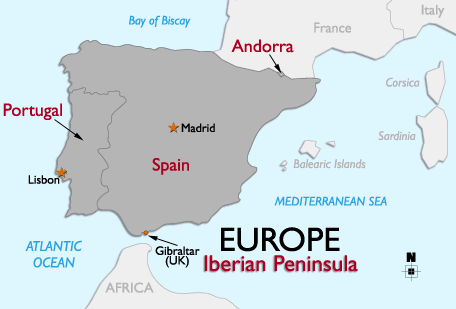
    • Daffodils are native to the Mediterranean, particularly the Iberian peninsula (Spain and Portugal).

    Where daffodils originally come from.
    (Map of the Iberian Peninsula from Worldatlas.com)

      • The daffodil is the flower of St. David's day, celebrated in Wales on March 1.
      • This year, though, the unusual cold has delayed the daffodil crop, so the flowers are in very short supply for the Welsh holiday.
      • Most daffodils are yellow, but they may also be white or some mixture of yellow and white.

      Paperwhites are one kind of daffodil.
      (Photo from Sherwood's Forest Nursery)


      This daffodil's center, which is often referred to as the trumpet, happens to be orange center.
      (Photo from the University of Nottingham)

      • In England, people sometimes call them the Lent lily because they bloom during Lent.
      • Sprouting from bulbs, daffodils are among the first flowers to bloom in the spring.
      • They are also one of the easiest flowers to grow.  They're very tolerant of the cold, but they will grow in warmer climates, too, even as far south as the Florida and Texas along the Gulf of Mexico.
      • They don't mind shade, either, but only if it's near a deciduous tree.  They won't do well in the shade of evergreens because those block out too much shade.
      • Their favorite places to grow are hillsides or raised beds -- places where the water can drain off -- and in the sun.  They like it if their bulbs are planted about 12 inches below the surface, and then give them lots of water while they're initially growing, please.

      Representation of a daffodil as it grows from bulb to flowering plant.
      (Image from Doug Green's flower-garden-bulbs.com)

        • Supposedly, squirrels and chipmunks won't eat daffodil bulbs because they contain little crystals which are poisonous to those animals.  But they may dig up the bulbs and toss them aside.

        This is what daffodil bulbs look like.  Wonderful that they turn into those bright and nodding flowers, isn't it?
        (Photo from Catholic by Grace)

        • Once they've bloomed, they can remain in flower for anywhere from six weeks to six months, depending on the cultivar and the climate.
        • After the plant has bloomed, allow the leaves to turn yellow before trimming them back.
        • They'll continue to sprout for about 3 to 5 years, but you have to dig them up.  After the leaves have yellowed and you've trimmed them, dig them up, wash them off, and let the bulbs dry out for about a week.  Put them in a breathable sack, like an onion bag, and store them in the coolest place you have until next spring.
        • Don't eat daffodils. They're poisonous!

        Here's that famous poem that's got daffodils in it:

        I wandered lonely as a cloud
        That floats on high o'er vales and hills,
        When all at once I saw a crowd,
        A host, of golden daffodils;
        Beside the lake, beneath the trees,
        Fluttering and dancing in the breeze.

        Continuous as the stars that shine
        And twinkle on the milky way,
        They stretched in never-ending line
        Along the margin of a bay:
        Ten thousand saw I at a glance,
        Tossing their heads in sprightly dance.

        The waves beside them danced; but they
        Out-did the sparkling waves in glee:
        A poet could not but be gay,
        In such a jocund company:
        I gazed---and gazed---but little thought
        What wealth the show to me had brought:

        For oft, when on my couch I lie
        In vacant or in pensive mood,
        They flash upon that inward eye
        Which is the bliss of solitude;
        And then my heart with pleasure fills,
        And dances with the daffodils.

        ("I Wandered Lonely as a Cloud," William Wordsworth, 1804)

        Wordsworth wrote this poem after his sister told him about coming across a field of daffodils. Perhaps what she saw looked like this:


        This field of daffodils is on a hill in Volcano, CA.
        (Photo by Kepola on Panoramio)


        Sources
        American Daffodil Society, Frequently Asked Questions and Guidelines for Growing
        The Flower Expert, Daffodils
        Myth Encyclopedia, Narcissus
        Edith Hamilton, Mythology
        Paul Sims, "Lonely as a cloud: Coldest winter for 30 years puts daffodil crop month behind schedule," Daily Mail, February 28, 2010
        Birth-Flower.com, March Birth Flower: Daffodils
        Birth Flowers Guide, March Birth Flower

        Friday, February 5, 2010

        Apple #437: Blackberry Winter

        I'm working on a fairly lengthy Apple entry that I hope you'll enjoy.  In the meantime, here's a brief one.

        I heard a song on the radio yesterday about blackberry winter.  Reminded me I've always meant to look up that phrase.

        • Blackberry winter happens in the spring when the weather has been getting warm and you think you're on your way to summer, and then snap! there's a sudden cold spell.
        • It's so called because this usually happens around the time when the blackberries are in bloom.

        Blackberries in bloom
        (Photo by Ken Moore at The Carrboro Citizen)

        • It's a phrase that's more common in the southern U.S. than anywhere else.
        • I first encountered the phrase when I read the short story called "Blackberry Winter" by Robert Penn Warren.  The story is told from the point of view of a boy whose parents are going through hard times when a stranger arrives at their farm looking for work.  It's a terrific story with one of the best last lines I've ever read.


        This collection of short stories is where I read "Blackberry Winter."  There's lots of other great stuff in here too.


        There are lots of versions of songs called "Blackberry Winter."  Most of them on YouTube are jazz recordings. There's also an oldie sung by the Townsel Sisters.  But none of those are right.  I heard an acoustic version with one guy singing.  If I can find that song again, I'll post it.  But for now, it shall remain a mystery because I must go to bed.


        You might also be interested in the Daily Apple entry on blackberries.


        Sources
        Wordsmith, A.Word.A.Day, Issue 131, August 14, 2004
        Dave's Garden, Definition of blackberry winter

        Tuesday, March 17, 2009

        Apple #375: St. Patrick's Day

        I just now remembered that I wanted to do a post about St. Patrick's Day. It's a bit late, so please excuse the brevity. Soul of wit and all that.


        (Photo from You're History)

        • St. Patrick was born the son of wealthy British parents in 387 A.D.
        • Before he became St. Patrick, his given name was Maewyn Succat.
        • When he was sixteen, he was captured by several Irishmen who were raiding his parents' estate in England.
        • They brought him to Ireland and sold him to a chieftain who held him captive for six years.
        • He worked during his enslavement as a shepherd. He sought solace in Christianity and became a devout and prayerful shepherd.
        • Finally he was able to escape. He walked something like 200 miles to get to the coast and got on a ship, making his way back eventually to Britain.
        • Once there, he had a dream in which an angel told him to go back to Ireland -- the land where he was held prisoner -- and become a missionary. So that's what he did.
        • As soon as he arrived in Ireland, he went back to the chieftain who had enslaved him and paid the guy the price for his freedom.
        • Then he began traveling all across Ireland, speaking Gaelic and teaching everyone he met about Christianity in a way that fit in with customs they already observed.
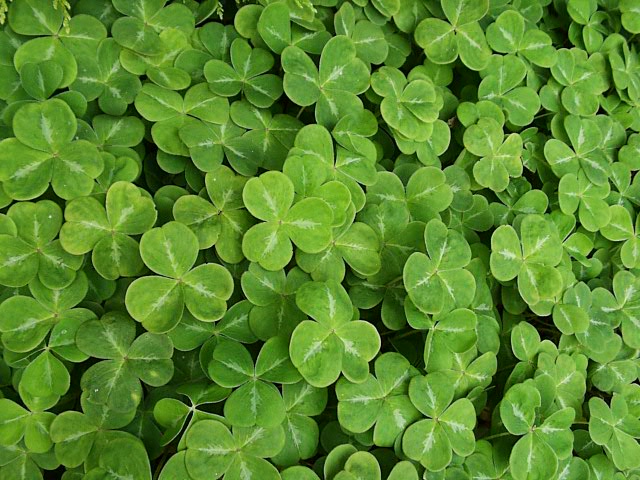
        • St. Patrick's signature prayer is all about the Trinity (Father, Son, and Holy Spirit). He used the shamrock to represent the Trinity. The shamrock was also sacred to the Druids. Using a symbol that was powerful to them to describe Christianity was typical of his teaching methods.
        • So the shamrock remains a traditional symbol of St. Patrick's Day.


        Stained glass window of St. Patrick, holding the things that are typically associated with him: his shepherd's crook, reminding us of his early days as a shepherd, and a shamrock which was his way of teaching about the Trinity.  Sometimes he's also drawn holding a snake, but here his third item is a book. This is somewhat ironic since he grew up with little education, but here the book symbolizes the writing and teaching he did in his later years.
        (Photo from St. Thomas Aquinas Chapel in Park Slope)

        • St. Patrick did not drive any snakes out of Ireland. That story is a myth. It does serve a purpose, though, which is to suggest that he is responsible for making Ireland "safe," and thereby demonstrating how beloved and revered he became among the Irish.
        • March 17 marks the anniversary of his death. For many years, the British did not allow the Irish to do all sorts of things, including speak their own language or have their own celebrations. So they were not allowed to celebrate St. Patrick's Day.
        • It wasn't until after millions of Irish had emigrated to the US that they were able to celebrate the day freely, and they did so with gusto. Even though this anniversary takes place in the middle of Lent when many Catholics abstain from meat, it became traditional to suspend all of that for one day and drink and dance and eat bacon and cabbage in celebration.


        Traditional Irish breakfast.  Irish bacon is at about 1:00 on that plate.  It's made from brined pork shoulder and boiled slowly with salt, pepper, and spices.  It's thicker than the bacon we're used to and may be more like Canadian bacon.  Clockwise from the bacon are: fried egg, sauteed tomato, baked beans inn tomato sauce, Guinness brown bread with butter, and Irish sausage.
        (Photo and bacon recipe from Emma Clare Eats)


        More Irish bacon with a few sausages.
        (Photo and bacon recipe from Emma Clare Eats)


        Sources
        History Channel, Who Was St. Patrick? and the History of the Holiday
        Sean Markey, St. Patrick's Day Fast Facts: Beyond the Blarney, National Geographic News
        New Advent Catholic Encyclopedia, St. Patrick
        Kiddyhouse, St. Patrick's Day Resources

        Saturday, March 7, 2009

        Apple #372: Why is March Windy

        The other day, we all turned our calendars from February to March, and bang, it got super windy outside. It was as if the atmosphere knew, hey, it's March! Time to get windy!

        But seriously, why does that happen? It's not as if the earth suddenly starts spinning faster on March 1. Something is changing, at exactly this time of the year, which makes the wind pick up. But what is it?


        (clip art from Idaho Public Television)

        • I found only a couple sites that explained this. But before I could understand exactly what I was reading, I had to learn all over again what wind is.
        • The air surrounding our planet is not all at the same temperature. In some places, it's warm, in others it's cold, still others, it's downright hot. The molecules in hot air behave differently than those in cold air.

        Molecules on the left are cold. Not moving much. Packed together. Molecules on the right are warm. Moving around a lot. Lots of space in between. Flying high.
        (Diagram posted by AtownWxWatcher at AccuWeather.com's blog)


        • Think of the molecules in the air like a bunch of little kids. They're all standing around on the playground. Warm up the playground, and they'll start running around. They'll get all giddy and excited. The space between each kid will get bigger and bigger. Just as the kids are running around, excited, putting more space between each other, that's what happens to air molecules as you heat them up. They move faster, spread out, get less dense.
        • And when kids get a chance to run around and burn up their energy, they feel less and less pressure. They're happy, they're excited, they're under very little pressure. So, too, when the air heats up, its pressure drops.
        • Now, instead of warming up the playground, let's cool it down. In fact, let's get it downright cold. The little kids are going to stop running around. They're going to huddle up next to each other. They're going to press their arms and legs together tight and stick close to each other for warmth. That's what the air molecules do, too, when it's cold. Slow down and stick together.
        • When you put a bunch of little kids really close together, they won't like it very much. Packed in like that, they're going to start feeling the pressure. In the same way, the cold air molecules are sticking together at higher pressures.
        • So we've got our various pockets of air. In the hot zones, all the little kids are running around excited under very little pressure. And they're right against the pockets of cold air, where all the little kids are packed together and surly and not liking it one bit.
        • Now, it's just a fact of physics that when you put two extremes next to each other, they're going to try to balance each other out. (Specifically, according to the second law of thermodynamics, high energy states will move toward low energy states, yah yah yah.) So our excited, high-pressure kids are going to try to mingle with the surly, low-pressure kids. "Hey, you guys," they're going to shout, running over to the cold kids. "What's the matter with you? Come on, let's play! Tag, you're it!"
        • Okay, I now have to abandon my metaphor because the air molecules are going to start moving in ways that little kids do not. Like I said, when the hot high-pressure air gets near the cold low-pressure air, the hot air will flow toward the cold to try to balance out the differences in pressure. That gets the air moving, starting up our wind.

        Almost exactly what happens when two pockets of different air pressure encounter each other. Except the hot air blows into the cold.
        (Art by Johanna)

        • Because the pressure in a column of cold air gets lower and lower really fast as you go up the column, the hot air is going to shoot up that column of cold air to try to balance out the pressure. Which makes for more wind.
        • Another factor that affects all this is the fact that the earth is rotating. Underneath the air, the earth is spinning. Where the air is closer to the ground, the friction of the moving ground slows down the wind speed. Up higher, where the temperature also happens to be colder and the pressures lower, the wind speed is faster.
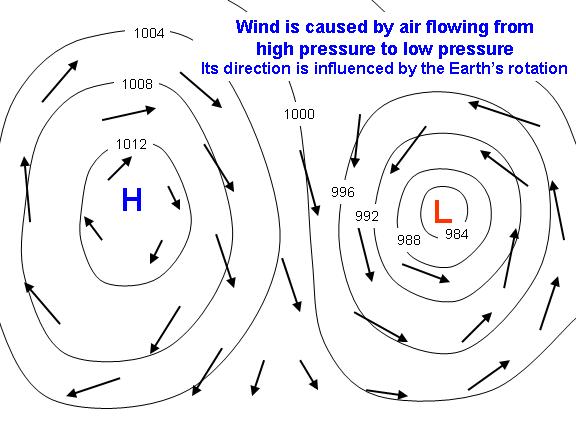
        • The motion of the earth below the wind also influences the way the air travels around the centers of pressure. Around our hot, low-pressure pockets, the wind turns in one direction; around low, high-pressure centers, it spins the opposite way. Where the two pockets of pressure touch each other, those two windstreams will join up and help to spin each other faster.
        • Which way the wind spins around the pressure centers is determined by which hemisphere they happen to be in. In the Northern Hemisphere, the air around the high-pressure pockets spins clockwise and counter-clockwise around low pressure zones. In the Southern Hemisphere, it's exactly the opposite.

        How the wind spins in different directions around high pressure versus low pressure centers.
        (Diagram from weatherquestions.com)


        • Finally, because of the earth's rotation, the wind isn't spinning in nice neat circles around the pressure centers, but is flowing around them in a stream. The streams flow against each other or collide, and any place they come into contact, they're going to try to balance each other out -- more wind.
        • So we've got all kinds of things creating wind. But what causes the most noticeable increases in wind speed is when two very different pockets of air pressure and temperature get up next to each other. The hot is going to rush into the cold, and it'll get windy.
        • Specifically in March, in the Northern Hemisphere, there's still a lot of cold air hanging around, left over from winter. That cold air can be really dense and cold, same as during a storm in January. However, because the Northern Hemisphere is starting to get more sun, the sunlight is heating the surface of the earth and it's creating more pockets of warm air.

        Due to the revolution of the earth around the sun and the earth's tilt, by the time it's March, the Northern Hemisphere will start getting more sunshine, which means more warm air.
        (Diagram from Scholastic.com)


        • The new warm air pockets start flowing toward the big cold air masses that are still hanging around. The pockets of warm air will rush toward them, trying to balance out the pressure. The warm air rushes up into the pockets of cold air, mixing the pressures and creating lots of wind.
        • Throughout March, the earth is steadily working its way around so that still more sunshine falls on the Northern Hemisphere. By the time we hit April, there's a lot more warm air, and the cold air masses are less severely cold. So the wind isn't as gusty and forceful come April.
        • I think it's pretty much a guarantee that March will always come in like a lion and go out like a lamb.


        (Image by Karen Craig, from the picture book directory of children's illustration)


        Sources
        Weather Questions.com, What causes wind?
        theweatherprediction, What Causes Wind? by meteorologist Jeff Haby
        Weather Dudes, Why is March such a windy month?
        USA Today blog, diagram labeled Why is March so windy?

        Sunday, March 23, 2008

        Apple #305: Easter Lilies and FishFish

        First things first. Happy Easter, everybody!


        Easter Lily
        (Photo from Wikimedia)


        Texas A&M has a page full of interesting stuff about Easter Lilies, such as:
        • Easter Lilies are native to Japan. They were first brought to the US after World War I, when a soldier planted several hybrid bulbs on the south coast of Oregon in 1919.
        • Their popularity in the US exploded during World War II when, after the bombing of Pearl Harbor, it became extremely difficult to get Easter Lilies.
        • Now, 95% of Easter Lilies sold in the US are grown in a very small region along the California-Oregon border, near where that soldier planted his first hybrid bulbs.
        • The bulbs take three to four years before they are ready to be potted and forced to bloom in time for Easter.
        • Lots of traditions and legends surround the connection between Easter and Easter Lilies, but here is one particularly compelling item:
            • White lilies were found growing in the Garden of Gethsemane, where before Jesus was arrested, he prayed so fervently "his sweat became like drops of blood falling to the ground." Tradition has it that where the drops of his blood fell, lilies grew.

        FISHFISH

        The next item on my list is to note that yesterday was FishFish's second birthday -- believe it or not. For those who may not know who or what FishFish is, he's my betta fish. And technically, he's more than two years old because two years ago yesterday is actually the anniversary of when I brought him home from the pet store. But he's still coming along swimmingly (har har), thanks in no small part to kind friends who look after him while I'm gadding about in other parts of the country.

        For more about FishFish, in the right-hand frame under the section Browse the Daily Apple, click on the betta fish link.

        Monday, May 2, 2005

        Apple #65: Spring Fever

        Yesterday, I told someone that I thought I might have spring fever. Do people still talk about spring fever? Is it even a real thing?
        • Teachers seem to have the most to say about spring fever. Apparently, their students start going haywire in the springtime, and they want to understand why it happens and what to do about it. College students like to describe spring fever, too, as a way to explain why they're so distracted and have stopped caring about homework.
        • The funny thing is, some people say it makes you languorous and sluggish, and other people say it makes you restless and jumpy. Or you might feel both ways, in sequence.
        • Some people say that spring fever happens when there's a sudden warm spell after a long period of cold temperatures. Your body has to get rid of the extra heat, so your blood vessels dilate and your body works hard to do this. This gives you an "energetic" feeling, and makes you restless.
        • Other people say that with the change in the amount of daylight, your body's sleeping patterns change. This lowers your body's supply of noradrenaline, which reduces your memory, attention span, alertness, and overall mental energy. Once your body adjusts to the seasonal change, you get a burst of mental as well as physical energy.
        • Still others say spring fever is related to allergies. Because your body is working to fend off a lot of things that make you sneeze and that weren't a factor for several months, you may feel more light-headed or spacey, or tired, or silly.
        • Changes in air pressure may also be the culprit. Some people say that can affect your mood. Since low air pressure is associated with storms, and it rains a lot in the springtime, you may be affected first by the drop in air pressure and second by the fact that it's raining out and you can't go run around outside like your body might be itching to do.
        • Some student advisers say that with the warm weather, students start wearing fewer clothes, and co-eds are distracted by all the freshly revealed flesh. When the students emerge from the funk stage of spring fever and enter into the energetic stage, all those bare arms and legs make the students "ready for some lovin'."
        Based on all these different descriptions of what spring fever is, and all the various explanations for it, I'm going to conclude that 1) nobody really knows what it is; and 2) everybody feels funky in the springtime.

        Sources
        Utah Education Network, weather trivia, What is spring fever?
        Janet Frazier, "Spring and Summer Issues for School Employees," NCAE Safe and Healthy School Site
        "Spring Fever: Welcome to silly season," Parenting Special Needs, About.com
        "Spring Fever!" The Crusader, April 23, 2004, Holy Cross College
        "Question: Why can't I concentrate when spring rolls around?" The Captain's Log, vol 36 issue 21, Christopher Newport University

        Wednesday, February 16, 2005

        Apple #37: Umbrellas


        It's been raining quite a bit lately. Every time I carry an umbrella, I think, "What a great invention." It's simple, and it's genius.


        A couple under an umbrella in Laos
        (Photo from Cringel's blog)


        • The first umbrellas were parasols, used to provide shade from the sun. Ancient art from Egypt, Assyria, Greece, and China all show people carrying parasols. Having one held up over you was a sign of prestige.
        • The Chinese were the first to waterproof their parasols for protection against rain. They coated the fabric with wax and lacquer.
        • The use of umbrellas became popular in Europe in the 16th Century. Except at first, only women used them.
        • Early European umbrellas used wood or whalebone for the handle and ribs, and alpaca or oiled canvas for the covering. Some umbrellas were made of intricately carved ebony.
        • Then in the late 1700's, a British guy named Jonas Hanway, who was a travel writer about Persia and well-known philanthropist, started carrying umbrellas when it rained. Eventually, other British gentlemen started carrying them, too. Some people in England still call their umbrellas the "Hanway."
        • In 1852, a guy named Samuel Fox patented the use of steel for the ribs. He said he did this to try to use up the steel he had left over from making stays for corsets.
        • Also in the 1850's, Europeans realized they could use umbrellas in the sun, too, and thus the parasol became popular again. It was considered an essential accessory for women until the invention of the automobile.
        Sources
        "Who Invented the Umbrella?" Mary Bellis, on the Inventors pages at About.com
        "Umbrella" entry in the Columbia Electronic Encyclopedia, accessed through InfoPlease
        "Jonas Hanway" entry in the 1911 Encyclopedia Britannica