Showing posts with label seasons - fall. Show all posts

Wednesday, November 27, 2013

Apple #652: Presidential Turkey Pardon

So, you know that bit of tom-foolery (pun) where the President "pardons" a turkey so it won't get killed and eaten for his Thanksgiving dinner?  Everybody says that's such a tradition, and isn't it clever and also humane, and there's all this ceremony around it.


Barack Obama pardoning the turkey -- or is he blessing it?
(Photo from change.org)


Well, as traditions go it isn't that old, and in my opinion, it's kind of dumb.  Here are the facts:
  • People have presented turkeys to the White House for a long time, this is true.  The National Turkey Federation has donated turkeys to the WH each year since 1947. But the first 2 Presidents to receive their donation from this group (Harry S Truman and Dwight D. Eisenhower) didn't "pardon" the turkeys at all.  They said thank you and ate them.
  • JFK did not "pardon" any donated turkeys, either.  He did say of one that it wasn't big enough so it should be sent back to the farm: "We'll just let this one grow."  Which suggests that after it's had time to grow some more, then we'll eat it.  News reports used the word "pardon," but JFK did not.


Nobody talks much about LBJ's turkey.  I have the feeling that's because it went quietly onto his table.
(Photo from Corbis at Bon Appetit)

  • Ronald Reagan was actually the first President to use the word "pardon" in reference to the donated turkey.  But he wasn't even saying anything like, "I hearby pardon this turkey which has been donated...."  Nope.  He was in the middle of being grilled about the Iran-Contra scandal.  When he was asked if he would pardon Lt. Col. Oliver North and ex-national security advisor John Poindexter, Reagan dodged the question by saying if that year's donated turkey had not already been destined for a petting zoo, "I would have pardoned him."
  • Not sure how that could have satisfied the reporters, but politicians are good at dodging questions.


Ronald Reagan and his helpful press conference prop, the turkey.
(Photo from All This Is That)

  • The first President who used the official pardon in reference to a turkey was George H. W. Bush (the first George Bush).  This was in 1989.  At the turkey press conference -- a function which had started to become an annual thing -- GHWB said of the turkey he had been presented, “Let me assure this fine tom he will not end up on anyone's dinner table. Not this guy. He's been granted a presidential pardon as of right now, allowing him to live out his days on a farm not far from here.”


GHWB and his officially pardoned turkey.
(Photo from Getty at Bon Appetit)

  • Every year since, the sitting President has followed GHWB's lead and said he was "pardoning" the donated turkey.
  • But the turkeys that are donated are raised specifically to be eaten.  That is, they're bred to be enormous, nearly 3x the size of their wild-turkey-relatives.  They're raised to be so large that their skeletons can't even support their own weight.  They suffer all sorts of medical maladies due to our now-typical turkey-to-table breeding practices.
  • As a result, nearly all the turkeys that are pardoned die within a year of the pardon anyway.
  • Finally, the true Presidential pardon exists to exonerate someone of a crime.  These turkeys committed no crime.  Animal rights activists might even argue that the crime was committed against the turkeys.
  • I say, If someone gives you a turkey, you first of all say thank you.  And if you're going to breed and raise a turkey to be eaten, you should eat it.  


In Minnesota, the governor pardons the live turkey -- for one day.  The Minnesota Turkey Growers, who provide the live turkey, also donate some 1,180 frozen turkeys to food pantries.
(Photo by Laura Durben at Minnesota Turkey, sourced from MinnPost)


P.S. There is no period after the S in Harry S Truman.  He did not have a middle name, only a middle initial.  Since the S does not stand for anything, using a period is pointless. (pun)


Related entries: Grateful vs. Thankful, Turkeys, Thanksgiving

Sources
Snopes, The Ungobbled Gobbler
Mental Floss, Free Bird: The History of Presidential Turkey Pardoning
The Washington Post WonkBlog, The turkey pardon is America's dumbest tradition
LA Times, Presidential turkey pardon far from a storied tradition
Philly.com, Credit GOP for the first official turkey pardon

Sunday, October 20, 2013

Apple #657: Leaves Turning Colors

I have had a request!  Daily Apple reader Marietta wants to know:

Have you done a Daily Apple on leaves and colors? Like why do they turn yellow and red and orange instead of purple and blue and pink? And what dictates to the plant what color it turns? Why are some of my maples red and some yellow and some go from green to orange to yellow, turning color more than once? Just something I was wondering about on my way home tonight. 
An excellent question!  I have seen a few tidbits here and there on this topic lately, but I haven't delved into it.  I am happy to do so now.


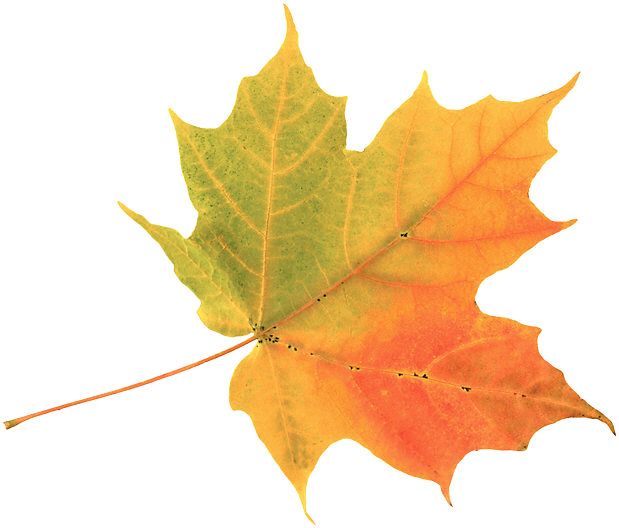
Maple leaf changing color.  Once you read this entry, you will know to say, "You can see where the chlorophyll has faded and the carotenoid pigment has become apparent."
(Image from Outdoor Parent)


  • So, you know that plants make chlorophyll, right?  That's the chemical that makes the leaves green.
  • During spring & summer, as sun shines on a leaf, the chlorophyll in it fades, similar to the way a colored photo fades in sunlight.  So the plant makes more chlorophyll to replace what has broken down.  This process of breaking down & remaking chlorophyll goes on all the time in a plant or tree.
  • You might think that, in the fall, when the days get shorter and there is less sunlight, that would mean the chlorophyll wouldn't break down as quickly so there would be more green in the leaves.  But that's not actually what happens.  Because there's another process going on too.
  • The reduction in the amount of daylight causes something else to happen in a tree -- certain cells at the base of each leaf start building up like a wall of blocks, or an abscission layer of cells.  These blocks of cells keep essential minerals and carbohydrates from traveling out to the leaves.  Without those necessary ingredients, the plants can't make more chlorophyll.  So the green in each leaf soon fades. 
  • As the green disappears, other colors emerge.  Those colors are determined by the presence of other pigments present in the leaves -- and how much of which type.
      • Yellow - xanthophylls
      • Orange - carotenoids
      • Red and purple - anthocyanins
      • Brown - tannins
  • The reds and purples/anthocyanins come from sugars in the leaf.  Not all deciduous trees make anthocyanins, and the ones that do, don't make these sugars until fall.
  • Variations in the reds and purples are determined by pH levels.  The more acidic the sap in a leaf's cells, the more bright red the pigment.  The less acidic, the more purple. 
  • Eventually the other colors/chemicals will break down and fade as the chlorophyll did.  The only chemical/color that doesn't disappear is tannins, or the browns. That's why most of the leaves on the ground eventually wind up being brown.  
  • The reason the browns don't fade is that tannins are mostly a waste product.  Just as the leaf loses its ability to make more chlorophyll, so also it loses its ability to get rid of wastes.
 
Different types of trees have different levels of the various pigments in them, so you get this kind of color display.
(Photo from Taskeasy, which recommends 10 drives to see autumn leaves) 

  • Various species of trees produce different levels of the various chemicals, so they tend to turn more of one color than another: 
      • Yellow - Aspens, Yellow poplars, Black maples, Norway maples
      • Golden bronze - Hickories
      • Dark orange - Sassafrass
      • Orange red -  Sugar maples
      • Scarlet red - Red maples
      • Crimson - Sourwood, Black tupelo
      • Purplish red - Dogwoods, Sweetgums, Japanese maple
      • Light tan - Beeches
      • Red, russet, or brown - Oaks
      • Brown - Elms

Uh-oh. This fellow fell before his color changed.  Maybe his abscission layer built up too quickly.  (These are all maples, by the way.  In my opinion, the sugar maples turn the best colors.)
(Wallpaper photo from Layoutsparks)

  • Of course no tree's leaves turn all one color all at once.  As the saying goes, "Color is an event."  As you remember from elementary school art class, different mixtures of base colors will result in different new colors.
  • Plus, there is a great variation within one tree, even within one leaf, in the amount of the various chemicals/colors present.  Different parts of a tree may also have varying levels of moisture.  The temperature may even vary slightly from, say, the bottom branches to the top branches.  Plus, the sunlight is steadily breaking down the color pigments as time passes.  All of these things will affect what color a given leaf will be at any given time. 
  • On a broader scale, in a given fall season, variations in temperature, the amount of sunlight, and the moisture in the soil affect the strength and duration of the non-chlorophyll colors. 
      • Lots of sunlight + low temperatures = chlorophyll/green breaks down faster
      • Lots of sunlight + low temps at night = more reds & purples/anthocyanins
      • Lost of moisture in summer + sunny, dry, cool but not freezing fall = best & brightest fall colors
      • Drought in summer = blocking cells develop early, so leaves may drop before they change color
      • Wind or heavy rain in fall = leaves knocked off trees early
      • Early frost or freezing temps = production of anthocyanins stops, and the colorful season ends
  • Eventually, that wall of blocking cells cuts off all connections between the leaf and the rest of the tree, and soon after that, the leaf breaks away and falls to the ground.
 
For a while, the leaves are just as lovely on the ground as they are on the trees.
(Photo from Inside Gatlinburg) 

  • The next question you might ask is Why do the leaves change color?  That, my friends, is a much bigger unknown.  
  • Scientists have come up with some theories, but they're not very certain about any of them.  The majority of theories center around why the trees would produce anthocyanins, the reds & the purples, which signal the presence of sugars or carbohydrates in the plant.  Why, just before it loses its leaves, would the plant bother to stock up those very leaves with a bunch of expensive carbohydrates?
  • Here are some of those theories:
    • Plants that are healthy produce a lot of sugars and therefore reds & purples.  Insects can suck more out of weaker plants, so maybe the colors are a signal to the bugs, don't come around here because I can fight you off, go someplace else where the leaves are more brown and the plant is weaker.
    • Perhaps the anthocyanins protect the leaves from too much sunlight, which not only makes the colors fade, but also breaks down other necessary chemicals in the leaf.  With those extra sugars available, therefore, the plant may have more time to absorb more of the necessary nutrients from the leaf before it drops.
    • Perhaps the extra carbohydrates act as some kind of insulation to help protect the plant from injury during very cool nights or at the first frost.
    • Perhaps the extra carbohydrates help create reserves against water loss during dry spells in fall.
  • But again, no one knows for sure why the leaves change color. 
  • As usual, science is very good at answering the how, but it sucks at answering the why.

Whoo.  Marvelous.  Sometimes, it's enough to simply enjoy.
(Photo from Pragmatic Obots Unite)


Related entries: How many leaves fall?; Forests
Sources
The United States National Arboretum, The Science of Color in Autumn Leaves
USDA Forest Service, Why Leaves Change Color
Garden Walk Garden Talk, Why Do Leaves Change Different Colors on the Same Tree, November 18, 2010
University of Wisconsin, Chemical of the Week, The Chemistry of Autumn Colors
Howstuffworks, Why do leaves change color and turn red?
Arbor Day Foundation, Top Fall Trees in the United States
Butler University, Friesner Herbarium, Why Leaves Change Color

Monday, October 18, 2010

Apple #488: How Many Leaves Fall

I've been walking around in the woods lately, enjoying the rustle and crackle of walking through fallen leaves on the paths and the leaves turning color on the trees.  This year's colors aren't quite as pyrotechnic as other years because it's been so dry, but some of the colors are still pretty eye-popping.


(Photos by the Apple Lady)


All these leaves turning and dropping to the ground led me to wonder, how many leaves fall each autumn?

Well, of course no one is going to go all across the country and count every single leaf on the ground.  Ho, ho, no, that would be silly (though I am wondering right now if it could be done, if you had enough people....).  So of course such a number has to be an estimate.

It turns out, even counting the number of trees is a near-impossibility.  But there are people at the US Forest Inventory & Analysis program who do count trees.  Or actually, they count a sample of trees within an area of forest and generate an estimate for the total number of trees in the entire forest.

And someone did come up with an estimate for the average number of leaves that grow on a mature tree:  about 200,000.

So, putting together all those estimates, I have a total estimate for you.  Drum-roll, please.


Or instead of a drum roll, how about a stroll across a leafy bridge?  If you want to count the leaves, or even the trees as you go, it would be much appreciated.
(Photo by the Apple Lady)


This number is for
  • In the United States only
  • not including Hawaii, New Mexico, West Texas, or Wyoming
  • forest land only (not counting the trees in your yard or the local city park or along your streets, etc.)
  • does not include timberland either (land owned by industrial companies)
  • hardwood trees only (the best way to get deciduous trees only, and no conifers)
  • doesn't include every single variety of hardwood in existence, but includes the major and most common species
  • only those hardwoods that measure 1" in diameter at breast height (dbh)

Estimated number of trees that drop their leaves in the forests of the US: 203,257,948,035.  (Over 203 billion, in other words)

Multiply that number of trees by 200,000 leaves, and you get, depending on your preferred method of notation:
  • 40,651,600,000,000,000
  • or 4.06516 E+16
  • or more than 40 quadrillion leaves.
Given all the bits & pieces of data (trees) that are not included, I'd say that's probably a third of the actual total.


These leaves strewn all across this path are only a very small sample of the 40 -- or perhaps 120 -- quadrillion leaves that will fall this autumn.
(Photo by the Apple Lady)


Sources
USDA Forest Service, Forest Inventory & Analysis, Forest Inventory Data Online, Standard Reports
Wisconsin County Forests, Questions and Answers about Wisconsin Forests

Monday, October 5, 2009

Apple #414: Those Halloween Stores

The other day I noticed somebody out on a busy street corner holding up a sign and sort of dancing around to get people's attention for one of those big Halloween stores. You know the kind, the ones that move into an empty store space for the month before Halloween, sell a whole bunch of stuff, and by November 1, they've packed up and moved out.

I wondered, how do those things work? They must be profitable or they wouldn't show up again the next year, nor would there be another store in a different location. But what kind of profits are we talking about here?


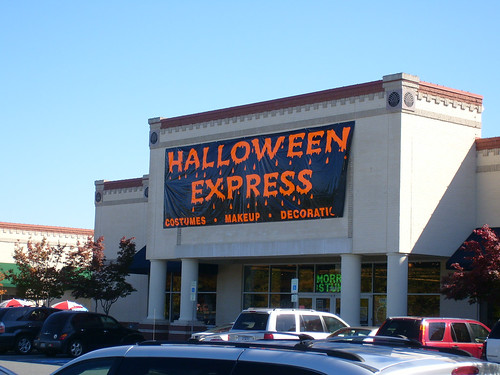
A typical Halloween Express storefront. You can see that the banner with the store name on it is temporary. This one is in Charlotte, North Carolina.
(Photo with some rights restrictions by english invader on Flickr)


The answer, according to what I read, begins with understanding what the market is like for Halloween goodies.


THE MARKET
  • In the US in 2006, consumers spent $4.96 billion on Halloween stuff. That's a lot of money on costumes and candy.
  • To put that number in perspective, though, we Americans spent 100 times that -- $457.4 billion -- on the Christmas/Hanukkah holidays.
  • In fact, Halloween weighs in at only the sixth-highest spending holiday of the year, after Christmas/Hanukkah, Valentine's Day, Easter, Mother's Day, and Father's Day.
  • People spend more on those other holidays because those holidays all involve gift-giving. Except for the candy that people hand out to trick-or-treaters, nobody gives gifts for Halloween, which is why the holiday falls relatively low on the money scale.
  • But in terms of decorations, it comes in second place just behind Christmas. 86% of adults decorate their houses for Halloween, both inside and out.

Some people really get into the Halloween decorations. This is outside a house in Lenox Hill, New York.
(Photo by Tim Ruddell on Flickr)


  • Candy is perishable but costumes and decorations are not and those have higher profit margins anyway. So the retail stores focus on those products and focus hard.
  • Of all the retailers who sell Halloween stuff, it's the companies that operate at least 100 of those big, temporary stores that bring in the majority of that $4.96 billion.

Halloween USA in Aurora, Colorado
(Photo from Snagajob)


HOW IT'S DONE
  • They start looking for store locations in January -- 10 months ahead of time. Most of these retail companies have a pretty specific set of criteria for the kind of location they want.
  • Halloween Express, one of the leaders in this group of Halloween retailers, looks for:
  1. Space in a strip mall or in a free-standing location
  2. Has to be at least 7,000 square feet
  3. Has to be in a high traffic area near busy streets
  4. Has to be available for all of October
  5. Has to allow temporary signs to be put up
  6. Will pay more than the current rent
  • How much is more than the current rent? It varies depending on the city and the specific location. But for one store front, Halloween Express paid $100,000 per month ($200K total) for a 20,000 square foot space.
  • Most retailers pay $500,000 for a whole year in that same size space.
  • But that high rent may be worth it. Halloween Express, as an entire chain, sold about $70 million worth of Halloween stuff in 2007.
  • For a lot of malls that are struggling due to the bankruptcy and closure of a lot of major retailers (Linen 'N' Things, Mervyn's, MicroCenter, to name a few), a tenant that's willing to take over a huge amount of space and pay higher than the going rent even for a couple of months can be very attractive.

Spirit Halloween stores are owned by Spencer's. This location opened in a former La-Z-Boy store.
(Photo from the Spree Patrol)


  • A Halloween store will bring more foot traffic to the mall in general, but only for the couple months it's open. So the Halloween stores are a temporary stopgap, but if a commercial realtor has the chance to put a longer term store in that space, they'll opt for that over the Halloween store.
  • Once the location is secured, somebody local -- a franchisee -- operates the store. That person is responsible for managing the rest of the details, including the inventory and the staff.

THE MONEY
  • The individual franchisee operates the store. They invest $10,000 to buy the rights to the first store and then an additional $70,000 to pay for the inventory and any other opening costs.
  • Ordering the inventory is the trickiest part of the business. The franchisee has to go to trade shows, decide which costumes and masks will be hot that year, and order them at the right time so everything will be delivered, unpacked, and on display in the store by the time it's ready to open.

Some of the stuff the clerks would have to unpack and display. These decorations were available in 2008 at a Spirit Halloween store in New Mexico.
(Photo from Season of Shadows)

  • The franchisee also hires cashiers and people to unpack the inventory and set it out on the shelves. Once the store is open, the franchisee is also in charge of managing it. This means showing up, answering questions, solving last-minute problems, making sure everybody's there when they're supposed to be, making sure things are set up the way they're supposed to be. But really, how hard can that be?
  • So let's do some quick math here. Let's pretend we Daily Apple readers want to open one of these stores. Our investment is $80,000 for the rights to the store and the inventory, plus salaries.
  • Salaries wouldn't be that expensive. All you'd have to pay would be minimum wage for people to run the cash registers. You wouldn't have to pay any benefits because the employees would only be working for two months.
  • Minimum wage is $7.25 per hour. Say we have 25 people working 8 hour days. Say the store is open 7 days a week. Our staff wouldn't all work 8 hour days 7 days a week, but to make the math easier, let's say they do. And let's say we're generous and we're going to pay our cashiers and stockers $8 per hour. That's $89,600 in salaries.
  • So we've got $179,600 invested total.
  • Let's say our store is an average Halloween Express store. Since they made $70 million and they have about 100 stores, that would put an average store's sales at about $500K.
  • Even if we assume that our rent is that really high $200K, that still leaves us with a profit of $120,400. Not bad for a few months' worth of work.

Ka-ching!
(Photo from GetReligion.org. I'm not even kidding.)

  • That $120K profit that I arrived at should definitely be taken as an estimate. Because I've also read that the temporary Halloween store usually does not make a profit its first year.
  • But the temporary Halloween store typically does turn a profit by its second year. This is very fast for retail. Most retail stores don't turn a profit until somewhere in their third or even fifth year.
  • Here's another benchmark: if one of these pop-up Halloween stores sells 70% of its inventory, it's considered to be doing well. So the next time you're in one of those giant stores, look around and say to yourself, "Seventy percent. They're going to sell seventy percent of everything that's in here." I think you'll be able to feel the money.
  • Costumes are where the profits can be at their highest. Though they're typically made of polyester and plastic, most costumes start at around $24 and go up to about $180 for a complete outfit with lots of trimmings. The risqué costumes, which are increasingly popular with adults, typically start around $80 and go up.

How the costumes are packaged and displayed at a Halloween Express.
(Photo by Evan Hill at the U of Tennessee)


THIS YEAR
  • Speaking of costumes, the top costumes for adults in 2009 are, in descending order:
  1. Witch
  2. Vampire
  3. Pirate
  4. Clown
  5. Wench/Tart/Vixen

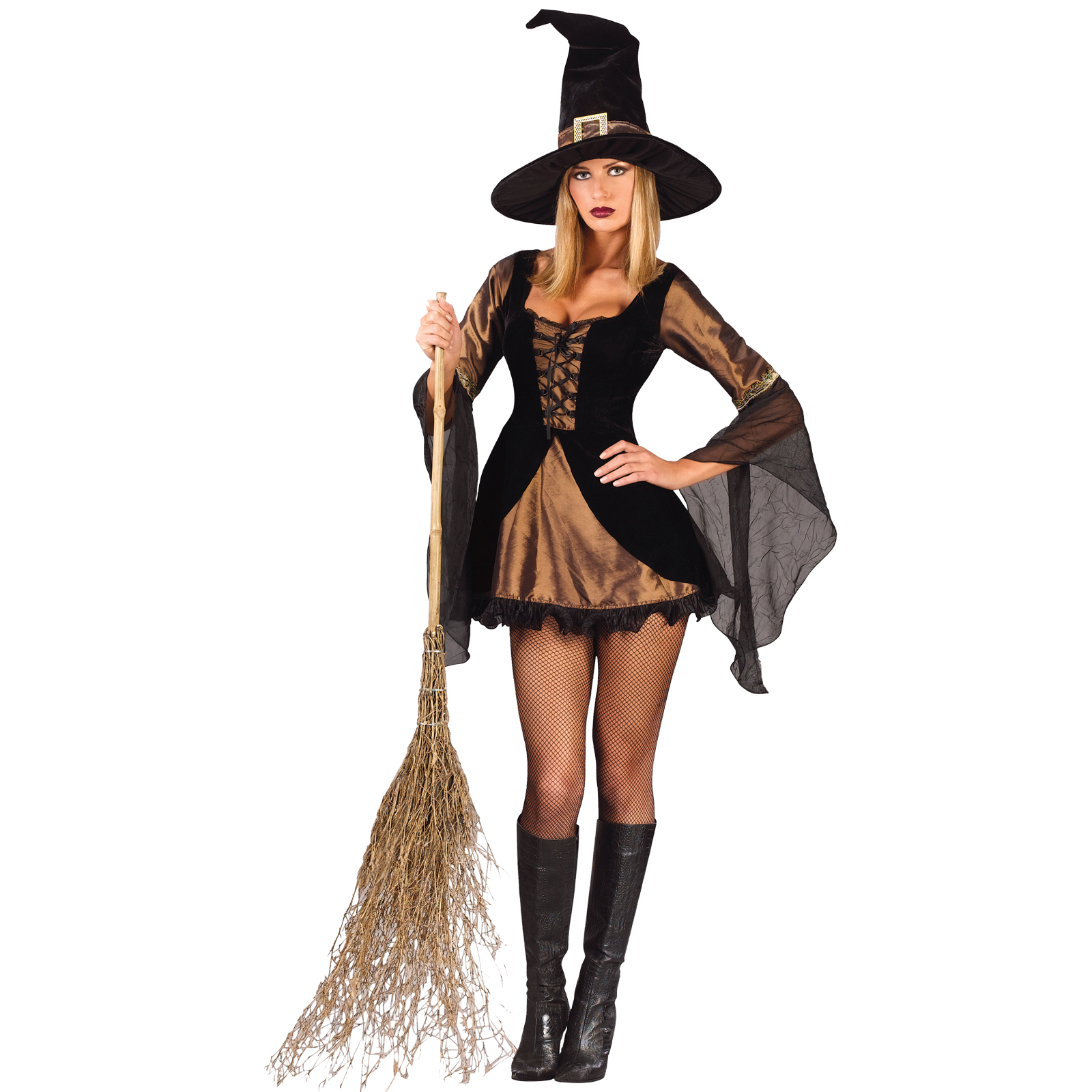
Prime example of the sort of costume most in demand these days. It's for adults, it's of the "sexy" variety, and it's of a witch.
(This particular costume is available from HalloweenMasksandCostumes.com. But I bet you could also find it in one of those big stores, too.)


  • Besides the top categories, there are also usually one or two specific costumes that are "hot" in a given year. During an election year, for example, costumes or masks that look like the current candidates are usually big sellers.
  • Or if a movie is especially popular, so are costumes that look like those movie characters. Like after Scream came out, for example, everybody was wearing those elongated masks.

None of the Scream masks I saw online get the contorted mouth shape exactly right. This one is available from Costume Maniacs for $7.99.

  • This year, because of the economic downturn, most people say they're planning to re-use costumes from previous years, or make their own, or they're going to make their own decorations and treats to hang up or hand out.
  • In fact, the average adult plans to spend about $55 each year on Halloween goodies. That's gone down from about $100 per consumer per year in the late 1990s.
  • The average 18-24 year-old spent $86 on Halloween in 2008, and they say they'll spend less than that this year -- only $68.
  • So maybe those stores will only sell, what, sixty percent of their inventory?

After seeing how much money these stores rake in so quickly, I am definitely seeing the do-it-yourself appeal. On the other hand, those ready-made costumes sure do come in handy if you find out only a day or two ahead of time that someone you know will, in fact, be having a Halloween party and you need a costume that's better than the sheet with holes cut out for eyes that you wore last year.


(Screen shot from It's the Great Pumpkin, Charlie Brown!
sourced from Sweet Tea Prohibition)


The best place I ever bought a costume was at a costume shop that served the local theater and ballet companies. This store had everything. The best were the masks -- tons of them all around the top of the walls, really fantastic, elaborate, sometimes gory, truly scary.

The people who worked there knew their make-up, too. You could say to the guy behind the counter, "How do I make myself look like Frankenstein?" and he would tell you which colors of make-up you needed to buy, how much of each color to apply, and where. He would tell you how to glue on the fake bolts, how to make the top of your head stick out, and how to make the stitches all the way across. I heard one customer ask one of the make-up guys how he could make himself look like a monster that had been melted in a nuclear accident, and right away the make-up guy had all kinds of ideas. Super knowledgeable and creative people.

Sadly, that store closed several years ago. But if there is such a store in your neighborhood, it is definitely worth the trip. Here is a short list of theatrical costume shops, most of which also specialize in things like fake beards, or hand-made corsets, or Zoot suits, or mascot suits.


Storefront of DC Theatricks in Buffalo, NY. Not as screamingly eye-catching as those big temporary stores, but based on what lots of people online say about them, they have a huge selection of costumes for purchase or rental, and the sales people are friendly and helpful.
(Photo from Buffalo Place)


Sources
Terry Boyd, "Seasonal Halloween stores give a temporary, but significant, retail boost," Business First of Louisville, October 30, 2008
Halloween Advertising Agency, Halloween Industry
National Retail Federation, As Economy Impacts Halloween, Consumers Get Creative, September 29, 2009
National Retail Federation, Vampires Move Up Top Costumes List; Nurses, Politicians Drop Off, October 1, 2009
Stephanie Hoops, "Priced Right for Fright Night," Ventura County Star, October 4, 2009
CNBC, Spooked Consumers Plan to Spend Less on Halloween, September 29, 2009
National Retail Federation, As Halloween Shifts to Seasonal Celebration, Retailers Not Spooked By Surge in Spending, September 20, 2006
Patricia Norris, Halloween Sales Huge for 2007, Specialty Retail Expert, November 2, 2007
Retail Infusion, Halloween Express

Wednesday, November 26, 2008

Apple #353: Thanksgiving

So I'm getting ready to go home to visit my family for Thanksgiving, and I'm wondering what I should do a Daily Apple about. And I realize, I've already got Daily Apple entries for just about everything you might encounter on your typical Thanksgiving Day.

The only thing I don't have is an entry about Thanksgiving Day itself.

I find Thanksgiving Day confusing. For one thing, there are so many different days and years that people claim was the first Thanksgiving, and that's mostly due to the fact that there were lots of different settlements sprinkled here and there on the Atlantic Coast. And then, was it first declared a holiday by FDR, or by Abraham Lincoln, or by George Washington. One could make a case for any of those three.


Pretty soon, it all starts making about this much sense.


And then what did they eat (not pumpkin pie as we know it, that's for sure). The answer to that depends on when you say the first Thanksgiving happened. Some of the very early ones took place in the summer when people were overjoyed simply to have survived the killing winter. So if you say the first Thanksgiving was in the summer, there would have been various kinds of summer crops and grains, prepared in ways that aren't that familiar to us anymore. But if you say the first true Thanksgiving was when Lincoln proclaimed it so, in November, then the food would have been very different.

And of course it's also fraught with all kinds of discomfort because what was a celebration for white settler folk wound up meaning terrible devastation for native folks.

See? It's just not an easy or even a particularly nice topic to wrestle with on these here Daily Apple pages.

To me, what gives Thanksgiving Day meaning is not its complicated and sometimes unsettling history, but the time I spend with my family. It's kind of funny when I think about it because, in practice, Thanksgiving Day is a holiday devoted to sitting around with your family and friends, eating food and watching TV. And then later, going to the movies. It's what most of us probably already do with our families anyway. Yet this day says, "No, you must stop everything else you're doing and go hang out with your family and friends. And there must be turkey!"

Now, I know for some people, this time of year can be tough. Families may be broken up. There might be somebody missing from the table this year. You might not get along with everybody in your family the way you'd like to. It's not all happy cranberries and sugar and good times. I know this, believe me. But so do a lot of people. That may not seem like a comforting thought, but, well, here, let me show you.


Sisters Pamela and Ella and their deceased sister, Marjorie in the photo.
(Photo by Luis Sanchez, from the Cincinnati Enquirer)


In 2007, the Census Bureau surveyed 116 million households in the United States. They found out that:
  • 78 million of those households contained families or married people.

  • 37.5 million households were "non-family" or people who live together but are not related or married to each other.


This is Joey and Hina and Weifei.
(Photo by Anna on Picasa)


  • About half of households had a married spouse present.

  • 17 million households are headed by a divorced person; 11 million by a widow or widower.
  • 22.6 million households are run by someone who never married.
  • Most of us live in families of 2 or 3 people. 


This is David with his family

  • If we don't live with our families, we tend to live by ourselves and go visit.


This is Desiree Taggart's family -- or, as she says, only some of it.
(Photo from taggartsmyname's blog)


  • Some of us live with families as large as 6 children or more.

  • A few of us also live with families to whom we are not related.
  • For those of us who run the house and have children, slightly more than half live with our children. Slightly less than half live apart from them.


This family lives in Guam
(Photo from Zenhabits)


  • Some of our households -- about 7.5 million of us-- live with at least one family member who is 65 or older.


Okay, so here's my point. All of these households, in my mind, are families. Blood-related, adopted, married, or not. These are families. Relationships. And they all look different.

But we're all going to take a day, and go be with the people who gave birth to us or to whom we gave birth, our siblings, our nephews, our step-parents, our foster children, our spouses, our aunts, grandparents, cousins-in-law, great step-nieces, our friends, and we're just going to hang out. Spend the day. Eat some food. Watch TV. Be with each other. And I think that's nice.


(Photo from Andy Macias' Family Photos)


Happy Be With Each Other Day.

Sources
US Census Bureau, America's Families and Living Arrangements: 2007
Purple Slinky, Strange Facts about Thanksgiving, November 3, 2008

Sunday, October 19, 2008

Apple #347: Pumpkins

Hey, it's Fall.


(Photo from Cooking from the Market, which has a recipe for pumpkin soup)

  • Pumpkins are a fruit.
  1. The seeds are within the part you eat, which makes pumpkins, like all of its squash cousins, a fruit.
  • They are also 90% water.
  • The largest pumpkins get to be around 1,000 pounds.

There is actually a club for people who have grown pumpkins that weigh over 1,100 pounds. It's called the called the 1100 Club. This guy, Larry Checkon from North Cambria, PA, is a member and also a former world record-holder, with his pumpkin which weighed 1,469 pounds.
(Photo from the Pumpkin Nook)


  • A ripe pumpkin will have a hard shell that won't dent or scratch easily when you press your thumbnail to it.
  • Also, don't choose a pumpkin with any soft spots, cracks, splits, or bug holes.
  • Pumpkins originated in Central America, but they can be grown just about anywhere in the world. Antarctica is the only continent where people haven't been able to grow them.
  • In colonial times, when people used pumpkin in their pies, they baked it into the crust.
  • The colonial ancestor of the pumpkin pie was a roasted pumpkin:
  1. Cut off the top
  2. Scoop out the innards & the seeds
  3. Fill it up with milk, spices, and honey
  4. Bake the squash in hot ashes

Paula Deen's pumpkin pie
(Photo from the Food Network)


  • 90% of the pumpkins grown in the United States are grown within a 90-mile radius of Peoria, Illinois.

The University of Illinois is in Champaign. All the pumpkins are in nearby Peoria. Barack Obama's house is in Chicago.
(Map from Joel Ward's real estate seminars)


  • Connecticut Field is the variety of pumpkin that people most commonly use for carving.
  • People have carved pumpkins for centuries.

This drawing called "The Pumpkin Effigy" appeared in The Ladies Floral Cabinet in September 1875.
(Photo from Inspiration Line)


  • The phrase "Jack o' Lantern" refers to an Irish legend about a guy named Stingy Jack and the Devil:
  1. The Devil heard about Stingy Jack, so he invited Stingy Jack to have a drink with him. But Stingy Jack, being stingy as well as being a drunk, didn't want to pay for it. The wily Devil, thinking had Jack right where he wanted him, said he'd turn himself into a coin that Jack could use to pay for the drink. Stingy Jack agreed. Except then he put the Devil-coin into his pocket where he also had a silver cross, which prevented the Devil from changing back into his fully Devilish self.
  2. Once the Devil cried Uncle, essentially, Jack said he'd let him out of his pocket only if the Devil agreed not to bother him again for a whole year. During that time, if Jack should die, the Devil wouldn't get to have his soul. Sick of being a coin, the Devil agreed and once he was back to his old self, let Stingy Jack alone.
  3. A year later, the Devil came back. He told Jack he'd come to collect. Stingy Jack said he'd go with the Devil, but first, would the he climb up that tree and get Jack an apple? The Devil thought he'd already gotten Jack to agree to go with him, so he climbed up the tree. While he was up there, Jack put crosses all around the tree, which kept the Devil from climbing back down again.
  4. Once again, the Devil yelped for help. Jack said he'd let him out of the tree if the Devil agreed never to take his soul. The Devil agreed and Jack let him go.
  5. Finally, Stingy Jack died. But because he'd been a stingy drunk and a liar as well, he wasn't allowed into Heaven. So he got sent down to Hell, but when he got there, the Devil wouldn't let him in. Not only was the Devil still mad at him, but he'd given his word that he wouldn't take Jack's soul.
  6. So the Devil kicked him back up to Earth and gave him nothing but a burning ember to light his way. Stingy Jack put the coal into a carved-out turnip and carried it like a lantern, and he roams the earth this way to this day. So he became known as Jack of the Lantern, or Jack O'Lantern for short.
  • By the way, people in Ireland and Scotland used to carve faces into turnips and beets and then light them with candles. This was to frighten away Stingy Jack and any other unsavory spirits who might be wandering about. When the Irish immigrants got to North America, they discovered that pumpkins worked really well for the purpose of making Jack O'Lanterns, and that's how we got pumpkin carving.

Since the idea of the Jack O'Lantern is to scare off Stingy Jack who was kind of a rotten guy, I wonder which would work better, a happy face or a scary face.
(Photo from Wikimedia Commons)
  • Before Halloween, there was the Celtic harvest feast of Samhain (pronounced sow-ane). It started at sunset October 31 and lasted until sunset November 1. Its purpose was nothing spooky or devilish; it was simply a harvest feast. Samhain means "Summer's End."

It's a pumpkin extravaganza at The Pumpkin Show in Circleville, Ohio. The 2008 Pumpkin Show was this past weekend, but you can go again in 2009, on October 21-24. They have a largest pumpkin contest, a Miss Pumpkin pageant, a carnival at night, and not just one parade, but several.
(Photo from the Circleville Pumpkin Show)


Sources
University of Illinois Extension, Pumpkin Facts,
History Channel, The Real Story of Halloween
Penumbra, The Story of Stingy Jack
The Pumpkin Patch
The Pumpkin Nook

Monday, November 5, 2007

Apple #278: Guy Fawkes Day

Today, November 5, has been Guy Fawkes Day. Or so says my calendar. I know it's a British holiday, and I think it has something to do with burning effigies of some guy, but that's about all I can remember. So I'm going to ferret out the details.

By the way, I meant to complete this entry yesterday, so we could all prepare and celebrate appropriately when the day hit, but yesterday I was sick as a dog. Feeling better today.

  • Every November 5 is Guy Fawkes Day. It's not one of those holidays that roam depending on the year.
  • Guy Fawkes is the name of a guy (some say that our word "guy" actually comes from Guy Fawkes' name) who tried to blow up British Parliament and the King of England in 1605.

Guy Fawkes. See how he's frowning, in a clearly malevolent way? He must be a bad guy.
(Image sourced from Linx Public Affairs)


  • That fall, King James was going to show up to open Parliament for its session. Fawkes would then detonate his 36 barrels of gunpowder where they were stashed beneath a bunch of firewood and heavy iron bars. Kablooey, there'd be no more King, no more House of Lords.
  • Fawkes wasn't alone in his plan. He wasn't even the ringleader. Robert Catesby was the man behind the plan. Fawkes was just one of 13 fellow Catholics who had plotted together.

This print of depicts 7 of the 13 conspirators, including Guy "Guido" Fawkes. See how wily and scheming their eyes are? That's proof of their evil ways.
(Image from Learn History)


  • They were all angry because King James' predecessor, Queen Elizabeth I, had had a lot of Catholics executed during her rule. King James had promised to stop having so many Catholics executed. But it didn't look to the 13 conspirators like King James was going to be true to his word, and that Parliament was even less likely to stop killing the Catholics. So they hatched their plan
  • Despite their anger with the government, one of the conspirators got worried about his relative who was in the House of Lords and warned him about of the plot and told him to stay away from the Parliament buildings. The relative then forwarded the letter to King James.

King James I, the guy that Guy wanted to blow up
(Image from PBS)


  • [Recently, though, historians have questioned the authenticity of that letter. It is now believed that the King's officials knew of the plot and fabricated the letter as evidence before giving it to the King.]
  • On October 26, 1605, the soldiers went searching for the conspirators. They killed several of the 13 men in the process of arresting them, and they found Fawkes in the basement of the House of Lords, waiting next to the gunpowder to light it.
  • When they asked him his name, he said it was John Johnson. Not exactly a quick-thinker.
  • On November 5, when the public got the news that some guy named Guy Fawkes was in prison for a foiled treasonous plot, they were so happy he was stopped that they built a bunch of bonfires and made effigies of him and burned them.
  • Fawkes was tortured until he confessed, and later, he and the rest of his band were executed.
  • Subsequently, British officials went on to persecute and torture even more Catholics than before. Fortunately, that part of British practices has died away.
  • Year after year, the British celebrated the day they were saved from treason by building bonfires, making effigies of Guy Fawkes the traitor, and burning him. Sometimes people made effigies of the Pope as well, and burned him too.

The Newpound Bonfire Society dressing up and making effigies in remembrance of the Gunpowder Plot.
(Photo from Wisborough Green)


  • Children went around asking "a penny for the Guy," and used the money to buy fireworks, which they set off on the same night.

Remember, remember the Fifth of November
Gunpowder, treason and plot.
We know no reason why gunpowder treason
Should ever be forgot.
Holla boys, holla boys! Huzza-a-a!
A stick and a stake, for King George's sake,
A stick and a stump, for Guy Fawkes' rump!
Holla boys, holla boys! Huza-a-a!

(English rhyme that came about several years after the actual plot)


TODAY
  • The routines of British government still reflect the influence of the Gunpowder Plot. The monarch only visits Parliament once a year, and that's to help preserve his or her safety. In addition, the cellars are still routinely searched before the opening and the monarch's arrival.
  • The celebration has evolved enough that it now has a tongue-in-cheek flavor. Some people might even be hailing the attempt to overthrow the government.
  • That whole "penny for the Guy" thing is now like trick-or-treat. Instead of being used to buy fireworks, the kids keep the money.

You can get this and other T-shirts to help celebrate Guy Fawkes Night here.


Guy Fawkes Day -- and Guy Fawkes Night -- is celebrated in various British-friendly countries around the world. Mainly, people burn a lot of stuff and set off fireworks.


Effigy of Guy Fawkes on parade in Lewes, England.
(Photo from Wikimedia)


Fireworks, set off near Kenilworth Castle, during a Guy Fawkes Night celebration.
(Photo from the Kenilworth Round Table)


Today is only one of many celebratory days of November.

Sources
Kaboose, Holidays & Fun, Guy Fawkes Day
Infoplease, Guy Fawkes Day: The anniversary of the famous Gunpowder Plot, reprinted from the Columbia Electronic Encyclopedia, 2005.
Fun Social Studies, Guy Fawkes Day: Bonfire Night
Guy Fawkes and Bonfire Night
Pip Wilson, Wilson's Almanac on Guy Fawkes Day

Friday, September 28, 2007

Apples for Fall


(Photo from Sled Dog Music's blog about music and Winnipeg)


I'm going to be going out of town for a few days for a much-needed trip back to the Apple Lady homeland. Since we just crossed the autumnal equinox (i.e., it's now officially fall), I thought you might enjoy perusing through Daily Apples on these fall-ish topics:

Potted Mums (currently a very popular entry)

Apple Juice vs. Apple Cider

Monarch Butterflies

Brett Favre

Corduroy
(you know, you wear corduroy pants to school)

Fog vs. Dew

Days of November


Turkeys


Yom Kippur

Monday, September 17, 2007

Apple #267: Yom Kippur

I see by my calendar that Yom Kippur is coming up this Saturday. I know that it's a Jewish religious holiday, but I don't know much more about it than that.

  • The words "Yom Kippur" mean "Day of Atonement."
  • It is considered the most sacred of Jewish holy days, the "Sabbath of Sabbaths." People who don't usually attend services the rest of the year often attend services on Yom Kippur.
  • Supposedly on this day, the books of judgment are sealed. Actually, 10 days earlier on Rosh Hashanah, the names of the chosen are written in the Book of Life. On Yom Kippur, that book gets sealed for the year. So this day is your last chance to do all you can to try to get your name entered in the Book of Life.
  • To make this happen, you must atone for sins between you and God. That is essentially what the services on Yom Kippur are all about.
  • If you want to atone for sins committed between you and another person, you must seek out that person before Yom Kippur, reconcile your differences, and right the wrongs in whatever manner is appropriate. The 10 days between Rosh Hashanah and Yom Kippur are especially reserved for this type of reconciliation.

Mushka (age 4) and Rochel Goldman (age 2) help their mother light candles in preparation for Yom Kippur. It is also customary to light candles and bless the challah (traditional bread) the night before Yom Kippur.
(Photo from CrownHeights.info)


  • Atonement happens on this day in particular to commemorate the time, back in the day, when Moses yelled at the Israelites for worshiping the golden calf and threw the Ten Commandment tablets to the ground, breaking them. After Moses went up the mountain and sought and gained God's forgiveness, Moses came back to the Israelites with a list of things they should do to atone for their sins. And they had to do these things "for all time."

Moses loses it.
(sourced from Graham Phillips)


  • The main thing on Moses' list is to keep a full fast for 25 hours, from sunset the evening before, until nightfall on Yom Kippur.
  • Not only are you to abstain from eating or drinking, you should also refrain from
      • working
      • washing and bathing
      • anointing your body -- no perfumes, lotions, oils, deodorant, etc.
      • wearing leather shoes (presumably because an animal had to die for them)
      • any sexual relations
  • Current Jewish law has added a couple of exceptions. For health reasons, children under 9 years old and pregnant women are not allowed to fast. Also, if you're especially sick or if you've just had a baby, you could be granted an exception.
  • In addition to keeping to Moses' list, it is also customary to wear white to symbolize purity of the soul, and to spend most of the day in the synagogue.
  • Yom Kippur services generally include a group confession and displaying the holy scrolls of the Torah. Because the scrolls are sacred, out of respect, worshipers stand through the entire service, which is quite lengthy.
  • The majority of the service is characterized by repentance and heartfelt prayers for forgiveness.
  • The service ends with a very long blast of the shofar, which is a kind of trumpet supposed to be made from a ram's horn. After the shofar blast, the people respond: "Next year in Jerusalem!"

Blowing the shofar at the end of Yom Kippur services
(Photo from Britannica.com)


As I type this, there are five days left until Yom Kippur. . . .


Sources
Judaism 101, Yom Kippur
Holidays.net, The Jewish Holiday of Yom Kippur
Howstuffworks, Yom Kippur