Showing posts with label science - moons and planets. Show all posts

Monday, August 27, 2012

Apple #601: Blue Moons

So there's going to be a blue moon in a few days.  Which means it will be the second full moon this month.

Why is it called a blue moon, anyway?


A full moon that, with photography's help, appears to be blue. But the blue moon we'll experience won't actually look blue.
(Photo from Geekologie)

  • Originally, a blue moon did not mean the 2nd full moon in a month. It meant something else.
  • So, it takes about 29.5 days for a moon to go from full to new and back to full again.  This is close to a month, but not quite.  But still, if you average it out, 12 months in a year means there should be 12 full moons in a year. Assuming a season is 4 months long, there should be 3 full moons per season.


This example month shows how the moon's phases mostly but don't exactly correspond with a calendar month.
(Image from menstruation.com.au)

  • But of course since our calendar doesn't match up exactly with what the moon does, every once in a while the anomalies show up.  Sometimes there are 4 full moons per season.  The Farmers' Almanac used to refer to that 4th full moon of the season as a blue moon.
  • Then in 1946, a guy named James Hugh Pruett wrote an article for a magazine called Sky and Telescope.  He consulted his Farmers' Almanac about blue moons (and a 1943 issue of the magazine which, in a Q&A column, was a bit vague about the definition), but in doing so, Pruett misunderstood the definition and he presented his misunderstanding in his article as fact.  He wrote:
"Seven times in 19 years there were — and still are — 13 full moons in a year. This gives 11 months with one full moon each and one with two. This second in a month, so I interpret it, was called Blue Moon."
  • Thus the definition that a blue moon is the 2nd full moon in a month was born. 


Another psuedo-blue moon
(Photo from Albert Combrink)

  • Subsequent articles of the magazine used the, shall we say, revised definition.  So other people were this using 2nd full moon in a month as their definition, too.  Books like the Kids’ World Almanac of Records and Facts were describing a blue moon as a 2nd full moon in a month.  Trivial Pursuit used that as the definition of a blue moon, too.  In short, that definition entered the popular culture and it is now considered the primary definition.
  • One thing I find especially interesting about all of this is that official astronomy sites like NASA, etc., will refer to the newer definition as having come from "modern folklore."  But it didn't.  It came from a magazine dedicated to astronomy -- from astronomers themselves.  Yes, it originated with a mistake, but it was an astronomy person who made it.  So it's not exactly folklore.


And this "blue moon" isn't exactly real.
(Photo from Within My Eyes)
  • According to the new definition -- 2nd full moon in a month -- here are the dates of recent-past & upcoming blue moons:
    • December 31, 2009
    • August 31, 2012
    • July 31, 2015
    • March 31, 2018
    • October 31, 2020 (ooh, Halloween)
    • August 31, 3023
    • May 31, 2026
    • December 31, 2028 (ooh, New Year's Eve)
  • According to the original definition -- the 4th full moon in a season --  here are recent-past & upcoming blue moons:
    • November 21, 2010 
    • August 21, 2013
    • May 21, 2016
  • Even though the dates are different, using either definition, blue moons occur about once every 3 years.  
  • So "once in a blue moon," which we normally mean as something that happens very rarely if at all, apparently really means about once every 3 years.


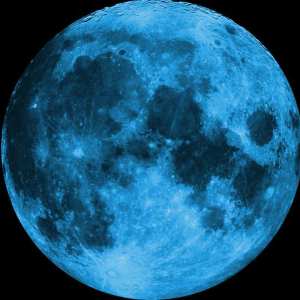
This moon looks blue in the photo, but the moon probably didn't appear to be so when the photographer took the picture. Just as the phrase "blue moon" indicates a moon that doesn't actually look blue.
(Photo from Doing the 116 Blog)

But why is it Blue?
  • Now that we've got our terms and our dates straightened out, we still haven't found the answer to the question, why's it blue?
  • Moons that actually appear to be blue in the sky are, in fact, very rare.  The first known instance when the moon appeared to be blue happened in 1883, after the eruption of Krakatoa, a volcano in Indonesia.


Krakatoa (or Krakatau as the Indonesians call it) erupting more recently.
(Photo from Fajaryusufrock)

  • The eruption was so enormous, scientists today think it must have been like the blast of a nuclear bomb that would be about 13 times the strength of the bomb that was dropped on Hiroshima in 1945.  Tons of ash went everywhere, including up to the top of Earth's atmosphere.
  • The ash had enough particles of just the right dimension (1 micron wide) that scattered red light but allowed other colors like blues and greens to pass.  White moonbeams passing through the cloud of ash appeared to people on Earth as blue.
  • The ash lingered for years, so the moon appeared as blue for a very long time (the sun also appeared as lavender but for some reason "lavender sun" didn't stick).
  • Even though people saw the moon as blue for a long time, it hadn't happened before, or at all often as far as anybody knew.  So the phrase "once in a blue moon" really did refer to something truly rare.

In true correspondence with the term, I am preparing this Daily Apple as a true Daily Apple -- the second one in two days.  I also just discovered that I wrote an entry on Blue Moons once before.  I completely forgot about that.  Repeating a topic, my dear readers, is very rare.  That's like the moon after the eruption of an Indonesian volcano rare.


One more not really blue moon for you
(Photo from Fact-o-tron)


Sources
Sky & Telescope, What's a Blue Moon?
EarthSky, The next Blue Moon is August 31, 2012
StarDate, Moon Phases
Moon Giant, What is a Blue Moon? 
NASA Science News, Blue Moon
NASA, Blue Moon
Daily Apple, Full Moons, Orange and Otherwise
Farmers' Almanac, Full Moon Names and Their Meanings

Monday, May 9, 2011

Apple #523: The Moon

It's very late at night.  So I thought I'd find a few facts about the moon.


Gallileo spacecraft took this photo of the Moon, not me.
(Photo from NASA)

  • The Moon is made of the Earth. Scientists are pretty sure that the Moon was formed about 4.5 billion years ago, when a giant something-or-other about the size of Mars crashed into the Earth. The collision sent a giant spray of rock and earth and basically hunks of the Earth's crust flying into the air.  All the debris, smaller than the Earth, fell into orbit around our planet.  Gradually, after about 100 million years, the debris coalesced into what we now know as the Moon.  So you could say the Moon is very upper-crust.
  • We're about the same age. Even though the Moon was formed out of the Earth's crust, scientists have estimated that the Moon and the Earth about both about 4.56 billion years old.
  • But the Moon is a lot skinnier. The moon has about 1/80th the mass that Earth does. But don't worry. The Moon might be skinnier, but we're a lot more popular.

The Earth, as seen from the Moon's surface. This was taken shortly before Neil Armstrong and Buzz Aldrin got out of Apollo 11 to go walk on the Moon. These kinds of photos always give me the strangest kind of vertigo.

(Photo by Getty, sourced from CNN)

  • The Moon wants more space.  It's slowly moving farther away from the Earth, at a rate of about 4 centimeters per year. But don't worry, it's not going to break up with us completely.  In about 50 billion years from now, it will stop drifting away and settle into a new orbit.  By that point it will be far enough away that instead of taking roughly 27.3 days to make it around the Earth, it will take 47 days.  I wonder if we'll adjust our calendars by then.
  • The Moon's official name is "the Moon."  Nobody knew for a long time that other planets had their own satellites.  So when they called ours the Moon, they thought it was the only one.  When they found out there were other moons orbiting other planets, it was too late to call the Moon Murgatroyd or Mephistopheles or Millicent or anything else but Moon.  So they refer to the other moons as "a moon" with a lower case m, or else they give those other moons specific names like Io.

The Moon on March 19, 2011, when it was at its closest point to Earth.  Scientists refer to this as the Super Perigee Moon.  It's seen here looking over the shoulder of the Lincoln Memorial in Washington, D.C.
(Photo by Bill Ingalls at NASA)

  • The Moon shows us only its face.  Back in the good old days when the Moon was first formed, it used to rotate around the Earth and show off all its sides.  But over time its rotation slowed down untiil it became "tidally locked" with Earth. Another way to describe this is to say that it rotates on its axis at the same rate of speed as it takes to go around the Earth.  In other words, it's stuck on showing us one side. This is how we got things like Pink Floyd's Dark Side of the Moon. Because it only shows us one side, no one had any idea what was over there on the other side until 1959 when a Soviet spacecraft went over there and took pictures.  Thanks to lots more spacecraft and space cameras, NASA will soon be releasing new topographic map of the moon -- all the way around.

Here's a recent composite of lots of photos taken by NASA's Lunar Reconnaissance Orbiter Camera, of the far side of the moon.
(Photo from NASA)

  • The hot side stays hot and the cold side stays cold. Well, that's true for about two weeks at a time.  Because the takes 27.3 days to complete one rotation, its days are a lot longer.  One full day, from sunrise to sunrise, takes about 27.3 days.  This means that for two weeks, the same side of the moon is facing the sun.  Because there's barely any atmosphere around the Moon -- or at least, not like what we have -- the sun's light and heat go straight to the Moon's surface.  The bright side can get up to 243 degrees F in that two-week period.  Meanwhile, the dark side can get as cold as -272 degrees F in that same time period.
  • The Man in the Moon is really geography. What we think looks like a face is the highlands, which look brighter, and the large seas of once-upon-a-time-volcanic-lava, which are darker.  This lunar geography was formed by all sorts of asteroids and other space-things slamming into the Moon and leaving scars all over the place. 

I always wondered what exactly people thought was the man in the moon.  This is one person's outline.  Is this where you see the man in the moon, too?
(Image by David Haworth)

I like to think of the Moon as friends with all of us.  Here, it's friends with the giraffes. 
(Photo from desktopart wallpaper)


Other Daily Apple entries about the Moon:
Blue Moons
Full Moons, Orange and Otherwise
Origins of the Earth and Moon
Lunacy and the Full Moon


Sources
Fraser Cain, Interesting Facts about the Moon, Universe Today, October 24, 2008
NASA, The Far Side of the Moon -- And All the Way Around, March 11, 2011
The Earth's History, How old is the Earth?
National Geographic News, Moon Facts, July 16, 2004
NASA, Solar System Exploration, Earth's Moon

Friday, January 1, 2010

Apple #428: Blue Moons

Tonight, the last night of 2009, happens to be a blue moon.


Blue moon
(You can download this photo as a desktop wallpaper from Desktop Rating)


  • A blue moon is the second full moon that occurs within the same month.
  • Since a full lunar cycle takes 29.5 days, it's very rare that two full moons will happen within the same calendar month. So the phrase "once in a blue moon" is meant to indicate rarity.
  • But this is a relatively new meaning.
  • Previous meanings have included:
  • The fourth full moon in a season, which usually has three. According to this meaning, the blue moon could occur in the last month before the beginning of the new season, which would be the month before the equinox or solstice. This means there could be a blue moon in February, May, August, or November.
  • Even older than this meaning is the sense of the moon visually appearing blue. This happens because of a lot of smoke or dust particles in the air. And by a lot, I'm talking due to major catastrophes such as the eruption of Krakatoa in Indonesia in 1883 which was so enormous it may have been akin to a 100 megaton nuclear bomb. The particles in the air afterwards made the moon look blue every month for two years.
  • The phrase originally -- way back in the 1500s -- meant "never." According to people way back when, the moon was obviously not blue. So when people said that if I say such & such a thing happened once in a blue moon, that meant it never happened.
  • But apparently people learned that blue moons actually are possible and, as most of us know today, we should never say never. So now a blue moon can happen, but not very often. So the phrase no longer means "never" but "rarely." And our definition of what exactly a blue moon is has changed. We now accept that blue moons are not only possible, but that they occur according to a specific pattern.
  • The definition of two full moons in a month is the prevalent one now. According to this meaning, we will see blue moons once every three years or so.
  • Our next blue moon will occur in April 2012.

Blue moon photo from NASA. So you know it's possible. Except this photo was taken using a blue filter over the lens.

  • There's also blue moon ice cream.

(Photo of blue moon ice cream, and a recipe using soy milk, available at Speed Bump Kitchen)

  • People have a hard time describing the exact flavor of blue moon ice cream. Descriptions and flavorings have included
  • bubble gum
  • cotton candy
  • marshmallow
  • frosting
  • Froot Loops
  • blue curacao
  • peach
  • nutmeg
  • lemon
  • cherry
  • orange
  • pineapple
  • licorice
  • coconut
  • almond
  • pistachio
  • ginger
  • custard
  • buttercream
  • cloves
  • chocolate
  • vanilla
  • or some combination thereof. This flavor confusion is partly due to the fact that different ice cream makers use different flavors for their blue moon ice cream. I think it's also because no food in real life has the color of blue moon ice cream, so the visual confusion also confuses our palate.
  • It's probably best to say that the flavor of blue moon ice cream is about as mysterious as blue moons themselves.
  • The first blue moon ice cream may have been made at Sherman Dairy Products in South Haven, Michigan. I've had their ice cream and it sure is good. Even my family's dog once sneaked into their ice cream store.
  • Blue Moon beer, meanwhile, is more specific about its flavors.

Blue Moon beer with orange slice
(Photo from Rate Your World)

  • It's a wheat beer made in Denver, Colorado, and its brewers say their beer is made from white wheat, orange peel, and coriander. Wheat beers tend to be sweeter and cloudier than lagers most Americans are used to. I happen to have tasted some this evening, and I thought it was all right.
  • Finally, I have a song for you. You might expect the melancholy "Blue Moon," but that's not what I'm going to give you. I heard this song on my way home tonight, and it's a good one that most of us have probably forgotten. I invite you to stand up and do a little dance while you listen.


  • If you really want to hear "Blue Moon," here are some options for you:
  • Blue Moon, sung by Dean Martin -- closest to the version you're expecting, plus some soupiness, and Dean inexplicably putting his hand into his tuxedo jacket, and he screws up the word "whisper," which turns out to be kind of funny

But I sure do wish you'd listen to that King Harvest song. Give it another listen and you'll want to give a little shake of your hips. Trust me. And have a happy new year.


Related entries:
Full Moons, Orange and Otherwise
Lunacy and the Full Moon


Sources
Sky and Telescope, What's a Blue Moon?
inconstant moon, on blue moons
NASA, Blue Moon
Infoplease, Once in a Blue Moon
All About Blue Moon, Blue Moon Ice Cream
Blue Moon Brewing Company (must be 21+ to enter)
The Brew Club, Blue Moon Wheat Beer Review, May 15, 2009

Thursday, June 26, 2008

Apple #325: How to Get to Outer Space

I was at a dinner party the other night, and I forget how this came up -- oh! I remember! I mentioned that it was finally explained to me, through some episode of Nova or something like that, that weather is actually the effect of Earth spinning through space. That is, the air that's rushing around our planet is outer space, which just happens to be within Earth's atmosphere. I said that knowing this made the volatility of weather make more sense to me. It's from outer space! Of course it's going to be fierce and crazy!

(No remarks, please, about the nerdiness that I bring to dinner parties. You don't know what else happens at these gatherings that I don't tell you about. Oh, the Parcheesi games . . .)

In response to my news about the weather coming from outer space, one member of the dinner party asked, "Where does space start, anyway?"


Looking back to Earth from a shuttle in outer space
(Photo from Hemmy.net)

There was much discussion about this. I said that it was outside the earth's atmosphere, but none of us knew how far above the earth's surface you have to go to get to space. We made lots of guesses and speculations: as far away as it is to drive from here to California? 300 miles? 1,000 miles?

The question itched at me, and I asked my host, who is a teacher, if she had any sort of science textbook on hand. I remembered, once upon a time in my grade school career, seeing a diagram that showed the various levels of the earth's atmosphere with arrows and measurements indicating how high up they were. Sadly, my host said she had no such book, but that if I wanted to, I could go get on yon internet and look it up. Like the absolute giddy nerd that I am, I ran up to her computer room and got to Googling.

I found the answer, shared it with my fellow dinner-eaters, and together we marveled at this fact:
  • Outer space is defined as starting 62 miles above the Earth's surface. This is not far.
  • If you could drive your car to outer space, and if you drove 60 miles an hour, it would take you just over an hour to get there.
  • Here's another perspective on it: most commercial airline jets fly at 36,000 feet. That's about 6.8 miles, or 1/10 of the distance to get to outer space.


This diagram shows lots of the stuff that's up in the air at their respective heights. On this diagram, space starts at the 100 km mark.
(Diagram from Kowoma's GPS Explained page)


  • That 62 mile marker is totally arbitrary, by the way. The unit of measurement that scientists use is kilometers, and 62 miles equals 100 kilometers. So some scientist at some point seems to have picked a nice round number for the place where space begins.
  • One scientist argues that the true beginning of space should be defined as the place where the Earth's gravitational pull no longer has any effect on you. The place, he argues, where your home can no longer draw you back to it.
  • The rough location where Earth's gravity wouldn't affect you is 13 million miles away (a.k.a. 21 million kilometers). Now that is outer space.


The view from where outer space starts, or 62 miles above the Earth's surface. Looks pretty outer-spacey to me. I mean, I wouldn't want to be out there all by myself.
(Photo from Space Today Online)


  • But okay, let's say you want to go to regular old 62-mile-away space. That's not that far, as we've established. So why don't people go there more often?
  • Because to get there, you have to overcome that pervasive and mysterious force that no one really understands: gravity. It's one thing to say you're going to get past Earth's gravitational pull. It's another thing to actually do it.
  • To get yourself up in the air, you have to use a force greater than the force that's pulling you down to the ground (32 feet per second per second). Think about how hard it is for you to jump very high. Think about what a big deal we all make of it when a basketball player can jump high enough to grab a basketball out of the air and dunk it into a basket. That's only a few feet. And we're trying to go 62 miles.
  • (By the way, the record for the highest slam dunk goes to Michael Wilson of the Harlem Globetrotters, who dunked the ball successfully into a 12-foot hoop. That's not even 1/27,000 of the distance we're shooting for here.)


The celebrated Michael Jordan, performing one of his signature slam dunks. The top of his hoop is only 10 feet high -- not even as high as the one dunked into by the world record holder.
(Photo from NBA.com)


  • To get outside the realm of the Earth's gravity, you have to go fast enough to overcome the force of gravity itself, multiplied by the mass of the Earth, divided by its radius.
  • Leaving out all the messy math, this works out to be 11.2 kilometers per second. That's also known as 7 miles per second, or 25 thousand miles per hour.
  • To reach 25,000 mph, you have to have a huge force propelling you up there.
  • But of course you can't shoot just your body up into space -- you would burn up on the way out of the atmosphere. So you've got to have the appropriate pressurized suit, and the oxygen tanks so you can breathe up there, and you'd better put it all in a vehicle of some sort. So you'll need to get yourself a rocket ship.


You can get your very own Apollo Moon Suit replica, built to replicate those worn by the astronauts on the Apollo missions, for a mere $2,460 from the Space Store. The suits are custom-made, so you get no returns, no discounts.

  • Assuming you're going to use the same sort of rockets that NASA uses, your rocket by itself won't weigh all that much, only about 165,000 pounds. When you add the necessary boosters, it goes up to about 428,000 pounds.
  • But generally speaking, the amount of fuel you need for your rocket is in a ratio of 36:1. So, when you add the amount of fuel you need to your rocket and the boosters, you get an entire package that weighs around 4.4 million pounds.
  • Then, because your fuel is going to burn up wicked-fast -- in about 8 minutes, actually -- you'd better bring enough fuel to generate 4.5 million pounds of thrust.
  • Different rockets are propelled by different types of fuel, depending on their destination (the moon, Mars, someplace else). One option is to use liquid hydrogen in one tank and liquid oxygen in the other. Then let these two things get together, but in a controlled way, and you have an explosion strong enough to propel that 4.4 million pounds of stuff 62 miles, and then some.


The space shuttle Discovery's first launch on July 4, 2006. All that fuel interacting and exploding is what makes those huge billowing clouds of smoke.
(Photo from NASA)


  • The whole feat is so difficult to accomplish that if you can get your rocket to make it even 50 miles up, NASA will give you astronaut status.

All that to go 62 miles up. I'm going to think about this the next time I'm driving 62 miles horizontally, more or less.

Oh, and if you want to go on to the moon, you've got another 238,732 miles to go. But maybe after that first 62, the rest is cake.


Sources
"How High is Space?" Space Today Online
Seth Shostak, "Gray area where space begins," Space.com, reprinted at CNN.com, June 25, 2004
What is Space? Space I: Worksheet 9, Native Access to Engineering Programme, Concordia University, Montreal
Katrina C. Arabe, Ride a White Hot Rocket, Industrial Market Trends, August 4, 2004
NASA Facts Online, Propellants

Saturday, January 13, 2007

Apple #216: Origins of the Earth and the Moon, part II

Not long ago, I posted an entry about the beginnings of the Earth as a planet and the "birth" of the Moon. I mentioned that there is more to the story about the relationship between the moon and the Earth, so I will continue that story now.

Again, I want to state that what I am describing represents a condensed version of many astronomers' theories about the origins of the universe and various planets and so on. It is highly possible and even likely that, as scientists learn more about these sorts of things, this story will change. But for now, here's how it goes:

  • Where we last left the Earth and the moon, the Earth had sustained an enormous collision with another planet, about the size of Mars, and out of this impact the moon was formed.
  • Meanwhile, all kinds of wacky adjustments were still happening out in the rest of the solar system. Planets kept consolidating and getting bigger, and any time that happened, everybody else had to adjust. Scientists aren't exactly sure what triggered it, possibly a change in Jupiter's orbit, but the asteroid belt shifted. And all of a sudden, Earth and the moon were flying into the asteroid belt. You've seen this sort of thing happen in Star Wars, so you know it isn't pretty.
  • Okay, so there were asteroids flying everywhere, right? Since it has larger mass than the asteriods, the Earth's gravity was pulling the asteroids to it. So the Earth was getting shelled by these asteroids, but since the moon was hanging around, too, spinning around the Earth, the moon sometimes got between the asteroids and the Earth. As a result, the moon got clobbered way more than it otherwise would have, simply because it was so close to Earth -- much closer than it is now (you may recall, it's retreating an inch and a half farther from Earth each year).
  • This asteroid bombardment went on for some thousands of years. You can see evidence of this on the moon today, without even using a telescope. All those shadows are enormous craters, caused by thousands upon thousands of asteroids slamming into the moon.

This is the moon's south pole, rife with craters made by asteroids
(Photo from NASA's Clementine Mission)


  • You can't see similar craters on Earth because all the volcanic and tectonic activity over the millenia have changed the surface too much, but some rocks have been found on the Earth that support this theory about the asteroids hitting the moon and the Earth.
  • The moon, however, stopped changing not long after it got hit by all those asteroids. Its surface used to be molten basalt and volcanic stuff, and the channels that are still visible used to be seams of lava. But all that volcanic stuff cooled and hardened and eventually froze into the shapes we see now. The Sea of Tranquility, for example, used to be a giant sea of molten lava which filled in a crater made by who knows how many asteroids.
  • This period when the asteroid shelling happened is called the Lunar Cataclysm or the Late Heavy Bombardment, and this happened about 3.9 billion years ago (long before the other asteroid or asteroids that wiped out the dinosaurs). It came on pretty suddenly, and in terms of astronomical time, it stopped fairly suddenly too.

This graph shows the decline in the postulated number of asteroids that have hit the moon since its inception. The red line represents the new theory of a spike in the number of asteroids that hit the moon during the Lunar Cataclysm.
(Graph by Barbara Cohen)


  • But the interesting thing is, very soon after the asteroid insanity stopped, life on Earth started. Nobody's sure what role those asteroids played, if any. Did the asteroids bring water to Earth? Did the impact of the asteroids alter the molecular composition of surface carbons to form amino acids? Did the heat generated by the asteroids produce enough steam to form water? Nobody is really sure about this part, but people are running lots of tests to try to figure it out.

Drawing of an asteroid hitting Earth -- who knows exactly what could have resulted from such an impact?
(Drawing by Don Davis, sourced from the Australian Spaceguard Survey)


  • Here is one possible theory about how the asteroids helped bring about the genesis of life on earth: Perhaps the asteroids brought a lot of ice with them, which then melted when they hit Earth. Or perhaps the steam issuing from all the molten goo started to condense and fall back to Earth as water. In any case, at some point around 3.9 million years ago, a lot of water appeared on the Earth.
  • The moon, which was still very close to the Earth, was orbiting around the Earth and creating tides. But because the Earth was still spinning really fast from the impact with that other planet, and because the moon was still so close, these aren't just your everyday tides. These are enormous tides, some thousands of feet high. The waves from these things traveled over fantastic distances, then slid back out to sea, scooping all kinds of material with them into the water. Thus, the highly sought-after "primordial soup" was mixed, creating the right environment for life to generate.
  • Something else important about the moon and the tides happened too. Because the moon was still really close to the Earth, its gravitational pull was sucking water toward it in a big bulge some thousands of feet high. This bulge created a drag on the Earth's spin and very slowly started making it slow down.

How the moon's gravitational pull creates tides and helps slow the Earth's spin
(Diagram from Helmer Alasken's page about the moon)


  • In addition, because the Earth was spinning way faster than the moon was orbiting, the Earth was in essence spinning underneath its oceans. This means that the land under the water was creating friction, and that friction also helped slow the Earth's spin.
  • When the Earth slowed its spin, the insanely violent winds calmed down, hurricanes weren't happening as often or as severely, and there was less chaos in general. This meant that the life that was burgeoning in the water could have a chance to survive without being ripped apart by searing winds or tremendous waves.
  • So, in essence, the moon helped make it possible for life to thrive on Earth.
  • And here's another way the moon helped. When that second planet hit Early Earth and knocked it off-kilter, that was crucial because the Earth's tilt is what ensures that no part of the planet is exposed to the sun's heat for too many months at a time. But while that rogue planet set the Earth aslant to begin with, the moon is what keeps it there.

The Earth's tilt is what gives us different seasons throughout the year
(Diagram from Howstuffworks.com)


  • Without the moon's gravitational pull tugging at the Earth, the Earth would start to wobble as it spun, the same way a top starts to wobble as it slows down. If the Earth started wobbling, different parts of the planet would be exposed to sun at all kinds of chaotic times, the winds would shift in crazy ways, and the weather would get all chaotic and super-violent again, and we or maybe no life might be able to survive it.
So, thanks, moon, for helping us hang on.


Sources
National Geographic Society, Naked Science television series, Moon Mysteries and Birth of the Earth
NOVA Transcripts, Origin: Earth is Born and subsequent segments, September 28 and 29, 2004
David A. Kring, Arizona University and NASA/UA Space Imagery Center, The Lunar Cataclysm Hypothesis
Ron Cowen, "An early cosmic wallop for life on Earth?" Science News Online, December 2, 2000
Lori Stiles, "Asteroids Caused the Early Inner Solar System Cataclysm," University of Arizona Sci/Tech news, September 15, 2005
Lori Stiles, "Lunar Meteorite Ages Strongly Support Lunar Cataclysm," Space Daily, November 30, 2000
Strom et al, "The Origin of Planetary Impactors in the Inner Solar System," University of Arizona Faculty Reprints, April 2005
Bernard Foing, "Linking the Earth to the Moon," Astrobiology Magazine, August 3, 2006
Jeremy Bailey, Australian Centre for Astrobiology, "The Inner Solar System Cataclysm, the Origin of Life, and the Return to the Moon"
G. Jeffrey Taylor, Origin of the Earth and Moon, Planetary Science Research Discoveries, December 31, 1998

Michael Richmond, What if the Earth had no Moon? July 15, 2005

Sunday, January 7, 2007

Apple #215: Origins of the Earth and the Moon

I just saw two programs on the National Geographic Society channel, and I want to share with you some of the things I learned.

The shows were about the beginning of the solar system and how the Earth was formed, but there was a particularly interesting section about the role that the moon has played in enabling life to begin and to thrive here on Earth.

So I'll tell you the story of the moon and the Earth, as I understand it. I should say up front that this story I'm about to tell is a series of scientific theories as they exist at this point. One story people used to tell about the universe was that the Earth was at the center and everything rotated around it. Now we have a different story to tell, supported by a lot more evidence. But it's possible and even likely that this story I'm about to tell will change in the future, as we learn more about our universe.

Okay, so here it is.

  • So there was this enormous explosion, right? Astronomers see stars blow up all the time, and what happens is all these enormous rocks and boulders and particles go shooting out in all directions. Just a mass of stuff everwhere, a huge cloud of it. And they say at that the beginning of the universe, the same kind of thing happened except on a massive scale.
  • But everything in the universe was spinning. So all the stuff in this huge cloud all had some spin going on. And you know how, when a figure skater does a spin on the ice, she has her arms spread out and she's going kind of slowly, but as she spins, she pulls her arms in and makes her body tighter, and she goes faster and faster the more compact she makes herself? Well, that's what happened to the stuff in the cloud.
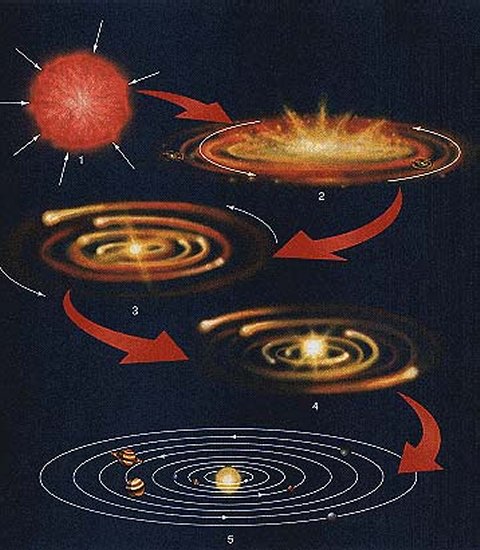
  • As they spun, big rocks attracted littler rocks and got still bigger. Like in that video game, Katamari, if you've ever played it, stuff accumulated more stuff. Eventually, the rocks and particles and dust and all that consolidated to form the ancestors of the planets of our solar system.

One drawing of the process by which the solar system formed. Except I'd suggest that it wasn't quite as neat as that, and bear in mind that everything was more or less on fire for a long, long time.
(Drawing from Aerospaceweb)

  • The big, hulking pre-planets started throwing their weight around, moving in their own special, sometimes looping orbits. There were about twice as many planets then as there are now, and their orbits were quite different from the orbits the planets travel today.
  • One of those planets was ultimately going to be the Earth. But back then, Early Earth was enormously hot, covered with molten lava, a steaming, stinking, intolerable inferno. Within that ball of molten stuff, various elements started to consolidate, too. The heavy stuff like iron sunk to the middle of the ball, and the lighter stuff light carbon stayed at the surface.
  • That iron is still there, still molten, and as it swirls around, its motion generates a magnetic field. There's so much iron in the center of the earth, its resultant magnetic field is large enough to encircle the entire planet. And that's what it did way back at the formation of the Earth.
  • Now, remember, there were these other planets loping around the solar system, doing their wacky things, and combining with other, larger planets. Scientists now believe that one of those other planets, smaller than Earth, got sucked toward Earth and collided with it. This made Earth larger, but it also made the moon.
  • When that second planet hit ours, it got pulverized and a bunch of rocks and stuff also flew out from the Earth. Think of throwing a rock into a pile of dirt: a shower of dirt flies up into the air when you do that. The stuff that flew out from the Earth then over the course of about a hundred years, it coalesced and formed what we now know as the moon.

One rendition of a smaller planet colliding into what is now Earth. The resultant spray of rocks and stuff then was pulled together by gravity to form the moon.
(Drawing by David Darling)


  • After its formation, the moon continued to move farther away from Earth (and still is, at 1.5 inches per year) , but because it was smaller, gravity kept it rotating around the Earth even as it slowly cycled ever outwards.
  • That blow from the other planet, by the way, hit Early Earth at an angle, so it was more of a glancing blow rather than a head-on collision. And that impact knocked the Earth off-kilter, to its present tilt. This is crucial because the tilt is what allows our climates to have seasons and vary throughout the year.
But there's more about why the Earth is the way it is today which, surprisingly, has to do with the moon. I'll put that into a separate entry and continue The Story of the Earth and the Moon there.


Some Astronomy Fun
Choose your asteroid and send it hurtling toward a planet of your choice and see the result

Sources
National Geographic Society, Naked Science television series, Moon Mysteries and Birth of the Earth
NOVA Transcripts, Origin: Earth is Born and subsequent segments, September 28 and 29, 2004
Ron Cowen, "An early cosmic wallop for life on Earth?" Science News Online, December 2, 2000
Bernard Foing, "Linking the Earth to the Moon," Astrobiology Magazine, August 3, 2006
Jeremy Bailey, Australian Centre for Astrobiology, "The Inner Solar System Cataclysm, the Origin of Life, and the Return to the Moon"
G. Jeffrey Taylor, Origin of the Earth and Moon, Planetary Science Research Discoveries, December 31, 1998

Tuesday, June 21, 2005

Apple #83: Full Moons, Orange and Otherwise

ORANGE FULL MOON

Last night there was a full moon, and it looked orange. I asked the person standing next to me if he knew why the moon was orange. He thought a minute, and said no, he didn't. Maybe, he said, pointing to the orange shirt he was wearing, it was because of his shirt?
  • It is the scattering of light by the earth's atmosphere that makes the moon appear orange, especially when it first rises.
  • Early in the moon's ascent, it is still pretty close to the surface of the earth, from our vantage point. This means we have to "look" through a lot more of the atmosphere.
  • The air molecules in the atmosphere scatter away the pieces of visible light that are blue, green, and purple. So when we look through a lot of the atmosphere toward the moon, which is white, we see it as yellow, orange, or red.
  • Sometimes when the moon is directly overhead, it will still appear to be orange in color. This can be because there is a lot of dust or smoke or pollution in the air.
  • Also, the Harvest Moon in the fall appears to be orange. This is for two reasons. First, during some months of the year, the atmosphere contains more dust particles than others. In the fall, many farmers are harvesting their crops, and there is also a lot of pollen floating around. Second, the moon also rises at a lower angle to the horizon in the fall. Thus, at the autumn equinox, you'll see a big fat orange moon, the Harvest Moon.

The Harvest Moon. Photo by Brian D. Buck

FULL MOON NAMES

This reference to the Harvest Moon reminds me, I've always liked the fact that each month's full moon has a different name, but I can never remember what they are, and I'd also like to know why they are so named. As it turns out, most of the names come from Native American tribes and refer to weather, growing, or hunting conditions at the time of the full moon.
  • January: Wolf Moon
    • Wolf packs, hungry, howl together in snowy January.
  • February: Ice or Snow or Hunger Moon
    • Heaviest snow or ice falls during this month. It's hard to hunt or find plants to eat, so this is also a hungry time of year.
  • March: Worm or Crow or Full Sap or Lenten or Crust Moon
    • With the first thaws, earthworm casts begin to appear in the soil, signaling the return of robins and the beginning of spring. The crows caw to signal the end of winter, the sap begins to run, and for Europeans, it's time to start fasting for Lent. Another name, the Crust Moon, referred to the fact that snows melt and freeze again at night, making a crust on top of it.
  • April: Growing or Pink Moon
    • The pink herb moss, or wild ground phlox, which is one of the earliest spring wildflowers, appears at this time. It also signals the first plants beginning to grow.
  • May: Hare or Flower or Corn Moon
    • Flowers bloom abundantly at this time, rabbits are born, and it's time to plant corn.
  • June: Mead or Strawberry or Rose Moon
    • Time to harvest the strawberries, make the mead, and in Europe, pick the roses.
  • July: Hay or Thunder or Buck Moon
    • Buck deer begin pushing out new antlers, it's time to mow hay, and lots of thunderstorms happen in July.
  • August: Corn or Sturgeon Moon
    • In the Great Lakes, sturgeon are abundant and easy to catch, and it's time to pick the corn. Some tribes also called this the Full Red Moon, which would make sense, given that some things are being harvested in August.
  • September: Harvest Moon
    • This moon may actually be in October some years, as it appears closest to the autumnal equinox. Often, farmers are working at the harvest until late at night at this time of year, and the moon appears to be orange because of all the dust and pollen they work up.
  • October: Blood or Hunter's Moon
    • After the harvest, the deer and fox and other animals are fattened and easier to spot, and it is time to hunt. Blood runs from the animals hunted, but also perhaps the moon still appears red in the sky.
  • November: Snow or Beaver Moon
    • This is the time of the first snow, and time to set the beaver traps before the swamps freeze, to ensure a warm supply of furs for winter. The beavers themselves are also preparing for winter.
  • December: Cold Moon
    • Nights are getting longer, and colder, and it's just plain cold.
One moon fact I never really thought about before: though the time of the full moon's appearance may differ, everyone in the world will see the same full moon on the same evening.

Sources
Keith Cooley, Keith's Moon Page, "The Orange Moon" This is an extremely cool site, by the way. You can see what the phase of the moon was on any day of the year going back to 1800. You can find out what your weight would be on the moon. Find out when the next blue moon will be. Learn about eclipses, moon landings, the tides, and how the moon determines when Easter falls.

University Corporation for Atmospheric Research - Windows to the Universe - Quickie Questions - Moon Madness

Farmer's Almanac, Full Moon Names and Their Meanings

Wednesday, January 12, 2005

Apple #24: Jupiter

Jupiter is my favorite planet. I like it because of the spot, which is a storm, and because it's lots of different colors. And, it turns out, all kinds of crazy stuff goes on there.


(Photo of Jupiter from Zabawiki)


  • Jupiter is the fifth planet from the Sun.
  • It is the largest planet in our solar system. It has more than twice the mass of all the other planets combined. If Jupiter were hollow, more than 1,000 Earths would fit inside it.
  • Galileo's discovery in 1610 of four of Jupiter's moons and the fact that they rotated around Jupiter was the first time anybody realized that things in the heavens rotated around things other than the Earth.
  • We now know of 63 moons that orbit around Jupiter.
  • Jupiter is 90% hydrogen and 10% helium, with traces of methane, water, ammonia, and "rock." This composition is considered to be very close to that of the nebula from which our solar system was formed.
  • The presence of "rock" is really only a guess. Scientists think that Jupiter probably has a rocky core, with a mass of about 10 to 15 times that of Earth.
  • Around this core is liquid metallic hydrogen, which can exist only at pressures greater than 4 million bars.
  • Winds whip around Jupiter at more than 400 mph, driven mostly by the planet's internal heat. This heat is generated by the planet's slow gravitational compression.
  • The colors which seem to be on the planet are actually clouds, made mostly of ammonia and ice. The exact reason for the colors is uncertain. Some say they're from trace elements in the atmosphere, maybe sulfur or phosphorous. In some images, the colors are coded to correspond with altitudes of the clouds, where blue is the lowest and red is the highest.
  • The Great Red Spot (GRS) is a 12,000 km by 25,000 km oval, large enough to hold two Earths.
  • The Spot is actually a hurricane-like storm of gases, which has existed for at least as long as people have been looking at it, or over 400 years. Nobody seems to know much more about it than that. See a movie of the red spot in action.
  • Jupiter also has rings, like Saturn, though they are much smaller and fainter. They were discovered by Voyager I in 1979. They are actually small dust particles.
  • Jupiter also has "auroral emissions" or magnetic events like Earth's northern lights.
This is from the Hubble Space Telescope, in 2004:


Update: In July 2009, the telescope Hubble has taken pictures of a new large spot on Jupiter, a black one. It's estimated to be 6,000 miles wide, or about twice the size of Europe. This spot was probably caused, astronomers believe, by an impact from a comet or an asteroid.

To-scale image of the new black spot on Jupiter, as taken by Hubble.
(Photo from the Hubblesite)


While everyone has been talking about how great Hubble is for the pictures it's taken, the new black spot was first noticed by an amateur astronomer named Anthony Wesley from Australia.

Sources:
The Nine Planets
Views of the Solar System,
Jupiter page
Hubble Space Telescope's
Hubblesite
A little bit more detail about the
Great Red Spot, from Astronomy 161, as taught by the Department of Physics & Astronomy at the University of Tennessee
News about the black spot:
"Hubble pictures Jupiter's 'scar'," BBC News, July 24, 2009
"See Jupiter's Great Black Spot," MSNBC News, July 24, 2009