Showing posts with label clothes. Show all posts

Sunday, June 17, 2012

Apple #590: Why are Blue Jeans Blue?

Continuing my theme of blue-related topics (later historians will refer to this as my blue period), instead of reaching for some exotic blue thing, i.e., the blue-footed booby of last week's entry, I thought, what about some common thing that we take for granted as being blue?  Like blue jeans?  Why are they blue, anyway?


That's a lotta jeans, and they're all blue.
(Photo from Zoe's Sketch Book)

  • The short answer is:
    • 1. because blue was a popular color when jeans were invented, and 
    • 2. cotton is difficult to dye, but for whatever reason, it doesn't mind indigo.
  • But of course, you know me.  There's more to the story than that, and I can't let it go without telling you the rest.

How Blue Jeans Were Invented
  • OK, so Levi Strauss owned a dry goods store (that means he sold a lot of clothing and fabrics and textiles).  He was originally from Germany, grew up in New York, then moved out to San Francisco to sell stuff to the miners and scads of people going West for the Gold Rush.
  • One of Strauss's customers was a tailor from Reno, Jacob Davis. He was taking Strauss's fabrics and turning them into horse blankets and tents and selling those. 
  • He, too, was born in Europe -- Latvia, to be precise -- then moved with his family to New York, then headed West. This business about both guys being from Europe is important; you'll see why in a bit.  
  • Davis's customers told him their pants kept getting ripped, especially at the pockets, while they were working.  One day, while using rivets on horse blankets, Davis thought he'd try using rivets on his work pants to keep the pockets from getting ripped.  He made some pants like that, and they were a hit with his customers.

Jacob Davis (born Jacob Youphes, from Latvia) came up with the idea for riveted work pants.


Levi Strauss (born Loeb Strauss, from Germany) sold Davis the fabric and had the money to pay for the patent.
(Photos from The Great Idea Finder)

  • Davis wrote to Strauss in San Francisco about his idea, Strauss said it sounded good to him, and he agreed to help Davis file the patent.  The key feature of the pants was that they were like overalls except without the bib-like top -- for many years they were referred to as "waist overalls" -- and they had rivets which were sturdier at holding the garment together.
  • The first pairs of jeans came in two styles, blue denim and brown cotton "duck," which was another kind of sturdy fabric.  The duck never got as soft as the denim so that fell out of favor rather quickly.
  • Denim had been around for a long time -- the history of denim is its own interesting story which I won't get into here -- and Strauss and Davis dyed their denim blue because, as I said, cotton (which is what denim is made of) is difficult to dye, but indigo works with it quite well.  So it was one of the easier choices of colors for denim.
  • Specifically, they used indigo to dye their denim. And as it happens, indigo had been very highly sought-after for a long time.  For centuries, actually.  

Europeans Sure do Love that Indigo
  • Indigo dye comes from the indigo plant, which is a flowering shrub.  The precise name of the plant varies a little depending on where it's grown and what species it is.  There's indigo from India, and indigo from Africa, and another type of indigo from the tropical Americas.
   
This is the Indigofera tinctoria, which is the type of indigo that grows in India.
(Photo from the Prelude Medicinal Plants Database)


This is Indigofera arrecta, which is the species of indigo that grows in Africa. I couldn't find a photo of this species with flowers, but you can see the difference in the leaf shape. 
(Photo by Bart Wursten, Flora of Zimbabwe)
  • There's also another plant entirely grown in Europe, called woad, which also produces a blue color. It's woad that the Celts used to paint themselves blue, by the way.  Robin Hood's Saxon green was made by combining woad and a yellow dye that came from wild mignonette. But woad's blue is not the same as indigo's blue. Even though Queen Elizabeth I banned indigo in an effort to support the use of woad at home, people still wanted their indigo.
  • For a long time, the only place where Europeans could get indigo was from India.  I'm talking the 1400s now.  People had to sail those dangerous, long-ass freakin' trade routes to India and back to get indigo to Europe and dye their clothes with it.  So you had to be pretty rich to have any garments colored blue, which meant that for a long time way back then, only royalty wore indigo.
  • (Which means, by the way, if anyone gives you guff for wearing blue jeans, you could always retort, "Once upon a time, kings would have killed to be able to wear blue pants like these.")
  • By the late 1500s, the Europeans just had to have their indigo, so folks in India started growing the plants like mad.  There was something of a boom in India over indigo, but for some people that was a bad thing.  Plantations developed and so did slavery.
  • By the 1700s, Europeans had become totally hooked on their indigo, but they were sick of sailing all the way to India to get it. So they started coming up with other ways to get their indigo.  So the Spanish colonists began growing it in Central America and in Louisiana.  British colonists started growing it in the early US colonies. 
    • Actually, the first indigo crop in today's US was started in South Carolina by a 16 year-old girl, Eliza Lucas Pinckney. After her mother died and her father went to Antigua to become governor there, she took over her father's homestead and decided to start growing indigo. Her first two attempts failed but the third one worked. Soon indigo exports from South Carolina took off like wildfire.
    • Indigo might have been the king crop of the south by the time of the Civil War, if the Revolutionary War hadn't happened and people hadn't needed rice more.  Then the cotton gin was invented, which made it even easier to convert cotton from crop to thread, so by that time, if anyone was still growing indigo in the south, they switched to cotton.
  • If the south could have grown the two together, indigo and cotton, things might have turned out very differently for them.  That and if they hadn't gotten into the whole nasty slavery thing.

  
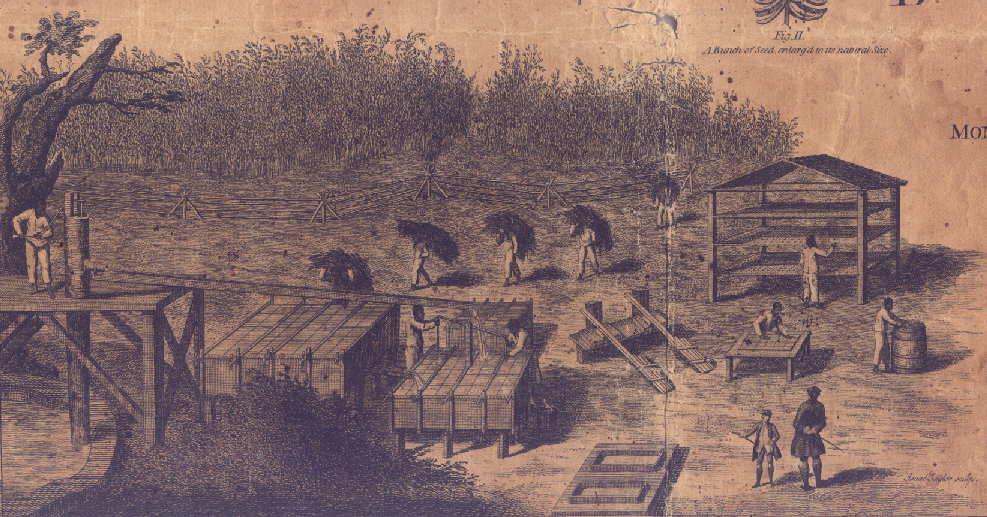
Detail from a map of the Parish of St. Stephen in Craven County, showing slave laborers harvesting and drying indigo on a plantation.
(Map from Duke University's Special Collections Library section, Slave Voices)

Indigo and Slave Labor
  • Now, when I say the "colonists started growing indigo," what I mean is they had the idea to do it, and they bought the stuff needed to get the crop going, but the people who did the actual work were slaves.  
  • In the Central Americas, it was the native peoples.  Strangely, they kept getting sick and dying from working with the indigo. (Dying while dyeing. It's a pun, but it's not funny.) The Spanish thought, hey, those black slaves from Africa might not be as frail. So they switched to African slaves.
  • Since indigo also grows in Africa, some of the African slaves already knew how to work with it. So they made their own improvements to the cultivation of indigo, and they also improved dyeing methods. But they kept getting sick and dying, too. 
  • As far as I can tell, it wasn't the plants themselves that were making people sick. To get from a leaf or a flower of the indigo plant into a dye that will adhere to a fabric, you have to extract the color from the plant, and then you have to make it water-soluble.  In the process of doing that, at one stage you get something called indigo yellow. It is thought that the indigo yellow by-product is probably the thing that was toxic.
 
This woman in Thailand is working with natural indigo. Knowing how many people died back in the day from using natural indigo, this photo makes me very nervous.
(Photo from Tammachat Natural Textiles)

  • So in the big picture of indigo, it was becoming more widely available as it was being grown in more places. But it was the Europeans who wanted it and who had the money to pay for it.  
  • So the initial reason for why Strauss & Davis dyed their denim blue is probably because, having worked for years with textiles, they would have known that cotton doesn't mind being blue.  So blue would have been an easy choice, from a manufacturing standpoint.
  • But I also think their origins in Europe have something to do with it.  Because they came from a place where people really wanted to have clothes and garments dyed blue. 
  • So even though Strauss & Davis's work pants were intended for people who were most definitely not rich, they might have assumed that people would want very much to have blue pants. As it turns out, they were right.

From Natural to Synthetic
  • But the fact that people were getting sick and dying from working with indigo, that was kind of a problem. And it was also a problem that the supply of indigo just couldn't keep up with demand.  So some chemists started to figure out how they could make a synthetic indigo.
  • Most of the advanced chemistry at the time was being done in Germany (this is why so many of our chemical and pharmaceutical companies today are based in Germany or have German names). One German chemist named -- get this -- Johann Friedrich Wilhelm Adolf von Baeyer started working on figuring out how to make a synthetic indigo.  That was in 1865.  By 1880, he'd found the answer.

How indigo was synthesized in the 1900s, beginning with naphthalene and using potassium permanganate as the oxidant. 


How indigo is usually synthesized today, starting with benzene and using the now much less expensive sodium.
(Diagrams from Backyard Chemistry)

  • Strauss & Davis patented their waist overalls / blue jeans in 1873. So their blue jeans came out right when the chemists were trying to solve the indigo problem.  It's a total coincidence that shortly after those waist overalls started taking off that a synthetic indigo was found.
  • It took a while before people started buying synthetic indigo.  People didn't believe it was possible to have a synthetic indigo, for one thing, and for another, the molecule looks exactly the same as natural indigo. Some chemists have a hard time telling them apart. But it was the low price and the "superior purity" of the synthetic indigo that finally convinced people en masse that they could get the same or better results from the synthetic stuff.
  • By 1913, BASF, the company for whom Baeyer worked, had sold 4,900 tons of indigo.  That's a lot of blue.  
  • While the first blue jeans were almost certainly made with natural indigo, at some point in the next 40 years or so, Levis Strauss blue jeans were made with synthetic indigo and have been ever since.
  • Today, synthetic indigo is now the most-produced textile dye in the world, largely because of the popularity of blue jeans. In 2002, 17,000 tons of synthetic indigo were manufactured worldwide.

Jeans from Japan, dyed with natural indigo on the left and right, and synthetic in the middle. You can see that the blue of the synthetic is different from the natural, but the two natural indigos also differ from each other.
(Photo by superbored at superfuture)

The Hues of those Blues
  • About the fading.  Natural indigo fades naturally over time.  So it makes sense that synthetic indigo, which looks and acts a lot like the natural stuff, would do the same.
  • Also, the results of dyeing with natural indigo can vary considerably from one batch to the next, depending on humidity, temperature, and so on.  
  • When dyeing with natural indigo, when the dye is watery and you're sloshing the pants around in the vat, it actually has a greenish-yellow color.  You hang up the pants to dry, during which time oxidation takes place, and they turn blue. (As for that photo above in which the wet dye is blue, all I can think is that the dye was exposed to the air long enough that it turned blue even while it was wet.)
  • At any point in the process -- how the dye is extracted, whether it came from an indigo plant grown in India or in Africa or in Central America, how the vat is mixed, how humid it was that day, how sunny it was when the pants dried -- any of those things can have variables, which means the blue color on the pants can be different from one batch to the next.  
  • So it's perfectly in keeping with the characteristics of natural indigo that our synthetically-dyed blue jeans vary in shade from one pair to the next, and that they fade.
 
Blue jeans are blue, but there are all sorts of shades and hues of blue.
(Photo from A History of American Technology)


Coda in India
  • Remember all those slaves in India who were working on the indigo plantations?  Well, when synthetic indigo became popular, the bottom fell out of the natural indigo market.  Growers in India couldn't get people to buy as much of their indigo as they used to.  So the plantation owners (many of whom were British) started putting the squeeze on their slaves/indentured servants to grow more indigo and to give up a bigger percentage of their yield to the growers.
  • This put a big hurt on a lot of people who were already hurting.  The villages where the workers lived were rife with horrible conditions. At the historic Champaran protest in 1917, the majority of the thousands who turned out to protest were indigo growers. It was during this protest that Gandhi made his first public statement advocating non-violent resistance.  
  • After that protest, Gandhi interviewed over 8,000 indigo workers and published a scathing report about how they had been exploited.  As a result of that report, the bill that was passed reforming agrarian practices in India was part of the beginning of India's victory for independence.
  
I'm not sure when this photo was taken, but this may have been what the Champaran protest in 1917 looked like.
(Photo from Mibihar.com)

  • Baeyer won the Nobel for Chemistry in 1905, and his discovery of synthetic indigo was one of the reasons he was awarded the prize.   I don't think the Nobel committee had any idea of the ultimately positive effect his synthetic indigo would have on so many people around the world.


Natural indigo-dyed jeans are becoming popular again, especially in Japan (which has its own history with indigo), which is where these were made. You can buy a pair of these Oni Denim Awa Shoai of your very own for only $685.00. 
(Photo from blue in green)


The moral here seems to be that just because it's got the word "natural" in front of it, that doesn't necessarily mean it's better.


Sources
The Great Idea Finder, Blue Jeans History
History.com, This Day in History, May 20, 1873: Levi Strauss and Jacob Davis receive patent for blue jeans
BASF, The Chemical Reporter, What makes blue-jeans blue? podcast
The Straight Dope Message Board, Why are blue jeans blue?
Jean M. West, Slavery in America, The Devil's Blue Dye: Indigo and Slavery
superfuture, supertalk, natural versus synthetic indigo
UCLA, Plants and Civilization, Economic Botany, Woad is Me (Isatis)
University of New Brunswick, Outreach Site for the Department of Chemistry, The history of indigo
Plant Cultures, Indigo - history
Sarah Leopold, Sewanee University, Chemistry & Art, A Brief History of Indigo in the United States

Friday, October 14, 2011

Apple #551: Make Pantyhose Last Longer

I confess, I wear hosiery. In the winter I prefer tights because they're warmer, but in fall or spring when I don't want something as heavy and warm as tights, I like pantyhose better (much as I detest that word, or pretty much any word involving "panty").

But the dang things get holes in them after two or three wearings. Unlike socks, they can't be sewn up or fixed in some way. You can try to stop a run or a hole from getting bigger with nail polish, but sometimes the hole or run busts right through and keeps going to encompass several toes or extend all the way across the foot.


Keep wearing a pair of hose long enough and any run will turn into a ginormous thing like this, I don't care how much nail polish you use to try to stop it.
(Photo from Tanng J)


I'll also turn them around so that the hole that started on top of one toe is now on the bottom of the toe, but sometimes that hole gets bigger down there, or another one starts at the top of another toe. So my toes are poking through the dang things all over the place, which gets uncomfortable not to mention annoying. The rest of the garment is fine, but the toes are shot. The whole pair is then worthless and must be replaced.

Is there any way to make these stupid things last longer?


These fancy pairs of hosiery are pretty and they're fun to wear. But they probably don't survive many wearings at all.
(Photo from The Daily Green)


Lots of sites have many suggestions. Some of them I already do, to no avail. Other suggestions are new to me. I'll separate the suggestions that way.

Tips I Do Already
  • Buy the kind with reinforced toes. I never buy sheer toes anymore. Absolutely isn't worth it. But I bust through even the reinforced toes within a few wearings.

A lot of fashion adviser people will tell you to stay away from the reinforced toe varieties because they're not exactly pretty. But those fashion adviser people probably make a lot more money than I do and can afford to replace their hosiery after one or two wearings.
(Photo from essentialapparel.com)


  • Buy the thicker, sturdier kind. One woman swears by the Resilience brand. I tried those before, and I do remember noticing they were a bit more durable than usual. But they still develop holes or snags. One snag in this suggestion (ha ha pun): Hanes discontinued them in 2007.

If it says "support" on the package, those are probably going to be more durable.
(Photo and pantyhose from onehanesplace)


  • Put them on properly. Bunch one leg of hosiery all the way down to the toe, work it slowly over your foot, and gently unfurl the bunched hosiery as you slide up the leg. Bunching it up at the outset keeps you from pulling or tugging at the material. In general, the more gently you handle the hosiery, the better.
  • Prevent snags. Keep your toenails trimmed, trim hangnails, file rough edges on fingernails or toenails, wear lotion on your hands, put lotion on your feet and legs -- anything to smooth the whole process of putting on the nylons. Some people even suggest wearing cotton gloves. That sounds like some kind of Mommy Dearest obsession so I'm probably not going to do that.

This kind of hole and its related runs probably came about because the wearer bumped against something sharp or maybe she accidentally put her fingernail through the hosiery while putting them on.
(Photo from eHow)


  • Inspect your footwear. Perhaps you have some roughened surface inside your shoes, or perhaps your shoes are too tight. Extra friction at the toes could wear the garment out sooner.
  • Try upsizing. Especially if you're in between sizes, buy the next larger size up. A roomier garment means less strain. Upsizing doesn't always work for me, though. Sometimes the next size up is Saggus McBaggus. That is decidedly less attractive than a minor run across the foot.
  • Rotate pairs. Don't wear the same pair multiple days in a row, or even two days in a row. Let them rest.
  • Hand wash only. I used to hand wash my hosiery. It takes longer, and I always suspected I didn't get all the soap out. Now I wash them in the gentle cycle of my washing machine. I put them in an old pillow cover that zips so they won't wrap around the core of the machine. But maybe I should go back to hand washing. Sigh.
  • Use Hosiery Mate. This is a special detergent designed only for washing hosiery. I used to use this too. It had a funny, over-detergenty smell that I didn't really like. I didn't notice much difference when I used this versus a regular laundry detergent, either. But one woman swears it helps her hosiery last longer -- although, reading her comment again, she says it's her tights that have lasted 10 years. Well, sure, I've had pairs of tights last that long, too. But I'm talking nylons, woman!

Suggestions That Are New to Me
  • Buy the kind with more lycra or spandex. I've never looked at ingredient labels on hosiery packages, but I doubt they have the fabric contents broken down by percentages. Still, if the packaging says somewhere that they're about 15% lycra or spandex, that kind will probably last longer, since those materials are more durable than nylon.
  • Wash before wearing. That's right, after you take them out of the package, don't put them on, wash them instead. Some people recommend cold water in the gentle cycle of the washing machine, others say only hand washing will do.
  • Wash them with liquid starch. This is by hand washing only. Follow the instructions on the bottle of starch. No idea if it's got instructions particular to washing hosiery, but if it doesn't, I'd guess use less than a capful in a sink of cold water.

I've only ever seen spray starch in cans that my mom used while ironing. This is a gallon of liquid starch. One bottle costs about $3.
(Photo from thriftyfun)

  • Freeze them. Lots of people recommend this and have done so for years, apparently. It's such a common suggestion that even Snopes investigated it to see if it's true. The only conclusion Snopes arrived at was to say that the reason this might have worked had more to do with the type of fabric used in making hosiery about 30 years ago (more nylon then than now?). Today it probably has less of an effect, they guessed, but they couldn't say anything definitive it.
  • One science-sounding guy said he thought there might be some truth to it. I kind of doubt that he's an expert, but I'll give you his explanation in his own words:
"When you get something real cold, the molecules stop moving, then you bring it back to room temp and as the molecules warm up they rearrange and release much of the internal stress between them. This makes the material very uniform on a molecular level. Thus, internal stress is reduced as things warm back up. This reduces the weak spots in the nylon material and allows the panty hose to stand more abuse prior to tearing or 'running'."
  • So, what the heck, why not give it a try?

This mom keeps her pantyhose in the freezer. You can see the large package sticking up at the left.
(Photo from The Daily Green)


  • People differ in their instructions about how and when to freeze them. The variations break down into two camps, to wet first or not to wet first. Here the instructions for each:
  • Before wearing the first time, keep them in the package and freeze for 24 hours.
  • Before wearing the first time, wet them, squeeze out most of the excess water, put them in a bag, and put them in the freezer. Thaw and allow them to dry before wearing.
  • There are still more suggestions, ones that have nothing to do with freezing.
  • Lightly spray them with hairspray after you have put them on. I'm intrigued by this one. Some hairsprays are like shellac, so it stands to reason that they might impart some durability to nylon as well as hair.
  • Wash them as soon as you get home. Some people say as soon as they get in the door, they're taking off the pantyhose and going to the sink to wash them out.
  • Soak them in salt water. Not sure if you're supposed to do this before wearing or after. The person who suggested it did say to let them soak for a day.
  • Double up. If you get a run in one leg, cut the bad leg off, leaving the panty (ugh, that word) intact. Match that half-amputated pair with another amputated pair and wear them together. This means that you'll have to wear both panties, one on top of the other, each with one good leg. I know I won't be trying this one.
  • Store them in a Ziploc bag or other container where they won't get snagged on the inside of your drawer.


If you go the doubling-up route, you'll want to be careful about matching the two legs with each other, or you might get something like this, except even less fashionable.
(Photo from Just Humor Me)


After having read all these recommendations, especially the odder-sounding ones like freezing the pantyhose, I thought I'd consult the expert. Who knows more about pantyhose than Heloise? Interestingly, when I searched her site (or ran several searches for "pantyhose" and "Heloise"), I found scads of tips for what to do with those old pantyhose that you can't wear anymore. I didn't find a single tip about how to make your pantyhose last longer.


Tree Hugger is another place that has lots of suggestions for what to do with your old pantyhose.
(Photo from Tree Hugger)


Wear Something Else Instead

I thought this was kind of funny. A lot of people's suggestions about making pantyhose last longer included at least two or three ideas in this category -- simply avoid them altogether. Which says to me that it's pretty much a losing battle, trying to make these things last any length of time.
  • Try thigh-highs instead. I'm not a fan of these, since they get stretched out and slide down almost immediately. But some people say they last longer than pantyhose. [shrugs]
  • Wear trouser socks instead. These will only work if you wear pants, not skirts. But they're cheaper, and they're usually more durable to boot (ha ha another pun).

Trouser socks are hosiery in knee-high form, with some added durability.
(Photo and this pair available from Simply Tall)


  • Wear tights instead. They're thicker and more durable. Yes, they definitely are.
  • Wear longer skirts and no hose.
  • Wear tall boots and no hose.

One thing that everyone agrees on: the expensive kind are no more durable than the cheap kind. You might buy the pricey kind because you like the way they look or they've got one of those built-in body-shaper things (a.k.a. girdle), but don't expect them to last longer just because you spent a lot of money on them. The reverse is also true: just because you get the cheap kind, that doesn't mean they'll fall apart faster.

So I guess the moral is, buy what you like, do your best to make them last, and move on.


If I didn't care anything about price, I'd try these. It's hard to tell from this small photo (the only one I could link to here) but they look pretty good to me. They might also be the answer to my question. They're matte tights, but they look like pantyhose. So they might last as long as tights. The drawback? They're $48.00 a pair.
(Photo and Wolford 'Fatal 15' Seamless Tights from Nordstrom)


There's also these, which are supposed to look transparent, so they're probably fragile as all get-out. But from the photo and the description, it sounds like they'd be smooth. As it happens, the description does have a percentage content breakdown. They're 96% polyamide (a.k.a. nylon), 3% elastane (generic for Spandex), and 1% cotton. They're sheer, with a sheer toe, of course. Completely indulgent purchase this would be. But if I had a kajillion dollars, I'd try them.
(Wolford Naked 8 Sheer Pantyhose, $30.00 at bare necessities)


These are more in my price range. I like the silky shiny ones, but they wear out at the drop of a shoe. These are -- get ready for this uber-long name -- Berkshire Silky Control Top Extra Wear Sheer Lycra Leg Hosiery. The color is French Coffee.
(These range in price depending on the color, but this one is $5.21 per pair through Amazon. Not bad.)


All right, that's enough of my pipe-dream hosiery shopping. You're just lucky I didn't start looking at tights!

Oh, I almost forgot: if you have tried any of those techniques that are new to me, tell us in the comments how well they work (or maybe don't work) for you.


Sources
eHow, How to Make Pantyhose Last Longer, October 11, 2011
Dollar Stretcher, Pantyhose Budget Buster
The Thrifty Couple, Daily Dose of Thrifty: Make Your Nylons and Pantyhose Last Longer
Chrissy Stewart, Wryte Stuff, How to Make Your Pantyhose and Stockings Last Longer, September 17, 2008
Snopes, Storing batteries in a refrigerator or freezer will improve their performance (that's false, by the way. They also investigated freezing pantyhose and refrigerating nail polish. Their jury is still out on the latter two.)
Ask Metafilter, Replacement for Hanes Resilience nylons?

Democratic Underground, Does freezing pantyhose really make them last longer? March 23, 2006

Sunday, August 28, 2011

Apple #544: Cummerbunds

Simply put, what the heck are cummerbunds for? I know a lot of men find them annoying and pretty useless.

(And yes, that's spelled correctly. A lot of people pronounce the word "cumberbund," but that's incorrect. The word is "cummerbund.")


Cummerbund, front and back
(Photo from fashionmanifesto)


  • Cast your mind back to the days when the British were in control of India. This would be in the 1850s. Back home, it's the heyday of Victorian England. Lots of stuffiness, etiquette, and above all, lots of clothing.
  • In India, however, it's freakin' hot. Formal dinnerwear that one would normally wear back home in England is black-tie dress: double-breasted jacket, black tie, waistcoat (a.k.a. vest), trousers -- all that is simply way too much clothing to wear in India.
  • So the British officers hit upon an alternate solution. They noticed that Indian men wore a sort of sash thing around their waists when they dressed formally, and they looked quite dashing when they did so. The British men imitated them and substituted the sash for the waistcoat.

British officer in India wearing the sash typically worn by Indian men.
(Photo from The Ohio State University Press)


  • The Indian sash was called, in Persian, a "kamarband." Kamar means "waist," and band means "to enclose." So it's a garment that encloses or wraps around the waist.
  • Side note: in India today, a "kamarband" (or kamarbandh or tagdi) refers more commonly to a jeweled belt that Indian women wear to their wedding or some other formal occasion.

This woman is wearing her kamarband above her waist. She's also wearing a kamarband saree, which has a decorative border at the top of the part that wraps around her waist.
(Photo from ras_kattaria on Photobucket)


  • All right, back to India in the 1850s.
  • Not only did the British officers start wearing the kamarbands, they also took to wearing them with a great many folds, or pleats in it. The pleats were worn facing up; that is, so that the open part of the pleats faced upward.
  • Wearing the pleats facing upward turned the sash into a kind of utilitarian version of the waistcoat. The waistcoat often came equipped with pockets. The sash had none. But worn folded into many pleats, the sash suddenly became a useful receptacle for ticket stubs, receipts, and other little necessaries.

This is pretty terrible -- heads of cotton depicted on both the necktie and the cummerbund -- but at least the cummerbund is shown with the pleats up. I had a lot of trouble finding a photo with the pleats up, so apparently people are wearing them pleats down these days. But traditionally, cummerbunds were worn pleats up.
(Photo from Southern Proper)


  • Some people have since noted that the pleats facing upward have the added benefit of catching any stray crumbs that may fall while you're eating your oh-so-fancy and delectable dinner. But that was not the original intent.
  • Finally, the sash could be tightened in such a way as to act as a male corset, tightening that wine-assisted waistline.
  • Now, today's cummerbunds probably don't do a whole lot to contribute to a slimming appearance. Some men wear colorful or flashy cummerbunds, but drawing attention to a body part typically makes it look larger.
  • The classical approach to wearing cummerbunds is as follows:
  • If at all possible, the cummerbund should be made of silk. Makes a difference over polyester, appearance-wise. It also won't be as hot.
  • In terms of colors, the cummerbund should not match the tie.
  • For black-tie formal-wear, the cummerbund should be in one of the classic colors: black, midnight blue, maroon, or red.
  • So for black tie formalwear, your trousers will be black and your tie will be black too. If your cummerbund isn't supposed to match the tie, then it had better be some other color than black. So thank goodness for the options of midnight blue, maroon, or red. But wouldn't those other colors draw attention to ye olde waistline?

Here, the cummerbund and bow tie match, but the cummerbund is wine-colored, close to the originally recommended darker colors for cummerbunds. You still notice the color, but it's not so garish it pokes your eyes out (see below).
(Photo from Jbellendir.com)


  • If it's summer time and your jacket is white, the cummerbund will often match the jacket. (I've seen photos of white jackets with black trousers and black cummerbund, and that seems to work, too.)
  • All this said, many tuxedos worn to proms and weddings have cummerbunds that match the neckties.
  • In fact, I found zero photos of men wearing suits with cummerbunds where the cummerbund was a different color than the necktie. So I guess that rule about cummerbund colors is so classic, nobody follows it anymore.
  • Generally speaking, however, the matching garish tie and cummerbund doesn't do a man many favors.

See? Your eye goes straight to that garish yellow and orange thing on his waist. Thus his waist, which really isn't that big, seems much more prominent.
(Photo from Wikipedia)


This guy has the misfortune of ranking high on the doofus scale, but that matching bright blue cummerbund and tie aren't helping him any.
(Photo and cummerbund available from wellpromo.com)


Brad's necktie and cummerbund are in matching plaid, which seems about right for him. Dammit, Janet.
(Photo from Columbia's Closet)


This beats just about everything I've seen. These are camouflage-colored skull and crossbone cummerbunds worn, not with bow ties, but with neckties. No wonder that kid on the right looks like he wants to strangle somebody.
(Photo from Santana Formal Accessories)


Oh dear. Where did he come from?
(Photo from dammitwheeler.com)

  • All right, if those are the nos, what are some yeses?

In this photo, sans jacket, it's easier to see how a dark cummerbund can make you look thinner.
(Photo from The modern gentleman)


Black and white. Clean lines.
(Photo from Moss Hire)


Yes, the black tie and black cummerbund are about as traditional as it gets, maybe to the point of yawnsville for many people. But what I like about it is that it allows the eye to go first to the face, which is the part of the human anatomy I find to be the most fascinating of all.
(Photo from Jbellendir.com)


Sources
Bows 'N Ties, The History of the Cummerbund, October 11, 2010
WiseGeek, What is a Cummerbund?
Fine Tuxedos, Tuxedo Cummerbunds: What are They?

Shopbeat, Freaky Fashion Friday: The Cummerbund

Sunday, June 19, 2011

Apple #531: Pajamas

I've been doing all sorts of jobs around the house today, and I've never changed out of my pajamas.  So let's find out about pajamas.


Pajamas rock.
(Photo from Sodahead)

  • The word "pajama" (in England, "pyjama") is actually a Hindi word, pajama.  That word derives from the Persian (Iran used to be Persia) paejamah or paijama. The word means "leg clothing."
  • The word comes straight from that part of the world because that's where the garment came from.
  • In the 1700s when the British first showed up in India, they thought the loose, baggy trousers that people wore were a pretty good idea.  Muslims, both men and women, wore them, and some Sikh men did too.  "By Jove," thought the British, "cracking good idea, especially in this heat."

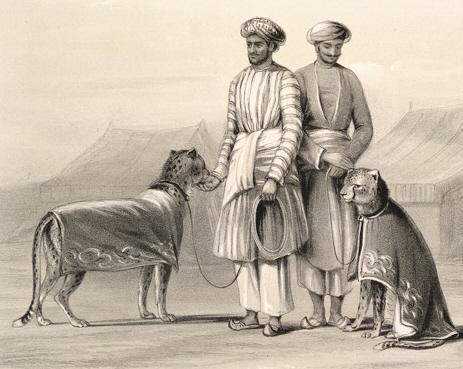
Men from India wearing their pajamas.  Not for sleeping or lounging, but actually to go cheetah hunting.  You can't see how they fasten, of course, but you can see how loose and floppy they are at the ankles.
(Photo from Wikimedia Commons)


Meanwhile, back in England, here's what the men were wearing in 1844.  Not exactly loose and flowing and floppy.
(Photo, as you can see, from Victoriana.com)

    • So the British brought the pajamas back to England with them. But what with the damp and cold weather and more restrictive clothing styles, they didn't really catch on for everyday wear.  Some British men wore them for lounging around the house, but after a while even that fell out of fashion.
    • In the 1800s as the British were securing more and more of India under their control, they thought, "Dash it, those pajamas are capital garments."  So they brought them back home with them again.  This round of British pajama-lovers wore them at night, for sleeping.
    • This was still rather an exotic idea in England at the time.  While women wore nightdresses, most men slept naked, or they wore long nightshirts and caps.  

    Here's Scrooge wearing his nightshirt and cap when Jacob Marley pays his portentous visit.
    (From A Christmas Carol, from Bygone Books Blog)


    This is a strange hodgepodge of stuff for sale in an antique store, but that white garment is a man's nightshirt. Topping it off is a top hat decorated for Christmas, so you'll have to imagine the nightshirt without the hat.  Looks an awful lot like a nightgown, doesn't it?
    (Photo from Musings of a Sea Witch)

    • I should note that while the idea of wearing pants to bed was all new in England, it was not new to the Portuguese.  Or at least, those who lived on the island of Goa.  A French traveler noted that the Portuguese there had adopted the custom of wearing loose cotton pants to bed as early as 1610. But apparently the French traveler didn't think much of it, nor did many other Europeans because most histories maintain that European men didn't wear pants to bed until the mid-1800s.
    • As my history teacher used to say, quoting Victor Hugo, "There is nothing more powerful than an idea whose time has come."  Apparently by the mid-1800s the time for pajamas in England had come because they soon became quite popular as sleeping garments.
    • They only caught on with the men-folk, though.  I don't know if that's because the women already had a sleeping garment, the nightdress, or if it was mainly the men who were soldiering in India who had encountered pajamas in their native habitat so to speak, and so were already comfortable with the idea of wearing them.  Whatever the reason, it was the men who wore pajamas to bed.  
    • Some time not too long after that, the footed pajama was born.  It's thought that someone first sewed feet/socks to the bottom of pajamas to protect the feet from bugs.  Specifically, termites, which were very common in India.

    Footed pajamas are now so pervasive, I bet most of you reading this blog wore them at some point in your early childhood.  They're also apparently all the rage on college campuses these days.
    (Photo from Ur College Fashion)

      • In The Secret Sharer (1910) by Joseph Conrad, the narrator says he was in his "sleeping suit," a phrase I always liked.  I wonder if that was pajamas, or a nightshirt and cap, or what. 
      • It took a little longer, but by 1923 or 1924, American fashion magazines were reporting that the high society men and women both had been seen wearing pajamas at the beach. Well, once it was known that the well-to-do were wearing their pajamas in public, the general public had to have pajamas too, and pajama sales took off.  
      • Clothing retailers reported that, though they were selling lots of pajamas, they were still selling just as many nightgowns as before.  Presumably this mean that women wearing pajamas at that time were mainly wearing them in public but still preferred the good old nightgown for sleeping.

      I'm not sure where or when this ad originally ran, but I'm going to guess in England, some time in the 1930s.  The copy is especially delightful.
      (Photo from Dumbbells, Ear Caps, and Hair Restorers: A Shopper's Guide to Gentleman's Foibles -- 1800s-1930s. From The Steampunk Forum at Brass Goggles)


      Nightshirts didn't entirely go away at first. This McCall's pattern for a man's nightshirt is from 1941.
      (Image from Vintage Patterns Wiki)


      But by 1966, which is when this ad is from, the nightshirt was pretty much gone and it was all pajamas.  And at $3.74, how can you go wrong?
      (Photo from 1966 Spiegel catalog from genibee on Flickr)

      • Since the word "pajama" actually means "clothes you wear on your legs," it's technically redundant to say "pajama pants."  But now, since we buy and sell a set of clothes with a shirt and pants and we call the whole set "pajamas," the phrase "pajama pants" has come into being as a way to specify one item of the set. 


      There's tons of variety in women's pajamas now.  You've got your long pants/long sleeved fleeces, your long pants/T-shirt cottons, your fancy silks, your shorty top and bottoms, and everything else in between.
      (Photo from Diva Village, where you can buy any or all of these)


        I don't know who would do such a thing as this.
        (Image from Leslie Linevsky on E-Marketing)


        This is the proper way to wear footy pajamas.
        (Photo from ParentLife Online)


        Sources
        Online Etymology Dictionary, Pajamas
        Sir Henry Yule and Arthur Coke-Burnell, Hobson-Jobson: A glossary of colloquial Anglo-Indian words and phrases, and of kindred terms, etymological, historical, geographical, and discursive, 1903, page 748, PYJAMMAS.
        Ask Andy About Clothes, Pajamas - History of
        JumpinJammerz.com, History of Pajamas
        Manas: India and its Neighbors, History and Politics, British India