Showing posts with label plants - trees. Show all posts

Monday, September 7, 2015

Apple #717: Ginkgo Trees

Yesterday, I was sitting outside a coffee house with my friend, let's call her Kiki Malone, and she noticed that the tree that was shading our table was a ginkgo tree.  I turned and looked at the leaves.  Seeing the distinctive fan shape, I said she was right, it was a ginkgo.


Only the ginkgo tree has leaves with a fan shape.
(Image from The Anecdotal Goat)


She said, "It's the oldest living tree in the world."  Then she added, "I think.  A person has to be careful saying things like that around the Apple Lady."

I said it had to get annoying, being friends with someone who often says, "Actually, according to what I learned when I did a Daily Apple on that topic. . . ."  Kiki was very gracious and said it wasn't like that at all.  She also said many positive and appreciative things about this here Daily Apple blog as a whole.

So, as a thank you to Kiki for saying so many nice things about the Daily Apple, here is an entry for you on ginkgo trees.  And let me begin by saying: You were correct.

  • The Ginkgo biloba is the oldest living species of tree in the world.
  •  Fossils of ginkgo trees have been found going as far back as 250 million years plus. 
  • That puts the ginkgo as having been alive in the Triassic period, which suffered a massive extinction event along with enormous volcanic eruptions.  Then the dinosaurs whose names most of us know showed up, and they went through their massive extinction event.
  • Ginkgo trees survived all of that.


Artist's rendering of what the Triassic period and its dinosaurs might have looked like. There should be some ginkgo trees in there somewhere. . . .
(Wallpaper from National Geographic)

  • The following characteristics may be why this tree has been able to survive for so many millennia:
    • No insects like to eat it or damage it
    • It suffers from no serious diseases
    • While it prefers moist, sandy soils, it will grow in just about any type of soil, even alkaline, or acidic, or compacted and not well-drained soils
    • It isn't bothered much by road salt, or air pollution, or occasional high temperatures


This particular ginkgo tree is a 1,400 year-old female. She lives in Jonichiji, Japan.
(Photo by Atsuko & Kunihiko Kato, on The Ginkgo Pages)

  • The ginkgo is singular in many other ways as well:
    • It is the only tree with a fan-shaped leaf
    • A single ginkgo tree can live to be 3,000 years old
    • While there are several varieties, it is the only tree in its species
    • While it is the only tree in its species, its classification confounds botanists
  • Some botanists say that the ginkgo is a deciduous conifer -- a type of tree with needles and cones, but which also has leaves that drop in the fall.  True deciduous conifers include several species of larches, bald cypresses, the Chinese swamp cypress, and the Pond Cypress, and the Dawn redwood.  These are also really old species of trees.
  • Some botanists argue that ginkgos are not really conifers, and so therefore are not a decidous conifer.  These botanists say the ginkgo is more closely related to cycads, which is another very old group of plants, of which only some 250 species survive. These live in tropical places and they have leaves that grow out in a radiating circle from the central branch.  They look like palm trees.
  • Still other botanists say the ginkgo is neither a conifer nor a cycad, but completely its own thing.
  • Apparently, botanists have a lot more to figure out when it comes to the ginkgo.
    • The seeds are another really unusual thing about this tree.  The female ginkgo produces a fruit, inside of which is a nut in a shell, and the nut is edible in small amounts.  But I need to break down each of these elements bit by bit.


    The items in these four bowls all come from the fruit. What they call "berries" is the fruit of the female ginkgo. Inside the fruit is the nut in a hard white shell, almost like a pistachio shell. Inside the shell is the nut, which is best roasted. Once that's done, peel the outer layer off the nut to get to the glistening, green nut meat.  But don't eat too many of them, or you'll get a stomach ache.
    (Photo from Hot Topix Suburban Foragers)


    What the fruit looks like on the ginkgo branch. These look a little too yellow; might need some more time to ripen.
    (Photo from Kennesaw State University)


    • The fruit looks like a small, yellow plum, but it stinks like crap.  Literally.  Some people say it smells like vomit.  Others say it smells like sulfur.  Still others say it smells like sour milk. Let's just say it reeks bad.
    • It stinks so bad, scientists can't figure out what animal would want to eat that fruit and thus disperse the seed.  They speculate that maybe the animal that used to eat it has since died out and the tree has outlived its disperser.  There are records that badgers used to eat them, but no current evidence of such today.  But somehow the seeds are still getting dispersed.
    • It could be that humans are now the ginkgo's greatest disperser because we now depend on this tree like crazy.  Since it will grow in spite of conditions that threaten other trees, and it has no pests and no diseases that go after it, it's become enormously common, especially in cities. Lots of cities have lined their streets with ginkgo trees.


    A tree-lined street in Mie prefecture, Japan
    (Photo from Wikimedia Commons)

    • But here again, we run into the stink problem.  People find the stink of the fruit to be so disgusting, they've asked that the ginkgo trees be removed.  In various cities like Easton, PA, and Bloomington, MN, and Lexington, KY, they've done just that.
    • They haven't removed all ginkgos, only the stinky females.


    Catalpa Road  in Lexington, KY lined with ginkgos. Why they didn't call it Ginkgo Road, I don't know.
    (Photo from Panoramio)

    • But there's a small problem: it takes 30 years for a ginkgo to reach its reproductive years. And it is nearly impossible to tell whether a tree is male or female before that time. So the cities that are trying to get rid of the females aren't even sure they've got them all.
    • And then a funny thing happens.  Very occasionally, about 1 out of 100 male ginkgos will mysteriously transform.  It will become female and start producing the stinky fruit.
    • This thing is doggoned determined to reproduce.  I can almost hear those those ginkgo trees giggling at us and saying, "Silly humans. We have lived on this planet for millions of years.  It's going to take a helluva lot more than you puny humans digging up a few of our females to wipe us out."
    • But even that is not all there is to say about the stinky fruits.  They have the same toxin as poison ivy or poison oak.  So if you want to harvest them for the nut inside, you'd better wear rubber gloves.
    • Also, the fruit contains a tannin which will stain your clothes or your shoes. One guy who lives on a street in Pennsylvania lined with ginkgos had to get his car re-painted twice because of the ginkgo stains.
    • Oh, and one more thing.  People say the nut, when roasted, tastes like a cross between edamame, a pine nut, and a potato.  Quite tasty, in other words.  In various countries in Asia, the nut is considered a delicacy and is sprinkled on desserts, or in soups, or served with meats.  Only problem is, the nut carries another kind of toxin which will make you throw up if you eat too much of it.


    I can practically hear all the laughter from the ginkgos up and down this tunnel of them, in a park outside Tokyo.
    (Photo from Maxi's Comments)


    • About the name.
    • The tree is native to China, and then it was brought to Japan. Its name is an Anglicized rendering of the Japanese version of the Chinese name yin-hing, where yin = silver and hing = apricot. 
    • The tree was brought to Europe by a Dutch surgeon in 1727, and then to what is now the US -- Philadelphia, actually -- by William Hamilton in 1784.  A few years later, he suggested to Thomas Jefferson that he might like three of them in his gardens at Monticello. 
    • So the tree is pretty cool.  But I can't talk about the tree without mentioning the supplements.
    • There are all sorts of claims out there about the health benefits of the ginkgo.  In China, they say it's the seeds that have the health benefits. In the US, it's the leaves. Either way, such claims include but are not limited to the enormous list below. 
    • The 3 with the asterisk are ones where there has been some good scientific evidence that may suggest some positive result. The rest are pretty much fluff.
      • Brain / Memory
        • Improves memory
        • Improves brain health
        • Reduces severity of migraines
        • Reduces symptoms of dementia*
        • Reduces effects of aging
      • Other Mental health
        • Benefits people with ADHD
        • Benefits people with autism
        • Benefits people with generalized anxiety disorder *
        • Benefits people with schizophrenia *
      • Respiratory
        • May reduce asthma symptoms 
        • Treats scar tissue on lungs
      • Circulatory / cardiovascular
        • Improves blood circulation
        • Helps reduce high blood sugar
        • Helps in recovery from strokes
        • Reduces the number of attacks associated with Reynaud's disease (blood circulation)
      • Diabetes or related
        • Benefits people with retinopathy (diabetes-related eye damage)
        • Benefits people with kidney dysfunction, especially for diabetics
      • Eyes
        • Improves eye health and vision
        • Treats eye allergies
      • Ears / Balance
        • Treats chronic ear disorders
        • Aids in treating tinnitus
        • Treats altitude sickness
        • Reduces vertigo
      • Cancer
        • Prevents cancer
        • Shrinks stomach cancer tumors
        • Reduces effects of chemotherapy
      • Musculoskeletal
        • Improves performance in athletics
        • Assists in treating multiple sclerosis 
        • Improves quality of life for people with fibromyalgia
      • Other
        • Reduces cocaine dependence
        • Treats erectile dysfunction
        • Reduces toxicity of radioactive iodine used to treat thyroid disorders
        • Treats hemorrhoids
        • Reduces symptoms of PMS
        • Gel form reduces wrinkles
    • Boy, one plant that can do all of that, treat everything from headaches to old age to wrinkles and schizophrenia and cancer?  That sure must be some wonder drug!
    • (^sarcasm)


      Shelf after shelf of dietary supplements, or herbal supplements, or natural supplements. This is code for "bullshit."
      (Photo from Fake Food Watch)

      • One trial that asked people to take ginkgo supplements could not prove anything because they didn't get enough data. This is because the "natural" supplements that people were taking turned out to have less than the required minimum 24% ginkgo extract. The pills didn't have enough ginkgo in them to have an effect. Those "natural supplements" were, in effect, snake oil.
      • If traditional medicine is stumped, do you really think some nutjob with a pile of ginkgo pills is going to know something they don't?  Don't let them suck the money out of you. Smile and nod, and keep on walking. 
      • You know who's getting the last laugh, don't you? The ginkgo trees.  They're like, look at those idiots. Thinking my nuts are doing all kinds of wonderful things for them. All they're doing is dispersing my seeds. Disperse on, humans, disperse on.


      This ginkgo lives at the Montalvo Arts Center in Saratoga, CA.
      (Photo by Nathan Zanon)


      Sources
      Yale Environment 360, Ginkgo: The Life Story of the Oldest Tree on Earth, May 1, 2013
      Missouri Botanical Garden, Ginkgo biloba
      Arbor Day Foundation, Ginkgo
      Harvesting ginkgo fruits: Breaking the stink barrier, The Washington Post,  October 12, 2010
      The Morning Call, No flowery expressions: Easton trees just reek, April 24, 2008
      Gingko [sic] Trees That 'Smell Like Vomit' Causing Trouble Nationwide, The Huffington Post via AP, March 18, 2010
      UBC Botanical Garden Forums, How many Deciduous Conifer's [sic] are there?
      about home, What Are Deciduous Conifers?
      University of Nebraska-Lincoln, Deciduous Conifers
      The Jefferson Monticello, Ginkgo

      As an herbal supplement
      Fransen et al., Assessment of health claims, content, and safety of herbal supplements containing Gonkgo biloba, Food Nutr Res. 2010; 54:10
      May Clinic, Ginkgo (Ginkgo biloba)
      Target, Walmart Selling Fake Ginkgo, Garlic, Ginseng Thanks to Political Loophole, Fake Food Watch, February 5, 2015

      Sunday, April 25, 2010

      Apple #452: Forests

      I'm sorry the Daily Apple has been getting short shrift lately.  I've been spending a lot of my free time in the woods.  Literally.

      There are several large parks that surround the city where I live, and many of them include large tracts of forest.  For the most part, these are lands that were converted to farmland in the early to late 1800s but for one reason or another have become overgrown again and are now natural preserve areas. Walking or hiking trails wind among the trees which are just now beginning to pop out their new leaves all over the place and little wildflowers are beginning to bloom, and the streams are starting to make delightful trickling noises, and those woods are such wonderful places to be, I keep going back.

      I've also taken lots of pictures. If you're curious, this is the type of camera I have.


      Forest of hardwoods near where I live, on a typical sunny day.
      (Photo by the Apple Lady)


      There are many depressing facts about forests.  If you want to read about how forests are disappearing and how we're using too much wood and all that, you can read about those things here or here.  But I want to talk about the good things about forests.

      There so many different types of plants and animals and bugs and birds that live in forests, and I could talk about all of them.  But for the sake of keeping this entry focused, I'm going to talk mainly about the trees.


      Here's one of the biggest old trees in the woods. You come around a curve in the path and come upon this thing and you feel like you've wandered in front of a giant, mossy wizard.
      (Photo by the Apple Lady)

      • The UN's Food and Agricultural Organization defines a forest as 
        • a piece of land bigger than 5,000 sq meters, which is slightly larger than one acre
        • with trees higher than 5 meters, or 16.4 ft tall
        • with a tree canopy cover of more than 10%
      • There are different types of forests.  A primary forest is one that has essentially never been disturbed by human activities.  The majority of primary forests left on Earth are in Brazil and, surprisingly, the Russian Federation.
      • Other types of forests are ones that have been cleared at some point and regenerated, either naturally or by having trees replanted by humans.  
      • There are also forest plantations, where people have planted a ton of trees, usually of the same species.  Sometimes they're planted to produce wood but other times they're planted with a protective or ecological purpose in mind such as combating desertification.
      •  About 30% of the total land on Earth is covered by forests of one kind or another.
      • The data for the US is similar.  About 33% of the total land in the country is forest land.

      Typical hillside, with lots of tall trees and new growth as well. This was taken in June.
      (Photo by the Apple Lady)

        •  The number of species of trees in a forest varies quite a lot depending on the climate.  Generally, the forests containing the greatest diversity of species are in the tropical regions.  Forests with fewer numbers of species are in cold climates where mainly coniferous trees grow.

        Map of the number of tree species in forests, by country
        (Graphic by the FAO's Global Forest Resources Assessment 2005, sourced from Green Facts)

        • Pines, oaks, and spruces are the three most common genera of trees worldwide.  They account for nearly 24% of the total types of trees around the globe. 
        • Fir, birch, beech, and poplar are the next most common, in descending order of prevalence.
        • In the US, the data about tree species diversity gets more fragmented.  Forests are categorized in terms of two or three genera names linked together.  Those names indicate that those types of trees are the most prevalent, but they are by no means the only types of trees that grow there.
        • For example, in the Eastern US, the most common type of forest is the oak-hickory.  In the West, the most common category is "other softwoods," which refers to a variety of coniferous trees.  It's easiest to show you the charts.

        (Source: USDA, US Forest Resource Facts and Historical Trends 2002)


        (Source: USDA, US Forest Resource Facts and Historical Trends 2002)


        • Lest you think that "oak-hickory" means that only oaks and hickories grow there, another study about trees growing in forests in Michigan says they found that 63 different species of trees grow in "oak-hickory" forests.  
        • In Michigan, by the way, the type of forest with the greatest diversity of species is the northern hardwood forest, which are home primarily to maple, basswood, beech, and yellow birch trees.  These forests contain 71 total different species. 

          This is how one of the forests looked only a month ago.  No leaves yet, but pretty nonetheless with the sun and the clouds peeking through.
          (Photo by the Apple Lady)

            • In the US, as of the year 2000, 28% of the country's forests were in counties with large urban centers, or more than 20,000 people.

            (Source: USDA, US Forest Resource Facts and Historical Trends 2002)

              • Forests do all sorts of good things for us. Not only do they help reduce the amount of greenhouse gases in the air, they also 
                • absorb heat energy and provide a cooling effect
                • trap and intercept wind-borne pollution
                • protect soil from wind erosion
                • protect coastal areas from shoreline erosion
                • reduce the impact of avalanches
                • moderate the impact of floods
                • protect water resources by filtering pollutants and mitigating salinity
              • Every type of forest, whether it's primary or otherwise, does at least some if not all of these things.

              If this doesn't shout, "I support life!" I don't know what does.
              (Photo by the Apple Lady)

                • Even trees that have been felled and lie in landfills or those that have been converted to lumber, and yes, even the paper resting in your laser printer right now -- all of those once-upon-a-time trees still retain much of the carbon that they absorbed when they were living trees.
                • About 51% of the country's fresh water supply originates in forested land.

                At the far edge of the woods are bluffs that drop down to a river. Lining the far side of the riverbank are sycamores. Took this at sunset a few days ago.
                (Photo by the Apple Lady)

                • An average tree exhales about 120 pounds of oxygen per year.  One person needs one pound of oxygen to breathe per day, so it takes about three trees to provide enough oxygen for one person to breathe each day.
                • According to the USDA, "In the last half of the nineteenth century, an average of 13 square miles of forest was cleared every day for 50 years." 
                • Today, 55% of the country's timber is younger than 50 years old.  6% of the country's trees is older than 175 years. 

                  (Source: USDA, US Forest Resource Facts and Historical Trends 2002)


                  One of the huge white oaks that grow in these forests. They're so massive in diameter as well as height that I can't capture the entirety of one of these trees in a single frame.  There are several that are even larger, but I chose this photo because I'm hoping the fencepost in the foreground gives you an idea of the size.  Park officials estimate that these white oaks were planted somewhere around the time of the Civil War.
                  (Photo by the Apple Lady)

                  • Though there are fewer forests than there used to be, the rate of net loss of forested areas worldwide is declining thanks to increased forest planting and the natural expansion of forests on land that once once developed but has since been abandoned.
                  • In the US, the most forested land is still in the West.  Each region of the country has seen a decline in the amount of forested land since 1850.  But in recent years, all areas have increased the amount of forested land.

                  (Source: USDA, US Forest Resource Facts and Historical Trends 2002)

                  • The amount of forested area in the South will continue to increase, since that area has seen the largest amount of tree planting, with extensive planting programs carried out in the 1950s and again in the 1980s.


                  Hopefully the future will hold more trees, more paths, more woods to explore.
                  (Photo by the Apple Lady)


                  Sources
                  Green Facts Scientific Board, Forest and Scientific Facts on Forests
                  FAO, Global Forest Resources Assessment 2005, Chapter 3: Biological diversity
                  USDA, US Forest Facts and Historical Trends 2000
                  Michigan State University Extension, Tree Diversity Within Michigan Forest Types
                  Weyerhauser, Forest Facts

                  Thursday, June 25, 2009

                  Apple #392: Digger or Gray Pine

                  The big news of the day are the deaths first of Farrah Fawcett and then of Michael Jackson. I tried to think of some way I could contribute something new to the discussion. I looked for news of an occasion when they had both been together, but the internet is so full of stories about today, I didn't have any luck.

                  I thought of some things they had in common -- his hair literally caught on fire, her hairstyle caught fire figuratively in that it became hugely popular; he was tried for molestation, she portrayed someone who had been molested; they both hired a well-known Hollywood wiretapping PI bad-ass named Anthony Pellicano. But all that is a bunch of fluff that avoids the shock and sense of loss that a lot of people are feeling over the deaths of these two pop culture icons.

                  The best I can offer you on these subjects is an entry I did way back in July 2005 about Charlie's Angels.

                  When you're ready to move on to other topics, I have this one to offer you. It's about a certain type of pine tree I was introduced to during my trip to California.

                  My intrepid traveling companion/sherpa and I were driving away from Yosemite, back down through the Sierra foothills and slowly wending our way toward civilization. We were talking about how huge the pine trees are around there, and how enormous their cones are. I mentioned that my mom has a basket of super-large pine cones at her house, but I didn't know what kind they were. He said there was one tree that made pine cones so large and heavy that when they fell, if one of them hit you on the head, it would be like getting hit by a missile. He thought that maybe these pine cones were like the ones my mom had.

                  When we stopped to eat at a little town called Mariposa, he decided to see if he could find any of these particular pine cones. So he went forging into the brush and unearthed from the tall grass not one, but two of them. Both of them had opened only about halfway. The top half of the cones were still closed up tight as a drum, hanging onto their seeds. They weren't like the kind my mom has, but they were pretty magnificent. And they were really heavy. I'm bad at gauging this sort of thing, but I'd say they weighed about two pounds, each.


                  One of the two Digger or Gray pine cones. I took the photo next to a ruler so you could see that it's about six inches tall. The white stuff on the tips is sap.
                  (Photo by your faithful Apple Lady)


                  • These pine cones belong to the Digger or Gray pine tree.
                  • The reason these trees have two common names is because the first is now considered to be offensive. White settlers called the natives in the area "Diggers" because they dug for roots and seeds and other foods, and it was a pretty derogatory term. These native people also ate the seeds of this pine tree, so the tree was named after them, or after what the white people called them.
                  • Recently out of awareness of this racist etymology, people have begun calling the tree the Gray pine. But the switch in common names hasn't fully taken hold, and a lot of people still call it the Digger pine.
                  • Its scientific name is Pinus sabiniana, after a British attorney and famous naturalist named Sabine who studied the tree.
                  I packed the two pine cones in plastic bags in my suitcase and took them home with me. When I got home and opened my suitcase, I disocvered that TSA had opened my suitcase and inspected them. I can't imagine what they must have looked like on the security camera. I also discovered that the pine cones had opened the rest of the way at some point during the flight. I expected there to be pine cone seeds and dross all over everything, but I only found two seeds.


                  Gives you another idea of the size of these things. This is the one that the seeds came out of. You can see the hollow places that held the seeds.
                  (Photo by the Apple Lady)


                  • Cones can grow as large as 8 to 12 inches, though they're more often smaller. When they're still fresh off the tree, before they've dried out and lost their seeds, they can weigh anywhere from a half to one and a half pounds.
                  • The cones usually open in the fall, in September or October. But it can take several months before all the spines have opened and all the seeds have dispersed. Some cones have been found with seeds ready to fly as late as February.
                  • It usually takes 10 to 25 years before a digger/gray pine tree will produce cones.
                  • Here's some pine cone terminology:
                  1. The things that hold the seeds are called cone scales.
                  2. The spiky things at the pointed tips of the scales are spurs.
                  3. If a cone has seeds enclosed, it's a female cone.
                  4. If a cone has no seeds but only pollen, it's male. Male cones are usually smaller.


                  The spurs on the digger/gray cone scales are very pointy and sharp. This is one of the distinctive features of the digger/gray cones. When I picked up one of the cones, a spur pricked my finger and drew blood. It hurt like I had a splinter in there for several days. That was over a week ago, and I still have a sore, dark mark on my finger.
                  (Photo by the Apple Lady)

                  • Unlike a lot of other pine trees, the cones don't necessarily fall from the tree before they open up and eject the seeds. In fact, even after the seeds have flown the coop so to speak, the cones may still hang around on the tree for quite a long time.
                  • In addition to the usual methods of cone seed dispersal -- wind, birds carrying them off, cones dropping to the ground and flinging them about -- digger pine cones are remarkably buoyant. Digger pine cones that had dropped into rivers and streams have been found as far away from their native lands as 25 miles, or within 8 miles of the ocean.


                  Digger or gray pine cone seeds. I discovered these loose in the plastic bag after I unpacked the pine cones. The one on the right is still in its seed coat (anil, a word I learned from crossword puzzles). Everybody says that these seeds are edible, so after I took this picture, I tried to eat one of the seeds. It was so hard, it was like biting into a stone! I couldn't even make a dent. It left a resiny, piney tang in my mouth.
                  (Photo by the Apple Lady)

                  • Seeds generally grow to 3/4" to 1" long, and fresh out of the cone, they weigh about 1 gram (0.04 ounces). That might not seem very heavy, but compare that to other seeds you encounter more frequently, like sunflower seeds or sesame seeds.
                  • Men of the Sierra Miwok tribe used to climb the trees and pick the cones when they were still green. They'd roast the cones in hot ashes for 20 minutes, and the resin would come out, which was sweet. The heat made the cones open, so along with the sweet syrup, the Miwok ate the roasted, immature seeds.

                  Gray pine is a name that suits these trees because the needles are gray. Sometimes they're also called Ghost Pines for the way the branches have an airy appearance.
                  (Photo from Watching the World Wake Up blog about botany)


                  • The trees grow best on rocky slopes, canyon walls, and dry hills -- places where there isn't a lot of moisture.
                  • Given how well the trees like dry places, it's pretty remarkable how quickly they grow -- 28 inches per year for the first 8 years, and then sometimes as much as 3 feet per year after that.
                  • These trees really don't like shade, though. And because they tend to grow on rocky soils, they can't put down very deep roots, so they usually meet their demise by being blown over by high winds.
                  • Another unusual feature of these trees is that, unlike most pines, they don't always have single trunks. In fact, the trunk often splits into two or three, almost like an elm.
                  • The trunks are also usually curved and the wood is lightweight, which makes it undesirable for lumber. When cut, the wood often warps. The wood is also saturated with pitch, which makes it smoke when burned, so it's not good for firewood.

                  A digger pine, all by itself where there's no shade, on a rocky slope, and starting to curve. This tree might look lonely, but it's probably thinking, Aaah, this is just how I like it.
                  (Photo sourced from Two Small Farms)


                  • Lots of online sites sell pine cones, including Digger cones. On most of them, the cones over 5 inches long go for $4 each. Under 5 inches are only $2. Their cones are much cleaner-looking than mine, but I got mine for free. Or for the cost of a trip to California, anyway.


                  The base of this pine cone, which I'm guessing is a female one, measures about 7 inches across (diameter).
                  (Photo by the Apple Lady)


                  How's that for star power?

                  Sources
                  Robert F. Powers, Northeastern Area State and Private Forestry, Silvics of North America, volume 1, Pinus sabiniana, Dougl., Digger Pine
                  Jim Conrad, Digger Pine, Pinus sabiniana, Backyard Nature, October 2, 2005
                  James E. Cole, Digger Pine, from The Cone-bearing Trees of Yosemite, 1939
                  National Center for Conservation Science & Policy, Oregon Big Tree Registry, Digger Pine
                  University of Washington, Campus Public Arts Program, 54. Digger Pine
                  Coloma Valley, Gray "Digger" Pine
                  Professor Kevin Murray, Science 226, Lab 4: Plant & animal diversity, University of Montana, Spring 2009

                  Friday, June 5, 2009

                  Apple #389: Sequoia Trees

                  One of the things I did on my trip to California was go with a friend of mine to Yosemite. There are many enormous things to see there -- huge rocks, huge trees, huge waterfalls. All of it is so beautiful, you kind of can't believe it. After I was there for a while, I kind of got used to it. I'd be walking along, eyes on the path, and then I'd look up and it would all still be there, and it would astonish me all over again. Still enormous, still covered with gigantic green trees, still sitting there like it was perfectly everyday to be so enormous and so magnificent.

                  I'm realizing as I type this that I need to do an entry about Yosemite. Since I was introduced to the national park before I saw the sequoia trees, I should do the Yosemite entry first. But a few Daily Apple fans have been clamoring for the sequoia tree entry, so I'm doing this one first.

                  There are a number of sequoia groves in Yosemite, and the one I went to was the Mariposa Grove, near an area called Wawona. You have to walk into the woods a ways, so that's what we were doing, and then my friend pointed up ahead, and I looked where he was pointing, and I saw the first sequoia tree. My jaw dropped and I said, "Whoa." That was my very articulate, intelligent response. I took a photo or two, stared some more. Then I said, "I know why they call this place Wawona. Because that's all you can say when you see these trees."


                  The first sequoia I saw. I took two photos of this tree and later spliced them together. You can probably detect the line where the photos meet. I could have Photoshopped that out, but I decided to leave it in. It's hard to convey just how tall these things are. I thought if you could see where the two photos join, that might give you an idea of how much -- or how little -- of one tree would fit into the frame at a time.
                  (Photo by your Apple Lady)


                  • Sequoias grow as high as 310 feet tall. The tallest sequoia in the grove where I was is 290 feet.
                  • The largest giant sequoia is over 40 feet in diameter around its base.
                  • There are other trees that grow taller (their relatives, the coastal redwoods, may grow up to 378 feet). There are other trees that are also wider around (a Montezuma cypress in Mexico has exceeded 50 feet around).
                  • But in terms of total volume, sequoia trees are the largest living things on earth.
                  • They are also the heaviest living things. A sequoia may weigh as much as 2,000 tons. A blue whale, by comparison, only weighs 200 tons.

                  Here's another attempt to give you an idea of the size of these trees. The smallish pink and blue things to the right of the tree are people. Not children, adults.
                  (Photo by the Apple Lady)


                  • Sequoias only grow on the western side of the Sierra Nevada mountain range, in about 70 groves.


                  The trunk of the second sequoia, I think. In the background on the right, very small, are people looking at the tree. The small blue rectangle next to the right of the tree is a van parked behind the tree.
                  (Photo by the Apple Lady)


                  • The trees all had signs, like the one in the above photo, cautioning people not to stand too close. This is because the root system does not extend deep underground like you might thing, but it's all very close to the surface. Sequoia botanists estimate that 95% of a sequoia's roots are within 3 feet of the surface.
                  • When the buildup of soil and stuff gets to be too deep and the roots too far below the surface to get necessary nutrients, the tree will send out new roots. Some of those roots extend from the ends of the old root system, but some of them extend from the central base of the tree, but above the older roots and closer to the surface of the ground. It is these fresh, new roots that park rangers are trying to protect by telling people not to stand too close to the tree.
                  • Despite the fact that the roots are so close to the surface, the trees don't fall over because the root systems extend far, far from the trunk. Sometimes the roots can reach over half an acre.
                  • The bottom part of all these trees was hollowed out, to some extent or other, and blackened. This is where forest fires have burned away the bottom core of the trees.
                  • Sequoia trees don't burn as easily as other types of trees because the bark is full of little air pockets.


                  Around the side of the trunk of the second sequoia. The charred section (burn scar) on this tree is relatively smaller, compared to some of the others. But they all have a similar flame-like shape to them.
                  (Photo by the Apple Lady)


                  • The results look pretty precarious, especially given the height and volume of these trees. But fire is essential to the health and reproduction of the sequoia. Forest fires clear away the smaller trees that compete for sunlight that the sequoias need, and the ash from burned branches and leaves provides nutrients that are essential to the sequoia.
                  • Perhaps most importantly of all, fires provide heat. The sequoia's cones will not open and disperse their seeds unless temperatures reach a certain point. So the sequoias need fire in order to reproduce.
                  • The cones can be very patient, waiting on the branches for the right fire to come along. Some of the cones remain closed up for as long as 20 years.
                  • A large sequoia may have about 11,000 cones. In a year when its cones dry out and open, the seeds scattering everywhere, the tree will disperse an estimated 300,000 to 400,000 seeds. The seeds may fly as far as 600 feet from the tree.
                  • The reason that fires affect sequoias in this particular way -- by burning away the lower core of the tree -- is because that inner core is actually dead. The living part of the tree is at its outer edges (called the cambium), just beneath the bark. While the loss of the center does weaken the tree structurally, the sequoia can grow quite nicely without it.
                  • I was so amazed by these trees that were standing with no center, just about, that I thought surely they must grow in a different way than other types of plants. How could a tree survive without its middle?

                  The sequoia on the right is known as the Clothespin tree, for obvious reasons. Yup, this tree is still alive and still growing.
                  (Photo by the Apple Lady)


                  • But I have just learned that sequoias grow the same way that all trees do, which is to say that all the growing action happens in the rings around the very center. The very center is the pith, and not much goes on there. The rings -- the xylem and phloem -- are where new cells that hold the nutrients are added, and the outer layer -- the cork, which we call bark -- expands to hold the innards.

                  (Diagram of how trees grow from Ross E. Koning's Plant Physiology page)

                  • Like many other plants, over time the sequoia also develops another protective layer under the cork (bark) called the periderm. The periderm is made of cells that are very similar to the cork cells, plus they have a special waterproofing capability, believe it or not. The sequoia differs from other plants in that its periderm and its cork are especially thick -- up to several feet thick.
                  • The thickness of those tough outer layers is what protects the sensitive growing parts (cambium) and helps the tree keep standing even after fires have burned out the pith.
                  • Sequoias also happen to be loaded with tannins, which are a type of antioxidant that plants have. (You may have encountered tannins in wine, which are what give the wine its puckery, almost bitter flavor. Tannins are present in the grapes, especially in unripe green ones.)
                  • The superabundance of tannins is what gives the sequoia wood its distinctive reddish-orange color.
                  • After the bottom part of the tree gets burned away, the tannins leak down into that burned area and sort of coat it, almost like sap. It's not sticky like sap, but it is moist. To any animals or insects that might consider burrowing into the wood, the tannins taste very astringent and are for some animals toxic. So the tannins help protect that exposed wood against invaders.

                  What one of the burn scars looks like up close. The glistening areas are where the tannins are leaking out of the tree.
                  (Photo by the Apple Lady)


                  The same burn scar on the same tree, looking up. Judging by how high up these trees get burned, those fires must be no joke.
                  (Photo by the Apple Lady)


                  The dark stuff on the left side of that tree is not a shadow, that's where the bark got charred from some past forest fire. This is another indication of how high those flames must leap. That tree isn't sequoia; I think it's a sugar pine.
                  (Photo by the Apple Lady)


                  The roots of a sequoia that fell over 150 years ago. These trees don't really decay the way most other trees do because of all the tannins in the wood. Fungi and bacteria that normally break down fallen trees do not like the tannins, so they don't go to work on fallen sequoias -- that is, not until after many years' worth of rains and snows have begun to wash off the tannins. You can see some green mossy stuff starting to grow on some of these roots.
                  (Photo by the Apple Lady. I don't know any of the people in this photo.)


                  • Because of their resistance to fire and insects and decay, sequoia trees live for a really long time. The oldest known sequoia is estimated to be about 3,200 to 3,500 years old. When you're talking multiple thousands of years, what's a few hundred, give or take?
                  • Fossils show that sequoia trees used to grow all over the place in the Jurassic period -- the time of the dinosaurs.
                  • If a sequoia tree still has a bunch of dead branches on it on the lower section of the tree, that means it's younger than 100 years old. Mature sequoias generally shed their dead branches (or the branches get burned off) and are without any branches until about 100 to 150 feet up the trunk.
                  • Sequoias survived the logging craze of the late 1800s, first of all because the bark is so thick it dulled the loggers' saws before they could get very far. But when the loggers got the trees cut down, they discovered that the wood is actually very brittle. Most of the sequoias that were cut down were used to make stakes for grape plants in vineyards because the wood was too brittle to be used for much else. When cut into planks, it warps, so it's no good for lumber.
                  • The brittleness of the wood is often what causes sequoia trees' downfall (ha ha). In spite of their protection against fire and insects and fungi and bacteria, sometimes the burn scars can be so extensive that the remaining wood can't support the tree as well anymore and when a strong wind comes up, the wood cracks and the tree falls over.
                  • The word sequoia comes from the name of the Cherokee man who wrote down the Cherokee alphabet, or syllabary.

                  Sequoyah, the man who invented the written form of his Cherokee language.
                  (Image from the National Park Service)


                  • During a hunting accident in which his foot was permanently he was given the name "pig's foot," which is Seqouyah (sometimes Sikwayi) in Cherokee.
                  • So the sequoia trees are essentially called "pig's feet."
                  • But how did this man become connected with gigantic trees? He never even lived in California.
                  • Sequoyah was born in Tennessee and grew up to be a fur trapper. After his accident, he couldn't trap anymore, so he learned blacksmithing and silversmithing. He got married and his family moved to Georgia.
                  • In the War of 1812, he fought for the United States against the British and the Creek tribe.
                  • While he was in the military, he observed his fellow soldiers reading and writing. He was inspired, not to learn English, but to write down his own language. He was convinced if the Cherokee had a written version of their language, they would have more power in the eyes of white people.
                  • He experimented with pictographs and tried making new letter shapes based on the symbols in English, Greek, and Hebrew alphabets. After twelve years of hard work and with the help of his young daughter, he had represented all the sounds of his language in 86 symbols.
                  • His syllabary caught on quickly, especially because of the way he taught it to others, and it wasn't long before thousands of Cherokee had learned to read and write their own language, which had before only been spoken.
                  • He became very politically active on behalf of his fellow Cherokee, and acted as a diplomat on behalf of his people in Washington, DC.
                  • His goal was to try to unite the Cherokee nation. He died in 1843 while searching for a group of Cherokee that were rumored to have gone south to Mexico.
                  • It is said that one of the ways his memory was honored was by naming the great sequoia trees after him. But I can't find out when the trees were named, or by whom, or why they picked exactly this man.
                  Now I'm going to stop talking and show you more photos. I saved some of the best for last.


                  The base of the largest tree in Mariposa Grove, the Grizzly Giant. This photo doesn't give you any sense at all of how big this tree is. It's 209 feet tall, its trunk's circumference is 96 feet, and it was born some time around 700 B.C. This photo gives you a much better idea.
                  (Photo by the Apple Lady)


                  Some of the branches of the Grizzly Giant. That biggest branch at the top of the photo is 7 feet in diameter, which is larger than any of the non-sequoia tree trunks in the entire area.
                  (Photo by the Apple Lady)


                  Better still, here's a very short video I took panning up from the bottom of the Grizzly Giant to the top. You can even hear the wacky birds in the background. Ah, technology!


                  Sequoia tree tops
                  (Photo by the Apple Lady)


                  Sequoias like sunlight.
                  (Photo by the Apple Lady)


                  If you're curious, this is the type of camera I have.

                  Sources
                  Mariposa Grove of Giant Sequoias, pamphlet from the Yosemite National Park
                  Susan D. Kocher, University of California, Berkeley, Why Does Giant Sequoia Grow Here
                  Economic Expert, Giant Sequoia
                  Marian Armstrong,
                  Wildlife and Plants, Sequoia
                  USDA Forest Service, Sequoia National Forest
                  Ross E. Koning, Plant Physiology, Wood and Bark
                  California State Parks, Parks Online Resource for Teachers and Students, Lesson 3, Fallen Giant
                  Howstuffworks, Sequoia
                  Wineanorak, Tannins in wine
                  Manataka American Indian Council, Sequoyah, Inventor of the Cherokee Syllabary
                  Encyclopedia Britannica, Sequoyah, Cherokee leader
                  The New Georgia Encyclopedia, Sequoyah (ca. 1770-ca. 1840)
                  Yosemite Hikes, The Grizzly Giant

                  Wednesday, August 31, 2005

                  Apple #103: Oaks in the Beech Family

                  A few days ago, I picked up a handful of acorns. I wanted to find out what kind of oak tree they came from, so I consulted one of those tree identification guides. I always have trouble with those books. The leaves or the flowers or whatever in the pictures never seem to look like what I saw. If I find something that looks close and then go read the description of the plant, there's either a bunch of other stuff that doesn't match, or the plant described on the next page could just as well be the one I saw.

                  So I didn't find out what kind of oak tree the acorns came from. But while I was investigating, I discovered something else puzzling. The book identified oak trees as a member of the beech family. I thought that was pretty bizarre because their leaves look nothing like each other.


                  Beech leaves


                  Various types of oak leaves

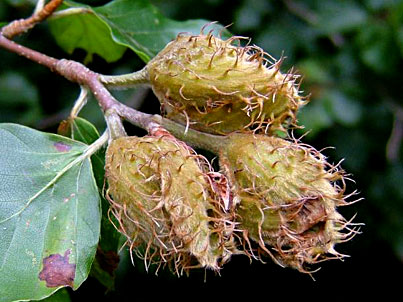
                  Also, beech trees make beech nuts, which are fuzzy or prickly, while oak trees make acorns, which are smooth and hard.


                  Beech nuts


                  Acorns

                  So you would think, based on these easily observable tremendous differences, that oak trees and beech trees would be entirely separate from each other, right?

                  Nope. Oak trees are firmly entrenched as part of the beech tree family. Here's how the taxonomy breaks down:
                  • Kingdom: Plants
                  • Division: Spermotophyra (seed-bearing plants with true flowers)
                    • Class: Angiospermae (encased seeds)
                      • Subclass: Dicotylendonae (seeds with two "leaves"; hardwood trees)
                        • Super Order: Amentiferae (catkins or clustered flowers)
                          • Order: Fagales
                            • Fagales Family 1: Betulaceae (birch, alder, ironwood, musclewood)
                            • Fagales Family 2: Fagaceae (beech, oak)
                              • Genus: Fagus (beech)
                              • Genus: Quercus (oak)
                  Even after reading all this stuff about oaks and beeches, I still wondered why in the heck the two are part of the same group. The answer comes to you courtesy of Bill Cook, a forester from Michigan's Upper Peninsula. According to his site, the classification was done by Europeans, and in Europe, the beech tree is much more common than the oak.

                  That explains why the beech trees rule the family, but not why the Europeans put the oaks in the same family. Maybe they thought, since there were fewer oaks, they could get away with jamming them in with the beeches.

                  There are close to 10,000 species of trees on Earth. More than 1,000 are in the United States. With that many trees to work with, I guess people are bound to make some puzzling classification decisions.

                  Apparently, people review these classifications all the time and suggest that species should be put into different categories. They have to do a lot of research before people will agree to make the change. According to one in-depth article on the subject, researchers now conduct phylogenetic analysis and they also look at the genomic profile of a plant to help them decide where it belongs. These people are not goofing around. This article notes:

                  With respect to larger relationships, however, ... those within Quercus have also attracted renewed attention, initially in 1993 ... and again since 1997. ... No single new phylogenetically based scheme has, however, found favor and little resolution below the major groups has been essayed.

                  So, people are looking into it. Slowly. Maybe the classification will change. Maybe not. Tune in over the next, oh, 50 years or so to see what happens to the oaks and the beeches.


                  Sources
                  Michigan Forests Forever Teachers Guide, Michigan Tree and Shrub Species
                  Bill Cook, Michigan State University Extension Forester for the Upper Peninsula of Michigan, UP Tree Identification Key, The Oaks
                  University of Kentucky, Agricultural Communications Service, Scientific Classification of Trees: An Introduction for Wood Workers
                  St. Louis County Health Pollen and Mold Center, Beech Family (Fagaceae Family) - BEECH
                  R. Govaerts and D.G. Frodin, "About the Fagales," presentation, Royal Botanic Gardens, Kew