Showing posts with label food - other. Show all posts

Monday, June 22, 2015

Apple #713: Nutrition Data Labels

I have developed a fondness for a rather terrible junk food.  I've always liked Fritos, especially when inserted into a grilled cheese sandwich.  But now they've got these newfangled souped-up Fritos -- the Honey BBQ Flavor Twists.  The name itself should tell you this is processed pseudo pfood from the pit of badness, but apparently, I don't care.

The twistiness makes the Fritos extra-crunchy and therefore very satisfying, and the honey barbecue flavor, which is probably an affront to all genuine barbecues everywhere, is such a diabolical combination of sweet and spicy that I keep going back for more.

I've been trying to cut back on the sugar these days, and I assumed these junky temptresses would have tons of sugar in them.  I mean, they've got "Honey" in their name.  But when I checked the nutrition label, it says only 1 gram of sugar per serving, where one serving equals 23 chips.


Nutrition Facts for Fritos Honey BBQ Favor Twists.  Recipe for for my downfall, apparently.
(Image from Frito-Lay)


23 chips is a fairly good amount.  I can usually hold myself to about that many per junk-out session with the Fritos.  1 gram of sugar is not that much.  In fact, it's surprisingly little.  Especially when the ingredients include
  • Corn -- among the sweetest of the vegetables. It is, after all, the source of corn syrup.
  • Sugar
  • Brown sugar
  • Honey solids
  • Molasses solids

Either all these sweetening agents are present in very small amounts, or somebody's not doing their math right.

So then of course I had to wonder, who puts together this nutrition data, anyway?  Is it the food manufacturers themselves who say how much of x, y, & z is in their stuff, or is somebody else looking at the food they make and tallying up the goods & the bads?  If it's the food manufacturers themselves, what's to prevent them from lying through their high fructose corn syrup-coated teeth?

Never fear, the Apple Lady has got the skinny for you.

  • It's the FDA that is in charge of the Nutrition Data label.  But when I say "in charge of," I mean they are the ones who say what the label looks like, and what information must be included on it -- you have to say how much trans fats are in your food, how much sodium, how much protein, etc., etc.
  • By the way, they've proposed changing the way the Nutrition Data label looks.  An example of the current label is shown below on the left, and an example of the proposed new label is on the right. 


(sample Nutrition Facts labels, current and forthcoming, from the FDA)

  • They want to make the information that's most important to people bigger and easier to read -- calories in big print, as is the serving size, and the % daily values are closer to the thing they're measuring.  I think it's an improvement. 
  • Speaking of serving size, the FDA are also going to change the way servings sizes are calculated, to reflect what's more realistic.  Instead of making serving sizes say how much of a thing you should eat or drink, they're going to say how much of a thing you actually will eat or drink.  So for a 20-ounce Coke, for example, instead of saying that's a serving and a half or whatever amount they now use, soon they'll say it is one serving, since most people drink the entire 20 ounces as a serving.  Which will mean the amount of sugar per serving displayed on the label of a 20-ounce Coke will most definitely go up.


The exterior of one of the FDA's buildings at its campus headquarters in Silver Spring, MD
(Photo from the FDA's Flickr page)


One of the labs at the FDA. This particular lab is used for drug evaluation, but this gives you an idea of the level of technology the FDA is using on a regular basis to carry out its multitudinous operations.
(Photo from the FDA's Flickr page)

  • The FDA also dictates the way percentages of daily values are calculated (you would expect this to be obvious and simple, but it's not), and they stipulate how the samples of a particular food are to be determined, how many must be sampled, what math to use to get rid of outliers in the sample, and so on.
  • I want to pause on this concept of sampling for a moment.  Let's say your product is dried plums.  You grow your plums in several different orchards in different locations around the country.  The plums grown in California during a drought will be slightly different -- maybe smaller with a darker & thicker skin -- than the plums grown in Michigan during an especially rainy season -- maybe larger and with more moisture -- and those will again differ slightly from the plums grown in Idaho during an especially sunny time -- maybe these will have a lighter-colored skin but darker flesh.  
  • Because of these variations, the nutritional content of the plums in each of these regions will also vary slightly.  Maybe the droughty California plums will have a higher fiber content, while the rainy Michigan plums have more sugar, while the sunny Idaho plums have more Vitamin C.
  • The FDA therefore has rules about how to account for such variations in crops.  Either you use a database that's already been complied for your product (in this case, plums) that has been let's say "normalized" to take into account all the variations -- growing season, have the crops been transported and how far and for how long, in what soil were they grown, how were they processed, and so on.  Or if the FDA doesn't have a database already, you can develop your own, but the FDA has very strict rules about how you do that.
  • So, ultimately, the FDA is in charge of what the label looks like, how the samples are compiled, and what math is used to arrive at the numbers that go on the label.
  • But the real meat & potatoes of the business -- how the food itself is tested and analyzed -- the FDA is not in charge of that.
  • The testing & analysis of the food is the responsibility of the food manufacturer.  In the case of our Honey BBQ Twisty Fritos, that would be Frito-Lay.
  • However, most food manufacturers do not test & analyze their own foods.  They don't have the expertise or capabilities to do that.  Most food manufacturers hire a laboratory to do the testing & analysis for them.
  • Who are the food testing laboratories?  They are legion, across the country and around the world.
  • Think of all the things that foods can be tested for.  Here is a short list:
    • Nutritional data -- fats, vitamins, minerals, calories, etc.
    • Presence of toxins -- bacteria, salmonella, fungal toxins, etc.
    • Organically grown or not, and the effect on nutrition
    • Influence of pesticides or herbicides
    • Presence of GMOs or influence of GMOs on nutrition
  • That gives you one clue as to how many food testing labs there are out there.  


An FDA inspector and a store employee conducting a pretty simple on-site test to determine the pH of rice.  With a pH of < 4.6, the rice can be left at room temperature while the sushi, right, is prepared.
(Photo from the FDA's Food Safety Flickr page)

  • Maybe a better indicator of the number of food testing labs is the range of methods that can be used to analyze food. Those, too, are now legion.
    • One of my favorite methods is by incineration.  That's right, they burn the food.  Then they analyze the ash. The ash can tell them lots of things, such as levels of carbon or potassium, or the alkalinity of the food.  Two notable observations: if they're analyzing a sugar or a gelatin and there's an unusually high amount of ash after burning, it means the sugar is of low quality.  Or when analyzing other types of food, a high amount of ash can indicate "the presence of an adulterant," like dirt or sand.
    • Most methods these days are extremely advanced, and the names for those methods use very big words.  I've listed some of these techniques along with a super-simplified description of how the technique is used to identify a food's chemical components.
      • mass spectrometry -- identifies chemicals by their mass
      • nuclear magnetic resonance spectroscopy -- by the magnetic fields surrounding the nuclei
      • polymerase chain reaction -- by their DNA replicated on a large scale
      • gas chromatography -- by the gases present when the material is vaporized
      • high-performance liquid chromatography -- by the way each component interacts with another liquid
      • capillary electrophoresis -- by the way the ions react after voltage is applied
      • supercritical fluid extraction -- by the way the compounds behave in the presence of a non-organic solvent super-heated and super-pressurized so it is between a liquid and a gas
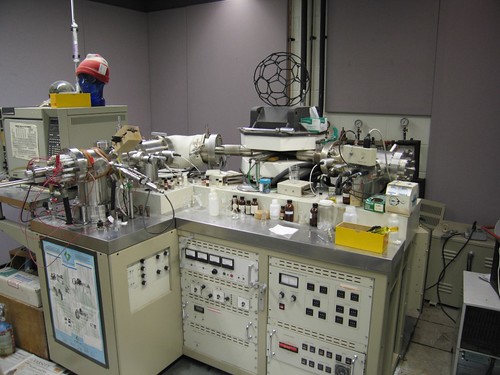
This is what a mass spectrometry machine looks like, circa 2005.
(Photo by Nayu Kim on Flickr)

  • You can see how a food manufacturer would not possess the expertise or the equipment to run such tests.
  • The methods the labs use to run their tests are stipulated, for the most part, by the industry associations to which they belong.  There are several such associations -- the American Association of Cereal Chemists, the American Oil Chemists Society, the Institute of Food Technologists, to name a few.

http://www.aoac.org/iMIS15_Prod/AOAC

  • The AOAC is a global association of academics, government agency members, laboratories, instrument manufacturers, and other providers of chemical technology services and equipment.  Since 1884, these members have contributed their knowledge and experience toward the development of standards of chemical analysis -- not just for testing food for nutritional content, but they also test supplements & vitamins, infant formula, livestock feed, fertilizer, soil & water, and human & animal pharmaceuticals.
  • They publish what seems to be the industry bible that describes the best way to run all sorts of tests, whichever method you're using, or for whatever component(s) you want to identify.  Their guide, Official Methods of Analysis, is the must-have reference tool for the industry (though the current edition, the 19th, is sold out at the moment).
  • It's all voluntary, people's participation in this association and their contribution to the development of better & better standards.  But if they screwed up their own standards, they'd only be making things harder for themselves.  Having standards is also a way they can tell which companies are doing a good job and which companies are doing shoddy work and so might be giving their fellow chemists a bad name.
  • So it's in an industry association's best interests to come up with the best practices that they can and to keep everybody as informed about those best methods.  This is why the FDA seems to feel pretty confident in relying on the chemical & food research community to develop and maintain their own methods for analyzing foods.
  • So, to recap, a food manufacturer hires one of these food analysis labs that are most likely a member of the AOAC or similar organization.  The lab runs whatever super-duper tests they have on the food -- in our case, the FritoLay Honey BBQ Flavor Twists--and then they report the results of their multiple & complex tests to the food manufacturer.
  • It is up to the food manufacturer to make sure that the information on the Nutrition Data label is accurate and is presented in line with the FDA's regulations (the math is done correctly, etc.).
  • The manufacturer sends the information about the label to their packager, the packager prints the labels on the packaging & ships out the product, the grocery store puts it on the shelf, we pick it up, read the label, say, "Only one gram of sugar? Heck, that's hardly anything," and buy the stupid bag of Fritos.


The Frito-Lay Honey BBQ Flavor Twist packaging being produced.  The material used is a pre-printed plastic film which extends product shelf life. Frito-Lay's Fayetteville, TN plant is working to find more ways to recycle this material.  Their scraps from making potato chips are sold to a dog food manufacturer.
(Photo from Maintenance Technology)

  • But the FDA isn't entirely and totally trusting of this process.  They will randomly spot-check a manufacturer's products.  They'll run their own tests and compare the results against the Nutrition Data label. (The FDA follows the AOAC's Methods in conducting their tests, by the way.)
  • The FDA is in charge of most of the foods we eat.  The USDA polices all things meat & poultry -- slaughtered, processed, packaged meats, chicken, and eggs -- and the FDA covers everything else.  It's the USDA's policy that if the stuff that's actually in the package is within 20% of what the label says, the food is in compliance.  I can't find anything that says so exactly, but I'm assuming that the FDA has a similar tolerance allowance in the neighborhood of 20%.
  • If what's in the package is more than 20% different than what the label says, then you're out of compliance and . . . I don't know what happens next.  All the out-of-compliance stuff I found was for really serious things, like foodborne illnesses (salmonella, listeria, etc.) which can be really dangerous and which were found to be present because some element of the company's operation was out of compliance with the FDA's requirements for how you're supposed to set up your shop.  
  • I couldn't find any discussion of occasions when what was in a package of Fritos differed in some way greater than 20% of what the label said, and what the FDA did about it.
  • I suppose there's probably a hierarchy of penalties -- fines, requirements to change your labels and maybe your procedures, and then if the problem persists, maybe you lose your approval to sell your foodstuffs.  But I'm just guessing at this part of it.


FDA food safety inspectors examining cans of infant formula to see if they're within their expiration date.
(Photo from the FDA's Food Safety Flickr page)

  • So, what does this all mean about my Fritos nutrition data label?  I think it means that, unless I'm willing to go out and get my own mass spectrometer and run my own spectrometry tests, I should probably accept that the industry professionals know what they're doing -- within a 20% range of accuracy, and for a normalized sample of Fritos.  
  • It is possible I could have gotten a rogue bag of Fritos that has more than 20%  of what the label says of sugar in it, which would amount to > 1.2 grams of sugar per serving as opposed to 1 gram per serving.  But the odds of that happening are not high.  
  • And I'd probably eat the crunchy twisty Fritos anyway.


Mmm, look how crunchy.
(Screenshot from this video of someone eating a bag of the Honey BBQ Flavor Twists)


Sources
USDA, Frequently Asked Questions, What are the regulations for creating food product and nutrition labels?
US FDA, Guidance for Industry: Nutritional Labeling Manual - A Guide for Developing and Using Data Bases
US FDA, Proposed Changes to the Nutrition Facts Label
US FDA, Compliance Manuals
Leo M. L. Nollet, Handbook of Food Analysis: Physical characterization and nutrient analysis
AOAC International 
Alejandro Cifuentes, Food Analysis: Present, Future, and Foodomics, ISRN Analytical Chemistry, Volume 2012, Doc ID 801607
The National Restaurant Association, The rise of nutrition analysis
Chem Guide UK, The Mass Spectrometer

Monday, February 2, 2015

Apple #700: Avocados & Guacamole

A whole lotta people watched the Superbowl tonight.  And a whole lotta those people ate guacamole.  So I thought now would be a good time to talk about guacamole.


Guacamole served in one of those trendy, so-called authentic volcanic mortar bowls.
(Photo and recipe from the California Avocado Commission)

Avocados

  • Guacamole, as I'm sure you know, is made from avocados.  So let's start there.
  • Avocados are native to Mexico.  The Aztecs who lived in Mexico before it was colonized by Spain were cultivating avocado trees as long ago as 500 B.C. We have evidence that the Incas in Peru were cultivating avocados as far back as 750 B.C.
  • The avocado trees were growing in Mexico, just on their avocado-own, as long ago as 5,000 to 7,000 B.C.


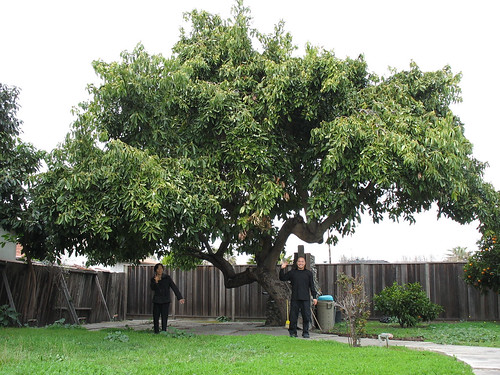
Avocados grow on trees, like this.  A single tree can produce anywhere from 150 to 500 avocados in one year.
(Photo by joeysplanting, sourced from The Garden Lady, who can tell you how to grow an avocado tree)


This is how an avocado seedling sprouts from that giant pit inside.
(Photo from Reclaim Grow Sustain)


This is how avocados hang from the tree. Like a pair of testicles.
(Photo from AnandTech forums)

  • The word "avocado" comes from the Nahuatl (the language spoken by the Aztecs) word "ahuacatl." Which means "testicles."
  • So perhaps this is why the avocado is sometimes considered an aphrodisiac.  (Something to consider this Valentine's Day.)
  • Spanish priests arriving in Mexico did not find the joke funny at all. In fact, they took it so seriously, they prohibited their flock from eating the avocado.
  • Maybe this is why it took 300 years for someone to bring avocados north from Mexico into California.  The Spaniards arrived in Mexico in the 1500s; the first avocado trees weren't planted north of Mexico, in California, until 1871.
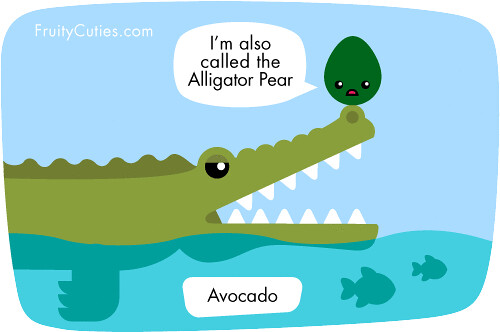
  • Even then, it took a really long time for avocados to catch on with the American public in general.  In the early 1900s, Americans were calling avocados "alligator pears" because of their shape and the way the skin is green and bumpy.  Doesn't sound very appetizing, does it?


Or, maybe now, people think the name "alligator pear" is cute.  And perhaps more appealing to children than "avocado."
(Image from FruityCuties on Flickr)

  • It was the California Avocado Growers' Exchange who started calling them "avocados," deriving the word from the original Nahuatl in 1920.
  • With lots of help from the California Avocado Growers' Exchange -- marketing and PR pieces and so on -- more people over the years began to get more familiar with the avocado.  But the fruits were expensive to buy outside California, so they were considered something that rich people ate, or something that was served at fancy parties.  Kind of like the way people talk about arugula now.
  • Then, when prices were beginning to come down a bit and people were getting a little comfier with the avocado, the whole fat-is-bad thing hit in the 1980s and doctors started telling everybody "Don't Eat Fat."  Since avocados have a lot of fat, especially for a fruit (yes, avocado is a fruit.  And yes, 85% of its calories come from fat), people took this to mean that avocados are bad for you and will give you a heart attack or something terrible like that.
  • It is true, avocados are relatively high in fat, but they've got the monounsaturated kind, the kind that may help chip away at your cholesterol. In addition, their particular kind of fats can also help to reduce inflammation, a benefit that people with arthritis have experienced.  They also have 4 grams of protein per fruit.  How many pieces of fruit can you think of that contain protein?  So avocados and their fats are actually quite healthy-friendly.
  • We've also learned since the 1980s that one cup of fresh avocado can increase your body's absorption of beneficial carotenoids & other antioxidants by anywhere from 200% to 400%.  Let me put it this way: Spinach has all kinds of good stuff for your body.  Put a little fresh avocado on that, and your body will extract even more goodness from that spinach.


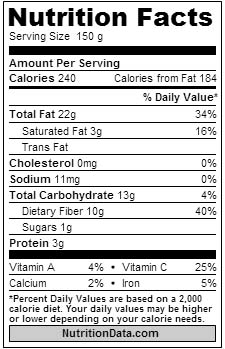
Nutrition Facts for 1 cup of raw avocados. More info available from NutritionData.com


This might be a better way of demonstrating how the fat in avocado really isn't so bad, compared to other fatty foods.
(Diagram from Smart Living)


The most nutritious part of the avocado is just beneath the skin, in the darker green flesh. So avocado growers recommend using the "nick and peel" method to take off the skin, which will help preserve the nutrient-est part of the fruit. That method is demonstrated here: 


  • But we didn't know any of that in the 1980s.  We just thought avocados were expensive and decadent and kind of bad for you.  
  • So in the 1990s, the California Avocado Growers started making commercials. There was one showing Angie Dickinson eating an avocado with a spoon, another one featuring an avocado named Mr. Ripe, whose purpose was to show people that ripe avocados are not bright green but rather a dark greenish-black.  In other words, they were trying to promote the heck out of avocados.
  • Then they found out that a lot of people were eating guacamole -- among other things -- on Super Bowl Sunday.  Here, I have to pause for a minute and show you this quote from Olga Khazan, writing for The Atlantic:
Americans did with the big game what we’ve done with seemingly every national event: Turn it from a day centered on a specific purpose to a day of consuming thousands more calories than our stomachs will comfortably fit. Super Bowl Sunday became less about football fanaticism and more about chips and seven-layer dip. In recent years, Americans have consumed 1.23 billion chicken wings on Super Bowl Sunday and eaten 15 million pizzas.
  • Pretty sharp, eh?
  • Well, the Avocado Growers (now the California Avocado Commission) took advantage of this, big-time.  In the days leading up to 1992's Super Bowl, they showed football players on TV eating guacamole.  They got football players and their families to submit recipes for guacamole and had a tasting competition.  At the game itself, they had PR people handing out samples of guacamole to fans at the stadium and to reporters.  They did this sort of thing for a couple years running and pretty soon, guacamole and avocados became a companion story, along with the new of the game itself.
  • And boy, did their efforts pay off.  In 2012, we Americans ate 12 million pounds of avocados on Super Bowl Sunday.  Yes, all those avocados on just one day.
  • The only other days of the year when we eat as many or more avocados are on Cinco de Mayo -- a holiday we didn't pay much attention to as a country until recently -- and Independence Day.  The avocado, a Mexican fruit once banned for its testicularity, has now become an American staple.
  • Today, an estimated 43% of US households purchase avocados.
  • That's a huge uptick from back in the 1960s, but it looks like there's more room to grow, doesn't it?  Avocado growers in Mexico apparently agree because they're getting in on the marketing game, now too.  I noticed -- and maybe you did too -- their commercial for avocados during this year's Super Bowl.


  • 90% of the avocados we buy here in the U.S. come from California -- specifically from an area covering 52,000 acres from San Luis Obispo to San Diego.  I guess the avocado growers in Mexico want to put a dent in that 90%. 

Guacamole

  • But we don't really care about marketing and commercials, do we?  What we really care about is guacamole.  Because it's gooooood.  


Guacamole. Once you start eating it, you can't stop.
(Recipe & photo by Quentin Bacon at Real Simple)

  • The Aztecs, who grew those avocados way back in the B.C. days, made guacamole too.
  • If you'll remember, their word for avocados was ahuacatl (testicles, yes). Their word for guacamole was ahuaca-mulli, or avocado sauce or avocado mixture.
  • I suppose, translated literally, that would be testicle sauce.
  • Traditionally, guacamole is made from 5 ingredients:
    • Avocado
    • chiles or hot peppers
    • onion
    • tomato
    • salt
  • I know, you cilantro-lovers are saying, what about the lime and the cilantro?  Most of us add those 2 ingredients today, but guacamole purists say that's not the truly traditional way to make guacamole.  They say the lime & cilantro spoil the flavor.  I know a few cilantro-lovers who might disagree with that.
  • One other thing to note about these ingredients.  I've always used jalapeño peppers because that's what's most readily available.  But most of the recipes I've checked for this entry say to use serrano chile.  
  • Serranos look like jalapeños, but they are smaller and more slender. Like any pepper, they start out green when they are least ripe, and they slowly darken and get spicier through yellow to orange to red.  The greener the pepper, the milder the heat.
  • Serranos are hotter than jalapeños, but not as hot as cayenne or habanero peppers.  One site describes the difference in heat levels this way: In a strong man contest, habaneros can lift an 18-wheeler, serranos a VW van, and jalapeños a Vespa scooter.  So if you think  spicy, you'd probably better not upgrade to serranos.


Left to right: Habanero, serrano, jalapeño. Hottest, hotter, hot
(Photo from cookthink.com)

  •  As with any truly good recipe, there are a million slightly different ways you can make it, according to your preferences.  Same is true for guacamole.


Anjali at The Pickyeater makes her guacamole according to the recipe in a cookbook called Must Have Been Something I Ate (which I think is a terrible name for a cookbook).  This recipe calls for extra spices, including cumin & coriander, the juice of both limes and lemons, and instead of fresh peppers, uses chili powder and cayenne.
(Photo and recipe at The Pickyeater)


  • (By the way, adding your favorite salsa to a bowl of chopped or mashed avocado is the shortest short-cut to guacamole.)
  • If you want to make the traditional guac but also with cilantro & lime, Simply Recipes has your recipe.
  • (I would show you photos of their guac, but these people have their copyright watermarks all over their pictures. So, no free photo PR from me.)
  • If you really want to get wacky with it, Avocado Central has guacamole recipes like
    • Bacon guacamole
    • Buttermilk Ranch guacamole
    • Mango guacamole
    • Mariachi guacamole (does it really have ground-up mariachis in it?)
    • Pistachio guacamole
    • Tomatillo guacamole
  •  For a selection of more "authentic" or traditional recipes, check out the recipe options available at -- where else? -- the California Avocado Commission.


The recipe for this guacamole won the California Avocado Commission's recipe for Best Guacamole Ever -- in 2010.
(Photo and recipe from the California Avocado Commission)


Hey, I almost forgot.  This is my 700th Apple.  It's late and I don't know what to say about that at the moment other than, 700 is a fairly big number.


Sources
Mother Nature Network, Who invented guacamole? June 19, 2013
Olga Khazan, The Selling of the Avocado, January 13, 2015
Online Etymology Dictionary, guacamole
Guyot, Top 10 Romantic Foods: Avocado
California Avocado Commission, Fun Avocado Facts
The World's Healthiest Foods, Avocados
Live Science, Avocados: Health Benefits, October 23, 2014
Gourmet Sleuth, Guacamole - Recipe Ingredients and History
Eat More Chiles, Serrano
Cookthink.com, Habanero vs. Serrano vs. Jalapeño

Monday, November 10, 2014

Apple #688: The Magic That Is Garlic

Let's talk about garlic.

It makes our breath stink to high heaven, yet we love to eat it.  Some cultures have denigrated others for being "garlic eaters," yet studies show time and again, the savory foods the majority of us like best are those with garlic in them.  The bulb is a great big knobby thing that doesn't look at all enticing or even edible, but we eat so much of it that 500 million pounds of garlic are planted each year in the United States alone.

Such a miraculous plant deserves an Apple.


What do you think when you see garlic? Pew, that stinks?  Or Mmm, delicious?
(Photo from Care2)

What Is It?

  • Garlic is first of all an herb.  
  • Herbs are plants used for their flavor, but usually herbs (as distinct from spices) are those whose leaves we use.  Think of basil or oregano or rosemary.  
  • But with garlic, we usually don't use the leafy parts (though you can) but rather the bulbs. 
  • Still, this bulb is considered an herb.


This image is a bit blurry, but the parts of the garlic plant are labeled with general terms. The stalk is more officially known as the scape.  Usually farmers cut this off and throw it away, but some are starting to sell the scape at farmers' markets. You can use scapes as you might use chives.
(Diagram from Rickertville Farm)

  • Garlic is a member of the lily family, and within that, in the genus Allium.  It lives there with its fellow stinky relatives -- the onion, the leek, the wild ramps.

The Stink

  • Everyone knows garlic is stinky.  But actually, garlic has no smell at all -- until it is cut into or damaged.
  • Left whole, allowed to grow merrily and do its thing in the soil, garlic would be offensive to no one.  But once its cells are damaged, a key compound called alliin morphs into its evil twin allicin, and that seeks out its best friend sulfur, and then everything gets really stinky really fast.


Garlic intact in the bulb: not stinky at all.  Garlic smashed and chopped into tiny pieces: very stinky.
(Photo by the Apple Lady)

  • In fact, 4 sulfur-containing compounds are created when garlic is cut or crushed or smashed or bitten into or otherwise damaged: 
    • diallyl disulfide
    • allyl methyl sulfide
    • allyl mercaptan
    • allyl methyl sulfide
  • 3 of these 4 compounds your body can digest and get rid of pretty quickly.  The 4th, allyl methyl sulfide, lingers.  For as long as 2 whole days, in some people.  Some sources say it even gets into the lung tissue and that's why it takes so long to go away.
  • So that's what you're smelling on your partner's breath 2 days after you shared that delicious dish of really garlicky spaghetti: the old allyl methyl sulfide, who never knows when it's time to leave a party.


(Image from Healthy Fellow)

  • Side note: the fact that garlic doesn't stink until you break it open makes me wonder if ropes of garlic would really be all that effective against vampires.  Probably a better vampire repellant would be crushing and smearing fresh garlic all over yourself. Of course, you'd probably be repelling everybody else for a half-mile radius, too.
  • By the way, there are lots of suggestions for getting rid of garlic breath.  Such suggestions include:
    • eating parsley
    • drinking a glass of milk
    • drinking green tea
    • eating button mushrooms (cooked or uncooked, I'm not sure)
    • eating raw kiwi
    • eating eggplant
    • mixing your garlic-laden foods with lemon juice or other citric acid beforehand
  • But based on what I've read, these suggestions seem to provide minimal benefits, if any.
  • One thing I do know from experience is how to get the garlic smell off your hands: wipe your stinky garlic fingers on stainless steel.  This could be a butter knife, your kitchen faucet, whatever is handy.  Neutralizes the smell better than soap & water alone. 


This person is sort of caressing her water faucet. If you've got garlic stink on your hands, you won't want to caress the faucet, you'll want to rub your fingers & hands all over it.  That will remove the smell very well. No need to be coy about it.
(Photo from Delta Lahara Single Handle Lavatory Faucet available on Amazon)

The Reason for the Stink, and How to Grow Your Own

  • Why does garlic stink? Because it's a defense mechanism.  It's not only people who experience garlic's pungent smell when breaking into it -- animals and insects do, too.
  • In fact, the sink factor in garlic is considered to be the plant's own built-in pesticide.
  • In double fact, pesticide manufacturers have sometimes used garlic in their products to repel bugs.
  • Because it naturally repels many bugs, it's relatively easy to grow.  
  • Garlic is also frost-tolerant.  It produces best results if you plant it in the fall and it's in the ground a few weeks before the first frost.
  • It reproduces asexually, which means you don't need to start the plant from seeds.  You can pop a garlic clove in the ground, papery husk & all, and it will grow into a plant.
  • However, you probably don't want to plant the cloves from bulbs you get at the grocery store.  Those bulbs were most likely grown in some other part of the country, and there are enough varieties of garlic that you can buy a bulb that is best suited to your climate.
  • Garlic is such a not-fussy plant, it PREFERS to grow outside.  It won't do well if you plant it in a container indoors because it likes all the vagaries of sun and rain and temperature.  If you've got an apartment, stick a clove in a pot with dirt and put it on your balcony.  Give it some straw for mulch and water it now and then and in the spring, you'll have your very own garlic plant.


If you're going to plant several cloves, make sure they are well-spaced apart like this.  If you're planting in open ground, you may also want to keep track of where you've planted them because garlic has a tendency to split off new cloves and start new shoots where you least expect them.  These tend to grow up smaller and with less flavor, though.
(Photo from 99 Roots)


Garden Betty says when your garlic plants look like this, it's time to dig up those bulbs.
(Photo from Garden Betty)

  • Harvest when about half of the leaves turn yellow and start to droop.
  • After you pull up the bulbs, brush off the soil and put them in a well-aired shady place for 2 weeks.  The outer husk will dry and turn papery.  This is called "curing" the garlic.  Now you can store the bulbs in a cool, dry place for several months and they won't go bad.
  • The only thing that garlic plants don't like are various forms of fungus, mildew, or rot.  If you get fungus on your bulbs (not a pleasant thing), it's probably also in your soil, and it will contaminate your next crop too.  Plant something else in that place for a few rotations and monitor your soil's pH.  If necessary, don't plant anything in the soil and give the sun a chance to blast the bad things out of there for about 4-6 weeks.
  • Some scientists think that garlic may be the first plant cultivated by humans.  That's how long it's been around.  That's how much we like it, that for all this time, we've kept growing it and kept eating it.

From Stinky to Delicious?

  • Most of the time, we tend to avoid eating foods that smell bad to us.  So why, when it comes to this plant that smells so bad, do we love to eat it?
  • Answer: just as cutting garlic changes its chemical composition, so also does cooking.  In other words, cooking it makes it taste a million times better than it smells.
  • As garlic is cooked, various compounds in it break down into different aromatics (the smell improves).  The heat also breaks down the more complex sugars and carbohydrates into simpler sugars like glucose and fructose, which we always love to eat.
  • In short, cooking it makes it get sweeter and smell better.
  • But it still retains some of that savory flavor.  Think of how roasted-in-the-bulb garlic tastes, smeared over crusty bread with olive oil.  There's definitely some sweetness there, but there's also a funky roasted flavor that you just can't get with anything else.
  • The thing is, the amount of heat, or the length of time that you heat garlic can yield very different results in terms of flavor.  Cook it only a short amount of time, and it keeps its pungent, sharp flavor.  Sear it at too high a heat or cook it for too long, and it will pass that lovely savory place and enter into the burned, acrid, almost sour place.
  • Actually, there are all sorts of factors that affect the flavor of garlic.  Here are some of them:
    • Don't smash it -- peel off the papery skin, but put the garlic in the food whole. Some of the garlic flavor will come through, but it will be mild.  Because you haven't released very many of those stinky sulfur compounds, you won't have that pungent aroma to overcome.  But then again, those flavors won't be there to turn into a bevy of delicious flavors, either.  No pain no gain.
    • Cut the clove into a few pieces and rinse it first -- the water will wash away some of the sulfurous compounds.  This is especially recommended if you're using fresh, raw garlic in something like salsa or a dip.  Rinsing it first will keep the sulfur scents to a minimum, and since those compounds also tend to get more potent with time, you'll want to add the garlic shortly before serving.
    • Use a milder variety of garlic -- the plain white garlic has the strongest flavor.  Garlic bulbs that have a purplish tinge (these are Italian or Mexican varieties) have a milder flavor.  Elephant garlic, which isn't even really garlic and which is the size of a small grapefruit, is white but it has the mildest flavor of all.


These are just some of the different varieties of garlic.  In general, the whiter the papery outside, the stronger the garlic.  Purple garlics are milder.
(Photo from Penny Woodward) 
    • Roast it -- roasting the garlic slowly will soften the pungent notes and let the more buttery, savory flavors develop.  The best way to do this is to take a whole bulb, lop off the pointy ends so that the innards are exposed, but the whole thing is still encased in its papery coatings. Cover it liberally with your favorite olive oil, wrap it all up in foil, and put it in a preheated 400º F oven for about 35 to 40 minutes.  When it's nicely softened, you'll be able to squeeze the now gooshy cloves out of the bulb and use it like a spread. Yum.


This is what your roasted garlic should look like when it's done. Like a little honeycomb of softened brown and squooshy goodness.
(Photo from Second Helpings)

    • Marinate with it -- this is going toward the less mild, slightly stronger flavor.  If you put cloves (diced or undiced as you prefer) in a marinade with salt or some kind of salty liquid like soy sauce, the salt will draw some of the flavor out of the garlic.  Once you cook your marinated whatever, that garlic flavor will tone down a bit, but some of those raw garlic compounds will be in your marinated whatever.
    • Infuse with it -- by this I mean your oil.  Usually people put cloves of garlic into olive oil, but you could do it with whatever your favorite oil happens to be. Some people put the cloves in the bottle of oil and keep it that way.  Be careful not to keep this more than a week or two because it is possible for botulism to develop.  A safer way of infusing is to sauté some garlic in your oil, heat it up and get those flavors going, then toss out the garlic and use the oil to cook the rest of your dish.  You'll have the flavor of developed garlic, but you won't have any actual garlic pieces to bite into.
    • If you want a whole lot of that bright garlic flavor, purée it and sauté it -- Pureeing the garlic is doing the most damage to those garlic cells as possible, and thus creating the greatest amount of those sulfur compounds as possible.  Sautéing it cooks away some of the sharpness but also allows some of the savory notes to develop.  Be careful not to let your pan get to hot or to allow your garlic to sit in one place very long or it will start to turn brown/burn/taste bad.

Health Benefits?

  • A lot of people maintain that garlic can do everything from being an aphrodisiac to fighting off influenza to curing cancer.
  • Researchers are still studying the effects of garlic in rigorous, controlled studies, so they can't say much definitively at the moment.  
  • But they have noticed that people who tend to have quite a bit of garlic in their diets tend to have lower rates of certain types of cancer: mouth and throat, stomach, kidney, colorectal, and prostate.  Other types of cancer such as breast, ovarian, bladder, lung, etc., they're not sure whether garlic plays any role or not.
  • Some studies suggest that garlic prohibits the formation of blood clots, so that makes people say it would be helpful in preventing embolisms or strokes or heart disease.  But that also means that if you're taking some type of blood thinner, you may not want to eat a lot of garlic, because it might overdo the blood thinning.  Again, this is all still very guessy.
  • Other people say it has anti-inflammatory properties and so therefore it might be beneficial to people with rheumatoid arthritis.  Again, a few very small studies have been conducted with some positive results, but it's not enough to make any sweeping, definitive generalizations.
  • A few studies have shown that garlic supplements do have an effect on cold & flu viruses.  They do not reduce the incidence -- that is, garlic won't keep you from getting a cold or flu, but it does seem to reduce the amount of time people are sick.  So if you get a cold or the flu, you might try putting some garlic in your chicken noodle soup.  Might make the ickies go away faster. 


This roasted garlic & shallot soup might be just the thing if you've got a cold.
(Photo and recipe available from Once Upon a Cutting Board)

  • Garlic also seems to interfere with anaesthesia.  So if you're going to have surgery -- well, they tell you to fast for 12 hours beforehand anyway -- or if you're going to have some sort of dental procedure, you may want to avoid eating garlic ahead of time.  I would guess, since some of those compounds can stay in your system for 2 days, that you might want to avoid garlic for up to 2 days before such a procedure.
  • Again, this is all pretty speculative at this point, I am not a doctor, consult your physician for any definitive advice tailored to your specific situation.

Summation

  • Let me list all the properties of garlic I've covered here, to show you what I mean:
    • stinks but only when necessary
    • changes flavor dramatically when cooked
    • can be manipulated to produce a variety of flavors
    • contains its own pesticide
    • frost-resistant
    • easy to grow in many climates
    • may generate additional sprouts all on its own
    • may be anti-inflammatory
    • may have anti-clotting properties
    • interferes with anaesthesia
    • may reduce the severity of colds & flu
    • may help prevent cancer
  • Pretty cool, huh?

Garlic has about as many properties are there are garlic bulbs in this photo.
(Photo from Care2)


Sources
The Herb Society of America, Garlic, 2004, 2006
Penn State Extension, Garlic Production
Integrated Taxonomic Information System, Allium L.
Compound Interest, What Compounds Cause Garlic Breath? May 5, 2014
Maanvi Singh, Science of Stink: Blame Sulfur Compounds for Your Garlic Breath, NPR, June 21, 2014
Harold McGee, The Chemical Weapons of Onion and Garlic, The New York Times, June 8, 2010 
Healthy Fellow, Garlic Breath Remedies, December 7, 2010
Melissa Clark, "A Garlic Festival Without a Single Clove," [how to use scapes in cooking] The New York Times, June 18, 2008
Rickertville Farm, How to Grow Garlic
The Old Farmer's Almanac, Garlic
Organic Gardening, Disease Defense
J. Kenji López-Alt, Ask The Food Lab: On Developing Garlic Flavor, Serious Eats, January 24, 2013
Food Network, Food Encyclopedia, Garlic
American Cancer Society, Garlic
South Beach Diet, Get the Most from Garlic
Nantz M P et al., Supplementation with aged garlic extract improves both NK and γδ-T cell function [. . .] Clin. Nutr, June 2012
Denisov L N et al., Garlic effectiveness in rheumatoid arthritis, Ter Arkh, abstract, 1999

Tuesday, January 21, 2014

Apple #658: A Few Facts about Butter

I've been reading about butter lately.  Not margarine, actual butter.  Here are some things I have learned:


Butter. Smooth, creamy, a hint of salt.  But what color should it be?  Yellow?  Cream?  Ivory?
(Photo from 5 Degrees of Inspiration)

  • Butter is yellow because of the grass that cows eat.
  • Grass contains carotenoids--pigments that are present in plants--which are yellow.  (You might remember I mentioned these in the entry about how leaves change color.)
  • Here's the process:
    • The cow eats grass, and so therefore also eats carotenoids.  
    • When the cow is milked, the carotenoids from the grass go right along into the milk.  
    • When the milk gets churned, it separates into fat solids and buttermilk.  Since the yellow-pigment carotenoids are fat-soluble (which means they cling to fat), more of those go with the fat solids than the buttermilk.  
    • The buttermilk is strained off.  
    • The fat solids that are rich with the yellow pigment get shaped into butter.  Which is yellow.


Milk that's been churned (or that's gone through about 5 minutes in the food processor) and that has separated into buttermilk and fat solids, which are yellow.  The fat solids are what becomes butter.
(Photo and instructions for how to make your own butter with a food processor from Food Renegade)


  • True, make-it-yourself butter will vary in shades of yellow from one batch to the next.  The amount of yellow depends on all sorts of factors such as
    • What type of grass/silage/hay/cereal the cows have eaten, or what time of year it is when they're milked. If the cows have eaten dried grasses during the winter, their milk will be paler in color.
    • The breed of cow -- how much of the pigment passes into the milk varies by type of cow (Guernsey cows produce a golden yellow milk fat, while Holstein cows produce white cream)
    • Even within a single breed, from which cows the milk has been collected.  
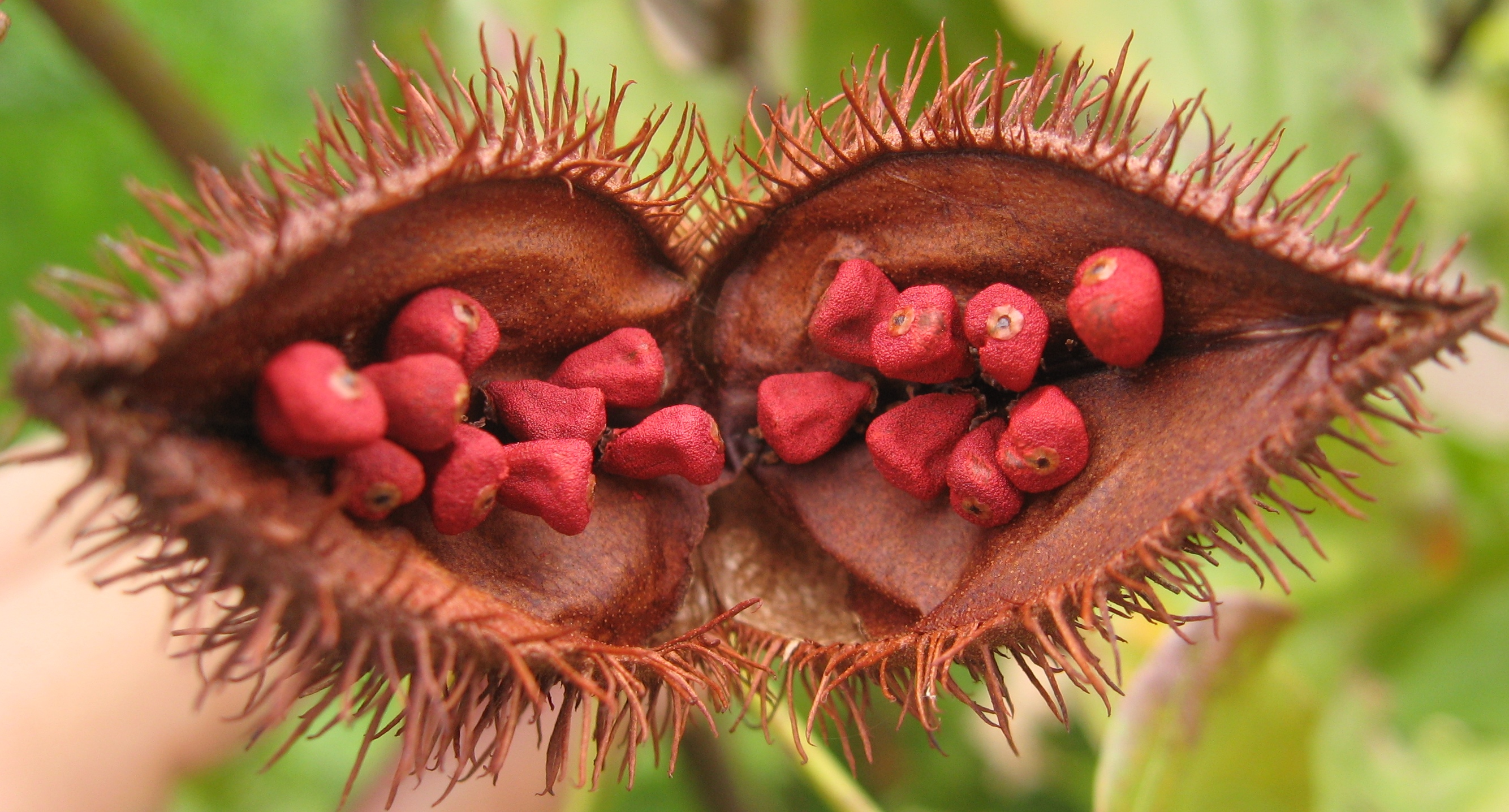
  • Many commercially produced butters have additional yellow coloring from annatto (a seed with lots of carotenoids) or carotene (often derived from marigolds, essentially carotenoids) to make the color of the butter uniform, and also to give butter the yellow color that people expect it to have.

(By the way, this is what annatto is. Sorry for the scary-looking picture, but that's how it grows.)

Seed pods of the achiote tree, which grows in South America
(Photo from Wikipedia)


The seeds are harvested and ground up, and the powder is then used to make an oil that will turn food yellow or orange very easily.
(Image from Karma-Free Cooking)

  • Back in the way-back day, before government regulations outlawed such things (hey! regulations can be helpful!) people used to sell "adulterated butter" -- butter which was made with less butterfat and substituting vegetable oils or tallow or some other kind of cheaper fat, but they'd sell it for the same price as regular butter.  Or they'd take butter that had turned rancid, boil it, add some fresh milk to it, churn it, and sell it like it was fresh.
  • Since people assumed that butter that is less yellow has less fat (not necessarily true, but it's an assumption people made), the bad-butter-sellers would disguise their bad butter by adding yellow coloring.  But the things they used to dye the butter yellow were pretty horrible, such as coal tar or coal tar-derivatives, or copper, which is poisonous.


Or should butter be more yellow, like this?
(Photo from The Gluten Doctors)

  • (By the way, adulterated butter is still sometimes an issue.  Not butter with coal tar or copper, but butter that doesn't have the required amount of butterfat.  Regulators occasionally still have to crack down on bad-butter-sellers every once in a while, for substituting cheaper vegetable oils for butter fat and selling it at a high-quality-butter price.  Acceptable butter should be about 80% butter and 15% water.)
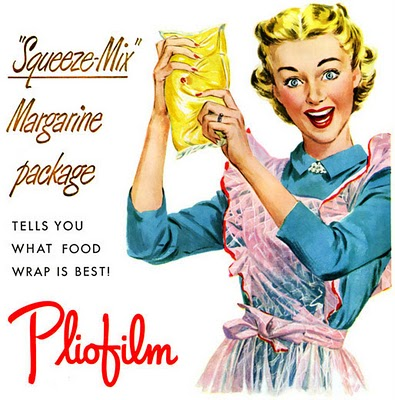
  • When margarine was widely produced during World War II due to rationing, people were suspicious of it because it didn't look yellow like butter.  So margarine manufacturers started including packets of yellow powder that you would mix with the margarine to make it yellow like butter.  But it was a saturated, super-yellow color.
 
Ad for a WWII-era margarine's "Color-Kwik bag" of yellow pigment
(Image from The Society Pages)


Here's another margarine ad, this one with the E-Z Color Pak.  When they spell it funny, you know it's kwality.
(Image from Ancestors in Aprons)


  • But people got used to that.  So when margarine eventually became more popular than butter, then people thought the super-saturated yellow of margarine was what butter ought to look like.  So when people went back to buying butter, which had a paler yellow or almost creamy color, they thought, hey, there's something wrong with this butter, it's not yellow like it should be.  
  • So now butter manufacturers have started to add more dye to color the butter to make it look like margarine.  Today, though, they use annatto or carotene -- neither of which is toxic.


Food Renegade's homemade butter -- made from raw cream that came from grass-fed cows.  The yellow is from the grass, not from adding added coloring.  But if she made another batch of butter using a different type of cream, probably the color would have turned out slightly different.
(Photo from Food Renegade)


Here's the best part about butter, how it melts on things like this muffin, and makes things all warm and melty and creamy and mmmm.
(Photo from Wikimedia)


Sources
Doug & Linda's Dairy Antique Site, Other Dairy Antiques
Wikipedia (German) Butter
Dairy Farmers of Canada, Butter Facts & Fallacies The Society Pages, The Politics of Yellow: Butter vs. Margarine
Kendra Smith-Howard, Pure and Modern Milk: An Environmental History Since 1900, page 60ff.
The Nineteenth Century and After, vol 62, 1907, page 413
Anthony S. Wohl, Adulteration and Contamination of Food in Victorian England

Tuesday, January 7, 2014

Apple #656: Different Kinds of Yeast

I've had a question!  Intrepid Apple reader Melliflua wants to know what is meant by "fast-acting" yeast.

I don't have any context for this question -- is Melliflua making bread and wants to know whether one kind of yeast that doesn't say "fast-acting" will work just as well? -- only that she wonders what it is.  She doesn't want a whole Apple per se, just wondering.

So, in the spirit of doing entries more often, but keeping them shorter, I won't get into the long-standing mystery that is yeast.  I'll just give you the 3 varieties that are typically sold in stores today and tell you how they're different.


Yeast -- but what kind?
(Photo from Red Star Yeast)

Fresh or Wet Yeast

  • Comes in a solid, compressed form like a cake
  • Preferred by commercial bakers
  • Will only last a couple days refrigerated
  • Can last up to 3 months in the freezer.  Defrost when ready to bake & use a little extra
  • 1 cube fresh yeast = 1 envelope of active dry yeast or 1-1/2 tsp to 2 tsp instant yeast
  • If the recipe calls for dry yeast and you have fresh, use 2x the amount


Fresh yeast is sold in compressed blocks like this. Looks like tofu or tuna or anyway not so appetizing. If you're a commercial baker or especially Martha-Stewart-particular, you may go with this type.
(Photo from Big Black Dogs)


Active Dry Yeast

  • Granular, similar to the consistency of cornmeal
  • Store in a cool, dry place until the "best before" day on the package. Outdated yeast won't rise.
  • Needs to be dissolved in warm water to get the yeast going.
  • Adding some sugar to feed the yeast -- honey or granulated sugar -- will speed things along. But if the recipe doesn't tell you to do this, it's probably best not to.
  • That said, adding sugar is a way to test or "proof" the yeast to make sure it's still active. Most packaged yeasts with a "best buy" date  don't need to be proofed; you can trust the date.
  • After adding water & maybe sugar, let stand 5-10 minutes until bubbles form and it expands to about 2x its size
  • Will provide 2 rises -- once after kneading, and again after shaping
  • 1 envelope active dry = 2-1/4 tsp = 1/4 ounce
  • If the recipe calls for fresh yeast and you have active dry, use 1/2 the amount
  • If a recipe calls for Rapid Rise, and you have active dry, don't use it; get Rapid Rise instead.

Active dry yeast, out of the package

A typical envelope of Active dry yeast
(Photo from Cheese and Toast)


Here's a good depiction of the difference between Active Dry and Instant/Fast-Acting/Rapid Rise/Bread Machine Yeast
(Photo from Angel Yeast)


Fast-Acting or Instant or Rapid Rise or Bread Machine Yeast

  • All these terms mean the same thing.
  • Slightly different strain of yeast than Active dry
  • Also granular, but particles are very fine
  • Since the particles are so small, there's no need to dissolve the yeast in warm water first. You  can add it directly to your recipe.  Hence the "instant" or "fast-acting" or "rapid rise" etc.
  • Store in a cool, dry place until the "best before" day on the package. Outdated yeast won't rise.
  • Will provide 2 rises -- once after kneading, and again after shaping
  • 1 envelope instant/fast-acting/rapid rise = 2 1/4 tsp = 1/4 ounce
  • If the recipe calls for fresh yeast and you have this kind, use 1/4 the amount
  • If a recipe calls for Active Dry and you have Rapid Rise, use slightly more and cut the rise time in half.

These are all the same type of yeast:

(Photo from What Is Cooking Now)


(Photo from The Kitchn [not a typo])


(Photo from Baking Ways)


How's that, Melliflua?  Did I answer your question?

Sources
Nigella Lawson's Kitchen Queries, Different Kinds of Yeast
What's Cooking America, How to Use Yeast in Bread Making)