Showing posts with label history. Show all posts

Monday, March 21, 2016

Apple #730: White Rose Resistance

You may have seen the news recently that the hacker group calling itself Anonymous said they were going to hack Donald Trump. They released some basic personal information -- his cell phone number, Social Security number, and some other easy-to-find stuff -- and invited anyone who wanted to take a crack at hacking him or his businesses to do so.

In one part of their message, they said, "Many of you have said to yourself that if you were alive in Nazi Germany, then you would have done something, you would have resisted, like the White Rose Society resisted. Now is the time to prove that. The White Rose Society has risen again in the United States."

I never heard of the White Rose Society, so I was curious to know what it was.  I Googled it and, wow, quite the story.


The original White Rose group did not have a logo or an insignia; they were not that sophisticated. They called themselves "White Rose" for reasons that remain obscure.
(Photo from HD Wallpapers Fit)


  • It's been referred to as the White Rose Society, or the White Rose Resistance, or more accurately, simply as "White Rose." It was a small group of German medical students in their early 20s who got together in 1942 and 1943 and printed 6 pamphlets speaking against Hitler and Nazism and urging others to resist what had become a totalitarian regime.
  • This might not sound like such a big deal, but it was. Let me break down the details.
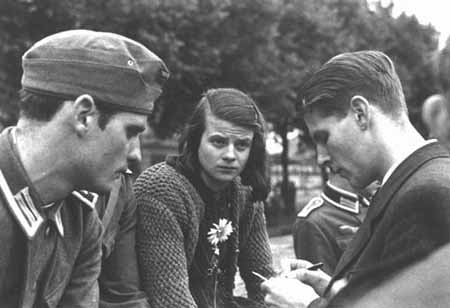
 
Hans Scholl (left) was 24, his sister Sophie was 21, and Christoph Probst, a mutual friend of both, was 22. Photo was taken in 1942 when the White Rose began.
(photo from the US Holocaust Museum Archives, sourced from the Jewish Virtual Library)
 
  • First, this happened in 1942. By this time, the Nazi regime was operating at full strength within Germany, as was the Gestapo (secret police).  They had clamped down on any kind of speech that was against the government in any way, shutting down newspapers, and rounding up and killing or sending off to concentration camps anyone who spoke out against the government.
  • People couldn't speak freely among friends or neighbors because if you spoke against the government in any way, the person you thought was your neighbor and trustworthy would rat you out to the Gestapo, and there you were getting beaten or jailed or sent away, etc.
  • Telephone calls could be listened in on at any time, mail could be opened and inspected, and your person could be searched at any time for any reason.
  • The Gestapo was keeping track of even the sale of stamps.  If anyone bought a whole bunch of stamps, that person got investigated by the Gestapo and depending on what they learned about how the stamps were used, that person got beat up or thrown in jail or sent off to a concentration camp or killed.  The same was true about purchases of a lot of paper.  And Envelopes. And printing presses, of course.
  • It was in the midst of this thoroughly repressive situation that this group of students started meeting and talking together.  There were only about 4 or 5 of them, all medical students at the University of Munich, and at first they talked about music, or literature, and philosophy -- especially philosophy.  Soon they ventured into discussing politics with each other, which would have been a rare treat to be able to do such a thing and feel safe.
  • In the early years of the war, the students were like many of their fellow Germans, supportive of their government, willing to participate and do what they could for the cause of their country. Some of these young medical students had even been members the Hitler Youth. The leaders of this small group were:
    • Hans Scholl, 24
    • Alex Schmorell, 25
    • Jürgen Wittenstein, 23
    • Sophie Scholl - Hans' sister, 21

Alex Schmorell, one of the leaders and founding members of the White Rose, was 25.
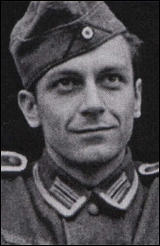
(Photo from the Holocaust Research Project)


Jürgen Wittenstein had been about to leave Germany in 1939 but instead drove two stranded Jewish teenagers to Berlin in the hope that, from there, they could leave the country safely.
(Photo from Spartacus Educational)

  • After having lived through four years of the government's increasingly repressive and brutal tactics, these medical students were justifiably disturbed. Schmorell and Wittenstein attended the very popular lectures of their university's philosophy teacher, Kurt Huber, and they took his teachings very much to heart.  So they decided to do something to resist.
  • In June of 1942, Hans and Alex wrote a leaflet, which they planned to be the first of many, and which they called "Leaflet [or leaves] of the White Rose."  
  • They went to their philosophy teacher, Kurt Huber, for advice in writing the pamphlet. At first he thought it would do no good except to risk their necks, but in the end he decided to help.  He advised them on the wording of the leaflets and talked with them at length about what they wanted to accomplish, challenging them and making sure they were aware of the risks they were taking.


Kurt Huber had had diphtheria when he was young and emergency surgery had cut his throat and left him with difficulty in speaking, a limp, and a tremor in his hands that only subsided when he played the piano. His students said they did not notice his impairments at all when he lectured, his speeches were so learned and absorbing.
(Photo from the Holocaust Research Project)


Another photo of Huber, this from 1941.  He was 48 when this photo was taken.
(Photo from Spartacus Educational)
  • Some websites suggest Huber was consulted very early on in the group's formation, while others say he did not get involved until later. Either way, it seems clear that though he was involved, the group was not his idea but that of his students'.
  • The first leaflet was a few paragraphs long, invoking the ideas of philosophers such as Goethe and Schiller and Aristotle, and encouraging readers of the pamphlet to resist.
  • Excerpts from this first pamphlet will give a sense of the atmosphere of the time:
If the German people are already so corrupted and spiritually crushed that they do not raise a hand, . . . if they abandon the will to take decisive action and turn the wheel of history and thus subject it to their own rational decision; if they are so devoid of all individuality, have already gone so far along the road toward turning into a spiritless and cowardly mass - then, yes, they deserve their downfall.

[. . . ] every individual, conscious of his responsibility as a member of Christian and Western civilization, must defend himself against the scourges of mankind, against fascism and any similar system of totalitarianism. Offer passive resistance - resistance - wherever you may be, forestall the spread of this atheistic war machine before it is too late. . . .

Do not forget that every people deserves the regime it is willing to endure. [. . . ]

Please make as many copies of this leaflet as you can and distribute them.
This is what the leaflet looked like, page 1 of 2. Just a piece of paper with a bunch of words typed on it. Nothing fancy. But those words are highly charged and dangerous. Across the top it reads, "Leaflet of the White Rose I."
(Photo sourced from Flashbak)

  • Hans and Alex made only about 100 copies of the leaflet, typing each one on a typewriter. They left them in telephone boxes, mailed them to students and professors across Germany, and carried them by train to other towns in the country and left them there.
  • I'm not sure who said this, but it was apparently one of the members of the White Rose:
"Some of us traveled in civilian clothing, hoping for the best, some with forged travel orders, I myself used false identification papers (my cousin's with whom I shared a certain resemblance). We left the briefcases which contained the leaflets in a different compartment, for luggage was routinely searched. Mostly, however, leaflets were taken by female students who were not subject to such scrutiny."

  • 35 of the first set of pamphlets wound up in the hands of the Gestapo.  But the rest reached their intended recipients, some as far away as Austria.  And though the Gestapo knew about the leaflets, they could not figure out who was producing them.
  • Hans' sister Sophie enrolled in the University of Munich, also as a medical student, shortly after the first pamphlet was distributed.  She found out about the White Rose group and wanted to join.  At first her brother wouldn't allow her to because of the danger, but she persisted. Another friend of theirs, Christoph Probst, also joined at this time.
  • They wrote and distributed three more leaflets.  Sophie and other young women helped distribute them, since the Gestapo tended not to search women as often as they did men.
  • Here are more excerpts. 
  • Leaflet Two: 

By this time the group had got hold of a duplicating machine -- this one, to be exact.  It had to be cranked by hand, which they did at night when people were sleeping.
(Photo from the Holocaust Research Project)

If at the start, this cancerous growth in the nation was not particularly noticeable, it was only because there were still enough forces at work that operated for the good, so that it was kept under control. As it grew larger, however, and finally in an ultimate spurt of growth attained ruling power, the tumor broke open, as it were, and infected the whole body.

[. . . ] Now the end is at hand. Now it is our task to find one another again, to spread information from person to person, to keep a steady purpose, and to allow ourselves no rest until the last man in persuaded of the urgent need of his struggle against this system.

[. . . ] only by way of example do we want to cite the fact that since the conquest of Poland three hundred thousand Jews have been murdered in this country in the most bestial way. Here we see the most frightful crime against human dignity, a crime that is unparalleled in the whole of history. For Jews, too, are human beings.

  • Leaflet Three:

The top of it says it's a Leaflet of the White Rose, III, followed by "Salus publica suprema lex" -- the public good is the supreme law.
(Photo from the Holocaust Research Project)

our present "state" is the dictatorship of evil. "Oh, we've known that for a long time," I hear you object, "and it isn't necessary to bring that to our attention again." But, I ask you, if you know that, why do you not bestir yourselves, why do you allow these men who are in power to rob you step by step, openly and in secret, of one domain of your rights after another?
[. . . ] And now every convinced opponent of National Socialism must ask himself how he can fight against the present "state" in the most effective way:

Sabotage in armament plants and war industries, sabotage at all gatherings, rallies, public ceremonies, and organizations of the National Socialist Party. Sabotage in all the areas of science and scholarship which further the continuation of the war - whether in universities, technical schools, laboratories, research institutions, or technical bureaus. Sabotage in all publications, all newspapers, that are in the pay of the "government" and that defend its ideology and aid in disseminating the brown lie.

  •  Leaflet Four:
Every word that comes from Hitler's mouth is a lie. When he says peace, he means war, and when he blasphemously uses the name of the Almighty, he means the power of evil, the fallen angel, Satan. His mouth is the foul-smelling maw of Hell, and his might is at bottom accursed.
[. . . ] We wish expressly to point out that the White Rose is not in the pay of any foreign power. Though we know that National Socialist power must be broken by military means, we are trying to achieve a renewal from within of the severely wounded German spirit.
[. . . ] To set you at rest, we add that the addresses of the readers of the White Rose are not recorded in writing. They were picked at random from directories.
We will not be silent. We are your bad conscience. The White Rose will not leave you in peace!

  • After they wrote and distributed these 4 pamphlets, the students reached the end of the school term. The university decided to send its medical/military students to the Russian front to give them experience with treating patients in field hospitals.
  • While at the Russian front, the medical students witnessed the fighting conditions, saw the Warsaw Ghetto, saw a group of naked Jews being shot in an open pit, saw Ukrainian soldiers being "hired" to shoot whoever was pointed at for the price of a pack of cigarettes, and you know, just the basic horror show that is war, and this war in particular.
  •  Also, another medical student, Willi Graf, met the Scholls and became their friend and, once back at school, joined the White Rose.


Willi Graf, another member of the White Rose, was 25.
(Photo from the Holocaust Research Project)

  • When they got back to school in Munich in the fall, they distributed more pamphlets, now with the goal to find more students at more universities to join their cause. Graf was particularly involved in trying to recruit more members from beyond Munich.
  • In addition to writing and distributing more leaflets, Hans, Alex, and Will also painted graffiti on buildings throughout Munich, which shouted things like 
    • Freedom! 
    • Down with Hitler!
    • Hitler is a Mass Murderer!
    • and they painted Swastikas with great big cross-outs
  • Again, these things might seem tame to us now, but again, it was extremely dangerous.  To paint these things on the walls, one had to do this in public, with the possibility that anyone looking could see and report the matter. The buildings they chose were along a very busy street in the middle of Munich, where the graffiti would be sure to be seen -- and where they might very easily have been seen putting it there.  


The Sixth Leaflet. The title is translated, "A German leaflet." It was much fancier, and they had managed to make somewhere between 1500 and 1800 copies of it.
(Sourced from Canadians in Afghanistan)

  • The sixth leaflet was the last one written. Hans and Sophie took copies of it to the university in a big suitcase, and they left stacks of them in the hallways for students to find when they came out of class. They still had some left, so Sophie went up to the top floor and, looking down the stairwell atrium, flung them into the air.
  • The custodian, Jakob Schmid, saw this and called the police. Hans and Sophie were arrested by the Gestapo, and so were the other members of the group.
  • The members of the White Rose were tried -- if you can call it a trial.  A special court, of the kind called "the People's Court" -- I am not kidding -- was convened to hear this case.  It was run by Berlin judge Roland Freiser, who was not so much a judge as a screaming prosecutor.

"Judge" Roland Freiser, center, at the People's Court in Germany
(Photo from the Holocaust Research Project)

  • Freiser shouted abuse at the accused, and said he was baffled how young people from such good families could turn out so bad, how could their minds have gotten so warped, etc.  Their defense attorney was useless, saying only "Let justice be done."
  • Sophie stood up and said, "Somebody, after all, had to make a start. What we wrote and said is also believed by many others. They just don't dare to express themselves as we did."


The Gestapo's photos of Sophie Scholl, taken February 18, 1943, upon her arrest.
(Photo sourced from Flashbak)

  • After 4 hours, the leaders of the group were convicted and sentenced to death.  Sophie was led to the guillotine first.  (Ladies first? WTH?)
  • "A witness described Sophie as unflinching as she walked to her death. The executioner also remarked that he had never seen someone meet the end of life as courageously as she did."
  • Christoph Probst, closest friend of Hans and Sophie, with a wife and three children, and who had helped edit and distribute the leaflets, was next.  He shouted, "We will see each other in a few minutes!" before he was executed.
  • Hans' last words before he was executed were "Long live freedom!"
  • Later trials ended with more convictions and executions.  Alex Schmorell was turned in by an ex-girlfriend, convicted, and executed.  Willi Graf and the Kurt Huber philosophy teacher were also convicted and executed.  
  • One student who had tried to collect money to support Huber's widow was also arrested and convicted. 
  • Of the primary members of the White Rose, only one survived: Jürgen Wittenstein.


Jürgen (George) Wittenstein in 1943, taken when he expected to be arrested and executed.
(Photo by Wittenstein, sourced from the Santa Barbara Independent)

  • Wittenstein was arrested and questioned by the Gestapo. The only reason they let him go was because his army commander who knew him from his compulsory military service intervened on his behalf.
  • Wittenstein had been the one to alert Hans and Sophie's parents to their arrest, and managed to get them into the prison so they could see their children one last time.  Had it not been for Wittenstein, Hans and Sophie's parents would have learned of their children's deaths only after the fact.
  • Wittenstein later emigrated to the United States, where he attended Harvard and became a practicing and research surgeon, performing complex heart operations, and helping to establish new cardiac facilities at other hospitals.


Jürgen Wittenstein, in 2010 at age 91, at a reunion held with the two teenagers he helped in 1939. They had left Germany and settled in New York.
(Photo from the Santa Barbara Independent)


Sources
US News & World Report, Anonymous Launches Offensive Against Trump, March 17, 2016
Time Magazine, Secret Service Investigating Claims That Anonymous Hacked Donald Trump, March 18, 2016
Global Nonviolent Action Database, White Rose Resistance to Hitler's Regime, 1942-1943
Holocaust Education & Archive Research Team, The White Rose
Jewish Virtual Library, Holocaust Resistance: The White Rose - A Lesson in Dissent
Spartacus Educational, Jürgen Wittenstein and Kurt Huber
The United States Holocaust Museum, Holocaust Encyclopedia, White Rose
History Is a Weapon, The Six Pamphlets of the White Rose Society
Flashbak, Sophie Scholl and the White Rose Rebellion, February 22, 2016
History.com, Feb 18, This Day in History: Nazis arrest White Rose resistance leaders
The History Learning Site, The White Rose Movement
Santa Barbara Independent, George (Jürgen) Wittenstein: 1919-2015: A Member of WWII’s White Rose, July 9, 2015

Monday, March 9, 2015

Apple #704: Bloody Sunday and Selma to Montgomery

Yesterday, President Obama gave a speech commemorating the 50th anniversary of the march from Selma, Alabama.  There's been a lot of reaction to it, most of it positive.  There was also that movie about Selma, released recently, but which I have not seen.  I somehow manage never to get to the movie theatre these days.

I am embarrassed to admit this, but in listening to Obama's speech and in reading journalists' comments on it, I don't know what "Bloody Sunday" refers to.  I hear that and I think of the Troubles in Ireland (such a nice, delicate way of describing centuries' worth of Catholic vs. Protestant bombings and murders).

But of course I know that these speeches about Selma, Alabama, can't be talking about Ireland, that they mean events that took place during the civil rights protests in 1965.  But that's about all I know.

So what did happen in Selma, Alabama in 1965?  And to give me a place to start, why Selma?


Now that I've read the whole story, I see how this Life magazine cover photo pretty much says it all.  The two guys in front of the two-by-two column of people are Hosea Williams (L) and John Lewis (R).
(Life cover image from Successimg.com)

  • The Civil Rights Act was passed in 1964.  That was supposed to stop people and communities from discriminating against other people on the basis of race or color or sex or religion or national origin.  One of the ways people weren't supposed to be discriminated against was in matters related to voting.  But in fact, even though the nation-wide law of the land forbade it, many communities were still preventing people -- mainly African Americans -- from voting.
  • One of the places where this was happening most egregiously was in Selma, Alabama.  Some sources say only 2 percent of Selma's eligible black voters were registered to vote; other sources say less than 1 percent.
  • Selma was the county seat of Dallas County and the county sheriff, Jim Clark, had been very vocal in his opposition to blacks being allowed to vote.  He went around wearing a button that said "Never," meaning never allow black people to vote.  At one voting rights demonstration, he rounded up all the protestors using cattle prods and forced them to march faster and faster until a number of the protestors vomited.


Jim Clark, Sheriff of Selma, Alabama in 1965, violently opposed to black voting rights.
(UPI photo from NYT)

  • He was friends with people in the KKK, and he organized a posse -- literally, a posse -- of KKK members alongside police officers to stand around in front of places where black people were going to register to vote.  His posse guys were also armed with billy clubs and cattle prods.  
  • African Americans who had shown up to these registration drives either to register or to demonstrate and encourage others to vote were harassed, shouted at, threatened, or beaten.
  • There were two locally-organized groups that were trying to prevail in spite of this neanderthal.  These two groups were called the Student Nonviolent Coordinating Committee (SNCC) and the Southern Christian Leadership Conference (SCLC).
  • It was around this time that Dr. Martin Luther King was informed of what was happening in Selma.  He supported both groups' efforts and encouraged them to continue to conduct nonviolent protests against the practices of Jim Clark et al., to draw national attention to the problem, and to raise national awareness about the fact that people were still being kept from voting.


Martin Luther King, Jr.  You know who he was, of course.
(Photo from funcheapsf)

  • Many of the demonstrations that the groups held, which took place in January and February of 1965, were conducted outside the Dallas County Courthouse. They were trying to bring the problem literally to the steps of the courthouse, which was supposed to uphold the Civil Rights Act, but was not. 
  • During one of these demonstrations, on February 17, sheriff Clark and his men, who were also joined by state troopers sent to Selma by Governor Wallace, decided to break up the march by beating the men and women who had assembled with their billy clubs.  This was nothing new, really.  They had responded to other demonstrations in similarly violent ways.
  • On this particular evening, some of the demonstrators tried to get away from the troopers with clubs by running into a cafe.  But the troopers followed them in and started whaling on an older man, someone's grandfather.  His daughter rushed to the man's aid, and the trooper knocked her down.  Then her son, Jimmy Lee Jackson, stepped in and tried to protect his mother from being hit some more.  The state trooper responded by pulling out his gun and shooting Jackson, point-blank, in the abdomen.
  • Jackson, a 26 year-old church deacon, died of his wounds eight days later.


Jimmy Lee Jackson, deacon, 26, shot for trying to keep his mother from getting beaten up.
(Photo sourced from the Northeastern University School of Law)

  • One of the organizers of the SCLC, Reverend James Bevell, said they should take the body of Jimmy Lee Jackson in a funeral cortege all the way to the state capitol, Montgomery, to show the state of Alabama and the country at large what had happened.  In discussing this idea and planning how to make it happen, they decided it should be a march from Selma to Montgomery. 

The First Attempt -- Bloody Sunday


Map showing the road -- Highway 80 -- from Selma, AL to the state capital, Montgomery.
(Map from the National Park Service)


This is what the first march looked like, coming over the bridge from Selma, led by John Lewis and Hosea Williams.
(Photo sourced from crmvet.org)


  • On March 7, led by the SNCC and the SCLC, some 600 people gathered at a church in downtown Selma, knelt together in prayer, and then began their march walking two-by-two through Selma, intending to go all the way to Montgomery, which is about 50 miles away.
  • The road from Selma to Montgomery goes south out of Selma before it cuts east. The southern edge of Selma is bounded by the Alabama River.  The bridge going over the river is the Edmund Pettus Bridge.  So essentially, once you cross the Edmund Pettus Bridge over the Alabama River, you're outside Selma, with about 49 1/2 miles to go to Montgomery.
  • The 600 marchers made it as far as this bridge when they were confronted by a blockade of sheriff Clark's men and his stupid posse and state troopers sent there by Governor Wallace.  I cannot believe, in 1965, there was a freakin' posse.  But there was.
  • The troopers and policemen and the KKK whatnots were armed with billy clubs and bullwhips, and they were wearing gas masks.  In other words, they showed up ready for a fight.


What was waiting for the marchers
(Photo sourced from crmvet.org)

  • A state trooper named Major Cloud got on his bullhorn and told the marchers that this was the end of their demonstration, that it was unlawful, and they had two minutes to disperse.
  • Well, it wasn't unlawful at all.  So the marchers did not disperse.  They didn't do anything else, either.  They didn't rush forward or do anything threatening.  They just continued to stand there.  
  • But this apparently was unacceptable to Major Cloud because he gave the order to the troopers to advance, and they did.  They pushed their mass of people into the two-by-two line of marchers and pushed them down like a steamshovel knocking down bowling pins.  And then they started hitting people.
  • They beat people -- men and women -- with their billy clubs.  They released their tear gas and clouds of it were everywhere.  It was pretty much a nightmare.


Tear gas canisters all up the road in Selma
(Photo sourced from crmvet.org)


Some of the wounded
(Photo sourced from crmvet.org)

  • Multiple people were beaten, in the head, in the face, on the back.  They walked away with bloodied faces and broken noses.  One of the fifty-eight people beaten severely enough they had to be treated at a local hospital was John Lewis, chairman of the SNCC.  His skull was fractured.  
  • Here is an excerpt from his testimony given in a federal hearing following this march.  The guy questioning him is an attorney.
Lewis: I was hit on my head right here.
Hall: What were you hit with?
Lewis: I was hit with a billy club, and I saw the State Trooper that hit me.
Hall: How many times were you hit?
Lewis: I was hit twice, once when I was lying down and was attempting to get up.
Hall: Do we understand you to say were hit . . . and then attempted to get up and were hit—and was hit again.
Lewis: Right.


John Lewis, one of the leaders of the first march, shown here in the foreground in the light overcoat.
(Photo from Raceandpoverty.org) 

John Lewis being hit by a state trooper in Selma, AL, 1965.
(AP file photo sourced from the Tampa Tribune)


Hosea Williams, the guy who co-led the first march with John Lewis.  The photo was taken probably ten years or so later, when Williams held various political positions in Georgia.
(Photo from the New Georgia Encyclopedia)

  • At the conclusion of the hearing, Judge Frank Johnson, Jr., ruled that the demonstrators had a constitutional right to march.  Which means the troopers and Clark and all the rest of those hooligans in uniform had no right to do what they did.
  • All this might have passed by the notice of most people in the country, making it only in a few newspapers, except that cameramen from TV news stations were there and filmed the whole thing.  So it was broadcast on TV news around the country.  And people across the country who saw this footage were horrified.
  • I found some of this footage so you could see it for yourself. 

This is an excerpt from some historical documentary, beginning with a description of what was happening in Selma leading up to Bloody Sunday.  The guy pointing his billy club at the camera is Sheriff Jim Clark.  Toward the end is footage from Bloody Sunday itself.


The first 3 minutes of this video show, without commentary, some of the footage from Blood Sunday.


  • Dr. King was sending out telegrams and press releases and public statements, decrying the response of law enforcement, and calling on religious leaders across the country to join their cause.  They would try their march again, he said, and the more people who would join their nonviolent demonstration, the better.
  • That same judge who said their first march was lawful told Dr. King he was going to issue a restraining order to prevent the march from going forward, at least for a few more days, until March 11.  He wanted enough time for a federal court order to go through so that a different batch of lawmen could be dispatched to Selma to provide protection for the marchers against Clark et al.
  • Dr. King sort of did and sort of did not do what the judge said.

The Second March -- March 9

  • Two days after Bloody Sunday, somewhat against the orders of the judge, Dr. King led 2,000 plus people -- note that the number more than tripled in two days -- as far as the Edmund Pettus Bridge.  There, they stopped and knelt to pray.  Then they turned and went back to Selma.
  • The troopers were still there, at the far side of the bridge.  By not crossing the bridge, the marchers did not antagonize the troopers.  But they also did not back down from their own decision to make some sort of demonstration. And it was peaceful.
  • At some point on this day, King gave a speech which included the statement, "I would rather die on the highways of Alabama, than make a butchery of my conscience."  Strong stuff, Dr. King.
  • By this time, President Lyndon Johnson was very well aware of everything that was going on.  He promised, in the wake of the second march, to introduce legislation that would specifically guarantee voting rights, and that he would do so within a matter of days.
  • A white Unitarian minister named James Reeb was one of hundreds of people who had seen the coverage of Bloody Sunday on TV and who flew to Selma to participate in the demonstrations.  The night of March 9, he and two other Unitarian ministers were eating in a restaurant in Selma that served both whites and blacks. After they left that restaurant, they were walking back to a meeting that would be led by Dr. King when they were attacked by "local whites."
  • Reeb was beaten severely in the head with a club.  Somehow, it was several hours before he was brought to a hospital in Birmingham, where doctors performed brain surgery.  But to no avail.  The Unitarian minister, born in Kansas and ministering in Boston, died two days later.  He was 38 years old.


James Reeb, Unitarian minister
(Photo from the James Reeb Unitarian Universality Congregation)

  • Reeb's death galvanized many more people in the country.  If those "local whites" in Selma would kill a white man over this race thing, clearly they were way out of line.  
    • (You still see this sort of thing in movies all the time.  The black sidekick gets killed, because he's expendable, and this is what spurs the white hero into action.  Or a bunch of black guys in the background get shot, but it's only when one of the white guys who actually has a speaking part gets wounded that the white hero really gets ticked off and starts kicking ass and taking names.  We've still got a long way to go.)
  • All sorts of things started happening.  Johnson addressed Congress, saying, "Their cause must be our cause too. Because it is not just Negroes, but really it is all of us, who must overcome the crippling legacy of bigotry and injustice. And we shall overcome." More importantly, he submitted his voting rights legislation to Congress on March 17.
  • The Selma demonstrators submitted a detailed plan, describing their plans to march from Selma to Montgomery, to that judge, Frank Johnson, Jr., and he approved it.  He then called up Governor Wallace and asked him to call off his dogs -- er, troopers.  But to be on the safe side, the federal government also sent hundreds of Alabama National Guardsman to protect the marchers.

 The Third Time's the Charm

  • The third march set out on March 21.  This time, there were 3,200 people. Some sources say there were 8,000, but the judge said they had to limit the number to 300 people at a time marching along the two-lane highway. This time, they were protected by National Guardsmen and members of  the FBI. 
  • They walked from Selma to Montgomery, covering anywhere from 7 to 17 miles per day.  They camped out at night on land belonging to people sympathetic to the demonstration.  By the time they got to Montgomery, the number of marchers had greatly expanded to some 25,000 people.


What the third march looked like, coming into Montgomery
(Photo sourced from Jacobin Magazine)

  • They reached he capitol building four days later, on March 25.  Dr. King delivered a speech on the steps of the capitol building.  It was here that he said the following:
"I know you are asking today, "How long will it take?" (Speak, sir) Somebody's asking, "How long will prejudice blind the visions of men, darken their understanding, and drive bright-eyed wisdom from her sacred throne?" Somebody's asking, "When will wounded justice, lying prostrate on the streets of Selma and Birmingham and communities all over the South, be lifted from this dust of shame to reign supreme among the children of men?" Somebody's asking, "When will the radiant star of hope be plunged against the nocturnal bosom of this lonely night, (Speak, speak, speak) plucked from weary souls with chains of fear and the manacles of death? How long will justice be crucified, (Speak) and truth bear it?" (Yes, sir) I come to say to you this afternoon, however difficult the moment, (Yes, sir) however frustrating the hour, it will not be long, (No sir) because "truth crushed to earth will rise again." (Yes, sir) How long? Not long, (Yes, sir) because "no lie can live forever." (Yes, sir) How long? Not long, (All right. How long) because "you shall reap what you sow." (Yes, sir)"

"How long? Not long, because the arc of the moral universe is long, but it bends toward justice."
Aerial photo of the demonstrators gathered in front of the capitol building in Montgomery.
(Library of Congress photo sourced from On This Very Spot)

  • After this speech, a delegation from the marchers tried to deliver a petition to Governor Wallace.  The doors of the capitol were blocked by -- who else? -- a line of state troopers.  The delegation asked that the petition be delivered to the governor.  They were told that the governor was not in.  They remained on the steps with the petition until one of the governor's secretaries came out and collected the petition.
  • Five months later, on August 6, President Johnson signed into law the Voting Rights Act of 1965.  As he signed this bill into law, he called the right to vote "the most powerful instrument ever devised by man for breaking down injustice and destroying the terrible walls which imprison men because they are different from other men." (and women too, I would add)


President Johnson signing the Voting Rights Act into law
(Photo from the National Archives on Flickr)


But It's Still Not Over

  • Although the march was ultimately successful in helping to secure a voting rights law for the entire country, and in bringing to the eyes of people across the nation the extent of violence that some bigoted people were willing to go to in order to protect their narrow-mindedness, this wasn't the end of the story.
  • The same night that the marchers arrived in Montgomery, there was yet another murder.  A housewife from Detroit, Viola Liuzzo, who had also seen the news about Bloody Sunday on TV and who came down to Selma to march in support, was driving a fellow marcher, an African-American teenager named Leroy Moton, back from Montgomery to Selma.
  • She was driving him along Highway 80 when another car pulled up next to theirs and, I think while both cars were still driving, a passenger in the other car pulled out a gun and shot at her.  The bullet struck her in the face.  She lost control of the car, understandably since she was probably dead at that point, and the car went into a ditch and crashed.  
  • The guys in the car stopped and got out and would have killed Leroy Moton too, except he pretended to be dead.


Viola Liuzzo, one of the marchers from Selma to Montgomery, originally from Detroit, killed for giving a black teen-ager a ride home.
(AP photo from NPR)


I would show you a photo of Leroy Moton from that time, but money-grubbing Corbis owns them all.  So if you want to see what Leroy looked like, here's a photo of him.

  • Three of the 4 guys in the car were members of the KKK.  The fourth guy was also a KKK member, but he had turned FBI informant.  The next day, the three KKK guys were arrested. (Why, why why did the informant guy let it get to the point where someone got killed?)
  • The three KKK guys were tried, but of course, since the dead person was a woman, they had to say it was all her fault.  People testified at the trial that Viola was a Communist sympathizer (her second husband was a member of the Teamsters, and she herself was a member of the NAACP), that she had gone to Selma to have sex with black men, that she was a drug addict.  The old trick of making the victim look guilty, and when the victim is a woman, they call her a slut.
  • The KKK members were all acquitted by an all-white jury.
  • There was another trial years later, on federal charges.  Two of the 3 guys were convicted and sentenced to 10 years. The third guy died before he could be sentenced.  The two guys in prison later said it was the informer who did the shooting, but it was too late. The informer had been granted immunity, so things were left as-is.
  • In the meantime, Viola's family were sent letters filled with phrases like "N---r-lover". Her children were called "N---r lover's baby" and had rocks thrown at them.  Ladies' Home Journal polled its readers, asking them what they thought of Viola, and the majority said she was not a good mother, should have stayed home, and minded her own business.  Her husband became an alcoholic and died.  Her children suffered from post-traumatic stress disorder.
  • I'm getting a little off-track here, because I'm getting incensed.  
  • It wasn't only Viola and her family who continued to suffer despite the eventual successes of the march from Selma to Montgomery. As we've all seen more recently, in the Trayvon Martin case in Florida, in Ferguson, Missouri, in the Eric Garner case in New York City, too many African Americans are still suffering violent acts perpetrated against them because of racism and bigotry.  We as a country have made some improvements since slavery, and since 1965.  But we still have a long way to go.
  • Here's another bit of proof of that: about 4,000 bags, each containing a rock and a KKK flyer, were thrown onto the doorsteps of houses throughout Selma on the 50th anniversary of the march to Montgomery.  The fliers contained all sorts of "statistics" (a.k.a. bullshit) about the likelihood of this or that non-white race to commit this or that type of crime.
  • Robert Jones, the grand dragon of the Loyal White Knights of the KKK said to a reporter from the AP, "We pretty much put out fliers, some against King and some against immigration. It's time for the American people to wake up to these falsehoods that they preach about MLK."
  • He was also hoping the fliers would attract new members.  "The Klan is still out there and we are watching," Jones said.
  • Makes me sick.

The Moral of the Story

  • Vote.  People died for your right to vote.  Not just in the Revolutionary War, not just in the Civil War, but only a few decades ago.  And the struggle continues today.  
  • Very few countries in the world allow its entire citizenry to vote, and even fewer have fair and not-rigged elections.  This is a right that everyone should have, but very few people in this world have it.  We--all of us in this country--do have the right to vote.  It is an enormous privilege, hard-won by the lives of countless people who came before you.
  • The first and best way to make your voice heard is to vote.  If you're still not satisfied, get people together and demonstrate -- peacefully.  Show people what the problem is and present them with a solution.  If you get enough people to see the wrong that's being done, sooner or later, the rest of us will hear you.  And in this country, as President Obama said in his speech, we are committed to improving our laws and ourselves so that everyone will one day be treated fairly. As we all know deep down everyone should be treated.  And the KKK be damned.

P.S.


Today, John Lewis is a member of the House of Representatives, and currently serves as Senior Chief Deputy Whip for the Democratic Party.  Know how he got there?  Votes.
(Photo from John Lewis's Congressional page) 


Sources
Stanford University, Martin Luther King Institute, Selma to Montgomery March (1965)
History Channel, Civil Rights Movement Video, Bloody Sunday (5 min)
The National Archives, Confrontations for Justice, John Lewis - March from Selma to Montgomery, "Bloody Sunday," 1965
BlackPast.org, Selma, Alabama (Bloody Sunday, March 7, 1965)
AL.com, KKK fliers left at Selma homes on 50th anniversary of "Bloody Sunday," March 8, 2015

Sheriff Jim Clark
The New York Times, Jim Clark, Sheriff Who Enforced Segregation, Dies at 84, June 7, 2007
Jimmy Lee Jackson
Northeastern University School of Law, Jimmie Lee Jackson

James Reeb
Stanford University, Martin Luther King Institute, Reeb, James (1927-1965)
James Reeb Unitarian Universalist Congregation, Who Was James Reeb?

Viola Liuzzo
Biography, Viola Gregg Liuzzo
NPR, Killed for Taking Part in "Everybody's Fight," August 12, 2013

Monday, October 27, 2014

Apple #686: Remembering 9/11 -- The World Trade Center

Well, this one is the granddaddy, isn't it?  In case you haven't noticed, I've been avoiding this one.  It's hard to talk about, and even harder to find something positive to say about what happened without sounding like some brainless twit of a Pollyanna.

It's also taking me a long time.  Whenever I've sat down to try to put this together, told myself, Finish this post and then you can move on, I found I couldn't do very much for very long.  It's one thing to read a whole lot of stuff about what happened in NY on 9/11, but it's another thing entirely to think about it in some coherent way, form meaningful words, and write them down.  What you'll read here in this one post has taken me weeks to get down.


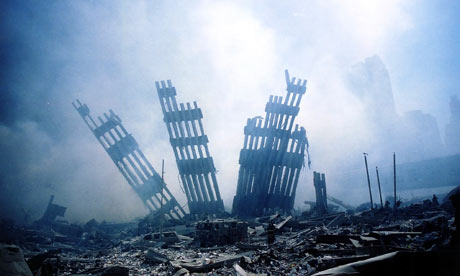
Ground Zero, after the attacks.
(Photo by Alex Fuchs/AFP, from The Guardian)


My goal is to tell you some of the facts I learned.  Because they were news to me -- though maybe they won't be to you.  Some of the facts are pretty gruesome, and up until now, I've shied away from talking about such things.  But that was one of the questions I had, when I was re-visiting the events of that day.  Thousands of people were killed.  We saw all kinds of evidence all over the place of the buildings that were completely destroyed, but we didn't see very much evidence of the people who must have been injured, their bodies wrecked.

I am not a gore-seeker.  There are people out there who are.  I really do not want to cater to those interests if I can help it.  My reason for wanting to know some of the gory physical facts is because, after all the time that has passed, I wanted some irrefutable thing that would tell me, this happened to people.  Not just the horrible, choking, toxic dust (I will give you a few facts about that), not just the surreal and incredible sight of those planes crashing straight into the towers, but what happened to people.  I want survivors and family members to know that the few facts I have to share about that, I say with the utmost respect.  I want to talk about this because I think it is important that we who weren't as directly touched by the events can face the consequences of these acts.  The terrorists hurt people.  A lot of them.  This wasn't just one ideology clashing with another.  This was people doing violence to other people.  I think it is important to talk about that.

I learned some other facts that are a little less upsetting, or maybe I should say a little less bloody.  I want to share those with you too.  I make no promises that the sequence with which I present the odd bits that I learned will make any sort of sense.  I mean, the whole thing doesn't really make any sense, so why should my presentation of a few of the facts within it have any kind of cohesiveness?

OK.  Enough throat-clearing.  Here goes.

Effects of the Initial Fireball Explosions

  • When the jets collided with the buildings, they ripped holes in the walls and ceilings and floors and elevator shafts and so on of the buildings.  The jets themselves were also basically shredded.  So one of the things that happened was that jet fuel leaked out of the planes and caught fire.  10,000 gallons of jet fuel.  The way I've described it sounds slow-moving, but it all happened pretty much instantaneously.
  • In the North tower, the exposed jet fuel erupted into a fireball on impact.  You've seen in movies how fireballs expand outward super-fast.  Well, the fireball ballooned into every open space available, including down the elevator shaft.  
  • The fireball blew down the shaft and exploded out of the shaft onto several floors, including the 77th, the 22nd, the West lobby on the ground floor, and the B4 level, 4 stories below ground.  That fireball traveled from the 92nd floor all the way down to 4 floors below ground in seconds.


The fireball that erupted from the South Tower upon impact.  But the scale of it gives you an idea of the size of the similar fireball that blew exploded down the elevator shaft in the North Tower.
(Photo from the Daily Mail)

  • People who were standing in the lobby, 92 floors below the impact, waiting for elevators or whatever they were doing, were visited by a a great flaming ball of jet fuel that billowed out of the elevator shaft and incinerated them.  
  • Firefighters on their way to the North Tower were 100 yards away when a man, completely on fire, ran in front of the truck.  He saw the firetruck coming only after he'd run out in front of it, and the driver of the engine said it was clear from his expression, the man thought he was going to get run over.  But they skidded the fire engine to a stop just in time, firefighters got out and rolled him in a jacket, doused him, and wrapped him in a burn blanket.  They later learned that he survived.
  • When the firefighters ran into the buildings, they saw people lying on the floor, charred.  
"A man, already dead, was pushed against a wall, his clothes gone, his eyeglasses blackened, his tongue lying on the floor next to him. The other was a woman, with no clothes, her hair burned off, her eyes sealed.
“'The woman, she sat up. I’m yelling to her, ‘Don’t worry, we’re going to help you,’” John M said. “She sat up and was trying to talk, but her throat had closed up. She died right there.'” (From the Appleton Post Crescent, via the FDNY Ten House)
  • The floor of the lobby was covered with broken glass from the plate glass windows, water from the sprinkler systems, and blood.  Outside, in the plaza between the two buildings were briefcases, bags, purses, wallets, and also bits and pieces of people's bodies--as well as the bodies of those who had fallen or jumped from the windows above the impact.
  • Over two years later, remains found at or near the site were still being identified.

Falling or Jumping

  • There is a lot of controversy about the people who fell or jumped.  When the planes hit the towers, they severed the elevator shaft, blocked the stairwells, and even severed the pipe that firefighters plug their hoses into to shoot fire up into a skyscraper.  Not only was there no exit, the place was filled with burning jet fuel and black smoke and intense heat.  In some cases, the windows were smashed open by the force of the impact.  In others, people broke windows on purpose to get air to breathe. 
  • Some who were on lower floors looked out the windows and saw people plummeting past them.  Some say they caught glimpses of people's faces, and they say the falling people looked surprised.  Shocked, as if they didn't know they were falling until it was too late.  So these people say that those who fell may have stumbled toward the window, unable to see much of anything because of all the smoke, and then discovered they had fallen out as they were falling.
  • Videos and photos of people falling became some of the most controversial images of the attacks.


"The Falling Man," photo taken by Richard Drew of a man whose identity is still uncertain, falling from the North Tower before it collapsed.
(Photo from Wikipedia)

  • Some people refuse to accept that those who plummeted from the burning towers jumped on purpose.  They find the concept of intentionally jumping -- suicide -- to be too upsetting to be accepted. Some say the jumpers were cowardly, or that what they did was shameful.
  • The New York medical examiner ruled the deaths of all those who fell were not suicides but rather deaths by blunt force trauma.  A spokesperson for that office said they were not suicides because
"Jumping indicates a choice, and these people did not have that choice. That is why the deaths were ruled homicide, because the actions of other people caused them to die. The force of the explosion and the fire behind them forced them out of the windows."
(spokesperson for NY medical examiner, quoted in the Daily Mail)
  • One man who found evidence that his wife was among those who fell said he takes comfort in the belief that she jumped.
"'It made me feel she didn’t suffer and that she chose death on her terms rather than letting them burn her up.'

"He has no time for suggestions that she took the easy way out. 'The people who died that day weren’t soldiers. They were everyday people — parents and housewives and brothers and sisters and children.'"
(Husband of a woman who died in the attacks, quoted in the Daily Mail)
  • It is estimated that some 200 people jumped or fell.  Authorities can't be certain because the bodies of those who plummeted were "obliterated."
  • For my part, I think the concept of discovering you're falling to your death only when it's too late to be horribly frightening and awful.  
  • At the same time, those who were clinging to the broken outer edges of the building and decided to let go -- somehow, this seems less awful to me. 
  • I think, had I been one of those people choking and coughing because of the burning jet fuel and the black smoke billowing everywhere, the heat of that awful fire coming ever closer, the outside air might have seemed like a relief.  I might have believed I could possibly survive the fall when I certainly would not survive the flames.  There were some people who held clothes over their head like a parachute as they fell, so they may have thought something similar.  The fabric was ripped out of their hands on the way down, so that plan did not work.  But I think that, for some people, jumping was an attempt to save their lives, not to lose it one purpose.


People clinging to the outer edges of the World Trade Center as it burned. This is a choice no one would ever want to have to make.
(Photo from Moon & Neptune in Twelfth House)

  • Many survivors who were in the towers when they were hit and escaped say they only understood the full extent of the danger when they saw people falling to their deaths outside the windows.  Only then did they realize it was urgent that they get out.  Many say, had it not been for those who fell, they would not have survived.

FDNY Ten House

  • Looking at one example can sometimes say a lot about the larger picture.  At 124 Liberty Street, Engine Co. 10 and Ladder 10 of the NYC Fire Department -- referred to as 10 House -- is across the street from the World Trade Center site.  This is one of numerous fire departments that responded to the attacks, and suffered casualties.
  • Five of its firefighters were killed during the response.
    • Lieutenant Gregg Atlas
    • Firefighter Jeffrey Olsen
    • Firefighter Paul Pansini
    • Lieutenant Stephen Harrell
    • Firefighter Sean Tallon
  • 10 House's proximity to the WTC meant that the firefighters were uniquely trained and its engines were uniquely designed to fight fires in skyscrapers.  The engine was built with a lower ride height so it could be driven into underground parking garages, firefighters had experience dealing with fires at great heights that required special responses with hoses, and the fact that it is not possible to break through the roof and work down, as most fire crews do in smaller buildings.
  • Just as their proximity to the WTC meant they had unique skills, that same proximity also put them at a huge disadvantage: 
"As the towers collapsed, tons of building debris fell onto the firehouse and forced its way into it, blowing out windows and doors and causing extensive damage to the facade, interior structures, utilities, lighting and the roof. Inside the firehouse, the apparatus floor was flooded with over three feet of debris and in some areas in and around the firehouse the debris from the collapse was nearly six feet deep. The building’s ventilation system, air conditioning units and Nederman exhaust system were completely destroyed."  (NY Mayor Bloomberg Press Release, from FDNY 10 House)


Ten House's location across the street from the WTC site.
(Photo by NOAA, from FDNY 10 House)


Outside the front door of 10 House after the buildings collapsed. Firefighters who had been rescuing people from the burning buildings and getting themselves and others out after the collapse came back to their engine house -- their home base -- and found this.
(Photo from FDNY 10 House)


The street sign that used to be posted near FDNY 10 House's front door.
(Photo from FDNY 10 House)


The door from their fire engine, damaged due to the force of the buildings' collapse.
(Photo from FDNY 10 House)

  • Here are various firefighters describing the collapse:
"The second collapse was much worse because the dust that was on the ground already started up a cloud that was much bigger than the first one. That's a detail most of the people who weren't there don't realize: the collapse of the second building started much more dust and debris than the first collapse."  (Firefighter Larry Monachelli, from a different engine house)

“This stuff came through and it was hot. It had a hissing noise to it, with a big gust of wind. It was like wiping crushed glass on your skin. It was like an avalanche coming at me through a valley." (Firefighter Pete D'Ancona, 10 House)

[After the collapses] “Everybody was gray, covered in soot. You couldn’t tell what color or nationality anyone was. They were all gray.” (Firefighter Pete D'Ancona, 10 House)


The dust cloud billowing out after the collapse of the North Tower, from several blocks away.
(Photo by NY photographer Tobias Everke)

  • Surviving the fires and the collapses was not enough. Because the firefighters from 10 House (along with firefighters from many other locations) had to comb through the wreckage, looking for survivors and after a certain time had passed, remains.  To be specific, body parts.  Every time they found a hand, a firefighter's foot in a boot, a scrap of some flesh that had once belonged to a person, they had to bag it, label it, and put it in a cart that would be taken to the morgue.
  • This went on, day after day, with barely any breaks, for two months.
  • After that two months, the entire engine house had reached its limit.  They all went on sick leave for about a month.
  • One of the firefighters, Pete D'Ancona who described what it was like to be in the dust cloud, had to have surgery to have glass particles removed from his sinuses.  
 

The Toxic Dust Cloud

  •  The clouds that billowed out when the buildings collapsed contained all sorts of bad stuff.  Building materials for sure were part of that cloud, including but not limited to such lovely materials as 
    • pulverized concrete
    • asbestos
    • lead
    • freon
    • silicon
    • sulfur
  • Also in the mix was jet fuel and the fumes released from its incineration, plus PCBs, and traces of elements that are poisonous: arsenic, chromium, and cobalt, to name a few.
  • I'll talk about just the asbestos.  I've read a lot about asbestos over the years, so I have a many asbestos-related facts in my head.  To be brief, asbestos was a hugely beneficial material that kept buildings from catching fire or keeping fires from spreading back in the day when less was known about fireproof building materials.  So it once upon a time saved a lot of lives.  However, it's a mineral that, once it's disturbed, shreds into thousands of tiny tiny particles.  A certain kind of asbestos -- the kind that was used most often in the past -- has a hook-like shape.  Those tiny particles with their little hooks catch in people's lungs and tear up the tissue and wreak all kinds of havoc.
  • At first, the government refused to say that the air or the water in Manhattan was toxic or dangerous or threatening or particularly bad.  A frenzy of patriotism had been whipped up in the aftermath of the attacks. For some reason, admitting that people were suffering the effects of the attacks -- admitting the truth of the matter and dealing with the myriad health issues that people were suffering as a result of the attacks -- was considered to be somehow unpatriotic.
  • It took 9 years for Congress to pass legislation (commonly known as the Zadroga Act) setting aside funds to compensate responders and other people suffering the physical and mental effects of the attacks. Legislators who opposed establishing such a fund did not want to promote "entitlement."


Survivors covered in the toxic dust created by the collapse of the two towers. They sure look like they want to be "entitled," don't they?
(Photo by Gulnara Samoilova from the AP, at Pop Photo)

  • Many responders and survivors continue to suffer from what is now commonly called the "World Trade Center cough."  
  • Many are even now still suffering from forms of PTSD, being startled every time the floor of a building shakes, or flinching when a jet flies over, in addition to respiratory problems, asthma, pulmonary disorders, cardiovascular problems, scarring from burns, reproductive failures, cancer of various kinds.  You know.  No biggie.  Nothing anybody ought to try and DO something about. 
  • Due to respiratory problems, many responders today have difficulty walking up a flight of stairs.  Ironic, isn't it? 
  • One part of the Act was due to expire October 2015.  Various lawmakers made impassioned pleas to extend the Act, but I can't find any evidence that Congress has voted on the issue.  If anyone knows the status of this, let me know and I'll update things here.

Some Good Things

  • After all that, here are some positives.


FDNY 10 House's new fire engine filling a reflecting pool at the WTC memorial site on the 2005 anniversary of 9/11
(Photo from FDNY 10 House)

  • The names of every person who died in the 9/11 attacks and in the 1993 attack on the World Trade Center are inscribed into bronze panels surrounding the reflecting pools at the site of the buildings.
  • The new World Trade Center, dubbed One World Trade Center, is scheduled to open in a few short days: November 3, 2014.


One World Trade Center
(Photo from the NY Observer)

  • One World Trade Center was built exceeding the new standards of building construction, as developed based on lessons learned from the impact and collapse of the towers.  Some of those features include
    • Shatterproof glass on the lower floors
    • Special filters in the buildings HVAC system to filter biological and chemical agents
    • Concrete-encased sprinkler systems, elevator shafts, and stair risers
    • More structural columns encased in concrete to prevent collapse
    • Communication system designed to allow continuous communication between fire departments and other rescue personnel who might respond in an emergency
  • In addition, architects, engineers, and construction experts continue to update and refine the safety and security of high-rise buildings in a handbook regularly consulted by construction professionals.
  • 2,977 people died in the attacks on the Towers.  Somewhere around 14,000 to 15,000 people were in the Towers when they were hit.  That means some 11,000 to 12,000 people got out.


Bretagne, one of the dogs who searched Ground Zero for survivors, returned to the Memorial in September 2014.
(Photo via the Huffington Post)


Genelle Guzman-McMillan (in the blue dress) was one of the people the search & rescue dogs found in the rubble -- in fact, the last person to be pulled alive from the wreckage.  Here she is with her husband and her three daughters outside their home in 2011.
(Photo by Dan Callister, from Today)


See also Remembering 9/11: The Pentagon and Remembering 9/11: Shanksville, PA

Sources
If you want to read more extensively about what that day was like, these are some especially good sources:
Ed Culhane, Appleton Post Crescent, Amazing Grace: Fire Truck from Clintonville embraced by FDNY Ladder 10, 2002
Undicisettembre, World Trade Center: an interview with firefighter Larry Monachelli
Pop Photo.com, 9/11: The Photographers' Stories, Part 1 (there are 4 parts)
The History Channel's documentary 102 Minutes  That Changed America, showing footage taken by various videographers at various locations around the Towers, is a powerful thing to watch.  They don't have the entire video online, but their website gives you a good introductory feel for the documentary. 

Additional Sources
National Commission on Terrorist Attacks Upon the United States, Chapter 9: Heroism and Horror
Tom Leonard, Daily Mail, "The 9/11 victims America wants to forget: The 200 jumpers who flung themselves from the Twin Towers who have been 'airbrushed from history,'" September 11, 2011
News.com.au, "The story behind the most powerful image of 9/11: The Falling Man," September 12, 2013
Steve Fishman, "Toxic Dust," New York Magazine, August 27, 2011
Dan Amira, "Deal Reached on 9/11 Health-Care Bill," New York Magazine, September 10, 2010
Raymond Hernandez, House Passes 9/11 Health Care Bill, The New York Times, September 29, 2010
NYC governmental site, 9/11 Health, Physical Health Effects Articles
9/11 Memorial
Curbed NY, "One World Trade Center Has an Opening Date, or Two," October 24, 2014
Raymond T. Mellon, esq., Zetlin & Chiara, The Construction Standard of Care After 9/11