Showing posts with label animals - insects. Show all posts

Monday, January 25, 2016

Apple #725: Brown Marmorated Stink Bugs

I've had a request!  Daily Apple reader Millicent wants to know, in short, what's the deal with stinkbugs.  She said:

What is up with so-called stink bugs? I just moved one out of the house yesterday, not handling it directly but with a Bounty paper towel, and my hands still stunk afterwards. A friend and I were talking about them this weekend, and we both think that these bugs weren't around--certainly not in these numbers--even ten years ago.

I'm a little surprised that Millicent discovered one of these bugs in her house in January, because I'm willing to bet that, like ladybugs, they hunker down and sleep for the winter and emerge in spring.  I'm also willing to bet an enormous amount of money that these are a non-native species that arrived here recently and have no predators, and that's why they're suddenly everywhere.  Ten thousand dollars, that's what I'll bet.

I asked Millicent to send me a picture of the bug she saw because often the common name one person has for a bug is different than another person's common name, so I wanted to make sure I was going to talk about the bug she meant.

She sent me a link to a general Google search page for "stink bug," so I am 95% certain that the particular stink bug she saw is the Brown Marmorated Stink bug.


The stink bug in question -- Brown Marmorated, that is.
(Photo by Thomas V. Myers, National Pest Management Association, sourced from USA Today)


And it turns out, your Apple Lady is correct on all points.  I'll take that $10,000 now, please.

  • There are some 4,700 stink bug species in the world, and about 250 of them are native to the US and Canada.  We never paid much attention to any of them because they weren't here in hordes.  Then the Brown Marmorated stink bug (Halyomorpha halys) showed up.
  • The Brown Marmorateds are native to several countries in Asia -- China, Japan, Korea (North and South, presumably), and Taiwan. They made their first recorded appearance in the United States in Allentown, Pennsylvania in 1998.  It is presumed that they traveled here on some sort of shipping container.

Billy Joel should probably write another verse about the stinkbugs showing up in Allentown.


  • This species of stinkbug does have predators that are native to the US and Canada -- other types of stink bugs, assassin bugs (yes, there is such a thing), and parasites that feed on their eggs.  But these predators also prey on several other bug species, so there aren't enough of them to tackle the ever-expanding Brown Marmorated population.
  • They have now been sighted in at least 40 states, and in very high numbers in 19 of those 40.
  • They pretty much eat everything.  They like just about every kind of fruit that grows on a tree -- citrus fruits, apples, peaches, plums, mulberries, persimmons, figs, you name it they eat it -- plus sweet corn and field corn, ornamental trees, soybeans, lima beans -- pretty much every kind of bean --  green peppers, and weeds.
  • They will poke a straw-like appendage through the skin of the fruit and suck up the sap, leaving behind clusters of brownish white badness.  Some people say the damage they leave behind is often in the shape of a cat face, but I think those people are a little creative with their visualizations.


Damage to an apple caused by the pernicious Brown Marmorated stink bug.
(Photo from Penn State University Department of Entomology)

  • When the bugs are frightened or disturbed or squashed, they emit a very unpleasant stink from their glands.  It can be difficult to get the stink off your hands or your clothes. Some people are allergic to it.
  • They're otherwise harmless to people -- they don't sting or bite -- but they can be annoying as all get-out, especially because of the stink.  And they're hard to get rid of.
  • Most pesticides don't work on them, including the kinds of sprays that are sold to the general public for in-home use.  If you smash them as you would any other bug, you'll get the stink on your skin or your clothes or your carpet or your furniture. 
  • People suggest using a vacuum to suck them up, but if you get enough of them in your vacuum, they can stink up the vacuum.
  • One entomologist from Cornell University says a better way to kill these stink bugs is to fill a household spray bottle with a solution of soapy water, which is about 1% or 2% soap.  Dish soap is probably the easiest thing to use.  Spray 'em to death.
  • The best thing to do is to make sure the stink bugs don't get in your house in the first place.  Seal up cracks along window frames or around doors with caulk, use those shields you can stick on the bottom of your door, do as much as you can to stop up any crevices a stink bug could sneak through.
  • They'll most likely want to get into your house before winter comes so they have a place to sleep through the cold weather.  Then when things warm up in spring, they'll start stirring again.  That's when most people notice them out and about.  If you happen to catch them just after they've woken up, it won't take much to bump them off because they'll still be groggy and hungry and slow. 
  • The good news is, it looks like some birds here in the US are beginning to develop a taste for the Brown Marmorateds, and people have also reported seeing some lizards eating them too.  So maybe more natural predators will emerge and help us keep these stink bugs from eating every last thing in sight and stinking up the joint besides.

Normally, I include more pictures in an entry, but these bugs are not so attractive looking, and photos of their eggs or of them swarming give me the willies.  So I'll provide links for those who don't mind looking at such things and move on.


Sources
Penn State University, Department of Entomology, Brown Marmorated Stink Bug
Bill Cary, Indianapolis Star via USA Today,  It's stink bug season: Here's how to get rid of them, April 3, 2015
Doyle Rice, USA Today, Ding, dong, stink bugs calling on warm, cozy homes, October 15, 2013
New Jersey Agricultural Experiment Station, Rutgers, Brown Marmorated Stink Bug FAQs
Orkin, Stink Bugs 
Stop BMSB

Monday, August 17, 2015

Apple #716: Cicadas

The air is buzzing with the noise of cicadas.  Which makes me realize, I know next to nothing about them.  I'm not a fan of their appearance, but I'm very curious about the loud noise they make. So what's the deal with cicada sounds?


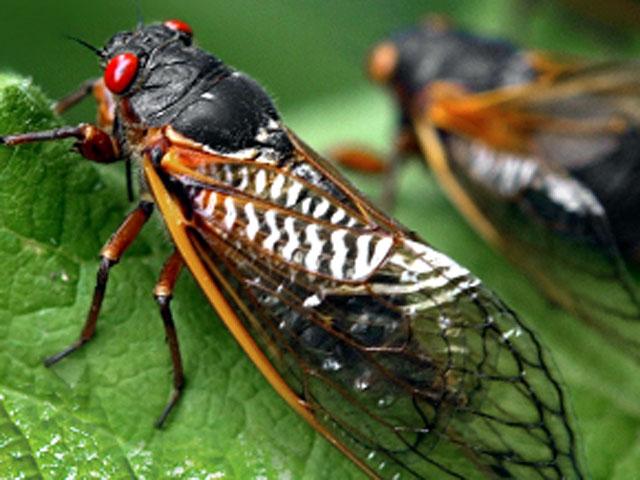
The Magicicada septendecim emerges every 17 years.
(Photo from Crockett Facilities Services)

  • There are about 3,400 species of cicada in the world, and over 190 species and sub-species in North America alone. So talking about cicadas in general means you're generalizing about a lot of different species, each with slightly different characteristics. But generalizing is what I'm going to do anyway.
  • In most cicada species, it's the males who make the noise, and the noise they're making is a mating song.  
  • Females make their own sound by flicking their wings, which sounds similar to a light switch being flipped on and off.  In some species, females make this sound in response to the males' mating song.
  • Cicadas make other sounds too, such as distress alarms when a predator is attacking, or warm-up calls before the males launch into their big production.  But we have a harder time hearing those other calls and distinguishing them from each other.  So most of the time when people are talking about cicada noises, they mean the loud mating call of the males.
  • If you think it sounds like thousands of cicadas are making the same noise together, you're not wrong.  Males will synchronize their songs with each other so they are all going off at the same time. This establishes a "chorusing center" and works to attract large numbers of females to the same place, increasing everybody's odds of finding a mate.
  • Exactly how each cicada makes his song isn't entirely understood.  What we do know is that each cicada has two bumps on either side of their abdomen.  The bumps are called tymbals.  Special muscles inside the abdomen make the tymbals contract and make a popping noise, and then the muscles pop the tymbals back out again to make another popping noise.  

 
Close-up of one tymbal relaxed, then contracted. Popping the tymbal in and out makes a popping noise.
(Diagram from The Robinson Library) 

  • They work a lot like those metal clicker toys you may have played with when you were a kid, popping the metal up and down to make a clicking sound.


  • The difference is a male cicada can make those tymbals pop in and out 100 to 500 times per second. 
  • The other difference is the echo.  The tymbals are housed in the cicada's exoskeleton. Beneath the tymbals, the body of the abdomen is mostly hollow.  So the clicking of the tymbals at rapid-fire speed gets echoed again and again, and the echoes echo each other.


Cross-sections of a cicada's abdomen. You can see the largely empty abdomen and how much space there is for the noise of the tymbal to create an echo. 
(Diagram from The Robinson Library) 

  • Making the tymbals pop in and out would be, for us, like making our entire rib cage collapse and expand over and over again 100 to 500 times a second.
  • But on the cicada, it looks like it's shaking its tail like a rattlesnake.


  • Knowing this much about how the process works, you would think scientists would be able to replicate the sound.  Nope.  
  • Naval researchers have tried for years to figure out how to do what the cicada does, in order to create a very loud sound that will travel a long way through water, produced using very little power. "We're still working on it," researchers say.
  • Perhaps the most mysterious part of the process is exactly why it's so loud.  But it definitely is loud -- deafening, in fact.
  • One species of cicada in Australia is said to produce a call that exceeds 120 decibels at close range. At this level, sounds reach the deafening point.  Other things that hit 120 decibels: fireworks displays at close range. Thunder. A passing freight train -- louder even than that.
  • The loudest cicada in North America was recorded by the University of Florida at 108.9 decibels. This is just slightly less loud than that passing freight train. 
  • The video below is of this species of cicada, the Neotibicen pronotalis walkeri (formerly Tibicen pronotalis walkeri), or the Walker's Cicada.  It lives in 28 of the 50 states, mainly in the Midwest and the South.


  • Even the cicadas have to protect themselves from their own noisy mating songs. On either side of their head, both males and females have large membranes called tympana. Yup, they're like ears. A short tendon connects each tympana to the auditory organ in the cicada's head. When the male sings, that tendon retracts, pulling the middle of the tympana inward, creasing it so that it will not absorb his own sound. 
  • In a manner of speaking, he's putting ear plugs in to protect himself from the decibels of his own song. (Pete Townshed, eat your heart out?)
  • The males also tone it down a bit when an interested female approaches.

Life Cycles and Brood Cycles

  • The female lays her eggs in the roots or branches of a tree. After the eggs hatch, the young cicadas are pale little worm-like things. They live underground, in the tree roots, drinking the tree's xylem (nutritional fluids). They are too small to damage the trees they live on, even in high numbers.
  • In some species, the young stay down there for two or three years before they crawl up to the surface, shedding their nymph exoskeleton on the way, to begin their life as an adult.  In other species, the young may stay underground as long as 17 years. 
  • Still other species emerge each year, but every several years, enormous numbers of them will surface at once.  
  • Once the adults are above ground with their new skin, wings inflated and ready to go, they fly up into the trees where the males start their songs and the females commence their clicking.
  • One genus, the Magicicada, has species such as the septendecim that emerge every 17 years (Latin lovers will notice the word for "seventeen" in the name) or 13 years. 
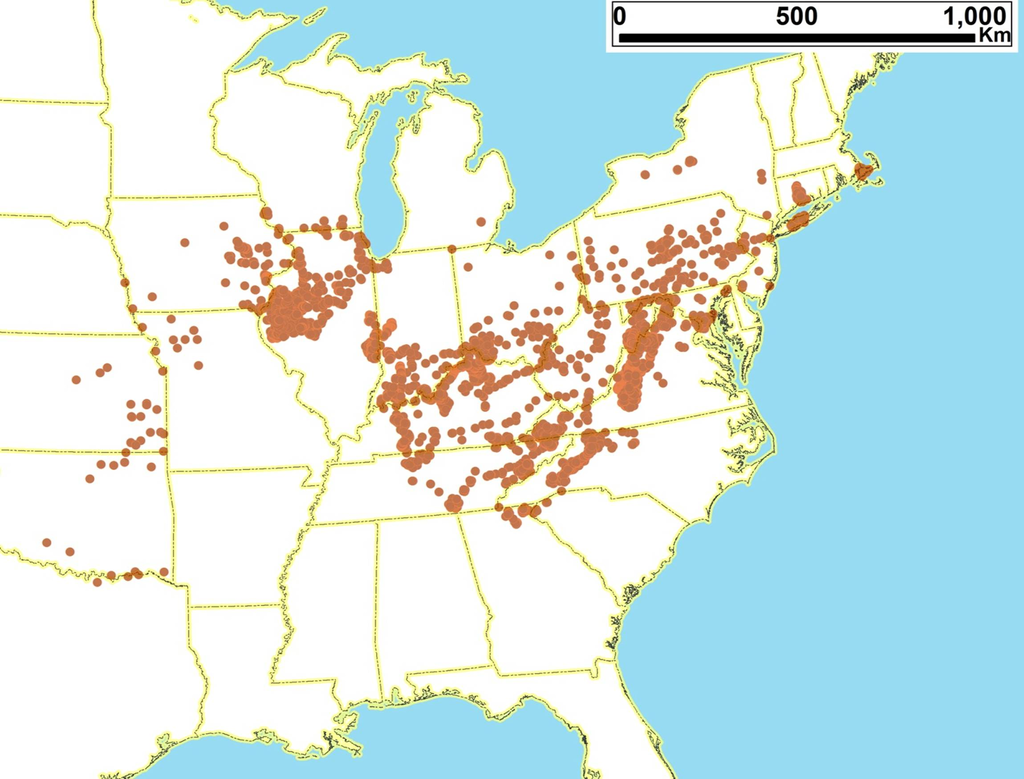
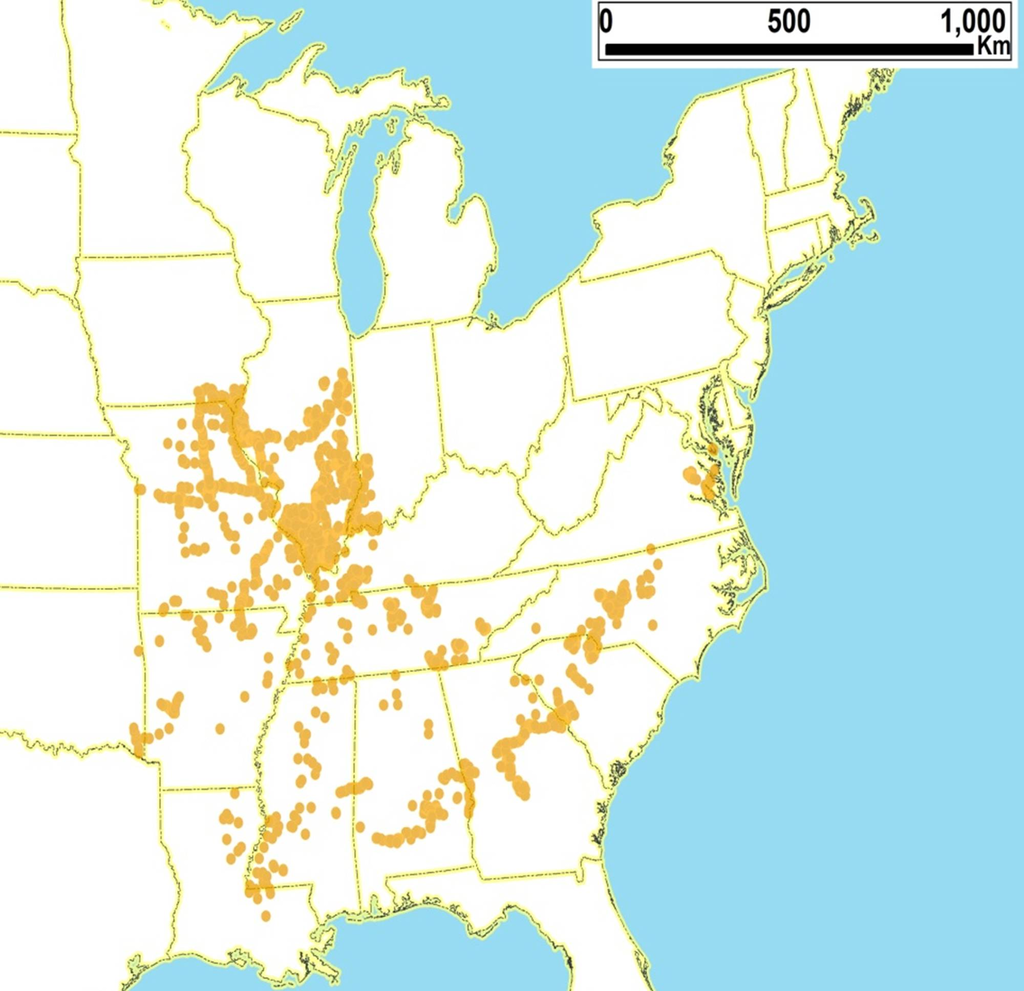
  • There are pockets of Magicicada in various places around the U.S. One pocket, or brood, emerged this year in Iowa, Kansas, Missouri, Nebraska, Oklahoma, and Texas.  In 2016, another 17-year brood is due to emerge in New York, Ohio, Pennsylvania, Virginia, and West Virginia. (To see a chart of brood cycles across the country, check out Cicada Mania)
  • The fact that this species has broods across several states that each emerge at different times, plus the fact that there are many other species that emerge annually or close to that is why it seems like there are a ton of cicadas in some part of the country each year.


Distribution map of the 17-year Magicicada species populations.


Distribution map of the 13-year Magicicada populations.
(Map from Sanborn & Phillips, Biogeography of the Cicadas, Diversity 2013)


  • As adults, cicadas live only about 4 to 6 weeks before they die.


The life cycle of a cicada
(Diagram from The HouseholdPests.org)

Cicadas Are Not Locusts

  • It is important to note that cicadas are not locusts, which are migratory grasshoppers.  It is tempting to think there's a plague of cicadas when you see them in enormous numbers singing their crazy loud songs to each other. But that is simply not true.
  • Cicadas do very little damage to the trees they live on, either as adults that we can hear and see all over the place, or as nymphs underground.  Some younger trees might struggle with the effects of large numbers of cicadas, but older trees do just fine. 
  • They don't bite or sting people. They're not interested in people at all.  They just want to get it on, give up the ghost, and that's it. 

Bonus Fact

  • Small cicadas make their songs at a pitch higher than what humans can hear. But dogs and other animals can hear them, and if they're close enough, the high-pitched song can be loud enough to make the dog wince or whine in pain.

Sources
Cicada Mania
The Robinson Library, Family Cicadidae
Howstuffworks, How Cicadas Work
Colorado State University Extension, Cicadas
National Geographic, Cicada 
Science Daily, Secrets of the Cicada's Sound, May 30, 2013

Monday, May 18, 2015

Apple #711: Do Ladybugs Bite?

If you've been reading the series of entries on how I put together these here Daily Apples, you'll already be a little bit familiar with this topic (I used this topic as an example in Part 2 of Behind the Daily Apple).  But it seems to me that the best way to finish the question, how do I do what I do, is to show you the final result.  So here is the final result.

So here's the question I said I would take up: what's up with the biting ladybugs?  To get a bit more specific, where did they come from?  Did they always bite, or is this a new thing?  Let me insert one more general question ahead of that: Do ladybugs bite?

  • Short answer: Yes. And it's kind of our own fault.


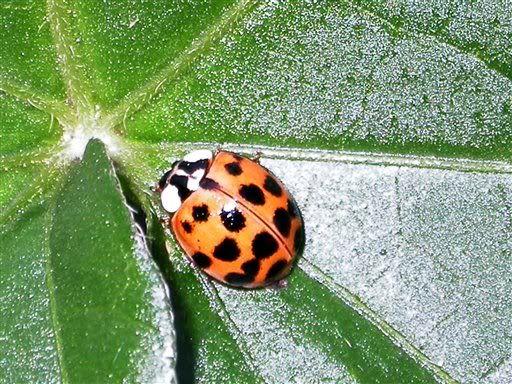
Asian ladybug. This kind bites.
(Photo from GardenWeb)
 
  • This is a case of unintended consequences. Or put another way, people not really thinking through the effects of their actions.
  • As early as 1916, again in the 1960s, and yet again in the 1970s, people in the US brought ladybugs from Asia here to this country because those Asian ladybugs ate aphids.  
    • What better way to control this pest problem? they said with excitement. No pesticides necessary!  We just drop a bag of Asian ladybugs on these pecan trees, or on these rose bushes (that's what the ladybugs were sold for in my home town, back in the day), and they'll eat up the aphids!  No more aphid problem!  Sure, maybe we've got a few extra ladybugs.  So what?  They're harmless.  They're ladybugs!
  • Well.  After enough years of dropping bags full of ladybugs onto pecan trees and rose bushes and whatever else, the Asian ladybugs made themselves at home here in this country.  They "jumped ship" as one source put it, meaning they did not die off at the end of the season but rather started building little ladybug homes, having little ladybug babies, and raising their offspring, who then went and had more little ladybug babies.


Multicolored Asian lady beetle females can lay up to 3,800 eggs in one season, sometimes in batches of 20 to 30 eggs per day.  Lots of ladybugs making lots of ladybug babies, and you'll get a pretty big ladybug population pretty fast.
(Photo from The Ohio State University OARDC)

  • They were "observed in the wild" -- meaning there was a large enough colony living on their own, outside of any farmer's or gardener's observation or assistance -- in New Orleans in 1988.  Since then, the Asian ladybug has spread like crazy across most of the United States and Canada.
  • They are now considered established in the Northwest, the Northeast, and the Midwest.
  • Why is this such a problem?  After all, they're only ladybugs, right?
  • To answer that, we have to know a little more about this particular kind of ladybug.
  • The Asian ladybug, a.k.a. . . .
    • Harmonia axyridis
    • multicolored Asian lady beetle
    • Asian lady beetle
    • Halloween lady beetle
    • Japanese lady beetle
    • harlequin ladybird
    • many-named ladybird
    • multivariate ladybird
    • pumpkin ladybird
    • Japanese ladybird
    • southern ladybird
  • . . . eats aphids.  I mean, they really go to town on the aphids.  They were first brought here to eat the aphids on pecan trees, but then they discovered all the soybean fields all across the south and the Midwest.  Rife throughout those soybean fields were soybean aphids.  A smorgasbord to the multicolored Asian lady beetle.  And they went to town, munching up the soybean aphids like nobody's business.

Pictures of soybean aphids en masse -- or any swarming bugs -- give me the creepy crawlies, so I won't post a photo of them here.  But if you want to see what soybean aphids look like, take a look at Purdue University's page about them. Or just trust me when I say they're little yellow-green bugs and they generally cover the undersides of soybean leaves.

  • So, that's good, right?  Multicolored Asian lady beetles eat lots of soybean aphids, and that helps our soybeans grow, farmers are happy, we're happy.  Right?
  • Well, the multicolored Asian lady beetle does some other things too.  They migrate each year in the fall.  And before they migrate, they all get together to make their migration plans.  OK, I don't know if that's what they're doing, but they do combine to form great colonies of lady beetles.
  • They like to find tall sheltered places, like the where the wall of a house meets the roof, or the side of a mountain, or the sides of tall buildings.  They generally prefer light-colored buildings as places to hang out.

Again, I am not a fan of pictures of swarming bugs, but if you want to see what a whole bunch of multicolored Asian lady beetles congregating on the arm of a sofa looks like, be my guest.


  • The way they call to other multicolored Asian lady beetles is by releasing pheromones.  In most cases, you and I can't consciously smell pheromones.  But we can smell the pheromones of the multicolored Asian lady beetle.  And the pheromones smell terrible.  People describe it as "foul," "unpleasant," or "acrid." 
  • That might not be such a big deal, if there were only one multicolored Asian lady beetle on your arm.  But hordes of them swarming on the side of your house?  If you smashed them with a broom, those stinky pheromones (or perhaps it's another substance, one designed to ward off predators) would come out of the leg joints of the smashed lady beetles, and you'd have a pretty stinky mess.
  • And mess is right, because not only do the pheromones stink, they can also stain.  So if they're in your house and they're climbing up your aunt's beige silk curtains or they're crawling across your pearl-colored Asian carpet, perhaps thinking finally they're home, and you smash them, now you've got stinky lady beetle juice all over your aunt's lovely curtains and your pearl-and-now-lady-beetle-colored Asian carpet.


The stain of smashed Asian lady beetles.  All over your nice carpet. 
(Photo from University of Kentucky College of Agriculture, Food, and Environment)


  • So what, you say.  So they stink a little bit.  So they might make a stain if I smash them.  I just won't smash them.  I'll seal up the cracks and crevices of my house so they can't get in, they'll stay out side, I'll let them eat all my aphids, and we'll all be happy.
  • OK, well, they also bite.  The lady beetles native to the US do not bite.  But these foreign imports do.


This is the biting kind of ladybug (the multicolored Asian lady beetle).  You can identify it as such by the M or W shape on the lighter colored back of its neck behind the head.
(Photo from Maclean's in CA)


The multicolored Asian lady beetle can range in color from yellow to orange to russet, and the number of spots on their backs may vary.  But the one thing that is consistent is that M or W shape on the back of the neck.  You will also know it by its bite.
(Photo from Michigan State University)


  • Eh, big deal to that too, you say.  It's just a little bug.  The bite might sting a bit at first, but it's not like a mosquito bite, or a bee sting.  It's not going to itch and itch or really hurt or anything like that . . . right?
  • Um, sort of wrong.  It's true that the bite from a multicolored Asian lady beetle is more like an annoying pinch than anything especially painful.  But some people can have an allergic reaction.  And the way this allergy expresses itself is in the form of rhinoconjunctivitis, more commonly known as pink eye. 
  • If you've ever had pink eye, you know it's really unpleasant.  And people tend to back away from you like you have the plague.  If you watched Bob Costas covering the Olympics when he had pink eye, you know what I'm talking about.


Bob Costas, with pink eye.  He didn't get his from a reaction to a ladybug's bite, but let his painful-looking eyeballs be a cautionary tale to you nonetheless.
(Photo from Faboverfifty) 

  • Some sources also suggest that allergic reactions to the bite of a multicolored Asian lady beetle could trigger asthma.  And that is most certainly not fun.
  • Another problem is one which, in general, we hear about a lot when people talk about invasive species: lack of predators, and the inability of native species to compete.  In parts of southeast Michigan for example, the multicolored Asian lady beetle has so aggressively out-competed the native lady beetles for food, the native species are now severely threatened.
  • We're starting to learn enough about how ecosystems work to know that if even one plant or animal is threatened or on the verge of disappearing, that can have a huge ripple effect up the food chain.  So it's probable in another five or ten years or so, scientists will start telling us about some frog or bird or other creature that relies on the native ladybirds for food but can't find any to eat because there are only the noxious multicolored Asian lady beetles flying around, and so now the frog or bird or whatever it is has become at risk.


Here is an excellent drawing of the food chain involving a ladybug. The ladybug eats the aphid, the spider eats the ladybug, and the bird eats the spider.
(Drawing by Joshua Campes, posted at LALB)

  • Putting all this another way, the Asian ladybugs became an invasive species in this country -- and we were the ones responsible for the invasion.  You know, good intentions.  Trying to control a pest without using pesticide.  But unhappy results.
  • One final tidbit: the multicolored Asian lady beetle is cannibalistic.  That is, some of them eat their own larvae or their own eggs.  This seems to be an inherited trait, first of all.  But it also seems to be influenced by the number of aphids.  Lots of aphids, less cannibalism.  Few aphids, and they eat their young.  
  • I'm not saying we should bring in bags of some other aphid-eater from some other country to try to force the multicolored Asian lady beetle to eat their young. I'm just saying, something else to think about.  When you get a bite from a ladybug, did that ladybug use those same jaws to eat its own offspring?
  • Changes how you feel about ladybugs a little bit, doesn't it?


The ladybug. Cute classroom clipart, or vicious child-eating insect?
(Clip art from PublicDomainPictures.net)

Sources
Creature Control, Asian Lady Beetle
University of Minnesota Extension, Multicolored Asian lady beetles
Michigan State University Diagnostic Services, Multicolored Asian Ladybeetle
R L Koch, The multicolored Asian lady beetle, Harmonia axyridis: A review of its biology, uses in biological control, and non-target impacts,  J. Insect Sci., 2003, 3:32
Michael F. Potter et al., University of Kentucky, College of Agriculture, Food, and Environment, Asian Lady Beetle Infestation of Structures
Cornell University College of Agriculture and Life Sciences, Biological Control, Harmonia axyridis

Monday, April 27, 2015

Apple #709: Behind the Daily Apple -- Doing the Research

This is part two in a series of entries that attempt to answer the question, how does the Apple Lady do what she does?  (For all you dirty-minded folks out there, that means how do I assemble these here Daily Apples.)

The first part talked about how to construct a search query that yields targeted results.  The next step in what I do is to read what I find, to follow what information I find -- which can sometimes surprise me -- and then organize it in a coherent way and type it up.

Mahalia (the faithful Apple reader who requested this), I've been thinking about this for a week, and I'm still a bit stumped as to how to represent this process for you in a way that will be neither so detailed as to be tedious nor so glossed-over as to be useless.  I might like to have two columns of text, one where I type up what would be the Daily Apple entry, and another beside it where I comment on how I arrived at thus & so.  But Blogger doesn't allow for any two-column shenanigans.  So I'll have to come up with another method.


You might say we're getting to the heart of the Daily Apple in this entry. (The apple, by the way, is a Pink Lady.)
(Photo from Chauncey's in the UK)

The Question

First things first. Every entry starts with the question at hand.  If I don't have a question from a faithful or interested reader, I come up with my own.  It's usually some oddment or other that I run into either in conversation during the week, or occasionally it's something in the news that I don't understand entirely, or sometimes there is no unanswered question nagging me -- or at least, not one that comes to mind when I sit down to assemble one of these here Daily Apples -- so I try to think of something.  These are usually my criteria:
  • A question whose answer I don't already know
  • The topic is something everyday, nothing arcane like how nanospheres work, but rather something that most of us encounter or could encounter in our daily lives
  • I try to keep the question focused. Nothing so general as "tell me everything about tigers." Much as I like tigers and do want to know as much about them as possible, I've learned that if my topic is too general, I find myself reproducing encyclopedia entries. I'd rather choose a topic that is a little more focused, like "what noises do tigers make" because I think I'd have a better chance of telling you something you don't already know, and also because this is a way to try to keep my entries not so long that no one will read them.  I have a tendency to go long.

For this meta-Apple, I am going to violate one of my criteria and choose a question whose answer I already know: what's up with the biting ladybugs?  To get a bit more specific, where did they come from?  Did they always bite, or is this a new thing?

I'm choosing a known topic to give myself a better shot at showing you how I do what I do.  No surprises in the searching, no need to completely re-work the organization of the entry, or other apple-tastrophes like that.

Once I've stated the question, I usually put a picture just beneath it.  I try to find a picture that typifies the entry as a whole, in case that picture becomes the thumbnail associated with the entry.  I want the image to be something colorful or engaging, something that makes you want to click on or read the entry.

In this case, I could show you a picture of swarming or biting ladybugs, but I do not want to give you the itchies right off the bat.  Instead, I'll just show you a lot of ladybugs.  Or maybe just one.


Asian ladybug. This kind bites.
(Photo from GardenWeb)


The process of how I find the images and how I link to them -- all that I'll cover in another entry about images.

The Search

The next thing that happens is I go do a lot of Googling.  How I do the Googling, how I build a search query I discussed in the previous entry, so I won't go through all that again.

What I'm going to show you instead is what I look for when I've done the search query, and how I proceed through the results I get.


Today's results of a Google search for "biting ladybugs"


So I started out with a pretty unprofessional search query, just typing in biting ladybugs.  No quotation marks or anything.  This was my first search on the topic, and I just wanted to throw something out there and see what came back, see if I needed to refine my search at all, and in what way.

I also wanted to get a sense of the general public's perception about ladybugs.  Do lots of people know that ladybugs bite?  Do some people think that they don't?

Sometimes the mis-information about a topic can tell you something pretty interesting about the topic itself, so much so that the mis-information itself can become the interesting to talk about.  Like, for example, if I decided to do a Daily Apple on the roundness of the Earth, I would absolutely have to talk about the fact that some people persist in believing that the Earth is flat. [insert gif of someone shuddering here]

But in this case, it looks like lots of people do know that ladybugs bite, though they seem to be rather stunned by this, or unable to believe that something as apparently innocuous as a ladybug would ever bite someone.  I'm gathering this from the questions that have been posed:  "Do Ladybugs (the garden variety ladybug we all know and love) bite? My mother insists that she received a nasty bite from a ladybug" and "I looked up whether lady bugs bite after being bitten by one today."

So I might want to begin the answer part of my entry with something like this:

  • Yes, it's true.  The ladybugs that you so loved when you were small, the ones whose cutout shapes decorated the walls of your pre-school and kindergarten classrooms, do bite.  
  • Or at least, one species that lives here now does.
(I'm getting ahead of myself here.  I'm revealing part of the answer that I already know.)

The Sources


Let's look at the results of my search again, more closely.  There are several entries from "homemade" sites like mine -- regular Joe or Jane Schmos typing up their experiences with ladybugs.  Their experiences might be very interesting, or their research could be very reliable.  Heck, your Daily Apple is a "homemade" site.  But I wouldn't choose these as the FIRST site I check on a topic.  If there were no other good results, I might go to a homemade site first, but then I would look for confirming information from some other, more traditionally reliable sites.

Another place I would put lower on my list is the hit from Quora.com, which is a site where people post questions they want answered, and then they vote on what they think is the best answer--sort of like Answers.com, or Ask Yahoo, or those other public sites where anyone can post an answer, and anyone can decide it's a good one.

And while we're on the subject of less-favorable sources, let's talk about Wikipedia.  Wikipedia can be a great place TO START.  Oftentimes there's stuff in a Wikipedia entry that I didn't know, and that's either because I'm not fully informed, or else it's because somebody made up some crap or didn't cite their sources and I can't verify it.


Wikipedia.  Nice place to visit, but you don't want to live there.
(Image from Wikipedia Commons)


So if I use Wikipedia at all, I consider it a jumping-off point.  If I do look at it, I try to find at least two other sources -- yes, two -- that back up what's on Wikipedia.  If I find some tidbit of information on Wikipedia first, I try to follow it to its source and then I look for at least one other page or site that discusses that tidbit.  Usually when I do that, I discover qualifications, some additional detail that reveals something was glossed over in the Wikipedia entry, or explained badly or incompletely.  This is another reason I double- and triple-check information I find on Wikipedia.

Only when I feel like I've got a solid answer that I can explain clearly to myself as well as to you, and that I've used sources I feel confident about recommending do I post something.

Your Apple Lady does not want to be telling you a bunch of lies & made-up junk, that's for sure.

In this case, the keyword snapshot that pops up the the Wikipedia link sounds pretty interesting:  "Sometimes, the beetles will bite humans, presumably in an attempt to acquire salt. . . "  Well, that would be interesting to know, wouldn't it?  WHY ladybugs bite?  That's sort of on the order of what do women want, in the insect world, isn't it?

But this is a little bit farther down the line than we are right now.  We still need to talk more about the fact that ladybugs do bite.  This is another thing I want to point out.  I don't like to give you only yes/no answers.  I like to give you context.  Detail.  Background.  The bigger picture.  So you don't just know that ladybugs bite, you know which ones, in what circumstances, maybe in what parts of the country or what parts of the world, and so on.  You're more likely to remember the yes/no answer if you've got more parts of that bigger picture in your mind.  And, frankly, I like to know the details.  Hate to break it to you, but I'm looking this stuff up as much for me as for you.


Screenshot of Creature Control's page on the Asian Lady Beetle


OK, the first link I clicked on was the one to Creature Control's site.  It was second on the Google results list, after the one that sounded homemade.  Usually Google puts at the top pages that are reliable or authoritative or that are really strongly focused on the topic at hand.  So I trusted Google to give me better results at the top.

This is information from a commercial site.  Meaning, Creature Control is a business -- in this case, a pest exterminating business, like Orkin -- and they are posting information about one of the pests they exterminate.  These are folks who deal with bugs on a daily basis, so they ought to know about these bugs.

However, sometimes these sorts of things are typed up by people who are not so good at the proofreading, or people whose knowledge is so pigeonholed as to be incomplete, or who round out their information with rumor or wild guesses or other kind of slipshod information.  So I've learned to regard pages like these as a pretty good place to start, but another type of source to be verified.

Here is Creature Control's introductory paragraph:

The Asian lady beetle (not to be confused with the indigenous American ladybug) is an invasive species of the Coccinellidae family introduced into the United States in 1988 for the purpose of reducing native aphid populations. Since 1988, they have spread throughout North America, in most places displacing the native ladybug populations to become the dominant Coccinellidae beetle. Because of their destruction of plant life and their aggressive tendency to bite, Asianlady beetles are commonly considered a nuisance pest. [Creature Control, Asian Lady Beetle]

You can see what I mean about the proofreading -- sometimes "Asian lady" is one word, sometimes two, Coccinellidae is sometimes italicized, sometimes not.  The reason I point this out is not to be annoying (well, typos do annoy me), but because this can be a sign that the information itself is similarly treated with half-attentive care.

In this case, after having looked at several other sites on the topic, I can tell you that Creature Control has done a really good job with the facts here.  Other sites might say the same sort of thing more succinctly or with better spelling, or with a little more detail, but they all back up what Creature Control says here.

So I would keep this page open as one of my tabs to refer to, and then I would go back to my search results and look at the next one that catches my eye.

Let's look at a page that I would consider more authoritative.


Screenshot of Michigan State University's Diagnostic Services page on Multicolored Asian Ladybeetles


A lot of state universities in the US have what are usually called Extension services.  These are departments or branches within the university, usually associated with agriculture or farming, which provide information and assistance to the public.  My mom used to call the MSU extension in our city (she was an MSU grad) whenever she found a bug she couldn't identify in the house or in the yard.  They were glad to know about these bugs because it helped them in their research to know which bugs were appearing where, and they would tell my mom what kind of bug it was, was it a good or a bad thing that it was in the house or the yard, and what should she do if she wanted to get rid of it.

That was before the days of the internet.  Now, instead of calling their offices, you can search their website.

So I happen to know that these Extension Service people, and by extension (hah!) their websites, can be very helpful in explaining their bug & plant research to the public.  This Diagnostic Services page looks like it might be a service like that.  So I am likely to grant them a lot of credibility.

They are referring to these ladybugs by their species name (Harmonia axyridis), and they are also giving several common names for it: ladybeetle or ladybug in general, and Multicolored Asian Ladybeetle in particular.

The problem is, there is a TON of information here.  They're talking about what the larvae look like, and how the eggs hatch, and what the pupae do.  In most cases, I omit this level of detail.  Only if there were some bizarre fact that I think it would be fun to point out (let's pretend, for example, they said that the larvae of these ladybugs drive cars by the time they're two weeks old!), then I might include something from that panoply of detail.  But if it isn't related to the topic at hand, or if it doesn't shed more light on the whys and wherefores of the topic at hand, then I'll skip passing it on to you.

But let me show you one paragraph of theirs.  Here you can see they provide a lot more detail about the introduction of this ladybug into the United States than the Creature Control page did:

The multicolored Asian lady beetle is a native of Asia. There were several attempts to introduce the beetle into the southeastern and southwestern portions of the United States to help control aphids on pecan trees back in the late 70’s. Some say that none of these deliberate attempts succeeded, but that the beetle became established after ‘jumping ship’ somewhere along the Gulf coast. Since then it has spread rapidly throughout the US and southern Canada. It was first found in Ontario in 1992. Despite popular rumors, the beetle was not released by the DNR, MSU, or chemical companies. One reason that might explain their large numbers is our newest aphid pest, the soybean aphid. This aphid was discovered in Michigan and other Midwestern states during the summer of 2000. Thousands of these aphids can occur on a single soybean plant and the Asian Multicolored Ladybeetle is taking advantage of this unlimited food source. Soybean aphid populations were very high in 2001 (the last time we saw large populations of the Asian lady beetle), and again this past summer. Many of the soybean plants examined at our diagnostic lab have had a dozen or so ladybeetle larvae munching away on the hapless aphids. There are multiple generations of the beetle during the summer and the adults can live up to three years. [Michigan State University, Multicolored Asian Ladybeetle]

They say the ladybug was introduced in the late 1970s.  Creature Control said 1988.  So I'm going to have to find other sources that confirm either one of those dates, or perhaps clarify why these two sources differ.

But they also say this ladybug was introduced to control aphids, and they also mention pecan trees (Creature Control mentioned the pecan trees in another paragraph on their page), so I'm feeling pretty good about those two basic facts.

This paragraph really loses its focus, though. It starts out talking about the introduction of the ladybugs, moves into the aphids that the ladybugs ate, then the soybean aphids in particular (when was "this past summer," exactly?), and finishes with how many generations of the beetle live in one summer.  These facts might all be solid and verifiable, but it will take some organization to straighten out all this information.  Whoever wrote this probably knows a ton of stuff, and gets excited about what they know, and all their knowledge is linked together, so it all comes out in one great lump.

I don't want to go through every single source exhaustively because I think you would get profoundly bored, but let me show you one more in particular.  Let's talk about that Wikipedia entry.


Screenshot of the Wikipedia page on Harmonia axyridis, the kind of ladybug that bites


There's lots of general information up front about the colors of this ladybug -- "ranging from yellow-orange to black" -- and how many spots -- between 0 and 22 -- which is helpful information, but again, details I would verify elsewhere.

But let's look at their paragraph about how these ladybugs were introduced into the United States, so we can compare it to our other two sources:

This species became established in North America as the result of introductions into the United States in an attempt to control the spread of aphids. In the last three decades, this insect has spread throughout the United States and Canada, and has been a prominent factor in controlling aphid populations. In the US, the first introductions took place as far back as 1916. The species repeatedly failed to establish in the wild after successfully controlling aphid populations, but an established population of beetles was observed in the wild near New Orleans, Louisiana, around 1988. In the following years, it quickly spread to other states, being occasionally observed in the Midwest within five to seven years and becoming common in the region by about 2000. The species was also established in the Northwest by 1991, and the Northeast by 1994, aided by additional introductions from the native range, rather than just reaching there from the Southeast. Reportedly, it has heavily fed on soybean aphids (which recently appeared in the US after coming from China), supposedly saving farmers vast sums of money in 2001. [Wikipedia, Harmonia axyridis]

Pretty much dovetails with the other two. Wikipedia says the first introduction of this ladybug happened as long ago as 1916.  Hmm, when three sources disagree so wildly, that either means somebody is choosing to omit some instance in favor of another for some reason, or else that nobody is really sure, and so I won't be able to give you an exact, definite date.

There's that date 1988, though, when an established population was observed in the wild near New Orleans.  I think that might be what MSU meant when they said the ladybugs "jumped ship" near the Gulf Coast.  We've got references here, too, to the soybean aphid, and the timeline seems to match up pretty well with that of MSU's.

So I would say this entry, or at least this paragraph from this entry, seems to be pretty reliable.  I'll want to look at a couple more pages, though, to verify further and round things out.

Further Digging -- and Finding Gold

But the real reason I want to look at the Wikipedia entry is because of the sources.  Here is their sub-section on the Biology and Behavior of this bug:


Screenshot of the Biology and behavior subsection in Wikipedia's entry on Harmonia axyridis, the ladybug that bites


Since you have to click on that screenshot to read it, unfortunately, let me reproduce a bit of it to show you what I'm after:

These insects will "reflex bleed" when agitated, releasing hemolymph from their legs. The liquid has a foul odour (similar to that of dead leaves) and can cause stains. Some people have allergic reactions, including allergic rhinoconjunctivitis when exposed to these beetles.[1] Sometimes, the beetles will bite humans,[1] presumably in an attempt to acquire salt, although many people feel a pricking sensation as a lady beetle walks across the skin, which is just the pressure from the ladybird's feet. Bites normally do no more harm than cause irritation, although a small number of people are allergic to bites.[15]

First of all, you'll note that these ladybugs release a chemical that stinks like dead leaves, and to which some people are allergic.  (Allergic rhinoconjunctivitis is pink eye, by the way.)  Included here is that sentence that mentions the possibility that ladybugs might only be biting for salt.  I really want to verify that with another source, and this is where I want to point out those footnote reference numbers.

Those note numbers will take you down to the references at the bottom of the Wikipedia entry, which are then linked to the site where that source material appears.  In the case of these references, many of the links have died or moved or gone away, so it's turned out to be a little tricky tracking down the sources for the information here.  And you'll notice that the statement about doing it for the salt is not footnoted.  So where that bit of information came from, I'm not sure.

But the sources do turn up a goldmine.  Among other things, there's a link to an article published in The Journal of Insect Science in 2003 -- it doesn't get much more authoritative than that on the free internet -- and that article talks about how these ladybugs are cannibals!  Not that cannibalism is that rare in the insect and animal world, so it's more the shock value of saying "these ladybugs are cannibals!"  But that little fact is definitely going into the entry.  Nothing to do with the biting of people, but it's one of those bizarre tidbits I like to pass along.

The article also talks about how these ladybugs are especially problematic in vineyards, because they love to eat lots of fruit including grapes, and so they'll swarm on the grapes and vines, and the harvesters can't help but crush the ladybugs along with the grapes in the harvest.  Now that's a problem and a half.  Again, something else I would include.

They also confirm a lot of things that are in that Creature Control page.  I guess Google knew what it was doing, after all, when it put that Creature Control page high on its results list.

Nothing in this article about the salt, though.  So I'm going to do a search on Harmonia axyridis and salt.

The results?  That Wikipedia entry, another page that has copied the Wikipedia entry verbatim, another page that happens to mention Salt Lake City.  Otherwise, nada.

OK, what about Harmonia axyridis and sodium?  All I get is an extremely technical page describing what I think are the genomic and protein structures, which include sodium, in this species.  Nothing about biting, nothing about the bugs themselves wanting to eat salt.

But I do find on another University Extension Service page, this time from Minnesota, this sentence:

These bites are incidental, as the beetles are presumably searching for moisture or food.

That "presumably" word makes me suspect that this page might be the source for what Wikipedia said about salt.

Regardless, I am not going to repeat Wikipedia's supposition about salt, since I can't verify it, and since whoever wrote that entry didn't cite their source.  But I do feel pretty confident about saying what Minnesota's Extension Service said that maybe the ladybugs are looking for sustenance.  But I'll be sure to include that "maybe."

So this gives you an idea of how I go back & forth between sources, how I use them to verify or confirm each other, or to connect me to additional sources for further information.  I often discover further clarifications or qualifications the further I dig, and sometimes those clarifications that people omit when they're trying to generalize turn out to be pretty interesting. 

What's Next

I wanted to present you with a complete entry at the end of this discussion, but I have to go to bed now. So maybe what I'll do instead is give you the text of the entry next time, maybe with some meta-discussion about how I made decisions here & there about what to include and in what order.  Because finding the images takes a long time, I imagine talking about the images will have to be yet another entry of its own.

Sorry there weren't more pictures with this one.  Here, I'll put in one last picture.


This is the biting kind of ladybug.  You can identify it as such by the M or W shape on the lighter colored back of its neck behind the head.
(Photo from Maclean's in CA)


Sources
[since I'm giving you the behind-the-scenes view, I'll give you the plain, unadulterated URLs]

http://www.creaturecontrol.net/Asian%20Lady%20Bug
http://www.pestid.msu.edu/insects-and-arthropods/multicolored-asian-ladybeetle/
http://en.wikipedia.org/wiki/Harmonia_axyridis
http://www.ncbi.nlm.nih.gov/pmc/articles/PMC524671/
http://www.extension.umn.edu/garden/insects/find/multicolored-asian-lady-beetles/
http://www.biocontrol.entomology.cornell.edu/predators/Harmonia.php

Saturday, April 5, 2014

Apple #668: Yellow Sac Spiders, Mazda6s, and the Smell of Gas

All right, you lazy copycat reporters.  I'm calling you on your mindless repetition of other sources without doing any fact-checking of your own, right here and now.

There's a story getting repeated like mad by every major news source, minor news source, TV news page, web newsjunkie page, and car fan blog out there.  They're all saying the same thing over and over so it probably doesn't matter which source I quote, so I'll just pick one.

[EDIT: Since search engines are picking up the portion of this entry that repeats the untrue statement, I am going to amend the news article so that it is factually correct.]


The 2014 Mazda6 -- not included in the recall.  The recall only covers some 42,000 Mazda6s made in 2010-2012.  But all you reporters who are reporting repeating this story had BETTER look at things differently.
(Photo by Aaron Gold, from About.com Cars)


Here is the story from the AP Newswire, picked up and reposted verbatim by ABCNews [and edited to be correct, by me]:
Mazda is recalling 42,000 Mazda6 cars in the U.S. because spiders can weave a web in a vent hose and cause the fuel tank to crack.

The recall involves cars from the 2010 through 2012 model years equipped with 2.5-liter engines.

The yellow sac spider, which is [NOT NECESSARILY] attracted to hydrocarbons, builds webs [SACS] that [MAY] cause pressure to build in the fuel tank. That increases the risk of fuel leaks and fire.

Mazda recalled cars in 2011 for the same problem. It put covers on the vent line, but has found spiders can get past them.

Mazda will update the cars' software for free beginning this month to ensure that the fuel tank pressure doesn't build up.

Mazda says no injuries or fires have been reported due to the issue.

SPOILER: I can find no evidence whatsoever that yellow sac spiders "are attracted to hydrocarbons" or "like the smell of gas" or any other such anthropomorphic explanation for their behavior.  So how many other elements of this story are untrue, and continuing to be repeated as if they are?

Of the innumerable sources reporting repeating this story, many have headlines such as 
    • (Some clarification: This particular model of car was recalled in 2011 for the spiders-in-the-fuel-line reason.  So there are two bouts of news stories on this topic, one batch from 2014 and another from 2011.  The fix that Mazda came up with in 2011 was insufficient to keep the spiders out.  They've figured out a different solution, so they've issued a new recall to get people to bring their cars in to get the new fix.  Both bouts of news stories did the same repetition thing, with the occasional clever headline meant to incite hilarity.) 
    • Some further clarification: It's not that the cars are infested with spiders, as some headlines suggest.  It's that sometimes a spider may build a nest in the fuel line. If that happens, damage to the fuel-related parts may result.  Mazda wants to recall the cars to put in a fix in order to prevent that damage.

    I thought, "This is interesting, a spider that likes the smell of gasoline.  I want to know more about that."  So I did some searching about the yellow sac spider.  Here are some of the basic, most salient facts:


    The yellow sac spider is very common.  You probably recognize it by its pale body and the dark tips at the end of its legs.
    (Photo from Jonesblog)

    • The yellow sac spider is very common throughout the United States.
    • It likes to hang out under leaves or in crevices or in hidden spots because it stalks and hunts its prey, usually at night.
    • Typical nesting spots include under leaves, in woodpiles, or under stones. In or around a house they may be found up in the corners, under eaves, or behind baseboards.
    • This spider is so-named because its body is yellow and it builds sacs, rather than webs.  (Let me repeat that: this spider does not build webs.)  In addition to being the spider's daily retreat, the sac is also the place where the female stores her eggs until they hatch.
    • The only reason people pay much attention to this type of spider is because its bite contains a mild venom that can be painful to people.  If you get a spider bite that hurts and maybe even swells a bit, it is probably from a yellow sac spider.
    • If you've gotten such a bite, clean it with iodine or other antiseptic and put ice on it. 


    One example of the kind of Photoshopped images showing the yellow sac spider in a gas tank. 
    (Image from Free Republic)


    None of the pages describing the yellow sac spider in & of itself said anything about the spider liking the smell of gasoline, or hydrocarbons, or hydrogen oxide.

    Let me repeat that but in a slightly different way: all of the entomology/spider/species resources I checked said NOTHING about this type of spider liking the smell of gasoline.


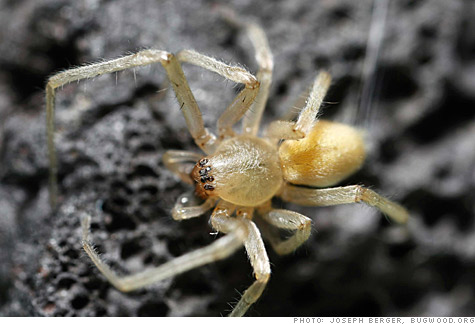
    Yellow sac spiders do have one unusual physical feature: they have 8 eyes, 2 more than most spiders have.
    (Photo by Joseph Berger, from Bugwood.ord, sourced from CNNMoney)

    • There are a couple types of spider that do utilize hydrocarbons: 
      • The males of certain very tiny dwarf spiders (linyphiids) emit a type of hydrocarbon that works sort of like a pheromone and tells females the male is fit and would make a suitable mate.
      • Another type of spider called corinnids mimic the ants that they live among so they can eat the ants with impunity.  These types of spiders look or walk like the ants. One species even has the mimicry down to such a science, they also emit a hydrocarbon, similar to one that the ants themselves use, which tells the ants "I am a colony-member, not an intruder."  Like the yellow sac spider, corinnids build sacs.  But corinnids are in the genus Castianeira, and yellow sac are in the Cheiracanthium genus.
    • These are the only two types of spiders I found that have anything to do with hydrocarbons.  But these are not yellow sac spiders.

    The only sources I found that said anything about the yellow sac spider in particular liking the smell of gasoline, or hydrocarbons, or hydrogen oxide, were all news articles or blog posts about the Mazda recall.

    Seemed pretty fishy to me. I wondered, did someone make a factually incorrect statement at some point, and everyone has just kept repeating that statement without checking it, for years?

    So I started looking into some of the supposedly factual statements in the news release.

    For example, you may have noticed that the AP story I quoted above (and all the others robotically following suit) says that the spiders in the Mazda gas tank are building webs and it's the webs that are causing problems.  But, as we've learned, yellow sac spiders do not build webs, they build sacs.

    Is it the news sources that are incorrectly describing what the spiders are doing?  Maybe the original information from Mazda was more specific and accurate.  So I found the recall notice.


    Diagram showing Mazda's evaporative canister and other parts of the fuel system where the spider may build its home. 
    (Diagram from Engine-Codes.com)

    • The text of the actual 2014 recall notice from Mazda says that a spider "may weave a web" in the evaporative canister vent line, causing a restriction.  It says that in November 2013, Mazda "found that there was a crack in the fuel tank and a spider web was present in the canister vent line," and they found 9 cases of similar situations.  Webs. 
    • In February 2014, they changed the way they wrote the software code that controls the fuel tank pressure to keep the tank from cracking "even under such a severe condition as the canister vent line is clogged by a spider web."  Again, web.

    Well, maybe Mazda are just trying to be general in their description, to use language everybody will understand, rather than to use something more specific like "spider sacs" or some such.  Or maybe the thing they were seeing in the fuel line was really a web, and not a sac.  So maybe this particular spider isn't really a yellow sac spider at all.


    This is the thing that a yellow sac spider builds: a sac.  Here, a female is tucking her eggs into it.
    (Photo from Forestry Images)


    So where did the assertion that this spider is a yellow sac spider come from?
    • According to an LA Times article published in 2011 when Mazda issued the first recall notice, it was Mazda that identified the spider as the yellow sac: 
      • "Mazda identified the culprit as the yellow sac spider, or Cheiracanthium inclusum. The pale, mildly venomous creatures lay their eggs in silk-wrapped bunches — usually in vegetation. But why they're choosing Mazdas instead of, say, Porsche Spyders, is a mystery. As is the fact that only the 4-cylinder Mazda6 cars are playing host."

    So it is definitely the yellow sac spider that is spinning its webs building its sacs inside Mazda6 cars.  I'm going to give Mazda the benefit of the doubt on this point, and say that they use the word "web" in their recall notice so as to be easily understood, when they more accurately should have said "sac."

    But we still have the question that got me started on all of this: where did this business of yellow sac spiders liking the smell of gas come from?  That, after all, is the reported reputed reason why they are building their webs sacs in the fuel lines of Mazada6s. 

    • In 2011, when the first recall notice was issued, USA Today actually talked to an entomologist -- not one, but two!  The first one said that the yellow sac spider is very common, you often see them running around in your kitchen or basement.  
    • The second entomologist said that yellow sac spiders
    "are found throughout the nation, and there is no particular reason why they would choose the inside of a car body to hang out, rather than some other crevice, says Rick Vetter, a researcher at the University of California-Riverside."
    • Nothing about liking the smell of gas.  Or hydrocarbons.  Or hydrogen oxide.  Only that inside a fuel tank is a nice, hidden little spot like any other hidden little spot that they like for sac-building.
    • This business of yellow spiders liking the smell of gas seems to come from news stories around the time of that first recall in 2011.  And the original source for that assertion seems to be here (I'm quoting from Reuters, but a whole bunch of sources picked this up and repeated this verbatim):
    "While it's very rare, this spider's distinguishing characteristic is that it likes the smell of gasoline, caused by the hydrogen oxide," said automotive journalist Mitsuhiro Kunisawa. "Once it smells the gasoline from outside, it will go inside."
    • First of all, I think the referent for the "it's very rare" is not the spider but the (supposed) preference for the smell of gasoline.  Because Kunisawa does say a few sentences later, "In the United States, it's a relatively common type of spider."
    • But what about "this spider's distinguishing characteristic is that it likes the smell of gasoline"?  Where does he get that?  He is an automotive journalist.  What does he know about particular spiders' distinguishing characteristics? 
    • Even if Kunisawa was correct about that (and he wasn't; the distinguishing characteristic of the yellow sac spider is that it has a venom which results in mild pain when people get bitten by it), why didn't any of these countless news sources check him on that?  


    Mitsuhiro Kunisawa.  A decent enough guy, I'm sure.  Loves reporting about cars.  But maybe not the most authoritative source on the habits of spiders.
    (Photo from SixStar-ism)

    • Why didn't anyone call up an entomologist and ask, hey, do yellow sac spiders like the smell of gasoline?  But they didn't.  They just quoted the automotive journalist about the reason for the behavior of a spider as if it were verified fact.

    Lazy.  Lazy, sloppy journalism. Perpetuated through an entire news cycle in 2011, and then picked up and perpetuated again in 2014.

    Now here are some actual facts:
    • The yellow sac spider may or may not like the smell of gasoline.  Probably it has no opinion one way or the other.  The reason it (does not spin its web but) builds its sac in the fuel line of Mazda6s is probably because that spot is a nice, hidden location.
    • Spiders of various species are known to occasionally build webs or nests in fuel lines of cars, regardless of make or model (See Car Talk; Hearth message board; and more Car Talk).  If you go to fill your gas tank and the nozzle shuts off after only about 1/4 of a tank for no apparent reason, and continues to do so after repeated unsuccessful attempts, it is possible a spider may have built a web in the works and that is causing fumes to accumulate and shut off the system.
    • Spiders may build a nest somewhere in your car, but a spider building a nest in the fuel line so that it causes a crack or other failure is not that common.  Only 9 cases -- or was it 20? -- were reported to Mazda since 2011.  That's out of thousands and thousands of cars.
    • Only some of the Mazda6s are being recalled -- only the ones built in the Flat Rock, Michigan plant from 2010 to 2012.
    • Why the yellow sac spiders prefer only the Mazda6s from Flat Rock, Michigan, and not Mazda6s built elsewhere, Mazda does not say. 
    • That, my friends, is probably where the real story lies: that it is only the fuel lines of cars built in Flat Rock, Michigan that are negatively affected by spiders.  Not some made-up anthropomorphic-mythological junk about spiders liking the smell of gasoline.

    The Flat Rock assembly plant is no longer owned by Mazda.  As of 2012, it now belongs to Ford. They switched to building new Mustangs and the 2013 Ford Fusion sedan.
    (Image from Mustangs Daily)


    Sources
    Recall news articles - 2014
    Detroit News, Spiders prompt second Mazda recall for possible fuel tank problem, April 4, 2014
    ABCNews, Mazda Recalling Cars Due to Danger from Insect, April 4, 2014
    Reuters, Gasoline-loving spiders cause Mazda car recall for second time, April 4, 2014
    WTVR.com, Gasoline-loving spiders prompt another Mazda recall, April 5, 2014
    WKYC.com, For real? Mazda's latest recall due to a spider, man, April 4, 2014
    WPTV, Mazda6 recall: Yellow sac spider can weave webs in vent hose, causing fuel tank to crack, April 5, 2014
    Boston.com, Mazda6 recalled for spider infestations, April 5, 2014
    CarScoops, Gasoline-Sniffing Spiders Strike Back, Mazda Recalls 42,000 Mazda6 Sedans in the U.S., April 4, 2014
    Autoblog, Mazda spiders return,42k Mazda6 sedans recalled for webby fuel tanks, April 5, 2014
    Edmunds.com, 2010-'12 Mazda 6 Recalled for Fire Risk Traced to Spiders, April 4, 2014
    WebProNews, Spiders [sic] Gasoline Huffing Cause Mazda Recall, April 4, 2014

    Recall news articles - 2011
    USA Today, Experts: Spiders infesting recalled Mazdas are "common," March 4, 2011
    USA Today, Spider infestation leads to recall of 65,000 Mazdas, March 3, 2011
    Los Angeles Times, Mazda recalls 65,000 cars for spider problem, March 3, 2011
    CarScoops, A Gasoline-Addict Spider Gets 52,000 Mazda6 Cars Recalled in the US, March 4, 2011
    CNN, Spiders lead to Mazda recall, March 3, 2011
    Reuters, Gas-loving spider prompts Mazda to recall in U.S., March 4, 2011

    Yellow sac spider information
    University of Nebraska-Lincoln Extension in Lancaster County, Spider Bites? Look for a Sac Spider
    Michigan State University Diagnostic Services, Yellow sac spiders (Cheiracanthium inclusum and C. mildei)
    The Ohio State University Extension Fact Sheet, Sac Spiders
    Penn State University Entomology, Agrarian Sac Spider
    Washington State University Department of Entomology, Yellow Sac Spider
    Encyclopedia of Life, Cheiracanthium inclusum / Yellow Sac Spider
    San Mateo County Mosquito and Vector Control District, Yellow Sac Spider brochure 

    Orkin, Yellow Sac Spiders
    PermaTreat, Yellow Sac Spider
    Hulett Environmental Services, Yellow (Golden) Sac Spiders

    Spiders who like hydrocarbons
    ASBMB Today, Q&A with Stefan Schulz
    Richard J. Adams, Field Guide to the Spiders of California and the Pacific Coast States

    Mazda6 recall documents
    NHTSA safercar.gov, Spiders may Block Fuel Tank Vent Line, Mazda North American Operations, March 11, 2014
    NHTSA Recall Acknowledgment letter, April 3, 2014
    Mazda letter to NHTSA submission of voluntary recall, March 11, 2014

    Spiders in cars or fuel lines in general
    Car Talk, Is the dealer spinning me a yarn about spiders in the fuel line?
    Car Talk forum, gas tank fueling problem
    Hearth.com, Filling the gas tank and spider eggs, October 22, 2009
    Hyundai Forum, Gas tank
    Daily and Sunday Express, Black widow spiders found in car, December 12, 2011
    Yahoo Answers, How can I repel yellow sac spiders from my car?