Showing posts with label dance. Show all posts

Tuesday, April 14, 2009

Apple #380: The Hokey Pokey

While I was at home for the Easter weekend, I took a bath. I only have a shower here, no bathtub, and because I do enjoy a nice hot bath with lots of bubbles, I take advantage of the bathtub whenever I'm at my parents' house.

I assure you, by the way, that your Apple Lady always bathes in the complete and appropriate bathing attire.


(Photo from the Library of Congress LC-USZ62-120028-1902, sourced from Victoriana.com)

So there I was in the bathtub, fully enjoying the relaxing steaminess. I even put my face in the water and that was relaxing too. As I did so, the words from part of the Hokey Pokey came to me: "You put your whole self in, you put your whole self out. . . ." As I leaned back in delicious comfort, I sighed and said, "That's what it's all about."

As I continued to relax and enjoy my steamy soak, the words from the Hokey Pokey played themselves over and over in my brain. Then I suddenly paid attention to what they were saying. And I had an epiphany. The Meaning of the Hokey Pokey was revealed to me.

It's all about how to live, I realized. Or, it's a description of how we live and learn. First we try things out, a toe or a leg or an arm at a time. Then we get the head into it. But it's not until we throw our whole selves into it that we really get it. That's what it's all about.

I am truncating the extent of my realization. Believe me when I say my steam-inspired revelation went into great detail. I interpreted the song line by line. I thought, that's why we do the Hokey Pokey at weddings, because you have to throw your whole self into a marriage if it's going to work. I imagined issuing a call that we should do the Hokey Pokey at all major life events, not just weddings but baptisms, first days of school, first days of a new job, moving into a new house, maybe even the opening ceremony of the Olympics.

Now that I am dried off and well away from the bathtub, I recognize the, uh, head-over-heelness with which I embraced that idea.

But I do have some lingering questions. Where did that song come from, anyway? Does it have some other meaning that I'm not aware of?


Guests at a wedding in Ohio, putting their right arms in. And sort of tentatively, at that.
(Photo from Chris Glass' journal)


It turns out, this simple question about what I thought was a simple song has overturned a rock and revealed everything from lawsuits to bigotry to cocaine. And ice cream.

  • The Hokey Pokey was written by a man named Larry LaPrise, originally from Detroit.

(Image from goodworksonearth)

  • He was a musician with a group called the Ram Trio. LaPrise along with his two bandmates made up the song while the Ram Trio were performing for a bunch of skiers at a resort in Idaho.
  • The song was such a hit, they recorded it in 1949.
  • In 1953, another bandleader named Ray Anthony bought the rights to the song and put it on the B side of the Bunny Hop.
  • In the 1960s, Roy Acuff's company bought the rights to the song, and that's when the song really took off.
  • LaPrise went on to work for the US Postal Service.
  • In 1992, LaPrise said of the song, it's "like a square dance, really. You turn around. You shake it all about. Everyone is in a circle, and it gets them all involved."

This bride and groom are doing the Hokey Pokey with feeling.
(Photo from the blog English Rules)


  • Now, over in England, they have a version of the song called the Hokey Cokey. The lyrics are strikingly similar to the Hokey Pokey, and you're supposed to do the same kind of leg in, leg out, etc. dance. It was very popular with the servicemen during World War II.
  • Some people have said that "hokey cokey" is a bastardization of a phrase that is said in Latin at Catholic masses. The phrase is hoc est corpus meum, or "this is my body," which the priest says when elevating the eucharist.
  • People claim that "hocus pocus" is a phrase that Puritans used to make fun of the Catholic mass and the Latin-speak that priests used, and that "hokey cokey" is another such phrase.
  • They say that the Hokey Cokey song and its motions was intended to make fun of priests and the various gestures they used during the eucharistic prayers.
  • Just recently, in fact, people in Scotland and England have been calling for legislation to ban the song and to include punishments for people who sing and dance it in public as committing a hate crime. Apparently some fans of one Scots football team were singing it in a jeering fashion at fans of another Scots football team. Then this business about how it's supposedly an anti-Catholic song got brought into the mix.
  • Well. This sounds like a lot of going overboard to me.

At Gulliver's Theme Park in Milton-Keynes, England, Gully Mouse and his friends are doing the Hokey Cokey. This doesn't look like a hate crime to me.
(Photo from Gulliver's Theme Park)


  • When I delved into it further, I discovered that the grandson of the guy who wrote the Hokey Cokey said it didn't have anything to do with Latin or priests or Catholicism or any of that. It is about ice cream.

Al Tabor, at the left, and his band at the club where they first played the Hokey Cokey.
(Photo from the Hokey Cokey Man, website of the play about Al Tabor's life)


  • This guy, Alan Balfour, said his grandfather, Al Tabor told him that ice cream sellers used to go up and down the street chanting, "Hokey pokey, penny a lump, have a lick, make you jump!" to sell their ice cream. (He lived in London's East End where people used to talk like that. Except if you're cockney you say 'okey pokey.) So he used that phrase to write a song that he thought would cheer people up during a world war.

Hokey Pokey is also a vanilla ice cream with toffee bits that's very popular in New Zealand.
(Photo from Jeremy & Andrea on Flickr)


  • Then a Canadian officer said Tabor should change it from "hokey pokey" to "hokey cokey," because "cokey" means "crazy." So he did.
  • He first performed the song the Hokey Cokey with his band in 1940.
  • In the meantime, we have yet that other songwriter in the mix, Jimmy Kennedy. He was a well-known Irish songwriter in the 1940s, and he wrote a song called the Cokey Cokey in 1942.

Jimmy Kennedy, renowned Irish songwriter and creator of the Cokey Cokey.
(Photo from Culture Northern Ireland)


  • His son says his dad told him he wrote the song based on a Canadian folk tune sung by coal miners, who were proclaiming the wonders of cocaine. So "coke" would have a triple meaning here -- coal/coke, cocaine/coke, and as we learned just a bit ago, crazy/cokey. Except Kennedy, Jr. said his son wrote on the back of the original sheet music that "'cokey' means 'dope-fiend.'"
  • Kennedy, Jr. also says his dad told him how he came up with the song. He said he was watching a bunch of Canadian soldiers, stationed in Britain, singing and dancing at a nightclub in London and having a great time. He said when he got back to his hotel, he wrote a chorus based on the feet and hand movements of the soldiers. Over the next couple of days he wrote some more lyrics and made some adaptations, but in the end he had the Cokey Cokey. A song to cheer people up during wartime, as he'd intended.
  • He originally published the song as the Cokey Cokey, but the name was later changed to The Hokey Cokey.
  • When our old friend the Hokey Pokey was recorded, Kennedy sued LaPrise (but not Tabor -- why, I don't know) for copyright infringement. The two wound up settling out of court.
  • If you try to buy sheet music of the Hokey Cokey, it's got Jimmy Kennedy's name on it.
  • Copyright for the Hokey Pokey is still listed as Acuff-Rose Music from when Roy Acuff bought it.

Guests hokey pokeying at a wedding in 1990. This is what it's all about.
(Photo from paulbavol at Flickr)


Sources
"The Hokey Pokey Man Is Dead at 83," The New York Times, April 11, 1996
Stuart MacDonald, "Hokey Cokey: no Catholic dig," The Sunday Times Online, January 11, 2009
Auslan Cramb, "Doing the Hokey Cokey 'could be hate crime,'" Telegraph, Decmeber 21, 2008
Randy Boswell, "Canada's Hokey Pokey cause of England dust up," Canwest News Service, February 6, 2009
Fred R. Shapiro, The Yale Book of Quotations, Jimmy Kennedy entry, page 419
The BS Historian, What if the Hokey Cokey IS what it's all about?

Sunday, May 4, 2008

Apple #314: Silence

Last night, I went to see a ballet. I wish the choreography had been a little more demanding, but on the whole, it was a very stirring performance.

Ballets are like an operas in the sense that the story can be quite dramatic, with people falling deeply in love, and sometimes there are sword fights or other violent moments, and there's often a good dose of fantasy. But in ballets, the whole story is told without words. No speaking, no singing. There's the music and the dancing, and that's it. The movements and gestures and facial expressions of the dancers do most of the work in conveying not just the plot but the emotion. The ballet I went to see happened to be Romeo and Juliet, so you can bet there was a lot of emotion. Two pas de deux (dance for two people) in particular were absolutely beautiful.

I left with that stunned sense you get when an experience has tapped some emotional well. And because none of the dancers had spoken during the entire performance, I had no desire to break that spell by speaking. I have spoken since then -- talked on the phone briefly to my mother, asked for an Italian soda at the coffee shop -- but not very much. And I've felt the same desire to continue in this pool of quiet. Just to be still.

So I'm thinking about silence.

KEEPING ONESELF SILENT
  • Some people take vows of silence in protest for political purposes.
      • Each year on April 18, high school and college students across the United States take a vow of silence to protest the bullying that happens in their schools against other students who are lesbian, gay, bisexual, or transgender. It is also supposed to let the school administrators know that the students don't like this behavior, and they want their principals and deans to take steps to stop the bullying.
      • Each October 24, students across high schools and colleges take a similar, collective vow of silence to protest abortion.
      • Just recently, students at San Jose State University took a vow of silence, covering their mouths with handkerchiefs, to protest the university's decision to stop funding the Educational Opportunity Program, which assists low-income and disadvantaged students. After the school board agreed to re-instate the program, one of the protesters pushed down the handkerchief and said, "Thank you."

Dr. John Francis, Planetwalker and silence-keeper
(Photo sourced from Verde, a blog about sustainability)

      • One environmental activist, John Francis, decided to stop using all forms of motorized transport after two oil tankers collided in 1971, spilling crude oil all across San Francisco Bay. People were giving him grief about walking everywhere, so then he decided to stop talking. At first, he was only going to stop talking for one day, but he kept extending his vow of silence again and again, and it lasted 17 years. Remarkably, during that 17 years, he walked across the country, earned college and graduate degrees in science and environmental studies, taught classes, and even dated, all without speaking. On Earth Day (April 22) 1990, he decided to speak again. "After 17 years of not speaking, to hear my voice, I didn't recognize it." Now he is a traveling lecturer, speaking to people about what he learned on his walking tour, and he has published a book called Planetwalker: 22 Years of Walking. 17 Years of Silence.

Planetwalker sells on Amazon for about $17.

      • Various sports figures have taken vows of silence to protest the way the media has portrayed the reasons behind their actions, or inactions.
  • Vows of silence taken to protest something don't seem to me to be very silent, in the end. The purpose is to communicate something, get your message heard, and to propel someone else to take action.
  • Perhaps what I'm more familiar with are vows of silence taken for religious reasons.
      • Trappist monks and nuns, whom most people believe take a vow of silence, actually do speak. They just limit their spoken communication to occasions when they have to explain something to do their work, to have a spiritual exchange with their superiors, or to have spontaneous conversation on special occasions. Frequently refraining from speaking helps the monks and nuns to discover that "speaking is not always the best form of communication. In fact it is frequently used as a coverup."

Thomas Merton, perhaps the most famous Trappist monk, certainly did not refrain from speaking. Among other achievements, he met and conversed with leaders of several religions, including the Dalai Lama of Tibet, as seen here.
(Photo from Spiritual Stars of the Millennium - Thomas Merton)


      • Most monasteries and convents do allow their members to speak, but they also encourage silence as a path to reflection and prayer.
      • Monks at one Cistercian monastery in Spain recently agreed to break their order's 905 years of silence specifically to begin selling the wine the monks have been making for years, in order to raise funds necessary for them to continue. Though they talk to people who may purchase their wine, the brothers on the whole keep silent, and they do not speak when they are in the wine cellars.
  • Perhaps surprisingly, there are some movies that eschew speaking, or are about silence.
      • Into Great Silence is about the monks who live in the Grand Chartreuse Carthusian monastery in France. The monks take a vow of silence upon entering, and though they may speak to each other on walks they take each week, they are otherwise silent. The movie documents that silence, giving a glimpse of what it is like to live without speech.
      • A trilogy of films, Koyaanisqatsi (the Hopi word for Life out of Balance), Powaqqatsi (Hopi for Life's Sorcerer), and Naqoyqatsi (Hopi for War as a Way of Life), are about the influence of technology on various aspects of our lives. There is music, composed by Philip Glass, but there is no speaking, no narration. The films use only images and music to convey a wide-reaching narrative. The images are vivid, rich with color, and they don't just flicker across the screen but the camera lingers on them: people crossing an intersection, baboons bathing in an alpine spring, baby chicks moving on an assembly line. You are given time to absorb what you are seeing, time to think about it in context of the other images you have seen and the music you are hearing. The result is a meditative and yet compelling experience. I'm going to do the movie trailer thing and give you adjectives that people used to describe it: spellbinding, mesmerizing, an audiovisual rush, hauntingly evocative, one of the greatest films of all time.


Koyaanisqatsi - Life Out of Balance is available from Amazon for $10.99. Amazon also has a deal on the whole trilogy, but the set was out of stock when I made this page.


LISTENING TO SILENCE

  • French researchers have discovered that when people are told to listen for a noise that will occur shortly, the auditory cortex of their brains is just as active as when they are actually listening to a sound. In other words, listening with expectation of a sound produces the same level of brain activity as listening to the sound itself. They also discovered that the brain activity in the expectation phase was similar to that of people with Attention Deficit Disorder. Which bears out things that ADHD people report, which is that all noises attract their attention at the same level of importance, and everything seems so noisy they can't concentrate.
  • With the development of all sorts of communication technologies, cell phones, home theaters, video games, appliances, and the typical next-door-dog-barking, some people are seeking places where they can find silence.
      • Owens Corning, the company that makes the pink insulation, has developed sealants and other insulators that you can use to insulate your home and reduce noise by 85%. They also recommend acoustic floor mats -- which I would love to give to my neighbor who enjoys stomping around on her hardwood floors in her high heels every morning and evening.
      • You can also get noise-canceling headphones, which use internal microphones to generate another set of white noise sounds that will drown out the ambient noise around you. That white noise isn't loud enough to cancel out really penetrating sounds like someone snoring in the seat next to you, or a screaming baby, or an ambulance siren. But it will block out the humming of a refrigerator, traffic passing by, wind, rain. As far as I'm concerned, these headphones block out the wrong stuff.
      • Isolation tanks, where you lay down in a dark soundproof tank with skin-temperate salt water, or isolation chambers, which are small rooms that are also dark and soundproof, have both been used as a way to help people achieve peaceful, meditative states. However, if people are left in them too long, they begin to hallucinate and then they experience anxiety, antisocial behavior, and their brains stop learning new things. Here is one person's experience -- with pictures! -- of being in a sensory deprivation tank for an hour, which was not so much time that it became a negative experience.
      • There are also rooms called anechoic chambers. These rooms are lined with cone-shaped insulation and are designed to reduce the echoes created by something moving within the chamber. The result is a "dead"-sounding room.

Artist Jacob Kirkegaard is using an anechoic chamber to help him listen to and record the sounds generated within his own ears. He calls his project Labyrinthitis.
(Photo sourced from Nordic Sound Art)


  • John Cage, the well-known avant-garde musician whose works of music often include passages of silence, says there is no such thing as silence. He says that in music, silence refers to all those sounds that are not intended.
    • One of John Cage's most notable pieces, 4'33" (4 minutes 33 seconds), was inspired by a visit to an anechoic chamber at Harvard University, which was promised to have the ability to block all sound. Cage was delighted to discover that what he heard was his own heartbeat, the pulse of his blood, and even the whistling of the nerves in his ears.

That's my kind of silence.


Then of course there are people who do not have a choice but to listen to silence. One blog, Hear Again, describes the "voyages of a cochlear implantee," meaning someone who was hearing impaired but with the aid of an implant, now has improved hearing. The blog appears to be dead, but there's a lot of really good information here. On this particular page, Ivan C describes what it's like to be deaf.


Sources
"Silence promotes gay awareness,"
The Enquirer, April 16, 2004
"Rajastan teacher's vow of silence angers students," India eNews, January 24, 2008
"Protest yield support for student equality,"
Spartan Daily, April 24, 2008
Random House, Inc. Planetwalker: 22 Years of Walking. 17 Years of Silence.
"Environmentalist starts talking after 17 years,"
The Sydney Morning Herald, April 6, 2007
"Students at Hundreds of Campuses to Join Day of Silence Against Abortion Oct. 24," LifeSiteNews.com, October 6, 2006
"Mark Johnston takes vow of silence,"
Telegraph, February 8, 2007
"Hibs players take vow of silence," BBC Sport, August 4, 2005
"13-year-old boy breaks vow of silence after 10 years,"
Daily Mail, June 14, 2007
Cistercian Order of the Strict Observance (Trappists), Frequently Asked Questions
"Swapping a vow of silence for almighty fine wine,"
The Age, July 17, 2003
PTF: Sound Advice: Insulating against modern noise,
Builder News Magazine, January 2008
"Can we hear the sound of silence?" BBC News, January 9, 2006
Wikipedia, Sensory Deprivation
V. Bracha, Isolation chamber for eyeblink conditioning in the rabbit
Pass the Popcorn, Into Great Silence: And At Great Length, Too, March 30, 2007
Music, Noise, Silence, and Sound, which looks like somebody's paper for a class, but I have no idea who or for what class
Peter Gutmann, The Sounds of Silence, Classical Notes, 1999

Thursday, December 7, 2006

Apple #210: Limbo

I was thinking about the word limbo. There's the kind of limbo you can be in, which to my way of thinking is an in-between state, neither here nor there. But there's also the dance, where you try to bend backwards and walk underneath a stick. I wondered, are the two words somehow connected, in their origins perhaps? Or are they totally different things that happen to share the same word?

Limbo the Place, or State

  • In this sense, the word comes from the Latin word limbus, which means a hem or a border that is distinctive from the rest of the garment. It could also mean anything joined on, such as a limb of one's body.
  • That concept of a border is probably what applies best here.
  • In Catholic theology, limbo is a place or a state that is neither heaven nor hell, in which unbaptized souls are suspended.

Mantegna's Descent Into Limbo
(Sold at Sotheby's for $28.5 million)

  • From this religious theory came a more secularized version. Limbo came to be the imaginary place where lost or neglected things or people went.
  • Limbo also came to refer to the situation of feeling oneself disregarded or forgotten. Or, if you say you are in limbo, you mean that you are in a state of waiting to find out what will become of you at some unknown point in the future.
  • One definition from the 1800s describes limbo as a waste basket where things are stowed that are too good to be thrown away but not good enough to use.
  • For prisoners, limbo refers to the time spent in jail awaiting trial.

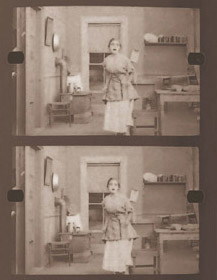
Images of Mary Pickford as Priscilla, in the 1910 film "An Arcadian Maid." These images are provided as examples of films that have not been fully restored and remain unavailable to the public. The author of the Pickford Film Legacy website writes, "These Pickford titles remain in a seemingly unnecessary state of limbo." The woman herself seems to be stuck in limbo.
(Photo from the Pickford Film Legacy)


Limbo the Dance

  • The dance originated in Trinidad (in the Caribbean). It involves a stick being held up while the dancer arches backwards and scoots beneath the stick without falling over or touching the ground. Again and again the dancer passes under the stick, but each time the stick is lowered. The dance ends when the stick is so low that no one can go beneath it without falling or touching the ground.

Dancers in Grenada, which is next door to Trinidad, doing the limbo
(Photo from the Grenada Drum Festival)


  • The dance was originally meant to depict people being forced into slavery, having to bend and twist as they were forced into the hold of a slave ship. One can imagine the ship's hold becoming more and more crowded. In a less tangible sense, the dance depicts the concept of slavery itself, which makes greater and greater demands on a person so that a person struggles first to meet those demands and then simply to survive.
  • The dance as we know it may also have had its roots in an African funeral dance called the legba or legua.
  • It is possible that limbo in this sense is related to the idea of being limber, or being able to bend one's limbs.
So, there are similarities. The dance originally depicted a certain type of limbo, that of being forced into slavery, a state from which one never knows when one might be released. In both the dance and the religious theological definition, people are trying to meet someone else's expectations but not quite making it. Clearly, limbo is not a good place to be.

It's a good thing they made a dance out of it. It's sort of like the blues, and how those songs take feeling so bad and turn it into something that makes you feel good.


These people live at the South Pole, and they're doing the limbo
(they also may have been drinking alcohol mixed with fresh snow water)


This just in:

It appears that the Pope is considering declaring that limbo was never an official part of the Catholic church's teachings, and that it may not actually exist. But as far as I can tell, he hasn't made an official determination one way or another yet.

So now even the concept of limbo is in limbo.


Sources
OneLook and the various dictionaries sourced there, limbo
New Advent, Catholic Encyclopedia, Limbo
A Prisoner's Dictionary, limbo
Sonny Watson's Street Swing, Limbo
Merriam-Webster, second definition of limbo
Paul Cachia, "Limbo was never part of the official teaching of the Catholic doctrine," di-ve news, October 7, 2006
"Vatican to review state of limbo," BBC News, October 6, 2006