Saturday, January 19, 2008

Apple #293: Blood Types

I donated blood yesterday. While I was there, some manager lady was inspecting the nurses collecting the blood, and she was talking really loud about all kinds of stuff. The nurses were short-staffed that day so there were long lines at each stage of the process, but of course the manager didn't step in to help, she just kept talking.

One of the things she said was, "Of course my blood type is boring old A positive. They've always got a supply of boring old A positive." I felt a bit sad at hearing this because my blood type happens to be A positive, and I was always sort of proud of that. You know, like A+.

I asked the nurse who was testing my blood whether what the manager lady had said was true, do they have too much A positive. He said yes, they always have the most of that because it's the most common blood type. O negative is the one they need the most, he said. He paused, then added, "But we always need people to donate, of any type."


This woman is donating blood. See how easy it is? You sit in a lounge chair, they give you free snacks and drinks, and everybody is really nice to you.
(Photo from the American Red Cross)


I decided I wanted to learn more about blood types. I remember learning something about it in school, but I had forgotten most of it.

  • If you give a person the blood of someone with a different blood type, the blood will clump. The red blood cells crack, which allows all the proteins inside leak out, and that's really bad because the hemoglobin that's kept in the red blood cells is toxic to every thing outside the red blood cells. So once hemoglobin is on the loose, so to speak, it can be fatal.
  • It wasn't until Karl Landsteiner figured out why blood clumps and all the rest happens that people were able to donate blood to each other successfully. Landsteiner, by the way, won a Nobel Prize for figuring out this problem.

Karl Landsteiner, the guy who figured out blood types
(Photo from Karl Landsteiner Geselleschaft)


  • So here's what he found out. Your blood contains a certain combination of antigens and antibodies (together, they're also referred to as agglutinogens).
      • Antigens: these are little knobs of protein, or they could be bacteria or a virus, and they're sort of like code-in-waiting. When they get stimulated, they make your body's immune system trigger a specific disease-fighting response.
      • Antibodies: these are the disease-fighting proteins that spring into fighting action when their related antigen shows up.
  • The blood types are a way to indicate what kind of antigens and antibodies are already in your blood. As you can see, the type name comes from the type of antigen.

Type

Antigens

Antibodies

A

A

B

B

B

A

AB

A & B

none

O

none

A & B

  • By the way, the type generally referred to as O (the letter o) was originally referred to as 0 (zero), since it means that there are zero antigens on the red blood cells.
  • Knowing which antigens & which antibodies are present is important when it comes to deciding whose blood can get donated to whom.
  • As long as you've got the antibodies that do not correlate with the same antigens (type A antibodies present with type B antigens), you'll be OK. But if you give somebody an antigen for which they already have the antibody in their blood, the antibody will automatically start fighting against that antigen. Since the antigens live on the outside of the red blood cells, the antibody will eventually crack open the red blood cells, the hemoglobin will escape, and then all hell breaks loose.

Antigens on a red blood cell and antibodies attaching to them
(Drawing from Healthy, Wealthy, & Wise)


  • But if you give people a type of blood that will not make the antibodies fight against the antigens, all hell will not break loose. Here's a table that shows which blood types can work safely together:

Blood Group
Antigens
Antibodies
Can give blood to
Can receive blood from
AB
A and B
None
AB
AB, A, B, 0
A
A
B
A and AB
A and 0
B
B
A
B and AB
B and 0
0
None
A and B
AB, A, B, 0
0
(table from Nobel Prize.org)

  • Because type O has no antigens, it won't trigger an antibody response. And since it has both types of antibodies, it can work just fine in the presence of either A or B antigens. That's why type O is known as the universal donor, because it can work when combined with any blood type.
  • Because AB has no antibodies, it doesn't have anything that will fight against whatever you introduce to it. So it can receive blood from anybody. However, if you give somebody AB blood, or both AB antigens, the antibodies that they already have will fight against the AB blood, clumping will result, hemoglobin escapes, hell breaks loose again.

THE RH FACTOR
  • There are now 20 different methods of typing blood. The ABO system is the one that is most commonly known.
  • The next most commonly known is the Rh factor system. This one refers to whether or not you have the Rh antigen present on the red blood cells.
  • Rh+ means you do have the Rh antigen, Rh- means you do not.
  • So you can give somebody who already has the Rh antigen either Rh+ or Rh- blood. But you can't give Rh- blood somebody with the Rh antigen, because the Rh- blood will develop antibodies to fight against the Rh+ blood.

(Image from Nobelprize.org)


Commonly, the ABO blood typing system gets combined with the Rh typing system, so that blood types are expressed in terms of A's, B's, and O's and then with a positive or negative indicator afterwards. So someone like me with a blood type of A+ has A antigens, B antibodies, and is Rh positive.

The frequency with which the different blood types occur varies slightly depending on where you are in the world. But as more people marry other people from all sorts of places, the more uniform the blood type distribution will become.

At the moment, though, here is the frequency of occurrence of the various blood types in the United States, from most common to least common:

Type / Rh

Occurrence in the US

O+

38%

A+

34%

B+

9%

O-

7%

A-

6%

AB+

3%

B-

2%

AB-

1%

(source: American Association of Blood Banks)


As you can see, Rh- is less common than Rh+.

For more information about blood type distribution on a global basis with lots of interesting maps, see Distribution of Blood Types


ALL WE NEED NOW IS A LICENSE AND A BLOOD TEST


Adelaide spends much of Guys & Dolls demanding that Nathan Detroit get a license and a blood test -- to marry her, in other words.
(Photo of Frank Sinatra & Vivian Blaine as Nathan & Adelaide from Stomptokyo.com)


I had one more question about blood types. I thought that you used to be required to get a blood test before getting married so they could determine if you and your prospective partner had compatible Rh factors. If not, you might have children with birth defects. In fact, if I remember correctly, my fifth grade teacher taught us this. But I haven't heard people mention the blood test thing at all recently, so I wondered if doctors found a way around the Rh factor incompatibility.

It turns out that my idea about the Rh factor test was wrong. Blood tests used to be required to test, not for Rh factor, but for syphilis or rubella (a form of measles). The presence of either one of these diseases can lead to very serious birth defects, or they could be fatal to a fetus. The blood test would then be used to tell people whether they ought to go get vaccinated or quarantine themselves upon pregnancy.

Either my memory is faulty, or my fifth grade teacher didn't tell us about the syphilis part because it has to do with s-e-x.

Not many states require a blood test anymore because those tests now are done at pregnancy. A few states do still require a blood test, however, so if you're fixing to get married soon, check with your state marriage license office.

That said, Rh disease is possibility -- rare, but possible. If the mother is Rh- and the father is Rh+, the baby could also be Rh+, which would be incompatible with the mother's Rh- blood.

It's not as much of a concern now because doctors can give the mother an injection of a drug called Rhogam which removes the fetal Rh+ blood cells from the mother's Rh- blood stream before her body makes the antibodies. Or else it's possible to give the fetus a complete transfusion through the umbilical cord.

It's all pretty miraculous, isn't it?


Sources
Nobelprize.org, Blood Groups, Blood Typing and Blood Transfusions
University of Utah, Genetic Science Learning Center, What are Blood Types?
Online Medical Dictionary, definition of antigens
CDC, National Immunization Program, Glossary, antigens
InteliHealth, Robert H. Shmerling, M.D., The Truth about Premarital Blood Testing, November 15, 2006
University of Pennsylvania Health System, Pregnancy Health Center, Blood Group (Rh) Incompatibility

Sunday, January 13, 2008

Apple #292: Baptism or Christening?

Recently I was talking to someone about a new baby getting baptized. The person I talked to said "christened." Then we both agreed we didn't know what the difference is, only that my family always said "baptized," while he and his family always said "christened."

So what is the difference?

  • In a baptism, a person is spiritually reborn as a new entrant in a particular religion.
  • The term "baptism" comes from a Greek word which essentially means "bath."
  • People of Christian faith use the term "baptism" for their ceremony of entry, but so do people of other faiths as well.

Beatrice, a.k.a. Trixie, getting baptized at a church in Oklahoma.
(Photo from Sean Gleeson's blog)

  • In a christening, a person is spiritually reborn as in a baptism, but the term used to be a little bit more specific.
  • The term "christening" comes from the concept that the person being baptized is being dedicated specifically to Christ or the Christian faith.
  • The term also comes from way back in the days of early Christendom and in the beginnings of the Catholic church and the idea that when you christen somebody, usually a baby, the parents are making that decision on behalf of the child.
  • So if an adult wants to join a particular Christian church, that person is generally said to be getting baptized rather than christened.
  • Christening also used to be a separate ceremony when the child was named, and that happened in addition to the baptism. Now, however, there really isn't a naming ceremony, just the baptism.

This boy is getting baptized at Carver Lake Park in Minnesota.
(Photo from the Woodbury Baptist Church)


  • Also, you can christen a ship or a church or other kinds of objects. In that kind of christening service, the ship or the church are dedicated to God's service.
      • You know how British ships are named H.M.S. something-or-other? The H.M.S. stands for His or Her Majesty's Service. Because the king or queen was regarded since King Henry VIII's time as divinely appointed, by dedicating a ship to the service of the king or queen, you are dedicating it also to the service of God. Hence, ships can be christened.
  • A lot of Catholics still prefer the term "christening" to "baptism," but some Catholics think the term got appropriated by the whole ship-christening thing, so they use "baptism" instead.

Vanessa is getting baptized at a church in Singapore.
(Photo from Vanessa Tan's blog)


  • It's also worth noting that baptism is the one ceremony or sacrament that's recognized and accepted by any and every Christian church, regardless of who did the baptizing and under what circumstances.
  • So, generally speaking, since there's no difference anymore in what happens whether you call it a "baptism" or a "christening," you can use either term depending on your personal preference, regardless of what sort of Christianity you practice.
  • And I'm glad of that. We could all do with fewer shibboleths.

Sources
Dallas-Fort Worth Wedding Exchange, Christening and Baptism
The Free Library by Farlex, What's the difference between a Baptism and a christening?
St John's in the City, Getting Baptised at St John's
Ask the Padre, Is there a difference between Baptism and Christening?

Wednesday, January 9, 2008

The Military Needs to Know

Going through the stats of who's visited the Daily Apple lately, I discovered this:


(by the way, the entry they visited is this one.)

I think what this means is, I win.

Saturday, January 5, 2008

Apple #291: Daily Apples in the News

Yesterday, I heard on NPR that the FBI had recently re-opened the cold case of D. B. Cooper, who hijacked an airplane in 1971 and got away without getting caught.

Immediately, my ears perked up, because I had done a Daily Apple about D. B. Cooper a while back.

For those of you who may not remember every single Daily Apple in as much detail as I do, you can check out the old entry, of course. But in sum, he was a guy in his 40s or so who, the night before Thanksgiving in 1971, took control of a Northwest Airlines plane on its way to Seattle, and demanded $200,000 or else he'd blow up the plane. The plane landed in Seattle, they gave him the money and some parachutes he'd also asked for, he let the passengers go, and then made the crew fly him to Mexico City. En route, he jumped out of the plane into a rainstorm. Nobody ever found him.


FBI and police sketches of D. B. Cooper. Except now, he'd look much older.
(Image from the FBI)


Many speculated that he died during the jump, but some people think he survived. He's kind of turned into a legendary figure. Now, though, the FBI has re-opened the case. They say he's no legend, just a mediocre guy in his 40s who couldn't think of any other way to take care of his family. But apparently, they also think he survived and that he has eluded them to this date.

[Edit: More recent news stories say the FBI are following up on a "credible" and "pretty interesting lead," but they won't give more details than that. 8/1/2011]

Original Daily Apple story about D.B. Cooper (scroll down)
NPR story with more details
FBI's official web page asking for help in solving the case


Having heard this news story, I wondered how many other Daily Apple topics have been in the news recently. So I thought I'd check in on a couple.


DAVID LEE ROTH

The first one that comes to mind is the fact that David Lee Roth is now, despite all Eddie Van Halen's assertions for years and years and years, touring again with Van Halen.

Faithful Daily Apple readers may recall that the original Daily Apple on David Lee Roth was prompted by the desire to answer one of my brother's favorite eternal questions: What do you think David Lee Roth is doing right now?

Well, now we know what David Lee Roth is doing with most of his time these days.


L to R: Alex, DLR who can't believe his luck, Eddie, & Wolfie (who looks a lot like his mom, Valerie)
(promo photo sourced from My San Antonio Blogs)


The band now includes Wolfgang Van Halen, Eddie's son, who is playing bass instead of Michael Anthony. Eddie's on guitar, and Alex is on drums, and DLR is on vocals, of course. The tour started in December, and is scheduled to last until early April.

I picked one of the places they're playing at random -- New Orleans on February 8 -- and asked Ticketmaster to give me a best available ticket.

They offered me a seat in row 20 of a a lower-level section next to the stage, but at the very left corner of it. Apparently all the floor tickets are sold out at this venue. Price: $147.50 plus $15.50 in fees, or $163. For one person.

Cheapest available was $47.50 plus all fees for a total of $60.85. This is for an upper level seat in row 8, which isn't completely nosebleed, but it's close.

True-blue David Lee Roth fans (headquartered in Hell, Michigan) are loving the tour. Van Halen fans, however, have given the shows mixed reviews. Many people said that Diamond Dave missed lyrics, sang the same verse over and over, or otherwise screwed up. But others said the show rocked and they loved it.

First official announcement that the reunion tour would actually happen
Van Halen's official website
Original Daily Apple about David Lee Roth
David Lee Roth sighted on The Sopranos (scroll down)


TUNA TARTARE

Kate Walsh, a star on the TV series "Grey's Anatomy," recently got engaged to her boyfriend Alex Young. He proposed to her in a restaurant in San Francisco. Knowing how much she likes butterflies, he asked the chefs to form a tuna tartare in the shape of a butterfly. After it was served, he asked her to marry him.


Tuna tartare: an aphrodisiac for Kate Walsh?
(Photo from The Incredible Shrinking Whimsical)


While Walsh was quoted as saying she likes butterflies, the article didn't mention whether she likes to eat tuna tartare, regardless of its shape.

News of Kate Walsh's engagement
Original Daily Apple on tuna tartare


BRETT FAVRE

Brett Favre, seemingly eternal quarterback of the Green Bay Packers, has been in the news a lot this fall. Most recently, sportswriters for the Associated Press newswires voted on the NFL's Most Valuable Player. Tom Brady, quarterback for this year's undefeated and seemingly iron-clad New England Patriots, got every single vote for MVP except one. And that vote went to Brett Favre.

In December, he passed Dan Marino's record for most total passing yards in a career. Referees stopped the play once he'd completed the pass so they could give him the game ball. Right after the whistle blew, Favre asked what happened, had been a penalty?


(Photo from Greta Van Sustern's page)


His current NFL records:
  • Total passing yards (61,655)
  • Career TD passes (442)
  • Pass attempts (8,758)
  • Pass completions (5,377)
  • Wins as a starting quarterback (160 as of 12/16/07)
  • Consecutive starts as a quarterback (251 as of 12/16/07)

News about the MVP voting results

Favre breaks Marino's record
Favre's current and career stats
Original Daily Apple about Brett Favre
(I just realized that was my 4th ever post and Favre's jersey number is 4. I don't think I did that on purpose. But I might have.)


LOCH NESS MONSTER

The Loch Ness Monster, who also seems to be eternally popular as well as immortal, is in the news again. This time it's because of a movie mainly for children called "The Water Horse: Legend of the Deep." The movie draws on the legend of the Loch Ness Monster, except, instead of discovering the monster alive and well in the lake, the boy protagonist finds an egg which hatches and grows into a water creature very like the Loch Ness Monster, whom he calls Crusoe.


Alex Etel, the 13 year-old child lead in The Water Horse, apparently hugs a Loch Ness Monster-lookalike. Except that's a computer generated image, and he's actually touching nothing.
(Photo from the Washington Post)


Review of The Water Horse
Original Daily Apple entry on the Loch Ness Monster


NINTENDO

Finally, due to the enormous success of its video game system the Wii (pronounced whee), Nintendo has risen from the ashes like a phoenix. Just a few years ago, they were a near-dinosaur in the video game world compared to Sony and Microsoft. Now, Nintendo has the third largest market capitalization of all Japanese companies. In other words, they have sold boatloads of stock and people have bought it like crazy because they love the Wii. So the company is having enormous success right now.


Somebody boxing on a Wii projected on a big screen -- on a Norwegian Cruise Line ship.
(Photo from Siliconera)


Overview of Nintendo's current success
Original Daily Apple entry about Nintendo


There's no real rhyme or reason to how I picked these entries, or why I put them in the order that I did. I just picked a few topics, checked the news, and reported on what I found.

But the point is, even though your Apple Lady isn't always hip to the most current events all the time, your Daily Apple can still keep you in the know about the very latest.

When somebody brings up Tom Brady's MVP award, for example, you could maybe come back with some of Brett Favre's stats. Or when somebody says they saw "The Water Horse," you could say you saw the surgeon's photo and it's all bunk.

Or when you see some old guy carrying a briefcase with tattered twenty-dollar bills sticking out of it, you can say, "Hey, that's D. B. Cooper, and I recognize him because I read the Daily Apple!"

Or something like that.

Monday, December 31, 2007

Apple #290: The Phoenix

Well, Apple readers, I'm back from my trip home. It was filled with much, much sleeping -- all of it very necessary -- as well as other good things like sandwiches, dog walks in the snow, board and card games with my parents, and finally, football on TV. I encountered some topics during my vacation that I plan to investigate here in these (web) pages. But I'm going to hold off on those because I thought it would be more appropriate to do an Apple on something New Year's Eve-related instead.

I considered the various aspects of New Year's Eve, such as how have various cultures around the world celebrated the beginning of a new year, or the Times Square ball drop, or party hats and blow-horns, etc. None of these topics really piqued my interest, though. So I tried to think of something kind of New Year's-esque, and I thought of the phoenix. You know, the bird that gets re-born.

  • The phoenix is a mythological bird that lives a very long time and then is reborn or resurrects itself. It is symbolic of new life, regeneration, all those good things.

Generally what we imagine when we think of a phoenix.
(Image from Bocage Books)

  • Lots of different cultures have stories about a phoenix. Depending on the country of origin, the bird may have a different name, a different method of dying or resurrecting itself.
Culture
Arabia

Name
Phoenix

Characteristics
Only one exists at a time. Lives near a well, sings an enchanting song.

Appearance
Large as an eagle with scarlet and gold feathers

Death & Resurrection
Builds its own pyre of aromatic branches and spices (like myrrh) and sets itself on fire. Rises from the ashes 3 days later.


Grecian phoenix, nesting in a palm tree
(Image from Anyone for Tee?)


Culture
Greece

Name
Phoenix

Characteristics
Comes from Arabia to Heliopolis in Egypt to bury his father, encased in an egg of myrrh.

Appearance
Eagle, with scarlet and gold feathers

Death & Resurrection
Builds a nest on top of a palm tree with aromatic plants (cassia and myrrh) and dies. Young phoenix arises from the dead phoenix.


Egypt's Bennu
(Image from Phoenix Moon)


Culture
Egypt

Name
Bennu

Characteristics
Soul of the sun god, Re, or also a symbol of the periodic flooding of the Nile.

Appearance
Heron with two long feathers extending from his head, sometimes also crowned with the sun

Death & Resurrection
Stands alone on the rocks following the flood.


The closest representation I've found to how I picture Fawkes.
(From Laura Freeman's Harry Potter tarot deck)


Culture
Harry Potter (I couldn’t resist)

Name
Phoenix, specifically, Fawkes

Characteristics
Animal representative of Albus Dumbledore. Tears have healing properties, as does its song.

Appearance
Size of a swan, crimson feathers, long (very strong) tail. Claws, beak, and tail are golden.

Death & Resurrection
Can appear and disappear at will, but also dies in a burst of flame to be re-born almost immediately in its ashes.


China's Feng Huang
(Image from the Aerie of Paragon)


Culture
China

Name
Feng Huang

Characteristics
Very gentle, lands without crushing anything, eats only dewdrops. But it does attack snakes.

Appearance
Rooster’s beak, swallow’s face, snake’s neck, goose’s breast, tortoise’s back, stag’s hind legs, fish’s tail

Death & Resurrection
Immortal. Appearance signals the start of good times; disappearance marks onset of bad times. Nests in the woo-tung tree.


Culture
Japan

Name
Ho-Oo

Characteristics
Combination of the male Ho and female Oo bird.

Appearance
Very similar to the Chinese Feng Huang

Death & Resurrection
Descends from heaven at the birth of a virtuous ruler and nests in a paulownia tree. Goes back to heaven at the close of peaceful and prosperous times.


Hindu Garuda (here, he's eating a snake)
(Photo by D. Finnin)


Culture
Indian / Hindu

Name
Garuda

Characteristics
King of birds. Hates evil, attacks snakes

Appearance
Head, wings, talons, beak of an eagle; body and limbs of a man. White face, red wings, brilliantly shining body.

Death & Resurrection
Fought the gods to get the draft of immortality and rescued his mother from the underworld where she was guarded by snakes. Carries immortality still.


  • In nearly all of these stories, as you can see, the phoenix is a force of good. Sometimes its appearance only signals the beginning of good times; in other stories, the phoenix actively fights on behalf of good and against evil.
  • Basically, if the phoenix is on your side, you're in good shape.
  • In addition to these mythological birds, other birds have been suggested as variants of the phoenix.
      • Although the name Firebird is very suggestive of the story of the Phoenix, I don't think the Russian legend of the firebird is actually that similar to the phoenix. You can read the story of the firebird yourself and see what you think.
      • The Thunderbird, who is present in many Native American stories just as there is not one Native American tribe, so there is no single Thunderbird, is also said to be similar to the phoenix. But just as there is not one single Native American tribe but several tribes with all sorts of different stories, so there is also not one Thunderbird. In just one of the stories I read, the Thunderbird seems more powerful and god-like than the phoenix, and it has more to do with influencing the weather. But again, you can read the Thunderbird stories yourself.

May your new year be like the phoenix rising from the ashes. Or, may your new year be as filled with goodness as the phoenix's song. Or, may you be empowered like the feng huang to fight the snakes of evil and nest in the woo-tung tree of happiness. Or otherwise, happy new year!

Sources
Mythical Realm, Rise of the Phoenix
Encyclopedia Mythica, Garuda and Phoenix
Carlos Parada, Greek Mythology Link, The Phoenix
Godchecker, Chinese Mythology, Feng-Huang
Dr. Jean Couteau, archipelaGoMagazine, Garuda: From Myth to National Symbol
Harry Potter Lexicon, The Bestiary, Phoenixes: Fawkes
N.S. Gill, "Phoenix - Bird - The Phoenix," About.com: Ancient / Classical History

Saturday, December 22, 2007

Apple #289: Some Santa Facts

Lots of people say that the Santa Claus we know today is the product of Coca-Cola ads. That's not exactly true. Here's the real chronology:


The 1931 Coca-Cola Santa, drawn by Haddon Sundblom
(Image from the St. Nicholas Center)

  • The Coca-Cola advertisements that depicted Santa in a red suit with white trim and all the works we're so familiar with did not begin to appear until 1931.
  • In the 1920s, popular illustrators like Norman Rockwell and N. C. Wyeth were painting Santas in the well-known red suit, etc.
  • And actually, the first person to draw Santa as fat, jolly, white-whiskered and wearing a red suit was Thomas Nast, in 1869.


This image of Santa in the red suit and red floppy cap etc. appeared around 1869, long before the Coca-Cola ads.
[Dang it, they changed the link. I can't post it here now, but you can click to look at the Thomas Nast drawing.]
(Image from the St. Nicholas Center)


  • In 1832, Clement C. Moore described him in "A Visit from St. Nicholas" (now known as "The Night Before Christmas") as a jolly elf who smoked a pipe and drove a flying sleigh pulled by "eight tiny reindeer."
  • In 1809, Washington Irving's satire, Knickerbocker's History of New York, included several references to St. Nicholas as a jolly Dutch fellow with a clay pipe. Although he meant to make fun of a lot of things that people were doing at the time, the image of St. Nicholas as a fat, pipe-smoking Dutch tradesman is generally regarded as the product of Irving's imagination.


This drawing of St. Nicholas is from 1810. Didn't take long to get from here to the jolly fat elf in a red suit.
[They changed the link for this too.  Click to see the 1810 broadside.)
(Image from the St. Nicholas Center)


  • Colonial Germans in Pennsylvania, as well as other settlers from Europe, celebrated St. Nicholas' feast day in the colonies in the 1700s.
  • Many European and Russian Catholics celebrated the feast day of St. Nicholas for centuries.
  • The original Saint Nicholas was an actual person who was born some time around 260 AD. He was a bishop who lived in various places around Turkey and Asia Minor. Many stories are told about him and it is difficult to determine what is accurate and what is legend. Mainly, he was renowned for his generosity. He gave to those in need, and he often did so in secret, since the people to whom he gave could not have afforded to repay him in any material way.

With that, I leave you for about a week or so. I'm going to my homeland for Christmas celebrations, dog-walking, and much nap-taking.

Merry Christmas from the Apple Lady.


Sources
St. Nicholas Center, Saint Nicholas and the Origin of Santa Claus
SantaClaus.com, Santa's FAQ page, Historical Questions
Lone Star Christmas connection, Santa's Origins and FAQs

Sunday, December 16, 2007

Apple #288: Cinnamon

For today's entry, I considered the Christmas tree in Rockefeller Center in New York City. But in doing a little searching around, I found an already excellent entry covering all the major facts I wanted to know about the tree: what kind is it, why does it always look so skinny, where do they get the trees, etc. For these answers and more, check out Steve Nix's guide to the Rockefeller Christmas Tree.

Also, this year, the lights aren't fluorescent bulbs but more efficient LEDs. And they're powered by 365 solar panels installed on a nearby skyscraper rooftop. When the tree is taken down after the first week of January, the wood will be used to build homes for Habitat for Humanity.

I couldn't find a photo of this year's Christmas tree, so here's a video of when it was first lit on November 28.


Anyway, since that topic has already been well-covered elsewhere, I needed to pick another subject. So I looked around and saw a mug of tea. My favorite tea right now includes several different herbs but what makes it especially tasty is the cinnamon (I prefer bags to loose tea, by the way).

So here's an Apple about cinnamon.


(Image from Leslie Beck, RN, Canada's Leading Nutritionist)

  • Cinnamon is originally from Sri Lanka, or what used to be called Ceylon.
  • The oldest known written reference to cinnamon is from -- you guessed it, regular readers -- China.
  • In the 16th and 17th centuries, cinnamon was so highly prized, European countries fought over ownership of Sri Lanka, just so they could export cinnamon.
  • By the early 1800s, though, people figured out they could grow cinnamon in other places such as the various islands in Indonesia and Malaysia. Once there was no longer a monopoly on cinnamon, the price dropped, and people stopped fighting over it -- for the most part.


Sri Lanka is shown in red on this map, but you can also see the other countries where most cinnamon is grown today, including Indonesia, Malaysia, Vietnam, and China.
(Map sourced from High Quality Organics)


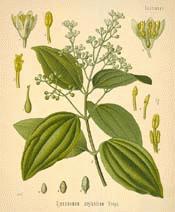
  • Cinnamon is the inner bark of a cinnamon tree (Cinnamomum zeylanicum). It's an evergreen tree that grows best in almost pure sand.
  • The bark is harvested during the rainy season when it's moist and pliable, then allowed to dry into its familiar curling shape.
  • Most of the cinnamon sold in the United States actually comes from a different tree, called Cassia (Cinnamomum cassia). This tree is native to China, and it, too, is an evergreen, but its bark is coarser and darker, and its flavor is more pungent and less sweet.


Ceylon cinnamon on the left, Cassia cinnamon on the right. Similar, but not exactly the same.
(Images from Mrs. M. Grieve's Botanical.com)


  • Though Cassia cinnamon is far more commonly available, Sri Lanka's cinnamon, or Ceylon cinnamon, is still considered the best because of its flavor, which some say is sweeter, or more "lively."
  • Ceylon cinnamon is made from only the inner bark, while Cassia cinnamon is made from the entire bark.


Ceylon cinnamon bark on the left, cassia cinnamon bark on the right.
(Images from Gernot Katzer's Spice Pages)


  • Cinnamon is one of the essential ingredients of the increasingly well-known Chinese five-powder spice.
  • Several Indian dishes that call for cinnamon actually use an entire roll of bark, or quill. The quill is put into hot oil and cooked until it uncurls, this releasing its fragrance and flavor. Then other ingredients are added to the dish. The cinnamon bark is typically removed, or else it is retained but only as a garnish.
  • If you have powdered cinnamon, though, use it quickly or else store it in the refrigerator. Once cinnamon is powdered, it loses lots of its essential oils and thus much of its flavor, and it deteriorates pretty quickly.
  • If you think you might be keeping it for a while, cinnamon sticks will actually stay preserved longer if you store them in an airtight container, and grind only what you need when you're about to use it.


In a jar is possibly the best way to store cinnamon for greatest longevity -- provided that cork makes a tight seal. And if you put the jar in the refrigerator, that would help, too.
(Image from SoftDental)


  • If you're not sure whether your cinnamon is still fresh, open the jar and take a good sniff or two. If it still smells sweet, it's good. If the sweetness is faint or not there at all, the spice won't do much for your food, either.
  • Two teaspoons of ground cinnamon* will give you more than 35% of your daily requirement of manganese.
  • You've got to have manganese to stay healthy, but you only need a little bit of it. Besides cinnamon, sources for manganese include whole grains, spinach, soy beans, nuts, olive oil, oysters, and tea.
  • There's another reason to make sure you don't go overboard with the cinnamon -- or in this case, I should say, cassia. Cassia cinnamon contains a compound called coumarin which can be toxic in high doses. Ceylon cinnamon has much lower levels of coumarin.
  • Cinnamon also contains a chemical called cinnamaldehyde.  Sounds like formaldehyde, doesn't it?  That's because they're chemically similar -- and similarly bad for you.  A little dusting of cinnamon on your French toast won't hurt you.  But a bunch of it at once will. (See below.)
  • Some people say cinnamon can aid in alleviating high blood pressure and that it can also reduce blood sugar, so it is considered to be helpful to people with diabetes. But please note that if you are going to use cinnamon as an herbal remedy, you'll be safer if you use the Ceylon cinnamon -- if you can find it.


You can make these cinnamon buns yourself with the recipe posted at Once Upon a Cakestand


*EDIT: You don't really want to eat a whole bunch of cinnamon at once because it can be toxic.  There's currently a fad called the Cinnamon Challenge which dares people to eat a tablespoon of cinnamon in 60 seconds without drinking water.  Mostly it's teen-agers who've tried it, but then, so has the governor of Illinois.

Here's why you DO NOT want to do this: people who have done this wind up calling poison control centers or else being rushed to emergency rooms because of the toxicity of so much cinnamon.  Some people have even shown up with collapsed lungs.

First, you get a terrible burning feeling in your nose and throat, you can't breathe.  Because your body knows better than you that that much of the stuff is toxic, you will gag.  You will next either spit the stuff out, or if you persist in swallowing it, you'll probably vomit (if you're lucky).  When you gag, you'll puff out a bunch of the powdered spice which you then may inhale by accident.  Once the cinnamon is in your lungs, its toxicity will go to work there, and you could wind up with an asthma attack or even scars on your lungs.  Scarring of the lungs is emphysema, folks. Same as what you get from smoking cigarettes over a long period of time.  Your lungs may even collapse.  Thus you could find yourself in the hospital with a collapsed lung, needing to be put on a ventilator.

Your body knows this is bad stuff.  Be at least as smart as your body and don't force it to do something it knows is a really bad idea.

If someone has swallowed a spoonful of cinnamon, call the Poison Control Center at 1-800-222-1222.

Sources
"LEDs will light up Rockefeller Christmas tree," AP Newswire posted at CNN.com, November 21, 2007
Peggy Trowbridge Fillippone, Cinnamon History, About.com: Home Cooking
Recipe Zaar, Kitchen Dictionary, Cinnamon
Mrs. M. Grieve, Botanical.com, Cinnamon and Cassia (Cinnamon)
Gernot Katzer's Spice Pages, Ceylon Cinnamon
Spice-Racks.com, Cinnamon: The Truth About This Spice
The World's Healthiest Foods, Cinnamon, ground
Leslie Beck, RD, Healthy Cooking, Cinnamon -- December 2006's Featured Food
Department of Health and Human Services, Agency for Toxic Substances & Disease Registry, ToxFAQs for Manganese
Lenntech, Health effects of Manganese


Consequences of the "Cinnamon Challenge," The New York Times, April 22, 2013
5 Reasons not to Take the Cinnamon Challenge, Forbes, April 23, 2013

Saturday, December 15, 2007

Apple #287: Anniversaries

  • Most people think of the word "anniversary" in connection with weddings, or how long a couple has been married. But really, an anniversary can mark any event.
  • The word comes from two Latin words, annus which means "year", and versus which means "turned." In other words, an anniversary commemorates the passage of a year.

"The best way to forget something is to commemorate it."
--The History Boys, by Alan Bennett

  • In fact, the first known use of the word "anniversary" in English was in a religious sense. The word first appeared in print around 1230 A.D. in a devotional book for nuns. It wasn't until 1673 that the phrase "wedding anniversary" appeared in English usage.

"I once wanted to be an atheist, but I gave up -- they have no holidays."
--Henny Youngman

  • A birthday is a kind of anniversary. The Spanish way of wishing someone "happy birthday" makes this pretty plain: felix compleanos literally means "happy completion of another year."

"He that outlives this day, and comes safe home
Will stand a tip-toe when the day is named"
--Henry V, Shakespeare

  • Our Independence Day here in the United States is another kind of anniversary. Each year, we celebrate the passage of another year since our country declared its independence from England and we mark the fact that our country is another year older.
  • Veterans' Day, sometimes also called Armistice Day, commemorates the end of World War I. The war officially ended in June of 1919, but on November 11, 1918, the Allied nations and Germany agreed to a temporary cease-fire, or armistice. So Veterans Day is celebrated each year on November 11.

"At the going down of the sun and in the morning
We will remember them."
--"For the Fallen," by Laurence Binyon

  • For some people, anniversaries can be really difficult. If someone you love has died, anniversaries seem to pop up all over the place, and they can trigger feelings of sadness all over again. Such difficult days can include the anniversary of the person's death day, their birthday, Christmas or other holidays that had particular meaning, or if it was a romantic relationship, days that were especially important to the two of you such as the day you first met.

"The holiest of all holidays are those
Kept by ourselves in silence and apart;
The secret anniversaries of the heart."
--"Holidays" by Henry Wadsworth Longfellow

  • If this is true for you, allow yourself the time to feel whatever it is you're feeling. Just because a certain amount of time has passed, that doesn't mean you're supposed to be "over it." Sad things happen. It's okay to be sad.
  • Some things you can do on difficult anniversaries include:
      • Make sure you're with friends or family members
      • List the good things you remember about the person you lost
      • Write the person a letter telling him or her all the things you meant to say
      • Start a new tradition in honor of the person, such as making a journey someplace meaningful, or establishing a charitable fund in your loved one's memory
      • If it's a loss you share with others, such as a loss of your loved one to war, attending a group ceremony or memorial can bring you together with others at a difficult time.

Whether you're having a bad anniversary or a good one, know that there will be more good anniversaries to come. More birthdays, more peace agreements, more feast days, more life.


Sources
History.org, The Journal of the Colonial Williamsburg Foundation, Anniversaries and the Origin of History, by Michael Olmert
India Pakistan Trade Unit, Sikh Religious Holidays and Muslim Religious Holidays
Exploring Religions, Buddhism, Time and Worship
United States Department of Veterans Affairs, History of Veterans Day
MayoClinic's article sourced at CNN, Grief: Coping with reminders after a loss
Quotations found using Bartleby's, Quoteland, and Michael Olmert's page on Anniversaries

Monday, December 10, 2007

Apple #286: Cold Turkey

I recently ran across this expression, to quit something cold turkey. Usually people use this phrase in reference to quitting cigarettes or alcohol or some other kind of drug, and they mean that you stop using it suddenly, all at once.

But all of a sudden, the phrase seemed strange to me. Why turkey? And why is the turkey cold? And what do turkeys have to do with quitting anything?


"Cold turkey" does not mean, literally, a chilly turkey.
(Painting by Ron Parvu, Cold Turkey, 1998, on view at the Saginaw Art Museum)


  • There are lots of ideas about the origins of this phrase.
  • One page says that when you quit some sort of drug immediately, you get the cold sweats, which gives you goose bumps, and that's where the phrase comes from. But that slang dictionary is not very reputable, and I suspect that Ted Duckworth, who wrote it, didn't do all his research -- at least, not on this phrase.
  • Wikipedia's entry (and multiple sites that link back to it or simply copy it verbatim) say that "cold turkey" is a variation on the phrase "talk turkey," which means that you speak without lying or indirection of any kind. When you go cold turkey, then, you're no longer messing around with those drugs that set you wandering off course. And when you do that, you go through withdrawal, so you get the cold sweats and goose bumps as in plucked turkey flesh.

Wikipedia, I think on this occasion, you're a turkey.

  • As one person noted at the Word Reference forum, that connection between the appearance of goose bumps and the appearance of a plucked turkey's flesh seems much too serendipitous to be believed.
  • And actually, my copy of the OED (Oxford English Dictionary) says that to "talk turkey" means to say lots of affable, high-flown things. Or, to spin a story that's probably got some flattery in it besides. This is just about as opposite as it gets to Wikipedia's definition of talking turkey.

Sort of what my copy of the OED looks like. Except I bought mine from the Book of the Month club back in the late 1980s for $30.
(Photo from the Oxford English Dictionary)


  • The Online Etymology Dictionary's definition of "talking turkey" is closer to the OED's than it is to Wikipedia's. They say that that phrase probably comes from a long, extended joke told in 1824 about an Indian who got swindled. So, according to the Etymology Dictionary, talking turkey means talking hogwash. Which I think is what those other definitions of "cold turkey" are doing.
  • So here's what the Online Etymology Dictionary says is the definition of cold turkey: If you've served turkey but it's still cold, you haven't given it very much preparation. So doing something "cold turkey" similarly means you've done it with little preparation.

If all you've done is lay out cold slices of this, you haven't done very much.
(Photo from Koch's Turkey)


  • Furthermore, the Etymology Dictionary says that the phrase was first used in 1910. But by 1921, the phrase was further specified to mean quitting an addictive substance -- and in that original usage, heroin.
  • None of those other sources offer an initial use of the phrase. And the Online Etymology Dictionary is written and compiled by Douglas Harper, a much-published historian who does his work and then some when it comes to historical topics he cares about, as opposed to other definitions that have been written by just anybody whose credentials are unknown. So I'm putting my money on his definition.

I wish, though, that somebody could tell me why turkey as opposed to, oh, chicken or beef or sausage. But I suppose it's the same reason why people picked mutton when they made up the phrase, "she's a regular cold shoulder of mutton." Just because.


By the way, in addition to this entry, I also updated my entry (Apple #5!) on Handel's Messiah with more information on that score. (Pun-of-the-day brought to you by the Apple Lady)


Sources
Definitions I trust:
Online Etymology Dictionary, cold turkey and talk turkey
Short Stories Help Children, The etymology of common phrases means what it means!
WordReference.com, English language forum, Cold turkey

Definitions I don't trust:
Wikipedia, cold turkey
Answerbag, "How did the phrase "(to quit) cold turkey" originate?"
Yahoo! Answers, I know what it means to quit "cold turkey," but why is it called that?
You Q and A, Why is it called cold turkey when you are in withdrawal?

Friday, December 7, 2007

Apple #285: Cows in Winter

The building where I work is near some farmland, including a cow pasture. The other day, it had snowed a couple inches or so, and the cows were out. In the snow. I wondered what they do in the snow. Do they snuffle through the snow to find grass, or do they just wander around and eat the snow? And just in general, what do you do with cows when it snows?


Somebody left these cows out in the snow.
(Photo from Utah State Cooperative Extension)


  • Well, apparently this is a subject of some debate among cattle farmers. Some farmers say that cows get too thin and sick if you leave them outside during the winter (this is called "outwintering"). They say if it gets icy, the cows can slip and fall and maybe break a leg. These farmers also say that high winds and rain make the animals the sickest in winter. Of particular concern is the likelihood that milk cows can get frostbitten teats. Yikes!
  • Other farmers say the cows prefer to be outside, and as long as it's not too icy, and if you give them windbreaks -- high walls or something tall like bales lashed together where they can stand to shield themselves against the wind -- they'll be all right. Farmers who outwinter their cows generally do so because they believe their cows stay healthier if they can keep grazing all year round.

These cows live in the UK, where people have made limestone walls like this one all over the place. These walls act as excellent windbreaks for the cows.
(Photo from the Peak District National Park, Derbyshire, England)


  • Some farmers also say it's far less expensive to keep the cows outside because, even though it requires some more work on your part, you don't have to spend as much money keeping the buildings warm. Also, you don't have to pick up the forage, bag it, bring it inside, and feed it to the cows. You'd still have to bale the hay, but you can leave it out in the field or in feeders and let the cows go get it.


New hay bales left out in the snow for cows to graze from, with spaces between to provide shelter for the cows.
(Photo from Big Oak Ridge)

  • Apparently, cows need two basic types of food:
      • Something for roughage, like hay or stockpiled grass or even kale. Some farmers let the cows graze and get all the roughage they need that way, but most say you have to supplement the grazing at least somewhat.
      • Grain, which in the winter usually means some sort of corn or corn waste, but it could also mean cotton seed or, in the case of one farm, pizza crust!


Another way to make sure your cows get enough to eat is by "swath grazing," which involves laying down stretches of forage in the late fall and allowing the animals to graze for it through the snow during winter, as these Canadian cattle are doing.
(Photo by Duane McCartney, from the FAO's Grasslands of the World, Chapter 12)


  • If you're going to outwinter your cows, you have to feed them more than you would if you kept them in the warm barn. This is because the cows need more energy to keep warm while they're outside, and they're going to move around more and get more exercise. So you have to feed them about 15% to 20% more than you would otherwise. Since cows eat about 90 pounds of food a day per cow, that's an additional 13 to 18 pounds of food per day.
  • Farmers also disagree on the best way to water the cows in the winter. Eating snow to get water is not an instinctive behavior for cows, but after about three days, they figure it out and will eat the snow.
  • Some farmers they'll eat the snow and do fine, as long as you make sure to turn them out into areas where the snow is fresh and clean. One Canadian farmer says, "Canadians . . . said that their cows do better eating snow than drinking large amounts of cold water."

Cow eating snow, after having learned to do so.
(Photo from Wie IST das Wetter?)


  • Others say it's hard to make sure the cows are in clean snow, and they won't eat snow if it's crusted over, so you need to provide the cows with water tanks -- heated, if you can afford it, or otherwise you go out there yourself and crack the ice off of it for the cows.
  • All cows will grow longer hair as winter approaches. If you put them outside, their hair will grow longer still, around six to eight inches long depending on the type of cow and your location. Some people have coats or sacking drapes made for their cows. They say the cows wearing the coats will stay outside in even the worst weather and continue to graze and feed.
  • Cows that are ready to give birth (calve) are kept inside. Smaller cows may also be kept inside and fed until they reach a healthy enough weight to be outside. Less hardy animals can be, um, sent elsewhere.
  • But most farmers say that, if you give the cows high-quality hay, keep a close eye on their health, and ensure that the food and water supply are adequate, most cows will actually be healthier by virtue of having stayed outside and walked around and eaten in the snow.


Cows in Missouri, grazing through snow in February. Agricultural researchers grew annual feed rather than hay and let the cows graze on that. They saved lots of money, and the cows did very well on the annual feed besides.
(Photo from the Missouri Agricultural Experiment Station)


Sources
Ed Brick, Outwintering dairy cattle: animal health issues, UW-Madison Center for Integrated Agricultural Systems
Jeremy Hunt, "Out wintering cattle can be worth the effort," Whitebread Shorthorn Association
"Significant savings make outwintering attractive," Farmers Weekly Interactive, March 12, 2007
Outwintering Issues Summarized by FWO from Graze-L, Owenlea Holsteins
Outside winter feeding on forage basics, Trumpline Stackyard, September 12, 2005
Watering Cows with Snow - Frequently Asked Questions, Government of Alberta Agriculture and Food
National Agricultural Library, All about Dairy Cows

Sunday, December 2, 2007

Apple #284: Ketchup

I have several burning questions about ketchup:
  • Why does the word have two spellings, ketchup and catsup?
  • Which of the two spellings is preferred?
  • Who first made it and how long has it been around?

The answers to all these questions are interlinked in the global history of ketchup.

Ketchup is actually the descendant of a condiment first made in China (as I have found again and again in my Daily Apple quests, just about everything in the world today came from China). But in its original form, it included no tomatoes, and was closer to Worcestershire sauce.


Worcestershire sauce
(Image from Jupiter images)


In fact, ketchup's ancestor was a pickled fish sauce, called ketsiap. This word, too, has various spellings, including kôe-chiap and ka-chiap, among others. It was thinner and more liquid than what we know as ketchup today, and its primary ingredient was pickled fish brine. People loved that fish brine, and they used it as a dipping sauce.

As sailors and other traders traveled about, they brought the sauce with them from China to Indonesia and Malaysia. From there, it made the journey to England and France, where it underwent some modifications, mainly the addition of lots of mushrooms. By the 1700s, various ketchup recipes included ingredients such as:
  • anchovies
  • fish brine
  • oysters
  • walnuts
  • mushrooms
  • kidney beans
  • lemons
  • white wine
  • vinegar
  • sweet spices like nutmeg and cloves.


Frontispiece of Elizabeth Smith's The Compleat Housewife, first published in 1742 (this image is from the 1850 version). It was published in England but sold in the US. It includes a recipe for mushroom ketchup, and is considered to be the record of the first known ketchup made in the United States.
(Image from University of Pennsylvania Library)


People started adding tomatoes to their ketchup in the 1780s. Then, in 1872, Henry J. Heinz came up with his recipe that used tomatoes plus the primary ingredient in all his multitudinous products, vinegar. He also added salt, sugar, onion, and spices, and wound up with a condiment that hit all the major taste sensations: sweet, salty, bitter, sour, and savory (umami).

Heinz' tomato ketchup hit the stores in 1876. But his was not the only tomato ketchup for sale. All sorts of other manufacturers were making their own tomato ketchup. And they each had a slightly different spelling for their product, trying to establish theirs as unique and also the best one available.


Bottles of Heinz ketchup as they appeared in 1876.
(Image from Heinz Australia)


Finally, after all the competitors edged each other out of the market, three were left standing: Heinz, Del Monte, and Hunt's. Heinz called their product Ketchup, while Del Monte and Hunt's called theirs Catsup.

So you can thank advertisers, I suppose, for the fact that two spellings for the same product are still in use today.

The spelling that seems to be the dominant choice today is ketchup. Personally, I decided I prefer that spelling because it is closest to the word for ketchup's ancestor, ke-tsiap. But another event influenced the preference in spelling.

In 1981, the US government issued a list of preferred vegetables for use in school cafeterias. They included ketchup on that list of vegetables. There was a huge outcry about this, lots of scoffing at the idea of ketchup as a vegetable, and the USDA took it off the list.

But when they put ketchup on the list, they used only one spelling, ketchup. Del Monte and Hunt's fell way behind in their sales compared to Heinz because they were selling catsup. Del Monte changed the name of their product to Ketchup, and Hunt's followed suit not long after. Both companies wanted to catch up with their competitor. Har har har!


Del Monte used to sell catsup . . .
(Image from adclassix)


. . . but now they sell ketchup -- and still classify it as a vegetable item.
(Image from Del Monte Vegetables / Ketchup)


Hunt's also sold catsup for a very long time . . .
(Image from Goantiques; ad for sale by TCAC Mall)


. . . but they, too, got on the ketchup bandwagon.
(Image from Hunt's Ketchup Products)


While all this furore was going on about whether or not ketchup could be considered a vegetable and how should companies could get more of it sold to schools, the fact remained that tomatoes, from which ketchup is made, are technically fruit.


One final tidbit about ketchup: the best way to get ketchup out of the bottle is not to invert the bottle completely and whack it on the bottom. Instead, tilt the bottle part way, as you would to pour a bottle of soda, and tap it on the neck. This will help the air slide up the neck and displace the extremely viscous viscous liquid that is ketchup, so that it will want to slide out of the bottle. If you've got a glass bottle of Heinz ketchup, try tapping on the number 57 on the neck. That should do the trick.


This billboard demonstrates the best angle for pouring ketchup.
(Image sourced from Heck Of A Guy's blog, which provides extensive detail on all the elements of decanting ketchup)


But actually, most ketchups are now sold in squeeze bottles, so that's not much of an issue anymore.

Now I'm really hungry for French fries and ketchup.

(Image from Impact Menu Systems)


Sources
Peggy Trowbridge Filippone, "Ketchup / Catsup History," Home Cooking, about.com, 2007.
Lynne Kerrigan, Culinary Sleuth, Global Gourmet, Everything You Always Wanted to Know About Ketchup.
Lynn's false facts which many people accepted as true debunked here.
Andrew F. Smith, Pure Ketchup: A History of America's National Condiment, with Recipes, page 6.
Patricia B. Mitchell, Ketchup's Colorful Past, Food History.
Joe Kissell, The Story of Ketchup, Interesting Thing of the Day, December 1, 2004.
Kimberly Skopitz, A brief history of ketchup, essortment, 2002.
The Accidental Scientist, Science of Cooking, A Brief History of Ketchup.

Monday, November 26, 2007

Apple #283: Heisman Trophy

So while I was home for Thanksgiving, I watched a lot of football with my dad. Professional, college, and high school. And they were each good games, actually.

At one point during the football-fest, my dad and I started talking about the Heisman Trophy. That must have been during the Missouri-Kansas game because the Missouri quarterback, Chase Daniel, is considered a top contender for the trophy this year.

Anyway, my dad said that usually offensive players win the Heisman because they get more air time. He said any football player could win, and that a few defensive players have won, but it usually goes to someone on offense.

I filed away that little remark as a possible Daily Apple topic. Now here we are with my question: have any defensive players won the Heisman?

Answer: yes. A few.

Oh, yeah. First I suppose I should say what the Heisman trophy is.


You'll notice, by the way, that the figure in the trophy is carrying the ball, stiff-arming an invisible defender. In other words, the trophy itself depicts an offensive player. Though I suppose the figure could have just recovered a fumble or caught an interception . . .
(Photo from Heisman Trophy)


The Heisman is a much-coveted award given to the best college football player in each given year. The trophy has been awarded since the 1930s, so it has a lot of history and because only one person wins it, it has a lot of prestige. The winner is decided by secret ballot, and the votes are cast by sports journalists and media people from all around the country, as well as by previous Heisman trophy winners. Additionally, recent voting rules have allowed one fan to cast a ballot. I don't know how they decide who that fan will be.

Each voter chooses his or her top three candidates in order of preference, with the first choice getting the most points and the third choice getting the least. Currently, about 950 people vote on the Heisman trophy-winner.

Now, for the defensive football players who've won the trophy.


LARRY KELLEY, Yale, 1936
(Image of 1936 trading card from the-game.org)
  • The second player to be awarded the Heisman Trophy.
  • It was actually the first year the award had that name. When he was told he had won, he didn't know what the award was.
  • He was a defensive end who played for Yale.
  • But he also played on offense and caught 15 TD passes, including a crucial one against Yale's arch-rival Princeton.
  • He was drafted by the Detroit Lions, but turned down the offer.
  • He went on to teach and coach football at the high school level.
  • Sadly, he sold his Heisman Trophy in 2000 to help pay his federal income taxes. Six months later, he died of a self-inflicted gunshot wound.


LEON HART, Notre Dame, 1949
(Photo from the College Football Hall of Fame)
  • Leon Hart also played on offense sometimes, but he's better known for his defensive performance.
  • In fact, he's considered by some to be the best defensive player ever
  • Voted All-American three of the four years he played
  • Won the AP's Athlete of the Year award in 1949
  • Known as "a savage blocker and tackler"
  • His team, Notre Dame, did not lose a single game his sophomore to senior year
  • He went on to play for the Detroit Lions
  • In 1951, he was the last player to win the All-Pro award for both offensive and defensive positions.


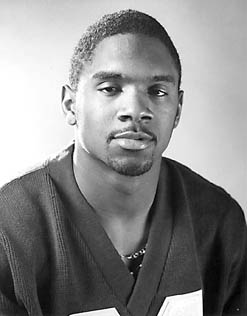
CHARLES WOODSON, Michigan, 1997
(Photo from University of Michigan's Bentley Historical Library)
  • Played as cornerback, whose primary job is to cover the quarterback and try to prevent passes
  • The season he won -- his junior year -- he had 8 interceptions.
  • He also played on offense as a pass receiver, and on special teams offense returning punts.
  • That year, he blew away Peyton Manning, Randy Moss, and Ricky Williams in the number of votes he received for the Heisman.
  • Started as a true freshman and was a two-time All-American.
  • He went on to play for the Oakland Raiders the following year, and was named the NFL Defensive Rookie of the Year.

And that's it. Everybody else is either a running back, quarterback, full back, or wide receiver. But mostly it's running backs who've won.

While the list of Heisman Trophy winners is like a mini-hall of fame list, here are some especially notable winners:

  • Paul Hornung, Notre Dame, 1956
      • Quarterback
      • NFL Green Bay Packers (halfback)
      • MVP in 1960 and 1961
      • Known also for his abilities to run, pass, block, and tackle. He was also a placekicker.
      • Vince Lombardi: "the most versatile man who ever played the game"
  • Roger Staubach, Navy, 1963
      • Quarterback
      • NFL Dallas Cowboys
      • 1st year in the NFL he was 27
      • MVP of Super Bowl VI
      • Voted into the Pro Hall of Fame the first year he became eligible
  • Archie Griffin, Ohio State, 1974 & 1975
      • Running back
      • 31 games with 100+ yards his senior year
      • Only player ever to win the Heisman twice
      • Woody Hayes: "the greatest football player I've ever coached"
      • NFL Cincinnati Bengals
  • Tony Dorsett, Pittsburgh, 1976
      • Running back
      • Still holds numerous NCAA records including most seasons with 1,000 yards, most yards, most yards rushing, and several others
      • NFL Dallas Cowboys
      • Named Rookie of the Year in 1977 and played in the Super Bowl as a rookie
  • Barry Sanders, Oklahoma State, 1988
      • Running back
      • Averaged 200 yards per game his junior year, the year he won the Heisman
      • NFL Detroit Lions
      • Sanders won Rookie of the Year with the Dallas Cowboys
      • Despite the Lions' abysmal performance, Sanders continued to rack up enormous statistics and to win several accolades for his abilities

And of course, this list would not be complete without:
  • O.J. Simpson, U of Southern California, 1968
      • Tailback
      • Broke several NCAA records in both 1967 and 1968
      • Won the trophy in the biggest voting landslide in the Heisman's history
      • NFL Buffalo Bills and San Francisco 49ers
      • First running back to pass the 2,000-yard per season mark
      • Sold his Heisman Trophy in 1999 for $230,000 to pay part of the verdict against him in the wrongful death suit won by the families of Nicole Brown Simpson and Ronald Goldman.

Enough of him. How about this instead:

Keep your eye on #2. One interception after another, TD receptions, even a pass of his own.
If you don't want to watch the whole thing (the sound is annoying), check out Woodson's leaping interception at about 3:50.


Sources
Heisman.com, Heisman Winners by Year, The Heisman Trophy
New York Times Obituaries, "Larry Kelley, 85, a Yale End Who Won the Heisman, Dies," June 29, 2000
College Football Hall of Fame, Leon Hart
Pro Football Hall of Fame, Paul Hornung, Roger Staubach
About.com, Football, O.J. Simpson