Tuesday, July 8, 2008

Apple #327: Summer Reading

I love books. I love reading. Reading is one of my favorite things to do. I like holding books, I like paging through them, I like looking things up in books. I like going to libraries (I used to be a librarian, you know), and I like going to bookstores -- used or new -- and finding treasures. I like books with pictures in them. I like listening to people read books to me. I like reading before I go to sleep at night, and I like reading while I eat my lunch.

My dad said to me once, looking up from a book he was reading, "Aren't books wonderful things? Somebody took the time to write all of this down so other people could read it. Magnificent."

My thoughts exactly.

As you probably know, I was off on vacation for a week. I went to one of the best places in the world, ever, and it was beautiful there. I did quite a few outside things, but I also did a ton of reading. I was there with my parents, and at two or three points throughout each day, in between running errands or fixing this & that, we would stop for lunch or a snack and read. At the beginning of the day, we'd start out with the paper, and then as we finished with that, we'd each move to our respective novels and histories. By night time, the three of us would all be sitting around the coffee table -- my dad in the big wooden rocking chair, my mom in the blue upholstered rocking chair, and me on the couch -- reading. Familial bliss.

Want to know what we were reading? Okay.

My dad:

  • Mr Lincoln's Army, and then A Stillness at Appomattox by Bruce Catton. They are 2 of the 3 volumes in the set called The Army of the Potomac. My dad read out loud a few passages to my mom and me, one in which Lincoln paid a visit to General McClellan who was taking his time about things. Lincoln said to McClellan, "If you don't want to use the army, I should like to borrow it for a while." My dad likes Civil War histories almost as much as he likes World War II histories, but he especially likes Bruce Catton's writing style. John Miller, one of Amazon's reviewers agrees: "If every historian wrote like Bruce Catton, no one would read fiction."


  • He finished those two and moved on to Panama Fever: The Epic Story of One of the Greatest Human Achievements of All Time-- the Building of the Panama Canal, which is just out this year, and something my mom brought home from the library for him. It has several photographs, and my dad always starts a history book at the photos and reads forward from there. He showed me one photo of the locks when they were closed, no water on the side from which the photo was being taken. I don't know the height of those enormous metal doors, but the person standing in front of them looked about the size of a wee pencil in comparison. He also read out that Panama had several feet of rain one year when the canal was being built. Yes, that's feet.
  • Waiting in the wings for him are several P.D. James mysteries. He likes P.D. James quite a bit. He says sometimes the things that happen are distasteful, but he enjoys the writing so much he's willing to overlook the unsavory parts. The next one on top of the pile is A Taste for Death (Adam Dalgliesh Mysteries, No. 7).

My mom:


  • Immediate Family by Eileen Goudge. She told me it's about four friends, one of them a man, and each of the friends has a different and somewhat dramatic thing going on. One of the friends, a woman, really wants a baby. So the wife of the man tells him to go get her pregnant, which he does (reminded me of The Big Chill). In the meantime, someone also seems to have been involved in the shooting of the girlfriend of an aging rock star. My mom said she knew right away who the guilty culprit was, but having figured out that mystery certainly didn't ruin her interest because she read the whole thing in a day or two, even stayed up late one night to finish it.
  • I didn't see the title of the next book she started, but I know that she bought a copy of Henri Nouwen's Our Greatest Gift: Meditation on Dying and Caring at the used book store one day. She really likes Henri Nouwen, and when she sees one of his books (used) that she doesn't already have, she'll buy it. She said the way she reads his books is a page or sometimes only a paragraph at a time, and then she puts it down and thinks about it, lets it sink in for a while.
  • To make up for the fact that I didn't see the title of the next thing she read, I'll tell you that she also likes novels by Jan Mitford, the Miss Julia series by Ann B. Ross, and she liked quite a few novels by Elizabeth Berg. Recently, she read One True Thing by Anna Quindlen, and she liked that. She sometimes likes Tess Gerritsen (scary, says my mom), and every once in a while when she can't find anything else she'll read a Danielle Steele and sort of put up with it.
Me:


  • The Men and the Girls by Joanna Trollope. That is a thoroughly stupid cover and does not fit her writing style at all. Joanna Trollope is one of my recent finds, and fortunately she is wonderfully prolific, so I almost always find a book of hers that I haven't read yet. She takes a situation in marriages or families -- second marriages with step-children, for example, or couples who are unfaithful with friends, or young women who are searching for careers and romance at the same time, or in this case, older men (60s ish) who are married to younger women (early 30s ish) -- and shows how it plays out in two families. Trollope is really good at making the children real and moving among everybody's point of view, keeping you up to date on what everybody is thinking. When they start freaking out, she lets you follow along as they figure out why. She's very big on no self-pity, and if a character gets too caught up with a particular house or apartment at the expense of someone else, you can bet that character is going to wind up the loser.
  • I'm also wading through You Must Remember This by Joyce Carol Oates. This is the fourth JCO novel I've read in a row (I have my reasons), and it's getting a little old. She usually combines a tale about somebody who suffers some extraordinary violence at the beginning with some sort of cultural situation. In one book, the cultural situation was the lawyers and how corrupt they can be, in another it was doctors. In this one, it's the Cold War and bomb shelters. That topic never interested me to begin with. The place where I've paused in this book has taken a break from the personal story and is spending time on Eisenhower and bomb shelters and panic about nuclear war, and I find it dull. As soon as the story of incest with the uncle picks up again, I might get back into it. But this might be one that fades away.
  • Mrs. Eckdorf in O'Neill's Hotel, by William Trevor, is one that I'm reading with great interest. In this novel, Mrs. Eckdorf is a photographer who finds out about very personal, heart-wrenching stories and goes and takes photographs of the people involved and publishes it all in documentary-like coffee table books. She's shown up at the O'Neill Hotel in Dublin because she believes some terrible tragedy happened there in the past, and she's determined to find out what it is and get pictures of everybody still caught up in the tragedy. But the people who live in this dilapidated hotel that is sometimes used for prostitution do not cooperate with Mrs. Eckdorf's plans. Mrs. Eckdorf, sometimes prone to shouting at herself in German in the middle of the street, kind of loses it. I find this book especially interesting to read during our current mania for tell-all memoirs. William Trevor has such a deft and gentle touch, and this novel is no exception. The novels of his I like best are those that deal with people who are off their rockers. So in my estimation, this is at the top of my list of his books.


  • From the library, I checked out a copy of Mrs. Pollifax and the Second Thief on tape, to listen to in the car on my drive back. I like to listen to books on tape as I'm driving long distances, but I make sure to pick novels that don't require intense thought, otherwise I tend to drive past exists and other places where I'm supposed to turn. My mom and I used to read Mrs. Pollifax books back when I was maybe 12 or so, and when she declared that the newer ones weren't as good, I took her word for it and left them behind. This title is the 16th of 22 and it's not too bad. Anyway, if you're not familiar, Emily Pollifax is a grandmother, a member of her garden club, has studied karate for enjoyment for years, and winds up becoming a spy for the CIA. Listening to this book now, I think the CIA sounds more British than American, or at least her two handlers, Carstairs and Bishop, seem far more gentle than I imagine most CIA guys to be. She gets into all kinds of scrapes (in this one, she's in Sicily being followed by many suspicious cars and being tracked by a notorious international assassin). Her adherence to manners, decency, and common sense are what help to get her out again. And she sometimes has the help of a dashing fellow agent named John Sebastian Farrell. In this one, Farrell is wounded and needs her help.

Hopefully, at least one book from all these titles will pique your interest and you'll check it out from your local library or book store. If you're not interested in any of these but you'd like some more suggestions, click on my label entries about art and books, and scroll down to find a few entries about other books and authors.

Or of course, a great place to look is at your local library's web site. Usually, libraries have lists of recommendations under such titles as "Recommended Reads" or "Reader's Advisory" or "If You Liked [Author Name Here]." Your local library is a great resource. Don't be afraid to ask the librarians for suggestions. For a librarian, that's the very best kind of question to be asked -- in my opinion, and I think most librarians would agree -- because you get to talk to people about books and what they like to read. Yum.

Tuesday, July 1, 2008

Apple #326: Tilapia

Okay, remember that dinner party where we wound up talking about outer space? Well, one of the things we ate at that dinner party was some very tasty tilapia, prepared by our talented and thoughtful host.

I am not normally a fish-lover -- it's the texture that gets to me first, and then the fishy flavor, so lots of fish is pretty much off my menu. But I enjoyed the tilapia. There was a lemony sauce on top, nothing too overwhelming, but enough to give it a bit of sweet flavor. It was kind of like the fish version of chicken.

We all commented on it, complimented our host of course, wondered where it came from. (Aha, thought I. Some Daily Apple material here.) I guessed South America. Sounded like a good enough guess to everyone.

  • My guess was wrong. Tilapia comes from North Africa. The most prevalent species of Tilapia is the Nile Tilapia.
  • One thing to note is that some people confuse Nile Perch (Lates niloticus) and Nile Tilapia (Oreochromis niloticus). They are actually different types of fish.

Nile perch (Lates niloticus)
(Image from Wikipedia)

      • Nile perch live mainly in the major lakes of Africa
      • They have an almost pointy head, and they are silver with a blue tinge
      • They are super aggressive eaters, and will eat bugs, crustaceans, and other fish, including its own species.
      • Nile perch is very popular and has been introduced to a lot of places, but because it's so aggressive, it has either eaten or almost eradicated several species.

Nile Tilapia (Oreochromis niloticus)
(Image from the Southern Regional Aquatic Center)


  • Nile Tilapia like to eat water plants and algae, but they'll also eat little tiny animals and plankton. They don't filter the plankton the way that carp do. Instead, they secrete a mucous on their gills, the plankton gets trapped in the mucous until it forms a ball, and then the fish eats the ball of mucous and plankton. Ew.
  • They generally prefer warm fresh water, but they can tolerate brackish or salty water, too. They don't like true saltwater as much, though, so that means they tend to prefer living and swimming in rivers rather than in sea water. You can, of course, also raise them in ponds and tanks.

Nile Tilapia swimming around. One of the things they like to eat is mosquito eggs. So some scientists think they might be helpful in reducing the spread of malaria.
(Photo from FishChannel.com)


  • They don't mind a lot of nitrites in the water, and they're very resistant to diseases that tend to wipe out other types of fish.
  • They also spawn and grow quickly, so it doesn't take long before you can eat them. This is why lots of countries around the world are raising and eating tilapia.
  • Because they grow so quickly and easily, even in poorer conditions, they can become an invasive species, too, if they are not managed properly.

A bunch of farm-raised Nile tilapia that have just been caught.
(Photo from fishfarming.com)


  • But now, lots of people raise tilapia, mainly on fish farms, all over the world.
  • Most of the frozen tilapia sold in the US comes from China. Some food advisory people say to avoid tilapia raised in China and Taiwan because they tend to live in waters that are more polluted than what people in the US would allow.
  • But you can also get fresh tilapia that's grown up in Central America, in countries like Honduras, Ecuador, Costa Rica, and Trinidad and Tobago.
  • It's also raised in various places in the US, such as in Virginia and South Carolina. But it's such a relatively easy fish to raise, and it tolerates tank life very well, that probably you could find fresh tilapia that comes from just about any place.
  • In fact, they are so prolific that people in Indonesia used to regard them as pests, until they started eating them.

Fillets of Nile tilapia
(Photo from fishfarming.com)

  • Because it doesn't have a very strong fishy flavor, tilapia is becoming increasingly popular in the US. In fact, it is now the fifth-most consumed fish in the United States, behind other favorites like tuna and salmon.
  • Some chefs, though, poo-poo the tilapia. "Insipid," they call it. "Sponge-like," "flavorless," and "trash fish." These chefs are too good for the tilapia, apparently.

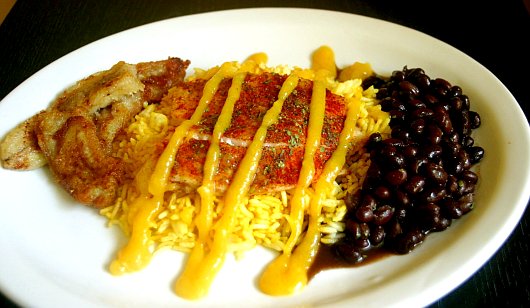
What grilled tilapia could look like on your plate
(Photo from MyRecipes.com's 7 Ways with Tilapia)


  • Mainly, you can grill it, broil it, or bake it -- pretty much the same as with most fish.
  • One easy recipe says to put the fillets on a piece of foil, give them each a tablespoon of butter, salt & pepper them, add some garlic, basil, and chopped tomato. Pour a cup of white wine over the lot, roll up the foil, stick it on the grill (medium heat) for 15 minutes until they're flaky. And that's it.
  • Another one that requires only slightly more work sounds pretty good to me, too: Tilapia with balsamic butter sauce. Simmer the vinegar and some garlic in a saucepan until it reduces, for about 5 minutes, set it aside. Salt & pepper the fish, put them in a skillet with some oil, and saute them for about 2 minutes per side. Then add some butter to the vinegar sauce, pour it over the fish, and you're done.

If you prefer spicy, you might want to try the Tilapia with Spicy Mango Salsa
(Recipe and Photo from In the Kitchen)


And with that, I am taking my leave for a bit. I'm going off on vacation. I'll be back probably on Sunday. Not sure whether I'll be able to give you a new entry on Sunday night or not. We'll see.

In the meantime, enjoy those fireworks and watermelons!


Sources
Len Spoden, "Two Sides to Every Tilapia," The Washington Post, August 8, 2007
Aquaculture blog, Tilapia Culture, February 3, 2007 -- a great overview
American Tilapia Association, FAQs for Tilapia -- these links open separate Word documents, which in some cases are not what the links say they're going to be.
Thomas Popma and Michael Masser, "Tilapia: Life History and Biology," Southern Regional Aquaculture Center, March 1999
Randy Sell, Department of Agricultural Economics, North Dakota State University, Tilapia

Sunday, June 29, 2008

Today

is my birthday.

It is also the anniversary of something that didn't turn out so well.

They say that people tend not to remember mixed emotions as well as they remember feeling either happy or sad. So I'll try to make this day memorable for happy reasons.

Thursday, June 26, 2008

Apple #325: How to Get to Outer Space

I was at a dinner party the other night, and I forget how this came up -- oh! I remember! I mentioned that it was finally explained to me, through some episode of Nova or something like that, that weather is actually the effect of Earth spinning through space. That is, the air that's rushing around our planet is outer space, which just happens to be within Earth's atmosphere. I said that knowing this made the volatility of weather make more sense to me. It's from outer space! Of course it's going to be fierce and crazy!

(No remarks, please, about the nerdiness that I bring to dinner parties. You don't know what else happens at these gatherings that I don't tell you about. Oh, the Parcheesi games . . .)

In response to my news about the weather coming from outer space, one member of the dinner party asked, "Where does space start, anyway?"


Looking back to Earth from a shuttle in outer space
(Photo from Hemmy.net)

There was much discussion about this. I said that it was outside the earth's atmosphere, but none of us knew how far above the earth's surface you have to go to get to space. We made lots of guesses and speculations: as far away as it is to drive from here to California? 300 miles? 1,000 miles?

The question itched at me, and I asked my host, who is a teacher, if she had any sort of science textbook on hand. I remembered, once upon a time in my grade school career, seeing a diagram that showed the various levels of the earth's atmosphere with arrows and measurements indicating how high up they were. Sadly, my host said she had no such book, but that if I wanted to, I could go get on yon internet and look it up. Like the absolute giddy nerd that I am, I ran up to her computer room and got to Googling.

I found the answer, shared it with my fellow dinner-eaters, and together we marveled at this fact:
  • Outer space is defined as starting 62 miles above the Earth's surface. This is not far.
  • If you could drive your car to outer space, and if you drove 60 miles an hour, it would take you just over an hour to get there.
  • Here's another perspective on it: most commercial airline jets fly at 36,000 feet. That's about 6.8 miles, or 1/10 of the distance to get to outer space.


This diagram shows lots of the stuff that's up in the air at their respective heights. On this diagram, space starts at the 100 km mark.
(Diagram from Kowoma's GPS Explained page)


  • That 62 mile marker is totally arbitrary, by the way. The unit of measurement that scientists use is kilometers, and 62 miles equals 100 kilometers. So some scientist at some point seems to have picked a nice round number for the place where space begins.
  • One scientist argues that the true beginning of space should be defined as the place where the Earth's gravitational pull no longer has any effect on you. The place, he argues, where your home can no longer draw you back to it.
  • The rough location where Earth's gravity wouldn't affect you is 13 million miles away (a.k.a. 21 million kilometers). Now that is outer space.


The view from where outer space starts, or 62 miles above the Earth's surface. Looks pretty outer-spacey to me. I mean, I wouldn't want to be out there all by myself.
(Photo from Space Today Online)


  • But okay, let's say you want to go to regular old 62-mile-away space. That's not that far, as we've established. So why don't people go there more often?
  • Because to get there, you have to overcome that pervasive and mysterious force that no one really understands: gravity. It's one thing to say you're going to get past Earth's gravitational pull. It's another thing to actually do it.
  • To get yourself up in the air, you have to use a force greater than the force that's pulling you down to the ground (32 feet per second per second). Think about how hard it is for you to jump very high. Think about what a big deal we all make of it when a basketball player can jump high enough to grab a basketball out of the air and dunk it into a basket. That's only a few feet. And we're trying to go 62 miles.
  • (By the way, the record for the highest slam dunk goes to Michael Wilson of the Harlem Globetrotters, who dunked the ball successfully into a 12-foot hoop. That's not even 1/27,000 of the distance we're shooting for here.)


The celebrated Michael Jordan, performing one of his signature slam dunks. The top of his hoop is only 10 feet high -- not even as high as the one dunked into by the world record holder.
(Photo from NBA.com)


  • To get outside the realm of the Earth's gravity, you have to go fast enough to overcome the force of gravity itself, multiplied by the mass of the Earth, divided by its radius.
  • Leaving out all the messy math, this works out to be 11.2 kilometers per second. That's also known as 7 miles per second, or 25 thousand miles per hour.
  • To reach 25,000 mph, you have to have a huge force propelling you up there.
  • But of course you can't shoot just your body up into space -- you would burn up on the way out of the atmosphere. So you've got to have the appropriate pressurized suit, and the oxygen tanks so you can breathe up there, and you'd better put it all in a vehicle of some sort. So you'll need to get yourself a rocket ship.


You can get your very own Apollo Moon Suit replica, built to replicate those worn by the astronauts on the Apollo missions, for a mere $2,460 from the Space Store. The suits are custom-made, so you get no returns, no discounts.

  • Assuming you're going to use the same sort of rockets that NASA uses, your rocket by itself won't weigh all that much, only about 165,000 pounds. When you add the necessary boosters, it goes up to about 428,000 pounds.
  • But generally speaking, the amount of fuel you need for your rocket is in a ratio of 36:1. So, when you add the amount of fuel you need to your rocket and the boosters, you get an entire package that weighs around 4.4 million pounds.
  • Then, because your fuel is going to burn up wicked-fast -- in about 8 minutes, actually -- you'd better bring enough fuel to generate 4.5 million pounds of thrust.
  • Different rockets are propelled by different types of fuel, depending on their destination (the moon, Mars, someplace else). One option is to use liquid hydrogen in one tank and liquid oxygen in the other. Then let these two things get together, but in a controlled way, and you have an explosion strong enough to propel that 4.4 million pounds of stuff 62 miles, and then some.


The space shuttle Discovery's first launch on July 4, 2006. All that fuel interacting and exploding is what makes those huge billowing clouds of smoke.
(Photo from NASA)


  • The whole feat is so difficult to accomplish that if you can get your rocket to make it even 50 miles up, NASA will give you astronaut status.

All that to go 62 miles up. I'm going to think about this the next time I'm driving 62 miles horizontally, more or less.

Oh, and if you want to go on to the moon, you've got another 238,732 miles to go. But maybe after that first 62, the rest is cake.


Sources
"How High is Space?" Space Today Online
Seth Shostak, "Gray area where space begins," Space.com, reprinted at CNN.com, June 25, 2004
What is Space? Space I: Worksheet 9, Native Access to Engineering Programme, Concordia University, Montreal
Katrina C. Arabe, Ride a White Hot Rocket, Industrial Market Trends, August 4, 2004
NASA Facts Online, Propellants

Sunday, June 22, 2008

Apple #324: G Forces

Long-time readers of the Daily Apple may remember that I like to watch Formula One racing. There was another race today in France. (Felipe Massa came in first. My favorite driver, Fernando Alonso, came in 8th, but at least he got a point.).

One of the things the TV broadcasters do during each race is to show you the race from one of the driver's perspectives with an on-board camera. So you're watching as if you're the driver, looking out over the nose of the car while it is going at incredible rates of speed along the track and whipping around corners.
  • Just how fast are they going? Well, in this most recent race, Kimi Raikkonen had the fastest lap with a time of 1 minute 27 seconds. That's how long it took him to drive once around the 4.411 km track (2.7 miles). That means, averaged out over the entire track, he was going just over 113 miles per hour in that particular lap.
  • Big deal, you say? Well, this isn't like NASCAR where the track is just a circle. These tracks have super-tight turns, sometimes switching left & right several times in succession (chicanes). So the driver has to down-shift and slow down to make it around those turns -- though without losing so much speed that the guy behind him can pass -- and then they speed up again in the straightaway.

This is what the track looks like at Magny-Cours, France, where today's race was held. Image driving that thing at an average of 113 miles/hour in your Honda or whatever it is you drive.
(Image from BBC Sport)


  • It's difficult for me to guess how fast they're going on the straightaway, because though the announcers will sometimes mention their speed, it's always in terms of kilometers per hour, and I can't convert from kilometers to miles in my head, on the fly. But if I remember right, on other courses, sometimes the fastest lap is around 180 miles per hour. That suggests to me that, during this race, the drivers were going at least that fast on the straightaways.
Here's an example of the onboard view. This is of Kimi Raikkonen driving through the streets -- yes, those are the streets -- of Monaco in 2008. You can see people standing on the other side of the barriers they have erected at the curbs. This is just a practice lap, not an actual race.


(You can also see this video is a higher-quality version here)


Okay, so you're watching the drivers manipulate their cars at these 120 mile/hour plus rates of speed on the course, from the point of view of the driver. In addition to this perspective, the TV station sometimes puts up a graphic that shows the G forces the driver is experiencing. It looks like a target with a great big G in the middle and concentric circles radiating out from it. On this target they put a dot, green as it's closer to the middle and red as it moves to the outside. This is supposed to show what it feels like to be the driver as the car is going around the turns and the force of the speed and the turn is trying to push the driver's body to the outside of the turn.

In addition to this pictorial representation, they also have a scale with numbers along it and as the G forces increase, a green bar goes farther up the scale. So you also get the G force in numerical terms as well as in a spatial representation.

Now here's my question. I sort of intuitively get what they mean by G forces. But what are G forces, exactly? And at what point do you say, Wow, that's a lot of force?

  • Just by standing on the surface of the Earth, gravity is exerting a force on you. The force of gravitational pull is expressed as 1G.
  • Any time you move, you have to accelerate in some direction or another, and you have to do so enough to overcome the force that gravity is working on you in order for you to move. This is true whether you want to move vertically, horizontally, or in any direction.

When you first begin to run, you have to work hard to overcome the fact that you were first at rest. While you are mainly feeling the strain of your muscles working, your body is also experiencing a slight increase in the G forces pressing against it.
(Photo from Kapunahala Elementary School's page about speed)


  • It's important to remember that it's not speed that creates G forces, but a change in the rate of speed -- accelerating or decelerating -- or a change in direction.
  • As you accelerate, your body experiences that change in force. But most of the time, you're not accelerating that much, maybe a micro-unit above the force of gravity (something like 1.00000001G), so you're not really aware of it.
  • It starts to become a big deal when the force of acceleration doubles or even triples the Earth's gravitational pull -- 2G or 3G.
  • But it's really only a big deal if those G forces are experienced over a significant length of time. If you jump down from even the lowest step on a flight of stairs, you're moving faster than the rate of gravity by 2 or 3G when you reach the floor, but you experience that level of force very fleetingly. The average sneeze creates a force of around 2.5G.
  • Sustained over time, however, at even 3G, most human beings will lose consciousness. During World War I, when people were sending pilots up pretty much for the first time, they discovered some of the pilots were "fainting in the air," and that's how they found out about G forces. It was decided that people could not withstand G forces more than 18G.
  • The reason people faint at higher G forces is because your heart has to work that many times harder to keep the blood pumping throughout your body. If your body experiences a blip of high G forces, your heart says, "Okay, I can handle that." But if your body is constantly getting buffeted by the force of continued acceleration, your heart has to keep working extra-hard that entire time. And after a while, it just can't keep up, you get less & less oxygen to your brain, until finally you pass out. Or something else in your body gives way.

Diagram showing that people can withstand higher G forces for different amounts of time -- and depending on their body's position. If you are reclining, your heart doesn't have to work as hard to pump the blood around. Thus the pilots can withstand higher G forces if they're lying down.
(Image from Combat Reform -- a huge page with tons of images, so beware of data overload)

  • When you ride a roller coaster, you're also feeling the effects of high G forces. But the coasters are built so that those G forces won't be sustained for any length of time. Or when you're in a commercial airplane and it's taking off or landing, you're feeling the effect of high G forces.

This woman is riding a roller coaster, looks like The Hulk, which is at Universal's Islands of Adventure in Orlando. This coaster reaches forces of 4.5Gs.
(Photo from WKMG Orlando Local6.com)


  • While we're on the subject of roller coasters for a moment, one driver said that because of all the G forces, driving an F1 car felt like riding on a roller coaster, your body getting slammed around in that same way, except you have to drive it.
  • Today's astronauts, who get propelled out of the Earth's atmosphere at insane rates of acceleration, have to withstand 3Gs of force for the whole time the rocket is shooting up into space. Astronauts on board earlier space crafts endured forces of 9G.
  • Fighter pilots, whose airplanes can also accelerate at ridiculous rates, also have to withstand high G forces for extended periods of time, and up to 9G when they pull a tight turn. I should note, though, that fighter pilots now also wear special anti-g suits that have additional pockets of air and are constricted around the legs to help keep the blood flowing, so that they don't have to worry so much about passing out.
  • Formula One (F1) drivers fall into third place in the category of people who typically experience high G forces over long periods of time. Typically, when F1 drivers accelerate out of corners, they're feeling G forces of around 1.5G to 2G. As they're going into and around the corners, though, the G forces often reach 4G, and up to 5G when they hit the brakes. Sometimes, when they have to decelerate very quickly, the G forces can even be negative. Somewhat surprisingly, negative G forces are even harder on the body.
  • At 5G, your head, which weighs about 10 pounds, feels like it weighs 50 pounds. You have difficulty moving your hands and feet, lifting your arms, and keeping your head up.

Pilot John Stapp enduring all sorts of changes in G forces as he made a 421-mph ride in 1954.
(Photo from Nova's page about G forces)


  • Since Ayrton Senna's death at Imola in 1994, F1 officials have required F1 race tracks to have more turns in them so that the cars would not be able to get up as much speed and thus be required to decelerate as much when they encounter turns -- in effect, lowering the G forces throughout the track.
  • While astronauts and pilots are experiencing a downward pull as their crafts propel them into the atmosphere, F1 drivers are going around, more or less, in a circle. So their bodies want to continue in that trajectory of the circle. But when the car changes direction, the driver's body gets thrown toward the outside of that circle. In addition, when the car slows down or speeds up, the driver's body is moves forward as the car is slows, or is pushed back against the seat as the car accelerates.
  • So the F1 driver's body is getting shoved around in all kinds of directions almost all the time they're racing. This is one of the reasons why you can see their heads kind of bobbling around in the car as they're driving. And the helmets they wear weigh about 14 pounds.
  • Lots of F1 drivers do specific exercises to strengthen the neck so they're better able to withstand all that bouncing around. In one program about F1 racing, I saw driver Jarno Trulli with a strap around his head which was attached by a cable to some weights on a weight machine. Sitting on the machine's bench, he tilted his head sideways, away from the machine, so that the strap pulled the cable and lifted the weights. I'm sure they all do similar exercises. Kimi Raikkonen's neck, for example, is looking more and more like a football player's.

Kimi Raikkonen, last year's Formula One champion, has been keeping up with his neck exercises.
(Image from Sportingo.com)


Here's another onboard view, this time with Fernando Alonso. This is the beginning of this year's race in Canada, and this gives you an idea of how fast these guys accelerate off the pole and how crazy it is at the beginning of every race as everybody's trying to get a better position and not crash. You can also see how much his head moves around as the car goes over bumps or around corners.


(You can also watch a higher quality version of Alonso's race here)

  • The effect on F1 drivers' cardiovascular system is even more significant. One study found that two drivers, who were averaging between 145 and 155 miles per hour in a given race, had their pulse rates go up to 175 to 200 beats per minute. Generally speaking, most people's pulse rates when at rest are around 60 to 80 beats per minute.
  • "It's extremely exhausting," says one member of the motorsport group at Cranfield University (UK).
  • Another driver said that because of the G forces, driving an F1 car is "like wrestling with King Kong."
  • When John Dixon decided in 2004 he wanted to try make the leap from Indycar driving to Formula One, he did pretty well in a test run, as far as keeping up with the rest of the pack, but he said the G forces in the corners were "huge." He went on, "The acceleration isn't too bad because your head is resting most of the time, but the g-forces turning and the braking in the braking zone, your head goes down and you have to slowly bring it up. The forces are way more than what we get. I lasted about three runs before my neck was done."

I have a couple other entries about Formula One racing, in case you're interested:
  • Formula One Racing - basic information about the sport, plus photos of leading drivers and some crashes
  • Nail-Biter - from 2006, in the midst of the season, around the time Schumacher announced his retirement, with one photo (I had others but they have since gone AWOL).


Sources
National Physical Laboratory, FAQs, "What are 'g-forces' and are they caused by gravity?"
Peter Tyson, All About G Forces, Nova
Argonne National Laboratory, Ask a Scientist Physics Archive, What is the greatest amount of g forces experienced?
M. Colleen Gino, Human Spaceflight, Astrophys-Assist
Ian Sample, "How grueling is formula one?"
The Guardian, March 3, 2005
Eric S. Watkins, "The Physiology and Pathology of Formula One Grand Prix Motor Racing," chapter 14,
Clinical Neurosurgery, Volume 53, 2006.
Formula One Drivers Fitness, F1 Complete, November 19, 2006
"Dixon keen on F1 move," BBC Motorsport, March 29, 2004

Sunday, June 15, 2008

Apple #323: Sunflowers

It's kind of difficult to think of another Daily Apple topic at the moment, since Tim Russert's unexpected heart attack and death. Lots of people have been stopping by here to read my entry about him and to look at the pictures I'd posted, and some people even posted their own very gracious, moving comments in remembrance of him. Like so many people, I'm shocked and saddened to lose someone who contributed so much to our country's discourse, and did so in a way that was never smarmy or vitriolic but always respectful, decent, and human.

But he was also indefatigable when it came to his job. Thoroughly prepared, reliable, and unflinching. So, taking my cue from him, I will press on.

After some thought, I decided to do today's entry about sunflowers. My friend Mike likes them. They're huge and they seem to be entirely positive and pretty as well as useful. So sunflowers, it is.


The Elite Sun variety of sunflowers
(Photo from Buckingham Nurseries)


  • Sunflowers generally grow to be 8 to 15 feet tall.

This man's Sawtooth Sunflowers can grow up to 20 feet tall.
(Photo from Bluestem Nursery)


  • The sunflower is the state flower of Kansas. It is also the national flower of Russia.
  • Kansas' climate suits the sunflower perfectly: it likes open, grassy prairie areas, lots of sun, and while it likes a good amount of water, it can also survive periods of drought.
  • Sunflowers do not like the cold, though, and the first frost will kill them.
  • Sow new seeds after the last frost, and in 90 to 100 days, the plant will be mature.
  • Also when you sow your seeds, make sure the plants will be 2 to 2-1/2 feet apart. If you're growing the big ones, you'll want to stake them so they don't fall over.
  • In six months, the plant can reach 8 to 12 feet high. That makes sunflowers one of the fastest-growing plants.

One really enormous sunflower.
(Photo from Renee's Garden, where you can find lots of tips about growing super-huge sunflowers.)


  • One word of caution: some people are allergic to the sunflower's leaves and stems, and may develop a rash.
  • One wild sunflower head is actually 1,000 to 2,000 individual flower heads joined at a single base. Cultivated sunflowers have only a single head.

The wild sunflower, or the true Helianthus annuus (and also a bug). The center of the wild sunflower is not as huge or densely packed with seeds as the cultivated varieties.
(Photo from the Western New Mexico University)


  • The wild sunflower is one of four major crops that are native to North America (the others are blueberries, cranberries, and pecans).
  • All cultivated sunflowers are derived from the wild sunflower (Helianthus annuus), and some of the cultivated sunflowers can vary tremendously in size and color.

One type of cultivated sunflower, the Earth Walker. This variety will grow to about 9 feet, and you can eat the seeds -- and the flowers, too.
(1 packet of 30 seeds will cost you $1.47 from Thompson & Morgan's English seeds)


  • The flower's head will track the movement of the sun throughout the day. This trait is called heliotropism. This happens because the darker, unlit side grows slightly faster than the sunny side. That makes the head tilt toward the sun.
  • Native Americans used sunflowers for all kinds of things: roasted seeds, sunflower meal for baking or added to stews, a coffee-like beverage made from the hulls, dyes, face paint, cooking oil, hair oil, and medicinal treatments.
  • Europeans brought the sunflower with them to Europe, but it wasn't until the Russians started growing them as an edible crop that the rest of the Europeans did so, too. Today, Russia is the world's largest producer of sunflower oil.
      • One variety of the sunflower, the Russian Mammoth, is one of the oldest surviving cultivated types of sunflowers, known to have been sold by seed companies for at least 130 years.
      • In the US, three new types of sunflowers have recently been introduced, all of them for ornamental purposes.

Natural precision in the arrangement of the seeds
(Photo from In the Armchair)


  • The arrangement of the seeds in the head can be so precise, it inspired great mathematicians like Leonardo Fibonacci to study them. He discovered that the seeds are grow according to a precise ratio which he called the Golden Ratio. He arrived at this ratio using a pretty simple method, but the number works out to be 1.6180339. All kinds of stuff in nature progresses according to this number, including the spirals you can see in the head of a sunflower.
  • In addition to being a mathematical beauty, the seeds are hugely useful to people and to animals:
      • Sunflower oil, made from the black seeds, is the world's second most valuable oil seed.
      • Birds like sunflower seeds too, but they prefer the black seeds, not the striped-hulled ones.

Black sunflower seeds, the kind without stripes, the kind used to make oil, and the kind birds like best.
(Photo from Wild Bird Seed UK)


      • If you don't want so many birds in your garden and you want to eat the seeds, plant the ones with striped seeds.

The striped seeds: the kind you want to eat
(Photo from Wild Bird Seed UK)

      • Some squirrels will even climb the plant to get to the seeds.
  • Here's what to do if you want to harvest the seeds to eat:
      • Wait until the head has turned brown in the fall. The back of the head should also be a banana-yellow and turning brown. You might have to wait until after the first frost before this happens.
      • If the birds are eating all your seeds and they're not mature enough for you yet, you can cut the head off the plant and hang it in some enclosed place like your garage until the head is mature. You might also want to put a loose sack or cheesecloth around the head to catch any seeds that fall off on their own.

A pile of sunflower heads ready for the seeds to be harvested.
(Photo from a blog called 1916 Home)


      • Once you've cut the head from the plant, rub the seeds free with your hand.
      • Put the unshelled seeds in some sort of container.
      • Make some salt water, dissolving 1/4 cup to 1/2 cup of salt per two quarts of water. Pour in enough salt water to completely cover the seeds.
      • Soak the seeds in the salt water overnight.
      • Next day, drain the water and pat the seeds dry.
      • [If you don't want your seeds to be salted, you can skip the soaking process and go straight to the roasting]
      • Preheat your oven to 300 degrees F.
      • Spread the unshelled seeds evenly on a cookie sheet or shallow pan.
      • Bake for 30 to 40 minutes until golden brown, stirring occasionally.
      • A slight crack will often form on the length of the seeds as they roast. Taste to make sure they're roasted fully.
      • Store in an airtight container.
      • If you're going to eat them immediately, you can also roast the seeds with a cup of melted butter poured on top. Like popcorn!
  • According to what I've seen, it looks like hulling the seeds is kind of a painstaking process. You can't take the hulls off before the seeds are roasted anyway, so once you've roasted the seeds with the shell on, it's up to you if you want to "crack & eat" or try to split them one by one by hand. Commercial producers have very sophisticated machines to hull the seeds, so unless you want to buy a machine like that, you're hulling the seeds one by one, probably with your teeth.

A sunflower seed hull-removing machine, available for purchase from China. You probably don't have room for one of these in your kitchen.
(Photo from ECPlaza)


  • By the way, eating the hulls isn't bad for you. They're almost all fiber. The only possible drawback is that a piece of the hull might poke your innards on the way down, but this has not happened as far as anyone at the National Sunflower Association knows, so you're probably safe eating the hulls.

Carpenter bee visiting a sunflower
(Photo from the Great Sunflower Project)

      • They'll give you free sunflower seeds, and all you have to do in return is, two afternoons per month, record the temperature, watch your plants, and write down when 5 bees visit one of your plants.
      • You only need to keep watch for 30 minutes, because if 5 bees haven't stopped by in those 30 minutes, the Sunflower Project wants to know that too.

Sources
Floridata, Helianthus annus (Common names: sunflower)
Sherry Rindels, Iowa State University's Horticulture & Home Pest News, Sunflowers, April 26, 1996
National Sunflower Association, All About Sunflower FAQs and How to Roast In-Shell Sunflower Seeds
Netfirms, Complete Guide to Growing Sunflowers
Mrs. Davenport's Class, Facts about Sunflowers
Library Thinkquest, Fibonacci Ratios

Sunday, June 8, 2008

Apple #322: Pockets

The subject of pockets has come up in conversations with friends enough times that I thought that I must investigate. Because what if none of your clothes had pockets? No pockets in your skirts or pants or shorts or shirts, that's not too unthinkable because we all have some of those types of clothes that do not have pockets. But what if none of those items had pockets? And no pockets in your coat, either? A pretty major innovation, those pockets.

  • I can't find anything that backs me up on this, but it is my theory that the first pockets were part of saddles and draped across horses' backs. It is also my theory that, at some point, people decided that if the horse could carry a bag with pockets, then so could they.

Display of items made by the Nez Perce, a native tribe whom scholars estimate to have lived in the Pacific Northwest for some 10,000 years. Saddle bags are hanging in the upper middle portion of the photo.
(Photo from the Clearwater Historical Museum in Idaho)


  • Nobody knows when the first pockets for humans were invented. But scholars do know that the first pockets were not sewn into clothes but they were little bags worn outside the clothes, usually on a string that tied around the waist.
  • If this item sounds a lot like a purse, that's because it is. The words "pocket" and "purse" actually come from the same Germanic root word which means "bag."
  • One example of these types of early bag/pockets that you might be familiar with are the pouches that the Scots wore with their kilts. The word for those is sporran (which is a descendant of the Latin bursa, which means "purse").

This Scottish lad is proudly wearing his full kilt with sporran -- even though he's in Australia, not Scotland.
(This complete outfit and others like it are available for hire from Melbourne Kilt)


The little girl who is getting a garland of hop leaves sewn to her hat is wearing a pocket on her right side.
(Painting is William Frederick Witherington's "The Hop Garland" from 1834. Photo from the Victoria & Albert)


  • Later, other types of pockets were made to be tied around the waist and worn at the right or left side, easy to access with whichever hand you preferred.

This pocket from the early 1700s was worn outside the clothing and embroidered to make it decorative. The slit which allows the wearer easy access to the pocket's contents, is also embellished.
(Photo from the Victoria & Albert)


  • The problem with these outer pockets was that, just as they were easy for the wearer to access, they were also easy for thieves to dip into or even remove entirely from the wearer's person. So people started keeping them underneath their clothing, to make it harder for thieves to get to.
  • By the way, some pictures and drawings of these early pockets remind me of the kind of carrying pouches that people use today when traveling: simple canvas bags that are just large enough to hold passports and wallets, and which travelers are encouraged to wear beneath their clothes, for safety's sake.

A pair of pockets on a single string, designed to be worn beneath women's dresses and above the petticoat, from about 1800-1830 ish.
(Photo from the Victoria & Albert)


The "neck wallet" recommended by that seasoned traveler Rick Steves. It's a little more sophisticated, with the zippers and the cinchable strap, but the concept is an old, old one.
(The Essential Silk Wallet can be yours, from the Rick Steves website, for $12.95)


  • But the problem with the secreted pocket was the same as what many travelers find frustrating about those identity pouches: it's super annoying to try to get anything out of it without having to disrobe in public.
  • So then people started making slits in their clothing to make it easier to reach those under-the-clothing pockets. A thief could still slip his or her hand in there, but at least that was presented more difficulty than the above-the-clothes pocket. This slit-in-the-clothes innovation marked the beginning of the use of the word "pocket" as distinct from "purse" or other words meaning "bag," etc.

This woman is demonstrating how slits in the outer layers allowed access to the pockets beneath.
(Photo from The Staymaker, which includes other photos of how women dressed in the 18th century)


  • By the 1700s, men's pockets were sewn into their clothes, but women's pockets were typically still a separate item. (This is where the pocket branched into two forks -- pockets versus purses, one for each gender.)
  • Often, women wore their pocket/pouches underneath their dresses or beneath their petticoats. Most skirts and petticoats were made with a slit so the woman could discreetly insert her hand into the pocket.
  • Sometimes women still wore a pocket outside her clothes, but it often had embroidery all over it and became an item of fashion. So the external pocket evolved into a purse, and it became common for some women to have the purse that was on view as a fashionable object for all to see, as well as the hidden pocket that carried hidden secrets like letters or coins.
  • In general, what did people keep in their pockets in the way-back-when times? Well, it depends on which century you're thinking of, but basically, here are some of the items people used to keep in their pockets, roughly in chronological order:
      • Coins -- in fact, some believe that pockets were originally invented for the sole purpose of carrying coins. Other items found their way into pockets later.
      • Food (biscuits, jerky, fruit, candies, etc.)
      • Watches
      • Rings or other jewelry
      • Handkerchiefs
      • Love letters (billets-doux)
      • Pincushion, thimble, scissors, or other sewing implements
      • Small knife for cutting the pages of books or opening envelopes
      • Pencil case, pen nibs, other writing utensils
      • Mirror, scent bottles, combs
      • Miniature bottles or flasks of gin, whiskey, or other liquor
      • Snuff boxes
      • Rail or theater tickets
      • Eyeglasses

With the exception of the newspaper, these are the objects found in Abraham Lincoln's pockets the night of his assassination: wallet, a five-dollar bill, two kinds of eyeglasses, a pocket knife, can't tell if it's a handkerchief or the playbill, what looks like a change purse, and some other object that maybe was used for sealing envelopes? Click here to see the photo at a larger size.
(Photo from the Library of Congress)


  • Since the line "Potato I have" from Ulysses frequently goes through my mind, and since Bloomsday is coming up, here are at least some of the items that Leopold Bloom, at one time or another, carries in his pockets in 1904. I'm sure he's got more things in there, but without re-reading the whole novel tonight, this is the best I can come up with:
      • Potato
      • Latchkey
      • Pork kidney
      • Bar of lemon soap
      • Bottle of perfume (Rose of Castile)
      • Yellow flower with a pin
      • Love letter
      • Newspaper
      • His card
  • Now, in addition to many of the things I've already listed, people carry other, newfangled objects in their pockets -- items that people in the 18th or even early 20th centuries never would have imagined:
      • Cell phones, Blackberries, pagers
      • iPods
      • Flash drives
      • Car keys
      • Driver's license, credit cards
      • Disposable Kleenex

What else do you carry in your pockets that I haven't listed here?


Sources
BBC, The Guide to Life, the Universe, and Everything, A Very Brief History of the Pocket
Victoria & Albert Museum, Pockets
Jeff Elder, "History of Pockets? Lint me your ears; more,"
Jewish World Review, March 3, 2004
Barbara Burman and Seth Denbo, The history of pockets, posted by the Visual Arts Data Service (VADS) at the University College for the Creative Arts

Wednesday, June 4, 2008

Wikifame?

I just discovered that one of my Daily Apples was used as a source for a Wikipedia entry. I feel so famous!

The Wikipedia entry is about that oh-so-crucial topic, Spackling paste. And if you scroll down to the bottom of the fairly brief entry, you'll see in the References portion a link to my very own entry about Spackle.

I realize that Wikipedia is the encyclopedia written by the people, it's considered suspect and not all that reliable, etc. So it's not as if the Encyclopedia Britannica went linking to my blog. But still. Someone considers me an authority! About spackle! I'm blushing.

Sunday, June 1, 2008

Apple #321: Lightning

Yesterday some friends and I were outside, talking about swimming, and then it started to sprinkle. A few of us agreed that we had enjoyed swimming in the rain once upon a time, but then I asked, "Isn't it bad to go swimming during the rain, or something?" Yes, my friends assured me, because lightning could strike the water and you could be electrocuted.

Sometimes the physics of this world impress the heck out of me.


LIGHTNING AND SWIMMING
  • The National Lightning Safety Institute recommends that you NOT go swimming while it's raining or during a thunderstorm or any time you think lightning might strike. As one of my friends said, water is a conductor, so if lightning strikes the water and you're within about 20 feet of the strike, the electricity is probably going to shoot through the water and zap you.

If the sky looks like this, better not go swimming.
(Photo of the Hamilton Fish Pool in New York City, by Charlotte Cooper)


  • If you're swimming in salt water, that's potentially more dangerous, since salt water is an even better conductor of electricity than fresh water.
  • Or, what could be more likely, is that your head, sticking up out of the flat surface of the water, might be the highest point in the nearby area, so the lightning might strike you directly.
  • The National Lightning Safety Institute says that swimming in outdoor pools is also hazardous. If the lightning strikes the water, the electricity could travel not just through the water but also down to the base of the pool where there are pipes or perhaps the metal drain or maybe some wiring, the electricity would travel along that conductor as well as through the water, and then you're super-toast.
  • Even swimming in indoor pools during storms is not as safe as you might think. The lightning could strike some pipe that goes from the ground outside to the pool inside, or it could strike some wiring that supplies power to the heated pool, and then there goes the electricity along that metal conduit into the pool, which is filled not just with water but also with other chemicals, and then zappo! you're cooked.
  • To prevent such zap-you're-cooked scenarios, the National Weather Service recommends that you count the number of seconds in between the flash of lightning and the clap of thunder. They call this the Flash-to-Bang count. Each five seconds in between the lightning flash and the thunder represents one mile. As soon as you count 30 seconds between lightning and thunder, that's considered the danger zone, and you should get out of the water or away from any exposed location. If my memory of thunderstorms serves me correctly, that's probably in most cases when you can see lightning and hear thunder.

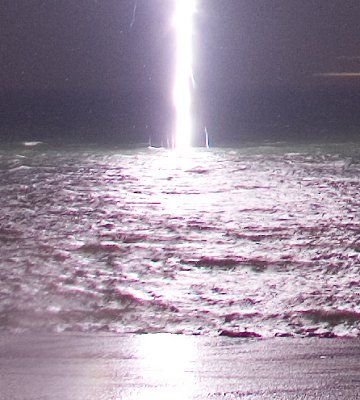
This is what it looks like when lightning hits water. You do not want to be around when this happens.
(Photo by Francis Schaefers and Daniel Burger, at spaceweather.com)


  • The best places to take shelter are in substantial buildings (not lean-tos but structures with walls and a roof) or a vehicle that has a metal-topped roof.
  • They also say that you should wait at least 30 minutes after you hear the last rumble of thunder before going back in the water. This is because most lightning comes from the back edge of a thundercloud than from its leading edge.
  • While it is not possible to have lightning without thunder (lightning causes thunder), it is possible to see lightning and not be able to hear the thunder because it is out of earshot.

GENERAL LIGHTNING FACTS
  • Lightning travels about 1 billion feet per second.
  • A lightning strike actually has two components: the cloud-to-ground strike and the ground-to-cloud strike in return, but it all happens so fast, it looks like it's a single event. (Storm Highway has animations that show this process in slow motion.)

A pretty clear cloud-to-ground strike, with several branches
(Photo from Wikimedia)


  • Lightning can heat the air anywhere from 18,000 degrees F to 60,000 degrees F. That's at minimum 7,000 degrees hotter than the surface of the sun.
  • Thunder is the sound of lightning expanding the air super-fast to such super-hot temperatures.
  • A typical lightning flash is about the thickness of a person's thumb.
  • Lightning strikes objects that stick up the highest in a landscape. This is why standing under a lone tree during a thunderstorm is probably the stupidest place to be.
  • It is not true that metal things will attract lightning to them. Lightning will typically strike an object that sticks up highest before it will "find" something made of metal.

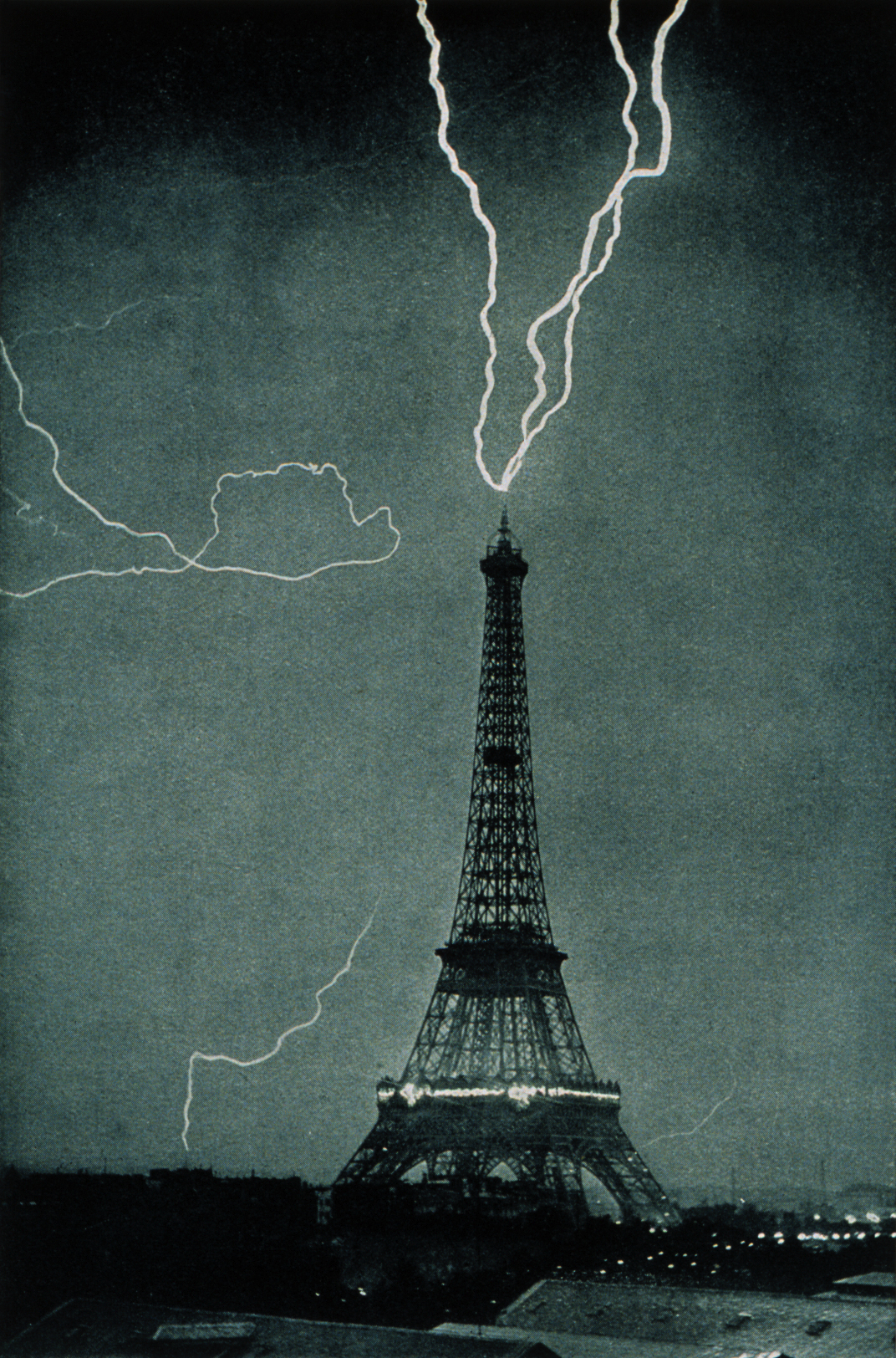
Lightning striking the Eiffel Tower multiple times in 1906.
(Image from NOAA, sourced from Wikipedia)


  • 8% of deaths due to lightning strikes happened to people in or on the water. Almost 14% of lightning-strike fatalities happened to people standing under trees.
  • Lightning that hits a tree will travel down the trunk and turn the water in the tree to steam.
  • If it strikes the ground, it will fuse the dirt and clay into silica rocks called fulgarite. Those rocks often take the shape of the path the lightning took across the ground.

A piece of fulgarite. This photo and more of fulgarite in different shapes from the Glendale Community College's Earth Science Image Archive.

  • It is possible to be struck by lightning while using the toilet. Electricity from the lightning could theoretically travel along the plumbing or through the water. Less than 3% of lightning strikes occur inside a building, so it's a very low-risk situation, but there is some risk.
  • NOAA recommends that if you are outside and isolated during in a thunderstorm, ditch the umbrella, and get into a crouch with your feet together and your head tucked in between your arms. To reduce the amount of you that is touching the ground (soil with its metals and other ingredients makes a good conductor), lift your heels from the ground, too. Though I can't imagine this is a position you could sustain for very long.
  • The state with the highest number of cloud-to-ground flashes is Texas, with an average of almost 3 million flashes per year from 1996 through 2005. Florida is a distant second, with about half that amount.

Global map showing the number of lightning flashes per year, averaged over 5 years. Central Africa has the highest number of lightning strikes.
(Map generated by NASA's Optical Transient Detector, sourced from NASA's Remote Sensing Tutorial page on Hurricane Andrew)

  • The good news is that 80% of people who have been struck by lightning do survive.

This man was struck by lightning, which made branching patterns across the surface of his skin.
(Photo from the New England Journal of Medicine, sourced from Stoneridge Engineering's page What are Lichtenburg Figures)


You might also be interested in my entry about thunderstorms.

Sources
National Lightning Safety Institute, Indoor/Outdoor Swimming Pool Safety and Lightning and Aquatics Safety
USA Today, Answers Archive, Lightning safety and survival
NOAA, Top 10 Myths of Lightning Safety
NOAA, National Severe Storms Laboratory, Lightning Basics and Lightning FAQs
Vaisala, Number of Cloud-to-Ground Flashes by State from 1996 to 2005