Monday, October 5, 2009

Apple #414: Those Halloween Stores

The other day I noticed somebody out on a busy street corner holding up a sign and sort of dancing around to get people's attention for one of those big Halloween stores. You know the kind, the ones that move into an empty store space for the month before Halloween, sell a whole bunch of stuff, and by November 1, they've packed up and moved out.

I wondered, how do those things work? They must be profitable or they wouldn't show up again the next year, nor would there be another store in a different location. But what kind of profits are we talking about here?
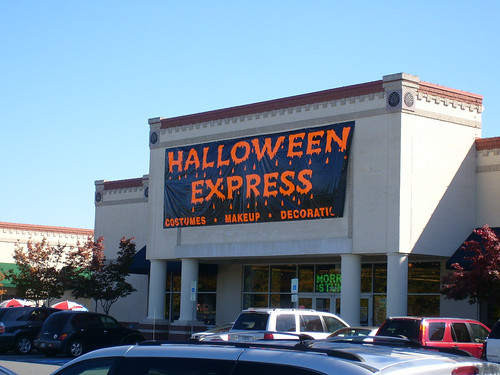

A typical Halloween Express storefront. You can see that the banner with the store name on it is temporary. This one is in Charlotte, North Carolina.
(Photo with some rights restrictions by english invader on Flickr)


The answer, according to what I read, begins with understanding what the market is like for Halloween goodies.


THE MARKET
  • In the US in 2006, consumers spent $4.96 billion on Halloween stuff. That's a lot of money on costumes and candy.
  • To put that number in perspective, though, we Americans spent 100 times that -- $457.4 billion -- on the Christmas/Hanukkah holidays.
  • In fact, Halloween weighs in at only the sixth-highest spending holiday of the year, after Christmas/Hanukkah, Valentine's Day, Easter, Mother's Day, and Father's Day.
  • People spend more on those other holidays because those holidays all involve gift-giving. Except for the candy that people hand out to trick-or-treaters, nobody gives gifts for Halloween, which is why the holiday falls relatively low on the money scale.
  • But in terms of decorations, it comes in second place just behind Christmas. 86% of adults decorate their houses for Halloween, both inside and out.

Some people really get into the Halloween decorations. This is outside a house in Lenox Hill, New York.
(Photo by Tim Ruddell on Flickr)


  • Candy is perishable but costumes and decorations are not and those have higher profit margins anyway. So the retail stores focus on those products and focus hard.
  • Of all the retailers who sell Halloween stuff, it's the companies that operate at least 100 of those big, temporary stores that bring in the majority of that $4.96 billion.

Halloween USA in Aurora, Colorado
(Photo from Snagajob)


HOW IT'S DONE
  • They start looking for store locations in January -- 10 months ahead of time. Most of these retail companies have a pretty specific set of criteria for the kind of location they want.
  • Halloween Express, one of the leaders in this group of Halloween retailers, looks for:
  1. Space in a strip mall or in a free-standing location
  2. Has to be at least 7,000 square feet
  3. Has to be in a high traffic area near busy streets
  4. Has to be available for all of October
  5. Has to allow temporary signs to be put up
  6. Will pay more than the current rent
  • How much is more than the current rent? It varies depending on the city and the specific location. But for one store front, Halloween Express paid $100,000 per month ($200K total) for a 20,000 square foot space.
  • Most retailers pay $500,000 for a whole year in that same size space.
  • But that high rent may be worth it. Halloween Express, as an entire chain, sold about $70 million worth of Halloween stuff in 2007.
  • For a lot of malls that are struggling due to the bankruptcy and closure of a lot of major retailers (Linen 'N' Things, Mervyn's, MicroCenter, to name a few), a tenant that's willing to take over a huge amount of space and pay higher than the going rent even for a couple of months can be very attractive.

Spirit Halloween stores are owned by Spencer's. This location opened in a former La-Z-Boy store.
(Photo from the Spree Patrol)


  • A Halloween store will bring more foot traffic to the mall in general, but only for the couple months it's open. So the Halloween stores are a temporary stopgap, but if a commercial realtor has the chance to put a longer term store in that space, they'll opt for that over the Halloween store.
  • Once the location is secured, somebody local -- a franchisee -- operates the store. That person is responsible for managing the rest of the details, including the inventory and the staff.

THE MONEY
  • The individual franchisee operates the store. They invest $10,000 to buy the rights to the first store and then an additional $70,000 to pay for the inventory and any other opening costs.
  • Ordering the inventory is the trickiest part of the business. The franchisee has to go to trade shows, decide which costumes and masks will be hot that year, and order them at the right time so everything will be delivered, unpacked, and on display in the store by the time it's ready to open.

Some of the stuff the clerks would have to unpack and display. These decorations were available in 2008 at a Spirit Halloween store in New Mexico.
(Photo from Season of Shadows)

  • The franchisee also hires cashiers and people to unpack the inventory and set it out on the shelves. Once the store is open, the franchisee is also in charge of managing it. This means showing up, answering questions, solving last-minute problems, making sure everybody's there when they're supposed to be, making sure things are set up the way they're supposed to be. But really, how hard can that be?
  • So let's do some quick math here. Let's pretend we Daily Apple readers want to open one of these stores. Our investment is $80,000 for the rights to the store and the inventory, plus salaries.
  • Salaries wouldn't be that expensive. All you'd have to pay would be minimum wage for people to run the cash registers. You wouldn't have to pay any benefits because the employees would only be working for two months.
  • Minimum wage is $7.25 per hour. Say we have 25 people working 8 hour days. Say the store is open 7 days a week. Our staff wouldn't all work 8 hour days 7 days a week, but to make the math easier, let's say they do. And let's say we're generous and we're going to pay our cashiers and stockers $8 per hour. That's $89,600 in salaries.
  • So we've got $179,600 invested total.
  • Let's say our store is an average Halloween Express store. Since they made $70 million and they have about 100 stores, that would put an average store's sales at about $500K.
  • Even if we assume that our rent is that really high $200K, that still leaves us with a profit of $120,400. Not bad for a few months' worth of work.

Ka-ching!
(Photo from GetReligion.org. I'm not even kidding.)

  • That $120K profit that I arrived at should definitely be taken as an estimate. Because I've also read that the temporary Halloween store usually does not make a profit its first year.
  • But the temporary Halloween store typically does turn a profit by its second year. This is very fast for retail. Most retail stores don't turn a profit until somewhere in their third or even fifth year.
  • Here's another benchmark: if one of these pop-up Halloween stores sells 70% of its inventory, it's considered to be doing well. So the next time you're in one of those giant stores, look around and say to yourself, "Seventy percent. They're going to sell seventy percent of everything that's in here." I think you'll be able to feel the money.
  • Costumes are where the profits can be at their highest. Though they're typically made of polyester and plastic, most costumes start at around $24 and go up to about $180 for a complete outfit with lots of trimmings. The risqué costumes, which are increasingly popular with adults, typically start around $80 and go up.

How the costumes are packaged and displayed at a Halloween Express.
(Photo by Evan Hill at the U of Tennessee)


THIS YEAR
  • Speaking of costumes, the top costumes for adults in 2009 are, in descending order:
  1. Witch
  2. Vampire
  3. Pirate
  4. Clown
  5. Wench/Tart/Vixen

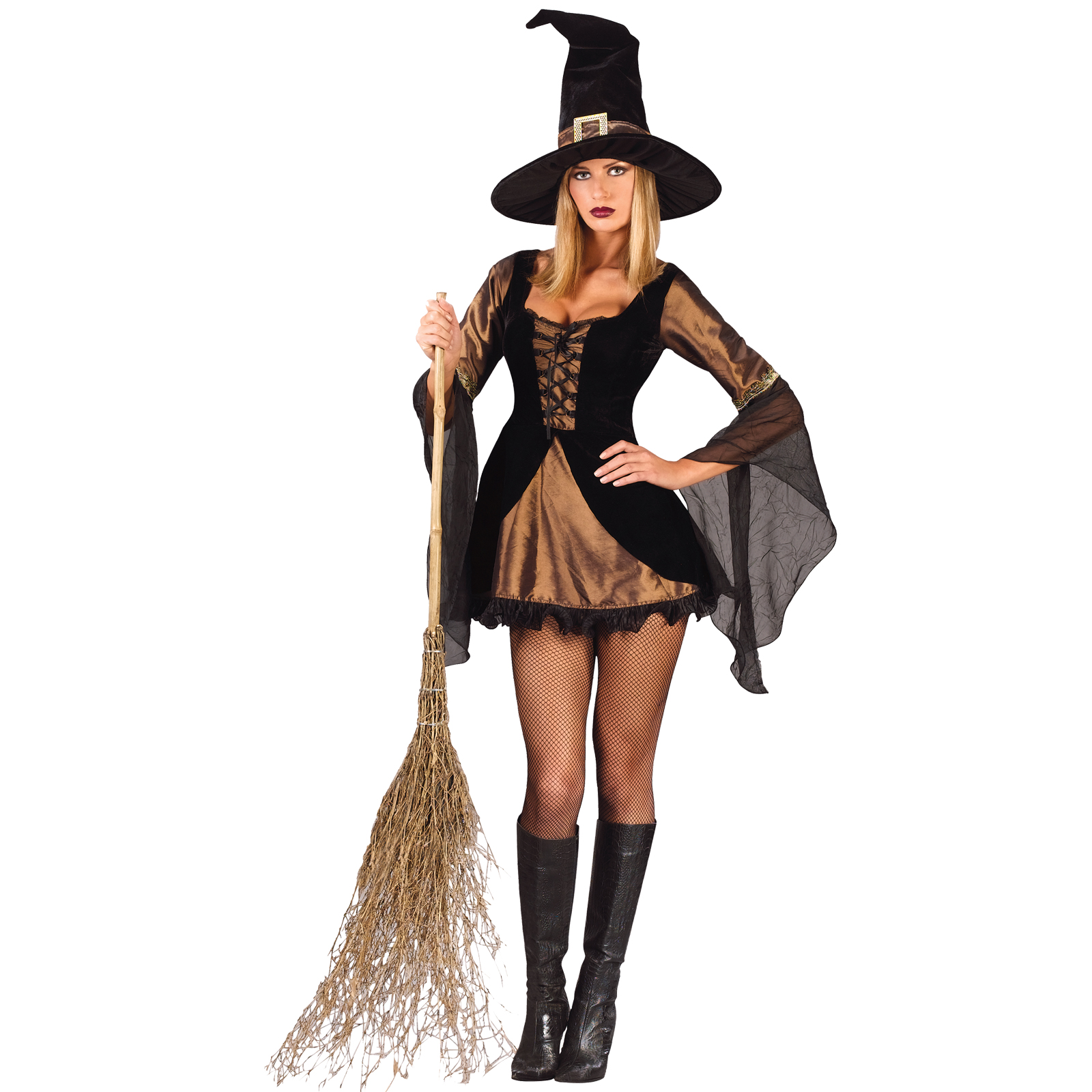
Prime example of the sort of costume most in demand these days. It's for adults, it's of the "sexy" variety, and it's of a witch.
(This particular costume is available from HalloweenMasksandCostumes.com. But I bet you could also find it in one of those big stores, too.)


  • Besides the top categories, there are also usually one or two specific costumes that are "hot" in a given year. During an election year, for example, costumes or masks that look like the current candidates are usually big sellers.
  • Or if a movie is especially popular, so are costumes that look like those movie characters. Like after Scream came out, for example, everybody was wearing those elongated masks.

None of the Scream masks I saw online get the contorted mouth shape exactly right. This one is available from Costume Maniacs for $7.99.

  • This year, because of the economic downturn, most people say they're planning to re-use costumes from previous years, or make their own, or they're going to make their own decorations and treats to hang up or hand out.
  • In fact, the average adult plans to spend about $55 each year on Halloween goodies. That's gone down from about $100 per consumer per year in the late 1990s.
  • The average 18-24 year-old spent $86 on Halloween in 2008, and they say they'll spend less than that this year -- only $68.
  • So maybe those stores will only sell, what, sixty percent of their inventory?

After seeing how much money these stores rake in so quickly, I am definitely seeing the do-it-yourself appeal. On the other hand, those ready-made costumes sure do come in handy if you find out only a day or two ahead of time that someone you know will, in fact, be having a Halloween party and you need a costume that's better than the sheet with holes cut out for eyes that you wore last year.


(Screen shot from It's the Great Pumpkin, Charlie Brown!
sourced from Sweet Tea Prohibition)


The best place I ever bought a costume was at a costume shop that served the local theater and ballet companies. This store had everything. The best were the masks -- tons of them all around the top of the walls, really fantastic, elaborate, sometimes gory, truly scary.

The people who worked there knew their make-up, too. You could say to the guy behind the counter, "How do I make myself look like Frankenstein?" and he would tell you which colors of make-up you needed to buy, how much of each color to apply, and where. He would tell you how to glue on the fake bolts, how to make the top of your head stick out, and how to make the stitches all the way across. I heard one customer ask one of the make-up guys how he could make himself look like a monster that had been melted in a nuclear accident, and right away the make-up guy had all kinds of ideas. Super knowledgeable and creative people.

Sadly, that store closed several years ago. But if there is such a store in your neighborhood, it is definitely worth the trip. Here is a short list of theatrical costume shops, most of which also specialize in things like fake beards, or hand-made corsets, or Zoot suits, or mascot suits.


Storefront of DC Theatricks in Buffalo, NY. Not as screamingly eye-catching as those big temporary stores, but based on what lots of people online say about them, they have a huge selection of costumes for purchase or rental, and the sales people are friendly and helpful.
(Photo from Buffalo Place)


Sources
Terry Boyd, "Seasonal Halloween stores give a temporary, but significant, retail boost," Business First of Louisville, October 30, 2008
Halloween Advertising Agency, Halloween Industry
National Retail Federation, As Economy Impacts Halloween, Consumers Get Creative, September 29, 2009
National Retail Federation, Vampires Move Up Top Costumes List; Nurses, Politicians Drop Off, October 1, 2009
Stephanie Hoops, "Priced Right for Fright Night," Ventura County Star, October 4, 2009
CNBC, Spooked Consumers Plan to Spend Less on Halloween, September 29, 2009
National Retail Federation, As Halloween Shifts to Seasonal Celebration, Retailers Not Spooked By Surge in Spending, September 20, 2006
Patricia Norris, Halloween Sales Huge for 2007, Specialty Retail Expert, November 2, 2007
Retail Infusion, Halloween Express

Thursday, October 1, 2009

Apple #413: Smut

At the request of an entirely anonymous Daily Apple reader, I give you more smut.

Wherever possible, the Apple Lady does try to fulfill all requests.

  • Smut is a parasitic fungus that can infect many crops, but most commonly, corn, wheat, and onions.
  • On corn, smut penetrates the tissue of the plant, especially on the leaves or the tassels, and develops into large balls, or boils, or galls. When the balls are broken, a great mass of black, greasy, powdery spores are released.

Smut balls on corn ears
(Photo from Cornell University)


  • When smut grows on wheat, it is typically referred to as "loose smut." In this case, the smut has infected the plant to such an extent that instead of producing wheat flowers and pollen, it produces smut pods that release smut spores.

Loose smut, or Ustilago tritici
(Photo from Virginia Tech University)


  • On onions, if smut infects the seedlings, the seedlings usually die within 3-5 weeks. Those onions that do survive a smut infection and produce bulbs will retain black streaks or lesions, which contain more spores.

Smut on a white onion.
(Photo from the Manitoba Weekly Vegetable Report)


  • Mature onions that have been infected also tend to shrink more rapidly in storage and they are more susceptible to soft rot.
  • If an onions has turned smutty, and if the flesh of the onion is still firm, you can wash off the black spores and still use the onion. However, it probably won't be as flavorful as a fresher, non-smutty onion.
  • Smut spores are extremely hardy and can survive for several years even underground. The spores can be eaten by livestock, pass through the animal's system, and still go on to germinate and produce more smut.

Spores of the corn smut fungus
(Photo from the University of Georgia)

  • Smut spreads and yields more smut most easily during hot, dry seasons. The hot air blows the smut spores farther and to more places, from one farm to the next.
  • Smut spores do require moisture to grow. Once the spores land in the niches of a plant, if enough water has collected there, the smut will penetrate the tissue and spread.
  • Smut is very difficult to control and likely impossible to eradicate. Even if every gardener and every farmer across the country stopped all work except to inspect all the plants for any smut balls, cut them out wherever they were found, and burned them; and even if every gardener and farmer did this three times a year, perhaps the amount of smut could be reduced.
  • Varieties of corn have been developed that are especially resistant -- though not impervious -- to smut. These varieties include but are not limited to:
  • Bellringer
  • Capitan
  • Sweet Rhythm
  • Sweet Sue
  • Country Gentlemen Hybrid
  • Golden Gleam
  • Golden Beauty
  • Spring Gold
  • Smut does not seem to like garlic, as none has ever been found growing on it.
  • (Vampires don't like garlic either. Could there be a connection?)
  • In some parts of the world, smut is considered a tasty treat. It is collected, sometimes canned, and sold in Mexico as huitlacoche.
  • P.S. The word "smut" first means "black mark, or stain," and it comes from Germanic verbs that mean "to make dirty" or "defile." The second meaning, "indecent or obscene language," arose at nearly the same time as the first, in the 1660s.

Sources
Cornell University Plant Disease Diagnostic Clinic, Corn Smut Fact Sheet
Doctor Fungus, Introduction to Fungi
Virginia Tech University, Department of Plant Pathology, Physiology, and Weed Science, Wheat Loose Smut
Karen Delahunt and Walt Stevenson, University of Wisconsin Cooperative Extension, Onion Disorder: Smut
Purdue University Department of Botany and Plant Pathology, Diagnosis and Control of Onion Diseases
Online Etymology Dictionary, smut

Sunday, September 27, 2009

Apple #412: Moss

After that last, somewhat steamy entry, I thought it was time for something nice and soothing. Like moss. Mosses are so soft and springy and spongy and green.


(Photo by the Apple Lady)

  • Mosses grow everywhere on the planet except on the sea floor.
  • There are so many different kinds of mosses and their parts are so tiny, the only way to identify them accurately is with a microscope.
  • Mosses are Bryophytes. The reason we care about that word is because it means they were the first green plants to evolve on land.
  • That makes mosses about 350 million years old. Older than flowering plants, older than conifers.
  • As the first green plants, mosses were very simple, and they have stayed simple. They have no stems, no roots, and no leaves in the sense that we think of them.
  • Without typical roots and stems, mosses don't have a vascular system, or a way to deliver moisture & nutrients to all parts of the plant. So mosses depend on their environment to supply the entire plant with adequate moisture and nutrients.
  • In other words, mosses prefer to live in moist places. They are very inventive at finding places where enough moisture collects.

WHERE MOSSES LIVE
  • In the northern hemisphere, mosses like to grow on the north sides of trees. You might see moss growing all around the base of a tree, but you'll see more of it on the north side.
  • The reason mosses like the north side is because less sunlight shines over there. That keeps the north side relatively shady and damp, a nice home for a moss.

Apparently the right half of this tree is to the north. That whole side is covered in moss while the other side is nearly free of it.
(Photo by the Apple Lady. Sorry about the blurring.)


  • Some other places that mosses especially like:
  • Up the sides of hardwood trees. They collect the rainwater as it trickles down the crevices of the bark.

Moss growing in a nearly perfect vertical stripe.
(Photo by the Apple Lady)


On this white ash tree, moss is also growing in the bark crevices on the roots.
(Photo by the Apple Lady)


  • On fallen logs and stumps. The nooks and crannies in fallen logs make them ideal spots for mosses. Water collects there as do other nutrients. The mosses that live on fallen trees don't even need to take any nutrients from the fallen tree itself (which means they're epiphytic).

Moss growing all along the top of this fallen tree trunk.
(Photo by the Apple Lady)


  • Rooftops. Shingles made of wood or composites or even asbestos make a friendly place for the mosses to sit. Ash that flies up from the fireplace provides nutrients, and if it's nice and shady up there, the roof doesn't dry out so fast and the mosses like it even better. At my parents' cottage by a lake, it's one of our fall tasks to climb up on the roof and sweep off all the moss pillows. Now I know why we get so many moss pillows up there. That roof has all the ingredients that mosses like best.

Moss pillows growing out of the cracks between shingles.
(Photo by Holly Holston, age 14)


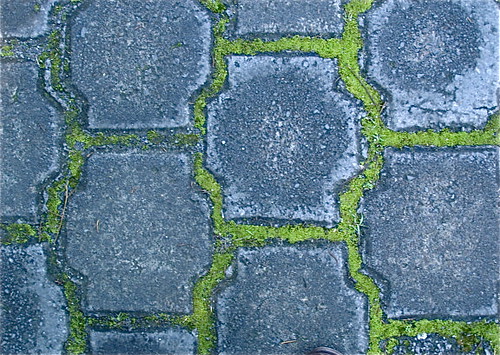
  • Sidewalk cracks. The cracks collect nutrients and moisture that isn't easily dried up by sunlight. Again, a naturally happy place for mosses to grow.

Moss growing in the crevices of a sidewalk in Cotacachi, Ecuador.
(Photo by Gary A. Scott)


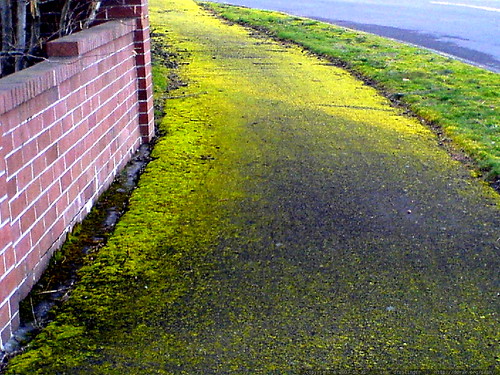
Moss growing like mad all across the surface of a sidewalk.
(Photo by Sean Dreilinger on Flickr)


MAKING MORE MOSSES
  • When it comes to reproducing, mosses are again dependent on their environment, but for this function they need wind as well as moisture.
  • Male mosses produce zoospores. The male mosses fling their zoospores out and the wind carries them off. Some of the zoospores land on a female moss. The zoospores and the egg cells on the female moss will try to get together, but they'll only be successful if there's enough moisture.
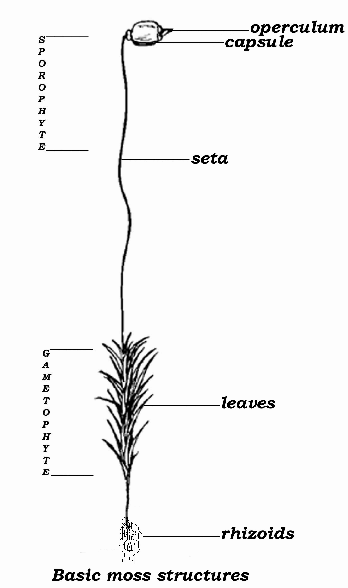
  • Once the female plant's eggs are fertilized, she shoots up a stalk, also called a seta or a sporophyte. At the top of the stalk is a little knob or a pod, called a capsule.

Female moss reproductive structure
(Diagram from Oregon State University)


  • The capsule contains single-celled spores. They're sort of like tiny seeds, but they're even biologically simpler than seeds. When the female plant decides the moisture and wind and all those conditions are right, the capsule opens and the spores fly off on the wind.
  • The spores might land anywhere, but again, they need enough moisture to become a plant.

MOSS IMPOSTORS
  • Some things get called mosses but they're not really.
  • Spanish moss -- not a true moss. It produces flowers and it's a Bromeliad, like a lot of houseplants. It also happens to be epiphytic, which means it grows on another plant but doesn't take any nutrients from it.
  • Club moss -- Ground Pine might be a more accurate name. These are an evergreen herb.
  • Flowering moss -- if they produce flowers, we know they can't be a true moss. Better known as Creeping Phlox.
  • Reindeer moss -- actually a type of lichen, which is like the marriage of a fungus and algae.

MORE REASONS TO LIKE MOSS
  • Besides the fact that they're soft and springy and green, we like mosses because they help prevent erosion. By hanging onto the soil, they help prevent it from being blown or washed away. At the same time, they help to increase the amount of moisture that the nearby ground is able to store.
  • They are also good indicators of pollution. Or rather, their absence is. There are so many different kinds of mosses and they're so good at finding little nooks and niches where there's water and nutrients, if you don't see any around, chances are you're in a place where there's lots of pollution.


With all this moss growing like a carpet along the gravel path, we know we don't have to worry about air pollution here. And if we felt like it, we could take off our shoes and the moss would feel so nice underfoot.
(Photo by the Apple Lady)


Sources
Oregon State University, Basic Biology of Mosses
US Forest Service, Pacific Northwest Research Station, Special Forests Products Bryophyta (division) Moss, 2001
Wise Geek, What is Moss?
Backyard Nature, Mosses
Indiana Public Media, A Moment of Science, There's Moss on the North Side, September 27, 2003

Thursday, September 24, 2009

Apple #411: Words for Slut

One of my co-workers and I sometimes laugh about those old words for a woman of easy virtue. Hussy, hoyden, trollop. Even that phrase I just used, "woman of easy virtue," she and I have laughed about that, too.

After one of these silly sessions, I started thinking about all the different words there are for women who have lots of sexual partners and are therefore considered to be immoral. There sure are a lot of such words. I got to thinking about the word "slut" and how similar it looks to other words, and I wondered where it came from.


A Victorian era slut.
(Photo from The Heliograph)


So when I got home, I looked up "slut" in the Online Etymology Dictionary. Then I looked up all those other words too, and I noticed a pattern which surprised me. I double-checked in my Oxford English Dictionary because sometimes those two sources disagree. The OED doesn't always deal with slang, but for the words which the OED offered an etymology and a definition, it agreed very closely with the Online Etymology Dictionary.

Here's what I discovered: most of those insulting words started out meaning something relatively benign. Sometimes they didn't even necessarily refer to women at all at first, let alone any particular kind of woman. Only after the passage of many years, sometimes as long as a few centuries, did they take on the pejorative meaning.

The etymologies don't say this, but it is interesting to think about how the evolution might have taken place, or the assumptions lurking behind the shift in definitions. A woman dresses sloppily and so therefore she must be a whore. A woman is a kitchen maid and so therefore she must be . . . you follow my drift.


WORDS THAT STARTED OUT NOT SO BAD

slut - originally, a slovenly woman. Didn't suggest anything about her morals or sexual behavior, only that she was sloppily dressed. In some usages, it meant "kitchen maid or drudge." Chaucer even used the word sluttish in the 1300s to refer to an untidy man. Samuel Pepys used it innocuously to say of his daughter Susan, "[she] is a most admirable slut and pleases us mightily." But in spite of Pepys, the word had already begun taking on negative connotations relatively early in its existence (about 50-100 years after its first documented usage) and by the 1860s it was pretty much entrenched in turpitude.


On this postcard -- yes, people mailed this to each other -- both meanings of "slut" apply, sort of: she was poor and ragged in her dress and she was also being used by her uncle.
(Image from Uncle Eddie's Theory Corner)


trollop - also originally a slovenly woman. Probably came from the verb "to troll," meaning to roll about or wallow, as in mud. Another meaning referred to anything dangling untidily, including loose clothing worn by -- you guessed it -- loose women.

hussy - originally, housewife. Sometimes even a thrifty housewife. Then it was expanded to mean any woman or girl, married or not. It was also used as a "playfully rude" way of addressing a woman. But then the playfulness began to disappear. By 1650 it had also become a serious way to indicate a woman of loose morals, and by the 19th century it had shed all the innocuous meanings entirely and retained only the derogatory one.

harlot - originally, vagabond, tramp, or camp follower. Also applied to traveling entertainers like jugglers, jesters, and later, actors. Sometimes a villain, glutton, or fornicator -- but he was male. For 200 years, from the 13th through the 15th century, a harlot was a man. But by the 16th century the word was frequently used in Bible translations and nearly always in reference to a woman -- one who was not a juggler or an entertainer, but a prostitute.

tramp - originally, to walk heavily, to stamp. Then it came to indicate a wanderer or vagabond, or one who tramps. It also referred to people, often women, who stomped on things like straw or wash clothes to press out the water. Didn't take on the meaning of a promiscuous woman until 1922.

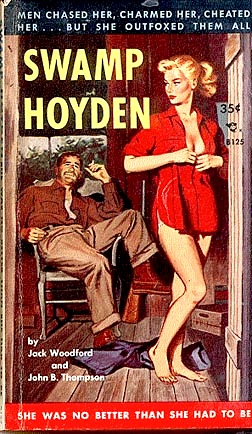
hoyden - from the late 1500s, probably from a Dutch word that means rustic, uncivilized man, a boor; or a heathen. Didn't develop a negative connotation about women until the 1670s. Then she was only noisy or rowdy at first.


I would have guessed that people stopped using "hoyden" maybe a century ago, but this book was published in 1951, so it's still kicking a little.
(Image from Good Girl Art)


hooker - originally in England, referred to thieves who stole things using hooks. Sometimes they stole watches, sometimes they used great long hooks to reach in through a window to snatch the sheets off the bed. For a while in 1863 it referred to the men who formed General Hooker's Army of the Potomac during the Civil War. General Hooker himself had a fondness for gambling and alcohol and women, and his headquarters were considered a cross between a bar and a brothel. But in general, the sense of hooker as a prostitute most likely originates from the idea that prostitutes ensnare or "hook" their customers.

bimbo - from the Italian word bambino meaning baby, it referred first to a fellow or a chap, then a stupid man, then an inconsequential and contemptible man. In the 1920s the word was used by a journalist at Variety magazine to refer to a pretty but stupid, flighty woman of easy virtue. It became popular again in the US in the 1980s. Some current definitions say that not only is the woman pretty but stupid; she may also be the mistress of an older wealthy man.

tart - originally an endearment, a shortened form of "sweetheart." Or it could be derived from "jam-tart," which was 19th century British slang for an attractive woman. Attractive, you'll note, but not necessarily whorish.

broad - originally, a woman who is broad in the hips, or it might have come from the word abroadwife which referred to a woman away from her husband, who has typically been taken into slavery. So the number of sexual partners would not be of her choosing but apparently that didn't matter. There was also the sense of broad which meant plain-spoken speech, sometimes to the point of coarseness or lewdness. By 1911, the slang usage of broad generally suggested a coarse, low-class woman.


WORDS THAT HAVE ALWAYS MEANT "WHORE"

whore - adulterer. This is the big one, and it pretty much has always meant prostitute. But it may have come from a Sanskrit word qar or Kama, which means love, or the god of love. That word became carus in Latin, which means "dear" or "friend." But there was a whole other branch of Germanic words that descended from qar and those meant adulterer or fornicator.

prostitute - literally "placed in front" or publicly exposed. Originally, prostitute referred to a woman who had been sold into slavery and was then used for sex. So she was known by her sexual behavior, but that behavior wasn't of her own volition.

courtesan - dates back to the mid-1500s. From the Italian cortigiana, which means woman of the court. She's somehow attached to the sovereign rulers of a place. But apparently her attachment is only as a prostitute because that meaning is given at the same time and in the same sentence as "woman of the court."

strumpet - its origin is not certain but it may be related to a Latin verb stuprare that means "to have illicit relations with." Or it could be from a Middle Dutch word strompe, which means "stocking," as in the stockings that prostitutes wore. Another possible connection is that it could have come from the verb "to strum," which was once upon a time defined as having carnal knowledge of a woman or else playing a harpsichord or other stringed instrument badly. So according to that possible etymology, not only was the man strumming the woman, he also seems to have been doing it badly.

floozie - has always meant a woman of disreputable character. Born around 1902, perhaps derived from flossy, meaning fancy or frilly.

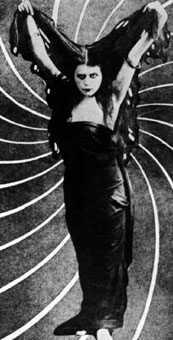
vamp - short for vampire (which word, by the way, can be traced back to a Tatar word that means "witch"). Vamp was born around 1911 in conjunction with a play and movie called A Fool There Was which featured Theda Bara, who was the Marilyn Monroe of her day, playing a very sultry woman known in the play as The Vampire.


Theda Bara as The Vampire. She's less creepy and more seductive in her role as Cleopatra, but the word vamp stuck and Cleo did not.
(Photos from Vampire Junction)


There are all sorts of other meanings for vamp, including the part of a shoe or sock that covers the body of the foot; or in the verb form, to patch together, to ad lib or improvise, or to walk the streets. You can see how there might be connections between those meanings and the idea of a seductress, but apparently the slang vamp comes only from vampire and has nothing to do with those other kinds of vamps.

piece, or piece of ass - surprisingly, dates all the way back to 1785. Not indicative of any gender in particular, but refers to anyone available for a fixed amount.


So what's my point? Beyond sharing this observation with you, I'm not sure, exactly. The only comparable slang I could think of for slutty men was "stud," and that's not very derogatory. Over time, will that get turned into an insult for women too? Or is it possible that we English speakers are turning fewer words into synonyms for "whore"? Hard to tell.

Either way, we can choose where our language goes. It's not as if our words emerge out of the mist of some mysterious Delphic pit in the earth. We're the ones who make up our words and decide what they mean. If we want a lot of words that insult women on the basis of their sexuality, then I guess that's what we'll have.


Sources
My copy of the Oxford English Dictionary
Online Etymology Dictionary, bimbo
Oxford Dictionary of Phrase and Fable, bimbo
OneLook, bimbo
Online Etymology Dictionary, broad
Online Etymology Dictionary, courtesan
Online Etymology Dictionary, floozie
Online Etymology Dictionary, harlot
Online Etymology Dictionary, hooker
Jonathan Dunder, Free Information Society, Hooker, Joseph
Online Etymology Dictionary, hoyden
Online Etymology Dictionary, hussy
Online Etymology Dictionary, piece
Online Etymology Dictionary, slut
Online Etymology Dictionary, strumpet
Online Etymology Dictionary, tart
Online Etymology Dictionary, tramp
Online Etymology Dictionary, trollop
Online Etymology Dictionary, vamp, vampire
Online Etymology Dictionary, whore

Sunday, September 20, 2009

Apple #410: Removing Red Wine Stains

A few days ago, I was having one of those work dinners with some co-workers and a salesperson who wanted our business. The salesperson got a bit exuberant and knocked over his wineglass. The spill was unfortunately aimed in my direction so that my shirt got splattered with red wine and my new skirt was doused with it.

The now-embarrassed salesman asked the waitress for some club soda, and she brought a towel soaked with it. I used the club soda-saturated cloth to blot my shirt and soak up the wine that had spilled on my skirt. It took a few minutes, but I was very happy to see that the wine disappeared from my clothes and reappeared instead on the white towel.


Club soda: is it magic?
(Photo from Coach Creative Space)


This was my first experience with a red wine spill. I had heard about the club soda trick but never had to try it and I was really amazed to see how well it worked. I was so impressed, I kept using the club soda towel to clean the wine stain off the cloth of the booth where we were sitting. It worked like magic on that, too.

Of course, Apple Lady that I am, I wanted to know why the club soda worked so well.

  • First of all, no matter what you use to clean up the spill, act quickly. The sooner you mop it up, the less chance it has to soak in.
  • Second, you want to make sure you don't rub the stain because that will only encourage the liquid to seek shelter more deeply into the fabric. Blot. Always and only blot.
  • Third, you want to use something that will absorb the spilled liquid more quickly than the thing you've spilled it on. Lots of things qualify as a fast absorbent.
  • Some substances work better depending on the liquid or on the fabric, but there is a basic list of products that generally work well.

This doesn't have to be a disaster. Not with club soda or salt handy!
(Photo from A Cleaner Carpet)


  • Salt -- absorbs all kinds of liquids. It is salt's nature to do this.
  • Baking soda -- does the same, though not quite as well as salt and may get clumpy.
  • Talcum powder -- you probably don't have this sitting around your dinner table, but maybe it is at hand in the bathroom or bedroom. If the talcum powder has perfume or colors added to it, though, use something else.
  • Vinegar and ammonia -- these two together are excellent at removing all sorts of stains, especially smelly ones like pet stains. They get rid of the stain and the odor.
  • I gave you this list before the club soda because two of the three ingredients in club soda are what impart its stain-removing magic:
  1. Water
  2. Carbon dioxide
  3. Salt
  • A lot of people maintain that it's the bubbles (a.k.a. carbon dioxide) that remove wine stains, but in fact, it's probably the salt and the water. The salt helps to absorb the stained liquid and the water helps to rinse the area further.
  • By that logic, salt water would probably also work as a decent stain remover. I haven't tried it myself, but I'll bet it would work.
  • Besides those household staples, lots of people highly recommend these commercial products for removing red wine stains:
  1. Shout
  2. Spot Shot
  3. Wine Away

Wine Away is available in lots of versions, from large sizes to smaller emergency kits.
(Photo from Products With Style)


  • Wine Away was (obviously) created specifically to clean up wine stains. It's made of some proprietary combination of fruit and vegetable extracts so it's non-toxic, and it leaves a citrus scent behind.
  • No product will always remove every stain, especially if the stain has had a chance to settle in and get comfortable. So act fast, blot, and keep at it!


Sources
Judith Williams, eHow, How Does Club Soda and Salt Get a Wine Stain Out?
How does club soda remove red wine stains? Scientific American, June 12, 206
Professor's House, Red Wine Stains
Art & Betsey Stratemeyer, How to Remove Wine Stains
Mrs. Clean USA, Cleaning Tips on Removing Red Wine Stains

Wednesday, September 16, 2009

Apple #409: The Palmer House

This past weekend I was in Chicago attending a wedding. I stayed in the Palmer House.

Like so many places in Chicago, the outside of it doesn't look like much, but the inside is a very different story. Here is more or less what the lobby looks like:


The Palmer House lobby. What's strange about this photo is that it's empty of people. I never saw this room when it wasn't bustling with people -- sitting in the chairs or at the bar, waiting beside luggage for someone else to join them, walking through with luggage or without. It's busy and lively and yet still civil and beautiful.
(Photo from the Pickled Tongue)


The summary: in the end, with tax and parking, it cost me $250 per night to stay here. Some guests have found the rooms to be too small and while I saw their point, that didn't bother me. I was very comfortable. It is possible that if I didn't have a sentimental attachment to the place, I might not have thought the price was worth it. As it was though, I found the whole experience to be enjoyable and if I could, I'd do it again.


The full story

Long ago in my former life as a corporate librarian, I worked a few blocks east of the Palmer House in the financial district. Coming and going off the train I would see people getting out of cars and taxis and going into the Palmer House. To me, having just come from my apartment where I slept on my futon on the floor and had eaten nothing but a few cheese & tomato sandwiches in the past three days, the Palmer House was a place to regard with awe. I said the name to myself in something of an awed whisper, Ooh, the Palmer House. So staying at that hotel this past weekend represented the fulfillment of some long-held desire.


Someone's blurry photo of one of the entrances to the Palmer House, this one on Wabash.
(Photo from IgoUgo)


Not that I'm suddenly enormously wealthy or anything like that. The groom, through the company where he works, was able to get a slightly reduced rate for those attending his wedding. I realized I might never have such a chance again, so I bit that bullet of opportunity and made my reservations.


Ooh, the Palmer House

I'm not the only one who has a sentimental attachment to this hotel. That's because of its history. Here are a few brief facts to put this place in perspective:

  • The hotel was originally built by Potter Palmer, the businessman who developed most of the shops on State Street, in 1871 as a gift for his wife, Bertha Honoré.

Potter Palmer, the Chicago businessman who built the Palmer House hotel.
(Photo from Absolute Astronomy)


Bertha Honoré, for whom the Palmer House was built.
(Photo from Absolute Astronomy)

  • Bertha, by the way, was a socialite, philanthropist, and art collector. After meeting Claude Monet, she purchased 200 Impressionist paintings, which she later bequeathed to the Chicago Institute of Art.
  • Thirteen days after it opened, the hotel burned in the Great Chicago Fire.
  • Not to be dissuaded, Palmer got a loan for $1.7 million -- remember, this is 1871 -- and rebuilt the whole thing even more grandly than before. It was made primarily of iron and brick and was touted as the world's first fire-proof hotel.
  • The hotel re-opened in 1873, though the reconstruction took an two additional years. The hotel has remained open ever since.
  • The famous brass peacock front doors were designed by Tiffany.

Brass peacock front doors on the Monroe Street entrance of the Palmer House.
(Photo by Galen Frysinger)


  • The two 24-karat gold chandeliers in the lobby were also designed by Tiffany. So were the brass door handles, hinges, and hardware still in use throughout the hotel.
  • By the 1920s it was clear that the 7-story hotel simply wasn't big enough. So the Palmer Estate (Potter had died in 1902) decided to rebuild again. This time, they made it 25 stories, they completed the reconstruction in only two years, and they kept the hotel in operation the entire time.
  • It was renovated again in 2007. Redoing the 3,700 square foot penthouse alone cost $1.5 million. One of the artists who helped restore the Sistine Chapel was hired to clean and preserve the lobby ceiling, which includes 21 murals of Greek mythological figures.
  • The hotel has changed hands a few times. As of 2005, Thor Equities owns the hotel but it retains the Hilton name.
  • The Palmer House Hilton currently rings in at 1.7 million square feet, with 1,639 rooms, including 44 deluxe suites and the penthouse. These stats make the Palmer House Hilton the second largest hotel in the city of Chicago. (The two-tower Hyatt Regency on East Wacker is the largest.)
  • Famous people who have stayed in the Palmer House:
  1. Ulysses S. Grant
  2. William Jennings Bryan
  3. William McKinley
  4. Mark Twain
  5. Charles Dickens
  6. Oscar Wilde
  7. Sarah Bernhardt
  8. Buffalo Bill
  9. Prince Charles
  10. Nearly every US President
  11. Barack Obama
  • Entertainers who have played the Empire Room, which no longer hosts shows but is available for private meetings and weddings:
  1. Frank Sinatra
  2. Judy Garland
  3. Jimmy Durante
  4. Maurice Chevalier
  5. Jerry Lewis
  6. Ella Fitzgerald
  7. Harry Belafonte
  8. Louis Armstrong
  • One last historical tidbit: the brownie was invented at the Palmer House. Bertha was asked to create a dessert for the Women's Pavilion at the 1892 World's Columbian Exposition. Working with the Palmer House chef, the two of them came up with the brownie.

My stay

I had read at various websites like Trip Advisor that quite a few people were disappointed in the size of the rooms. So when I entered mine, I was prepared. The Palmer House does offer different sizes of rooms, each one larger and more luxurious and more expensive than the last. My room had a queen size bed and was on the smaller end of the options.


Bed and desk in the room where I stayed
(Photo by the Apple Lady)


I also figured, this is in the heart of downtown. Space is going to be at a premium. So the rooms might be smaller than what most of us are used to in great, sprawling hotels, but you will be assured of a comfortable stay. And I was right.

The bed was very comfortable. Firm but with a plush top. Sometimes mattresses like that give me backaches, but this one did not. The draperies darkened the room very nicely and I slept very well.

I also read that the walls are a bit thin and it is easy to hear one's neighbors. This I found to be true, too. One day I heard a neighbor banging things around in the closet. No idea what that was about, especially since it went on for some time. Another night I heard a different neighbor watching TV for quite a while. But what disturbed my peace the most was morning-waking-up noises. Showers running, toilets flushing, that sort of thing. I prefer to sleep in. So I got a cheap pair of foam earplugs and popped them in before I went to sleep and I was fine.

There was one other noise issue that was even more of a problem. The first room they gave me on the 13th floor seemed to be away from the land of the elevators. Well, first, let me show you what's up with the elevators.


Three sets of elevators on the 15th floor of the Palmer House
(Photo by the Apple Lady)


The Palmer House has 23 floors. There isn't one elevator that stops at all 23 floors but rather different elevators that serve different floors. This is a fairly common elevator situation in large buildings in Chicago. Instead of each elevator stopping at each floor and taking forever,the elevator serves only a select number of floors and shoots past the others. In the Palmer House there are three banks of elevators. The set on the left serves floors 1-8 and 13-17, the set in the middle serves floors 1-8 and 18-23, and the set on the right serves floors 1-12.

With all those floors and over a hundred rooms on each floor, those elevators are going all the time. There aren't any guest rooms located right next to this realm of elevators -- at least, there don't seem to be. You walk out of this land of elevators and turn right or left and make a little turn and then you're in a hallway of rooms. So you think you're a safe distance away from the elevators.

But the workings of the elevators are on the backside of this realm. The first room I was given was next to the backside of one of the sets of elevators. As soon as I walked into the room, I could tell it was a no-go. I could hear the workings of the gears, the stopping and starting and the motor of each of the three elevators on that side of the realm. And the stopping and starting was almost continual.

So I called down to the front desk and asked if they would give me a different room that wasn't near the elevator works. Not a problem at all, Miss Apple Lady, they said (well, they said my actual name, but you get the idea). They sent someone up with a new room key and if I had wanted, he would have carried my luggage for me to the next room. I didn't have much so that wasn't necessary. But I did appreciate that I didn't have to go all the way back down to the lobby with my luggage to get a new key and then go back up again to a new room.

As I left that room on the 13th floor for my new room on the 15th floor, I passed a set of three doors. The noises of the elevator works was very loud at that spot and it seemed obvious that those were the service access doors to the backside of the elevators.

This is what the three doors looked like:


If you're put in a room next to doors like these, you will probably want to move. Behind such doors are the workings of the elevators.
(Photo by the Apple Lady)


My new room on the 15th floor was a farther distance down one of the hallways away from the elevators.


My hallway on the 15th floor. The photos on the walls are black and white stills of celebrities who have performed in the hotel's Empire Room in the past.
(Photo by the Apple Lady)


Door to room 15-171, where I stayed. I'm sure it will be very famous in the future and everyone will want to stay there. "Please," future guests will ask, "may I stay in the Apple Lady's room?" Bound to happen.
(Photo by the Apple Lady)


I had also read online that several Palmer House guests thought that the bathrooms were much too small. And, yes, my bathroom was cozy. I had to shut the door to get in and out of the tub / shower.

But it was very attractive and everything in it was clean and new and fresh. The towels were thick and white and clean. It was well-lit, which is unusual for hotel bathrooms, and it smelled nice too.


Bathroom sink in the first room they gave me. Toilet is to the right, shower / tub is behind. The make-up mirror on the wall has a magnifying side and a regular side. Beneath the sink are some shelves where they give you the free shampoo, conditioner, soap, etc. There's also a hair dryer and room to put your own stuff, too.
(Photo by the Apple Lady)


Bathroom sink in the second room. See how clean and shiny it is! I also want to point out the soap dish. It's an actual dish. So many hotel sinks have a little dip in the side where you're supposed to put the soap, but the soap inevitably slides out of there and slips all over the bowl of the sink. This is a dish with little grooves in the bottom of it too, no less. Put down the soap, it stays put.
(Photo by the Apple Lady)


I am a fan of baths. Showers, too, but I do enjoy a good bath. I don't have a bathtub in my current residence so I am always hopeful I'll get a relaxing bath when I stay at a hotel. I was very pleased with the bath in my room at the Palmer House.

The tub was long enough that I could lie back comfortably without my kneecaps sticking up. Those of you six footers out there would probably get chilly kneecaps, but I did not. The water heated up very quickly and had no problems staying hot long enough to fill the bath and more.

It did take quite a while to drain, though. I've noticed that about lots of hotel baths. I don't know why that is, if it's because there are so many rooms, or what. Ought to get that Apple Lady to look into that for me.

For those of you who prefer showers, I am happy to report that the shower head was very acceptable. It didn't have massage options on it, but it was big as a dessert plate and the spray was neither scouring nor wimpy but comfortable.


Shower head in a Palmer House bathroom.
(Photo by the Apple Lady)


The one thing about the bathroom that I had trouble getting used to was a slightly raised strip of marble on the floor of the doorway into the bathroom. I tripped over this thing four or five times before I got used to it. I could see that this could be a potential hazard for people with bifocals or for people like me who don't always look where they're going.


Tripping spot leading into and out of the bathroom
(Photo by the Apple Lady)


The rest of the second room was very like the first. Same size bed, same bedclothes, same color pillows, etc.


Desk and chair. Just to the left of the phone is a little black gizmo which provides an internet connection. On the base of the lamp are some outlets, and there are more outlets under the desk. So this would be a good place to set up one's laptop, if one had such a thing and wanted to use it while staying in this hotel.
(Photo by the Apple Lady)


Television and chest of drawers, which face the bed. On either side of the chest of drawers are little cabinets with open shelves where you could put your stuff if you wanted to. On top of the cabinet on the left was a tray with two glasses and an ice bucket. On the backsplash of the cabinets were two outlets. The photo on the wall is of a couple boating on the Chicago River and a ferris wheel and a lovely plume of some sort of pollution coming from a nearby smokestack.
(Photo by the Apple Lady)


The view out the window, of other rooms in the Palmer House. You might be staying at the Palmer House, but as this view reminds you, you're still in downtown Chicago, all right.
(Photo by the Apple Lady)


The fact that this hotel is located downtown brings up another issue: parking. If you can avoid bringing a car into downtown Chicago, do so. The train is very handy and serves all sorts of locations relatively easily. On foot or by train, you don't have to worry about negotiating all the one way streets and figuring out where you're going while the cabs are zipping past you on all sides. But above all you don't have to worry about parking. Metered spots on the street are few and far between, and garages are pricey.

I had planned on taking the Megabus to Chicago -- an express bus which very low fares, sometimes as low as $1 each way -- but I got the pick-up location wrong and I missed the bus. So I drove. Which meant I had to park my car someplace once I got to the hotel. That would cost me beaucoups bucks but it was my fault for missing the bus.

When I pulled up out front of the Palmer House, a helpful valet told me I could have him park my car for $51, which would cover parking for 24 hours, or I could park the car myself in the garage on the next block for $36. "The only difference is the price," he told me.

He could have tried to tell me how much time I would save if I had him park my car for me or some song and dance like that, but he told me the truth up front and without hesitation. Appreciating his candor, I parked my car myself.


Another entrance to the Palmer House, this one on Monroe. The self-park garage is just up the street across Wabash, on the right.
(Photo from Cows and Graveyards)


The $36 covered 24 hours and I could come and go as often as I wanted during that 24 hours. As instructed, I took the ticket to the reception desk and they validated it for me, and the cost was charged to my room. Check-out time is 11 a.m. and the parking was good until 5 p.m. the day of check-out. That was very handy because I was able to check out of the hotel, load my luggage into my car and take care of a few more odds and ends and have lunch in Millennium Park without having to rush off right away.

Because I'm pointing out some shortcomings as well as things I liked, maybe it sounds like I didn't like my stay that much. But I did. I slept very well, I very much enjoyed the bath and the shower, I liked walking along the peacock-feathered carpets and riding the elevators and, once on the street-level floor, walking along the corridors bustling with people and lined with shops. I just plain enjoyed being in the place.


The best part was the people

I want to be sure to mention the people who work for the Palmer House. There were all sorts of bellmen, doormen, people to greet you when you pulled up in your car, and men in uniforms who would hail a cab for you. They were all welcoming and helpful without being officious. The people at the concierge desk who were swamped the day I arrived were unfailingly pleasant, and the people working at the reception desk were friendly, professional, and helpful.

When I called to ask to have my room changed, the woman who answered the phone agreed to take care of that without any hesitation. She was professional and courteous. She was the one who offered to have a room key sent up, and she asked if I needed any help with my luggage.

Everyone I encountered was helpful and courteous, never cold or condescending, but warm and offering to smooth the way if I so desired.


The hotel is full of little gems like this. This is the mail drop, available on each floor. My dad's old office building had chutes like these. You put your mail in the little slot, let go, and feel a little vertigo as you watch your letters whisking down the chute to some mysterious mail collection bin somewhere many stories below. I know it works because I mailed a couple postcards in this very chute, and I have been assured that at least one of them has arrived at its destination.
(Photo by the Apple Lady)


Here's the link if you want to find out about room rates or make a reservation. Make sure to investigate all the options to find a hotel at the size and price that will suit you.

If you've stayed in the penthouse in the past, you might be able to stay there again for a pretty good rate. One couple who stayed in the penthouse on their honeymoon in 1947 got to stay there again for the same rate: $10.


Sources
My own experience
Absolute Astronomy, Palmer House, Potter Palmer
Palmer House Hilton Media Kit