Monday, February 3, 2014

Apple #660: Green screens

Daily Apple reader Jim Bob wants to know why green screens aren't blue anymore, but green.  If you know what a green screen is, this question makes sense to you.  If you don't, this may sound like gibberish.  Or, if you are the film/video naif like I once was, the very existence of green screens may come as a total shock.  So let's begin answering Jim Bob's question by first talking about what a green screen is.

  • So, you know how the TV meteorologist stands in front of a weather map and makes all sorts of gestures while the high and low pressure bars shift around and words like COLD! or HOT! suddenly appear?  The meteorologist isn't really standing in front of a screen that is dynamically doing all that behind him or her.  What's really back there is a plain screen -- which, these days, is green.


Weather lady gesturing in front of a plain green background on the left.  With the aid of technology, she winds up looking like the weather lady pointing out key features of a dynamically changing map.
(Photo from virtualstudio.tv)

  • The screen behind the meteorologist might be called all sorts of things -- background screen, green screen, blue screen -- but they are all essentially the same thing.  This background is the blank into which your fancy background will eventually be placed.
  • They do this same sort of thing with movies all the time, and more and more often as they're using so much digital filmmaking and special effects.  Your action super-hero isn't really dangling from a rope from a helicopter hundreds of feet above a chasm filled with fire and saber-toothed dragons.  No.  Your action super-hero is on some studio lot someplace, holding onto a rope in front of a green screen.  All the rest is added in later, and probably computer-generated besides. The saber-toothed dragons, of course, are real.
  • Much of the Star Wars action scenes were filmed using green screens.  Or actually, blue screens.
  • Ah, lost innocence.


For the newer Star Wars movies, they went with the blue screen.  It doesn't hurt my heart so much to look at this because the newer Star Wars movies couldn't hold a candle to the Luke Skywalker ones.
(Image posted by Voodoo Child and ComputerForums) 


  • OK, so how do they swap out the green for all that dramatic scenery or the shifting weather map?  In answering this, I will answer Jim Bob's question about why the switch from blue to green.
  • Back in the day, they used to use blue screens. This was because the filmmakers (TV or movie) could run the film through a red filter, which would make the blue black.  That would turn the shot of the meteorologist in front of the weather map into a black & white matte shot.
  • Then they would overlay the shot of the weather map on top of the black & white shot, and voila, wherever there was black, that would get filled in with the weather map.  
  • Same goes with filmmaking.  Actor is filmed in front of the background screen (keyhole image), the shot gets filtered so it becomes black & white (the mask), and the fancy background gets filled in wherever there's black (combined image).


Example showing the 3 steps of using a green screen: the keyhole shot of the person, the black & white filtered mask, and finally the combined image.
(Tiny image from Technologies for Worship)


Or maybe the process is best represented in 4 steps, as shown here.
(Image from Crystal Vision)

  • For TV purposes, this was all done on the fly, live.  So sometimes you might see some fuzziness around the edges of the meteorologist, where the filter picked up some of the darker shades of the meteorologist's hair, or maybe the seams of his suit, or maybe the spots in his tie.  And since they were filming live, there wasn't much they could do about it.
  • The problem wasn't so much that it was live TV, it was the color blue.  It was initially preferred because blue contrasts very well with white people's skin tones (and since white people are the ones on TV and in movies the most often, we're the most concerned with them. Ahem.)  But people tend to wear blue clothes.  Or they have blue eyes.  Even if it's not exactly the same shade of blue as the screen behind them, their blue clothes or their blue eyes could still get masked out.
  • So you'd wind up with what happens in this mini-scene from Groundhog Day, in the clip below, from 4 seconds in to about 8 seconds. (Today is Groundhog Day, by the way. Don't forget your booties 'cause it's cold out there.)


  • Producers used to sweat over this quite a bit, getting the actors ("the talent" ["Did he actually call himself 'the talent'?"]) or the TV guests or whoever to change out of whatever blue clothes they happened to be wearing into something not-blue.
  • But then they hit on a novel solution: change the color of the screen.  Instead of making everybody change their clothes, make the background a different color.
  • Now, they could have made the screen any color of the rainbow.  Especially with today's film & digital technology, the background screen could be any color at all--yellow, orange, magenta, periwinkle.  Whatever.  But they settled on neon green because people aren't very likely to be wearing that color, and it still provides a good contrast with most skin tones.
  • On St. Patrick's Day, they might run into some difficulties.  But otherwise, the green screen has worked pretty well.


Life of Pi in front of the blue screen, and above a blue pit which is supposed to be the ocean. (That book was such a crock. He stole almost the entire plot from a 1981 novel, and then changed the ending so that it was all a dream.) I suppose maybe the movies stick with blue because they of course control what the people are wearing; they don't have to worry about anybody showing up unexpectedly wearing something that will match the background screen.
(Photo from SocialNewsDaily)

  • If you were making your own movie, you wouldn't necessarily have to use a background that is neon green.  You could use a background that is of a different color.  But you'd better make sure your superhero's costume isn't the same color as your homemade background.
  • You would also want to make sure there is no texture in your homemade background.  Say you're making a film in your high school hallway, where the walls are painted cinderblock.  That would not be a good idea because cinderblock has all sorts of pits and little holes in it, which will create shadows, and when you try to get your cinderblock background to turn black so you can swap it out, the shadows won't get picked up, so you'll wind up with your superhero standing in front of a background of the Grand Canyon with all sorts of pits and dots in it.
  • Actually, an old-school green chalkboard (that's a pun but it's also accurate) works very well as a green screen.  But of course the chalkboard wouldn't go any lower than about the waist or mid-thigh, so that could present a problem.
  • You also want to make sure your background and the person standing in front of it are lit separately.  Make sure you light the background evenly -- no hard spotlights that create hot white bright spots and shadows at the edges -- and try to keep your actor-person's shadow from falling on the background, which means make sure they stay far enough away from the green screen.  Shadows make that part of the background a different color, so when you try to mask it out, it will be harder to pick up.


I am certainly no expert, but based on the advice I read elsewhere, this looks to me like an example of what NOT to do. There is hard light hitting the top of the green screen, there is outdoor light mixing with the artificial light, the screen has rumples and creases in it which means it also has shadows.  The guy who worked on this set and posted the image says this set-up was "far from perfect," but acceptable given the budget and situation.
(Photo from Brian Brown, posted at DFInfo.net)


Here's a layout showing what kinds of lights should be placed where, and the formula for figuring out how far things should be placed from each other.
(Diagram and lots of helpful instructions from SteveoStudios)


This looks like a much more professional set-up. Notice, for example, how her shadow is falling forward, away from the green screen, yet her face is still brightly lit.
(Photo and more lighting tips from eyefish.tv)
  • Also, if you're going to do any zooming in or out, you'd better make sure that the zooming you do of your person in front of the background matches the zooming you'll do in your fancy landscape.  Otherwise you might wind up with your person looking like they're becoming a giant against a fancy landscape that is growing, but not as fast as the person.  Generally, zooming is not recommended unless you're highly skilled because it's too dang hard to get things to match up right.
  • You also want to make sure your camera while you're filming the foreground shots doesn't move.  Say you're using a handheld camera to film your friend Joe in front of the green chalkboard in the Economics classroom.  The entire shot is going to bounce and wiggle a bit, which may be OK on its own.  But once you mask out the green chalkboard and put your fancy background of computer-generated Antarctica with giant spiders behind your friend Joe, he's going to bounce and wiggle around while Antarctica stays still, and it will look obviously wrong and silly.
  • That's all the mechanical stuff.  The big thing I wanted to know when I got to reading about this was, how do they get rid of the green?  Is there a magic anti-green button that they push?
  • The answer is, kind of yes, but it's harder and more complicated than we'd all want it to be.  If you've ever used Photoshop and tried to swap out one background color for another, you know 1) basically how this process works; 2) it can be a real painstaking task when it seems like it should be such a simple thing to do.
  • This process, by the way, is known as chrominance keying, or chroma keying for short.  Many people include using a green screen and managing the mechanics that I just described as part of the chroma keying process.  But for my money, it seems like the real chroma keying happens in post-production, when you're manipulating the images to get them to combine.
  • For amateurs who want to chroma key, you could use a video editing software program like Final Cut Pro X to edit your movies and make combined shots.  Essentially, you would tell the software what color to look for -- the color of your background screen, and then you push the Matte button.  It turns that background color black and thus makes the black & white mask.
  • But of course it's never so easy as that.  You might have to adjust the edges to make sure it's not ghosting -- leaving behind an outline -- or erasing parts of your actor's hair, or you might have to account for any shadows that you just couldn't get rid of when you filmed the background image, or maybe there are gradient differences in your background image and you have to deal with those one by one.


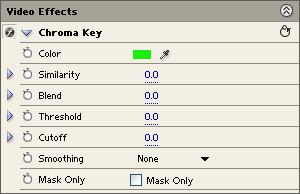
The Chroma Key Effect in Adobe Premiere.  Looks pretty simple, but that apparently simple toolbox holds a wealth of capabilities.  And it only gets more complex from here.
(Image from Media College)


In Final Cut Pro X, aligning the background shot with the foreground shot to make sure what your actor is doing makes sense in front of the fancy background you're going to give her.
(Screen shot from Apple Support)
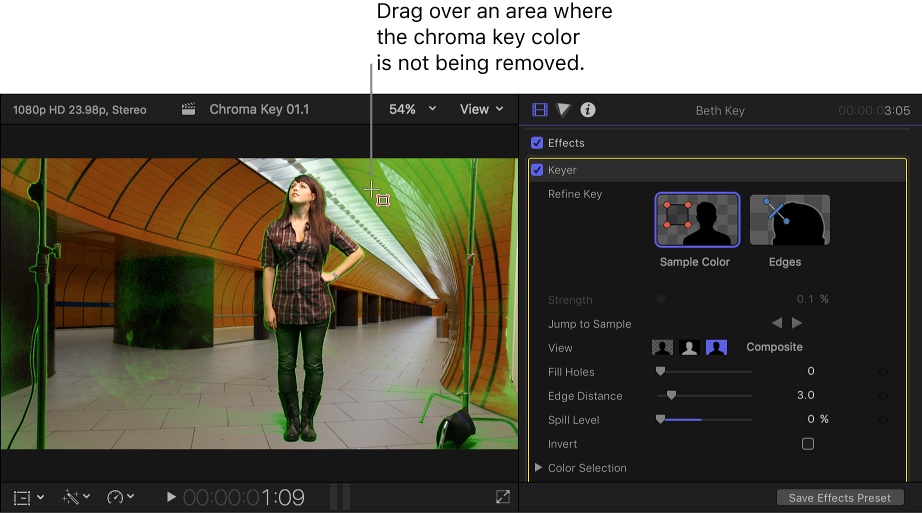


Cleaning up an incompletely masked background in a combined image using Final Cut Pro X.
(Screen shot from Apple Support)

  • So, making the black & white mask and ultimately your combined image can take a lot of work, and it's a bit of an artistic process in itself.
  • That's even more true for TV & movie filming.  In those situations, their cameras are pulling in so much information, and thus generating so much data, they can't do the image combining on a PC. As powerful as our computers are today, they still can't keep up with all that data and do all the on-the-fly processing involved in chroma keying.
  • So TV stations and filmmakers use hardware whose sole purpose is video mixing.  They might use a video mixer (or a vision mixer) which can do all sorts of things, like making transitions such as wipes from one shot to another, or putting together shots from different cameras to make a seamless single take, or adding effects like turning everything sepia-toned to make it look like an old movie.  Among the things a video mixer can do is combine shots & do chroma keying.


Lots of people recommend the Videonix MX-1 or MXPro video mixer for chroma keying.
(Image from Southern Advantage, whose current price is $2,500.  Amazon has some used ones for sale for $700.)


This Snell & Wilcox Kahuna HD/SD would be used by a large studio.  That word Kahuna is there for a reason.
(Image from Media College)

  • For even greater and more sophisticated control of the chroma keying process, like if you're Peter Jackson and you want to make sure your Avatars look totally real in front of their fake alien background, then you would get a piece of hardware whose sole purpose is chroma keying.  You would use one of these if you have lots of other kinds of manipulations you want to do to the film, so you could do your other video mixing while you're doing the the chroma keying separately.  You would also get some really sophisticated color correction, lighting compensation, and edge correction capabilities that a video mixer or some PC software program simply wouldn't have.


The Safire 3 3G/HD/SD chroma key board. Does real-time chroma keying. It's supposedly a favorite among sports broadcasters because it uses algorithms to determine what color to mask out -- making it very good at dealing with complex background colors like grass.
(Image and product from Crystal Vision) 


Well, Jim Bob.  I think that about covers green & blue screens.  Next time you see a movie where the action hero is dangling from a rope from a helicopter, you will be more impressed, not so much with the actor, but with all the work that went into making it look like he really was doing such a damn fool thing.


Sources
Videomaker, How Does Green Screen Work?, and The ChromaKey Genie
Howstuffworks, How Blue Screens Work
Media College, Using Green Screen Footage and Vision Mixer
VirtualStudio.TV, What is Chroma Keying and how do green screens work? 
Technologies for Worship, The Basics of Video Keying
Sign Video, How Chroma Keying Works
Apple Support, Final Cut Pro X: Use chroma keys
Crystal Vision white paper, The Importance of the Chroma Keyer in a Virtual Studio System

Monday, January 27, 2014

Apple #659: Giving Someone "The Finger"

You may recall that in a previous entry, we looked into the origins of the "shame on you" gesture.  Now we have another gesture to explore: giving someone the finger.  Middle, that is.

This one comes as a request from regular Daily Apple reader Majondra who would like to know the origins of "flipping the bird." I suspect this will be another one of those "nobody knows" sorts of things, but I will do my best.  I'll also see how many different ways of describing this gesture I can come up with.


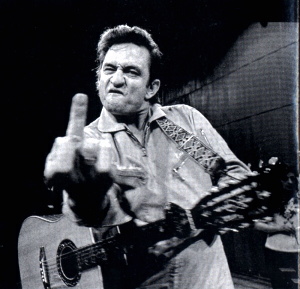
So many images of celebrities giving the finger have clearly been Photoshopped. This one, by gum, has not.
(Photo from Johnny Cash Gives You the Finger)

  • Just to be clear, before I begin, extending the middle finger in the lone, vertical fashion is a concise way to invite the viewer to take a phallic object and insert it in the privatemost part of the viewer's body; to wit, to fuck off.
  • It's the definition!  I had to say it.  
  • Now that we've got that out of the way, let's proceed with the business at hand. Ahem.
  • Many people have hazarded guesses as to when this gesture originated.
  • In 1968, the crew of the USS Pueblo was captured by North Korean forces, and the surviving 82 crewmembers taken as prisoners.  The North Korean military took many pictures of the captive crewmembers and circulated them throughout the country as propaganda. The North Koreans also showed propaganda to the US prisoners, one of which was a film that included a shot of a British man gave the finger to the camera.  Since the North Koreans didn't seem to understand what that gesture meant, one or two the crewmembers from then on gave the finger to the camera every time their picture was taken for propaganda purposes.


One of the North Koreans' photos of some of the crew of the USS Pueblo. Can you spot the bird being flipped?
(Photo from the USS Pueblo Digit Affair)

  • A few months later, Time magazine got hold of one of the photos and in an article explained the true meaning of the Hawaiian Good Luck sign. The North Koreans eventually saw this article, and they subjected the captives to fierce and brutal beatings for a solid week. 
  • After the servicemen did this in a number of photos, the North Koreans asked what it meant.  The servicemen told the North Koreans it was the Hawaiian Good Luck sign.
    • (Even though the ship was in international waters, the North Koreans demanded that the captain of the USS Pueblo apologize.  Eventually he did, but it took a long time before they accepted his apology as sincere, and after 11 months, the North Koreans released the crew The captain of the USS Pueblo eventually apologized to the North Koreans, and the crew was allowed to cross the DMZ and leave.)
  • So when this article was published in Time, is this when the gesture became popular?
  • Nope. It's older than that.
  • In the movie Titanic (always an excellent resource for historical fact -- not), Rose gives Lovejoy the finger.  Is that out of place, or did the the gesture actually originate when the Titanic sank?


Rose hailing Lovejoy
(Screenshot from fanpop!)

  • I will stand mute on whether the gesture in the film is out of place. But the hand signal is in fact older than than the Titanic.
  • In 1886, for a picture of the then-stellar baseball team the Boston Beaneaters and their rivals the New York Giants, Hall of Fame pitcher Charles "Old Hoss" Radbourn extended his middle digit salute for posterity.


Here's the group photo.  The guy in the back left is, um, gesturing in a singular fashion.
(Photo from Wikipedia)


In case you can't see, here's a close-up.
(Photo from SB Nation)

  • So is 1886 when the gesture originated?
  • Nope.
  • Going back 200 years more, a 1644 dictionary of sign language called Chirologica: of the Naturall Language of the Hande by John Bulwer includes the sign for extending the middle finger, and labels it as a "convicium facio", which means "I provoke an argument."  The dictionary defines the tallboy greeting as a "natural expression of scorn and contempt."


Plate from Bulwer's Chirologica, demonstrating the convicium facio.
(Image from Dr. George Pullman's Canons of Rhetoric)

  • So did the gesture originate in the 17th century?
  • Nope. It's older still than that.
  • There's a story going around the internet about the days before the Battle of Agincourt in 1415.  The story goes that the French, expecting to beat the pants off the British, said they would cut the middle finger off all captured English soldiers, thus rendering it impossible for the captured soldiers to fight in the future.  (Because, in anticipating their capture, they were also anticipating their release? or escape?)  But the British routed the French.  The archers, whose bows were made of yew and the practice of using the longbow was supposedly referred to as "plucking the yew," delighted and slap-happy in their victory, waved their middle fingers in triumph at the defeated French and shouted, "See, we plucked yew!" 


A gif made to look like a plate from some book supposedly from 1415 that is demonstrating the entirely mythological "pluck yew" tale.
(Image from Lilolia)

  • Even if this tale were true, which it is not, did the gesture originate sometime in the 1400s?
  • Nope.  It's older even than that.
  • In the Roman empire, the Latin poet Martial, in one of his satirical Epigrams that were published between 86 AD and 103 AD, describes a character who is always healthy and therefore has no need of doctors as extending "the indecent finger" at three doctors.
  • In fact, lots of Romans apparently engaged in the one-fingered salute because many Roman writers of the day referred to the middle finger as the "digitus impudicus," or the shameless or indecent or offensive finger.
  • It was also the practice for the emperor to make his citizens kneel and kiss his hand.  Slightly before Martial's time, dissipated Roman emperor Caligula (emperor from 37 AD to 41 AD) used to make the senators who were his enemies kiss his middle finger -- the suggestion being that he was making them kiss his lower one-eyed emperor, if you get my meaning.


Statue of Caligula. You can practically hear him saying, "Kiss it. Go on, kiss it!"
(Photo from United we stand)

  • Wow, 37 A.D. That's a long time ago. So did the Romans invent the gesture?
  • Nope. It's older even than that.
  • Roman historian Tacitus wrote that German tribesmen flashed the impudent finger at invading Roman soldiers.  So it wasn't just the Romans who did it. 
  • It may be that the Romans learned it from the Germans, but it's more likely that they grew up knowing it, as pretty much everyone has, since the oldest known use of the gesture dates from at least 400 years earlier, in Greece.


Greek philosopher Diogenes (412 BCE - 323 BCE), who rejected all sorts of niceties of society, lived in a jar or tube, spat on people, masturbated in public, and was a fan of giving people the finger.
(Painting of Diogenes by John William Waterhouse, from Wikipedia)

  • In Aristophanes' satirical play The Clouds (419 BC), one of the characters gives the finger to Socrates.  (I mean, how many of us would like to give the finger to Socrates?)
  • Here is Socrates being all smarty-pants about poetic meter, and his interlocutor's reply follows:
SOCRATES: Well, to begin with,
they’ll make you elegant in company—
and you’ll recognize the different rhythms,
the enoplian and the dactylic,
which is like a digit.
STREPSIADES: Like a digit!
By god, that’s something I do know!
SOCRATES: Then tell me.
STREPSIADES: When I was a lad a digit meant this!
[Strepsiades sticks his middle finger straight up under Socrates’ nose]
  • Well, that is one translation.  Here is another, a bit saltier:
SOCRATES: A detailed knowledge of rhythm enables you to socialize effectively in polite company and seem refined and cultured. You'll know about martial modes and dactylic meter . . .

[Strepsiades looks confused.]

 Beating the rhythm with your fingers!

STREPSIADES: I know how to beat with my fingers, by Zeus!

SOCRATES: You do? Tell me about it.

STREPSIADES: Well when I was a young lad it was this . . .

[Strepsiades grabs and shuffles his phallus.]

SOCRATES: Gods! You are nothing but a village idiot!
  • So apparently, depending on the translation, Strepsiades either flips Socrates the bird, or goes straight for the source, so to speak.
  • The gesture may be older even than the Greeks.


(Photo from somewhere on StrangeZoo, but sourced from Cracked)


P.S. Where is Tall Man?


Sources
The Straight Dope, What's the origin of "the finger"?
Daniel Nasaw, BBC News Magazine, When did the middle finger become offensive? February 6, 2012
USS Pueblo
The Finger, A (Short) History of the Longest Finger
Snopes, Pluck Yew
Brian Palmer, Slate, Cluck You: Why do we call giving someone the finger "flipping the bird"?
English Language & Usage, What's the origin of "flipping the bird"?
Mental Floss, Why Is the Middle Finger Offensive?
English Language & Usage, What's the origin of "flipping the bird"?
Aristophanes 1: Clouds, Wasps, Birds, translated by Peter Meineck, p 50

Tuesday, January 21, 2014

Apple #658: A Few Facts about Butter

I've been reading about butter lately.  Not margarine, actual butter.  Here are some things I have learned:


Butter. Smooth, creamy, a hint of salt.  But what color should it be?  Yellow?  Cream?  Ivory?
(Photo from 5 Degrees of Inspiration)

  • Butter is yellow because of the grass that cows eat.
  • Grass contains carotenoids--pigments that are present in plants--which are yellow.  (You might remember I mentioned these in the entry about how leaves change color.)
  • Here's the process:
    • The cow eats grass, and so therefore also eats carotenoids.  
    • When the cow is milked, the carotenoids from the grass go right along into the milk.  
    • When the milk gets churned, it separates into fat solids and buttermilk.  Since the yellow-pigment carotenoids are fat-soluble (which means they cling to fat), more of those go with the fat solids than the buttermilk.  
    • The buttermilk is strained off.  
    • The fat solids that are rich with the yellow pigment get shaped into butter.  Which is yellow.


Milk that's been churned (or that's gone through about 5 minutes in the food processor) and that has separated into buttermilk and fat solids, which are yellow.  The fat solids are what becomes butter.
(Photo and instructions for how to make your own butter with a food processor from Food Renegade)


  • True, make-it-yourself butter will vary in shades of yellow from one batch to the next.  The amount of yellow depends on all sorts of factors such as
    • What type of grass/silage/hay/cereal the cows have eaten, or what time of year it is when they're milked. If the cows have eaten dried grasses during the winter, their milk will be paler in color.
    • The breed of cow -- how much of the pigment passes into the milk varies by type of cow (Guernsey cows produce a golden yellow milk fat, while Holstein cows produce white cream)
    • Even within a single breed, from which cows the milk has been collected.  
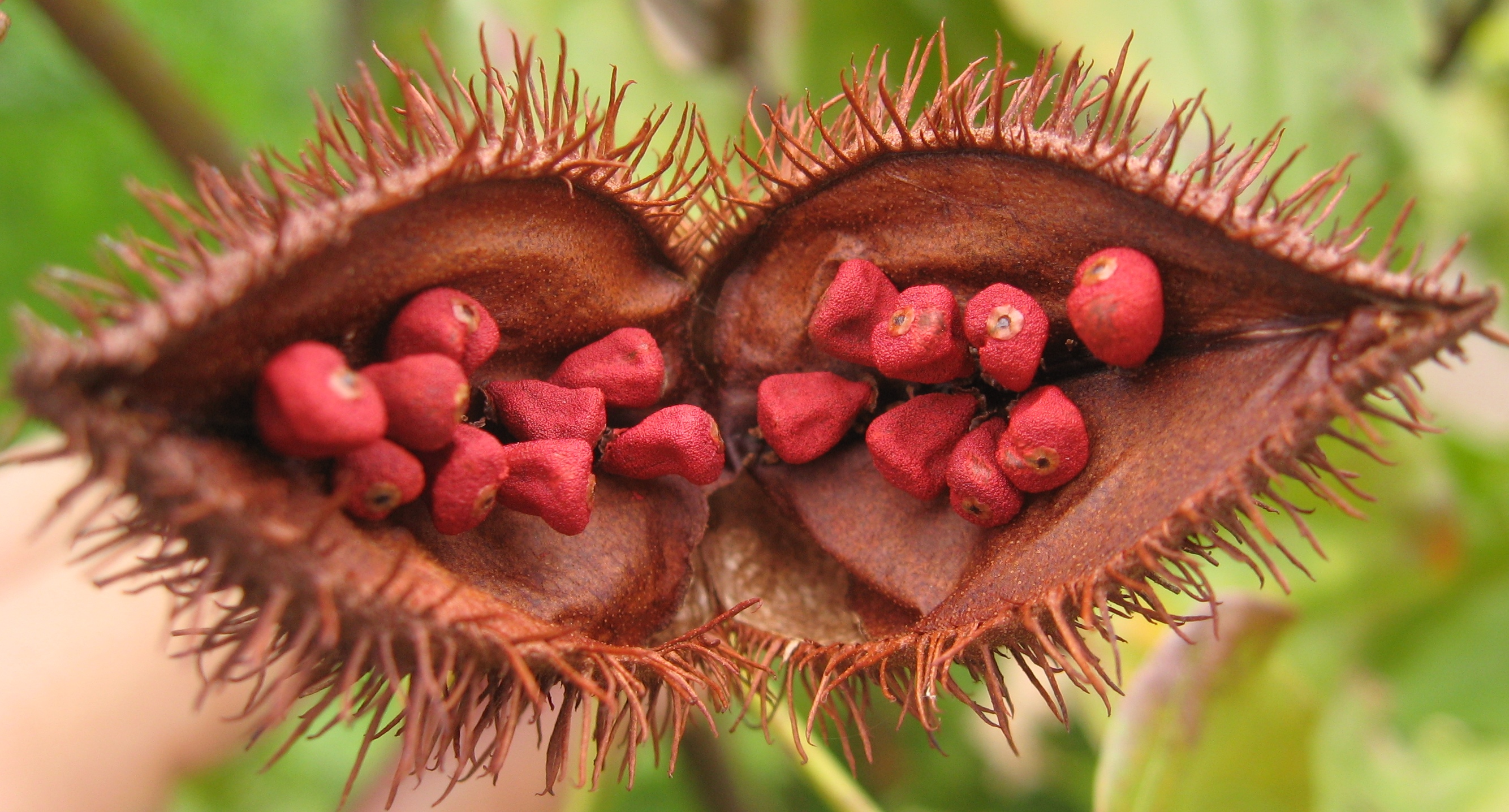
  • Many commercially produced butters have additional yellow coloring from annatto (a seed with lots of carotenoids) or carotene (often derived from marigolds, essentially carotenoids) to make the color of the butter uniform, and also to give butter the yellow color that people expect it to have.

(By the way, this is what annatto is. Sorry for the scary-looking picture, but that's how it grows.)

Seed pods of the achiote tree, which grows in South America
(Photo from Wikipedia)


The seeds are harvested and ground up, and the powder is then used to make an oil that will turn food yellow or orange very easily.
(Image from Karma-Free Cooking)

  • Back in the way-back day, before government regulations outlawed such things (hey! regulations can be helpful!) people used to sell "adulterated butter" -- butter which was made with less butterfat and substituting vegetable oils or tallow or some other kind of cheaper fat, but they'd sell it for the same price as regular butter.  Or they'd take butter that had turned rancid, boil it, add some fresh milk to it, churn it, and sell it like it was fresh.
  • Since people assumed that butter that is less yellow has less fat (not necessarily true, but it's an assumption people made), the bad-butter-sellers would disguise their bad butter by adding yellow coloring.  But the things they used to dye the butter yellow were pretty horrible, such as coal tar or coal tar-derivatives, or copper, which is poisonous.


Or should butter be more yellow, like this?
(Photo from The Gluten Doctors)

  • (By the way, adulterated butter is still sometimes an issue.  Not butter with coal tar or copper, but butter that doesn't have the required amount of butterfat.  Regulators occasionally still have to crack down on bad-butter-sellers every once in a while, for substituting cheaper vegetable oils for butter fat and selling it at a high-quality-butter price.  Acceptable butter should be about 80% butter and 15% water.)
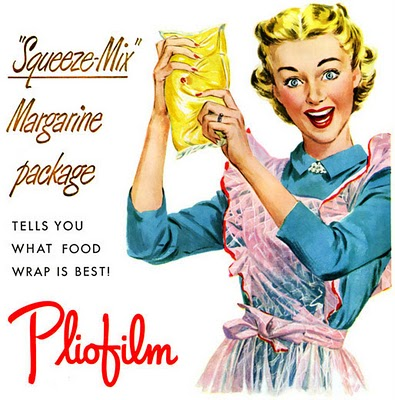
  • When margarine was widely produced during World War II due to rationing, people were suspicious of it because it didn't look yellow like butter.  So margarine manufacturers started including packets of yellow powder that you would mix with the margarine to make it yellow like butter.  But it was a saturated, super-yellow color.
 
Ad for a WWII-era margarine's "Color-Kwik bag" of yellow pigment
(Image from The Society Pages)


Here's another margarine ad, this one with the E-Z Color Pak.  When they spell it funny, you know it's kwality.
(Image from Ancestors in Aprons)


  • But people got used to that.  So when margarine eventually became more popular than butter, then people thought the super-saturated yellow of margarine was what butter ought to look like.  So when people went back to buying butter, which had a paler yellow or almost creamy color, they thought, hey, there's something wrong with this butter, it's not yellow like it should be.  
  • So now butter manufacturers have started to add more dye to color the butter to make it look like margarine.  Today, though, they use annatto or carotene -- neither of which is toxic.


Food Renegade's homemade butter -- made from raw cream that came from grass-fed cows.  The yellow is from the grass, not from adding added coloring.  But if she made another batch of butter using a different type of cream, probably the color would have turned out slightly different.
(Photo from Food Renegade)


Here's the best part about butter, how it melts on things like this muffin, and makes things all warm and melty and creamy and mmmm.
(Photo from Wikimedia)


Sources
Doug & Linda's Dairy Antique Site, Other Dairy Antiques
Wikipedia (German) Butter
Dairy Farmers of Canada, Butter Facts & Fallacies The Society Pages, The Politics of Yellow: Butter vs. Margarine
Kendra Smith-Howard, Pure and Modern Milk: An Environmental History Since 1900, page 60ff.
The Nineteenth Century and After, vol 62, 1907, page 413
Anthony S. Wohl, Adulteration and Contamination of Food in Victorian England

Sunday, January 12, 2014

Apple #657: Shame on You Gesture

Regular Daily Apple reader John of Gaunt wants to know where the "shame on you" gesture came from.  You know the one, where you point one finger and scrape the forefinger of the other hand down the top of it over and over.


We used to say "tsk tsk" while doing this, or "naughty, naughty."  It was usually a way one kid told another in a sing-song sort of way, "Uh-oh, you're about to get in Troub-le."

I haven't thought of this in YEARS.  John of Gaunt says he hasn't either, but it came up in conversation and nobody knew where the gesture had come from. It seems to be something that kids do, but adults generally don't.  Unless they really want to infuriate or tease somebody.

So where did it come from?  Why does this particular gesture mean this particular thing?


  • The short answer is, nobody knows.
  • This gesture and its accompanying meaning is strictly a North American thing.  Try this in some other part of the world, and nobody will know what the heck you're doing. 


"Shame, shame" should probably have an "I don't really mean it" expression accompanying the gesture to show you're teasing. Otherwise you could really tick someone off.
(Photo from SPOAG - Society for the Preservation of Anachronistic Gesture)

  • Many ideas have been proposed about the origin of this gesture.  Ideas range from the plausible to the odd to the sort of thing that makes you think, whoever came up with that explanation obviously has weird psychological issues that I don't even want to get into.
  • Here are some of those ideas: 
    • It mimics an adult slapping a hand on a child's wrist to correct misbehavior.
    • It means, "You are like this dry skin I am wiping from my finger. Take that!" [wipe wipe]. Perhaps whoever came up with this could use some hand lotion?
    • The motion resembles wiping cooties off oneself and onto another person.  Grade school cooties, of course.
    • The pointing draws attention to the wrong-doer, and the rubbing of the finger represents corporal punishment, meaning the wrong-doer should be hit for what he or she just did.
    • The motion resembles friction, like sawing, which in turn suggests that the wrong-doer ought to have a finger sawn off for what he or she just did. yikes!
    • The motion resembles friction, reminiscent of rubbing 2 sticks together to start a fire, which in turn reminds someone of witchcraft trials (a bit of a leap there), so perhaps it's meant to suggest you should be burned for what you just did.
    • The motion resembles a carrot being peeled.  Why that would be relevant, the person wasn't sure, except perhaps it might suggest you ought to peel the "dirty" parts of yourself away. Egad.
    • The motion resembles 2 knives being sharpened against each other.  But why that would be relevant, the person has no idea. I think this person needs 2 of their mental knives sharpened.
    • The position of the fingers is similar to that of a cross, so the motion therefore resembles breaking a crucifix. The suggestion is that in making this gesture, it is similar to holding up your two fingers crossed to ward off a demon. (Except this gesture includes motion, so it seems the meaning of this gesture should be different, but how it's different, the person whose idea this is doesn't explain.)


Making the shape of the cross with your fingers.  This photo is a bit blurry, but it was the only non-stock photo of this gesture that I could find.  You would think, with the number of times that people have done this in horror movies, that pictures of this would be everywhere.  Nope. Everything is of crossing your fingers.  Not the same thing. And in my opinion, making the shape of a cross and rubbing your finger over the top of the other in a "shame, shame" gesture are also not the same thing.
(Photo from Freethinker's Corner)

  • If I have to choose one meaning, I think the first one sounds the most likely, that it's mimicking an adult slapping away the hand of the misbehaving child.
  • But that's just my guess, nothing authoritative at all.  So I've not been much help in answering John of Gaunt's question.  But I do have one other somewhat substantive thing to add.
  • If I had to say who makes the "shame, shame" gesture the most often, it would be in this order:
    • one child to another -- most often
    • an adult to a child -- maybe once or twice
    • one adult to another -- hardly ever
  • If the gesture is meant to mimic an adult slapping away the had of a child, then it's sort of ironic, isn't it, that the people who make the gesture the most often are children doing it to each other.
  • The reason adults hardly ever make this gesture, whether to a child or to each other, is probably because the gesture is, at its heart, pointing.
  • As I'm sure you know, pointing at someone is inherently rude.  Pointing at a thing you want might be the first method of communication that we learn as infants, and it is an important tool of the pre-verbal.  But when you have words, pointing at a person is a very different thing.  It's really not something you want to do unless you're itching for a fight.
"At close quarters, pointing at another human being is almost universally considered an aggressive, hostile, or unfriendly act. Because it focuses so much attention upon the recipient, close-quarters pointing is frowned upon throughout the world." [quoted from a page no longer accessible online]

Unpleasant to be pointed at, isn't it?  After about 3 seconds of looking at this, you want to smack that finger away, don't you?
(Photo from Flickr via International Business Times)


  • If pointing at someone is likely to start a fight, pointing plus saying, "Shame, shame," at another adult would be so rude, you'd be likely to get your face bashed in.  
  • So I imagine the reason we adults don't do this anymore is because at some point (pun), we learned not to.  We've outgrown it.

Tuesday, January 7, 2014

Apple #656: Different Kinds of Yeast

I've had a question!  Intrepid Apple reader Melliflua wants to know what is meant by "fast-acting" yeast.

I don't have any context for this question -- is Melliflua making bread and wants to know whether one kind of yeast that doesn't say "fast-acting" will work just as well? -- only that she wonders what it is.  She doesn't want a whole Apple per se, just wondering.

So, in the spirit of doing entries more often, but keeping them shorter, I won't get into the long-standing mystery that is yeast.  I'll just give you the 3 varieties that are typically sold in stores today and tell you how they're different.


Yeast -- but what kind?
(Photo from Red Star Yeast)

Fresh or Wet Yeast

  • Comes in a solid, compressed form like a cake
  • Preferred by commercial bakers
  • Will only last a couple days refrigerated
  • Can last up to 3 months in the freezer.  Defrost when ready to bake & use a little extra
  • 1 cube fresh yeast = 1 envelope of active dry yeast or 1-1/2 tsp to 2 tsp instant yeast
  • If the recipe calls for dry yeast and you have fresh, use 2x the amount


Fresh yeast is sold in compressed blocks like this. Looks like tofu or tuna or anyway not so appetizing. If you're a commercial baker or especially Martha-Stewart-particular, you may go with this type.
(Photo from Big Black Dogs)


Active Dry Yeast

  • Granular, similar to the consistency of cornmeal
  • Store in a cool, dry place until the "best before" day on the package. Outdated yeast won't rise.
  • Needs to be dissolved in warm water to get the yeast going.
  • Adding some sugar to feed the yeast -- honey or granulated sugar -- will speed things along. But if the recipe doesn't tell you to do this, it's probably best not to.
  • That said, adding sugar is a way to test or "proof" the yeast to make sure it's still active. Most packaged yeasts with a "best buy" date  don't need to be proofed; you can trust the date.
  • After adding water & maybe sugar, let stand 5-10 minutes until bubbles form and it expands to about 2x its size
  • Will provide 2 rises -- once after kneading, and again after shaping
  • 1 envelope active dry = 2-1/4 tsp = 1/4 ounce
  • If the recipe calls for fresh yeast and you have active dry, use 1/2 the amount
  • If a recipe calls for Rapid Rise, and you have active dry, don't use it; get Rapid Rise instead.

Active dry yeast, out of the package

A typical envelope of Active dry yeast
(Photo from Cheese and Toast)


Here's a good depiction of the difference between Active Dry and Instant/Fast-Acting/Rapid Rise/Bread Machine Yeast
(Photo from Angel Yeast)


Fast-Acting or Instant or Rapid Rise or Bread Machine Yeast

  • All these terms mean the same thing.
  • Slightly different strain of yeast than Active dry
  • Also granular, but particles are very fine
  • Since the particles are so small, there's no need to dissolve the yeast in warm water first. You  can add it directly to your recipe.  Hence the "instant" or "fast-acting" or "rapid rise" etc.
  • Store in a cool, dry place until the "best before" day on the package. Outdated yeast won't rise.
  • Will provide 2 rises -- once after kneading, and again after shaping
  • 1 envelope instant/fast-acting/rapid rise = 2 1/4 tsp = 1/4 ounce
  • If the recipe calls for fresh yeast and you have this kind, use 1/4 the amount
  • If a recipe calls for Active Dry and you have Rapid Rise, use slightly more and cut the rise time in half.

These are all the same type of yeast:

(Photo from What Is Cooking Now)


(Photo from The Kitchn [not a typo])


(Photo from Baking Ways)


How's that, Melliflua?  Did I answer your question?

Sources
Nigella Lawson's Kitchen Queries, Different Kinds of Yeast
What's Cooking America, How to Use Yeast in Bread Making)

Monday, January 6, 2014

Apple #655: How the Grinch Stole Christmas

OK, so I planned to do this entry before Christmas, but then there were cookies, and there was gift shopping, and then there had to be packing, and the Daily Apple just didn't happen.  Then the vacation happened, and it seemed like the time for the Grinch had passed.  But now I'm realizing that if I don't do the Grinch entry as I'd planned, I won't get back in the Daily Apple swing of things again.

So I now bring you, many days after Christmas (but wouldn't it be nice if the Christmas spirit lasted longer than just one day?) the facts behind How the Grinch Stole Christmas -- the TV special.  Ta-da!


Maybe you're all like this: Christmas is over. So what. Big deal. Well, let's see what I come up with here.
(Image from Animated Views)


  • The guy who sings "You're a Mean One, Mr. Grinch" is Tony the Tiger.


Not only does Tony the Tiger say that Frosted Flakes are grrrrrreat, he also sings things like, "Your brain is full of spiders, and "You have termites in your smile," and "You're a nasty wasty skunk."
(Kellogg's Tony the Tiger image sourced from Delish)

  • Yes, Boris Karloff narrated the special, but the guy singing the Grinch song was the man who did the voice of Tony the Tiger (a.k.a. Thurl Ravenscroft).  
  • The TV network did not credit Ravenscroft on screen, so Dr. Seuss (a.k.a. Theodore Geisel) wrote a column to be distributed to all the major newspapers making sure to give Tony the Tiger, er, Mr. Ravenscroft the credit.


From TV Guide's "close-up" mini-piece on the first airing of the Grinch in December 1966.  I don't know if you can read it in this incarnation, but Thurl Ravenscroft is given credit here. (Click here for a larger version of the TV Guide Close-Up)
(Photo from Tulgey Wood)

  • Boris Karloff, the voice of the Grinch, said in an interview that "his chief interests are flower gardens, poetry, and the stage."  Think of that the next time you see him in any one of his numerous scary movies, such as Frankenstein, Arsenic & Old Lace, Scarface, or The Ghost in the Invisible Bikini.
  • Boris Karloff's grandmother, by the way, was the sister of Anna who was memorialized in Anna and the King of Siam, a.k.a. The King and I.


Anna and the King. She's wondering, "Do you suppose my great-nephew will turn out to be a Grinch?" The king considers the matter, too.
(Screen shot from The King & I from The Anchor)


OK, now here's Boris Karloff for real.  From L to R, Seuss, Karloff, and animator Chuck Jones looking at storyboards for the Grinch.
(Photo from chained and perfumed)

  • Karloff was born November 23, 1887.  When the Grinch first aired on December 18, 1966, he was a month shy of his 79th birthday.
  • The book, as you may recall, was done in 2-color.  That means black & white with the occasional use of another color, which in this case was red.  The Grinch wasn't green until he got animated for TV.

One of the pages from the book.  No Grinchy green.  Only black, white, and touches of Christmas red.
(Image from DownloadCheapApp)


He looks much meaner here, don't you think? Such a Grinchy grin.
(Screenshot from Christmas Specials Wiki)

  • The song, "You're a Mean One, Mr. Grinch," is so much a part of the Grinchlore, it seems almost unthinkable that it didn't exist right along with the book.  But nope.  Like the Grinchy green, the song is another thing that wasn't in the book.  Not at all.  
  • Who came up with such Grinchy genius?  Why, the music teacher from "Fame," of course.


Who would have thought that such a nice, friendly, supportive, caring teacher like Mr. Shorofsky could have written the song about the Grinch?
(Image from Mark Perkins on Flickr)

  • In real life, Albert Hague (a.k.a. Benjamin Shorofsky) composed all sorts of songs, including the scores of a couple musicals, most notably "Redhead," which won a Tony in 1979.
  • Also in real life, Hague was born in Berlin in 1920, and he left Germany to escape the Nazis.  Anybody who grows up with the Nazis probably knows a bit about Grinches.


Ooh, he's Grinchy, isn't he?
(Image from Animated Views)

  • Following Hague's numerous successes with songs and musicals in the 60's, his agent called and told him Ted Geisel (a.k.a. Dr. Seuss) was looking for someone to write a song to go along with his Grinch book.  So Hague put something together, and then he told his agent Seuss should come to his house (by this time, Hague had left Cincinnati where he'd settled after leaving Germany, and moved to California).  
  • No, Hague's agent said, Seuss is too much of a big cheese.  You go to him.  "No," Hague said. "Don't make him come to my house because I'm more important; make him come here because I have the better piano." Long story short, Seuss went to Hague's house.
  • Hague played the song he'd written for Suess, and when he's finished singing & playing the song, "Seuss looked up and said, 'Anyone who slides an octave on the word Grinch gets the job.'"
  • According to IMDb, Hague also collaborated withe Seuss in writing all the other songs in the TV special:
    • Fahoo Foraze
    • Trim Up the Tree
    • Welcome Christmas


This moment creeps me out to no end.
(Screenshot from Jenny in Ottawa)

  • Oh, and the voice of Cindy Lou Who?  Why, that's none other than June Foray, a.k.a. the voice of Rocky from Rocky & Bullwinkle.
  • She was also Natasha from the same cartoon, Wheezy & Lena Hyena from Who Framed Roger Rabbit, Jokey Smurf, and often, Granny in the post-Mel Blanc Bugs Bunny shows, to name a few others.

Here's what she has to say about the voices she's done.  She mentions doing the Grinch "for Chuck" -- she means Chuck Jones, animator.


Why, Santy Claus, why?
(Screenshot from Seuss-ipedia)

  • So, now that you know all these little-known facts about our favorite Grinch, when you watch the special when it airs on TV -- er, next Christmas season -- you can say to your friends and family, "That guy singing? That's Tony the Tiger!  The Grinch's great aunt is Anna from The King and I!  Cindy Lou Who is also Rocky from Rocky & Bullwinkle" and astound your friends. Or bore the heck out of your children.
  • P.S. I couldn't let you go without a Christmas wish now, could I?

Welcome Christmas, fahoo ramus
Welcome Christmas, dahoo damus
Christmas Day will always be
Just so long as we have we

Welcome Christmas, while we stand
Heart to heart and hand in hand.


(Screenshot from Dad Is the New Mom)


Merry Christmas, everyone!

Sources
ABE Books, Top 10 Dr. Seuss facts you may not know
Chuck Jones, Tag Archives: Boris Karloff
Tulgey Wood, Karloff the Uncanny, December 18, 2011
IMDb, Boris Karloff, June Foray
Deborah Rieselman, UC Magazine, UC grad Al Hague composes 'How the Grinch Stole Christmas"
Lisa See, Fame Forever, Before Fame Made Albert Hague Famous, He Had a Colorful Career as a Musician
All Music, Albert Hague Artist Biography